
CANADA'S POPULATION GROWTH SLOWS, JOBS DIP AND A “CONTROLLED INCREASE” IS ON THE TABLE
CANADA'S POPULATION GROWTH SLOWS, JOBS DIP AND A “CONTROLLED INCREASE” IS ON THE TABLE
Three stories landed within weeks of each other: a weaker jobs report, a major revision to Canada's population numbers, and comments from the Prime Minister about when population growth might resume. Read together, they point to a country adjusting to much lower immigration levels, and they matter to anyone planning a move, a work permit extension or a permanent residence application. Here is what the official data shows, and what is opinion.
A weaker August for jobs
Statistics Canada's Labour Force Survey for August showed employment falling by about 41,700 jobs, to 21,173,100. The labour force also shrank, by roughly 36,800 people. The unemployment rate held at 6.4%, and the employment rate edged down from 60.9% to 60.8%. Compared with a year earlier, employment was still up by about 216,500. Among young Canadians the picture is harder: the youth unemployment rate was 12.9%.
Labour economist Mikal Skuterud, in commentary associated with the C.D. Howe Institute, argued that the decline reflects a shrinking supply of workers rather than collapsing demand, and noted that the monthly change is small enough that it cannot be statistically distinguished from zero. That is his own analysis, but other economists have reached similar conclusions. Analysts at RBC pointed to aging and retirements alongside slower immigration, and TD economists described the report as “far from a shock” that reflects a “sag in the labour force population.”
Takeaway: fewer jobs does not necessarily mean fewer opportunities for qualified workers. When the number of people available to work is falling, employers in sectors facing shortages can still struggle to hire.
Population estimates were revised
On September 23, Statistics Canada released updated population estimates. As of July 1, 2026, Canada's population was 41,798,407, up 189,425 (0.5%) from a year earlier. That is the slowest annual growth in absolute terms since 1944/45, and in percentage terms since 1915/16.
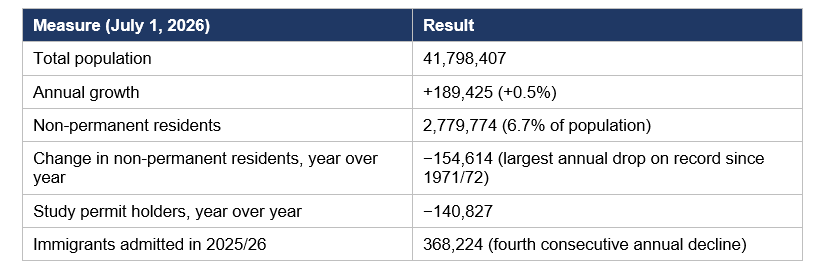
Why were the numbers revised? Statistics Canada explained that it introduced two new adjustments to its estimates of non-permanent residents: one using exit data from the Canada Border Services Agency, and one accounting for permit holders on maintained status who are waiting for a decision on their extension. It also said newer IRCC data contained substantially more extension records, which made this update larger than usual, and it revised figures back to July 1, 2021. As a result, 2025 population growth now stands at about 280,810, rather than the first-ever annual decline suggested by earlier preliminary estimates. RBC estimated that roughly 80% of the revision of about 301,000 comes from the new method for non-permanent residents.
It is worth being clear about what this means. Maintained status is a lawful situation: a person who applies to extend their permit before it expires can generally remain in Canada under the same conditions while IRCC decides. The revision shows that more people were in this position than earlier data captured. It is a statistical correction, not evidence of unlawful presence.
The Prime Minister's comments on future growth
In an interview with The New York Times on September 23, reported by The Canadian Press, Prime Minister Mark Carney said: “Now the question starts to become, when do we resume some controlled increase in the population, which is the nature of Canada… So that will happen, and we just want to make sure that we've got it under control.”
He cited declines of about 60% in student arrivals, 50% in temporary foreign workers and roughly one-third in asylum claims, and said limited population growth is weighing on the economy. No timeline was given. The government's stated goal is for temporary residents to make up less than 5% of the population by the end of 2027.
The next important marker is the 2027–2029 Immigration Levels Plan, which the government is required by law to table by November 1. The previous federal budget set temporary resident arrivals at 385,000 for 2026 and 370,000 for 2027 and 2028, with 380,000 permanent residents each year from 2026 to 2028. Some think tanks, including the C.D. Howe Institute, have urged continued reductions, while others argue the economy needs more workers. The decision belongs to government, and Levels Plan numbers can change.
What this could mean for newcomers
• Do not wait on a signal. A “controlled increase” has no date. Anyone eligible today should not assume conditions will loosen soon.
• Permanent residence remains the stable goal. Temporary status is under the most pressure, so planning a transition to permanent residence early matters.
• Keep status in order. If your permit is expiring, apply to extend before the expiry date to preserve maintained status.
• Watch the Levels Plan. The November announcement will show where the government intends to place its priorities.
• Targeted pathways may carry more weight. Category-based Express Entry draws and provincial programs continue to select candidates in specific fields.
Not sure how these changes affect your plans?
Population targets, labour needs and Levels Plan numbers shape which programs are open and which candidates are selected. Global Opportunities will assess your situation, explain how current policy affects your timeline and help you choose the pathway with the best chance of success. Contact us today to book an assessment with Global Opportunities and find out which path fits your situation.
Sources: Statistics Canada, The Daily (September 23, 2026) and Labour Force Survey, August 2026 (as published by provincial government summary); Government of Canada, Immigration Levels Plan and Budget information; The Canadian Press (via CTV News, CP24, BNN Bloomberg) and CBC News reporting. Prime Minister's remarks are as reported by The Canadian Press. Commentary by economists is attributed and represents their own analysis. This article is for general information only and is not legal advice.