
EXPRESS ENTRY TRADES DRAW: CRS CUT-OFF DROPS TO 476 FOR SKILLED TRADES CANDIDATES

SASKATCHEWAN SINP 2026: 76% OF NOMINATIONS USED AND PROCESSING TIMES AT TWO WEEKS
Saskatchewan has updated the numbers behind its Saskatchewan Immigrant Nominee Program (SINP), and they offer a useful snapshot for anyone weighing the province as a path to permanent residence. Three of every four nominations available for 2026 have now been used, and most applicants in the main streams are seeing quick turnarounds. Here is what the province is reporting and what it could mean for your own plans.
Where the 2026 nominations stand
According to the Government of Saskatchewan, the SINP has used 4,023 of its 5,261 nominations for 2026, or 76%. The province started the year with an allocation of 4,761 and has since received an increase, which brings the current total to 5,261. The province notes that these figures are updated quarterly and do not include applications that are still in process.

Why the capped sectors matter
Saskatchewan limits the share of nominations that can go to certain occupations in a few high-volume sectors: trucking, accommodations, food services and retail trade. These sectors are capped at a maximum of 25% of the total allocation, and they are open only to workers who have six months or less remaining on their work permit. The cap itself was raised from 1,190 to 1,315 nominations during the year, and the province has said further mid-year adjustments are possible.
At 88% used, this is the part of the program with the least room left. Final intakes for the year were held in September, and a planned intake for November 2 was cancelled. In practical terms, a worker in one of these sectors who was counting on a late-year opening should speak with a professional soon about alternatives.
Priority sectors keep the door wider. Saskatchewan gives focus to health care, agriculture, skilled trades, mining, manufacturing, energy and technology. Candidates with experience in these fields generally have more room within the allocation than those in the capped sectors.
Processing times for the third quarter
The province also published its processing times for July 1 to September 30, 2026. They are based on the time it takes to finalize 80% of applications, and for most streams they are short:
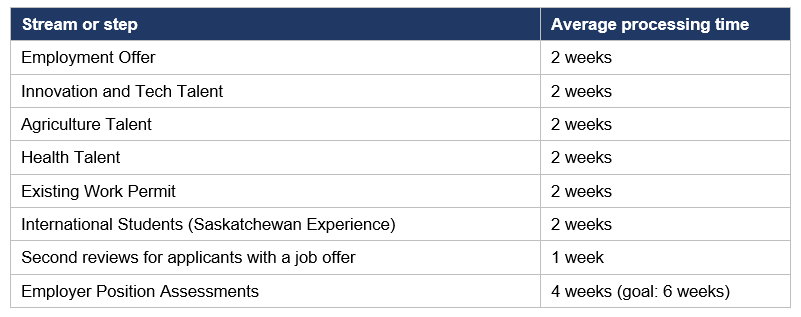
For the International Skilled Worker and Saskatchewan Experience categories, the province's stated processing goal is 16 weeks. Keep in mind that a SINP nomination is only one step. After it, a candidate still applies to Immigration, Refugees and Citizenship Canada (IRCC) for permanent residence, and that stage has its own timelines.
What this means for you
• Strong momentum in priority sectors. If your occupation falls in health, agriculture, skilled trades, mining, manufacturing, energy or technology, the numbers suggest continued activity.
• Capped sectors are tight. With 88% already used, timing and eligibility details matter more than ever, including how much time remains on your work permit.
• Document quality drives speed. Short processing times apply to complete files. An application with gaps or inconsistencies can take much longer, and errors can affect future applications.
• Work permit dates are critical. Because the capped sectors are limited to workers with six months or less left on their permit, planning around the expiry date is essential.
Every profile is different, and a program that works well for one candidate may not suit another. The right choice depends on your occupation, language results, work history, family situation and how much time you have in Canada.
Is Saskatchewan the right province for your next step?
Programs like the SINP reward candidates who prepare early and choose the right stream. Global Opportunities will review your profile, compare Saskatchewan with other federal and provincial options, and explain the risks, costs and realistic timelines before you commit to anything. Contact us today to book an assessment with Global Opportunities and find out which path fits your situation.