
Canadian Citizenship: A Complete Guide to Requirements, the Test and the Ceremony
Becoming a Canadian citizen is the last step for many people who move to Canada: it comes after years as a permanent resident, and it gives you a Canadian passport and the right to vote. This guide explains, in plain English and with a link to the official page for every point, who can apply, how many days you need in Canada and how to count them, the tax and language requirements, the citizenship test and the Discover Canada study guide, applying for children, citizenship by descent and the changes from Bill C-3, dual citizenship, the oath and ceremony, what happens afterwards, why applications are returned or refused, and how to avoid scams.
About our sources: This guide summarises what official sources (the Government of Canada, provincial and territorial governments and the other organisations we link to) said when we checked them in November 2026. We link every source so you can read it yourself. Rules, rates and requirements change, sometimes without notice, and the official page is the one that counts. This is general information, not legal, tax or immigration advice. Global Opportunities is not responsible for how this information is interpreted or for changes made after it was written.
We wrote this guide for permanent residents thinking about citizenship, for people still planning their move, and for families with children or with a Canadian parent born abroad. Immigration, Refugees and Citizenship Canada (IRCC) decides citizenship applications, and its pages on canada.ca are the ones that count. We do not make the rules; we report what IRCC's pages said in November 2026 and link them so you can confirm them yourself.
One thing to keep in mind from the start: meeting the requirements described here is the minimum to apply. It does not mean an application will be approved. IRCC reviews each case and makes the decision.

Watch our recorded seminars and lives →
In this guide
Canadian citizenship at a glance
Who can apply for Canadian citizenship?
Canadian citizenship requirements: the full list
How long do you need to live in Canada to become a citizen?
How to count your days: the official Physical Presence Calculator
Do you need to file taxes to become a Canadian citizen?
Do you need a language test for Canadian citizenship?
What is on the Canadian citizenship test, and how do you study?
Age-related exemptions, accommodations and waivers
Situations that prevent you from becoming a citizen
How to apply for Canadian citizenship, step by step
Documents for an adult citizenship application
What happens after you apply
Applying for Canadian citizenship for a child
Citizenship by descent and the changes from Bill C-3
Proof of citizenship: the citizenship certificate
Does Canada allow dual citizenship?
The citizenship ceremony and the oath
After you become a citizen: passport, voting and more
Common reasons citizenship applications are returned or refused
Scams and authorized representatives
Citizenship fees and processing times: where to check them
Frequently asked questions
Related guides
How Global Opportunities can help
Sources
Canadian citizenship at a glance
If you only read one section, read this one. Each point is explained in detail further down, with its official source.
Who can apply as an adult: according to IRCC's citizenship eligibility page, permanent residents who meet the requirements. Visitors, students and temporary workers cannot apply for citizenship directly; they first need permanent resident status.
Time in Canada: according to IRCC, adults need at least 1,095 days (3 years) of physical presence in Canada during the 5 years before the date they sign their application (eligibility page).
Counting days: IRCC asks applicants to use its official Physical Presence Calculator for paper applications; online applicants use the calculator inside their online account (physical presence page).
Taxes: IRCC says you may need to have filed taxes in Canada for at least 3 of the 5 years before you apply (eligibility page).
Language: according to IRCC, applicants aged 18 to 54 on the day they sign must show they can speak and listen in English or French at Canadian Language Benchmarks (CLB) or Niveaux de compétence linguistique canadiens (NCLC) level 4 or higher (language proof page).
Test: IRCC explains that applicants aged 18 to 54 on the day they sign take a knowledge test about Canada, based on the study guide Discover Canada (how the test works).
Oath: the last step for most applicants is taking the oath of citizenship at a ceremony, in person or by video (citizenship ceremony).
Born abroad to a Canadian parent: you may already be a citizen. The rules changed with Bill C-3, which IRCC says took effect on December 15, 2025 (changes to citizenship rules).
Requirements as published by IRCC on canada.ca, as of November 2026. They may have changed by the time you read this: check the linked pages before you rely on them. Meeting the requirements does not mean an application will be approved; IRCC decides each case.
Who can apply for Canadian citizenship?
According to IRCC's eligibility page, adults apply for a grant of citizenship only if they have permanent resident status and meet the other requirements: time in Canada, taxes, language, the test and no prohibitions. Some people born abroad to a Canadian parent may already be citizens and apply for a citizenship certificate instead.
There are two very different situations, and it helps to know which one is yours before you read anything else.
Permanent residents: the grant of citizenship
Most people who become Canadian after immigrating do it through what IRCC calls a grant of citizenship: you apply, IRCC checks that you meet the requirements, you take the test if it applies to you, and you take the oath. IRCC's eligibility page says plainly that all applicants must have valid permanent resident (PR) status in Canada.
According to the same page:
You can apply with a valid or an expired PR card. What matters is your status, not the card.
You cannot have a removal order, and you cannot have unmet conditions on your PR status, such as medical screening.
If you are under review for immigration or fraud reasons, you can still apply, but IRCC says processing may be suspended.
If you are not a permanent resident yet, you cannot apply for citizenship. The first step is permanent residence. Our article Permanent residence in Canada: who is actually eligible and our guide How to immigrate to Canada explain the main pathways in general terms. IRCC's page Understand permanent resident status explains what PR status allows and what it requires.
People who may already be citizens
Some people do not need to apply for a grant at all, because they may already be Canadian. IRCC's page Check if you're already a Canadian citizen lists the main situations:
Born in Canada: IRCC says you are likely a Canadian citizen if you were born in Canada. The exceptions include children of foreign diplomats with diplomatic privileges.
Born outside Canada to a Canadian parent: you may be a citizen by descent. The rules depend on your date of birth and on whether your Canadian parent was also born abroad. We explain them in the section on citizenship by descent and Bill C-3.
Naturalized citizens: if you were granted citizenship as an adult, or as a minor because a parent or guardian applied for you, you are a citizen.
People affected by changes to the Citizenship Act: IRCC says you may be a citizen if you were born abroad to a parent who was a citizen, or who became one because of these changes, or if you lost your citizenship in the past and it was restored.
Situations that do not make you a citizen automatically
The same IRCC page is clear that some situations, which people often assume are enough, do not make you a citizen automatically:
your parent became a citizen after you were born;
you were adopted outside Canada by a Canadian citizen (IRCC says you can apply after the adoption is complete);
you married a Canadian citizen;
your refugee claim was accepted;
you have lived in Canada as a permanent resident for many years.
If you are a spouse or partner of a Canadian and not yet a permanent resident, the first step is usually permanent residence; our article on family sponsorship in Canada explains the general idea.
Rules as published by IRCC on canada.ca, as of November 2026. They may have changed: check the linked pages. If you are not sure whether you are already a citizen, IRCC says the way to find out for sure is to apply for a citizenship certificate.
Canadian citizenship requirements: the full list
IRCC groups the adult requirements on its eligibility page. In summary, to become a citizen as an adult, according to IRCC you must:
Have permanent resident status in Canada, with no removal order and no unmet conditions.
Meet the physical presence requirement: at least 1,095 days in Canada during the 5 years before you sign your application.
File your taxes, if you had to: IRCC says you may need to file taxes in Canada for at least 3 of the 5 years before you apply.
Prove your language skills, if you are 18 to 54 on the day you sign: English or French, speaking and listening, at CLB or NCLC level 4.
Pass the citizenship test, if you are 18 to 54 on the day you sign.
Take the oath of citizenship at a ceremony, if your application is approved and you are at least 18 (minors aged 14 to 17 also take it, as explained below).
Not be under a prohibition, which IRCC says is most often related to criminal or security matters, in or outside Canada.
Each of these points has details and exceptions, and the rest of this guide goes through them one by one. Before you start, IRCC offers a free online questionnaire, Check your eligibility for citizenship, that walks you through the basic questions. It gives you general orientation; it is not a decision on your case.
Requirements as published by IRCC on canada.ca, as of November 2026. They may have changed by the time you read this: check the linked pages. Meeting these requirements does not mean an application will be approved; IRCC decides each case.
How long do you need to live in Canada to become a citizen?
According to IRCC, adults must have been physically present in Canada for at least 1,095 days during the five years before they apply. Some time spent in Canada before becoming a permanent resident may count, as IRCC explains, and IRCC asks applicants to use its official Physical Presence Calculator.
It is also the requirement where mistakes are most common. Here is what IRCC says, point by point.
The basic rule: 1,095 days in 5 years
According to IRCC's eligibility page, adult applicants must have been physically present in Canada for at least 1,095 days (3 years) during their 5-year eligibility period.
Three details matter here:
The 5 years are counted back from the day you sign. IRCC defines the eligibility period as the 5 years before the date you sign your application. It is not a calendar year count, and it is not the date IRCC receives your application.
The days do not have to be in a row. What matters is the total number of days you were physically in Canada within that 5-year window.
At least 730 of those days must be as a permanent resident. IRCC says the eligibility period must include at least 730 days as a PR.
Does time as a temporary resident count?
Yes, partly. According to IRCC's eligibility page, time you spent in Canada before becoming a permanent resident can count if it falls within your 5-year eligibility period and you were:
a temporary resident with valid status, which IRCC says includes visitors, students, workers and temporary resident permit holders; or
a protected person.
IRCC explains how that time is counted:
Each day counts as half a day. IRCC says each day as a temporary resident or protected person counts as 0.5 days.
There is a cap. IRCC says this credit is capped at 365 days, which is the equivalent of 730 calendar days spent in Canada before becoming a PR.
Status must be valid. For temporary residents, IRCC says you must have had valid status. Days when you were in Canada without status do not count.
Protected persons: IRCC says the time counts only from the day your claim or your pre-removal risk assessment (PRRA) was approved until the day before you became a permanent resident.
Time that does not count
According to IRCC's eligibility page, the following time does not count toward physical presence:
time spent in prison, on parole or on probation;
time spent in Canada waiting for a decision on a refugee claim (before being recognized as a protected person).
And, of course, days you spent outside Canada are not days of physical presence. The exception is time working outside Canada as a Crown servant.
Crown servants and their families
IRCC explains that each day you were employed outside Canada as a Crown servant, or as a family member of one (a spouse, a common-law partner or a child), counts as 1 day of physical presence. IRCC notes that locally engaged employees are not included. If this applies to you, IRCC's how to apply page says you must apply on paper.
Apply with more days than the minimum
This is one of the most useful pieces of advice on IRCC's own page: IRCC recommends applying with more than 1,095 days of physical presence, in case there is a problem with your calculation (eligibility page). A forgotten weekend trip or a date entered wrong can leave you below the minimum. A buffer protects you.
Physical presence for citizenship is not the same as the PR residency obligation
People often mix up two different rules:
The residency obligation is what you must meet to keep your permanent resident status. IRCC explains it on its permanent resident status page.
The physical presence requirement is what you must meet to apply for citizenship, and it is a different count over a different period.
Meeting one does not mean you meet the other. Check each one on its own official page.
Rules as published by IRCC on canada.ca, as of November 2026. They may have changed by the time you read this: check the linked pages before you rely on them. The count is often miscalculated: it depends on the exact date you sign and on every trip outside Canada. Use IRCC's official calculator, and remember that IRCC makes the final calculation.
How to count your days: the official Physical Presence Calculator
IRCC has an official tool to count your days, and it asks you to use it. Here is how it works, according to IRCC's page Calculate your physical presence.
Where to find the calculator
If you apply on paper: use IRCC's Physical Presence Calculator at eservices.cic.gc.ca. IRCC recommends it. You complete it online, print the result and include the printout with your application.
If you apply online: the calculator is built into your online citizenship account. IRCC says you can only use that version after you create an account, but you can check your days first with the paper-application calculator.
If you cannot or do not want to use the online calculator for a paper application, IRCC says you can complete and print the form CIT 0407 (Physical Presence Calculation) instead.
The official calculator is always on a Government of Canada address (eservices.cic.gc.ca or canada.ca). Be careful with private websites that copy the name: they are not official, and you should not enter personal information into them.
What you need before you start
To use the calculator, you need exact dates. The calculator's frequently asked questions say you must enter exact dates, and suggest checking your passport and other records, such as banking records, travel itineraries and receipts, to find them. Before you sit down, gather:
the date you became a permanent resident (it is on your confirmation of permanent residence);
if you lived in Canada before becoming a PR, the dates and type of each temporary status you held (visitor, student, worker) and, if it applies, the date you became a protected person;
every trip outside Canada in the last 5 years: the date you left, the date you came back, where you went and why;
the date you plan to sign your application.
How the calculator counts a trip
The calculator's FAQ explains its rule: when calculating an absence, the day you leave Canada and the day you return are not considered days of absence. Both are counted as days of physical presence, because you were in Canada for part of those days. For example, the FAQ explains that an absence from July 1 to July 15 equals 13 days of absence.
The same FAQ is clear that you must still declare every trip, including day trips to the United States, even if you come back the same day.
The application date must match the date you sign
This detail causes applications to be returned. IRCC's how to apply page lists, among the reasons an application can be returned, a signature date that is in the past or the future, or that is different from the "Application date" in the physical presence calculation. In practice: run the calculation with the exact date you will sign, and sign on that date.
Keep a travel journal
IRCC offers an optional travel journal to help you keep track. IRCC suggests recording the date you left and the date you came back, even if it is the same day, including day trips (less than 24 hours) to the United States, the countries you visited and the reason for each trip. IRCC says the journal is a personal aid: it is not an official document and you do not send it with your application. If you are a new permanent resident, starting the journal now will save you a lot of searching later.
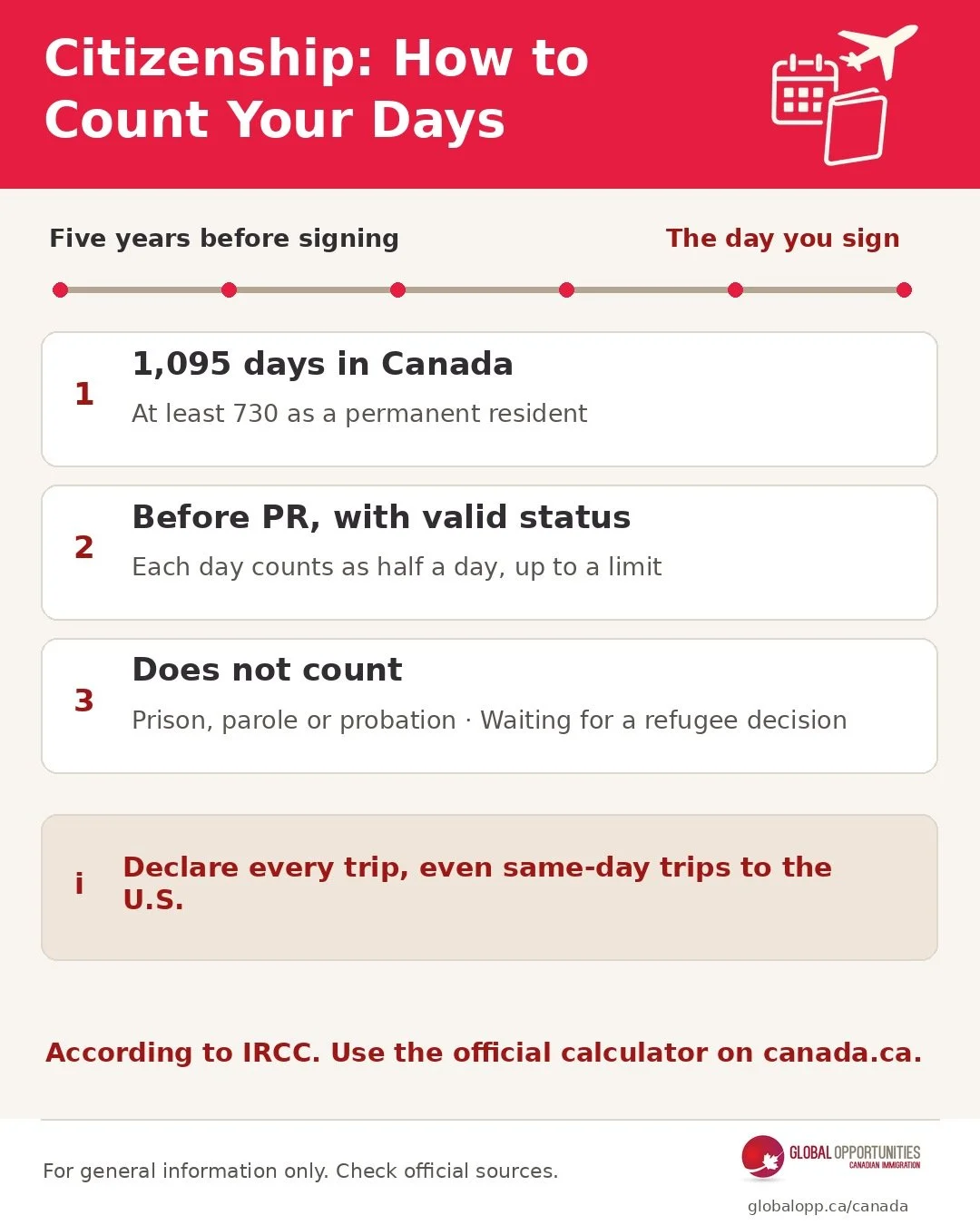
How the calculator works, as published by IRCC, as of November 2026. Check the linked pages before you rely on them. The calculator gives you an estimate based on what you enter; IRCC verifies your travel history and makes the final count.
Do you need to file taxes to become a Canadian citizen?
According to IRCC's eligibility page, you may need to file taxes in Canada for at least 3 of the 5 years before you apply. IRCC's wording is important: the requirement applies if you had to file under Canada's tax rules. In the application, IRCC says you report whether you had to file and whether you actually filed.
Who has to file a tax return?
That question is answered by the Canada Revenue Agency (CRA), not by IRCC. The CRA's page for newcomers to Canada explains that:
for most people, residency for tax purposes starts on the first day they live in Canada, once they have enough residential ties;
you do not need to file until the year after you become a resident (the CRA gives the example that someone who arrived in 2025 files a 2025 return by April 30, 2026);
residents generally have until April 30 to file for the previous year, and self-employed people until June 15;
the CRA recommends filing every year, even with no income or no tax owing, because it uses your return to calculate your benefit and credit payments.
Why this matters for citizenship
Filing on time every year, even with little or no income, lets you answer this question with confidence. If your tax situation is complicated (income abroad, self-employment, unclear residency years), talk to a tax professional before you apply.
Rules as published by IRCC and the Canada Revenue Agency, as of November 2026. They may have changed: check the linked pages before you rely on them. Whether you had to file in a given year depends on your own tax situation, which the CRA decides, not this guide.
Do you need a language test for Canadian citizenship?
Who must provide language proof
According to IRCC's language proof page, if you are 18 to 54 years of age on the day you sign your application, you must submit proof that you can speak and listen in English or French at Canadian Language Benchmarks (CLB) level 4 or higher, or the French equivalent, NCLC 4.
Some points people often miss:
Only speaking and listening are required. IRCC's requirement covers these two skills. Reading and writing are not part of the language proof for citizenship.
Age is counted on the day you sign. If you are 55 on the day you sign, IRCC's rules exempt you from the language proof. If you are 54, it applies to you.
Children under 18 do not need it. IRCC's eligibility page says minors do not need to prove language skills.
It can be English or French. You choose.
What IRCC accepts as proof
IRCC walks you through the accepted proof in steps. In general terms, the documents it lists are:
Education in English or French (step 1): proof that you completed, or are taking, a secondary or post-secondary program in English or French, in Canada or abroad. IRCC lists a diploma, a transcript or a certificate. If the document is not in English or French, IRCC says you must include a certified translation that shows the program was taught in English or French.
Approved third-party language test results (step 2): IRCC lists CELPIP-General, IELTS General Training, PTE Core, TEF Canada and TCF Canada, each with the minimum results it accepts for listening and speaking on that page. IRCC says it only accepts IELTS General Training for citizenship, not IELTS Academic. IRCC also says that if your results meet the requirements, you can include a copy even if they have expired. Many people use the test results they already submitted for permanent residence.
Government-funded language training (step 3): a certificate from Language Instruction for Newcomers to Canada (LINC) or Cours de langue pour les immigrants au Canada (CLIC) showing CLB level 4 or higher in speaking and listening, under the conditions IRCC lists.
Provincial language programs (step 4): IRCC lists specific certificates from programs in British Columbia, Saskatchewan, Manitoba, Nova Scotia, Ontario and Quebec, each with its conditions.
If none of these applies to you, IRCC's step pages continue to the next options. Read them in order on canada.ca. If you are planning to book a test, our guide English and French tests for Canada explains how the main tests work.
When IRCC returns an application because of language proof
IRCC's language proof page warns that it will not process your application, and will return the entire application to you, if your proof cannot be read, is not included, or is in another language without a certified translation. Check your copy before you submit.
Can IRCC assess your language during the process?
Yes. IRCC's eligibility page says officials may also assess your language skills during the application process, or during a test if needed. IRCC's test results page explains that a hearing with a citizenship official can include language questions.
Rules as published by IRCC on canada.ca, as of November 2026. The minimum results for each test are listed on IRCC's page and may change: check them before you book or submit. Language proof is one requirement among several; IRCC decides each case.
What is on the Canadian citizenship test, and how do you study?
Who takes the test
According to IRCC's page How the test works, most applicants who are between 18 and 54 years old on the day they sign their application must take the citizenship test. People under 18 or 55 and over, and people granted a waiver, do not take it.
What the test is like
IRCC's page Study for the test describes the format:
20 questions, multiple choice or true or false;
in English or French;
45 minutes long;
to pass, according to IRCC, you need at least 15 of the 20 questions right;
the questions cover the rights and responsibilities of citizenship and Canada's history, geography, economy, government, laws and symbols, and IRCC says all questions are based on the study guide.
IRCC also says the test does not assess your language ability. An officer notes communication skills only if you are invited to an interview.
How you take it: online, by video or in person
IRCC's page How the test works explains the formats:
Online: most applicants take the test online, from anywhere, with webcam monitoring.
In person: used when an accommodation is needed. IRCC says it can be written on paper, alone or with others, or taken orally, and other formats such as Braille are available.
Microsoft Teams: an oral test by video call, also used for accommodations.
You do not book the test yourself. IRCC says you are invited by email after you submit your application (Wait for a test invitation), and that you then have a 30-day period to complete the online test. IRCC's page Take the online test explains what you need, and If you missed the test explains what to do if you could not take it.
If you do not pass the first time
IRCC's test results page explains the next steps:
You can retake the test up to 3 times within your 30-day test period, whether online, on Microsoft Teams or in person.
If you do not pass after 3 attempts, IRCC says you are invited to a hearing with a citizenship official. The hearing can include oral knowledge questions, questions about your residence in Canada and language questions.
IRCC says that if you pass the hearing, you wait for a ceremony invitation, and if you fail the hearing, your application is refused. In that case you would need to apply again and pay the fees again.
IRCC also notes that an officer reviews online results, and that you check your status in the online tracker rather than waiting for an email.
If you pass
According to the same results page, depending on your case you may be invited to an interview. IRCC says interviews are used to verify your identity, check the photocopies of your documents against the originals and confirm your eligibility. IRCC asks you to bring the original documents you submitted, plus any passport or travel documents you used in the 5 years before you applied. After that, you are invited to the ceremony.
How to study: Discover Canada
The official study guide is Discover Canada: The Rights and Responsibilities of Citizenship, published by IRCC (Discover Canada). IRCC's study page says you can read it online, download it as a PDF or eBook, listen to an audio version or order a paper copy. IRCC also publishes practice questions at the end of the guide.
Some practical study tips:
Read the whole guide, not just summaries. IRCC says every question is based on the guide, so the official text is the best source. Practice apps and private websites can be outdated.
Learn your own province or territory. The guide has a section on Canada's regions. Know your provincial capital, your premier's role and how provincial government works.
Know how government works. Many people find the sections on the three levels of government, Parliament, elections and the Crown the most detailed. Spend extra time there.
Practise in the language you will take the test in. If you will take it in English, study in English, even if a translation helps you understand first.
For a light introduction to Canada's history before you open Discover Canada, watch our short video Canada: From the Beginning.
Test format as published by IRCC, as of November 2026. It may change: check IRCC's study page before your test. Passing the test is one step; IRCC decides the application as a whole.
Age-related exemptions, accommodations and waivers
Automatic exemptions by age
According to IRCC's eligibility page, some requirements do not apply because of your age on the day you sign:
Adults 55 and older: exempt from the language requirement and the test.
All minors under 18: exempt from the language requirement and the test.
Minors under 14: exempt from the oath.
Physical presence, taxes (if you had to file) and prohibitions still apply to adults of any age.
Accommodations
If you have a disability or another need that affects how you can take the test, attend an interview or the ceremony, IRCC explains how to ask for an accommodation on its page Request an accommodation. The in-person and Microsoft Teams test formats described above exist partly for this reason.
Waivers
In some cases, a requirement can be waived. IRCC's waiver page explains them. According to IRCC's eligibility page, adults can ask for a waiver of the language requirement, the test and the oath, and minors aged 14 to 17 can ask for a waiver of the oath. IRCC explains who can ask for a waiver and what documents to include. A waiver is a request: IRCC decides whether to grant it.
Rules as published by IRCC on canada.ca, as of November 2026. Check the linked pages before you rely on them. Ages are counted on the day you sign your application, not on the day IRCC decides it.
Situations that prevent you from becoming a citizen
IRCC calls these prohibitions. Its page Situations that may prevent you from becoming a citizen lists them. In general terms, according to IRCC you cannot become a citizen while, or for a period after, situations like these apply:
you are serving a term of imprisonment, or you are on parole or on probation in Canada, or serving a sentence outside Canada;
you are charged with, on trial for, or appealing certain offences in Canada or equivalent offences abroad;
you are under a removal order;
you are being investigated for, charged with, or have been convicted of war crimes or crimes against humanity;
you were convicted of certain offences within the 4 years before you apply, in or outside Canada, as IRCC describes on the page;
a previous citizenship application was refused for misrepresentation within the past 5 years, or your citizenship was revoked for fraud within the past 10 years, as IRCC explains;
other serious situations listed on IRCC's page.
IRCC says that if a prohibition applies to you, you must wait until it no longer applies before you apply, and that you must disclose these situations in your application. IRCC reviews each case. If a prohibition arises while your application is in process, IRCC says you must contact it.
If any of this applies to you or a family member, this is exactly the kind of situation where it makes sense to get professional advice before applying.
Rules as published by IRCC on canada.ca, as of November 2026. They are summarized here in general terms; the exact wording and time periods are on IRCC's page. Each situation is assessed by IRCC case by case.
How to apply for Canadian citizenship, step by step
IRCC's page Apply for citizenship explains the process: check that you are eligible, create your online account or get the paper forms, fill out the application, pay the fees, sign and date it, and submit it. IRCC encourages most people to apply online. Here are the steps in order.
According to IRCC:
Check your eligibility and whether you must apply on paper.
Create your online account and start the application, or get the forms and documents for a paper application.
Fill out the application. IRCC says a representative may help you, but if you apply online you must complete it yourself.
Pay the fees. Online, you pay and upload the receipt to your account. On paper, IRCC says you pay only when you are ready to submit and include the printed receipt.
Sign and date the application. IRCC says minors aged 14 to 17 must also sign.
Submit it. On paper, IRCC says to mail or courier the complete application and all documents to the address on its page, using a service you can track.
Online or on paper?
IRCC says it encourages applicants to apply online: it explains that online applications have built-in error checks, send you a confirmation email, and do not need printing or mailing.
According to IRCC, you must apply on paper if:
your physical presence calculation includes time outside Canada as a Crown servant, or as a family member of one; or
you want a representative to complete and submit the application for you.
Who can apply online
IRCC's how to apply page explains:
Adults (18 and older) can apply online alone or as a group with other adults. IRCC says each adult needs their own linked account, with only one adult per account. One adult submits all the applications in the group after everyone has signed.
Parents or legal guardians can create applications for minors in their own account, up to the number of minors IRCC lists on the page.
Minors applying on their own can apply online only in the situations IRCC describes, with a request that IRCC reviews.
Before you submit
Check the reasons IRCC lists for returning applications (see the section on returned and refused applications below) before you sign: most of them, such as a signature date that does not match your calculation, are about dates and missing pieces. Keep copies of everything you send.
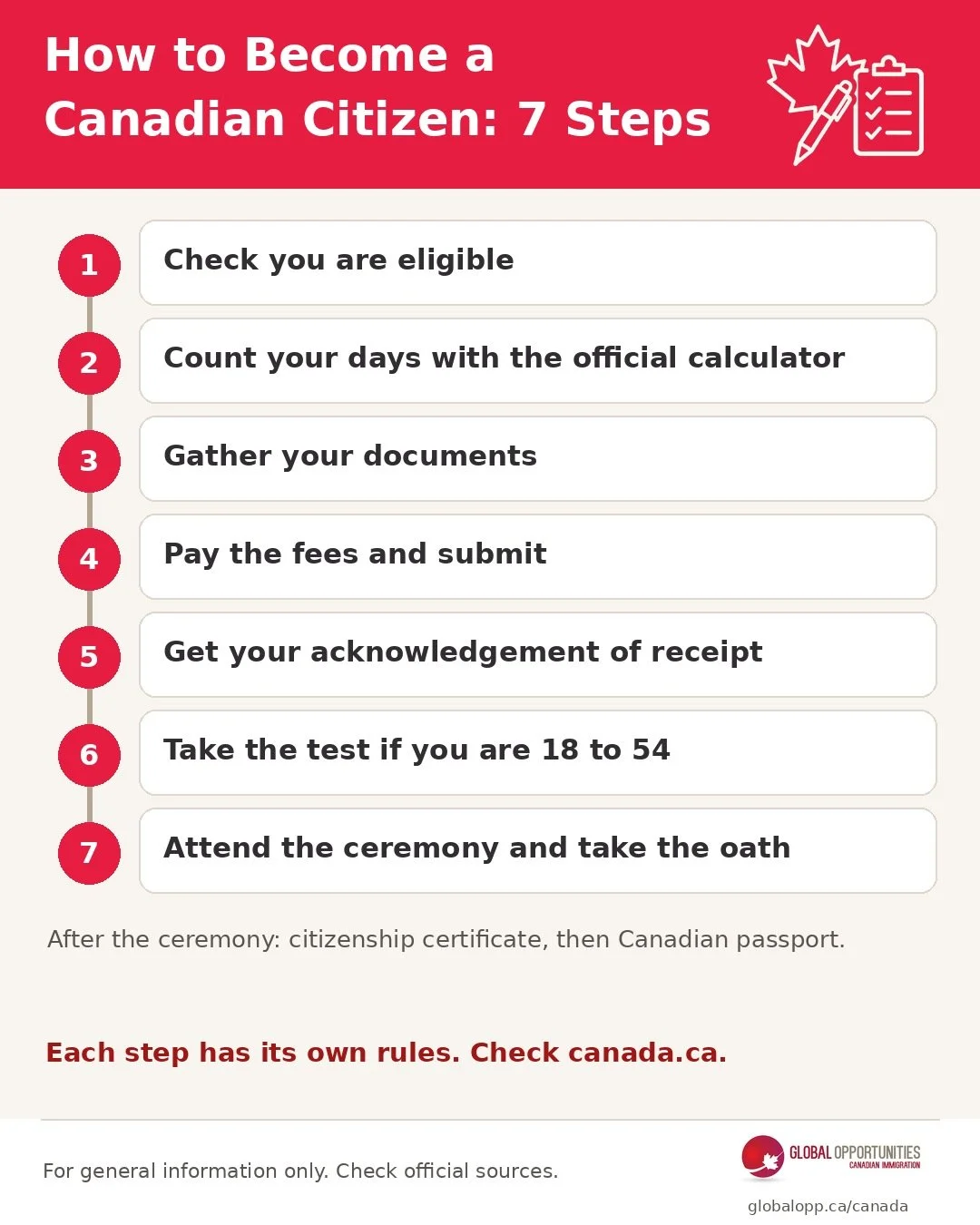
Watch our recorded live session on how to become a Canadian citizen for a general overview; the IRCC pages linked in this guide are the ones that count.
Process as published by IRCC on canada.ca, as of November 2026. It may change: follow the instructions on IRCC's page and in your online account, which take precedence over this summary.
Documents for an adult citizenship application
IRCC's page Adult application: forms and documents lists what to include in a paper application. If you apply online, IRCC says to follow the instructions in your online account, which take precedence.
Documents every adult applicant includes (paper application)
According to IRCC's checklist:
the document checklist (CIT 0007);
the adult citizenship application form (CIT 0002);
colour photocopies of the identity pages of your passports and travel documents from your eligibility period, and any pages showing extensions (IRCC asks you to explain in the form if you had no travel document);
your physical presence calculation from the official calculator (or form CIT 0407);
language proof, if you are 18 to 54 (or a waiver request);
photocopies of two pieces of personal identification, each showing your name, photo and date of birth;
two identical colour citizenship photos that meet IRCC's photo specifications;
your fee receipt.
Documents some applicants include
IRCC lists documents that apply only in certain situations, including:
the Use of a Representative form (IMM 5476), if someone represents you;
police certificates, which IRCC says you need if, since turning 18, you lived outside Canada for 183 days or more in a row within the past 4 years (see IRCC's page for the exact rule);
certified translations of any document that is not in English or French;
documents for a name change or a date of birth change;
the Residence Outside Canada form (CIT 0177), for Crown servants and their family members;
waiver documents, if you are asking for a waiver.
Document list as published by IRCC, as of November 2026. IRCC updates its forms and checklists: always download the current version from canada.ca before you apply. Using an outdated form can lead to a returned application.
What happens after you apply
IRCC's page After you apply explains the stages. In order:
Completeness check and acknowledgement of receipt (AOR). IRCC first checks that your application is complete. When it is, you get an AOR, which IRCC says means processing has started. The AOR includes your application number and your unique client identifier (UCI). IRCC says incomplete applications are returned and the fee is not processed.
Fingerprints, if IRCC asks for them. IRCC says you would have your fingerprints taken electronically through a local police service, the RCMP or an RCMP-accredited company, and that fingerprints taken at a Service Canada Centre are not accepted.
The citizenship test, for applicants aged 18 to 54 on the day they signed.
A possible interview. IRCC explains that some applications are selected at random for a more detailed review under its Quality Assurance Program, and you may be asked for more information or invited to an interview.
The citizenship ceremony, where most applicants take the oath.
Checking your status
IRCC says you can check your application status online after you receive your AOR (Check your application status). IRCC asks applicants not to contact it about status before the AOR.
Moving or travelling while you wait
Address changes: IRCC says to tell it right away if you move, even if you set up mail forwarding (change your address).
Travel: IRCC says you can leave Canada while your application is in process if you keep your PR status, can receive mail and email, can reply within the deadline, and are available in person for the test (if it applies), any interview and the ceremony. IRCC asks you to contact it if you will be away for more than two weeks in a row.
Our newcomer guide to Canada covers daily life topics while you wait, such as work permits, health care and building your life in Toronto.
Process as published by IRCC, as of November 2026. The stages can vary from one case to another, and not every applicant goes through every stage.
Applying for Canadian citizenship for a child
Children under 18 can become Canadian citizens, but the rules depend on whether a parent is already a citizen, or is applying at the same time. IRCC explains them on its eligibility page, and uses the section numbers of the Citizenship Act to name each case.
When a parent is Canadian or is applying at the same time: minor 5(2)
According to IRCC, this is the case for a child whose parent is already a Canadian citizen or is applying at the same time. The application is made by a biological or adoptive parent or a legal guardian. IRCC lists these requirements for the child:
permanent resident status;
taking the oath, if the child is 14 to 17;
no prohibition.
IRCC's list for this case does not include the physical presence requirement, the language proof or the test. The forms are on IRCC's page Minor 5(2) application: forms and documents.
When no parent is Canadian or applying: minor 5(1)
IRCC says this is for a child when no parent is a citizen or applying at the same time. The person applying must have custody of the child or be legally allowed to act for them, and does not need to be a citizen. IRCC lists these requirements:
permanent resident status;
physical presence: according to IRCC, the child needs 1,095 days in Canada in the 5 years before the parent or guardian signs, with at least 730 of those days as a PR;
tax filing, if the child had to file;
the oath, if the child is 14 to 17 (IRCC says minors aged 14 to 17 must also sign the application);
no prohibition.
The forms are on IRCC's page Minor 5(1) application: forms and documents. IRCC also explains that minors aged 14 to 17 may apply on their own in some situations, by selecting a waiver checkbox in the signature section.
What children do not need
According to IRCC, all minors under 18 are exempt from the language requirement and the test, and minors under 14 are exempt from the oath.
Applying as a family
A parent can create the children's applications in their own online account, as IRCC explains on its how to apply page. If one application in a group is incomplete, IRCC says all of them are returned.
Children adopted outside Canada
If a Canadian citizen adopts a child outside Canada, IRCC says citizenship is not automatic. There is a specific process, called a direct grant of citizenship, explained on IRCC's page Citizenship for a child adopted abroad. The rules for second-generation adoptions also changed with Bill C-3 (see the next section).
Rules as published by IRCC on canada.ca, as of November 2026. They may have changed: check the linked pages. Which rule applies to a child depends on the parents' status on the day of signing; IRCC decides each case.
Citizenship by descent and the changes from Bill C-3
This section is for people born outside Canada who have a Canadian parent, and for Canadians living abroad who have, or plan to have, children outside Canada. The rules changed recently, so it is worth reading the official pages carefully.
What citizenship by descent means
You are a citizen by descent if you were born outside Canada and you got Canadian citizenship through a Canadian parent, rather than by being born in Canada or being granted citizenship. IRCC's page Check if you're already a Canadian citizen says that if you were born outside Canada to a Canadian parent, the rules depend on your date of birth.
What was the first-generation limit?
According to IRCC's page on the changes to citizenship rules, before Bill C-3 citizenship by descent was limited to the first generation born outside Canada. In simple terms: a child born abroad to a Canadian parent who was also born abroad was generally not a citizen by descent.
IRCC's proof of citizenship page explains the background: in December 2023, the Ontario Superior Court of Justice ruled that the first-generation limit was unconstitutional for many people, and in March 2025 IRCC introduced an interim measure to support people affected.
What Bill C-3 changed
According to IRCC's changes to citizenship rules page:
The Government of Canada passed Bill C-3, and IRCC says the change officially took effect on December 15, 2025.
The first-generation limit on citizenship by descent was removed in some situations.
People who were already citizens before the bill became law remain citizens.
If you were born abroad before Bill C-3 took effect
IRCC says that if you were born outside Canada in the second generation or later before December 15, 2025, to a Canadian parent, in most cases you are automatically a Canadian citizen. IRCC says this also covers people born to someone who became Canadian because of these changes (changes to citizenship rules).
"Automatically" does not mean you have a document. IRCC says that if you think you became a citizen because of Bill C-3, you must apply for a citizenship certificate to find out for sure.
If a child is born or adopted abroad after Bill C-3 took effect
For children born or adopted on or after that date in the second generation or later, IRCC describes a requirement based on the Canadian parent's time in Canada:
Birth: IRCC says a child born outside Canada in the second generation or later may be Canadian if their parent was also born or adopted outside Canada to a Canadian citizen, and that same parent spent at least 1,095 days in Canada before the birth (changes to citizenship rules). IRCC's certificate eligibility page adds that, in that case, you must prove that your Canadian parent spent 1,095 days in Canada before you were born.
Adoption: IRCC says an adopted child may be eligible for a direct grant of citizenship if they were born and adopted outside Canada in the second generation or later, and their Canadian parent spent at least 1,095 days in Canada before the adoption.
Applications under the interim measure
IRCC says that if you applied under the interim measure and your application is still in progress, it will be processed under the new rules, and you do not need to submit a new citizenship certificate application (changes to citizenship rules).
Bill C-3 and "Lost Canadians": how to find proof of citizenship
People who lost their Canadian citizenship, or never received it, because of rules in older versions of the Citizenship Act are often called "Lost Canadians". IRCC's page Changes to citizenship rules 2009 to 2015 explains that earlier changes gave citizenship to certain people who had lost it, and its page on the changes to citizenship rules says citizenship may have been restored or given to some people born abroad to a Canadian parent because of Bill C-3. If you think this applies to you or a relative:
To prove your own citizenship: IRCC says to apply for a citizenship certificate, which is the document that proves you are a citizen.
To confirm when someone became a citizen: anyone can ask IRCC for a search of citizenship records, for themselves or for another person, such as a parent or grandparent. IRCC says the result is a letter that cannot be used to prove someone is a Canadian citizen or to apply for a passport; for that, you need a citizenship certificate.
For older records: Library and Archives Canada's citizenship and naturalization records page says most citizenship and naturalization records from 1854 to the present are held by IRCC, and describes the older registers and lists that Library and Archives Canada keeps.
These cases depend on dates of birth, documents and each family's history. To know how the rules apply to you, book a consultation.
If you do not want to be a citizen
IRCC says that if the change made you a Canadian automatically and you do not want to be one, you can apply to give up (renounce) your citizenship (renounce Canadian citizenship). This can matter if your other country does not allow dual citizenship.
Rules as published by IRCC and Library and Archives Canada on canada.ca, as of November 2026. Citizenship by descent depends on dates of birth, on each parent's history and on documents, and it is often misunderstood. IRCC confirms whether someone is a citizen by deciding a citizenship certificate application. This summary does not tell you whether you are a citizen.
Proof of citizenship: the citizenship certificate
What a citizenship certificate is
IRCC's page Citizenship certificate says a citizenship certificate is a document that proves your Canadian citizenship. It is not a travel document: to travel abroad you still need a passport.
IRCC's proof of citizenship page lists the related services: applying for, replacing or updating a certificate; the documents that prove citizenship; and searching existing citizenship records.
Who applies for one
According to IRCC's certificate eligibility page:
Existing citizens may apply to prove their status, for example for a passport, a job, a pension or a social insurance number.
You can apply to replace a lost, stolen or destroyed certificate, or to update one after a legal name change.
If you are not sure whether you are a citizen, you can apply to find out.
Parents may apply for a minor child born outside Canada.
People born in Canada usually do not need one: IRCC says a provincial or territorial birth certificate should be enough to prove citizenship, although you can still apply.
People who become citizens through a grant (the process described in most of this guide) receive their certificate after the ceremony and do not apply separately.
IRCC also notes that it no longer issues citizenship cards. If you apply to replace or update an old card, IRCC says it sends you a certificate instead (citizenship certificate).
How to apply
IRCC's page Apply for a citizenship certificate explains the online and paper options and the documents to include. After you apply, IRCC's page After you apply for proof of citizenship explains the next steps. The fee is on IRCC's official fee list (see the section on fees below).
Rules as published by IRCC on canada.ca, as of November 2026. Check the linked pages before you apply. A certificate application is decided by IRCC.
Does Canada allow dual citizenship?
What Canada says
IRCC's Help Centre answers this directly: Canadians are allowed to take a foreign citizenship while keeping their Canadian citizenship, and you do not apply for dual citizenship: there is no related certificate (What is dual citizenship?).
What your other country says
This is the part that depends on you. IRCC explains that each country decides who it considers to be a citizen, and advises you to ask the embassy of your country of citizenship about its rules before applying for Canadian citizenship (What is dual citizenship?). The Government of Canada's travel page for dual citizens adds that not all countries allow it, and some may consider it illegal for you to have another citizenship.
For example, Mexico's Secretariat of Foreign Affairs (SRE) quotes Article 37 of the Mexican Constitution on its nationality FAQ, which states that no Mexican by birth may be deprived of their nationality. Each country's rules are its own: check with your country's embassy or consulate. If you are moving from Europe, Asia or Africa, check your country's rules on dual nationality with its embassy; our guides to moving to Canada from Europe, from Asia and from Africa cover other country-specific steps.
Travelling as a dual citizen
There is one important travel rule. IRCC's page Dual Canadian citizens says dual citizens can no longer travel to or transit through Canada by air with a non-Canadian passport, so in general you need a valid Canadian passport to fly to Canada. According to the same page:
Canadian-American dual citizens may use either a valid U.S. passport or a valid Canadian passport, as long as they meet the basic entry requirements, and should carry proof of Canadian citizenship if they travel with only a U.S. passport.
If you do not have a valid Canadian passport, you may qualify for a special authorization in limited situations that IRCC describes on the page.
When you travel to your other country of citizenship, that country may require you to enter with its own passport. The Government of Canada's dual citizens travel page explains what to consider, including that Canada's ability to help you may be limited in a country that considers you its own citizen.
Rules as published by IRCC, the Government of Canada's travel site and Mexico's SRE, as of November 2026. They may have changed: check the linked pages. Your other country's rules are decided by that country, not by Canada.
The citizenship ceremony and the oath
IRCC says that, for most applicants, the citizenship ceremony is the last step before becoming a Canadian citizen (citizenship ceremony). You become a citizen when you take the oath. It is also a celebration: IRCC says members of the public and elected officials can attend most in-person ceremonies to support new citizens, and you can find one near you with IRCC's Find a citizenship ceremony tool.
Who takes the oath
According to IRCC's page Who has to take the oath and its eligibility page, applicants aged 18 and over take the oath, and so do minors aged 14 to 17. Minors under 14 are exempt.
Virtual or in person
IRCC's page Ceremony formats explains that IRCC may invite you to a virtual ceremony by video conference or to an in-person ceremony. Your invitation includes the date, the time and either the video link or the location. IRCC decides which format you are invited to; if you were invited to one format and want the other, IRCC says you can ask to reschedule. IRCC's page When to go to your ceremony explains rescheduling.
What to bring
Your invitation and IRCC's page What to bring to your ceremony list the documents and identification you need. Read both carefully a few days before. IRCC explains that your PR card is destroyed or collected at the ceremony (after the ceremony).
What happens at the ceremony
IRCC's page What to expect at your ceremony explains:
A presiding official leads the ceremony.
You take the oath of citizenship. IRCC says you can swear it, referring to your religious belief (and you may bring your holy book), or affirm it, without referring to religious belief.
You sing O Canada in a bilingual version; IRCC says you may sing in English, French or both, and it offers recordings to practise with.
IRCC says ceremonies last a few hours, and suggests business attire appropriate for the occasion. Traditional, religious or ceremonial clothing and head coverings are welcome, and so are red and white.
You sign the Oath or Affirmation of Citizenship form. IRCC says that in person you sign it during the ceremony; online, you sign it and email it back as your invitation explains. IRCC stresses that you must sign it on the day you take the oath, not the day before or after.
The words of the oath
This is the oath as IRCC publishes it on its What to expect page:
I swear (or affirm) that I will be faithful and bear true allegiance to His Majesty King Charles the Third, King of Canada, His Heirs and Successors, and that I will faithfully observe the laws of Canada, including the Constitution, which recognizes and affirms the Aboriginal and treaty rights of First Nations, Inuit and Métis peoples, and fulfill my duties as a Canadian citizen.
Ceremony details as published by IRCC, as of November 2026. Your invitation contains the instructions that apply to you; follow them over any general summary.
After you become a citizen: passport, voting and more
IRCC's page After the ceremony explains the next steps.
Your citizenship certificate
According to IRCC:
E-certificate: IRCC emails you an instruction letter after you attend, return your signed Oath or Affirmation form, and IRCC confirms your citizenship. The certificate is then available in the IRCC Portal.
Paper certificate: at an in-person ceremony, IRCC says you receive it on the day; after a virtual ceremony, it is mailed to your Canadian address.
IRCC asks you to keep it safe, check your personal information and not laminate it.
Your Canadian passport
IRCC says you can apply for a Canadian passport only after you get your citizenship certificate, and that if you have an e-certificate you must print it to apply (after the ceremony). Because your PR card is collected at the ceremony, IRCC explains that you need a Canadian passport to travel abroad and come back. Plan your trips accordingly: avoid booking international travel right after your ceremony until you have your passport.
Adults: Apply for a new adult passport.
Children: Apply for a child passport.
Passport fees and processing times are on those official pages.
Voting
Voting is one of the rights that come with citizenship. Elections Canada's voter registration page says that to register and vote in a federal election you must be at least 18 years old and have Canadian citizenship. Elections Canada explains that you can register online, register at the polls when you go to vote, or update your information through the Elections Canada section of your tax return. Citizens aged 14 to 17 can sign up for the Register of Future Electors.
For provincial and territorial elections, IRCC points to the list of provincial and territorial election agencies on the sec-sce.ca New Canadians page. Municipal elections are run by each municipality.
Other things to know
Address changes: IRCC says you do not need to notify it of address changes after you become a citizen.
Settling in for the long term: our newcomer guide to Canada covers everyday topics such as health care, banking, housing and work.
Taking part in your community: IRCC suggests ways to get involved on its page Be an active community member. Our article on building community in Canada has ideas too.
Free admission to national parks: IRCC's after-the-ceremony page mentions free admission to Parks Canada places for new citizens; see Parks Canada's page on free admission for new citizens for the current conditions.
Information as published by IRCC, Elections Canada and Parks Canada, as of November 2026. Check the linked pages for current conditions.
Common reasons citizenship applications are returned or refused
There are two different outcomes, and it helps to know the difference:
A returned application is sent back before processing, usually because something is missing or wrong. IRCC says the fee is not processed. You fix the problem and apply again.
A refused application has been processed and IRCC has decided you do not meet a requirement, or that a prohibition applies.
Reasons IRCC lists for returning an application
According to IRCC's how to apply page, an application can be returned or delayed for reasons such as:
missing information or documents;
incomplete or partial payment of the fees, or a missing receipt;
a signature date in the past or the future, or one that does not match the "Application date" in the physical presence calculation;
the application arriving more than 90 days after the signature date;
losing eligibility by the day before signing;
in a group application, one incomplete application, which IRCC says causes all the applications in the group to be returned.
IRCC's language proof page adds that the whole application is returned if the language proof cannot be read, is missing, or is in another language without a certified translation.
Situations that lead to a refusal
Based on IRCC's pages, an application can be refused when, for example:
the applicant does not meet the physical presence requirement once IRCC checks the travel history;
the applicant fails the hearing after not passing the test, as IRCC's test results page explains;
a prohibition applies (situations that prevent citizenship);
IRCC finds misrepresentation. IRCC warns that submitting false documents, lying on an application or cheating on a citizenship test has serious consequences (consequences of fraud), and its prohibitions page describes a waiting period after a refusal for misrepresentation.
Common mistakes you can avoid
Applying with exactly 1,095 days. IRCC itself recommends applying with more than the minimum.
Forgetting short trips. Every absence must be declared, including same-day trips to the United States, according to the calculator's FAQ.
Mixing up dates. Compare your list of trips with your passport stamps and records. The dates you declare should match what other records show.
Signing on the wrong date or mailing too late.
Leaving out a passport from your eligibility period.
Using an old form. Download the current one from canada.ca each time.
Not answering IRCC's requests on time. If IRCC asks for documents or invites you to something, reply within the deadline it gives.
Not updating your address.
Our article on Canada visa refusals explains, in general terms, why careful preparation matters for any application to IRCC.
Reasons as listed by IRCC on canada.ca, as of November 2026. This is not a complete list, and every case is assessed by IRCC. If your application was returned or refused, read IRCC's letter carefully: it explains the reason.
Scams and authorized representatives
You can apply on your own
Nobody is required to hire anyone to apply for citizenship. IRCC's forms, guides, calculator and study guide are free on canada.ca. Some people prefer help, especially with complex cases (long or frequent trips, prohibitions, children in different situations, citizenship by descent). If you want help, make sure the person is authorized.
Who can charge you for help
IRCC's page Check if your representative is authorized says that paid representatives must be:
immigration or citizenship consultants who are members of the College of Immigration and Citizenship Consultants (CICC);
lawyers or notaries who are members of a Canadian provincial or territorial law society, or notaries who are members of the Chambre des notaires du Québec;
paralegals who are members of the Law Society of Ontario (in Ontario only).
IRCC says that if a representative is not a member in good standing, you should not use their services. To check a consultant, use the CICC public register. For lawyers, most law societies let you check membership online. If someone represents you, IRCC's page Use a representative explains the Use of a Representative form (IMM 5476), and IRCC explains how to file a complaint against a representative.
Warning signs of a scam
IRCC's page on internet, email and telephone scams lists what IRCC will and will not do. According to IRCC:
IRCC will never ask you for any sort of payment by telephone.
IRCC staff will not ask you to deposit money into a personal bank account or transfer money through a private money transfer service.
IRCC staff will not threaten you or offer special deals. IRCC says, "No one can guarantee you a job or a visa to Canada."
IRCC will not start a conversation with you on social media; check that posts come from verified Government of Canada accounts.
Be careful with emails from free webmail addresses and with websites that copy government pages; check the address before you enter personal information.
Other red flags for citizenship applicants:
someone who promises they can "guarantee" your citizenship or "skip" the test;
someone who offers to "fix" your travel history or your days;
a website that charges you for the Physical Presence Calculator or for Discover Canada, which are free on canada.ca;
a person who asks you to sign a blank form or keep your original documents.
If you think you were targeted, IRCC explains how to report fraud. You can also contact the Canadian Anti-Fraud Centre.
Information as published by IRCC and the CICC, as of November 2026. Lists of regulators and organizations are for reference only. Check a representative's status on the official register before you pay anyone.
Citizenship fees and processing times: where to check them
We do not publish IRCC fees or processing times in this guide, because they change and the official numbers are the only ones that count. Here is where to find them:
Fees: IRCC's official fee list. IRCC's how to apply page explains that adults pay a processing fee and a right of citizenship fee, and that minors pay a processing fee. It also says that partial or missing payment causes an application to be returned.
Processing times: IRCC's processing times tool. Select the citizenship application type that applies to you.
Urgent processing: IRCC's how to apply page says urgent processing is available only in exceptional cases, and links to the conditions.
Fees and processing times change. Always check the official IRCC pages on the day you apply.
Frequently asked questions
How long do I need to live in Canada to become a citizen?
According to IRCC, adults need to have been physically present in Canada for at least 1,095 days (3 years) during the 5 years before the date they sign their application, and at least 730 of those days must be as a permanent resident. The days do not need to be in a row. Some time as a temporary resident or protected person before PR can count as half days, up to a limit IRCC sets. IRCC recommends applying with more than 1,095 days in case there is a problem with your calculation. Use IRCC's official Physical Presence Calculator before you apply, with the exact date you will sign. See our section on physical presence.
Does time as a temporary resident count toward citizenship?
Yes, partly. According to IRCC, each day you spent in Canada with valid status as a visitor, student, worker or temporary resident permit holder, within your 5-year eligibility period and before becoming a permanent resident, counts as half a day. IRCC caps this credit at 365 days, which equals 730 calendar days in Canada. Time without valid status does not count, and IRCC says time waiting for a refugee claim decision does not count either. For protected persons, IRCC counts the time from the approval of their claim until the day before they became permanent residents. The calculator applies these rules when you enter your dates. See our section on physical presence.
Where is the official Physical Presence Calculator?
IRCC's calculator for paper applications is at eservices.cic.gc.ca. If you apply online, IRCC says the calculator is inside your online citizenship account, which you can only use after you create an account. If you cannot use the online calculator for a paper application, IRCC accepts the form CIT 0407. According to the calculator's FAQ, the day you leave and the day you return count as days in Canada, but you must still declare every trip, including same-day trips to the United States. The calculator is free: be careful with private websites that copy its name. See our calculator section.
Can I keep my other citizenship if I become Canadian?
Canada allows it. IRCC's Help Centre says Canadians are allowed to hold a foreign citizenship while keeping their Canadian citizenship, and that you do not need to apply for dual citizenship. The question is what your other country allows: each country decides who its citizens are, and some do not allow dual citizenship. IRCC advises you to ask your country's embassy about its rules before applying. Also note that, according to IRCC, dual citizens generally need a valid Canadian passport to fly to Canada, with an exception for Canadian-American dual citizens. See our dual citizenship section.
Who has to take the citizenship test?
According to IRCC, most applicants who are between 18 and 54 years old on the day they sign their application must take the test. Children under 18 and adults 55 and older do not take it, and neither do people granted a waiver. IRCC invites you after you apply; you do not book it yourself. Most people take it online, and IRCC offers other formats as accommodations. IRCC says the test has 20 questions, lasts 45 minutes and you need at least 15 correct answers to pass. All questions come from the free study guide Discover Canada. See our test section.
What happens if I fail the citizenship test?
IRCC says you can retake the test up to 3 times within your 30-day test period. If you do not pass after those attempts, IRCC invites you to a hearing with a citizenship official, which can include oral knowledge questions, questions about your residence and language questions. If you pass the hearing, you wait for your ceremony invitation. If you fail the hearing, IRCC says your application is refused, and you would need to apply again and pay the fees again. The best protection is to study the whole Discover Canada guide and IRCC's practice questions before your invitation arrives. See our test section.
Do I need to take a language test for Canadian citizenship?
Not necessarily a new test. According to IRCC, applicants aged 18 to 54 on the day they sign must submit proof of speaking and listening in English or French at CLB or NCLC level 4 or higher. IRCC accepts several kinds of proof: a diploma, transcript or certificate from a secondary or post-secondary program in English or French; results from approved tests (CELPIP-General, IELTS General Training, PTE Core, TEF Canada, TCF Canada) that meet the minimums on IRCC's page, even if expired; LINC or CLIC certificates; and some provincial program certificates. Many people use the test results they submitted for permanent residence. See our language section.
Do I need to have filed taxes to become a citizen?
According to IRCC, you may need to have filed taxes in Canada for at least 3 of the 5 years before you apply. The requirement applies if you were required to file under Canada's tax rules, and in the application you report whether you had to file and whether you did. Whether you had to file in a given year is a tax question, answered by the Canada Revenue Agency. The CRA recommends filing every year, even with no income, because your return is used to calculate benefits and credits. If you missed a year, consider fixing it before you apply. See our tax section.
Can I apply for citizenship for my children?
Yes. According to IRCC, if a parent is already a Canadian citizen or is applying at the same time, a child who is a permanent resident can apply as a "minor 5(2)": the child does not need to meet the physical presence requirement, the language proof or the test, but must take the oath if 14 to 17. If no parent is a citizen or applying, the child applies as a "minor 5(1)" and must meet physical presence and other requirements IRCC lists. A parent can add children's applications to their own online account. Children under 14 do not take the oath. See our section on applying for a child.
I was born outside Canada to a Canadian parent. Am I a citizen?
You may be. According to IRCC, Bill C-3 took effect on December 15, 2025 and removed the first-generation limit in some situations. IRCC says that if you were born abroad in the second generation or later before that date to a Canadian parent, in most cases you are automatically a citizen. For children born abroad on or after that date to a Canadian parent who was also born abroad, IRCC says the parent must have spent at least 1,095 days in Canada before the birth. The only way to know for sure, IRCC says, is to apply for a citizenship certificate. See our section on citizenship by descent.
Does marrying a Canadian make me a citizen?
No. IRCC's page on checking whether you are already a citizen lists marrying a Canadian citizen among the situations that do not make you a citizen automatically. A spouse or partner of a Canadian usually becomes a permanent resident first, for example through family sponsorship, and can then apply for citizenship once they meet the requirements, including physical presence. The same is true for people whose refugee claim was accepted and for permanent residents who have lived in Canada for many years: they apply like anyone else. See our section on who can apply.
Is the citizenship ceremony virtual or in person?
It can be either. IRCC says it may invite you to a virtual ceremony by video conference or to an in-person ceremony, and the invitation tells you which one. If you were invited to one format and want the other, IRCC says you can ask to reschedule. In both cases you take the oath, sing O Canada and sign the Oath or Affirmation form on the same day you take the oath. IRCC says your PR card is destroyed or collected at the ceremony, so plan any international trips around getting your Canadian passport. See our ceremony section.
Can I apply for citizenship if my PR card has expired?
Yes, if you still have permanent resident status. IRCC's eligibility page says you can apply with a valid or an expired PR card: what matters is your status, not the card. You still need to meet every other requirement, including physical presence, taxes, language proof and the test if they apply to you, and you cannot have a removal order or unmet conditions on your PR status. See our section on who can apply.
Can I travel outside Canada after I apply for citizenship?
Yes, with conditions. IRCC's page After you apply says you can leave Canada while your application is in process if you keep your PR status, can receive mail and email, can reply within the deadline, and are available in person for the test, any interview and the ceremony. IRCC asks you to contact it if you will be away for more than two weeks in a row. See our section on what happens after you apply.
What happens to my PR status when I become a citizen?
You take the oath and become a Canadian citizen. IRCC's page After the ceremony says your PR card is destroyed or collected at the ceremony, that as a citizen you must have a Canadian passport to travel abroad and return to Canada, and that you no longer need to tell IRCC when you change your address. Plan any trips around getting your passport. See our section on what happens after you become a citizen.
Can permanent residents vote in Canada?
Not in federal elections. Elections Canada's voter registration page says that to register and vote in a federal election you must be at least 18 years old and have Canadian citizenship. Provincial, territorial and municipal elections have their own rules, set by each election agency or municipality. Once you become a citizen, you can register online or at the polls. See our section on voting.
How do I get a Canadian passport after the ceremony?
IRCC says you can apply for a passport only after you get your citizenship certificate, and that if you have an e-certificate you must print it to apply (after the ceremony). Adults use IRCC's new adult passport page, and children the child passport page. Fees and processing times are on those official pages. See our section on your Canadian passport.
Can I apply for citizenship with a criminal record?
It depends on the situation, and IRCC assesses each case. IRCC's page Situations that may prevent you from becoming a citizen lists prohibitions such as serving a sentence, being on parole or probation, facing certain charges, or certain convictions within the 4 years before you apply, in or outside Canada. IRCC says you must wait until a prohibition no longer applies and must disclose these situations in your application. For your own case, book a consultation. See our section on prohibitions.
Can I use a search of citizenship records as proof of citizenship?
No. IRCC's page on the search of citizenship records says anyone can ask for a search to confirm a person's citizenship and naturalization information, for themselves or someone else, but the letter cannot be used to prove someone is a Canadian citizen or to apply for a Canadian passport. For that, IRCC says you need a citizenship certificate. See our section on Bill C-3 and "Lost Canadians".
Related guides
How Global Opportunities can help
Citizenship can look simple on paper, but many cases have details that deserve a second look: frequent or long trips, years with unclear tax filing, children in different situations, a past charge or conviction, or a Canadian parent born abroad. Every case is different, and nobody can guarantee a result: IRCC decides each application.
Our regulated consultant: Lic. Mildrete Monserrath Gutierrez Martinez, Regulated Canadian Immigration Consultant (RCIC), CICC licence R514880. Verify her licence on the CICC Public Register: https://college-ic.ca/protecting-the-public/find-an-immigration-consultant. Global Opportunities does not offer services for Quebec's immigration programs. Global Opportunities is a private firm and is not part of the Government of Canada or any provincial government.
Recorded seminars and lives: watch our recorded seminars in English or the Spanish recordings, and browse our YouTube channel.
More articles in English: read our Moving to Canada articles on topics such as permanent residence, family sponsorship and building community in Canada.
Help with your citizenship application: our team can review whether you meet the requirements, check your physical presence count and your documents, and prepare your citizenship application with you. IRCC makes the final decision on every application.
Personalized consultation: to review your own case, book a consultation or write to info@globalopp.ca.
Prefer email? Tell us what you need help with (my Canadian citizenship application) and we will reply: email info@globalopp.ca.
Contact Global Opportunities →
Sources
IRCC, Check your eligibility for citizenship (questionnaire)
IRCC, Citizenship test: how it works, study, invitation, online test, missed test and results
IRCC, Discover Canada: The Rights and Responsibilities of Citizenship and study questions
IRCC, Situations that may prevent you from becoming a citizen
IRCC, Adult application forms and documents, minor 5(1) and minor 5(2)
Library and Archives Canada, Citizenship and naturalization records
IRCC, Proof of citizenship, citizenship certificate, eligibility, how to apply, after you apply and valid proof of citizenship
Secretaría de Relaciones Exteriores (Mexico), Nationality FAQ
IRCC, Citizenship ceremony: who takes the oath, formats, when to go, what to bring, what to expect and after the ceremony
sec-sce.ca, New Canadians (provincial and territorial election agencies)
IRCC, Be an active community member · Services for Canadians
IRCC, Check if your representative is authorized, use a representative and file a complaint
College of Immigration and Citizenship Consultants, Public register
IRCC, Internet, email and telephone scams, report fraud and consequences of fraud
Global Opportunities, Moving to Canada articles · Recorded seminars and lives · Recorded seminars in English · YouTube channel
Global Opportunities videos: How to Become a Canadian Citizen · Canada: From the Beginning
The information in this guide comes from the official sources linked above (Immigration, Refugees and Citizenship Canada, the Canada Revenue Agency, Elections Canada, Library and Archives Canada, the Government of Canada's travel site and the other organizations named), as they read when we checked them in November 2026. It may have changed since then, sometimes without notice, and the official page is the one that counts. This guide is general information for reference only. It is not immigration, legal, tax or professional advice. Global Opportunities is not responsible for how anyone interprets this content, for decisions made based on it, or for changes made after it was written. Citizenship requirements, the test, language proof, citizenship by descent, fees, forms and processing times are set by the Government of Canada and change; other countries' rules on dual citizenship are set by those countries. Meeting the requirements does not guarantee that an application will be approved: IRCC decides each case. Organizations and websites mentioned are for reference only; we are not affiliated with them. Global Opportunities is a private firm and is not part of the Government of Canada or of any regulator. For advice on your own situation, book a consultation.
Last reviewed: November 2026