
Moving to Canada from Asia: India, the Philippines and More
Moving to Canada from Asia is one of the most common journeys in Canadian immigration, and most people start with the same questions: do I need a visa, can I study English first, which pathway fits my profile, which English test should I book, and how do I avoid scams? This guide answers them in plain English, country by country, using official Government of Canada sources.
About our sources: This guide summarises what official sources (the Government of Canada, provincial and territorial governments and the other organisations we link to) said when we checked them in November 2026. We link every source so you can read it yourself. Rules, rates and requirements change, sometimes without notice, and the official page is the one that counts. This is general information, not legal, tax or immigration advice. Global Opportunities is not responsible for how this information is interpreted or for changes made after it was written.
According to Statistics Canada's 2021 Census, people born in Asia (including the Middle East) made up 62.0% of the immigrants who arrived from 2016 to 2021, and India was the top place of birth of new immigrants, followed by the Philippines and China (Statistics Canada, The Daily, 26 October 2022). Those numbers describe the past and do not predict anyone's result, but they show that you will not be the first person from your country to make this move.
Asia is also a key market for Canada's language schools. Languages Canada reports that Japan, South Korea, China and Taiwan are among the top sources of students in Canadian language programs (see the English section below), and for many students that first course is the start of a bigger plan. This guide gives that group special attention, together with skilled workers, international students, nurses and families from South and Southeast Asia.
This guide covers Canada's side only: Canadian programs, Canadian requirements and Canadian daily life. It does not cover the laws, emigration rules or tax systems of India, Japan, the Philippines or any other country. We are Global Opportunities, a private immigration firm based in Toronto. Every program mentioned here changes over time, so we link the official page for each one. Please check it before you make any decision.

Watch our recorded seminars and lives →
In this guide
Moving to Canada from Asia: do you need a visa or an eTA?
Biometrics, medical exams and visa application centres
Skilled pathways for moving to Canada from Asia: Express Entry and provincial programs
Studying in Canada from Asia: study permits and what to know before you pay
Studying English in Canada: a popular first step from Asia
How do you get Asian qualifications recognized in Canada?
Which English tests do you need to move to Canada from Asia?
Working Holiday from Asia: Japan, Korea, Taiwan and Hong Kong
Moving to Canada from India
Moving to Canada from the Philippines
Moving to Canada from Pakistan
Moving to Canada from Bangladesh
Moving to Canada from Nepal
Moving to Canada from Sri Lanka
Moving to Canada from China
Moving to Canada from Hong Kong and Taiwan
Moving to Canada from Vietnam
Moving to Canada from Japan
Moving to Canada from South Korea
Moving to Canada from Iran
Moving to Canada from the UAE and the Gulf
Moving to Canada from other Asian countries
Fraud, fake job offers and unauthorized agents
Budget, documents and what to bring when moving to Canada from Asia
Planning checklist for moving to Canada from Asia
Your first weeks after moving to Canada from Asia
Frequently asked questions
Related guides
How Global Opportunities can help
Sources
Moving to Canada from Asia: do you need a visa or an eTA?
It depends on your passport. IRCC's entry requirements page lists citizens of India, Pakistan, Bangladesh, China and Vietnam, among others, as needing a visitor visa, while citizens of Japan and South Korea need an eTA to fly. Some Filipino citizens may qualify for an eTA when flying. Run IRCC's official tool to check yours.
Entry rules depend on your citizenship, not on where you live. They also depend on how you travel and why you are coming. The official place to check is IRCC's tool Find out if you need a visa or eTA to travel to Canada. You answer a few questions and it tells you which document you may need.
At the time of writing, IRCC's entry requirements by country or territory page lists the citizens of India, Pakistan, Bangladesh, Nepal, Sri Lanka, the People's Republic of China and Vietnam among the travellers who need a visitor visa. It lists the Philippines as visa-required, with a note that some citizens of the Philippines may be eligible for an eTA instead if they meet certain requirements and fly. Japan and the Republic of Korea are listed among the countries whose citizens need an eTA to fly to Canada. Holders of a Hong Kong SAR passport, and holders of an ordinary Taiwanese passport that includes the personal identification number, are also listed for an eTA when flying. These lists change, so run the official tool before every trip. Still unsure which one you need? See eTA vs visitor visa for Canada.
Visitor visa or eTA: what is the difference?
Visitor visa: a document placed in your passport. You apply online, usually give biometrics, and wait for a decision before you travel.
eTA (electronic travel authorization): an online authorization linked to your passport, for visa-exempt air travellers. Apply only on the official eTA page.
A few points to keep in mind
A visa or an eTA is for travel, not for work or study. Work and longer studies generally need a permit. Check whether you need a work permit.
Some visa-required travellers may qualify for an eTA instead. IRCC's eTA eligibility page explains that citizens of select visa-required countries may apply for an eTA instead, but only for air travel.
The passport you travel with decides the rule. An Indian citizen living in the United Arab Emirates, for example, follows the rules for Indian citizens.
If a visa is refused. The refusal letter gives the general reason. To understand how officers assess applications, read Canada visa refusals: how IRCC evaluates applications.
Watch our live session on the difference between an eTA and a visitor visa (recorded in November 2025; IRCC's tool has the current rules).
Entry rules as listed on IRCC's entry requirements and eTA pages in November 2026. A visa or an eTA lets you travel to Canada; it does not mean you will be allowed in, because the border officer decides at entry. Check the official tool before every trip.
Biometrics, medical exams and visa application centres
Many applicants moving to Canada from Asia will need to give biometrics at some point, and some will also need an immigration medical exam.
Who needs to give biometrics
According to IRCC's biometrics page, biometrics are your fingerprints and photo, and IRCC collects them to confirm your identity. Unless you are exempt, IRCC says you need to give biometrics when you apply for temporary residence (such as a visitor visa, a study permit or a work permit), for permanent residence, and in some other cases. Some people are exempt, for example visa-exempt visitors applying only for an eTA. The details, including how long biometrics remain valid, are on Who needs to give biometrics.
How and where
Biometrics are given in person, at an appointment, after you receive IRCC's instruction letter. IRCC explains how to give your biometrics and has a tool to find a collection point near you. Outside Canada, collection points are often visa application centres.
Immigration medical exams for students and workers from Asia
Some temporary residents need an immigration medical exam. According to IRCC's medical exam requirements for temporary residents, for stays of more than 6 months you need an exam if, for example, you have lived in or travelled to certain countries or territories for 6 months or more in a row in the year before you come, or if you will work in a job in which public health must be protected. Jobs in health care, child care and similar work can require an exam even for shorter stays. IRCC publishes the country requirements list, and many Asian countries are on it, so check it. Exams must be done by a doctor on IRCC's list of panel physicians.
What a visa application centre (VAC) is, and what it is not
According to IRCC's page Find a visa application centre:
VACs are private companies that have formal contracts with the Government of Canada.
They can provide services such as collecting biometrics, accepting payment of application fees and returning passports by courier, depending on the location.
VACs play no role in the decision-making process and are expressly forbidden to give visa-related advice. All decisions are made by IRCC officers.
Anyone offering to "speed up" your file for money is a red flag.
Biometrics and medical exam rules as published by IRCC, as of November 2026. Whether you need an exam depends on your own travel history, stay and job, so check IRCC's pages for your case.
Skilled pathways for moving to Canada from Asia: Express Entry and provincial programs
Most skilled workers from Asia look at two families of programs: Express Entry, the online system IRCC uses for three federal economic programs, and the Provincial Nominee Programs run by the provinces and territories. There is no program for any specific Asian country; IRCC assesses each person against the program's own requirements.
If your goal is to live in Canada permanently, you will usually look at the economic immigration programs. The two main families are the programs managed through Express Entry and the Provincial Nominee Programs (PNPs). Quebec selects its own economic immigrants through separate programs; Global Opportunities does not offer services for Quebec's immigration programs, so if Quebec is your goal, start at Immigration in Québec.
What Express Entry is
According to IRCC, Express Entry is the online system used to manage applications for three federal programs:
Federal Skilled Worker Program: for skilled workers with eligible work experience, often gained outside Canada. Many professionals in Asia start their research here. See our page on the Federal Skilled Worker program.
Canadian Experience Class: for skilled workers with eligible Canadian work experience.
Federal Skilled Trades Program: for skilled workers qualified in a skilled trade.
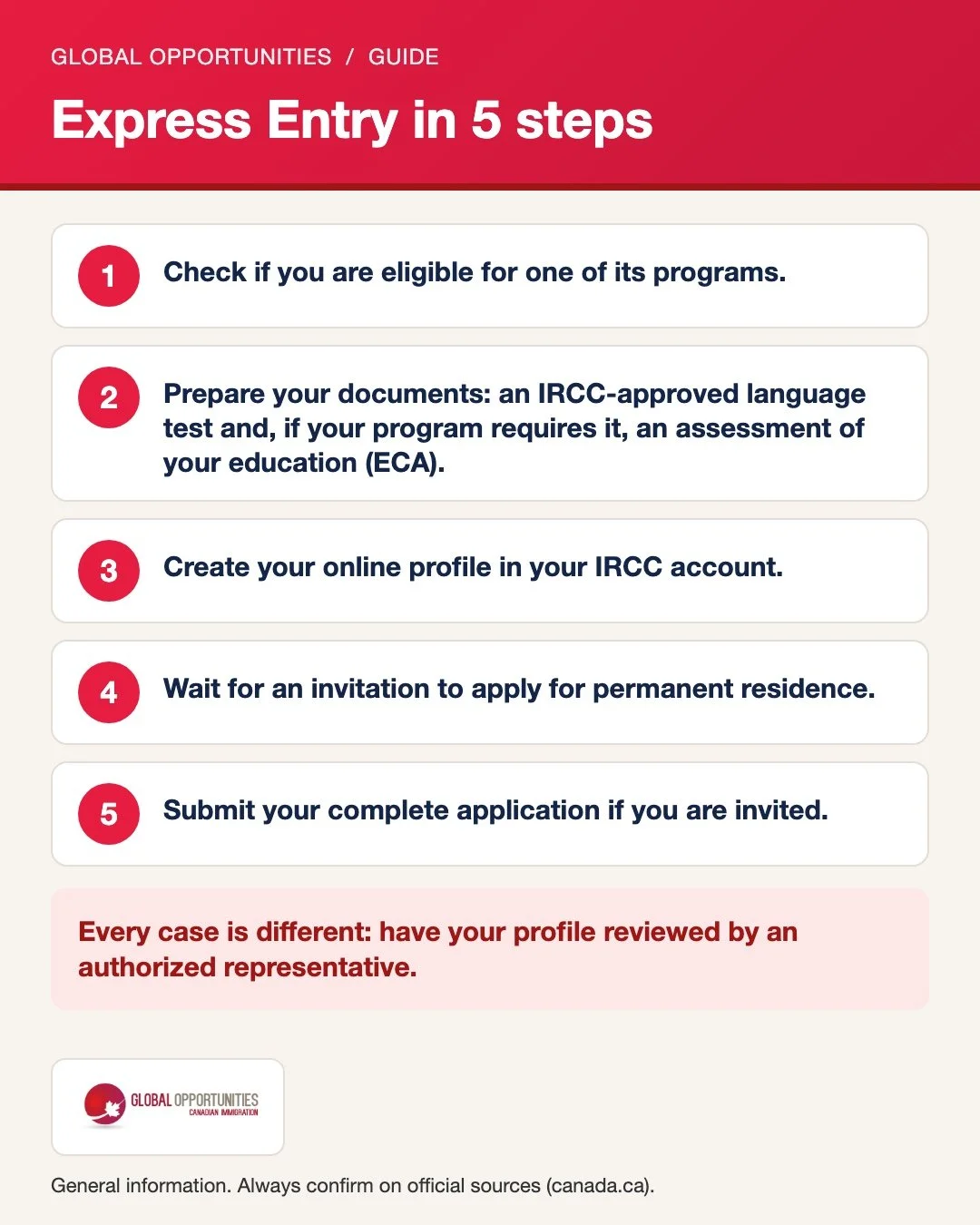
How Express Entry works, step by step
In general terms, according to IRCC:
Check that you meet the minimum requirements of at least one program.
Create an online profile; if eligible, you enter the pool.
Candidates are ranked with the Comprehensive Ranking System (CRS), based on factors such as age, education, language and work experience.
IRCC holds general, program-specific or category-based rounds of invitations.
If invited, you submit a complete application for permanent residence.
Being in the pool does not guarantee an invitation. Round types, the number of invitations and the scores needed change from round to round, so we do not publish them. Prepare your language results, credential assessment and work history carefully.
Category-based selection
IRCC can also invite candidates who fit a specific category. At the time of writing, IRCC's category-based selection page lists French-language proficiency; healthcare and social services occupations; STEM occupations; trade occupations; education occupations; transport occupations; physicians with Canadian work experience; senior managers with Canadian work experience; researchers with Canadian work experience; and skilled military recruits. Categories and the occupations in each one change, and IRCC identifies eligible candidates from their profile, so always check the current page.
Canadian Experience Class after working in Canada
The Canadian Experience Class is for people with skilled, paid work experience gained in Canada while authorized to work with temporary resident status. According to IRCC, work done while studying full-time does not count, self-employment generally does not count, you need an approved language test, and you must plan to live outside Quebec. Working in Canada does not by itself lead to permanent residence.
Provincial Nominee Programs
According to IRCC's Provincial Nominee Program page, the participating provinces and territories are Alberta, British Columbia, Manitoba, New Brunswick, Newfoundland and Labrador, the Northwest Territories, Nova Scotia, Ontario, Prince Edward Island, Saskatchewan and Yukon. Quebec and Nunavut do not have PNPs. Each province or territory sets its own streams and criteria, and these change often. Some streams are linked to Express Entry and others (base streams) are not. The Atlantic provinces also take part in the Atlantic Immigration Program, which works with designated employers. Our province guides explain each region's life and programs: Ontario, British Columbia, Alberta, Saskatchewan, Manitoba, Nova Scotia, New Brunswick, Prince Edward Island, Newfoundland and Labrador and the territories. For a broader overview, see Immigration to Canada and permanent resident requirements. Watch our live session on why applying is not the same as being selected.
Program descriptions as published by IRCC and the provinces, as of November 2026. Meeting a program's minimum requirements does not mean you will be invited or approved: IRCC and the provinces decide each case.
Studying in Canada from Asia: study permits and what to know before you pay
Many people moving to Canada from Asia first come as international students. Studying in Canada can be a valuable experience, but a study permit is not a permanent residence program, and no school, agent or consultant can promise that studying will lead to a work permit or to permanent residence. For an overview of study permits and how to prepare, see our Study in Canada page.
The basics of a study permit
According to IRCC's study permit page, a study permit allows foreign nationals to study at a designated learning institution (DLI), and most foreign nationals need one to study in Canada. You should apply before you travel, following IRCC's how to apply instructions.
IRCC's page on documents for a study permit lists, among others:
a letter of acceptance from your school;
proof of identity;
proof that you can support yourself and any family members who come with you;
in most cases, a provincial or territorial attestation letter (PAL/TAL). IRCC notes that in most cases you need to accept your offer and pay your tuition, in part or in full, to get it. Students going to Quebec need a Quebec Acceptance Certificate instead.
How much money you must show, and how long processing takes, depend on each case and change over time, so we do not give figures here. IRCC sets the fees and publishes them on the official page; to know what applies to your own situation, a consultation is the way to find out.
The Student Direct Stream has ended
Many Asian students used to apply through the Student Direct Stream (SDS). IRCC's notice End of the Student Direct Stream and Nigeria Student Express explains that the SDS ended and that applications are now processed through the regular study permit stream. If an agent still sells you an "SDS application" or a "fast track", ask where that appears on canada.ca.
Check the school before you pay anything
Not all schools in Canada can accept international students. Before you pay a deposit, confirm that your school is on IRCC's designated learning institutions list.
How to choose a program from Asia
Start from your long-term goal and your previous studies or work.
Check the work-after-graduation rules before you enrol. According to IRCC's post-graduation work permit eligibility page, bachelor's, master's and doctoral graduates have no field of study requirement, while graduates of college and other non-university programs generally must meet a field of study requirement. IRCC also requires proof of language ability for most post-graduation work permit applications.
Compare the school and the province, not only the price. Our province guides describe the colleges, universities and cities in each region.
Working after graduation is not automatic
According to IRCC's page on working after you graduate, only graduates of certain designated learning institutions may be eligible for a post-graduation work permit, and the rules have changed several times.
Study permit scams
IRCC has a dedicated page on international student scams. Its main warnings include:
Be wary of anyone who promises you a letter of acceptance from a DLI if you pay them. Ask the school to send the letter directly to you.
Pay tuition directly to the school, never through an intermediary.
Unauthorized representatives do not have special connections with Canadian immigration officers, and hiring one will not speed up your application.
Study permit and post-graduation work permit rules as published by IRCC, as of November 2026. A study permit does not lead automatically to a work permit or to permanent residence, and the eligibility rules have changed several times: check IRCC's pages on the day you apply.
Studying English in Canada: a popular first step from Asia
For many people in Asia, the first trip to Canada is not to immigrate but to study English. According to Languages Canada, the national association of accredited language programs, Japan is the largest source of students in Canadian language programs, and South Korea, China and Taiwan are also among the top markets (Languages Canada, 2025 Annual Survey Report, Executive Summary). A language course can help you improve your English, get to know a Canadian city and decide whether a longer plan makes sense for you. This section explains the Canadian rules that apply, so you can plan it properly.

Short English courses: do you need a study permit?
It depends on the length of your program. According to IRCC's page Study in Canada without a study permit, "you don't need a study permit if you're coming to Canada for a program that lasts 6 months or less." The course must also be finished within the period you are allowed to stay in Canada. You still need the right travel document for your passport: an eTA or a visitor visa (see the visa section above).
A few points to keep in mind, based on IRCC's pages:
The course must fit within your authorized stay. IRCC's page says you must finish the program within the period you are allowed to stay, so plan the dates before you book.
You can still apply for a study permit for a short course if you prefer. It may make it easier to continue studying if your plans change. IRCC explains the options on the same page.
A visitor who studies cannot work. Being a student on a short course does not give you permission to work in Canada; IRCC explains when you need a work permit.
Bring your school letter and proof of funds to the border. The border officer makes the final decision on entry.
Longer English programs: when you need a study permit
Longer programs generally need a study permit before you travel, and IRCC's study permit eligibility page requires enrolment at a designated learning institution (DLI). Many language schools are not DLIs, so check the school on IRCC's DLI list before you pay anything.
English as a pathway into college or university
Some colleges and universities accept completion of their own or a partner's English program instead of a test score. Ask the institution in writing which programs it accepts, and if you plan English first and then a diploma, check what IRCC requires when you change programs or schools.
Can English students work in Canada?
Usually not. According to IRCC's page on working off campus, you cannot work off campus if you are only enrolled in an English or French as a second language (ESL/FSL) program. If you want to work and study English, a Working Holiday may fit better, if your country takes part.
English programs and work after graduation
Studying English alone does not lead to a post-graduation work permit. IRCC's post-graduation work permit eligibility page states that you are not eligible if you studied English or French as a second language. In the same way, IRCC's page on open work permits for spouses of students limits that option to certain programs, and language programs are not among them. If your goal is to stay longer, plan the English course as a first step and look carefully at what comes next.
How to choose a language school
Check accreditation. Languages Canada is the national association of accredited English and French programs. Its directory lets you look up schools and see which ones are accredited.
Check DLI status if you need a study permit.
Ask about class size, the mix of nationalities and homestay options. A class where everyone shares your first language makes it harder to practise English.
Pay the school directly, and read IRCC's warnings about international student scams. Ask for the refund policy in writing before you pay.
Which city is best for studying English?
There is no single best city. Compare a few things before you choose:
Climate: winters differ a lot between cities. Compare them with Environment and Climate Change Canada's Canadian Climate Normals.
Rent: compare cities with the CMHC Rental Market Reports.
The school: accreditation, class size and the mix of nationalities matter more than the city's reputation.
Montreal (Quebec): the Government of Quebec explains that French is the official language of Quebec, so keep that in mind if English immersion is your goal.
Our British Columbia, Ontario and Alberta guides describe each region's cities.
From Japan and South Korea: English, Working Holiday and what comes next
Japan and South Korea combine two advantages: their citizens need only an eTA to fly to Canada, and both countries take part in International Experience Canada (see the Working Holiday section below). Many young people from Japan and Korea combine both: a short English course first, then a Working Holiday to gain Canadian work experience. According to the IRCC Help Centre, IEC participants may take individual courses within the limits IRCC sets, and longer programs need a study permit.
After that, some people look at permanent residence. Skilled, paid work in Canada may count toward the Canadian Experience Class, and better English results can strengthen an Express Entry profile. Nothing here is automatic: each program has its own rules, and invitations are never guaranteed.
From Taiwan, China and other Asian countries
According to IRCC's entry requirements by country or territory page:
Taiwan: holders of an ordinary Taiwanese passport that includes the personal identification number need an eTA to fly, and Taiwan takes part in IEC.
China, Vietnam, India and most other Asian countries: citizens need a visitor visa, even for a short course. Apply early and use the official visa or eTA tool.
Thailand and the Philippines: these countries are visa-required, but IRCC notes that some of their citizens may qualify for an eTA if they fly and meet certain conditions.
A note on languages
Global Opportunities works in English and Spanish. We do not offer services in Japanese, Korean, Chinese or other Asian languages, so you will need to be comfortable communicating in English, or have someone you trust help you, if you would like our support.
Study, work and IEC rules as published by IRCC, and market data from Languages Canada, as of November 2026. A short course without a study permit does not give you permission to work, and studying English alone does not qualify you for a post-graduation work permit.
How do you get Asian qualifications recognized in Canada?
Degrees and professional qualifications from Asia are not recognized automatically in Canada. There are two separate processes, and it helps to keep them apart: one for immigration and one for working in your profession. We explain the difference in detail in ECA vs professional licence in Canada.
Educational Credential Assessment (ECA) for Express Entry
According to IRCC, an Educational Credential Assessment checks that a foreign degree, diploma or certificate is valid and equal to a Canadian one. You need an ECA if you studied outside Canada and want to qualify for the Federal Skilled Worker Program as the principal applicant, or to get points for your foreign education. Your spouse's or partner's foreign education can also earn points if they come with you.
IRCC designates the organizations that can issue ECAs for immigration. For most applicants they are:
Comparative Education Service, University of Toronto School of Continuing Studies
International Credential Assessment Service of Canada
World Education Services
International Qualifications Assessment Service (IQAS)
International Credential Evaluation Service, British Columbia Institute of Technology
Physicians, pharmacists and architects must use a designated professional body in the cases IRCC describes: the Medical Council of Canada, the Pharmacy Examining Board of Canada and the Canadian Architectural Certification Board. The ECA has a validity period, explained on the official page.
This list is for reference only. Always confirm the current designated organizations on IRCC's page.
Practical tips for ECAs from Asian universities
Start early. Many assessment organizations ask for transcripts sent directly by your university in a sealed envelope or through an approved verification channel. Universities in India, the Philippines, China, Korea and elsewhere can take time to respond.
Check the names. The name on your degree, transcripts, passport and test should match; keep official proof of any change.
Translations. Documents not in English or French usually need a certified translation.
An ECA is not a licence. IRCC is clear that an ECA does not guarantee a job in your field or a licence to practise a regulated profession.
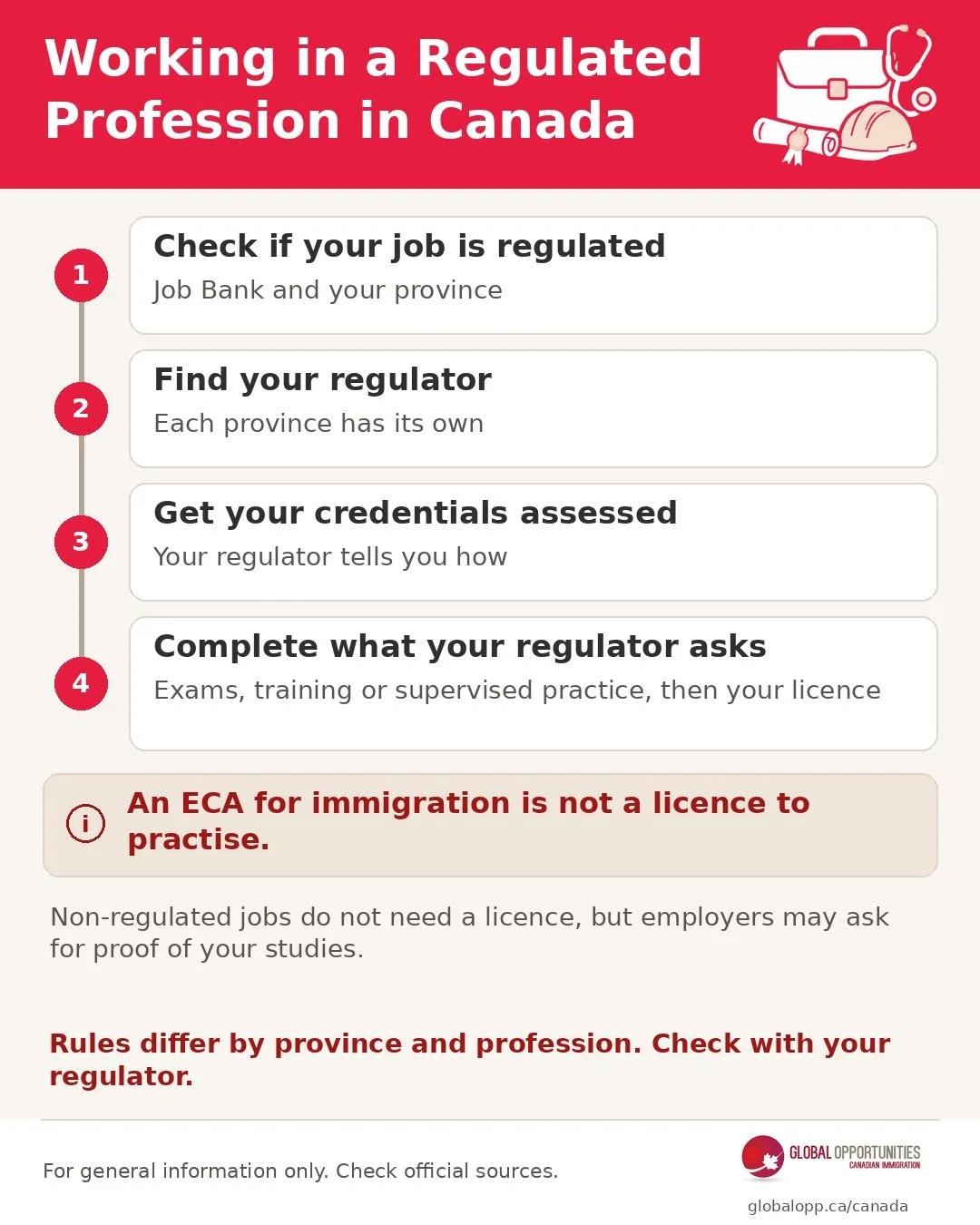
Regulated professions: licensing is provincial
In Canada, some occupations are regulated: you need a licence from a regulatory body in the province or territory where you will work, for example as an engineer, nurse, doctor, pharmacist or teacher. According to the Government of Canada's Foreign Credential Recognition page, a regulatory body in that province or territory assesses your credentials and issues licences, and it is a good idea to contact it early, ideally before you arrive.
IRCC also lists free pre-arrival services to prepare for work in Canada, including help with credential recognition. Eligibility depends on your situation.
Any regulator we mention is for reference only. The list may not be complete, and requirements must always be confirmed directly with the regulator in the province or territory where you plan to work.
Nurses from Asia
If you are a nurse educated in Asia, start with licensing early. According to the National Nursing Assessment Service (NNAS), NNAS collects and verifies the credentials of internationally educated nurses and prepares an Advisory Report for regulators. Its reports are accepted by nursing regulators across Canada except in Quebec and the territories, and NNAS does not grant licences: each provincial regulator decides. Check NNAS eligibility and the regulator in your target province. Read our full guide, Immigrate to Canada as a professional, which has a section for nurses. Step by step, including advice for Filipino and Indian nurses: how to immigrate to Canada as a nurse.
Engineers and IT professionals
Many IT roles are not regulated in Canada, while engineering is: each province has its own engineering regulator. Use Job Bank to see how your job is described in Canada.
Based on IRCC's ECA page, the Government of Canada's Foreign Credential Recognition page and NNAS, as of November 2026. An ECA is for immigration only: it is not a licence and does not mean a regulator will accept your qualifications.
Which English tests do you need to move to Canada from Asia?
Even if you studied in English, most Canadian economic immigration programs ask you to prove your language ability with an approved test. A degree taught in English does not replace the test for Express Entry. Our full English and French tests for Canada guide explains each test, the scoring and where to take it, with fee examples by country.
Which English tests IRCC accepts for Express Entry
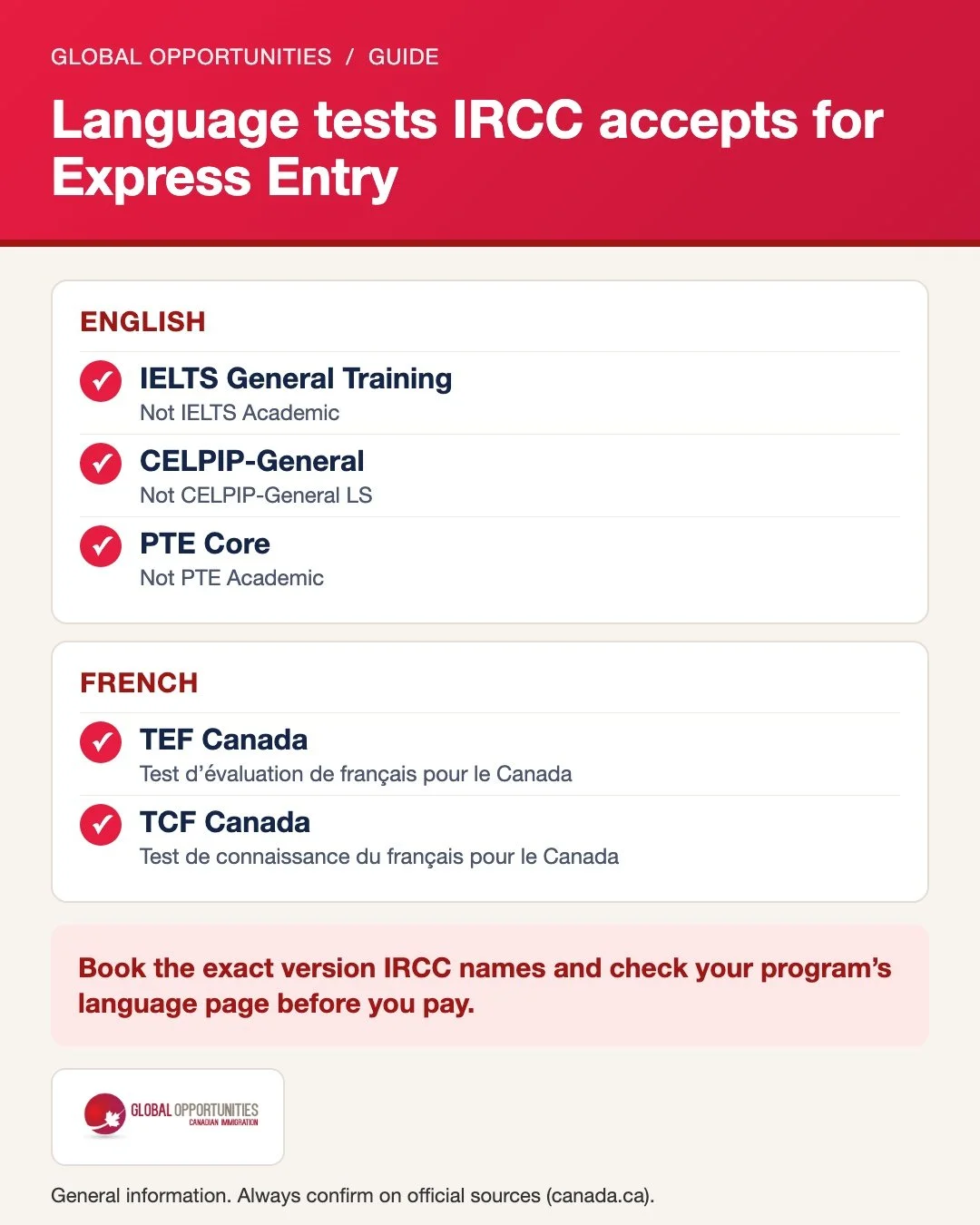
According to IRCC's Express Entry language test page, the accepted English tests are:
CELPIP: it must be the CELPIP-General test.
IELTS: it must be the General Training option. IRCC states that the IELTS One Skill Retake is not accepted for Express Entry.
PTE Core: it must be the PTE Core option of the Pearson Test of English.
The accepted French tests are TEF Canada and TCF Canada. Pay close attention to the exact name: IELTS Academic and PTE Academic, which many students in Asia take for university admission, are not on IRCC's Express Entry list. IRCC converts your results into Canadian Language Benchmark (CLB) levels for English and NCLC levels for French. Minimum levels and validity rules are on the official page. Provincial and other programs can set their own requirements.
TOEIC, TOEFL and Eiken are not on the Express Entry list
Many students and workers in Japan, Korea and Taiwan already have TOEIC, TOEFL or Eiken scores. These can help with school admission or job applications, but they are not among the tests IRCC lists for Express Entry. If you are planning permanent residence, book one of the three accepted English tests above.
IELTS General Training
The official IELTS site has a test centre finder where you can filter by country and by test type. Make sure you book IELTS General Training. The format is explained on the official IELTS General Training page. Not every centre offers both test types, so check that the centre lists General Training.
CELPIP-General
CELPIP has official country pages for several Asian countries, linked in each country section below. Centres and dates change, so check when you are ready to book.
PTE Core
According to Pearson's official PTE Core page, PTE Core is a computer-based test taken at an authorized test centre, it cannot be taken at home, and it is used for Canadian permanent residence and citizenship applications. Pearson directs people who want to study in Canada to PTE Academic instead. For PTE Core centres, dates and prices in your country, check Pearson's site.
Watch our live session on how CELPIP results fit into an immigration application.
Accepted tests as listed by IRCC, and test details as published by IELTS, CELPIP and Pearson, as of November 2026. Reaching a CLB level does not by itself make you eligible: each program sets its own minimum levels, so check the official page for yours.
Working Holiday from Asia: Japan, Korea, Taiwan and Hong Kong
International Experience Canada (IEC) is a Government of Canada program that lets eligible young people from countries and territories with a youth mobility agreement with Canada travel and work in Canada for a limited time. In Asia, IRCC's eligibility by country and category page lists four participants at the time of writing:
Japan: Working Holiday.
Republic of Korea: Working Holiday, Young Professionals and International Co-op (Internship).
Taiwan: Working Holiday, Young Professionals and International Co-op (Internship). IRCC's page notes that the Taiwanese passport must include the personal identification number.
Hong Kong SAR: Working Holiday.
India, the Philippines, Pakistan, Bangladesh, Nepal, Sri Lanka, China and Vietnam do not appear on that list at the time of writing. The list of countries and categories can change, so check the official page.
The three IEC categories
Working Holiday: for people without a job offer who want to work for different employers. It gives an open work permit.
Young Professionals: for people with a job offer in Canada that supports their professional development. It gives an employer-specific work permit. According to IRCC's IEC eligibility page, the job generally must be in TEER category 0, 1, 2 or 3 of the National Occupational Classification, and a TEER 4 job may qualify if it is in your field of study.
International Co-op (Internship): for post-secondary students outside Canada who need a work placement in Canada to complete their studies. It also gives an employer-specific work permit.
For Young Professionals and International Co-op, the Canadian employer has its own steps, including submitting the offer through IRCC's Employer Portal, as explained on IRCC's page for employers hiring through IEC.
How IEC works
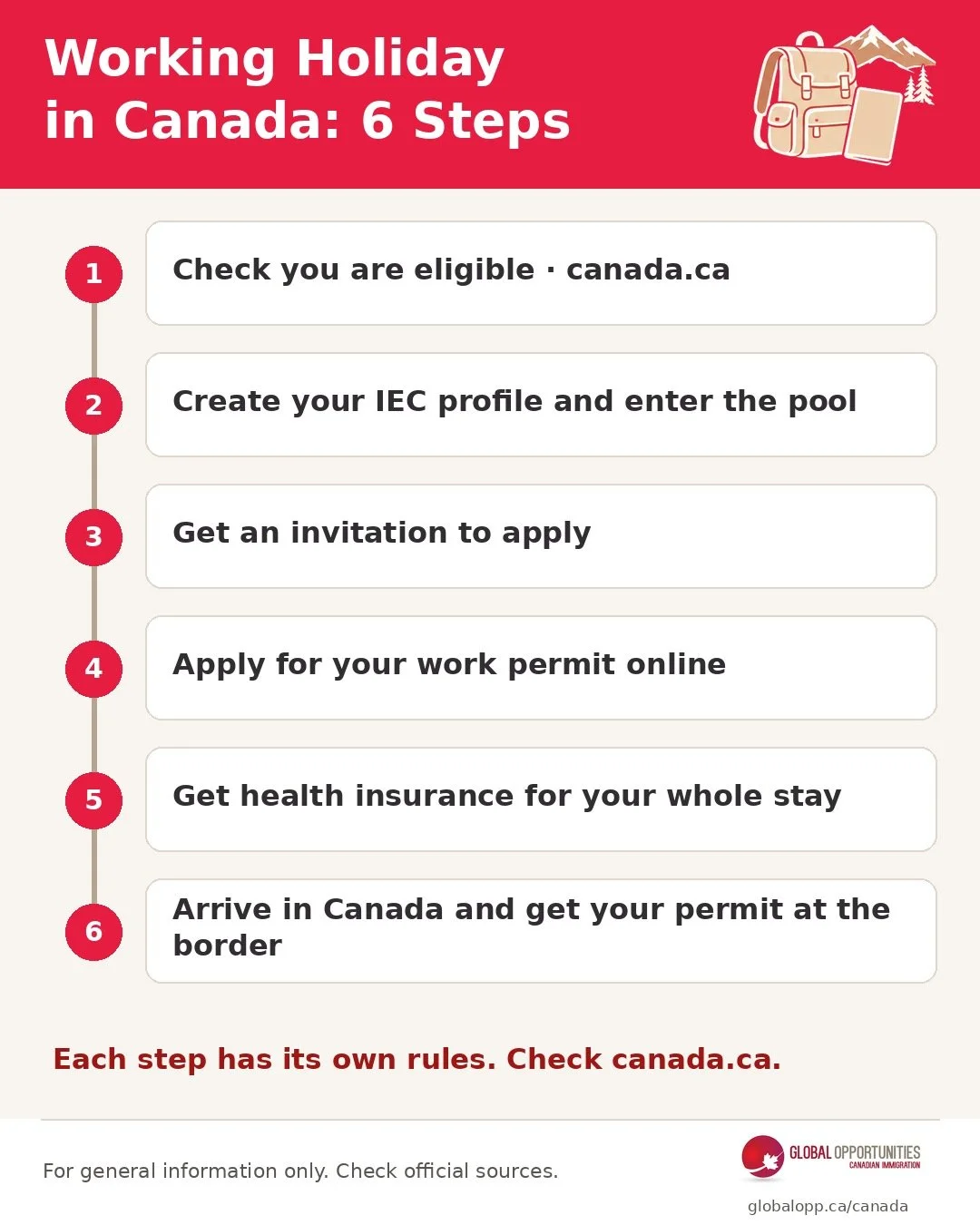
IEC is not first-come, first-served. In general, according to IRCC's page on how IEC works, you answer a questionnaire, submit a profile, enter one or more pools and wait for a possible invitation to apply for a work permit. An invitation is never guaranteed.
Age limits, the length of the work permit, required funds, health insurance rules, the number of times you can participate and fees are set by IRCC for each country and category, and they change, so read your country's section on the official page. IRCC states that if you are from an IEC country or territory, you do not have to use a recognized organization. Our overview page is Working Holiday in Canada.
Working Holiday tips for Japanese, Korean and Taiwanese participants
Prepare a Canadian-style resume before you arrive. Our newcomers guide includes a full sample.
Health care or child care jobs may require an immigration medical exam, according to IRCC's medical exam requirements for temporary residents. Plan this early.
Keep records of every job: contracts, pay stubs and reference letters. They matter if you later apply for permanent residence.
IEC participants and categories as listed by IRCC, as of November 2026. Being eligible to enter an IEC pool does not mean you will be invited, and a working holiday does not lead automatically to permanent residence.
Moving to Canada from India
India is the largest source of new immigrants to Canada: according to Statistics Canada, it was the top place of birth of people who immigrated from 2016 to 2021 (The Daily, 2022). That also means many Indian candidates are preparing at the same time, so careful planning pays off.

Visiting: IRCC's entry requirements by country or territory page lists Indian citizens as needing a visitor visa. Check the visa or eTA tool.
Working Holiday: India is not on IRCC's IEC eligibility by country list at the time of writing.
Study permits: the Student Direct Stream has ended, so Indian students apply through the regular stream. Confirm the school is a DLI, get the attestation letter where required, and pay tuition only to the school.
English tests: according to the IELTS test centre finder, IELTS General Training is offered by IDP in many cities, including New Delhi, Mumbai, Pune, Bengaluru, Chennai, Hyderabad, Kolkata, Ahmedabad, Chandigarh, Amritsar, Jalandhar, Ludhiana and Kochi. CELPIP has an official page, Take the CELPIP Test in India. For PTE Core, check Pearson's site.
Credentials: plan your ECA early, because assessment organizations often need documents sent directly by your university. If your profession is regulated, contact the provincial regulator.
Police certificate: IRCC explains how to get one on its India police certificate page. If you have lived in the Gulf or elsewhere, you may need certificates from those countries too.
Moving to Canada from the Philippines
According to Statistics Canada, the Philippines was the second most common place of birth of people who immigrated to Canada from 2016 to 2021 (The Daily, 2022).
Visiting: IRCC's entry requirements by country or territory page lists the Philippines as visa-required, but notes that some citizens of the Philippines may be eligible for an eTA if they meet certain requirements and travel by air. The visa or eTA tool will tell you which applies to you.
Living outside the Philippines? If you live or work in another country, remember that entry rules depend on your citizenship, and you may need police certificates from other countries where you have lived. See IRCC's general police certificates page.
Working Holiday: the Philippines is not on IRCC's IEC eligibility by country list at the time of writing.
English tests: according to the IELTS test centre finder, IELTS General Training is offered by the British Council and IDP in many cities, including Manila, Makati, Quezon City, Cebu, Davao, Iloilo and Baguio. CELPIP has an official page, Take the CELPIP Test in the Philippines. For PTE Core, check Pearson's site.
Nurses and health workers: nursing is regulated by each province. See the nurses section above and our guide for professionals.
Police certificate: Philippines.
Moving to Canada from Pakistan
Visiting: IRCC's entry requirements by country or territory page lists Pakistani citizens as needing a visitor visa.
Working Holiday: Pakistan is not on IRCC's IEC eligibility by country list at the time of writing.
English tests: according to the IELTS test centre finder, IELTS General Training is offered in cities such as Islamabad, Lahore, Karachi, Faisalabad, Multan and Peshawar. CELPIP has an official page, Take the CELPIP Test in Pakistan. For PTE Core, check Pearson's site.
Credentials: engineers, doctors, pharmacists and other regulated professionals should contact the Canadian regulator early. An ECA alone does not allow you to practise.
Police certificate: Pakistan.
Moving to Canada from Bangladesh
Visiting: IRCC's entry requirements by country or territory page lists Bangladeshi citizens as needing a visitor visa.
Working Holiday: Bangladesh is not on IRCC's IEC eligibility by country list at the time of writing.
English tests: CELPIP has an official page, Take the CELPIP Test in Bangladesh. For IELTS General Training and PTE Core, use the IELTS test centre finder and Pearson's site.
Students: if you are considering studying first, read the study section above, including the scam warnings, before paying any agent or school.
Credentials: ask your university early how it sends transcripts to Canadian assessment organizations.
Police certificate: Bangladesh.
Moving to Canada from Nepal
Visiting: IRCC's entry requirements by country or territory page lists Nepalese citizens as needing a visitor visa.
Working Holiday: Nepal is not on IRCC's IEC eligibility by country list at the time of writing.
English tests: CELPIP has an official page, Take the CELPIP Test in Nepal. For IELTS General Training and PTE Core, check the providers' sites.
Credentials: if you plan to use Nepalese education in Express Entry, you will need an ECA from a designated organization.
Police certificate: Nepal.
Moving to Canada from Sri Lanka
Visiting: IRCC's entry requirements by country or territory page lists Sri Lankan citizens as needing a visitor visa.
Working Holiday: Sri Lanka is not on IRCC's IEC eligibility by country list at the time of writing.
English tests: CELPIP has an official page, Take the CELPIP Test in Sri Lanka. For IELTS General Training and PTE Core, check the providers' sites.
Credentials: regulated professionals, such as accountants in some roles, engineers and health professionals, should check licensing with the provincial regulator.
Police certificate: Sri Lanka.
Moving to Canada from China
According to Statistics Canada, China was the third most common place of birth of people who immigrated to Canada from 2016 to 2021 (The Daily, 2022).
Visiting: IRCC's entry requirements by country or territory page lists citizens of the People's Republic of China as needing a visitor visa, including for a short English course.
Working Holiday: the People's Republic of China is not on IRCC's IEC eligibility by country list at the time of writing.
Studying English or a degree: According to Languages Canada, China is one of the top markets for Canadian language programs. Read the English section above, and check DLI status before you pay.
English tests: according to the IELTS test centre finder, IELTS General Training is offered in many cities, including Beijing, Shanghai, Guangzhou, Shenzhen, Chengdu and Wuhan; check that your centre lists General Training. CELPIP has an official page for China. For PTE Core, check Pearson's site.
Credentials: Chinese degrees often need verification through official channels before an assessment organization accepts them. Follow the instructions of the organization you choose.
Police certificate: China.
Moving to Canada from Hong Kong and Taiwan
Entry rules for Hong Kong SAR and Taiwan passport holders are different from those for the People's Republic of China. IRCC lists holders of a Hong Kong SAR passport, and holders of an ordinary Taiwanese passport that includes the personal identification number, among the travellers who need an eTA when flying. Run the visa or eTA tool with your own passport.
Hong Kong
Entry: IRCC's entry requirements by country or territory page lists holders of a passport issued by Hong Kong SAR among the travellers who need an eTA when flying.
Working Holiday: IRCC's eligibility by country page lists Hong Kong with the Working Holiday category.
Taiwan
Working Holiday and more: according to IRCC's IEC eligibility by country page, Taiwan takes part in IEC with Working Holiday, Young Professionals and International Co-op.
Studying English: According to Languages Canada, Taiwan is one of the top markets for Canadian language programs. See the English section above.
Driving: Ontario's official page Exchange an out-of-province driver's licence lists Taiwan, Japan and South Korea among the places from which you can exchange a licence, subject to conditions. Other provinces have their own rules.
English tests: CELPIP has an official page for Taiwan.
Police certificate: Taiwan.
Moving to Canada from Vietnam
Visiting: IRCC's entry requirements by country or territory page lists Vietnamese citizens as needing a visitor visa.
Working Holiday: Vietnam is not on IRCC's IEC eligibility by country list at the time of writing.
English tests: according to the IELTS test centre finder, IELTS General Training is offered in cities such as Hanoi, Ho Chi Minh City and Da Nang. For CELPIP-General and PTE Core in Vietnam, check each provider's site; availability changes.
Students: if you are considering a study permit, confirm the school is a DLI and read IRCC's student scam warnings.
Police certificate: Vietnam.
Moving to Canada from Japan
Visiting: IRCC's entry requirements by country or territory page lists Japanese citizens among the travellers who need an eTA to fly to Canada. An eTA does not allow you to work or study in a long program.
Studying English: see "Studying English in Canada" above.
Working Holiday: Japan has a youth mobility agreement with Canada, and IRCC lists the Working Holiday category for Japanese citizens. Participation rules are on the official page.
From Working Holiday to permanent residence? Skilled, paid work in Canada may count toward the Canadian Experience Class if it meets the rules; it is never automatic.
English tests: according to the IELTS test centre finder, IELTS General Training is offered in Tokyo, Yokohama, Osaka, Kyoto, Nagoya, Fukuoka, Hiroshima and Sendai. CELPIP has an official page, Take the CELPIP Test in Japan. TOEIC and Eiken are not on IRCC's Express Entry list. French speakers can also look at TEF Canada and TCF Canada.
Driving: Ontario lists Japan among the places from which you can exchange a licence, subject to the conditions on its official page.
Police certificate: Japan.
Moving to Canada from South Korea
Visiting: IRCC's entry requirements by country or territory page lists citizens of the Republic of Korea among the travellers who need an eTA to fly to Canada.
Studying English: According to Languages Canada, South Korea is one of the top sources of students in Canadian language programs. Read the section "Studying English in Canada" above for the study permit, work and school rules.
Working Holiday and more: IRCC lists three IEC categories for Korean citizens: Working Holiday, Young Professionals and International Co-op (Internship). Each has its own participation rules on the official page. Young Professionals can suit graduates who already have a Canadian job offer in their field.
English tests: according to the IELTS test centre finder, IELTS General Training is offered in Seoul, Busan, Daegu, Daejeon and Incheon. CELPIP has an official page, Take the CELPIP Test in Korea. For PTE Core, check Pearson's site.
Credentials: if you plan to work in a regulated profession, such as nursing or engineering, contact the provincial regulator early.
Driving: Ontario's official page lists South Korea among the places from which you can exchange a licence, subject to conditions.
Police certificate: South Korea.
Moving to Canada from Iran
The general sections of this guide apply to Iranian citizens too: Express Entry and provincial programs, ECAs, approved language tests and fraud warnings. A few steps work differently:
Entry: run IRCC's visa or eTA tool with your Iranian passport.
Passport submission: IRCC's where to submit your passport page says applicants from Iran can submit their passport in person at a visa application centre in Istanbul or Ankara, Türkiye. Send it only when IRCC asks.
Police certificate: according to IRCC's police certificate page for Iran, the document is a "certificate of no criminal record". In Iran you apply in person at a police+10 centre or online through the Sana system (the online link works only from inside Iran); from abroad, at the nearest Iranian embassy. IRCC notes that, because the Iranian embassy in Canada is closed, Iran's Ministry of Foreign Affairs offers an alternative for Iranians living in Canada, with information only in Persian.
Credentials and tests: plan your ECA and your approved language test early, as explained in the qualifications and English test sections above.
Passport and police certificate instructions as published by IRCC, as of November 2026. IRCC's country pages can change: check them before you apply.
Moving to Canada from the UAE and the Gulf
Many people from India, Pakistan, the Philippines and other countries live and work in the United Arab Emirates, Qatar, Saudi Arabia, Kuwait or Oman. If that is you, remember that your passport, not your residence, decides whether you need a visa or an eTA: run IRCC's visa or eTA tool with the passport you travel on.
Police certificates: IRCC's police certificate page for the UAE says you need only one clearance, from any emirate: a police clearance certificate, a criminal clearance certificate or a good conduct certificate. You can request it at the police department of your emirate (in person or through a representative with a power of attorney), online through Dubai Police, or at the nearest UAE embassy if you have left. As IRCC's police certificates page explains, you may also need certificates from your country of citizenship and other countries where you have lived.
Passport submission: when we checked, IRCC's where to submit your passport page listed visa application centres in Dubai and Abu Dhabi (UAE), Doha (Qatar), Riyadh, Jeddah and Al Khobar (Saudi Arabia), Kuwait City (Kuwait) and Muscat (Oman). Follow the instructions IRCC sends you.
Work experience: experience gained in the Gulf can count for some programs if it meets the program's rules; keep detailed reference letters that describe your duties, as IRCC's pages explain.
Police certificate and passport instructions as published by IRCC, as of November 2026. Each case is different: check IRCC's pages for your passport and your program before you apply.
Moving to Canada from other Asian countries
People also move from Thailand, Malaysia, Singapore, Indonesia and many other countries. The same rules apply:
Entry: run the official visa or eTA tool with your passport.
Working Holiday: check whether your country appears on IRCC's IEC eligibility by country page.
Police certificates: IRCC's police certificates page has instructions for each country.
English tests: use each provider's official finder; CELPIP lists centres in Malaysia, Singapore and Thailand.
Fraud, fake job offers and unauthorized agents
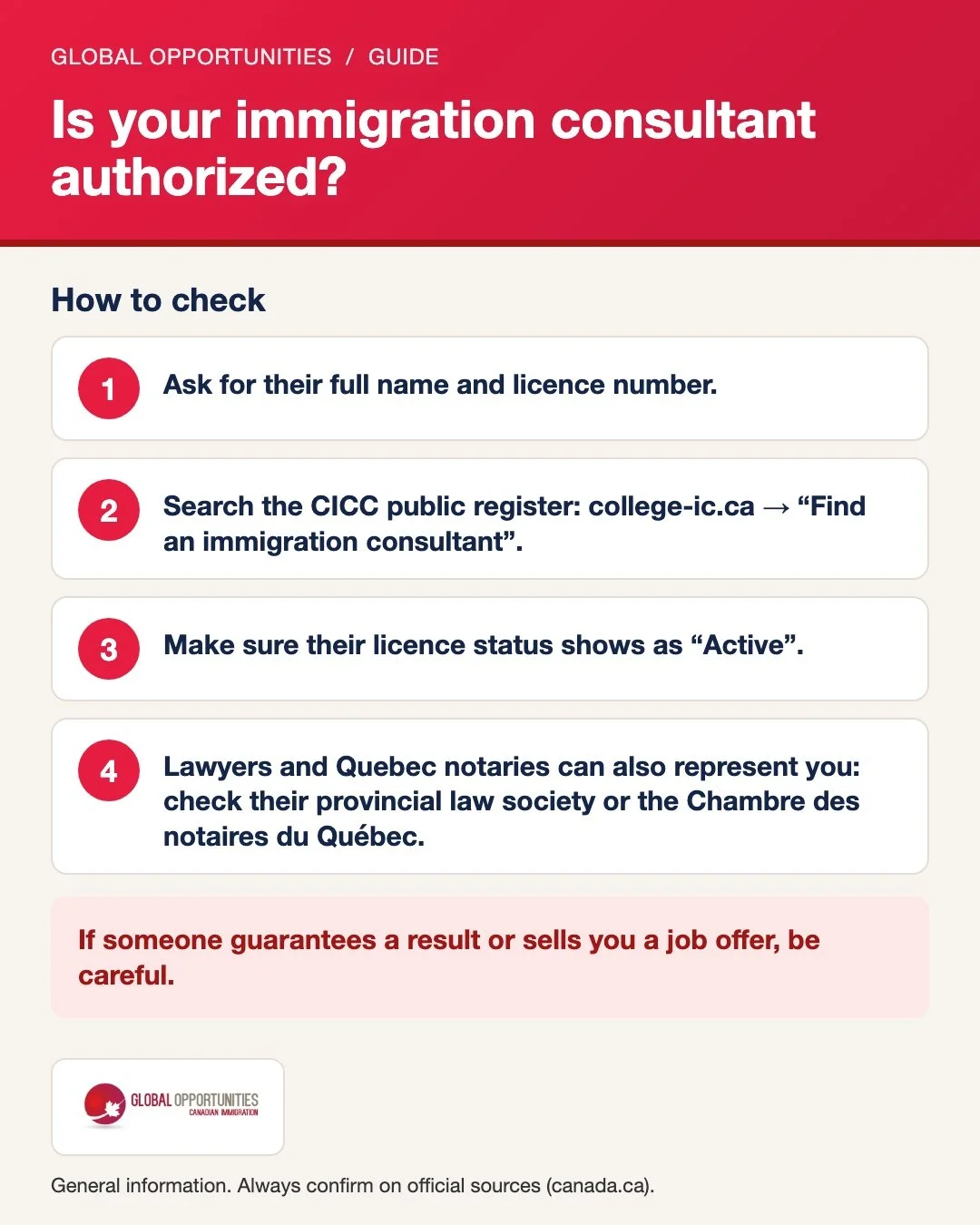
Immigration fraud targets people in every country. IRCC notes that newcomers and international students are specific targets. This is one of the most important sections of this guide. IRCC's main page on protecting yourself from fraud is the place to start.
What IRCC says no one can do
According to IRCC's pages on online and telephone scams and fraud targeting newcomers:
No one can guarantee you a job, a visa or permanent residence in Canada. Only IRCC officers make decisions.
IRCC does not offer special deals or faster processing in exchange for extra money.
IRCC will never ask for payment by telephone, into a personal bank account or through private money transfer services or prepaid cards.
Fake job offers
Warning signs, based on IRCC's guidance:
The salary seems too high to be real.
Someone asks you to pay for a job offer, a Labour Market Impact Assessment (LMIA) or "guaranteed" entry. The LMIA is something the employer applies for; see our page on the LMIA.
The offer arrives without a real interview, or the employer cannot be found on its own official website.
You are asked to send money or documents through social media, messaging apps or a personal account.
A "government" email comes from a free webmail address instead of an address ending in gc.ca or canada.ca.
Global Opportunities does not offer jobs. To look for real job postings, use Job Bank, the Government of Canada's job site.
Unauthorized agents
You do not have to pay anyone to apply. If you choose to pay a representative, IRCC's page Check if your representative is authorized explains that only these people may charge for immigration advice or representation:
immigration and citizenship consultants who are members of the College of Immigration and Citizenship Consultants (CICC);
lawyers and notaries who are members of a Canadian provincial or territorial law society, or notaries of the Chambre des notaires du Québec;
paralegals in Ontario who are members of the Law Society of Ontario.
Unauthorized local "agents" have no special connection with Canadian officers. Education agents who help you choose a school are different from immigration representatives: if anyone prepares or submits your immigration application, they must be declared on it. Learn more on IRCC's page about using a representative.
False documents have serious consequences
Misrepresentation can lead to serious penalties, even if an agent prepared the documents (see the consequences of fraud). Never sign an application you have not read, and keep your own account password.
How to report fraud
IRCC's report fraud page lists the channels, including IRCC's own form, the Canadian Anti-Fraud Centre, the police and the CICC complaint process. IRCC notes that its goal is to stop the people committing fraud, not to punish the people who were misled.
Learn the Canadian resume format and how to spot job scams.
Based on IRCC's fraud and representative pages, as of November 2026. Check any paid representative yourself on the CICC or law society register before you sign or pay.
Budget, documents and what to bring when moving to Canada from Asia
Planning your budget in general terms
We do not publish program fees or the money IRCC asks you to show. Fees are on canada.ca, and the proof of funds that applies depends on each case and on the program, so a consultation is the way to know what applies to you. For your own budget, price each item from official or provider sources:
Before you leave: language test, ECA, translations, police certificates, medical exam, IRCC fees, biometrics and flights.
First months: rent and deposits, furniture, phone, transit, groceries, winter clothing and health insurance until provincial coverage starts.
Students: tuition, books, housing and a student health plan.
IRCC's Prepare financially page explains that the cost of living varies depending on where you settle. For rents, use the CMHC Rental Market Reports; our province guides give official rent and transit figures with dates.
Documents to bring in your hand luggage
Passport, and your permit approval letter or confirmation of permanent residence.
Letter of acceptance (students) and proof of funds.
Degrees, transcripts and, if you have it, your ECA report.
Work reference letters, contracts and recent pay slips.
Your driving licence and, if you will try to exchange it, a driving record from your home country and an official translation where required.
Marriage and birth certificates for your family.
Vaccination records and a list of your prescriptions.
Bringing your belongings
If you are moving to Canada to live, the Canada Border Services Agency explains how to import your personal and household goods on its page Moving or returning to Canada, and many people prepare a list of goods using the BSF186 Personal Effects Accounting Document. Food, plants and animal products have strict rules, so check before you pack traditional foods or medicines. If you carry a large amount of money, read CBSA's rules on declaring it. Moving with a dog or cat? Read our guide to immigrating to Canada with your pet.
Most of Canada has a cold, snowy winter; you can buy a good coat and boots once you arrive. Our newcomers guide has a first-winter checklist.
Tax treaties
Canada has income tax treaties in force with many Asian countries, including India, the Philippines, Pakistan, Vietnam and the United Arab Emirates, according to the Department of Finance's list of tax treaties in force. A treaty can matter if you keep income, property or investments in your home country after you move. How it applies depends on your situation, so ask a tax professional.
Customs and currency rules as published by the Canada Border Services Agency, and the tax treaty list as published by the Department of Finance, as of November 2026. They may have changed by the time you read this: check the linked pages before you pack.
Planning checklist for moving to Canada from Asia
Use this as a general order of steps. Not every step applies to everyone.
Check your entry document with the official visa or eTA tool, using the passport you will travel with.
Define your goal: a short English course, a degree or diploma, a Working Holiday, or permanent residence. Each has different rules.
Read the official program page for your goal on canada.ca, including fees and current requirements.
Choose your province with our province guides, and check the provincial program pages if you are thinking of a PNP.
Book the right English test (IELTS General Training, CELPIP-General or PTE Core for Express Entry), or IELTS Academic or another test only if your school asks for it.
Start your ECA if you will use foreign education in Express Entry.
Contact your regulator if your occupation is regulated in Canada.
Request police certificates from every country where IRCC asks for them, following the country pages.
Check whether you need an immigration medical exam.
Verify your school or representative: DLI list for schools, CICC or law society register for paid representatives.
Prepare your budget and documents as described above.
Plan your first weeks: temporary housing, SIN, bank account, health coverage and a phone plan.
Your first weeks after moving to Canada from Asia
Our detailed Newcomer's Guide explains every first-weeks step, including housing, tenant rights, credit, health care, driving, winter and a sample Canadian resume.
The essentials, with official links:
Get your Social Insurance Number. Service Canada's SIN page explains how to apply online, by mail or in person, and states that there is no fee.
Open a bank account. According to the Financial Consumer Agency of Canada, you can open an account with proper identification even if you are not a Canadian citizen.
Sort out health coverage. Each province and territory has its own health plan, and some have a waiting period. See IRCC's page on health care in Canada.
Look for free newcomer services. IRCC's newcomer services finder lists settlement organizations outside Quebec. Eligibility depends on your status. IRCC also lists free pre-arrival services for some people before they travel.
Start your job search on Job Bank and through your professional network.
Planning for the long term? Our Canadian citizenship guide covers physical presence, the test and dual citizenship.
Based on Service Canada, the Financial Consumer Agency of Canada and IRCC, as of November 2026. Health coverage and waiting periods are set by each province or territory, so check the plan where you will live.
Frequently asked questions
Do I need a visa when moving to Canada from Asia?
It depends on your citizenship, not on where you live. At the time of writing, IRCC lists citizens of India, Pakistan, Bangladesh, Nepal, Sri Lanka, China and Vietnam as needing a visitor visa. Citizens of Japan and South Korea, and holders of Hong Kong SAR passports and ordinary Taiwanese passports with the personal identification number, need an eTA to fly. Some citizens of the Philippines and Thailand may qualify for an eTA if they fly and meet certain conditions. Use the official visa or eTA tool before every trip. A visa or eTA only lets you travel; work and long studies need a permit. See the visa section above.
Can Filipinos get an eTA instead of a visa when moving to Canada from the Philippines?
Possibly. IRCC notes that some citizens of the Philippines may be eligible for an eTA if they meet certain requirements and fly to Canada; the conditions are on its eTA eligibility page. If you arrive by land or sea, you still need a visitor visa. The official tool asks a few questions and tells you which document applies. Apply for an eTA only on canada.ca, never on look-alike websites. If you are coming to work or study, the permit is a separate application. See the Philippines section above.
Can Thai citizens get an eTA?
Possibly, if they fly. At the time of writing, IRCC's entry requirements by country or territory page lists Thailand as a visa-required country whose citizens may be eligible for an electronic travel authorization (eTA) instead of a visitor visa, but only when travelling by air and only if they meet certain requirements. IRCC explains those requirements on its eTA eligibility page, and they can change, so read them on the day you apply. If you arrive by land or sea, including on a cruise ship, you need a visitor visa. The same page lists other Asian countries in this group, including the Philippines, Indonesia and Malaysia. An eTA lets you travel, not work or study. Apply only on canada.ca, never through look-alike websites. See the visa section above.
Do I need a transit visa to connect through Vancouver or Toronto?
It depends on your passport. According to IRCC's transit page, travellers from visa-required countries generally need a transit visa when they connect between two international flights at a Canadian airport, such as Vancouver or Toronto, if the transit lasts 48 hours or less; for longer stays, IRCC says you need a visitor visa. Travellers from visa-exempt countries, such as Japan and South Korea, need an eTA to transit by air. IRCC also explains that holders of passports from China, Indonesia, the Philippines, Thailand and Taiwan (for Taiwanese passports without a personal identification number) may be able to transit without a visa when travelling to or from the United States, if they meet certain conditions. Indian passports were not on that list when we checked. Check the official tool before you book.
Which countries in Asia have a Working Holiday with Canada?
At the time of writing, IRCC lists Japan, the Republic of Korea, Taiwan and Hong Kong SAR as Asian participants in International Experience Canada. Japan and Hong Kong have the Working Holiday category; Korea and Taiwan also have Young Professionals and International Co-op. India, the Philippines, China, Vietnam and other countries in South and Southeast Asia are not on the list. The list and the participation rules can change, so check the eligibility by country page. An invitation is never guaranteed. See the Working Holiday section above.
Can Indians or Filipinos apply for a Working Holiday in Canada?
Not through their Indian or Filipino citizenship, at the time of writing. International Experience Canada (IEC), which includes the Working Holiday category, is open only to citizens of the countries and territories on IRCC's eligibility by country page, and India and the Philippines are not on that list. Living or working in a participating country does not change this, because IEC depends on your citizenship; if you also hold the citizenship of a participating country, its rules apply. Common alternatives include a study permit, an employer-supported work permit or, if you are eligible, Express Entry or a provincial nominee program. None of these is a working holiday, and each has its own requirements. Canada can sign new youth mobility agreements, so check the official page. See the Working Holiday and skilled pathways sections above.
Do I need a study permit to study English in Canada?
Not for a short program. According to IRCC, "you don't need a study permit if you're coming to Canada for a program that lasts 6 months or less," as long as you finish it within your authorized stay. You still need an eTA or a visitor visa, depending on your passport. Longer programs generally need a study permit, and the school must be a designated learning institution. Many language schools are not DLIs, so check the DLI list before you pay. See the English section above.
Can I work while studying English in Canada?
Generally not. According to IRCC, students enrolled only in an English or French as a second language program cannot work off campus, and visitors on a short course cannot work at all. English studies alone also do not qualify for a post-graduation work permit or allow a spouse to get an open work permit. If you want to combine English and work, check whether your country takes part in International Experience Canada: Working Holiday participants can work and may take individual courses within IRCC's limits. See the English and Working Holiday sections above.
What is the best city in Canada to study English?
There is no single best city; it depends on what you want. Compare the school, rents from CMHC data and the climate, using Environment and Climate Change Canada's Canadian Climate Normals, before deciding. In Montreal, keep in mind that French is the official language of Quebec. Our province guides describe each city in detail. See the section on choosing a city above.
Can a Working Holiday from Japan or Korea lead to permanent residence?
It can be a first step, but it is never automatic. The Canadian Experience Class considers skilled, paid work experience gained in Canada while you were authorized to work. Whether your Working Holiday jobs count depends on the occupation, the hours, how long you worked and the rules when you apply, and invitations are never guaranteed. Keep contracts, pay stubs and reference letters from every job, and read the official Canadian Experience Class page. See the Japan and South Korea sections above.
Does Global Opportunities speak Japanese, Korean or Chinese?
No. Global Opportunities works in English and Spanish only. We do not offer services in Japanese, Korean, Chinese, Hindi, Tagalog or other Asian languages. If you would like our support, you will need to be comfortable communicating in English, or have someone you trust help you. Free settlement organizations in Canada can also help newcomers, and IRCC's newcomer services finder can help you find them once you are eligible. Official IRCC forms and pages are in English and French. See the note on languages in the English section above.
Has the Student Direct Stream (SDS) ended for students from Asia?
Yes. IRCC's notice explains that the Student Direct Stream ended, and that study permit applications are now processed through the regular study permit stream. This affects students from India, the Philippines, Pakistan, Vietnam, China and other countries that used it. The regular stream has its own document list, including a letter of acceptance, proof of funds and, in most cases, a provincial or territorial attestation letter. If an agent still offers an "SDS" or "fast track" application, ask them to show you where that appears on canada.ca. Read IRCC's notice. See the study section above.
Do I need a medical exam to study or work in Canada from Asia?
It depends on how long you will stay, where you have lived recently and the job you will do. IRCC's medical exam requirements for temporary residents page explains the cases, with its country list, and only an IRCC panel physician can do the exam. The medical exams section above has the details.
Do I need a job offer when moving to Canada from Asia as a skilled worker?
Not always. Some programs, such as the Federal Skilled Worker Program through Express Entry, do not always require a job offer. Other programs, and many provincial streams, do, sometimes from an employer in a specific province or region. Be very careful with anyone who offers to sell you a job offer: IRCC warns that no one can guarantee you a job or a visa, and paying for an LMIA or a job offer is a common scam. Eligibility and invitations are never guaranteed. See the skilled pathways and fraud sections above.
Which English tests are accepted when moving to Canada from Asia?
For Express Entry, IRCC accepts CELPIP-General, IELTS General Training and PTE Core. IELTS Academic, PTE Academic and the IELTS One Skill Retake are not on that list, and neither are TOEIC, TOEFL or Eiken. For French, IRCC accepts TEF Canada and TCF Canada. Your results are converted into Canadian Language Benchmark levels, and minimum levels and validity rules are on IRCC's language test page. Schools and provincial programs may set their own requirements. Our tests guide compares the three English tests. See the English tests section above.
Where can I take IELTS General Training or CELPIP in Asia?
IELTS General Training is available in most Asian countries through the British Council, IDP and partner centres. Use the official IELTS test centre finder and filter by General Training, because not every centre offers both test types. CELPIP has official pages for India, the Philippines, Pakistan, Bangladesh, Nepal, Sri Lanka, China, Taiwan, Japan and South Korea. PTE Core is offered at Pearson test centres in many countries. Dates and prices change, so check each provider when you are ready to book. See the country sections above.
Do I need an ECA for my degree when moving to Canada from Asia?
For the Federal Skilled Worker Program, and to get points for foreign education in Express Entry, IRCC requires an Educational Credential Assessment from a designated organization; physicians, pharmacists and architects may need a designated professional body instead. Many organizations ask for transcripts sent directly by your university, so start early. An ECA is not a licence to practise a regulated profession and does not guarantee a job. Check the current list on IRCC's ECA page. See the qualifications section above.
Can I work as a nurse after moving to Canada from the Philippines or India?
Only after you are licensed by the nursing regulator of the province where you will work. Immigration and licensing are separate processes, and you can start licensing before you move. In most provinces, internationally educated nurses begin with the National Nursing Assessment Service (NNAS), which verifies documents and prepares an Advisory Report for the regulator but does not grant licences. Some provinces have their own routes for nurses from certain countries, so check the regulator directly. See our guide for professionals and the nurses section above. Step by step, including advice for Filipino and Indian nurses: how to immigrate to Canada as a nurse.
Can I work as an engineer in Canada with an Asian degree?
You can work in many engineering-related jobs, but to call yourself an engineer or take legal responsibility for engineering work, you need a licence from the engineering regulator of your province. Each province has its own regulator and process, which usually includes an academic assessment, experience review and an ethics or law exam. IT and software roles are generally not regulated, so a licence is not required, although employers will look closely at your experience and English. Contact the regulator early, and use IRCC's free pre-arrival services if you are eligible. See the qualifications section above.
Does studying in Canada lead to permanent residence for people moving to Canada from Asia?
Not automatically. Some graduates of certain institutions may be eligible for a post-graduation work permit, and Canadian work experience after graduation may help in programs such as the Canadian Experience Class or some provincial streams. But the rules change often: according to IRCC's post-graduation work permit eligibility page, IRCC has added a field of study requirement for many college programs and a language requirement for post-graduation work permits. No school, agent or consultant can promise permanent residence. Choose a program that makes sense for your career even if your immigration plans change. See the study section above.
How do I choose a college or university in Canada from Asia?
Start with your goal and your previous studies. Confirm that the institution is on the DLI list, check whether the specific program can lead to a post-graduation work permit under IRCC's current rules, and look at co-op options, student support and the city. Ask how the school handles attestation letters for its province and whether it accepts your English test. Pay tuition only to the school and get every promise in writing. Our province guides describe the colleges and universities in each region, for example Ontario and British Columbia. See the study section above.
Can I exchange my Japanese, Korean or Taiwanese driving licence in Canada?
It depends on the province. Ontario's official page lists Japan, South Korea and Taiwan among the places from which you can exchange a licence, subject to conditions, and says you can use a valid licence from another country for 60 days after you move to Ontario. Motorcycle and commercial classes have different rules. Other provinces have their own lists, so check the licensing office where you will live. Our newcomers guide explains graduated licensing and car insurance. See the Japan, Korea and Taiwan sections above.
Can I exchange my Indian or Filipino driving licence in Canada?
In most cases you cannot exchange it directly; you take tests instead. Licences are provincial. Alberta's exchange page does not list India or the Philippines among the jurisdictions whose licences it exchanges without testing: drivers from other places pass a knowledge test, surrender their licence and take a road test, and Alberta describes a program that may let experienced drivers reach the road test sooner. In British Columbia, ICBC's page for people moving from another country says drivers from non-reciprocal places must pass a knowledge test and a road test, and that you need proof of your driving history; without enough proven experience, you enter graduated licensing. Ontario publishes its own exchange list and rules. Bring an official driving record from home. See our newcomers guide for graduated licensing.
How can I tell if a job offer is fake when moving to Canada from Asia?
Be careful if you are asked to pay for the offer or an LMIA, if the salary seems too high to be real, if there was no real interview, if the company cannot be found on its own website or if payment goes to a personal account. Offers sent only through social media or messaging apps are another warning sign. IRCC says no one can guarantee a job or a visa. Search for real jobs on Job Bank, and report suspected fraud to the Canadian Anti-Fraud Centre. Global Opportunities does not offer jobs. See the fraud section above.
How do I check if an immigration agent is authorized?
Only certain people may charge you for Canadian immigration advice: consultants who are members of the College of Immigration and Citizenship Consultants, lawyers and notaries who belong to a Canadian law society or the Chambre des notaires du Québec, and Ontario paralegals licensed by the Law Society of Ontario. Search the CICC Public Register or the law society directory, and compare the name and licence number with the contract. Education agents who help with school choice are not immigration representatives. Anyone who prepares your application must be declared on it. See the fraud section above.
Why was my Canadian visa refused, and should I reapply?
An officer refuses a visitor visa when they are not satisfied that you meet the requirements. According to IRCC's visitor visa eligibility page, the officer checks that you have a valid passport, are in good health and have no criminal or immigration-related convictions, that your ties to your home country, such as a job, a home, financial assets or family, will take you back, that you will leave at the end of your visit, and that you have enough money for your stay. Read the refusal letter for the general reason, and if you need more detail you can ask for your file under IRCC's Privacy Act request process. Reapply only when you can address the reason with real changes or better evidence. To understand how officers assess applications, read Canada visa refusals: how IRCC evaluates applications.
Where do I give biometrics when moving to Canada from Asia?
Usually at a visa application centre or another official collection point, after IRCC sends you a biometric instruction letter. Use IRCC's collection point finder to see the centres in your country; large countries such as India, China and the Philippines have several. Visa application centres are private companies under contract with the Government of Canada: they collect biometrics and documents, but they do not make decisions and are forbidden to give visa advice. If you gave biometrics before, you may not need to give them again for a while. See the biometrics section above.
Do I need a police certificate when moving to Canada from Asia?
Many applications require police certificates, sometimes from several countries where you have lived, for example if you worked in the Gulf or Singapore. IRCC's police certificates page explains who needs one, when to request it and how to get it in each country, with separate pages for India, the Philippines, Pakistan, Bangladesh, Nepal, Sri Lanka, China, Taiwan, Vietnam, Japan, South Korea and many others. Some countries take a long time to issue certificates, so follow IRCC's instructions on timing. See the country sections above.
How much money do I need to move to Canada from Asia?
We do not publish the amounts IRCC asks you to show, or program fees. Fees are on canada.ca, and the proof of funds that applies depends on each case and program; a consultation is the way to know what applies to you. For your own budget, include the language test, credential assessment, translations, police certificates, medical exam if required, IRCC fees, flights, temporary housing, rent deposits, winter clothing and health insurance until provincial coverage begins. Rents vary a lot between cities: use the official CMHC Rental Market Reports and IRCC's Prepare financially page. See the budget section above.
What should I bring when moving to Canada from Asia?
In your hand luggage, carry your passport, your permit approval or confirmation of permanent residence, your letter of acceptance if you are a student, proof of funds, degrees, transcripts, your ECA report, work reference letters, your driving licence and driving record, and family certificates. If you are moving to live in Canada, read CBSA's page on moving or returning to Canada and prepare a list of your goods. Check CBSA's rules before packing food or traditional medicines. Buy your winter coat in Canada. See the what to bring section above.
What food and spices can I bring to Canada from India or the Philippines?
Declare all of it. The Canadian Food Inspection Agency (CFIA) states on its page Bringing food into Canada for personal use that travellers must declare all food products they bring into Canada. From countries other than the United States, the CFIA says fresh, dried and cured meats are not permitted, and only some commercially prepared, shelf-stable and sealed meat products are allowed, so check before you pack home-made meat dishes. For dairy, it lists ice cream, yogurt, kashk and pasteurized cheese as permitted from any country. For spices, pickles, sweets, dried fish or rice, check the product in the CFIA's Automated Import Reference System (AIRS). The Canada Border Services Agency explains what you must declare. If in doubt, declare it.
Do I have to declare cash or gold when I land in Canada?
Cash, yes, above a set value. The Canada Border Services Agency (CBSA) states on its currency reporting page that you must report currency or monetary instruments worth 10,000 Canadian dollars or more, in Canadian or foreign currency or a mix, when you enter or leave Canada. Monetary instruments include stocks, bonds, cheques, money orders, bank drafts and traveller's cheques. Carrying money is legal, but if you do not report the full amount, the CBSA can seize it and apply a penalty. CBSA's currency page does not mention gold; jewellery and other goods are covered by CBSA's general rules on what you must declare, so declare gold and valuable jewellery when in doubt and ask the officer. Keep receipts for items you already own. See the section on bringing your belongings.
Where do I start after arriving in Canada from Asia?
Start with your Social Insurance Number, a bank account, health coverage, a phone plan and housing, then your job search or school orientation. Free settlement organizations can help; find them with IRCC's newcomer services finder, and check whether your status makes you eligible. Our Newcomer's Guide explains every step in detail, including renting, tenant rights, building credit, health care, driving, winter clothing and a full sample Canadian resume and cover letter you can adapt to your own experience. See the first weeks section above.
Related guides
How Global Opportunities can help
Global Opportunities is a private immigration firm in Toronto. If you are planning a move from Asia, we can help you understand which Canadian programs may fit your profile and what to prepare. We cannot guarantee an invitation, a permit or a result: every decision is made by IRCC or the province. We work in English and Spanish; we do not offer services in Asian languages.
Our regulated consultant: Lic. Mildrete Monserrath Gutierrez Martinez, Regulated Canadian Immigration Consultant (RCIC), CICC licence R514880. Verify her licence on the CICC Public Register: https://college-ic.ca/protecting-the-public/find-an-immigration-consultant. Global Opportunities does not offer services for Quebec's immigration programs. Global Opportunities is a private firm and is not part of the Government of Canada or any provincial government.
Recorded seminars and lives: watch our recorded seminars in English or the Spanish recordings, and find everything on our YouTube channel.
More articles in English: read our Moving to Canada articles on topics such as health care, cost of living, the ECA and professional licences, and building community in Canada.
Personalized consultation: to review your situation, contact us through our contact page or write to info@globalopp.ca.
Prefer email? Tell us what you need help with (moving to Canada from Asia) and we will reply: email info@globalopp.ca.
Contact Global Opportunities →
Sources
IRCC: End of the Student Direct Stream and Nigeria Student Express
IRCC: Post-graduation work permit, field of study requirement
Languages Canada: 2025 Annual Survey Report, Executive Summary
CELPIP country pages: India · Philippines · Pakistan · Bangladesh · Nepal · Sri Lanka · China · Taiwan · Japan · Korea
IRCC: Hire skilled youth through International Experience Canada
Government of Ontario: Exchange an out-of-province driver's licence
IRCC: Police certificates and country pages for India, Philippines, Pakistan, Bangladesh, Nepal, Sri Lanka, China, Taiwan, Vietnam, Japan and South Korea
College of Immigration and Citizenship Consultants: Public Register
Environment and Climate Change Canada: Canadian Climate Normals
Government of Alberta: Exchange a licence from outside Alberta
Canada Border Services Agency: Travelling with 10,000 Canadian dollars or more
The information in this guide is general and for reference only. It is not immigration, legal or professional advice, and it may change at any time. Global Opportunities is not responsible for how anyone interprets this content or for decisions made based on it: what you read depends on when you read it. Entry requirements, Express Entry, provincial programs, study permit rules, language school rules, International Experience Canada and language test rules change frequently, and nothing in this guide covers the immigration, emigration, labour or tax laws of any Asian country. Statistics describe the past and do not predict any outcome. The information comes from the official sources linked in this guide, as we found them when we checked them in November 2026, and it may have changed since. Always confirm requirements with official Government of Canada and provincial sources. For your own case, book a consultation. Global Opportunities is a private firm, is not part of the Government of Canada or of any regulator, and does not offer jobs.
Last reviewed: November 2026