
Living in Nova Scotia, Canada: A Complete Guide for Newcomers
Living in Nova Scotia, Canada means living close to the ocean: in the Halifax Regional Municipality, the largest municipality in Atlantic Canada, or in a smaller community on the coast, in the Annapolis Valley or on Cape Breton Island. This guide explains what daily life in Nova Scotia looks like for newcomers: Halifax's neighbourhoods, buses and ferries, the other cities, rents, tenant rights, driving, MSI health coverage, banks, groceries, the HST, winter, every university and college, work, free newcomer services and the official ways people move here.
About our sources: This guide summarises what official sources (the Government of Canada, provincial and territorial governments and the other organisations we link to) said when we checked them in November 2026. We link every source so you can read it yourself. Rules, rates and requirements change, sometimes without notice, and the official page is the one that counts. This is general information, not legal, tax or immigration advice. Global Opportunities is not responsible for how this information is interpreted or for changes made after it was written.
According to Canadian Heritage, Nova Scotia entered Confederation on July 1, 1867 (Canadian Heritage, symbols of Nova Scotia).
We wrote this guide for someone who is about to arrive, or has just arrived, and knows nothing yet: workers, international students and families. Every section links to the official page where you can confirm the details. Where we give a price (a bus fare, an average rent, a tax rate), it comes from the official source, with the date we checked it. Prices change, so always check the current price on the source before you make a decision. If you want help with resumes, work permits and your first weeks in Canada, read our companion newcomer guide to Canada, which includes resume samples.
Watch our recorded seminars and lives →
Prefer Spanish? Read our Spanish guide.
In this guide
Nova Scotia at a glance
Where is Nova Scotia? Map, location and key facts
How to get to Nova Scotia: by plane, car, train or bus
Buying your first home in Nova Scotia
Emergencies and natural hazards in Nova Scotia
Living in Halifax: neighbourhoods and city overview
Getting around Halifax: buses, ferries and fares
Other cities in Nova Scotia: Sydney, Truro, New Glasgow, the Valley and more
How much is rent in Nova Scotia? Where to look, rents and tenant rights
Driving in Nova Scotia: licences, insurance, inspections and winter
How do newcomers get health care in Nova Scotia? MSI, family doctors and 811
Banking in Nova Scotia for newcomers
Groceries and shopping in Nova Scotia
How much does it cost to live in Nova Scotia?
How much tax do you pay in Nova Scotia, and which benefits can you get?
How cold is Nova Scotia, and how do you prepare for winter?
Education in Nova Scotia: schools, universities and NSCC
Jobs and main industries in Nova Scotia
Free newcomer services in Nova Scotia
Culture, community and the outdoors in Nova Scotia
How can you immigrate to Nova Scotia?
French in Nova Scotia
First steps after arriving in Nova Scotia
Frequently asked questions
Related guides
How Global Opportunities can help
Sources
Nova Scotia at a glance
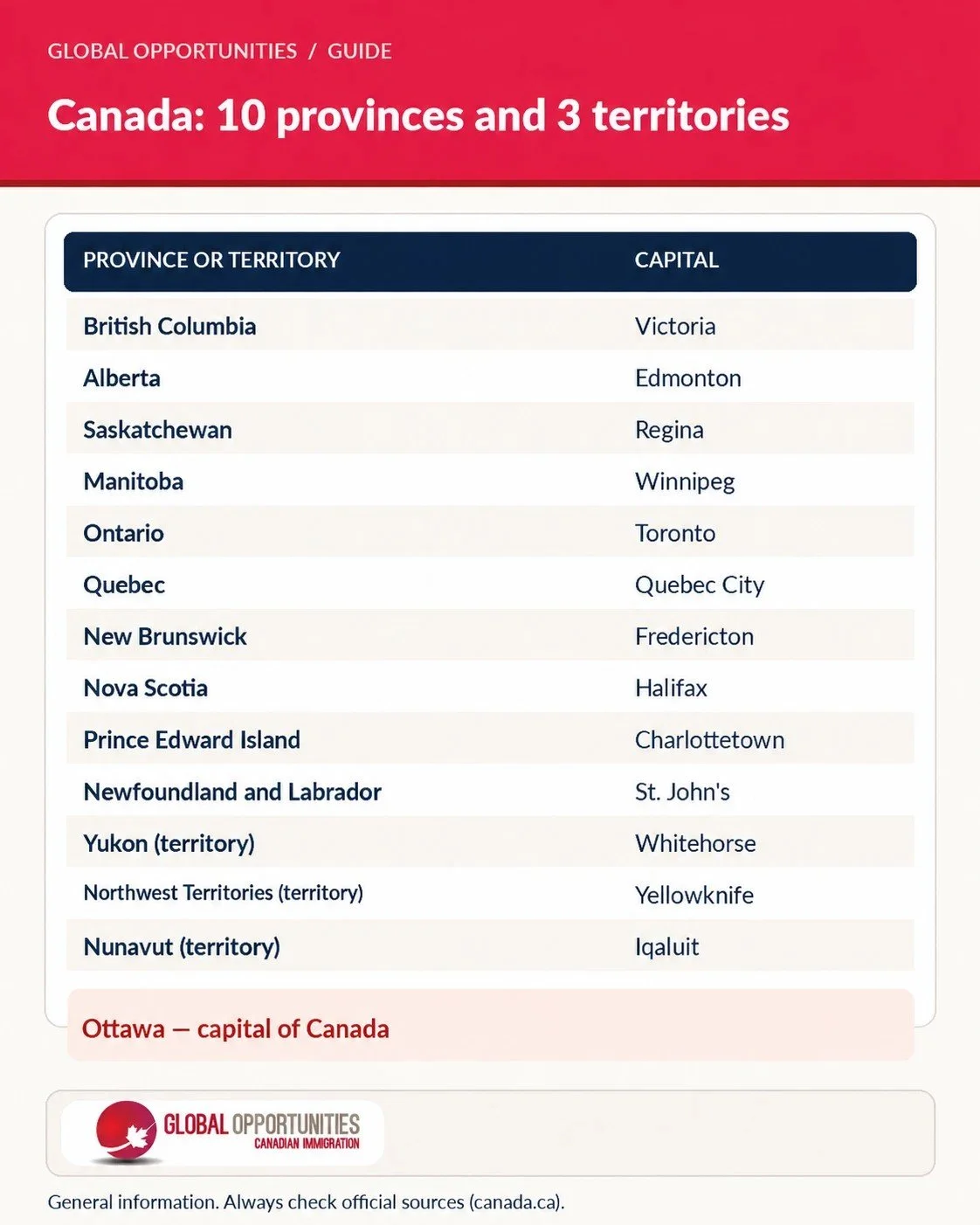
Nova Scotia is a province on Canada's Atlantic coast, and its capital is Halifax. The Halifax Regional Municipality explains that Nova Scotia, New Brunswick and Prince Edward Island are the Maritimes, and that, with Newfoundland and Labrador, they form Atlantic Canada (Halifax, your city).
Where the name comes from
"Nova Scotia" is Latin for "New Scotland". According to Canadian Heritage, Sir William Alexander named the territory after receiving a land grant from King James VI of Scotland (James I of England) in 1621; the charter was in Latin, so the name kept its Latin form. (Canadian Heritage, symbols of Nova Scotia). The Halifax Regional Municipality notes that this area is known as Mi'kma'ki, where the Mi'kmaw people have lived for more than 12,000 years, and that Halifax is in an area the Mi'kmaq call K'jipuktuk, meaning "Great Harbour" (Halifax, your city).
A coastal province
The Bay of Fundy. According to Immigration, Refugees and Citizenship Canada (IRCC), Nova Scotia is known for the world's highest tides in the Bay of Fundy (Discover Canada, Canada's regions).
Shipbuilding, fisheries and shipping. IRCC says the province's identity is linked to shipbuilding, fisheries and shipping (same source).
Where is Nova Scotia? Map, location and key facts
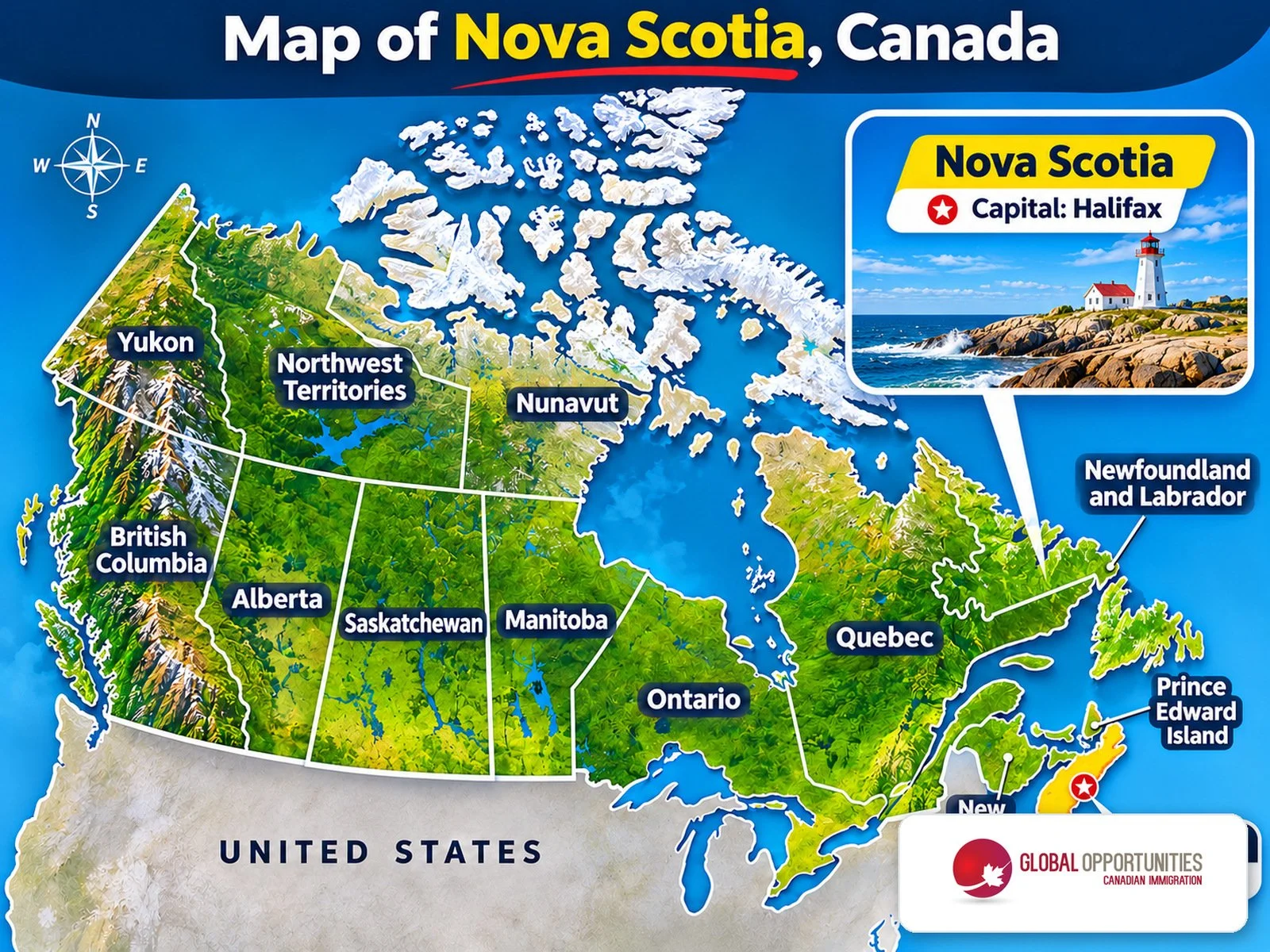
Nova Scotia is a Maritime province on Canada's Atlantic coast, made up of a mainland peninsula and Cape Breton Island. By land it connects only with New Brunswick; by sea, ferries link it with Prince Edward Island, Newfoundland and Labrador, New Brunswick and the US state of Maine. Its capital and largest municipality is Halifax.
Borders and neighbours
New Brunswick, by land: the Government of New Brunswick's newcomers page notes that Maritime Bus connects New Brunswick with Nova Scotia.
The Atlantic Ocean and the Bay of Fundy, known for the world's highest tides, according to IRCC's Discover Canada.
By ferry: Prince Edward Island (Caribou–Wood Islands), New Brunswick (Digby–Saint John) and Maine (Yarmouth–Bar Harbor), according to ferries.ca, and Newfoundland and Labrador from North Sydney, according to Marine Atlantic.
Capital, largest communities and time zone
Capital and largest municipality: Halifax. According to Statistics Canada's 2021 Census, the Halifax Regional Municipality had 439,819 residents and the Cape Breton Regional Municipality 93,694 (Statistics Canada, table 98-10-0002-01).
Time zone: Atlantic Time. The Government of New Brunswick notes that New Brunswick, Nova Scotia and Prince Edward Island are all on Atlantic Standard (Daylight) Time (Government of New Brunswick, basic facts), one hour ahead of Toronto.
Land area and population
Land area: 52,824.71 square kilometres, according to the 2021 Census (Statistics Canada, table 98-10-0001-01).
Population: Statistics Canada estimated Nova Scotia's population at 1,103,419 on July 1, 2026 (Statistics Canada, table 17-10-0009-01).
Economy and main industries
IRCC says Nova Scotia's identity is linked to shipbuilding, fisheries and shipping, and notes offshore oil and gas exploration (Discover Canada). According to Job Bank's economic scan for Nova Scotia, health care and social assistance led job growth in 2025, followed by transportation and warehousing, construction, business support services and professional, scientific and technical services. See our jobs section for details by region.
Population by origin: what the census says
These figures come from the 2021 Census and describe the population living in private households (955,860 people in Nova Scotia). They are context about who lives here, not a ranking of places (Statistics Canada, Census Profile, Nova Scotia; detailed tables: visible minority, table 98-10-0351-01 and ethnic or cultural origin, table 98-10-0355-01).
Visible minority groups. According to the 2021 Census, 93,430 people in Nova Scotia belonged to a visible minority group. The largest groups were Black (28,220), South Asian (21,650), Chinese (11,595), Arab (10,605) and Filipino (6,615), followed by Latin American (2,910) and Korean (2,840).
Ethnic or cultural origins. People can report more than one origin, so these numbers overlap. The most common origins reported were Scottish (257,200), English (217,915), Irish (195,660), Canadian (151,300), French (113,640) and German (86,860), followed by Acadian (49,200). Mi'kmaq origins were reported by 21,300 people, and Lebanese origins by 7,285.
Latin American origins. About 5,565 people reported a Latin, Central or South American origin, most often Mexican (935) and Brazilian (705).
Census counts as published by Statistics Canada for the 2021 Census, the most recent with these details when we checked in November 2026. They describe 2021, not today, and they are not immigration figures: check the linked tables for the full definitions.
How to get to Nova Scotia: by plane, car, train or bus
Most people arrive in Nova Scotia by plane at Halifax Stanfield International Airport. You can also drive or take the bus from New Brunswick, ride VIA Rail's Ocean train from Montréal, or arrive by ferry.
Main airport
Halifax Stanfield International Airport (YHZ) describes itself as Atlantic Canada's premier full-service airport (Halifax Stanfield). Our section on getting around Halifax explains how to get from the airport to the city.
Flying to Nova Scotia from abroad: airlines and common routes
As of November 2026, Halifax Stanfield's airlines page lists:
Year-round: Air Canada, Air Saint-Pierre, BermudAir, Flair Airlines, PAL Airlines, Pascan Aviation, Porter, United Airlines and WestJet.
Summer seasonal: American Airlines, Delta Air Lines, Discover Airlines, Edelweiss and Icelandair.
Winter seasonal: Air Transat.
The airport's non-stop flights page shows, by region:
Europe: Air Canada flies year-round to London Heathrow. In the summer season, the page listed WestJet flights to Amsterdam, Barcelona, Dublin, Edinburgh, Lisbon, London Gatwick and Paris, Discover Airlines to Frankfurt and Edelweiss to Zurich.
United States: year-round flights to Boston (Air Canada) and Newark (Air Canada and United), plus seasonal routes to cities such as New York LaGuardia, Chicago, Philadelphia, Washington, Orlando and Fort Lauderdale.
Mexico and the Caribbean: seasonal winter flights to Cancún (Air Canada, Air Transat, Porter and WestJet), Punta Cana, Puerto Plata, Montego Bay, Nassau and Bridgetown, and year-round BermudAir flights to Bermuda.
Within Canada: year-round flights to Toronto Pearson (Air Canada, Porter, WestJet and Flair), Montréal-Trudeau, Ottawa, Calgary and other cities, and seasonal flights to Vancouver.
Common ways to get there. From Europe, the non-stop routes above are a common option, especially in summer. From Latin America other than the winter sun routes, and from Asia, Australia and New Zealand, there were no non-stop flights on the airport's page, so travellers connect through another airport; Halifax has direct flights to Toronto Pearson, Montréal-Trudeau, Calgary and, seasonally, Vancouver.
Airlines and routes as listed by Halifax Stanfield International Airport, as of November 2026. Routes and airlines change seasonally: check the airport's page and the airlines before you book.
Driving, train and bus
Road. You drive into Nova Scotia from New Brunswick. Before you travel, check road conditions, closures and highway cameras on 511 Nova Scotia.
Train. VIA Rail's Ocean connects Montréal and Halifax through New Brunswick (VIA Rail, Montréal–Halifax (Ocean)). Check the current schedule on VIA's site.
Bus. Maritime Bus runs intercity buses in the Maritimes and says it operates 364 days a year (Maritime Bus).
Ferries
Bay Ferries: The CAT between Yarmouth and Bar Harbor, Maine, and the MV Fundy Rose between Digby and Saint John, New Brunswick (ferries.ca).
Northumberland Ferries: Caribou, Nova Scotia, to Wood Islands, Prince Edward Island, in season (ferries.ca).
Marine Atlantic: North Sydney to Port aux Basques and Argentia, Newfoundland and Labrador (Marine Atlantic).
Driving from the United States
Nova Scotia has no land border with the United States. The Canada Border Services Agency's border wait times page lists the nearest crossings from Maine into New Brunswick: St. Stephen (two bridges from Calais), Edmundston and Woodstock Road. From there you continue by road into Nova Scotia. Read the CBSA's travel information on what to declare and which documents you need, and check whether you need a visa or an eTA with IRCC's official tool. Entry rules depend on your citizenship and status.
Transportation information as published by Halifax Stanfield, VIA Rail, Maritime Bus, Bay Ferries, Northumberland Ferries, Marine Atlantic and the CBSA, as of November 2026. Services and schedules change, and some ferries run only part of the year: check the linked pages before you travel.
Buying your first home in Nova Scotia
Most newcomers rent first. If you later want to buy, the Government of Canada offers a tax-free savings account for first homes, a way to use your RRSP savings and a tax credit. Every rule depends on your own situation, so read the official pages and talk to a lawyer, a mortgage professional or the Canada Revenue Agency (CRA) before you decide.
Saving for a first home: the FHSA and the Home Buyers' Plan
First Home Savings Account (FHSA). According to the CRA's opening your FHSAs page, to open an FHSA you must be a resident of Canada, at least 18 (19 where that is the age of majority) and no older than 71 at the end of the year, and a first-time home buyer: in general, you did not live in a home that you or your spouse or common-law partner owned in the current year or the previous four calendar years. Read the CRA's FHSA overview for the contribution limits.
Home Buyers' Plan (HBP). The CRA explains that the HBP lets you withdraw from your registered retirement savings plans (RRSPs) to buy or build a qualifying home. As of November 2026, its HBP page gives a withdrawal limit of $60,000, repaid over 15 years; for first withdrawals made from January 1, 2026, to December 31, 2028, the start of repayments is deferred.
Home buyers' amount. According to the CRA's line 31270 page, this non-refundable tax credit helps first-time home buyers; the page says you can claim up to $10,000 for a qualifying home acquired in 2025.
The Canada Mortgage and Housing Corporation (CMHC) has a step-by-step home buying guide, including information for newcomers.
Provincial and municipal costs
We did not find a provincial first-time home buyer program on the Government of Nova Scotia pages we checked in November 2026. Property tax is a municipal tax: in Halifax, the municipality's property taxes page explains how the tax bill works. Ask your lawyer which provincial and municipal costs apply to your purchase.
Rules and amounts as published by the Canada Revenue Agency and the Halifax Regional Municipality, as of November 2026. Eligibility depends on each person and the rules change: check the CRA and the provincial and municipal pages, or ask a professional, before you rely on them. Foreign buyers may face other federal rules.
Emergencies and natural hazards in Nova Scotia
Nova Scotia is a calm place to live most of the year, but hurricanes and post-tropical storms, winter storms, power outages, floods and summer wildfires can happen. The Government of Nova Scotia's Emergency Info Nova Scotia site explains how to prepare for each hazard.
Be prepared: kit, plan and NS Alert
Build a kit. Emergency Info Nova Scotia's preparing for an emergency page explains what your household emergency kit needs to keep you prepared for 72 hours, plus a car kit and a go-bag.
Make a plan with your household, including where you would meet if you had to evacuate.
Get alerts. According to the Government of Nova Scotia, NS Alert is the province's free emergency alerting app. It works with Canada's national Alert Ready system and can also reach people on 3G networks or Wi-Fi; you choose the locations you care about (NS Alert).
Hurricanes and storms
According to the Government of Canada, hurricane season usually lasts from June through November, and communities close to the Atlantic Ocean are most at risk (Get Prepared, hurricanes). Our climate section explains how to prepare for storms and power outages.
Wildfires and burn restrictions
Emergency Info Nova Scotia's wildfire page recommends packing a go-kit with food, medications, clothing and pet supplies, planning a meeting place with your family and keeping copies of important documents somewhere else. The province's fire restrictions page shows whether burning is allowed; during wildfire season, restrictions are updated daily. If smoke reaches your area, check the Air Quality Health Index from Environment and Climate Change Canada.
Information as published by the Government of Nova Scotia, the Government of Canada and Environment and Climate Change Canada, as of November 2026. In an emergency, follow the instructions of local officials, and call 911 if lives or property are in danger.
Living in Halifax: neighbourhoods and city overview
Halifax is the capital of Nova Scotia. According to IRCC, the province has Canada's largest east coast port, and Halifax is home to Canada's largest naval base (Discover Canada). According to Job Bank, the Halifax region has accounted for about 80% of Nova Scotia's job gains since 2019 (Job Bank, Nova Scotia economic scan, May 2026).
How Halifax is organized
According to the municipality, the Halifax Regional Municipality (HRM) was created in 1996 when Halifax, Dartmouth, Bedford and the County of Halifax were brought together. It includes around 200 communities and is the largest municipality in Atlantic Canada (Halifax, your city). The harbour separates Halifax and Dartmouth, which are connected by the Macdonald and MacKay bridges, run by Halifax Harbour Bridges, and by Halifax Transit's ferries. CMHC's rental figures for the Halifax CMA cover the whole urban area, and the municipality's website is the official place for services such as garbage collection, recreation and parking.
The descriptions below come from the official tourism site, Discover Halifax, and are general orientation, not a ranking. Visit, check bus routes and compare listings before you choose.
Downtown Halifax
Discover Halifax describes downtown as tucked between the Halifax Citadel National Historic Site and the harbour, with pubs, independent shops and restaurants (Discover Halifax, Downtown Halifax). Parks Canada describes the Citadel as a hilltop fort in the heart of downtown with a view of Halifax Harbour (Parks Canada, Halifax Citadel). The municipality notes that, for decades, many immigrants arrived in Canada through Pier 21 in the Port of Halifax; today it is home to the Canadian Museum of Immigration at Pier 21, on Marginal Road. Several post-secondary institutions are in Halifax, including Dalhousie, King's, Saint Mary's, NSCAD, the Atlantic School of Theology and NSCC's Institute of Technology Campus (see the education section).
The North End and the West End
Discover Halifax describes the North End as a diverse, multicultural area known for colourful saltbox houses, murals along Gottingen Street, and cafés, shops and restaurants on Agricola Street. The same page tells the story of Africville, a Black community whose residents were relocated in the 1960s, now remembered at the Africville Museum (Discover Halifax, North End). In the West End, Quinpool Road has local shops, cafés, restaurants and murals, and its side streets have older homes and mature trees (Discover Halifax, West End).
Bedford and Sackville
Discover Halifax's Bedford-Sackville page mentions DeWolf Park, where you can fish from the dock on the Bedford Basin, the Sackville Farmers' Market (May to November) and the Fultz House Museum in Lower Sackville (Discover Halifax, Bedford-Sackville). Mount Saint Vincent University is on the Bedford Highway in Halifax (MSVU).
Dartmouth, Cole Harbour and Eastern Passage
Discover Halifax calls downtown Dartmouth a compact, walkable neighbourhood across the harbour and one of the region's spots for local food and drink, reached by the Halifax–Dartmouth ferry. Alderney Landing hosts community events and a farmers' market, and you can walk around Lake Banook and Sullivan's Pond (Discover Halifax, Explore Downtown Dartmouth). Further east, Cole Harbour has green spaces, coastal trails and beaches, and Fisherman's Cove is in Eastern Passage (Discover Halifax, Dartmouth-Cole Harbour). NSCC's Ivany and Akerley campuses are in Dartmouth (NSCC, campuses).
Rural communities in the municipality
Discover Halifax divides the municipality into nine regions, including the Eastern Shore, the Musquodoboit Valley, the Peggy's Cove Coastal Region and the Halifax Airport Area (Discover Halifax, regions). If you are thinking of living in a rural community, check whether Halifax Transit serves it before you sign a lease.
Daily life in Halifax
Health care. The Queen Elizabeth II Health Sciences Centre (QEII), in Halifax, is a multi-campus teaching and research organization that includes the Halifax Infirmary and Victoria General sites (Nova Scotia Health, QEII). IWK Health describes its mission as helping Maritime families lead healthy lives.
Community. Several of the settlement organizations listed by the province, such as ISANS, Veith House and Halifax Public Libraries, serve the Halifax Regional Municipality (Live in Nova Scotia, settlement services).
Things to weigh: among the centres listed in the housing section of this guide, the Halifax CMA has the highest average rents reported by CMHC.
Getting around Halifax: buses, ferries and fares
Halifax Transit, run by the municipality, operates the buses, the Halifax–Dartmouth ferries and Access-A-Bus, the door-to-door service for people with disabilities. Regular buses and ferries use the same fares, so one ticket or pass covers both.
Halifax Transit fares
According to Halifax Transit's fares, tickets and passes page, as of November 2026, the fares for the conventional bus, ferry and Access-A-Bus are:
One ride: $3 adult (18–64); $2.25 senior (65+) and youth (13–17); free for children 12 and under.
10 tickets or rides: $27 adult; $20.25 senior and youth.
1-day pass (HFXGO): $7.50 adult; $5.50 senior and youth.
7-day pass (HFXGO): $25.50 adult; $19 senior and youth.
Monthly pass: $90 adult; $66 senior and youth.
According to the same Halifax Transit fares page, Regional Express routes (320, 330 and 370) cost more: $4.75 for an adult single ride and $139 for an adult monthly pass, with a $1.50 adult top-up if you board with a regular ticket, transfer or monthly pass. The page also notes that all Halifax Transit bus and ferry services are free for people 65 and older on Tuesdays from 10 a.m. to 3:30 p.m. and after 6 p.m. Fares change, so check the current price on the official page.
How to pay
HFXGO, the official mobile app, sells tickets and passes on your phone.
Retailers and municipal customer service centres sell tickets and monthly passes. The official page lists the customer service centres at Alderney Gate in Dartmouth and Bayers Road Centre in Halifax.
Cash when you board, with exact change.
According to Halifax Transit's fares page, monthly passes go on sale from the 20th of the previous month until the 10th of the month they are valid.
Fare capping and transfers
Halifax Transit explains that fare capping works only for HFXGO users who create and verify an account, add funds and use the Tap & Ride barcode. The system tracks your rides and stops charging you once you reach the cost of a daily or monthly pass. Individual tickets bought in the app do not count toward the cap.
Transfers: according to Halifax Transit's fares, tickets and passes page, paper transfers are valid for up to 90 minutes after the end of the route and work on any route or the ferry; ask the operator when you pay. HFXGO tickets are valid for 150 minutes (two and a half hours) from activation.
The Halifax–Dartmouth ferries
Halifax Transit runs two harbour ferry routes (ferry service): the Alderney ferry, between downtown Halifax and downtown Dartmouth, and the Woodside ferry, between downtown Halifax and Woodside in Dartmouth.
Student passes and living without a car
Halifax Transit's fares page points to programs such as the UPass for students at participating schools and the Affordable Access Transit Pass Program for eligible low-income residents. Before you choose where to live, check which routes serve your home, work or school, and follow Halifax Transit's service alerts in winter.
Getting to and from the airport
According to Halifax Stanfield International Airport, Halifax Transit's Regional Express route 320 runs between the airport and downtown Halifax, and Maritime Bus serves the airport as part of its routes across the Maritimes (Halifax Stanfield, buses and shuttles). The airport also lists shuttles, taxis and rental cars.
Transit in the rest of Nova Scotia
Transit Cape Breton serves the Cape Breton Regional Municipality, including Sydney. According to the municipality, since June 15, 2026 it charges a flat fare of $2.50 one way anywhere it operates, with free transfers, tap payment by debit or credit card, the Umo app or a reloadable card; children 10 and under ride free; a regular unlimited pass costs $82.50, and a discounted 30-day pass for eligible youth, students and seniors costs $66 (CBRM, Tap and Ride announcement; Transit Cape Breton). Checked in November 2026; check the current price.
Annapolis Valley: the former Kings Transit website now redirects to Tidal Transit, a bus service based in New Minas. Check its website for routes and fares.
In other areas, ask your settlement agency or municipality what transit exists.
Fares as published by Halifax Transit and the Cape Breton Regional Municipality, as of November 2026. They may have changed by the time you read this, and discounts depend on age and eligibility: check the linked pages before you rely on them.
Other cities in Nova Scotia: Sydney, Truro, New Glasgow, the Valley and more
Outside Halifax, Nova Scotia has smaller cities and towns, each with its own economy and community. CMHC reports lower average rents in Sydney, Truro, Kentville and New Glasgow than in Halifax (see the housing section). Check job postings in your occupation and how you will get around before you choose. The short descriptions below come from Tourism Nova Scotia, the official tourism sites and the institutions themselves.
Sydney and Cape Breton Island
Tourism Nova Scotia calls Sydney the capital of Cape Breton Island (Tourism Nova Scotia, cities and towns), and Destination Cape Breton describes it as the largest community in the Cape Breton Regional Municipality (CBRM), with a downtown on the harbour, a boardwalk, museums, galleries and a performing arts theatre (Destination Cape Breton, Sydney).
Education. Cape Breton University is on Grand Lake Road in Sydney, and NSCC has its Sydney Waterfront Campus here (NSCC, campuses).
Rent. According to CMHC's Rental Market Survey, the average rent for a two-bedroom apartment in the city of Sydney was $1,191 in October 2025 (see the housing section).
Nature and heritage. The Cabot Trail and Cape Breton Highlands National Park.
The labour market. According to Job Bank, Cape Breton had the highest unemployment rate among the province's regions in 2025, at 10.9% (Job Bank, May 2026). Check postings in your occupation before moving.
Getting around. Transit Cape Breton runs buses in the municipality; check whether its routes serve the places you need.
Newcomer support. New Dawn, the Cape Breton Island Centre for Immigration in Sydney, provides settlement support and outreach across the island, and YREACH also lists Sydney (Live in Nova Scotia, settlement services).
Truro
Tourism Nova Scotia says Truro is known as the "Hub of Nova Scotia": it is in central Nova Scotia, is easily reached by car from Halifax, and its connections to major highways help earn the name (Tourism Nova Scotia, Truro). The same page highlights Victoria Park and the Fundy Discovery Site, where you can watch the tidal bore.
Education. Dalhousie University lists a campus location in Truro and Bible Hill (Dalhousie), and NSCC has a Truro Campus.
Rent. According to CMHC's Rental Market Survey, the average two-bedroom rent in the Truro area was $1,254 in October 2025.
Newcomer support. YREACH offers settlement support in Truro (Live in Nova Scotia).
New Glasgow and Pictou County
On the Northumberland Shore, Tourism Nova Scotia describes New Glasgow as having a downtown with shops and restaurants that is home to The Jubilee, a summer music festival, and Pictou as the place to discover the "birthplace of New Scotland" at the Hector Heritage Quay. It also notes that the sheltered Northumberland Strait has some of the region's warmest ocean beaches in summer (Tourism Nova Scotia, Northumberland Shore). NSCC's Pictou Campus is in Stellarton. According to CMHC's Rental Market Survey, the average two-bedroom rent in the New Glasgow area was $1,077 in October 2025. YREACH lists Pictou among its communities.
Antigonish
Tourism Nova Scotia describes Antigonish as home to the Antigonish Highland Games and St. Francis Xavier University (StFX), with beaches, a mountain biking park and a downtown with breweries and restaurants (Tourism Nova Scotia, Northumberland Shore). The Antigonish Women's Resource Centre offers settlement support for Antigonish and Guysborough counties (Live in Nova Scotia).
Kentville, Wolfville and the Annapolis Valley
Tourism Nova Scotia describes the Bay of Fundy and Annapolis Valley region as a place of agricultural communities, award-winning wineries and the world's highest tides (Tourism Nova Scotia, Bay of Fundy and Annapolis Valley).
Wolfville is, in Tourism Nova Scotia's words, a walkable university town known for wineries, local food and farm markets, home to Acadia University (Tourism Nova Scotia, Wolfville).
Kentville hosts events such as the Annapolis Valley Apple Blossom Festival in spring, and has NSCC's Kingstec Campus. According to CMHC's Rental Market Survey, the average two-bedroom rent in the Kentville area was $1,127 in October 2025.
The labour market. According to Job Bank, the Annapolis Valley was the only region where employment declined in 2025, although its unemployment rate (5.1%) was the lowest figure cited for the province's regions (Job Bank, May 2026).
History. According to Parks Canada, Grand-Pré, near Wolfville, was a centre of Acadian settlement from 1682 to 1755 and is the place most closely tied to the Deportation of the Acadians. Its landscape is recognized by UNESCO (Parks Canada, Grand-Pré).
Newcomer support. YREACH lists Kentville, and the Valley Community Learning Association offers English classes in Kentville, Wolfville, Middleton and Cornwallis (Live in Nova Scotia).
Yarmouth and southwestern Nova Scotia
Tourism Nova Scotia invites visitors to Yarmouth to experience its Acadian history and culture, beaches and seafood (Tourism Nova Scotia, cities and towns). In the region, Université Sainte-Anne has its main campus at Pointe-de-l'Église (Church Point) and a campus in Tusket (Université Sainte-Anne), and NSCC's Burridge Campus is in Yarmouth. CMHC's Rental Market Survey does not publish a reliable average rent for Yarmouth for October 2025 (the figure is suppressed), so check local listings. YREACH lists Yarmouth, and the Town of Yarmouth publishes a Western Nova Scotia welcome guide.
Bridgewater, Lunenburg and the South Shore
The South Shore runs southwest of Halifax along the Atlantic.
Lunenburg. According to Parks Canada, Lunenburg was founded in 1753 for mostly German-speaking Protestant colonists, and Old Town Lunenburg became a UNESCO World Heritage Site in 1995 as the best surviving example of a British colonial "model town" (Parks Canada, Old Town Lunenburg). Tourism Nova Scotia also mentions the Bluenose II.
Bridgewater sits on the LaHave River, according to Tourism Nova Scotia (cities and towns), and is home to NSCC's Lunenburg Campus. YREACH lists Bridgewater.
Mahone Bay and Liverpool. Tourism Nova Scotia highlights the Three Churches of Mahone Bay and Liverpool's Privateer Days.
Language support. The Atlantic Canada Language Academy offers English classes in Lunenburg and Queens counties (Live in Nova Scotia).
Rents as published by CMHC and labour market figures as published by Job Bank, as of November 2026. They are averages and past data: they are not listings or job offers and do not predict what you will find. Check the linked pages before you rely on them.
How much is rent in Nova Scotia? Where to look, rents and tenant rights
Most newcomers rent when they first arrive in Nova Scotia. Rental rules come from the Residential Tenancies Act, administered by the province's Residential Tenancies Program, which resolves disputes through applications to the Director of Residential Tenancies.

Average rents in Nova Scotia: CMHC figures
According to CMHC's Rental Market Survey, in October 2025, the average monthly rents in private apartment buildings were (CMHC, Rental Market Survey data tables, 2025):
Halifax CMA: studio $1,362; one bedroom $1,540; two bedrooms $1,826; three bedrooms or more $2,251. The vacancy rate for all apartments was 2.7%.
Halifax, units that changed tenants: the average two-bedroom rent for units that had a new tenant in the past year was $2,058, higher than the overall average, because long-time tenants usually pay less.
City of Sydney: one bedroom $900; two bedrooms $1,191.
Truro area: one bedroom $1,013; two bedrooms $1,254.
Kentville area: one bedroom $1,041; two bedrooms $1,127.
New Glasgow area: one bedroom $758; two bedrooms $1,077.
Nova Scotia (centres of 10,000+): two bedrooms $1,711; vacancy rate 2.6%.
These are averages for purpose-built rental apartments, not for rooms or rented houses, and new listings are often higher. Rents change, so check current listings and CMHC's latest data.
Where to look for a rental in Nova Scotia
Online listing sites such as Kijiji, Facebook Marketplace, Rentals.ca and PadMapper. Set alerts and search by neighbourhood.
Property management companies that own apartment buildings often list units on their own websites.
University and college housing offices. If you are a student, ask your school about residences and off-campus housing before you arrive.
Settlement agencies such as ISANS and YREACH: the province's settlement services page lists housing among the topics they cover (Live in Nova Scotia).
We mention private websites and companies for reference only. Global Opportunities has no relationship with them and does not recommend any of them.
Renting a room or an apartment
If you rent a room in a shared house or apartment, get the agreement in writing and ask what you will share and what is included. For an apartment, ask what is included: heat, hot water, electricity, parking and laundry.
What landlords usually ask for
Landlords may ask for identification, proof of income and references, and may check your credit. According to the province's renting guide (April 2025), landlords cannot charge an application fee, and any money taken before the lease is signed or before rent is due is considered a security deposit.
Security deposits: what is legal in Nova Scotia
According to the province's renting guide:
A landlord can ask for a security deposit of up to half of one month's rent.
The landlord must keep the deposit in a trust account, and if the property changes hands, the new landlord becomes responsible for it.
A landlord cannot charge an extra deposit for pets.
Normal wear and tear cannot be paid from the deposit. At the end of the tenancy, the landlord can only keep part of it for unpaid rent or damage, following the rules in the ending a tenancy guide. If you disagree, you can apply to the Director (Form S, to return a security deposit).
The lease and the Standard Form of Lease
Nova Scotia has a Standard Form of Lease (Form P). The province's renting guide explains that:
Landlords must give tenants a signed copy of the lease, together with a copy of the Residential Tenancies Act (paper, electronic or a web address in the lease), within 10 days of signing or moving in.
If there is no written lease, the Standard Form of Lease still applies and the tenancy defaults to month-to-month.
There are periodic leases (year-to-year, month-to-month or week-to-week, which renew automatically) and fixed-term leases (with a set end date).
Landlord rules must be reasonable, apply equally to all tenants and cannot remove rights under the Act.
Fill in the Rental Unit Condition Report when you move in, and take dated photos.
Rent increases and the temporary rent cap
According to the province's temporary rent cap fact sheet (2026):
The current rent cap is 5%, and it is in effect until December 31, 2027.
Rent can only increase by up to 5% once every 12 months, including when you renew a lease for the same unit, even on a fixed-term lease.
Rent cannot increase at all during the first 12 months of your tenancy.
The cap does not apply to new tenants signing a new lease, to public housing or to land-lease communities (mobile home parks).
Removing a service (such as parking) or starting to charge for something that was included (such as heat or power) counts as a rent increase.
The province's renting guide adds that landlords must give written notice of a rent increase: four months for year-to-year and month-to-month leases, and eight weeks for week-to-week leases. If you disagree, you can apply to the Residential Tenancies Program (Form J) for mediation or a hearing.
Your rights as a tenant in Nova Scotia
According to the province's renting guide:
Landlord entry. A landlord can enter only in an emergency or after giving 24 hours' written notice, and the entry must be during daylight hours.
Heat. Landlords cannot turn off the heat, even during a dispute or if rent is owed, and cannot cut utilities included in the lease. The guide says the temperature should be 20°C to 22°C.
Repairs. Landlords must keep the property fit for living; tenants pay for damage they or their guests cause.
Late rent. Landlords can charge 1% of the monthly rent per month for late rent, and have a specific eviction process for unpaid rent. Tenants cannot withhold rent to force repairs.
Discrimination. Landlords cannot refuse to rent based on a protected characteristic; see the Nova Scotia Human Rights Commission.
Solving problems: the Residential Tenancies Program
The Residential Tenancies Program publishes the forms, guides and fact sheets, including the guide to resolving disputes. If you and your landlord cannot agree, you file an Application to the Director (Form J), which can lead to mediation or a hearing, often by phone. The rent cap fact sheet lists the program's phone line, 1-800-670-4357.
How to avoid rental scams
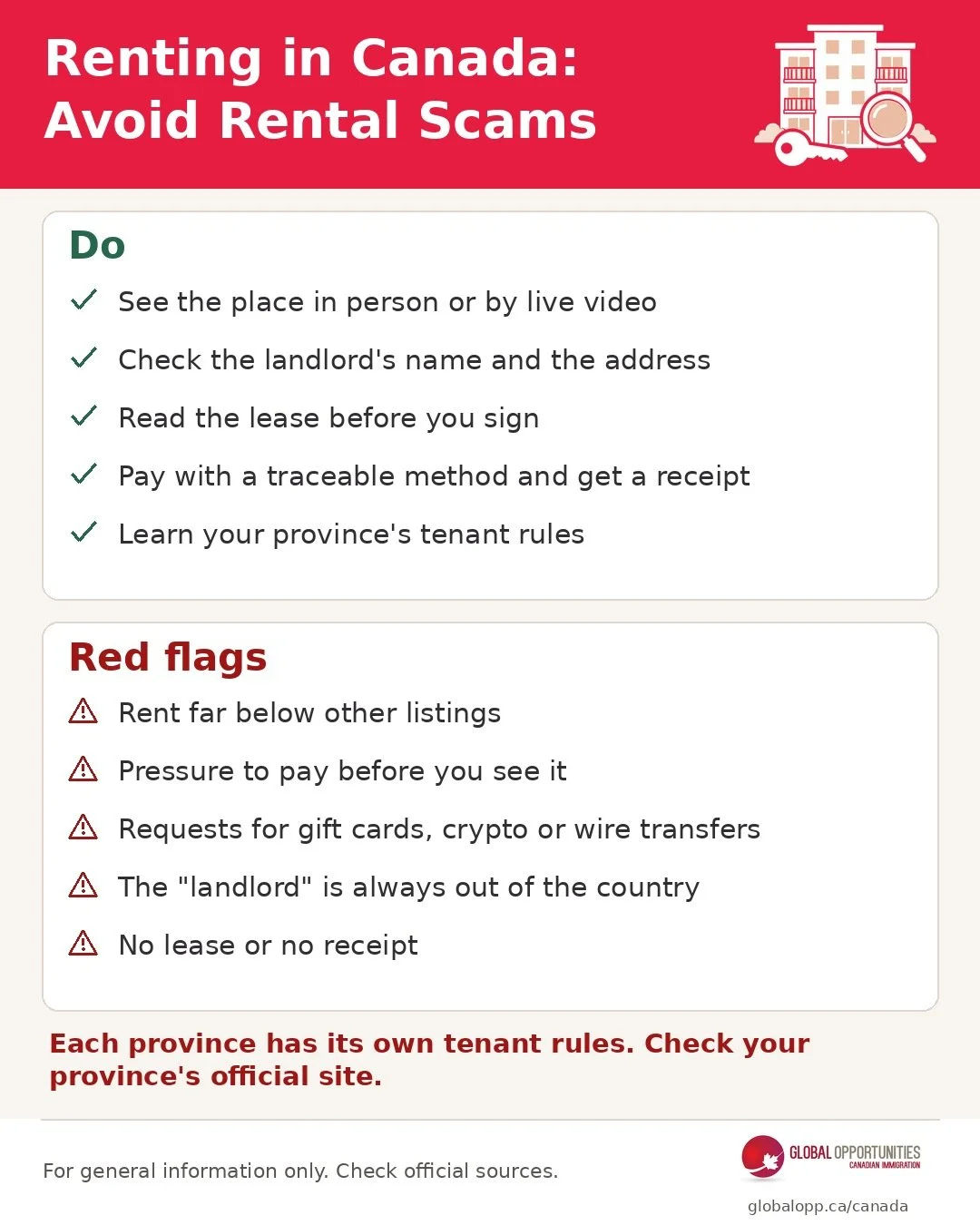
The Competition Bureau warns about rental scams in Rental scam: no room for error. Follow these steps:
Never send money for a place you have not seen.
Be suspicious of rents far below similar units or pressure to pay quickly.
Confirm that the person showing the unit can rent it.
Check what you are asked to pay. The province's renting guide limits the deposit to half a month's rent and does not allow application fees, so a request for more, or for an application fee, is a warning sign.
Get a written lease and a receipt for every payment.
Utilities: power, heat and internet
Ask exactly what the rent includes: heat, power, hot water, internet and parking. During storms, Nova Scotia Power publishes an outage map. Tenant insurance is not required by law, but many landlords ask for it, and the province's renting guide notes that it generally covers your belongings.
Rents as published by CMHC, and tenancy rules as published by the Government of Nova Scotia's Residential Tenancies Program, as of November 2026. CMHC figures are averages for existing apartments, not asking rents, and the rent cap does not apply to a new lease with a new tenant. Check the linked pages before you rely on them.
Driving in Nova Scotia: licences, insurance, inspections and winter
In Nova Scotia, driver's licences and vehicle registration are handled by the Registry of Motor Vehicles through Access Nova Scotia, and car insurance is bought from private insurers. Outside Halifax and Sydney, check whether any public transit serves your area before you decide whether you need a car.
Nova Scotia's graduated driver licensing: the three stages
According to Service Nova Scotia's Graduated Driver Licensing Program page, every new driver, of any age, who applies for a learner's licence enters the Graduated Driver Licensing (GDL) program. It has three stages:
Learner's licence (Class 7). You pass the knowledge and vision tests to get it. Operating conditions include no passengers except a supervising driver who is not in the GDL program, and zero alcohol or drugs. The minimum practice period is 12 months, which can be reduced to 9 months if you complete an approved driver education course (at least 25 hours of online or classroom learning and 10 hours in a vehicle). To move on, you must pass a road test.
Newly licensed driver. You stay at this stage for at least two years. Conditions include zero alcohol or drugs; only one front-seat passenger, with rear passengers limited to the number of seat belts; no driving between midnight and 5 a.m. unless you have an exemption (for work, school or volunteer firefighting, for example) or a supervising driver; and no upgrade beyond a Class 5 licence. To graduate, you must complete an approved driver education course (a short six-hour course or the long course) and give the certificate to the Registry; otherwise you stay at this stage indefinitely.
Restricted individual ("condition 47"). For two more years you must keep zero alcohol or drugs, and you cannot act as a supervising driver. After that, the GDL restrictions are removed and you hold a full Class 5 licence.
Demerit points apply more strictly to newly licensed drivers, and suspensions delay graduation. The Nova Scotia Driver's Handbook explains the rules of the road for the knowledge test.
Exchanging a foreign driver's licence
According to the province's page on exchanging your licence, checked in November 2026:
You can drive on a valid out-of-country licence for up to 180 days after moving to Nova Scotia. After that, you must exchange it to keep driving legally.
If your licence is from a listed country (the page names examples such as Australia, Germany, Japan, New Zealand and the United Kingdom) and at or above the listed class, you can exchange it for an equivalent Nova Scotia class with a vision test, surrendering your foreign licence.
If your country or class is not listed, you need full testing: knowledge test, vision test and road test.
If your licence is not in English or French, you need a certified translation from an approved provider (the page names ATINS, CTTIC, ISANS or a consulate or embassy). An International Driving Permit is not accepted as a translation.
Exchanges are done in person at an Access Nova Scotia or Registry of Motor Vehicles location; the page links to online appointment booking and to the current fee schedule. You receive a 30-day temporary licence while the card is mailed.
Bring proof of your driving experience if you have it, and always check the current list of countries and fees on the official page.
Car insurance in Nova Scotia
According to Service Nova Scotia, insurance information is required whenever a vehicle registration (plate) is issued or renewed for a motorized vehicle, using a Statement of Insurance form for in-person and mail requests (Service Nova Scotia, registering a vehicle). Insurance is sold by private insurance companies, through brokers or directly. Ask each insurer how it sets your premium and whether it considers your driving and insurance history from home, and compare several quotes.
The province's insurance page has information on licensing for insurance agents, agencies, adjusters and companies, and bulletins from the Superintendent of Insurance. The Nova Scotia Energy and Regulatory Boards Tribunal lists auto insurance among the matters handled by the Nova Scotia Regulatory and Appeals Board.
Registering a car and the safety inspection
Nova Scotia requires a motor vehicle safety inspection at an official inspection station. According to Service Nova Scotia's vehicle (safety) inspections page:
A used passenger vehicle (a "type 1" vehicle) that passes inspection gets a sticker valid for two years; a new vehicle gets one valid for three years.
A used vehicle entering the province that must be registered in Nova Scotia must be registered within 180 days and inspected no later than 10 days after registration.
When you buy a used car privately, it must have a valid inspection sticker issued within 30 days before the sale, or the buyer must obtain one before the transfer.
Renting a car when you arrive
Each rental company sets its own rules on minimum age, young-driver fees, accepted licences, payment and insurance, and they can vary by location. Some examples, checked in November 2026:
At the airport. Halifax Stanfield lists Alamo, Avis, Budget, Dollar/Thrifty, Enterprise, Hertz and National, with counters on the lower level of the Airport Parkade (Halifax Stanfield, rental cars).
Enterprise lists a minimum age of 25, a young driver's fee that may apply to renters under 25 and that varies by location, a valid driver's licence with a photo, and a credit or debit card, with accepted payment forms varying by location (Enterprise, rental requirements).
National says international renters need a valid home-country licence with a photo. An International Driving Permit is recommended for licences in a non-English Latin alphabet and required for licences in a non-Latin alphabet, and you cannot rent with an International Driving Permit alone (National, driver's licence policy).
International Driving Permit. CAA explains that the permits it issues in Canada are only for holders of a Canadian provincial or territorial licence, and that a permit is valid only together with a valid driver's licence (CAA, International Driving Permit).
Before you book, confirm with the company and location the age rules, whether it accepts your licence, the payment method and what insurance is included. We mention private companies for reference only. Global Opportunities has no relationship with any of them and does not recommend any.
Winter driving and winter tires
The Halifax Regional Municipality advises newcomers who will drive in winter to get winter tires and to keep an emergency kit in the car with a flashlight, a shovel, a blanket and booster cables (Halifax, your city). Check road conditions on the province's 511 traveller information service before long trips.
Parking in Halifax and the winter parking ban
According to the municipality's overnight winter parking ban page, the ban is in effect every year from December 15 to March 31, but it is enforced only during declared weather events and ongoing snow clearing. When it is enforced, you cannot park on the street from 1 a.m. to 6 a.m.; cars left on the street can be ticketed or towed. The municipality has two zones (Zone 1, Central, and Zone 2, Non-Central) that can be enforced separately, and you can sign up for notifications. Vehicles interfering with snow clearing can be towed at any time. Other towns have their own winter rules, so check your municipality's website.
Licensing, exchange and inspection rules as published by the Government of Nova Scotia and Service Nova Scotia, rental requirements as published by each company, and parking rules as published by the Halifax Regional Municipality, as of November 2026. The list of countries for a licence exchange and the fees can change, and each rental location may apply its own rules: check the linked pages before you rely on them.
How do newcomers get health care in Nova Scotia? MSI, family doctors and 811
Nova Scotia's public health insurance plan is the Nova Scotia Health Insurance Program, commonly called MSI. If you are eligible, you apply for a Nova Scotia health card and show it when you use health services. Nova Scotia Health says it operates hospitals, health centres and community-based programs across the province (Nova Scotia Health, about us), and IWK Health describes its mission as helping Maritime families lead healthy lives.
New to how public health care works? Read the health care system in Canada.
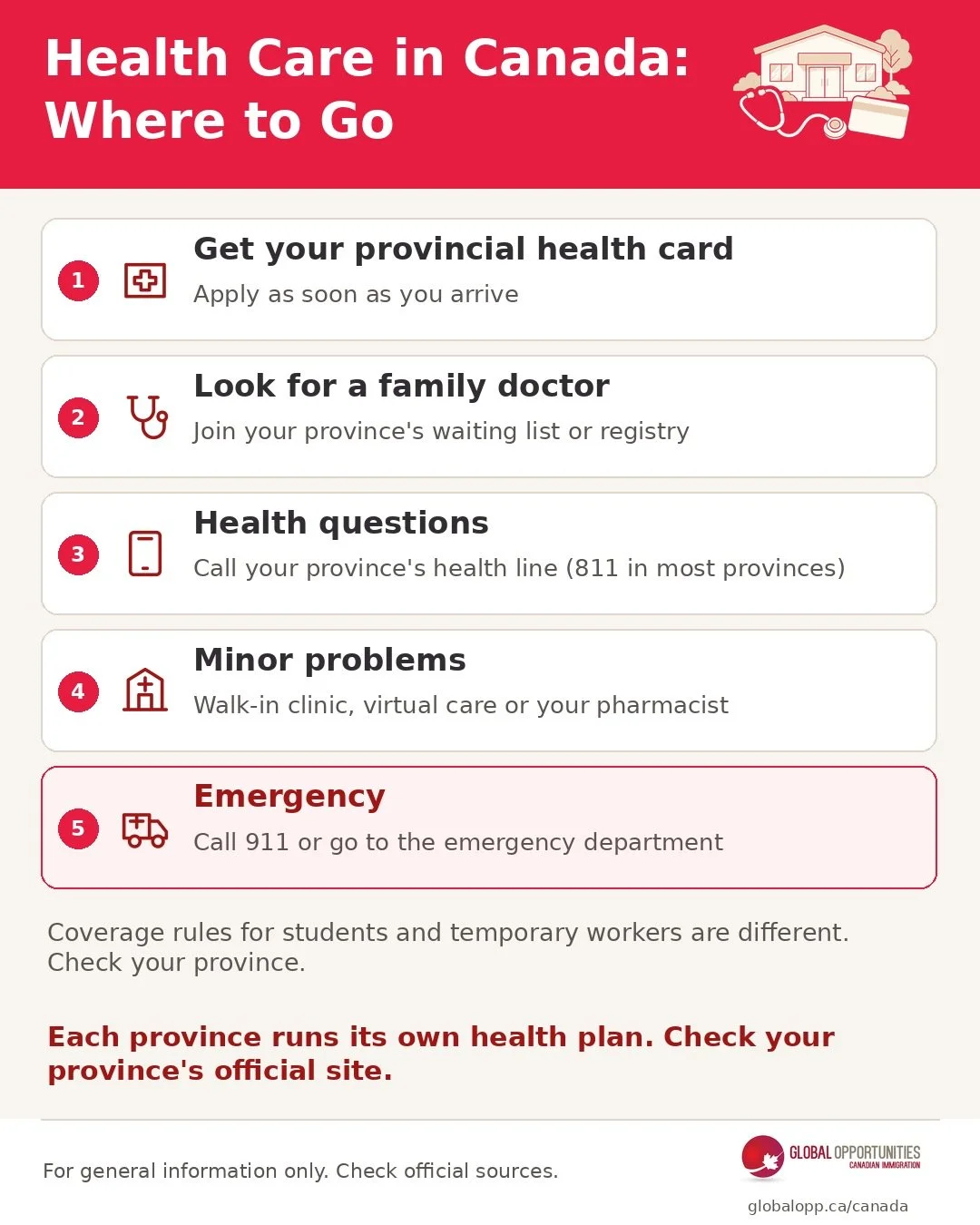
When MSI coverage starts
The Government of Nova Scotia explains when coverage usually begins for people moving to the province (coverage if you move to Nova Scotia). In general terms, for citizens and permanent residents arriving from abroad it usually starts on the date they become Nova Scotia residents; for work permit holders with a permit or contract of 12 months or more, on the later of the residency date or the date the immigration document was issued. Most international students have a later start date, with exceptions. Read the full eligibility page for your situation, and buy private health insurance for the time before you are covered.
How to apply for a health card
According to the province (apply for a health card), in-person service is not available. Step by step:
Gather your documents, including proof that you are legally entitled to remain in Canada and proof of your current Nova Scotia address.
Apply online through MSI Resident Services, which emails you a link to upload the Registration for Health Services Form and your documents, or apply by mail, fax or secure drop box.
Call MSI if you have questions: Nova Scotia Health lists MSI's phone number as 1-800-563-8880.
Finding a family doctor: the Need a Family Practice Registry
Nova Scotia Health runs the Need a Family Practice Registry (Nova Scotia Health) for people without a family doctor or nurse practitioner. Key points from the official page, checked in November 2026:
You can register online or by calling 811. If you are new to Nova Scotia and do not have a health card yet, you must register by phone, and you must provide your health card number within four months; your registration is complete only once you call 811 again with the number.
When a practice is accepting new patients, Nova Scotia Health sends it the list of people registered for that community. Nova Scotia Health says it cannot confirm your place on the list or when you will be matched.
Most family physicians accept patients from the registry, but they are independent and can decide how they accept new patients.
Virtual care, pharmacies and other options while you wait
VirtualCareNS gives Nova Scotians virtual access to a family doctor or nurse practitioner. According to Nova Scotia Health (VirtualCareNS), Full Care is available only to people on the Need a Family Practice Registry, and Basic Care offers advice and prescription renewals. If you are new to the province, you cannot use VirtualCareNS until you have received your physical health card.
Community pharmacy primary care clinics and urgent treatment centres are listed by Nova Scotia Health as other ways to get care. The registry page notes that people without a health card are not eligible for some services, including VirtualCareNS and community pharmacy primary care clinics.
YourHealthNS is the official app and website (YourHealthNS) to find pharmacies and emergency departments near you, book services such as blood collection, X-rays and vaccines, and see appointments.
811 and emergencies
Life-threatening emergency: call 911 or go to the nearest emergency department.
Health questions that are not emergencies: call 811. Registered nurses answer around the clock, seven days a week, free of charge (811 Nova Scotia).
Community and social services: call or text 211, or visit 211 Nova Scotia, to find food banks, housing help and other local services.
What MSI does not cover
MSI does not cover every health service, so check the province's MSI eligibility page and ask before you receive a service. The province's Pharmacare programs help certain groups with prescription costs. If you get a job with benefits, read your group plan carefully.
Coverage rules as published by the Government of Nova Scotia and Nova Scotia Health, as of November 2026. When your coverage starts depends on your status and the dates on your documents, and joining the registry does not mean you will be matched with a doctor by a certain date. Check the linked pages before you rely on them.
Banking in Nova Scotia for newcomers
Opening a bank account is one of your first tasks in Nova Scotia: you need it to receive your salary, pay rent and start building a credit history. The Financial Consumer Agency of Canada (FCAC) explains what identification banks require and what to do if a bank refuses to open an account (FCAC, opening a bank account).
Banks and credit unions in Nova Scotia
National banks have branches in Nova Scotia. For example, the branch locators of BMO and CIBC list branches in Halifax, and Scotiabank (The Bank of Nova Scotia) says it grew from its beginnings in Halifax (Scotiabank Archives). Credit unions are another option: Atlantic Central's credit union finder lets you search for one near you, and it explains that credit union members are shareholders with a say in how their credit union operates. Compare monthly fees, transaction limits, international transfer costs and branch locations near your home or work. We mention financial institutions for reference only. Global Opportunities has no relationship with any of them and does not recommend any.
What you need to open an account
Generally, banks ask for identification such as a passport and your immigration document (for example, your Confirmation of Permanent Residence, work permit or study permit), and proof of address. FCAC's page lists the accepted documents and your rights, and explains when a bank can ask for your Social Insurance Number.
Building a credit history
In Canada, landlords, phone companies and lenders often check your credit report. FCAC explains how credit reports and scores work. To start building credit: get a credit card (a secured credit card, backed by a deposit, is an option if you are refused a regular card), use it for small purchases, pay the full balance on time every month, and keep your spending well below the limit.
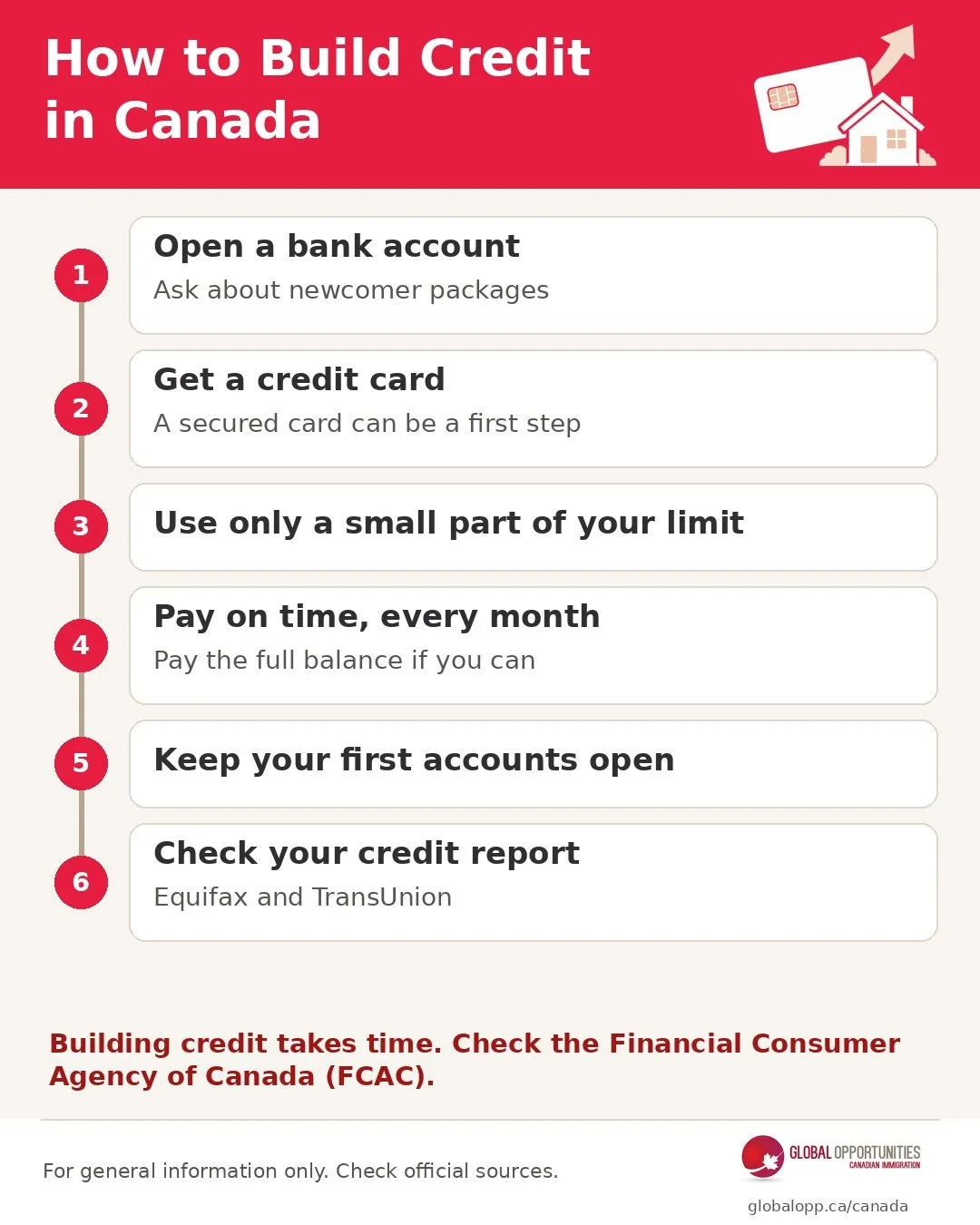
Groceries and shopping in Nova Scotia
Nova Scotia has supermarket chains and farmers' markets. Prices vary between stores, so compare flyers and online prices.
Supermarkets and farmers' markets
Atlantic Superstore and No Frills include Nova Scotia in their online store locators (Atlantic Superstore; No Frills).
Sobeys and Foodland are banners of Sobeys Inc., part of Empire Company Limited, which is headquartered in Stellarton, Nova Scotia (Empire Company).
Farmers' markets: the Halifax Brewery Market is a year-round farmers' market on Saturday mornings in the historic Alexander Keith's building on Lower Water Street. Discover Halifax also mentions the Alderney Landing Farmers' Market in Dartmouth (Explore Downtown Dartmouth) and the Sackville Farmers' Market, from May to November (Bedford-Sackville).
International products: ask your settlement agency or community associations where to find products from your country.
We mention stores for reference only. Global Opportunities has no relationship with any of them.
What to wear for your first winter
The Halifax Regional Municipality advises preparing for all kinds of winter weather: a jacket with a hood that keeps your head dry, a hat, gloves or mittens, and several layers of clothes (Halifax, your city). Compare prices at different stores, and consider second-hand options.
How much does it cost to live in Nova Scotia?
The cost of living in Nova Scotia depends a lot on where you live: according to CMHC, average rents in the Halifax CMA are higher than in Sydney or New Glasgow (see the housing section).
Main monthly costs to plan for
Plan for rent (see the CMHC figures in the housing section), heat and power if they are not included, transportation (according to Halifax Transit's fares page, an adult monthly pass is $90 as of November 2026; or the costs of a car), groceries, phone and internet, winter clothing and child care. Prices change, so check the current price on each official source. The benefits in our taxes and benefits section can help. For a national overview, see our article on the cost of living in Canada.
How much tax do you pay in Nova Scotia, and which benefits can you get?
In Nova Scotia you pay federal and provincial income tax on what you earn, and the HST on most purchases. Filing a tax return every year is also how you receive benefits such as the Canada child benefit, the Nova Scotia child benefit and the Nova Scotia affordable living tax credit.
How much income tax do you pay in Nova Scotia?
In Canada, personal income tax is administered by the Canada Revenue Agency (CRA). You pay federal tax and provincial tax, and both are calculated on the same yearly tax return. Canada uses brackets: each rate applies only to the portion of your taxable income that falls within that bracket, not to your whole income. According to the CRA, your provincial rate is determined by the province or territory where you lived on December 31 of the tax year (CRA, tax rates and income brackets for the current year).
According to the CRA's tax rates and income brackets page, the rates for the 2026 tax year are, as of November 2026:
Federal: 14% on the first $58,523 of taxable income, rising in steps up to 33% on the portion over $258,482.
Nova Scotia: 8.79% on the first $30,995; 14.95% on the portion from $30,995.01 to $61,991; 16.67% on the portion from $61,991.01 to $97,417; 17.5% on the portion from $97,417.01 to $157,124; and 21% on the portion over $157,124.
Rates and brackets change every year, so check the current rate on the CRA page. If you are an employee, your employer deducts tax from each pay cheque; your return then settles the difference and claims your credits. You need a Social Insurance Number (SIN) to work and file. Newcomers should file a tax return every year, even with low income: the CRA's page for newcomers to Canada explains residency for tax purposes, how to do your first return and how newcomers can apply for benefit payments even before they file for the first time. If your income is modest and your situation simple, the CRA lists free tax clinics.
The HST in Nova Scotia
Nova Scotia uses the Harmonized Sales Tax (HST), which combines the federal and provincial sales taxes. According to the Canada Revenue Agency, as of April 1, 2025, the HST rate in Nova Scotia decreased to 14% (CRA, GST/HST rates, checked in November 2026). Some goods and services are taxed and others are not; the CRA explains which supplies are taxable. Check the current rate on the CRA page.
The Canada child benefit and other federal payments
According to the CRA, the Canada child benefit (CCB) is a tax-free monthly payment for eligible families to help with the cost of raising children under 18 (CRA, Canada child benefit). The CRA lists the conditions: you live with the child, you are primarily responsible for the child's care and upbringing, you are a resident of Canada for tax purposes, and you or your spouse or common-law partner is a Canadian citizen, a permanent resident, a protected person or a temporary resident who meets the CRA's conditions (CRA, before you apply for the CCB). Newcomers can apply through their CRA account or with Form RC66 (CRA, how to apply for the CCB). The amount depends on family income and on the number and ages of your children, and you and your spouse or partner must file a tax return every year to keep receiving it.
The CRA also pays the Canada Groceries and Essentials Benefit (CGEB), which replaced the GST/HST credit in July 2026. According to the CRA, it provides tax-free quarterly payments to individuals and families with low and modest incomes, and you are automatically considered for it when you file your taxes (CRA, Canada Groceries and Essentials Benefit).
Nova Scotia benefits and credits
The CRA administers these provincial programs for Nova Scotia (CRA, Province of Nova Scotia programs):
Nova Scotia child benefit (NSCB): a tax-free amount paid monthly to help low- and modest-income families with the cost of raising children, combined with the CCB in a single payment. For July 2026 to June 2027, the CRA lists up to $127.08 a month for each child under 18, with a partial benefit for adjusted family net income between $26,000 and $34,000, as of November 2026.
Nova Scotia affordable living tax credit (NSALTC): a tax-free amount for low- and modest-income individuals and families that offsets the HST and is paid with the quarterly CGEB payments. For July 2026 to June 2027, the CRA lists a maximum of $255.00 a year for an individual or a couple, plus $60.00 for each child, reduced by 5% of adjusted family net income over $30,000, as of November 2026.
Because these programs are paid with the CCB and the CGEB, applying for the CCB if you have children and filing your tax return every year is what puts you in the system. Check the current amounts on the CRA page.
Affordable child care in Nova Scotia
According to Child Care Nova Scotia, the province's child care website, average fees for regulated child care were reduced by approximately 50% for families with children under the age of 6, compared with 2021, through phased fee reductions under the Canada-Wide Early Learning and Child Care Agreement (Child Care Nova Scotia, affordable child care). The lower fee is automatic: if your child is enrolled with a participating licensed provider, it is already included in your bill, and most licensed child care centres and regulated family home child care providers take part. Lower-income families may also qualify for the Child Care Subsidy, which can cover part or all of the cost on top of the lower fees. Use the Nova Scotia child care directory to find licensed programs, and contact providers early, because spaces can be limited.
Tax rates, benefit amounts and child care fees as published by the Canada Revenue Agency and Child Care Nova Scotia, as of November 2026. Tax rates apply by bracket, not to your whole income, and benefit amounts depend on your family income and situation. They may have changed by the time you read this: check the linked pages before you rely on them.
How cold is Nova Scotia, and how do you prepare for winter?
The ocean shapes Nova Scotia's climate. IRCC describes the Atlantic provinces as having cool winters and cool, humid summers (Discover Canada). The Halifax Regional Municipality says Halifax has warmer winters than the rest of Canada because it is close to the Atlantic, but that winter weather can bring strong winds, heavy snowfall, freezing rain and cold temperatures (Halifax, your city).
Weather information
To compare cities, look up official climate normals on the Environment and Climate Change Canada site, and check daily forecasts and weather warnings on weather.gc.ca.
Hurricanes, storms and power outages
According to the Government of Canada, hurricane season usually lasts from June through November, and communities close to the Atlantic Ocean are most at risk for a hurricane (Get Prepared, hurricanes). Prepare an emergency kit for storms and power outages, as the Government of Canada explains on its emergency preparedness page, follow official warnings on weather.gc.ca, and check Nova Scotia Power's outage map during outages.
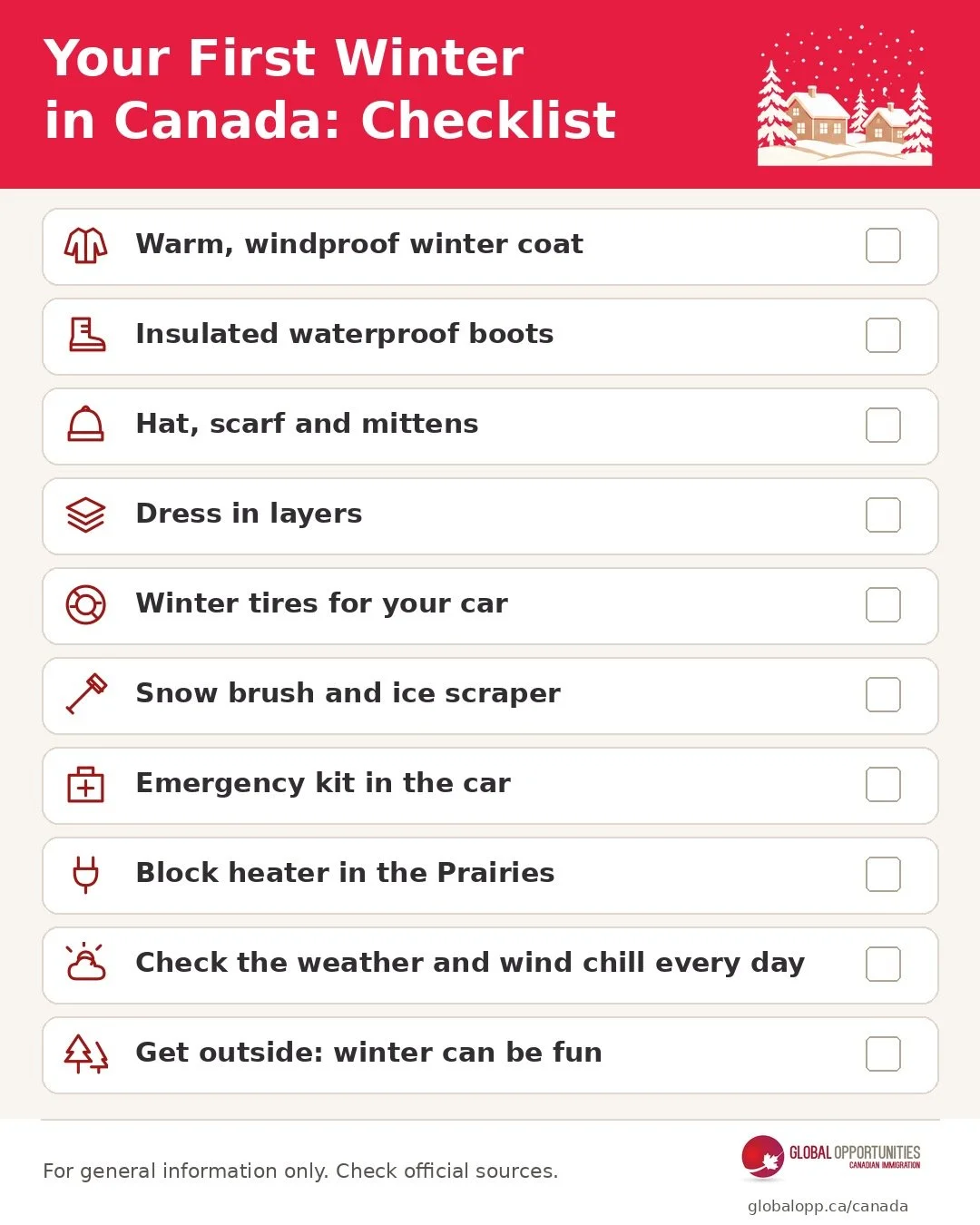
First-winter checklist
Buy winter clothing before the first snow: a jacket with a hood, a hat, gloves or mittens, and layers.
Check your lease to see who clears the snow at your home.
Learn your municipality's winter parking rules.
If you drive, get winter tires, keep an emergency kit in the car and check 511 before long trips.
Prepare an emergency kit for storms and power outages.
Education in Nova Scotia: schools, universities and NSCC
Nova Scotia has publicly funded public schools, including French-language schools, the ten universities listed below, and a community college, NSCC, with campuses across the province.
Public schools and how to register your child
According to the Government of Nova Scotia, public schools are publicly funded, everyone over the age of five and under 21 has the right to attend public school, and attendance is compulsory for children over five and under 16. You register at your local school or your Regional Centre for Education, and the province runs a school lunch program for public school students (going to school in Nova Scotia).
Public education is organized into seven Regional Centres for Education (Halifax, Cape Breton-Victoria, Chignecto-Central, Annapolis Valley, South Shore, Tri-County and Strait) and the Conseil scolaire acadien provincial (CSAP), which describes itself as the only francophone school board in Nova Scotia (Regional Centres for Education and CSAP; CSAP). Ask your school or Regional Centre for Education which documents to bring. YREACH offers school settlement support, according to the province's settlement services page.
Universities in Nova Scotia
Each university below is a designated learning institution for international students; confirm its current status on IRCC's designated learning institutions list. The descriptions come from each institution's website, checked in November 2026.
Dalhousie University lists campus locations in Halifax, Truro and Bible Hill, Yarmouth, Cape Breton and Saint John, New Brunswick, and describes itself as one of Canada's top 15 research-intensive universities. Its faculties are Agriculture; Architecture and Planning; Arts and Social Sciences; Computer Science; Dentistry; Engineering; Graduate Studies; Health; Law; Management; Medicine; Open Learning and Career Development; and Science. It offers co-operative education and work-integrated learning. Apply online through its how to apply page.
University of King's College, in Halifax, offers the Foundation Year Program, which it calls a great books program, journalism, writing and publishing programs, and honours programs and areas of study in arts and humanities, science and music. Apply to King's.
Saint Mary's University, on Robie Street in Halifax, has Faculties of Arts and Science, the Sobey School of Business, a Division of Engineering and graduate studies. It lists co-op options in arts, science, commerce, engineering and the Master of Science in Applied Science. See its admissions page.
Mount Saint Vincent University, on the Bedford Highway in Halifax, offers arts, science, professional studies (such as business administration, information technology and tourism and hospitality), education and graduate studies. Its co-operative education programs are in business administration, public relations and tourism and hospitality management. Apply now.
NSCAD University, on Duke Street in Halifax, says it has shaped visual and material culture in Canada since 1887. Programs include art history, design, film, ceramics, painting, photography, jewellery and metalsmithing, and textiles and fashion, plus graduate degrees. How to apply.
Atlantic School of Theology, in Halifax, describes itself as an ecumenical environment and offers graduate studies, a Bachelor of Theology, diplomas, certificates and continuing education. Apply.
Acadia University, in Wolfville, lists four faculties: Arts, Professional Studies, Pure and Applied Sciences, and Theology, and has a co-op program that combines study terms with paid work terms. See admissions.
St. Francis Xavier University (StFX), in Antigonish, has faculties of Arts, Business, Education and Science, graduate programs, and co-operative education in selected programs. See its admissions information.
Cape Breton University (CBU), in Sydney (contact page), lists program areas in arts, social sciences and culture; business; community economic development; education; engineering and technology; health and well-being; nursing; and sciences, and says it is a national leader in service-learning experiences. See CBU admissions.
Université Sainte-Anne says it is the only French-language post-secondary institution in Nova Scotia and that its courses are offered in French, except English courses and some continuing education courses. Its main campus is at Pointe-de-l'Église (Church Point), with campuses in Halifax, Tusket, Petit-de-Grat and Saint-Joseph-du-Moine. It offers university and college programs, French immersion and French as a second language. Apply.
Nova Scotia Community College (NSCC)
NSCC (Nova Scotia Community College) lists academic schools and an Institute of Skilled Trades, and offers co-op programs. According to its campus list, its campuses are:
Halifax region: Institute of Technology Campus (Halifax), Ivany Campus (Dartmouth) and Akerley Campus (Dartmouth).
Annapolis Valley: Kingstec Campus (Kentville), Annapolis Valley Campus (Middleton) and the Centre of Geographic Sciences (COGS) in Lawrencetown.
Southwest and South Shore: Burridge Campus (Yarmouth, with a learning centre in Digby), Shelburne Campus and Lunenburg Campus (Bridgewater).
Northern and central: Truro Campus, Cumberland Campus (Springhill, with a learning centre in Amherst) and Pictou Campus (Stellarton).
Eastern: Strait Area Campus (Port Hawkesbury, home of the Nautical Institute) and Sydney Waterfront Campus.
Online: eCampus.
Apply through NSCC's application page; international students have a separate international application page. Application windows vary by program and intake, so check the international page before you apply.
How to apply to college or university in Nova Scotia
Each institution above has its own application page, linked in its description. Deadlines, documents and English or French requirements vary by school and program, so start early. International students generally need:
A letter of acceptance from a designated learning institution.
In most cases, a provincial attestation letter (PAL). IRCC explains that the PAL is "usually required to apply for a study permit" and is "provided by the designated learning institution (DLI) you plan to attend" (IRCC, provincial attestation letter). The page lists who is exempt.
A study permit from IRCC. Rules change often; check IRCC's study in Canada page.
Free English and French classes for newcomers
According to IRCC, permanent residents and protected persons can take free classes through Language Instruction for Newcomers to Canada (LINC) (IRCC, language classes). The province's settlement page lists English training through ISANS, YREACH, Halifax Public Libraries, NSCC and regional organizations (Live in Nova Scotia). Confirm with each organization whether a class is free for your status. If you need a language test for work, study or immigration, see our guide to English and French tests for Canada.
School, admission and study permit information as published by the Government of Nova Scotia, IRCC and each institution, as of November 2026. A letter of acceptance or a PAL does not mean a study permit will be approved; IRCC decides each case. Check the linked pages before you rely on them.
Jobs and main industries in Nova Scotia
Job Bank's economic scan for Nova Scotia shows which industries added or lost jobs, by region. Global Opportunities does not offer jobs, and no one can guarantee you a job in Canada.
The labour market in numbers
According to Job Bank's economic scan for Nova Scotia, updated in May 2026, employment grew by 0.4% in 2025 and the annual unemployment rate was 6.6%. Health care and social assistance led job growth, followed by transportation and warehousing, construction (which reached its highest employment on record), business support services and professional, scientific and technical services. Accommodation and food services and educational services lost the most jobs (Job Bank, Nova Scotia economic scan). Conditions vary by region and occupation.
Key industries and regions
Halifax. According to Job Bank, employment in the Halifax region grew in 2025, led by health care and social assistance, followed by professional, scientific and technical services and by business, building and other support services (Job Bank, Nova Scotia economic scan).
Other regions. The same report says employment grew in the North Shore and Southern regions, was little changed in Cape Breton and declined in the Annapolis Valley in 2025.
Province-wide. IRCC says the province's identity is linked to shipbuilding, fisheries and shipping, and notes offshore oil and gas exploration (Discover Canada).
Where to look for work
Job Bank: the Government of Canada's job board, by city and occupation.
Job Bank outlooks for Nova Scotia: three-year outlooks by occupation. They are not job offers.
Government of Nova Scotia careers: openings in the provincial public service.
Employers directly: Nova Scotia Health, IWK, universities, NSCC, school boards and municipalities.
Nova Scotia Works Employment Services Centres: according to the province, they offer an integrated bundle of employment services that help residents understand, prepare for and meet the needs of the job market, and services for employers. Ask the centre near you which services you can use.
Settlement agencies such as ISANS, which lists job readiness training and employment language programs.
Resume tips: use a concise Canadian-style resume (no photo, age or marital status), adapt it to each posting, and build a network through volunteering and professional associations. Our newcomer guide to Canada has resume samples. Before you apply, read our guide to Canadian resumes, cover letters and job interviews.
Minimum wage and employment rights
According to the Government of Nova Scotia, as of October 1, 2026, employers must pay employees at least $17.00 per hour (Government of Nova Scotia, minimum wage). The same page explains other pay rules, such as call-in pay: an employee called in outside regular hours must be paid for at least three hours at the minimum wage. Overtime and other workplace rules are set out in the Labour Standards Code. The minimum wage changes over time, so check the current rate on the official page.
Minimum wage and pay rules as published by the Government of Nova Scotia, as of November 2026. The minimum wage is the lowest legal hourly rate, not the typical wage for a job. Check the linked page before you rely on it.
Regulated professions and trades
Many occupations in Nova Scotia, including most health professions, engineering, teaching and many trades, are regulated: you need a licence, registration or certificate from the provincial regulatory body. Foreign credentials alone do not give you a licence. Start with the province's list of regulatory bodies. For more on licences, credential assessments and job searches by profession, see our guide on how to immigrate to Canada as a professional.
Nurses trained abroad can read how to immigrate to Canada as a nurse, which lists the nursing regulator in each province.
Any mention of regulated occupations in this guide is for reference only. The list may not be complete. Always confirm requirements directly with the regulator for your profession or trade.
Free newcomer services in Nova Scotia
The province's settlement services page says settlement services are available across the province, at no cost, in person or online, in English or French. It lists the organizations, with topics such as employment, money and taxes, housing, language learning, health care, child care and education, and transportation. Some of them:
ISANS (Immigrant Services Association of Nova Scotia), Halifax: settlement support, job readiness training, employment language programs and pre-arrival support (Nova Scotia Start). ISANS says it delivers services in person and online.
YMCA YREACH: settlement support outside Halifax, in Bridgewater, Yarmouth, Kentville, Amherst, Truro, Pictou, Sydney and other communities, plus school settlement support.
New Dawn, Cape Breton Island Centre for Immigration, Sydney: settlement support and outreach across Cape Breton.
Fédération acadienne de la Nouvelle-Écosse (FANE): settlement services and informal French instruction for French-speaking newcomers across the province, with online support.
Antigonish Women's Resource Centre: settlement support for Antigonish and Guysborough counties.
Valley Community Learning Association, Atlantic Canada Language Academy, Digby Area Learning Association and Veith House: English training, skills and integration support, and newcomer family programs in their regions.
YWCA of Halifax: a financial literacy program.
This list is for reference only and may not be complete. Check eligibility with each organization. You can also use IRCC's newcomer services finder. IRCC notes that, starting April 1, 2026, economic class permanent residents can only access newcomer services for a limited time, so contact an agency early.
Culture, community and the outdoors in Nova Scotia
Nova Scotia's culture includes Mi'kmaw, Acadian, Celtic and Gaelic, African Nova Scotian and many other traditions.
Mi'kmaw culture. The Halifax Regional Municipality explains that the area is Mi'kma'ki and that Peace and Friendship Treaties were signed between the British Crown and the Mi'kmaq (Halifax, your city).
Acadian culture. According to Parks Canada, the Deportation of the Acadians began in 1755 and continued until 1762; Acadians were later allowed to return (Parks Canada, Grand-Pré). Tourism Nova Scotia highlights Yarmouth's Acadian history and culture, and Université Sainte-Anne notes that most residents of Isle Madame, where its Petit-de-Grat campus is, are of Acadian, French-speaking origin (Université Sainte-Anne, Petit-de-Grat).
Gaelic and Celtic traditions. IRCC notes that Celtic and Gaelic traditions sustain a vibrant culture in the province (Discover Canada). Tourism Nova Scotia suggests taking in a ceilidh in Sydney and lists the Antigonish Highland Games.
African Nova Scotian history. In Halifax, the Africville Museum recognizes the contribution of the Africville community to Canadian and African diasporic history (Discover Halifax, North End).
An international community. The municipality says immigrants keep making Halifax a more multicultural community (Halifax, your city). Settlement agencies can connect you with community groups. Settling in is also about people: read our article on building community in Canada.
The ocean and the outdoors
Discover Halifax calls the Peggy's Point Lighthouse at Peggy's Cove one of the most photographed lighthouses in the world (Discover Halifax, Peggy's Cove Coastal Region). Other places to explore include the Cabot Trail and Cape Breton Highlands National Park, Kejimkujik, the UNESCO World Heritage Sites of Old Town Lunenburg and the Landscape of Grand-Pré, the beaches of the Northumberland Strait and the Bay of Fundy tides.
How can you immigrate to Nova Scotia?
There is no single "Nova Scotia visa". People move to Nova Scotia through federal programs run by IRCC, the Nova Scotia Nominee Program, the Atlantic Immigration Program, or a temporary permit to study or work. Programs, streams and requirements change frequently, so always check the official pages. Which pathway fits you, and what it would require, depends on each case; a consultation is the way to know. If you plan to visit first, use IRCC's tool to check if you need a visa or an eTA.
Express Entry. According to IRCC, it manages the Federal Skilled Worker Program, the Federal Skilled Trades Program and the Canadian Experience Class (IRCC, Express Entry). See also our page on the Federal Skilled Worker program.
Nova Scotia Nominee Program (NSNP). According to the official NSNP page, reviewed in November 2026, candidates choose a stream and submit an online expression of interest, which enters a pool; being in the pool does not guarantee selection. The province selects candidates based on factors such as labour market needs, sector priorities and program capacity. Nominees then apply to IRCC, which makes the final decision on permanent residence (IRCC, provincial nominees). For an overview of how these programs work across Canada, see our page on provincial nominee programs.
Atlantic Immigration Program (AIP). According to IRCC, it is a pathway to permanent residence for skilled foreign workers and international graduates of Canadian institutions who want to work and live in Atlantic Canada (IRCC, Atlantic Immigration Program). In general terms, it requires a job offer from an employer designated by the province, and in Nova Scotia the province must endorse the position (Live in Nova Scotia, AIP).
Study and work permits. IRCC describes employer-specific and open work permits (IRCC, work in Canada). See our pages on the LMIA and Working Holiday in Canada. Irish citizens can read our working holiday guide for Irish citizens. If your permit ends within a year, watch Is your work permit or PGWP expiring in the next 12 months?
Program descriptions as published by IRCC and the Government of Nova Scotia (Live in Nova Scotia), as of November 2026. The NSNP and the AIP change often, and what you read here may already be different. Entering the NSNP pool or meeting a program's requirements does not mean you will be selected or that an application will be approved; the province and IRCC decide each case. Always check the official pages, and be wary of anyone who promises a nomination, permanent residence or a job.
Already working in the province? Watch our live session Have you completed one year of work experience in Canada?, which explains why being eligible for permanent residence is not the same as being selected.
After permanent residence, many people apply for citizenship: see our guide to Canadian citizenship.
French in Nova Scotia
Nova Scotia has Acadian francophone communities and French-language schools, post-secondary education and settlement services.
French-language schools: the CSAP describes itself as the only francophone school board in Nova Scotia.
University and college in French: Université Sainte-Anne, with five campuses, including one in Halifax.
Settlement services in French: FANE offers settlement services for French-speaking newcomers, according to the province's settlement services page.
Francophone immigration: see the Government of Canada's page on francophone immigration outside Quebec and our page on French language proficiency.
Check the language requirements of each job posting. Global Opportunities does not offer services for Quebec's immigration programs; this guide covers Nova Scotia only.
First steps after arriving in Nova Scotia
Your first weeks in Nova Scotia involve a few key tasks. Doing them early makes everything else easier.
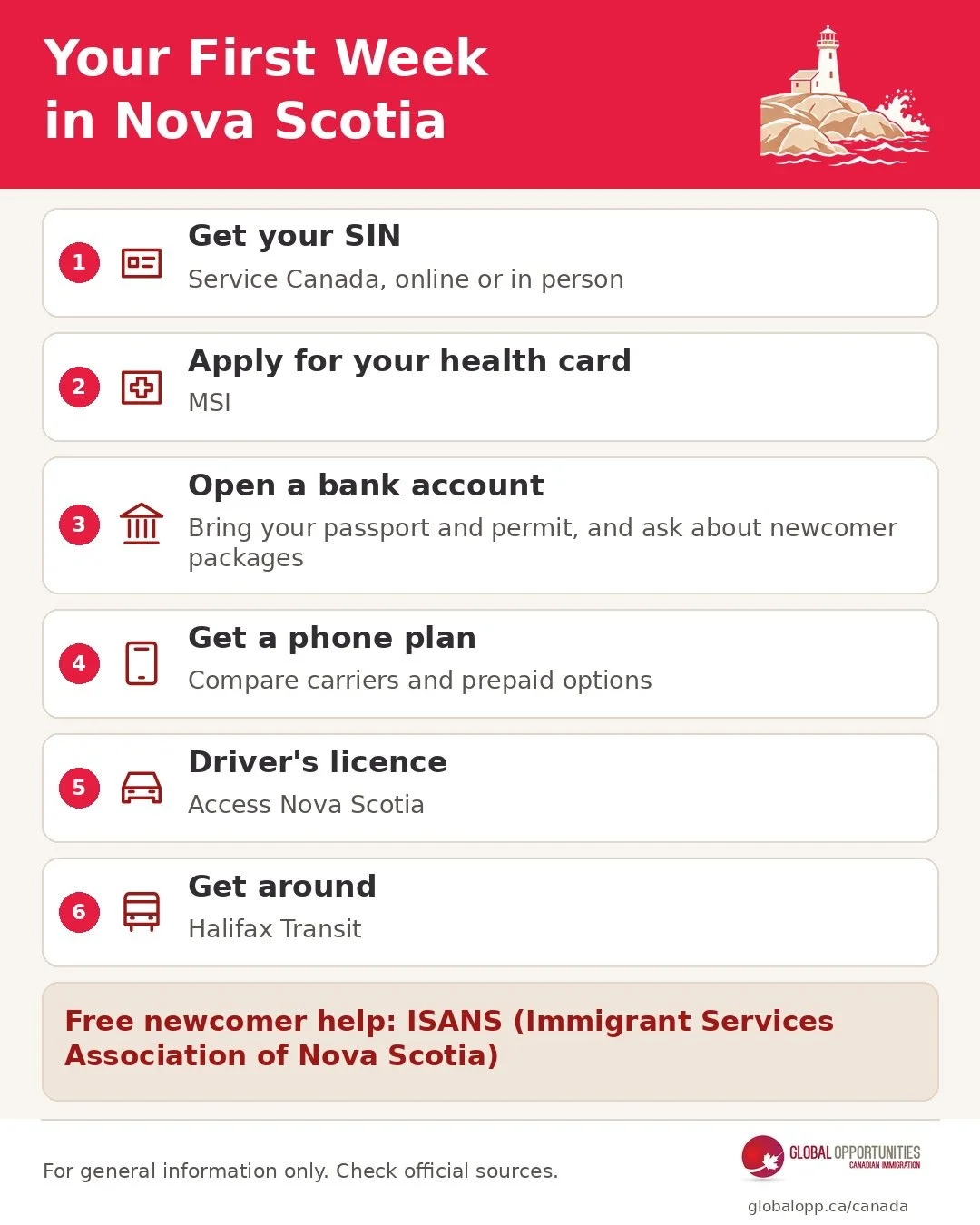
Get your Social Insurance Number (SIN) to work and access government programs (Service Canada, SIN).
Apply for your MSI health card, then call 811 to join the Need a Family Practice Registry, and call again when you get your card number.
Buy private health insurance to cover any gap before MSI starts.
Open a bank account and start building credit.
Contact a settlement agency (ISANS, YREACH, New Dawn, FANE or another one near you).
Find housing with a written lease, and remember the deposit and rent cap rules.
Get a transit pass or plan your driving: according to the province's licence exchange page, you can drive on a valid out-of-country licence for up to 180 days after moving to Nova Scotia, then you must exchange it.
Register your children for school at your local school or Regional Centre for Education, and look into child care on Child Care Nova Scotia.
Prepare for winter: coat, boots, emergency kit and, if you drive, winter tires.
Frequently asked questions
Is it expensive to live in Halifax?
Among the centres listed in this guide, the Halifax CMA has the highest average rents reported by CMHC. According to CMHC's Rental Market Survey, the average two-bedroom apartment in the Halifax CMA rented for $1,826 in October 2025, and units that changed tenants averaged $2,058. According to Halifax Transit's fares page, an adult monthly pass costs $90 (November 2026), and according to the CRA, the HST in Nova Scotia is 14%. Rents in Sydney, New Glasgow, Kentville and Truro are lower. Check current listings and the official sources, because prices change.
What are the best neighbourhoods in Halifax for newcomers?
There is no single best area; it depends on your budget, work, school and whether you have a car. Discover Halifax, the official tourism site, describes the North End's murals, cafés and restaurants, the West End's Quinpool Road, and downtown Dartmouth as a compact, walkable neighbourhood across the harbour, reached by ferry. Bedford, Sackville and Cole Harbour are other parts of the municipality. Compare CMHC rents, check Halifax Transit routes and visit before you sign a lease.
Is Halifax safe?
Safety varies by neighbourhood and time of day, as in any city, so it is best to look at official data and local advice rather than online rankings. Statistics Canada publishes the Crime Severity Index for provinces and census metropolitan areas, including Halifax, in table 35-10-0026-01, which lets you compare cities and see how the index changes from year to year. The Halifax Regional Municipality publishes crime mapping and information from Halifax Regional Police on its website. Before you sign a lease, visit the area at different times of day, ask your settlement agency, such as ISANS, and future neighbours, and check how you would get home by bus or ferry at night. In an emergency, call 911. See our Halifax section.
Do I need a car to live in Nova Scotia?
It depends on where you live. Halifax Transit runs buses and ferries in the Halifax Regional Municipality, Transit Cape Breton serves the Cape Breton Regional Municipality, and Tidal Transit (the former Kings Transit website) runs buses in the Annapolis Valley. Check whether routes serve your home, work or school before you decide. If you plan to drive, budget for insurance, fuel, winter tires and the provincial vehicle safety inspection, and remember that, according to the province's licence exchange page, you can drive on a valid foreign licence for up to 180 days after moving to Nova Scotia.
How much is rent in Nova Scotia outside Halifax?
According to CMHC's Rental Market Survey, in October 2025 the average two-bedroom apartment rented for $1,191 in the city of Sydney, $1,254 in the Truro area, $1,127 in the Kentville area and $1,077 in the New Glasgow area. The average for all Nova Scotia centres of 10,000 people or more was $1,711. CMHC does not publish a reliable figure for every town; for Yarmouth, for example, the figure is suppressed. Check current listings and CMHC's latest data.
How much can a landlord ask for as a deposit in Nova Scotia?
According to the province's renting guide, a landlord can ask for a security deposit of up to half of one month's rent. The landlord must keep it in a trust account, cannot charge an extra deposit for pets and cannot charge an application fee. Any money taken before the lease is signed or before rent is due counts as a security deposit. At the end of the tenancy, the landlord can keep part of it only for unpaid rent or damage beyond normal wear and tear. Disputes go to the Residential Tenancies Program.
How much can my rent go up in Nova Scotia?
According to the province's temporary rent cap fact sheet, the rent cap is 5% and is in effect until December 31, 2027. Rent can go up by at most 5% once every 12 months, including when you renew a lease for the same unit, and it cannot go up at all during the first 12 months of a tenancy. The cap does not apply to a new tenant signing a new lease, to public housing or to land-lease communities. Landlords must give written notice, usually four months for monthly or yearly leases.
How do I get an MSI health card in Nova Scotia?
You apply online through MSI Resident Services, which emails you a link to upload the Registration for Health Services Form and your documents, or by mail, fax or secure drop box; in-person service is not available. You need proof that you are legally entitled to remain in Canada and proof of your Nova Scotia address. When coverage starts depends on your status, and many international students have specific rules. Read the official eligibility page, and buy private health insurance for any period before you are covered.
How do I find a family doctor in Nova Scotia?
Register with Nova Scotia Health's Need a Family Practice Registry, online or by calling 811. According to Nova Scotia Health, if you are new and do not have a health card yet, you must register by phone and provide your health card number within four months. Practices accepting new patients receive the list for their community, and Nova Scotia Health says it cannot confirm your place or when you will be matched. While you wait, you can use VirtualCareNS once you have your physical health card, urgent treatment centres, community pharmacy primary care clinics (with a health card) and 811.
How do I exchange my foreign driver's licence in Nova Scotia?
According to the province's licence exchange page, you can drive on a valid foreign licence for up to 180 days after moving to Nova Scotia; then you must exchange it. If your country and class are on the province's exchange list, you take a vision test and surrender your foreign licence. If not, you need full testing: knowledge, vision and road tests. Licences not in English or French need a certified translation; an International Driving Permit is not accepted as a translation. Exchanges are done in person at Access Nova Scotia or the Registry of Motor Vehicles, by appointment.
Do I need winter tires in Nova Scotia?
The Halifax Regional Municipality advises newcomers who will drive in winter to get winter tires and to keep an emergency kit in the car with a flashlight, a shovel, a blanket and booster cables. Check the province's 511 service for road conditions before long trips. In Halifax, learn the rules of the overnight winter parking ban, which, according to the municipality, is enforced from 1 a.m. to 6 a.m. only during declared weather events between December 15 and March 31.
What is the HST in Nova Scotia?
The Harmonized Sales Tax combines the federal and provincial sales taxes into one. According to the Canada Revenue Agency, as of April 1, 2025, the HST rate in Nova Scotia decreased to 14%. Some goods and services are taxed and others are not. Check the current rate on the CRA page, because tax rates can change.
How cold does it get in Halifax, and does Nova Scotia get hurricanes?
The Halifax Regional Municipality says Halifax has warmer winters than the rest of Canada because it is close to the Atlantic, but winter can bring strong winds, heavy snowfall, freezing rain and cold temperatures. According to the Government of Canada, hurricane season usually lasts from June through November, and communities close to the Atlantic Ocean are most at risk. Keep an emergency kit, follow official warnings on weather.gc.ca, and check Environment and Climate Change Canada's climate normals for each city.
What universities and colleges are in Nova Scotia?
Nova Scotia's universities are Dalhousie (Halifax, with other locations including Truro and Bible Hill), the University of King's College, Saint Mary's, Mount Saint Vincent, NSCAD University and the Atlantic School of Theology, all in Halifax; Acadia in Wolfville; St. Francis Xavier in Antigonish; Cape Breton University in Sydney; and Université Sainte-Anne, which says it is the only French-language post-secondary institution in Nova Scotia, with its main campus at Pointe-de-l'Église (Church Point). The Nova Scotia Community College (NSCC) has campuses across the province and online. Check each school's status on IRCC's designated learning institutions list.
Where can I get free help as a newcomer in Nova Scotia?
The province's Live in Nova Scotia website says settlement services are available across the province at no cost, in person or online, in English or French, and lists the organizations. ISANS serves Halifax and also delivers services online; YMCA YREACH serves communities outside Halifax such as Sydney, Truro, Kentville, Bridgewater, Yarmouth, Amherst and Pictou; New Dawn serves Cape Breton; and FANE serves French-speaking newcomers across the province. Nova Scotia Works centres offer employment services. Check eligibility with each organization, and contact them early, because IRCC says some newcomer services are time-limited for economic class permanent residents.
How much does Halifax Transit cost?
According to Halifax Transit's fares, tickets and passes page, as of November 2026, an adult single ride on its buses and ferries costs $3, seniors (65+) and youth (13–17) pay $2.25 and children 12 and under ride free. An adult 1-day HFXGO pass costs $7.50, a 7-day pass $25.50 and a monthly pass $90. Regional Express routes 320, 330 and 370 cost more: $4.75 for an adult single ride. You can pay in the HFXGO app, with tickets from retailers and customer service centres, or with exact change in cash. If you verify an HFXGO account and use Tap & Ride, fare capping stops charging you once you reach the cost of a daily or monthly pass. Fares change, so check the official page. See our getting around Halifax section.
How do I get from Halifax Stanfield Airport to downtown Halifax?
You can take Halifax Transit's Regional Express route 320, which runs between the airport and downtown Halifax. According to Halifax Stanfield International Airport, Maritime Bus also serves the airport as part of its routes across the Maritimes, and the airport lists shuttles, taxis and rental cars. Halifax Transit's fares page says Regional Express routes cost more than regular buses: $4.75 for an adult single ride as of November 2026, with a $1.50 adult top-up if you board with a regular ticket, transfer or monthly pass. If you plan to rent a car, the airport lists several companies with counters on the lower level of the Airport Parkade; confirm age rules, accepted licences and insurance with the company before you book. See our getting around Halifax section.
Do cars need a safety inspection in Nova Scotia?
Yes. Nova Scotia requires a motor vehicle safety inspection at an official inspection station. According to Service Nova Scotia's vehicle (safety) inspections page, a used passenger vehicle that passes gets a sticker valid for two years, and a new vehicle gets one valid for three years. If you bring a used vehicle from outside the province and it must be registered in Nova Scotia, you must register it within 180 days and have it inspected no later than 10 days after registration. When you buy a used car privately, it must have a valid inspection sticker issued within 30 days before the sale, or the buyer must get one before the transfer. Service Nova Scotia also requires insurance information to register a vehicle. See our driving section.
How do I find an apartment to rent in Halifax?
Start with online listing sites such as Kijiji, Facebook Marketplace, Rentals.ca and PadMapper, the websites of property management companies, your school's housing office if you are a student, and settlement agencies such as ISANS and YREACH. Landlords may ask for identification, proof of income and references, and may check your credit. According to the province's renting guide, landlords cannot charge an application fee, and any money taken before the lease is signed or before rent is due counts as a security deposit. Nova Scotia has a Standard Form of Lease, and your landlord must give you a signed copy within 10 days. Never send money for a place you have not seen, and fill in the Rental Unit Condition Report when you move in. See our housing section.
What are my rights as a tenant in Nova Scotia?
Your rights come from the Residential Tenancies Act. According to the province's renting guide, a landlord can enter only in an emergency or after giving 24 hours' written notice, during daylight hours. Landlords cannot turn off the heat, even during a dispute or if rent is owed, and must keep the property fit for living; tenants pay for damage they or their guests cause. Landlords can charge 1% of the monthly rent per month for late rent, and tenants cannot withhold rent to force repairs. Landlords cannot refuse to rent based on a protected characteristic. If you and your landlord cannot agree, you can file an Application to the Director (Form J) with the Residential Tenancies Program, which can lead to mediation or a hearing. See our housing section.
Are heat, power and internet included in the rent in Nova Scotia?
It depends on the lease, so ask exactly what the rent includes: heat, power, hot water, internet and parking. If something that was included, such as heat or power, stops being included, the province's rent cap fact sheet counts it as a rent increase. According to the province's renting guide, landlords cannot turn off the heat or cut utilities included in the lease, and the temperature should be 20°C to 22°C. During storms, Nova Scotia Power publishes an outage map. Tenant insurance is not required by law, but many landlords ask for it, and the renting guide notes that it generally covers your belongings. If you need help with housing or other local services, you can call or text 211. See our housing section.
When does MSI coverage start for newcomers?
It depends on your status. According to the Government of Nova Scotia's page on coverage if you move to Nova Scotia, coverage for citizens and permanent residents arriving from abroad usually starts on the date they become Nova Scotia residents. For work permit holders with a permit or contract of 12 months or more, it usually starts on the later of the residency date or the date the immigration document was issued. Most international students have a later start date, with exceptions. Read the province's full eligibility page for your situation, and buy private health insurance to cover the time before MSI starts. Until you have your physical health card, you cannot use some services, such as VirtualCareNS. See our health care section.
Can international students get MSI in Nova Scotia?
Yes, but usually not right away. According to the Government of Nova Scotia, an international student with a study permit valid for a minimum of 12 months can apply for a health card on the first day of the 13th month after arriving in Nova Scotia as a student, or after the date of the study permit, whichever is later, and can apply up to 90 days before that date (Government of Nova Scotia, coverage if you move to Nova Scotia). The page notes that there is no waiting period if you are employed as a teaching or research assistant with a Nova Scotia university, and that an eligible spouse or common-law partner and dependants can get a card at the same time. For your first year, you need your school's health plan or private insurance, so ask your international office how it works. See our health care section.
How do I register my child for school in Nova Scotia?
You register at your local school or your Regional Centre for Education. According to the Government of Nova Scotia (going to school in Nova Scotia), public schools are publicly funded, everyone over the age of five and under 21 has the right to attend public school, and attendance is compulsory for children over five and under 16. The province runs a school lunch program for public school students. Public education is organized into seven Regional Centres for Education and the Conseil scolaire acadien provincial (CSAP), which describes itself as the only francophone school board in Nova Scotia. Ask your school or Regional Centre for Education which documents to bring. YREACH offers school settlement support, according to the province's settlement services page. See our education section.
How does affordable child care work in Nova Scotia?
According to Child Care Nova Scotia, the province's child care website, average fees for regulated child care have been reduced by approximately 50% for families with children under 6, compared with 2021, under the Canada-Wide Early Learning and Child Care Agreement (Child Care Nova Scotia, affordable child care). You do not need to apply for the lower fee: if your child is enrolled with a participating licensed provider, it is already included in your bill. Most licensed child care centres and regulated family home child care providers take part, but some do not, so ask each provider. Lower-income families may also qualify for the Child Care Subsidy, which can cover part or all of the cost on top of the lower fees, and many families receive both. Find licensed programs in the child care directory on Child Care Nova Scotia, and contact providers early. See our taxes and benefits section.
What jobs are in demand in Nova Scotia?
Job Bank's economic scan shows which industries are growing, but it is not a list of job offers. According to Job Bank's Nova Scotia economic scan, updated in May 2026, health care and social assistance led job growth in 2025, followed by transportation and warehousing, construction, business support services and professional, scientific and technical services. Accommodation and food services and educational services lost the most jobs. The Halifax region has accounted for about 80% of the province's job gains since 2019. Use Job Bank's three-year outlooks by occupation, and check whether your profession or trade is regulated before you apply. Global Opportunities does not offer jobs. See our jobs section.
What is the minimum wage in Nova Scotia?
According to the Government of Nova Scotia, as of October 1, 2026, employers must pay employees at least $17.00 per hour (Government of Nova Scotia, minimum wage). The same page explains related rules: for example, an employee who is called in to work outside regular hours must be paid for at least three hours at the minimum wage, and employees must be paid at least the minimum wage for time spent at the workplace waiting for work at the employer's request. Overtime is addressed in the Minimum Wage Order (General) and the Labour Standards Code. Many jobs pay more than the minimum: Job Bank lets you look up the wages reported for your occupation in Nova Scotia (Job Bank, search wages). The rate changes over time, so check the current rate before you accept a job offer. See our jobs section.
How do I open a bank account in Nova Scotia?
Visit a bank or credit union with your identification. Generally, banks ask for a passport, your immigration document (such as your Confirmation of Permanent Residence, work permit or study permit) and proof of address. The Financial Consumer Agency of Canada (FCAC) explains which documents are accepted, your rights and what to do if a bank refuses to open an account (FCAC, opening a bank account). National banks have branches in Nova Scotia, and Atlantic Central's credit union finder lets you search for a credit union near you. Compare monthly fees, transaction limits, international transfer costs and branch locations. Once your account is open, start building a credit history, for example with a secured credit card that you pay in full every month. See our banking section.
What is the Nova Scotia Nominee Program (NSNP)?
The NSNP is the province's own immigration program. According to the official NSNP page, reviewed in November 2026, candidates choose a stream and submit an online expression of interest, which enters a pool; being in the pool does not guarantee selection. The province selects candidates based on factors such as labour market needs, sector priorities and program capacity. Nominees then apply to IRCC, which makes the final decision on permanent residence. Streams and requirements change often, so always check the official page before you apply, and be wary of anyone who promises a nomination. See our how people immigrate to Nova Scotia section.
What is the Atlantic Immigration Program?
The Atlantic Immigration Program (AIP) is a federal pathway to permanent residence in Atlantic Canada. According to IRCC (Atlantic Immigration Program), it is for skilled foreign workers and international graduates of Canadian institutions who want to work and live in Atlantic Canada. In general terms, it requires a job offer from an employer designated by the province, and in Nova Scotia the province must endorse the position, as the Live in Nova Scotia AIP page explains. Requirements change often, so check the official pages, and be wary of anyone who promises a job offer or permanent residence, or asks you to pay for a job offer. See our how people immigrate to Nova Scotia section.
Is it better to live in Halifax or Sydney?
It depends on your occupation, budget and how you will get around. According to CMHC's Rental Market Survey, in October 2025 the average two-bedroom apartment rented for $1,826 in the Halifax CMA and $1,191 in the city of Sydney. According to Job Bank (Nova Scotia economic scan), the Halifax region has accounted for about 80% of the province's job gains since 2019, while Cape Breton had the highest unemployment rate among the province's regions in 2025, at 10.9%. Sydney has Cape Breton University, NSCC's Sydney Waterfront Campus, Transit Cape Breton and New Dawn for settlement support; Halifax has several universities, Halifax Transit and ISANS. Check postings in your occupation in both places before you choose. See our other cities section.
Halifax, Moncton or St. John's: which suits newcomers?
It depends on your occupation, budget and languages, so compare jobs in your field first. On housing, CMHC's October 2025 survey put the average two-bedroom apartment at $1,826 in the Halifax CMA and $1,453 in the Moncton CMA (CMHC, Rental Market Survey data tables); in the St. John's metropolitan area, CMHC's figure for apartments and row houses was $1,348. Halifax is home to several universities and NSCC campuses (see our education section); Moncton is in the most bilingual part of New Brunswick, which can help if you speak French; and Memorial University's largest campus is in St. John's. The HST is 14% in Nova Scotia and 15% in New Brunswick and Newfoundland and Labrador, according to the CRA. Read our guides to New Brunswick and Newfoundland and Labrador, and check current prices on each official source.
When should I call 911 in Nova Scotia, and what if I call it by mistake?
According to the Government of Nova Scotia's 911 page, call 911 if your health, safety or property is threatened and you need help right away; the call is free from any phone. If you call 911 by accident, do not hang up: stay on the line and tell the call taker the call was accidental. If you hang up, the call taker will call you back, and if they cannot reach you, emergency services could come to your location. If your problem is not an emergency, do not call 911, so call takers are free for emergencies.
Is there a mental health crisis line in Nova Scotia?
Yes. If you or someone you know is thinking about suicide, you can call or text 9-8-8, the Suicide Crisis Helpline, 24 hours a day, every day of the year (9-8-8). If someone's life is in immediate danger, call 911. For non-urgent health questions, the provincial 811 line can point you to local services (see the health section).
How do I check road conditions in Nova Scotia before I drive?
Use 511 Nova Scotia to check road conditions and highway cameras before you leave. Emergency Info Nova Scotia also links to winter road updates, plow tracking and parking-ban information (Emergency Info Nova Scotia).
What do I do if I get a flat tire or my car breaks down in Nova Scotia?
If you are in danger or blocking traffic, call 911. For a flat tire, a dead battery or a tow, many drivers use roadside assistance. CAA offers roadside assistance to its members through regional clubs, and says that services may vary by club (CAA). Some car insurance policies, new-car warranties and credit cards also include roadside assistance: check your policy or card agreement before you need it, and keep the phone number in your car.
How does car insurance work in Nova Scotia?
Insurance is mandatory to register a vehicle, and Service Nova Scotia asks for insurance information whenever a registration is issued or renewed (Service Nova Scotia, registering a vehicle). You buy it from private insurance companies, directly or through brokers. The province's insurance page has bulletins from the Superintendent of Insurance, and the Nova Scotia Energy and Regulatory Boards Tribunal lists auto insurance among the matters it handles. Compare several quotes, and ask how insurers treat your driving history from abroad. See the driving section.
Can newcomers get the Canadian Dental Care Plan in Nova Scotia?
Possibly, once you meet the conditions. According to the Government of Canada's CDCP eligibility page, you must meet all four requirements: no access to private dental insurance or coverage, a tax return filed in Canada (and your spouse's or partner's, if you have one), an adjusted family net income below $90,000, and being a Canadian resident for tax purposes. Filing your first Canadian tax return is therefore the first step. Conditions as published by the Government of Canada, as of November 2026; check the official page before you apply.
What is 811 in Nova Scotia?
811 is the province's free health line: registered nurses answer around the clock, seven days a week (811 Nova Scotia). You also call 811 to join Nova Scotia Health's Need a Family Practice Registry. For emergencies, call 911. See our health section.
Is Nova Scotia a good place to live?
It depends on your work, budget and lifestyle. On the plus side, according to Job Bank's economic scan, health care and several other sectors added jobs in 2025, and Halifax Transit runs buses and harbour ferries in the Halifax Regional Municipality (see the transit section). On the other side, outside Halifax and Cape Breton many people need a car, storms and power outages happen, and job growth varies by region (the same report shows employment declined in the Annapolis Valley in 2025). Compare job postings and rents in the area you are considering using the official data in this guide.
Are there direct flights to Halifax from Europe or Mexico?
Yes, at least part of the year. As of November 2026, Halifax Stanfield's non-stop flights page listed a year-round Air Canada flight to London Heathrow and, in summer, WestJet flights to Amsterdam, Barcelona, Dublin, Edinburgh, Lisbon, London Gatwick and Paris, Discover Airlines to Frankfurt and Edelweiss to Zurich. From Mexico, it listed seasonal winter flights to Cancún with Air Canada, Air Transat, Porter and WestJet; there were no non-stop flights to Mexico City. Routes and airlines change seasonally, so check the airport's page and the airlines before you book.
Can Global Opportunities get me a job in Nova Scotia?
No. Global Opportunities does not offer jobs or job offers, and no one can guarantee you a job in Canada. To look for work, use Job Bank, the Government of Nova Scotia's careers site, employers' websites, Nova Scotia Works centres and settlement agencies such as ISANS. Be wary of anyone who promises you a job or asks you to pay for a job offer.
Related guides
How Global Opportunities can help
Choosing a province and a pathway depends on your education, work experience, languages and goals. We can help you understand your options.
Our regulated consultant: Lic. Mildrete Monserrath Gutierrez Martinez, Regulated Canadian Immigration Consultant (RCIC), CICC licence R514880. Verify her licence on the CICC Public Register: https://college-ic.ca/protecting-the-public/find-an-immigration-consultant. Global Opportunities does not offer services for Quebec's immigration programs. Global Opportunities is a private firm and is not part of the Government of Canada or any provincial government.
Recorded seminars and lives: watch our recorded seminars in English or the Spanish recordings, and visit our YouTube channel.
More articles in English: read our Moving to Canada articles on topics such as health care, cost of living, the ECA and professional licences, and building community in Canada.
Personalized consultation: for a review of your own case, contact us or write to info@globalopp.ca.
Prefer email? Tell us what you need help with (moving to Nova Scotia) and we will reply: email info@globalopp.ca.
Contact Global Opportunities →
Sources
Government of Nova Scotia, Residential Tenancies Guides: Renting (April 2025)
Government of Nova Scotia, Temporary rent cap and rent increases (2026)
Government of Nova Scotia, Exchange your out-of-province driver's licence
Government of Nova Scotia, Coverage if you move to Nova Scotia
Canada Revenue Agency, Tax rates and income brackets for the current year
Canada Revenue Agency, Before you apply for the Canada child benefit
Canada Revenue Agency, How to apply for the Canada child benefit
Canada Revenue Agency, Canada Groceries and Essentials Benefit
Child Care Nova Scotia, Families (directory and Child Care Subsidy)
Statistics Canada, Crime severity index and weighted clearance rates (table 35-10-0026-01)
Government of Nova Scotia, Regional Centres for Education and CSAP
Government of Nova Scotia, Nova Scotia Works Employment Services Centres
Discover Halifax, Regions, including Downtown Halifax, North End, West End, Bedford-Sackville, Dartmouth-Cole Harbour, Explore Downtown Dartmouth and Peggy's Cove Coastal Region
Tourism Nova Scotia, Cities and towns, Truro, Wolfville, Bay of Fundy and Annapolis Valley and Northumberland Shore
Nova Scotia Health, About us and QEII Health Sciences Centre
BMO, Halifax branches, CIBC, Halifax locations and Scotiabank Archives
Atlantic Superstore, Store locator, No Frills, Store locator and Empire Company (Sobeys)
University and college websites: Dalhousie, University of King's College, Saint Mary's and its co-op degree programs, Mount Saint Vincent, NSCAD, Atlantic School of Theology, Acadia, StFX, Cape Breton University, Université Sainte-Anne and its Petit-de-Grat campus, and NSCC
Statistics Canada, Visible minority by gender and age (table 98-10-0351-01) · Ethnic or cultural origin by gender and age (table 98-10-0355-01)
Statistics Canada, Population and dwelling counts (table 98-10-0001-01) · by municipality (table 98-10-0002-01) · Population estimates, quarterly (table 17-10-0009-01)
Canada Revenue Agency, First Home Savings Account · Opening your FHSAs · Home Buyers' Plan · Line 31270, home buyers' amount
Government of Canada, Canadian Dental Care Plan: do you qualify
Global Opportunities on YouTube, Have you completed one year of work experience in Canada?
Government of New Brunswick, Basic facts (Atlantic Time) · Newcomers
Halifax Stanfield International Airport, Airlines · Non-stop flights
VIA Rail, Montréal–Halifax (Ocean) · Maritime Bus · Bay Ferries and Northumberland Ferries · Marine Atlantic
Canada Border Services Agency, Border wait times · Travel information
Emergency Info Nova Scotia · Preparing for an emergency · Wildfire · NS Alert · Fire restrictions
Environment and Climate Change Canada, Air Quality Health Index
The information in this guide comes from the official sources linked above, as they read when we checked them in November 2026, and it may have changed since. It is general and for reference only. It is not immigration, legal or professional advice, and it may change at any time. Global Opportunities is not responsible for how anyone interprets this content, for decisions made based on it or for changes made after it was written: what you read depends on when you read it. Immigration programs, the Nova Scotia Nominee Program, the Atlantic Immigration Program, health coverage rules, rental rules, fares, rents and tax rates change frequently, and statistics describe the past and do not predict any outcome. Always confirm requirements and prices with official Government of Canada, Government of Nova Scotia and municipal sources. Global Opportunities is a private firm, is not part of the Government of Canada or of any regulator, and does not offer jobs. For advice on your own case, book a consultation.
Last reviewed: November 2026