
Working Holiday in Canada for Irish Citizens: The Complete IEC Guide
If you are thinking about a working holiday in Canada, the questions are usually the same: can Irish citizens get a working holiday visa for Canada, how do the IEC pools work, which Garda certificates do I need, what health insurance counts, and what can I do when my permit ends? This guide answers them in plain English, using official Government of Canada sources, for Irish people still at home, for those already in Canada and for anyone thinking about studying or settling here.
About our sources: This guide summarises what official sources (the Government of Canada, provincial and territorial governments and the other organisations we link to) said when we checked them in November 2026. We link every source so you can read it yourself. Rules, rates and requirements change, sometimes without notice, and the official page is the one that counts. This is general information, not legal, tax or immigration advice. Global Opportunities is not responsible for how this information is interpreted or for changes made after it was written.
For young Irish citizens, the route is International Experience Canada (IEC), the Government of Canada program behind what people in Ireland call the "Canadian working holiday visa". Some people come for a season, some for a career move, and some later look at permanent residence.
This guide follows the path in order, from the IEC categories and the application to arriving, your first weeks, jobs, licences, the Irish community and the options after IEC. It covers Canada's side only, not Irish tax, social welfare or emigration rules. We are Global Opportunities, a private immigration firm based in Toronto. Programs change, so we link the official page for each one: check it before you decide anything.

Watch our recorded seminars and lives →
In this guide
Can Irish citizens get a working holiday visa for Canada?
Do Irish citizens need a visa for Canada? eTA, visitors and how long you can stay
The three IEC categories for Irish citizens
IEC Ireland participation rules: can you do IEC twice?
IEC requirements for Irish citizens: who can apply
How to apply for IEC from Ireland, step by step
IEC pools, invitations and seasons explained
Documents for IEC Ireland: Garda police certificates and more
Biometrics for Irish applicants: the Dublin visa application centre
IEC health insurance for Irish citizens: what to look for
Proof of funds for IEC Ireland
Arriving in Canada on IEC: port of entry letter and what border officers check
Your first weeks in Canada: SIN, bank, phone and housing
Health care in Canada for IEC participants
Where to live in Canada on IEC: Toronto, Vancouver, Calgary, Banff, Whistler, Halifax and St. John's
What jobs can Irish IEC participants do in Canada?
Getting licensed in Canada: Red Seal trades, NNAS for nurses and other regulators
Exchanging an Irish driving licence in Canada, province by province
Irish community in Canada: Embassy, consulates, I/CAN and GAA clubs
Do you pay tax in Canada on IEC? Taxes, pensions and the Canada–Ireland agreement
Studying in Canada as an Irish citizen
Already in Canada on IEC? Next steps to stay longer
Common mistakes Irish IEC applicants make
Frequently asked questions
Related guides
How Global Opportunities can help
Sources
Can Irish citizens get a working holiday visa for Canada?
Yes. Ireland has a youth mobility agreement with Canada, and IRCC's page IEC: eligibility by country and category lists Ireland among the participating countries, with three categories: Working Holiday, Young Professionals and International Co-op. Irish participants apply through International Experience Canada and, if approved, receive a work permit when they land.
Strictly speaking, Canada does not issue a "working holiday visa". Irish participants receive a work permit under IEC. There are two stages: first you are selected from a pool and invited to apply, then you apply for the permit. If approved, you receive a port of entry letter of introduction, and a border services officer issues the actual work permit when you land.
Keep in mind from the start:
IEC is temporary. It is not, on its own, a path to permanent residence, although Canadian work experience may help you qualify for other programs later.
It is not first-come, first-served. You wait in a pool for a possible invitation, and nobody can promise you one.
You apply directly through your IRCC secure account. You never need to pay anyone for an invitation.
The rules change between seasons. Always read the official page for Ireland.
Do Irish citizens need a visa for Canada? eTA, visitors and how long you can stay
No visitor visa, but an eTA to fly. According to IRCC's entry requirements by country or territory, Irish citizens need an electronic travel authorization (eTA), not a visitor visa, to fly to or through Canada.
Irish passport and eTA for Canada
An eTA is linked electronically to your passport. You apply online with a valid passport, a payment card and an email address; use the official Government of Canada page, because other sites may charge extra. IRCC says dual Canadian citizens need a Canadian passport to fly to Canada, not an eTA.
IEC participants do not apply separately. IRCC's IEC application page says that if you need an eTA, "you'll automatically receive one when your work permit application is approved." Still unsure which one you need? See eTA vs visitor visa for Canada.
How long can Irish citizens stay in Canada as visitors?
According to IRCC's page about visitor visas, "Most visitors can stay for up to 6 months in Canada," although the border officer may set a different date. Visitors cannot work; for that you need a work permit, such as an IEC permit. IRCC explains how to extend your stay before your status expires.
Watch our live session on the difference between an eTA and a visitor visa (recorded in November 2025; IRCC's pages have the current rules).
The three IEC categories for Irish citizens
At the time of writing, IRCC lists all three IEC categories for Irish citizens, each with its own pool and type of work permit.
Working Holiday (the "Canadian working holiday visa")
According to IRCC's eligibility by country page, this category is designed for Irish citizens "who intend to travel in Canada and who wish to find temporary paid employment to help pay for their trip". No job offer is needed. It gives an open work permit, which IRCC's prepare for arrival page says should show an "open" employer and an "unknown" location, so you can work for most employers anywhere in Canada and change jobs or cities when you want. More from Global: Working Holiday in Canada.
Young Professionals
For Irish citizens, "particularly post-secondary graduates", who want professional work experience in Canada. You need a signed letter of offer or contract before you submit your profile, in your field of expertise and contributing to your professional development. IRCC's eligibility page explains the skill-level (TEER) rules the job must meet. The permit is employer-specific, and the employer has steps to complete in IRCC's Employer Portal before you apply.
International Co-op (Internship)
According to IRCC's eligibility by country page, this category is for Irish citizens registered at a post-secondary institution in Ireland who need a work placement in Canada as part of their curriculum. You need a signed offer for the placement before you submit your profile, proof of registration and a document linking the job to your studies. The permit is employer-specific.
Which IEC category is right for you?
Working Holiday suits people who want flexibility, travel or a ski season. Young Professionals suits people with a professional job already lined up. International Co-op suits students whose Irish course includes a placement.
IRCC's profile page explains that invitations are issued in this order: International Co-op, then Young Professionals, then Working Holiday. If you are in both the International Co-op and Working Holiday pools, you will get an International Co-op invitation, and a Working Holiday one only if no International Co-op spots are left.
Category descriptions and invitation order as published by IRCC on its IEC eligibility and profile pages, as of November 2026. Choosing a category does not mean you will be invited: IRCC decides who receives an invitation and whether a permit is issued.
IEC Ireland participation rules: can you do IEC twice?
"IEC Ireland 2nd participation" is one of the most searched questions. According to the Ireland section of IRCC's eligibility by country page, at the time of writing you may participate in each category (Working Holiday, Young Professionals, International Co-op) only once, and:
after Working Holiday or Young Professionals, you may take part one more time through International Co-op, if you meet its criteria;
after International Co-op, you may take part one more time "through the Working Holiday category or the Young Professionals category".
In practice, an Irish citizen generally gets one Working Holiday or Young Professionals participation plus one International Co-op participation, in either order. Because International Co-op requires registration at an institution in Ireland, many people who have done a Working Holiday look at other work permits instead.
The Ireland section also has a special rule for people who participated in IEC before 2013, and says those who participated more than once before 2013 are no longer eligible. Read that note if it applies to you.
When does a participation count?
IRCC's eligibility page says a participation counts once you arrive in Canada and receive your work permit; an approved application alone does not count. IRCC's after you apply page adds that if you cannot come before your port of entry letter expires, it does not count. IRCC also says you can only have one IEC profile at a time and one IEC permit per season.
Do Irish citizens need a recognized organization?
No. IRCC's page on recognized organizations explains that using a recognized organization (RO) is optional for countries with a youth mobility agreement. ROs can help with planning or finding work, some charge, and in some cases they can give access to IEC to people who are not otherwise eligible. They are not immigration representatives.
Participation rules as published in the Ireland section of IRCC's IEC eligibility by country page, as of November 2026. Whether a past participation counts in your case is decided by IRCC: read the official page before you submit a profile.
IEC requirements for Irish citizens: who can apply
According to the Ireland section of the eligibility page, you must, in general:
be an Irish citizen with a valid Irish passport for your whole stay (IRCC states your work permit "can't be valid longer than your passport");
be within the age range IRCC sets for Ireland;
have the minimum funds IRCC asks for;
have health insurance for your whole stay (you may have to show it at the border);
not be inadmissible to Canada;
before departure, have a round-trip ticket or the money to buy a departure ticket;
not be accompanied by dependants;
pay the fees;
meet your category's extra conditions (a qualifying job offer for Young Professionals; registration in Ireland and a placement offer for International Co-op).
We do not reproduce ages, amounts or durations here, because the only reliable version is the official one. Read the Ireland section for the current figures.
Can I apply for IEC if I live outside Ireland?
Yes. IRCC's eligibility by country page sets the rules by citizenship, so eligibility depends on your Irish citizenship, not where you live. Irish citizens in Australia, the UK or elsewhere can submit a profile. Where you give biometrics and which police certificates you need depend on where you have lived.
Can I bring my partner or children on IEC?
Not under your permit. IRCC's page on family members says they "can't come with you to Canada under the IEC program", but can apply to work, visit or study on their own. An eligible partner can submit their own IEC profile. IRCC adds that family members of some foreign workers may apply for an open work permit, only after you are approved and if they are eligible.
Irish and British dual citizens
Many people from Northern Ireland hold both Irish and British citizenship, and the United Kingdom has its own IEC arrangement with different rules. Read both country sections, answer the questionnaire truthfully, and ask IRCC if you are unsure.
Requirements as listed by IRCC in the Ireland section of its IEC eligibility page, as of November 2026. Meeting these requirements does not mean IRCC will approve an application: IRCC decides each case.
How to apply for IEC from Ireland, step by step
This summarizes IRCC's pages on creating your IEC profile and submitting your work permit application. Always follow the current instructions in your account.
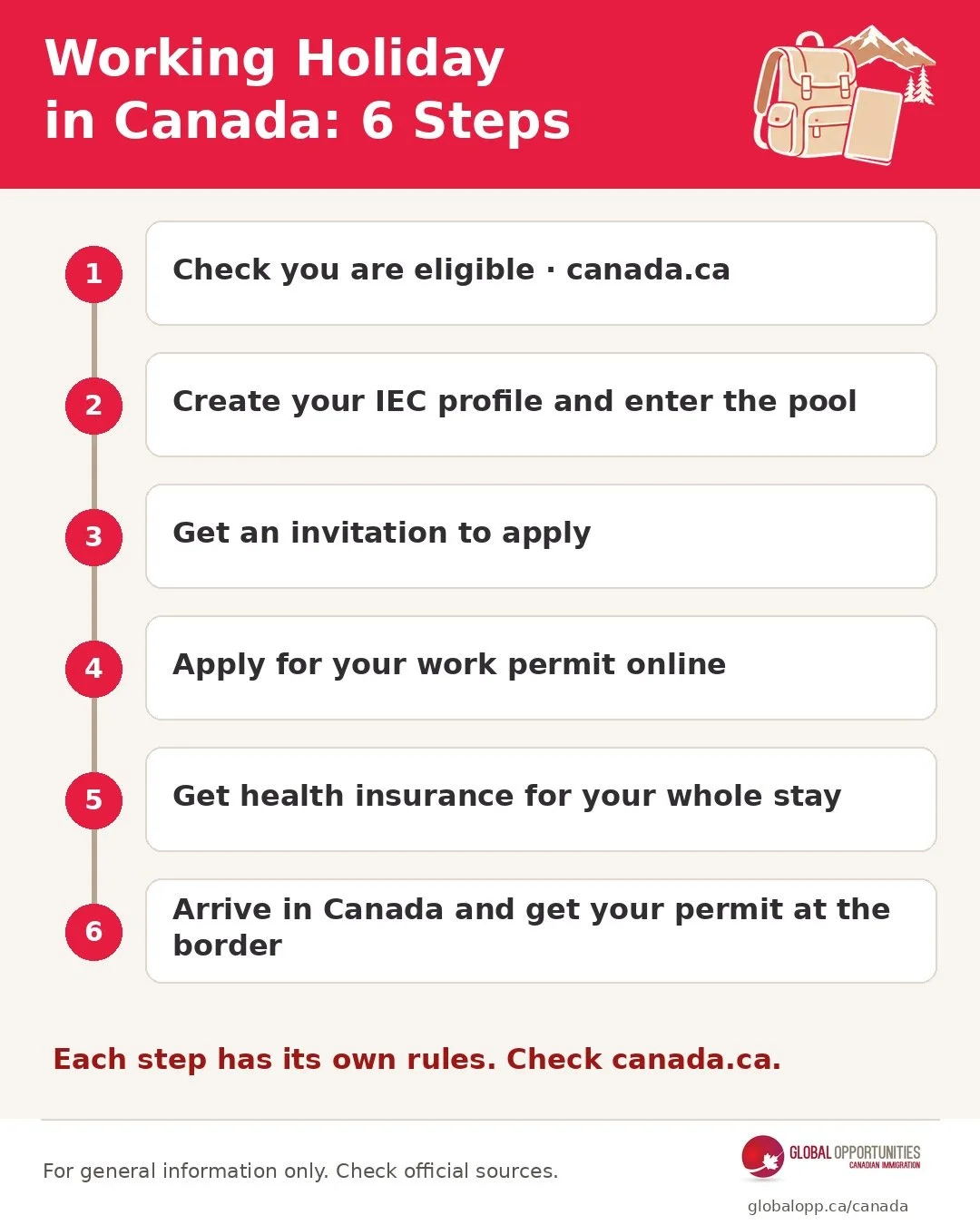
Check your eligibility. In your IRCC secure account, choose International Experience Canada and answer a short questionnaire about citizenship, residence, studies and any job offer.
Complete your profile with your passport and personal details. IRCC gives you a limited time to submit it, or you start over.
Submit your profile to one or more pools. IRCC says you can submit at any time during the season, and if you submit before the final round for your country, you could get an Invitation to Apply (ITA). A profile is not a work permit application.
Wait for an invitation. Your profile stays in the pool until you are invited, become ineligible or the season ends. Start gathering documents now.
Accept or decline. IRCC's profile and invitation page says: "You have 10 days to accept the invitation before it expires." Declining keeps you in the pool if eligible, and IRCC says it "won't have a negative effect on future invitations."
Apply for the work permit. IRCC's application page states: "You have exactly 20 days from the time you accept your ITA to submit your work permit application." The deadline is in Coordinated Universal Time (UTC), not Irish time. Complete the forms, upload your checklist documents and pay the fees.
Give biometrics if asked (see the biometrics section).
Medical exam, if your situation requires one (see the documents section).
Wait for a decision. IRCC may ask for more documents or an interview. How long it takes depends on each case; IRCC publishes its current estimate on the IEC page.
Receive your port of entry letter of introduction, then travel and activate your permit at the border.
Tips for the forms and the wait
Answer truthfully and completely; IRCC warns that false or missing information can lead to refusal and future inadmissibility.
Leave no gaps in your work and education history, and include unpaid work, unemployment and travel.
Working Holiday applicants are told exactly what to type in the job offer fields.
IRCC's after you apply page advises waiting until approval before buying a flight or health insurance, committing to an employer or accommodation, or leaving your job or home in Ireland.
Steps and deadlines as published by IRCC on its IEC profile and application pages, as of November 2026. Deadlines are set by IRCC and run in UTC: always follow the instructions in your own IRCC account.
IEC pools, invitations and seasons explained
"What are my chances of getting an IEC invitation?" IEC runs in seasons: IRCC keeps pools open, sends invitations in rounds and closes the pools when the season ends.
Rounds of invitations. IRCC's rounds of invitations page says "the number of candidates invited to apply during each round varies", and rounds continue until no spots are left or the season closes. Select Ireland to see key dates, candidates in the pools, spots available and your chances that season.
Season status. In November 2026, IRCC's IEC page said the current season's pools were closed and that people could create a new profile when the pools reopen for the next season; existing accounts stay valid.
Timing. IRCC's IEC page says: "If you want to start working in Canada in the next 12 months, you should create and submit your profile as soon as possible." Submitting early gives you more rounds.
No guarantees. Nobody can guarantee an invitation.
We do not publish quotas or statistics, because they change every season.
Season information as published by IRCC on its IEC and rounds of invitations pages, as of November 2026. Past rounds and pool numbers do not predict whether you will be invited.
Documents for IEC Ireland: Garda police certificates and more
After you accept your invitation, the system generates a personalized document checklist, the only definitive list for your case. According to IRCC's application page, it commonly includes the following.
Garda police certificates for Canada
According to IRCC's IEC application page, in most cases you need police certificates "for countries or territories where you've spent 6 or more months in a row since the age of 18." For your current country, the certificate "cannot be older than 6 months from the day you apply"; for other countries, it must be issued after you left.
IRCC's page on police certificates from Ireland explains that you apply in person or by mail to the superintendent in charge of the district where you live or lived. IRCC notes there is "no centralized police computer system serving county superintendent offices", that each county's Garda Síochána office issues its own certificates, and that you need one for each county where you lived during the required period. The page links the Irish National Police Station Directory, and the Garda Síochána website has more information.
Start early, while you wait for an invitation.
One per county or district: if you lived in Dublin for college and then in Cork or Galway, you may need more than one.
From abroad: contact each district office and ask how they handle postal requests.
Other countries: IRCC's police certificates page explains how to get certificates from Australia, the UK and elsewhere.
Not ready in time? IRCC lets you upload proof that you applied; an officer will request the certificate later, and you must provide it by that deadline.
One upload field: combine several certificates into one file.
Passport, CV, photo and family form
Passport: a clear copy, valid when you apply, enter and leave, with a blank page other than the last. Your permit will not outlast it, so renew first if it expires during your planned stay.
CV: your education, jobs and main duties, current job title and where you live.
Digital photo to IRCC's specifications, and the Family Information form (IMM 5707).
Medical exam (if needed)
IRCC's IEC application page says you should get a medical exam before applying if you recently lived or travelled in certain countries for six months or more, or plan to work in "the health field", "primary or secondary education", or "child care or elderly care". It must be done by an IRCC-approved panel physician. Without it, your permit may carry conditions that stop you working in those jobs. IRCC's change page explains how restrictions can be removed later. This matters for Irish nurses, carers, teachers and childcare workers.
Young Professionals and International Co-op
You need an employer number from the offer your employer submits in IRCC's Employer Portal. International Co-op applicants also need proof of registration and proof that the job is linked to their studies.
Document rules as published by IRCC on its IEC application and police certificate pages, as of November 2026. The personalized checklist in your IRCC account is the one that counts for your application.
Biometrics for Irish applicants: the Dublin visa application centre
Most IEC applicants must give fingerprints and a photo unless they have valid biometrics from a previous application. IRCC's application page explains that after you pay and submit, you receive a biometric instruction letter, and you have "up to 30 days" to give biometrics in person.
In Ireland: IRCC's lists of where to give biometrics and visa application centres include a visa application centre (VAC) in Dublin, by appointment through the official site linked from IRCC.
Outside Ireland: IRCC says the location "doesn't have to be in your country of residence", so Irish citizens in Northern Ireland, Britain or Australia can use a nearby centre.
Book quickly. If no appointments exist within your deadline, IRCC lets you request an extension with proof. Work or travel plans are not accepted reasons.
Validity: IRCC cannot issue a permit beyond your biometrics' expiry date.
Biometrics rules as published by IRCC, as of November 2026. Your biometric instruction letter sets your own deadline.
IEC health insurance for Irish citizens: what to look for
Getting health insurance wrong can shorten your permit for good. IRCC's prepare for arrival and application pages set the rules.
What it must cover and for how long
Medical care, hospitalization and repatriation. IRCC explains that repatriation covers getting you to a medical facility, returning you home or returning your remains in case of severe illness, injury or death.
Your entire stay. IRCC recommends one policy for the whole length of your permit, or two consecutive policies.
The key warning: "If your health insurance doesn't last the entire length of your stay in Canada, you'll be given a work permit that expires on the same day as your insurance." IRCC says you cannot change that later, even if you extend your insurance.
When to buy: you need it before you arrive, and IRCC "strongly" recommends waiting until you have your port of entry letter.
Checklist before you buy
Ask the provider in writing whether it covers medical care, hospitalization and repatriation in Canada.
Check the start date (on or before arrival) and the end date (your full intended stay).
Check whether cover continues if you travel to the US during your stay.
Get the certificate and a document explaining the coverage, in English or French; IRCC's permit-by-mail process refuses a certificate without coverage details.
Carry paper copies in your hand luggage.
IRCC's prepare for arrival page adds that a provincial health card is not enough, because "Repatriation isn't covered by provincial health insurance." We do not recommend any insurer.
Insurance rules as published by IRCC on its IEC prepare for arrival and application pages, as of November 2026. A policy sold as "IEC insurance" is not automatically accepted: check that it meets IRCC's rules and ask the insurer in writing.
Proof of funds for IEC Ireland
IEC requires enough money to support yourself on arrival. The amount is set by IRCC in the Ireland section of the eligibility page and on the prepare for arrival page; check the current figure there.
IRCC's prepare for arrival page asks for a bank statement issued "no more than 1 week before you leave for Canada", or an original, signed letter from your bank with your balance, issued in the same period.
You also need a return ticket or money to buy one.
Large amounts of cash or monetary instruments must be declared at the border; see the Canada Border Services Agency.
IRCC's prepare for arrival page notes that "The cost of living varies based on where you decide to settle in Canada." Deposits, the first month's rent, winter clothes and a few weeks without pay add up, especially in Toronto, Vancouver and the mountain towns. How much you should bring beyond IRCC's minimum depends on each case; if you are unsure, a consultation is the way to know.
Proof of funds rules as published by IRCC, as of November 2026. IRCC's minimum is not a budget, and having it does not mean the border officer will issue a permit.
Arriving in Canada on IEC: port of entry letter and what border officers check
Your port of entry letter of introduction
If approved, a port of entry (POE) letter of introduction appears in your account. IRCC's after you apply page says it "doesn't guarantee entry into Canada or guarantee a work permit", that you must show it at a port of entry on or before the expiry date marked on it, and that it cannot be transferred. IRCC adds that in most cases you cannot get a refund once it is issued. Plan your flight around its expiry, your insurance start date and your passport.
What to show the border officer
IRCC's prepare for arrival page says to tell the officer you have come to work and to be ready to show:
your passport and POE letter of introduction;
proof of health insurance and proof of funds;
a ticket out of Canada, or money to buy one;
copies of the documents from your application.
If the officer is not satisfied, IRCC's prepare for arrival page says "you may be asked to return to your country on the next flight at your own expense." Keep documents in your hand luggage.
Check your work permit before you leave the counter
Check your name, the "Valid until" date (which IRCC says cannot pass the agreement's limit, your passport, biometrics or insurance expiry, or your contract end for employer-specific permits), any medical restrictions, and, for Working Holiday, an "open" employer and "unknown" location. Tell the officer about mistakes right away.
Already in Canada with a valid letter?
IRCC's prepare for arrival page explains that you can get the permit mailed to a Canadian address only if you were in Canada with a valid IEC permit when you applied for another participation, have a valid letter, and have legal status when you ask. Otherwise, IRCC says you must leave and re-enter "from a country or territory other than the US or Saint-Pierre-et-Miquelon".
Border rules as published by IRCC on its IEC pages, as of November 2026. A port of entry letter does not guarantee entry or a work permit: the border services officer decides.
Your first weeks in Canada: SIN, bank, phone and housing
Our newcomers in Canada guide covers each step in depth, including work permits, maintained status, Canadian résumés, banks and Toronto life. The short version:
Social Insurance Number (SIN). You need it to work and be paid. Service Canada explains how to apply. Share it only with your employer and organizations that legally need it.
Bank account. The Financial Consumer Agency of Canada explains your rights and accepted ID. Banks such as RBC, TD and Scotiabank have pages for newcomers on their own websites; check each bank's eligibility rules for temporary workers. These names are for reference only, and we have no relationship with them. Irish credit history does not usually transfer, so you will build Canadian credit from the start.
Phone. Landlords and employers expect a local number; check whether your Irish phone is unlocked.
Housing. You may want to start with a short-term rental or a room. Listing sites include Kijiji and PadMapper, for reference only and with no relationship with us. Never send money for a place you have not seen. Tenant rules are provincial: see our Ontario, British Columbia, Alberta, Nova Scotia and Newfoundland and Labrador guides.
Canadian résumé. Leave out photos, date of birth and marital status, and focus on achievements. See our guide to working in Canada: resume, cover letter and interview.
Free newcomer services. IRCC's services finder lists settlement organizations; eligibility depends on your status.
Driving licence. Exchange it within your province's deadline (see the driving section).
Health care in Canada for IEC participants
Each province runs its own public health plan and decides which temporary residents qualify and when. For IEC, two rules apply together:
Private insurance stays mandatory for your entire stay. IRCC's prepare for arrival page says: "Having a valid provincial health card is not enough."
Provincial coverage is separate. Check the health section of your province guide: Ontario (OHIP), British Columbia (MSP), Alberta (AHCIP), Nova Scotia (MSI) or Newfoundland and Labrador (MCP).
Walk-in clinics, virtual care and provincial health lines (811 in many provinces) help with non-emergencies; in an emergency, call 911. Ask your insurer how claims work before you need it. New to how public health care works? Read the health care system in Canada.
Health coverage rules are set by each province, and IRCC's insurance rule is on its IEC pages, as of November 2026. A provincial health card, if you qualify for one, does not replace the private insurance IRCC requires.
Where to live in Canada on IEC: Toronto, Vancouver, Calgary, Banff, Whistler, Halifax and St. John's
With a Working Holiday permit you can live almost anywhere in Canada. Below are a few cities with official rent and transit figures.
How to read the figures: rents are CMHC's average monthly rent for a two-bedroom apartment in purpose-built rental buildings, from the October 2025 Rental Market Survey (CMHC data tables), checked in November 2026. They include long-term tenants, so new listings and rooms are priced differently, and many newcomers share. Transit fares are from each operator's site as of November 2026. Check the current price before you budget.
Toronto, Ontario
Toronto has a Consulate General of Ireland and a Toronto division of Gaelic Games Canada. CMHC reported an average two-bedroom rent of $2,046 in the Toronto metropolitan area in October 2025. As of November 2026, the TTC listed an adult fare of $3.30 with PRESTO, debit or credit card (check the current price). Read our Ontario guide and the newcomers guide, which focuses on Toronto.
Vancouver, British Columbia
According to the Embassy of Ireland and Gaelic Games Canada, Vancouver has a Consulate General of Ireland and a Vancouver division of Gaelic Games Canada. To compare its climate with other cities, use Environment and Climate Change Canada's Canadian Climate Normals. CMHC reported an average two-bedroom rent of $2,363 in the Vancouver metropolitan area in October 2025. As of November 2026, TransLink listed a 1-zone adult fare of $2.85 with a Compass Card (check the current price). Read our British Columbia guide.
Calgary, Banff, Canmore and the Rockies, Alberta
Calgary has an Irish honorary consul, according to the Embassy of Ireland. CMHC reported an average two-bedroom rent of $1,914 in the Calgary area in October 2025, and as of November 2026 Calgary Transit listed an adult single fare of $4.00 (check the current price). For Banff, Lake Louise and Canmore, CMHC reported $2,442 for a two-bedroom in the Canmore area in October 2025; if a seasonal employer offers staff housing, get the details in writing. Read our Alberta guide.
Whistler, British Columbia
Whistler is a resort municipality north of Vancouver. If an employer offers staff housing, ask for the details in writing. See the Resort Municipality of Whistler and our British Columbia guide.
Halifax, Nova Scotia
Halifax is the capital of Nova Scotia, and the Embassy of Ireland lists an honorary consul in Halifax. CMHC reported an average two-bedroom rent of $1,826 in the Halifax metropolitan area in October 2025, and as of November 2026 Halifax Transit listed an adult bus or ferry fare of $3 (check the current price). Read our Nova Scotia guide.
St. John's, Newfoundland and Labrador
St. John's is the capital of Newfoundland and Labrador, and the Embassy of Ireland lists an honorary consul for the province. CMHC reported an average two-bedroom rent of $1,348 in the St. John's area in October 2025 (CMHC, St. John's), and as of November 2026 Metrobus listed an adult cash fare of $2.50 (check the current price). Read our Newfoundland and Labrador guide.
Other cities, such as Ottawa, Edmonton, Victoria and Winnipeg, have their own rents and job markets; check CMHC and Job Bank. See the map of Canada and its provinces. For time zones, travel between provinces and what to pack, see our page Explore Canada.
Rents as published by CMHC (October 2025 Rental Market Survey) and fares as published by each transit operator, as of November 2026. They may have changed by the time you read this: check the linked pages before you rely on them.
What jobs can Irish IEC participants do in Canada?
A Working Holiday permit lets you work for most employers, but it does not license you for a regulated profession or trade. Global Opportunities does not offer jobs or job placement.

Construction and the skilled trades
Construction work ranges from general labour to site supervision, project management and quantity surveying. Provincial trade authorities, such as SkilledTradesBC and Skilled Trades Ontario, set the rules for trades; some trades, such as electrician and plumber, are "compulsory" in some provinces: you cannot work in them without a provincial certificate or registered apprenticeship (see the licensing section). Employers often require safety training; Ontario, for example, has a working at heights training standard with approved providers. Provincial employment standards on pay, overtime and safety apply to you whatever your permit.
Hospitality, tourism and ski resorts
If you work in a bar, restaurant or hotel and serve alcohol, provinces require responsible service training:
Ontario: the AGCO approves Smart Serve for all liquor licensees and their employees, including bars and restaurants.
British Columbia: the province explains who must have a Serving It Right certificate.
Alberta: AGLC says ProServe certification is mandatory for positions such as bartenders and servers.
Read any job offer carefully and keep a copy.
Nursing and health care
You cannot work as a registered nurse without registration with the regulator of your province, usually starting with NNAS (see the licensing section). The process takes time, so it helps to start before you travel. Health jobs also trigger IRCC's medical exam rule for IEC.
Technology, finance, engineering and office work
Most tech roles are unregulated, but engineering and accounting are regulated; Engineers Canada explains how provincial associations regulate engineering. See our guide Immigrate to Canada as a professional.
Teaching and childcare
Public school teaching requires provincial certification, for example from the Ontario College of Teachers. Childcare and education also trigger IRCC's medical exam rule.
How to find a job in Canada
Job Bank, the Government of Canada's job site.
Employer websites and professional networks such as LinkedIn.
I/CAN, whose website lists employment information for the Irish community (see the community section).
A Canadian-style résumé, a cover letter and practice with behavioural interviews: our guide to working in Canada: resume, cover letter and interview explains each step, with a template, and has a section on preparing a Working Holiday before you travel.
Never pay for a job offer. IRCC explains common scams on its page on protecting yourself from fraud.
The kind of work you do matters if you want to stay
IRCC's Canadian Experience Class page says only certain skilled, paid work counts, and lists self-employment, volunteer work, unpaid internships and work while studying full time as not counting. "Self-employed" or cash-in-hand arrangements can affect this.
Training and work rules as published by the provincial bodies we link and IRCC's Canadian Experience Class page, as of November 2026. An open work permit does not license you for a regulated job: the provincial regulator decides.
Getting licensed in Canada: Red Seal trades, NNAS for nurses and other regulators
Red Seal and provincial trade certification
Trades certification is provincial. The Red Seal Program sets interprovincial standards for many trades. Each province's authority decides how experience from abroad is assessed and whether you can challenge the exam:
Ontario: Skilled Trades Ontario's trade equivalency assessment.
British Columbia: SkilledTradesBC.
Contact the authority before you arrive and ask which documents they need; apprenticeship records, a detailed work history and references usually matter.
Nurses from Ireland: NNAS
The National Nursing Assessment Service (NNAS) assesses documents of internationally educated nurses for most Canadian nursing regulators. NNAS does not grant licences: the provincial regulator decides. Our guide Immigrate to Canada as a professional has a full section for nurses. Irish nurses can read our full guide to nursing in Canada for internationally educated nurses.
Other regulated professions
Teachers, engineers, accountants, pharmacists, physiotherapists, social workers and many others are regulated provincially. Contact the regulator early, because exams or Canadian experience may be required.
Requirements as published by each regulator, as of November 2026. Any regulator or organization we mention is for reference only. The list may not be complete, and requirements must always be confirmed directly with the regulator in the province or territory where you plan to work.
Exchanging an Irish driving licence in Canada, province by province
Driving licences are provincial. When we checked the official pages in November 2026, these provinces listed Ireland for exchange or reciprocity, each with conditions such as licence class, deadlines and surrendering your Irish licence:
Ontario: the page on how to exchange an out-of-province driver's licence lists the Republic of Ireland, with exceptions such as learner's permits. Our Ontario guide explains G1, G2 and G.
British Columbia: ICBC's page for people moving from another country says new residents have 90 days to switch, and its list of licence exchange jurisdictions includes Ireland.
Alberta: the page on exchanging a non-Alberta licence lists the Republic of Ireland for certain classes.
Nova Scotia: the province's licence exchange page lists Ireland (Class B) for a Nova Scotia Class 5, with a vision test.
Newfoundland and Labrador: the process for new residents lists Ireland among reciprocity countries.
New Brunswick: the page on licences for new residents lists Ireland for a Class 5 exchange.
Prince Edward Island: the reciprocity sheet lists Ireland for a unilateral Class 5 exchange with extra proof.
Manitoba: MPI's list of eligible countries includes Ireland.
Saskatchewan: our Saskatchewan guide explains SGI's honoured-country list, which included Ireland when we checked.
Bring your original licence and, ideally, a driving record and a claims history letter from your Irish insurer, which may help with Canadian car insurance. Each car rental company sets its own rules on licences, credit cards and age; Enterprise, for example, explains its driver's licence requirements for licences issued outside Canada. Check the company's own page before you book.
Licence exchange rules as published by each province's licensing authority, as of November 2026. A country being on a list does not mean every licence class or every driver qualifies: the province decides.
Irish community in Canada: Embassy, consulates, I/CAN and GAA clubs
Embassy of Ireland and consulates in Canada
According to the Government of Ireland, Team Ireland in Canada includes the Embassy of Ireland in Ottawa, Consulates General in Toronto and Vancouver, and Honorary Consuls in Calgary, Newfoundland and Labrador, Nova Scotia and Halifax (Embassy of Ireland, Canada). They help with passports, emergencies and documents, and the Embassy's New to Canada page has information for new arrivals. They do not handle Canadian immigration applications.
I/CAN: the Irish Canadian Immigration Centre
The Eamonn O'Loghlin Irish Canadian Immigration Centre (I/CAN) is a non-profit supporting the Irish diaspora across Canada. Its website lists free, confidential information on immigration, employment and social services, national webinars and newcomer events in Vancouver and Toronto. I/CAN states it gives information, not case-specific advice.
For more ideas on making friends and contacts, see building community in Canada.
GAA clubs in Canada
Gaelic Games Canada, the Canadian county board, organizes clubs through Toronto, Vancouver, Western and Eastern divisions. Organizations listed are for reference only. The list is not complete, and Global Opportunities has no relationship with them.
Do you pay tax in Canada on IEC? Taxes, pensions and the Canada–Ireland agreement
Employers normally deduct income tax, Canada Pension Plan contributions and Employment Insurance from your pay. The Canada Revenue Agency's page for newcomers to Canada explains tax residency and your first return. Ask Irish authorities about Irish tax.
According to the Government of Canada's page on the Canada–Ireland agreement, the Agreement on Social Security came into force in 1992. If you have lived or worked in both countries, it may help you qualify for Canadian or Irish old age, disability and survivor benefits. Each country pays based only on periods creditable under its own program, but periods in one country can help you meet the other's minimum requirements. The page lists the forms and where to send them.
Filing your Canadian tax return when you leave
Many IEC participants go home before the tax season. The Canada Revenue Agency's page for people leaving Canada (emigrants) says:
File a return for the year you leave if you owe tax or want a refund because you paid too much tax.
Enter your departure date on page 1 of the return, in the residence information area, and use the package for the province or territory where you lived on the day you left.
If you decide you do not have to file, tell the CRA your departure date as soon as possible.
Tell your Canadian bank and any other Canadian payers that you are no longer a resident.
If you are not sure whether you are still a resident of Canada for tax purposes, for example because you keep a home or a partner here, CRA's Form NR73, Determination of Residency Status (leaving Canada) page explains how to ask the CRA for its opinion.
Tax and pension information as published by the Canada Revenue Agency and the Government of Canada, as of November 2026. This is general information, not tax advice: your own situation decides what you owe or can claim, and filing deadlines and rules change. Check the CRA pages or ask a tax professional.
Studying in Canada as an Irish citizen
Short courses: IRCC's page Who can study without a permit says "You don't need a study permit if you're coming to Canada for a program that lasts 6 months or less." It also explains that workers with a valid work permit may study for "6 months or less" under a temporary public policy.
During IEC: the IRCC Help Centre says you can hold a study permit and an IEC work permit at the same time, but IEC is not meant for people planning to study for more than six months during their participation.
Full programs: college and university programs generally need a study permit and acceptance from a designated learning institution. Rules and caps change often; our province guides describe each province's institutions.
International Co-op: a placement in Canada as part of your Irish course.
A study permit is temporary, and work rules after graduation change often. Research them before choosing a program if you hope to stay.
Study rules as published by IRCC, as of November 2026. Studying without a permit or alongside IEC depends on IRCC's conditions: check its pages before you enrol.
Already in Canada on IEC? Next steps to stay longer
IEC permits cannot simply be extended. IRCC's page on changing your IEC work permit allows changes only in "very specific situations", such as correcting an IRCC error, a new passport, an extended job offer for Young Professionals or International Co-op, or removing medical restrictions.
Read who is eligible for permanent residence, and who needs a different strategy. If your permit ends within a year, watch Is your work permit or PGWP expiring in the next 12 months?
Maintained status
IRCC's IEC changes page says that if you apply for a different work permit, you "should submit your application at least 30 days before your International Experience Canada work permit expires", and that if your permit expires during processing, you can keep working under the same conditions until a decision. This is maintained status, and it only applies if you apply before your permit expires. Our newcomers in Canada guide explains it in detail, along with what to do if your permit has expired.
Canadian Experience Class and other Express Entry programs
The Canadian Experience Class is for people with skilled, paid Canadian work experience; skilled IEC work may count if it meets the rules. Your Irish experience and education may count under other Express Entry programs, such as the Federal Skilled Worker program, usually with an educational credential assessment. You need an approved language test even as a native English speaker; see our guide to English and French tests for Canada, which covers test centres in Ireland and Canada. Being in the pool never guarantees an invitation. Read How to immigrate to Canada. More from Global: Canadian Experience Class. Watch why being in Canada is no longer enough to plan your next step early. If your IEC job is skilled work, watch Have you completed one year of work experience in Canada?, and to see whether your IEC job may count, watch our live session on NOC codes and TEER categories.
Provincial Nominee Programs and the Atlantic Immigration Program
Many provinces have streams for workers already employed there; start with IRCC's Provincial Nominee Program page and your province guide. In Nova Scotia, New Brunswick, Prince Edward Island and Newfoundland and Labrador, the Atlantic Immigration Program is for people with a job offer from a designated employer. Streams open, close and change often.
Another work permit: LMIA and employer-specific permits
Many IEC participants move to an employer-specific work permit. In many cases the employer first needs a Labour Market Impact Assessment (LMIA); see our page on the LMIA. IRCC explains how to extend or change your work permit from inside Canada.
A second IEC participation or studying
If you still have a participation for Ireland, IRCC says you can submit a new profile and may be invited again (remember the permit-by-mail rule in the arrival section). A study permit is another possible step.
Nothing here is automatic. Each program has its own requirements, nothing is guaranteed, and the rules change. Look at your options early in your permit.
IRCC explains that some time spent in Canada before permanent residence may count toward citizenship; see how to count your days for Canadian citizenship.
Program rules as published by IRCC and the provinces, as of November 2026. Having Canadian work experience does not mean you qualify for permanent residence: IRCC and the provinces decide each case. To know your own options, book a consultation.
Common mistakes Irish IEC applicants make
Paying someone who promises an invitation or a job. Invitations come only from IRCC.
A passport that expires too soon. Your permit cannot outlast it.
Insurance that ends early or lacks repatriation. Your permit is cut to the insurance end date for good.
Buying flights or insurance before approval.
Leaving Garda certificates to the last minute, or forgetting one county or another country.
Missing the UTC deadline after accepting your invitation.
Gaps in work or travel history on the forms.
Ignoring the medical exam rule for health, teaching or childcare jobs.
A bank statement older than a week at departure.
Not checking your permit at the airport.
Letting your port of entry letter expire.
Self-employed or cash-in-hand work if you hope to use Canadian experience later.
Waiting until your last months to plan, or applying after your permit has expired.
Forgetting the language test for Express Entry.
Frequently asked questions
Can Irish citizens get a working holiday visa for Canada?
Yes. Ireland has a youth mobility agreement with Canada, so Irish citizens can apply to International Experience Canada (IEC). The "Canadian working holiday visa" is really an open work permit under IEC's Working Holiday category. You submit a profile to a pool, wait for a possible invitation, apply for the permit and, if approved, receive a port of entry letter. A border services officer issues the permit when you land. Nobody can guarantee an invitation. See the first sections of this guide and IRCC's eligibility by country page.
Do Irish citizens need a visa to visit Canada?
No visitor visa, but you need an electronic travel authorization (eTA) to fly to or through Canada. IRCC's entry requirements list Ireland among eTA-required countries. Apply on the official Government of Canada page with your passport, a payment card and an email address, and avoid third-party sites that charge extra. Dual Irish-Canadian citizens must fly on a Canadian passport. An eTA lets you visit, not work; to work you need a work permit. See the section on visas and the eTA above and IRCC's eTA page.
Do I need an eTA if I am going to Canada on IEC?
Not separately. IRCC says that if you need an eTA, you will receive one automatically when your IEC work permit application is approved. Travel on the same passport you used for your IEC application, because your approval and eTA are linked to it. If you change passports before travelling, check IRCC's guidance first. Keep your port of entry letter with your passport for the border. Remember that the eTA alone does not let you work: your work permit is issued at the border. See the eTA section above and IRCC's IEC application page.
How long can Irish citizens stay in Canada?
It depends on your status. As a visitor, IRCC's visitor visa page says "Most visitors can stay for up to 6 months in Canada," though the officer can set a different date. On IEC, your permit length depends on your category and the Canada–Ireland agreement, and it is also capped by your passport, biometrics and health insurance expiry dates, and by your contract for employer-specific permits. IRCC lists current lengths in the Ireland section of its eligibility page. To stay longer, you need another status. See the next steps section.
Which IEC categories are open to Irish citizens?
At the time of writing, IRCC lists all three: Working Holiday, Young Professionals and International Co-op (Internship). Working Holiday gives an open work permit with no job offer needed. Young Professionals needs a signed job offer in your field that contributes to your professional development. International Co-op is for students registered at a post-secondary institution in Ireland who need a placement. Each has its own pool. Check IRCC's eligibility by country page, because categories can change. See the categories section.
Do I need a job offer for the IEC Working Holiday?
No. IRCC describes the Working Holiday category as being for Irish citizens who intend to travel in Canada and wish to find temporary paid work to help pay for their trip, and it gives an open work permit, so you look for work after you arrive (IEC eligibility, canada.ca). The other two categories are different: for Young Professionals you need a signed letter of offer or contract in your field before you submit your profile, and for International Co-op you need a signed offer for a placement that is part of your studies in Ireland. Even without a job offer, plan your money: IRCC asks participants to show funds for their initial expenses, as the proof of funds section explains. Never pay anyone for a job offer. See "The three IEC categories for Irish citizens" above.
Can I do IEC twice as an Irish citizen? (IEC Ireland 2nd participation)
According to IRCC's Ireland section, you can take part in each category only once. After Working Holiday or Young Professionals, you may participate one more time through International Co-op if you meet its criteria; after International Co-op, one more time through Working Holiday or Young Professionals. So most people get one Working Holiday or Young Professionals participation plus one International Co-op participation. IRCC's Ireland section also has a special rule for people who participated before 2013, and recognized organizations can sometimes open access. See the participation rules section.
What is the age limit for the Canadian working holiday for Irish citizens?
IRCC sets an age range for each country, and the Ireland section of the eligibility page states the current one for each category. We do not repeat it because it can change, and IRCC's instructions explain how it applies. If you are close to the limit, read the official page carefully and do not leave your profile to the end of a season. If you are no longer eligible for IEC, other work permits and programs may still be options. See the requirements section.
Do Irish citizens need a recognized organization to apply for IEC?
No. IRCC explains that for countries with a youth mobility agreement, such as Ireland, using a recognized organization is optional. ROs are listed by IRCC and can help with planning or finding work; some charge, and in some cases they can give IEC access to people who would not otherwise be eligible. They are not immigration representatives and cannot guarantee an invitation. Most Irish applicants apply directly through their IRCC account. Check the official list, because the organizations and their services can change. See IRCC's recognized organizations page.
How do the IEC pools and invitations work for Ireland?
You submit a profile in your IRCC account to one or more pools for Ireland, one per category. IRCC sends Invitations to Apply in rounds during the season, first for International Co-op, then Young Professionals, then Working Holiday. Your profile stays in the pool until you are invited, become ineligible or the season ends. IRCC's rounds of invitations page shows key dates, candidates in the pool and spots available. Being in a pool never guarantees an invitation. See the pools section above.
When does the next IEC season open for Ireland?
IRCC announces each season on its IEC page and its rounds of invitations page. In November 2026, IRCC said the current season's pools were closed and that people could create a new profile when the pools reopen for the next season; existing IRCC accounts remain valid. IRCC advises submitting your profile as soon as possible if you want to start working within a year. Use the wait to prepare your passport, Garda certificates and savings. See the pools section above.
Do I need a Garda police certificate for IEC?
Usually, yes. IRCC says that in most cases you need police certificates for each country where you have spent six or more months in a row since age 18, and the certificate for your current country must not be older than six months when you apply. For Ireland, IRCC's police certificate page says you apply to the Garda superintendent of each district where you lived, because there is no central system. If yours is late, upload proof that you applied. See the documents section.
How do I get a Garda certificate if I live outside Ireland?
IRCC's police certificate page for Ireland says you can apply in person or by mail to the superintendent in charge of each district where you lived, and it links the Irish National Police Station Directory with district contacts. From Australia, the UK or elsewhere, contact each district office and ask how they handle postal requests and how long they take. You will also need a certificate from your current country if you have lived there six months or more in a row. Start before your invitation arrives. See the Garda section and the Garda Síochána website.
Where do Irish applicants give biometrics for Canada?
In Ireland, at the Canada visa application centre in Dublin, by appointment. IRCC's biometrics locator lists Dublin, with booking through the centre's official site. IRCC says the location does not have to be in your country of residence, so Irish citizens in Northern Ireland, Britain or Australia can use a nearby centre. You receive a biometric instruction letter after paying and submitting, and you have a limited time to attend, so book quickly. If you gave biometrics for a recent Canadian application, they may still be valid; IRCC's tools let you check. See the biometrics section.
What health insurance do I need for IEC?
IRCC's prepare for arrival page requires insurance covering medical care, hospitalization and repatriation for your entire stay. It recommends one policy for the whole permit, or two consecutive policies, and strongly recommends buying it after you get your port of entry letter. If your insurance ends early, IRCC says your permit will expire the same day, and you cannot fix it later. Bring the certificate and a document showing what the plan covers, in English or French. A provincial health card is not enough because it does not cover repatriation. See the health insurance section.
How much money do I need for IEC from Ireland?
IRCC sets a minimum, shown in the Ireland section of the eligibility page and on the prepare for arrival page; check the current figure there. At the airport you may be asked for a bank statement issued no more than one week before departure, or an original signed bank letter, plus a return ticket or money for one. The minimum is only a starting point: deposits, first month's rent, transport and winter clothes cost more in big cities and ski towns. See the proof of funds and cities sections.
What do border officers check when I arrive on IEC?
IRCC says to tell the officer you have come to work and to be ready to show your passport, port of entry letter, proof of health insurance, proof of funds, a ticket out of Canada or money for one, and copies of your application documents. If the officer is satisfied that you are admissible, you receive your work permit. Before leaving the counter, check your name, the "Valid until" date, medical restrictions and, for Working Holiday, an "open" employer. Report mistakes immediately. See the arrival section and IRCC's prepare for arrival page.
Can I bring my partner on the Canadian working holiday?
Not on your permit. IRCC says family members can't come with you under IEC, but they can apply to work, visit or study on their own. An eligible partner can submit their own IEC profile, but invitations are separate and not linked. IRCC also explains that family members of some foreign workers may apply for an open work permit, only after you are approved and if they meet the rules. Couples should plan for one partner being invited before the other. See the requirements section and IRCC's family members page.
Can I apply for IEC as an Irish citizen living in Australia or the UK?
Yes. Eligibility depends on your Irish citizenship, not where you live. The questionnaire asks about your citizenship, permanent residence and current residence. You can give biometrics at the nearest collection point, even outside your country of residence. You will need police certificates for each country where you have spent six or more months in a row since age 18, which may include Ireland, Australia and the UK. If you are also British, read the UK and Ireland sections on IRCC's page, because the rules differ. See the requirements and documents sections. If you live in Australia, our guide to moving to Canada from Australia covers flights, shipping and daily life from there.
Can I extend my Canadian working holiday?
Generally, no. IRCC says IEC permits can only be changed in very specific situations, such as correcting an IRCC error, a new passport, an extended job offer for Young Professionals or International Co-op, or removing medical restrictions. Extending your insurance after arrival does not extend the permit. To stay longer you need another status: a different work permit, a study permit or permanent residence. IRCC's IEC changes page says to apply for a new work permit at least 30 days before your IEC permit expires, so maintained status can apply. See the next steps section.
Toronto or Vancouver: which is better for Irish IEC participants?
Neither is better for everyone: it depends on your work, budget and lifestyle. Both cities have a Consulate General of Ireland and a division of Gaelic Games Canada, so it is easy to meet other Irish people. On housing, CMHC's October 2025 Rental Market Survey reported an average two-bedroom rent of $2,046 in the Toronto metropolitan area and $2,363 in the Vancouver area (CMHC data tables); rooms and new listings are priced differently, so check current prices. Vancouver is the closest big city to Whistler for a ski season, and Toronto is the base of our newcomers guide. Compare job ads for your field on Job Bank in both cities, then read our Ontario and British Columbia guides. See "Where to live in Canada on IEC" above.
Can I work in construction in Canada on a working holiday?
Yes. A Working Holiday open work permit lets you work for most employers, including in construction. General labour does not usually need a licence, but some trades, such as electrician, are compulsory in some provinces and require a provincial certificate or registered apprenticeship. Employers often require safety training, such as Ontario's approved working at heights training. Avoid cash-in-hand or "self-employed" arrangements: you lose protections, and IRCC says self-employment does not count for the Canadian Experience Class. See the jobs and licensing sections.
Can Irish nurses work in Canada?
Yes, once registered with the nursing regulator of the province where they will work. Most internationally educated nurses start with the National Nursing Assessment Service (NNAS), which assesses documents for most Canadian nursing regulators; the provincial regulator then decides and may require exams or further education. Start early, because it takes time. On IEC, IRCC's medical exam rule applies to health jobs, and without it your permit may carry restrictions. See the licensing section and our guide Immigrate to Canada as a professional. Irish nurses can read our full guide to nursing in Canada for internationally educated nurses.
Can Irish electricians and plumbers work in Canada?
Yes, but trades are regulated by each province, and electrician and plumber are compulsory trades in some provinces, so you need a provincial certificate or registered apprenticeship. Many provinces let experienced tradespeople from abroad have their experience assessed and challenge the certification exam, and the Red Seal Program sets interprovincial standards. Skilled Trades Ontario offers a trade equivalency assessment; SkilledTradesBC and Alberta's apprenticeship system handle their provinces. Contact the authority before you arrive, with your apprenticeship records. See the licensing section.
Can I drive in Canada on my Irish licence before exchanging it?
For a limited time, yes, and each province sets the rule. Ontario says that when you move there, you can use a valid licence from another country "for 60 days", and after that you need to switch to an Ontario licence (Ontario, exchange a licence). In British Columbia, ICBC says you can drive using your current licence for up to 90 days after moving, with some exceptions (ICBC, moving from another country). Alberta says that if you are living there permanently, you must exchange your licence within 90 days of becoming a resident, and it explains separate rules for temporary residents and visitors (Alberta, exchange a licence). Other provinces have their own rules, linked in the driving section. Before you drive, check that your insurance or rental agreement covers you on an Irish licence.
Can I exchange my Irish driving licence in Canada?
In many provinces, yes. When we checked in November 2026, Ontario, British Columbia, Alberta, Nova Scotia, Newfoundland and Labrador, New Brunswick, Prince Edward Island, Manitoba and Saskatchewan listed Ireland on their official exchange or reciprocity pages, each with conditions such as licence class, deadlines and surrendering your Irish licence. For example, ICBC says new B.C. residents have 90 days to switch. Bring your original licence and a driving record. Rules change, so check your province's page before you go. See the driving licence section for the links.
Is there an Irish community in Canada?
Yes. Team Ireland in Canada includes the Embassy of Ireland in Ottawa, Consulates General in Toronto and Vancouver, and honorary consuls in Calgary, Newfoundland and Labrador, Nova Scotia and Halifax. The Irish Canadian Immigration Centre (I/CAN) offers free information, webinars, employment resources and newcomer events in Toronto and Vancouver. Gaelic Games Canada organizes GAA clubs in Toronto, Vancouver, Western and Eastern divisions. See the community section.
Is there an Irish community in Newfoundland?
Yes. Irish heritage is part of everyday culture in Newfoundland and Labrador, especially on the Avalon Peninsula. The province's tourism site describes the Irish Loop, a coastal route south of St. John's, as an area shaped by its strong Irish heritage, with music and storytelling. The Government of Ireland lists an honorary consul for Newfoundland and Labrador among Team Ireland in Canada (Embassy of Ireland, Canada). St. John's is also a smaller and, according to CMHC, less expensive rental market than Toronto or Vancouver (see "St. John's, Newfoundland and Labrador" above). Our Newfoundland and Labrador guide covers neighbourhoods, housing, MCP health coverage, driving and your first winter, and has its own section on music and community.
Can I bring my dog from Ireland to Canada?
Usually yes, but check the official rules before you book. The Canadian Food Inspection Agency (CFIA) sets the import requirements for dogs, and they depend on things such as the dog's age, whether it is a personal pet or a commercial import (for example, a dog for sale or adoption) and the country it comes from. When we checked in November 2026, Ireland was not on CFIA's list of countries at high risk for dog rabies, from which commercial dogs are prohibited. Use CFIA's pages on importing and travelling with pets and its Automated Import Reference System (AIRS) to confirm current requirements, such as vaccinations and certificates. Airlines also set their own pet rules. Read our guide to immigrating to Canada with your pet.
Can I study in Canada on a working holiday?
Short courses, yes. IRCC's study without a permit page says you don't need a study permit for a program that lasts 6 months or less, and workers with a valid work permit may study for up to 6 months under a temporary public policy. The IRCC Help Centre says you can hold a study permit and an IEC permit at the same time, but IEC is not meant for people planning to study for more than six months during their participation; for that, you need a study permit. Full college and university programs need a study permit and acceptance from a designated learning institution. See the studying section.
Can a working holiday in Canada lead to permanent residence?
It can be a first step, but nothing is automatic. Skilled, paid work in Canada may count toward the Canadian Experience Class or provincial nominee streams if it meets their rules. IRCC says self-employment, volunteer work and unpaid internships do not count for the Canadian Experience Class. You will also need an approved language test, even as a native English speaker. Other routes include the Atlantic Immigration Program and employer-specific permits supported by an LMIA. Invitations and nominations are never guaranteed, so plan early. See the next steps section.
Do Irish citizens need a language test for Canadian permanent residence?
For Express Entry, yes. Canada requires an approved English or French test result even from native English speakers, and an Irish passport or degree does not replace it. Provincial programs set their own language rules, and many also require an approved test. IEC itself does not require one. Our guide to English and French tests for Canada explains which tests IRCC accepts, where to take them in Ireland and Canada, and how to prepare. Results are valid for a limited time, so time your test well. See the next steps section. Watch our short video on how CELPIP fits into a permanent residence plan.
Does my work in Canada count toward my Irish pension?
The Agreement on Social Security between Canada and Ireland may help. According to the Government of Canada, if you have lived or worked in both countries, it may help you qualify for Canadian or Irish old age, disability and survivor benefits, or both. Each country pays based only on periods creditable under its own program, but periods in one country can help you meet the other's minimum requirements. The Canadian page lists the forms and where to send them; for Irish benefits, ask the Irish authorities. See the pensions section and the Government of Canada page.
Can I get a tax refund when I leave Canada after IEC?
You may, if more tax was deducted from your pay than you owe. The Canada Revenue Agency says that when you leave Canada, you should file a Canadian return if you owe tax or want a refund, and enter your date of departure on page 1 of the return (leaving Canada (emigrants), CRA). CRA also explains that your federal non-refundable credits are limited to your resident and non-resident periods, and that you generally cannot claim provincial refundable credits unless you were resident in Canada on December 31. Whether you get money back depends on your income, the tax withheld and your credits, so there is no standard amount. File through official CRA channels, and read the full terms of any paid refund service before you sign. For Irish tax, ask the Irish authorities.
Can I claim EI on a working holiday in Canada?
Employment Insurance premiums are usually deducted from your pay, but receiving benefits depends on the rules. Service Canada says that to get EI regular benefits you must have been employed in insurable employment, lost your job through no fault of your own, been without work and pay for at least 7 consecutive days in the last 52 weeks, worked enough insurable hours in your qualifying period, and be ready, willing and capable of working each day while actively looking for work (EI regular benefits: eligibility, canada.ca). Leaving a job by choice at the end of a season, or travelling instead of looking for work, may not fit these conditions. Service Canada decides each claim and encourages people to apply so it can determine eligibility.
Can I get a tax refund when I leave Canada after IEC?
Possibly. According to the Canada Revenue Agency's page for people leaving Canada, you file a return for the year you leave if you owe tax or want a refund because too much tax was deducted, and you enter your departure date on it. Whether you get money back depends on your income and deductions. See the tax section above.
Related guides
How Global Opportunities can help
Global Opportunities is a private immigration firm in Toronto. Whether you are preparing your IEC application in Ireland or already working in Canada and thinking about your next step, we can help you understand which Canadian programs may fit your profile and what to prepare. We cannot guarantee an invitation, a permit or a result: every decision is made by IRCC or the province.
Our regulated consultant: Lic. Mildrete Monserrath Gutierrez Martinez, Regulated Canadian Immigration Consultant (RCIC), CICC licence R514880. Verify her licence on the CICC Public Register: https://college-ic.ca/protecting-the-public/find-an-immigration-consultant. Global Opportunities does not offer services for Quebec's immigration programs. Global Opportunities is a private firm and is not part of the Government of Canada or any provincial government.
Recorded seminars and lives: watch our recorded seminars in English or the Spanish recordings, and find everything on our YouTube channel. If you are already in Canada, start with Is your work permit or PGWP expiring in the next 12 months?
More articles in English: read our Moving to Canada articles on topics such as health care, cost of living, the ECA and professional licences, and building community in Canada.
Personalized consultation: to review your situation, contact us through our contact page or write to info@globalopp.ca.
Prefer email? Tell us what you need help with (my Working Holiday (IEC) and staying in Canada) and we will reply: email info@globalopp.ca.
Contact Global Opportunities →
Sources
Canada Revenue Agency: Form NR73, Determination of Residency Status (leaving Canada)
Government of Canada: Canada–Ireland social security agreement
Environment and Climate Change Canada: Canadian Climate Normals
CFIA: Importing and travelling with pets, countries at high risk for dog rabies and AIRS
ICBC: Moving from another country, Ontario: exchange a driver's licence and Alberta: exchange a licence
The information in this guide is general and for reference only. It summarises what the official sources we link said when we checked them in November 2026, and it may have changed since. It is not immigration, legal, tax or professional advice. Global Opportunities is not responsible for how anyone interprets this content, for decisions made based on it or for changes made after it was written: what you read depends on when you read it. International Experience Canada, its seasons, categories, participation rules and requirements change frequently, rents and fares change, and nothing in this guide covers Irish tax, social welfare or emigration rules. Professional licensing is decided by each provincial regulator, and driving licence exchanges by each province. Statistics describe the past and do not predict any outcome. Always confirm requirements with official Government of Canada and provincial sources. Global Opportunities is a private firm, is not part of the Government of Canada, the Government of Ireland or any regulator, and does not offer jobs. For advice on your own case, book a consultation through our contact page.
Last reviewed: November 2026