
English and French Tests for Canada: IELTS, CELPIP, PTE Core, TEF and TCF
English and French tests for Canada are one of the first real steps in most economic immigration plans. Immigration, Refugees and Citizenship Canada (IRCC) accepts a short list of approved tests, and booking the wrong version is one of the most common and avoidable mistakes. This guide explains which tests IRCC accepts, how each one works section by section, how results become CLB and NCLC levels, where to take each test in your country and where to study.
About our sources: This guide summarises what official sources (the Government of Canada, provincial and territorial governments and the other organisations we link to) said when we checked them in November 2026. We link every source so you can read it yourself. Rules, rates and requirements change, sometimes without notice, and the official page is the one that counts. This is general information, not legal, tax or immigration advice. Global Opportunities is not responsible for how this information is interpreted or for changes made after it was written.
Your language skills affect much more than one application: programs, the job search and daily life all depend on them. Canada has two official languages, English and French, and IRCC accepts approved tests in both.
We do not publish immigration scores, points, minimum levels, government fees or processing times in this guide: they change, and they depend on your program and your profile. Where we mention a test fee, it comes from the test provider's own page, with the date we checked it, and you should always confirm the current price before booking. Every section links to the official page where you can confirm the details.

Watch our recorded seminars and lives →
Prefer Spanish? Read our Spanish guide.
In this guide
Why language tests matter for Canadian immigration
Which language tests does IRCC accept?
What are CLB and NCLC levels?
IELTS test types explained: which IELTS for Canada
IELTS General Training format, scoring and booking
Where to take IELTS General Training in each country
CELPIP-General for Canada
PTE Core for Canada
TEF Canada
TCF Canada
Where to take TEF Canada and TCF Canada
How to choose your English or French test for Canada
How to prepare for IELTS, CELPIP, PTE Core, TEF and TCF
Where to study English and French, before and after you arrive
How long are language test results valid for Canadian immigration?
How to send your language test results to IRCC
Language tests for study and work permits in Canada
French as an advantage for immigration to Canada
Language proof for Canadian citizenship
Test day tips for language tests for Canada
Common mistakes with language tests for Canada
Frequently asked questions
Related guides
How Global Opportunities can help
Sources
Why language tests matter for Canadian immigration
Many Canadian economic immigration programs require you to prove your English or French with a test approved by IRCC. A certificate from a language school or a university degree in English does not replace that test for these programs.
According to IRCC, "many economic immigration programs require a language test to qualify." IRCC's help centre lists programs such as Express Entry and the Atlantic Immigration Program, among others (IRCC help centre, language tests). The list can change, so check the page for the program you are interested in.
Provincial and territorial nominee programs set their own requirements: IRCC explains that each province and territory has its own criteria (IRCC, Provincial Nominee Program). Some streams ask for a specific level, others for none, and the rules change often.
What the test does for your application
It shows you meet the minimum. Each program sets a minimum level, and you must meet it to be eligible. The minimums are different from one program to another, so read the official page for yours.
It can strengthen your profile. In Express Entry, your language results are part of how your profile is assessed. How much they matter depends on your age, education, work experience and family situation, which is why a personalized review is useful.
It prepares you for life and work in Canada. Employers, regulators, colleges and universities all look closely at your communication skills.
Language tests beyond immigration
The test that IRCC asks for is not always the test that a school, an employer or a professional regulator asks for. For example, the official IELTS website says that IELTS Academic is for people who wish to study at undergraduate or postgraduate levels, or who seek professional registration, for example doctors and nurses (IELTS, IELTS Academic). If you work in a regulated profession, check your regulator's language requirement separately. Employers judge your English in the interview too: see job interviews in Canada. References to regulators are for reference only, may not be complete, and must be confirmed with the regulator for your profession.
Program requirements as described by IRCC's help centre and its Provincial Nominee Program page, as of November 2026. Meeting a program's language minimum does not mean an application will be approved; IRCC, or the province or territory, decides each case.
Which language tests does IRCC accept?
For Express Entry, IRCC accepts three English tests and two French tests. The key is to book the exact version IRCC names. According to IRCC's Express Entry: language test results page:
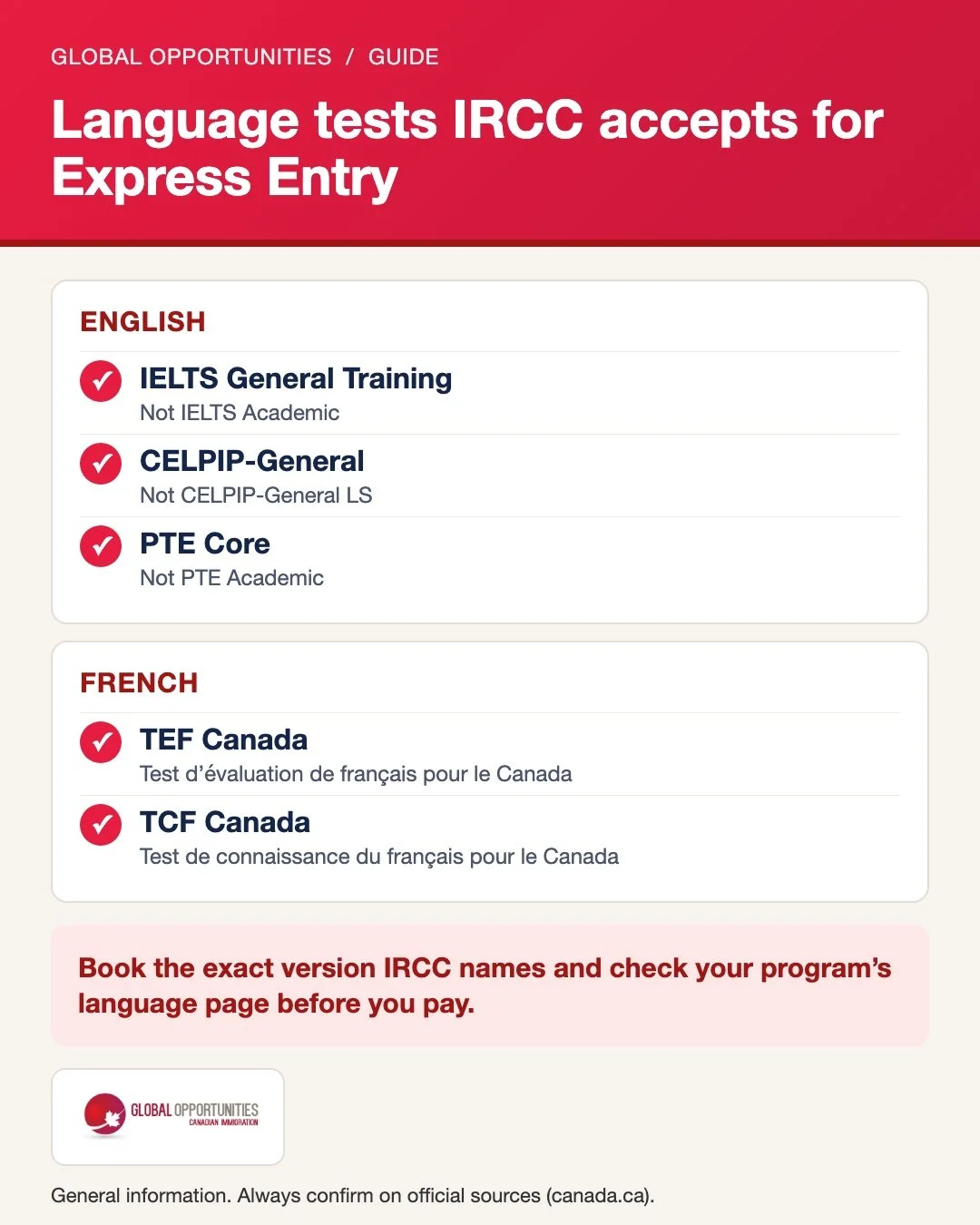
English tests
CELPIP: you must take the CELPIP-General test.
IELTS: you must take the IELTS General Training test.
PTE: you must take the PTE Core test.
French tests
TEF Canada (Test d'évaluation de français pour le Canada).
TCF Canada (Test de connaissance du français pour le Canada).
Versions IRCC does not accept for Express Entry
IELTS Academic is not on IRCC's list for Express Entry. IRCC states that you must take IELTS General Training.
IELTS One Skill Retake. IRCC states: "We don't accept IELTS One Skill Retake for Express Entry."
CELPIP-General LS is a two-skill version (listening and speaking). It is not the version IRCC names for Express Entry.
PTE Academic. IRCC names PTE Core. According to Pearson, students planning to study in Canada take PTE Academic, and PTE Core is the version for Canadian immigration (Pearson, PTE Core).
Other tests, such as the Duolingo English Test, TOEFL, Cambridge English exams or a general TCF or TEF, are not on IRCC's Express Entry list, even if a school accepts them.
The same tests appear for other programs, such as the Atlantic Immigration Program, which lists CELPIP-General, IELTS General Training or PTE Core in English, and TEF Canada or TCF Canada in French (IRCC, Atlantic Immigration Program: language testing). Always check the language page of your own program before you book.
List of approved tests as published by IRCC, as of November 2026. A test that a school, employer or regulator accepts is not automatically accepted by IRCC: only the versions named on IRCC's page count for immigration.
What are CLB and NCLC levels?
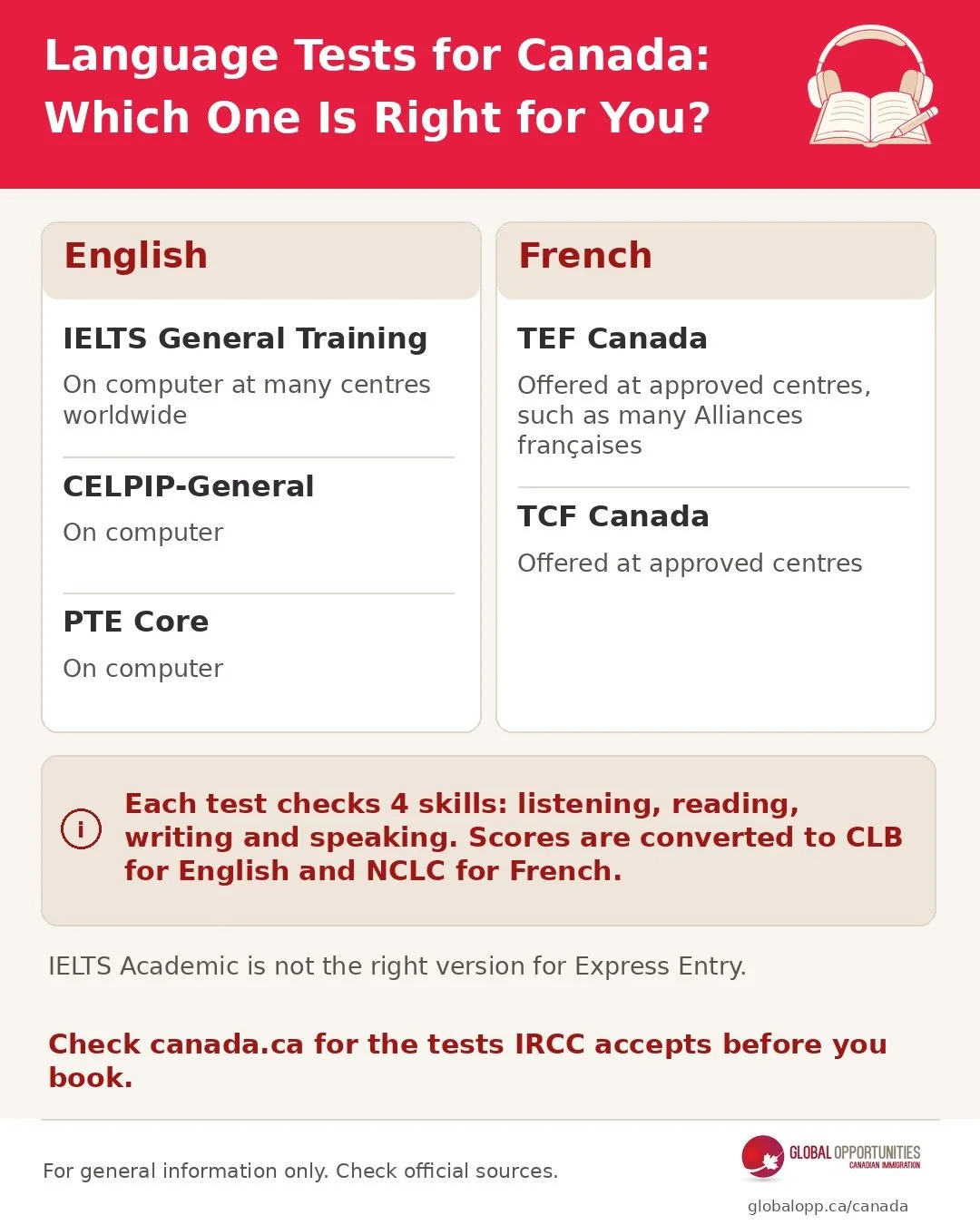
IRCC does not use each test's own score directly. It converts your results into Canadian levels: the Canadian Language Benchmarks (CLB) for English and the Niveaux de compétence linguistique canadiens (NCLC) for French. This lets IRCC compare results from different tests on the same scale.
What the CLB is
According to the Centre for Canadian Language Benchmarks, the CLB is a descriptive scale of English as a second language ability written as 12 benchmarks along a continuum from basic to advanced. The benchmarks were developed by the Centre for Canadian Language Benchmarks and remain the property of IRCC (CCLB, about the CLB). The French equivalent is the NCLC (CCLB, NCLC). IRCC links to both pages from its Express Entry language page.
In plain words, the CLB describes what a person can actually do in the language: follow a conversation, understand instructions, write a message, express an opinion. Lower levels describe basic, everyday communication; higher levels describe fluent and complex communication at work and in society.
Four abilities, assessed one by one
IRCC looks at your result for each ability: speaking, listening, reading and writing. Minimum levels apply to each ability, not to an average. A strong overall score does not make up for one ability below the minimum (IRCC, Express Entry: language test results).
How the conversion works
Each test has its own scale. IELTS reports bands, CELPIP reports levels, PTE Core reports scores, and TEF Canada and TCF Canada report scores per test. IRCC publishes a table for each approved test that shows which score, in each ability, corresponds to each CLB or NCLC level. You take your score for each ability, find it in the table for your test, and read the level.
The same CLB level can correspond to different scores in different abilities of the same test. For example, the score needed in listening for a given level is not necessarily the same as the score needed in reading. That is normal: the tables are built ability by ability.
Where to find the official equivalencies
IRCC publishes the official conversion tables for each approved test on its Express Entry: language test results page, and the minimum level for each Express Entry program on the same page. Programs outside Express Entry publish their requirements on their own language pages.
We do not reproduce these tables here, on purpose. Equivalencies and minimums can change. Always use the current table on canada.ca.
First and second official language
If you speak both English and French, IRCC treats one as your first official language and the other as your second. IRCC explains that for the Federal Skilled Worker Program, your second official language can also be taken into account if you meet a minimum level in all four abilities (IRCC, Express Entry: language test results). IRCC also advises French-speaking candidates to choose their strongest language as their first official language (IRCC, Express Entry for French-speaking skilled workers). How your first and second official languages are counted depends on each case; a consultation is the way to know how it applies to you.
Levels and equivalencies as published by IRCC and the Centre for Canadian Language Benchmarks, as of November 2026. Reaching a CLB or NCLC level is assessed ability by ability using IRCC's current table; an overall score, a school's level or a practice test does not show that you meet a program's minimum.
IELTS test types explained: which IELTS for Canada
IELTS (International English Language Testing System) comes in several versions with very similar names. For Canadian immigration, the one you need is IELTS General Training, taken as a full test. The other versions exist for other purposes. Here is each one in plain words.
IELTS General Training: the one for Canadian immigration
According to the official IELTS website, General Training is the test to choose if you want to migrate to an English-speaking country, such as Canada, or train or study below degree level (IELTS, General Training). It measures English in everyday, social and workplace situations: notices, advertisements, workplace documents, letters. IRCC lists IELTS General Training as the IELTS version it accepts for Express Entry, and its citizenship page states: "We only accept IELTS General Training for citizenship applications" (IRCC, citizenship language proof, step 2).
IELTS Academic: for study and professional registration
According to IELTS, IELTS Academic is for people who want to study at undergraduate or postgraduate level or who seek professional registration (IELTS, Academic). Its Reading and Writing sections use academic texts and tasks, such as describing a graph. IELTS Academic is not accepted for Express Entry. If you plan to study in Canada first and immigrate later, you may need IELTS Academic for your school and, later, IELTS General Training (or another approved test) for IRCC.
IELTS on computer and Writing on Paper
According to IELTS, on computer "questions for the Listening, Reading, and Writing sections are shown on the screen," you type your answers, and Speaking is a face-to-face session with an examiner. In selected countries, the Writing on Paper option lets you take the test on computer but write the Writing section by hand (IELTS, ways to take IELTS). The format of the test and the version (General Training) are what matter to IRCC; the delivery mode does not change which version you are taking.
Fully paper-based IELTS is being replaced by computer delivery in many countries. For example, IDP's country pages for Mexico, Colombia, Peru, Chile, Ecuador, Argentina and Brazil say IELTS on paper is no longer available from IDP there (see, for example, IDP Mexico). Check what your centre offers.
IELTS Online: Academic only
IELTS Online lets you sit the test at home or another suitable private location. According to IELTS, it has the same format, questions, timing and marking criteria as the test at a centre, but it is offered in some countries for the Academic test only (IELTS, ways to take IELTS). That means there is no home version of IELTS General Training, and IELTS Online cannot be used for Express Entry.
IELTS for UKVI: for UK visas, not needed for Canada
According to IELTS, IELTS for UK Visas and Immigration (UKVI) is a Secure English Language Test accepted by the UK government, taken in person at an official IELTS for UKVI centre with an additional layer of security (IELTS, tests for UKVI). It exists in Academic and General Training forms and usually costs more. You do not need the UKVI version for Canada. IRCC asks for IELTS General Training; booking the UKVI label only adds cost. The same applies to IELTS Life Skills, a listening and speaking test for some UK visa routes, which is not on IRCC's list.
IELTS One Skill Retake: not accepted for Express Entry
According to IELTS, One Skill Retake lets you retake one section within 60 days of a full IELTS on computer, at centres that offer it, and you receive a new Test Report Form (IELTS, One Skill Retake). Some organizations accept it. IRCC does not accept IELTS One Skill Retake for Express Entry (IRCC, Express Entry: language test results). If one section is low, plan a new full test.
Test versions as described by IELTS and IRCC, as of November 2026. The name on your booking screen must match the version IRCC names; a similar-sounding version (Academic, UKVI, Life Skills, Online or One Skill Retake) is not a substitute for Express Entry.
IELTS General Training format, scoring and booking
IELTS General Training has four sections: Listening, Reading, Writing and Speaking. Listening and Speaking are the same as in IELTS Academic; Reading and Writing are different (IELTS, General Training). Listening, Reading and Writing are taken in one session; Speaking may be on the same day or on a different day, depending on the centre.
IELTS General Training Listening
According to IELTS, Listening has 4 parts and 40 questions (10 per part) and lasts about 30 minutes. On paper, there is extra time to transfer your answers (IELTS, General Training Listening). Answer as you listen, and read the questions ahead when you can.
IELTS General Training Reading
According to IELTS, Reading lasts 60 minutes, with 3 sections and 40 questions of increasing difficulty (IELTS, General Training Reading):
Section 1: short everyday texts, such as notices and advertisements.
Section 2: two texts related to work, such as job descriptions or workplace policies.
Section 3: one longer text on a topic of general interest.
There is no extra time to transfer answers, so time management is a big part of this section.
IELTS General Training Writing
According to IELTS, Writing lasts 60 minutes and has two tasks (IELTS, General Training Writing):
Task 1: a letter (personal, semi-formal or formal) of at least 150 words, in about 20 minutes, responding to a situation such as asking for information or explaining a problem.
Task 2: an essay of at least 250 words, in about 40 minutes, responding to a point of view or a problem.
According to the IELTS Writing page, Task 2 counts twice as much as Task 1. Many candidates lose marks by spending too long on the letter.
IELTS General Training Speaking
According to IELTS, Speaking lasts 11 to 14 minutes and is a face-to-face, recorded conversation with a certified examiner, in three parts (IELTS, General Training Speaking):
Part 1: questions about yourself and familiar topics, 4 to 5 minutes.
Part 2: a long turn: you get a card with a topic, 1 minute to prepare and up to 2 minutes to speak.
Part 3: a discussion of more abstract ideas connected to Part 2, 4 to 5 minutes.
How IELTS scoring works
According to IELTS, results are reported on a band scale from 0 to 9, in whole and half bands, for each section, plus an overall band. The overall band is the average of the four sections, rounded to the nearest half band (IELTS, scoring in detail). For Canada, remember that IRCC looks at each section's band and converts it into a CLB level using its own table; the overall band does not decide your eligibility.
How IRCC converts IELTS bands to CLB
You take your band for listening, reading, writing and speaking, then look up each one in IRCC's IELTS General Training table on the Express Entry: language test results page. Each ability gets its own CLB level. Your program's minimum must be met in every ability. We do not list the bands or the minimums here: use the current IRCC table.
How to book IELTS General Training
Find a centre. Use the official IELTS test centre finder and choose your country and city. Each centre page shows the tests it offers, the format and the fee.
Book with the official provider. IELTS is delivered by IDP and the British Council, depending on the country and the centre. Book on the provider's official site or through the centre listed on ielts.org.
Choose carefully on screen. Select IELTS General Training, the standard version (not UKVI, not Life Skills), a full test (not One Skill Retake), and the delivery mode you prefer.
Use your passport details. The identification document you book with is usually the one you must bring on test day, and your name should match exactly.
Keep your confirmation, book your Speaking slot if asked, and read the centre's rules on rescheduling and cancellation.
When you get IELTS results
According to IELTS, results for the test on computer are usually available within a few days; its official pages mention 1 to 2 days and 1 to 5 days (IELTS, getting and sharing your results). Your result appears on a Test Report Form (TRF), which has a TRF number you will need for your IRCC profile. IELTS itself recommends that results be considered valid for two years (IELTS, scoring in detail); for IRCC, what matters is IRCC's own validity rule, explained further below.
We also talked about IELTS in an interview on our YouTube channel: Everything you need to know about IELTS.
Format, timing, scoring and results timelines as published by IELTS, as of November 2026. Details mentioned in recorded talks, including our own interview, may have changed since they were recorded: the official IELTS website is the one that counts.
Where to take IELTS General Training in each country
IELTS General Training is offered in many countries through two official providers: IDP and the British Council. Below is what we found on the official IELTS test centre finder and on IDP's country pages when we checked in November 2026. Centres open, close and change often, so always confirm on the official finder before you plan travel. Moving from one of these regions? Our guides for people moving to Canada from Asia, Africa and Europe cover visas, studies and arrival.
How to read this section:
Providers are the organizations whose centres appear on ielts.org for that country.
Cities are listed only when they appeared on an official page we opened. The lists may not be complete.
Fees are the price shown on one specific centre page on ielts.org or on the provider's country page, for IELTS General Training on computer, standard version (not UKVI). IELTS notes that prices may vary and may be subject to local tax. Fees are as of November 2026; check the current price before booking. Other centres in the same country can charge a different amount.
Test providers and centres are private organizations. We mention them for reference only; Global Opportunities has no relationship with them.
IELTS General Training in Mexico
Providers: IDP and the British Council, plus other centres in the IELTS network.
Cities (IDP): Mexico City, Guadalajara, Monterrey, Toluca, Cuernavaca, Aguascalientes, Tijuana, Campeche, Chihuahua, Hermosillo, León, Mérida, Oaxaca, Puebla, Querétaro, Culiacán, Veracruz, Villahermosa, Xalapa and Cancún (IDP Mexico). British Council centres on ielts.org include Mexico City, Monterrey, Guadalajara, Puebla and Querétaro.
Fee example (November 2026): MXN 5,260 at the British Council Mexico centre (ielts.org, British Council Mexico). Check the current price.
IELTS General Training in Colombia
Providers: IDP and the British Council.
Cities: IDP lists Barranquilla, Bogotá, Cali, Chía, Cúcuta, Medellín, Neiva and Pasto (IDP Colombia). British Council centres include Bogotá, Medellín (Sabaneta), Cali, Bucaramanga and Barranquilla.
Fee example (November 2026): COP 1,129,000 at the British Council Colombia centre (ielts.org, British Council Colombia). Check the current price.
IELTS General Training in Peru
Providers: IDP and the British Council.
Cities: IDP lists Lima (San Borja and Miraflores), Arequipa and Trujillo (IDP Peru). The British Council centres we found are in Lima.
Fee example (November 2026): PEN 1,020 at the Británico San Isidro centre in Lima (ielts.org, Británico San Isidro). Check the current price.
IELTS General Training in Chile
Providers: IDP and the British Council.
Cities: IDP lists Santiago and Antofagasta (IDP Chile). The British Council centre we found is in Santiago (Providencia).
Fee example (November 2026): CLP 275,500 at the British Council centre in Providencia (ielts.org, British Council Berlitz Providencia). Check the current price.
IELTS General Training in Ecuador
Providers: IDP and the British Council.
Cities: Quito and Guayaquil (IDP Ecuador).
Fee example (November 2026): USD 246 at the British Council centre in Quito (ielts.org, British Council International House Quito). Check the current price.
IELTS General Training in Brazil
Providers: IDP and the British Council.
Cities: IDP lists Belo Horizonte, Brasília, Campinas, Cascavel, Curitiba, Florianópolis, Joinville, Londrina, Porto Alegre, Rio de Janeiro and São Paulo (IDP Brazil). British Council centres also include Salvador and Recife.
Fee example (November 2026): BRL 1,360 at the British Council São Paulo centre (ielts.org, British Council São Paulo). Check the current price.
IELTS General Training in Argentina
Providers: IDP and the British Council.
Cities: IDP's city list includes Buenos Aires, Córdoba, Mendoza, Neuquén, Rosario, Salta, Santa Fe and Trelew (IDP Argentina). British Council centres include Buenos Aires, Rosario and Córdoba.
Fee example (November 2026): the centres we checked list the fee in US dollars, for example USD 282 at the British Council Buenos Aires centre (ielts.org, British Council Buenos Aires). Check the current price.
IELTS General Training in Venezuela
Provider: the British Council. IDP does not list Venezuela among its countries.
City: Caracas.
Fee example: USD 310 at the British Council Caracas centre (ielts.org, British Council Caracas), as of November 2026. Check the current price and the session calendar with the centre.
IELTS General Training in Costa Rica
Provider: the British Council.
City: San José.
Fee example (November 2026): USD 230 at the BritEd (Colegio Británico de Costa Rica) centre (ielts.org, BritEd Costa Rica). Check the current price.
IELTS General Training in Guatemala, Honduras, El Salvador, the Dominican Republic and Panama
We could not confirm an IELTS centre in these countries on the official pages we were able to open. That does not mean there is none: centres change, and some British Council pages could not be checked. Search the official IELTS test centre finder for your country. If there is no centre near you, compare the options in a neighbouring country, and check the CELPIP and PTE Core finders too (see their sections below).
IELTS General Training in Spain
Providers: IDP and the British Council.
Cities: IDP lists Madrid, Barcelona and Valencia (IDP Spain). British Council centres include Madrid, Las Rozas, Barcelona, Bilbao, Valencia, Zaragoza, Pamplona, A Coruña, Vigo, Alicante, Burgos and Córdoba.
Fee example (November 2026): EUR 284 at the British Council Barcelona centre (ielts.org, British Council Barcelona). Check the current price.
IELTS General Training in the United Kingdom
Provider: the British Council, with a large network of centres across the country.
Format: on computer at many centres.
Fees: vary by centre; check the centre page on the IELTS test centre finder.
Note: many UK centres also offer IELTS for UKVI. For Canada, book the standard IELTS General Training unless you also need a UK visa.
IELTS General Training in Ireland
Providers: IDP and the British Council.
Cities: IDP lists Dublin (IDP Ireland). British Council centres include Dublin, Galway and Cork.
Fee example (November 2026): EUR 220 at the Exam Centre of Ireland in Dublin (ielts.org, Exam Centre of Ireland). Check the current price.
Planning a working holiday? Read our working holiday guide for Irish citizens.
IELTS General Training in France
Providers: IDP and the British Council.
Cities: IDP lists Paris (IDP France). British Council centres include Paris, Noisy-le-Grand, Lyon, Lille, Marseille, Nice, Bordeaux, Strasbourg and the Rouen and Toulouse areas.
Fee example (November 2026): EUR 307 at Touchstone Educationals in Paris (ielts.org, Touchstone Educationals). Check the current price.
French speakers in France: if your French is strong, a TEF Canada or TCF Canada can also be useful (see the French sections below).
IELTS General Training in Germany
Providers: IDP and the British Council.
Cities: IDP lists Frankfurt (IDP Germany). British Council centres include Berlin, Hamburg, Heidelberg, Marburg, Dortmund and Aachen.
Fee example (November 2026): EUR 286 at the British Council Germany centre (ielts.org, British Council Germany). Check the current price.
IELTS General Training in Italy
Providers: IDP and the British Council.
Cities: IDP's list includes Rome, Milan, Naples, Bologna, Florence, Bari, Catania, Palermo, Perugia, Pescara, Reggio Calabria, Rimini, Salerno, Siena, Varese and Verona (IDP Italy). British Council centres include Milan, Rome, Bologna, Padua, Verona, Vicenza, Catania, Lecce, Sassari and Pesaro.
Fee example (November 2026): EUR 290 at International House Rome (ielts.org, International House Rome). Check the current price.
IELTS General Training in Portugal
Providers: IDP and the British Council.
Cities: IDP lists Lisbon, Estoril and Vila Nova de Gaia (Porto area) (IDP Portugal). The British Council centre we found is in Lisbon.
Fee example (November 2026): EUR 291 at the English Exam Centre in Lisbon (ielts.org, English Exam Centre Lisbon). Check the current price.
IELTS General Training in India
Provider: IDP. The centres listed for India on ielts.org are IDP centres.
Cities: a long list, including New Delhi, Noida, Gurugram, Mumbai, Navi Mumbai, Thane, Pune, Bengaluru, Chennai, Hyderabad, Kolkata, Ahmedabad, Vadodara, Surat, Rajkot, Jaipur, Lucknow, Bhopal, Chandigarh, Amritsar, Jalandhar, Ludhiana, Patiala, Bathinda, Kochi, Kottayam, Thiruvananthapuram, Coimbatore, Visakhapatnam, Vijayawada and many more.
Format: on computer, and on computer with Writing on Paper.
Fee example: INR 19,000 at IDP Education India, Noida (ielts.org, IDP Noida), as of November 2026. Check the current price on IDP India.
IELTS General Training in the Philippines
Providers: the British Council and IDP.
Cities: many, including Manila, Makati, Quezon City, Pasig, Taguig, Cebu, Davao, Iloilo, Bacolod, Baguio, Cagayan de Oro, Pampanga, Batangas and others (IDP Philippines).
Fee example: IDP announced PHP 14,470 for IELTS on computer from July 2026 (IDP Philippines, price update), as of November 2026. Some centres show a different amount. Check the current price.
IELTS General Training in Pakistan
Providers: the British Council, IDP and other centres in the IELTS network.
Cities: Islamabad, Lahore, Karachi, Faisalabad, Multan, Peshawar, Quetta, Sialkot, Gujranwala, Hyderabad and others (IDP Pakistan).
Fees: vary by city and format; check IDP Pakistan's fee page and the centre page on ielts.org.
IELTS General Training in Nigeria
Providers: the British Council and IDP.
Cities: Lagos (including Ikeja, Ikoyi, Victoria Island and Festac), Abuja, Ibadan, Port Harcourt, Enugu, Benin City, Kano, Owerri, Uyo, Calabar, Warri and others.
Fee example (November 2026): NGN 299,000 for IELTS on computer (IDP Nigeria). Check the current price.
IELTS General Training in Kenya
Providers: the British Council and IDP.
Cities: Nairobi, Mombasa, Kisumu, Nakuru, Eldoret, Kakamega, Kisii and Meru.
Fee example (November 2026): KES 41,580 for IELTS on computer (IDP Kenya). Check the current price.
IELTS General Training in Ghana
Providers: the British Council and IDP.
Cities: Accra, Kumasi, Takoradi, Tamale and Tema.
Fee example (November 2026): GHS 3,720 for IELTS on computer at IDP Accra (ielts.org, IDP Ghana Accra). Check the current price.
IELTS General Training in South Africa
Providers: the British Council and other centres in the IELTS network.
Cities: Johannesburg, Pretoria, Cape Town, Durban and Gqeberha.
Fee example (November 2026): ZAR 6,200 at the Horizon Consultants centre in Cape Town (ielts.org, Horizon Consultants Cape Town). Check the current price.
IELTS General Training in Morocco
Provider: the British Council.
Cities: Rabat, Casablanca, Marrakesh, Fes, Tangier, Agadir, Tetouan, Oujda, El Jadida and Safi.
Fee example (November 2026): MAD 3,080 at the British Council centre in Tangier (ielts.org, British Council Tangier). Check the current price.
French speakers in Morocco: TEF Canada and TCF Canada are also an option (see below).
IELTS General Training in China
Providers: IDP and university test centres operating with China's national education examinations authority, which publishes IELTS information on its own site.
Cities: Beijing, Shanghai, Guangzhou, Shenzhen, Chengdu, Chongqing, Hangzhou, Nanjing, Wuhan, Xi'an, Tianjin, Shenyang, Xiamen, Qingdao, Jinan, Zhengzhou and many more.
Note: some centres in China offer only IELTS Academic. Check that the centre lists General Training before booking.
Fee example (November 2026): CNY 1,990 for General Training on computer at a Shanghai centre (ielts.org, Shanghai University of Finance and Economics). Check the current price.
IELTS General Training in Japan
Providers: the British Council (with partner organizations) and IDP.
Cities: Tokyo, Yokohama, Osaka, Kyoto, Nagoya, Fukuoka, Hiroshima and Sendai.
Fee example: JPY 29,700 at the Eiken Yokohama centre (ielts.org, Eiken Yokohama), as of November 2026. Some centres charge less. Check the current price.
IELTS General Training in South Korea
Providers: IDP and the British Council.
Cities: Seoul, Busan, Daegu, Daejeon and Incheon.
Fee example (November 2026): KRW 347,000 (IDP Korea, test fees). Check the current price.
IELTS General Training in Vietnam
Providers: the British Council and IDP.
Cities: Hanoi, Ho Chi Minh City, Da Nang, Hai Phong, Can Tho, Hue, Khanh Hoa, Vung Tau, Bien Hoa, Binh Duong and many more (IDP Vietnam).
Fee example (November 2026): VND 4,664,000 (IDP Vietnam, IELTS fees). Check the current price.
IELTS General Training in the United Arab Emirates
Providers: the British Council and IDP.
Cities: Dubai, Abu Dhabi, Sharjah, Al Ain, Ajman, Ras Al Khaimah, Fujairah, Umm Al Quwain and Dibba.
Fee example: AED 1,590 for IELTS on computer at IDP (IDP UAE), as of November 2026. British Council centres vary. Check the current price.
IELTS General Training in Australia
Provider: IDP, plus some university and institute centres.
Cities: Sydney, Melbourne, Brisbane, Perth, Adelaide, Canberra, Hobart, Darwin, Gold Coast, Newcastle, Wollongong, Cairns, Townsville and Launceston (IDP Australia).
Fee example (November 2026): AUD 505 at IDP Kensington (ielts.org, IDP Australia Kensington). Check the current price.
If you are in Australia on a working holiday and thinking about Canada, see our guide to moving to Canada from Australia.
IELTS General Training in Canada
Providers: IDP and the British Council.
Cities: IDP says it has more than 180 test centres in more than 50 cities in Canada, including Toronto, Brampton, Mississauga, Markham, Richmond Hill, Ottawa, Kitchener, Waterloo, Montreal, Vancouver, Surrey, Burnaby, Victoria, Calgary, Edmonton, Regina, Winnipeg and Halifax (IDP Canada).
Format: on computer; IDP also offers Writing on Paper at some centres.
Fees: vary by centre; check the centre page on the IELTS test centre finder.
If your country is not listed
Open the IELTS test centre finder, choose your country and filter by test type. If there is no General Training option nearby, compare CELPIP-General and PTE Core in your country, or a French test if your French is strong. All approved tests are valid for the programs that accept them.
Providers, cities and fees as shown on ielts.org and the providers' country pages, as of November 2026. A fee example is one centre's price on that date, not a fixed national price: check the current fee with your centre before you book.
CELPIP-General for Canada
CELPIP (Canadian English Language Proficiency Index Program) is a general English test developed in Canada. For permanent residence, the version IRCC accepts is the CELPIP-General. According to the official CELPIP website, the CELPIP-General evaluates listening, reading, writing and speaking and is officially designated for permanent residence applications by IRCC (CELPIP, CELPIP-General).
CELPIP-General format
The whole test is computer-based and done in one sitting, with no separate speaking session. CELPIP describes the total test time as about 2 hours and 50 minutes (CELPIP, Canadian residency). According to CELPIP's test format page:
Listening: 6 parts, about 46 to 55 minutes.
Reading: 4 parts, about 43 to 56 minutes.
Writing: 2 tasks in 53 minutes: writing an email and responding to survey questions.
Speaking: 8 tasks in about 15 minutes.
For Speaking, you reply to on-screen prompts verbally and your answers are recorded. There is no examiner sitting in front of you. The accents and situations are Canadian, which some people find helpful if they already live in Canada.
CELPIP results
According to CELPIP, results are available online in your CELPIP account 2 to 4 business days after the test. The Official Score Report is a PDF you download, and CELPIP says hard copy score reports have been discontinued (CELPIP, test results). Each skill gets its own level, which you convert into a CLB level using IRCC's CELPIP table.
CELPIP-General vs CELPIP-General LS
The CELPIP website explains that there are two versions and asks test takers to confirm which one they need:
CELPIP-General evaluates all four skills and is the IRCC-approved test for permanent residence applications.
CELPIP-General LS evaluates only listening and speaking, takes about 1 hour and 10 minutes, and CELPIP describes it as the IRCC-approved test for Canadian citizenship applications (CELPIP, Canadian citizenship).
If you are applying for permanent residence, book the CELPIP-General.
CELPIP fees in Canada
According to celpip.ca, as of November 2026, the CELPIP-General test costs CAD 299 plus applicable taxes (CELPIP, Canadian residency) and CELPIP-General LS: CAD 199 plus applicable taxes (CELPIP, Canadian citizenship). CELPIP says international pricing will vary. Check the current price before booking.
Where to take CELPIP
CELPIP is offered widely across Canada. Outside Canada, the country list on the official CELPIP test date finder included, among others, when we checked in November 2026: Australia, Bangladesh, Brazil, Cameroon, China, Colombia, Costa Rica, Ecuador, Egypt, France, Germany, Ghana, Greece, India, Ireland, Jamaica, Japan, Kenya, Republic of Korea, Kuwait, Lebanon, Malaysia, Mexico, Morocco, Nepal, Nigeria, Pakistan, the Philippines, Qatar, Saudi Arabia, Singapore, South Africa, Sri Lanka, Taiwan, Thailand, Trinidad and Tobago, the United Arab Emirates, the United Kingdom and the United States.
Locations abroad include cities such as Mexico City, Guadalajara, San José (Costa Rica), Quito, Chía (Colombia), Rabat, Manila, Cebu and New Delhi. The list changes and sessions abroad can be less frequent than in Canada, so check the finder for your city and dates. Also confirm that the session is CELPIP-General, not LS.
CELPIP preparation
CELPIP offers free practice tests (unlocked with a short form), a free online sample test, free information sessions, and paid study materials and courses (CELPIP, free practice tests). Because the whole test is on computer, practise typing your writing tasks and speaking into a microphone with a timer. Watch our short video on how CELPIP fits into a permanent residence plan. We also talked about the CELPIP in an interview on our YouTube channel (in Spanish): Todo lo que necesitas saber sobre CELPIP.
Watch our recorded live session on how CELPIP results fit into a Canadian immigration application. We summarise our CELPIP and IELTS sessions on our recorded seminars in English page.
Format, versions, results timelines and fees as published by CELPIP, as of November 2026. Details mentioned in recorded talks, including our own videos, may have changed since they were recorded: celpip.ca is the one that counts. For permanent residence, book CELPIP-General, not CELPIP-General LS.
PTE Core for Canada
PTE Core is Pearson's general English test for Canada. IRCC lists it as an approved English test, and you must choose the PTE Core option (IRCC, Express Entry: language test results).
What PTE Core is
According to Pearson (PTE Core):
PTE Core is a computer-based test that assesses general English skills: speaking, writing, reading and listening.
It is taken in one sitting at a test centre, in about 2 hours. Pearson says it cannot be taken at home.
Pearson describes PTE Core as accepted by IRCC for economic permanent residence programs and for citizenship applications, while students planning to study in Canada take PTE Academic instead.
PTE Core format
According to Pearson's PTE Core page, the test has three parts:
Speaking and Writing together, about 50 to 65 minutes, with several question types.
Reading, about 27 to 37 minutes.
Listening, about 22 to 37 minutes.
Speaking is recorded by the computer; there is no examiner in the room.
PTE Core vs PTE Academic
PTE Core: general English, for Canadian immigration and citizenship according to Pearson and IRCC.
PTE Academic: academic English, for study. It is not the version IRCC names for Express Entry.
The names look alike on the booking screen. Select PTE Core.
PTE Core results and where to take it
According to Pearson, results are usually available within 2 business days, sometimes up to 5, and you receive an email when your score report is ready. Pearson says PTE is offered at more than 500 test centres in over 115 countries (Pearson, PTE Core). Search locations, dates and the price in your country on Pearson's official test centres and fees page. Pearson also publishes official PTE Core preparation resources, some free and some paid.
Format, results timelines and test centre figures as published by Pearson, as of November 2026. PTE Academic is not a substitute for PTE Core for Express Entry.
TEF Canada
TEF Canada (Test d'évaluation de français pour le Canada) is a French test from Le français des affaires, part of the Paris Île-de-France Chamber of Commerce and Industry (CCI Paris Île-de-France). IRCC lists it as an approved French test (IRCC, Express Entry: language test results).

What TEF Canada measures
According to Le français des affaires, TEF Canada is the test for people who want to apply for immigration or citizenship in Canada, and it has four compulsory components for immigration (Le français des affaires, TEF Canada).
TEF Canada format
According to Le français des affaires (TEF Canada presentation):
Compréhension écrite (reading): 40 multiple-choice questions, 60 minutes.
Compréhension orale (listening): 40 multiple-choice questions, 40 minutes.
Expression écrite (writing): 60 minutes, in two sections (Section A, about 25 minutes and at least 80 words; Section B, about 35 minutes and at least 200 words).
Expression orale (speaking): 15 minutes, in two sections (about 5 and 10 minutes), face to face with an examiner.
For citizenship, only listening and speaking are needed. For immigration, all four tests must be taken, and Le français des affaires says they must be taken on the same day for the certificate to be recognized by Canadian authorities.
How TEF Canada is taken and scored
According to Le français des affaires, reading, listening and writing are taken on computer, and speaking is face to face with an examiner (TEF Canada, taking the test). Results arrive in 1 to 10 business days through a digital link, with no paper certificate, and are valid for 2 years. You can retake the test, with a 20-day waiting period between sittings (TEF Canada, certificate). IRCC converts each score into an NCLC level using its TEF Canada table.
TEF Canada: which scores to enter in Express Entry
IRCC's language testing page says your level is based on the "Équivalence ancien score" (previous score equivalency) column of your TEF Canada results, and that you should enter only the scores from that column. IRCC says not to enter the "Score / 699" results in your Express Entry profile, and warns that if you don't enter the correct scores, it may refuse your application. Check this column carefully before you fill out your profile.
TEF Canada instructions as published by IRCC on its language testing page, as of November 2026. Check that page before you enter your results: IRCC's instructions are the ones that count.
TEF Canada vs TEFAQ
TEFAQ is a different test, intended for immigration to Quebec. It is not the test IRCC names for Express Entry. Global Opportunities does not offer services for Quebec's immigration programs; we mention TEFAQ only so you do not book it by mistake.
Format, results timelines, validity and retake rules as published by Le français des affaires, as of November 2026. The provider's two-year validity is not the same as IRCC's validity rule, which is the one that counts for your application.
TCF Canada
TCF Canada (Test de connaissance du français pour le Canada) is a French test from France Éducation international. According to France Éducation international, it is intended for anyone who needs to certify their French for economic immigration to Canada or for Canadian citizenship, and who must submit an application to IRCC (France Éducation international, TCF Canada).
TCF Canada format
According to France Éducation international, TCF Canada has four compulsory tests of general French, with a total of about 2 hours and 47 minutes:
Compréhension orale (listening): 39 multiple-choice questions, 35 minutes.
Compréhension écrite (reading): 39 multiple-choice questions, 60 minutes.
Expression écrite (writing): 3 tasks, 60 minutes.
Expression orale (speaking): 3 tasks, 12 minutes including preparation, an individual, face-to-face test with an examiner.
Depending on the centre, TCF Canada may be on paper or on computer.
TCF Canada results, validity and retakes
According to France Éducation international, results are available in your TCF candidate account within 15 working days of the agency receiving the session materials, and they are valid for 2 years from the date they are issued. You can take TCF Canada as many times as you wish, but you must wait 20 days between sittings; some centres apply longer local rules (France Éducation international, TCF Canada). France Éducation international also notes temporary changes to its rescoring service, so read the official page before you plan around a rescore.
TCF Canada vs TCF Québec and general TCF
TCF Canada is the version IRCC accepts.
TCF Québec is for files submitted to Quebec's immigration ministry (France Éducation international, TCF Québec). Global Opportunities does not offer services for Quebec's immigration programs.
TCF tout public and other TCF versions are general French certificates. They are not the version IRCC names.
Format, results timelines, validity and retake rules as published by France Éducation international, as of November 2026. Some centres apply longer local waiting periods: check with your centre before you plan a retake.
Where to take TEF Canada and TCF Canada
You register for TEF Canada or TCF Canada directly with an approved test centre. Many approved centres are Alliance Française schools or Instituts français, which also teach French. Each centre sets its own calendar, registration rules and fee.
Official centre finders
TEF Canada: Le français des affaires' approved centre finder.
TCF Canada: France Éducation international's list of TCF test centres. The list covers TCF centres in general, so ask the centre whether it offers TCF Canada specifically.
TEF Canada and TCF Canada centres in Canada
These centres said on their own websites, when we checked in November 2026, that they offer TEF Canada and TCF Canada:
Alliance Française de Toronto: an accredited exam centre for TCF and TEF, with exam locations in Spadina (downtown), North York, Mississauga and Oakville (AF Toronto, tests). It also offers an orientation session about TEF and TCF.
Alliance Française d'Ottawa: TEF Canada and TCF Canada (AF Ottawa, TCF Canada). Its TEF page listed CAD 390 for the four modules and CAD 195 for two modules, as of November 2026 (AF Ottawa, TEF). Check the current price.
Alliance Française Vancouver: an official testing centre for TEF and TCF (AF Vancouver, TEF and TCF).
Alliance Française de Calgary: TEF Canada and TCF (AF Calgary, TEF Canada; AF Calgary, TCF).
Alliance Française Halifax: TEF and TCF Canada (AF Halifax, TEF; AF Halifax, TCF Canada).
Universities and other approved centres in Canada may also offer these tests; use the official finders.
TEF Canada and TCF Canada centres abroad
Examples we checked on official centre websites in November 2026:
Mexico: Alianza Francesa de México describes TEF Canada and its Polanco location as an official TEF centre (Alianza Francesa de México, certifications).
Chile: the Instituto Francés de Chile lists TCF certifications (Instituto Francés de Chile, TCF). Ask whether the session is TCF Canada.
Peru: the Alianza Francesa de Lima lists TCF and TEF sessions (AF Lima, international exams). Confirm with the centre that it is the Canada version.
Colombia: we could not open the Alianza Francesa de Bogotá website. Check the official finders.
Morocco: the Institut français du Maroc lists TCF and TEF certifications across several cities (Institut français du Maroc, certifications). Confirm the Canada version with the centre.
Philippines: Alliance Française de Manille says the TEF format that applies there is TEF Canada (Alliance Française de Manille, TEF).
India: Alliance Française de Delhi says it conducts only the TCF Canada examination (AF Delhi, TCF).
Alliance Française schools, Instituts français and test centres are independent organizations. We mention them for reference only; Global Opportunities has no relationship with them.
Centres and fees as shown on each centre's own website, as of November 2026. Confirm with the centre that the session is the Canada version and check the current fee before you register.
How to choose your English or French test for Canada
All approved tests are valid for the programs that accept them. The best test for you is usually the one whose format suits you, that is offered near you, and that fits your timeline. IRCC lists each of them as an approved test; none is described as better than another.
Questions to ask yourself
Which program am I applying to? Read its official language page first. Express Entry, the Atlantic Immigration Program and citizenship do not all accept the same versions.
English, French or both? If French is strong for you, a French test can open additional options (see the French section below). If you speak both languages well, consider taking a test in each.
What format suits me?
If you prefer speaking to a person, IELTS Speaking is face to face with an examiner, and so are the TEF Canada and TCF Canada oral tests.
If you prefer everything on a computer, CELPIP-General and PTE Core are taken on computer, including speaking.
If you write faster by hand, ask whether your IELTS centre offers Writing on Paper.
Where can I take it? CELPIP has fewer locations outside Canada. IELTS, PTE Core, TEF Canada and TCF Canada are offered in many countries. Check the official finder for your city before you decide.
When do I need results? Plan your study time, the booking, the result wait and a possible retake.
What else will I use it for? If you also need a test for a school or a regulator, check which versions they accept. You may need two different tests.
How to prepare for IELTS, CELPIP, PTE Core, TEF and TCF
The most useful preparation is getting to know the exact format of your test and practising all four abilities under time pressure.
Official preparation resources
IELTS: official sample tests and preparation resources on ielts.org. IDP and the British Council also offer their own preparation materials.
CELPIP: free practice tests and a free sample test on celpip.ca, plus paid materials and courses.
PTE Core: official PTE Core preparation from Pearson, with free short courses and paid practice tests.
TEF Canada: test description and sample tasks on the Le français des affaires TEF Canada page. Many Alliance Française centres run preparation workshops.
TCF Canada: test description and sample tasks on France Éducation international.
A simple preparation plan
Take a full practice test under real timing and find your weakest ability; for many candidates it is writing or speaking.
Study the task types of your test one by one.
Practise daily, even briefly: listen, read, write short emails and speak out loud with a timer, and get feedback from a teacher or partner.
Take another full practice test before the real one, at the same time of day as your booking.
Be careful with unofficial "guaranteed score" offers
No one can promise a score. Be wary of anyone who offers "leaked questions", a "guaranteed band" or a shortcut. Book only through the official provider or its approved centres.
Where to study English and French, before and after you arrive
You do not need a course to take a test, but structured study helps many people. There are options in your country before you move and, for eligible newcomers, free classes in Canada.
Studying French with the Alliance Française network
The Alliance Française is a worldwide network of French language centres. Many offer general French courses, conversation classes and TEF or TCF preparation. In Canada, for example, the Alliance Française de Toronto lists group courses for adults, teens and children, and orientation sessions about TEF and TCF (AF Toronto, exams). Alliances in Ottawa, Vancouver, Calgary and Halifax, and in many Latin American, European, African and Asian cities, also teach French. Check the course options on your local centre's website.
Studying English before you move
Language schools, university extension programs and, in some countries, the British Council and IDP offer general English and test preparation. Libraries, conversation clubs, podcasts, news sites and apps help you practise daily. Choose everyday and workplace English, since the immigration tests are general tests.
Free language classes for newcomers in Canada (LINC and CLIC)
IRCC explains that permanent residents and protected persons can take language classes at no cost. These are the government-funded LINC classes (Language Instruction for Newcomers to Canada) in English and CLIC (Cours de langue pour les immigrants au Canada) in French (IRCC, language classes). According to IRCC:
You first contact an organization that helps newcomers.
Before starting a class, you must be assessed to find out your current level.
Then you register and start classes.
These classes help with daily life and work, but they do not replace an approved test for immigration or citizenship. Our Newcomers in Canada guide explains free newcomer services, including language classes, step by step.
Adult ESL classes through Ontario school boards
In Ontario, many school boards offer adult English as a Second Language (ESL) and French as a Second Language classes, funded by the province, at beginner, intermediate and advanced levels, in person or online. The Government of Ontario says Ontario residents might be eligible for language training classes at school boards (Ontario, improve your English and French). Eligibility is set by each program and can differ from LINC. For example, the Ottawa-Carleton District School Board says its classes are for Ontario residents 18 and over, including citizens, permanent residents and refugee claimants, and are not offered to visitors or people on work or study permits (OCDSB, ESL and LINC). Check the current rules with your local school board.
Other ways to practise in Canada
Public libraries, settlement organizations and volunteering all offer everyday chances to practise English or French. Check what your local library and newcomer organizations offer.
Eligibility for free classes as described by IRCC, the Government of Ontario and the Ottawa-Carleton District School Board, as of November 2026. Eligibility depends on your status and the program; a free class does not replace an approved test for immigration or citizenship.
How long are language test results valid for Canadian immigration?
For Express Entry, IRCC states that your language test results must be less than 2 years old when you complete your Express Entry profile and when you submit your application for permanent residence (IRCC, Express Entry: language test results). IRCC adds that applications with expired results are refused.
For the Atlantic Immigration Program, IRCC states that results must be less than 2 years old when you apply (IRCC, Atlantic Immigration Program: language testing). For any other program, check that program's official language page on canada.ca: rules can differ and can change.
The test providers also describe results as valid for 2 years: CELPIP says scores are valid for 2 years from the date the score report is issued (CELPIP, test results), and Le français des affaires (TEF Canada, certificate) and France Éducation international (TCF Canada) say TEF Canada and TCF Canada results are valid for 2 years. For IRCC, though, the rule that counts is IRCC's.
Plan around the date
Note the date on your result and count forward before you build your profile.
If you expect a long process, think about whether your results will still be valid when you need to submit your application.
Keep your official results and test report number safe; you will need to enter them exactly.
Validity rules as published by IRCC, as of November 2026. A result that is still valid for the test provider can be too old for IRCC: count from the dates IRCC names, not from the provider's validity period.
How to send your language test results to IRCC
You do not usually mail results to IRCC. You enter the details of your result in your online profile or application, and you include a copy of the result when your application's document checklist asks for it.
Based on IRCC's Express Entry: language test results and language testing pages, the steps are:
Take an approved version of the test and wait for your official result.
Check the dates: IRCC says your results must be less than 2 years old when you complete your Express Entry profile and when you submit your application.
Enter your test details in your profile, including the language test result form or certificate number and test PIN, if the system asks for it.
Enter your scores for each ability exactly as they appear on your report. For TEF Canada, IRCC says to use only the "Équivalence ancien score" column.
Upload a copy of your result when your application's document checklist asks for it.
Where to find the numbers on each result
IELTS General Training: the Test Report Form (TRF) number on your result.
CELPIP-General: the details on your Official Score Report, downloaded as a PDF from your CELPIP account.
PTE Core: your score report, which Pearson says you can share using your Score Report Code or send from your myPTE account.
TEF Canada and TCF Canada: the certificate details on the digital result you receive from the provider.
Tips for entering your results
Enter the scores for each ability exactly as they appear on your report. For TEF Canada, use the "Équivalence ancien score" column, as IRCC instructs.
Enter the test date and the date the results were issued correctly; validity is calculated from them.
Follow your application's document checklist for what to upload.
Steps as published by IRCC on its Express Entry language pages, as of November 2026. Your online profile and document checklist give the instructions that apply to you; follow them over this summary.
Language tests for study and work permits in Canada
For study, the language test is usually set by your school, not by IRCC's Express Entry list. For some work permits, IRCC has its own language rules.
Language tests for studying in Canada
Colleges and universities set their own admission requirements, including which English or French tests they accept and the scores they ask for. Many ask for IELTS Academic or PTE Academic, and some accept other tests. For example, Duolingo says its English Test is accepted by thousands of institutions worldwide, and its institution search lists Canadian universities (Duolingo English Test, institutions). The Duolingo English Test is not on IRCC's list for immigration. Check the requirements on your school's official admissions page.
According to IRCC's notice, the Student Direct Stream, which had its own language requirement, ended on November 8, 2024 (IRCC, end of the Student Direct Stream). Study permit applicants now follow the regular process; check the current study permit documents page.
Language tests for the post-graduation work permit
IRCC says that applicants for a post-graduation work permit must prove their English or French language skills, with an exemption for applications submitted before November 1, 2024 (IRCC, PGWP eligibility). The accepted tests and levels are on IRCC's linked pages. If you are a student who plans to stay and work after graduating, read that page early, because the test you took for admission may not be one IRCC accepts for the work permit.
Study permit and PGWP rules as published by IRCC, as of November 2026. Being admitted by a school with a given test does not mean that test meets IRCC's language requirement for a post-graduation work permit.
French as an advantage for immigration to Canada
If you speak French, an approved French test can open doors in Canada's immigration system outside Quebec. For a detailed explanation of the Express Entry French category, see our page on French language proficiency.
What IRCC says about French in Express Entry
Extra points for French. IRCC explains that French-speaking candidates can earn additional points for strong French language skills, even if French is their second language (IRCC, Express Entry for French-speaking skilled workers). We do not give point values: how much French adds depends on each case, and a consultation is the way to know what it means for your profile.
French-language proficiency category. IRCC's page on category-based selection lists French-language proficiency among the current categories, and IRCC says it monitors and assesses categories on a regular basis (IRCC, category-based selection). Categories and their requirements change; check the official page.
Francophone Mobility work permit
According to IRCC, the Francophone Mobility work permit is for people who plan to live and work in one of the provinces or territories outside Quebec and who can prove their French speaking and listening skills at the required level. The employer uses an LMIA exemption code for Mobilité Francophone, so a Labour Market Impact Assessment is not needed (IRCC, Francophone Mobility eligibility). Eligibility rules change; read the official page.
Should you take a French test if French is your second language?
If you already have a solid intermediate or advanced level of French, a TEF Canada or TCF Canada can add to your profile. If your French is basic, the time may be better spent on your English results first. The right choice depends on your full profile; a consultation is the way to know for your own case.
Global Opportunities does not offer services for Quebec's immigration programs. Quebec has its own selection system and requirements; this section covers the rest of Canada only.
French-language rules and categories as described by IRCC, as of November 2026. Categories change, and having strong French results does not mean you will be invited to apply or that an application will be approved.
Language proof for Canadian citizenship
Citizenship has its own language rules, separate from permanent residence. IRCC asks many adult applicants to show they can speak and listen in English or French at a basic level (IRCC, proof of language for citizenship).
In general terms, IRCC's citizenship pages explain that:
Proof can be a diploma, transcript or certificate from a secondary or post-secondary program taken in English or French, with a certified translation where needed.
If you did not study in English or French, you can use results from an approved test. IRCC lists CELPIP-General, IELTS General Training, PTE Core, TEF Canada and TCF Canada, and states: "We only accept IELTS General Training for citizenship applications" (IRCC, citizenship language proof, step 2).
IRCC's help centre also lists CELPIP-General LS, the listening and speaking version, among the tests accepted for citizenship (IRCC help centre, language test for citizenship).
For TEF Canada, Le français des affaires says only the listening and speaking tests are needed for citizenship.
Who must provide proof, the required level and the accepted documents are set out on IRCC's official pages. Read them before you apply, because incomplete language proof can delay or affect your application. Language is only one of the requirements: see our Canadian citizenship requirements guide.
Citizenship language rules as published by IRCC, as of November 2026. The tests accepted for citizenship are not identical to those for permanent residence: CELPIP-General LS, for example, is listed for citizenship but not for Express Entry.
Test day tips for language tests for Canada
A calm, well-planned test day protects the work you put into preparing.
The day before
Read your booking confirmation again: test type, address, start time, Speaking time if separate.
Prepare the same identification document you used to book. Check that it has not expired.
Plan your route and arrive early. Late arrivals may not be admitted.
At the test centre
Expect identity and security checks; follow the centre's instructions.
Personal items, phones and watches usually go into a locker.
Listen to the instructions and check that the screen or paper shows the right test.
For speaking tests with an examiner, speak naturally and develop your answers; short answers give the examiner little to assess.
For computer speaking tests (CELPIP and PTE Core), speak clearly at a normal pace and keep going until the time ends; do not wait in silence.
Common mistakes with language tests for Canada
Most problems have nothing to do with how good your English or French is. They come from the wrong version, expired results or careless details.
Booking IELTS Academic instead of IELTS General Training. For Express Entry and citizenship, IRCC names General Training.
Booking IELTS for UKVI, IELTS Life Skills or IELTS Online (Academic only) when you need IELTS General Training.
Booking CELPIP-General LS for permanent residence. The LS version covers only listening and speaking; for permanent residence, take the CELPIP-General.
Booking PTE Academic instead of PTE Core.
Using an IELTS One Skill Retake result for Express Entry. IRCC does not accept it.
Booking a general TCF, TCF Québec or TEFAQ instead of TCF Canada or TEF Canada, or not confirming with the centre that the session is the Canada version.
Looking only at the overall score. IRCC checks each ability separately.
Letting results expire before you create your profile or submit your application.
Typing results incorrectly in your online profile or application. Copy them exactly from your official report.
Name mismatches between your test booking and your passport.
Assuming the immigration test is enough for your regulator or your school. Your profession or school may require a different test or version.
Paying someone who promises a score or a "guaranteed" result. Book only through the official provider or its approved centres.
Frequently asked questions
Which English tests does Canada accept for immigration?
For Express Entry, IRCC accepts three English tests: CELPIP-General, IELTS General Training and PTE Core. Other versions with similar names, such as IELTS Academic, CELPIP-General LS and PTE Academic, are not the versions IRCC names for Express Entry. Other English tests, such as the Duolingo English Test or TOEFL, are not on the list either, even though many schools accept them. Always confirm the list on your program's language page. See "Which language tests does IRCC accept?" above.
Which French tests does Canada accept for immigration?
IRCC accepts TEF Canada and TCF Canada for Express Entry and other economic programs that require a language test. TEF Canada is from Le français des affaires (CCI Paris Île-de-France) and TCF Canada is from France Éducation international. Both have four compulsory parts for immigration: reading, listening, writing and speaking. Similar tests such as TEFAQ, TCF Québec or a general TCF are not the versions IRCC names. See the TEF Canada and TCF Canada sections above.
Is IELTS Academic accepted for Express Entry in Canada?
No. IRCC states that you must take IELTS General Training for Express Entry, and its citizenship page says it only accepts IELTS General Training for citizenship. IELTS Academic is designed for university study and professional registration. If you already took IELTS Academic for a school, you will need a new test (IELTS General Training or another approved test) for Express Entry. This is one of the most common booking mistakes, so check the test name on the screen before you pay. See "IELTS test types explained" above.
Is TOEFL accepted for Canada PR?
No, not for Express Entry or other economic immigration programs. IRCC's list of approved tests for Express Entry has three English tests, CELPIP-General, IELTS General Training and PTE Core, and two French tests, TEF Canada and TCF Canada; TOEFL is not on it (language tests, canada.ca). TOEFL can still be useful for study: colleges and universities set their own admission requirements, and some accept TOEFL, so check your school's official admissions page. If you took TOEFL for school and later want permanent residence, you will need a result from an approved test. If you plan to study in Canada first, our guides for people moving from Asia, Africa and Europe explain the study route. See "Versions IRCC does not accept for Express Entry" above.
Does IRCC accept the IELTS One Skill Retake?
Not for Express Entry. IRCC states: "We don't accept IELTS One Skill Retake for Express Entry" (language tests, canada.ca). According to the IELTS One Skill Retake page, One Skill Retake lets you retake one section within 60 days of a full IELTS on computer and gives you a new Test Report Form, and some organizations accept it. For Canadian immigration, though, if one section is below what you need, you should plan a new full IELTS General Training test, or consider another approved test. See "IELTS One Skill Retake" above.
Can I take IELTS General Training online from home for Canada?
No. According to IELTS, IELTS Online is offered in some countries for the Academic test only. There is no home version of IELTS General Training, so it must be taken at a test centre, either fully on computer or on computer with Writing on Paper where available. Since IELTS Academic is not accepted for Express Entry, IELTS Online is not an option for Canadian immigration. See "IELTS Online: Academic only" above.
Do I need IELTS for UKVI for Canada?
No. According to IELTS, IELTS for UKVI is a Secure English Language Test for UK visa and immigration purposes, taken at official UKVI centres with extra security. For Canada, IRCC asks for IELTS General Training, the standard version. Booking the UKVI version usually costs more and does not add anything for a Canadian application. On the booking screen, look for "General Training" without the UKVI label unless you also need it for the UK. See "IELTS for UKVI" above.
What is the difference between CELPIP-General and CELPIP-General LS for Canada?
According to CELPIP (Canadian residency; Canadian citizenship), CELPIP-General tests all four skills (listening, reading, writing and speaking) in about 2 hours and 50 minutes, and CELPIP says it is the IRCC-designated version for permanent residence. CELPIP-General LS tests only listening and speaking in about 1 hour and 10 minutes, and CELPIP describes it as the IRCC-approved version for citizenship. If you book LS for a permanent residence application, it will not cover reading and writing. Read the version name carefully before booking. See "CELPIP-General vs CELPIP-General LS" above.
Is PTE Core the same as PTE Academic?
No. Both are Pearson tests taken on computer, but PTE Core measures general English for immigration, while PTE Academic measures academic English for study. IRCC accepts the PTE Core option only for Express Entry, and Pearson describes PTE Core as accepted by IRCC for economic permanent residence and citizenship. If you need both, you may need to take both tests. See "PTE Core vs PTE Academic" above.
Is PTE Core easier than IELTS General Training?
Neither is easier for everyone. They work differently, and IRCC accepts both for Express Entry. According to Pearson, PTE Core is a computer-based test of about 2 hours, taken in one sitting at a test centre, with speaking recorded by the computer and scoring by an AI-powered engine combined with human expertise; most results arrive within two business days (PTE Core, Pearson). IELTS General Training can be taken on computer (and on paper at some centres), but its Speaking test is a face-to-face conversation with an examiner, and Writing includes a letter and an essay (ways to take IELTS). If you prefer talking to a person, IELTS may feel more natural; if you are comfortable typing and speaking to a microphone, PTE Core may suit you. Try the official practice material of each before you book. See "PTE Core for Canada" above.
What is a CLB level?
According to the Centre for Canadian Language Benchmarks, the Canadian Language Benchmarks (CLB) are a 12-level scale that describes English ability from basic to advanced. The French equivalent is the NCLC. IRCC converts your test results into CLB or NCLC levels, ability by ability, so it can compare results from different tests on the same scale. Each program sets a minimum level for each ability; you must meet it in all four, not on average. The minimums vary by program, so check IRCC's page for yours. See "What are CLB and NCLC levels?" above.
What does CLB 7 or CLB 9 mean?
They are levels on the Canadian Language Benchmarks, a scale of 12 benchmarks that the Centre for Canadian Language Benchmarks describes as a continuum from basic to advanced ability (CCLB, about the CLB). A higher number means you can handle more complex communication: CLB 9 describes a stronger ability than CLB 7, in each of the four skills. "CLB 7" in a program's rules means you need at least that level in speaking, listening, reading and writing, each one separately, not on average. Each test reaches a given level with different scores, so you must use IRCC's official equivalency table for your test on the language test results page. We do not reproduce the tables or say which programs ask for which level, because they change. See "What are CLB and NCLC levels?" above.
How do I convert my IELTS score to CLB?
Take your band for each section (listening, reading, writing and speaking) and look it up in IRCC's IELTS General Training table on the official Express Entry language test results page. Each section gives its own CLB level. The same CLB level can need different bands in different sections, so check each one separately. We do not reproduce the table because it can change; always use the current table on canada.ca. The same method works for CELPIP, PTE Core, TEF Canada and TCF Canada with their own tables. See "How IRCC converts IELTS bands to CLB" above.
What CLB level do I need for Express Entry?
It depends on the program. Each Express Entry program, and each program outside Express Entry, sets its own minimum level, and the minimum applies to each ability separately. IRCC publishes the minimum for each Express Entry program on its language test results page. Beyond the minimum, your language results are part of how your profile is assessed, and how much they matter depends on the rest of your profile. Minimums and rules change, so always check the current official page. See "What are CLB and NCLC levels?" above.
Does my spouse need a language test for Express Entry?
Not to make you eligible: the language requirement of each Express Entry program applies to you as the principal applicant. But your spouse's results can help your ranking. IRCC's CRS criteria include "spouse or common-law partner factors", and one of them is your spouse's official language proficiency. These factors apply when your spouse or partner is coming with you to Canada and is not a Canadian citizen or permanent resident; otherwise, IRCC scores you as if you had no spouse. If your spouse takes a test, it must be one of the approved tests and the correct version, such as IELTS General Training rather than IELTS Academic. Whether it is worth it depends on your whole profile. We do not give point values because they change; check the official criteria.
How long are language test results valid for Express Entry?
IRCC's language test results page states that results must be less than 2 years old when you complete your Express Entry profile and when you submit your permanent residence application, and that applications with expired results are refused. According to IRCC's Atlantic Immigration Program language page, that program also asks for results less than 2 years old when you apply. Test providers also describe their results as valid for 2 years, but for IRCC, the rule that counts is IRCC's. See "How long are language test results valid for Canadian immigration?" above.
Which is easier for Canada, IELTS or CELPIP?
Neither is easier for everyone. They are different formats. IELTS Speaking is a face-to-face conversation with an examiner, and IELTS Writing includes a letter and an essay. CELPIP is entirely on computer, with recorded speaking and Canadian situations and accents. Availability matters too: CELPIP has fewer locations outside Canada. Try the official sample tests for each, then choose the format that suits you and is available near you. See "How to choose your English or French test for Canada" above.
How many times can I take IELTS or CELPIP?
IRCC's language test page asks for a result from an approved test, in the right version and less than 2 years old at the key dates, and it does not set a number of attempts (language tests, canada.ca). Each provider sets its own booking and retake rules, so read them on the official site before you book: ielts.org for IELTS and celpip.ca for CELPIP. For French, France Éducation international says you can take TCF Canada as many times as you wish, with a waiting period between sittings. A retake makes most sense when one ability is just below the level you need and you have had time to practise it; take a full practice test first, so you are not paying for the same result twice. Keep in mind that IRCC does not accept the IELTS One Skill Retake for Express Entry.
Where can I find free CELPIP and IELTS practice tests?
Start with the official providers. CELPIP offers free practice tests, a free online sample test and free information sessions (CELPIP, free practice tests). IELTS publishes official sample test questions and other preparation resources, and IDP and the British Council add their own material. Pearson has official PTE Core preparation resources, some of them free. Watch our short video on how CELPIP fits into a permanent residence plan before you choose. Be careful with unofficial sites that sell "real exam questions" or promise a score: they are not the test providers, and no one can guarantee a result. Once you are a permanent resident in Canada, free LINC classes can also help. See "How to prepare for IELTS, CELPIP, PTE Core, TEF and TCF" above.
Where can I take IELTS General Training in my country?
Use the official IELTS test centre finder on ielts.org: choose your country and city, and check that the centre lists General Training. In most countries IELTS is delivered by IDP, the British Council or both. In our country-by-country section we list the providers and cities we found on official pages in November 2026. Centres change often, so confirm before you plan travel. See "Where to take IELTS General Training in each country" above.
How much does IELTS General Training cost?
It depends on the country and the centre. Each centre page on the official ielts.org finder shows the fee, and IELTS notes that prices may vary and may be subject to local tax. In our country-by-country section we give one example fee per country where we found it on an official page, with the date we checked. Always check the current price before booking. See "Where to take IELTS General Training in each country" above.
Can I take CELPIP outside Canada?
Yes, in some countries. When we checked the official CELPIP test date finder in November 2026, its country list included places such as Mexico, Colombia, Costa Rica, Ecuador, Brazil, India, the Philippines, Nigeria, the United Kingdom and the United States. Sessions abroad may be less frequent than in Canada. Check the finder for your city and dates, and confirm the session is CELPIP-General if you are applying for permanent residence. See "Where to take CELPIP" above.
How long does it take to get IELTS, CELPIP or PTE Core results?
According to each provider: IELTS on computer results usually arrive within a few days (IELTS, results); CELPIP results are online 2 to 4 business days after the test (CELPIP, test results); PTE Core results usually arrive within 2 business days, sometimes up to 5 (Pearson, PTE Core). For French, TEF Canada results arrive in 1 to 10 business days (TEF Canada, certificate), and TCF Canada results within 15 working days of France Éducation international receiving the session materials (TCF Canada). Timelines can change, so check the provider's page and leave room in your plan for a possible retake. See each test's section above.
Can I retake TEF Canada or TCF Canada?
Yes. Both Le français des affaires (TEF Canada, certificate) and France Éducation international (TCF Canada) say you can retake the test, with a waiting period of 20 days between sittings. Some centres apply longer local rules: the Alliance Française de Delhi, for example, mentions 30 days for TCF. If you plan a retake, book early and check the centre's calendar. See "TEF Canada" and "TCF Canada" above.
Where can I take TEF Canada or TCF Canada?
Use Le français des affaires' approved centre finder for TEF Canada and France Éducation international's list of TCF centres for TCF Canada, then contact the centre directly. Many approved centres are Alliance Française schools or Instituts français. In Canada, the Alliances Françaises of Toronto, Ottawa, Vancouver, Calgary and Halifax said they offer these tests when we checked. Always confirm it is the Canada version. See "Where to take TEF Canada and TCF Canada" above.
Is TEF Canada the same as TEFAQ, and TCF Canada the same as TCF Québec?
No. TEFAQ and TCF Québec are intended for immigration to Quebec, which has its own selection system. For federal programs such as Express Entry, IRCC names TEF Canada and TCF Canada. Global Opportunities does not offer services for Quebec's immigration programs; we mention these tests only so you can tell them apart. See "TEF Canada vs TEFAQ" above.
Which French test is easier: TEF Canada or TCF Canada?
Neither is easier for everyone. They are two different tests, from two different organizations, and IRCC accepts both for Express Entry. According to Le français des affaires, TEF Canada has four components, with 40 multiple-choice questions each in reading and listening; reading, listening and writing are on computer and speaking is face to face with an examiner (TEF Canada presentation). According to France Éducation international, TCF Canada also has four tests, with 39 multiple-choice questions each in listening and reading, three writing tasks and three speaking tasks with an examiner, on paper or computer depending on the centre (TCF Canada). Results timing and retake rules also differ. Try the official sample material for both, then choose by format, dates and centres near you. See "TEF Canada" and "TCF Canada" above.
Do I need a French test if I already have an English test for Canada?
Not necessarily. Most programs require proof in one official language. But if you speak French well, IRCC explains that French-speaking candidates can earn additional points in Express Entry, and IRCC lists French-language proficiency among its Express Entry categories. French can also matter for the Francophone Mobility work permit outside Quebec. Whether it is worth it depends on your level and the rest of your profile, so it depends on each case; a consultation is the way to know. See "French as an advantage for immigration to Canada" above.
What English test do nurses need: IELTS Academic or CELBAN?
It depends on who is asking. For immigration, IRCC only accepts its approved tests, such as IELTS General Training or CELPIP-General for English. For your nursing licence, the regulator decides. NNAS explains that it no longer collects language test scores: applicants now send proof of language proficiency directly to the nursing regulator, and NNAS points to options such as CELBAN, IELTS and OET (NNAS, FAQs). Many regulators accept IELTS Academic, which is a different version from the one IRCC accepts for Express Entry, so you may need two tests. Before you book, check the language page of the nursing regulator in your province and IRCC's list. We compare the tests for licence and immigration in English tests for nurses.
Do I need a language test for Canadian citizenship?
Many adult applicants must prove basic speaking and listening skills in English or French. Proof can be an education credential completed in English or French or results from an approved test. IRCC lists CELPIP-General, IELTS General Training, PTE Core, TEF Canada and TCF Canada, says it only accepts IELTS General Training for citizenship, and its help centre also lists CELPIP-General LS. Who must provide proof and the accepted documents are on IRCC's citizenship pages. Language is only one of the requirements: see our Canadian citizenship requirements guide.
Is the Duolingo English Test accepted for Canadian immigration?
No. The Duolingo English Test is not on IRCC's list of approved tests for Express Entry or citizenship. Many colleges and universities accept it for admission, and Duolingo's institution search lists Canadian universities, but school admission and immigration are different processes. If you plan to study first, check your school's requirements; if you plan to immigrate, take one of the IRCC-approved tests. See "Language tests for study and work permits in Canada" above.
Can I take free English classes in Canada as a newcomer?
IRCC explains that permanent residents and protected persons can take government-funded language classes (LINC in English, CLIC in French) at no cost, after a language assessment arranged through a newcomer organization. Other programs, such as adult ESL classes through some Ontario school boards, have their own eligibility rules, and some exclude people on work or study permits. These classes help with daily life but do not replace an approved test. See "Where to study English and French" above.
How do I send my language test results to IRCC?
You usually do not mail them. In your Express Entry profile, you enter your test details, including the result form or certificate number and test PIN if the system asks for it, and your scores for each ability exactly as they appear on your report (for TEF Canada, IRCC says to use the "Équivalence ancien score" column, not "Score / 699"). When you apply, follow your document checklist to upload what is required. See "How to send your language test results to IRCC" above.
Does Global Opportunities give language tests?
No. Global Opportunities is not a test centre, does not sell test bookings and has no relationship with the test providers. Book only through the official provider of each test (IDP or the British Council for IELTS, CELPIP, Pearson for PTE Core) or through the approved centres for TEF Canada and TCF Canada. What we can do is help you understand how language results fit into your immigration options, through our free seminars and personalized consultations. See "How Global Opportunities can help" below.
Related guides
Country guides: Moving to Canada from Asia, from Africa, from Europe and Working Holiday in Canada for Irish citizens
How Global Opportunities can help
Your language results are only one part of your immigration plan. Which test to take, which level to aim for and how it fits your program depend on your whole profile. We can help you understand your options.
Our regulated consultant: Lic. Mildrete Monserrath Gutierrez Martinez, Regulated Canadian Immigration Consultant (RCIC), CICC licence R514880. Verify her licence on the CICC Public Register: https://college-ic.ca/protecting-the-public/find-an-immigration-consultant. Global Opportunities does not offer services for Quebec's immigration programs. Global Opportunities is a private firm and is not part of the Government of Canada or any provincial government.
Recorded seminars and lives: watch our recorded seminars in English or the Spanish recordings, and browse our YouTube channel. For this topic, start with How CELPIP Can Help You Get Permanent Residency in Canada.
More articles in English: read our Moving to Canada articles on topics such as health care, cost of living, the ECA and professional licences, and building community in Canada.
Personalized consultation: for a review of your own case, contact us or write to info@globalopp.ca.
Prefer email? Tell us what you need help with (language tests and my immigration options) and we will reply: email info@globalopp.ca.
Contact Global Opportunities →
Sources
IRCC, End of the Student Direct Stream and Nigeria Student Express
ielts.org, British Council International House Quito (Ecuador)
ielts.org, Shanghai University of Finance and Economics (China)
NNAS, FAQs, CELBAN and OET
Global Opportunities on YouTube: How CELPIP Can Help You Get Permanent Residency in Canada
Global Opportunities on YouTube: Everything you need to know about IELTS
Global Opportunities on YouTube: Todo lo que necesitas saber sobre CELPIP (in Spanish)
Global Opportunities on YouTube: CELPIP for Canada Immigration
Global Opportunities, Recorded seminars and lives in English
The information in this guide is general and for reference only. It comes from the official sources linked in each section, as they read when we checked them in November 2026, and it may have changed since. It is not immigration, legal or professional advice. Global Opportunities is not responsible for how anyone interprets this content, for decisions made based on it, or for changes made after it was written: what you read depends on when you read it. Immigration programs, approved language tests, test versions, equivalency tables, test centres, test fees and test providers' rules change frequently. Test fees mentioned are examples from the providers' own pages on the date shown and may have changed. Always confirm requirements with official Government of Canada sources and with each test's official provider. Global Opportunities is a private firm, is not part of the Government of Canada, of any regulator or of any test provider, has no relationship with the test providers, schools or centres mentioned, and does not offer jobs. Details in recorded talks and videos may have changed since they were recorded. For advice on your own case, book a consultation.
Last reviewed: November 2026