
Moving to Canada from Europe: A Guide by Country
Moving to Canada from Europe raises the same questions in every country: do I need an eTA or a visa, can I come on a Working Holiday, which skilled pathway fits me, which language test do I need, will my qualifications be recognized, and what happens to my pension and my driving licence? This guide answers them in plain English, with a deeper section for each of the main European countries and links to official Government of Canada and provincial sources.
About our sources: This guide summarises what official sources (the Government of Canada, provincial and territorial governments and the other organisations we link to) said when we checked them in November 2026. We link every source so you can read it yourself. Rules, rates and requirements change, sometimes without notice, and the official page is the one that counts. This is general information, not legal, tax or immigration advice. Global Opportunities is not responsible for how this information is interpreted or for changes made after it was written.
Many European countries have a youth mobility agreement with Canada, and most European citizens can fly to Canada with an electronic travel authorization. Still, being European does not open a special door to permanent residence: Canada assesses each person against the requirements of the program they apply to. This guide covers only Canada's side: Canadian programs, Canadian requirements and Canadian daily life. It does not give advice on the immigration, tax, pension or legal rules of any European country.
We are Global Opportunities, a private immigration firm based in Toronto. Programs change often, so we link the official page for each one. Please check it before you make any decision. For life after you land, such as housing, banking, health cards and winter, read our newcomers in Canada guide.

Watch our recorded seminars and lives →
Prefer Spanish? Read our Spanish guide for people moving from Spain.
In this guide
Why do Europeans move to Canada?
Moving to Canada from Europe: Working Holiday and International Experience Canada
Moving to Canada from Europe: do you need a visa or an eTA?
Biometrics, police certificates and medical exams for European applicants
Moving to Canada from Europe as a skilled worker: Express Entry and provincial programs
How do you get European qualifications recognized in Canada?
Language tests for moving to Canada from Europe: English and French
French-speaking Europeans and Francophone communities outside Quebec
Moving to Canada from the United Kingdom
Moving to Canada from Ireland
Moving to Canada from France
Moving to Canada from Spain
Moving to Canada from Germany
Moving to Canada from Italy
Moving to Canada from Portugal
Moving to Canada from the Netherlands
Moving to Canada from Belgium
Moving to Canada from Switzerland
Moving to Canada from Austria
Moving to Canada from Poland
Moving to Canada from the Nordic countries
Moving to Canada from Central, Eastern and Southern Europe
Moving to Canada from Ukraine
Can you exchange a European driving licence in Canada?
Will your European pension count in Canada?
Choosing a province when moving to Canada from Europe
Planning checklist for moving to Canada from Europe
Your first steps after moving to Canada from Europe
Frequently asked questions
Related guides
How Global Opportunities can help
Sources
Why do Europeans move to Canada?
People move for many personal reasons. We share a few common themes as context, not as promises: what Canada offers depends on your profile, your occupation, the province you choose and the rules in force on the day you apply.
Two official languages
Canada has two official languages, English and French. English is the main working language in most provinces, and French is the main language of Quebec. There are also French-speaking communities in other provinces and territories.
Temporary and permanent options
Canada has temporary programs, such as International Experience Canada (IEC), and permanent residence programs, such as those managed through Express Entry and the provincial nominee programs. Some permanent programs give weight to work experience gained in Canada. That does not mean a temporary stay turns into permanent residence automatically: each program has its own requirements, and many candidates are never invited.
Moving to Canada from Europe: Working Holiday and International Experience Canada
For many young Europeans, the first step is International Experience Canada. IEC is a Government of Canada program that lets eligible young people from countries and territories with a youth mobility agreement with Canada travel and work in Canada for a limited time.
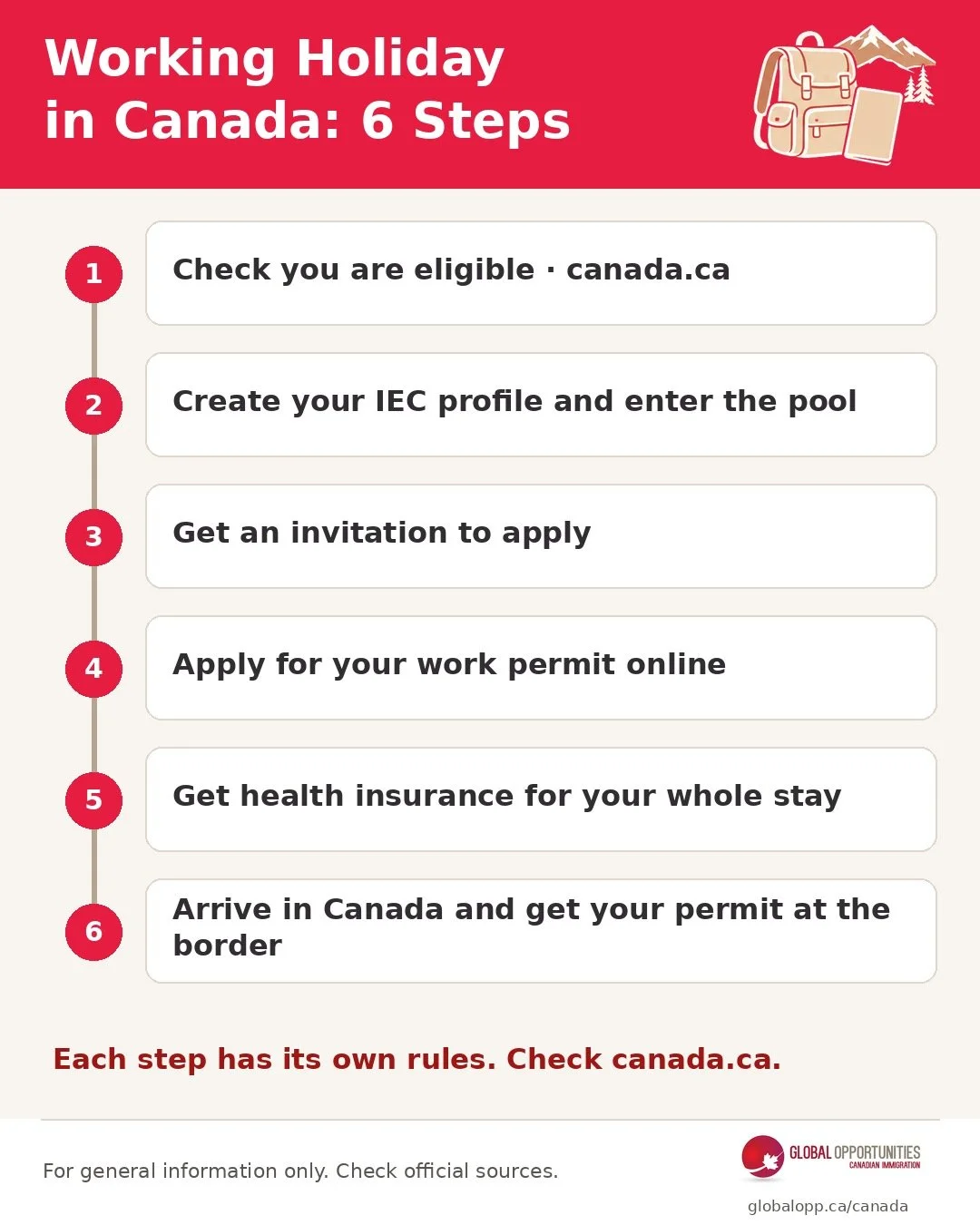
The three IEC categories
IRCC describes three categories. Not every country has access to all three:
Working Holiday: for people who do not have a job offer before arriving and want to work for different employers or in different places. It gives an open work permit, which lets you work for most employers in most locations in Canada.
Young Professionals: for people who already have a paid job offer in Canada that supports their professional development. It gives an employer-specific work permit, which ties you to that employer and location.
International Co-op (Internship): for students enrolled at a post-secondary institution outside Canada who need a work placement in Canada to complete their studies. It also gives an employer-specific work permit.
Which European countries take part in IEC
At the time of writing, IRCC's page IEC: Eligibility by country and category lists these European countries and categories. This list changes, so always check the official page before you plan.
All three categories (Working Holiday, Young Professionals and International Co-op): Austria, Croatia, Czech Republic, Estonia, Finland, France, Germany, Greece, Ireland, Italy, Latvia, Lithuania, Luxembourg, Norway, Poland, Portugal, Slovakia, Slovenia, Spain, Sweden and the United Kingdom.
Working Holiday and Young Professionals only: the Netherlands.
Working Holiday only: Andorra, Belgium, Denmark, Iceland and San Marino.
Young Professionals and International Co-op only (no Working Holiday): Switzerland.
If your European country is not on the list, such as Bulgaria, Hungary, Romania, Cyprus or Malta when we checked, IEC is not open to you as a citizen of that country at the time of writing. IRCC lists recognized organizations that offer optional support; they set their own eligibility rules, and IRCC states that if you are from an IEC country you do not have to use one.
Participation rules differ by country
Each country has its own rules on how many times you can take part, in which categories, and whether you need a break between permits. Some countries also have residence requirements or notes on national programs. Examples from IRCC's page at the time of writing:
Belgium, Italy and Spain: applicants must prove residence in that country, as IRCC describes.
Netherlands: applicants must prove Dutch residency or citizenship, and nationals of the Dutch Caribbean islands are treated as Dutch citizens.
Spain and Portugal: participants in the ICEX Vives (Spain) and Inov Contacto (Portugal) programs must apply through IEC in the Young Professionals pool.
France: participants in the VIE program (Volontariat international en entreprise) apply through the Young Professionals pool.
United Kingdom: British citizens and holders of Jersey or Guernsey passports can take part, with participation limits IRCC explains.
Ireland and Poland: IRCC explains limits on repeat participation and, for Poland, a break between permits.
Belgium and Luxembourg: IRCC notes that Quebec's health plan does not cover repatriation, so extra coverage is needed if you work in Quebec.
Read the section for your country on the official eligibility page.
How IEC pools and invitations work
IEC does not work on a first-come, first-served basis. In general, according to IRCC's page on how IEC works:
You answer a questionnaire in your IRCC account to check whether you are eligible.
If you are, you submit an IEC profile and choose the pools (categories) you want to be in.
IRCC sends invitations to apply to candidates from the pools during the season.
If you receive an invitation, you have a limited time to start and then submit your work permit application, pay the fees and give biometrics if required.
If your application is approved, you receive a port of entry letter, which you show when you arrive in Canada, where the work permit is issued.
An invitation is never guaranteed. Being in a pool does not mean you will be invited, and pools open and close by season. For Young Professionals and International Co-op, the employer also has steps to complete before you can apply.
Age, duration, funds and insurance: check the official page
Age limits, the length of the work permit, required funds, health insurance rules, participation limits and fees are set by IRCC, differ by country and category, and change. We do not reproduce them here, because the only reliable version is the official one. One practical point: according to IRCC's page Prepare for arrival, you need health insurance valid for your whole stay, and if your policy is shorter, the work permit can be issued to expire with your insurance. Start with the section for your country on the eligibility page, and read our overview, Working Holiday in Canada.
When your IEC stay ends, remember Canadian tax. The Canada Revenue Agency's page for people leaving Canada (emigrants) says you file a return for the year you leave if you owe tax or want a refund, enter your departure date on it, and tell your bank and other Canadian payers that you are no longer a resident. Our Irish working holiday guide explains this step in more detail.
IEC country lists and participation rules as published by IRCC, and tax information as published by the Canada Revenue Agency, as of November 2026. This is general information, not tax advice. Being eligible or being in a pool does not mean you will be invited or that a work permit will be approved: IRCC decides each case. Check the linked pages before you rely on them.
Moving to Canada from Europe: do you need a visa or an eTA?
It depends on your passport. IRCC's entry requirements page lists citizens of most EU countries, the United Kingdom, Ireland, Norway, Iceland and Switzerland as visa-exempt travellers who need an eTA to fly to Canada. Citizens of some other European countries, such as Albania, Serbia and Ukraine, need a visitor visa. Run IRCC's official tool to check yours.
Entry rules depend on your citizenship, your passport, how you travel and why you are coming. The official place to check is IRCC's tool Find out if you need a visa or eTA to travel to Canada. You answer a few questions and it tells you which document you may need.
European countries whose citizens need an eTA
At the time of writing, IRCC's entry requirements by country or territory page lists citizens of these European countries among the visa-exempt travellers who need an electronic travel authorization (eTA) to fly to Canada: Andorra, Austria, Belgium, Bulgaria, Croatia, Cyprus, Czech Republic, Denmark, Estonia, Finland, France, Germany, Greece, Hungary, Iceland, Ireland, Italy, Latvia, Liechtenstein, Lithuania, Luxembourg, Malta, Monaco, the Netherlands, Norway, Poland, Portugal, San Marino, Slovakia, Slovenia, Spain, Sweden, Switzerland and Vatican City. Romanian citizens need an eTA only with an electronic passport. For the United Kingdom, IRCC lists British citizens and several other British nationality categories, including citizens of British overseas territories such as Gibraltar.
European countries whose citizens need a visa
At the time of writing, IRCC lists citizens of Albania, Belarus, Bosnia-Herzegovina, Kosovo, Moldova, Montenegro, North Macedonia, Russia, Serbia and Ukraine as needing a visitor visa, as well as Romanians with a non-electronic passport. Türkiye, Georgia, Armenia and Azerbaijan are also on the visa-required list. These rules change, so run the official tool with your own passport before every trip. Still unsure which one you need? See eTA vs visitor visa for Canada.
A few points to keep in mind
An eTA is for travel, not for work or study. To work in Canada you generally need a work permit, for example through IEC or with a job offer, unless an exemption applies. Check whether you need a work permit. To study, you generally need a study permit.
The eTA applies when you fly. According to IRCC's eTA page, if you arrive by land or sea, for example from the United States, you do not need an eTA, but you still need a valid passport and must meet entry requirements.
Apply only on the official page. The eTA page on canada.ca is the Government of Canada's official page for applying. Websites that look official and charge extra are not part of the Government of Canada.
Dual citizens: IRCC's eTA page explains special rules for Canadian citizens, including dual citizens, who must travel with a Canadian passport.
Entry is not guaranteed. According to IRCC, a border services officer decides at the port of entry whether you can come in.
Watch our live session on the difference between an eTA and a visitor visa (recorded in November 2025; IRCC's tool has the current rules).
eTA and visa lists as published by IRCC, as of November 2026. They change, and an eTA or visa lets you travel to Canada but does not guarantee entry or allow you to work or study. Run IRCC's tool with your own passport before every trip.
Biometrics, police certificates and medical exams for European applicants
Even if you only need an eTA to visit, applications for a work permit, a study permit or permanent residence can involve biometrics, police certificates and a medical exam.
Biometrics and visa application centres in Europe
According to IRCC's page where to give your fingerprints and photo, outside Canada and the United States you give biometrics at a visa application centre (VAC). You need an appointment; IRCC states that booking is free and not to pay anyone for one. IRCC also states that you have 30 days from the time you get your biometric instruction letter to give your biometrics, and that if there is no VAC where you are applying from, you can go to any other VAC.
At the time of writing, IRCC lists VACs in these European cities: London, Dublin, Paris, Lyon, Madrid, Lisbon, Rome, Berlin, Düsseldorf, The Hague, Vienna, Warsaw, Stockholm, Helsinki, Athens, Bucharest, Kyiv and Lviv. IRCC's list did not show a VAC in Belgium, Switzerland, Norway or Denmark when we checked. Locations change, so check the official page and use only its links to book.
Police certificates for European applicants
IRCC usually asks for police certificates when you apply for permanent residence, and it may ask for them in other applications. Its general page, Police certificates, and its country list, How to get a police certificate, name the document and authority for each country. According to IRCC, certificates not in English or French need a certified translation, and fingerprints for a police certificate are not the same as biometrics. We summarize what IRCC's page says in each country section below. Confirm the process with the issuing authority, which sets its own rules and fees.
Medical exams
According to IRCC's medical exams page, your own doctor cannot do an immigration medical exam: only a panel physician approved by IRCC can. Many permanent residence applicants and some temporary applicants need one, depending on the job and where they lived. Use IRCC's panel physician search to find one.
Biometrics, police certificate and medical exam rules as published by IRCC, as of November 2026. Your own application instructions are the ones that count, and they can differ from this summary.
Moving to Canada from Europe as a skilled worker: Express Entry and provincial programs
Most skilled workers from Europe look at two families of programs: Express Entry, the online system IRCC uses for three federal economic programs, and the Provincial Nominee Programs run by the provinces and territories. Some also come first with a work permit through an employer or a trade agreement. IRCC assesses each person against each program's requirements.
If your goal is to live in Canada permanently, you will usually look at the economic immigration programs. The two main families are the programs managed through Express Entry and the Provincial Nominee Programs (PNPs). Quebec has its own immigration system and selects its own economic immigrants. Global Opportunities does not offer services for Quebec's immigration programs; if Quebec is your goal, start at Immigration in Québec.
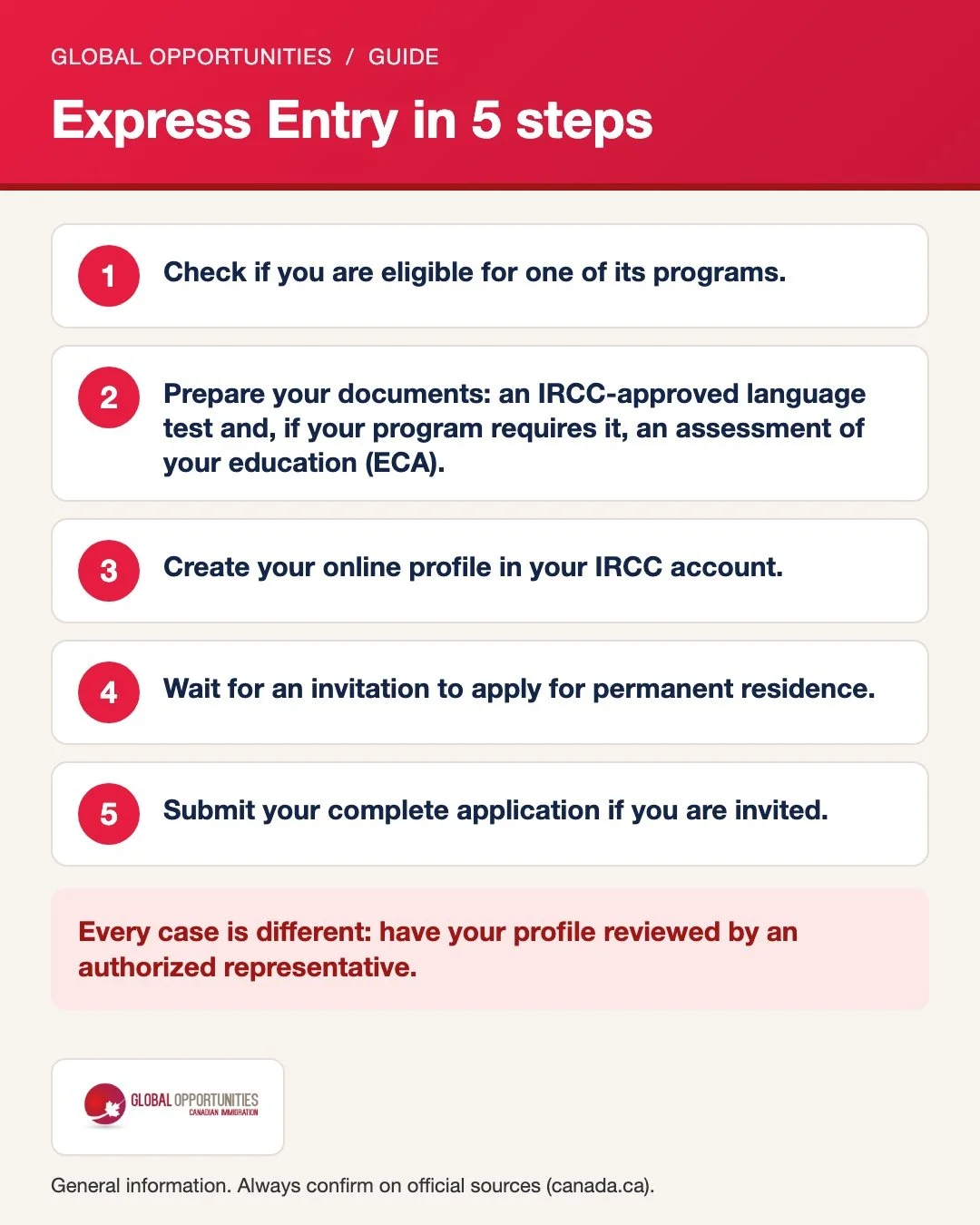
What Express Entry is
According to IRCC, Express Entry is the online system used to manage applications for three federal programs:
Federal Skilled Worker Program: for skilled workers with eligible foreign or Canadian work experience. Read more on our page about the Federal Skilled Worker program.
Canadian Experience Class: for skilled workers with eligible Canadian work experience.
Federal Skilled Trades Program: for skilled workers qualified in a skilled trade.
How Express Entry works, step by step
In general terms, according to IRCC:
You check whether you meet the minimum requirements of at least one of the three programs, on IRCC's eligibility page.
You create an online profile with your language results and, for foreign education, an Educational Credential Assessment. If you are eligible, you enter the pool of candidates.
Candidates are ranked with the Comprehensive Ranking System (CRS), which considers factors such as age, education, language ability and work experience.
IRCC holds rounds of invitations during the year. Rounds can be general, program-specific or category-based.
If you receive an invitation to apply, you submit a complete application for permanent residence, which IRCC then reviews.
Being in the pool does not guarantee an invitation. Round types, the number of invitations and the scores needed change from round to round. We do not publish scores or cut-offs because they describe the past and do not predict anything. Some programs require proof of funds, as IRCC explains on that page. Whether it applies to you, and what you would need to show, depends on each case; a consultation is the way to know.
Category-based selection
IRCC can also invite candidates who fit a specific category. At the time of writing, the category-based selection page lists French-language proficiency; healthcare and social services occupations; STEM occupations; trade occupations; education occupations; transport occupations; physicians, senior managers and researchers with Canadian work experience; and skilled military recruits. The categories and the occupations in each one change, so always check the current page.
Canadian Experience Class after working in Canada
The Canadian Experience Class is often discussed by Europeans who first come on a work permit, including through IEC. According to IRCC's Canadian Experience Class page, in general terms:
The work experience must be skilled, paid and gained in Canada while you were authorized to work with temporary resident status.
Volunteer work and unpaid internships do not count. Work done while you were a full-time student does not count, and self-employment generally does not count.
You must take an approved language test and meet the minimum level in all four abilities.
You must plan to live outside Quebec.
The amount of experience required, the language levels and the other details are on that official page. Working in Canada does not by itself lead to permanent residence: the job, the occupation, your status and the rules at the time all matter.
Provincial Nominee Programs
According to IRCC, provinces and territories can nominate people who can contribute to their economy and who want to live there. Each one sets its own criteria and streams, and these change often. Quebec and Nunavut do not run a PNP. There are two routes:
Express Entry-linked streams: for people who meet both a provincial stream and an Express Entry program. A nomination is added to the Express Entry profile.
Base (non-Express Entry) streams: for people who meet a provincial stream but not an Express Entry program.
Start with IRCC's Provincial Nominee Program page, then read the official site of the province that interests you. The Atlantic provinces also take part in the Atlantic Immigration Program, which works with designated employers.
Coming with a job offer or an intra-company transfer
Some Europeans come through an employer: either a Canadian employer who obtains a Labour Market Impact Assessment (LMIA), or an exemption, such as some intra-company transfers or trade agreements. Which route applies depends on the job, the employer and your nationality. IRCC's tool Find out if you need a work permit and our page on the Labour Market Impact Assessment are good starting points. According to Employment and Social Development Canada's Temporary Foreign Worker Program pages, employers cannot recover the LMIA processing fee from workers. Global Opportunities does not offer jobs.
CETA and CUKTCA: trade agreements with the EU and the UK
Canada has a trade agreement with the European Union (CETA) and another with the United Kingdom (CUKTCA). According to IRCC's CETA instructions, the agreement may allow some work permits without an LMIA for certain profiles, and IRCC's CUKTCA update explains that UK nationals are now covered by CUKTCA instead of CETA. These routes are narrow, depend on each case (your job, your employer and your nationality) and their rules change. To know whether this applies to you, book a consultation.
For a broader overview, see our guide How to immigrate to Canada and our summary of permanent resident requirements.
Watch our live session on why applying is not the same as being selected.
Program descriptions and trade agreement instructions as published by IRCC and the provinces, as of November 2026. Meeting the minimum requirements of a program, or being a citizen of a country covered by a trade agreement, does not mean you will be invited or that IRCC will approve an application or a work permit; IRCC and the provinces decide each case.
How do you get European qualifications recognized in Canada?
European degrees, diplomas and trade certificates are well known in Canada, but Canada does not recognize them automatically, and an EU-wide recognition does not carry over. There are two different processes, and it helps to keep them apart: one for immigration and one for working in your profession. We explain the difference in detail in ECA vs professional licence in Canada.
Educational Credential Assessment (ECA) for Express Entry
According to IRCC, an Educational Credential Assessment checks that a foreign degree, diploma or certificate is valid and equal to a Canadian one. You need an ECA if you studied outside Canada and want to qualify for the Federal Skilled Worker Program as the principal applicant, or to get points for your foreign education in Express Entry.
IRCC designates the organizations that can issue ECAs for immigration. For most applicants they are (for reference only; check IRCC's current list):
Comparative Education Service, University of Toronto School of Continuing Studies
International Credential Assessment Service of Canada
World Education Services
International Qualifications Assessment Service (IQAS)
International Credential Evaluation Service, British Columbia Institute of Technology
Some occupations must use a designated professional body instead: the Medical Council of Canada for physicians, the Pharmacy Examining Board of Canada for pharmacists and the Canadian Architectural Certification Board for architects, in the cases IRCC describes.
An ECA is not a licence. IRCC states that an ECA may help when you are looking for a job, but it does not guarantee a job in your field or a licence to practise a regulated profession.
Regulated professions: licensing is provincial
In Canada, some occupations are regulated: you need a licence or certification from a regulatory body in the province or territory where you will work. Engineers, nurses, doctors, pharmacists, teachers, architects, lawyers and many health professions are common examples. According to the Government of Canada's Foreign Credential Recognition page, a regulatory body in the province or territory assesses your foreign credentials and issues licences, and it is a good idea to contact it, ideally before you arrive.
The Canadian Information Centre for International Credentials (CICIC) explains which occupations are regulated in each province and points you to the right regulator. IRCC also lists free pre-arrival services, including help to prepare for work in Canada. Eligibility depends on your situation.
Any regulator or organization we mention is for reference only. The list may not be complete, and requirements must always be confirmed directly with the regulator in the province or territory where you plan to work.
Engineers from Europe
According to Engineers Canada, "to practise engineering in Canada, you must hold and maintain a licence from one of Canada's engineering regulators." Requirements vary but generally cover academics, engineering work experience in the province or territory, a professional practice exam on law and ethics, good character and language ability. Engineers Canada takes part in international agreements on academic recognition, but Engineers Canada states that a mutual recognition agreement only applies where a provincial or territorial regulator adopts it. A European "Ingenieur", "ingénieur" or chartered title does not let you call yourself a professional engineer in Canada until the provincial regulator licenses you.
Nurses, doctors and other health professionals from Europe
For most internationally educated nurses, the National Nursing Assessment Service (NNAS) describes itself as "the first step towards becoming a nurse in Canada"; it verifies documents for regulators but is not a licence. Physicians are licensed by each province's medical regulatory authority, and the Medical Council of Canada verifies credentials and runs national exams that regulators use. Some provinces have specific routes for physicians from certain jurisdictions, and these change; ask the provincial college directly. Nurses can follow our nursing licence and immigration guide.
Trades and the Red Seal Program
Many Europeans, especially from Germany, Austria, Switzerland, the Netherlands, Poland and Ireland, have completed formal apprenticeships. In Canada, certification is provincial and territorial. According to the official Red Seal Program site, provincial and territorial apprenticeship authorities certify tradespeople and administer the Red Seal exams. Questions about experience gained outside Canada go to the apprenticeship authority of the province or territory where you plan to work; the official list is on Provincial and Territorial Apprenticeship and Certification Authorities. Some trades are compulsory in some provinces, which means you need the provincial certificate or an apprenticeship registration before working; ask the authority on that official list whether yours is.
Licensing information as published by the Government of Canada, CICIC, Engineers Canada, NNAS, the Medical Council of Canada and the Red Seal Program, as of November 2026. An ECA, a European registration or a recognition agreement is not a Canadian licence: only the provincial or territorial regulator can license you.
Language tests for moving to Canada from Europe: English and French
Whether English or French is your first language, most Canadian economic immigration programs ask you to prove your language ability with an approved test. A European passport, a degree taught in English, a Cambridge certificate or a DELF/DALF does not replace the test. Our guide English and French tests for Canada explains each test in detail.
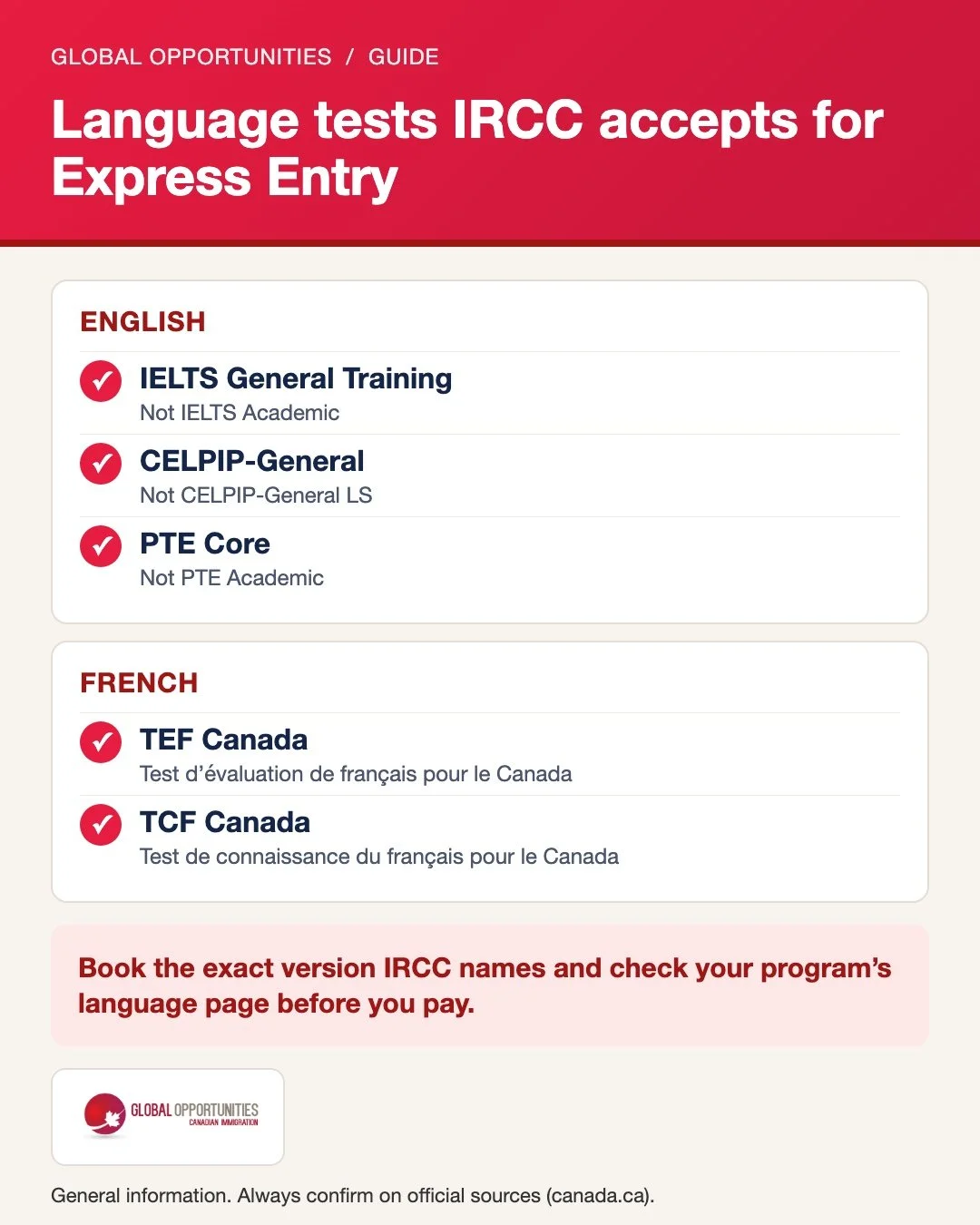
Which tests IRCC accepts for Express Entry
According to IRCC's Express Entry language test page, the accepted tests are:
English
CELPIP: it must be the CELPIP-General test.
IELTS: it must be the General Training option. IRCC states that the IELTS One Skill Retake is not accepted for Express Entry.
PTE Core: it must be the PTE Core option of the Pearson Test of English.
French
TEF Canada (Test d'évaluation de français).
TCF Canada (Test de connaissance du français).
Pay close attention to the exact name. Tests with similar names, such as IELTS Academic, PTE Academic or general French diplomas, are not on IRCC's Express Entry list. IRCC converts your results into Canadian Language Benchmark (CLB) levels for English or Niveaux de compétence linguistique canadiens (NCLC) for French, for each skill. IRCC states that results must be "less than 2 years old" when you create your profile and when you apply for permanent residence. Minimum levels are on the official page; provincial programs can set their own requirements.
Where to take the tests in Europe
Test centres and dates change, so use each provider's official finder. These providers are private or independent organizations; the list is for reference only.
IELTS General Training: the official IELTS test centre finder lets you filter by country and test type.
PTE Core: see Pearson's official PTE Core page. According to Pearson, PTE Core is taken at an authorized test centre, not at home, and it is a different test from PTE Academic.
CELPIP-General: check locations and dates on the official CELPIP website; centres outside Canada are limited.
TEF Canada: issued by Le français des affaires (CCI Paris Île-de-France). Use its official test centre finder and make sure you book TEF Canada, not another TEF version.
TCF Canada: issued by France Éducation international; see its official TCF Canada page. Book the Canada version.
Fees are set by each provider and vary by country, so check the price when you book. Watch our live session on how CELPIP results fit into an immigration application.
Accepted tests as published by IRCC, and test details as published by each provider, as of November 2026. A test result on its own does not make you eligible: each program sets its own minimum CLB or NCLC levels, and the official page is the one that counts.
French-speaking Europeans and Francophone communities outside Quebec
French speakers from France, Belgium, Switzerland, Luxembourg and elsewhere in Europe often assume that Quebec is the only option. It is not. IRCC's page Choose a Francophone community outside Quebec explains that many French-speaking Canadians live in other provinces and territories, where you can access French-language schools and some services in French. IRCC also notes that the working language in these communities is usually English.

Federal options that value French
At the time of writing, IRCC programs that give weight to French outside Quebec include:
French-language proficiency in Express Entry: one of the category-based selection categories. French ability is also considered in the ranking system.
Francophone Mobility (Mobilité Francophone): according to IRCC's eligibility page, this is a work permit that does not require an LMIA, for French-speaking workers with a job offer in a province or territory outside Quebec. IRCC states that you need intermediate French speaking and listening skills, at the level shown on the page, and that most occupations qualify, with exceptions it lists. The employer submits the offer through IRCC's Employer Portal first. It is open to any nationality, so it can suit French speakers who are too old for IEC or whose country has no IEC agreement.
IRCC also organizes the Destination Canada Mobility Forum, an annual information and recruitment event for French-speaking and bilingual candidates interested in communities outside Quebec; past editions have included Paris. Participation is free but by invitation. Some provinces also have their own streams for French speakers. Categories and streams can open, close or change, so check the official pages. Learn more on our page about French language proficiency. How much French helps in your own application depends on each case; a consultation is the way to know.
Francophone options as published by IRCC, as of November 2026. Speaking French does not by itself make you eligible for any program or guarantee an invitation.
Global Opportunities does not offer services for Quebec's immigration programs. Quebec has its own immigration system; if you plan to settle there, start at Immigration in Québec.
Moving to Canada from the United Kingdom
English is the working language in most provinces, which helps British newcomers from day one. Here are the Canada-side points that matter most.
IEC: at the time of writing, IRCC lists all three categories for the United Kingdom, for British citizens and holders of Jersey or Guernsey passports, with participation limits. Read the United Kingdom section of the eligibility page.
Travel: IRCC lists British citizens among eTA-required travellers when flying, and lists several other British nationality categories with their own conditions. Use the official tool with your exact passport.
Biometrics: IRCC lists a visa application centre in London.
Police certificate: IRCC's United Kingdom page names a police certificate from ACRO (the National Police Chiefs' Council Criminal Records Office), and explains what to do if it says "No Live Trace".
Language test: even native English speakers need an approved test for Express Entry and most economic programs.
Driving: Ontario lists Great Britain and Northern Ireland among its exchange partners, and Alberta lists the United Kingdom, subject to conditions. See the driving section.
Pensions: the United Kingdom appears on Canada's list of countries with a social security agreement. Questions about your UK State Pension go to the UK authorities.
Regulated professions: UK nursing, medical, engineering, teaching and accounting qualifications are assessed by Canadian regulators; registration in the UK is not a Canadian licence.
Trade agreement: UK nationals are covered by CUKTCA, not CETA; see the CETA and CUKTCA section above.
Moving to Canada from Ireland
Irish citizens share English as a working language with most of Canada, and Ireland has a youth mobility agreement with Canada. Read our full guide: Working Holiday in Canada for Irish citizens.
IEC: IRCC lists all three categories for Ireland at the time of writing, with participation rules specific to Irish citizens, including limits on repeat participation. Read the Ireland section of the eligibility page.
Travel: IRCC lists Irish citizens among eTA-required travellers when flying.
Biometrics: IRCC lists a visa application centre in Dublin.
Police certificate: IRCC's Ireland page names a police certificate from the Garda Síochána, through the superintendent for the district where you lived.
Driving: Ontario and Alberta both list the Republic of Ireland among their exchange partners, subject to conditions.
Pensions: Ireland appears on Canada's list of countries with a social security agreement.
Regulated professions: contact the Canadian regulator in your province early; registration is not automatic.
Moving to Canada from France
French citizens can live in French in many parts of Canada, not only in Quebec, and France has a youth mobility agreement with Canada.
IEC: IRCC lists all three categories for France at the time of writing. Participants in the VIE program apply through the Young Professionals pool.
Travel: IRCC lists French citizens among eTA-required travellers when flying.
Biometrics: IRCC lists visa application centres in Paris and Lyon.
Police certificate: IRCC's France page names the Bulletin no 3 from the Casier judiciaire national, applied for online. People born in New Caledonia, French Polynesia or Wallis and Futuna apply to the tribunal of their place of birth.
French outside Quebec: see the Francophone section above. You still need TEF Canada or TCF Canada to prove your French for Express Entry, and English helps in the workplace.
Driving: Ontario and Alberta both list France among their exchange partners, subject to conditions.
Pensions: France appears on Canada's list of countries with a social security agreement.
Quebec: Global Opportunities does not offer services for Quebec's immigration programs.
Moving to Canada from Spain
Spanish citizens have access to IEC, and Spain has a youth mobility agreement with Canada. We have a complete guide in Spanish: Cómo emigrar a Canadá desde España.
IEC: IRCC lists all three categories for Spain at the time of writing. Applicants must prove Spanish residency, and ICEX Vives participants apply through the Young Professionals pool.
Travel: IRCC lists Spanish citizens among eTA-required travellers when flying.
Biometrics: IRCC lists a visa application centre in Madrid.
Police certificate: IRCC's Spain page names the Certificado de Antecedentes Penales from the Ministry of Justice. It is issued in Spanish, so plan for a certified translation.
Language: most Spanish professionals take an English test; French can be an extra advantage.
Driving: Spain is not on Ontario's exchange list at the time of writing, but it is on Alberta's list and was among the European countries Saskatchewan's SGI added in 2023. Check the province where you will live.
Pensions: Spain appears on Canada's list of countries with a social security agreement.
Moving to Canada from Germany
Germany has a youth mobility agreement with Canada. If you trained in a trade or in engineering, remember that Canadian certification and licensing are provincial.
IEC: IRCC lists all three categories for Germany at the time of writing.
Travel: IRCC lists German citizens among eTA-required travellers when flying.
Biometrics: IRCC lists visa application centres in Berlin and Düsseldorf.
Police certificate: IRCC's Germany page names the Führungszeugnis (certificate of good conduct) from the Federal Office of Justice in Bonn, and explains how to apply from abroad. IRCC notes that newer certificates are issued in German, English and French.
Trades: if you hold a German trade qualification, such as a Gesellenbrief or Meisterbrief, contact the apprenticeship authority in your province through the Red Seal contact list.
Engineering: engineering is regulated in Canada, licensed by each province or territory.
Driving: Ontario and Alberta both list Germany, subject to conditions.
Pensions: Germany appears on Canada's list of countries with a social security agreement.
Moving to Canada from Italy
IEC: IRCC lists all three categories for Italy at the time of writing. Applicants must prove Italian residency, including a residence certificate (certificato di residenza).
Travel: IRCC lists Italian citizens among eTA-required travellers when flying.
Biometrics: IRCC lists a visa application centre in Rome.
Police certificate: IRCC's Italy page names the Certificato del Casellario Giudiziale and the Certificato dei carichi pendenti, through the Ministry of Justice.
Credentials: an ECA for immigration and a licence for regulated work are separate processes.
Driving: Italy is not on Ontario's exchange list at the time of writing, but it is on Alberta's list and among the countries SGI added in Saskatchewan in 2023.
Pensions: Italy appears on Canada's list of countries with a social security agreement.
Moving to Canada from Portugal
IEC: IRCC lists all three categories for Portugal at the time of writing. Inov Contacto participants apply through the Young Professionals pool, and IRCC states participation is limited to a single category.
Travel: IRCC lists Portuguese citizens among eTA-required travellers when flying.
Biometrics: IRCC lists a visa application centre in Lisbon.
Police certificate: IRCC's Portugal page names the Certificado do Registo Criminal from the DGAJ, and explains options to apply from abroad.
Driving: Portugal is not on Ontario's list at the time of writing, but it is on Alberta's list and among the countries SGI added in 2023.
Pensions: Portugal appears on Canada's list of countries with a social security agreement.
Moving to Canada from the Netherlands
Dutch citizens usually speak English well, which helps in most Canadian workplaces, but the language test is still required for economic programs.
IEC: at the time of writing, IRCC lists Working Holiday and Young Professionals for the Netherlands, but not International Co-op. Nationals of the Dutch Caribbean islands are treated as Dutch citizens for IEC.
Travel: IRCC lists Dutch citizens among eTA-required travellers when flying.
Biometrics: IRCC lists a visa application centre in The Hague.
Police certificate: IRCC's Netherlands page names the Verklaring Omtrent het Gedrag (VOG), through Justis or your municipality.
Driving: the Netherlands is not on Ontario's list at the time of writing, but it is on Alberta's list.
Pensions: the Netherlands appears on Canada's list of countries with a social security agreement.
Moving to Canada from Belgium
IEC: at the time of writing, IRCC lists Working Holiday only for Belgium, and applicants must prove Belgian residency.
Travel: IRCC lists Belgian citizens among eTA-required travellers when flying.
Biometrics: IRCC's list did not show a VAC in Belgium when we checked; IRCC states you can use any other VAC, such as Paris, The Hague or London.
Police certificate: IRCC's Belgium page names the central criminal record extract (Model 595), from your municipality if you live in Belgium or from the Federal Public Service Justice if you live abroad.
French and Dutch speakers: French speakers can look at Francophone options outside Quebec; Dutch speakers usually focus on English.
Driving: Ontario and Alberta both list Belgium, subject to conditions.
Pensions: Belgium appears on Canada's list of social security agreements.
Moving to Canada from Switzerland
IEC: at the time of writing, IRCC lists Young Professionals and International Co-op for Switzerland, but not Working Holiday. Young Professionals requires a signed job offer in your field before you submit a profile.
Travel: IRCC lists Swiss citizens among eTA-required travellers when flying.
Biometrics: IRCC's list did not show a VAC in Switzerland when we checked; IRCC states you can use any other VAC.
Police certificate: IRCC's Switzerland page names an extract from the Swiss criminal record (Privatauszug), available online or by mail.
Languages: French-speaking Swiss can look at Francophone options; German and Italian speakers usually take an English test.
Driving: Ontario and Alberta both list Switzerland, subject to conditions.
Pensions: Switzerland appears on Canada's list of social security agreements.
Moving to Canada from Austria
IEC: IRCC lists all three categories for Austria at the time of writing.
Travel and biometrics: eTA when flying; IRCC lists a VAC in Vienna.
Trades: Austrian apprenticeships are assessed by the provincial apprenticeship authority.
Driving: Ontario and Alberta both list Austria, subject to conditions.
Pensions: Austria appears on Canada's list of social security agreements.
Moving to Canada from Poland
IEC: IRCC lists all three categories for Poland at the time of writing, with a required break between permits and a different category each time.
Travel: IRCC lists Polish citizens among eTA-required travellers when flying.
Biometrics: IRCC lists a visa application centre in Warsaw.
Police certificate: IRCC's Poland page names a certificate from the National Criminal Register (Krajowy Rejestr Karny). It notes that Polish embassies and consulates no longer accept applications; you apply by mail or through an authorized person.
Trades and engineering: both are licensed provincially. Contact the authority in your province early.
Driving: Poland is not on Ontario's list at the time of writing, but it is on Alberta's list and among the countries SGI added in 2023.
Pensions: Poland appears on Canada's list of countries with a social security agreement.
Moving to Canada from the Nordic countries
Denmark, Finland, Iceland, Norway and Sweden all have youth mobility agreements with Canada, but the categories differ.
IEC categories at the time of writing: Finland, Norway and Sweden: Working Holiday, Young Professionals and International Co-op. Denmark and Iceland: Working Holiday only.
Travel: IRCC lists citizens of all five countries among eTA-required travellers when flying.
Biometrics: IRCC lists visa application centres in Stockholm and Helsinki. If there is no VAC in your country, IRCC states that you can go to any other VAC.
Police certificates: IRCC's Sweden page names an extract for use abroad from the Swedish Police; other Nordic countries have their own entries on IRCC's list.
Driving: Ontario lists Denmark; Alberta lists Denmark, Finland, Iceland, Norway and Sweden, subject to conditions.
Pensions: all five countries appear on Canada's list of countries with a social security agreement.
Moving to Canada from Central, Eastern and Southern Europe
IEC countries: Austria, Croatia, the Czech Republic, Estonia, Greece, Latvia, Lithuania, Slovakia and Slovenia have all three categories at the time of writing; Andorra and San Marino have Working Holiday only.
Not in IEC when we checked: Bulgaria, Hungary, Romania, Cyprus, Malta and the Western Balkans, among others. Citizens use other routes, such as employer-supported work permits, study permits or permanent residence programs.
eTA or visa: most EU citizens need an eTA when flying. Romanians need an eTA only with an electronic passport. Albania, Bosnia-Herzegovina, Kosovo, Moldova, Montenegro, North Macedonia, Serbia, Belarus and Russia are on the visa-required list.
Biometrics: IRCC lists VACs in Athens and Bucharest, among others.
Driving: Ontario lists Croatia, Hungary and Kosovo; Alberta lists many EU countries, including Bulgaria, Croatia, the Czech Republic, Greece, Hungary, Romania, Slovakia and Slovenia.
Pensions: many of these countries, including Bulgaria, Croatia, the Czech Republic, Greece, Hungary, Romania, Serbia, North Macedonia, Albania and Moldova, appear on Canada's social security agreement list.
Moving to Canada from Ukraine
Many Ukrainians came to Canada under special measures. Those measures have changed, so here we only explain the current rules as IRCC describes them.
CUAET has ended. IRCC's page Immigration measures and support for Ukrainians states that the Canada-Ukraine Authorization for Emergency Travel (CUAET) has ended, and that the special family-based permanent residence pathway is closed to new applications. Applications received before it closed continue to be processed.
People already in Canada: IRCC's page explains which extensions of work permits, study permits and visitor status may still be available, and how passport renewal delays are handled. Read it carefully, because deadlines apply.
New applicants: Ukrainian citizens are on IRCC's visa-required list and apply through the regular programs, the same as anyone else.
Biometrics: IRCC lists VACs in Kyiv and Lviv. Check the services each one offers.
Police certificate: IRCC's Ukraine page names an extract from the Ministry of Internal Affairs records, available through a Ukrainian embassy or consulate or a representative.
Driving: Ontario lists Ukraine among its exchange partners and has special rules for people who cannot provide their original licence; Alberta also exchanges Ukrainian licences, as its page describes.
Pensions: Ukraine does not appear on Canada's social security agreement list at the time of writing.
Measures for Ukrainians as published by IRCC, as of November 2026. They have changed several times and deadlines apply: read IRCC's page before you act.
Can you exchange a European driving licence in Canada?
There is no national driver's licence in Canada. Each province and territory sets its own rules, and a European licence is accepted for a short time only. The exchange lists differ a lot from province to province, which surprises many Europeans.
Ontario
Ontario's licence exchange page states that new residents can use a valid foreign licence for 60 days. At the time of writing, its exchange list includes Austria, Belgium, Croatia, France, Germany, Great Britain, Hungary, Denmark, the Isle of Man, Kosovo, Northern Ireland, the Republic of Ireland, Switzerland and Ukraine, among non-European partners. Drivers from other countries go through testing, and Ontario explains how to get credit for previous experience with an authentication letter from the authority that issued your licence. Motorcycle and commercial classes have separate rules.
Alberta
Alberta's exchange page lists many European jurisdictions whose licences can be exchanged without a knowledge or road test, including Austria, Belgium, Bulgaria, Croatia, Cyprus, the Czech Republic, Denmark, Estonia, Finland, France, Germany, Greece, Guernsey, Hungary, Iceland, the Isle of Man, Ireland, Italy, Jersey, Latvia, Liechtenstein, Lithuania, Luxembourg, Malta, the Netherlands, Norway, Poland, Portugal, Romania, Slovakia, Slovenia, Spain, Sweden, Switzerland and the United Kingdom, with class conditions, plus Ukraine. Alberta states that new permanent residents must exchange their licence within 90 days.
Saskatchewan and other provinces
In 2023, Saskatchewan's SGI announced that it extended licence reciprocity to 24 European countries, including Spain, Italy, Portugal, Poland, Greece and the Nordic countries. British Columbia's ICBC has its own list on its page for people moving from another country. Other provinces publish their own rules; check the licensing office of the province where you will live, and read our province guides.
Exchange lists and time limits as published by the Government of Ontario, the Government of Alberta, the Government of Saskatchewan and ICBC, as of November 2026. Being on a list usually comes with conditions on licence class and experience, and the lists change: check the linked pages before you rely on them.
Will your European pension count in Canada?
Canada has social security agreements with many European countries. At the time of writing the list includes Austria, Belgium, Bulgaria, Croatia, Cyprus, the Czech Republic, Denmark, Estonia, Finland, France, Germany, Greece, Hungary, Iceland, Ireland, Italy, Latvia, Lithuania, Luxembourg, Malta, the Netherlands, Norway, Poland, Portugal, Romania, Slovakia, Slovenia, Spain, Sweden, Switzerland and the United Kingdom, as well as several non-EU European countries. According to the Government of Canada, these agreements coordinate similar pension programs and can help people who lived or worked in both countries qualify for benefits; they do not increase the amount paid. Each agreement is different, so read the page for your country.
In Canada, workers contribute to the Canada Pension Plan (or Quebec's own plan in Quebec). Questions about your European pension, transfers of private pensions or tax in your home country should go to the competent authority or a qualified professional there. The Canada Revenue Agency has a page for newcomers to Canada about Canadian tax residency. Social security agreements are not the same as tax treaties: the Department of Finance's list of tax treaties in force includes treaties with most European countries, such as the United Kingdom, Ireland, France, Germany, Spain and Italy. How a treaty applies to you is a question for a tax professional.
Agreement list as published by the Government of Canada, the tax treaty list as published by the Department of Finance, and tax information as published by the Canada Revenue Agency, as of November 2026. An agreement does not mean you will receive a pension or a higher payment; each agreement and each case is different.
Choosing a province when moving to Canada from Europe
Where you live shapes your job search, your costs, the provincial programs you can look at, your driving licence options and your community. Our province guides explain cities, housing, transit, health care, schools, work and winter:
Living in New Brunswick, which the Government of New Brunswick describes as Canada's only officially bilingual province
Quebec is not on this list because Global Opportunities does not offer services for Quebec's immigration programs.
Planning checklist for moving to Canada from Europe
Use this as a planning list, not as a legal checklist. Your program's official document list always comes first.
Six to twelve months before
Check IEC eligibility for your country and category, and whether the season is open.
Book an approved language test, English, French or both.
Start your ECA if you need one, and contact your regulator or apprenticeship authority if your occupation is regulated or a trade.
Research provinces, including their driving licence exchange rules.
Three to six months before
Request police certificates following IRCC's country page, and arrange translations.
Gather civil documents and employer reference letters describing your duties.
Arrange health insurance for any waiting period, and for your whole stay if you come on IEC.
Request a driving record or authentication letter if your province asks for one.
Before you travel
Give biometrics at a VAC through IRCC's links, and do your medical exam with a panel physician if asked.
Apply for your eTA or visa only through official pages.
Check what you can bring on the Canada Border Services Agency's travellers page.
Plan your first weeks with our newcomers in Canada guide.
Moving with a dog or cat? Read our guide to immigrating to Canada with your pet.
Your first steps after moving to Canada from Europe
Our newcomers in Canada guide explains each step in detail. In short:
Keep your documents safe and check the details on your permit as soon as it is issued.
Get your Social Insurance Number through Service Canada.
Open a bank account. According to the Financial Consumer Agency of Canada, you can open one with proper identification even if you are not a Canadian citizen.
Sort out health coverage. According to IRCC's page on health care in Canada, each province runs its own plan and some have a waiting period. European health cards do not cover you in Canada.
Exchange or replace your driving licence before your foreign licence stops being valid in your province.
Contact your regulator or apprenticeship authority if your occupation is regulated or you work in a trade.
Look for free newcomer services with IRCC's newcomer services finder.
Start your job search on Job Bank. Global Opportunities does not offer jobs, and IRCC warns that no one can guarantee you a job or a visa.
Learn the Canadian resume format and how to spot job scams. Planning for the long term? Our Canadian citizenship guide covers physical presence, the test and dual citizenship.
Frequently asked questions
Which European countries can apply for a Working Holiday when moving to Canada from Europe?
At the time of writing, IRCC lists the Working Holiday category for Andorra, Austria, Belgium, Croatia, the Czech Republic, Denmark, Estonia, Finland, France, Germany, Greece, Iceland, Ireland, Italy, Latvia, Lithuania, Luxembourg, the Netherlands, Norway, Poland, Portugal, San Marino, Slovakia, Slovenia, Spain, Sweden and the United Kingdom. Switzerland has Young Professionals and International Co-op but not Working Holiday. Countries such as Bulgaria, Hungary, Romania, Cyprus and Malta were not on the list when we checked. Each country has its own participation rules and some require proof of residence. The list changes, so check the official page and read the IEC section of this guide.
Can Swiss citizens get a Working Holiday when moving to Canada from Europe?
At the time of writing, no. IRCC lists Young Professionals and International Co-op for Switzerland, but not Working Holiday. Young Professionals requires a signed job offer or contract in your field before you submit your profile, and International Co-op requires enrolment at a Swiss post-secondary institution and an internship that fits your studies. IRCC also explains limits on participation for Swiss citizens. If you speak French, Francophone Mobility may be another option if you have a job offer outside Quebec. Swiss citizens need an eTA to fly to Canada. Read the Switzerland section of IRCC's eligibility page.
How old do I need to be for IEC when moving to Canada from Europe?
Age limits are set by IRCC and vary by country and category, so we do not reproduce them: forum posts often mix up the rules for different countries. The only reliable version is your country's section on IRCC's eligibility page. IRCC also explains when you must meet the age requirement during the process. If you are above the age limit for your country, IEC is not available, but other routes may be: an employer-supported work permit, Francophone Mobility for French speakers, a study permit or a permanent residence program. Being eligible for IEC never guarantees an invitation.
Do Europeans need a visa or an eTA when moving to Canada from Europe?
It depends on your citizenship and passport. At the time of writing, citizens of most EU and EEA countries, Switzerland and the United Kingdom need an eTA to fly to Canada, not a visitor visa. Romanians need an eTA only with an electronic passport. Citizens of Ukraine, Serbia, Albania, Bosnia-Herzegovina, Kosovo, Moldova, Montenegro, North Macedonia, Belarus and Russia need a visa. An eTA is only for air travel, and it does not let you work or study. Use IRCC's visa or eTA tool with your passport, and apply for an eTA only on the official canada.ca page.
Does an eTA let me work after moving to Canada from Europe?
No. An eTA is an entry requirement for visa-exempt travellers who fly to Canada. It does not authorize work or study. To work, you generally need a work permit, for example through IEC, an employer-supported permit or Francophone Mobility, unless IRCC lists an exemption for your activity. To study, you generally need a study permit, unless an exemption applies, such as some short courses. IRCC's tool Find out if you need a work permit explains the exemptions. Working without authorization can affect your future applications, including permanent residence. If you are approved for a work or study permit, IRCC issues the eTA you need with it.
Can I apply for permanent residence when moving to Canada from Europe without a job offer?
Some programs do not always require a job offer. The Federal Skilled Worker Program through Express Entry is the best-known example: you can create a profile with your European experience, education and language results if you meet the minimum requirements. Where no job offer is required, IRCC may require proof of funds; what applies to you depends on each case, and a consultation is the way to know. Other programs, and many provincial streams, do require a job offer or a connection to the province. Being in the Express Entry pool does not mean you will be invited; invitations depend on the rounds IRCC holds, the categories it chooses and your ranking. Read the Express Entry section of this guide.
Does an IEC permit help me stay after moving to Canada from Europe?
It may. The Canadian Experience Class considers skilled, paid work experience gained in Canada while you were authorized to work, and IEC work counts if it meets the program's requirements. Whether your experience qualifies depends on your occupation, how long you worked and the rules when you apply; some provincial streams also value Canadian work experience. You also need approved language results and must plan to live outside Quebec for the Canadian Experience Class. Many IEC participants never become permanent residents, so plan your time in Canada with the official requirements in mind from the start. Read the CEC section and IRCC's Canadian Experience Class page.
Where do I give biometrics when moving to Canada from Europe?
At a visa application centre (VAC). At the time of writing, IRCC lists European VACs in London, Dublin, Paris, Lyon, Madrid, Lisbon, Rome, Berlin, Düsseldorf, The Hague, Vienna, Warsaw, Stockholm, Helsinki, Athens, Bucharest, Kyiv and Lviv. When we checked, there was no VAC listed in Belgium, Switzerland, Norway or Denmark; IRCC states that you can go to any other VAC. You need an appointment, booking is free, and IRCC says not to pay anyone for one. IRCC also states you have 30 days from your biometric instruction letter to give biometrics. Check the official biometrics page before you book.
Which police certificate do I need when moving to Canada from Europe?
It depends on the countries where you lived. IRCC's page How to get a police certificate names the document for each country: for example, an ACRO police certificate for the United Kingdom, the Bulletin no 3 for France, the Führungszeugnis for Germany, the Certificado de Antecedentes Penales for Spain, the VOG for the Netherlands and the Model 595 extract for Belgium. Certificates not in English or French need a certified translation. If you lived in several countries, you may need a certificate from each, as IRCC's instructions explain. The issuing authority sets its own process and fees, so start early. See the country sections of this guide.
Which English tests are accepted when moving to Canada from Europe?
For Express Entry, IRCC accepts three English tests: CELPIP-General, IELTS General Training and PTE Core. The exact version matters: IELTS Academic, PTE Academic and the IELTS One Skill Retake are not on IRCC's Express Entry list, and Cambridge certificates or a degree taught in English do not replace the test, even for native speakers from the United Kingdom or Ireland. IRCC's language test page states that results must be less than two years old when you create your profile and when you apply. Find centres through each provider's official finder; CELPIP has few centres outside Canada. Read our guide English and French tests for Canada.
Which French tests are accepted when moving to Canada from Europe?
For Express Entry, IRCC accepts TEF Canada and TCF Canada. TEF Canada is issued by Le français des affaires (CCI Paris Île-de-France) and TCF Canada by France Éducation international, through approved centres in many European cities. Other French diplomas, such as the DELF or DALF, and other versions of the TEF or TCF, do not replace them, even for native French speakers from France, Belgium, Switzerland or Luxembourg. French results can make you eligible for the French-language proficiency category and prove your level for Francophone Mobility. Book the Canada version, check dates early, and see the tests section of this guide.
Can French speakers live outside Quebec when moving to Canada from Europe?
Yes. There are Francophone communities in every province and territory, including Acadian communities in New Brunswick, Nova Scotia and Prince Edward Island, Franco-Ontarians, and communities in Manitoba, Saskatchewan, Alberta and British Columbia. IRCC's page Choose a Francophone community outside Quebec explains that you can access French-language schools and some services in French there, while the working language is usually English. Federal options that value French outside Quebec include the French-language proficiency category of Express Entry and Francophone Mobility. Quebec has its own immigration system, and Global Opportunities does not offer services for Quebec's programs.
What is Francophone Mobility for people moving to Canada from Europe?
Francophone Mobility (Mobilité Francophone) is a work permit option that does not require a Labour Market Impact Assessment. According to IRCC's eligibility page, it is for French-speaking workers with a job offer in a province or territory outside Quebec. You must show intermediate French speaking and listening skills, at the level IRCC states, and most occupations qualify, with exceptions IRCC lists. The employer submits the offer through IRCC's Employer Portal and gives you an offer of employment number. It is open to any nationality, which helps Europeans who are not eligible for IEC. It is a work permit, not permanent residence.
Do I need an ECA for my European degree when moving to Canada from Europe?
For the Federal Skilled Worker Program, and to get points for foreign education in Express Entry, IRCC requires an Educational Credential Assessment from a designated organization; physicians and pharmacists use the professional bodies IRCC names. This applies to European degrees too, including Bologna-system bachelor's and master's degrees. An ECA confirms that your credential is valid and equivalent to a Canadian one for immigration purposes; it is not a licence to work in a regulated profession and does not replace the regulator's assessment. Each organization sets its own rules on how your university sends transcripts, so follow its instructions. See IRCC's ECA page.
Is my European professional licence valid after moving to Canada from Europe?
Not automatically. Regulated professions in Canada, such as engineering, nursing, medicine, pharmacy, teaching, architecture and law, are licensed by provincial and territorial regulators. EU-wide recognition rules do not apply in Canada. Each regulator assesses your education and experience and may ask for exams, supervised practice or extra courses. Engineers Canada states that international recognition agreements only apply where a provincial regulator adopts them. Use CICIC to find the regulator for your occupation and province, and contact it before you move. You may be able to work in a related, non-regulated role while you go through licensing, as long as you do not use a protected title.
Will my German or other European trade qualification be recognized after moving to Canada from Europe?
Not automatically, but it can count. Trade certification in Canada is provincial and territorial. According to the Red Seal Program, provincial and territorial apprenticeship authorities certify tradespeople and run the Red Seal exams. If you completed an apprenticeship in Germany, Austria, Switzerland, the Netherlands, Poland, Ireland or elsewhere, contact the authority in your province through the official contact list to ask how your training and experience will be assessed, and whether you can challenge the exam. Some trades are compulsory in some provinces, so you cannot work in them without certification or apprenticeship registration. The Federal Skilled Trades Program may also be relevant.
Can I exchange my driver's licence after moving to Canada from Europe?
It depends on the province and the country that issued your licence. Ontario's licence exchange page states that new residents can drive on a valid foreign licence for 60 days, and its exchange list includes Austria, Belgium, Croatia, Denmark, France, Germany, Great Britain, Hungary, the Isle of Man, Kosovo, Northern Ireland, the Republic of Ireland, Switzerland and Ukraine. Alberta's list is much longer and includes Spain, Italy, Portugal, the Netherlands, Poland and the Nordic countries, with class conditions. The Government of Saskatchewan announced in 2023 that SGI extended reciprocity to 24 European countries. Drivers from other countries usually take tests. Read the driving section of this guide and your province's official page.
Can I exchange my UK driving licence in Canada?
In several provinces, yes, without a road test, but the rules depend on the province and on which part of the UK issued your licence. Ontario's licence exchange page includes Great Britain and Northern Ireland in its exchange list and says new residents can drive on a valid foreign licence for 60 days. Alberta's exchange page lists licences from England, Scotland and Wales for Class 5, the regular car licence, and from Northern Ireland for Class 5 and 6, exchanged without a knowledge or road test. British Columbia's ICBC publishes its own list on its page for people moving from another country. Other provinces set their own rules. Bring your photocard licence and an official driving record. See the driving licence section of this guide.
Will Canadian insurers recognize my European driving record?
It depends on the province and the insurer, so ask before you buy a car. In British Columbia, where ICBC provides basic insurance, its page on insurance for new and returning residents says ICBC can credit up to 15 years of driving experience from outside B.C., which can improve your discount, if you show a driver's abstract or a letter of experience from the licensing authority that issued your first non-learner licence. In other provinces, private insurers set their own rules on foreign experience and claims history, and some may price you as a new driver without proof. Before you leave Europe, request an official driving record from your licensing authority and a letter from your insurer showing your years of cover and claims, and ask brokers in your new province which documents they accept.
Does my European pension count after moving to Canada from Europe?
Canada has social security agreements with most EU countries, Switzerland, the United Kingdom, Norway, Iceland and several other European countries. According to the Government of Canada, these agreements coordinate similar pension programs and can help people who lived or worked in both countries qualify for benefits, but they do not increase payments. Each agreement is different, so read the country page on the Government of Canada's list. Ukraine was not on the list when we checked. Questions about your European pension, private pension transfers or taxes in your home country go to the competent authority or a qualified professional there.
Will my UK State Pension be frozen if I move to Canada?
Yes, according to GOV.UK. Its page on how your pension is affected if you retire abroad states that your State Pension only increases each year if you live in the European Economic Area, Gibraltar, Switzerland or a country with a social security agreement with the UK, but that you cannot get increases in Canada or New Zealand. Canada and the UK do have a social security agreement, listed on the Government of Canada's agreements page, which can help you qualify for Canadian benefits. Ask the UK Pension Service about your own situation, and see the pensions section of this guide.
Do I pay tax in both countries after moving to Canada?
Usually you are taxed in Canada once you become a Canadian resident for tax purposes. According to the Canada Revenue Agency's page for newcomers to Canada, for most newcomers that starts on the day you establish significant residential ties, such as a home, a spouse or dependants in Canada, and income you earned outside Canada before you became a resident is not subject to Canadian tax. Canada has tax treaties with many European countries, designed to avoid double taxation. If your situation is unclear, the CRA explains how to determine your residency status. Your obligations in your European country, such as exit rules or final returns, are set there, so ask a qualified tax professional in that country before you move.
Can I use my European health card after moving to Canada from Europe?
No. European health cards, including the EHIC and national cards, do not cover you in Canada. Health care is run by each province and territory, and according to IRCC's page on health care in Canada, you apply for a provincial health card if you are eligible, and some provinces have a waiting period, so IRCC recommends private insurance for that time. Eligibility for temporary residents, such as IEC participants, depends on the province. If you come on IEC, IRCC requires health insurance for your whole stay. Our newcomers in Canada guide explains how to register.
What happened to CUAET for Ukrainians moving to Canada?
According to IRCC's page Immigration measures and support for Ukrainians, the Canada-Ukraine Authorization for Emergency Travel has ended, and the special family-based permanent residence pathway is closed to new applications, while applications already received continue to be processed. People who came under CUAET should read IRCC's page for the options to extend their status and the deadlines that apply. New Ukrainian applicants need a visitor visa and apply through the regular temporary and permanent programs. Be careful with anyone who claims to offer a "new CUAET": check every program on canada.ca.
Can I bring my family when moving to Canada from Europe?
In many programs, yes. When you apply for permanent residence through Express Entry or a provincial program, you include your spouse or common-law partner and dependent children, and they may need medical exams, police certificates and biometrics. For temporary permits such as IEC, family members are not included automatically: they apply for their own visa, eTA or permit, and IRCC explains which permits a spouse or children may be eligible for, which change over time. If you are already a permanent resident or citizen, IRCC's family sponsorship page explains who you can sponsor. Check the current pages before you plan. Read more in our articles on family sponsorship in Canada and spousal sponsorship.
Can I work in Canada through my employer when moving to Canada from Europe?
Possibly. Some Europeans come with a job offer from a Canadian employer, with an LMIA or through an LMIA exemption, such as some intra-company transfers or trade agreements. Which route applies depends on the job, the employer and your nationality. The employer usually has steps to complete first, and you then apply for an employer-specific work permit. IRCC's tool Find out if you need a work permit is the starting point. According to Employment and Social Development Canada's Temporary Foreign Worker Program pages, employers cannot recover the LMIA processing fee from workers. Be wary of anyone who asks you to pay for a job offer. Global Opportunities does not offer jobs.
How long does it take when moving to Canada from Europe?
We do not publish processing times because they change constantly and depend on the program, the country and IRCC's workload. IRCC publishes current estimates on its official check processing times tool. IEC also depends on when pools open and when invitations are sent during the season. In practice, preparation also takes time: language tests, ECAs, police certificates from several countries and translations can take weeks or months. Start with the steps that depend on other institutions. Be wary of anyone who offers to make your application faster for a fee: IRCC states that representatives cannot speed up processing. How long your own case may take depends on each case; a consultation can help you plan.
Which province is best when moving to Canada from Europe?
There is no single best province: it depends on your occupation, language, budget, family and whether you have a job offer. Compare rents with the CMHC Rental Market Reports and job postings on Job Bank. Driving licence exchange rules also differ by province, as explained in the driving section of this guide. French speakers can use IRCC's page Choose a Francophone community outside Quebec. Read our province guides, linked in the section on choosing a province, and each province's official immigration site. Provincial programs change often.
Do I need a police certificate from every country where I lived when moving to Canada from Europe?
Often, yes. Many Europeans have lived in several countries, for study, Erasmus, work or family reasons. IRCC's application instructions explain for which countries and periods you need a police certificate, usually based on how long you lived there and your age at the time; the exact rules are in your application guide. Each certificate comes from the authority IRCC names for that country on its police certificate list, and some can be requested from abroad. If you cannot get one, IRCC explains that you must show proof of your request and explain your efforts. Start early, as some countries take longer.
Can I study in Canada when moving to Canada from Europe?
Yes, if you meet the requirements. Most international students need a study permit, even European citizens who only need an eTA to visit. You need a letter of acceptance from a designated learning institution, which you can check on IRCC's list of DLIs, and IRCC states that a provincial or territorial attestation letter is usually required, with exemptions it lists. You also need proof of financial support. Studying can lead to work experience in some cases, but it does not lead to permanent residence automatically, and not every program qualifies for a post-graduation work permit. Choose a program for its own value, and read our province guides for schools in each province. For an overview of study permits and how to prepare, see our Study in Canada page.
Can I bring my car from Europe to Canada?
In most cases, no. Transport Canada's page on importing a vehicle from countries other than the U.S. and Mexico states that vehicles bought outside the United States and Mexico generally cannot be imported, with some exceptions. The main exception is a vehicle that is 15 years old or older, based on the month and year of its manufacture; buses have their own cut-off date. Other exceptions cover some vehicles built to Canadian standards. Even when import is allowed, you still declare the vehicle to the Canada Border Services Agency, which explains moving or returning to Canada, and you must register, insure and, in some provinces, inspect it. Selling your car in Europe and buying one in Canada is usually simpler. Check the rules before you ship anything.
Can I bring my dog or cat from Europe?
Yes, if your pet meets the Canadian Food Inspection Agency's requirements. The CFIA's page on travelling with your dog explains that the rules depend on the country of origin, the animal's age, the purpose of the import and whether it travels with you, and that a dog that does not meet them may be refused entry, removed or lead to fines. The CFIA lists the United Kingdom, Ireland, Finland, Sweden and Iceland among the countries it recognizes as rabies-free for cats and dogs, which affects the documents you need. For other European countries, check the CFIA's travelling with a pet page and talk to your vet early. Airlines set their own rules too. See our guide to immigrating to Canada with your pet.
Do I need to translate my documents when moving to Canada from Europe?
Usually, if they are not in English or French. IRCC asks for certified translations of documents in other languages, and its application guides explain the exact rules for each application, including what to do if the translator is not certified. For police certificates, IRCC states that you send the original with a translation by a certified translator. German certificates of good conduct issued in recent years come in German, English and French, but many other European documents, such as Spanish, Italian, Polish or Portuguese certificates, will need a translation. Universities and ECA organizations set their own rules for transcripts. Plan the time and cost of translations, and keep the originals.
How do I check a consultant before moving to Canada from Europe?
Paid immigration consultants must be licensed by the College of Immigration and Citizenship Consultants (CICC). Search the CICC Public Register with the person's name and licence number, and check that the licence is active. Lawyers and paralegals are regulated by provincial law societies. IRCC's scams page states that you do not need a paid representative to apply and that hiring one will not speed up your application or guarantee approval. IEC recognized organizations are optional. Ask for a written contract and receipts, never sign blank forms, and keep access to your own IRCC account. If something seems wrong, IRCC's report fraud page explains where to report.
Related guides
How Global Opportunities can help
Global Opportunities is a private immigration firm in Toronto. If you are planning a move from Europe, we can help you understand which Canadian programs may fit your profile and what to prepare. We cannot guarantee an invitation, a permit or a result: every decision is made by IRCC or the province.
Our regulated consultant: Lic. Mildrete Monserrath Gutierrez Martinez, Regulated Canadian Immigration Consultant (RCIC), CICC licence R514880. Verify her licence on the CICC Public Register: https://college-ic.ca/protecting-the-public/find-an-immigration-consultant. Global Opportunities does not offer services for Quebec's immigration programs. Global Opportunities is a private firm and is not part of the Government of Canada or any provincial government.
Recorded seminars and lives: watch our recorded seminars in English or the Spanish recordings, and find everything on our YouTube channel.
More articles in English: read our Moving to Canada articles on topics such as health care, cost of living, the ECA and professional licences, and building community in Canada.
Personalized consultation: to review your situation, contact us through our contact page or write to info@globalopp.ca.
Prefer email? Tell us what you need help with (moving to Canada from Europe, including Working Holiday) and we will reply: email info@globalopp.ca.
Contact Global Opportunities →
Sources
IRCC: Canada–European Union Comprehensive Economic and Trade Agreement (CETA) instructions
IRCC: Canada–United Kingdom Trade Continuity Agreement (CUKTCA) update
Employment and Social Development Canada: Temporary Foreign Worker Program
Government of Canada: Countries with social security agreements
CICIC: Canadian Information Centre for International Credentials
Red Seal: Provincial and Territorial Apprenticeship and Certification Authorities
Government of Ontario: Exchange an out-of-province driver's licence
Government of Alberta: Exchange a licence from outside Alberta
Government of Saskatchewan: SGI extends driver's licence reciprocity to 24 European countries
GOV.UK: State Pension if you retire abroad, how your pension is affected
Transport Canada: Importing a vehicle from countries other than the U.S. and Mexico
Canada Border Services Agency: Moving or returning to Canada
CFIA: Countries recognized as rabies-free for domestic cats and dogs
The information in this guide comes from the official sources linked above, as they read when we checked them in November 2026, and it may have changed since. It is general and for reference only, and it is not immigration, legal, tax or professional advice. Global Opportunities is not responsible for how anyone interprets this content, for decisions made based on it, or for changes made after it was written. For your own case, book a consultation. International Experience Canada and its country list, eTA and visa requirements, Express Entry, provincial programs, Francophone programs, measures for Ukrainians, language test rules, driving licence exchange lists and official requirements change frequently, and nothing in this guide covers the immigration, tax, pension or legal rules of any European country. Always confirm requirements with official Government of Canada and provincial sources. Global Opportunities is a private firm, is not part of the Government of Canada or of any regulator, and does not offer jobs.
Last reviewed: November 2026