
Living in British Columbia, Canada: A Complete Guide for Newcomers
Living in British Columbia, Canada means living between the Pacific Ocean and the mountains: in Metro Vancouver, in the provincial capital Victoria, in the sunny Okanagan valley or in the northern forests. This guide explains what daily life in British Columbia looks like for newcomers: the main cities and neighbourhoods, rents and tenant rights, transit fares, driving with ICBC, health care with MSP, banks, groceries, the rain and the snow, every public college and university, work, free newcomer services and the official ways people move here.
About our sources: This guide summarises what official sources (the Government of Canada, provincial and territorial governments and the other organisations we link to) said when we checked them in November 2026. We link every source so you can read it yourself. Rules, rates and requirements change, sometimes without notice, and the official page is the one that counts. This is general information, not legal, tax or immigration advice. Global Opportunities is not responsible for how this information is interpreted or for changes made after it was written.
British Columbia, or B.C., is Canada's westernmost province. It offers mild coastal winters, mountains, lakes and a very diverse population, but also some of the highest housing costs in the country and a waiting period before public health coverage starts.
This guide is for workers, international students and families who are about to arrive or have just arrived. It follows the topics of the Government of B.C.'s own B.C. Newcomers' Guide to Resources and Services, which you can download for free in English, Arabic, French, Punjabi, Simplified Chinese, Spanish and Tagalog. Prices come from official or primary sources, with the date we checked them; always check the current price before you decide. For help with resumes and your first weeks in Canada in general, read our companion newcomer guide to Canada.
Watch our recorded seminars and lives →
Prefer Spanish? Read our Spanish guide.
In this guide
British Columbia at a glance
Where is British Columbia? Map, location and key facts
How to get to British Columbia: by plane, car, ferry, train or bus
Buying your first home in British Columbia
Emergencies and natural hazards in British Columbia
Living in Vancouver: neighbourhoods and city overview
Living in Metro Vancouver: Surrey, Burnaby, Richmond and other cities
Getting around Metro Vancouver: TransLink, Compass Card and fares
Living in Victoria and on Vancouver Island
Living in the Fraser Valley: Abbotsford and Chilliwack
Living in Kelowna and the Okanagan
Living in Kamloops and the B.C. interior
Living in Prince George and northern B.C.
How much is rent in British Columbia, and where do you find a place?
Driving in British Columbia: ICBC, licences, insurance and winter tires
How do newcomers get health care in British Columbia? MSP, family doctors and 8-1-1
Banking in British Columbia for newcomers
Groceries and shopping in British Columbia
How cold is British Columbia, and how do you prepare for rain and winter?
Education in British Columbia: schools, colleges and universities
Jobs and main industries in British Columbia
Free newcomer services in British Columbia
How much does it cost to live in British Columbia?
How much tax do you pay in British Columbia, and which benefits can you get?
Culture, community and the outdoors in British Columbia
How can you immigrate to British Columbia?
French in British Columbia
First steps after arriving in British Columbia
Frequently asked questions
Related guides
How Global Opportunities can help
Sources
British Columbia at a glance
British Columbia is the province on Canada's west coast, between the Pacific Ocean and Alberta. Its capital is Victoria, on Vancouver Island, and its largest city is Vancouver. According to Canadian Heritage, B.C. became Canada's sixth province on July 20, 1871 (Canadian Heritage, symbols of British Columbia).
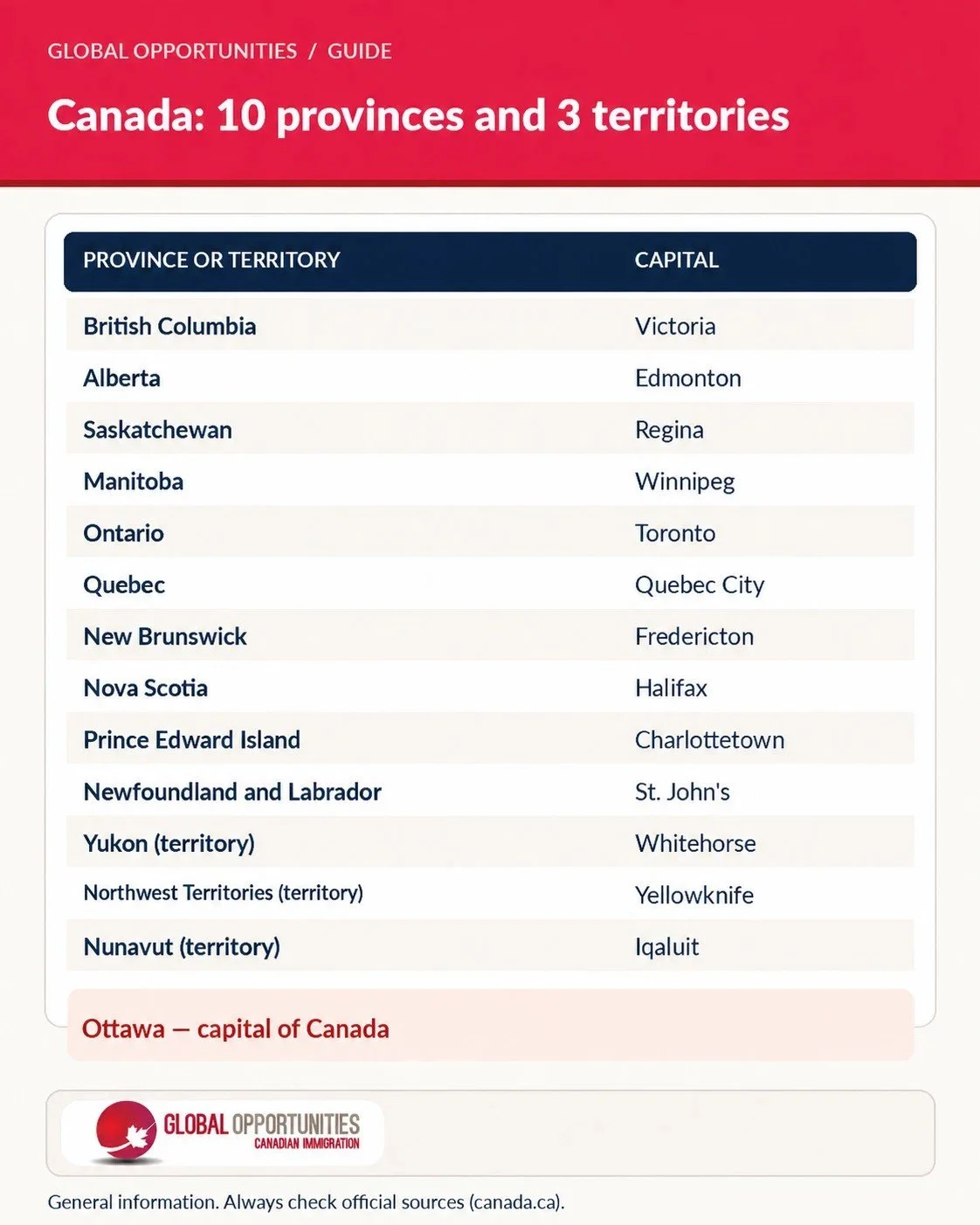
British Columbia in a few facts
Population. According to Statistics Canada, British Columbia had 5,710,598 residents on July 1, 2026, about 13.7% of Canada's population (Statistics Canada, table 17-10-0009-01).
Where people live. Statistics Canada estimated the Vancouver metropolitan area at 3,088,036 people and the Victoria metropolitan area at 445,090 people on July 1, 2025 (Statistics Canada, table 17-10-0148-01). The north is vast and much less populated.
Indigenous peoples. According to Canadian Heritage, British Columbia has more distinct First Nations than any other province or territory. Events often begin with a land acknowledgement of the local First Nation.
A diverse population. According to Immigration, Refugees and Citizenship Canada (IRCC), B.C.'s large Asian communities have made Chinese and Punjabi the most spoken languages in its cities after English (Discover Canada, Canada's regions).
Sales taxes. According to the Government of B.C. and the CRA, B.C. charges a provincial sales tax (PST), generally 7%, separate from the 5% federal GST (Government of B.C., PST; CRA, GST/HST rates). Shelf prices usually do not include tax.
Pacific time: no more clock changes
According to the Government of British Columbia, the province has moved to permanent year-round Pacific time (PCT), which is UTC-7. The clock change on March 8, 2026 was the last one, and clocks were not turned back on November 1, 2026. Some communities follow different rules: northeastern communities such as Dawson Creek and Fort St. John stay on mountain standard time, and southeastern communities such as Cranbrook, Fernie, Golden and Invermere stay aligned with Alberta at UTC-6 (Government of B.C., daylight saving time).
Where is British Columbia? Map, location and key facts
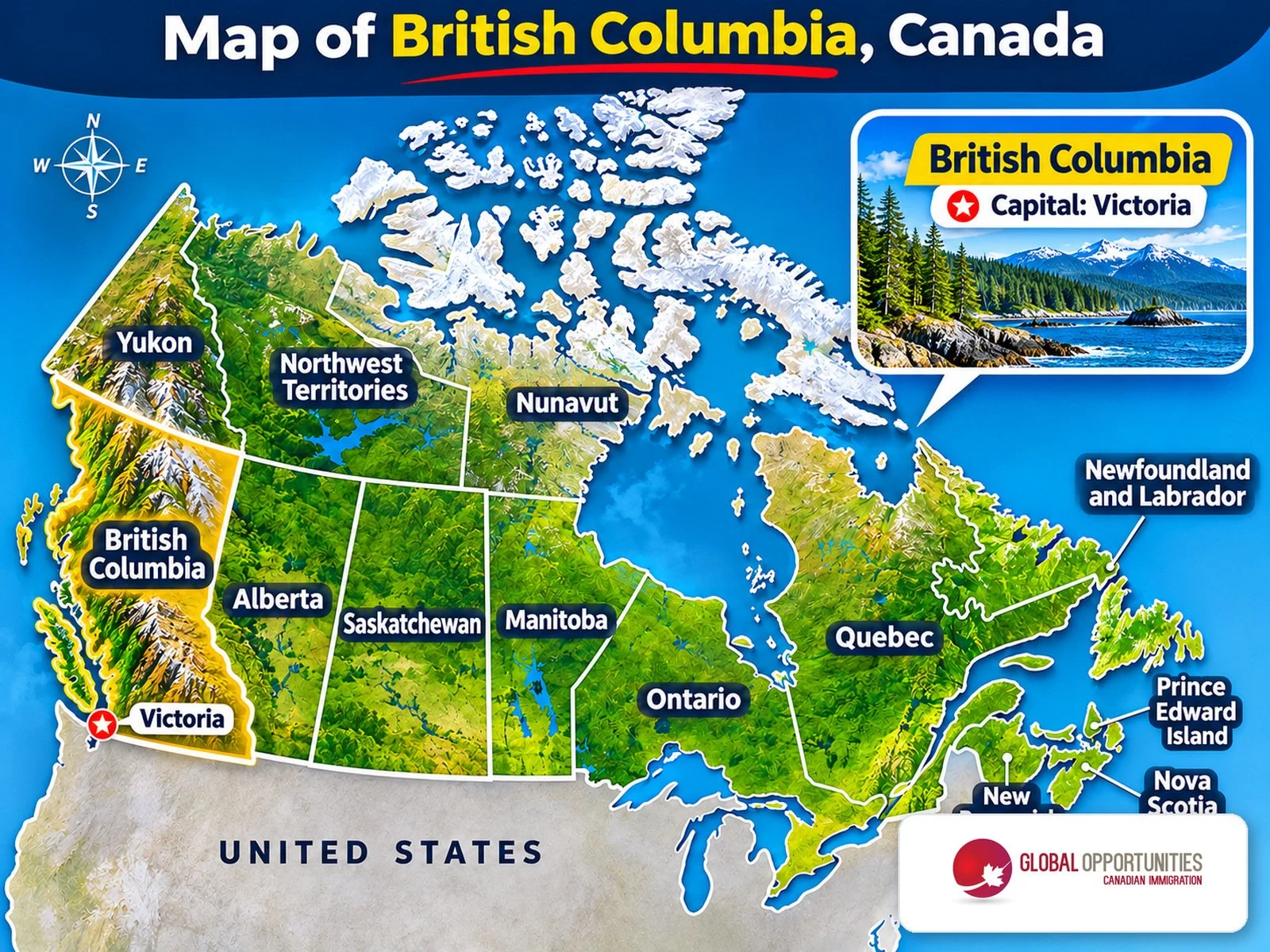
British Columbia is Canada's westernmost province. It borders the Pacific Ocean to the west, Alberta to the east, Yukon and the Northwest Territories to the north, and the US states of Washington, Idaho and Montana to the south, with Alaska to the northwest. Its capital is Victoria and its largest city is Vancouver.
Time zones. According to the Government of B.C., most of the province now stays on Pacific time (UTC-7) all year, while some northeastern and southeastern communities follow different rules (see "Pacific time" above).
Land area. According to Statistics Canada's 2021 Census, British Columbia covers 920,687 square kilometres of land (Statistics Canada, table 98-10-0001-01).
Population. The 2021 Census counted 5,000,879 people in B.C. on Census Day, May 11, 2021 (Statistics Canada, table 98-10-0001-01). Statistics Canada's latest estimate is 5,710,598 residents on July 1, 2026 (Statistics Canada, table 17-10-0009-01).
Economy. According to IRCC, forestry products make up about half of B.C.'s goods, and the province's economy also includes mining, fishing, agriculture and trade through its Pacific ports (Discover Canada, Canada's regions). WorkBC, the province's employment service, projects the most job openings in health care and social assistance, followed by professional, scientific and technical services (WorkBC, B.C. Labour Market Outlook). See the jobs section below.
Population by origin: what the census says
According to Statistics Canada's 2021 Census, about 1,689,490 people in British Columbia, out of 4,915,940 living in private households, identified as members of a visible minority group (Statistics Canada, table 98-10-0351-01). The largest groups were:
Chinese: 550,590
South Asian: 473,970
Filipino: 174,280
Korean: 72,820
Southeast Asian: 71,785
West Asian: 69,270
Latin American: 65,965
Black: 61,755
Japanese: 44,125
Arab: 28,010
The same census asked about ethnic or cultural origins, and people could give more than one. The most frequent answers in B.C. were English (1,019,250), Scottish (774,455), Irish (627,920), German (539,145) and Chinese (517,805), followed by French (312,750), Indian (275,970), Ukrainian (210,100), Filipino (172,920) and Italian (162,485). About 72,025 people reported Korean origins and 54,635 Japanese. Among Latin American origins, about 28,450 people reported Mexican origins, 12,435 Brazilian and 7,310 Colombian (Statistics Canada, table 98-10-0355-01).
Census counts as published by Statistics Canada for the 2021 Census. They describe how people answered the census questions in May 2021, not today's population, and because people could report more than one origin, the origin counts add up to more than the population. They are context, not a ranking of places.
How to get to British Columbia: by plane, car, ferry, train or bus
Most people arrive in British Columbia by plane, at Vancouver International Airport (YVR) or at airports such as Victoria International (YYJ). By road, the Trans-Canada Highway (Route 1) and the Coquihalla (Route 5) link the coast with the interior, BC Ferries connects the mainland with Vancouver Island, and VIA Rail serves Vancouver, Kamloops, Prince George and Prince Rupert.
By plane: Vancouver, Victoria and other airports
Vancouver International Airport (YVR). According to TransLink, the SkyTrain Canada Line runs between YVR, Richmond and downtown Vancouver (TransLink, SkyTrain); see the FAQ on getting from YVR to downtown.
Victoria International Airport (YYJ), run by the Victoria Airport Authority in North Saanich, near Sidney, on Vancouver Island (Victoria International Airport).
Other airports. Victoria's and Edmonton's airport pages list direct flights to Kelowna, Kamloops and Prince George, and Edmonton's also to Abbotsford, so these cities can be reached with a domestic connection (YYJ, airlines and destinations; YEG, non-stop destinations).
Flying to British Columbia from abroad: airlines and common routes
Airlines at YYJ: according to Victoria International Airport's airlines and destinations page, as of November 2026: Air Canada (and Air Canada Express), WestJet, Porter, Pacific Coastal, Air North, Flair (in summer) and Alaska Airlines (with Horizon Air).
Airlines at YVR: YVR's own airline and destination lists could not be checked for this guide; look them up on the airport's website before you book.
Common ways to get there, by region:
From the United States. YYJ lists daily Alaska Airlines flights to Seattle. Edmonton's airport also lists many US routes and direct flights to Victoria and Vancouver (YEG, non-stop destinations).
From Mexico. YYJ lists seasonal winter WestJet flights to Cancún, Puerto Vallarta and San José del Cabo.
From Europe. Calgary International Airport lists year-round non-stop flights to Amsterdam, Frankfurt, London and Paris (YYC, airlines and destinations), and YYJ lists direct flights to Calgary, so connecting in Calgary is one common way to reach Victoria.
From Asia, Australia and New Zealand, YYJ lists no non-stop flights, so the trip involves at least one connection. Check YVR's website and the airlines for current routes into Vancouver.
Airlines and routes as listed on the official pages of Victoria International Airport and Calgary International Airport, as of November 2026. Routes and airlines change seasonally: check the airport's page and the airlines before you book. We do not recommend any airline or route.
By car: B.C.'s main highways
According to the Government of B.C.'s official numbered routes:
Route 1 (Trans-Canada) runs on the mainland from the Horseshoe Bay ferry terminal through the North Shore and Metro Vancouver municipalities, then east through Hope.
Route 5 (Coquihalla) runs north from Hope through Merritt to Kamloops.
Route 3 (Crowsnest) runs east from Hope through Princeton and the southern interior.
Route 97 runs north from the US border near Oroville, Washington, through Osoyoos, Penticton, Kelowna and Vernon.
Route 99 (Sea to Sky) runs from the US border through Surrey, Delta, Richmond and Vancouver.
Route 16 (Yellowhead) runs east from the ferry terminal at Prince Rupert through Terrace, Smithers and Burns Lake.
Before a trip, check road conditions, closures and highway cameras on DriveBC, and remember that winter tires or chains are required on most B.C. highways from October 1 (see the driving section).
Driving from the United States
The Canada Border Services Agency (CBSA) lists these B.C. crossings on its border wait times page: Douglas and Pacific Highway (Surrey, B.C. / Blaine, Washington), Abbotsford-Huntingdon (Sumas, Washington) and Boundary Bay (Delta, B.C. / Point Roberts, Washington). CBSA notes that wait times can vary with events, holidays and enforcement actions, and do not include delays on the roads leading to the border. Before you travel, check CBSA's pages on visiting Canada and the travel documents you need, and use IRCC's tool to check if you need a visa or an eTA.
By ferry
BC Ferries connects the mainland with Vancouver Island, for example Vancouver–Victoria and Horseshoe Bay–Departure Bay (Nanaimo), and serves other coastal communities. See "Getting to Vancouver Island and other places" below.
By train: VIA Rail
VIA Rail's long-distance train connects Vancouver with Jasper and the rest of Canada, with stops such as Kamloops North (VIA Rail, Vancouver station; VIA Rail, Jasper to Vancouver; VIA Rail, Kamloops North). A separate VIA train links Jasper with Prince George and Prince Rupert (VIA Rail, Jasper to Prince Rupert; VIA Rail, Prince George).
By intercity bus
Red Arrow, a private intercity bus company, lists Vancouver and Kelowna among its destinations, with connections to Calgary and Edmonton (Red Arrow). Check schedules and fares with the operator before you travel.
Routes, crossings and services as described by the Government of B.C., CBSA, BC Ferries, VIA Rail, TransLink and Red Arrow, as of November 2026. Entry to Canada depends on your citizenship and documents, and the CBSA officer decides at the border: check the official pages before you travel.
Buying your first home in British Columbia
Most newcomers rent first, but many plan to buy. In British Columbia, first-time buyers can combine federal help (the First Home Savings Account, the Home Buyers' Plan and the home buyers' amount) with the province's first-time home buyers' exemption from property transfer tax and, once they own, the home owner grant.
Saving for a first home: the FHSA and the Home Buyers' Plan
First Home Savings Account (FHSA). According to the Canada Revenue Agency (CRA), to open an FHSA you must be a resident of Canada, at least 18 (19 where that is the legal age, as in B.C.), 71 or younger at the end of the year you open it, and a first-time home buyer: you did not live in a home that you owned or jointly owned as your principal residence in the current year or the previous four calendar years (CRA, opening your FHSAs; CRA, FHSA overview).
Home Buyers' Plan (HBP). According to the CRA, the HBP lets you withdraw from your RRSPs to buy or build a qualifying home, up to $60,000, and pay it back over 15 years, with temporary relief that defers the start of repayment for first withdrawals made from 2026 to 2028 (CRA, what is the Home Buyers' Plan).
Home buyers' amount. According to the CRA, eligible first-time buyers can claim up to $10,000 for a qualifying home on line 31270 of their tax return, a non-refundable credit (CRA, line 31270).
B.C.'s first time home buyers' program (property transfer tax)
According to the Government of B.C.'s first time home buyers' program page, you may be exempt from property transfer tax if you are a Canadian citizen or permanent resident, have lived in B.C. for at least a year immediately before you register the property (or filed at least two B.C. income tax returns in the previous six years), have never owned a registered interest in a principal residence anywhere in the world, and have never received this exemption before. For purchases since April 1, 2024, the page lists a full exemption on the first $500,000 of the price for homes with a fair market value of $835,000 or less, and a partial exemption up to $860,000.
The B.C. home owner grant
According to the Government of B.C., the home owner grant reduces the property taxes you pay each year on your principal residence. In general, you must be the registered owner, a Canadian citizen or permanent resident, live in B.C. and occupy the home as your principal residence, and you must apply every year. The page lists value thresholds that change each year.
The Canada Mortgage and Housing Corporation (CMHC) has a step-by-step home buying guide. Rules depend on each person's situation: check the CRA and Government of B.C. pages, and talk to a lender, a lawyer or notary, or a tax professional before you decide.
Rules and amounts as published by the Canada Revenue Agency and the Government of B.C., as of November 2026. They may have changed by the time you read this, and meeting one program's conditions does not mean you qualify for the others: check the linked pages before you rely on them.
Emergencies and natural hazards in British Columbia
British Columbia's main natural hazards are wildfires and smoke in summer, floods after heavy rain or snowmelt, winter storms and, on the coast, earthquakes. Most newcomers never face a serious emergency, but it helps to know where official alerts come from and to keep a household plan and an emergency kit.
Why does B.C. have a wildfire season?
According to the Government of B.C.'s what causes wildfire page, most wildfires in B.C. are started by lightning, which causes approximately 60% of wildfires every season, and human activity causes approximately 40%, through open burning, vehicles and engines, industrial activity, fireworks, discarded cigarettes and arson. The same page stresses that human-caused wildfires are preventable. Check the BC Wildfire Service for active fires, fire bans and restrictions.
Evacuation alerts, orders and rescinds: what to do
According to the Government of B.C.'s evacuation page:
Evacuation alert: an order may follow. Prepare to leave, including supplies for at least 3 days.
Evacuation order: everyone in the area must leave immediately.
Evacuation rescind: the situation is currently safe and people can return; a rescind can also downgrade an order to an alert.
EmergencyInfoBC lists current, verified information during emergencies in B.C., including evacuation orders and alerts, and links to a map where you can check your address. Local governments post their own evacuation maps. Follow official routes and do not drive through a wildfire unless officials direct you to (Government of Canada, Get Prepared: wildfires).
Wildfire smoke and air quality warnings
Check the Air Quality Health Index (AQHI), published by Environment and Climate Change Canada with health messages for the general public and for people at risk (Government of Canada, AQHI). When smoke is heavy, the Government of Canada suggests keeping windows and doors closed, using a certified portable air purifier and, if you must go outside, a well-fitting N95 or equivalent respirator (Get Prepared: wildfires).
Floods, earthquakes and emergency alerts
Floods can follow heavy rain or spring snowmelt. Follow your local government's alerts.
Earthquakes are possible on the coast. The Government of B.C.'s PreparedBC explains how to make a household plan, build an emergency kit and "Drop, Cover and Hold On".
Emergency alerts. The national Alert Ready system delivers critical alerts through television, radio and compatible wireless devices (Alert Ready). The Government of B.C. names BC Emergency Alerts and Alertable among the tools used to notify the public about evacuations (evacuation page).
Information as published by the Government of B.C., the Government of Canada and Alert Ready, as of November 2026. In an emergency, always follow the instructions of local authorities, which take priority over anything in this guide.
Living in Vancouver: neighbourhoods and city overview
Vancouver is British Columbia's largest city and the centre of Metro Vancouver, a region of 21 municipalities where many newcomers live outside the city itself. According to IRCC, the Port of Vancouver is Canada's largest and busiest port and the country's gateway to the Asia-Pacific (Discover Canada).
What life in Vancouver is like
Water and mountains. According to the City of Vancouver, the city is bordered by Burrard Inlet, English Bay, the Fraser River and the Strait of Georgia (City of Vancouver, our city). Destination Vancouver says Grouse Mountain is about a 15-minute drive from downtown and Cypress about 30 minutes (Destination Vancouver, skiing and snowboarding).
Rain. IRCC notes that in southwest B.C., rain is more common than snow in winter (Discover Canada).
Housing. Usually the largest expense (see the housing section for CMHC rents).
Below is a short description of some areas, based on the City of Vancouver's neighbourhood pages; visit before you sign anything.
Downtown and the West End
According to the City of Vancouver, Downtown is the city's main business district, on a peninsula bounded by Burrard Inlet to the north and False Creek and Yaletown to the south (City of Vancouver, Downtown). The West End, west of Downtown, is bounded on three sides by water (English Bay, Coal Harbour and Lost Lagoon in Stanley Park) and is a high-density area that includes Davie Village, Denman Street and shopping on Robson Street (City of Vancouver, West End).
Kitsilano, Fairview and Point Grey
According to the City of Vancouver, Kitsilano runs along the south shore of English Bay between Granville Island and Point Grey, and includes Kits Beach and shops and restaurants along West 4th Avenue and West Broadway (City of Vancouver, Kitsilano). Fairview runs from Granville Island along False Creek to Science World and south to Shaughnessy, and includes Granville Island and South Granville (City of Vancouver, Fairview). West Point Grey runs along English Bay between UBC and Kitsilano, with Jericho Beach and Spanish Banks (City of Vancouver, West Point Grey).
Mount Pleasant and Commercial Drive
According to the City of Vancouver, Mount Pleasant runs from False Creek up to where Broadway, Kingsway and Main Street meet, with heritage buildings and an arts community (City of Vancouver, Mount Pleasant). Grandview-Woodland is ethnically diverse, and its best-known street is Commercial Drive ("The Drive") (City of Vancouver, Grandview-Woodland).
Renfrew-Collingwood, Sunset and Marpole
According to the City of Vancouver, Renfrew-Collingwood runs along Vancouver's eastern boundary with Burnaby, with services along the Collingwood stretch of Kingsway (City of Vancouver, Renfrew-Collingwood). Sunset is ethnically diverse and a hub of Vancouver's Indo-Canadian community, with shopping on Main Street and Fraser Street (City of Vancouver, Sunset). Marpole is a gateway from the south and from the airport, with low-rise apartments and shopping on Granville Street (City of Vancouver, Marpole).
Kerrisdale, Dunbar and Oakridge
According to the City of Vancouver, Kerrisdale is mostly residential, with Kerrisdale Village as its main shopping area (City of Vancouver, Kerrisdale); Dunbar-Southlands is a residential area with Dunbar Village, east of UBC and Pacific Spirit Park (City of Vancouver, Dunbar-Southlands); and Oakridge mixes residential streets, a shopping mall and Langara College (City of Vancouver, Oakridge).
The North Shore: North Vancouver and West Vancouver
Across Burrard Inlet are the City of North Vancouver, the District of North Vancouver and West Vancouver. According to TransLink, the SeaBus links Lonsdale Quay in North Vancouver with Waterfront Station in downtown Vancouver, a crossing of about 12 minutes (TransLink, SeaBus).
Living in Metro Vancouver: Surrey, Burnaby, Richmond and other cities
According to Metro Vancouver, it is a partnership of 21 municipalities, one electoral area and one treaty First Nation (Metro Vancouver, member jurisdictions). Many newcomers live in these cities rather than in Vancouver itself.
Surrey
The City of Surrey describes itself as one of the fastest-growing, culturally diverse cities in Canada, made up of six communities: Cloverdale, Fleetwood, Guildford, Newton, South Surrey and Whalley/City Centre (City of Surrey, about Surrey).
Burnaby
According to the City of Burnaby, Burnaby is in the middle of Metro Vancouver and is B.C.'s third-largest city (City of Burnaby, about Burnaby). Its four town centres are Metrotown, Brentwood, Edmonds and Lougheed, served by Expo and Millennium Line SkyTrain stations (City of Burnaby, town centres). Simon Fraser University and BCIT both have their main campuses in Burnaby (see the education section).
Richmond
According to the City of Richmond, Richmond is an island city at the mouth of the Fraser River, covering Sea Island, most of Lulu Island and smaller islands, and is home to Vancouver International Airport (YVR); more than 60% of its residents are immigrants (City of Richmond, community profile). Tourism Richmond promotes the city's Asian cuisine, including its Dumpling Trail.
New Westminster
According to the City of New Westminster, the city has heritage architecture, a waterfront on the Fraser River and five SkyTrain stations (City of New Westminster, about New Westminster). Douglas College and the Justice Institute of British Columbia have their main campuses here (see the education section).
Coquitlam, Port Coquitlam and Port Moody (the Tri-Cities)
According to the City of Coquitlam, the Millennium Line (Evergreen Extension) and the West Coast Express meet at Coquitlam Central Station (City of Coquitlam, public transit). In Port Moody, the Shoreline Trail runs from Rocky Point Park to Old Orchard Park (City of Port Moody, Shoreline Trail). Douglas College has a campus in Coquitlam.
Delta, Langley, Maple Ridge and Pitt Meadows
Delta. According to the City of Delta, it is made up of Ladner (a heritage fishing village on the Fraser River), Tsawwassen (next to the U.S. border, with the BC Ferries terminal) and North Delta (City of Delta, happening in Delta).
Maple Ridge and Pitt Meadows. According to TransLink, the West Coast Express stops at Port Haney and Maple Meadows in Maple Ridge and at Pitt Meadows (TransLink, West Coast Express).
Langley (the City and the Township of Langley) is another Metro Vancouver option; check the municipal websites for neighbourhoods and services.
Whistler
According to the Resort Municipality of Whistler, the municipality aims to house 75% of its workforce in Whistler, and the Whistler Housing Authority holds more than 2,100 units reserved for employees; some large employers also provide staff housing (Resort Municipality of Whistler, employee and retiree housing). Ask employers about housing before you accept a job there.
Whistler is popular with Working Holiday participants: Irish citizens can read our IEC guide for Irish citizens, and Australians our guide to moving to Canada from Australia.
Getting around Metro Vancouver: TransLink, Compass Card and fares
TransLink runs public transit in Metro Vancouver: SkyTrain (Expo, Millennium and Canada lines), buses, the SeaBus to North Vancouver, the West Coast Express commuter train and HandyDART for people with disabilities. You pay with a Compass Card, a Compass Ticket or a contactless card or mobile wallet.
What is a Compass Card and how do I get one?
According to TransLink, the Compass Card is a reloadable fare card. You can buy it online at compasscard.ca, at the TransLink Customer Service Centre at Waterfront Station, at Compass Vending Machines in stations, or at Compass Retailers (many pharmacies and convenience stores). As of November 2026, a $6 refundable deposit applies to the card. You can load stored value or passes online, at machines, by phone or in person, and set up AutoLoad on a registered card (TransLink, Compass Card). Register it to protect the balance.
How to tap: on buses, tap the reader when you board. On SkyTrain, SeaBus and the West Coast Express, tap at the gates when you enter and when you exit. According to TransLink, not tapping can result in a fine (TransLink, Compass Card).
How much does transit cost in Vancouver?
According to TransLink's fare page, as of November 2026 (TransLink, pricing and fare zones):
Adult fare with stored value on a Compass Card: $2.85 (1 zone), $4.20 (2 zones), $5.40 (3 zones).
Adult fare with contactless payment or a cash Compass Ticket: $3.50 (1 zone), $5.10 (2 zones), $6.70 (3 zones).
Concession fare (Compass Card): $2.30 (1 zone), $3.40 (2 zones), $4.60 (3 zones).
DayPass (all zones): $12.55 adult, $9.75 concession.
Monthly pass (Compass Card): $117.20 (1 zone), $156.70 (2 zones), $211.65 (3 zones); concession monthly pass $66.95 for all zones.
YVR AddFare: $6.50 on trips that start at the three airport stations (YVR-Airport, Sea Island Centre and Templeton), with some exemptions.
Check the current price on TransLink before you travel, because fares change.
Fares as published by TransLink, as of November 2026. The fare you pay depends on how you pay, the zones you cross and the time of day, and fares may have changed by the time you read this: check the linked pages before you travel.
How fare zones and transfers work
According to TransLink's pricing and fare zones page:
Buses are always 1 zone. All bus and HandyDART trips cost a 1-zone fare at any time.
SkyTrain and SeaBus use zones (1, 2 or 3), depending on how many zone boundaries you cross. Check which zone your stations are in on the fare zone map on TransLink's pricing page.
Evenings and weekends are 1 zone. Trips after 6:30 p.m. on weekdays, and all day on weekends and statutory holidays, cost a 1-zone fare.
Transfers. A single fare is valid for 90 minutes on bus, SkyTrain, SeaBus and HandyDART, or 120 minutes when the West Coast Express is included.
Who pays a concession fare, and do children ride free?
According to TransLink, concession fares are for youth aged 13 to 18, seniors 65 and older, and HandyCard holders; seniors and youth must show photo ID. Children aged 12 and under ride free (TransLink, pricing and fare zones). Post-secondary students should ask their institution whether a student transit pass is included in their fees.
Getting to Vancouver Island and other places
BC Ferries lists routes between Metro Vancouver and Vancouver Island, such as Vancouver–Victoria and Horseshoe Bay–Departure Bay (Nanaimo), and offers advance booking on many sailings (BC Ferries). Tourism Nanaimo explains that Nanaimo's Departure Bay terminal serves Horseshoe Bay and its Duke Point terminal serves Tsawwassen (Tourism Nanaimo, getting here).
Living in Victoria and on Vancouver Island
Victoria is the capital of British Columbia, on Vancouver Island. It is smaller than Vancouver and has mild winters, but housing is still expensive. According to IRCC, it is a tourist centre and the headquarters of the navy's Pacific fleet (Discover Canada).
What life in Victoria is like
Work. As the capital, Victoria is home to the provincial government; its openings are posted on the BC Public Service careers page.
Studies. The University of Victoria and Camosun College (campuses in Victoria and Saanich) are in the Victoria area, and Royal Roads University is also on the provincial list of public institutions (Government of B.C., public institutions).
Climate. According to Environment and Climate Change Canada's climate normals (1981–2010), the average January temperature at Victoria's airport was 4.6°C, one of the mildest in Canada (ECCC, climate normals).
The region. According to the Capital Regional District, it serves 13 municipalities, among them Victoria, Saanich, Esquimalt, Oak Bay, View Royal, Colwood, Langford, Sidney and Sooke, plus three electoral areas (Capital Regional District, communities). Compare commute times before you choose where to live.
Transit in Victoria: BC Transit fares
BC Transit runs the Victoria Regional Transit System. According to BC Transit's fare page, as of November 2026 (BC Transit, Victoria fares):
Single ride: $3 for adults, seniors, youth and post-secondary students. Children 12 and under ride free.
DayPASS: $6.
30-day adult pass: $85; 30-day concession pass (seniors and youth): $45.
You can pay with Umo (BC Transit's app or reloadable card), with contactless payment, or at vendors. Check the current price before you travel.
Nanaimo
Nanaimo is on the east coast of Vancouver Island. According to Tourism Nanaimo, it has two BC Ferries terminals: Departure Bay, with sailings to Horseshoe Bay, and Duke Point, with sailings to Tsawwassen (Tourism Nanaimo, getting here). Vancouver Island University has its main campus in Nanaimo (VIU, programs). According to BC Transit, as of November 2026 a single adult ride costs $2.75, a DayPASS $5.50 and a 30-day adult pass $65; children 12 and under ride free (BC Transit, Nanaimo fares). Check the current price.
The Comox Valley, Campbell River and the Cowichan Valley
The Comox Valley is home to 19 Wing Comox, a Canadian Forces base, according to the Comox Valley Regional District (Comox Valley Regional District, planning for growth). North Island College has campuses in the Comox Valley and Campbell River (North Island College, campuses).
The Cowichan Valley, between Victoria and Nanaimo, has a Vancouver Island University campus.
On the island, ferries are part of your travel and budget. Outside Victoria, check local BC Transit service before you decide whether you need a car.
BC Transit fares in this guide (Victoria, Nanaimo, the Central Fraser Valley, Kelowna, Kamloops and Prince George) are as published on each system's BC Transit fare page, as of November 2026. Fares and pass types differ by community and may have changed: check the linked pages before you travel.
Living in the Fraser Valley: Abbotsford and Chilliwack
The Fraser Valley stretches east of Metro Vancouver along the Fraser River. Abbotsford and Chilliwack are its largest cities.
Abbotsford. According to the City of Abbotsford, agriculture is a major part of the local economy: berries, mainly blueberries and raspberries, are its largest crop by area, and the city has more than 100 dairy producers and a large share of B.C.'s egg and chicken production (City of Abbotsford, agriculture). The city is home to Abbotsford International Airport (City of Abbotsford, Abbotsford Airport).
University of the Fraser Valley. Its main campus is in Abbotsford, with campuses in Chilliwack, Mission and Hope (UFV, campuses).
Transit. BC Transit runs the Central Fraser Valley system (Abbotsford and Mission). According to BC Transit, as of November 2026, a single adult ride costs $2.75, a DayPASS $5.50 and a 30-day adult pass $59 (concession $49); children 12 and under ride free (BC Transit, Central Fraser Valley fares). Check the current price.
Living in Kelowna and the Okanagan
Kelowna is the largest city in the Okanagan Valley, in the southern interior of B.C., on Okanagan Lake. According to the City of Kelowna, it is the sixth-largest city in B.C., and its economic sectors include agriculture, construction and information technology (City of Kelowna, city profile). According to IRCC, B.C. is known for the fruit orchards and wine industry of the Okanagan Valley (Discover Canada).
Health care. According to Interior Health, Kelowna General Hospital is one of its two tertiary hospitals (Interior Health, hospital amenities and services).
Studies. UBC Okanagan and Okanagan College, which also has campuses in Penticton, Vernon and Salmon Arm.
Areas. The City's official community plan names five urban centres: Downtown, Pandosy, Capri-Landmark, Midtown and Rutland (City of Kelowna, 2040 Official Community Plan).
Climate. According to ECCC's climate normals (1981–2010), the average daily temperature at Kelowna's airport was -2.5°C in January and 19.5°C in July (ECCC, climate normals). In summer, check the BC Wildfire Service.
Transit. According to BC Transit, as of November 2026 a single ride costs $3 (adults, seniors, youth and post-secondary), a DayPASS $6 and a 30-day adult pass $80 (concession $55, college $65); children 12 and under ride free (BC Transit, Kelowna fares). Check the current price.
Living in Kamloops and the B.C. interior
Kamloops is a city in B.C.'s southern interior. According to Tourism Kamloops, its name comes from the Secwépemc word Tk̓emlúps, "where the rivers meet": the North and South Thompson rivers join there (Tourism Kamloops).
Studies. Thompson Rivers University has its main campus in Kamloops.
Health care. According to Interior Health, Royal Inland Hospital in Kamloops is one of its two tertiary hospitals (Interior Health).
Work. Search Job Bank and WorkBC by city to see which occupations are hiring.
Transit. According to BC Transit, as of November 2026 a single ride costs $2.50, a DayPASS $5 and a 30-day adult pass $55 (concession $35); children 12 and under ride free (BC Transit, Kamloops fares). Check the current price.
The Kootenays: Nelson, Castlegar and Cranbrook
The southeast of the province is mountainous, with small cities and towns. According to the City of Nelson, it has more than 350 restored heritage buildings (City of Nelson, about Nelson). Castlegar and Nelson host Selkirk College campuses (Selkirk College, campuses), and Cranbrook has the main campus of the College of the Rockies (College of the Rockies, campuses). Some communities follow a different time zone (see the at-a-glance section).
Living in Prince George and northern B.C.
Prince George is the largest city in northern British Columbia. According to the City of Prince George, it is a service centre for a regional economy based on forestry, mining, energy, transportation and public services (City of Prince George, economic development strategy).
Studies. The University of Northern British Columbia (UNBC) and the College of New Caledonia.
Climate. According to ECCC's climate normals (1981–2010), the average January temperature at the Prince George airport was -7.9°C, much colder than on the coast (ECCC, climate normals). You need a real winter coat, boots and winter tires.
Transit. According to BC Transit, as of November 2026 a single ride costs $2.75, a DayPASS $5.50 and a 30-day adult pass $65 (concession $55); children 12 and under ride free (BC Transit, Prince George fares). Check the current price.
The wider north. According to the City of Fort St. John, oil and gas are its largest industries, with forestry, agriculture and tourism also important (City of Fort St. John, community profile). Prince Rupert has a container port (Prince Rupert Port Authority, port information guide). Coast Mountain College (Terrace, Prince Rupert, Smithers, Hazelton and Haida Gwaii) and Northern Lights College (Dawson Creek, Fort St. John and other Peace region communities) are public colleges in the north.
Costs. CMHC rents are lower than in the south (see the housing section).
Thinking even further north? See Yukon, NWT and Nunavut.
How much is rent in British Columbia, and where do you find a place?
Most newcomers rent when they first arrive in British Columbia. Rental rules come from the Residential Tenancy Act, and the Residential Tenancy Branch (RTB) provides information and dispute resolution.
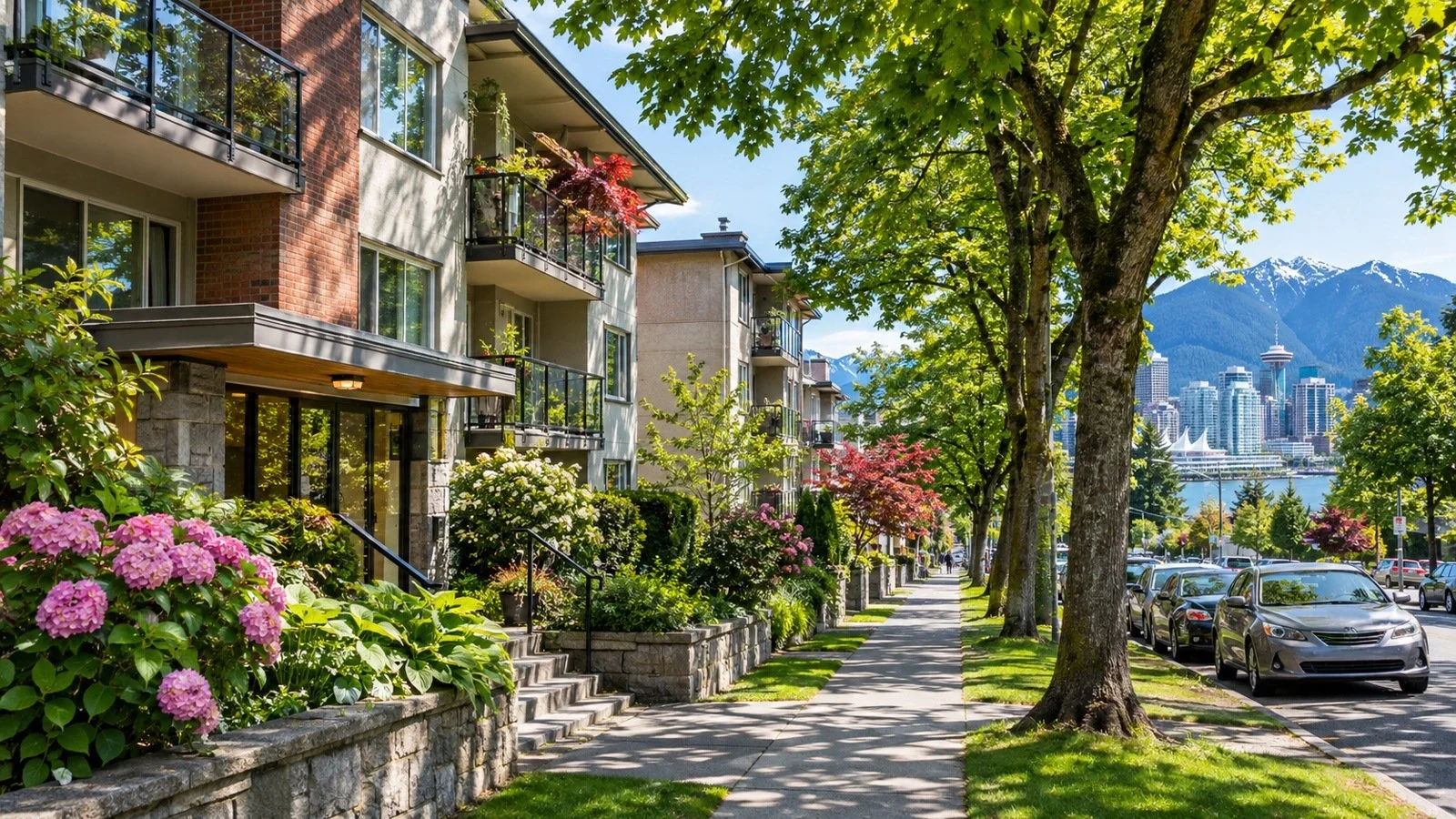
Average rents in British Columbia: CMHC figures by city
According to CMHC's Rental Market Survey, the average rent in purpose-built private apartment buildings in October 2025 was (CMHC, Rental Market Survey data tables, 2025):
Vancouver CMA (which includes Surrey, Burnaby, Richmond and the rest of Metro Vancouver): studio $1,667; one bedroom $1,806; two bedrooms $2,363. Vacancy rate 3.7%.
Victoria CMA: one bedroom $1,625; two bedrooms $2,120. Vacancy rate 3.3%.
Kelowna CMA: one bedroom $1,596; two bedrooms $2,118. Vacancy rate 6.4%.
Nanaimo CMA: one bedroom $1,526; two bedrooms $1,910. Vacancy rate 2.2%.
Kamloops CMA: one bedroom $1,347; two bedrooms $1,679. Vacancy rate 1.2%.
Abbotsford-Mission CMA: one bedroom $1,282; two bedrooms $1,592. Vacancy rate 2.8%.
Chilliwack CMA: one bedroom $1,231; two bedrooms $1,526. Vacancy rate 3.0%.
Prince George: one bedroom $1,202; two bedrooms $1,409. Vacancy rate 4.5%.
Fort St. John: one bedroom $913; two bedrooms $1,177.
British Columbia (centres of 10,000 people or more): one bedroom $1,685; two bedrooms $2,065. Vacancy rate 3.5%.
CMHC also reports that in the Vancouver CMA, the average rent for a two-bedroom condo apartment rented out by its owner was $2,900 in October 2025 (CMHC, Rental Market Survey data tables).
Averages include long-time tenants who pay less because of B.C.'s rent increase limits, so units advertised today usually cost more. These are October 2025 figures; check current listings.
Rents as published by CMHC for October 2025. They are averages for existing tenancies, not the price of a unit listed today, and they may have changed by the time you read this: check the linked CMHC tables and current listings before you budget.
Where to look for a rental in British Columbia
Online listing sites such as Craigslist, Facebook Marketplace, Kijiji, Rentals.ca, PadMapper and liv.rent.
Property management companies that own apartment buildings often list units on their own websites.
Community groups, places of worship and newcomer associations, including Latin American community groups, often share rooms and suites.
University and college housing offices for students: most institutions have residences and off-campus housing listings.
BC Housing manages subsidized and affordable housing programs for people with low incomes; waiting lists can be long (BC Housing).
We mention private websites and companies for reference only. Global Opportunities has no relationship with them and does not recommend any of them.
Renting a room, a basement suite or an apartment
A room in a shared house or apartment is the most common first step for single newcomers and students. Before you agree, ask the Residential Tenancy Branch whether the Residential Tenancy Act covers your arrangement, especially if you will share space with the owner.
A basement or secondary suite in a house is very common in B.C. Ask about heating, laundry, windows and light.
An apartment, condo, townhouse or house gives more privacy and space; condos often have strata (building) rules about pets, moving days and noise.
What landlords usually ask for
Landlords usually ask for identification, proof of income, references and sometimes a credit check. Without Canadian credit history, offer an employment letter, proof of savings, a reference from a landlord abroad or a co-signer.
Deposits and fees: what is legal in British Columbia
According to the Government of B.C. (deposits and fees):
Security deposit: no more than half of the first month's rent.
Pet damage deposit: a separate deposit, also capped at half of one month's rent, no matter how many pets. Landlords cannot charge other pet fees, such as a monthly pet fee.
No application fees. Landlords cannot charge a fee to accept, review or process a rental application.
Keys and fobs: no charge for the only key or access device; additional ones can cost no more than the replacement cost and must be refunded when returned.
Late rent: a fee of no more than $25, only if it is in the agreement.
Returning the deposit: the landlord has 15 days after the tenancy ends and receiving your forwarding address in writing to return the deposit with any interest, or to apply to the RTB to keep part of it.
The written tenancy agreement and the move-in inspection
According to the Government of B.C. (starting a tenancy):
Written agreement. Landlords must prepare a written agreement for every tenancy. The RTB has a standard form. Read it carefully: it says whether it is month-to-month or a fixed term, what is included (heat, hot water, electricity, parking, storage, laundry) and the rules of the building.
Move-in inspection. Landlord and tenant inspect the unit together and record its condition in a report, which helps decide later who pays for any damage. Take dated photos too.
Tenant insurance. It is not required by law, but many landlords ask for it, and it can protect your belongings and cover liability.
Rent increases in British Columbia
On rent increases, the Government of B.C. explains that rent can only be increased once every 12 months, with at least three full months' notice on the official form, and within the yearly limit set by the Residential Tenancy Branch (rent increases). According to the Government of B.C., the 2026 limit is 2.3% and the 2027 limit is 2.2% (Government of B.C., rent increase limits). A landlord who wants more needs your written agreement or an RTB decision. Check the current limit on the official page.
Your rights as a tenant and the Residential Tenancy Branch
The Residential Tenancy Branch administers the Residential Tenancy Act and provides information, education and dispute resolution for tenants and landlords. In general, tenants have the right to a reasonably maintained home, to privacy and to proper written notice before an eviction. The Government of B.C. recommends trying to talk things through first; if that fails, you can apply for dispute resolution.
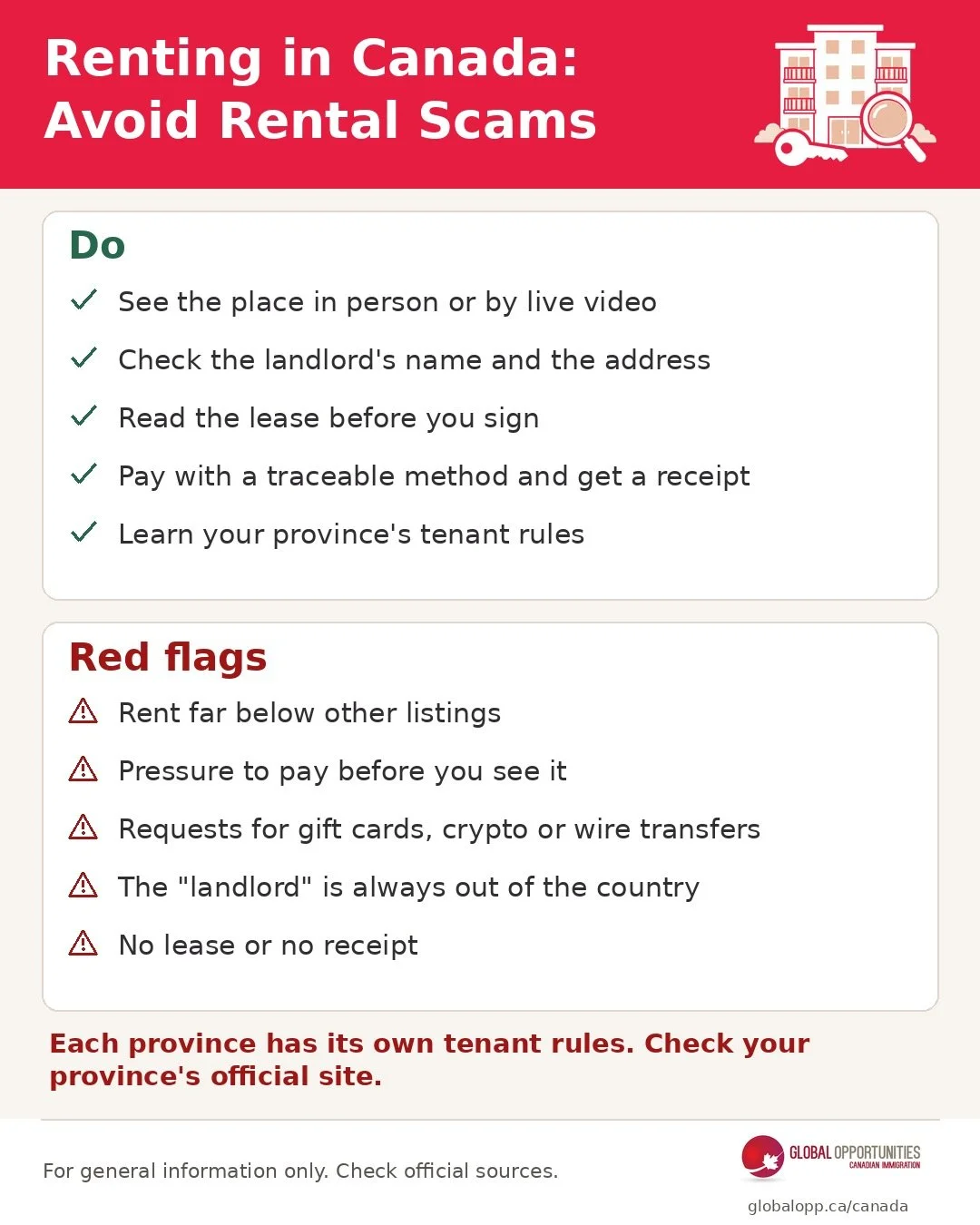
How to avoid rental scams
Rental scams usually ask for money before you have seen the place or met a real landlord. Four steps protect you:
Never send money for a place you have not seen in person or by a live video call with someone who can show you the unit and prove they are the owner or manager.
Be wary of prices far below average, owners who are "out of the country" and pressure to pay immediately.
Never pay in cash without a receipt, by wire transfer or with gift cards, and pay the deposit only when you sign a written agreement.
Report suspected scams. The Government of Canada's Canadian Anti-Fraud Centre explains common scams and how to report them.
Utilities: hydro, gas and internet
Electricity. According to BC Hydro, it is a provincial Crown corporation that delivers electricity to about 95% of B.C.'s population (BC Hydro, about us). FortisBC provides natural gas and electricity services in some areas; ask your landlord which companies serve the unit.
Internet and phone: compare prices, contract length and coverage, and ask about newcomer offers.
Heating: ask whether heat is included and whether the unit uses electric baseboards, a gas furnace or a heat pump.
We mention utility and telecommunications companies for reference only and have no relationship with any of them.
Driving in British Columbia: ICBC, licences, insurance and winter tires
In British Columbia, the Insurance Corporation of British Columbia (ICBC), a provincial Crown corporation, issues driver's licences and provides the mandatory basic car insurance.
Can I drive in B.C. with a foreign driver's licence?
According to ICBC, after moving to B.C. you have 90 days to switch your valid licence to a B.C. licence. The 90-day rule does not apply to tourists visiting for up to six months, to students with a valid student exemption who are enrolled full-time at a designated B.C. institution, and to some other groups listed by ICBC (ICBC, moving from another country).
How to exchange a foreign licence at ICBC
According to ICBC's page for people moving from another country:
Licence exchange jurisdictions. Licences from some countries and jurisdictions can be exchanged without testing. ICBC publishes the list; check it on the official page.
Everyone else can still apply for a B.C. licence, but must take a knowledge test and a road test.
Experience credit. ICBC can credit up to 15 years of driving experience if you provide an acceptable driving record showing your original licence date. It also affects your insurance premiums.
What to bring: primary ID (most Government of Canada immigration documents), secondary ID, proof of driving history, all your current driver's licences (you must surrender them) and proof of B.C. residency.
Translation. Translation may be needed, for example if your licence has non-English characters. It must be done by an ICBC-approved translator.
Languages. Knowledge tests are available in 12 languages.
Graduated licensing. If you cannot prove more than two years of non-learner driving experience, you enter B.C.'s Graduated Licensing Program.
What do the L and N signs mean? B.C.'s graduated licensing explained
New drivers in B.C. go through the Graduated Licensing Program (GLP): a learner stage (Class 7L), a novice stage (Class 7, often called the "N") and then a full Class 5 licence.
Class 7L (learner). According to ICBC, you can get your learner's licence on or after your 16th birthday by passing a knowledge test (40 out of 50 correct answers) (ICBC, get your L). Learner restrictions include (ICBC, you have a Class 7L licence):
You must drive with a qualified supervisor sitting in the front passenger seat, who holds a valid Class 1–5 licence and, since October 19, 2026, is at least 22.
Only one passenger besides the supervisor, unless all the others are immediate family (since October 19, 2026).
Display the red L sign on the back of the vehicle.
Zero alcohol and zero drugs in your blood.
No cellphones or other electronic devices, not even hands-free.
No driving between midnight and 5 a.m.
A minimum learner period applies before the road test; check it for your age on ICBC's site.
Class 7 (novice, "N"). You get it by passing the Class 7 road test (ICBC, get your N). According to ICBC, novice drivers under 25 must display the N sign, can drive with only one passenger unless all passengers are immediate family (or a qualified supervisor is present), cannot have alcohol or drugs in their blood, and cannot use a phone or other electronic device at any time (ICBC, Class 7 under 25). ICBC's page for novice drivers 25 or older describes a shorter path (ICBC, Class 7 and 25 or older).
From N to Class 5: the Driving Record Assessment. ICBC explains that as of October 19, 2026, drivers with a clean record no longer take a second road test. Instead they apply for a Driving Record Assessment after a period of safe driving: at least 24 months if you are under 25 (18 months if you completed an approved GLP course during the learner stage), or at least 12 months if you are 25 or older, with no prohibitions, suspensions, or convictions for excessive speed or electronic device use. After the upgrade, a 12-month restriction requires zero blood alcohol and zero drugs (ICBC, Graduated Licensing Program changes). According to ICBC, as of November 2026 upgrading as soon as you are eligible costs $17, or $75 if you wait and get a new five-year licence. Check the current fees on ICBC's site.
Car insurance in B.C.: ICBC Basic and optional coverage
Basic insurance is mandatory and comes from ICBC. According to ICBC, Basic Autoplan includes Enhanced Accident Benefits (care and recovery benefits, including income replacement, available even if you are at fault), Basic Vehicle Damage Coverage when another driver is responsible, $200,000 in Third Party Liability, Basic Underinsured Motorist Protection and inverse liability protection (ICBC, Basic insurance and Enhanced Care).
Optional coverage. Many drivers add optional coverage such as Collision and Extended Third Party Liability (higher limits), from ICBC or private insurers.
How to buy it. You insure and register a vehicle through an Autoplan broker. Ask about credit for your foreign driving record.
Renting a car when you arrive
Each rental company sets its own rules on minimum age, accepted licences and payment. For example, Enterprise says its minimum rental age in Canada is 21, that renters aged 21 to 24 pay a young renter fee, and that you need a valid photo driver's licence and a valid debit or credit card (some locations require a credit card) (Enterprise Canada, renting under 25). Before you book with any company, check its own requirements page: ask whether your foreign licence is accepted, whether it also asks for an International Driving Permit, and what optional coverage you are buying. We mention private services for reference only and have no relationship with any of them.
Parking in Vancouver and other cities
Meters and permits. Downtown street parking is paid at meters or through the app shown on the sign. Read every sign: time limits, rush-hour tow-away zones and resident permit-only blocks are common.
Apartment and condo parking. A parking spot is often rented separately from the unit, or not available at all. Ask before you sign the lease.
Snow. Many cities ask residents to clear the sidewalk in front of their home after a snowfall and may restrict parking during snow events. Check your lease and your city's website.
Do I need winter tires in B.C.?
It depends on where you drive. According to the Government of B.C., winter tires or chains are required on most B.C. highways from October 1 to April 30, while for select highways that do not go through mountain passes or high-snowfall areas the requirement ends on March 31. Routes are marked with signs. Winter tires are not required in many coastal areas, such as much of the Lower Mainland, but are needed on routes such as the Malahat and on most highways outside the coast (Government of B.C., designated winter tire and chain routes). Check the official page for what counts as a winter tire.
Before any trip, check road conditions, closures and highway cameras on DriveBC. Mountain highways can change quickly in winter.
BCID: photo ID if you do not drive
If you do not drive, ICBC issues the BCID card, a government photo ID card for people aged 12 or older (ICBC, apply for a BCID).
Licensing rules, fees and insurance coverage as published by ICBC, and winter tire rules as published by the Government of B.C., as of November 2026. Whether your foreign licence can be exchanged, and how much experience is credited, is decided by ICBC for each driver: check the linked pages before you rely on them.
How do newcomers get health care in British Columbia? MSP, family doctors and 8-1-1
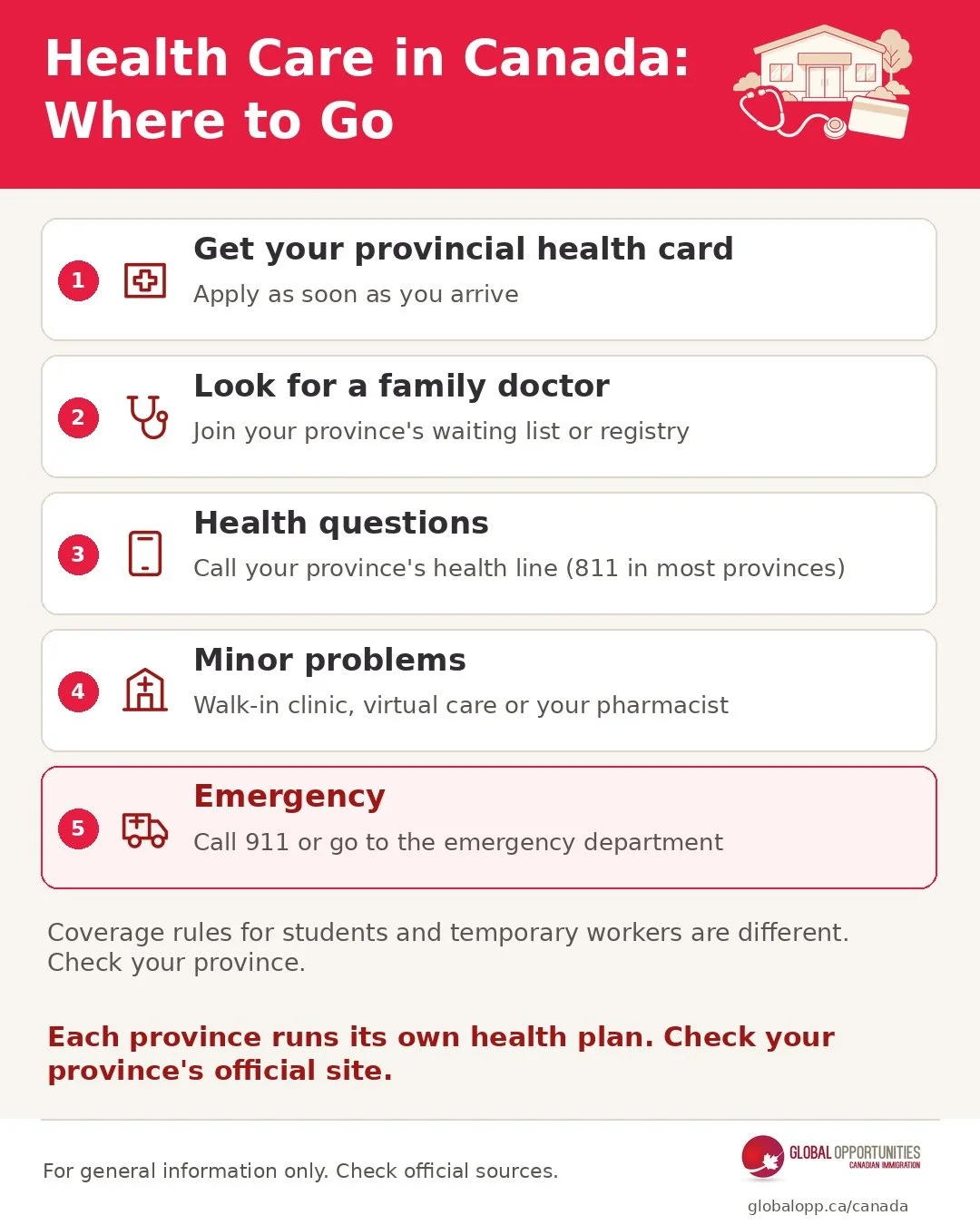
British Columbia's public health insurance plan is the Medical Services Plan (MSP). According to the Government of B.C., all B.C. residents must enrol in MSP. Your BC Services Card shows your Personal Health Number (Government of B.C., how to enrol). B.C. residents do not pay monthly MSP premiums: according to the Government of B.C., premiums were discontinued as of January 1, 2020 (Government of B.C., MSP for B.C. residents). International students enrolled in MSP may pay a health fee; check the official page.
New to how public health care works? Read the health care system in Canada.
Is there a waiting period for MSP?
Yes, for most new residents. According to the Government of B.C.'s MSP eligibility page, your coverage may start three months after your arrival date: the wait period is made up of the rest of the month in which you establish residence, plus two months. The Government of B.C. advises getting private health insurance while you wait and applying as soon as you arrive.
MSP eligibility: what the official page says
In general terms, the Government of B.C.'s eligibility page says:
Canadian citizens and permanent residents must make their home in B.C. and be physically present in the province at least six months in a calendar year.
Some study and work permit holders whose permits are valid for six months or more may be deemed residents.
According to the Government of B.C., Health Insurance BC answers questions at 604 683-7151 (Lower Mainland) or 1 800 663-7100.
How to apply for MSP and get a BC Services Card
According to the Government of B.C.'s how to enrol page:
Apply online, in person at a Service BC location or with the paper form (the BC Application for Health and Drug Coverage, which also covers Fair PharmaCare and supplementary benefits).
Get your BC Services Card with photo. Most adults 18 years and six months of age and older visit an ICBC driver licensing office with primary and secondary identification, declare that they live in B.C. and have their photo taken.
What MSP covers and what it does not
MSP pays for medically necessary physician services and hospital care, but not everything. Prescription drugs, routine dental care and eyeglasses are often paid privately or through workplace insurance. Check the official page on services covered by MSP.
Prescriptions, PharmaCare and pharmacists
Fair PharmaCare. According to the Government of B.C., it is an income-based plan that helps families pay for eligible prescription drugs, dispensing fees and some medical devices and supplies; to be eligible you must be enrolled in MSP (Government of B.C., Fair PharmaCare).
Pharmacists can help with minor ailments. Through the Minor Ailments and Contraception Service, B.C. pharmacists can assess and prescribe for a list of minor ailments and for contraception, and the Government of B.C. says many prescription contraceptives are free for B.C. residents (Government of B.C., see a pharmacist). You need a Personal Health Number.
How do I find a family doctor in B.C.?
Finding a family doctor can take time. The Health Connect Registry is a community list of B.C. residents who need a family doctor or nurse practitioner. According to HealthLink BC, you register online (it takes a few minutes) or by calling 8-1-1 in languages other than English, with your Personal Health Number, home address, email and phone; when a provider becomes available, the team in your community contacts you.
Finding care while you wait for a doctor
Use the HealthLink BC Find care tool to find health services near you while you wait for a family doctor.
According to HealthLink BC, pharmacists can renew medications, assess and treat minor ailments and prescribe contraceptives.
HealthLink BC 8-1-1 and emergencies
For a life-threatening emergency, call 911 or go to the nearest hospital emergency department. You will be seen in order of medical urgency, not order of arrival.
For health questions that are not emergencies, call 8-1-1 (HealthLink BC). According to HealthLink BC, registered nurses are available 24 hours a day, every day; dietitians on weekdays during the day; and pharmacists overnight. Translation is available in over 130 languages (HealthLink BC).
Health insurance for temporary residents and students
If you are not eligible for MSP yet, or at all, you need private health insurance. Many institutions require international students to have a health plan; ask your school's international office.
MSP rules, waiting period and eligibility as published by the Government of B.C., and HealthLink BC services as described by HealthLink BC, as of November 2026. Meeting the general conditions described here does not mean you are covered: Health Insurance BC decides each person's eligibility and start date. Check the linked pages before you rely on them.
Banking in British Columbia for newcomers
Opening a bank account is one of your first tasks in British Columbia: you need it to receive your salary, pay rent and build a credit history. The Financial Consumer Agency of Canada (FCAC) explains what identification banks require and what to do if a bank refuses to open an account (FCAC, opening a bank account).
Banks and credit unions in British Columbia
Canada's national banks, such as RBC, TD, Scotiabank, BMO and CIBC, operate in B.C.; use each bank's branch locator to find branches near you and ask about newcomer packages. B.C. also has credit unions, which are member-owned. For example, Coast Capital describes itself as a member-owned federal credit union that serves B.C. and other provinces (Coast Capital, about us). Online banks are another option. Compare fees, limits and transfer costs. We mention financial institutions for reference only. Global Opportunities has no relationship with any of them and does not recommend any.
What you need to open an account
Generally, banks ask for identification such as a passport and your immigration document (for example, your Confirmation of Permanent Residence, work permit or study permit), and proof of address. FCAC's page lists the accepted documents and your rights, and explains when a bank can ask for your Social Insurance Number.
Building a credit history
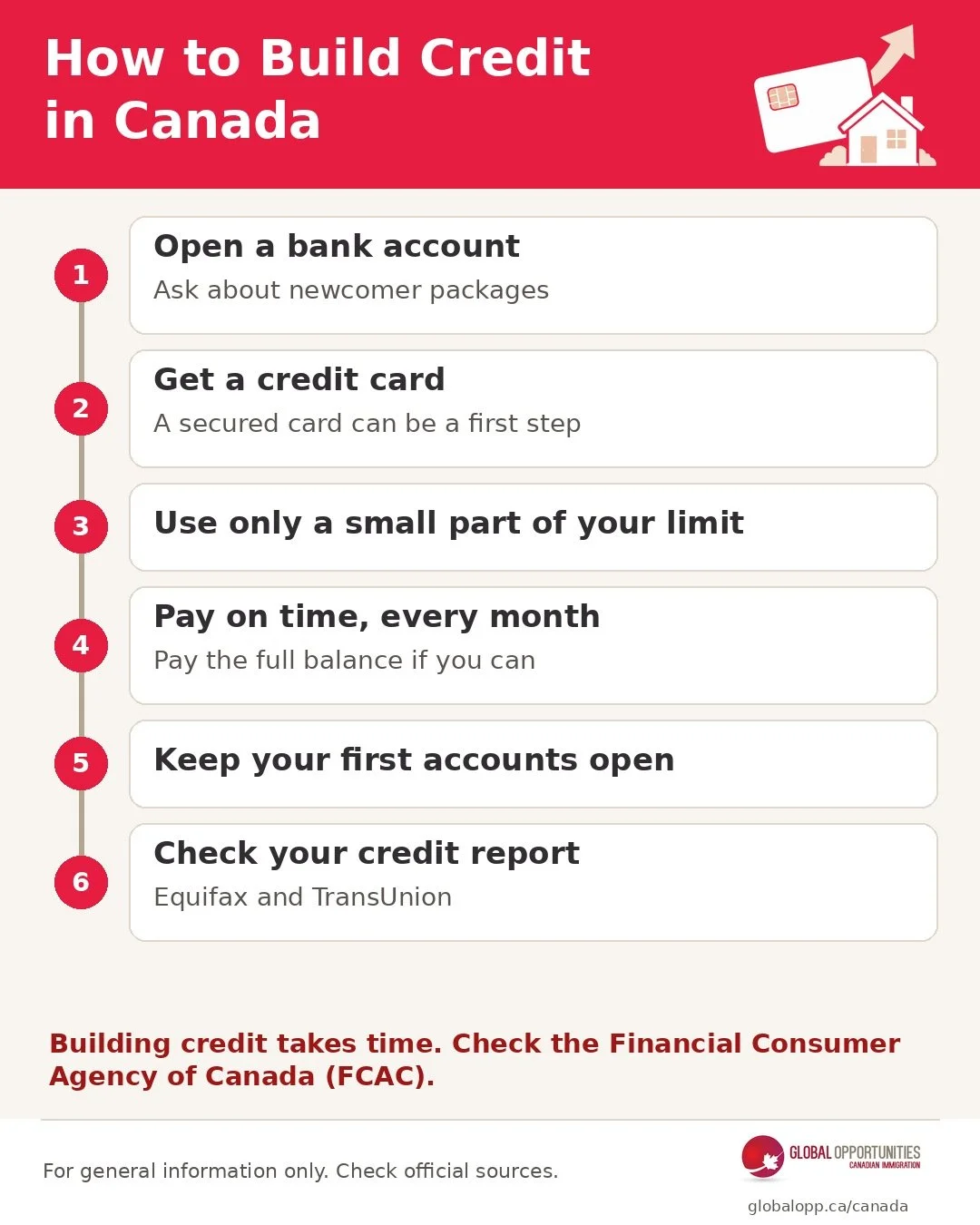
In Canada, landlords, phone companies and lenders often check your credit report. FCAC explains how credit reports and scores work. To start building credit: get a credit card (a secured credit card, backed by a deposit, is an option if you are refused a regular card) and pay the full balance on time every month.
Groceries and shopping in British Columbia
British Columbia has supermarkets for every budget, from discount chains and warehouse clubs to full-service supermarkets and Asian, South Asian, Latin American and other international grocery stores.
Supermarkets and other stores
Discount supermarkets and big-box stores are usually the lowest-cost option for groceries and household goods.
Warehouse clubs sell in bulk and require a paid membership.
Full-service supermarkets offer more variety, a pharmacy and prepared food.
Asian, South Asian, Filipino, Korean, Latin American and other community stores sell products from home; many supermarkets also have an international aisle.
Pharmacies and drugstores sell medicine, personal care products and some groceries.
Dollar stores sell basic household items.
Chains change their locations, so use each store's own store locator to check what is near your home. We mention types of stores for reference only. Global Opportunities has no relationship with any store.
What to buy for rain and winter
Rain gear on the coast: a hooded waterproof jacket, waterproof shoes and an umbrella.
Winter clothing inland and in the north: an insulated coat, waterproof boots with grip, a hat and gloves.
Where: outdoor and clothing stores, big-box stores and thrift stores, which sell used clothing at lower prices.
Furnishing your home on a budget
Many newcomers buy second-hand furniture through online marketplaces and thrift stores, or new furniture at large furniture and big-box stores. When you buy second-hand, meet in a public place and inspect the item before you pay.
How cold is British Columbia, and how do you prepare for rain and winter?
British Columbia has several climates in one province: mild, wet winters on the south coast, hot summers and snowy winters in the southern interior, and long, cold winters in the north.
Temperatures in B.C.'s cities
According to Environment and Climate Change Canada's climate normals for 1981–2010, the average daily temperature in January and July was:
Vancouver (airport): 4.1°C in January, 18.0°C in July.
Victoria (airport): 4.6°C in January, 16.9°C in July.
Kelowna (airport): -2.5°C in January, 19.5°C in July.
Prince George (airport): -7.9°C in January, 15.8°C in July.
These are long-term averages; individual days can be very different. Look up any community on the ECCC climate normals site.
What each season feels like
Fall and winter on the coast: grey, rainy and dark. Snow falls some years, usually for a few days. Strong rainstorms ("atmospheric rivers") can cause flooding.
Winter in the interior and the north: snow and freezing temperatures for weeks or months, especially in Prince George, the Cariboo, the Kootenays and the Peace region. Mountain passes get heavy snow.
Summer: warm and fairly dry on the coast, hot in the Okanagan and Kamloops. Heat waves can happen.
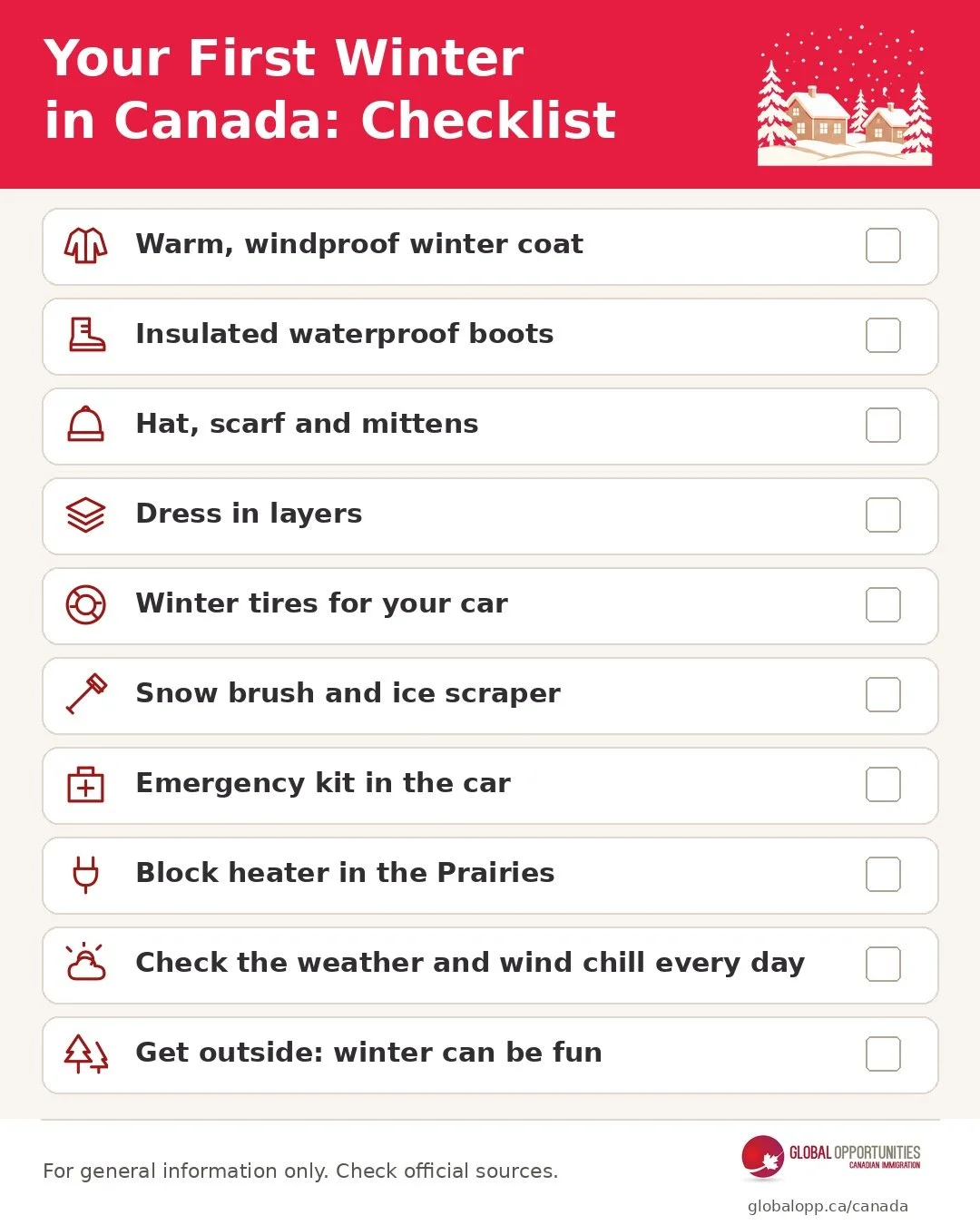
How to prepare for the rain and for your first winter
Dress in layers, with waterproof outer layers and footwear.
Get outside in daylight: the dark months can affect mood; talk to a health professional if you feel low for a long time.
Prepare your car with winter tires if needed and an emergency kit, and check DriveBC before highway trips.
Watch weather alerts from Environment and Climate Change Canada.
Wildfires, smoke, floods and earthquakes
Summer can bring wildfire smoke, heavy rain can bring floods, and earthquakes are possible on the coast. Wildfire season, evacuation alerts, air quality, earthquake preparedness and emergency alerts are explained in the section "Emergencies and natural hazards in British Columbia" near the top of this guide.
Education in British Columbia: schools, colleges and universities
British Columbia has free public schools from kindergarten to Grade 12, organized in school districts, a province-wide French-language school district, 25 public universities, colleges and institutes, and free or tuition-free English classes for many newcomers.
Public schools for children
Public schools from kindergarten to Grade 12 are run by school districts. According to the Government of B.C., children can start kindergarten in September of the year they turn five, and parents must register their child for school or homeschooling by the calendar year the child turns six (Government of B.C., full-day kindergarten). Schools offer English Language Learning (ELL) support.
How to register your child in school
According to the Government of B.C., in general you contact your local school district (or independent school authority) and bring:
Your child's original birth certificate, plus any applicable immigration documents and/or proof of Canadian citizenship for you and your child.
Your child's immunization record.
Proof of your address, such as a rental agreement or rental receipt.
Newcomers can register during the school year. Ask the district whether your child counts as a domestic student (no tuition) or an international student, which depends on your immigration status.
French at school
According to the Government of B.C., there are three ways to learn in French at school (compare French programs):
Francophone program, offered only by the Conseil scolaire francophone de la Colombie-Britannique (School District 93), for students whose parents qualify under section 23 of the Canadian Charter of Rights and Freedoms.
French immersion, open to all students, offered in 47 school districts and several independent schools.
Core French, a few blocks a week, offered in most school districts.
British Columbia's 25 public post-secondary institutions
The Government of B.C. lists 25 public post-secondary institutions (find an institution). Below is each one, grouped by region, with its campuses and main program areas as described on its own website when we checked in November 2026. Programs, campuses and co-op options change; always confirm on each institution's website. This list is for reference only and does not recommend any institution.
Metro Vancouver and the Sea-to-Sky
University of British Columbia (UBC). Vancouver campus and Okanagan campus in Kelowna. Programs include arts, science, applied science (engineering), commerce, forestry, law, medicine, nursing and education, and co-op is offered (UBC, our campuses; UBC, programs).
Simon Fraser University (SFU). Main campus on Burnaby Mountain, with campuses in Surrey and Vancouver. Faculties include applied sciences, arts and social sciences, business, communication, art and technology, education, environment, health sciences, science and medicine, and co-op is offered (SFU, campuses; SFU, faculties).
British Columbia Institute of Technology (BCIT). Main campus in Burnaby, plus a downtown Vancouver campus, an aerospace campus in Richmond, a marine campus in North Vancouver and a campus on Annacis Island in Delta. Program areas include applied and natural sciences, business and media, computing and IT, engineering, health sciences, and trades and apprenticeships (BCIT, campuses; BCIT, about).
Capilano University. Campuses in North Vancouver and Squamish. Schools include motion picture arts, animation and visual effects, design, performing arts, business, tourism management, outdoor recreation management, and education and childhood studies (Capilano University, locations; Capilano University, areas of study).
Emily Carr University of Art + Design. A Vancouver university specialized in art, design and media (Emily Carr University).
Kwantlen Polytechnic University (KPU). Campuses in Surrey, Richmond, Langley, Cloverdale (KPU Tech) and Surrey's Civic Plaza. Faculties include arts, business, design (including fashion), health, science (including horticulture), trades and technology, and academic and career preparation (KPU, campuses; KPU, faculties).
Douglas College. Campuses in New Westminster and Coquitlam. Programs include university transfer, commerce and business, health sciences, applied community studies, humanities and social sciences, performing and fine arts, and science and technology (Douglas College, campus information; Douglas College, programs).
Justice Institute of British Columbia (JIBC). Main campus in New Westminster, with campuses in Chilliwack, Maple Ridge, Pitt Meadows, Vernon and Langford. Training includes police, sheriff and corrections academies, firefighting, paramedicine, emergency management and counselling (JIBC, campuses; JIBC, programs).
Langara College. Campus on West 49th Avenue in Vancouver. University transfer and career programs, with faculties of arts, social science and community, nursing and nutrition, science, and management (Langara College, about).
Vancouver Community College (VCC). Downtown and Broadway campuses in Vancouver. Programs include baking and culinary arts, health sciences (including dental and practical nursing), transportation trades, design, music and dance, hospitality, business, ESL and academic upgrading (VCC, location; VCC, programs).
Vancouver Island
University of Victoria (UVic). Campus in Victoria. Faculties of business, education, engineering and computer science, fine arts, health, humanities, law, science and social sciences, with co-operative education (UVic, faculties).
Royal Roads University. A public university in Greater Victoria; check its programs and admissions on its own website (Royal Roads University).
Vancouver Island University (VIU). Main campus in Nanaimo, with campuses in Cowichan and Powell River (tiwšɛmawtxʷ). Areas include trades and applied technology, business and management, tourism, recreation and hospitality, education, health sciences (including nursing), arts and humanities, science and engineering, and aquaculture (VIU, programs).
Camosun College. Lansdowne campus in Victoria, Interurban campus in Saanich and a campus in Langford. Schools of arts and access, business, health sciences and human services, and trades, industry and professional studies, plus university transfer (Camosun College, campus locations; Camosun College, schools).
North Island College (NIC). Campuses in the Comox Valley, Campbell River, Port Alberni and Port Hardy. Programs include trades, health (including nursing), business administration, digital design and university arts and sciences (NIC, campuses; NIC, programs).
The interior and the Fraser Valley
University of the Fraser Valley (UFV). Main campus in Abbotsford, with campuses in Chilliwack, Mission and Hope. Programs include agriculture, criminal justice, nursing and health sciences, business and computing, trades and arts (UFV, campuses; UFV, programs).
Thompson Rivers University (TRU). Campuses in Kamloops and Williams Lake, plus TRU Open Learning. Schools and faculties include adventure, culinary arts and tourism; arts; business and economics; education and social work; law; nursing; science; and trades and technology, with co-op work terms (TRU, about; TRU, schools).
Nicola Valley Institute of Technology (NVIT). Describes itself as B.C.'s Indigenous public post-secondary institute, with campuses in Merritt and Vancouver. Programs include academic and career preparation, business, Indigenous early childhood education, environmental resources technology, practical nursing, human services, social work, trades and culinary arts (NVIT).
Okanagan College. Campuses in Kelowna, Penticton, Vernon and Salmon Arm. Trades and apprenticeship, business, health and social development, and arts and sciences (Okanagan College, campuses; Okanagan College, programs).
Selkirk College. Campuses in Castlegar and Nelson. Program areas include business, health and human services, hospitality and tourism, industry and trades training, university arts and sciences, environment and geomatics, forest technology, contemporary music and technology, and digital arts (Selkirk College, campuses; Selkirk College, programs).
College of the Rockies. Main campus in Cranbrook, with campuses in Creston, Fernie, Golden and Invermere. Programs include trades and apprenticeship, health (including nursing), business, tourism, human services and university studies (College of the Rockies, campuses; College of the Rockies, programs).
Northern B.C.
University of Northern British Columbia (UNBC). Main campus in Prince George, with regional campuses in Fort St. John, Terrace, Prince Rupert and Quesnel. Programs include environmental science, forestry, First Nations studies, nursing, social work and the Northern Medical Program (UNBC, campuses).
College of New Caledonia (CNC). Campuses in Prince George, Burns Lake, Mackenzie, Quesnel and Vanderhoof. Business and management, health sciences, human services, trades and industry, university studies, and natural resources and forest technology (CNC, campuses; CNC, programs).
Coast Mountain College. Campuses in Terrace, Prince Rupert, Smithers, Hazelton and Haida Gwaii, with place-based learning and field schools. Programs include arts, business, health and social services, science, trades and university transfer (Coast Mountain College, campuses; Coast Mountain College, programs).
Northern Lights College. Campuses in the Peace River region, including Dawson Creek and Fort St. John. Programs include trades and apprenticeships (including aircraft maintenance and power engineering), health and human services, business, education, university arts and science, and upgrading (Northern Lights College; Northern Lights College, trades and apprenticeships).
How to apply to colleges and universities in B.C.: EducationPlannerBC
B.C. has no single provincial application centre like Ontario's. Instead, EducationPlannerBC is the Province's planning and application service. According to EducationPlannerBC, you can apply there to any of B.C.'s 25 public post-secondary institutions; some, such as Royal Roads University, send you to their own application site. International students should check each institution's international admissions page.
Studying as an international student: DLI and PAL
Designated learning institution (DLI). According to IRCC, you need a letter of acceptance from a DLI to apply for a study permit. Check that your school and campus are on the official DLI list.
Provincial attestation letter (PAL). IRCC requires most study permit applicants to include a provincial or territorial attestation letter; in B.C., the institution requests it from the Province after accepting you. Check who needs a PAL and current rules on IRCC's study permit pages.
Study and post-study work rules change often: always check IRCC's study in Canada page.
Study permit rules as published by IRCC, and institution details as published by the Government of B.C. and each institution, as of November 2026. Having a letter of acceptance or a PAL does not mean a study permit will be approved; IRCC decides each case.
Free English classes for newcomers
LINC classes (federal). According to IRCC, permanent residents and protected persons can take language classes at no cost through Language Instruction for Newcomers to Canada (IRCC, language classes).
English Language Learning at public institutions. According to the Government of B.C., ELL programs for domestic students (Canadian citizens, permanent residents and refugees) are tuition-free at most public post-secondary institutions in B.C., although other costs may apply (Government of B.C., learn English).
If you need an English or French test for immigration or studies, see our guide to English and French tests for Canada.
Jobs and main industries in British Columbia
British Columbia's economy combines natural resources such as forestry, mining, energy, fishing and agriculture with trade, technology, film, tourism, construction, health care and services. According to IRCC, forestry products make up about half of B.C.'s goods (Discover Canada). Global Opportunities does not offer jobs, and no one can guarantee you a job in Canada.
What WorkBC projects
WorkBC, the Government of B.C.'s employment service, publishes a ten-year labour market outlook. In its 2025 edition, WorkBC projects 1,052,000 job openings in B.C. between 2025 and 2035, about 65% of them to replace workers who retire or leave the workforce. Health care and social assistance is the industry with the most projected openings, followed by professional, scientific and technical services (WorkBC, B.C. Labour Market Outlook).
These are projections, not job offers.
Where to look for work
WorkBC: B.C.'s job board, career profiles and labour market information.
Job Bank: the Government of Canada's job board. Filter by province, city and occupation.
Job Bank outlooks for B.C.: employment outlooks by occupation, rated from "very limited" to "very good".
Job Bank wage search: wages by occupation and region.
Employers directly: the BC Public Service, municipalities, health authorities, school districts and post-secondary institutions post openings on their own careers pages.
WorkBC Centres: free employment services
According to WorkBC, WorkBC Centres offer employment services at no cost in communities across the province (WorkBC Centres). Services include self-serve computers, one-on-one job search help, workshops on resumes and interviews, and, for eligible case-managed clients, training, work experience and financial supports. You check eligibility by applying online.
Resumes and job applications
Use a concise Canadian-style resume (no photo, age or marital status) adapted to each posting. Our newcomer guide to Canada explains how to write one, with examples. WorkBC Centres and settlement agencies can review it for free. Before you apply, read our guide to Canadian resumes, cover letters and job interviews.
Career Paths for Skilled Immigrants
According to WelcomeBC, Career Paths for Skilled Immigrants helps skilled professionals find work in B.C. that fits their training and experience. It is funded by the Province of B.C. and IRCC. In general, it is for permanent residents (within time limits that vary by stream), people approved for permanent residence and protected persons or refugees, with about one year of work experience from their home country, intermediate to advanced English, and who are unemployed or working below their skills. Support can include financial help for re-credentialling or licensing, job-related language training and career coaching (WelcomeBC, Career Paths).
Minimum wage and workers' rights
According to the Government of B.C., as of June 1, 2026, the general minimum wage is $18.25 per hour. It is reviewed each year in line with the province's Consumer Price Index, so check the current amount on the official page (Government of B.C., minimum wage). The Employment Standards Branch explains your rights at work, and WorkSafeBC covers workplace safety.
Minimum wage as published by the Government of B.C., as of November 2026. Some jobs have special rates, and the amount is reviewed each year: check the linked page before you rely on it.
Regulated professions and trades
According to the Government of B.C., many jobs in B.C. are regulated (list of professional regulatory authorities). If your occupation is regulated, you will need to apply to the regulatory body to work in it or use a protected title. Your foreign credentials alone do not give you a licence. Many trades are certified through SkilledTradesBC.
The Government of B.C. explains that professional regulatory authorities oversee regulated jobs and issue certification and credentials, and it publishes a list of professional regulatory authorities. Examples include the BC College of Nurses and Midwives and the College of Physicians and Surgeons of BC. Nurses trained abroad can read how to immigrate to Canada as a nurse, which lists the nursing regulator in each province.
Any mention of regulated occupations or regulators in this guide is for reference only. It may not be complete. Always confirm requirements directly with the regulator for your profession or trade.
WorkBC's figures are projections published by the Government of B.C., not job offers, and they may have been updated since November 2026: check the linked pages.
Free newcomer services in British Columbia
British Columbia has many free services for newcomers, funded by the Government of Canada and the Government of B.C. and delivered by non-profit settlement agencies. Which ones you can use depends on your immigration status.
Services for permanent residents (IRCC-funded)
IRCC funds settlement services for permanent residents and protected persons: information and orientation, language classes, employment help and community connections, at no cost. Use IRCC's newcomer services finder to find agencies near you. IRCC also funds pre-arrival services.
The BC Newcomer Services Program (temporary residents and others)
According to WelcomeBC, the BC Newcomer Services Program (BC NSP) serves groups who are often not eligible for federal services (WelcomeBC, BC NSP):
Temporary workers with a valid work permit.
International post-secondary students with a study permit, if their institution does not offer these services.
Provincial nominees waiting for a decision on their permanent residence application.
Naturalized Canadian citizens.
Displaced Ukrainians with valid CUAET visas, and their immediate family.
Refugee claimants (the page also points to the BC Safe Haven program for more support).
Services include orientation, English practice, community connections, help finding work and short-term emergency counselling. WelcomeBC lists providers by community; in Vancouver, for example, it lists ISSofBC, MOSAIC and S.U.C.C.E.S.S.
Other free help
WelcomeBC: the Government of B.C.'s newcomer website, with the free B.C. Newcomers' Guide (print copies can be ordered for addresses in B.C.).
AMSSA: the association that supports settlement and integration service providers in B.C.
Public libraries: free internet, English conversation circles and newcomer programs.
This list of organizations is for reference only and may not be complete. Global Opportunities has no relationship with these organizations.
How much does it cost to live in British Columbia?
British Columbia, and especially Metro Vancouver and Victoria, is one of the most expensive places to live in Canada, mainly because of housing. Smaller cities usually have lower rents, but you may need a car. Here is a summary of the prices in this guide, checked in November 2026; check the current price on each source.
Rent (CMHC, October 2025, purpose-built apartments): two bedrooms averaged $2,363 in the Vancouver CMA, $2,120 in Victoria, $2,118 in Kelowna, $1,910 in Nanaimo, $1,679 in Kamloops, $1,592 in Abbotsford-Mission and $1,409 in Prince George (CMHC).
Transit in Metro Vancouver (TransLink, as of November 2026): $2.85 for a 1-zone adult trip with a Compass Card, $117.20 for a 1-zone adult monthly pass, $12.55 for a DayPass (TransLink).
Transit in other cities (BC Transit, as of November 2026): a 30-day adult pass costs $85 in Victoria, $80 in Kelowna, $65 in Nanaimo and Prince George, $59 in Abbotsford-Mission and $55 in Kamloops (BC Transit).
Minimum wage: according to the Government of B.C., $18.25 per hour as of June 1, 2026 (Government of B.C., minimum wage).
Sales tax: according to the Government of B.C. and the CRA, generally 7% PST plus 5% GST (Government of B.C., PST; CRA, GST/HST rates).
Figures as published by CMHC, TransLink, BC Transit, the Government of B.C. and the CRA, as of November 2026. They may have changed by the time you read this: check the linked pages before you rely on them.
Also plan for groceries, phone, utilities, tenant insurance, and car costs if you drive. For a national overview, see our article on the cost of living in Canada.
How much tax do you pay in British Columbia, and which benefits can you get?
In British Columbia you pay federal and provincial income tax on what you earn, and, according to the Government of B.C. and the CRA, the 7% PST plus the 5% GST on many purchases. Renters, families and people with low or modest incomes can also receive tax-free federal and B.C. benefits and credits, and almost all of them depend on one thing: filing a tax return every year, even if you had little or no income.
The figures below come from the official pages as of November 2026. Tax rules and amounts change every year, so check the current rate before you budget. This section is general information, not tax advice. For your own situation, contact the Canada Revenue Agency (CRA) or a tax professional.
How much income tax do you pay in B.C.?
Canada's income tax is progressive. According to the CRA, provincial rates apply in addition to federal rates, each rate applies only to the portion of your taxable income that falls within its bracket, and your provincial rate depends on the province where you live on December 31 (CRA, tax rates and income brackets for the current year). For the 2026 tax year:
Federal rates (CRA): 14% on the first $58,523 of taxable income; 20.5% on the portion from $58,523 to $117,045; 26% from $117,045 to $181,440; 29% from $181,440 to $258,482; and 33% above $258,482.
B.C. rates (Government of B.C.): 5.60% on the first $50,363; 7.70% from $50,363 to $100,728; 10.50% from $100,728 to $115,648; 12.29% from $115,648 to $140,430; 14.70% from $140,430 to $190,405; 16.80% from $190,405 to $265,545; and 20.50% above $265,545 (Government of B.C., personal income tax rates).
The Government of B.C. explains that the 2026 brackets were increased by B.C.'s Consumer Price Index (2.2%), and that Budget 2026 paused the indexation of the brackets for the 2027 to 2030 tax years. For example, with a taxable income of $60,000, the B.C. rate of 5.60% applies to the first $50,363 and 7.70% only to the remaining $9,637. Deductions and tax credits then change the amount you actually owe.
Filing your return. If you have a modest income and a simple tax situation, the CRA's Community Volunteer Income Tax Program lists free tax clinics where volunteers complete returns (CRA, free tax clinics).
Sales tax in B.C.: PST and GST
According to the Government of B.C., the provincial sales tax (PST) is a retail sales tax that applies when taxable goods, software or services are acquired in B.C., unless a specific exemption applies, and the rate is generally 7% (Government of B.C., PST). The 5% federal GST applies separately (CRA, GST/HST calculator). The CRA lists basic groceries such as milk, bread and vegetables, and prescription drugs, as zero-rated for GST (CRA, type of supply).
The Canada Groceries and Essentials Benefit. According to the CRA, the federal GST/HST credit was renamed the Canada Groceries and Essentials Benefit (CGEB) as of July 2026, with the same eligibility, calculation and structure. It is a tax-free quarterly payment for individuals and families with low and modest incomes. You are considered automatically when you file your taxes, and the CRA page explains how to apply if you are a new resident of Canada (CRA, Canada Groceries and Essentials Benefit).
The B.C. renter's tax credit
According to the Government of B.C., the renter's tax credit gives up to $400 per year to low- and moderate-income renters, and you claim it on your income tax return (Government of B.C., B.C. renter's tax credit):
Who can claim it. You rented and lived in an eligible rental unit in B.C. under a tenancy agreement, licence, sublease or similar arrangement for at least six one-month periods during the year; you paid rent; and on December 31 you were a B.C. resident and 19 or older, a parent, or living with a spouse or common-law partner. Roommates who are not a couple can each claim their own credit if they meet the criteria.
Income limits. For the 2026 tax year, the credit is reduced when your adjusted income (yours plus your spouse's or partner's, with adjustments) is above $66,189, and it is zero at $86,189. The thresholds are indexed to inflation each year.
How to claim it. Complete form BC479, British Columbia Credits, with your return: the rental address, the rent paid, the months at each address and the name of your landlord. Keep proof of rent paid in case the CRA asks.
The credit is based on your income, not on how much rent you pay.
The Canada Child Benefit and the B.C. family benefit
The Canada Child Benefit (CCB) is a tax-free monthly payment for eligible families to help with the cost of raising children under 18 (CRA, Canada Child Benefit). According to the CRA's eligibility page, you must live with the child, be primarily responsible for the child's care and upbringing, and be a resident of Canada for tax purposes. You or your spouse or common-law partner must be a Canadian citizen, a permanent resident, a protected person, or a temporary resident who has lived in Canada for the previous 18 months and has a valid permit in the 19th month, among other cases listed on the page (CRA, who can apply). Newcomers apply with Form RC66 and Schedule RC66SCH, Status in Canada/Statement of Income (CRA, how to apply).
The B.C. family benefit is a tax-free monthly payment for families with children under 18, administered by the CRA and paid together with the CCB. If your child is registered for the CCB, they are automatically registered for the B.C. family benefit, and you (and your spouse or partner) must file a tax return. The amount is calculated by the CRA from your returns (Government of B.C., B.C. family benefit).
Affordable child care in B.C.: $10 a Day ChildCareBC and other help
$10 a Day ChildCareBC Centres. According to the Government of B.C., families at these centres pay no more than $200 a month per child for full-time care during regular business hours. Access depends on each centre's licensed capacity and waitlist, and providers choose to take part (ChildCareBC programs; $10 a Day ChildCareBC Centres).
Child Care Fee Reduction Initiative. Funding goes to eligible licensed providers to reduce monthly fees. Families do not need to apply.
Affordable Child Care Benefit. A monthly payment to help eligible families with child care costs, based on factors such as income, family size and type of care. You must renew your application every year.
Child Care Resource and Referral Centres help families find licensed care near them.
Rates, thresholds and benefit amounts as published by the Canada Revenue Agency and the Government of B.C., as of November 2026. They change every year: check the linked pages before you rely on them. Eligibility for each benefit depends on your own situation, including your residency and immigration status, and the CRA decides each case.
Culture, community and the outdoors in British Columbia
British Columbia is known for its mountains, coastline, forests and lakes, and for a park system that IRCC describes as the most extensive in Canada, with approximately 600 provincial parks (Discover Canada).
Nature and the outdoors
The Rockies. Yoho and Kootenay national parks, and Mount Robson, Mount Assiniboine and Hamber provincial parks, are part of the Canadian Rocky Mountain Parks UNESCO World Heritage Site (Parks Canada).
Provincial parks. Find camping, hiking and lakes on the official BC Parks website.
Skiing and winter sports on the North Shore mountains, in Whistler, the Okanagan, the Kootenays and many local hills.
In the cities
Vancouver's parks and beaches, Victoria's harbour, the Okanagan's lakes and wineries, museums, festivals and Indigenous art are all part of life in B.C. For events and ideas, see the official tourism sites Destination BC and Destination Vancouver.
Community
B.C.'s population is very diverse, especially in Metro Vancouver. Community centres, public libraries, settlement agencies and volunteering are good ways to meet people, including people from your own country.
Settling in is also about people: read our article on building community in Canada.
How can you immigrate to British Columbia?
There is no single "B.C. visa". People move to British Columbia through federal immigration programs run by IRCC, through the B.C. Provincial Nominee Program (BC PNP), or with a temporary permit to study or work. Programs, streams, requirements and fees change frequently, so always check the official pages linked below.
If you plan to visit first, use IRCC's official tool to check if you need a visa or an eTA.
Express Entry
According to IRCC, Express Entry is an online system used to manage immigration applications from skilled workers. It manages three programs: the Federal Skilled Worker Program, the Federal Skilled Trades Program and the Canadian Experience Class (IRCC, Express Entry). Requirements change; check the official page. See also our Federal Skilled Worker page.
The B.C. Provincial Nominee Program (BC PNP)
The BC PNP is B.C.'s provincial immigration program, run through WelcomeBC, with pathways for workers and for entrepreneurs (WelcomeBC, about the BC PNP). IRCC explains that a province nominates people, that each province sets its own requirements, and that the Government of Canada makes the final decision on permanent residence (IRCC, provincial nominee program).
According to WelcomeBC's page for workers, you register online, may be invited to apply, and if nominated then apply to IRCC for permanent residence. The worker streams described there generally require a full-time, indeterminate job offer from an eligible employer. An Express Entry BC option links the nomination to a federal Express Entry profile.
When we reviewed the BC PNP news page in November 2026, it reported that on April 23, 2026, the province realigned its skills immigration around three objectives: Care (health care, education, child care and veterinary care), Build (certified workers in key skilled trades for construction and infrastructure) and Innovate (targeted invitations to high economic impact talent). The Entry Level and Semi Skilled stream was officially closed, and the province said it would not launch new student streams. There is also a separate pathway for entrepreneurs.
BC PNP streams and priorities change often. What you read here may already be different when you read it. Always check WelcomeBC, and be wary of anyone who promises a nomination, permanent residence or a job.
Requirements such as language levels, proof of funds and processing times depend on each program and on each person's case, so we do not give figures here; a consultation is the way to know what applies to you.
For a general overview of how these programs work across Canada, see our page on provincial nominee programs.
Studying in British Columbia
International students need a letter of acceptance from a designated learning institution; see our education section and IRCC's study in Canada page.
Work permits
IRCC describes two main types of work permits: employer-specific work permits and open work permits (IRCC, work in Canada). Some employer-specific permits require the employer to obtain a Labour Market Impact Assessment; see our page on the LMIA. Young people from participating countries can read our Working Holiday page.
If your permit ends within a year, watch Is your work permit or PGWP expiring in the next 12 months?
Already working in the province? Watch why being eligible for permanent residence is not the same as being selected.
After permanent residence, many people apply for citizenship: see our guide to Canadian citizenship.
Programs and permit types as described by IRCC and WelcomeBC, as of November 2026. Meeting a program's requirements does not mean an application will be approved, and a nomination is not permanent residence: IRCC decides each case. Check the linked pages before you rely on them.
French in British Columbia
English is the language of daily life and work in British Columbia. The province also has a francophone community, a French-language school district and growing provincial services in French.
Government services in French. The Government of B.C.'s Francophone Affairs Program helps provincial ministries improve their ability to provide information and services in French, and a French language policy in effect since April 1, 2024 provides direction to gradually increase ministries' ability to serve French-speaking residents (Government of B.C., Francophone Affairs).
Immigration. WelcomeBC's BC PNP news page notes that the BC PNP's Care priority includes French-speaking K-12 teachers.
If French is one of your strengths, read our page on French language proficiency. Global Opportunities does not offer services for Quebec's immigration programs; this guide covers British Columbia only.
First steps after arriving in British Columbia
Your first weeks in British Columbia involve a few key tasks. Doing them early makes everything else easier.
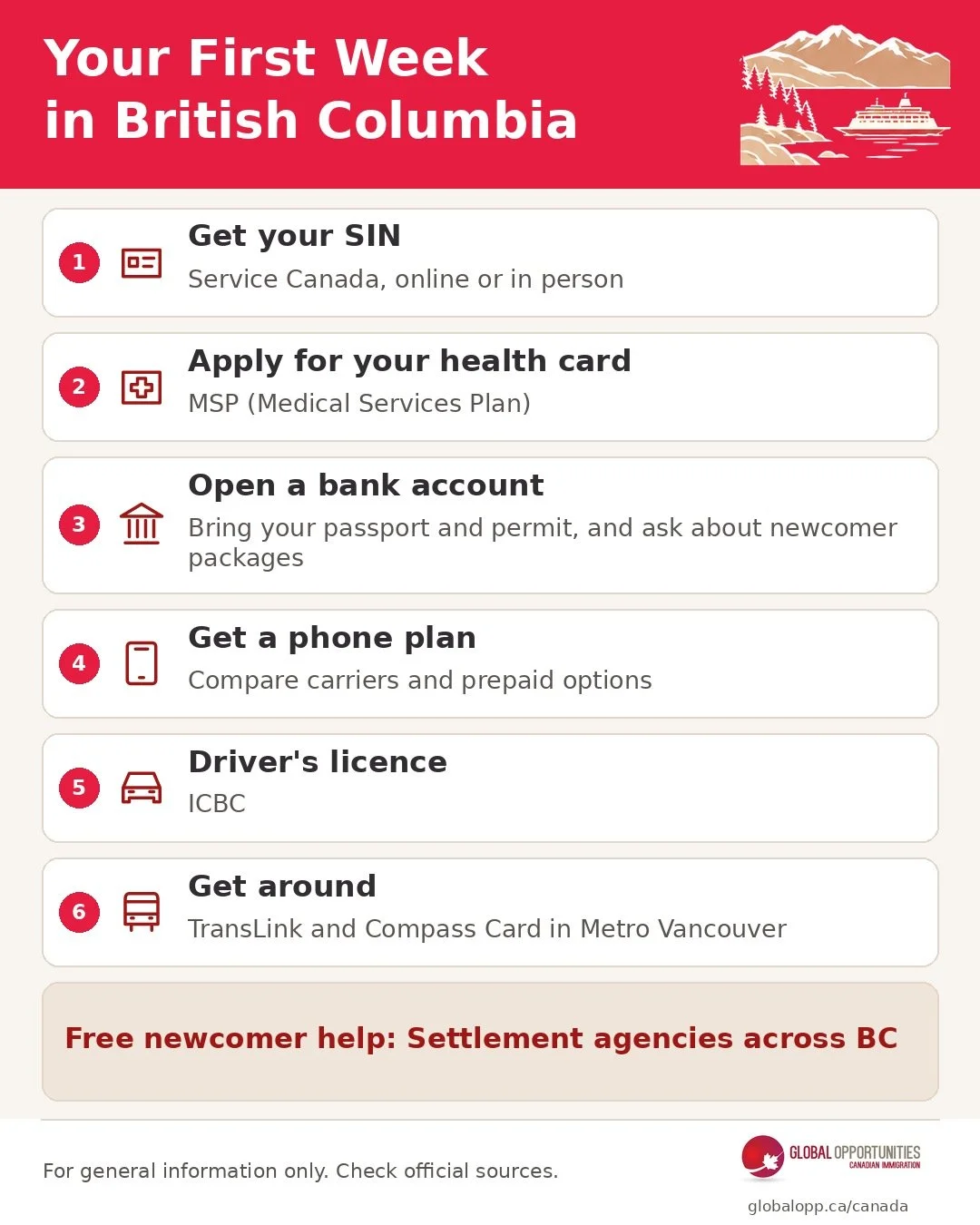
Your first-weeks checklist
Get your Social Insurance Number (SIN). You need it to work and to access government benefits (Service Canada, SIN).
Enrol in MSP right away and keep private health insurance for the waiting period (how to enrol).
Get your BC Services Card photo at an ICBC driver licensing office once you have applied for MSP.
Open a bank account and start building credit (FCAC, opening a bank account).
Find newcomer services with IRCC's newcomer services finder or WelcomeBC's BC Newcomer Services Program list.
Register your children for school with your local school district.
Get a Compass Card if you will use transit in Metro Vancouver, or download Umo for BC Transit in other communities.
Switch your driver's licence within 90 days if you have moved to B.C. (ICBC, moving from another country).
Join the Health Connect Registry once you have your Personal Health Number, and register for Fair PharmaCare.
Prepare for the season: rain gear on the coast, winter clothing inland.
Frequently asked questions
Is British Columbia a good place to live?
It depends on what you value and on your budget. B.C. offers a mild coastal climate (see the climate section), mountains, ocean and outdoor life, and large Asian communities, which the 2021 Census reflects (see "Population by origin" above). On the other hand, Metro Vancouver and Victoria are among the most expensive places to live in Canada, mainly because of housing, and summers can bring wildfire smoke. Compare CMHC rents and Job Bank outlooks for your occupation in several cities, read the cost of living and emergencies sections, and remember that no one can promise that a move will work out.
Is it expensive to live in British Columbia?
Yes, compared with most of Canada, mainly because of housing. According to CMHC, the average two-bedroom rent in purpose-built apartments was $2,363 in the Vancouver area and $2,120 in Victoria in October 2025. Transit, sales tax (7% PST plus 5% GST, according to the Government of B.C. and the CRA) and car costs add up too. On the other hand, residents pay no MSP premiums, and smaller cities such as Kamloops, Abbotsford and Prince George have lower rents. Build a monthly budget with real listings before you choose a city; see our cost of living section.
What is the cheapest place to live in British Columbia?
It depends on your job, household and whether you need a car. Looking only at CMHC's October 2025 average two-bedroom rents in purpose-built apartments, the lowest among the cities in this guide were in the north and the interior: $1,177 in Fort St. John, $1,409 in Prince George, $1,592 in Abbotsford-Mission and $1,679 in Kamloops, compared with $2,363 in the Vancouver area. Lower rent can mean fewer jobs in your field, colder winters and more driving. Compare job postings on WorkBC and Job Bank first.
Vancouver, Victoria or Kelowna: where should newcomers live in B.C.?
It depends on your occupation, budget and contacts. Metro Vancouver has the largest job market and the most transit, but the highest rents. Victoria is the provincial capital, with the mildest winters, a smaller job market and expensive housing. Kelowna is the largest city in the Okanagan, with real winters, hot summers and lower CMHC rents than Vancouver, but more need for a car. Search postings for your occupation in each city on WorkBC and Job Bank, compare CMHC rents in our housing section, and visit before signing a lease.
How much is rent in Vancouver?
According to CMHC's Rental Market Survey, in October 2025 the average rent in purpose-built private apartments in the Vancouver CMA, which includes Surrey, Burnaby and Richmond, was $1,667 for a studio, $1,806 for one bedroom and $2,363 for two bedrooms, with a vacancy rate of 3.7%. Owner-rented condo apartments averaged $2,900 for two bedrooms. Units advertised today usually cost more than averages, which include long-time tenants. A room in a shared house or a basement suite usually costs less. Check current listings and our housing section for where to search.
Is it better to live in Vancouver or Toronto?
Neither is better for everyone; compare them for your own field, budget and lifestyle. On rent, CMHC reported an average two-bedroom rent in purpose-built apartments of $2,363 in the Vancouver CMA and $2,046 in the Toronto CMA in October 2025. On transit, as of November 2026 a 1-zone adult trip with a Compass Card costs $2.85 according to TransLink, and an adult PRESTO fare is $3.30 according to the TTC. On climate, Environment and Climate Change Canada's 1981–2010 normals show an average January temperature of 4.1°C at Vancouver's airport, and IRCC notes that rain is more common than snow in southwest B.C. in winter, while Toronto's winters bring snow, slush and freezing rain. On jobs, compare Job Bank postings and outlooks for your occupation in each region. Read our Ontario guide for the Toronto side, and see the housing and transit sections of this guide.
Is Vancouver or Surrey safe for newcomers?
Like any large metropolitan area, Metro Vancouver has areas with different levels of reported crime, and conditions change over time. Rather than relying on rankings or social media, look at official data. Statistics Canada publishes the Crime Severity Index, which takes into account both the volume and the seriousness of police-reported crime, for Canada, the provinces and census metropolitan areas such as Vancouver (Statistics Canada, table 35-10-0026-01). The Vancouver Police Department's GeoDASH map shows reported crime by area, and the Surrey Police Service has crime maps and statistics for Surrey. Busy commercial areas often show more incidents because more people pass through them. Before you sign a lease, visit the area at different times of day, ask neighbours and check the route to transit. In an emergency, call 911.
How much can a landlord charge for a deposit in B.C.?
According to the Government of B.C.'s deposits and fees page, a security deposit can be no more than half of the first month's rent. A landlord can also ask for a separate pet damage deposit, capped at half a month's rent, so both together can never exceed one month's rent. Landlords cannot charge application fees or monthly pet fees. After the tenancy ends, the landlord has 15 days from receiving your forwarding address in writing to return the deposit with interest, or to apply to the Residential Tenancy Branch to keep part of it.
How much can rent go up in B.C.?
According to the Government of B.C.'s rent increases page, rent can be increased only once every 12 months, with at least three full months' notice on the official form, and within the yearly limit set by the Residential Tenancy Branch: 2.3% for 2026 and 2.2% for 2027. A landlord who wants more needs your written agreement or a decision from the Residential Tenancy Branch. Check the official rent increase page for the current limit and exceptions, and contact the RTB if you think an increase is not legal.
Can I rent a room in a house in B.C.?
Yes. A room in a shared house or a basement or secondary suite is a common first home in B.C. Before you agree, ask whether the Residential Tenancy Act covers your arrangement, especially if you will share a kitchen or bathroom with the owner; the Residential Tenancy Branch can tell you. For a suite, ask the landlord whether it is a permitted unit under the municipality's rules, and check heating, windows and the way out in an emergency. Be careful with short-term rentals: according to the Government of B.C., short-term rentals are limited to principal residences in many B.C. communities, and hosts and platforms must register (Government of B.C., short-term rentals). For longer stays, ask for a written tenancy agreement and a move-in inspection. See our housing section.
How much is BC Hydro per month?
There is no single amount: your bill depends on how much electricity you use, your home and how it is heated. According to BC Hydro, residential customers choose between a tiered rate, with a lower price up to a threshold in each billing period and a higher price after it, and a flat rate with a fixed price per kilowatt-hour; both can be combined with optional time-of-day pricing (BC Hydro, residential rates). When you open an account or move, BC Hydro charges $13.50 plus GST on your first bill (as of November 2026), and some accounts may require a security deposit (BC Hydro, moving). Ask your landlord whether electricity is included, whether the unit has electric baseboard heat, and which company serves it: FortisBC serves some areas. Use BC Hydro's rate estimator to compare plans.
How do I rent an apartment in Vancouver with no credit history?
Many newcomers have no Canadian credit history at first. To show you can pay, offer an employment letter or job offer, pay stubs, proof of savings, references from previous landlords (even from abroad) and identification, or use a co-signer. Many newcomers start in a room or a basement suite, where requirements are simpler. Remember that landlords cannot charge application fees and that a security deposit cannot exceed half a month's rent. Never send money for a place you have not seen.
How does public transit work in Vancouver, and how much does it cost?
TransLink runs SkyTrain, buses, the SeaBus and the West Coast Express. You pay with a Compass Card, a Compass Ticket or a contactless card. According to TransLink's pricing and fare zones page, as of November 2026, an adult 1-zone trip costs $2.85 with Compass Card stored value or $3.50 by contactless payment, and a DayPass costs $12.55. Buses are always 1 zone, and SkyTrain is 1 zone on weekday evenings after 6:30 p.m. and on weekends. A fare covers 90 minutes of transfers. Children 12 and under ride free. Check current prices on translink.ca.
How do I get from YVR airport to downtown Vancouver?
According to TransLink, the SkyTrain Canada Line travels between Downtown Vancouver, Vancouver International Airport (YVR) and Richmond (TransLink, SkyTrain). You can pay with a Compass Card, a Compass Ticket or a contactless credit or debit card or mobile wallet. Trips that start at YVR-Airport, Sea Island Centre or Templeton stations include a $6.50 YVR Airport AddFare at all times, with some exemptions, on top of the regular fare for the zones you travel; as of November 2026, a 1-zone adult fare is $2.85 with stored value on a Compass Card and $3.50 with contactless payment or a cash Compass Ticket (TransLink, pricing and fare zones). Use TransLink's fare estimator to see the exact fare for your trip, and check the current price before you travel. See our transit section.
Do I need a car in Vancouver?
Not necessarily. If you live and work near SkyTrain or frequent buses in Vancouver, Burnaby, New Westminster or Richmond, you can manage with transit, walking, cycling and car-share services. In much of Surrey, Langley, the Fraser Valley and the North Shore, and in smaller cities such as Kelowna, Kamloops and Prince George, a car makes life much easier, especially with children. A car also means, according to ICBC, switching to a B.C. licence within 90 days if you have moved here, mandatory ICBC Basic insurance, parking and fuel.
Can I drive in B.C. with a foreign driver's licence?
According to ICBC, if you move to B.C. you have 90 days to switch your valid licence to a B.C. licence. The rule does not apply to tourists visiting for up to six months, to some full-time students with a valid student exemption at a designated B.C. institution, and to some other groups listed by ICBC. If you rent a car on arrival, the rental company decides whether it accepts your licence and whether you also need an International Driving Permit. Check ICBC's page for newcomers before your 90 days run out.
How do I exchange my foreign licence at ICBC?
Visit an ICBC driver licensing office with primary and secondary ID, proof of driving history, all your current licences (you must surrender them) and proof of B.C. residency. According to ICBC, licences from some jurisdictions can be exchanged without testing; other drivers must take a knowledge test and a road test. ICBC can credit up to 15 years of driving experience with an acceptable driving record. Documents may need translation by an ICBC-approved translator. With two years or less of non-learner experience, you enter graduated licensing.
What do the L and N signs mean on cars in B.C.?
They mark drivers in B.C.'s Graduated Licensing Program. The red L is for learners (Class 7L), who according to ICBC must drive with a qualified supervisor in the front seat, carry only one other passenger unless the others are immediate family, not drive between midnight and 5 a.m., and have zero alcohol or drugs and no electronic devices. The green N is for novice drivers (Class 7) under 25, with passenger limits and the same zero-alcohol and no-device rules. According to ICBC, since October 19, 2026, a Driving Record Assessment replaces the second road test.
Why is car insurance in B.C. through ICBC?
In British Columbia, basic car insurance is provided by ICBC, a provincial Crown corporation, and it is mandatory for every vehicle. According to ICBC, Basic insurance includes Enhanced Accident Benefits (available even if you are at fault), Basic Vehicle Damage Coverage when someone else is responsible, $200,000 in Third Party Liability, Underinsured Motorist Protection and inverse liability. Many drivers add optional coverage, such as collision and higher liability limits, from ICBC or private insurers. You buy it through an Autoplan broker, where you can compare optional coverage from ICBC and private insurers; ask about credit for your foreign driving experience. According to the BC Utilities Commission (BCUC), ICBC is the only provider of basic car insurance in B.C., and the BCUC regulates ICBC's basic insurance rates (BCUC, regulating ICBC basic insurance).
Do I need winter tires in B.C.?
On many highways, yes. According to the Government of B.C., winter tires or chains are required on most B.C. highways from October 1 to April 30, and on select highways outside mountain passes and high-snowfall areas until March 31. Designated routes are marked with signs. Many coastal areas, such as much of the Lower Mainland, do not require them, but the Malahat on Vancouver Island and most highways in the interior and the north do. If you will drive to the Okanagan, Whistler or the north in winter, check DriveBC first.
How do I apply for MSP when I move to B.C.?
According to the Government of B.C., you can apply for the Medical Services Plan online, in person at a Service BC location or by mail with the paper form, which also registers you for Fair PharmaCare. Apply as soon as you arrive, because the waiting period runs from your arrival. After you enrol, most adults visit an ICBC driver licensing office with two pieces of ID to have their BC Services Card photo taken. Citizens, permanent residents and some permit holders with permits of six months or more may be eligible.
Is there a waiting period for MSP in B.C.?
Yes, for most new residents. According to the Government of B.C., the wait period is the rest of the month in which you establish residence in B.C., plus two months, so coverage may start about three months after you arrive. The Government of B.C. advises getting private health insurance while you wait. Buy it before you travel so you are covered from your first day, and apply for MSP right away to avoid a longer gap. Health Insurance BC can answer questions about your own situation.
What is the BC Services Card and how do I get one?
The BC Services Card is your provincial health card. It shows your Personal Health Number, which you use at doctors, hospitals and pharmacies and to join the Health Connect Registry. The photo version is also government photo ID and lets you log in to many provincial online services. According to the Government of B.C., you get it after you enrol in MSP: most adults visit an ICBC driver licensing office, show primary and secondary ID, declare that they live in B.C. and have their photo taken. Keep it with you.
How do I find a family doctor in B.C.?
Register on the Health Connect Registry, run through HealthLink BC. According to HealthLink BC, you sign up online in a few minutes, or by calling 8-1-1 in languages other than English, with your Personal Health Number, address, email and phone. When a family doctor or nurse practitioner becomes available in your community, the local team contacts you, so keep your details up to date. Meanwhile, HealthLink BC's Find care tool lists health services near you, pharmacists can assess and treat some minor ailments, and you can call 8-1-1 for advice.
What is HealthLink BC 8-1-1?
HealthLink BC is the province's free health information and advice service. According to HealthLink BC, by calling 8-1-1 you can speak with a registered nurse 24 hours a day, every day, with a dietitian on weekdays during the day and with a pharmacist overnight, and interpretation is available in over 130 languages. Nurses can help you decide whether you need a doctor, an urgent care centre or the emergency department. Its website also has health information and a Find care tool. For a life-threatening emergency, call 911.
What universities and colleges are in B.C.?
The Government of B.C. lists 25 public post-secondary institutions, including UBC (Vancouver and Kelowna), SFU, the University of Victoria, UNBC, BCIT, Kwantlen Polytechnic, Thompson Rivers, the University of the Fraser Valley, Vancouver Island University, Capilano, Emily Carr, Royal Roads, the Justice Institute of British Columbia, the Nicola Valley Institute of Technology and eleven colleges: Camosun, Coast Mountain, New Caledonia, the Rockies, Douglas, Langara, North Island, Northern Lights, Okanagan, Selkirk and Vancouver Community College. Our education section describes each one, with its campuses and main program areas as listed on its own website. Programs change, so always confirm with the institution.
How do I apply to college or university in B.C.?
Most applicants use EducationPlannerBC, the Province's planning and application service. According to EducationPlannerBC, you can apply there to any of B.C.'s 25 public post-secondary institutions; some, such as Royal Roads University, send you to their own application site. International students should follow each institution's international admissions instructions. If you need a study permit, check that the school is a designated learning institution and confirm on IRCC's website whether you need a provincial attestation letter. Admission requirements, deadlines and English test rules vary by program.
How do I register my child in school in B.C.?
Contact the school district for your address. According to the Government of B.C., bring your child's original birth certificate, any immigration documents or proof of citizenship for you and your child, your child's immunization record and proof of your address, such as a rental agreement. According to the Government of B.C., kindergarten starts in September of the year a child turns five, and newcomers can register during the school year. Ask whether your child will pay international student fees, which depends on your status, and what English Language Learning support the school offers.
What jobs are in demand in B.C.?
WorkBC's 2025 labour market outlook projects the most job openings to 2035 in health care and social assistance, followed by professional, scientific and technical services. Construction, trades, education, technology and transportation also appear often in postings. Projections are not job offers, and many jobs require Canadian experience, strong English or a provincial licence. Use WorkBC's career profiles and Job Bank's outlooks for B.C. by occupation and region, and check whether your occupation is regulated. WorkBC Centres provide free employment services. Global Opportunities does not offer jobs.
What is the minimum wage in B.C.?
According to the Government of B.C., the general minimum wage has been $18.25 per hour since June 1, 2026. The province reviews it each year in line with B.C.'s Consumer Price Index, so check the official minimum wage page for the current amount and for special rates that apply to some jobs. The Employment Standards Branch explains your rights on pay, hours of work, overtime, statutory holidays and vacation. Many jobs, especially in Metro Vancouver, pay more than the minimum, but living costs there are also high.
What is the B.C. renter's tax credit?
It is a B.C. credit of up to $400 a year for low- and moderate-income renters, administered by the Canada Revenue Agency. According to the Government of B.C., you can claim it if you rented and lived in an eligible rental unit in B.C. for at least six one-month periods in the year, paid rent, and on December 31 were a B.C. resident aged 19 or older, a parent, or living with a spouse or partner. For the 2026 tax year, the credit starts to go down when your adjusted family income is above $66,189 and is zero at $86,189; these thresholds are indexed each year. You claim it on form BC479 with your tax return, giving the address, rent paid, months and landlord's name. The amount depends on income, not on your rent. Check the official renter's tax credit page and see our taxes and benefits section.
What is the BC Family Benefit and $10 a day child care?
The B.C. family benefit is a tax-free monthly payment for families with children under 18, paid by the Canada Revenue Agency together with the Canada Child Benefit. You do not apply separately: if your child is registered for the Canada Child Benefit, they are automatically registered, and you and your spouse or partner must file tax returns every year (Government of B.C.). $10 a Day ChildCareBC Centres are licensed centres where, according to the province, families pay no more than $200 a month per child for full-time care during regular business hours. Spaces depend on each centre's capacity and waitlist. Other centres may lower fees through the Child Care Fee Reduction Initiative, and the Affordable Child Care Benefit gives eligible families a monthly payment, renewed every year (ChildCareBC programs). Your local Child Care Resource and Referral Centre can help you find care.
What taxes do you pay in B.C.?
According to the Government of B.C. and the CRA, most goods and many services carry the 7% provincial sales tax (PST) and the 5% federal GST, added at the till. You also pay federal and provincial income tax on your earnings, usually deducted from each pay cheque, and you file a tax return each spring with the Canada Revenue Agency. Filing, even with a low income, can give you access to benefits and credits such as the B.C. renter's tax credit and the Canada Groceries and Essentials Benefit (formerly the GST/HST credit). Homeowners pay property tax, and buying a home involves a property transfer tax. Check official pages for current rules, and see our section on taxes and benefits.
Does it snow in Vancouver, and how rainy is it?
Vancouver gets snow in some winters, usually for a few days, but rain is far more common: IRCC notes that in southwest B.C., rain is more common than snow in winter. According to Environment and Climate Change Canada's 1981–2010 climate normals, the average January temperature at Vancouver's airport was 4.1°C, mild for Canada. Fall and winter are grey, wet and dark, so a waterproof jacket, waterproof shoes and an umbrella are essential. When it snows, roads and transit slow down. Inland cities have much colder winters.
How do I prepare for wildfire season in B.C.?
According to the Government of B.C., most wildfires in the province are started by lightning and about 40% by human activity. Check the BC Wildfire Service for active fires, fire bans and evacuation information, follow your local government's alerts, and watch air quality advisories when there is smoke. The Government of B.C.'s PreparedBC explains how to make a household emergency plan and a kit with water, food, medicine, copies of documents, chargers and cash. Know your evacuation route and keep your car's fuel tank partly full in summer. EmergencyInfoBC lists evacuation orders and alerts, and the AQHI shows air quality; see the emergencies section near the top of this guide.
How do I get to Vancouver Island?
Most people take a BC Ferries ferry from the mainland. BC Ferries lists routes such as Vancouver–Victoria and Horseshoe Bay–Departure Bay (Nanaimo), and according to Tourism Nanaimo, Nanaimo's Duke Point terminal also has sailings to Tsawwassen. Many sailings can be booked in advance, and BC Ferries says some routes require booking and paying ahead. There are also flights to the island. If you live on the island, include ferry or flight costs in your budget. Check schedules, fares and booking rules on the BC Ferries website.
How do I immigrate to British Columbia?
Common pathways include the federal Express Entry system, the B.C. Provincial Nominee Program (BC PNP) and temporary study or work permits. Each has its own requirements, which change often. According to WelcomeBC's page for workers, the BC PNP's worker streams generally require a full-time, indeterminate job offer from an eligible employer, and according to its news page the province realigned its skills immigration around health care, construction trades and high-impact talent. Whether you qualify depends on your own case; a consultation is the way to know. Check WelcomeBC and IRCC directly, and never rely on anyone who promises results. Our immigration section links the official pages.
Are there direct flights to British Columbia from Europe or Mexico?
From Mexico, yes, at least in winter: as of November 2026, Victoria International Airport's airlines and destinations page listed seasonal WestJet flights to Cancún, Puerto Vallarta and San José del Cabo. For Vancouver International Airport (YVR), check the airport's own website and the airlines, because we could not confirm its current list for this guide. From Europe, Calgary International Airport lists year-round non-stop flights to Amsterdam, Frankfurt, London and Paris, with onward flights to Vancouver and Victoria (YYC, airlines and destinations). Routes change by season, so check before you book.
When should I call 911 in B.C., and what if I call by mistake?
Call 911 in an emergency, when someone's life, health or safety is at risk. E-Comm, the 911 centre for most of B.C., asks people who dial 911 by accident not to hang up and to stay on the line so the call-taker can make sure they are safe (E-Comm, accidental 911 calls). If an abandoned call is not answered, E-Comm's automated callback system may call you back: according to E-Comm, you can press 3 to report an accidental call or press 1 to reach a call-taker (E-Comm, automated callback system).
What is 9-8-8?
9-8-8 is the Suicide Crisis Helpline. According to 988.ca, you can call or text 9-8-8 any time, 24 hours a day, every day of the year, if you are thinking about suicide or are worried about someone else. If your safety is at risk right now, call 911. For other health questions, call HealthLink BC at 8-1-1.
How do I check road conditions in B.C. before driving?
Use DriveBC, the Government of B.C.'s traveller information site, for road conditions, closures, incidents and highway cameras. Check it before any trip on mountain highways such as the Coquihalla, especially from October to April, when winter tires or chains are required on most B.C. highways.
What should I do if I get a flat tire or my car breaks down in B.C.?
Move to a safe place if you can, turn on your hazard lights and call for help. Many drivers have roadside assistance through a CAA membership, which in B.C. is offered by BCAA (CAA), and some car insurance policies and credit cards include roadside assistance too: check your policy or card benefits before you need them. If anyone is hurt or the car is in a dangerous spot, call 911.
Can newcomers get the Canadian Dental Care Plan?
Possibly, once they meet the conditions. According to the Government of Canada, you must not have access to private dental insurance, you (and your spouse or common-law partner, if you have one) must have filed tax returns in Canada for the previous year, your adjusted family net income must be under the federal limit, and you must be a Canadian resident for tax purposes (Canadian Dental Care Plan, who can qualify). Filing your first tax return is therefore the first step. Check the current conditions on the official page.
Can Global Opportunities get me a job in British Columbia?
No. Global Opportunities does not offer jobs or job offers, and no one can guarantee you a job in Canada. To look for work, use WorkBC, Job Bank, employers' own career pages, networking and the free services of WorkBC Centres and settlement agencies. Be wary of anyone who asks you to pay for a job offer or promises a "guaranteed" job or immigration result, because these can be scams. What we offer is information in our free online seminars and, for your own case, a personalized consultation, as explained below.
Related guides
How Global Opportunities can help
Choosing a province and a pathway depends on your education, work experience, languages and goals. We can help you understand your options.
Our regulated consultant: Lic. Mildrete Monserrath Gutierrez Martinez, Regulated Canadian Immigration Consultant (RCIC), CICC licence R514880. Verify her licence on the CICC Public Register: https://college-ic.ca/protecting-the-public/find-an-immigration-consultant. Global Opportunities does not offer services for Quebec's immigration programs. Global Opportunities is a private firm and is not part of the Government of Canada or any provincial government.
Recorded seminars and lives: watch our recorded seminars in English or the Spanish recordings, and visit our YouTube channel.
More articles in English: read our Moving to Canada articles on topics such as health care, cost of living, the ECA and professional licences, and building community in Canada.
Personalized consultation: for a review of your own case, contact us or write to info@globalopp.ca.
Prefer email? Tell us what you need help with (moving to British Columbia) and we will reply: email info@globalopp.ca.
Contact Global Opportunities →
Sources
Statistics Canada, table 17-10-0009-01: population estimates, quarterly
Resort Municipality of Whistler, employee and retiree housing
Government of B.C., See a pharmacist for minor ailments or contraception
Financial Consumer Agency of Canada, Credit reports and scores
Government of B.C., Find a public post-secondary institution
Government of B.C., Professional regulatory authorities list
Canada Revenue Agency, Tax rates and income brackets, current year
Canada Revenue Agency, Canada Groceries and Essentials Benefit
Canada Revenue Agency, Canada Child Benefit · Who can apply · How to apply
Government of B.C., ChildCareBC programs · $10 a Day ChildCareBC Centres
Statistics Canada, Crime severity index and weighted clearance rates (table 35-10-0026-01)
Vancouver Police Department, GeoDASH · Surrey Police Service
Global Opportunities, Provincial nominee programs · Building community in Canada · Cost of living in Canada · The health care system in Canada
Global Opportunities on YouTube, Is your work permit or PGWP expiring in the next 12 months?
The information in this guide is general and for reference only. It is not immigration, legal or professional advice, and it may change at any time. Global Opportunities is not responsible for how anyone interprets this content or for decisions made based on it: what you read depends on when you read it. Immigration programs, the BC Provincial Nominee Program, provincial services, transit fares, rents, licensing rules and rental rules change frequently, and statistics and projections describe the past or possible trends and do not predict any outcome. The prices in this guide were checked on the dates shown; always check the current price with the source. Mentions of private companies, institutions and organizations are for reference only and do not mean any relationship or recommendation. Always confirm requirements with official Government of Canada and Government of British Columbia sources. Global Opportunities is a private firm, is not part of the Government of Canada or of any regulator, and does not offer jobs. The information comes from the official sources linked in this guide, as they read when we checked them in November 2026, and it may have changed since. Global Opportunities is not responsible for how this information is interpreted or for changes made after it was written. For advice on your own case, book a consultation.
Last reviewed: November 2026