
Living in Canada's North: Yukon, Northwest Territories and Nunavut
Living in Canada's North means living in Yukon, the Northwest Territories or Nunavut: three territories with huge landscapes, small communities, extreme winters and a strong Indigenous presence. This guide explains, step by step, what daily life is like in Whitehorse, Yellowknife, Iqaluit and the smaller communities, and everything a newcomer needs to sort out: housing, health cards, driving, food, clothing for the cold, schools, work and the official ways people move to the North.
About our sources: This guide summarises what official sources (the Government of Canada, provincial and territorial governments and the other organisations we link to) said when we checked them in November 2026. We link every source so you can read it yourself. Rules, rates and requirements change, sometimes without notice, and the official page is the one that counts. This is general information, not legal, tax or immigration advice. Global Opportunities is not responsible for how this information is interpreted or for changes made after it was written.
Canada has ten provinces and three territories, according to Immigration, Refugees and Citizenship Canada (IRCC). IRCC also notes that the three territories together make up about one-third of Canada's land mass (IRCC, Discover Canada: Canada's regions). Yet far fewer people live in all three territories combined than in many mid-sized cities in the south. That single fact explains most of what makes northern life different: long distances, small job markets, higher prices, scarce housing and services concentrated in the capitals.
We wrote this guide for someone who is about to arrive, or has just arrived, and knows nothing yet: workers, international students and families. Every section links to the official page where you can confirm the details. Where we give a price (a bus fare, a test fee, a median rent), it comes from the official source, with the date we checked it. Prices change, so always check the current price on the source before you make a decision. If you want help with work permits and your first weeks in Canada in general, read our companion newcomer guide to Canada.
Watch our recorded seminars and lives →
Prefer Spanish? Read our Spanish guide.
In this guide
Canada's territories at a glance
Where are Yukon, the Northwest Territories and Nunavut? Map, location and key facts
How to get to Yukon, the Northwest Territories and Nunavut: by plane, car, train or bus
Buying your first home in the territories
Emergencies and natural hazards in the North
What is a territory? Territories vs provinces
Indigenous peoples, languages and respectful conduct in the North
Living in Yukon: Whitehorse, Dawson City and Watson Lake
Living in the Northwest Territories: Yellowknife, Hay River, Inuvik and Fort Smith
Living in Nunavut: Iqaluit, Rankin Inlet and Cambridge Bay
How much is rent in the territories, and where do you find a place?
Getting around the North: transit, flights, highways and ice roads
Driving in Yukon, the NWT and Nunavut: licences, insurance and winter
How do newcomers get health care in the territories? Health cards, 811, emergencies and medical travel
Banking in Yukon, the NWT and Nunavut
Groceries, food costs and Nutrition North Canada
How cold is Canada's North, and how do you prepare for extreme cold?
Education in the territories: schools, Yukon University, Aurora College and Nunavut Arctic College
Jobs and main industries in the territories
Free newcomer services in the territories
Taxes and benefits in Yukon, the NWT and Nunavut
How much does it cost to live in the North?
Community, culture and the outdoors in Yukon, the NWT and Nunavut
How can you immigrate to Yukon, the Northwest Territories or Nunavut?
First steps after arriving in the North
Frequently asked questions
Related guides
How Global Opportunities can help
Sources
Canada's territories at a glance
Canada's three territories are Yukon, the Northwest Territories (often shortened to NWT) and Nunavut. Their capitals are Whitehorse, Yellowknife and Iqaluit. Together they stretch across the whole north of the country, from the border with Alaska in the west to the islands of the Arctic in the east.
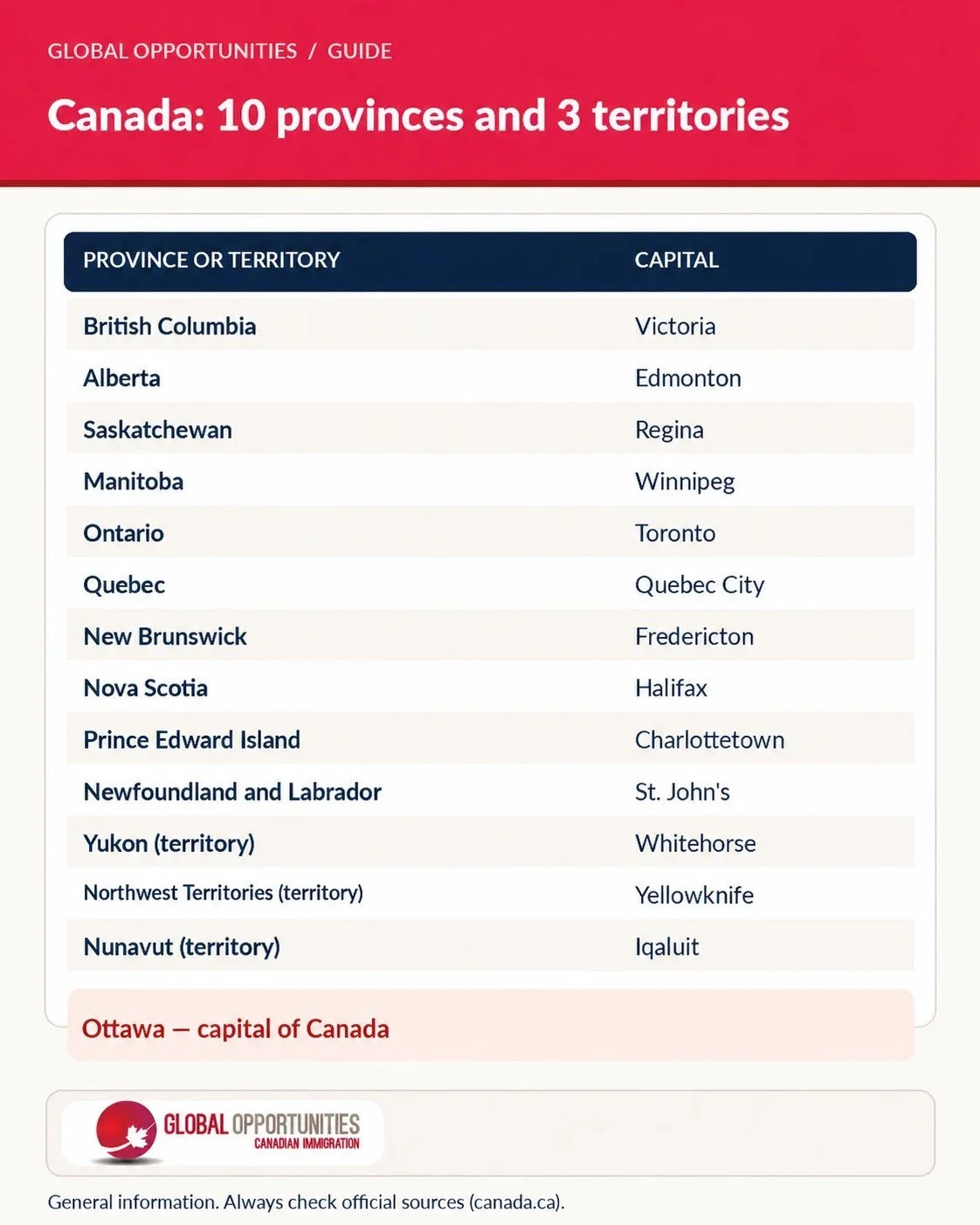
According to the Government of Canada's official pages on provincial and territorial symbols:
Yukon became a separate territory in 1898, when it was split from the Northwest Territories. Its capital is Whitehorse (Canadian Heritage, Yukon).
The Northwest Territories were created in 1870, when the territory was transferred to Canada. Its capital is Yellowknife (Canadian Heritage, Northwest Territories).
Nunavut came into effect on April 1, 1999, when it separated from the Northwest Territories. Its capital is Iqaluit, and its name means "our land" in Inuktitut (Canadian Heritage, Nunavut).
What the three territories have in common, and how they differ
All three have small communities that are often far apart, a strong Indigenous presence, long and very cold winters, higher costs and small job markets where, for most newcomers, a job offer comes before the move. But they are different places:
Yukon is connected to southern Canada by highway, and Whitehorse is by far its largest community. Daily life is mostly in English, with an active francophone community.
The Northwest Territories combine a capital with city services (Yellowknife) and many small, remote communities, some reached only by air or by seasonal winter roads. According to the GNWT, the NWT recognizes 11 official languages (GNWT, Official languages).
Nunavut is the most remote. Travel is mainly by air, bulk goods arrive by sealift in summer, and Inuktut is part of everyday life.
Where are Yukon, the Northwest Territories and Nunavut? Map, location and key facts
Yukon, the Northwest Territories and Nunavut cover Canada's North, from the border with Alaska in the west to Baffin Island in the east. Each capital is also its territory's largest community: Whitehorse, Yellowknife and Iqaluit. Together they had about 139,000 residents in mid-2026, according to Statistics Canada.
The borders below are as shown on the political maps in Natural Resources Canada's Atlas of Canada reference maps. Population and area figures come from Statistics Canada's 2021 Census (table 98-10-0001-01; for communities, table 98-10-0002-01) and its quarterly population estimates (table 17-10-0009-01). The economic summaries come from Job Bank's Economic Scan for Yukon, the Northwest Territories and Nunavut, 2026.
Yukon
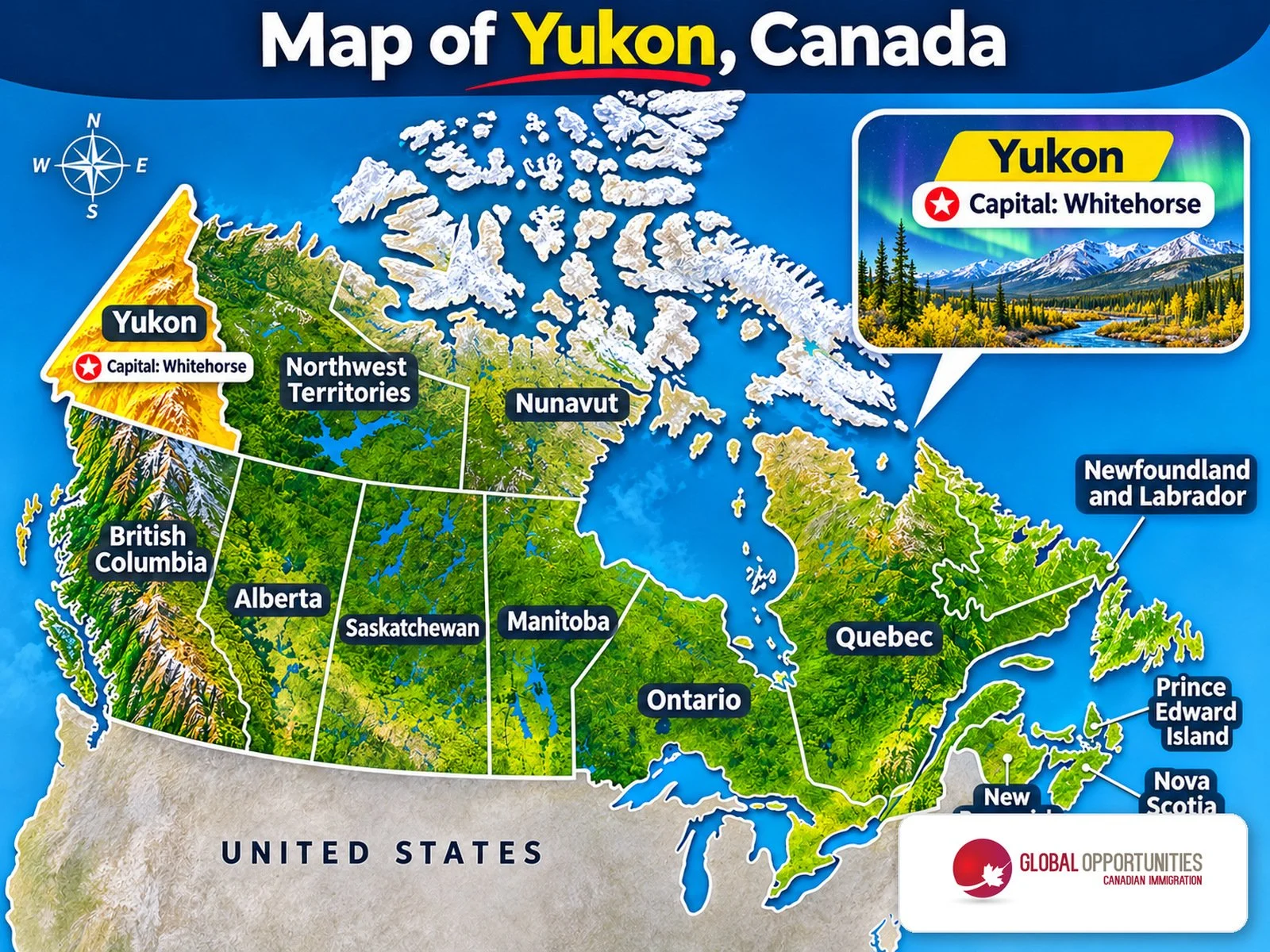
Borders: Alaska (United States) to the west, British Columbia to the south, the Northwest Territories to the east and the Beaufort Sea, in the Arctic Ocean, to the north.
Capital and largest city: Whitehorse, with 28,201 residents in the 2021 Census.
Time zone: the Government of Yukon explains that the territory stopped changing its clocks in 2020 and is permanently seven hours behind Coordinated Universal Time (UTC-7), which it calls Yukon Standard Time (Government of Yukon, Yukon Standard Time).
Land area and population: 472,345 square kilometres of land and 40,232 people in the 2021 Census; Statistics Canada estimated 50,356 people on July 1, 2026.
Economy: Job Bank's 2026 scan says mining is central to Yukon's economy, which contracted in 2025 mainly because the Eagle Gold Mine closed in 2024, and that public administration drove employment gains; Yukon had the strongest employment growth of the three territories in 2025.
Northwest Territories
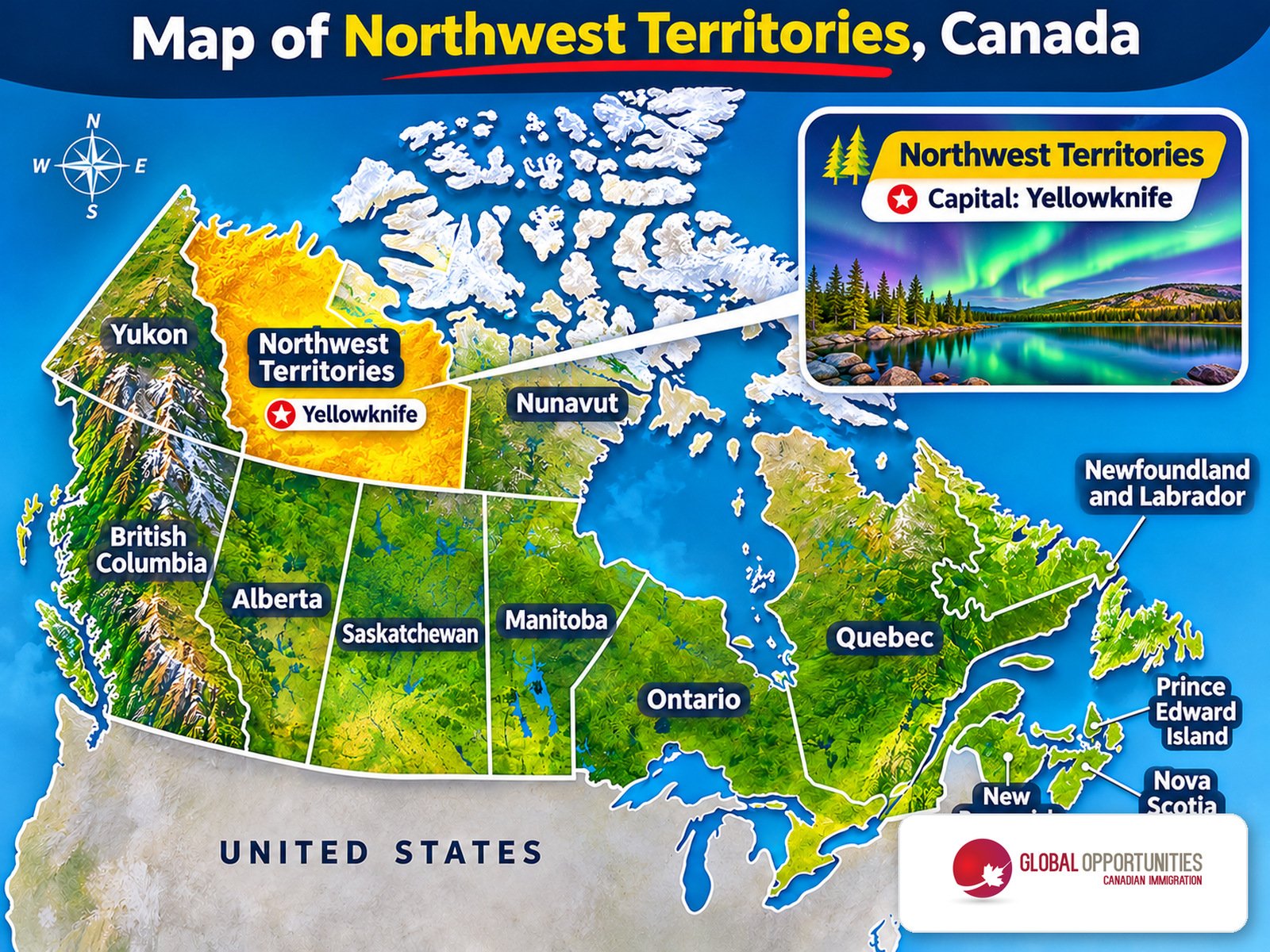
Borders: Canadian Heritage notes that the NWT is bordered by Canada's two other territories, Yukon to the west and Nunavut to the east (Canadian Heritage, Northwest Territories). To the south are British Columbia, Alberta and Saskatchewan, and to the north the Beaufort Sea and the Arctic islands.
Capital and largest city: Yellowknife, with 20,340 residents in the 2021 Census.
Time zone: according to the GNWT, the NWT ended seasonal time changes: since November 1, 2026, its permanent time standard, Northwest Territories Time (UTC-6), is observed all year, and the territory "now shares a common time with both Alberta and Saskatchewan" (GNWT, Northwest Territories ends seasonal time change).
Land area and population: 1,127,712 square kilometres of land and 41,070 people in the 2021 Census; Statistics Canada estimated 45,904 people on July 1, 2026.
Economy: Job Bank's 2026 scan says the NWT economy contracted in 2025 because of lower diamond production, that mining employment is expected to decline as the large diamond mines reach closure, that trade posted the largest job gains, and that health care is expected to grow.
Nunavut
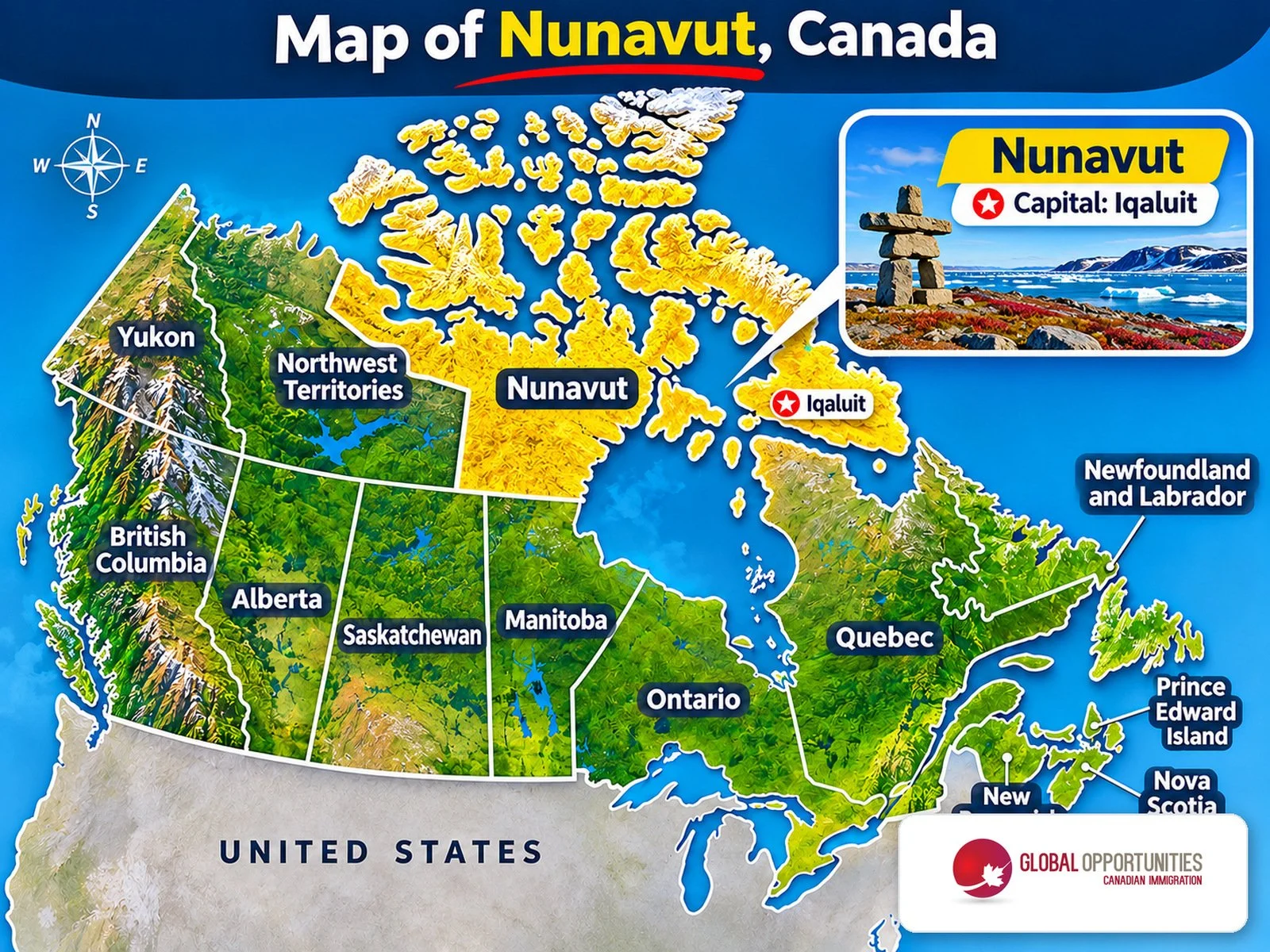
Borders: the Northwest Territories to the west and Manitoba to the south, with Hudson Bay to the south and east, and Baffin Bay and Davis Strait separating Baffin Island from Greenland. Most of Nunavut is made up of Arctic islands.
Capital and largest community: Iqaluit, with 7,429 residents in the 2021 Census; the second-largest was Rankin Inlet, with 2,975.
Time zones: the National Research Council explains that Nunavut spans three time zones (Eastern, Central and Mountain) and that most of the territory changes its clocks in spring and fall, while Southampton Island stays on Eastern Standard Time all year (NRC, time zones and daylight saving time). Check the local time of the community you are going to.
Land area and population: 1,836,994 square kilometres of land and 36,858 people in the 2021 Census; Statistics Canada estimated 43,091 people on July 1, 2026.
Economy: Job Bank's 2026 scan says Nunavut's growth was supported by government-funded infrastructure projects and mining, with higher output from its four operating gold mines, and that the mining sector is expected to grow.
Population by origin: what the census says
Statistics Canada's 2021 Census asked about Indigenous identity, visible minority groups and ethnic or cultural origins. These counts come from the long-form census and cover people in private households. You can explore them in the Census Profiles for Yukon, the Northwest Territories and Nunavut, and in Statistics Canada's tables on Indigenous identity, visible minority and ethnic or cultural origin.
Yukon (39,590 people in private households): about 8,810 people identified as Indigenous (6,935 First Nations, 1,285 Métis and 260 Inuit) and about 5,065 as part of a visible minority group. The largest groups were Filipino (1,945), South Asian (1,035), Chinese (640) and Black (560); about 235 people identified as Latin American, 175 as Japanese and 90 as Korean. The most common ethnic or cultural origins were English, Scottish, Irish, German, Canadian and French, and about 1,975 people reported Ukrainian origins.
Northwest Territories (40,380 people): about 20,035 people identified as Indigenous (12,315 First Nations, 4,155 Inuit and 2,890 Métis), about half the population. About 4,915 identified as part of a visible minority group, mainly Filipino (1,665), Black (1,060), South Asian (775) and Chinese (335); about 125 people identified as Latin American. Common origins included English, Scottish, Irish, Dene, Canadian, French, Inuvialuit and German.
Nunavut (36,605 people): about 31,385 people identified as Indigenous, almost all of them Inuit (30,865). About 1,320 identified as part of a visible minority group, mainly Black (565), Filipino (315) and South Asian (175); about 60 people identified as Latin American.
These counts describe the population in 2021. They are context for newcomers, not a ranking of communities, and the next census will update them.
Census figures and population estimates as published by Statistics Canada, time zones as published by the territorial governments and the National Research Council, and economic summaries as published by Job Bank, as of November 2026. Census counts are rounded, and people could report more than one origin. Check the linked pages for the current figures.
How to get to Yukon, the Northwest Territories and Nunavut: by plane, car, train or bus
Most newcomers fly to the North, through Whitehorse, Yellowknife or Iqaluit. Yukon and the NWT can also be reached by highway from British Columbia and Alberta, and Yukon from Alaska. There is no passenger train to the territories, and Nunavut is reached mainly by air.
Getting to Yukon
By plane: the main airport is Erik Nielsen Whitehorse International Airport, run by the Government of Yukon (Government of Yukon, Whitehorse airport). Air North, a Whitehorse-based airline, lists destinations that include Vancouver, Victoria, Kelowna, Kamloops, Calgary, Edmonton, Ottawa, Toronto, Yellowknife, Inuvik, Dawson City and Old Crow (Air North, destinations).
By car: NWT Tourism describes driving up the Alaska Highway through Yukon (NWT Tourism, road travel). Before you drive, check 511 Yukon and, in British Columbia, DriveBC.
From Alaska (United States): according to the CBSA, the seasonal Little Gold Creek port of entry operates from the Friday of the Victoria Day long weekend to September 15 each year, and travellers can use the Beaver Creek port of entry as an alternative in winter (CBSA, Little Gold Creek closes for the season). Check the CBSA's rules on what to declare and bring and current hours before you go.
Getting to the Northwest Territories
By plane: Yellowknife Airport is run by the GNWT Department of Infrastructure, which operates 27 airports in the territory (GNWT, airports). As of November 2026, the airport's airlines page lists Air Canada (Edmonton, Vancouver and Toronto), Air North (seasonal service to Whitehorse, plus Ottawa, Toronto and Vancouver), WestJet (Calgary and Edmonton) and Canadian North (Arctic destinations including Inuvik and Iqaluit).
By car: according to NWT Tourism (road travel), you can follow Alberta Highway 35 north to NWT Highway 1 south of Hay River, take Highway 77 from British Columbia to the Liard Trail, or drive the Dempster Highway from Yukon to Inuvik and Tuktoyaktuk. It adds that four car ferries cross unbridged rivers in summer and stop for several weeks during freeze-up and break-up. The GNWT says its highway system includes 3,873 kilometres of all-season highways, winter roads and access roads (GNWT, highway improvement projects). Check DriveNWT before every trip.
Getting to Nunavut
By plane: Iqaluit International Airport's airlines page lists Canadian North, which serves all Nunavut communities and connects Iqaluit with Ottawa and Montréal, and Air Greenland, which offers seasonal flights from Iqaluit to Greenland, plus several charter airlines. As described under "Getting around the North" below, air travel is the main way to travel to and within Nunavut.
By sea: goods arrive by sealift in summer (see "Highways, winter roads and sealift").
By train or bus
VIA Rail's northern route runs between Winnipeg and Churchill, Manitoba (VIA Rail, Winnipeg to Churchill); VIA Rail does not run to the territories. We did not find a scheduled intercity bus service to the territories on an official or operator site, so plan on flying or driving.
Flying to Yukon, the NWT and Nunavut from abroad: airlines and common routes
Based on the airport and airline pages above, as of November 2026:
Whitehorse: Air North's destination list includes Vancouver, Calgary, Edmonton, Ottawa and Toronto. Check the Government of Yukon's airport page for the other airlines that serve Whitehorse.
Yellowknife: flights to Edmonton, Calgary, Vancouver, Ottawa and Toronto, and to Whitehorse in season, with Air Canada, Air North and WestJet; Canadian North flies to other Arctic communities.
Iqaluit: Canadian North to Ottawa and Montréal, and Air Greenland's seasonal flights to Greenland.
We did not find nonstop flights from Europe, Latin America, the United States or Asia to Whitehorse, Yellowknife or Iqaluit on these official pages. Common ways to get there, by region of origin:
From Europe: a flight to a Canadian city with connections north, such as Vancouver, Calgary, Edmonton or Toronto (for Whitehorse and Yellowknife) or Ottawa or Montréal (for Iqaluit).
From Latin America and Mexico: a connection in Vancouver, Calgary, Edmonton or Toronto for Whitehorse and Yellowknife, or in Ottawa or Montréal for Iqaluit.
From the United States: a connection in one of those Canadian cities, or, for Yukon, the drive from Alaska.
From Asia: a connection in Vancouver, Calgary or Edmonton for Whitehorse and Yellowknife.
Routes and airlines change seasonally; check the airport's page and the airlines before you book. Use IRCC's tool to check if you need a visa or an eTA.
Airlines, routes, highways and border crossings as published by Air North, Yellowknife Airport, Iqaluit International Airport, the GNWT, NWT Tourism, VIA Rail and the CBSA, as of November 2026. Schedules change with the seasons and the weather, and a listed destination does not mean a daily or year-round flight: check the linked pages before you travel.
Buying your first home in the territories
Most newcomers to the North rent or live in staff housing first. When you are ready to buy, three federal measures can help first-time buyers: the First Home Savings Account, the Home Buyers' Plan and the home buyers' amount. Whether you qualify depends on your own situation.
First Home Savings Account (FHSA). According to the Canada Revenue Agency, to open one you must be a resident of Canada, at least 18 (or 19 where that is the age of majority), no older than 71 at the end of the year, and a first-time home buyer: you did not live, in the current year or the previous four, in a home that you or your spouse or partner owned (CRA, opening your FHSAs). Contribution limits are on the CRA's FHSA page.
Home Buyers' Plan (HBP). The CRA describes it as a program that lets you withdraw from your RRSPs to buy or build a qualifying home. As of November 2026, the CRA lists a withdrawal limit of $60,000 and a repayment period of 15 years (CRA, what is the Home Buyers' Plan).
Home buyers' amount (line 31270). A non-refundable federal tax credit for first-time home buyers. The CRA says you can claim up to $10,000 for a qualifying home acquired in 2025 (CRA, line 31270).
Each territory's housing corporation may have its own programs; ask the territorial government before you buy. The Canada Mortgage and Housing Corporation has a step-by-step home buying guide, and its Northern Housing Report describes the market in the three capitals (see the housing section). A federal law also temporarily prohibits most non-Canadians from buying residential property, with exceptions for some temporary residents: our newcomer guide to Canada explains what the official pages say.
Rules and amounts as published by the Canada Revenue Agency, as of November 2026. The rules depend on each person, and the CRA decides each case. This is not financial, tax or legal advice: check the CRA pages and your territorial government before you rely on them.
Emergencies and natural hazards in the North
The main natural hazards in the North are extreme cold and winter storms, wildfires and smoke in summer, and, in some communities, spring flooding. Being prepared makes them manageable: keep an emergency kit for at least 72 hours, know your community's alerts and follow official instructions.
Wildfire season: why it happens and what to do
Why and when. The GNWT says the NWT wildfire season begins May 1 and ends September 30, and that these fires are often naturally occurring (GNWT, wildfire operations). The Government of Canada's Get Prepared wildfire page explains that hotter temperatures and drier conditions are changing the frequency and intensity of wildfires.
What to do. The same page recommends a household emergency plan and kit, practising your escape routes, clearing dry debris from around your home, keeping your vehicle fuelled and following official instructions and evacuation orders.
NWT information. The GNWT's wildfire update has a live fire map, regional updates and links to smoke forecasts and road closures. Report a wildfire 24/7 at 1-877-698-3473 (1-877-NWT-FIRE). Its public safety page has notices, alerts and orders, services for evacuees and re-entry after an evacuation.
Yukon and Nunavut. Check the territorial government's emergency and wildfire information as soon as you arrive, and follow local radio and official social media during fire season.
Smoke and air quality. Check Environment and Climate Change Canada's Air Quality Health Index (AQHI); you can set AQHI notifications in the WeatherCAN app.
Emergency alerts and preparedness
Alert Ready is Canada's emergency alerting system. Alerts reach people through television, radio and compatible wireless devices. The federal Get Prepared site explains how to build a kit and a plan. In winter, follow Environment Canada's forecasts and warnings on weather.gc.ca; see also "Driving in extreme cold" and "First-winter checklist for the North".
Radon in Yukon homes
Radon is a natural radioactive gas that can build up indoors, especially in basements. Health Canada's cross-Canada survey found that Yukon, together with Manitoba, New Brunswick and Saskatchewan, had the highest percentages of tested homes above the radon guideline (Health Canada, cross-Canada survey of radon concentrations in homes). Health Canada explains how to buy a test kit or hire a professional, and how to reduce radon levels (Health Canada, radon). Whether you rent or buy, ask whether the home has been tested.
Preparedness and health information as published by the GNWT, the Government of Canada, Health Canada and Alert Ready, as of November 2026. Follow the instructions of local officials in any emergency, and check the linked pages for current alerts.
What is a territory? Territories vs provinces
The difference between a province and a territory is constitutional. According to the Government of Canada, provinces exercise their constitutionally recognized legislative powers, while territories exercise powers delegated by the federal government under the authority of the Parliament of Canada (Government of Canada, provinces and territories).
In daily life, a territory works much like a province: it has its own legislature, health insurance plan, schools, driver's licences and tenancy rules, and your rights as a permanent resident or citizen are the same. The transfer of powers to the territories is called devolution. According to Crown-Indigenous Relations and Northern Affairs Canada (CIRNAC), since the 1960s the territories have taken over matters such as health, education, social services, housing and airports; devolution of lands and resources was completed in Yukon in 2003 and in the NWT in 2014, and on January 18, 2024 the Nunavut Lands and Resources Devolution Agreement was signed (CIRNAC, Nunavut devolution).
For you, this means that almost every service you need in your first weeks is run by the territorial government, and each territory has its own rules. In this guide we explain the three sets of rules separately.
Indigenous peoples, languages and respectful conduct in the North
Canada's North is, first of all, the homeland of First Nations, Inuit and Métis peoples, who have lived here for thousands of years. Their languages, governments and knowledge of the land are part of everyday life in all three territories.
The peoples of each territory
Yukon. According to the Government of Yukon, there are 14 Yukon First Nations, whose traditional territories cover all land in the Yukon, and all 14 First Nations governments are important partners in the governance of the territory. The government lists eight Indigenous language groups: Gwich'in, Hän, Kaska, Northern Tutchone, Southern Tutchone, Tagish, Tlingit and Upper Tanana (Government of Yukon, Indigenous Peoples in the Yukon).
Northwest Territories. According to IRCC, more than half the population is Indigenous, including Dene, Inuit and Métis peoples (Discover Canada).
Nunavut. According to the Government of Canada, Inuit make up about 85% of Nunavut's population and descend from the Thule society, whose presence in the region dates back at least 1,000 years (Canadian Heritage, Nunavut).
Official languages of the NWT and Nunavut, and Inuktut
Northwest Territories: 11 official languages: Dene Kǝdǝ́, Dëne Sųłıné, Dene Zhatıé, Dinjii Zhuʼ Ginjik, English, French, Inuinnaqtun, Inuktitut, Inuvialuktun, nēhiyawēwin and Tłı̨chǫ (GNWT, Official languages).
Nunavut: all Nunavummiut have the right to use and receive services in Inuktut (Inuktitut and Inuinnaqtun), English or French, under the Official Languages Act and the Inuktut Protection Act (Office of the Languages Commissioner of Nunavut). IRCC notes that Inuktitut is the first language in schools. You will see Inuktut written in syllabics on signs and documents.
Yukon: English is the language spoken most (Government of Yukon, learn about working in the Yukon), and you can choose French as your preferred language of care on your health card.
Respectful conduct: what newcomers should know
These are general good practices; each community has its own customs, so ask and listen.
Learn whose traditional territory you live on, and remember that Indigenous governments are governments, often important employers, landlords and service providers.
Listen before you give opinions. The history of colonization, residential schools and relocations is still very present in many communities.
Ask before you take photos of people, homes, ceremonies or harvested animals.
Respect harvesting. Hunting, fishing and gathering (country food) are central to culture and food security. Follow the rules on access to Indigenous lands, and never touch traps, nets or equipment that is not yours.
Learn a few words of the local language, be patient when weather or community events change plans, and take part in feasts, games and volunteering.
Living in Yukon: Whitehorse, Dawson City and Watson Lake
Yukon is the territory of the Klondike Gold Rush, Canada's highest mountain and wide wild valleys. According to the Government of Canada, it is the westernmost and smallest of Canada's three territories, and its capital is Whitehorse (Canadian Heritage, Yukon). Canadian Heritage adds that the name probably comes from a word meaning "great river"; gold discovered in 1896 sparked the Klondike Gold Rush; and the capital moved from Dawson City to Whitehorse in 1953. IRCC adds that Yukon holds Canada's record low temperature, -63°C, and that Mount Logan is Canada's highest mountain (Discover Canada).
Whitehorse: what life is like in the capital
Whitehorse is the capital and by far the largest community (Canadian Heritage, Yukon). The City of Whitehorse works on the traditional territories of the Kwanlin Dün First Nation and the Ta'an Kwäch'än Council, and its website covers property, transit and other city services. Whitehorse has Whitehorse General Hospital and the Whitehorse Walk-In Clinic (Government of Yukon, walk-in clinic), Yukon University's Ayamdigut Campus, on the traditional territory of the Kwanlin Dün First Nation and Ta'an Kwäch'än Council (Yukon University, campuses), the city bus system, the main newcomer organizations, and schools with English, French immersion, French first-language and Catholic programs (Government of Yukon, register your child for school). Expect fewer specialists, stores and flights than in large southern cities.
Dawson City and Watson Lake
Dawson City was Yukon's capital until 1953, according to Canadian Heritage (Canadian Heritage, Yukon), and the City of Dawson calls itself the "home of the Klondike Gold Rush", in the heart of Tr'ondëk Hwëch'in Traditional Territory. Watson Lake is another Yukon town (Town of Watson Lake). Both have a community hospital, a health centre and a Yukon University campus (Government of Yukon, hospitals and health centres; Yukon University, campuses), and both are included, with Whitehorse, in the Yukon Bureau of Statistics rent survey (Yukon Bureau of Statistics, housing statistics). Ask employers about housing before you move: options are limited.
Other Yukon communities and the economy
The Government of Yukon lists community health centres in places such as Haines Junction, Carmacks, Carcross, Mayo, Faro, Teslin, Ross River, Pelly Crossing, Beaver Creek, Destruction Bay and Old Crow (Government of Yukon, hospitals and health centres). Housing, shopping and jobs are limited in small communities, so ask employers about housing before you move. IRCC notes that mining remains a significant part of Yukon's economy (Discover Canada), and government, health care, education, tourism, construction and the trades are other key sources of work. See Job Bank's outlooks for Yukon; outlooks are not job offers.
Living in the Northwest Territories: Yellowknife, Hay River, Inuvik and Fort Smith
The Northwest Territories are a land of great rivers and lakes, diamond mines and famous northern lights. The capital is Yellowknife, which IRCC describes as the "diamond capital of North America" (Discover Canada). According to the Government of Canada, Inuit and First Nations peoples lived here long before Europeans arrived; the territory was transferred to Canada in 1870, and in April 1999 it was divided in two, with the eastern part becoming Nunavut (Canadian Heritage, Northwest Territories).
Yellowknife: what life is like in the capital
According to the NWT Bureau of Statistics, Yellowknife had an estimated 22,858 residents on July 1, 2025, about half the territory's population. The next largest communities were Inuvik, Hay River, Fort Smith and Behchokǫ̀ (NWT Bureau of Statistics, community population estimates). Yellowknife is the centre of government, health care and transportation, with a city bus system and Aurora College's North Slave Campus. The City of Yellowknife's moving checklist tells newcomers to research the climate and cost of living, get the right gear for themselves and their vehicle, check lease terms carefully because local rentals "can be strict", and arrange power and heat, water and sewer, and internet (City of Yellowknife, getting set up). Before you move, read the City's checklist and plan for long, dark winters.
Hay River, Inuvik and Fort Smith
Hay River is among the NWT's largest communities, according to the NWT Bureau of Statistics (community population estimates). The Town of Hay River calls itself the "Hub of the North", and the GNWT's medical travel program also serves residents of the Hay River region (NWT medical travel).
Inuvik is home to Aurora College's Aurora Campus, and Fort Smith to its Thebacha Campus (Aurora College, campuses). The Town of Inuvik and the Town of Fort Smith websites cover municipal services; Inuvik's also covers the Inuvik to Tuktoyaktuk Highway.
In all of them, ask about housing, services and travel before you move.
Smaller NWT communities and the economy
According to the GNWT Department of Infrastructure, the winter road system connects nine remote communities and is typically open from December through April (GNWT Infrastructure, winter driving); the rest of the year, those communities depend mostly on flights. IRCC notes that the North has gold, lead, copper, diamond and zinc mines, and oil and gas deposits (Discover Canada). Main sources of work in the NWT are diamond mining (often on rotation), territorial, federal and Indigenous governments, health care, education and tourism. See Job Bank's NWT outlooks and GNWT careers.
Living in Nunavut: Iqaluit, Rankin Inlet and Cambridge Bay
Nunavut is Canada's newest territory. It was created on April 1, 1999, its name means "our land" in Inuktitut, and its motto is "Nunavut sanginivut" (Nunavut, our strength) (Canadian Heritage, Nunavut). It is a unique place to live, and also one of the most demanding.
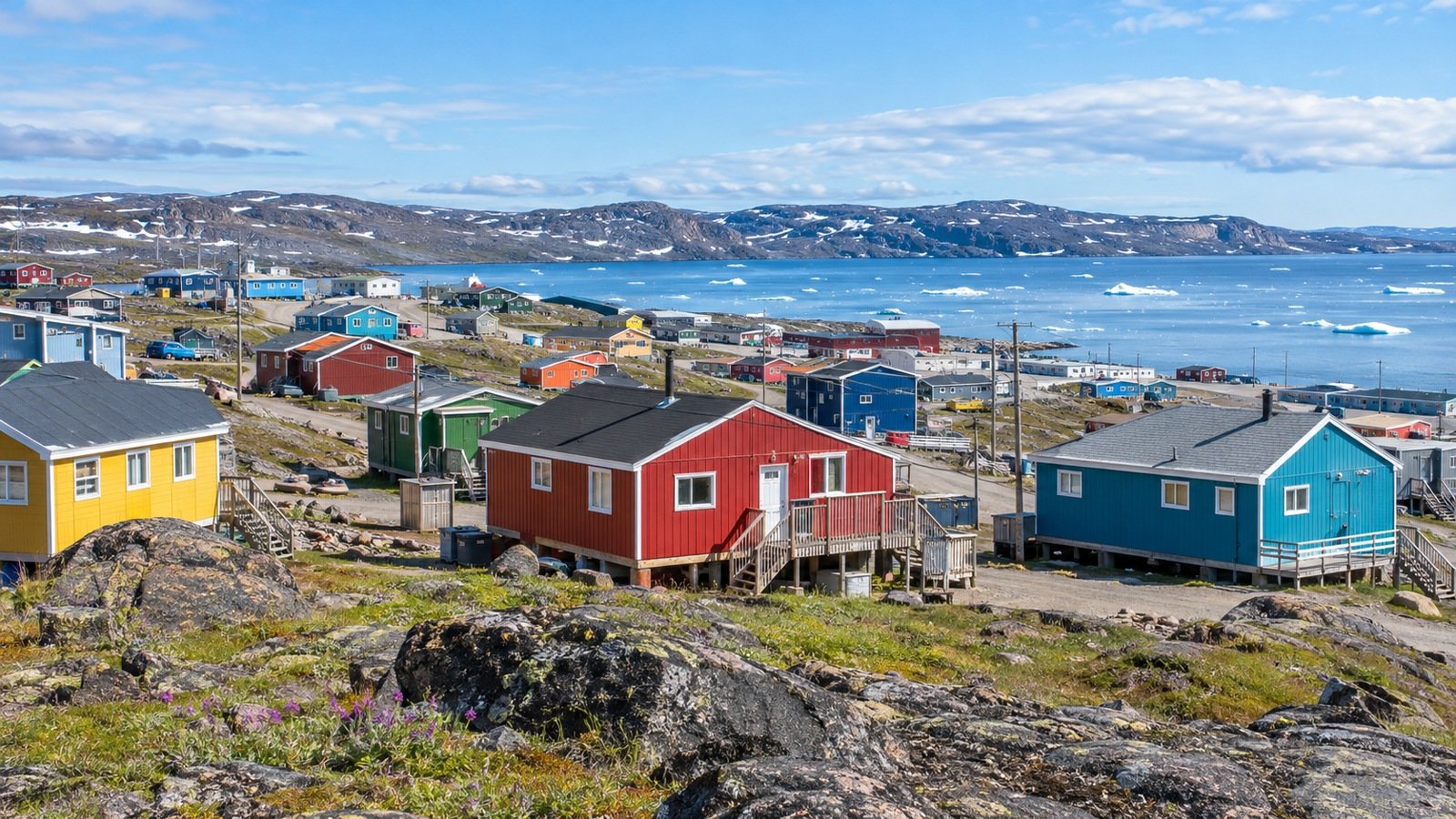
Iqaluit: what life is like in the capital
Iqaluit is the capital (Canadian Heritage, Nunavut), and the City of Iqaluit website covers municipal services. It is home to the Legislative Assembly, the Qikiqtani General Hospital, Nunavut Arctic College's Nunatta Campus and a Motor Vehicles office (Government of Nunavut, Nunavut Health Care Plan; Nunavut Arctic College, campuses; Government of Nunavut, Motor Vehicles offices). The public service is the largest source of work. Housing is the biggest challenge: CMHC reports a rental vacancy rate of about 0.3% in 2025, and that staff and employer-provided housing make up roughly two thirds of the rental stock (CMHC, Northern Housing Report). In practice, most people who move to Iqaluit arrive with a job that includes housing.
Rankin Inlet and Cambridge Bay
Rankin Inlet, in the Kivalliq Region, hosts the Health Insurance Programs Office (Government of Nunavut, Nunavut Health Care Plan), a Motor Vehicles office (Motor Vehicles offices) and Nunavut Arctic College's Kivalliq Campus, which, according to the college, serves seven Kivalliq communities and houses the Sanatuliqsarvik Nunavut Trades Training Centre (Nunavut Arctic College, campuses). See also the Hamlet of Rankin Inlet.
Cambridge Bay, in the Kitikmeot Region, is home to the Kitikmeot Campus, which serves Kugluktuk, Gjoa Haven, Kugaaruk, Taloyoak and Cambridge Bay (Nunavut Arctic College, campuses). See also the Hamlet of Cambridge Bay.
Nunavut's 25 communities and the economy
According to the Government of Nunavut, there is a Government Liaison Office in all 25 communities (Motor Vehicles offices), and Nunavut Arctic College says it has a Community Learning Centre in each (NAC, campuses). Public services, mining, fishing, hunting and the arts are all important; IRCC notes that Inuit art is sold throughout Canada and around the world (Discover Canada). The Government of Nunavut posts its jobs, with dedicated pages for nurses, physicians, midwives and teachers (job listings); see also Job Bank's Nunavut outlooks.
How much is rent in the territories, and where do you find a place?
Housing is the hardest part of moving to the North. Vacancy rates are very low, especially in Yellowknife and Iqaluit, and many small communities have almost no private rental market. Before you accept a job, ask whether housing is included, what it costs, and who pays for heat, power and water.
Median rents in Whitehorse, Yellowknife and Iqaluit: CMHC figures
According to CMHC's Northern Housing Report (published July 29, 2026, with 2025 data) (CMHC, Northern Housing Report), as of November 2026:
Whitehorse: median rent $1,364; vacancy rate 1.9%.
Yellowknife: median rent $1,975; vacancy rate 1.3% (2-bedroom units: 0.8%).
Iqaluit: median rent across all structures $3,025; vacancy rate about 0.3%.
New listings are often above the median. Check the current figures before you budget. The Yukon Bureau of Statistics also publishes a twice-yearly Yukon Rent Survey (housing statistics).
Staff housing, public housing and private rentals
Staff housing from employers (governments, health authorities, school boards, mines) is common; get its rules in writing: rent, utilities, furniture, pets, and what happens if you change jobs.
Public housing from the territorial housing corporations usually has waiting lists; CMHC notes long waitlists in Iqaluit (CMHC, Northern Housing Report). Newcomers who arrive for work should not plan on it.
Private rentals (apartments, rooms, suites, houses) exist mainly in Whitehorse and Yellowknife.
Where to look, and renting a room
Ask your employer first. Then search Kijiji, Facebook Marketplace and local community groups (the City of Yellowknife itself points newcomers to local social media groups to find "a place to stay" (City of Yellowknife, getting set up)), your college's student housing office, and word of mouth: in small towns, many rentals are never posted. Many newcomers start with a room in a shared house or a short-term furnished unit: cheaper and faster, with less privacy. Get every agreement in writing. We mention private websites for reference only. Global Opportunities has no relationship with them and does not recommend any of them.
Tenant rules in Yukon: the Residential Tenancies Office
According to the Government of Yukon, Yukon's Residential Tenancies Act came into effect on September 1, 2025. The Government of Yukon also says (security and pet deposits), a landlord can ask for a security deposit of up to one month's rent (exceptions for weekly tenancies) and a pet damage deposit of up to half of one month's rent; deposits earn interest; tenants need written consent to use the deposit as last month's rent; and both sides should do move-in and move-out condition inspections. Disputes go to the Residential Tenancies Office, an administrative tribunal.
Tenant rules in the NWT and Nunavut: the Rental Offices
NWT: the Rental Office (Department of Justice) gives landlords and tenants free information on their rights and obligations under the Residential Tenancies Act, and handles applications to a rental officer to resolve disputes (GNWT, Rental Office).
Nunavut: the Nunavut Rental Office receives, investigates, mediates and settles complaints, and gives information on security deposits, repairs, renewals and terminations, and the differences between staff housing, private rentals and public housing. Rental Officer orders can be appealed to the Nunavut Court of Justice; federally owned housing is not covered (Government of Nunavut, Rental Office).
Ask the Rental Office about deposit rules before you pay.
Avoiding rental scams, and utilities
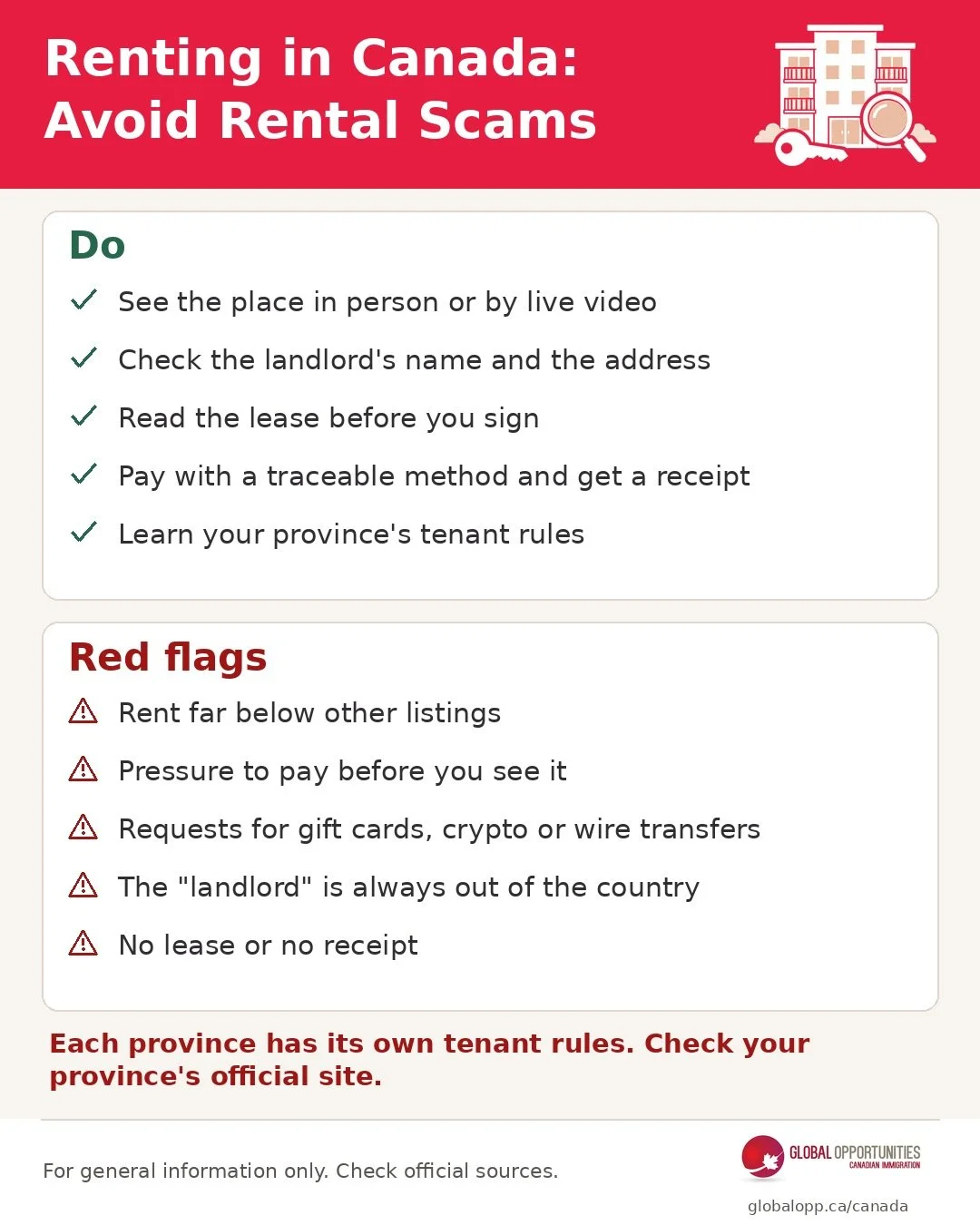
Never send money before you (or someone you trust) have seen the unit and confirmed who owns it. Warning signs: the "landlord" is away and cannot show it, asks for a wire transfer, gift cards or cryptocurrency, the price is far below the CMHC median, or you are pressured to pay immediately. Before you sign, ask whether heat is included (winter bills can be high), whether the home is on piped water or uses tanks served by truck and what the tenant must do, and which internet providers serve the building.
Rents and vacancy rates as published by CMHC (2025 data), and deposit and tenancy rules as published by the Government of Yukon, the GNWT Rental Office and the Nunavut Rental Office, as of November 2026. Medians are not the price of any given unit, and new listings are often higher. Figures and rules may have changed by the time you read this: check the linked pages before you rely on them.
Getting around the North: transit, flights, highways and ice roads
Only Whitehorse and Yellowknife have city bus systems. Elsewhere, people walk, drive, use taxis or travel by snowmobile and ATV. Between communities, travel is by highway in much of Yukon and the NWT, by winter roads in some NWT communities, and by air across Nunavut.
Whitehorse Transit fares
According to the City of Whitehorse (fares), as of November 2026: cash fare $3.50 for all riders; 10-ticket strip adult $33, student/youth $24, elder/senior and paratransit $14; monthly pass adult $87, student/youth $65, elder/senior and paratransit $39. Adult is 19 to 59, youth 5 to 18, senior 60+; up to two children under 5 ride free with an adult. Transfers last 90 minutes. You can buy tickets in the Token Transit app or at City Hall and other listed locations. Check the current price before you travel.
Yellowknife Transit fares
According to the City of Yellowknife (fares), as of November 2026: single or cash fare $2 (exact change); 10-ride pass $18 full, $12 discounted; 31-day pass $75 full, $50 discounted; annual pass $750 full, $500 discounted. Discounts apply to seniors (60+), students, persons with disabilities and registered YATS/YKFlex users; children 12 and under ride free with a fare-paying adult (up to four). Passes are sold at City Hall and listed businesses. Check the current price before you travel.
Fares as published by the City of Whitehorse and the City of Yellowknife, as of November 2026. Age limits and discount eligibility differ between the two cities. Fares may have changed by the time you read this: check the linked pages before you travel.
Iqaluit, smaller communities and flights
We did not find a municipal bus system in Iqaluit or the smaller communities; ask your employer or the local office about options such as taxis. Air travel connects the capitals with the south and with small communities; in Nunavut, it is the main way to travel, and the Government of Nunavut runs the community airports (airports). Book early, expect weather delays, check baggage rules before your move, and ask whether your contract includes relocation or annual travel.
Highways, winter roads and sealift
Highways: Yukon and the NWT have all-season highways that connect many communities with southern Canada (and, in Yukon's case, with Alaska). Distances are long and services far apart. Check 511 Yukon or DriveNWT before every trip.
Winter and ice roads (NWT): temporary routes of snow and ice across frozen lakes, rivers and trails, connecting nine remote communities, typically open from December through April, with dates "heavily dependent on weather and ice conditions". In that season they are the main way fuel and supplies reach those communities (GNWT Infrastructure, winter driving). Follow posted speed and load limits.
Sealift (Nunavut): the Government of Nunavut calls sealift "a vital link" for the annual re-supply of goods, typically between late June and late October. Residents can use the designated carriers to order non-perishable food and household goods for the year; respect your community's cutoff dates (sealift services).
Driving in Yukon, the NWT and Nunavut: licences, insurance and winter
Each territory has its own driver licensing rules, deadlines and list of recognized foreign licences. Read your territory's rules before you arrive, because some deadlines start the day you move.
Yukon: transferring a foreign or out-of-territory licence
According to the Government of Yukon (transfer your driver's licence):
You must transfer your licence within 120 days of moving, or within 30 days if you have an air-brake endorsement.
Licences recognized in the Yukon come from Canada, the United States, Taiwan, Germany (a sign test is required) and the Isle of Man.
If you have held your licence for less than 2 years outside Canada, you must enrol in the Graduated Driver's Licensing (GDL) program.
You surrender your old licence, pay the fee, and provide 1 proof of identity and 2 proofs of residency.
A vehicle you bring must be registered in the Yukon within 7 days if you are working, or 60 days if you are not, with valid Yukon insurance.
If your licence is from a country not on the list, you generally go through the licensing process as a new driver. Confirm your case with Motor Vehicles.
Yukon's graduated licensing: learner and novice stages
According to the Government of Yukon (get a driver's licence):
Learner stage: at least 15 years old, valid ID and proof of residency, and a written test and vision test. As of November 2026, the written test fee is $20 (check the current price). You drive only with a co-driver who has held a class 5 licence for at least 2 years, between 5 am and midnight, with zero alcohol or drugs, no electronic devices, no trailer, a maximum of 2 passengers (more if immediate family) and an "L" sign. You log at least 50 hours of practice and stay at least 6 months.
Novice stage: at least 16, 6 months as a learner and 50 hours of driving to take the road test, which costs $20 as of November 2026 (check the current price). Novices need a co-driver between midnight and 5 am (work exemptions may apply), keep zero tolerance for alcohol and drugs, cannot use devices or tow a trailer, and stay at least 18 months in this stage.
Full licence: after the novice stage, you apply at any Motor Vehicles office.
Northwest Territories: foreign licences and transfers
According to the GNWT Department of Infrastructure (information for foreign nationals; transfer a licence to the NWT):
A foreign national living in the NWT can drive with a valid licence from another country and an International Driving Permit (IDP). IDPs are valid for 12 months and equal an NWT Class 5 licence.
If you are applying for a licence in Canada for the first time, you may be able to transfer your foreign licence if your country is eligible; otherwise you must pass a knowledge test for a learner's permit and a road test. Ask your Driver and Vehicle Services Office.
With a licence from another Canadian province or territory, you have 30 days to transfer it after moving.
To update an NWT licence you need legal status in Canada; if your permit expires within 90 days, you must wait for the new permit or proof of PR.
If you need an IDP, find out in your home country, before you leave, how to obtain one there.
Nunavut: new resident licences
According to the Government of Nunavut (apply for a driver's licence; driver's manuals):
New residents must apply for a Nunavut licence within 30 days of moving; if your licence has been expired for more than 12 months, you must take an examination.
You apply at your local Motor Vehicle service provider with the application, a remittance slip and two pieces of acceptable ID (such as a passport, current licence or immigration authorization).
Nunavut also has a restricted licence for driving only in Nunavut or only within 100 kilometres of your home community.
Motor Vehicles offices are in Iqaluit, Rankin Inlet and Gjoa Haven, and Government Liaison Offices serve all 25 communities (Motor Vehicles offices).
Whether you can exchange a foreign licence without tests depends on your country; confirm with Motor Vehicle Services.
Car insurance in the territories
You buy car insurance from private insurers, through an agent or broker. According to the Government of Yukon, auto insurance is mandatory, bought from a private insurer "not from the government like in some other provinces", under a tort-based, at-fault model (Government of Yukon, learn about getting insurance). Insurers are regulated by each territory's Superintendent of Insurance, for example the NWT Office of the Superintendent of Insurance and the Nunavut Superintendent of Insurance. This list of regulators is for reference only and may not be complete; confirm details with each regulator. Your price depends on your driving history (bring a letter from your home insurer), the vehicle, where you live and how much you drive. Compare several quotes.
Renting a car when you arrive
Each rental company sets its own rules on minimum age, accepted licences and payment, so check before you book. As an example, one major company lists a minimum rental age of 21 in Yukon, the NWT and Nunavut (Enterprise, rental age by province), and its FAQ says digital licences are not accepted, an International Driving Permit is recommended for licences in a Latin alphabet that are not in English and required for licences in a non-Latin alphabet, and you cannot rent with the IDP alone (Enterprise, licence requirements). An IDP is only valid with a valid licence and is issued in the country that issued your licence (in Canada, CAA issues IDPs to holders of Canadian licences: CAA, International Driving Permit). Ask the company whether it needs a credit card in the driver's name, whether winter tires and a block heater cord are included, and whether gravel highways or winter roads are allowed.
Driving in extreme cold: block heaters and winter kits
Most northern vehicles have a block heater, an electric engine heater that you plug into an outdoor outlet so the vehicle starts in extreme cold. Ask your landlord and employer whether your parking spot has a plug, and check the cord for damage.
The GNWT Department of Infrastructure recommends checking road conditions, sharing your travel plans, using good winter tires, cold-temperature washer fluid and a scraper, keeping a full tank, and carrying a winter travel kit: a two-way radio or satellite phone, flares or reflective triangles, a shovel, sand or cat litter, a tow rope, booster cables, a flashlight, fire-starting materials, a spare tire and extra fuel, warm clothing, blankets or sleeping bags, non-perishable food, water and a first-aid kit. On the road, keep at least half a tank, check tire pressure often, drive with headlights on and watch for black ice (GNWT Infrastructure, winter driving).
Deadlines, fees and licence rules as published by the Government of Yukon, the GNWT Department of Infrastructure and the Government of Nunavut, and rental requirements as published by the company cited, as of November 2026. Whether your foreign licence can be exchanged, and with which tests, is decided by each territory's Motor Vehicles office for your own case. Check the linked pages before you rely on them.
How do newcomers get health care in the territories? Health cards, 811, emergencies and medical travel
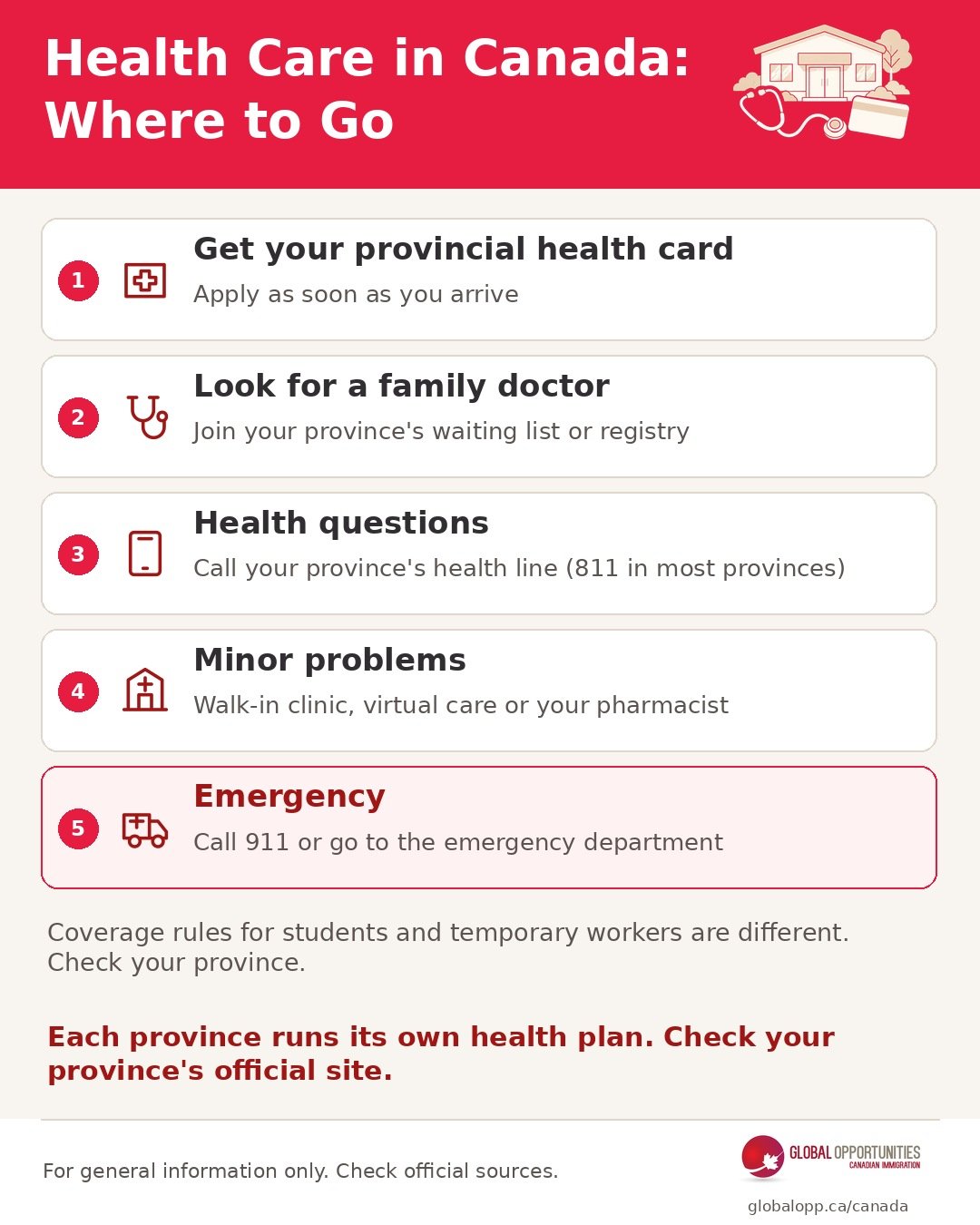
Each territory has its own public health insurance plan, with its own eligibility rules and waiting periods. Apply as soon as you arrive, and plan private insurance for any gap. In small communities, care is usually provided by nurses at a community health centre, and patients travel to a larger centre for tests, specialists or hospital care.
New to how public health care works? Read the health care system in Canada.
Yukon Health Care Insurance Plan (YHCIP)
According to the Government of Yukon (apply for a Yukon health care card):
Who is eligible: Canadian citizens or people with immigration status who make their permanent home in the Yukon and are present there (not absent more than 6 months without telling the plan). People on a Yukon-specific or open work permit valid for at least 1 year can apply. People on a study or tourist visa cannot apply; people with refugee status may be eligible.
Waiting period: new and returning residents must wait 3 months for coverage to start. Apply when you arrive, because delays can affect your eligibility date. If you move from another province or territory, your former plan covers you during the wait.
How to apply: in person in Whitehorse (4th floor, 204 Lambert Street) or through Territorial Agents in rural communities, with your citizenship, PR or work permit documents, a secondary ID and proof of residency (a utility bill, a Yukon pay stub or offer letter, or a signed lease of at least one year). You do not have to wait 3 months before applying.
Finding a family doctor in Yukon, walk-in care and 811
Find a Primary Care Provider: if you have no family doctor or nurse practitioner, register on this list; you must be on it to be matched. You can register if you have YHCIP coverage, are 16 or older and live in Whitehorse or its catchment area (Government of Yukon, find a primary care provider). Outside Whitehorse, community health centres provide care.
Whitehorse Walk-In Clinic (108 Jarvis Street, Unit 103): same-day, non-urgent care for Yukon residents covered by the plan, Monday to Friday. It does not do driver's medicals or immigration or insurance assessments, and the government notes that pharmacists in Whitehorse can treat some minor problems (Government of Yukon, walk-in clinic).
Yukon HealthLine 811: registered nurses answer health questions any time, any day, and can connect you with an after-hours pharmacist; airtime and long-distance charges may apply (Government of Yukon, 811).
Medical travel: the Medical Travel Program covers emergency air ambulance and travel for medically necessary, insured services not available in your community, to Whitehorse or elsewhere in Canada, and may include flights, mileage and approved meal and accommodation subsidies (Government of Yukon, medical travel).
NWT Health Care Plan
According to NWT Health and Social Services (general information for residents):
Who is eligible: people lawfully entitled to be in Canada who make their home in and are "ordinarily present" in the NWT, meaning physically present at least 153 days each calendar year.
From outside Canada: provide a valid immigration document. If you are on a work permit, study permit or another immigration document, contact the Health Services Administration Office about your case.
From elsewhere in Canada: you become eligible on the first day of the third month after the month you became a resident (arrive July 4, eligible October 1).
How to apply: send the NWT Application for Health Care (also at hospitals and health centres) with two proofs of NWT residence, such as a lease, rent receipt, landlord letter, utility bill, pay stub or bank statement. Cell phone bills, driver's licences and government IDs are not accepted.
Not covered: drugstore medicine, eyeglasses, dental care and medical supplies (check employer plans, GNWT extended benefits or private insurance).
NWT 811 connects you with registered nurses 24/7 for health advice, mental wellness and addiction support, quitting smoking or vaping, and poison control; you can also call 1-844-259-1793. It is not for emergencies (NWT 811).
Medical travel in the NWT: your health care provider submits the referral to your regional NTHSSA Medical Travel Office; you do not arrange it yourself. If approved, supports may include travel to the closest place where care is available, boarding home accommodation and meals, and approved escorts. If you have an NWT health card but no other benefits coverage, you must first apply for Extended Health Benefits (NWT medical travel).
Nunavut Health Care Plan
According to the Government of Nunavut (Nunavut Health Care Plan):
New residents fill out the A-508 New to Nunavut Health Care Coverage Form, also available at community health centres, nursing stations, the Qikiqtani General Hospital and the Health Insurance Programs Office in Rankin Inlet.
You provide two clear copies of identification (a birth certificate, valid passport or valid immigration documents are mandatory, plus one secondary document).
You provide proof of residency confirming you intend to make Nunavut your main place of residence for over 12 months and are not a temporary or rotational worker, such as an employer letter or job contract.
You email or mail everything to the Health Insurance Programs Office in Rankin Inlet, which confirms your eligibility. Report changes of address, long absences or a move away.
Health centres and medical travel in Nunavut. The Government of Nunavut describes Community Health Centres as providing health promotion, illness prevention, primary care and emergency treatment across the territory (health care service delivery). Care is often provided by nurses. For care not available locally, medical travel benefits require enrolment in the plan, pre-approval by a Nunavut health care professional, no other insurance coverage (or coverage used up), and travel that begins in Nunavut; 24-hour toll-free support lines exist for each region (Government of Nunavut, medical travel). When you arrive, learn your health centre's hours and after-hours arrangements, and check the health and emergency numbers for your community with the Government of Nunavut.
Emergencies: 911 in Yukon and the NWT, and emergency numbers in Nunavut
Yukon: 911 has been available across the Yukon since July 28, 2016, from landlines and from mobile phones where there is cell service (Government of Yukon, 911).
Northwest Territories: 911 has been available in all 33 NWT communities since November 4, 2019 (GNWT, 9-1-1 go live).
Nunavut: the Nunavut RCMP reminds residents that Nunavut does not have a 911 service. To reach the RCMP in an emergency, dial the first three digits of your community's local phone numbers followed by 1111; in Iqaluit, for example, that is 979-1111 (Nunavut RCMP, tips for calling in emergencies). Fire and health centre numbers differ by community, so check them with your community's Government Liaison Office or the Government of Nunavut when you arrive, and save them in your phone.
If you call 911 by mistake: the GNWT's 9-1-1 page explains that callers who dial by accident are asked to stay on the line until the call is confirmed to be a non-emergency, and that nothing further happens. It also notes that texting 9-1-1 is not available in the NWT.
Health insurance for temporary residents and students
If you are not yet covered, or not eligible (for example, on a study permit in Yukon), you need private health insurance. Students should check the plan offered or required by their college; workers should ask whether their employer's benefits start on day one and include medical travel, which is expensive in the North. NWT Health and Social Services recommends travel insurance for people without medical travel benefits through an employer (NWT Health Care Plan: general information).
Eligibility rules and waiting periods as published by the Government of Yukon, NWT Health and Social Services and the Government of Nunavut, as of November 2026. Having a permit or a lease does not by itself make you eligible: each territorial health plan decides your eligibility and your coverage start date. Check the linked pages before you rely on them.
Banking in Yukon, the NWT and Nunavut
Open a bank account in your first days. Branches are concentrated in the capitals; in small communities there may be few or none, so online banking is essential.
Large national banks such as RBC, TD, Scotiabank, BMO and CIBC operate across Canada; use each bank's online branch locator to see what exists in your community. Banks often advertise newcomer offers; compare fees and the cost of sending money abroad. Credit unions and online banks are other options. We mention financial institutions for reference only. Global Opportunities has no relationship with any of them and does not recommend any.
The Financial Consumer Agency of Canada explains what identification banks require (FCAC, opening a bank account): usually your passport and immigration document. Set up mobile banking before you go to a small community, carry some cash for outages, build credit with a secured or starter card paid in full, and compare the cost of sending money abroad.
Groceries, food costs and Nutrition North Canada
Food in the North costs more than in the south, and much more in small fly-in communities than in the capitals, because food travels very long distances, often by plane.
Where people shop
Whitehorse and Yellowknife have supermarkets, national chains, pharmacies and co-operatives (the Government of Yukon, for example, lists Shoppers Drug Mart, Save-On-Foods, Walmart and Superstore pharmacies in Whitehorse). Iqaluit has a few larger stores. Small communities often have a Northern store and/or a local co-operative. The North West Company says many of its store locations in Northern Canada and Alaska have operated for over 200 years (The North West Company), and its Northern store locator lists stores in Nunavut communities such as Iqaluit, Rankin Inlet and Cambridge Bay, and NWT communities such as Inuvik (Northern, store locations). Use each store's locator to confirm what exists in your community. We mention stores for reference only. Global Opportunities has no relationship with any of them.
Nutrition North Canada
According to the Government of Canada (Nutrition North Canada; how it works):
The subsidy covers eligible nutritious foods and certain non-food items, such as diapers and personal hygiene products, sold by registered retailers, suppliers, country food processors and local food growers in eligible communities.
For-profit businesses must pass on the full subsidy to consumers, and larger retailers must show it on receipts.
Individuals, schools and small retailers can use direct orders from registered suppliers.
The program also includes the Harvesters Support Grant and the Community Food Programs Fund for traditional hunting and harvesting, and nutrition education.
To manage costs, plan your shopping around deliveries, use sealift or direct orders for non-perishables, ask coworkers how they shop, and learn about country food with respect: in many communities it is shared within families and the community.
How cold is Canada's North, and how do you prepare for extreme cold?
The northern climate is the biggest adjustment for most newcomers: long, very cold winters with little daylight, and short, cool summers with very long days. With the right clothing and habits, people live and enjoy the outdoors all year.
How cold it gets: official climate normals
According to Environment and Climate Change Canada's Canadian Climate Normals for 1981 to 2010 (mean daily temperature at each airport station) (ECCC, climate normals):
Whitehorse: about -15.2°C in January and 14.3°C in July.
Yellowknife: about -25.6°C in January and 17.0°C in July.
Rankin Inlet: about -30.8°C in January.
Cambridge Bay: about -32.0°C in January.
Cold snaps are much colder, and wind chill makes it feel colder still. Look up your own community on the ECCC site.
Darkness, midnight sun and the northern lights
IRCC notes that in the North, daylight can last up to 24 hours at the height of summer, and in some areas the sun disappears in winter and darkness sets in for months (Discover Canada); the farther north, the longer the winter nights and summer days. Winter darkness can affect sleep and mood: keep a routine, get outside in daylight, stay active and connected, and talk to a health professional (or call 811 in Yukon or the NWT) if you feel low for a long time. Blackout curtains help with the midnight sun. And on clear, dark nights, the aurora borealis is one of the great rewards of northern life; northern lights viewing is an important part of winter tourism, especially in the NWT.
What clothing to buy, and where
Dress in layers: a thermal base layer (merino or synthetic, not cotton), a fleece or wool middle layer, and a long, insulated, windproof parka with a hood. Add insulated boots rated for very low temperatures, wool socks, mitts with liner gloves, a hat that covers your ears, a neck warmer or face mask, snow pants and ice grips.
In Whitehorse and Yellowknife, national chains such as Canadian Tire and Mark's, outdoor stores and local businesses sell winter gear; check each store's locator for your community. In small communities, the Northern store or the local co-op usually sells parkas, boots and mitts, and local artisans make traditional clothing. Many people buy the basics before moving to a small community, and second-hand gear circulates in local online groups. We mention stores for reference only and have no relationship with them.
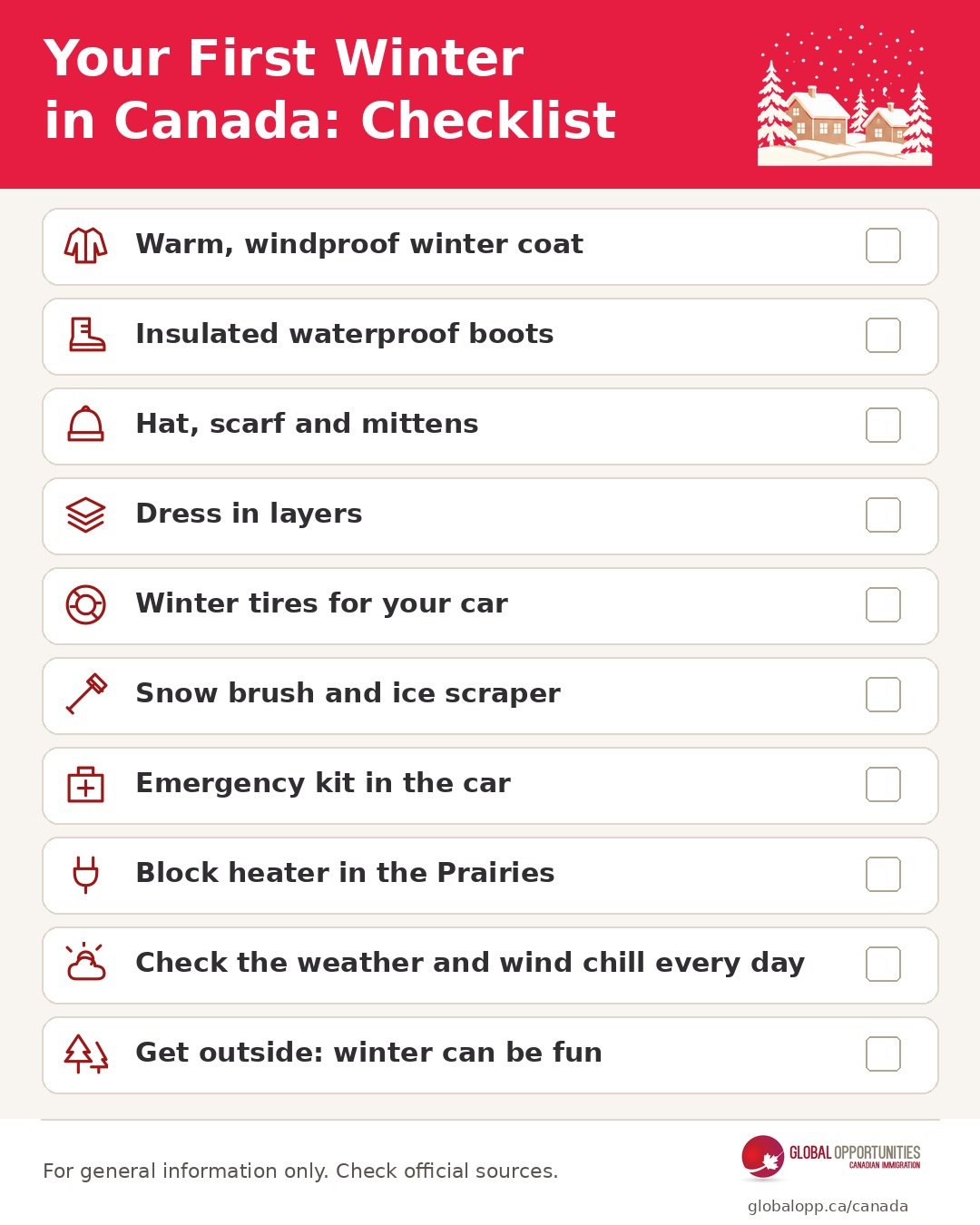
First-winter checklist for the North
Buy boots, a parka, mitts and a hat before the first cold snap.
Check your heating and know how to report a problem.
If you drive, install winter tires, check your block heater and pack a winter kit.
Save local emergency numbers and check road conditions before every trip.
Never go on lake or river ice unless you know it is safe, and tell someone where you are going.
Learn the signs of frostbite and hypothermia, and cover exposed skin in strong wind.
Education in the territories: schools, Yukon University, Aurora College and Nunavut Arctic College
Public school is free for resident children, and each territory has one main public post-secondary institution, with a main campus and community campuses or learning centres.
Public schools (K-12)
Yukon: families choose among English programs, French programs and Catholic education, and every school has an attendance area based on your home address; you can apply for an out-of-area transfer, and Catholic, French and First Nation School Board schools have wider areas (Government of Yukon, register your child for school). In Whitehorse, registration is online; in rural communities, at the school.
NWT: the Department of Education, Culture and Employment oversees JK-12 education (GNWT ECE), with French-language options in some communities.
Nunavut: IRCC notes that Inuktitut is the first language in schools (Discover Canada).
To register, contact the school and bring your child's birth certificate or passport, immigration documents, proof of address and previous school records.
Yukon University
Yukon University (YukonU) says it has "13 campuses located throughout the Yukon": the Ayamdigut Campus in Whitehorse, a campus at the Whitehorse Correctional Centre, and community campuses in Carcross, Carmacks, Dawson City, Faro, Haines Junction, Mayo, Old Crow, Pelly Crossing, Ross River, Teslin and Watson Lake (Yukon University, community education). Areas of study include business and leadership; health, education and human services; trades and apprenticeships; science; social sciences and humanities; Indigenous governance; culinary arts; and northern mining innovation (Yukon University).
Aurora College
Aurora College has three campuses: North Slave (Yellowknife), Thebacha (Fort Smith) and Aurora (Inuvik), plus community-based and distance delivery (Aurora College, campuses). Its program areas include Health and Human Services (such as a Bachelor of Science in Nursing, a Practical Nurse diploma and a Personal Support Worker certificate), Arts and Science (such as Environment and Natural Resources Technology), Business and Leadership, Education (such as Early Learning and Child Care), Academic Upgrading, and Trades, Apprenticeship and Industrial Training (Aurora College, programs). Check the official site for current programs and admission requirements.
Nunavut Arctic College
Nunavut Arctic College (NAC) has Community Learning Centres in all 25 communities, each staffed by an Adult Educator, and regional campuses in Iqaluit (Nunatta), Rankin Inlet (Kivalliq, with the Sanatuliqsarvik Nunavut Trades Training Centre) and Cambridge Bay (Kitikmeot) (NAC, campuses). Its program areas include Health and Wellness, Education, Business, Law, Arts, Inuit Culture and Language, and Trades and Technology, and it runs the Nunavut Research Institute and the Piqqusilirivvik cultural school (Nunavut Arctic College).
This list is for reference only. Institutions change their programs, campuses and admission requirements; always confirm on the institution's official website.
International students and language classes
International students should check that the program is at a designated learning institution and read IRCC's study permit rules (IRCC, study in Canada). Plan housing early, and remember that in Yukon, people on a study visa cannot join the territorial health plan. For English and French, the Government of Yukon lists language training in Whitehorse at the Multicultural Centre of the Yukon, the Association franco-yukonnaise, Yukon University, Yukon Learn and United for Literacy, and IRCC funds free classes for eligible newcomers such as permanent residents (IRCC, language classes).
Study permit rules as published by IRCC, and health plan rules as published by the Government of Yukon, as of November 2026. Being accepted by a school does not mean a study permit will be approved; IRCC decides each case. Check the linked pages before you rely on them.
Jobs and main industries in the territories
Job markets in the territories are small and concentrated in government, health care, education, mining, construction and tourism. For most people coming from outside, the realistic path is to arrive with a specific job offer. Global Opportunities does not offer jobs, and no one can guarantee you a job in Canada.
The main industries
Government: territorial, federal, municipal and Indigenous governments are among the largest employers.
Health care and social services, and education: the Government of Nunavut has dedicated job pages for nurses, physicians, midwives and teachers.
Mining and exploration, often on fly-in, fly-out rotations.
Construction and the trades, with short building seasons.
Tourism and hospitality, often seasonal, and transportation and logistics (airlines, trucking, winter roads, sealift).
Where to look for work
Government of Yukon job postings; the Government of Yukon also lists Job Bank, Employment Central and Yuwin for foreign workers (immigrate to the Yukon).
Employers directly: hospitals, colleges, municipalities, mining companies and Indigenous governments and corporations.
Before you apply, read our guide to Canadian resumes, cover letters and job interviews.
Tips for a northern job search
Ask about the full package: housing, relocation, flights, rotations and northern allowances.
Check whether your occupation is regulated in the territory. Any mention of regulated occupations is for reference only, may not be complete and must be confirmed with the regulator in that territory. See immigrate to Canada as a professional for how licensing and credential recognition work, and our guide to English and French tests for Canada if your regulator or immigration program asks for a language test.
Adapt your resume to the Canadian format, using the guide linked above, and explain your foreign experience in Canadian terms.
Know your rights. In Yukon, the Employment Standards Act covers minimum wage, hours, overtime, vacation and holidays, and you can report an unsafe workplace without being punished (Government of Yukon, learn about working in the Yukon).
Minimum wage in Yukon, the NWT and Nunavut
Each territory sets its own minimum wage, and all three adjust it regularly. As of November 2026, according to the territorial governments:
Yukon: $18.51 per hour since April 1, 2026, up from $17.94. The Government of Yukon explains that the minimum wage increases every year on April 1 and that the increase is tied to inflation, using the Consumer Price Index (Government of Yukon, find the minimum wage).
Northwest Territories: $17.20 per hour since September 1, 2026, up from $16.95 (GNWT, NWT minimum wage set to increase Sept 1, 2026). The Department of Education, Culture and Employment has a minimum wage page with the rules.
Nunavut: the minimum wage is set under Nunavut's labour standards rules and is reviewed regularly. Check the current rate with the Government of Nunavut's Labour Standards Compliance Office.
Minimum wage rates change, so always check the current rate on the official page before you compare job offers, and weigh any offer against the higher prices for housing, food and travel (see "How much does it cost to live in the North?").
Minimum wage rates as published by the Government of Yukon and the GNWT, as of November 2026. A minimum wage is the lowest legal hourly rate, not a typical salary. Rates may have changed by the time you read this: check the linked pages before you compare job offers.
Free newcomer services in the territories
There are fewer settlement organizations in the territories than in the provinces, but free help exists, mainly in the capitals. Contact them early, even before you arrive.
Multicultural Centre of the Yukon (MCY): according to the Government of Yukon, it provides settlement services, such as one-on-one and group sessions, to permanent residents, refugees, Yukon nominees, Canadian citizens and people with a work permit, from its office at 4141-D 4th Avenue in Whitehorse (Government of Yukon, learn about working in the Yukon).
Association franco-yukonnaise (AFY): information and referral services in French for permanent residents and eligible Yukon Nominee Program workers, at 302 Strickland Street in Whitehorse (AFY).
CDÉTNO (NWT): describes itself as the leading organization in the NWT for bilingual Welcome and Integration Services, with information and referral, family and school integration, employability and community services in Yellowknife (CDÉTNO).
Immigrate NWT Welcome Guide: the GNWT's guide to life in the territory (welcome guide). The City of Yellowknife also lists local resources and warns about immigration scams (immigration services).
Nunavut: the Government of Nunavut states that people who obtain permanent residence through a federal program are entitled to free services in the settlement process (immigrate to Nunavut); ask your employer and your community's Government Liaison Office.
Anywhere: IRCC's newcomer services finder lists free, government-funded services, including online ones.
This list of organizations is for reference only and may not be complete; confirm services and eligibility directly with each organization.
Taxes and benefits in Yukon, the NWT and Nunavut
People who live in the territories pay federal income tax plus territorial income tax, and only the 5% GST on most purchases, because, according to the CRA, none of the three territories charges a territorial sales tax (CRA, GST/HST rates). Families may receive the Canada Child Benefit together with a territorial child benefit, licensed child care costs less than it used to, and the northern residents deductions can lower the tax you pay.
All figures below come from the Canada Revenue Agency (CRA) or the territorial governments, as of November 2026. Rates, brackets and benefit amounts change every year, so check the current rate on the official page before you plan your budget.
How income tax works in the territories
In Canada you pay federal income tax and provincial or territorial income tax, and you report both on the same tax return to the CRA. The CRA explains that each rate applies only to the part of your income that falls within that bracket, and that provincial or territorial rates are charged in addition to the federal rates (CRA, tax rates and income brackets for the current year).
According to the CRA (tax rates and income brackets), the federal rates for the 2026 tax year are:
14% on the first $58,523 of taxable income
20.5% on income over $58,523 up to $117,045
26% on income over $117,045 up to $181,440
29% on income over $181,440 up to $258,482
33% on income over $258,482
Yukon income tax rates
According to the CRA (tax rates and income brackets), the Yukon rates for the 2026 tax year are:
6.4% on the first $58,523 of taxable income
9% on income over $58,523 up to $117,045
10.9% on income over $117,045 up to $181,440
12.8% on income over $181,440 up to $500,000
15% on income over $500,000
Northwest Territories income tax rates
According to the CRA (tax rates and income brackets), the NWT rates for the 2026 tax year are:
5.9% on the first $53,003 of taxable income
8.6% on income over $53,003 up to $106,009
12.2% on income over $106,009 up to $172,346
14.05% on income over $172,346
Nunavut income tax rates
According to the CRA (tax rates and income brackets), the Nunavut rates for the 2026 tax year are:
4% on the first $55,801 of taxable income
7% on income over $55,801 up to $111,602
9% on income over $111,602 up to $181,439
11.5% on income over $181,439
These are marginal rates, not the share of your whole income that goes to tax. Credits and deductions, such as the northern residents deductions below, reduce what you actually pay. Check the current rate on the CRA page each year.
Sales tax: only the 5% GST
The CRA's GST/HST rate table lists Yukon, the Northwest Territories and Nunavut at 5% GST and 0% provincial or territorial sales tax, as of November 2026 (CRA, GST/HST rates by province and territory). That means there is no HST and no PST in the territories, unlike in most provinces. Prices in the North are still often higher for other reasons, such as transportation (see "Groceries, food costs and Nutrition North Canada"). Check the current rate on the CRA page.
The Canada Child Benefit (CCB)
The CCB is a federal monthly payment for families with children under 18, administered by the CRA. According to the CRA, you must live with a child under 18, be a resident of Canada for tax purposes, and you or your spouse or common-law partner must be a Canadian citizen, permanent resident, protected person, temporary resident or a person registered (or eligible to be registered) under the Indian Act. Temporary residents must have lived in Canada for the previous 18 months and have a valid permit in the 19th month (CRA, CCB: before you apply).
You can apply when you register your newborn's birth where the province or territory offers that option, online through your CRA account, or with Form RC66. Newcomers also send Schedule RC66SCH, Status in Canada/Statement of Income (CRA, how to apply for the CCB).
Territorial child benefits: Yukon, NWT and Nunavut
Each territory has its own child benefit, administered by the CRA and combined with the CCB into a single monthly payment. According to the CRA, as of November 2026:
Yukon child benefit (YCB): a non-taxable monthly amount for low- and modest-income families with children under 18, funded by the Government of Yukon. You may receive $80.50 per month for each child, reduced if your adjusted family net income is above $35,000 (CRA, Yukon programs).
Northwest Territories child benefit: a non-taxable monthly amount for qualifying low- and middle-income families with children under 18, fully funded by the GNWT. If your adjusted family net income is above $30,000, you may get part of the benefit (CRA, Northwest Territories programs).
Nunavut child benefit (NUCB): a non-taxable monthly amount for qualifying families with children under 18, fully funded by the Government of Nunavut, with a basic benefit of $58.00 per child per month, reduced if your adjusted family net income is above $22,065 (CRA, Nunavut programs).
Amounts and income thresholds change every benefit year, so check the current amounts on the CRA pages.
Affordable child care in the territories
All three territories have lowered parent fees for licensed child care under agreements with the Government of Canada:
Yukon: the Government of Yukon's universal child care model is available to all Yukon families using licensed child care spaces. Parents whose children are registered in licensed child care see their monthly payment go down, without having to do anything. Eligible lower-income families can also apply for the Yukon child care subsidy, applied on top of the universal portion of their fees (Government of Yukon, universal child care).
Northwest Territories: the GNWT's average of $10 a day child care applies to children aged five and younger in licensed early learning and child care programs, since April 1, 2024. All licensed programs receive the subsidy, and families do not need to apply for the reduced fees (GNWT, average of $10 a day child care). Because it is an average, the fee you pay depends on the program.
Nunavut: according to the Government of Canada, families with preschool-aged children at licensed child care centres and licensed home day cares in Nunavut have been able to access $10-a-day child care since December 1, 2022 (Government of Canada, $10-a-day child care in Nunavut).
Licensed spaces are limited in many communities, so contact child care providers as early as you can and ask about waiting lists.
The northern residents deductions
According to the CRA, people who live in a prescribed zone may be able to claim the northern residents deductions on line 25500 of their tax return. You may qualify if you lived in a prescribed zone on a permanent basis for a continuous period of at least six consecutive months (CRA, line 25500). All places in Yukon, Nunavut and the Northwest Territories are in a prescribed northern zone (Zone A), where you can claim the full amount.
Residency deduction: for living costs in the zone. It has a basic amount and an additional amount; the additional amount applies only if you maintained a dwelling and you are the only member of the household claiming the basic amount. For the 2025 tax year, the CRA lists a basic amount of $11.00 per day and an additional amount of $11.00 per day in Zone A (CRA, line 25500).
Travel deduction: for eligible travel expenses for medical or other reasons (such as vacations) for you or an eligible family member. It is limited, among other things, by a standard amount of $1,200 per person per year, according to the CRA (line 25500).
How to claim: you calculate it on Form T2222, Northern Residents Deductions. If you have not yet lived in the zone for six months when you file, file without the claim and ask the CRA to adjust your return later.
Check the current amounts on the CRA page, and check your own case with the CRA or a tax professional. If your employer pays travel benefits or provides housing, ask how they affect your claim.
Tax rates, benefit amounts and deductions as published by the Canada Revenue Agency, and child care information as published by the Government of Yukon, the GNWT and the Government of Canada, as of November 2026. Marginal rates are not the share of your income that goes to tax, and eligibility for each benefit or deduction depends on your situation; the CRA decides each case. Check the linked pages before you rely on them.
How much does it cost to live in the North?
Living in the North is generally more expensive than in the south: housing, food, heating, flights and goods all cost more, and costs rise with isolation. Some jobs pay more or include housing or allowances, but the balance depends on your situation.
Budget for housing (see the CMHC medians above), food (much higher in fly-in communities), heating and power, a reliable winter vehicle or flights, winter clothing, and trips south.
Some of that is offset by the tax side: there is no territorial sales tax, and residents may be able to claim the northern residents deductions (see "Taxes and benefits in Yukon, the NWT and Nunavut"). Check your case with the CRA or a tax professional.
For a national overview, see our article on the cost of living in Canada.
Before you accept a northern job, ask: Is housing included, and what will I pay for rent and utilities? Are relocation and flights covered? Is there a northern allowance or travel benefit? What covers medical travel and the health plan waiting period? What does a week of groceries cost there? Are there a school, child care and internet suitable for my family?
Community, culture and the outdoors in Yukon, the NWT and Nunavut
People who thrive in the North usually say the community and the land make up for the cold and the distance.
Community life: winter and summer festivals, cultural celebrations, community feasts and volunteering (search and rescue, sports, food programs) are the best ways to meet people. The City of Yellowknife lists local media such as CBC North, Cabin Radio, CKLB Radio, NNSL and the French-language Ténois Media, plus community social media groups (getting set up).
Francophone and other communities: the francophone community is active in Whitehorse and Yellowknife (AFY, CDÉTNO). Latin American and other immigrant communities are small but exist, mostly in the capitals; ask the settlement organizations how to connect.
The outdoors: hiking, canoeing, fishing and camping under the midnight sun; cross-country skiing, snowshoeing, dog sledding, ice fishing and the northern lights in winter. Weather changes fast, cell coverage is limited and wildlife is part of the landscape, so carry the right gear and always tell someone your plans.
Settling in is also about people: read our article on building community in Canada.
The North can suit people with a clear plan: a job offer, experience in a needed field, good English (or French in some roles), and real interest in small-community life and Indigenous cultures. It may be harder if you need a large job market or big-city services close by.
How can you immigrate to Yukon, the Northwest Territories or Nunavut?
There is no single "northern visa". People move to the territories through federal programs run by IRCC, through the Yukon or Northwest Territories nominee programs, or with a temporary permit to work or study. Programs, requirements and fees change frequently, so always check the official pages. If you plan to visit first, use IRCC's tool to check if you need a visa or an eTA.
Express Entry and nominee programs
According to IRCC, Express Entry manages applications for permanent residence from skilled workers through the Federal Skilled Worker Program, the Federal Skilled Trades Program and the Canadian Experience Class (IRCC, Express Entry); see also our page on the Federal Skilled Worker program. IRCC's list of nominee programs includes Yukon and the NWT and states that Quebec and Nunavut don't have programs (IRCC, Provincial Nominee Program). A nomination is not permanent residence: the Government of Canada makes the final decision. For an overview of how nominee programs work across Canada, see our page on provincial nominee programs.
The Yukon Nominee Program
According to the Government of Yukon (Immigrate to the Yukon):
Workers apply under the Yukon Nominee Program and entrepreneurs under the Yukon Business Nominee Program; candidates can be inside or outside Canada.
The worker program is driven by employers filling critical vacancies when qualified Canadians or permanent residents cannot be found. You need a full-time, year-round job offer from an eligible Yukon employer; if you cannot find work in the Yukon, you cannot participate.
Streams include Critical Impact Worker, Skilled Worker and Express Entry, determined by the NOC and TEER category of the job offer.
Finding a job is your responsibility; employers are not obligated to nominate and cannot charge or collect a fee for nominating a worker. You do not need to hire a representative to be nominated; it is your choice.
The Northwest Territories Nominee Program
According to the GNWT (Immigrate NWT), you need either a job offer from an NWT employer or a plan to open, buy or invest in a business in the territory, through the Employer-Driven, Business or Francophone stream. When we reviewed the page in November 2026, it said the program had closed its most recent intake after receiving enough applications to fill the nominations allocated by the Government of Canada. Check the page for current intakes.
Nunavut: no nominee program
The Government of Nunavut confirms that there is currently no immigration pathway specifically for Nunavut, and that people who obtain permanent residence through a federal program are welcome in the territory (immigrate to Nunavut). People who want to live there permanently use federal programs, often after working for a Nunavut employer.
After permanent residence, many people apply for citizenship: see our guide to Canadian citizenship.
Nominee programs open and close intakes, change requirements and depend on the nominations the Government of Canada allocates each year. What you read here may already be different. Always check the official pages, and be wary of anyone who promises a nomination, permanent residence or a job. Meeting a program's requirements does not mean an application will be approved: the territory decides on nominations and IRCC decides each permanent residence application. Whether a pathway fits you depends on each case; a consultation is the way to know.
Work permits, study and language tests
IRCC describes employer-specific and open work permits (IRCC, Work in Canada); some employer-specific permits require a Labour Market Impact Assessment. For studies, start with IRCC's study in Canada page. Your permit type can affect territorial services, such as health coverage in Yukon. Most economic programs require an approved English or French test: see our guide to English and French tests for Canada.
If your permit ends within a year, watch Is your work permit or PGWP expiring in the next 12 months?
Work and study permit information as published by IRCC, as of November 2026. Having a job offer or an acceptance letter does not mean a permit will be approved; IRCC decides each case. Which permit, test or program applies to you depends on each case: book a consultation to review yours.
First steps after arriving in the North
Some deadlines start the day you move, and health coverage often has a waiting period, so start right away.
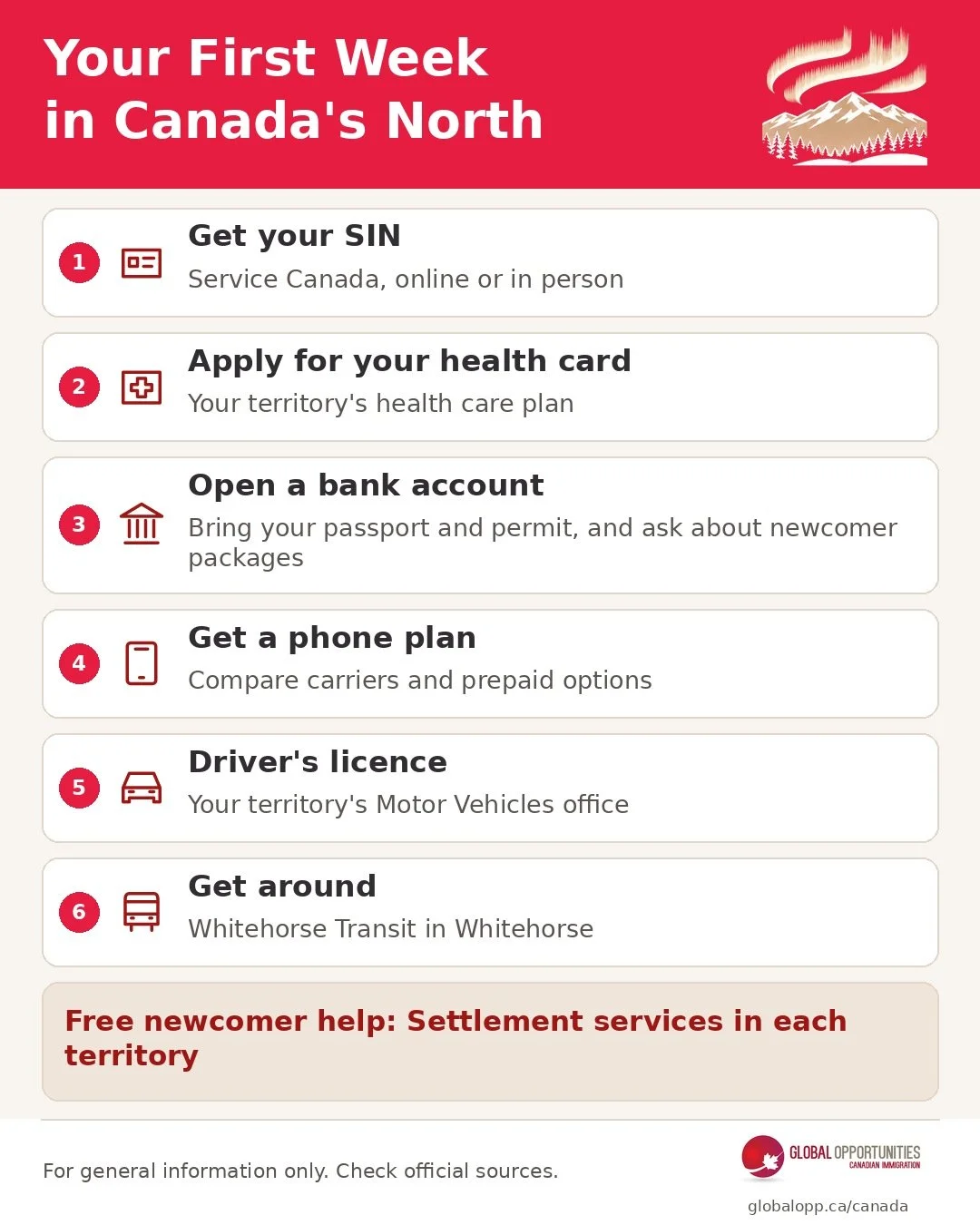
Get your Social Insurance Number (SIN), which you need to work in Canada or to access government programs and benefits (Service Canada, SIN).
Apply for your territorial health card: Yukon (in person), NWT or Nunavut. Keep private insurance until coverage starts.
Collect proof of residence (lease, pay stub, employer letter, utility bill) for your health card and licence.
Open a bank account and set up online banking.
Transfer your driver's licence on time: according to the territorial governments, 120 days in Yukon (Government of Yukon), 30 days in Nunavut (Government of Nunavut), and 30 days in the NWT for licences from other Canadian jurisdictions (GNWT); foreign licences have their own rules.
Register your children for school.
Register with Find a Primary Care Provider in Whitehorse, or visit your community health centre.
Save local emergency numbers; in Nunavut, where there is no 911, save your community's RCMP number (local prefix plus 1111), health centre and fire department.
Contact a free newcomer service: MCY or AFY in Yukon, CDÉTNO in the NWT, or IRCC's finder.
Buy proper winter clothing and prepare your vehicle for the cold.
Frequently asked questions
What are the three territories of Canada?
Canada's three territories are Yukon, the Northwest Territories (NWT) and Nunavut, with capitals in Whitehorse, Yellowknife and Iqaluit. According to IRCC, together they make up about one-third of Canada's land mass (Discover Canada), but far fewer people live there than in the provinces. Each territory has its own government, health plan, driver licensing, schools and tenancy rules, and daily life is very different in each one. Read the section on each territory before you choose where to look for work, and check the official links in each one.
What is the difference between a province and a territory in Canada?
According to the Government of Canada, provinces exercise their own constitutionally recognized powers, while territories exercise powers delegated by the federal government under the authority of Parliament (provinces and territories). Through devolution, the territories have taken over health, education, housing and, more recently, lands and resources. For a newcomer, a territory works much like a province: it runs your health card, driver's licence, schools and tenancy rules, and your rights as a permanent resident or citizen are the same. See "What is a territory? Territories vs provinces".
Is it expensive to live in Whitehorse, Yellowknife or Iqaluit?
Generally yes, and costs rise the more remote the community is. According to CMHC's Northern Housing Report (2025 data), the median rent was $1,364 in Whitehorse, $1,975 in Yellowknife and $3,025 in Iqaluit, as of November 2026 (CMHC, Northern Housing Report); check the current figures. Food, heating and flights also cost more than in the south. Some northern jobs include housing or allowances, and residents may qualify for the CRA's northern residents deductions. Ask any employer about housing and relocation before you accept. See "How much does it cost to live in the North?".
How hard is it to find housing in the territories?
Hard. CMHC's Northern Housing Report (CMHC) reported 2025 vacancy rates of 1.9% in Whitehorse, 1.3% in Yellowknife and about 0.3% in Iqaluit, where staff and employer-provided housing make up roughly two thirds of the rental stock. In small communities there is often no private rental market. Ask your employer about housing before you move, search local listings and groups, consider a room at first, and never pay a deposit for a unit nobody has seen. Each territory has a tenancy office that explains your rights. See the housing section.
How much can a landlord ask for as a security deposit in Yukon?
According to the Government of Yukon (security and pet deposits), under the Residential Tenancies Act in force since September 1, 2025, a security deposit can be up to one month's rent (exceptions apply to weekly tenancies), and a pet damage deposit up to half of one month's rent. Deposits earn interest, and you need the landlord's written consent to use the deposit as last month's rent. Disputes go to the Residential Tenancies Office. In the NWT and Nunavut, ask the territorial Rental Office about deposit rules.
Is there public transit in Whitehorse and Yellowknife?
Yes. According to the City of Whitehorse (fares), as of November 2026, Whitehorse Transit charges a $3.50 cash fare and an $87 adult monthly pass, with 90-minute transfers and tickets in the Token Transit app. According to the City of Yellowknife (fares), Yellowknife Transit charges a $2 cash fare (exact change) and $75 for a full-fare 31-day pass, with discounts for seniors, students and persons with disabilities. Check the current price on each city's fares page. Service is more limited than in big cities, so many residents also drive. See "Getting around the North".
Do I need a car in the North?
It depends on where you live. In Whitehorse and Yellowknife, you can manage near the centre and the bus routes, but a vehicle makes winter life and trips outside town much easier. Between communities in Yukon and the NWT, driving is often the only option besides flying. In Nunavut, travel to the south and between communities is mainly by air. If you drive, you need a territorial licence within the deadline, mandatory insurance, winter tires, a block heater and a winter kit.
Can I drive in the territories with a foreign driver's licence?
Each territory has its own rules. According to the Government of Yukon (transfer your driver's licence), licences from Canada, the United States, Taiwan, Germany (with a sign test) and the Isle of Man are recognized, and you must transfer within 120 days of moving. According to the GNWT (information for foreign nationals), in the NWT a foreign national can drive with a valid foreign licence plus an International Driving Permit; some licences can be transferred, otherwise you take a knowledge and a road test. According to the Government of Nunavut (apply for a driver's licence), new residents must apply within 30 days. Confirm your country's status with Motor Vehicles.
What is a block heater and do I need one?
A block heater is an electric heater in a vehicle's engine that keeps it warm in extreme cold so it starts. You plug it into an outdoor outlet with an extension cord, and many homes and workplaces in the North have plugs in parking spots. Ask your landlord and employer whether your spot has one, and check the cord for damage. Along with winter tires, a full tank and a winter travel kit, it is one of the basics of northern driving. See "Driving in extreme cold".
What are ice roads in the Northwest Territories?
Ice roads and winter roads are temporary roads of snow and ice built each winter across frozen lakes, rivers and overland trails. According to the GNWT Department of Infrastructure (winter driving), the NWT system connects nine remote communities, is typically open from December through April, and its dates depend heavily on weather and ice conditions. During that season, winter roads are the main way fuel and supplies reach those communities. Check DriveNWT before you go, follow posted speed and load limits, and carry a full winter kit.
How do I get a Yukon health card?
Apply to the Yukon Health Care Insurance Plan in person, in Whitehorse or through a Territorial Agent, as soon as you arrive. Bring proof of citizenship, PR status or an open or Yukon-specific work permit valid for at least one year, a secondary ID, and proof of Yukon residency such as a utility bill, a Yukon pay stub or offer letter, or a lease of at least one year. According to the Government of Yukon (apply for a Yukon health care card), new residents wait 3 months for coverage, and people on a study or tourist visa cannot apply.
How do I get an NWT health card?
According to NWT Health and Social Services (general information for residents), you complete the NWT Application for Health Care and send it with proof of your legal right to be in Canada and two documents proving your NWT residence, such as a lease, rent receipt, utility bill or employer letter. Cell phone bills, driver's licences and government IDs are not accepted. If you move from elsewhere in Canada, you become eligible on the first day of the third month after you become a resident. If you are on a work or study permit, contact the Health Services Administration Office.
How do I get a Nunavut health card?
According to the Government of Nunavut (Nunavut Health Care Plan), you fill out the A-508 New to Nunavut Health Care Coverage Form, available online and at health centres, nursing stations, the Qikiqtani General Hospital and the Health Insurance Programs Office in Rankin Inlet. Send it with two clear copies of identification (a passport or valid immigration documents are mandatory) and a proof of residency, such as an employer letter, showing that Nunavut will be your main residence for over 12 months and that you are not a temporary or rotational worker. The office confirms your eligibility.
How do I find a family doctor in Whitehorse?
Register with the Government of Yukon's Find a Primary Care Provider list. According to the Government of Yukon (find a primary care provider), you can register if you have valid Yukon health coverage, are 16 or older, have no family doctor or nurse practitioner, and live in Whitehorse or its catchment area; you must be on the list to be matched. Meanwhile, the Whitehorse Walk-In Clinic offers same-day, non-urgent care on weekdays, pharmacists can treat some minor problems, and HealthLine 811 is available any time. For emergencies, go to Whitehorse General Hospital or call 911.
Is there an 811 health line in the territories?
Yes in Yukon and the NWT. According to the Government of Yukon (811), Yukon HealthLine 811 is staffed by registered nurses any time of day and can connect you with an after-hours pharmacist. According to NWT Health and Social Services (NWT 811), NWT 811 offers registered nurses 24/7 for health advice, mental wellness and addiction support, quitting smoking and poison control. Neither line is for emergencies. In Nunavut, your community health centre is the first place for care; learn its hours and after-hours arrangements, and check health and emergency numbers for your community with the Government of Nunavut.
What number do I call in an emergency in the territories?
According to the territorial governments, 911 has been available across Yukon since 2016 (Government of Yukon), and in all 33 NWT communities since 2019 (GNWT). In Nunavut, which does not have a 911 service, the Nunavut RCMP asks callers to dial the first three digits of the local phone line followed by 1111 (979-1111 in Iqaluit) (Nunavut RCMP); check fire and health centre numbers for your community as soon as you arrive. If you call 911 by mistake in the NWT, the GNWT asks you to stay on the line until the call is confirmed to be a non-emergency (GNWT, 9-1-1 in the NWT). For health questions that are not emergencies, Yukon and the NWT have 811 lines; in Nunavut, contact your community health centre.
How does medical travel work in the North?
When an insured, medically necessary service is not available in your community, each territory's medical travel program may cover travel to the nearest place where it is available, sometimes outside the territory. A health care provider makes the referral and the trip must be approved in advance. Programs may cover flights, accommodation and meals, and approved escorts. In the NWT, residents without other coverage must first apply for Extended Health Benefits. Employer plans may have their own process, so check your benefits when you start a job.
Why is food so expensive in Nunavut and the NWT?
Because most food travels very long distances, often by plane, to small communities with few stores, and perishable food cannot wait for the summer sealift. Costs are generally higher in fly-in communities than in the capitals. According to the Government of Canada (Nutrition North Canada), Nutrition North Canada subsidizes eligible nutritious foods and some non-food items in eligible isolated communities; for-profit retailers must pass on the full subsidy, and larger retailers show it on receipts. Residents also use sealift, direct orders and country food to manage their budgets. See "Groceries, food costs and Nutrition North Canada".
What is Nutrition North Canada?
Nutrition North Canada is a Government of Canada program to make nutritious food more affordable in eligible isolated northern communities (Nutrition North Canada). Its subsidy applies to eligible foods and certain non-food items, such as diapers and hygiene products, sold by registered retailers, suppliers, country food processors and local food growers, and for-profit businesses must pass on the full subsidy. Individuals can also place direct orders. The program includes support for traditional hunting and harvesting and nutrition education. Check whether your community is eligible.
How good is internet in Nunavut and remote communities?
It depends a lot on the community, so check before you move. In December 2023, the Canadian Radio-television and Telecommunications Commission (CRTC) announced funding for SSi Micro to upgrade its satellite internet service, describing it as bringing high-speed satellite internet to all Nunavut communities for the first time, and noted that fibre will take significantly longer to build (CRTC, high-speed internet for all communities in Nunavut). Before you sign a lease or accept a job, ask your employer, landlord or the community office which providers serve the area, what speeds and data limits plans include, and what they cost, especially if you plan to work or study online.
Can I bring my pet to the North?
Yes, but plan ahead. If you are coming from abroad, the Canadian Food Inspection Agency (CFIA) explains that pets must meet specific requirements when travelling to Canada, which may include a health certificate, updated vaccinations, testing or medications. Use the CFIA's import requirements tool (AIRS) and contact a veterinarian as soon as you know your travel dates (CFIA, travelling with a pet). Inside Canada, most trips to the North involve flights, so check each airline's pet policy and cold-weather rules. Ask your landlord or staff housing office whether pets are allowed (Yukon also allows pet deposits; see "Tenant rules in Yukon: the Residential Tenancies Office"), and ask whether there is a veterinarian in your community. Read our guide to immigrating to Canada with your pet.
How cold does it get in Whitehorse, Yellowknife and Nunavut?
Very cold. According to Environment and Climate Change Canada's 1981 to 2010 climate normals (ECCC), the mean daily temperature in January is about -15.2°C in Whitehorse, -25.6°C in Yellowknife, -30.8°C in Rankin Inlet and -32.0°C in Cambridge Bay. Cold snaps go well below these averages, and wind chill makes it feel colder. July averages are about 14°C in Whitehorse and 17°C in Yellowknife. IRCC notes that Yukon holds Canada's record low of -63°C (Discover Canada). Dress in layers and plan for cold snaps. See "How cold is Canada's North, and how do you prepare for extreme cold?".
Is there 24-hour darkness in the North?
In some places, yes. IRCC (Discover Canada) notes that in the North, daylight can last up to 24 hours at the height of summer, and that in some areas the sun disappears in winter and darkness sets in for months. The farther north you live, the longer the winter darkness and the summer daylight. To cope, keep a routine, get outside during daylight, stay active and social, and talk to a health professional if your mood stays low. See "Darkness, midnight sun and the northern lights".
Can you see the northern lights in Whitehorse and Yellowknife?
Yes. The aurora borealis can be seen across the territories on clear, dark nights, and northern lights viewing is an important part of winter tourism, especially in the NWT. You see it best away from city lights. Dress for extreme cold, tell someone where you are going, and do not walk on lake ice unless you know it is safe. In summer, the long daylight makes the aurora hard to see, so the darker months are the best time to look up. Check the weather forecast for clear skies.
What should I wear for winter in the territories?
Dress in layers: a thermal base layer (wool or synthetic, not cotton), a fleece or wool middle layer, and a long, insulated, windproof parka with a hood. Add insulated boots rated for very low temperatures, wool socks, mitts with liners, a hat that covers your ears, a neck warmer or face mask, snow pants and ice grips. In Whitehorse and Yellowknife, chains such as Canadian Tire and Mark's and outdoor stores sell winter gear; in small communities, the Northern or co-op store.
What languages are spoken in the NWT and Nunavut?
According to the GNWT (official languages), the NWT recognizes 11 official languages: Dene Kǝdǝ́, Dëne Sųłıné, Dene Zhatıé, Dinjii Zhuʼ Ginjik, English, French, Inuinnaqtun, Inuktitut, Inuvialuktun, nēhiyawēwin and Tłı̨chǫ. According to the Languages Commissioner of Nunavut (linguistic rights), Nunavut residents have the right to use and receive services in Inuktut (Inuktitut and Inuinnaqtun), English or French, and IRCC notes that Inuktitut is the first language in schools. In Yukon, English is the most spoken language, with an active francophone community. English is enough for most jobs, but learning a few local words is appreciated and shows respect for the community.
What jobs are in demand in the territories?
The largest employers are territorial, federal, municipal and Indigenous governments, followed by health care, education, mining, construction and the trades, tourism and transportation. The Government of Nunavut has dedicated job pages for nurses, physicians, midwives and teachers. Check Job Bank's outlooks for each territory and the territorial job boards. Outlooks are not job offers, and Global Opportunities does not offer jobs. Check whether your occupation is regulated before you apply, and ask about housing and relocation. See "Jobs and main industries in the territories".
What is the minimum wage in Yukon, the NWT and Nunavut?
As of November 2026, the Government of Yukon lists a minimum wage of $18.51 per hour since April 1, 2026; it increases every April 1, tied to inflation measured by the Consumer Price Index (Government of Yukon). In the Northwest Territories, the GNWT announced that the minimum wage rose from $16.95 to $17.20 per hour on September 1, 2026 (GNWT). In Nunavut, the rate is set under the territory's labour standards rules and reviewed regularly; check the current rate with the Government of Nunavut's Labour Standards Compliance Office. Rates change, so always check the current rate on the official page, and compare any job offer with the cost of housing, food and travel where you will live. See "Minimum wage in Yukon, the NWT and Nunavut".
How much income tax do you pay in the territories?
You pay federal income tax plus territorial income tax, both on the same return to the CRA, and each rate applies only to the income within its bracket. According to the CRA, for the 2026 tax year the federal rates start at 14% on the first $58,523 of taxable income. The territorial rates start at 6.4% in Yukon (first $58,523), 5.9% in the NWT (first $53,003) and 4% in Nunavut (first $55,801), and rise in steps for higher incomes (CRA, tax rates and income brackets). There is no territorial sales tax, only the 5% GST. Credits and the northern residents deductions reduce what you actually pay. Rates change every year, so check the current rate. See "Taxes and benefits in Yukon, the NWT and Nunavut".
Do I get a tax deduction for living in the North? (Northern residents deductions)
Possibly. According to the CRA, if you lived in a prescribed zone on a permanent basis for a continuous period of at least six consecutive months, you may be able to claim the northern residents deductions on line 25500 of your return, using Form T2222 (CRA, line 25500). All places in Yukon, the NWT and Nunavut are in the prescribed northern zone, where the full amount can be claimed. There are two parts: a residency deduction for living costs, with a basic and an additional daily amount, and a travel deduction for eligible medical and other trips for you and eligible family members. If you have not yet reached six months when you file, the CRA says to file without the claim and request an adjustment later. Check your case with the CRA or a tax professional.
What child benefits are there in the territories?
Families may receive the federal Canada Child Benefit (CCB) plus a territorial benefit, all administered by the CRA and combined into a single monthly payment. According to the CRA, as of November 2026, the Yukon child benefit pays up to $80.50 per month per child, reduced above an adjusted family net income of $35,000. The Northwest Territories child benefit supports low- and middle-income families, with a partial benefit above $30,000. The Nunavut child benefit has a basic amount of $58.00 per child per month, reduced above $22,065 (CRA, provincial and territorial programs). According to the CRA (CCB: before you apply), temporary residents must meet extra CCB conditions, such as having lived in Canada for the previous 18 months. Amounts change each year, so check the current amounts. See "Taxes and benefits in Yukon, the NWT and Nunavut".
What are Yukon University, Aurora College and Nunavut Arctic College?
They are the main public post-secondary institutions of the three territories. Yukon University has its Ayamdigut Campus in Whitehorse and community campuses across the Yukon. Aurora College has campuses in Yellowknife, Fort Smith and Inuvik. Nunavut Arctic College has regional campuses in Iqaluit, Rankin Inlet and Cambridge Bay and Community Learning Centres in all 25 communities. Apply directly to each one. See the education section.
Does Nunavut have a nominee program?
No. IRCC states that Quebec and Nunavut don't have nominee programs (IRCC, Provincial Nominee Program), and the Government of Nunavut confirms that there is currently no immigration pathway specifically for Nunavut (immigrate to Nunavut). It adds that people who obtain permanent residence through a federal program are welcome and entitled to free settlement services. People who want to live in Nunavut permanently use federal programs such as Express Entry, often after gaining experience with a Nunavut employer. See "How can you immigrate to Yukon, the Northwest Territories or Nunavut?".
How do the Yukon and NWT nominee programs work?
Both lead to a nomination, not to permanent residence: IRCC makes the final decision (IRCC, Provincial Nominee Program). According to the Government of Yukon (immigrate to the Yukon), the Yukon Nominee Program is driven by employers and requires a full-time, year-round job offer from an eligible Yukon employer, with streams based on the occupation's NOC and TEER category; Yukon also has a Business Nominee Program. According to the GNWT (Immigrate NWT), the NWT Nominee Program requires a job offer from an NWT employer or a plan to open, buy or invest in a business. Intakes open and close, so always check the official pages. Whether either program fits you depends on each case; a consultation is the way to know.
Can Global Opportunities get me a job in Yukon, the Northwest Territories or Nunavut?
No. Global Opportunities does not offer jobs or job offers, and no one can guarantee you a job in Canada. Use Job Bank, the territorial government career pages, the Yukon job sites the government lists (such as Employment Central and Yuwin) and employers' own websites. Be wary of anyone who asks for money in exchange for a job offer: in the Yukon Nominee Program, for example, employers cannot charge a fee for nominating a worker, according to the Government of Yukon (immigrate to the Yukon). See "Where to look for work".
Are there direct flights to Whitehorse, Yellowknife or Iqaluit from Europe?
Not that we could find on the official pages we checked in November 2026. Air North's destination list covers cities in Canada, Yellowknife Airport's airlines page lists flights to Canadian cities, and Iqaluit International Airport's airlines page lists Canadian North (to Ottawa and Montréal) and Air Greenland's seasonal flights to Greenland. A common way to get there from Europe is to fly to a Canadian city with connections north: Vancouver, Calgary, Edmonton or Toronto for Whitehorse and Yellowknife, or Ottawa or Montréal for Iqaluit. Routes and airlines change seasonally, so check the airport pages and the airlines before you book. See "How to get to Yukon, the Northwest Territories and Nunavut".
What time zone are Yukon, the NWT and Nunavut in?
Each territory has its own rule. The Government of Yukon says Yukon is permanently seven hours behind Coordinated Universal Time (UTC-7) and no longer changes its clocks (Government of Yukon). The GNWT says that since November 1, 2026, the NWT observes Northwest Territories Time (UTC-6) all year, the same time as Alberta and Saskatchewan (GNWT). The National Research Council explains that Nunavut spans three time zones and that most of it still changes its clocks (NRC). Check the local time before calling an employer or booking a connection.
What happens if I call 911 by mistake?
Stay on the line. The GNWT's 9-1-1 page explains that people who call by accident are asked to stay on the line until the call is confirmed to be a non-emergency, and that nothing further happens and no emergency services are sent. It also suggests locking and storing your phone carefully to avoid accidental calls, and says 911 is for situations such as a crime in progress, a dangerous fire or someone who needs urgent medical help. Remember that Nunavut does not have a 911 service: the Nunavut RCMP asks callers to dial their community's local prefix followed by 1111.
What is 9-8-8, the Suicide Crisis Helpline?
9-8-8 is Canada's Suicide Crisis Helpline. You can call or text 9-8-8 at any time, 24 hours a day, every day of the year, if you are thinking about suicide or are worried about someone else. The service says that if someone's safety is at risk right now, you should call 911 (in Nunavut, your community's emergency number). For health advice, Yukon and the NWT also have 811 lines; NWT 811 includes mental wellness and addiction support. Long, dark winters can be hard: reaching out early is a good idea.
How do I check road conditions in the North?
Use 511 Yukon for Yukon highways and DriveNWT for the Northwest Territories, including ferries, ice crossings and winter roads; if you drive through British Columbia, use DriveBC. The GNWT Department of Infrastructure also recommends checking road conditions and sharing your travel plans before every winter trip (GNWT, winter driving). In Nunavut, travel to and between communities is mainly by air (see "Getting around the North"). See "Driving in extreme cold: block heaters and winter kits".
What do I do if I get a flat tire or my car breaks down in the North?
First get to a safe place, turn on your hazard lights and, if anyone is hurt or in danger, call for emergency help. Distances are long and cell coverage is limited, so carry the winter travel kit the GNWT recommends, including a satellite phone or two-way radio on remote highways (GNWT, winter driving). For roadside help, check whether a CAA club offers membership where you live (CAA), and whether your car insurance, your vehicle's manufacturer or your credit card includes roadside assistance: check your policy before you need it.
How does car insurance work in the territories?
You buy it from a private insurer through an agent or broker. According to the Government of Yukon, auto insurance is mandatory and bought from a private insurer, "not from the government like in some other provinces" (Government of Yukon, learn about getting insurance). Each territory's Superintendent of Insurance regulates insurers, for example the NWT Office of the Superintendent of Insurance and the Nunavut Superintendent of Insurance. Compare several quotes and bring a letter from your previous insurer about your driving history. See "Car insurance in the territories".
Can newcomers get the Canadian Dental Care Plan?
Possibly. According to the Government of Canada's Canadian Dental Care Plan page, you must meet four requirements: you have no access to private dental insurance, you (and your spouse or partner) have filed your tax returns in Canada, your adjusted family net income is below $90,000, and you are residents of Canada for tax purposes. So filing your first Canadian tax return is the first step. Dental care is not covered by the NWT Health Care Plan, and many northern jobs include dental benefits, so check your employer plan too.
Is Yellowknife safe?
Safety depends on the neighbourhood and on your own situation. If you want data, Statistics Canada publishes the Crime Severity Index for Canada, each province and territory and some cities, and you can compare the figures there; we do not rank places ourselves. As anywhere, lock your home and car and be careful with rental, job and immigration scams. For many newcomers, the bigger everyday risks in the North are natural: extreme cold, winter driving, thin ice and, in summer, wildfire smoke. Follow Environment Canada warnings and the GNWT's public safety page, and call 911 in an emergency.
Is the North a good place to live for newcomers?
It depends on what you value. Pros, from what this guide covers: no territorial sales tax and the northern residents deductions, many jobs in government, health care and education, small communities, Indigenous cultures and the outdoors, including the northern lights. Cons: housing is scarce and expensive (see the CMHC figures in the housing section), food and travel cost more, winters are long, cold and dark, and services and specialists are far away. Most people who move north arrive with a job offer that includes housing. Visit if you can, and read the housing, cost of living and climate sections before you decide.
Related guides
How Global Opportunities can help
Choosing where to live and which pathway to use depends on your education, work experience, languages and goals. We can help you understand your options.
Our regulated consultant: Lic. Mildrete Monserrath Gutierrez Martinez, Regulated Canadian Immigration Consultant (RCIC), CICC licence R514880. Verify her licence on the CICC Public Register: https://college-ic.ca/protecting-the-public/find-an-immigration-consultant. Global Opportunities does not offer services for Quebec's immigration programs. Global Opportunities is a private firm and is not part of the Government of Canada or any provincial government.
Recorded seminars and lives: watch our recorded seminars in English or the Spanish recordings, and visit our YouTube channel.
More articles in English: read our Moving to Canada articles on topics such as health care, cost of living, the ECA and professional licences, and building community in Canada.
Personalized consultation: for a review of your own case, contact us or write to info@globalopp.ca.
Prefer email? Tell us what you need help with (moving to Yukon, the NWT or Nunavut) and we will reply: email info@globalopp.ca.
Contact Global Opportunities →
Sources
Crown-Indigenous Relations and Northern Affairs Canada, Nunavut devolution
Office of the Languages Commissioner of Nunavut, Linguistic rights
NWT Health and Social Services, NWT Health Care Plan: general information
GNWT Education, Culture and Employment, Programs and services
Government of the Northwest Territories, Immigrate NWT welcome guide
Canada Revenue Agency, Line 25500: Northern residents deductions
Government of the Northwest Territories, Immigrate NWT: Immigrate here
Canada Revenue Agency, Tax rates and income brackets for the current year
Canada Revenue Agency, GST/HST rates by province and territory
Canada Revenue Agency, Canada Child Benefit: before you apply
Canada Revenue Agency, How to apply for the Canada Child Benefit
GNWT Education, Culture and Employment, Average of $10 a day child care
Government of Canada, $10-a-day child care for families in Nunavut
Statistics Canada, Population and dwelling counts (table 98-10-0001-01)
Statistics Canada, Population and dwelling counts by municipality (table 98-10-0002-01)
Statistics Canada, Population estimates, quarterly (table 17-10-0009-01)
Statistics Canada, Census Profile 2021: Northwest Territories
Statistics Canada, Indigenous identity (table 98-10-0264-01)
Statistics Canada, Ethnic or cultural origin (table 98-10-0355-01)
Statistics Canada, Crime severity index (table 35-10-0026-01)
Job Bank, Economic Scan: Yukon, Northwest Territories and Nunavut (2026)
National Research Council, Time zones and daylight saving time
Environment and Climate Change Canada, Air Quality Health Index
Health Canada, Cross-Canada survey of radon concentrations in homes
Nunavut RCMP, Tips for calling the Nunavut RCMP for emergencies
Government of Canada, Canadian Dental Care Plan: who can qualify
The information in this guide comes from the official sources linked in each section and in "Sources", as they stood when we checked them in November 2026, and it may have changed since. It is general and for reference only. It is not immigration, legal or professional advice, and it may change at any time. Global Opportunities is not responsible for how anyone interprets this content, for decisions made based on it, or for changes made by any source after it was written: what you read depends on when you read it. Immigration programs, the Yukon and Northwest Territories nominee programs, territorial health plans, driver licensing rules, tenancy rules, fares, rents and northern services change frequently, and statistics describe the past and do not predict any outcome. Always confirm requirements with official Government of Canada and territorial government sources. Global Opportunities is a private firm, is not part of the Government of Canada or of any regulator, and does not offer jobs. For advice on your own case, book a consultation.
Last reviewed: November 2026