
Immigrate to Canada as a Professional: A Guide by Occupation
Thinking about how to immigrate to Canada as a professional? Canada does not have a visa for each profession: you immigrate through an immigration program, and, if your occupation is regulated, you apply separately for a licence from the regulator of the province where you will work. This guide explains both processes, then goes profession by profession.
About our sources: This guide summarises what official sources (the Government of Canada, provincial and territorial governments and the other organisations we link to) said when we checked them in November 2026. We link every source so you can read it yourself. Rules, rates and requirements change, sometimes without notice, and the official page is the one that counts. This is general information, not legal, tax or immigration advice. Global Opportunities is not responsible for how this information is interpreted or for changes made after it was written.
Most professionals who move to Canada follow the same basic logic. Your work experience is classified with a National Occupational Classification (NOC) code. That code, together with your education, language results and the rest of your profile, decides which immigration programs you may be eligible for. Separately, if your profession is regulated (nursing, engineering, medicine, teaching in public schools, many skilled trades and others), you need a licence or certificate before you can practise or use the protected title.
Mixing those two processes up is one of the most common, and most expensive, mistakes we see. Below you will find how each one works, the official links to check every step yourself, and a section for each main profession: nurses, engineers, IT professionals, accountants, teachers, early childhood educators, doctors, pharmacists, dentists, physiotherapists, occupational therapists, medical laboratory technologists, psychologists, dietitians, paramedics, social workers, veterinarians, skilled trades and cooks, truck drivers, pilots, architects, lawyers, geoscientists, agrologists, and office, marketing and sales professionals. For each one we explain, based on the National Occupational Classification (NOC) and the regulator's own pages, whether it is regulated, who the regulator is and what the licensing steps look like.
Your NOC code is not decided by your job title. It depends on the main duties you actually performed. IRCC's find your NOC page tells you to make sure the main duties listed for a code match what you did at your job, and the same title can fit different NOC codes depending on those duties. We explain how to search by duties in the NOC section below.

Watch our recorded seminars and lives →
Prefer Spanish? Read our Spanish guide.
In this guide
How professionals immigrate to Canada
What is my NOC code and TEER category?
How to describe your foreign work experience
Is my occupation regulated in Canada?
Immigration and professional licence: two different processes
Educational Credential Assessment (ECA) for professionals
Bridging programs and support for internationally trained professionals
Nurses: how to immigrate to Canada
Engineers: P.Eng. licence and immigration
IT and software professionals: immigrating to Canada
Accountants (CPA): immigrating to Canada
Teachers: how to immigrate to Canada
Early childhood educators: how to immigrate to Canada
Doctors: how to immigrate to Canada as a physician
Pharmacists: how to immigrate to Canada
Dentists: how to practise dentistry in Canada (NDEB)
Other health professionals: physiotherapists, occupational therapists, lab technologists, psychologists, dietitians, paramedics and social workers
Veterinarians: how to immigrate to Canada and get licensed
Skilled trades and Red Seal: immigrating to Canada
Truck drivers: how to immigrate to Canada
Pilots: how to immigrate to Canada and get a Canadian licence
Architects: how to immigrate to Canada as an architect
Lawyers: the NCA assessment and licensing
Geoscientists and agrologists: P.Geo. and P.Ag. registration
Office, administrative, marketing and sales professionals: unregulated occupations
Other professions: finding your occupation in Canada
Job search for professionals in Canada
English and French tests for professionals
Frequently asked questions
Related guides
How Global Opportunities can help
Sources
How professionals immigrate to Canada
There is no single "professional visa" for Canada. According to Immigration, Refugees and Citizenship Canada (IRCC), there are several ways to immigrate: federal programs managed through Express Entry, Provincial Nominee Programs (PNPs), the Atlantic Immigration Program and others, and some people first come on a work or study permit (immigrate to Canada, canada.ca). Which one fits you depends on your whole profile: education, the type and length of your experience, your English or French, your family situation, the province you are interested in and the programs open at the time you apply. That is something only a review of your own case can answer, which is why this guide focuses on your profession and its licence, not on points or rounds.
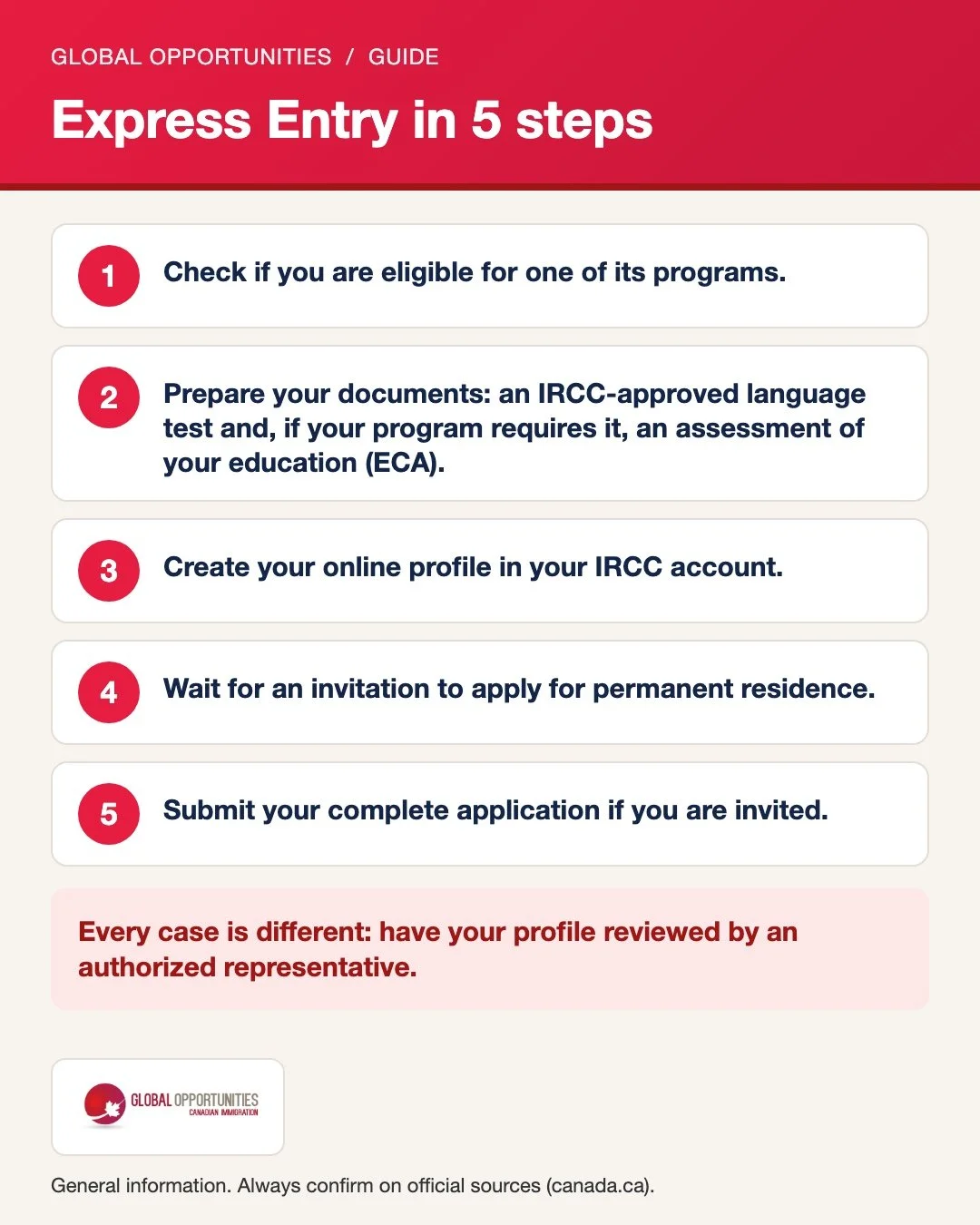
Express Entry: one pathway among several
Express Entry is the online system that IRCC uses to manage three federal permanent residence programs (Express Entry, canada.ca). More from Global: Express Entry.
Federal Skilled Worker Program (FSWP): for people with skilled work experience, usually gained abroad. IRCC requires skilled experience in a TEER 0, 1, 2 or 3 occupation (Federal Skilled Workers, canada.ca). More from Global: Federal Skilled Worker.
Canadian Experience Class (CEC): for people who already have skilled work experience in Canada, gained with authorized temporary status (Canadian Experience Class, canada.ca).
Federal Skilled Trades Program (FSTP): for qualified tradespeople. IRCC asks for either a valid job offer or a certificate of qualification in your trade issued by a Canadian provincial, territorial or federal authority, among other requirements (Federal Skilled Trades, canada.ca).
Having an Express Entry profile does not mean you will be invited to apply. IRCC ranks candidates and invites them in rounds, and how that works for you depends on your whole profile and on decisions IRCC makes over time. We do not publish scores or round results: whether Express Entry is realistic for you is a question for a personalized consultation.
Watch our recorded live session on why meeting the requirements is not the same as being selected.
Category-based selection: occupations that change
Besides general rounds, IRCC says it can invite candidates with specific attributes, such as experience in certain occupations or strong French (category-based selection, canada.ca). In the profession sections below we mention when an occupation appeared in one of these categories when we checked IRCC's page, but keep three things in mind:
Categories change. IRCC reviews them, and occupations are added and removed.
You do not sign up for a category. According to IRCC, it identifies eligible candidates from the information in their Express Entry profile.
A category does not guarantee an invitation. IRCC decides whether and when to hold a category round.
That is why we do not recommend choosing a career or a life plan based on a category. More from Global: Category-based selection, healthcare occupations, STEM occupations, trade occupations, education occupations and transport occupations.
Categories IRCC lists for category-based selection
According to IRCC's category-based selection page, when we checked it in November 2026, the categories and examples of their eligible occupations were:
French-language proficiency: based on French test results, not on an occupation. IRCC sets the French results required.
Healthcare and social services occupations: for example, physicians (specialists and family physicians), dentists, veterinarians, optometrists, pharmacists, dietitians and nutritionists, psychologists, physiotherapists, occupational therapists, nursing coordinators and supervisors, registered nurses and registered psychiatric nurses, nurse practitioners, licensed practical nurses, paramedical occupations, medical laboratory technologists, medical radiation technologists, pharmacy technicians, dental hygienists, massage therapists, nurse aides and orderlies, social workers, counselling therapists and social and community service workers.
Science, Technology, Engineering and Math (STEM) occupations: architecture and science managers, cybersecurity specialists, civil, mechanical, electrical and electronics, industrial and manufacturing, and geological engineers, civil, mechanical and electrical engineering technologists and technicians, and insurance agents and brokers.
Trade occupations: for example, construction estimators, construction managers, home building and renovation managers, machinists, sheet metal workers, welders, electricians, industrial electricians, plumbers, gas fitters, carpenters, cabinetmakers, bricklayers, millwrights and industrial mechanics, heavy-duty equipment mechanics, heating, refrigeration and air conditioning mechanics, concrete finishers, roofers, painters and decorators, floor covering installers and butchers.
Education occupations: secondary school teachers, elementary school and kindergarten teachers, early childhood educators and assistants, instructors of persons with disabilities, and elementary and secondary school teacher assistants.
Transport occupations: aircraft mechanics and inspectors, air pilots, flight engineers and flying instructors, aircraft instrument, electrical and avionics mechanics and technicians, and automotive service technicians, truck and bus mechanics.
Physicians with Canadian work experience: specialists and family physicians whose experience was gained in Canada.
Senior managers with Canadian work experience: senior managers in several sectors, with experience gained in Canada.
Researchers with Canadian work experience: university professors and lecturers, with experience gained in Canada.
Skilled military recruits: foreign military applicants with an employment offer from the Canadian Armed Forces, in specific Canadian Armed Forces occupations.
IRCC also says you must be eligible for one of the Express Entry programs, have recent work experience in one of the listed occupations and meet the instructions of each round. The complete list, with the exact NOC codes and experience rules, is on IRCC's page. IRCC says it monitors and assesses the categories regularly and announces the chosen categories in advance, so they change: IRCC's page is the one that counts, not this summary.
Program rules as published by IRCC as of November 2026. Meeting a program's requirements or appearing in a category does not mean an application will be invited or approved; IRCC decides each case.
Provincial Nominee Programs (PNPs)
Provinces and territories nominate people who have the skills they need and want to live there; each one sets its own requirements. According to IRCC, some provincial streams are aligned with Express Entry and others are not, and the province tells you which process applies. Quebec and Nunavut do not run Provincial Nominee Programs (how the PNP works, canada.ca). Many provinces have streams for specific occupations, such as healthcare, technology or trades, and they open, close and change them often. Many streams also require a job offer from an employer in the province.
Atlantic Immigration Program
The Atlantic Immigration Program helps designated employers in Nova Scotia, New Brunswick, Prince Edward Island and Newfoundland and Labrador hire qualified candidates for jobs they haven't been able to fill locally. It requires a job offer from a designated employer (Atlantic Immigration Program, canada.ca).
Provincial and Atlantic program rules as published by IRCC and the provinces as of November 2026. Streams open, close and change; a nomination or job offer does not guarantee permanent residence, which IRCC decides.
Work permits and study permits
Work permits: IRCC explains the types of work permits on its work permit page. Most require a job offer from a Canadian employer, and many require a Labour Market Impact Assessment (LMIA), which the employer applies for. Canadian work experience can later help with the CEC or provincial streams, but a work permit does not lead to permanent residence automatically. More from Global: LMIA.
Free trade agreements: citizens of some countries can work temporarily as professionals under trade agreements, such as the Canada–United States–Mexico Agreement (CUSMA). IRCC notes that the person must hold the required licence if the occupation is regulated in the province of destination (IRCC, CUSMA professionals).
Young people from partner countries: International Experience Canada offers working holiday and young professional permits for citizens of partner countries. More from Global: Working Holiday.
Study permits: some professionals study in Canada to update their profile or prepare for licensing; IRCC explains the requirements on its study permit page. Studying does not guarantee permanent residence.
Temporary permit rules as published by IRCC as of November 2026. A work or study permit is temporary and does not lead to permanent residence on its own.
Free trade agreement work permits: CUSMA, Chile, Colombia, Peru and Panama
Canada's free trade agreements include provisions that facilitate the temporary entry of business persons on a reciprocal basis, and the work permits issued under them do not require a Labour Market Impact Assessment (international free trade agreements, IRCC). They are part of the International Mobility Program. For professionals, the agreements that matter most to our readers are:
CUSMA (United States and Mexico): US and Mexican citizens can work in the professions listed in the agreement, such as engineer, accountant, registered nurse, lawyer, pharmacist or computer systems analyst, with pre-arranged employment with a Canadian employer and the qualifications the list requires. Self-employment is not allowed (CUSMA professionals, IRCC).
Chile, Colombia, Peru and Panama: each agreement has a professionals category for citizens who enter to provide pre-arranged professional services, as an employee of a Canadian enterprise or under a contract, in an occupation covered by the agreement and in the field for which they are qualified. Each one has its own list of occupations and conditions (Canada–Chile, Canada–Colombia, Canada–Peru and Canada–Panama, IRCC).
Three things to keep in mind:
A trade agreement does not replace a licence. IRCC's CUSMA instructions say the education it lists is a minimum for entry and does not reflect what you need to practise in Canada; for a regulated profession you still need the provincial licence.
These permits are temporary. They do not lead to permanent residence on their own, although skilled Canadian work experience can later help with the Canadian Experience Class or a provincial stream.
You need a real offer or contract. No one can sell you a "trade agreement job".
More from Global: work permits under CUSMA, Canada–Chile, Canada–Colombia, Canada–Peru and Canada–Panama.
CETA and CUKTCA: European Union and United Kingdom citizens
Citizens of the European Union and the United Kingdom have their own agreements. IRCC's CETA overview describes temporary entry for citizens of the 27 EU member countries under the Canada–European Union Comprehensive Economic and Trade Agreement (CETA), and IRCC's CUKTCA update explains that UK nationals who were previously covered by CETA are now covered by the Canada–United Kingdom Trade Continuity Agreement (CUKTCA). These agreements may allow some work permits without an LMIA for certain profiles. Whether one applies depends on each case (your citizenship, your role, your contract or employer and the conditions IRCC sets), and the rules change. To know whether this applies to you, book a consultation.
Please note: Based on IRCC's CETA and CUKTCA pages, as checked in November 2026. A trade agreement does not replace a professional licence or guarantee a work permit; IRCC decides each application.
Quebec runs its own selection system for skilled workers. Global Opportunities does not offer services for Quebec's immigration programs.
What is my NOC code and TEER category?
Canada classifies every job with the National Occupational Classification (NOC). Each occupation has a five-digit code and a TEER category, which shows the training, education, experience and responsibilities the job usually requires. IRCC uses the NOC 2021 version (find your NOC, canada.ca).
What is TEER?
TEER stands for Training, Education, Experience and Responsibilities. The categories run from 0 to 5:
TEER 0: management occupations.
TEER 1: occupations that usually require a university degree.
TEER 2: occupations that usually require a college diploma or apprenticeship training of two or more years, or supervisory occupations.
TEER 3: occupations that usually require a shorter college program or apprenticeship, or more than six months of on-the-job training.
TEER 4: occupations that usually require a high school diploma or several weeks of on-the-job training.
TEER 5: occupations that usually need a short work demonstration and no formal education.
In a NOC 2021 code, the second digit matches the TEER category: for example, 31301 (registered nurses) is TEER 1 and 72200 (electricians) is TEER 2.
Why does it matter? Because several programs only accept experience in certain TEER categories. For the Federal Skilled Worker Program, IRCC requires skilled experience in TEER 0, 1, 2 or 3. And category-based rounds are defined by specific NOC codes.
How to find the NOC code for your profession
Start from your duties, not from your title. IRCC's find your NOC page says to "make sure the main duties listed match what you did at your job". The official NOC search, run by the Government of Canada, lets you search by the work itself:
Open the official NOC search and choose NOC 2021 Version 1.0, the version IRCC uses.
Use the advanced search to look for words that describe your real tasks, such as "inspect welds", "prepare financial statements" or "design road systems". In "Narrow results by section", select Lead statement and Main duties (you can also add example titles). This finds codes by what the job involves, not by what it is called.
Open each possible code and compare its lead statement (the short description at the top) and its main duties with what you actually did, task by task. IRCC asks that your experience shows the actions in the lead statement and most of the main duties (Express Entry documents, canada.ca).
Read the exclusions of each code: they point you to related codes that may fit better.
Choose the code whose duties match your work, and make sure your reference letters describe those duties clearly.
One job title can map to different NOC codes. "Engineer", "analyst", "coordinator" or "manager" can each fall under several codes. An industrial engineer who worked in logistics may fit a logistics code; an engineer who managed projects may fit a management code. Choosing a code for convenience, without duties that support it, can lead to a refusal or to something more serious, such as a finding of misrepresentation.
Watch our video on the NOC on YouTube: Do you know if your job actually qualifies for Permanent Residence?
Each NOC profile also lists employment requirements. That section often tells you whether a licence, registration or trade certificate is required, which is a useful first clue about whether your occupation is regulated.
How to describe your foreign work experience
How you describe your experience matters twice: for immigration, where officers compare your duties with a NOC code, and for employers and regulators, who need to understand what you actually did. Titles mean different things in different countries, so detail is what counts.
Reference letters for immigration
IRCC asks for proof of work experience that shows you performed the lead statement and most of the main duties of your NOC (Express Entry documents, canada.ca). In practice, a strong reference letter:
is on company letterhead, with the company's address, phone and email;
states your job title or titles, with the dates of each position;
lists your main duties and responsibilities in your own job, not copied word for word from the NOC;
states your hours per week and your salary and benefits;
is signed by your supervisor or a human resources officer, with their name, title and contact details.
Keep contracts, pay slips, tax records and social security statements that support your letters, especially if a former employer has closed. Start collecting this before you need it.
Translating your experience for Canadian employers
Use plain functional titles. "Licenciado", "ingeniero", "engineer" or "doctor" do not mean the same in Canada. Describe what you did ("process improvement specialist", "internationally educated nurse") and avoid protected titles you do not hold in Canada.
Show results. Canadian resumés focus on achievements: projects delivered, budgets managed, systems implemented, teams led.
Explain your employers. A Canadian recruiter may not know your former company. A short line ("national bank with branches across the country") helps.
Convert your education and licences clearly. Mention your ECA or regulator assessment if you have one, and describe where you are in the licensing process.
Keep it short and local. Canadian resumés usually leave out photos, date of birth, marital status and religion.
Job Bank has a free resumé builder and newcomer tools, and IRCC-funded newcomer services offer free resumé and interview help.
Is my occupation regulated in Canada?
In Canada, some occupations are regulated by law: you need a licence or certification to work in them or to use the professional title. Others are not regulated, and employers decide whether your education and experience fit the job.
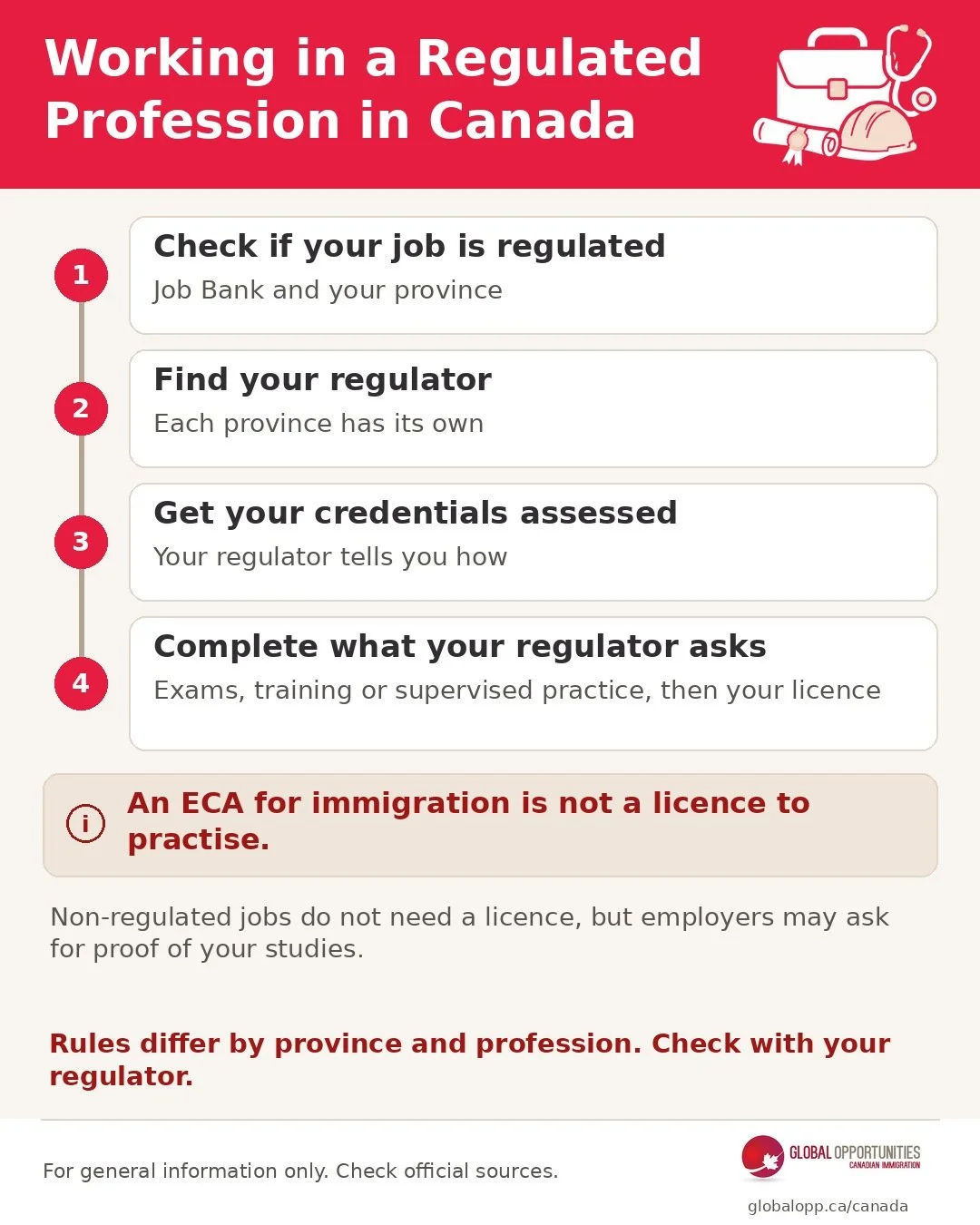
The Government of Canada explains it this way (foreign credential recognition, canada.ca):
Regulated profession: a job that must have a licence or certification to work or use a professional title, as required by law. Examples: doctor, nurse, engineer.
Skilled trade: a certification or registered apprenticeship is needed by law to work in a compulsory trade. Examples: plumber, electrician, welder.
Regulatory authority: an organization that oversees a regulated profession or trade, assesses education and credentials, issues licences or certificates and protects public safety.
Regulation is provincial
Licences are issued by each province or territory, not by the federal government. Each province has its own regulators, and requirements vary. A nurse licensed in Ontario is not automatically licensed in Alberta, and an engineer licensed in British Columbia needs a licence from the engineering regulator of another province to practise there. The same occupation can be regulated in one province and not in another, or have different requirements.
To check whether your occupation is regulated where you want to live, the Government of Canada recommends its Foreign Credential Recognition Tool, which helps you confirm whether your job is regulated in a province, find the regulatory body and review its requirements. It also warns that job titles in Canada might be different from other countries. The government suggests contacting the relevant authority, ideally before you arrive in Canada.
Can I work while I get my licence?
Often, yes, in related roles that do not require a licence. An engineer may work in a technical role under supervision, a nurse may work in a related support role while completing licensing, and a doctor may work in research. What you cannot do is use a protected title, such as "engineer" or "registered nurse", or carry out activities reserved for licensed professionals without the licence. The exact rules depend on each province and regulator.
Lists of regulators in this guide are for reference only, may not be complete or up to date, and must be confirmed with the regulator of your profession in the province that interests you.
Immigration and professional licence: two different processes
Your permanent residence or work permit is decided by the Government of Canada (or by a province, for nominee programs). Your professional licence is decided by the regulator of your profession in your province. They are separate applications, each with its own requirements, documents and fees.
Here is how they compare:
Who decides: for immigration, IRCC (and the province for nominee programs); for the licence, the provincial or territorial regulator.
What you get: immigration gives you permanent residence or a temporary permit; the licence gives you the right to practise and use the title in that province.
Education check: for immigration, an Educational Credential Assessment (ECA) from an IRCC-designated organization; for the licence, the academic assessment your regulator requires.
Language: for immigration, an IRCC-approved test; for the licence, the language evidence your regulator accepts, which may be different.
Professional exams: none for immigration; often one or more for the licence.
What this means in practice:
You can become a permanent resident without having your licence yet, and you can start some licensing steps before you have immigration status. They are parallel processes.
Permanent residence does not let you practise a regulated profession. Only the regulator can do that.
A licence does not give you the right to live or work in Canada. Only an immigration status can do that.
Planning both together helps you avoid paying for tests and assessments in the wrong order.
Global Opportunities helps with immigration. We do not handle professional licence applications: you submit those yourself, directly to the regulator.
Please note about licensing: Licensing requirements depend on the regulator, the province or territory and the exact work you want to do. Each regulator sets its own requirements, including the language tests and results it accepts, and they can change; check them on the regulator's own page. Global Opportunities can help with the immigration side of your plan, including guidance on the Educational Credential Assessment (ECA) for immigration. The licensing process with each regulatory body (often called a college, order or association) is done by you, directly with that body.
We explain the difference in detail in ECA vs professional licence in Canada.
Educational Credential Assessment (ECA) for professionals
An Educational Credential Assessment (ECA) shows what your foreign degree or diploma is equivalent to in Canada, for immigration purposes. According to IRCC, it is required for the Federal Skilled Worker Program if you studied outside Canada, and IRCC also uses it to recognise foreign education in Express Entry under the other programs (ECA, canada.ca). An ECA is not a professional licence and does not, on its own, let you practise a regulated profession.
Designated organizations
According to IRCC, most applicants can use one of these designated organizations (designated organizations, canada.ca):
Comparative Education Service, University of Toronto School of Continuing Studies
International Credential Assessment Service of Canada (ICAS)
World Education Services (WES)
International Qualifications Assessment Service (IQAS)
International Credential Evaluation Service, British Columbia Institute of Technology (ICES)
Doctors, pharmacists and architects
IRCC has specific rules for three occupations:
Doctors whose primary occupation is NOC 31100, 31101 or 31102 must have their primary medical diploma assessed by the Medical Council of Canada.
Pharmacists (NOC 31120) who need a licence to practise must use the Pharmacy Examining Board of Canada.
Architects (NOC 21200) who need a licence to practise must use the Canadian Architectural Certification Board.
If no licence is required for the job, IRCC says a designated organization can assess the credential. Always read the current IRCC page before you order an assessment.
Practical tip: ask your university early for transcripts and, where required, direct sending in sealed envelopes or electronically. Both ECA organizations and many regulators ask for documents sent directly by the institution. Check whether your regulator accepts the same assessment provider before you pay for two reports.
ECA rules as published by IRCC as of November 2026. An ECA is for immigration only: it is not a licence, and a regulator may require its own assessment.
Bridging programs and support for internationally trained professionals
A bridging program helps internationally trained people fill the gap between their foreign training and Canadian licensing or employment: occupation-specific courses, exam preparation, Canadian workplace experience and connections with employers. Many are run by colleges, universities and non-profit organizations with government funding.
Where to find bridging programs (examples)
Ontario: the Government of Ontario's Ontario Bridge Training Program lists programs by occupation and organization, and its page Work in your profession or trade explains how to start.
Alberta: the Fairness for Newcomers Office works with regulatory bodies to streamline the assessment of qualifications.
British Columbia: WelcomeBC describes Career Paths for Skilled Immigrants, which supports skilled newcomers with re-credentialling and employment.
Across Canada: IRCC-funded newcomer services include employment programs, mentoring and language training for specific professions, and the federal Foreign Credential Recognition page points to regulators and supports.
This list is for reference only, may not be complete or up to date, and eligibility rules vary. We have no relationship with the organizations that deliver these programs.
Is a bridging program required?
Usually not, unless your regulator assigns specific courses. But many internationally trained nurses, pharmacists, engineers and teachers find that a bridging program, or the courses the regulator assigns, is the most practical way to meet licensing gaps. Some programs require permanent residence or a specific status, and some are only open once you live in the province, so check eligibility before planning around one.
Nurses: how to immigrate to Canada
Nurses educated outside Canada can immigrate and, once they meet the requirements of the provincial regulator, become licensed to practise. There is no "nurse visa": you immigrate through an immigration program and apply separately for your nursing licence. According to NNAS, "nurse" is a protected title that only people licensed or registered by the nursing regulator of their province can use.
These are two separate processes. IRCC or the province decides your immigration, and the nursing regulator of the province where you want to work decides your licence, usually after a credential assessment, a registration exam and proof of English or French. For immigration, the main NOC codes are:
Registered nurses and registered psychiatric nurses: NOC 31301, TEER 1.
Nurse practitioners: NOC 31302, TEER 1.
Nursing coordinators and supervisors: NOC 31300, TEER 1.
Licensed practical nurses: NOC 32101, TEER 2.
Nurse aides, orderlies and patient service associates: NOC 33102, TEER 3.
When we reviewed IRCC's category-based selection page, these codes were in the healthcare and social services category of Express Entry. Categories change and do not guarantee an invitation.
For NNAS, the NCLEX-RN and REx-PN, the nursing regulator in each province, English tests for nurses and immigration pathways, read our complete guide on how to immigrate to Canada as a nurse. We also have a guide for nurses (in Spanish).
Licensing is decided by each nursing regulator, and immigration by IRCC or the province; one does not guarantee the other. Codes and categories as published by ESDC and IRCC as of November 2026.
Engineers: P.Eng. licence and immigration
Engineers can immigrate to Canada through the same programs as other professionals, and some engineering occupations have appeared in the STEM category of Express Entry. To practise engineering and use the title "engineer", you need a licence from the engineering regulator of the province or territory where you work. We also have a guide for engineers (in Spanish).
Engineering occupations and NOC codes
Common engineering codes (all TEER 1) include civil engineers (21300), mechanical engineers (21301), electrical and electronics engineers (21310), chemical engineers (21320), industrial and manufacturing engineers (21321), mining engineers (21330), geological engineers (21331) and petroleum engineers (21332).
When we reviewed IRCC's category page, the STEM category included civil, mechanical, electrical and electronics, industrial and manufacturing, and geological engineers, plus civil, mechanical and electrical engineering technologists and technicians. Other engineering occupations were not on the list but remain skilled (TEER 1) occupations that can be eligible in general rounds and provincial programs. The list changes; check the official page.
Remember that your code depends on your duties. In many countries, industrial engineering covers logistics, quality or management; in Canada, NOC 21321 focuses on manufacturing and production processes. If your experience was mainly in project management, estimating or supervision, another code may describe it better.
How the P.Eng. licence works
According to Engineers Canada, to practise engineering in Canada you must hold and maintain a licence from a provincial or territorial engineering regulator, and Engineers Canada does not grant licences. Requirements vary by regulator, but generally there are five criteria (overview of the licensing process, Engineers Canada):
Academics: an engineering degree from a program accredited by the Canadian Engineering Accreditation Board (CEAB), or equivalent qualifications.
Work experience: engineering experience that meets the requirements of the province or territory where you apply.
Professionalism and ethics: passing the Professional Practice Examination, which covers engineering law, professional standards and ethics.
Good character.
Language: the ability to work in English or French, depending on the province or territory.
If you studied outside Canada, the regulator reviews your education and may assign technical exams or courses. Engineers Canada develops tools that regulators use to check the academic knowledge of applicants who did not graduate from an accredited program. This academic review is separate from the ECA you need for immigration: one does not replace the other.
Engineers Canada also runs EngineerHere.ca, an information site for engineering graduates who want to become licensed in Canada. It notes that, if its information differs from a regulator's, the regulator is the authority.
Engineering regulators by province and territory
Engineers Canada lists 12 engineering regulators (engineering regulators, Engineers Canada):
Ontario: Professional Engineers Ontario (PEO)
British Columbia: Engineers and Geoscientists British Columbia
Alberta: Association of Professional Engineers and Geoscientists of Alberta (APEGA)
Saskatchewan: Association of Professional Engineers and Geoscientists of Saskatchewan (APEGS)
Manitoba: Engineers Geoscientists Manitoba
New Brunswick: Engineers and Geoscientists New Brunswick
Nova Scotia: Engineers Nova Scotia
Prince Edward Island: Engineers PEI
Newfoundland and Labrador: Professional Engineers and Geoscientists Newfoundland and Labrador (PEGNL)
Northwest Territories and Nunavut: NAPEG
Yukon: Engineers Yukon
This list of regulators is for reference only, may not be complete or up to date, and must be confirmed with the regulator. We include the OIQ for information only; Global Opportunities does not offer services for Quebec's immigration programs.
Working under supervision and using the title
You can work in many engineering-related jobs without a licence, but you cannot practise regulated engineering on your own or call yourself an engineer. Engineers Canada states that claiming to be an engineer without being licensed is against the law, and that using a protected title like "engineer" in a personal profile, including on LinkedIn, is misleading and illegal (use of professional title, Engineers Canada).
In practice, many newly arrived engineering graduates work as technologists, analysts, project coordinators, inspectors, estimators or quality specialists, or under the supervision of a licensed engineer as the regulator allows, while they progress toward their licence. Several regulators also have an engineer-in-training (EIT) or member-in-training stage for people who are accumulating experience. Describe your status accurately on your resumé (for example, "international engineering graduate" or "EIT", if you are registered as one) and check the rules with your regulator.
Engineering technologists and technicians
Canada has an occupation between technician and engineer: the engineering technologist. Civil (22300), mechanical (22301) and electrical and electronics (22310) engineering technologists and technicians are TEER 2, and all three were in the STEM category when we reviewed it.
According to the NOC, certification in civil engineering technology or a related field is available through provincial associations and may be required for some positions, usually after a period of supervised work experience; in Quebec, membership in the regulatory body for professional technologists is required to use the title "Professional Technologist". This occupation matters for two groups: people with a post-secondary technical or technologist education, for whom it is the natural fit, and engineers whose real duties were those of a technologist. If your main duties were a technologist's, that is your code, even with an engineering degree.
Engineers: what to do first
Identify your NOC code by duties.
Take an IRCC-approved language test.
Order an ECA for immigration.
Check the licensing requirements of the engineering regulator in the province that interests you, and whether you can start from abroad.
Review Express Entry, provincial programs and other options with a personalized consultation.
Licensing is decided by each engineering regulator, and immigration by IRCC or the province; one does not guarantee the other. Requirements as published by Engineers Canada and the NOC as of November 2026.
IT and software professionals: immigrating to Canada
Most IT and software jobs in Canada are not regulated, so you usually do not need a licence to work as a developer, analyst or data scientist. The exception is the title "engineer".
NOC codes for IT professionals
Common IT codes, all TEER 1, include:
Cybersecurity specialists: 21220
Information systems specialists: 21222
Data scientists: 21211
Software engineers and designers: 21231
Software developers and programmers: 21232
Computer engineers (except software engineers and designers): 21311
"Systems engineer" is not a single occupation in Canada: depending on what you did, your experience may fit software development, information systems, data science, cybersecurity or computer engineering. Choose by duties.
Data scientists, project managers and business analysts: NOC codes
These roles are not regulated, so the key is choosing the NOC code that matches your duties, not your job title.
Data scientists: NOC 21211, TEER 1. The NOC says a bachelor's degree in statistics, mathematics, computer science or a related field is usually required, and that a master's or doctorate in machine learning, data science or a related quantitative field is usually required as well, along with programming experience.
IT project managers and business systems roles: "Information technology (IT) project manager" is an example title under information systems specialists, NOC 21222, TEER 1. If you plan, direct and manage IT departments or teams, computer and information systems managers (20012) may fit better.
Business analysts and project managers outside IT: "business analyst project manager" is an example title under professional occupations in business management consulting, NOC 11201, TEER 1. In construction or engineering, a project manager's duties may fit another code, such as construction managers (70010).
Certifications such as the PMP are voluntary: they can help with employers, but they are not a licence and they are not required by IRCC. Read the main duties of each profile and choose the code that describes most of what you actually did.
IT and Express Entry categories
When we reviewed IRCC's category-based selection page, cybersecurity specialists (21220) were in the STEM category, but software engineers, software developers, data scientists and other IT codes were not. They can still be eligible in general Express Entry rounds and in provincial programs, some of which have run streams for technology occupations at different times. Categories change; always check the current list. More from Global: STEM occupations.
Can I call myself a software engineer?
According to the NOC profile for 21231, licensing by a provincial or territorial association of professional engineers is required to approve engineering drawings and reports and to practise as a Professional Engineer (P.Eng.), although many software jobs do not require it. Engineers Canada explains that, in most provinces, people without an engineering licence cannot use "engineer" in their title, even if their employer assigns it, and suggests alternatives such as "software specialist" or "data scientist". It also notes that Alberta amended its legislation in 2023 to let technology companies and workers use "software engineer" without an APEGA licence (use of professional title, Engineers Canada). Check the rule in your province.
What strengthens an IT profile
Reference letters with detailed duties, technologies and dates.
Strong English (and French, if possible), which IRCC assesses in most economic programs and employers assess in interviews.
A resumé that follows Canadian conventions and a professional LinkedIn profile that uses accurate titles.
Accountants (CPA): immigrating to Canada
Accountants usually fall under NOC 11100, "Financial auditors and accountants" (TEER 1); bookkeepers and accounting technicians fall under NOC 12200. When we reviewed IRCC's category-based selection page, neither was in an Express Entry category, but both are skilled occupations that can be eligible in general rounds and in provincial programs.
Is accounting regulated in Canada?
Partly. According to the NOC profile for 11100, Chartered Professional Accountant (CPA) designations require a university degree, completion of a professional or approved training program, on-the-job training and certification or membership with a provincial body, and licensing by the provincial or territorial governing body is usually required for accountants and auditors who practise public accounting. Trustees in bankruptcy need a separate licence.
In practice, this means:
To use the CPA designation or practise public accounting, you need the recognition of the CPA body of your province. CPA Canada has signed mutual recognition and similar agreements with some international accounting bodies on behalf of the provincial and regional CPA bodies, and the provincial body assesses each application and sets any extra requirements. Without an agreement, you usually have your education assessed and complete CPA courses and exams. See, for example, CPA British Columbia's page for internationally designated accountants.
Many accounting and finance jobs (for example, in companies' internal finance teams) do not require the CPA designation, although employers may prefer it.
Tips for accountants
Choose your NOC code by duties: financial analysts, auditors, controllers and finance managers have different codes.
Canadian accounting and tax rules are specific, so many internationally trained accountants take Canadian courses or certifications after arriving.
Strong English is essential for both immigration and work.
Designation rules as published by the NOC and CPA bodies as of November 2026. Recognition is decided by the provincial CPA body, and immigration by IRCC or the province; one does not guarantee the other.
Teachers: how to immigrate to Canada
To immigrate as a teacher you need, like any professional, a profile that is eligible for an immigration program. To teach in a public school, you also need a provincial teaching certificate. According to the NOC profile for 41221, elementary school and kindergarten teachers need a bachelor's degree in education and a provincial teaching certificate.

Teaching occupations and the education category
When we reviewed IRCC's category-based selection page, the education category of Express Entry included:
Secondary school teachers: 41220, TEER 1
Elementary school and kindergarten teachers: 41221, TEER 1
Early childhood educators and assistants: 42202, TEER 2
Instructors of persons with disabilities: 42203, TEER 2
Elementary and secondary school teacher assistants: 43100, TEER 3
The list changes and does not guarantee an invitation. More from Global: education occupations.
Teacher certification by province
Teacher certification is provincial; there is no national certificate. Examples:
Ontario: Ontario College of Teachers
British Columbia: Teacher Regulation Branch
Saskatchewan: Saskatchewan Professional Teachers Regulatory Board
Manitoba: Professional Certification Unit, Manitoba Education
Other provinces: the provincial department or ministry of education.
This list is for reference only, may not be complete or up to date, and must be confirmed with the certifying body.
Which code fits language teachers and college instructors?
If you taught in elementary or secondary schools, your code is likely 41221 or 41220.
If you taught in language schools, academies or companies, your experience may fit other codes, such as "Other instructors" (43109).
If you taught at a college or technical institute, it may be "College and other vocational instructors" (41210).
University professors and lecturers (41200) appeared in the category for researchers with Canadian work experience, which requires experience in Canada.
Early childhood educators have their own section below.
Certification is decided by each province's certifying body, and immigration by IRCC or the province; one does not guarantee the other.
Early childhood educators: how to immigrate to Canada
Early childhood educators (ECEs) work with young children in child care centres, preschools and kindergarten programs. In most provinces you need to be certified, registered or licensed to work as an ECE in licensed child care. They are classified as early childhood educators and assistants (NOC 42202, TEER 2).
What the NOC says
According to the NOC, early childhood educators need a two- to four-year college program in early childhood education or a bachelor's degree in child development; Ontario requires licensing, British Columbia requires certification, and other provinces and territories usually require licensing. Assistants usually need secondary school and child care experience, and may need an ECE assistant certificate or courses.
ECE certification by province (examples)
Ontario: the College of Early Childhood Educators registers people who use the title Registered Early Childhood Educator.
British Columbia: the ECE Registry certifies educators, and the Government of B.C. has a pathway for applicants with education completed outside Canada.
Alberta: the Government of Alberta runs early childhood educator certification.
Other provinces: the provincial ministry responsible for child care or early learning.
This list is for reference only, may not be complete or up to date, and must be confirmed with the certifying body.
Immigration notes for ECEs
When we reviewed IRCC's category-based selection page, early childhood educators and assistants (42202) were in the education category. Categories change and do not guarantee an invitation.
As TEER 2, the occupation counts as skilled for the Federal Skilled Worker Program and the Canadian Experience Class.
Some provinces have prioritized child care in their nominee programs at different times; for example, the BC PNP news page listed childcare among the occupations in British Columbia's Care priority when we reviewed it. Check each province's current streams.
Certification is decided by each province, and immigration by IRCC or the province; one does not guarantee the other. Information as published by the NOC, the provinces and IRCC as of November 2026.
Doctors: how to immigrate to Canada as a physician
Doctors can immigrate through the same programs as other professionals, but practising medicine requires a licence from the College of Physicians and Surgeons of the province, after verification of credentials, exams and, usually, a practice assessment or postgraduate training. The longest part is usually licensing, not immigration.
NOC codes for doctors
Doctors are classified as general practitioners and family physicians (31102), specialists in clinical and laboratory medicine (31100) and specialists in surgery (31101), all TEER 1. According to the NOC, family physicians need graduation from an approved medical school, residency training, the qualifying examinations of the Medical Council of Canada (or the Collège des médecins du Québec) and a licence from a provincial or territorial licensing authority.
The Medical Council of Canada and licensing
The Medical Council of Canada (MCC) validates and stores medical credentials, offers source verification through physiciansapply.ca, and administers exams such as the MCCQE Part I and the NAC examination, as well as the Practice-Ready Assessment framework. The MCC does not issue licences; its results inform the regulators' decisions.
Licences are issued by each province's college, for example the College of Physicians and Surgeons of Ontario, the College of Physicians and Surgeons of British Columbia and the College of Physicians and Surgeons of Alberta.
Routes to practice vary: some internationally trained physicians enter residency through a matching process, others go through a Practice-Ready Assessment in provinces that offer it, and some specialists from certain jurisdictions have specific routes. Each college explains its own.
This list is for reference only, may not be complete or up to date, and must be confirmed with the regulator.
Immigration rules specific to doctors
For the ECA, IRCC requires doctors whose primary occupation is NOC 31100, 31101 or 31102 to have their primary medical diploma assessed by the Medical Council of Canada (designated organizations, canada.ca).
When we reviewed IRCC's category-based selection page, the three codes were in the healthcare and social services category, and there was also a separate category for physicians with Canadian work experience.
IRCC allows a temporary exception in the Canadian Experience Class for some physicians who provided publicly funded medical services while self-employed, as its CEC page explains.
In Ontario, the Ontario Workforce Priority stream page mentioned eligible self-employed physicians when we reviewed it.
IRCC has a page called Live and work as a medical doctor in Canada that groups the options for doctors, separating those who have worked as a medical doctor in Canada from those who haven't: Express Entry, including a category for medical doctors; regional, provincial and territorial programs; the Provincial Nominee Program; and a work permit for doctors nominated by a province or territory. According to IRCC, doctors first need to have their foreign credentials assessed and to get licensed through a provincial or territorial regulatory authority.
Hear from professionals who made the move, including a doctor, on our success stories page (in Spanish).
Working while you get licensed
Without a licence, you cannot practise medicine or call yourself a physician in a way that suggests you are licensed. Many internationally trained doctors work in research, clinical trials, public health, health administration or related regulated professions while they progress. Describe your status accurately, for example "internationally trained physician".
Licensing is decided by each provincial College of Physicians and Surgeons, and immigration by IRCC or the province; one does not guarantee the other. Information as published by the MCC, the colleges and IRCC (including its medical doctors page) as of November 2026.
Pharmacists: how to immigrate to Canada
Pharmacists are regulated in every province and territory. According to the NOC, a university degree in pharmacy and a period of supervised practical training are required, and licensure is required in all provinces and territories for community and hospital pharmacists (NOC 31120, TEER 1).
PEBC: the national certification step
The Pharmacy Examining Board of Canada (PEBC) certifies pharmacists for the provincial regulators. For international graduates, PEBC's pages describe, in general terms, a document evaluation, an Evaluating Examination and the Qualifying Examination (Part I multiple-choice and Part II OSCE). PEBC certification is not a licence: after it, you register with the pharmacy regulator of your province, which may add its own requirements, such as a jurisprudence exam, practical training or language evidence. NAPRA keeps a list of pharmacy regulatory authorities; in Ontario, for example, it is the Ontario College of Pharmacists.
Immigration rules specific to pharmacists
For the ECA, IRCC says pharmacists (NOC 31120) who need a licence to practise must use PEBC as their assessment organization; if no licence is required for the job, a designated organization can assess the credential.
When we reviewed IRCC's category-based selection page, pharmacists (31120) and pharmacy technicians (32124) were in the healthcare and social services category. Categories change and do not guarantee an invitation.
While you progress, related roles such as pharmacy assistant, research or regulatory affairs may be open to you, as long as you do not perform restricted activities or use the protected title.
This list is for reference only, may not be complete or up to date, and must be confirmed with the regulator. Licensing is decided by each pharmacy regulator, and immigration by IRCC or the province; one does not guarantee the other.
Dentists: how to practise dentistry in Canada (NDEB)
Dentists are classified as NOC 31110, TEER 1. According to the NOC, a university degree from a recognized dental program and a licence from a provincial or territorial regulatory body are required. If your dental program is not recognized by the Commission on Dental Accreditation of Canada (CDAC), you go through the National Dental Examining Board of Canada (NDEB).
The NDEB Equivalency Process
The NDEB explains that its Equivalency Process applies when your dental degree program "is not recognized by the CDAC" (Equivalency Process, NDEB). It starts with an application and the verification of your credentials, followed by three examinations:
the Assessment of Fundamental Knowledge (AFK);
the Assessment of Clinical Judgement (ACJ);
the NDECC, a clinical competence examination.
Passing them lets you move on to the NDEB Certification Process, which includes the Virtual OSCE. The NDEB also describes other routes, such as accredited qualifying or degree completion programs at Canadian faculties of dentistry. Check the current dates, rules and requirements on the NDEB website.
Licensing with the provincial regulator
The NDEB says that "the provincial Dental Regulatory Authorities (DRAs) are responsible for issuing dental licenses", and that once you are certified you contact the regulator in the province where you want to practise (certificate and licence, NDEB). Examples (for reference only): the Royal College of Dental Surgeons of Ontario and the College of Oral Health Professionals of British Columbia.
Immigration notes for dentists
Immigration and licensing are separate processes, and you can work on both in parallel.
When we reviewed IRCC's category-based selection page, dentists were among the occupations in the healthcare and social services category. Categories change and do not guarantee an invitation.
Dental hygienists, dental assistants and denturists are separate occupations, with their own regulators and requirements.
This list is for reference only, may not be complete or up to date, and must be confirmed with the NDEB and the regulator of your province. Licensing is decided by the provincial dental regulator, and immigration by IRCC or the province; one does not guarantee the other.
Other health professionals: physiotherapists, occupational therapists, lab technologists, psychologists, dietitians, paramedics and social workers
Almost all health professions are regulated in Canada, so you will need the provincial regulator's licence in addition to an immigration status. The Government of Canada explains that provinces and territories regulate health care providers (Canada's health care system, canada.ca). In many health professions, a national body assesses internationally educated applicants or runs the entry exam, and then the provincial regulator issues the licence. When we reviewed IRCC's category-based selection page, the healthcare and social services category included many of these occupations.
National bodies that help with assessment or bring regulators together (examples, not a complete list):
Physiotherapists: Canadian Alliance of Physiotherapy Regulators.
Occupational therapists: ACOTRO.
Medical laboratory technologists: Canadian Society for Medical Laboratory Science (CSMLS).
Paramedics: Canadian Organization of Paramedic Regulators.
Midwives: Canadian Midwifery Regulators Council.
Psychologists: Association of Canadian Psychology Regulatory Organizations (ACPRO).
Veterinarians: the Canadian Veterinary Medical Association runs the National Examining Board; see the veterinarians section below.
Dietitians, respiratory therapists, social workers and others are regulated by provincial bodies; requirements vary from province to province.
These lists are for reference only, may not be complete or up to date, and must be confirmed with the regulator of your profession.
Physiotherapists: credential evaluation and licensing
Physiotherapists are classified as NOC 31202, TEER 1. The NOC says a licence or registration with a regulatory body, and a competency examination, are required in all provinces and territories. The Canadian Alliance of Physiotherapy Regulators (CAPR) provides credentialling and examination functions that come before licensing, and it says that passing the Canadian Physiotherapy Examination "is required to become a licensed physiotherapist in Canada" (CAPR). Internationally educated physiotherapists start with CAPR's credentialling pathway. Licensing itself is managed by the regulator of the province or territory where you will practise, and each one may have its own requirements, such as language evidence.
Express Entry category: according to IRCC's category-based selection page, when we checked it in November 2026, physiotherapists (31202) were in the healthcare and social services category. Categories change and do not guarantee an invitation.
Licensing is decided by each provincial physiotherapy regulator, and immigration by IRCC or the province; one does not guarantee the other. Information as published by CAPR and the NOC as of November 2026.
Occupational therapists: how to immigrate to Canada as an OT
Occupational therapists are classified as NOC 31203, TEER 1, and they are regulated. According to the NOC, the occupation requires a university degree in occupational therapy with supervised fieldwork, a national or provincial certification examination, and licensure with a regulatory body, which is "required in all provinces and territories".
For internationally educated occupational therapists, the Association of Canadian Occupational Therapy Regulatory Organizations (ACOTRO) runs SEAS, the Substantially Equivalent Assessment Steps (SEAS, ACOTRO). According to ACOTRO's SEAS steps page, in plain language:
Academic credential assessment: you apply, arrange a credential report from World Education Services and prove your identity, and ACOTRO checks your education against the minimum Canadian standard.
Three assessments: a language readiness assessment, a profession-specific review of your courses and fieldwork, and the Jurisprudence Knowledge Assessment Test (JKAT), an online exam.
Competency assessment: an interview-style assessment, after which a committee decides whether you meet substantial equivalency.
After SEAS, you apply to the occupational therapy regulator of the province where you plan to practise, which explains its own next steps.
Language: ACOTRO's language readiness page says that "you must first prove proficiency in either English or French language skills" before the JKAT and the competency assessment, and SEAS decides whether you need a language test. Check the accepted tests in the SEAS documents.
Express Entry category: according to IRCC's category-based selection page, when we checked it in November 2026, occupational therapists (31203) were in the healthcare and social services category. Categories change and do not guarantee an invitation.
Licensing is decided by each provincial OT regulator, and immigration by IRCC or the province; one does not guarantee the other. Steps as published by ACOTRO as of November 2026.
Medical laboratory technologists: CSMLS certification
Medical laboratory technologists are classified as NOC 32120, TEER 2. According to the NOC, the occupation requires a two- or three-year college program in medical laboratory technology; registration with a regulatory body is required in several provinces, including Ontario, Quebec and Alberta; and employers usually require certification from the Canadian Society for Medical Laboratory Science (CSMLS). So it is regulated in some provinces and not in others, but CSMLS certification is what most employers look for.
The CSMLS pathway for internationally educated medical laboratory technologists, in general terms:
Prior Learning Assessment (PLA): CSMLS assesses your education, training and clinical experience against its competency profile (PLA, CSMLS). CSMLS says that your education and experience in another country "do not automatically make you eligible" to write the exam.
National certification exam: if you are found eligible, you can write the CSMLS certification exam. Read the current conditions on the CSMLS page, since they can depend on the province where you live.
Provincial registration: where the occupation is regulated, you also register with the provincial college, for example the College of Medical Laboratory Technologists of Ontario or the College of Medical Laboratory Technologists of Alberta; CSMLS performs the PLA on behalf of the Alberta college.
Language: the CSMLS pages we checked did not state language requirements; check the documents required by CSMLS and by your provincial college.
Express Entry category: according to IRCC's category-based selection page, when we checked it in November 2026, medical laboratory technologists (32120) were in the healthcare and social services category. Categories change and do not guarantee an invitation.
Certification is decided by CSMLS, licensing by the provincial college where the occupation is regulated, and immigration by IRCC or the province; one does not guarantee the other. Information as published by CSMLS and the NOC as of November 2026.
Psychologists: registration with a provincial regulator
Psychologists are classified as NOC 31200, TEER 1, and are regulated in every province. According to the NOC, registration with a regulatory body is required in all provinces, the Northwest Territories and Nunavut. The NOC also says that a doctoral degree is required to use the title "Psychologist" in some provinces (Prince Edward Island, New Brunswick, Quebec, Ontario, Manitoba and British Columbia) and a master's degree in others; that supervised practical experience is required in most jurisdictions; and that the Examination for Professional Practice in Psychology (EPPP) is required in most provinces, with oral exams, ethics or jurisprudence exams in some.
For psychologists educated outside Canada and the United States, ACPRO, the national organization of psychology regulators, offers a single online entry point for participating jurisdictions (internationally educated applicants, ACPRO). According to ACPRO, the process is:
Apply to ICD, a credentials evaluation service, which verifies your documents.
ICD sends its report to the participating jurisdiction you choose.
You apply to that jurisdiction, which assesses you against its own standards and decides on your registration.
ACPRO says Alberta, the Northwest Territories, British Columbia, Quebec and Yukon were not participating in the portal when we checked, so applicants for those jurisdictions apply directly to the regulator, such as the College of Alberta Psychologists or the College of Health and Care Professionals of British Columbia. See ACPRO's jurisdictional requirements.
Language: each regulator sets its own language evidence; check the jurisdictional requirements page for your province.
Express Entry category: according to IRCC's category-based selection page, when we checked it in November 2026, psychologists (31200) were in the healthcare and social services category. Categories change and do not guarantee an invitation.
Registration is decided by each provincial psychology regulator, and immigration by IRCC or the province; one does not guarantee the other. Information as published by ACPRO and the NOC as of November 2026.
Dietitians: credential assessment and the registration exam
Dietitians and nutritionists are classified as NOC 31121, TEER 1. According to the NOC, dietitians need a degree in dietetics, nutrition or a related field from an accredited program plus supervised practical training, must pass the Canadian Dietetic Registration Exam in all provinces except Quebec, and must register with a regulatory body in all provinces. The title "nutritionist" is regulated only in some provinces.
Dietitians of Canada, the national professional association, advises internationally educated dietitians to "contact the provincial dietetic regulatory body" in the province where they plan to work to learn the registration requirements (internationally educated dietitians, Dietitians of Canada). In Ontario, for example, that is the College of Dietitians of Ontario. In general terms, the regulator assesses whether your education and practical training are equivalent to Canadian dietetic education, may ask you to complete courses or a bridging program, and then lets you write the registration exam. If you were not a dietitian abroad, Dietitians of Canada suggests applying to an accredited Canadian university program.
Language: set by each provincial regulator; check your regulator's registration page.
Express Entry category: according to IRCC's category-based selection page, when we checked it in November 2026, dietitians and nutritionists (31121) were in the healthcare and social services category. Categories change and do not guarantee an invitation.
Registration is decided by each provincial dietetic regulator, and immigration by IRCC or the province; one does not guarantee the other. Information as published by the NOC and Dietitians of Canada as of November 2026.
Paramedics: COPR and provincial registration
Paramedics are classified as "Paramedical occupations" (NOC 32102, TEER 2). According to the NOC, the occupation requires a college, hospital-based or other recognized paramedical program and licensing by a regulatory body in all provinces, plus the right class of driver's licence to drive emergency vehicles.
The Canadian Organization of Paramedic Regulators (COPR) runs the entry-to-practice exams and, for people trained outside Canada, the Paramedic Equivalency Assessment System (PEAS) (international assessments, COPR). According to COPR, in plain language:
You open an account on COPR's applicant portal and choose a pathway.
You complete that pathway's requirements, which can include document verification, translations and exams.
COPR sends the provincial regulator a summary of its findings and a recommended equivalency.
You contact the provincial regulator for the next steps, which vary by province.
COPR says PEAS covers the primary care and advanced care paramedic levels in most provinces, and that applicants for British Columbia, Ontario, Quebec or New Brunswick, or for other levels, should contact the provincial regulator directly. COPR does not issue licences; the provincial regulators do.
Language: the COPR page we checked did not state a language requirement; check with your provincial regulator.
Express Entry category: according to IRCC's category-based selection page, when we checked it in November 2026, paramedical occupations (32102) were in the healthcare and social services category. Categories change and do not guarantee an invitation.
Registration is decided by each provincial paramedic regulator, and immigration by IRCC or the province; one does not guarantee the other. Information as published by COPR and the NOC as of November 2026.
Social workers: provincial registration
Social workers are classified as NOC 41300, TEER 1. According to the NOC, registration with a provincial governing body is mandatory to practise as a social worker in several provinces, and the titles "Social Worker" and "Registered Social Worker" are regulated. The Canadian Council of Social Work Regulators explains that each province has its own legislation, that some provinces require registration even if your job title is not "social worker", and that people with international social work credentials should contact the regulator where they plan to live and work (CCSWR, professional regulation). Requirements commonly include an application, proof of a recognized social work credential, references, a criminal record check and a fee, and some provinces add exams or language requirements.
Express Entry category: according to IRCC's category-based selection page, when we checked it in November 2026, social workers (41300) were in the healthcare and social services category. Categories change and do not guarantee an invitation.
These lists are for reference only, may not be complete or up to date, and must be confirmed with the regulator of your profession. Registration is decided by each provincial regulator, and immigration by IRCC or the province; one does not guarantee the other.
Veterinarians: how to immigrate to Canada and get licensed
Veterinarians are classified as NOC 31103, TEER 1, and are regulated. According to the NOC, a doctor of veterinary medicine needs a veterinary medicine degree, must pass a national certification exam and must hold a provincial licence to practise.
The National Examining Board and the Certificate of Qualification
The Canadian Veterinary Medical Association (CVMA) set up the National Examining Board (NEB), which runs the national examination process. According to the CVMA, candidates who pass the NEB process receive a Certificate of Qualification (CQ), which is required before applying for a general licence from a provincial veterinary licensing body; the NEB itself cannot license veterinarians (about the NEB and the CQ, CVMA).
For graduates of veterinary programs that are not accredited by the CVMA or the AVMA, the CVMA's NEB pages describe, in general terms:
Application and document evaluation, including proof of graduation and language proficiency.
Basic and Clinical Sciences Examination (BCSE).
North American Veterinary Licensing Examination (NAVLE).
Clinical Proficiency Examination (CPE).
The CVMA also describes alternative pathways to the CQ for graduates of non-accredited programs. Check the current order, rules and dates on the NEB pages before you apply.
Language requirements for veterinarians
The CVMA's language proficiency page says that every NEB candidate must meet the language requirement in one of three ways: a veterinary degree taught entirely in English or French, an ECFVG certificate, or an accepted language test. The list of accepted tests depends on when you apply, and the CVMA notes that provincial regulators may require different tests.
Licensing with the provincial veterinary body
The CVMA says that "licensing for veterinary medicine is the responsibility of the provincial veterinary association". In Ontario, for example, the regulator is the College of Veterinarians of Ontario. Each provincial body sets its own requirements, so check yours before you plan.
Express Entry category: according to IRCC's category-based selection page, when we checked it in November 2026, veterinarians (31103) were in the healthcare and social services category. Categories change and do not guarantee an invitation.
Licensing is decided by each provincial veterinary body, and immigration by IRCC or the province; one does not guarantee the other. Information as published by the CVMA and the NOC as of November 2026.
Skilled trades and Red Seal: immigrating to Canada
Skilled trades have their own federal program, the Federal Skilled Trades Program, and when we reviewed IRCC's category-based selection page there was also a trade category in Express Entry. Many provinces also prioritize trades in their nominee programs.
Trade occupations
When we reviewed it, the trade category included occupations such as construction electricians (72200), industrial electricians (72201), plumbers (72300), gas fitters (72302), welders (72106), machinists (72100), sheet metal workers (72102), carpenters (72310), heavy-duty equipment mechanics (72401), HVAC and refrigeration mechanics (72402), construction estimators (22303) and construction managers (70010). The transport category included automotive service technicians and aircraft mechanics, among others. These lists change. More from Global: trade occupations and transport occupations.
Are trades regulated? Compulsory and voluntary trades
Some trades are compulsory: you need a provincial certificate, or registration as an apprentice, to work in them. Others are voluntary. The list varies by province. The NOC profile for construction electricians, for example, says trade certification is compulsory in some provinces and voluntary in others, and provinces update their lists: British Columbia has since made construction electrician a compulsory trade (see below).
Electricians, welders and plumbers: compulsory trades
In a compulsory trade, you need a provincial certificate, or registration as an apprentice, to work legally. What the NOC says, in general terms:
Construction electricians (72200): certification is compulsory in Newfoundland and Labrador, Nova Scotia, Prince Edward Island, New Brunswick, Quebec, Ontario, Manitoba, Saskatchewan and Alberta, and the NOC lists it as voluntary in British Columbia and the territories. However, SkilledTradesBC now lists construction electrician and industrial electrician among British Columbia's compulsory trades (SkilledTradesBC, skilled trades certification).
Plumbers (72300): certification is compulsory in Nova Scotia, Prince Edward Island, New Brunswick, Quebec, Ontario, Saskatchewan and Alberta, and voluntary in Newfoundland and Labrador, Manitoba, British Columbia and the territories.
Welders (72106): certification is compulsory in Alberta and voluntary in the other provinces and the territories.
All three are Red Seal trades (construction electrician, plumber and welder). If you have experience abroad, ask your province's trade authority how it assesses it; Skilled Trades Ontario, for example, has a trade equivalency assessment. These rules change, so always confirm them with the authority before you plan to work.
Cooks and chefs: Red Seal cook and NOC codes
Cooks are classified as NOC 63200, TEER 3, and chefs as NOC 62200, TEER 2. Choose by duties: chefs plan and direct food preparation, while cooks prepare and cook the food.
Is it compulsory? No. According to the NOC, trade certification for cooks is available, but voluntary, in all provinces and territories, so you can work as a cook without it.
Red Seal: Cook is a Red Seal trade. The NOC says the endorsement is available to qualified cooks, and to qualified chefs, after the interprovincial Red Seal examination.
Chef certifications: the NOC mentions the Certified Working Chef (CWC) and Certified Chef de Cuisine (CCC) designations of the Canadian Culinary Federation, which are optional.
Immigration: TEER 2 and 3 count as skilled for the Federal Skilled Worker Program and the Canadian Experience Class if you meet the other requirements. Because cooking is a trade, a provincial certificate of qualification can also matter for the Federal Skilled Trades Program; check IRCC's list of eligible trade groups.
What is the Red Seal?
The Interprovincial Standards Red Seal Program sets common standards to assess the skills of tradespeople across Canada. Provinces and territories are responsible for apprenticeship training and trade certification, including administering the Red Seal exam. Passing it earns a Red Seal endorsement on a provincial or territorial trade certificate. The program notes that the endorsement does not by itself mean a person is certified to practise a trade in a given province; that is confirmed by the provincial or territorial apprenticeship authority (about the Red Seal Program). See the list of Red Seal trades.
Provincial trade authorities (examples)
Ontario: Skilled Trades Ontario
British Columbia: SkilledTradesBC
Alberta: Alberta apprenticeship and industry training (Tradesecrets)
Saskatchewan: Saskatchewan Apprenticeship and Trade Certification Commission
Nova Scotia: Nova Scotia Apprenticeship Agency
This list is for reference only, may not be complete or up to date, and must be confirmed with the trade authority of your province.
Tip for tradespeople: many trades are learned on the job, so detailed reference letters (duties, hours, dates, tools and equipment) and any course certificates are essential, both for immigration and for the trade authority's assessment.
Trade certification is decided by each provincial or territorial trade authority, and immigration by IRCC or the province; one does not guarantee the other. Information as published by the NOC, the Red Seal Program and the trade authorities as of November 2026.
Truck drivers: how to immigrate to Canada
Transport truck drivers are classified as NOC 73300, TEER 3. To drive commercially in Canada you need a provincial commercial licence, and your foreign licence or experience may not be enough on its own.
What the NOC says about truck drivers
According to the NOC, completing secondary school is usually required; on-the-job training is provided; an accredited driver training course may be required; a Class 3 or D licence is needed for straight-body trucks and a Class 1 or A licence for long combination vehicles; an air brake endorsement (Z) is needed for vehicles with air brakes; and transportation of dangerous goods (TDG) certification is needed for hazardous products.
Commercial licensing and mandatory entry-level training
Driver licensing is provincial, and several provinces require mandatory entry-level training (MELT) before the road test for the highest commercial class. Examples (for reference only):
Ontario: mandatory training for Class A applicants, and get a truck driver's licence. The page explains who must complete it, which can include people with a commercial licence from another country.
British Columbia: ICBC's Class 1 MELT.
Manitoba: Manitoba Public Insurance's mandatory entry-level training.
Prince Edward Island: MELT for commercial Class 1 truck drivers.
This list is for reference only, may not be complete or up to date, and must be confirmed with the licensing authority of your province.
Immigration notes for truck drivers
TEER 3 counts as skilled for the Federal Skilled Worker Program and the Canadian Experience Class.
Federal Skilled Trades Program: when we reviewed IRCC's page, Major Group 73 was among the eligible trade groups, and 73300 belongs to it. The FSTP still requires a qualifying job offer or a Canadian certificate of qualification, among other conditions.
Express Entry categories: when we reviewed IRCC's category-based selection page, the transport category listed aviation occupations (including pilots) and automotive service technicians, truck and bus mechanics, not transport truck drivers (73300).
Provincial streams and work permits: each province decides which occupations its streams include, and this changes; with a genuine job offer, an employer-specific work permit may also be an option. Check the current rules.
Beware of trucking job scams. Offers that ask you to pay for a job, an LMIA or a "guaranteed" licence are red flags. Employers cannot charge you for a job.
Commercial licensing is decided by each province, and immigration by IRCC or the province; one does not guarantee the other. Information as published by the NOC, the provinces and IRCC as of November 2026.
Pilots: how to immigrate to Canada and get a Canadian licence
Pilots are classified as "Air pilots, flight engineers and flying instructors" (NOC 72600, TEER 2). Unlike most professions, pilot licensing is federal: licences are issued by Transport Canada, not by a province. According to the NOC, pilots need training from a certified flying or aviation school and a commercial or airline transport pilot licence, plus endorsements for the aircraft they fly, and flight engineers need a licence issued by Transport Canada.
Converting or validating a foreign pilot licence
Transport Canada's page for licensing foreign pilots describes, in general terms, three routes:
A Canadian licence: Transport Canada says it "may credit your training if your licence comes from a country that's a member" of the International Civil Aviation Organization (ICAO). You still meet the Canadian requirements for the licence you want, such as a Transport Canada medical, written exams and a flight test.
Conversion of a US FAA certificate: under a Canada–US agreement, holders of an FAA certificate may convert it; Transport Canada describes this as "usually the simplest way" for them (converting a US or Canadian pilot licence, Transport Canada).
A Foreign Licence Validation Certificate: for flying in Canada for a limited time, Transport Canada can validate your foreign licence (Foreign Licence Validation Certificates, Transport Canada). According to that page, commercial validations are applied for by the employer, and Transport Canada recommends a Canadian licence for longer stays.
Language: Transport Canada has a page on aviation language proficiency and approved examiners; check there which demonstration applies to your licence.
Immigration notes for pilots and aviation workers
TEER 2 counts as skilled for the Federal Skilled Worker Program and the Canadian Experience Class if you meet the other requirements.
According to IRCC's category-based selection page, when we checked it in November 2026, air pilots, flight engineers and flying instructors (72600) were in the transport category of Express Entry, together with aircraft mechanics and inspectors (72404) and avionics mechanics and technicians (22313). Categories change and do not guarantee an invitation.
A licence from Transport Canada does not give you the right to work in Canada, and an immigration status does not give you a Canadian licence.
Licensing is decided by Transport Canada, and immigration by IRCC or the province; one does not guarantee the other. Information as published by Transport Canada and the NOC as of November 2026.
Architects: how to immigrate to Canada as an architect
Architects are classified as "Architects" (NOC 21200, TEER 1), and architecture is a regulated profession. As with other professions, immigration and the licence are two separate processes. When we reviewed IRCC's category-based selection page, architects were not in an Express Entry category, while architecture and science managers (20011) were in the STEM category. Architects can still be eligible in general rounds and provincial programs. We also have a guide for architects (in Spanish).
Licensing for architects
According to the NOC, architects need a bachelor's degree from an accredited school of architecture (a master's may be required), an internship under the supervision of a registered architect, the architect registration examination, and registration with a provincial regulatory body, which is required in all provinces and the Northwest Territories.
The Canadian Architectural Certification Board (CACB) describes two main routes for people educated or licensed abroad (CACB):
Academic certification, internship and exam: CACB's academic certification assesses your architectural education against the Canadian Education Standard. CACB calls it "a mandatory step for graduates seeking licensure". Once certified, you can register in the Internship in Architecture Program (IAP) in a province or territory, and after the internship and the Examination for Architects in Canada (ExAC), you apply for licensure with the provincial association.
Broadly Experienced Foreign Architect (BEFA): an alternative pathway for architects already licensed in another country. CACB runs the BEFA program, which assesses your broad professional experience against the Canadian Standard of Competency for Architects in three steps: eligibility, a demonstration of competency and an interview. According to CACB's BEFA program highlights, applicants show proof of a completed architectural degree and of registration as an architect in a foreign jurisdiction, and BEFA certification enables licensure with the provincial or territorial association of their choice.
Provincial and territorial architectural associations
Licences are issued by the provincial or territorial association. The Royal Architectural Institute of Canada lists them on its associations page. Examples:
British Columbia: Architectural Institute of British Columbia (AIBC)
Alberta: Alberta Association of Architects
Saskatchewan: Saskatchewan Association of Architects
Manitoba: Manitoba Association of Architects
Nova Scotia: Nova Scotia Association of Architects
New Brunswick: Architects' Association of New Brunswick
Other jurisdictions: see the RAIC page for Prince Edward Island, Newfoundland and Labrador, the Northwest Territories and Quebec.
Language: the CACB pages we checked did not state a language requirement; check the BEFA eligibility rules and your provincial association's registration page.
This list is for reference only, may not be complete or up to date, and must be confirmed with the association. Licensing is decided by each provincial architectural association, and immigration by IRCC or the province; one does not guarantee the other. Global Opportunities does not offer services for Quebec's immigration programs.
The ECA for architects
For immigration, IRCC says that architects whose primary occupation is NOC 21200 and who need a licence to practise must have their ECA done by the Canadian Architectural Certification Board. If no licence is required for the job, a designated organization can assess the credential (designated organizations, canada.ca).
Alternatives while you work toward a licence: depending on your duties, experience in construction management (70010), construction estimating (22303) or architectural technology may describe your work better. Choose the code that matches what you actually did.
Express Entry category: according to IRCC's category-based selection page, when we checked it in November 2026, architects (21200) were not in a category, while architecture and science managers (20011) were in the STEM category. Categories change; check the current list.
Lawyers: the NCA assessment and licensing
Lawyers are classified as "Lawyers and Quebec notaries" (NOC 41101, TEER 1) and are licensed by the law society of each province or territory. If you trained outside Canada, the first step to practise in a common law province or territory is usually an assessment by the National Committee on Accreditation (NCA).
What the NCA does
The NCA, run by the Federation of Law Societies of Canada, "assesses the legal education and professional experience" of people who obtained their credentials outside Canada, using one standard across the country (NCA). The process, in general terms:
Self-assessment and application: check whether you are eligible on the NCA's self-assessment page and apply online.
Assessment: the NCA reviews your law degree and experience and tells you which subjects you must complete.
Assigned requirements: you complete them by writing NCA exams, taking approved courses at a Canadian law school, or a mix of both. The NCA says you must have your courses approved before you take them (assigned requirements, NCA). NCA exams are written online.
Certificate of Qualification: once you complete your requirements, you can receive the NCA's Certificate of Qualification.
Law society bar admission and licensing
The certificate is not a licence. It lets you apply to the bar admission program of a law society in a Canadian common law jurisdiction, not Quebec (bar admissions, NCA). Each law society sets its own process, which can include training, exams and a period of articling or a practice program. The NCA notes that it is your responsibility to research the options of the province where you want to practise.
Immigration notes for lawyers
Two separate processes: your immigration status comes from IRCC, and your licence from the law society. NOC 41101 is TEER 1, so it counts as skilled experience for the Federal Skilled Worker Program and the Canadian Experience Class if you meet the other requirements.
Legal work while you qualify: without a licence you cannot practise law or call yourself a lawyer, but some legal support, research or compliance roles do not require one. In Ontario, paralegals are licensed by the Law Society of Ontario.
CUSMA: US and Mexican citizens can work temporarily as lawyers under CUSMA if they meet its conditions, including the licence required to practise.
Quebec has a civil law system and its own bar. Global Opportunities does not offer services for Quebec's immigration programs.
This information is for reference only and must be confirmed with the NCA and the law society of your province. Licensing is decided by each law society, and immigration by IRCC or the province; one does not guarantee the other.
Geoscientists and agrologists: P.Geo. and P.Ag. registration
Geoscientists and agrologists (agronomists) are regulated in most provinces, by provincial bodies that are often less well known than those for engineers or nurses.
Geoscientists and geologists
Geoscientists are classified as "Geoscientists and oceanographers" (NOC 21102, TEER 1). According to the NOC, registration with a provincial or territorial association is usually required for employment and is mandatory to practise in all provinces and territories "except Prince Edward Island and the Yukon".
Geoscientists Canada, the national organization of the regulators, explains that "to practice, a geoscientist must register as a Professional Geoscientist (P.Geo.)" with the regulator of each province or territory where they practise (Geoscientists Canada). According to its pathway page, in plain language:
Hold a recognized degree in geoscience, or an equivalent, that meets the knowledge requirements.
Apply to the regulator where you intend to work; many applicants start as a Geoscientist-in-Training (GIT).
Gain supervised work experience.
Pass the national Professional Practice Exam on practice, law and ethics in Canada.
Geoscientists Canada says regulators have processes for applicants "arriving as immigrants". In several provinces the same regulator covers engineers and geoscientists, such as Engineers and Geoscientists BC and APEGA in Alberta; in Ontario it is Professional Geoscientists Ontario. APEGA, for example, says internationally trained geoscientists can begin the application before they arrive in Alberta (APEGA, internationally trained professionals).
Language: set by each regulator; check its registration requirements.
Express Entry category: according to IRCC's category-based selection page, when we checked it in November 2026, geological engineers (21331) were in the STEM category, but geoscientists and oceanographers (21102) were not. Categories change; check the current list.
Agrologists and agronomists
Agronomists and agrologists are classified as "Agricultural representatives, consultants and specialists" (NOC 21112, TEER 1), with example titles such as agronomist, agrologist and professional agrologist (P.Ag.). According to the NOC, a bachelor's or master's degree in agriculture or a related science is required, and "membership or eligibility for membership in a provincial institute of agrology is usually required".
Each province has its own institute of agrologists, which assesses your education and experience and sets its own requirements. Examples: the British Columbia Institute of Agrologists and the Saskatchewan Institute of Agrologists. If you trained as an "ingeniero agrónomo", check both the agrology institute and, if your work was mainly engineering, the engineering regulator.
Language: set by each institute; check its registration page.
This list is for reference only, may not be complete or up to date, and must be confirmed with the regulator. Registration is decided by each provincial regulator, and immigration by IRCC or the province; one does not guarantee the other. Information as published by the NOC, Geoscientists Canada and APEGA as of November 2026.
Office, administrative, marketing and sales professionals: unregulated occupations
Most office, administrative, marketing and sales jobs in Canada are not regulated. "Unregulated" means you do not need a licence from a regulator to work in the occupation: the employer decides whether your education and experience fit the job. The Government of Canada's foreign credential recognition page explains the difference between regulated and non-regulated jobs.
NOC codes for office and administrative roles
Administrative officers: NOC 13100, TEER 3, with example titles such as office administrator and office manager. According to the NOC, secondary school is required and a college diploma or university degree in business or public administration may be required.
Administrative assistants: NOC 13110, TEER 3, with example titles such as office administrative assistant and executive secretary. According to the NOC, a college or other program for administrative assistants, or previous clerical experience, is usually required.
Legal and medical administrative assistants, and managers of administrative services, have their own codes; search the NOC by duties.
NOC codes for marketing and sales roles
Marketing, advertising and public relations professionals: NOC 11202, TEER 1, with example titles such as digital marketing specialist, communications specialist and social media specialist.
Advertising, marketing and public relations managers: NOC 10022, TEER 0, if you managed the function or a team.
Technical sales specialists in wholesale trade: NOC 62100, TEER 2, for example software or technical sales representatives.
Retail salespersons: NOC 64100, TEER 4, which does not count as skilled for the Federal Skilled Worker Program or the Canadian Experience Class.
Express Entry category: according to IRCC's category-based selection page, when we checked it in November 2026, the office, marketing and sales codes above were not in a category, although insurance agents and brokers (63100) were in the STEM category and senior managers with Canadian work experience had their own category. Categories change; check the current list.
Why credential recognition still helps
Even when no licence is needed, an employer in Canada may not know your university or your former employer. That is where these help:
An ECA or credential report that shows the Canadian equivalent of your degree. For immigration you need one from an IRCC-designated organization anyway, and you can mention it on your resumé.
Voluntary designations: the NOC notes, for example, that public relations practitioners may need the Accredited in Public Relations (APR) designation. Designations like this, or certifications in project management or digital marketing, are not licences and are not required by IRCC, but some employers ask for them.
Canadian-style resumé and references that describe your results, tools and responsibilities. See our guide to working in Canada: resume, cover letter and interview.
Strong English or French: in communication-heavy roles such as marketing, sales and administration, language skills matter a great deal to employers.
A few roles that look administrative can be regulated: for example, paralegals in Ontario are licensed by the Law Society of Ontario. Check the NOC employment requirements for your exact code.
Information as published by the NOC and the Government of Canada as of November 2026. An unregulated occupation does not need a licence, but immigration is still decided by IRCC or the province, and a job offer is decided by the employer.
Other professions: finding your occupation in Canada
If your profession is not covered above, the method is the same: find your NOC code, check whether it is regulated in your province, and review your immigration options.
Business, finance and human resources: codes such as financial managers, financial analysts, human resources professionals or management consultants are usually not regulated, although some titles are.
Law: lawyers (41101) are regulated by provincial law societies; see the section on lawyers and the NCA above.
Aviation: flight crew licences are federal and handled by Transport Canada; see the section on pilots above.
Communications, design and hospitality: generally not regulated; employers decide.
To check any occupation:
Search your code on the NOC website and read its employment requirements.
Use the Foreign Credential Recognition Tool to see whether it is regulated in your province and who the regulator is.
Look up wages and job prospects for your occupation and region on Job Bank.
Not appearing in a category today does not mean you have no options; appearing in one does not guarantee an invitation. What weighs most is your whole profile.
Job search for professionals in Canada
Job searching as a professional in Canada means a Canadian-style resumé, a clear explanation of where you are in the licensing process, and legitimate channels only.
Where to look
Job Bank: the Government of Canada's job board, with a section for newcomers that includes job search tools, Job Match alerts, a resumé builder and information on credential recognition and language training.
Employer and public-sector career sites: hospitals, health authorities, municipalities and provincial governments post jobs on their own official sites.
Professional associations and regulators, which often share resources for internationally trained members.
Free newcomer services funded by IRCC, including some programs for internationally trained professionals: find free newcomer services. Our Newcomers in Canada guide and our province guides list employment services province by province.
A Canadian resume and interview practice: our guide to working in Canada: resume, cover letter and interview explains Canadian resumes, cover letters, interviews, references and how to describe a licence in progress.
How to spot fake job offers
Never pay for a job offer. The Government of Canada says an employer cannot make you pay to get or keep a job, or make you reimburse recruitment fees they paid (foreign workers' rights, canada.ca).
No one can guarantee a job, a visa or permanent residence. IRCC says so directly and warns against websites offering guaranteed high-paying jobs or special immigration deals (online and telephone scams, IRCC).
Be careful with salaries that seem too high to be real, and with anyone asking you to deposit money into a personal bank account.
Check your representative. If you pay someone for immigration advice, they must be authorized: a Regulated Canadian Immigration Consultant licensed by the College of Immigration and Citizenship Consultants, a lawyer or paralegal of a provincial or territorial law society, or a Quebec notary. Use IRCC's tool to check if a representative is authorized.
Global Opportunities does not offer jobs, does not sell job offers and is not a recruitment agency.
English and French tests for professionals
Your language results count twice: for immigration, with an IRCC-approved test, and often for your licence, with the evidence your regulator accepts. They are not always the same test or the same level.
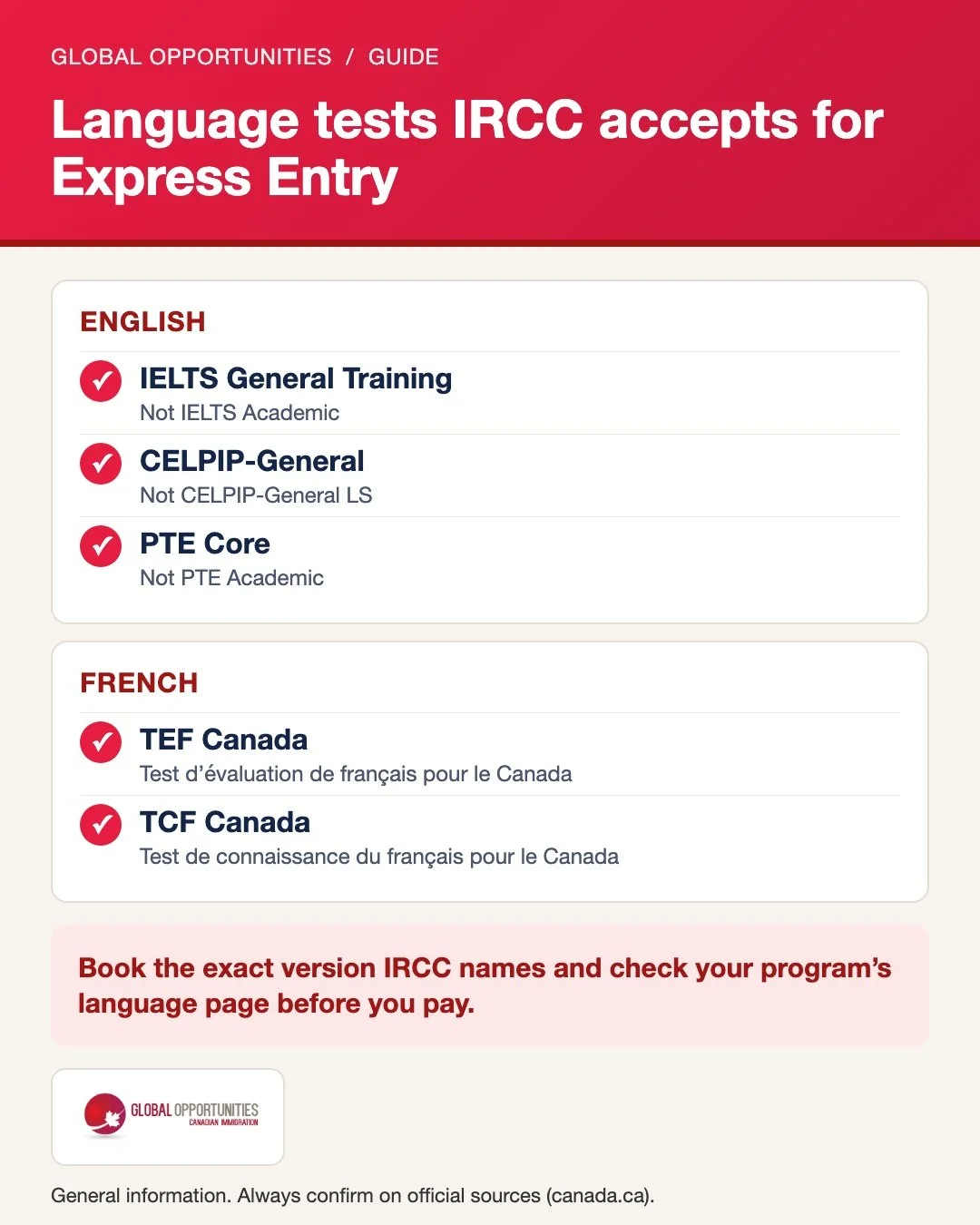
Tests accepted by IRCC for Express Entry
According to IRCC (language tests, canada.ca):
English: CELPIP-General, IELTS General Training and PTE Core.
French: TEF Canada and TCF Canada.
IELTS Academic and PTE Academic are not on IRCC's Express Entry list.
Tests accepted by regulators
Each regulator sets its own accepted tests and levels. Some accept IELTS Academic, profession-specific tests (for example, CELBAN for nurses) or evidence from your education or practice. Check your regulator's list before you book a test, especially if you hope to use one result for both purposes.
Why language matters so much
IRCC asks for language results in Express Entry and in many other economic programs; how much they matter in your case depends on your whole profile.
French can open extra options, including the French-language proficiency category. More from Global: French-language proficiency.
In practice, communication skills are key to getting hired in your profession.
Watch our live session on how CELPIP results fit into an immigration application, and see our English and French tests guide for every test IRCC accepts.
Accepted tests as published by IRCC and the regulators we link, as of November 2026. Each regulator sets its own tests and levels: check your regulator's page before you book a test.
Frequently asked questions
Can I immigrate to Canada as a professional without a job offer?
Often, yes. The Federal Skilled Worker Program and the Canadian Experience Class do not require a job offer, and some provincial streams do not either. Other routes do: the Atlantic Immigration Program and many provincial streams start with an employer. Your options depend on your whole profile: occupation, skilled experience, education, English or French, family and the programs open when you apply. A job offer can help in some programs, but never pay for one: employers cannot charge workers to get or keep a job.
Is there a professional visa to immigrate to Canada?
No. Canada does not have a visa for each profession. Professionals immigrate through programs such as Express Entry, Provincial Nominee Programs, the Atlantic Immigration Program or work permits, and the program decides your status. If your profession is regulated, you apply separately to the provincial regulator for a licence, which decides whether you can practise and use the protected title. That is why this guide explains both processes for each profession: immigration and licensing run in parallel, with different requirements, documents and decision-makers.
How do I find my NOC code to immigrate to Canada as a professional?
Not by your job title. Use the advanced search of the official NOC website (NOC 2021) to search for words that describe your main duties in the lead statement and main duties sections, read the lead statement and main duties of each possible code, and choose the one whose duties match what you actually did, not just your job title. IRCC asks that your experience shows the lead statement and most of the main duties. An engineer who managed projects may fit a management code, and an industrial engineer who worked in logistics may fit a logistics code. Then make sure your reference letters describe those duties. Choosing a code your duties do not support can lead to a refusal. Watch our YouTube video on the NOC.
What does TEER mean in the NOC?
TEER stands for Training, Education, Experience and Responsibilities. Every NOC code has a TEER category from 0 to 5: TEER 0 is management; TEER 1 usually requires a university degree; TEER 2 a college diploma, an apprenticeship of two or more years or supervisory duties; TEER 3 a shorter college program or apprenticeship or on-the-job training; TEER 4 and 5 require less formal training. The second digit of a NOC 2021 code matches its TEER. Several programs, such as the Federal Skilled Worker Program and the Canadian Experience Class, only accept experience in TEER 0, 1, 2 or 3.
Does permanent residence let me practise my profession in Canada?
Not if your profession is regulated. Permanent residence is decided by IRCC and lets you live and work in Canada; the licence is decided by the provincial regulator and lets you practise a regulated profession or use its protected title. They are separate processes. You can become a permanent resident before you are licensed, and you can often start some licensing steps before you immigrate. Until you have the licence, you can work in related roles that do not require it, under the rules of your province and regulator.
Is an ECA the same as a professional licence in Canada?
No. An Educational Credential Assessment shows what your foreign education is equivalent to in Canada, for immigration purposes, and is required for the Federal Skilled Worker Program if you studied abroad. A licence lets you practise a regulated profession and is issued by the provincial regulator after its own assessment, which may include exams, courses and supervised practice. Your regulator may not accept your ECA, and your ECA does not replace the regulator's review. Doctors, pharmacists and architects who need a licence have specific ECA organizations under IRCC's rules.
Which occupations are in the Express Entry healthcare category?
IRCC publishes the list of NOC codes for each category on its category-based selection page, and the list changes. When we reviewed it in November 2026, the healthcare and social services category included occupations such as registered nurses and other nursing roles, physicians, pharmacists and pharmacy technicians, dentists, therapists, medical laboratory technologists and social workers. Being in the category does not mean you can practise: almost all of these professions need a licence from the provincial regulator, which is a separate process. It also does not guarantee an invitation, because IRCC decides whether and when to hold category rounds. Before you plan around a category, check your exact NOC code against the current list. More from Global: healthcare occupations.
Does being in an Express Entry category guarantee permanent residence?
No. A category only means you may be considered in its rounds, if IRCC holds them. IRCC says category-based rounds supplement other round types, and that a category round may not be needed if enough eligible candidates are invited through general or program-specific rounds. You still need to qualify for one of the three Express Entry programs, be invited, submit a complete and accurate application and be admissible. No category, program or representative can guarantee an invitation or permanent residence.
How do I immigrate to Canada as a nurse?
Through two parallel processes: an immigration program, decided by IRCC or a province, and a nursing licence, decided by the regulator of the province where you want to work. There is no immigration program just for nurses. Our complete guide on how to immigrate to Canada as a nurse explains NNAS, the NCLEX-RN and REx-PN, each regulator, English tests and the main pathways. See our nurses section.
How do engineers get a P.Eng. licence in Canada?
Through the engineering regulator of the province where they want to practise. Engineers Canada, which does not grant licences, describes five general criteria: academics (an accredited degree or equivalent), engineering work experience that meets the province's requirements, the Professional Practice Examination on law and ethics, good character and language. If you studied outside Canada, the regulator reviews your education and may assign technical exams or courses. Many regulators have an engineer-in-training stage while you build experience. The regulator's review is separate from your ECA.
Can I work as an engineer in Canada without a licence?
You can work in many engineering-related roles, such as technologist, analyst, project coordinator, inspector or estimator, or under the supervision of a licensed engineer as your regulator allows. What you cannot do is practise regulated engineering on your own or use the title "engineer" without a licence. Engineers Canada says using a protected title like "engineer" in a personal profile, including on LinkedIn, is misleading and illegal. Describe yourself accurately, for example "international engineering graduate" or "EIT" if you are registered as one.
Do IT professionals need a licence to work in Canada?
Generally not. Most IT jobs, such as software developer, data scientist, systems analyst or cybersecurity specialist, are not regulated, and employers decide whether your education and experience fit. The exception is the title "engineer": Engineers Canada explains that, in most provinces, you cannot call yourself a "software engineer" without an engineering licence, even if your employer uses the title, although Alberta changed its rules for software engineers. Check the rule in your province and use accurate titles on your resumé and online profiles.
How do accountants immigrate to Canada?
Like other professionals, through Express Entry or provincial programs; financial auditors and accountants (NOC 11100) are TEER 1. To use the CPA designation or practise public accounting, you need recognition from your provincial CPA body. CPA Canada has signed recognition agreements with some international accounting bodies on behalf of the provincial bodies, and the provincial body assesses each application. Without an agreement, you usually have your education assessed and complete CPA courses and exams. Many accounting and finance jobs do not require the CPA designation.
How do teachers immigrate to Canada?
With an eligible immigration profile and, to teach in a public school, a provincial teaching certificate from the province's certifying body, such as the Ontario College of Teachers or British Columbia's Teacher Regulation Branch. Certification usually requires a bachelor's degree, a teacher education program and evidence of language proficiency, and the certifying body may assign courses. Elementary and secondary teachers (41221 and 41220) were in the education category when we reviewed it. Language school teachers and college instructors usually fit other codes.
How do early childhood educators immigrate to Canada?
Early childhood educators and assistants (NOC 42202, TEER 2) can use Express Entry, provincial streams and other programs, and they were in the education category when we reviewed IRCC's category-based selection page. To work in licensed child care, most provinces require certification or registration: in Ontario with the College of Early Childhood Educators, in British Columbia with the ECE Registry, which has a pathway for applicants educated outside Canada, and in Alberta through provincial certification.
How do doctors immigrate to Canada?
Doctors immigrate through the same programs as other professionals, and physicians were in the healthcare category when we reviewed IRCC's category-based selection page, with a separate category for physicians with Canadian experience. For the ECA, IRCC requires doctors to use the Medical Council of Canada. Practising medicine requires a licence from the provincial College of Physicians and Surgeons, usually after credential verification through physiciansapply.ca, MCC exams and either residency or a practice-ready assessment. Licensing usually takes longer than immigration, so plan both together.
How do pharmacists immigrate to Canada?
Pharmacists (NOC 31120, TEER 1) immigrate through Express Entry and provincial programs, and they were in the healthcare category when we reviewed IRCC's category-based selection page. For the ECA, IRCC says pharmacists who need a licence must use the Pharmacy Examining Board of Canada (PEBC). To practise, you generally complete PEBC's process for international graduates (document evaluation, the Evaluating Examination and the Qualifying Examination) and then register with your provincial pharmacy regulator, which may add its own requirements, such as jurisprudence exams or supervised practice.
How can I immigrate to Canada as an architect?
Through two separate processes. For immigration, architects (NOC 21200, TEER 1) can look at Express Entry, provincial programs and other pathways, and IRCC says architects who need a licence must have their ECA done by the Canadian Architectural Certification Board (CACB). For the licence, the NOC says registration with a provincial association is required in all provinces and the Northwest Territories. CACB describes two routes: academic certification of your education, followed by the Internship in Architecture Program and the Examination for Architects in Canada, or, if you are already licensed abroad, the Broadly Experienced Foreign Architect (BEFA) program. After that, you apply to the association of your province, such as the OAA in Ontario or the AIBC in British Columbia. Our section on architects links each official page, and we have a guide for architects in Spanish.
How can I immigrate to Canada as a veterinarian?
Veterinarians (NOC 31103, TEER 1) immigrate through the same programs as other professionals, and licensing is a separate process. According to the Canadian Veterinary Medical Association, its National Examining Board (NEB) issues a Certificate of Qualification to candidates who pass the NEB process, and that certificate is required before applying for a general licence from a provincial veterinary body. For graduates of non-accredited programs, the NEB pages describe a document evaluation, a language requirement, the Basic and Clinical Sciences Examination, the NAVLE and a Clinical Proficiency Examination, with some alternative pathways. The CVMA says licensing is the responsibility of the provincial veterinary association, so check its rules too. Our section on veterinarians links the official pages.
How do occupational therapists get registered in Canada?
According to the NOC, occupational therapists (31203, TEER 1) need licensure with a regulatory body in all provinces and territories. If you were educated outside Canada, you usually start with SEAS, the Substantially Equivalent Assessment Steps run by ACOTRO, the association of occupational therapy regulators. ACOTRO describes an academic credential assessment, then a language readiness assessment, a review of your courses and fieldwork and an online jurisprudence test, and finally an interview-style competency assessment. ACOTRO says you must prove proficiency in English or French before the jurisprudence test and the competency assessment. After SEAS, you apply to the regulator of the province where you will practise. Immigration is a separate process with IRCC or the province.
How do psychologists get licensed in Canada?
Psychologists (NOC 31200, TEER 1) must register with the psychology regulator of their province: according to the NOC, registration is required in all provinces, the Northwest Territories and Nunavut. The NOC also says a doctoral degree is required for the title "Psychologist" in some provinces and a master's in others, and that the EPPP exam and supervised experience are required in most jurisdictions. If you were educated outside Canada and the United States, ACPRO, the national organization of regulators, offers a single online entry point for participating jurisdictions through a credentials evaluation service; Alberta, British Columbia, Quebec, Yukon and the Northwest Territories were not participating when we checked, so you apply directly there. Our section on psychologists links each page.
Can I fly in Canada with my foreign pilot licence?
For a limited time, possibly. Pilot licences in Canada are federal and issued by Transport Canada, not by a province. Transport Canada describes three routes for foreign pilots: getting a Canadian licence, where it may credit training from a licence issued by an ICAO member country; converting a US FAA certificate under a Canada–US agreement; or a Foreign Licence Validation Certificate for flying in Canada for a limited time, which for commercial work is applied for by the employer. For a career in Canada, Transport Canada recommends a Canadian licence for longer stays. A licence does not give you the right to work in Canada, which depends on your immigration status. Our section on pilots links the official pages.
Do I need a licence to work in an office, marketing or sales job in Canada?
Usually not. Most administrative, marketing and sales occupations, such as administrative officers (NOC 13100), administrative assistants (13110), marketing and communications professionals (11202) and technical sales specialists (62100), are not regulated: no regulator has to license you, and the employer decides whether your education and experience fit. Credential recognition still helps, because Canadian employers may not know your university or former employers: an ECA, voluntary designations and a Canadian-style resumé make your profile easier to understand. A few related roles are regulated, such as paralegals in Ontario. For immigration, check the TEER of your code: retail salespersons (64100) are TEER 4, which does not count as skilled for the Federal Skilled Worker Program or the Canadian Experience Class.
What is the Red Seal for skilled trades in Canada?
The Interprovincial Standards Red Seal Program sets common standards for many trades. Provinces and territories handle apprenticeship and certification, including the Red Seal exam, and passing it adds a Red Seal endorsement to a provincial or territorial trade certificate. The program notes that the endorsement alone does not mean you are certified to practise in a given province; that is confirmed by the provincial apprenticeship authority. For immigration, a Canadian certificate of qualification can support the Federal Skilled Trades Program.
Are skilled trades regulated in Canada?
Some are. Compulsory trades require a provincial certificate, or registration as an apprentice, to work in them; voluntary trades do not, although certification helps with employers. The list of compulsory trades varies by province: the NOC profile for construction electricians, for example, says certification is compulsory in some provinces and voluntary in others. Internationally trained tradespeople usually apply to the provincial trade authority, such as Skilled Trades Ontario or SkilledTradesBC, for an assessment of their experience before writing a certification exam.
How do truck drivers immigrate to Canada?
Transport truck drivers (NOC 73300) are TEER 3, which counts as skilled for the Federal Skilled Worker Program and the Canadian Experience Class, and their major group was among the trades eligible for the Federal Skilled Trades Program when we reviewed IRCC's page. They were not in the transport category, which listed aviation occupations (including pilots) and automotive service technicians, truck and bus mechanics (category-based selection, IRCC). To drive commercially, you need a provincial licence, and several provinces require mandatory entry-level training before the Class 1 or Class A road test. Never pay for a trucking job offer or LMIA.
Can I use my foreign commercial driver's licence in Canada?
Commercial licensing is provincial, and requirements for drivers licensed abroad vary. In general, you should expect to obtain the provincial commercial class you need, such as Class 1 or Class A for tractor-trailers, with the knowledge tests, medical, air brake endorsement and road test the province requires. Several provinces require mandatory entry-level training, and Ontario's page explains when people with a commercial licence from another country must complete it. Check with the licensing authority of your province before you move, and be wary of anyone selling licences.
What are bridging programs for internationally trained professionals?
They are programs that help internationally trained people meet Canadian licensing or job requirements in their field, through occupation-specific courses, exam preparation, workplace experience, mentoring and employer connections. Ontario lists them under the Ontario Bridge Training Program, British Columbia offers Career Paths for Skilled Immigrants, and IRCC-funded newcomer services across Canada include employment programs for professionals. Eligibility varies: some require permanent residence or living in the province. They are usually optional, unless your regulator assigns specific courses. Our section on bridging programs links the official pages.
Can I start my licence before I move to Canada?
Often, yes, at least the first steps. Many regulators and national assessment bodies, such as NNAS for nurses, the Medical Council of Canada for doctors, PEBC for pharmacists and some engineering regulators, let you open a file, send documents or even write some exams from abroad. Other steps, such as supervised practice, some exams or transition courses, usually happen in Canada. Some regulators recommend having the permits required to work in Canada before you apply. Check what your regulator allows from abroad and plan the order with your immigration timeline.
How should I write my resumé as an internationally trained professional?
Use a Canadian format: short, focused on achievements, with plain functional titles and no photo, date of birth or marital status. Explain your former employers briefly, describe your duties and results, and state your education with any ECA or regulator assessment. If you are not yet licensed, do not use a protected title; describe your status accurately, for example "internationally educated nurse" or "EIT". Job Bank's newcomer section has a resumé builder, and free IRCC-funded newcomer services offer resumé reviews and interview practice. Our guide to working in Canada: resume, cover letter and interview has a full template.
What English test do professionals need for Canada?
Often two different ones. For Express Entry, IRCC accepts CELPIP-General, IELTS General Training and PTE Core for English, and TEF Canada and TCF Canada for French. Your regulator sets its own list, which may include IELTS Academic, profession-specific tests such as CELBAN for nurses or OET, or evidence from your education. IELTS Academic and PTE Academic are not on IRCC's Express Entry list. If you hope to use one result for both purposes, compare both lists before you book. Our English and French tests guide explains each test.
Where do professionals look for jobs in Canada?
Start with Job Bank, the Government of Canada's job board, which has a newcomer section, wage information and job alerts. Public employers, such as hospitals, health authorities, school boards, municipalities and provincial governments, post jobs on their own official sites. Professional associations and regulators often share resources for internationally trained members, and IRCC-funded newcomer services offer employment programs, mentoring and networking. Be wary of anyone who charges you for a job or promises one. Global Opportunities does not offer jobs and is not a recruitment agency.
Can US and Mexican professionals work in Canada under CUSMA?
Yes, in occupations listed in the Canada–United States–Mexico Agreement, such as engineer, accountant, registered nurse and computer systems analyst, if they are US or Mexican citizens, have pre-arranged employment with a Canadian employer and meet the qualifications the list requires. For regulated professions, IRCC's instructions say the person must have or be able to get the licence needed in the province, and registered nurses need a licence from the province of destination. Self-employment is not allowed. CUSMA permits are temporary; permanent residence requires a separate program.
Which jobs are in demand in Canada?
It depends on the occupation and the region, and it changes every year. The most reliable public source is Job Bank's job outlooks, which compare the prospects for an occupation in different parts of the country and, according to Job Bank, "reflect the probability of growth over the next 3 years" (trend analysis, Job Bank). Job Bank also publishes wages by region. Keep two things in mind. First, an occupation in demand is not an immigration pathway: it does not make you eligible for a program, and Express Entry categories and provincial streams have their own lists. Second, demand does not guarantee you a job, especially in regulated professions, where you also need a licence. Use outlooks to plan, together with your immigration options and your licensing steps.
Does Global Opportunities offer jobs or handle professional licences?
No. Global Opportunities is a private immigration firm. It does not offer jobs, does not sell job offers, is not a recruitment agency and does not handle professional licence applications: you submit those yourself, directly to the regulator, and several regulators require the applicant to complete the application personally. What we do is help you understand which immigration pathways may fit your profile and plan your immigration steps alongside your licensing plan, so that you do not spend money on tests and assessments in the wrong order.
Related guides
Guides in Spanish: for nurses (in Spanish), for engineers (in Spanish) and for architects (in Spanish)
Province guides: Ontario, British Columbia, Alberta, Saskatchewan, Manitoba, Nova Scotia, New Brunswick, Prince Edward Island, Newfoundland and Labrador and Yukon, Northwest Territories and Nunavut
Country guides: Moving to Canada from Asia, from Africa, from Europe, from Australia and Working Holiday in Canada for Irish citizens
How Global Opportunities can help
Global Opportunities Canadian Immigration Services is a private immigration firm in Toronto. We help professionals understand which Canadian immigration pathways may fit their profile, plan the steps in a sensible order and prepare their immigration applications. For regulated professions, that means looking at your immigration options alongside your licensing plan, so you do not spend money on tests and assessments in the wrong order. Every profile is different, programs change constantly and no one can guarantee a result. Global Opportunities does not handle professional licence applications: you submit those yourself, directly to the regulator.
Our regulated consultant: Lic. Mildrete Monserrath Gutierrez Martinez, Regulated Canadian Immigration Consultant (RCIC), CICC licence R514880. Verify her licence on the CICC Public Register: https://college-ic.ca/protecting-the-public/find-an-immigration-consultant. Global Opportunities does not offer services for Quebec's immigration programs. Global Opportunities is a private firm and is not part of the Government of Canada or any provincial government.
Recorded seminars and lives: watch our recorded seminars in English or the Spanish recordings, and browse our YouTube channel.
More articles in English: read our Moving to Canada articles on topics such as health care, cost of living, the ECA and professional licences, and building community in Canada.
Personalized consultation: a review of your profile and options with our team. Contact us or write to info@globalopp.ca.
Prefer email? Tell us what you need help with (immigrating to Canada with my profession) and we will reply: email info@globalopp.ca.
Contact Global Opportunities →
Sources
IRCC: Educational Credential Assessment and designated organizations
IRCC: Online and telephone scams and check if a representative is authorized
CIHI: Health Workforce in Canada, 2020 to 2024 (2024 data, published 12 Feb 2026)
Statistics Canada, The Daily, 19 Oct 2026: health workforce, 2025 data
CNO: approved providers, registration examination, English or French proficiency, guide for nurses educated outside Canada and April 2025 changes
Government of Saskatchewan: internationally educated health care professionals
BC PNP Skills Immigration, BC PNP news and Alberta Advantage Immigration Program
Engineers Canada: overview of the licensing process, engineering regulators and use of professional title
Medical Council of Canada and physiciansapply.ca (Practice-Ready Assessment: mcc.ca); colleges of physicians and surgeons of Ontario, British Columbia and Alberta
NOC 2021 profiles: 31120 Pharmacists, 42202 Early childhood educators and assistants, 44101 Home support workers and 73300 Transport truck drivers
PEBC: pharmacists, NAPRA: pharmacy regulatory authorities and Ontario College of Pharmacists
CPA British Columbia: internationally designated accountants
Teacher certification: Ontario College of Teachers, BC Teacher Regulation Branch, Alberta teacher certification, SPTRB and Manitoba Professional Certification Unit
ECE certification: College of Early Childhood Educators (Ontario), Government of B.C.: international ECE applicants and Alberta ECE certification
Commercial driver training: Ontario mandatory Class A training and truck driver's licence, ICBC MELT, Alberta Class 1 training, Manitoba Public Insurance MELT and PEI MELT
Bridging and credential support: Ontario Bridge Training Program, Ontario: work in your profession or trade, Alberta Fairness for Newcomers Office and WelcomeBC: Career Paths for Skilled Immigrants
Health professions: NDEB, Canadian Alliance of Physiotherapy Regulators, ACOTRO, CSMLS, COPR, CMRC and CVMA
IRCC: International free trade agreements, Canada–Chile, Canada–Colombia, Canada–Peru, Canada–Panama and International Mobility Program
IRCC: Program delivery update on the Canada–UK Trade Continuity Agreement (CUKTCA)
IRCC: Live and work as a medical doctor in Canada (page dated 19 October 2026)
Lawyers: NCA, self-assessment, assigned requirements, Certificate of Qualification and bar admissions
Dentists: NDEB Equivalency Process, NDEB certificate and licence, Royal College of Dental Surgeons of Ontario and College of Oral Health Professionals of BC
Physiotherapists and social workers: CAPR credentialling pathway and CCSWR, professional regulation
Trades: SkilledTradesBC, skilled trades certification, Skilled Trades Ontario, trade equivalency and Red Seal trades: cook, construction electrician, plumber and welder
NOC 2021 profiles: 11201, 20012, 21211, 21222, 31110, 31202, 41101, 41300, 62200, 63200, 72106, 72200 and 72300
IRCC: Immigrate to Canada, Express Entry, work permits and study permits
Occupational therapists: ACOTRO SEAS, SEAS steps and SEAS language readiness
Medical laboratory technologists: CSMLS internationally educated MLTs, CSMLS Prior Learning Assessment, CMLTO and CMLTA
Psychologists: ACPRO internationally educated applicants, ACPRO jurisdictional requirements, College of Alberta Psychologists and CHCPBC psychology
Dietitians: Dietitians of Canada, internationally educated and College of Dietitians of Ontario
Paramedics: COPR international assessments
Veterinarians: CVMA National Examining Board, about the NEB and the CQ, NEB language proficiency requirement and College of Veterinarians of Ontario
Pilots: Transport Canada, licensing foreign pilots, converting a US or Canadian pilot licence, Foreign Licence Validation Certificates and aviation language proficiency
Architects: CACB, CACB academic certification, BEFA program, BEFA program highlights (CACB, PDF) and RAIC: provincial and territorial associations of architects
Geoscientists and agrologists: Geoscientists Canada, becoming a P.Geo., APEGA, internationally trained professionals, Professional Geoscientists Ontario, BC Institute of Agrologists and Saskatchewan Institute of Agrologists
NOC 2021 profiles added in this update: 10022, 11202, 13100, 13110, 21102, 21112, 21200, 31103, 31121, 31200, 31203, 32102, 32120, 62100, 64100 and 72600
Global Opportunities: Recorded seminars and lives in English · Success stories (in Spanish)
Global Opportunities videos: Permanent residency: applying vs being selected · CELPIP for Canada Immigration
The information in this guide comes from the official sources linked above (the Government of Canada, provincial and territorial governments, regulators and national assessment bodies), as they read when we checked them in November 2026. It may have changed since then, and the official page is the one that counts. It is general information for reference only, not immigration, legal or professional advice. Global Opportunities is not responsible for how anyone interprets this content or for changes made after it was written. Immigration programs, Express Entry categories, provincial programs, regulators' requirements and licensing processes change frequently; the lists of regulators are for reference only and may not be complete; and statistics describe the past and do not predict any outcome. Licensing is decided by each regulator, and immigration by IRCC or the province; one does not guarantee the other. Global Opportunities is a private firm, is not part of the Government of Canada or of any regulator, and does not offer jobs. For advice on your own case, book a consultation.
Last reviewed: November 2026