
Moving to Canada from Australia: Everything You Need to Know
Moving to Canada from Australia is a big decision, whether you are an Australian citizen, a Canadian coming home, or one of the many students, graduates and workers from around the world who live in Australia today. Most people start with the same questions: can I work there, which pathway fits me, will my qualifications count, and where should I live? This guide answers them in plain English, using official Government of Canada and provincial sources.
About our sources: This guide summarises what official sources (the Government of Canada, provincial and territorial governments and the other organisations we link to) said when we checked them in November 2026. We link every source so you can read it yourself. Rules, rates and requirements change, sometimes without notice, and the official page is the one that counts. This is general information, not legal, tax or immigration advice. Global Opportunities is not responsible for how this information is interpreted or for changes made after it was written.
Australians and Canadians share a lot: English as a working language and Commonwealth roots. Yet the two countries run very different immigration systems, and what works in one does not automatically carry over to the other. If you live in Australia on a temporary visa, your skills, your English and your international experience can be a strong starting point for Canada: we explain how in a dedicated section. If you trained in Australia as a doctor, nurse, tradesperson or teacher, you will find a section for your profession. This guide focuses only on Canada's side: Canadian programs, Canadian requirements and Canadian daily life.
We are Global Opportunities, a private immigration firm based in Toronto. Every program mentioned here changes over time, so we link the official page for each one. Please check it before you make any decision.

Watch our recorded seminars and lives →
In this guide
Living in Australia but not Australian? Canada can be your next move
Studied medicine in Australia? Pathways to practise in Canada
Canadians returning home from Australia
Why do Australians move to Canada?
Moving to Canada from Australia: Working Holiday and International Experience Canada
Moving to Canada from Australia: do you need a visa or an eTA?
Moving to Canada from Australia as a skilled worker: Express Entry and provincial programs
How do you get Australian qualifications recognized in Canada?
Australian tradespeople: Red Seal and provincial certification
Australian nurses moving to Canada
Australian teachers moving to Canada
English tests for moving to Canada from Australia
French: an extra advantage when moving to Canada from Australia
Studying in Canada after Australia
Finding a job in Canada from Australia
Which province should you choose when moving to Canada from Australia?
Daily life in Canada for Australians: what changes
A note for New Zealanders moving to Canada
Budget, documents and what to bring from Australia
Planning checklist for moving to Canada from Australia
Your first weeks after moving to Canada from Australia
Frequently asked questions
Related guides
How Global Opportunities can help
Sources
Living in Australia but not Australian? Canada can be your next move
Australia is home to a large community of people who are not Australian citizens: international students, recent graduates, temporary skilled workers and working holiday makers from Latin America, Asia, Europe and beyond. Many of them have built strong English, international qualifications and real work experience, yet find that the road to Australian permanent residence is long or out of reach. If that is your story, Canada deserves a serious look. You already have much of what Canadian programs value: you have studied or worked abroad, you have adapted to a new country, and you work in English every day.

Who this section is for
International students and graduates in Australia, including those on a temporary graduate visa.
Temporary skilled workers whose visa depends on an employer.
Working holiday makers who want a longer-term plan.
People from Colombia, Peru, Chile, Brazil, Mexico and other countries who first moved to Australia to study English or a vocational course.
Why many people in Australia are looking at Canada
In recent years, Australia has tightened several of its temporary visa rules. According to the Australian Government's official Study Australia site, some temporary visa holders, including visitors and temporary graduates, can no longer apply for a new student visa from inside Australia. The details belong to the Australian Government, so check them on its official pages. For many people, this is the moment to plan the next step, and Canada is one of the countries with open, transparent pathways for skilled people.
Your citizenship decides your Canadian options, not where you live
This is the most important point to understand: Canada looks at your passport, not at your Australian visa.
Entering Canada: whether you need an eTA or a visitor visa depends on your citizenship. Citizens of Colombia and Peru, for example, need a visitor visa, while the rules for Brazil and Mexico depend on your situation. Check IRCC's visa or eTA tool with your own passport.
Working Holiday (IEC): International Experience Canada is organized by country of citizenship. IRCC's eligibility by country page lists Chile, Costa Rica and Spain, among others, but not Colombia, Brazil or Peru at the time of writing. Mexico is not on IRCC's IEC list, so Mexican citizens cannot apply for a Working Holiday in Canada. A working holiday in Australia does not give you access to IEC in Canada.
Permanent residence programs: Express Entry and the provincial programs are open to people of any nationality who meet their requirements, wherever they live.
Your Australian experience and studies can count
Work experience: according to IRCC, the Federal Skilled Worker Program considers skilled work experience gained in Canada or abroad, so skilled, paid work in Australia may count if it meets the program's rules. Casual jobs outside your field, such as hospitality while you studied, may not count as skilled experience; check how your role is classified in Canada's National Occupational Classification.
Education: a degree or diploma from Australia, or from your home country, can be assessed through an Educational Credential Assessment (see the qualifications section below). Australian vocational qualifications (VET) can also be assessed.
English: the English tests IRCC accepts, listed on its Express Entry language test page, can be taken in Australia. Book the exact test IRCC asks for: IELTS General Training, CELPIP-General or PTE Core, not IELTS Academic or PTE Academic, which many students in Australia have taken before.
Spanish, Portuguese or French: your first language is not scored on its own, but French is an advantage in Canadian immigration (see the French section below).
Applying from Australia
You can apply for most Canadian programs online from Australia. If IRCC asks for biometrics, you can give them at a visa application centre in Australia: find the current locations on IRCC's visa application centre finder. Many applications also require police certificates from the countries where you have lived, including Australia, where they are issued by the Australian Federal Police. See IRCC's page on police certificates from Australia, and remember that you may also need one from your home country.
Plan ahead, while your Australian visa is still valid
The strongest applications are usually prepared early. Book your English test, request your credential assessment and gather your work references while you are still working in Australia, because it is much harder to get reference letters once you have left. Nothing here guarantees a result: each Canadian program has its own requirements, and every decision is made by IRCC or the province. We work in English and Spanish, so Latin Americans in Australia can talk to us in their own language.
Please note: entry, IEC and permanent residence rules as published by IRCC, and Australian visa changes as published by the Australian Government, as of November 2026. Having studied or worked in Australia does not make you eligible for any Canadian program by itself; IRCC decides each case.
Studied medicine in Australia? Pathways to practise in Canada
Many people study medicine in Australia, including Canadians who plan to return home and international students who want to build a career in Canada. Canada needs doctors, and several provinces have opened new routes for physicians trained in Australia. If you have the ambition and the qualifications, this can be one of the most rewarding moves of your career. This section gives a general map; medical licensing is complex, so always confirm with the official bodies.

Medical graduates: the international medical graduate (IMG) route
If you graduated from an Australian medical school but have not completed postgraduate training, you will usually follow the international medical graduate route. According to the Medical Council of Canada, the path generally includes:
Opening an account on physiciansapply.ca and having your medical degree verified.
Passing the Medical Council of Canada's qualifying examination and, for residency applications, the National Assessment Collaboration (NAC) examination.
Applying for residency positions through CaRMS, the Canadian residency matching service.
Residency positions for international medical graduates can come with a return of service commitment set by the province; CaRMS and the province publish the conditions, so read them carefully before you apply. Canadian citizens and permanent residents who studied medicine in Australia usually apply through this route too; check CaRMS eligibility rules for your status.
Practising doctors trained in Australia
If you have completed your training and hold specialist or general practice qualifications from Australia, some provinces now offer more direct routes to a licence. At the time of writing, provincial medical regulators list Australia among their approved jurisdictions:
Nova Scotia: the College of Physicians and Surgeons of Nova Scotia lists Australian general practice fellowships and Australasian specialist colleges among its approved jurisdictions.
Alberta: the College of Physicians & Surgeons of Alberta has an approved jurisdiction route that includes Australia.
British Columbia: the College of Physicians and Surgeons of British Columbia has opened full licensure to family doctors and specialists trained in several jurisdictions, including Australia, together with an integration program.
Ontario: the College of Physicians and Surgeons of Ontario describes registration pathways for internationally trained physicians, including family physicians certified through the College of Family Physicians of Canada, which recognizes some international training.
Any regulator we mention is for reference only. The list may not be complete, and licensing requirements must always be confirmed directly with the medical regulator of the province or territory where you plan to work.
Immigration for doctors
A medical licence and immigration are two separate processes. IRCC has a page on immigrating to Canada as a medical doctor, and, according to IRCC's category-based selection page, health care is one of the Express Entry categories at the time of writing. Provinces also run their own programs for health professionals. The right combination depends on your training, your licence and the province, so plan both processes together, and ask the regulator what it needs before you resign from your Australian position.
Please note: licensing routes as published by the Medical Council of Canada, CaRMS and the provincial colleges of physicians named above, and immigration information as published by IRCC, as of November 2026. A route listed by a regulator does not mean you will be licensed or that IRCC will approve an application; each body decides each case.
Canadians returning home from Australia
Many Canadians spend years in Australia on a working holiday, for study or for a career, and some come home with an Australian partner and children born there. Coming back is not immigration for you, but there are still steps to plan.
Your own return
Entry: Canadian citizens have the right to enter Canada. Travel with a valid Canadian passport; IRCC explains Canadian passports, including how to renew from abroad. If you are a dual citizen, check IRCC's passport rules before you book: Canadian citizens are expected to travel to Canada on a Canadian passport.
Bringing your belongings: the Canada Border Services Agency's page Moving or returning to Canada explains the rules for former residents bringing back personal and household goods. Prepare a list of goods before you ship, using the BSF186 Personal Effects Accounting Document.
Health coverage: each province decides when returning residents are covered again, so check your provincial health plan before you land and consider private insurance for any gap.
Taxes: the Canada Revenue Agency has a section on individuals leaving or entering Canada. Australian tax and superannuation questions belong to an Australian professional.
Driving: the Government of Ontario's page Exchange an out-of-province driver's licence lists Australia among the places from which a licence can be exchanged, subject to conditions; other provinces have their own rules.
Pensions: Canada and Australia have a social security agreement that can help some people qualify for benefits. See Australia: pensions and benefits on canada.ca.
Your Australian partner
If your spouse or common-law partner is not Canadian, they will need their own status in Canada. One option is family sponsorship: IRCC explains sponsoring your spouse, partner or children, including the requirements for the sponsor. Some partners also qualify for IEC or Express Entry on their own. Plan the timing early, because your partner's right to work depends on the permit they hold. Read more in our articles on family sponsorship in Canada and spousal sponsorship.
Children born in Australia
Children born outside Canada to a Canadian parent may already be Canadian citizens, depending on the rules on citizenship by descent. IRCC's pages Find out if you're already a citizen and proof of citizenship explain how to check and how to get a citizenship certificate, which children usually need before applying for a Canadian passport. If a parent is Canadian, read about citizenship by descent in our Canadian citizenship guide.
Please note: rules as published by IRCC, the Canada Border Services Agency, the Canada Revenue Agency and the Government of Ontario, as of November 2026. Citizenship by descent depends on each family's facts: only IRCC can confirm whether a child is a Canadian citizen.
Why do Australians move to Canada?
People move for many personal reasons, and there is no single "right" one. A few general themes are below. We share them as context, not as promises: what Canada offers depends on your profile, your occupation, the province you choose and the rules in force on the day you apply.
A familiar language. English and French are Canada's two official languages, and the Government of Quebec explains that French is the official language of Quebec.
A different climate. For many Australians, the Canadian winter is the biggest adjustment; see the climate section below.
Pathways from temporary to permanent. Canada has temporary programs, such as International Experience Canada, and permanent programs, such as those managed through Express Entry and the provincial nominee programs. Some permanent programs give weight to work experience gained in Canada, but nothing turns into permanent residence automatically.
Room to research a career. Job Bank lets you look up how your occupation is described in Canada and see real job postings by province.
Moving to Canada from Australia: Working Holiday and International Experience Canada
For many young Australians, the first step is International Experience Canada (IEC). IEC is a Government of Canada program that lets eligible young people from countries and territories with a youth mobility agreement with Canada travel and work in Canada for a limited time. According to IRCC's official eligibility by country and category page, Australia has a youth mobility agreement with Canada.
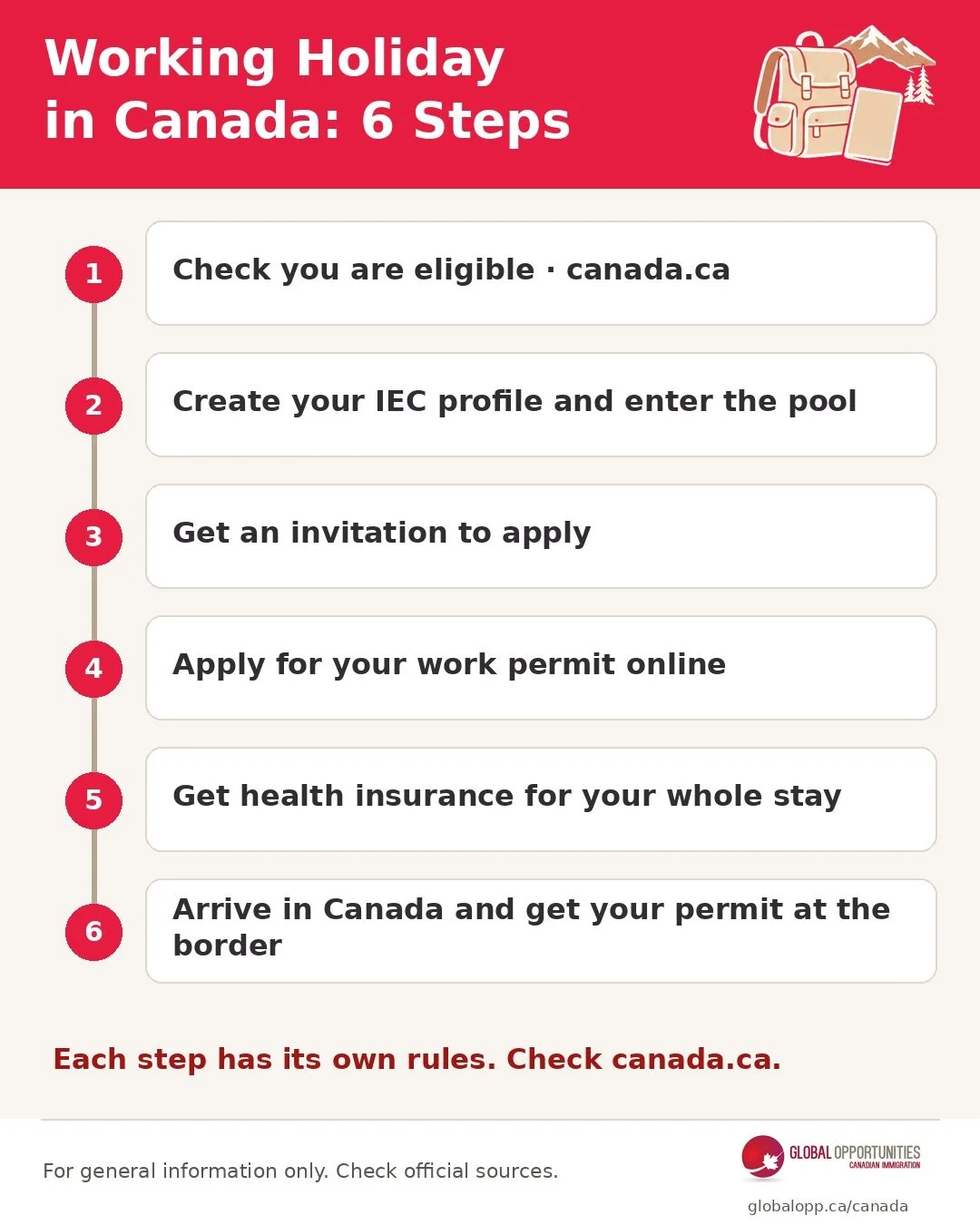
The three IEC categories available to Australians
IRCC's page on eligibility by country and category lists all three IEC categories for Australian citizens:
Working Holiday: for people who do not have a job offer before arriving and want to work for different employers or in different places. It gives an open work permit, which lets you work for most employers in most locations in Canada. According to IRCC's medical exam requirements, some jobs, for example in health care or with children, may require a medical exam.
Young Professionals: for people who already have a paid job offer in Canada that supports their professional development. It gives an employer-specific work permit, which ties you to that employer and location.
International Co-op (Internship): for students enrolled at a post-secondary institution outside Canada who need a work placement in Canada to complete their studies. It also gives an employer-specific work permit.
Working Holiday vs Young Professionals: which one fits you?
Job offer: Working Holiday needs none. Young Professionals needs a paid job offer before you apply. According to IRCC's IEC eligibility page, the job generally must be in TEER category 0, 1, 2 or 3 of the National Occupational Classification, and a TEER 4 job may qualify if it is in your field of study.
Freedom: Working Holiday lets you change jobs and cities. Young Professionals ties you to one employer and location.
Employer steps: for Young Professionals and International Co-op, the employer submits the job offer through IRCC's Employer Portal and completes its own obligations before you can apply, as explained on IRCC's page for employers hiring through IEC. For Working Holiday, there is no employer step.
Career value: Young Professionals is built around professional development, which can suit graduates who want skilled experience from day one. A Working Holiday can also include skilled work if you find it.
Participation: IRCC's page explains that Australian citizens can take part in Working Holiday or Young Professionals, not both, and that International Co-op can allow one further participation in some cases. Read the Australia section of the official page for the current rule.
How IEC pools and invitations work
IEC does not work on a first-come, first-served basis. In general, according to IRCC:
You create an account with IRCC and answer a questionnaire that checks whether you are eligible.
If you are, you submit an IEC profile and choose the pools (categories) you want to be in.
IRCC sends invitations to apply to candidates from the pools during the season.
If you receive an invitation, you have a limited time to start and then submit your work permit application, pay the fees and give biometrics if required.
If your application is approved, you receive a port of entry letter, which you show when you arrive in Canada.
An invitation is never guaranteed. Being in a pool does not mean you will be invited, and pools open and close by season.
How to check your eligibility on canada.ca
Age limits, the length of the work permit, required funds, health insurance rules, participation limits and fees are all set by IRCC and differ by country and category. They also change. We do not reproduce them here, because the only reliable version is the official one:
Open IEC: Eligibility by country and category and go to the Australia section.
Read the requirements for your category, including health insurance for your whole stay (IRCC says it must include repatriation) and the funds you must have.
Read how IEC works for the steps, deadlines and fees in force.
Use the questionnaire in your IRCC account to confirm whether you can submit a profile.
Do you need a recognized organization?
No. IRCC states that if you are from an IEC country or territory, you do not have to use a recognized organization (RO). ROs are Canadian organizations that can offer optional extra support, such as help finding a job or settling in, and most charge for their services. See using a recognized organization. You can also read our overview page, Working Holiday in Canada.
Please note: IEC rules as published by IRCC as of November 2026. Meeting the IEC requirements does not mean you will be invited or that IRCC will approve your work permit, and the rules for Australians are not the same as for other countries: read the Australia section of the official page.
Moving to Canada from Australia: do you need a visa or an eTA?
Australian citizens do not need a visitor visa, but IRCC's entry requirements page says they need an electronic travel authorization (eTA) to fly to Canada, plus a valid passport. An eTA is not needed when arriving by land or sea. If you live in Australia on another passport, that passport decides: run IRCC's official tool.
Entry rules depend on your citizenship, how you travel and why you are coming. The official place to check is IRCC's tool Find out if you need a visa or eTA to travel to Canada.
At the time of writing, IRCC's entry requirements by country page lists Australian citizens among the travellers who do not need a visitor visa but do need an electronic travel authorization (eTA) to fly to Canada, along with a valid passport. According to the same page, an eTA is not needed when arriving by land or sea (with a specific exception), but a valid passport still is. These rules can change, so run the official tool before every trip. Still unsure which one you need? See eTA vs visitor visa for Canada.
An eTA is for travel, not for work or study. To work in Canada you generally need a work permit, for example through IEC or with a job offer, unless an exemption applies. Check whether you need a work permit.
Apply only on the official page. The eTA page on canada.ca is the Government of Canada's official page for applying. Websites that look official and charge extra are not part of the Government of Canada.
If your work or study permit is approved, read your approval letter: it explains the travel document you need to enter Canada.
Watch our live session on the difference between an eTA and a visitor visa (recorded in November 2025; IRCC's tool has the current rules).
Please note: entry rules as published by IRCC as of November 2026. An eTA lets you board a flight; it does not guarantee entry, which is decided by a border services officer when you arrive.
Moving to Canada from Australia as a skilled worker: Express Entry and provincial programs
Most skilled workers moving from Australia look at two families of programs: Express Entry, the online system IRCC uses for three federal economic programs, and the Provincial Nominee Programs run by the provinces and territories. Australian experience and studies can count, but IRCC assesses each person against each program's own requirements.
If your goal is to live in Canada permanently, you will usually look at the economic immigration programs. The two main families are the programs managed through Express Entry and the Provincial Nominee Programs (PNPs). Quebec selects its own economic immigrants through separate programs; Global Opportunities does not offer services for Quebec's immigration programs, so if Quebec is your goal, start at Immigration in Québec.
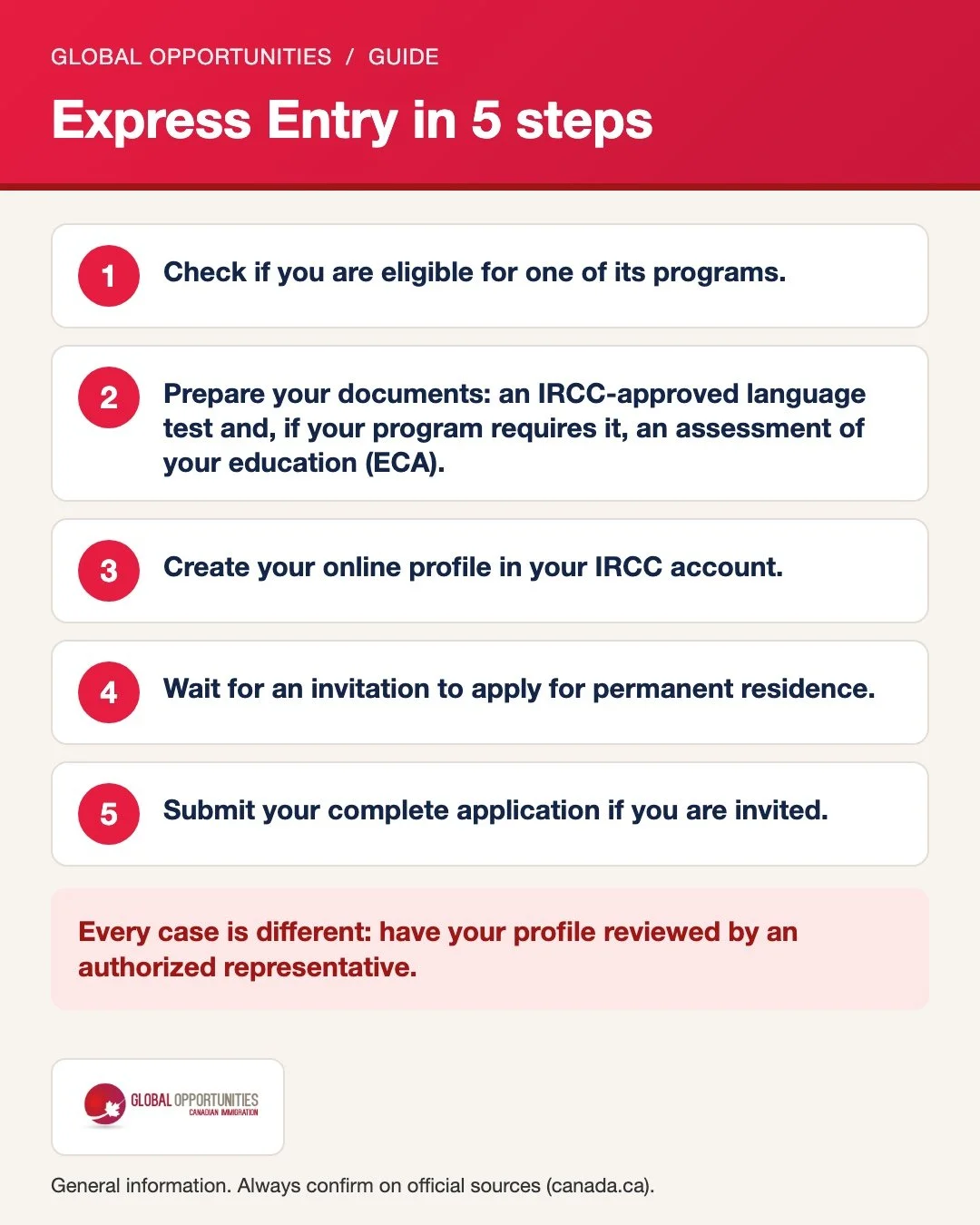
What Express Entry is
According to IRCC, Express Entry is the online system used to manage applications for three federal programs:
Federal Skilled Worker Program: for skilled workers with eligible foreign or Canadian work experience. Many Australians start their research here. Read more on our page about the Federal Skilled Worker program.
Canadian Experience Class: for skilled workers with eligible Canadian work experience.
Federal Skilled Trades Program: for skilled workers qualified in a skilled trade.
How Express Entry works, step by step
In general terms, according to IRCC:
You check whether you meet the minimum requirements of at least one of the three programs.
You create an online profile. If you are eligible, you enter the pool of candidates.
Candidates are ranked with the Comprehensive Ranking System (CRS), which, according to IRCC, gives points for factors such as age, education, language ability and work experience.
IRCC holds rounds of invitations during the year. Rounds can be general, program-specific (for example, for provincial nominees) or category-based.
If you receive an invitation to apply, you submit a complete application for permanent residence, which IRCC then reviews.
Being in the pool does not guarantee an invitation. Round types, the number of invitations and the scores needed change from round to round. We do not publish scores or cut-offs because they describe the past and do not predict anything.
Category-based selection
IRCC can also invite candidates who fit a specific category set to meet an economic goal. The category-based selection page currently lists French-language proficiency; healthcare and social services occupations; STEM occupations; trade occupations; education occupations; transport occupations; physicians with Canadian work experience; senior managers with Canadian work experience; researchers with Canadian work experience; and skilled military recruits. The list of categories and the occupations in each one can change, so always check the current page.
Canadian Experience Class after working in Canada
The Canadian Experience Class is often discussed by people who first come on a work permit, including through IEC. According to IRCC's Canadian Experience Class page, in general terms:
The work experience must be skilled, paid and gained in Canada while you were authorized to work with temporary resident status.
Volunteer work and unpaid internships do not count. Work done while you were a full-time student does not count, and self-employment generally does not count.
You must take an approved language test and meet the minimum level in all four abilities.
There is no education requirement, although education can improve your ranking in the pool.
You must plan to live outside Quebec.
The amount of experience required, the language levels and the other details are on the official page. Working in Canada does not by itself lead to permanent residence.
Provincial Nominee Programs
According to IRCC, provinces and territories can nominate people who can contribute to their economy and who want to live there. Each one sets its own criteria and streams, and these change often. The participating provinces and territories are Alberta, British Columbia, Manitoba, New Brunswick, Newfoundland and Labrador, the Northwest Territories, Nova Scotia, Ontario, Prince Edward Island, Saskatchewan and Yukon. Quebec and Nunavut do not run a PNP. Some streams are linked to Express Entry, where a nomination is added to your profile, and others (base streams) are not. Start with IRCC's Provincial Nominee Program page, then read the official site of the province that interests you.
For a broader overview, see our page Immigration to Canada and our summary of permanent resident requirements. Watch our live session on why applying is not the same as being selected.
Please note: program rules as published by IRCC and the provinces as of November 2026. Meeting the minimum requirements of a program does not mean you will be invited or that IRCC will approve an application; your chances depend on your whole profile, and a consultation is the way to look at your own case.
How do you get Australian qualifications recognized in Canada?
Australian degrees and trade qualifications are well known internationally, but Canada does not recognize them automatically. There are two different processes, and it helps to keep them apart: one for immigration and one for working in your profession. We explain the difference in detail in ECA vs professional licence in Canada.

Educational Credential Assessment (ECA) for Express Entry
According to IRCC, an Educational Credential Assessment checks that a foreign degree, diploma or certificate is valid and equal to a Canadian one. You need an ECA if you studied outside Canada and want to qualify for the Federal Skilled Worker Program as the principal applicant, or to get points for your foreign education in Express Entry. You can also get points for your spouse's or partner's foreign education.
IRCC designates the organizations that can issue ECAs for immigration. For most applicants they are:
Comparative Education Service, University of Toronto School of Continuing Studies
International Credential Assessment Service of Canada
World Education Services
International Qualifications Assessment Service (IQAS)
International Credential Evaluation Service, British Columbia Institute of Technology
Some occupations must use a designated professional body instead: the Medical Council of Canada for physicians, the Pharmacy Examining Board of Canada for pharmacists and the Canadian Architectural Certification Board for architects, in the cases IRCC describes. The ECA has a validity period, explained on the official page. This list is for reference only; confirm the current list on IRCC's page.
An ECA is not a licence. IRCC is clear that an ECA does not guarantee a job or permission to practise a regulated profession.
Regulated professions: licensing is provincial
In Canada, some occupations are regulated: you need a licence or certification from a regulatory body in the province or territory where you will work. Engineers, nurses, doctors, teachers and many health professions are common examples. According to the Government of Canada's Foreign Credential Recognition page, a regulatory body in that province or territory assesses your foreign credentials and issues licences, and it is a good idea to contact it, ideally before you arrive in Canada.
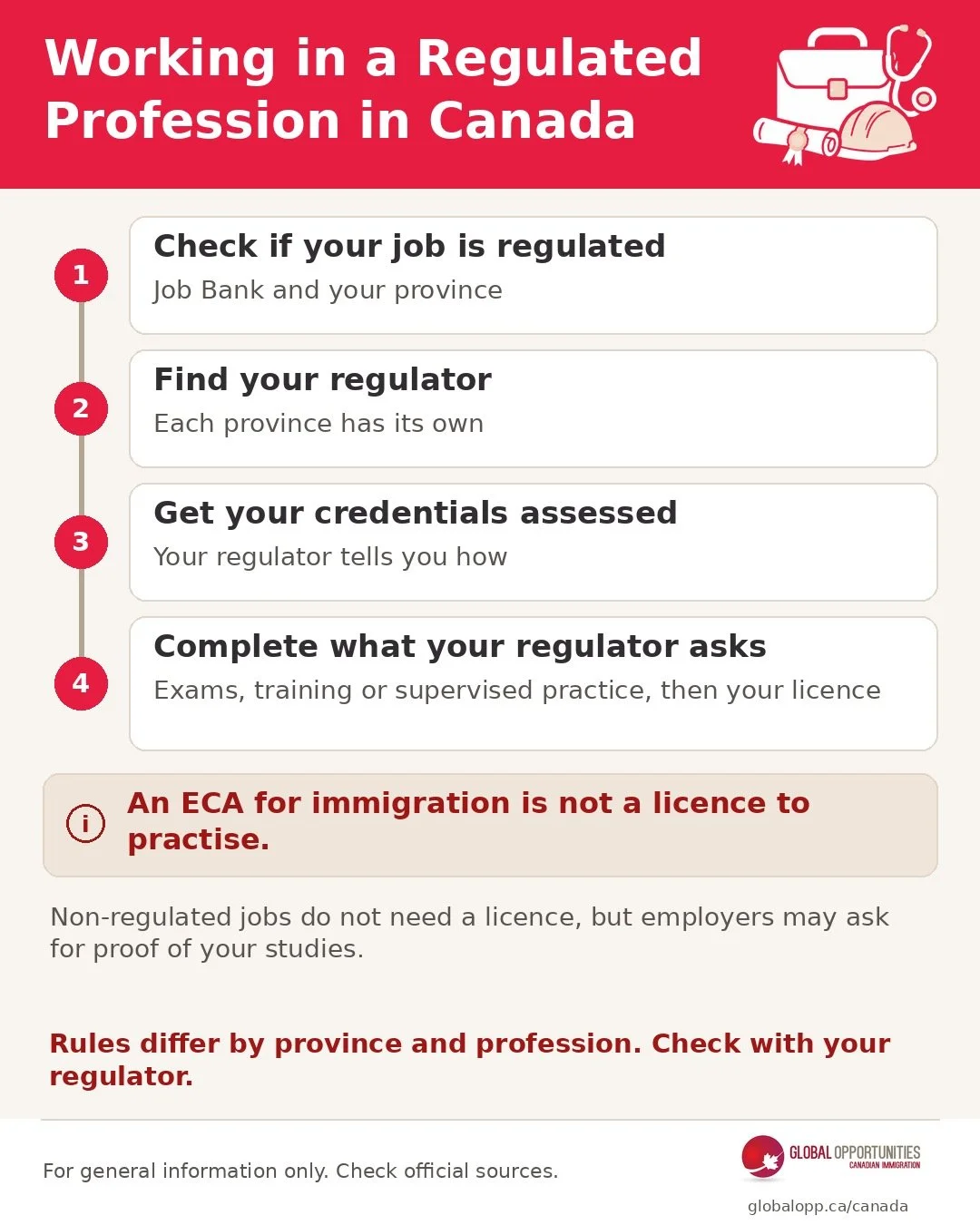
IRCC also lists free pre-arrival services to prepare for work in Canada, including programs that help with credential recognition. Eligibility for these services depends on your situation.
Please note: ECA information as published by IRCC, and credential recognition information as published by the Government of Canada, as of November 2026. An ECA is for immigration only: it does not license you to work in a regulated profession. Any regulator we mention is for reference only; the list may not be complete, and requirements must always be confirmed directly with the regulator in the province or territory where you plan to work.
Australian tradespeople: Red Seal and provincial certification
Electricians, plumbers, carpenters, chefs, mechanics and other tradespeople trained in Australia often ask whether their trade certificate is valid in Canada. The short answer: not automatically, but there is a clear process, and trades are in demand in many provinces.
How trade certification works in Canada
According to the official Red Seal Program site:
Provincial and territorial apprenticeship authorities certify tradespeople in their jurisdiction and administer the Red Seal exams.
A Red Seal endorsement on a provincial or territorial certificate shows you have the knowledge and skills to practise your trade across Canada.
Questions about experience gained outside Canada go to the apprenticeship authority of the province or territory where you plan to work. The official list is on the page Provincial and Territorial Apprenticeship and Certification Authorities.
You can see which trades are part of the program on the Red Seal website.
Compulsory and voluntary trades
In each province, some trades are compulsory: you must hold a certificate (or be a registered apprentice) to work in them. Other trades are voluntary. Each provincial or territorial apprenticeship authority on the Red Seal list of authorities sets its own list, so check it before you accept a job.
Example: challenging the exam in Ontario
Skilled Trades Ontario's Trade Equivalency Assessment is described as the first step toward a Certificate of Qualification for experienced workers who have not completed an Ontario apprenticeship but have equivalent skills and experience, including experience gained outside Canada. It determines whether you can challenge the certifying exam for your trade. Other provinces have similar processes through SkilledTradesBC, Alberta's Tradesecrets and the other authorities on the Red Seal list.
Practical tips for Australian tradies
Document your hours. Keep your Australian certificate, apprenticeship records and letters from employers detailing tasks and hours.
Check the trade name. Canadian trade names and scopes can differ from Australian ones.
Look at immigration options for trades, including the Federal Skilled Trades Program, the trades category in Express Entry and provincial streams.
Please note: information as published by the Red Seal Program, Skilled Trades Ontario and the provincial authorities named above, as of November 2026. Being allowed to challenge an exam is not the same as being certified. The authorities mentioned are for reference only; confirm requirements with the authority in your province.
Australian nurses moving to Canada
Nursing is regulated by each province, and immigration and licensing are separate processes. Some provinces have opened faster routes for nurses registered in Australia.
The general route: NNAS
According to the National Nursing Assessment Service (NNAS), NNAS collects and verifies the credentials of internationally educated nurses and prepares an Advisory Report for regulators. Its reports are accepted by nursing regulators across Canada except in Quebec and the territories, and NNAS does not grant licences. Check NNAS eligibility and the regulator in your target province.
British Columbia: a route for nurses registered in Australia
The British Columbia College of Nurses and Midwives (BCCNM) has a page for registered nurses registered in Australia, New Zealand or the United Kingdom. At the time of writing, it recommends applying to Inspire Global Assessments and to BCCNM at the same time: Inspire confirms identity and evaluates English and education credentials, and BCCNM verifies nursing practice and licensure. BCCNM also recommends having the permits required to work legally in Canada before applying, to avoid delays.
Other provinces
Other nursing regulators may have their own routes for nurses from Australia. Check the regulator's website directly, and read our guide Immigrate to Canada as a professional, which has a section for nurses. IRCC's category-based selection page also lists health care among the Express Entry categories at the time of writing, and some provinces have health streams. For NNAS, exams and pathways in every province, see how to immigrate to Canada as a nurse.
Please note: information as published by NNAS and BCCNM as of November 2026. A nursing licence and an immigration application are separate decisions made by different bodies. Regulators mentioned are for reference only; confirm requirements with the regulator.
Australian teachers moving to Canada
Teaching in Canada's public schools is regulated by each province. You need provincial certification before you can teach, and school boards hire separately.
Ontario: the Ontario College of Teachers certifies teachers in publicly funded schools and has information for internationally educated teachers, including information sessions.
British Columbia: the province explains certification on Become a teacher in B.C., and the BC Teacher Regulation site has more detail.
Alberta: Alberta Teacher Certification says you can apply as a graduate of a teacher preparation program from outside Canada, and successful applicants receive an interim certificate first.
Prepare your Australian registration, transcripts and proof of teaching experience. IRCC's category-based selection page lists education among the Express Entry categories at the time of writing. Early childhood educators, university lecturers and private school teachers follow different rules, so check with the province.
Please note: information as published by the Ontario College of Teachers, the Government of British Columbia, BC Teacher Regulation and the Government of Alberta as of November 2026. Certification does not guarantee a teaching job. Bodies mentioned are for reference only; confirm requirements with the regulator in your province.
English tests for moving to Canada from Australia
Even if English is your first language, most Canadian economic immigration programs ask you to prove your language ability with an approved test. Your Australian passport or your degree does not replace the test. Our English and French tests for Canada guide explains each test in detail, with fee examples.
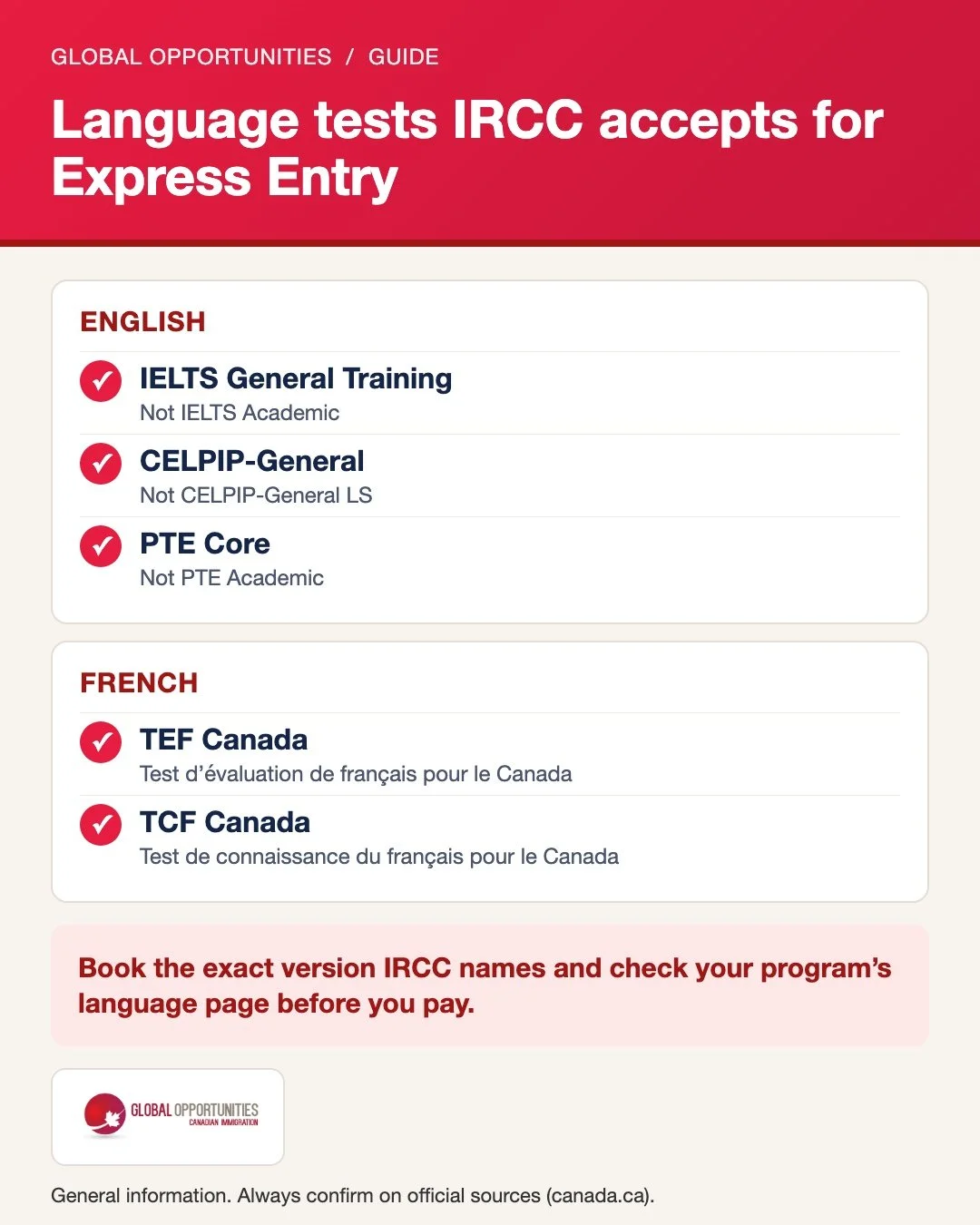
Which English tests IRCC accepts for Express Entry
According to IRCC's Express Entry language test page, the accepted English tests are:
CELPIP: it must be the CELPIP-General test.
IELTS: it must be the General Training option. IRCC states that it does not accept the IELTS One Skill Retake for Express Entry.
PTE Core: it must be the PTE Core option of the Pearson Test of English.
The accepted French tests are TEF Canada and TCF Canada. Tests with similar names, such as IELTS Academic or PTE Academic, are not on IRCC's Express Entry list. IRCC converts your results into Canadian Language Benchmark (CLB) levels for each skill. Minimum levels and validity rules are on the official page. Provincial programs, regulators and other federal programs can set their own language requirements.
Taking the tests in Australia
IELTS General Training: according to the official IELTS site, offered in cities including Sydney, Melbourne, Brisbane, Perth, Adelaide, Canberra, Hobart and Darwin. Use the official test centre finder and the IELTS General Training page.
CELPIP-General: CELPIP has an official page, Take the CELPIP Test in Australia, with test centres and dates. Make sure you register for CELPIP-General.
PTE Core: according to Pearson's PTE Core page, it is computer-based, taken at an authorized test centre, cannot be taken at home, and is used for Canadian permanent residence and citizenship applications. It is a different test from PTE Academic. Check Pearson's site for Australian centres.
A high score matters even for native speakers: according to IRCC, language is one of the factors in the Express Entry ranking, so prepare for the test format. Watch our live session on how CELPIP results fit into an immigration application.
Please note: accepted tests as published by IRCC, and test details as published by IELTS, CELPIP and Pearson, as of November 2026. Taking an accepted test does not by itself make you eligible: each program sets its own minimum CLB levels, and the official page is the one that counts.
French: an extra advantage when moving to Canada from Australia
French is not required to immigrate to most of Canada, but it can help. In Express Entry, IRCC lists French-language proficiency as one of the categories for category-based rounds of invitations, as explained on the category-based selection page. French ability is also considered in the ranking system, and some provinces have streams or initiatives for French speakers.
To have your French counted, you need an approved test: TEF Canada or TCF Canada, according to IRCC's language test page. If you studied French at school or university in Australia, it may be worth checking your level. Learn more on our page about French language proficiency. Treat French as a possible advantage, not a shortcut. How much French could help depends on each case, so we do not give points or levels here; a consultation is the way to know for your profile.
Please note: as published by IRCC as of November 2026. Category-based rounds are not held on a fixed schedule, and speaking French does not guarantee an invitation.
Studying in Canada after Australia
Some people choose to continue their studies in Canada, for example a postgraduate degree or a college program that builds on Australian experience. A Canadian study permit is a separate application with its own rules, and it is not a permanent residence program. For an overview of study permits and how to prepare, see our Study in Canada page.
Study permit: according to IRCC's study permit page, most foreign nationals need one to study in Canada, and you apply before you travel. Short programs may not need one: IRCC says "you don't need a study permit if you're coming to Canada for a program that lasts 6 months or less" (Study without a study permit).
Documents: IRCC's document list includes a letter of acceptance, proof of funds and, in most cases, a provincial or territorial attestation letter.
School: check that it is a designated learning institution.
Work after graduation: IRCC's post-graduation work permit eligibility page explains the rules, including a field of study requirement for many college programs and a language requirement. Read it before you pay any deposit.
Choose a program that builds on your Australian studies or work. Our province guides describe the colleges and universities in each region.
Please note: study permit and post-graduation work permit rules as published by IRCC as of November 2026. Being accepted by a school does not mean IRCC will issue a study permit, and completing a program does not by itself make you eligible for a post-graduation work permit: check the rules for your program before you enrol.
Finding a job in Canada from Australia
Global Opportunities does not offer jobs. What we can do is point you to official tools and explain the rules that affect job offers.
Job Bank: the Government of Canada's job site
Job Bank is the Government of Canada's job search service. You can search jobs by occupation and location. Canada describes occupations with the National Occupational Classification (NOC), which immigration programs also use, so learn how your job is named there. Canadian resumes differ from Australian ones in some details; our Newcomer's Guide includes a full sample resume and cover letter. Learn the Canadian resume format and how to spot job scams.
Beware of fake job offers
IRCC's page on online and telephone immigration scams reminds applicants that no one can guarantee a job or a visa to Canada, and warns about salaries that seem too high to be real. Warning signs:
Someone asks you to pay for a job offer or for "guaranteed" entry or faster processing.
The offer arrives without a real interview, or the job does not appear on the company's own website.
You are asked to send money to a personal bank account or through a private money transfer service.
You can report suspected fraud through IRCC's report fraud page.
LMIA explained simply
A Labour Market Impact Assessment (LMIA) is a review by Employment and Social Development Canada of whether hiring a temporary foreign worker will help or hurt Canada's job market. It is the employer who applies. According to the official page Find out if you need an LMIA, a positive LMIA shows that the employer needs a temporary foreign worker and that no Canadian or permanent resident is available to do the job. People with an open work permit, such as an IEC Working Holiday permit, do not need an LMIA to work. If someone offers to "sell" you an LMIA or a job offer, treat it as a red flag. Read our page on the LMIA.
Please note: as published by IRCC and Employment and Social Development Canada as of November 2026. A positive LMIA is not a work permit: the worker still has to apply, and IRCC decides.
Which province should you choose when moving to Canada from Australia?
Canada has ten provinces and three territories, and each one has its own health plan, licensing bodies, driving rules and, in most cases, its own nominee program. Choosing where to live affects your job search, your licence and your immigration options. You can explore them on our map of Canada's provinces.
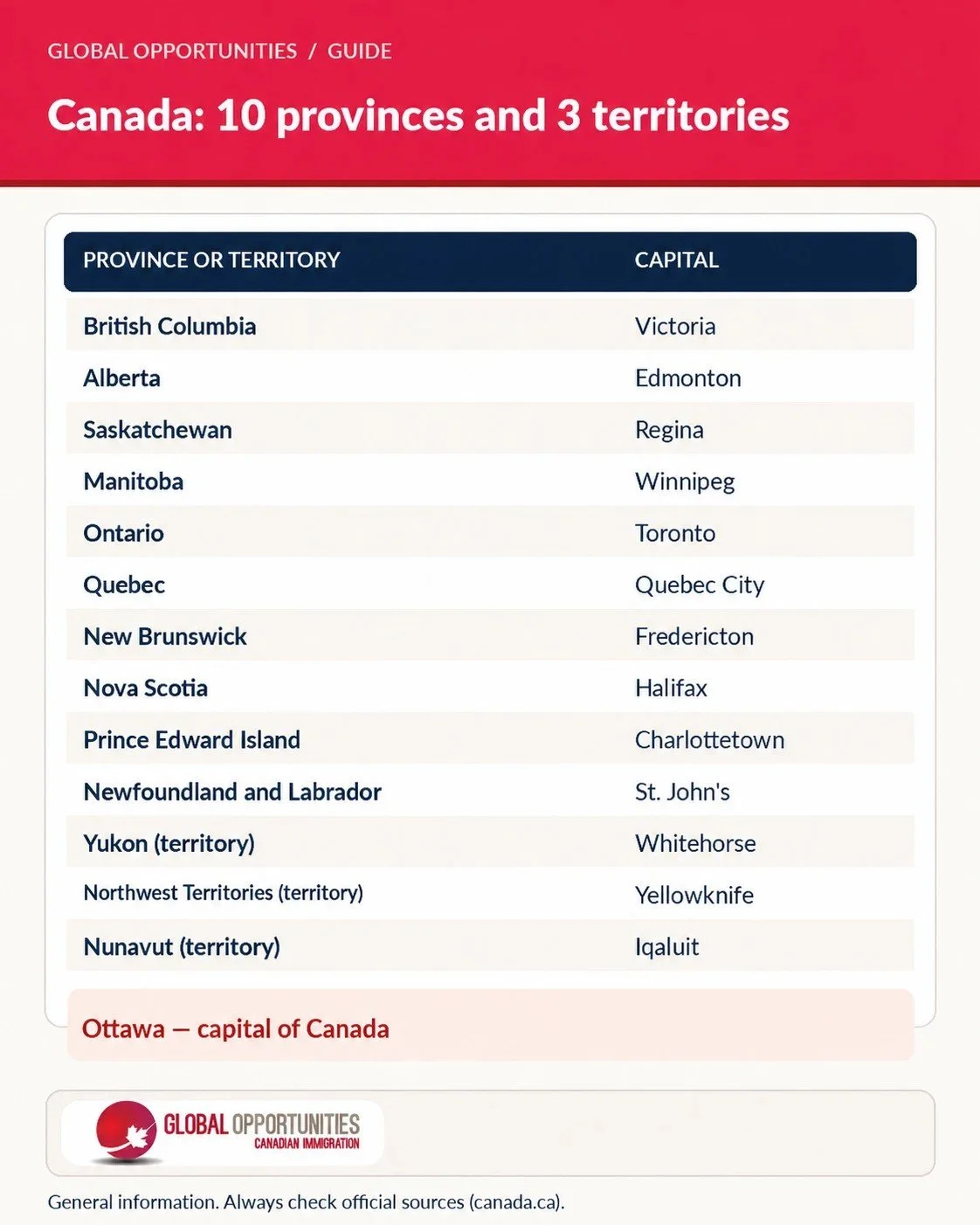
Ontario
Ontario is home to Toronto and to Ottawa, the national capital. Ontario runs the Ontario Immigrant Nominee Program. Read our full guide, Living in Ontario.
British Columbia
British Columbia, on the Pacific coast, includes Vancouver and Victoria. WelcomeBC explains the BC Provincial Nominee Program. Read our guide, Living in British Columbia.
Alberta
Alberta includes Calgary, Edmonton and the Rocky Mountains around Banff and Jasper. Its provincial program is the Alberta Advantage Immigration Program. Read our guide, Living in Alberta.
Other provinces and territories
The Prairie provinces, the Atlantic provinces and the territories each have their own programs; compare rents with the CMHC Rental Market Reports. The Atlantic provinces also take part in the Atlantic Immigration Program. Read our guides to Saskatchewan, Manitoba, Nova Scotia, New Brunswick, Prince Edward Island, Newfoundland and Labrador and Yukon, the Northwest Territories and Nunavut. Quebec has its own immigration system, and French is its official language.
Daily life in Canada for Australians: what changes
Daily life will feel familiar in many ways, but some things work differently. Our Newcomer's Guide covers housing, banks, credit, health care, driving, insurance, transit and winter in detail; here are the points Australians ask about most. For time zones, travel between provinces and what to pack, see our Explore Canada page.
Climate and winter
Winters differ a lot from one city to another. You can compare temperatures and snowfall for each city with Environment and Climate Change Canada's Canadian Climate Normals. Plan for proper winter clothing, footwear and, if you drive, winter tyres where needed. For forecasts, use Environment and Climate Change Canada's official weather site.
Winter tyres, utes and "tradies": Australian words vs Canadian words
Canadians mostly use American spelling and vocabulary for everyday things, so searching with Australian words can bring up the wrong results. A few you will meet in your first weeks:
Tyres are tires, and winter tyres are winter tires. Licence keeps the British spelling in Canada.
A ute is usually a pickup truck, and a servo is a gas station. Petrol is gas.
Rego is your vehicle registration, handled by each province.
A tradie is a tradesperson, and the sector is called the skilled trades. Look for "Red Seal" when you search for your trade.
Uni is university. In Canada, a college is usually a separate institution that offers diplomas and certificates, closer to TAFE than to a university.
A mobile is a cell phone, the footpath is the sidewalk, and a flat is an apartment.
Year 12 is Grade 12, the last year of high school in most provinces.
Using the Canadian word will help you find the right job ads, rentals and official pages.
Health care is provincial
According to IRCC's page on health care in Canada, each province and territory has its own health plan that covers different services. You apply for a health card in your province, some provinces have a waiting period, and IRCC recommends private insurance to cover that time. Eligibility depends on your province and status; IEC participants must have health insurance for their whole stay.
Banking, credit and your Social Insurance Number
According to the Financial Consumer Agency of Canada's page on opening a bank account, you can open an account with proper identification even if you are not a Canadian citizen. Your Australian credit history does not transfer, so you will build Canadian credit from scratch. To work, you need a Social Insurance Number: Service Canada's SIN page says you can apply online, by mail or in person, and that there is no fee.
Driving licences are provincial
There is no national driver's licence in Canada. Ontario's official page Exchange an out-of-province driver's licence lists Australia and New Zealand among the places from which you can exchange a licence, subject to conditions, and says you can use a valid licence from another country for 60 days after you move to Ontario. Other provinces have their own lists and timelines, so check the licensing office where you will live. Remember that Canadians drive on the right.
Money, tax and superannuation
Questions about Australian tax, superannuation, Medicare or other Australian obligations when you leave are outside the scope of this guide; please ask a qualified professional in Australia. On the Canadian side, the Canada Revenue Agency explains taxes for newcomers.
The Department of Finance's list of tax treaties in force includes a tax treaty between Canada and Australia. It can matter if you keep income, property or investments in Australia after you move; get advice for your own case.
Please note: as published by IRCC, the Financial Consumer Agency of Canada, Service Canada, the Government of Ontario, the Canada Revenue Agency and the Department of Finance, as of November 2026. Health coverage waiting periods and licence exchange rules differ by province and by status, and they may have changed by the time you read this: check the linked pages before you rely on them.
A note for New Zealanders moving to Canada
New Zealand also has a youth mobility agreement with Canada. According to IRCC's eligibility by country and category page, the IEC category currently available to New Zealand citizens is Working Holiday, with its own participation rules. Young Professionals and International Co-op are not listed for New Zealand at the time of writing.
Most of the rest of this guide applies to New Zealanders too: Express Entry, provincial programs, English tests, credential recognition and daily life. BCCNM's route for registered nurses also covers nurses registered in New Zealand, and Ontario's licence exchange list includes New Zealand. Use IRCC's visa or eTA tool with your own passport.
Please note: IEC categories as published by IRCC as of November 2026. The rules for New Zealanders are not the same as for Australians: read the New Zealand section of the official page.
Budget, documents and what to bring from Australia
Planning your budget in general terms
We do not publish IRCC fees or the funds IRCC asks you to show, because they change; read them on canada.ca on the day you apply. Whether you need proof of funds, and how much, depends on each case and program; a consultation is the way to know for yours. For your own budget, price each item from official or provider sources:
Before you leave: language test, credential assessment, police certificates, medical exam if required, IRCC fees, biometrics, flights and travel insurance.
First months in Canada: rent and deposits, furniture, a phone plan, transit, groceries, winter clothing and health insurance until provincial coverage begins.
IRCC's Prepare financially page explains that the cost of living varies depending on where you settle. For rents, use the CMHC Rental Market Reports; our province guides give official rent and transit figures with dates.
Please note: as published by IRCC and CMHC as of November 2026. Costs vary by city and household and change over time: price each item from the official or provider page before you rely on it.
Documents to carry
Passport, eTA, and your port of entry letter or confirmation of permanent residence.
Proof of funds and proof of health insurance if your program requires it.
Degrees, transcripts, trade certificates and your ECA report.
Work reference letters on company letterhead, contracts and payslips.
Professional registration (AHPRA, teacher registration or trade licence) and a certificate of good standing if your regulator asks for one.
Your driver's licence and, if possible, a driving record.
Birth and marriage certificates for your family.
Shipping your belongings
If you are moving to Canada to live, CBSA's page Moving or returning to Canada explains how to import personal and household goods, and many people prepare a list using the BSF186 Personal Effects Accounting Document. Check CBSA's rules before shipping vehicles, food, plants or outdoor gear with soil. Buy heavy winter gear in Canada, once you know your city. Moving with a dog or cat? Read our guide to immigrating to Canada with your pet. The Canadian Food Inspection Agency lists Australia among the countries it recognizes as rabies-free for domestic cats and dogs, which affects the documents your pet needs; check the CFIA's page on travelling with a pet before you book.
Please note: import and pet rules as published by the Canada Border Services Agency and the Canadian Food Inspection Agency as of November 2026. Check them again before you ship or travel, because they can change.
Planning checklist for moving to Canada from Australia
Check your entry document with the official visa or eTA tool, using your own passport.
Choose your route: Working Holiday or Young Professionals, a study permit, an employer-specific work permit, or permanent residence through Express Entry or a province. Returning Canadians: plan your partner's status.
Read the official program page for your route, including fees and current requirements.
Choose your province with our province guides.
Book the right English test: IELTS General Training, CELPIP-General or PTE Core.
Start your ECA if you will use foreign education in Express Entry.
Contact your regulator or apprenticeship authority if you are a doctor, nurse, teacher, engineer or tradesperson.
Collect reference letters from your Australian employers while you are still there.
Request police certificates from Australia and every other country IRCC asks for.
Check whether you need a medical exam, especially for health care or child care work.
Arrange health insurance for your first months.
Ask an Australian professional about tax and superannuation before you leave.
Plan your first weeks: temporary housing, SIN, bank account, health card and phone plan.
Your first weeks after moving to Canada from Australia
Most newcomers go through a similar checklist in their first weeks. Our detailed Newcomer's Guide explains every step, including renting and tenant rights, building credit, health care, driving and insurance, transit, winter and a sample Canadian resume. The essentials:
Keep your documents safe and check the details on your work permit as soon as it is issued at the airport.
Get your Social Insurance Number through Service Canada.
Open a bank account with original identification.
Sort out health coverage: apply for your provincial health card if you are eligible, and keep private insurance for any gap.
Exchange or apply for your driver's licence within your province's time limit.
Contact your regulator or apprenticeship authority if your occupation is regulated.
Look for free newcomer services. IRCC's newcomer services finder lists settlement organizations outside Quebec; eligibility depends on your status.
Start your job search on Job Bank and through your network.
Planning for the long term? Our Canadian citizenship guide covers physical presence, the test and dual citizenship.
Frequently asked questions
Can I move to Canada from Australia if I am not an Australian citizen?
Yes, many people do. Canada looks at your citizenship, not at your Australian visa: your passport decides whether you need an eTA or a visitor visa and whether you can join International Experience Canada. Express Entry and the provincial programs are open to any nationality that meets their requirements, and skilled, paid work in Australia may count as foreign work experience for the Federal Skilled Worker Program. Your Australian studies can be assessed through an ECA, and you can take the accepted English tests in Australia. Nothing is guaranteed, but your international profile can be a strong start. If you hold Irish citizenship, read our working holiday guide for Irish citizens. See the section for people living in Australia above.
Can Colombians, Peruvians, Brazilians or Mexicans living in Australia get a Working Holiday in Canada?
Not through International Experience Canada at the time of writing. IEC depends on your citizenship. Mexico is not on IRCC's IEC list, and neither are Colombia, Peru or Brazil, although the list does include Chile and Costa Rica. A working holiday visa in Australia does not give access to IEC in Canada. Your options may include a study permit, an employer-specific work permit or, if you qualify, Express Entry or a provincial program. Check the eligibility by country page, since the list can change. See the section for people living in Australia above.
Can Irish or British citizens living in Australia apply for IEC?
Yes, if they meet the requirements, because International Experience Canada depends on your citizenship, not on where you live. At the time of writing, IRCC's eligibility by country page lists both Ireland and the United Kingdom, each with the Working Holiday, Young Professionals and International Co-op (Internship) categories. Irish and British citizens in Australia apply under the rules for their own country, which can differ from the Australian rules in age limits, duration and how many times you can take part, so read the page for your citizenship, not the Australian one. Dual citizens should check which country's agreement suits them. Irish readers can find the details in our working holiday guide for Irish citizens. See the Working Holiday section above.
Does Global Opportunities help Latin Americans living in Australia in Spanish?
Yes. Global Opportunities works in English and Spanish, so if you are from Latin America and living in Australia, you can talk to us in Spanish about Canadian programs. We can explain which pathways may fit your profile and what to prepare, but we cannot guarantee a permit, an invitation or a result, because every decision is made by IRCC or the province. We do not offer jobs or services for Quebec's immigration programs. You can start with our recorded seminars and lives, our YouTube channel or our Moving to Canada articles, or contact us through our contact page. See How Global Opportunities can help below.
Can I practise medicine in Canada after studying medicine in Australia?
Possibly, but it takes planning. Medical graduates without completed postgraduate training usually follow the international medical graduate route: verification on physiciansapply.ca, Medical Council of Canada exams and an application for residency through CaRMS, often with a provincial return-of-service commitment. Fully trained doctors may qualify for provincial routes that list Australia as an approved jurisdiction, for example in Nova Scotia, Alberta and British Columbia. Licensing and immigration are separate processes, so plan both together and confirm everything with the provincial medical regulator. See the medicine section above.
I am a Canadian who studied medicine in Australia. How do I come home to practise?
Your citizenship means you do not need an immigration program to return, but you still need a medical licence. If you have not completed postgraduate training, you will usually follow the international medical graduate route through the Medical Council of Canada and CaRMS; check CaRMS eligibility rules and any return-of-service conditions in the province you choose. If you completed Australian specialist or general practice training, some provinces list Australia as an approved jurisdiction. Contact the College of Physicians and Surgeons of your target province early. See the medicine and returning Canadians sections above.
What do Canadians need to do when moving back from Australia?
You can enter Canada as a citizen, but plan the practical steps: travel on a valid Canadian passport, prepare a list of goods for the Canada Border Services Agency, check when your provincial health plan covers returning residents, review your tax situation with the Canada Revenue Agency and exchange your driver's licence where your province allows it. If your partner is not Canadian, they need their own status, for example through family sponsorship. Children born in Australia may already be Canadian through a parent; check before applying for their passport. See the returning Canadians section above.
Can I sponsor my Australian partner when I move back to Canada?
Canadian citizens and permanent residents can sponsor a spouse, common-law partner or conjugal partner if they meet IRCC's requirements, and the partner must also meet the requirements. IRCC's page on sponsoring your spouse, partner or children explains who can sponsor, who can be sponsored and how to apply. Depending on the case, the partner may also qualify for a work permit or for IEC or Express Entry on their own. Plan the timing early so your partner can work when you arrive. See the returning Canadians section above.
Can Australians apply for a Working Holiday when moving to Canada from Australia?
Yes. Australia has a youth mobility agreement with Canada, and IRCC lists the Working Holiday category for Australian citizens. You must meet the eligibility requirements for your country, including the age range, funds and health insurance set by IRCC, submit a profile and be invited from the pool. Being in the pool does not guarantee an invitation. A Working Holiday gives an open work permit, so you can work for most employers in most places. Check the official eligibility page for the current rules. See the Working Holiday section above.
What is the difference between Working Holiday and Young Professionals for Australians?
Working Holiday gives an open work permit and needs no job offer, so you can change jobs and cities. Young Professionals gives an employer-specific work permit and requires a paid job offer that supports your professional development; IRCC says the job generally must be in TEER category 0, 1, 2 or 3, and a TEER 4 job may qualify if it is in your field of study. For Young Professionals, the employer submits the offer through IRCC's Employer Portal before you apply. IRCC's page explains that Australians can take part in one or the other, not both. See the Working Holiday section above.
How old do I need to be to move to Canada from Australia on a Working Holiday?
Age limits for IEC are set by IRCC and vary by country and category, and they can change. We do not reproduce them here, because the only reliable version is the official one. Check the Australia section of the eligibility by country page for the current rule, together with the requirements on funds, health insurance and the number of times you can take part. If you are outside the age range, look at other options in this guide, such as Express Entry, provincial programs or an employer-specific work permit. See the Working Holiday section above.
Which Canadian ski towns are popular with Australians on IEC?
Two mountain areas that come up often are Whistler, in British Columbia, and Banff and Canmore, in Alberta. Banff is inside Banff National Park, and Parks Canada's eligible residency rules say you can only live in the park if you are an eligible resident, for example because your main job is at a business located in the park; signing a lease does not make you eligible, and landlords must check that their tenants qualify. Canmore is outside the park. Housing in resort towns can be hard to find in season, so ask employers whether they offer staff accommodation, and arrange somewhere to stay before you arrive. Read our guides to British Columbia and Alberta for each region, and see the winter tyres question below if you will drive.
Do I need a recognized organization to move to Canada from Australia through IEC?
No. IRCC states that citizens of IEC countries, including Australia, do not have to use a recognized organization. Recognized organizations are Canadian organizations that can offer optional extra support, such as help finding a job or settling in, and most charge for their services. Some people find them useful; others apply on their own through their IRCC account. If you use one, read its terms carefully and remember that it cannot guarantee an invitation or a job. See IRCC's page on recognized organizations and the Working Holiday section above.
Do I need a visa or an eTA when moving to Canada from Australia?
At the time of writing, IRCC lists Australian citizens as needing an eTA to fly to Canada, not a visitor visa, together with a valid passport. An eTA is not needed when arriving by land or sea, with a specific exception, but a passport still is. An eTA does not allow you to work or study: you need a work permit or study permit for that, unless an exemption applies. If you are not an Australian citizen, the rule depends on your own passport. Use IRCC's official visa or eTA tool before every trip. See the visa section above.
Can I apply for permanent residence when moving to Canada from Australia without a job offer?
Some programs, such as the Federal Skilled Worker Program through Express Entry, do not always require a job offer, provided you meet the program's other requirements. Other programs, and many provincial streams, do require one, sometimes from an employer in a specific province. Your language results, education, work experience and other factors affect your ranking in the Express Entry pool, and invitations are never guaranteed. Be careful with anyone who offers to sell you a job offer: that is a common scam. See the skilled worker section above.
Does work experience from an IEC permit help me stay after moving to Canada from Australia?
It may. The Canadian Experience Class considers skilled, paid work experience gained in Canada while you were authorized to work with temporary resident status. Whether your IEC experience qualifies depends on the occupation, the hours, how long you worked and the rules in force when you apply. Some provincial streams also consider work in the province. Working in Canada does not lead to permanent residence automatically, and invitations are never guaranteed. Keep your contracts, payslips and reference letters from every job. See the Canadian Experience Class section above.
Which English tests are accepted for moving to Canada from Australia?
For Express Entry, IRCC accepts CELPIP-General, IELTS General Training and PTE Core. IELTS Academic, PTE Academic and the IELTS One Skill Retake are not on that list, even though many people in Australia have taken them for study or Australian visas. For French, IRCC accepts TEF Canada and TCF Canada. Native English speakers also need the test for Express Entry, and a strong score can improve your ranking. All three English tests can be taken in Australia. Check the official language test page before booking. See the English tests section above.
Do I need an ECA for my Australian degree when moving to Canada from Australia?
For the Federal Skilled Worker Program, and to get points for foreign education in Express Entry, IRCC requires an Educational Credential Assessment from a designated organization. Physicians, pharmacists and architects may need to use a designated professional body instead. Your spouse's or partner's foreign education can also be assessed for points. An ECA confirms your credential is valid and equal to a Canadian one for immigration purposes; it is not a licence to work in a regulated profession and does not guarantee a job. Check IRCC's ECA page. See the qualifications section above.
Is my Australian trade certificate valid in Canada?
Not automatically. Trades are certified by provincial and territorial apprenticeship authorities, which administer the Red Seal exams. Experienced tradespeople trained abroad can usually apply for an assessment of their experience and, if eligible, challenge the certification exam. In Ontario, for example, Skilled Trades Ontario's Trade Equivalency Assessment is the first step. Some trades are compulsory, which means you cannot work in them without a certificate or apprentice registration. Contact the authority in your province before you accept a job, and keep detailed records of your Australian hours. See the trades section above.
Can Australian nurses work in Canada?
Yes, once licensed by the nursing regulator of the province where they will work. Immigration and licensing are separate. In most provinces, internationally educated nurses begin with the National Nursing Assessment Service. In British Columbia, at the time of writing, BCCNM has a route for registered nurses registered in Australia, New Zealand or the United Kingdom that involves applying to Inspire Global Assessments and BCCNM at the same time. Other regulators may have their own routes. Health care is also an Express Entry category at the time of writing. Check the regulator directly. See the nurses section above. For NNAS, exams and pathways in every province, see how to immigrate to Canada as a nurse.
Can Australian teachers teach in Canada?
Yes, after getting certified by the province where they want to teach. Each province has its own body: for example, the Ontario College of Teachers, British Columbia's teacher certification office and Alberta Teacher Certification. They review your teacher education, registration and experience, and some issue an interim certificate first. School boards hire separately, so certification does not guarantee a job. Prepare your transcripts, Australian registration and proof of experience early. Education is one of the Express Entry categories at the time of writing, which can change. See the teachers section above.
Is my Australian professional licence valid after moving to Canada from Australia?
Not automatically. Regulated professions, such as engineering, nursing, medicine, teaching, accounting in some roles and many health professions, are licensed by provincial and territorial regulators in Canada. Each regulator has its own process, which may include document verification, exams, supervised practice or language requirements. Some provinces have faster routes for professionals from Australia, especially in health care. Contact the regulator in the province where you plan to work, ideally before you move, and ask exactly what it needs. See the qualifications section above.
Can I exchange my driver's licence after moving to Canada from Australia?
It depends on the province. Ontario's official page Exchange an out-of-province driver's licence lists Australia and New Zealand among the places from which you can exchange a licence, subject to conditions, and says you can use a valid licence from another country for 60 days after moving to Ontario. Other provinces have their own lists, conditions and timelines. Bring your licence and, if possible, a record of your driving history. Car insurance in Canada may be priced as if you were a new driver unless you can prove your experience. See the daily life section above and our newcomers guide.
Do I need winter tyres in Canada?
It depends on the province, and sometimes on the road. In British Columbia, the provincial government's tire and chain requirements page explains that winter tires or chains are required on designated highways marked with signs, generally from October 1 to April 30, with some routes ending on March 31, and that legal winter tires carry the mountain/snowflake or M+S symbol with enough tread. In Quebec, the government's winter tire requirements page states that vehicles registered in Quebec must have winter tires from December 1 to March 15. In Ontario, insurers must offer a winter tire discount on private passenger vehicles under O. Reg. 222/15. Rules and dates are as of November 2026; check the current rules in your province before winter, and rent cars with winter tires when you drive in snow.
Does health care cover me right away after moving to Canada from Australia?
It depends on your province and your immigration status. Each province and territory runs its own health plan; some have a waiting period, and coverage for temporary residents differs. IEC participants must have health insurance for their whole stay as a condition of the program. IRCC recommends private insurance for any gap before provincial coverage begins. Returning Canadians should also check when their province covers them again, and keep private insurance until it does. See IRCC's health care page and the daily life section above.
Is there a social security agreement between Canada and Australia?
Yes. According to the Government of Canada's page on the Canada–Australia social security agreement, the agreement covers Canada Pension Plan and Old Age Security benefits on the Canadian side, and old age, disability and survivor benefits on the Australian side. It can help you qualify for a benefit in one or both countries by counting periods in the other country, for example Australian residence after age 18, but each country pays only for the periods it recognizes, so it does not increase the amount paid. It does not cover the Quebec Pension Plan. If you live in Canada, you apply for Australian benefits with the forms named on the page and return them to Service Canada. Superannuation is a separate Australian matter: see the next question.
What happens to my superannuation if I move to Canada?
Superannuation, Australian tax and other Australian obligations are outside the scope of this guide, and we do not advise on them. Please ask a qualified professional in Australia before you leave, because the rules are Australian and can be complex. On the Canadian side, the Canada Revenue Agency explains taxes for newcomers and for people entering Canada, and canada.ca has information on the social security agreement between Canada and Australia, which can help some people qualify for pension benefits. See the money and superannuation part of the daily life section above.
Is Canada cheaper than Australia?
It depends on the city, your household and your lifestyle, and we do not compare Australian figures. On the Canadian side, use official sources: the CMHC Rental Market Reports show average rents by city, Statistics Canada's consumer price indexes show how prices change, and each province publishes its own taxes and minimum wage. Compare these with official Australian data yourself. Look at the whole picture, not only rent: salaries in your occupation, income tax, sales tax, health coverage, car insurance, heating, winter clothing and the cost of flights home. Vancouver and Toronto are very different from smaller cities in the Prairies or Atlantic Canada. For a national overview, see our article on the cost of living in Canada. See the budget section above.
Which province is best for Australians?
There is no single best province; it depends on your occupation, your licence, your lifestyle and the immigration options for your profile. Compare rents with the CMHC Rental Market Reports, job postings on Job Bank and each province's own programs, including the Atlantic Immigration Program in the Atlantic provinces. Your regulator may also differ by province. Compare our province guides, starting with Living in British Columbia. See the province section above.
What should I bring when moving to Canada from Australia?
Carry your passport, eTA or port of entry letter, proof of funds and insurance if required, degrees, transcripts, trade certificates, your ECA report, reference letters on company letterhead, your professional registration, your driver's licence and family certificates. If you are moving to live in Canada, read CBSA's page on moving or returning to Canada and prepare a list of your goods. Check CBSA's rules before shipping vehicles, food or gear with soil. Buy winter clothing once you arrive. See the budget and documents section above.
Can I study in Canada after studying in Australia?
Yes, if you meet the requirements. According to IRCC's page on studying without a study permit, most foreign nationals need a study permit for programs longer than 6 months, and IRCC asks for a letter of acceptance from a designated learning institution, proof of funds and, in most cases, a provincial or territorial attestation letter. Australian transcripts and English results can support your application to the school. Before you pay a deposit, read IRCC's post-graduation work permit rules, including the field of study requirement for many college programs, and choose a program that builds on your Australian studies or work. A study permit is not a permanent residence program. See the studying section above.
Do I need a medical exam to work in Canada from Australia?
It depends on your job and your travel history. According to IRCC, jobs that bring you into close contact with people, such as health care and child care, can require an immigration medical exam, and stays of more than 6 months may require one if you have lived in or travelled to certain countries for 6 months or more in a row in the year before you come. IEC participants who want to work in these fields should plan the exam early; otherwise their permit may restrict that work. Check IRCC's medical exam requirements. See the Working Holiday section above.
Can New Zealanders follow this guide when moving to Canada?
Mostly, yes. Express Entry, provincial programs, the English tests, credential recognition and daily life work the same way. The main difference is IEC: IRCC lists only the Working Holiday category for New Zealand citizens at the time of writing, while Australians also have Young Professionals and International Co-op. BCCNM's route for registered nurses covers nurses registered in New Zealand, and Ontario's licence exchange list includes New Zealand. Check your entry requirements with IRCC's visa or eTA tool. See the New Zealand section above.
Related guides
How Global Opportunities can help
Global Opportunities is a private immigration firm in Toronto. If you are planning a move from Australia, we can help you understand which Canadian programs may fit your profile and what to prepare. We cannot guarantee an invitation, a permit or a result: every decision is made by IRCC or the province. We work in English and Spanish, so Latin Americans living in Australia can talk to us in their own language.
Our regulated consultant: Lic. Mildrete Monserrath Gutierrez Martinez, Regulated Canadian Immigration Consultant (RCIC), CICC licence R514880. Verify her licence on the CICC Public Register: https://college-ic.ca/protecting-the-public/find-an-immigration-consultant. Global Opportunities does not offer services for Quebec's immigration programs. Global Opportunities is a private firm and is not part of the Government of Canada or any provincial government.
Recorded seminars and lives: watch our recorded seminars in English or the Spanish recordings, and find everything on our YouTube channel.
More articles in English: read our Moving to Canada articles on topics such as health care, cost of living, the ECA and professional licences, and building community in Canada.
Personalized consultation: to review your situation, contact us through our contact page or write to info@globalopp.ca.
Prefer email? Tell us what you need help with (moving to Canada from Australia, including Working Holiday) and we will reply: email info@globalopp.ca.
Contact Global Opportunities →
Sources
IRCC: Hire skilled youth through International Experience Canada
Canada Revenue Agency: Individuals leaving or entering Canada
Environment and Climate Change Canada: Canadian Climate Normals
Red Seal: Provincial and Territorial Apprenticeship and Certification Authorities
Ontario College of Teachers: Internationally educated teachers
Government of Ontario: Exchange an out-of-province driver's licence
Government of Alberta: Alberta Advantage Immigration Program
Study Australia (Australian Government): Changes to student visa applications
Medical Council of Canada: Pathways for international medical graduates
College of Physicians and Surgeons of Nova Scotia: Approved jurisdictions
College of Physicians & Surgeons of Alberta: Approved jurisdiction route
College of Physicians and Surgeons of British Columbia: Eligibility bylaws updated
Government of British Columbia: Passenger vehicle tire and chain requirements
Government of Ontario: O. Reg. 222/15 (automobile insurance, winter tire discount)
Government of Canada: Canada–Australia social security agreement
CFIA: Countries recognized as rabies-free for domestic cats and dogs
The information in this guide is general and for reference only. It comes from the official sources linked throughout the guide, as they read when we checked them in November 2026, and it may have changed since then: the official page is the one that counts. It is not immigration, legal, tax or professional advice. Global Opportunities is not responsible for how anyone interprets this content, for decisions made based on it or for changes made after it was written. International Experience Canada, Express Entry, provincial programs, language test rules, professional licensing and official requirements change frequently, and nothing in this guide covers Australian or New Zealand immigration, tax, Medicare or superannuation rules. Medical, nursing, teaching and trade licensing is decided by each provincial regulator or authority. Global Opportunities is a private firm, is not part of the Government of Canada or of any regulator, and does not offer jobs. For advice on your own case, book a consultation through our contact page.
Last reviewed: November 2026