
Living in Ontario, Canada: A Complete Guide for Newcomers
Living in Ontario, Canada means choosing between the country's largest city, the national capital and dozens of mid-sized cities, all in one province. This guide explains what daily life in Ontario looks like for newcomers: Toronto's neighbourhoods, how PRESTO and the TTC work, other cities and their transit, rents, tenant rights, driving, health care, banks, groceries, schools and colleges, work, the seasons and the official ways people move here.
About our sources: This guide summarises what official sources (the Government of Canada, provincial and territorial governments and the other organisations we link to) said when we checked them in November 2026. We link every source so you can read it yourself. Rules, rates and requirements change, sometimes without notice, and the official page is the one that counts. This is general information, not legal, tax or immigration advice. Global Opportunities is not responsible for how this information is interpreted or for changes made after it was written.
Ontario is home to roughly two in five people in Canada. According to the Government of Ontario, the province had 16,258,260 residents on July 1, 2025, or 39.0% of the country's population (Ontario fact sheet, April 2026). Most of them live in cities along the Great Lakes, but the province also stretches north across forests and lakes all the way to Hudson Bay.
We wrote this guide for someone who is about to arrive, or has just arrived, and knows nothing yet: workers, international students and families. Every section links to the official page where you can confirm the details. Where we give a price (a transit fare, a licence fee, an average rent), it comes from the official source, with the date we checked it. Prices change, so always check the current price on the source before you make a decision. If you want help with work permits, resumes and your first weeks in Toronto, read our companion newcomer guide to Canada.
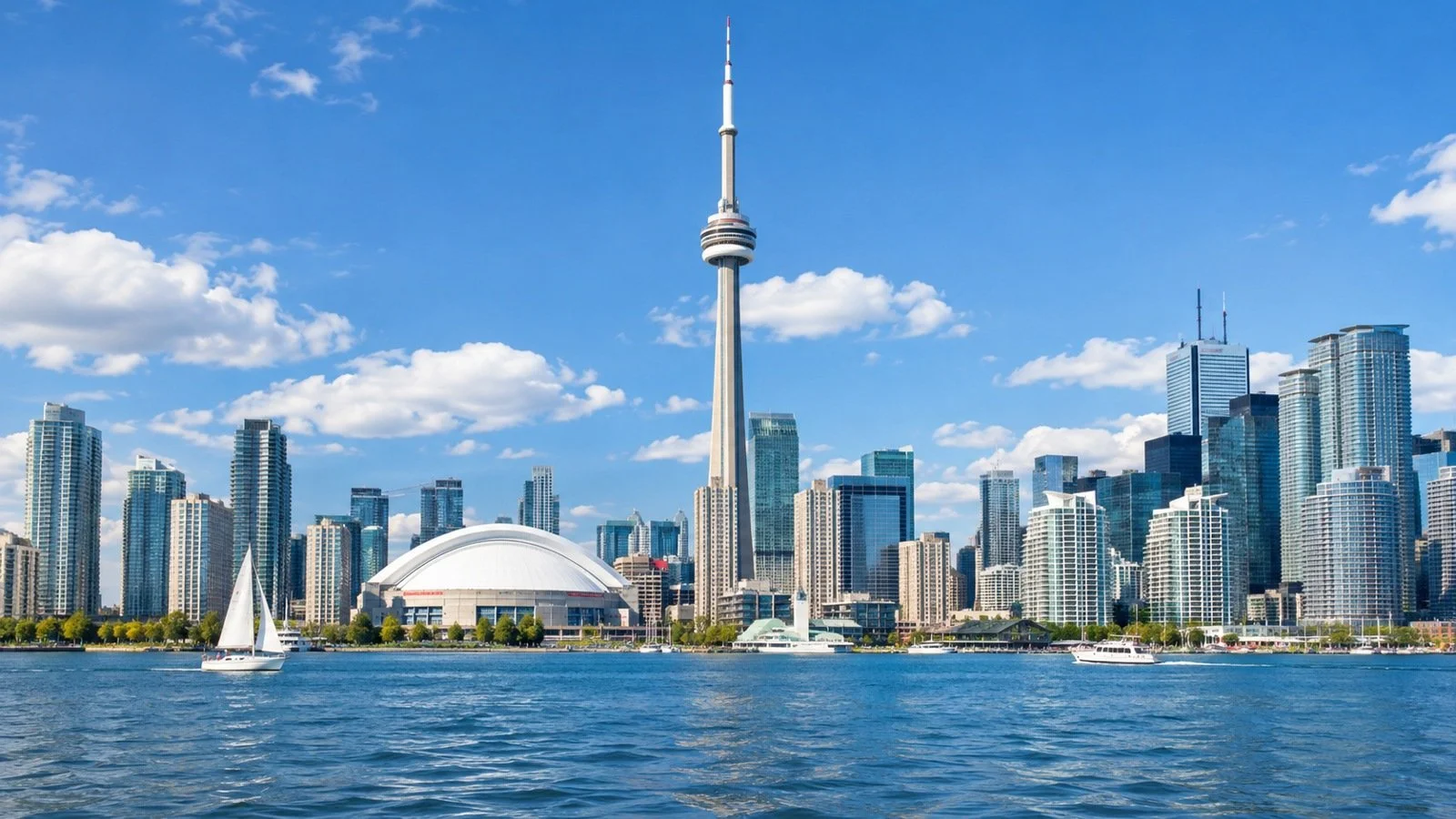
Watch our recorded seminars and lives →
Prefer Spanish? Read our Spanish guide.
In this guide
Ontario at a glance
Where is Ontario? Map, location and key facts
How to get to Ontario: by plane, car, train or bus
Buying your first home in Ontario
Emergencies and natural hazards in Ontario
Living in Toronto: neighbourhoods and city overview
Getting around Toronto: TTC, PRESTO and GO Transit
Living in Ottawa
Other cities in Ontario: transit, industries and rents
How much is rent in Ontario? Where to look, rents and tenant rights
Driving in Ontario: licences, insurance, car rental and parking
How do newcomers get health care in Ontario? OHIP, family doctors and Health811
Banking in Ontario for newcomers
Groceries and shopping in Ontario
How cold is Ontario, and how do you prepare for winter?
Education in Ontario: schools, colleges and universities
Jobs and main industries in Ontario
How much tax do you pay in Ontario, and which benefits can you get?
Culture and things to do in Ontario
How can you immigrate to Ontario?
French in Ontario
First steps after arriving in Ontario
Frequently asked questions
Related guides
How Global Opportunities can help
Sources
Ontario at a glance
Ontario is a province in central Canada. Its capital is Toronto, the largest city in the country, and it is also home to Ottawa, the capital of Canada. It is one of the four provinces that formed Canada at Confederation in 1867, together with Quebec, Nova Scotia and New Brunswick (Government of Ontario, About Ontario).
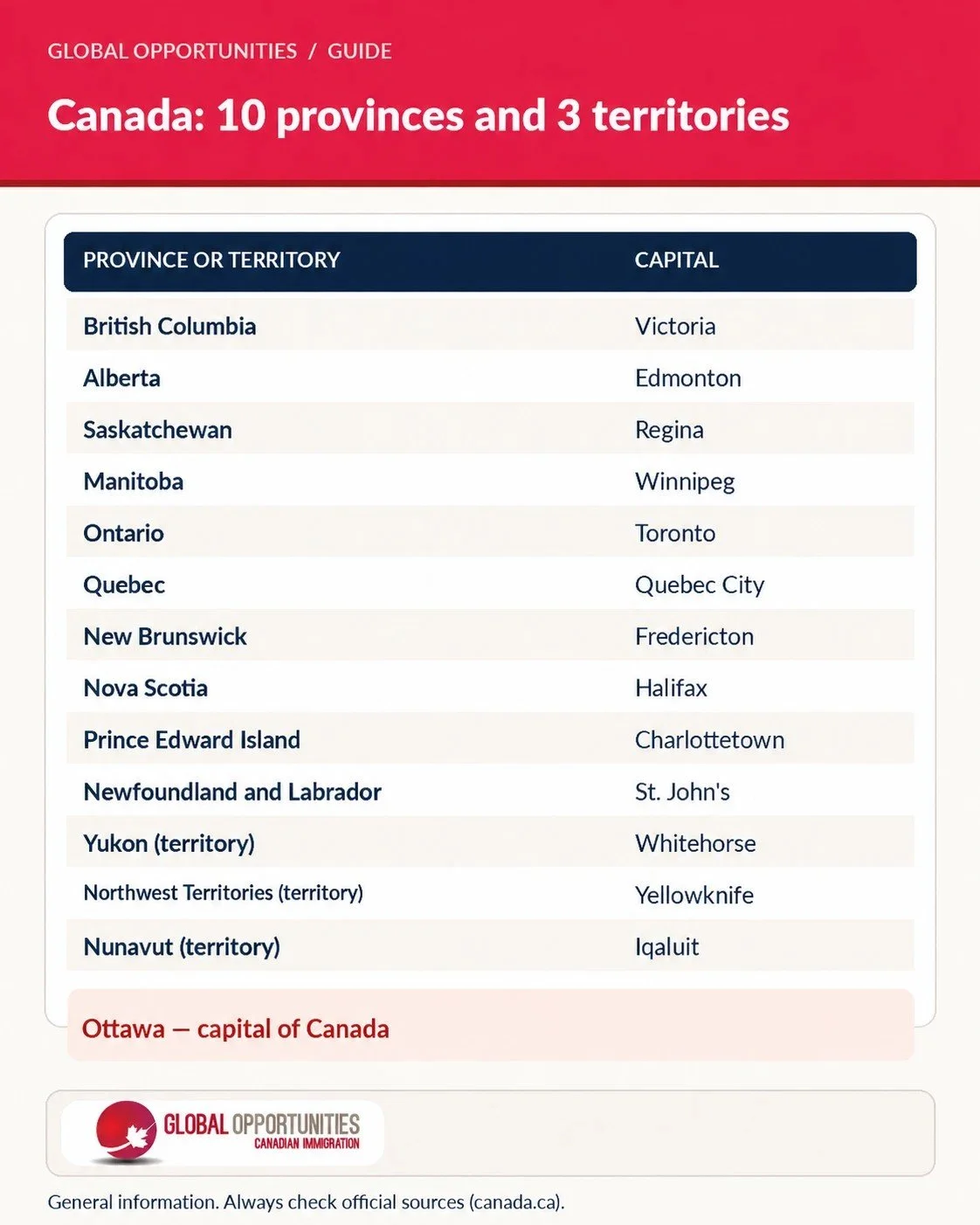
Geography: a very large province
According to the Government of Ontario, Ontario is Canada's second largest province, covering more than one million square kilometres, an area larger than France and Spain combined. It is bounded by Quebec to the east, Manitoba to the west, Hudson Bay and James Bay to the north, and the St. Lawrence River and the Great Lakes to the south (About Ontario).
From the same official page:
Ontario has more than 250,000 lakes, which hold about one-fifth of the world's fresh water.
Manitoulin Island, in Georgian Bay, is the world's largest freshwater island.
Forests cover about two-thirds of the province.
Ontario has two time zones: most of the province is on Eastern Time, and the boundary with Central Time runs just west of Thunder Bay.
In practice, this means distances are long. Driving from Toronto to Ottawa takes most of a day trip, and Thunder Bay is much farther: most people fly. When you compare cities, think about how often you will need to travel back to Toronto or to an airport.
The regions of Ontario
The Greater Golden Horseshoe. The area around the western end of Lake Ontario, including the Greater Toronto Area, Hamilton, St. Catharines and Niagara Falls. According to the Government of Ontario, it is the largest concentration of people and cities in the province, and the wider region reaches Brantford, Kitchener-Waterloo, Barrie and Peterborough.
Southwestern Ontario: London, Windsor, Sarnia and farmland between the Great Lakes.
Eastern Ontario: Ottawa, Kingston, Belleville, Cornwall and the St. Lawrence River.
Central Ontario: lakes, forests and cottage country, including Algonquin Provincial Park.
Northern Ontario: the Canadian Shield, the boreal forest and cities such as Sudbury, North Bay, Sault Ste. Marie, Timmins and Thunder Bay.
The Government of Ontario notes that more than 85% of Ontarians live in urban centres, mostly in cities on the shores of the Great Lakes (About Ontario).
Official language and diversity
According to the Government of Ontario, English is Ontario's official language, and the province also has French-language rights in its legal and education systems and provides government services in French in designated areas (About Ontario). We cover this in the section on French in Ontario below.
Ontario is also the traditional territory of many Indigenous peoples. The Government of Ontario reports that there are 133 First Nations communities in the province, representing at least seven major cultural and linguistic groups (About Ontario).
Where is Ontario? Map, location and key facts
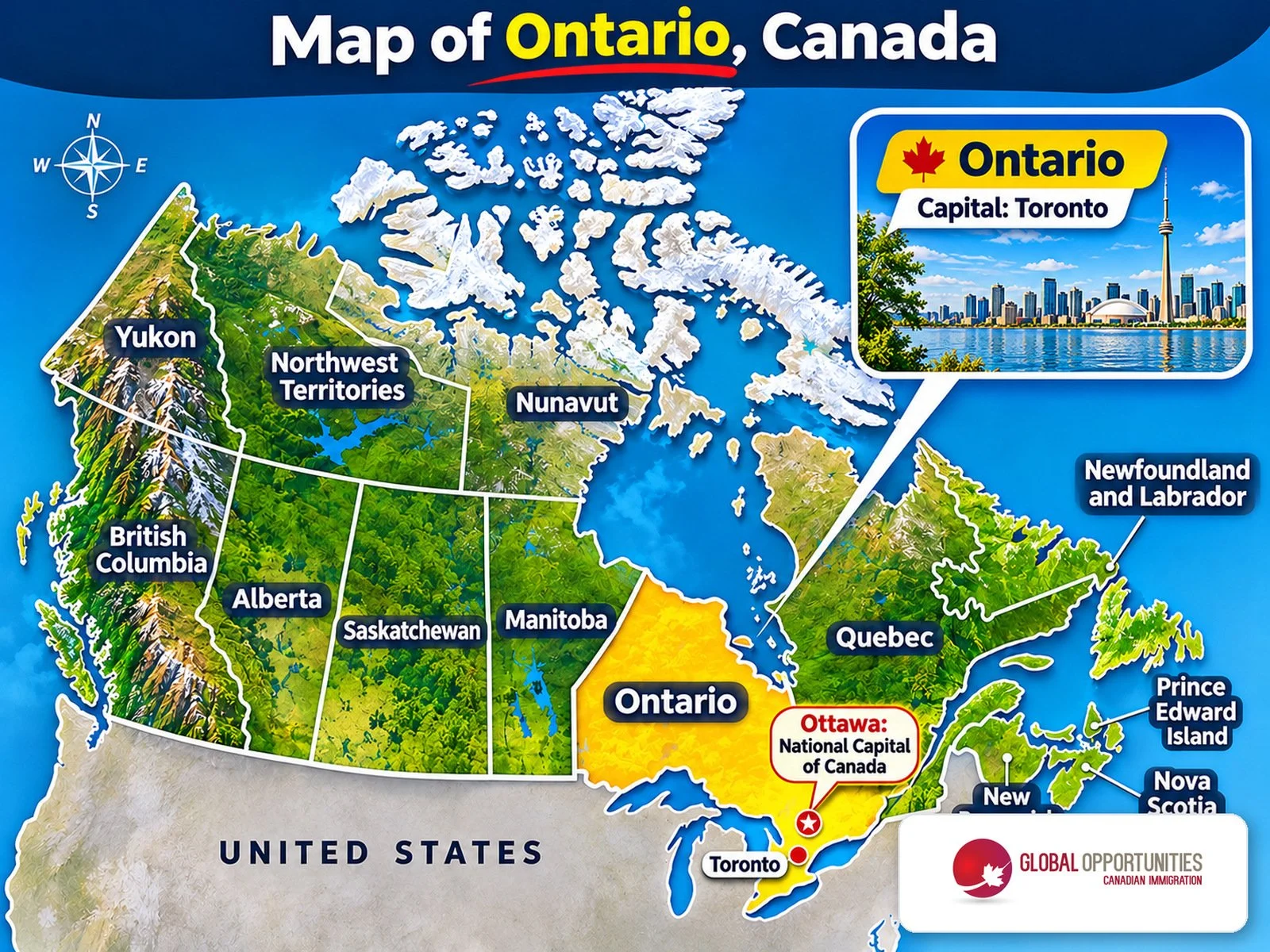
Ontario is in central Canada, between Quebec to the east and Manitoba to the west, with Hudson Bay and James Bay to the north and the Great Lakes and the St. Lawrence River along its southern edge. Its capital, Toronto, is also its largest city, and Ottawa, the capital of Canada, is in eastern Ontario (Government of Ontario, About Ontario).
Borders and neighbours
Provinces: Quebec to the east and Manitoba to the west, according to the Government of Ontario's About Ontario page.
Water: Hudson Bay and James Bay to the north; the Great Lakes and the St. Lawrence River to the south.
United States: the Canada Border Services Agency's border wait times page lists Ontario land crossings into New York, Michigan and Minnesota (see "Driving from the United States" below).
Capital, largest cities and time zones
Capital and largest city: Toronto. According to Statistics Canada's 2021 Census, the City of Toronto had 2,794,356 residents and the City of Ottawa 1,017,449 (Statistics Canada, population and dwelling counts by municipality, table 98-10-0002-01).
Time zones: according to the Government of Ontario, Ontario has two time zones: most of the province is on Eastern Time, and the boundary with Central Time is just west of Thunder Bay, running north from the United States border to Hudson Bay (About Ontario). If you will live or work in the northwest, confirm the local time and the clock-change rules with your municipality, because they are not the same everywhere in that region.
Land area and population
Land area: 892,411.76 square kilometres, according to the 2021 Census (Statistics Canada, population and dwelling counts, table 98-10-0001-01).
Population: Statistics Canada estimated Ontario's population at 16,262,121 on July 1, 2026 (Statistics Canada, population estimates, quarterly, table 17-10-0009-01). The Government of Ontario's fact sheet gives 16,258,260 for July 1, 2025, or 39.0% of Canada (Ontario fact sheet, April 2026).
Economy and main industries
According to the Government of Ontario, Ontario's industries range from farming and mining to manufacturing cars and designing software, the province generates 37% of Canada's GDP, and its manufacturing sector employs 830,000 people. It is the second largest vehicle-producing jurisdiction in North America, and most of its 25 active mining operations are in Northern Ontario (About Ontario). The province's April 2026 fact sheet lists services at 79.0% of Ontario's GDP in 2024 and motor vehicles and parts as its top international export in 2025 (Ontario fact sheet). We cover jobs by region in the jobs section below.
Population by origin: what the census says
Ontario is one of the most diverse places in Canada. These figures come from the 2021 Census and describe the population living in private households (14,031,755 people in Ontario). They are context about who lives here, not a ranking of places (Statistics Canada, Census Profile, Ontario; detailed tables: visible minority, table 98-10-0351-01 and ethnic or cultural origin, table 98-10-0355-01).
Visible minority groups. According to the 2021 Census, 4,817,360 people in Ontario belonged to a visible minority group. The largest groups were South Asian (1,515,295), Chinese (820,245), Black (768,740), Filipino (363,655), Arab (284,215) and Latin American (249,190), followed by West Asian (212,190), Southeast Asian (167,845), Korean (99,425) and Japanese (31,420).
Ethnic or cultural origins. People can report more than one origin, so these numbers overlap. The most common origins reported in Ontario were English (2,347,690), Irish (1,999,985), Scottish (1,937,010), Canadian (1,621,660), German (1,058,075), French (1,039,385) and Italian (905,105). Others included Chinese (821,840), Indian (764,430), Polish (461,090), Filipino (355,680), Ukrainian (342,255), Portuguese (300,600) and Jamaican (201,945).
Latin American origins. About 427,675 people in Ontario reported a Latin, Central or South American origin. The most common were Mexican (54,725), Colombian (39,420), Brazilian (33,905) and Salvadorean (24,735).
Census counts as published by Statistics Canada for the 2021 Census, the most recent with these details when we checked in November 2026. They describe 2021, not today, and they are not immigration figures: check the linked tables for the full definitions.
How to get to Ontario: by plane, car, train or bus
Most people arrive in Ontario by plane, usually at Toronto Pearson or Ottawa. Within the province, highways, VIA Rail trains, GO Transit and intercity buses connect the main cities, and you can also drive in from the United States at several bridges and tunnels.
Main airports
Toronto Pearson International Airport (YYZ): the main airport for the Toronto area (Toronto Pearson). The UP Express train links it to Union Station, as we explain in the FAQ.
Ottawa International Airport (YOW) (Ottawa International Airport).
Billy Bishop Toronto City Airport (YTZ), on the Toronto Islands, close to downtown (Billy Bishop Toronto City Airport).
Flying to Ontario from abroad: airlines and common routes
Ottawa. As of November 2026, the airport's airlines page lists nine airlines: Air Canada, Air France, Air North, Air Transat, Canadian North, PAL Airlines, Porter Airlines, United Airlines and WestJet. Its non-stop destinations page notes that airlines decide their destinations and that some routes vary by season.
Toronto Pearson. Pearson publishes its own list of airlines and non-stop destinations on torontopearson.com. We could not read that list for this update, so check it directly to see which cities in Europe, Latin America, Asia, the United States and Oceania have non-stop flights.
Common ways to get there. From Europe, Latin America and Mexico, Asia, the United States, Australia and New Zealand, the usual way in is a flight to Toronto Pearson or Ottawa, either non-stop or with a connection. Which cities have non-stop service changes by season, so look at each airport's destinations page and the airlines' sites for your own route.
Airlines and routes as listed by the Ottawa International Airport, as of November 2026. Routes and airlines change seasonally: check the airport's page and the airlines before you book.
Main highways
According to the Government of Ontario, Highways 11 and 17 are the Trans-Canada Highway routes across Northern Ontario, and the province has a special winter maintenance standard for them (Government of Ontario, keeping Highways 11 and 17 safe in winter). Distances in the north are long, and winter driving takes preparation (see the driving and winter sections). Before you drive, check road conditions, closures and highway cameras on Ontario 511.
Train: VIA Rail, GO Transit and Ontario Northland
VIA Rail runs intercity trains in Ontario. For example, its Toronto–Ottawa page lists a 444-kilometre trip with about 50 departures a week, as of November 2026. VIA also serves other cities in southern Ontario; see viarail.ca.
GO Transit connects Toronto with the surrounding region (see the section on getting around Toronto).
Ontario Northland, an agency of the Government of Ontario, runs intercity buses in Northern Ontario and says it is working to bring back passenger rail in the northeast with the Northlander (Ontario Northland).
Driving from the United States
The Canada Border Services Agency's border wait times page lists these Ontario crossings, among others:
Michigan: the Ambassador Bridge, the Detroit-Windsor Tunnel and the Gordie Howe International Bridge (Windsor–Detroit), the Blue Water Bridge (Point Edward–Port Huron) and the Sault Ste. Marie Bridge.
New York: the Peace Bridge (Fort Erie–Buffalo), the Rainbow Bridge (Niagara Falls) and the Queenston-Lewiston Bridge, plus Lansdowne (Thousand Islands Bridge), Prescott and Cornwall in eastern Ontario.
Minnesota: the Fort Frances Bridge (Fort Frances–International Falls).
The same page shows current wait times. Before you travel, read the CBSA's travel information on what you must declare and which documents you need, and check whether you need a visa or an eTA with IRCC's official tool. Entry rules depend on your citizenship and status.
Crossings and wait times as listed by the CBSA, train information as published by VIA Rail and Ontario Northland, as of November 2026. Services and schedules change: check the linked pages before you travel.
Buying your first home in Ontario
Most newcomers rent first. If you later want to buy, the Government of Canada offers a tax-free savings account for first homes, a way to use your RRSP savings and a tax credit, and Ontario and Toronto offer refunds of land transfer tax for eligible first-time buyers. Every rule depends on your own situation, so read the official pages and talk to a lawyer, a mortgage professional or the Canada Revenue Agency (CRA) before you decide.
Saving for a first home: the FHSA and the Home Buyers' Plan
First Home Savings Account (FHSA). According to the CRA's opening your FHSAs page, to open an FHSA you must be a resident of Canada, at least 18 (19 where that is the age of majority) and no older than 71 at the end of the year, and a first-time home buyer: in general, you did not live in a home that you or your spouse or common-law partner owned in the current year or the previous four calendar years. Read the CRA's FHSA overview for the contribution limits.
Home Buyers' Plan (HBP). The CRA explains that the HBP lets you withdraw from your registered retirement savings plans (RRSPs) to buy or build a qualifying home. As of November 2026, its HBP page gives a withdrawal limit of $60,000, repaid over 15 years; for first withdrawals made from January 1, 2026, to December 31, 2028, the start of repayments is deferred.
Home buyers' amount. According to the CRA's line 31270 page, this non-refundable tax credit helps first-time home buyers; the page says you can claim up to $10,000 for a qualifying home acquired in 2025.
The Canada Mortgage and Housing Corporation (CMHC) has a step-by-step home buying guide, including information for newcomers.
Land transfer tax refunds in Ontario and Toronto
Ontario. According to the Government of Ontario's land transfer tax refunds for first-time homebuyers, to qualify you must be at least 18, occupy the home as your principal residence within nine months, and never have owned a home, or an interest in one, anywhere in the world; your spouse cannot have owned one while you were spouses. The maximum refund is $4,000, and you must apply within 18 months. Buyers who are not yet Canadian citizens or permanent residents when the purchase closes have 18 months to obtain that status and then apply.
Toronto. Inside the City of Toronto you also pay a municipal land transfer tax. According to the City of Toronto's rebate page, first-time purchasers may get a rebate of up to $4,475 if they are at least 18, occupy the home as their principal residence within nine months, have never owned a home (nor has their spouse while married to them) and are Canadian citizens or permanent residents, or become one within 18 months.
Rules and amounts as published by the Canada Revenue Agency, the Government of Ontario and the City of Toronto, as of November 2026. Eligibility depends on each person and the rules change: check the CRA and the provincial and municipal pages, or ask a professional, before you rely on them. Foreign buyers may face other federal and provincial rules.
Emergencies and natural hazards in Ontario
Ontario is a safe place to live, and serious emergencies are uncommon, but the Government of Ontario asks every household to be ready to look after itself for at least 72 hours (Government of Ontario, emergency management in Ontario). The hazards you are most likely to notice are winter storms, power outages and, in the north, forest fires and smoke.
Be prepared: plan, kit and alerts
The Government of Ontario's Be prepared for an emergency page recommends three steps:
Make a plan with your household, including how you will contact each other and two safe meeting places.
Build a kit with enough non-perishable food for 3 days, 4 litres of water per person per day, medications, a flashlight, a battery or crank radio, copies of important documents and cash.
Stay informed. Alert Ready, the national emergency alert system, sends critical alerts in Ontario to television, radio and compatible wireless devices (Alert Ready).
Forest fires and smoke
According to the Government of Ontario's forest fires page, Ontario's wildland fire season runs from April 1 to October 31. The page has an interactive map of active fires and restricted fire zones. To report a wildland fire north of the French and Mattawa rivers, call 310-FIRE (3473); south of them, call 911. If smoke reaches your city, check the Air Quality Health Index from Environment and Climate Change Canada and follow local advice. People affected by wildland fires can call or text 2-1-1 for non-emergency information about supports.
Winter storms and power outages
The Government of Ontario's winter storms page explains that heavy snow and ice can make roads dangerous and interrupt power. It advises avoiding unnecessary travel, dressing in layers, checking for frostbite and keeping a kit with a flashlight, water, food and blankets. Check Ontario 511 before you drive.
Information as published by the Government of Ontario, Environment and Climate Change Canada and Alert Ready, as of November 2026. In an emergency, follow the instructions of local officials, and call 911 if lives or property are in danger.
Living in Toronto: neighbourhoods and city overview
Toronto is the capital of Ontario and the largest city in Canada. According to Immigration, Refugees and Citizenship Canada (IRCC), it is also the country's main financial centre (Discover Canada, Canada's regions). This section explains how the city is organized and what official sources say about some of its best-known neighbourhoods.
How Toronto is organized
The City of Toronto is one large municipality. According to the City of Toronto Archives, on January 1, 1998 the six area municipalities of Metropolitan Toronto (East York, Etobicoke, North York, Scarborough, Toronto and York) were amalgamated into one city (City of Toronto Archives, former municipalities). Locals still use those names every day, and you will see them in rental listings. Around the city sits the Greater Toronto Area (GTA): the regions of Peel (Mississauga, Brampton), York (Vaughan, Markham, Richmond Hill), Durham (Pickering, Ajax, Whitby, Oshawa) and Halton (Oakville, Burlington, Milton). Each has its own local transit system and its own city services.
A simple way to read a Toronto map is to follow the subway:
Line 1 Yonge-University is a U shape that runs north from downtown along Yonge Street on one side and along University Avenue and Spadina toward Vaughan on the other.
Line 2 Bloor-Danforth runs east-west across the city along Bloor Street and Danforth Avenue.
Line 4 Sheppard runs east from Yonge Street in North York.
Line 5 Eglinton (Mount Dennis to Kennedy) and Line 6 Finch West (Finch West station to Humber Polytechnic's North Campus) are light rail lines; the TTC explains that on these lines you pay before boarding (TTC, Line 5 Eglinton, TTC, Line 6 Finch West).
Living within a short walk of a subway or light rail station usually makes life without a car much more practical. Streetcars cover many downtown and midtown streets, and buses cover the rest.
The City publishes data on each of its official neighbourhoods on its neighbourhood profiles page. The descriptions below summarize what the City of Toronto, Destination Toronto (the city's official tourism organization), Parks Canada and the TTC say about each area. They are a starting point only: every street is different, so visit before you sign anything.
Downtown Toronto and the Financial District
Destination Toronto describes the Financial District, around King and Bay streets, as an area of skyscrapers and bank and corporate headquarters, busiest on weekdays (Destination Toronto, Financial District and PATH). The wider city centre includes the CN Tower, Rogers Centre, Scotiabank Arena and theatres such as Massey Hall (Destination Toronto, City Centre). Under the core runs the PATH, a mostly underground pedestrian network of more than 30 kilometres that connects more than 75 buildings, with restaurants, shops and services, according to the City of Toronto.
Transit: Line 1 and Union Station, the main hub for GO Transit and for the UP Express to Pearson Airport (UP Express).
Liberty Village and King West
According to Destination Toronto, Liberty Village, off King Street West, was once industrial; in the early 2000s production facilities, agencies and tech firms moved into converted warehouse lofts, followed by restaurants, bars, cafés and condos (Destination Toronto, Liberty Village). King West, which runs along King Street West from Liberty Village to University Avenue, was once a warehouse district and is now known for dining and nightlife (Destination Toronto, King West).
Transit: streetcars along King Street West; compare rush-hour travel times with the TTC trip planner before deciding.
The Annex and the University of Toronto area
Destination Toronto places the Annex north of Harbord Village and the University of Toronto, roughly between Bathurst Street, Dupont Street, Avenue Road and Bloor Street. It describes back streets of homes, many built around 1880, and restaurants, art galleries and independent shops (Destination Toronto, The Annex).
Transit: Destination Toronto names Bathurst, Spadina and St. George as the nearest subway stations.
Kensington Market and Chinatown
Parks Canada describes Kensington Market, a national historic site west of Spadina Avenue between College Street and Dundas Street West, as narrow streets of small shops with colourful awnings. It explains that the area was settled first by Jewish immigrants and later by Italian, Portuguese, Eastern European, Caribbean and Asian newcomers, and that its shops sell food, spices and clothing from around the world (Parks Canada, Kensington Market National Historic Site). Destination Toronto adds specialty grocers, bakeries, vintage clothing stores and cafés (Destination Toronto, Kensington Market). Next to it, Chinatown radiates for several blocks from Spadina Avenue and Dundas Street West, with multilingual storefronts and many Asian cuisines, according to Destination Toronto.
Transit: streetcars on Spadina Avenue and Dundas Street West; check routes with the TTC trip planner.
Little Italy and Little Portugal
According to Destination Toronto, Little Italy's main strip runs along College Street, a historically Italian area that is now more diverse and known for its patios (Destination Toronto, Little Italy). Little Portugal, along Dundas Street West, honours the Azorean immigrants who make up much of Toronto's Portuguese community, with low-rise buildings, Portuguese bakeries and churrasqueiras (Destination Toronto, Little Portugal).
Leslieville and Riverside
Destination Toronto places Leslieville east of the Don River, roughly from Empire Avenue to Coxwell Avenue, with independent boutiques and vintage shops on Queen Street East, many cafés and parks, and describes it as sought after by young families (Destination Toronto, Leslieville). Riverside, between the Don Valley Parkway and Leslieville, has Victorian streetscapes and is served by the 501 Queen streetcar (Destination Toronto, Riverside).
The Danforth (Greektown) and East York
According to Destination Toronto, the Danforth runs along Danforth Avenue east of the Don Valley Parkway and is still home to a large Greek population, with English and Greek street signs and Greek, Ethiopian, Turkish, Persian and Lebanese restaurants. The Taste of the Danforth street festival takes place each summer (Destination Toronto, Danforth/Greektown). To the north is the former borough of East York, one of the six municipalities amalgamated in 1998, according to the City of Toronto Archives.
Transit: Destination Toronto notes that the area is reached from any Line 2 station between Broadview and Main Street.
Midtown: Yonge and Eglinton and Davisville
Destination Toronto describes Yonge and Eglinton as a neighbourhood known for shopping and casual dining and popular with young professionals, served by Eglinton station (Destination Toronto, Yonge and Eglinton), and Davisville Village as family-friendly, with antique and vintage shops on Mount Pleasant Road, served by Davisville station (Destination Toronto, Davisville Village).
Transit: Line 1 along Yonge Street, and Line 5 Eglinton crossing east-west at Eglinton station.
North York
According to the City of Toronto, North York Centre stretches along Yonge Street from Highway 401 to Drewry and Cummer avenues. The City calls it the largest office-based employment hub in Toronto outside downtown, and says more than 50,000 people live there, near Sheppard-Yonge, North York Centre and Finch stations (City of Toronto, North York at the Centre). York University and Seneca Polytechnic's Newnham Campus are in the north of the city.
Transit: Line 1, Line 4 Sheppard, Line 6 Finch West in the northwest, and many bus routes.
Scarborough
Destination Toronto describes Scarborough as the east of Toronto, bounded by Lake Ontario, Victoria Park Avenue, Steeles Avenue and Pickering, with a multicultural food scene, Rouge National Urban Park and the clay cliffs of the Scarborough Bluffs, including Bluffer's Park beach (Destination Toronto, Scarborough, Scarborough Bluffs). The City of Toronto names the University of Toronto Scarborough and Centennial College as key institutional destinations in the area (City of Toronto, Scarborough East rapid transit briefing).
Transit: buses connecting to Kennedy station, where Line 2 meets Line 5 Eglinton, and to GO stations; the TTC trip planner helps you test commutes.
Etobicoke
Destination Toronto describes Etobicoke as the west end of the city, bounded by Etobicoke Creek, Steeles Avenue and Lake Ontario, with quiet neighbourhoods and green space, including the Old Mill area, Rexdale and Humber Bay Shores, a waterfront area between the Humber River and Mimico Creek with Humber Bay Park (Destination Toronto, Etobicoke, Humber Bay Shores).
Transit: Line 2 in the south, GO trains, buses, and Line 6 Finch West, which ends at Humber Polytechnic's North Campus, according to the TTC.
York, Weston and Mount Dennis
Northwest of downtown, in the former City of York, one of the six municipalities amalgamated in 1998, according to the City of Toronto Archives. Destination Toronto describes the stretch of Eglinton Avenue West from Marlee Avenue to Keele Street, known as Little Jamaica, as a hub for the Jamaican and wider Caribbean communities since the 1950s (Destination Toronto, Little Jamaica and Eglinton West).
Transit: Line 5 Eglinton starts at Mount Dennis, according to the TTC, and the UP Express stops at Weston and Mount Dennis (UP Express).
Beyond the city: the GTA
Many families also look at the GTA cities of Mississauga, Brampton, Vaughan, Markham, Richmond Hill, Oakville, Pickering, Ajax and Whitby. GO trains and buses connect these areas with Union Station (GO Transit, about us), and Ontario's One Fare Program reduces the cost of combining local transit with the TTC (see below). Outside the city, check local transit before you assume you can live without a car.
Before you sign a lease anywhere, visit the area at different times of day, walk to the nearest station, and test your commute with the TTC trip planner.
Daily life in Toronto
Commute. Living near a subway line or a GO station can save you hours each week.
Winter. The PATH, the subway and heated buildings make downtown winters easier.
Budget. Rent is usually the largest monthly cost; see the CMHC rent figures in our housing section.
Community. Settlement agencies, public libraries and community centres can connect you with community groups, including Latin American organizations. Find free services near you with IRCC's newcomer services finder.
Getting around Toronto: TTC, PRESTO and GO Transit
The Toronto Transit Commission (TTC) runs the city's subway, light rail, streetcars and buses. You can pay with a PRESTO card, a contactless debit or credit card, or exact cash, and card payments include a two-hour transfer and monthly fare capping. The official TTC routes and schedules page has the network map, and the TTC trip planner helps you plan each trip.
What is PRESTO?
PRESTO is the electronic fare card used by the TTC, GO Transit, UP Express and most transit systems in the Greater Toronto and Hamilton Area, as well as OC Transpo in Ottawa. According to PRESTO, it works across 11 transit agencies in the Greater Toronto and Hamilton Area and Ottawa (PRESTO). You load money (an "e-purse") or a pass onto the card and tap it on a reader every time you board a bus or streetcar, enter a station or board on a light rail platform.
How to get a PRESTO card, and what it costs
According to the TTC, as of November 2026 (TTC, fares and passes):
A physical PRESTO card costs $4. You can buy it at Fare Vending Machines in subway stations and Line 5 and Line 6 stations, at Shoppers Drug Mart or participating PRESTO Customer Service Outlets, or online at prestocard.ca.
A digital PRESTO card in your phone's mobile wallet is free (age 13+). The TTC links to PRESTO's instructions for Apple Wallet and Google Wallet. A digital card can be active on one device at a time.
A limited number of free PRESTO cards are available at select Toronto Public Library branches.
To load money or passes, use the free PRESTO app, prestocard.ca, a Fare Vending Machine, or a Shoppers Drug Mart or Customer Service Outlet.
The TTC's fares and passes page also notes that since March 2, 2026, PRESTO cards must have enough funds to cover the full fare before tapping; negative balances are no longer accepted. Register your card online so you can protect your balance if you lose it. Check the current price before you buy.
TTC fares: adult, youth, senior and post-secondary
These are the TTC's single-trip fares as listed on the official page in November 2026 (TTC, fares and passes). Fares change, so check the current price on the TTC website.
Paying with a PRESTO card:
Adult: $3.30
Youth (13 to 19): $2.35
Senior (65+): $2.25
Post-secondary student: $3.30 (adult price)
Fair Pass (City of Toronto low-income discount): $2.10
Paying with a contactless Interac debit or credit card (or a phone or watch):
$3.30 for everyone. The TTC explains that discounted fares such as youth, senior or Fair Pass are not available with this method.
Paying cash (exact fare only, no change given):
Adult: $3.35
Youth: $2.40
Senior: $2.30
Children 12 and under ride free. On the same TTC page, PRESTO Tickets (paper cards sold at Fare Vending Machines and Shoppers Drug Mart) were listed at $3.35 for one ride, $6.70 for two rides and $13.50 for a day pass; they are only sold at the adult price.
How to set a youth, senior or student fare on PRESTO
According to the TTC's fare types and discounts page, as of November 2026:
Child, youth and senior fare types must be set in person, at Shoppers Drug Mart or a participating PRESTO Customer Service Outlet, with proof of age. They cannot be set online or at a Fare Vending Machine.
Youth aged 16 to 19 must carry photo ID such as a high school photo ID, a driver's licence or an Ontario Photo Card. Seniors must carry photo ID such as a driver's licence or an Ontario Photo Card.
Post-secondary students need a TTC Post-Secondary Photo ID Card to use the Post-Secondary Monthly Pass, listed at $128.15. To be eligible, the TTC says you must be enrolled full-time in a degree or diploma program at a recognized post-secondary institution located in Toronto, or full-time at a registered private career college in Toronto. Students who are 19 or under can use the youth fare instead.
Fair Pass is a City of Toronto program for eligible low-income residents aged 20 to 64. You apply through the City (Fair Pass Transit Discount Program).
The two-hour transfer
The TTC's fares and passes page explains that when you pay with a PRESTO card, a PRESTO Ticket or a debit or credit card (including a mobile wallet), transfers made within two hours of your first tap are not charged another TTC fare. You can get off, run an errand and board again within that window. Tap the same card or device every time you enter a station, board a bus or streetcar, or board on a Line 5 or Line 6 platform. Cash payments do not include the two-hour transfer: with cash you get a paper transfer valid only for a continuous, one-way trip.
Monthly fare capping (and the end of most monthly passes)
This is the biggest recent change. According to the TTC, most TTC monthly and 12-month passes were discontinued on August 31, 2026, when monthly fare capping came into effect. Once you reach 47 eligible paid TTC fares in a calendar month with the same payment method, the rest of your TTC trips that month are free. Capping applies to PRESTO cards (physical or in a mobile wallet) and to debit and credit cards, including in a mobile wallet. It does not apply to cash, PRESTO Tickets or paper transfers (TTC, fares and passes).
Two practical tips from the TTC's fare rules: use one payment method all month (a physical credit card and the same card in your phone count as different methods), and keep tapping even after you reach the cap, because your tap is your proof of payment. The Adult 12-Month Pass ($143.00 per month on a 12-month contract) and the Post-Secondary Monthly Pass were still available when we checked.
Proof of payment, Line 5 and Line 6
Your tapped card, ticket, phone or paper transfer is your proof of payment, and fare inspectors can ask to see it. On Line 5 Eglinton and Line 6 Finch West, the TTC says there is no onboard payment: you pay before boarding at a PRESTO reader or a machine on the platform and keep your proof of payment.
Overnight service
When the subway is closed, the TTC's Blue Night Network runs on most major routes from approximately 1:30 a.m. until the subway opens, every 30 minutes or better, seven days a week (TTC routes and schedules).
Ontario's One Fare Program: connecting with other systems
Under Ontario's One Fare Program, you pay once when connecting between the TTC and GO Transit, Brampton Transit, Durham Region Transit, MiWay (Mississauga) and York Region Transit. According to the TTC (regional travel and One Fare):
One Fare works when you pay with a PRESTO card, PRESTO in a mobile wallet, or a debit or credit card. It does not work with cash or PRESTO Tickets.
Tap with the same payment method on every vehicle. Between the TTC and the local systems, the free transfer applies within two hours of your first tap on the TTC.
When you transfer from the TTC to GO Transit within two hours, the TTC portion of your fare is reimbursed.
People using a youth, senior or student discount must use a PRESTO card with the right fare type set.
TTC and regional fare caps are separate; only trips that start on the TTC count toward the TTC monthly cap.
GO Transit and UP Express
GO Transit is the regional public transit service for the Greater Toronto and Hamilton Area. According to GO Transit, it is a division of Metrolinx, an agency of the Government of Ontario, and it carries over 70 million passengers a year on a network of train and bus lines across the Greater Golden Horseshoe (GO Transit, about us). Union Station is the main hub.
GO fares depend on your fare type and on the distance between your two stops, so there is no single price. According to GO Transit's fare page, in November 2026: kids 12 and under ride free; youth (13 to 19) and full-time post-secondary students save 40% with PRESTO when they set the right fare type; and seniors (65+) save 55%. You can pay with PRESTO (card or mobile wallet), a debit or credit card, an e-ticket or a paper ticket, and you must tap off at the end of your trip unless you have a default trip set. Use the trip planner on gotransit.com to see your exact fare.
Fares and rules as published by the TTC, PRESTO and GO Transit, as of November 2026. Discounts apply only when the right fare type is set, and fares may have changed by the time you read this: check the linked pages before you rely on them.
Living in Ottawa
Ottawa is the capital of Canada. It sits on the Ottawa River in eastern Ontario, across the river from Gatineau, Quebec. According to IRCC, Ottawa was chosen as the capital in 1857 and is today Canada's fourth largest metropolitan area; its Rideau Canal, once a military waterway, is now a tourist attraction and a winter skateway (Discover Canada).
What life in Ottawa is like
Government city. Ottawa is the national capital and home to Parliament. Federal government jobs often have specific requirements, including language requirements, so read each posting carefully.
English and French. Ottawa sits across the river from Gatineau, Quebec. Many jobs, especially in the public service, list English and French requirements; check each posting.
Universities and colleges. The University of Ottawa, Carleton University, Algonquin College and La Cité (a French-language college) are all in Ottawa, according to the Government of Ontario's lists of universities and colleges.
Neighbourhoods. Ottawa Tourism describes the ByWard Market as nearly as old as the city itself, in the downtown core and reachable by O-Train, bus, bike or on foot; Centretown as densely populated, with murals, shops and restaurants; the Glebe as a Bank Street area of heritage buildings, shops and cafés along the Rideau Canal; and Westboro Village as having a walkable main street on Richmond Road. It describes Kanata, Stittsville and Bells Corners in the west, Orléans in the east and Barrhaven in the south as suburban communities (Ottawa Tourism, neighbourhoods).
Winters. Compare Ottawa's winters with other cities using the official climate normals linked in our climate section. IRCC notes that the Rideau Canal becomes a winter skateway.
OC Transpo fares and how to pay in Ottawa
OC Transpo runs Ottawa's buses and the O-Train. According to the OC Transpo fares page, as of November 2026:
Cash: $4.15. O-Payment (tapping a debit card, credit card, Google Pay or Apple Pay): $4.10, adult fare only.
Presto: adult $4.10; senior (65+) $3.28; pre-teen (11 to 12) $2.05; children 10 and under free.
Youth and pre-teens with the right Presto discount ride free on evenings after 5 p.m., weekends and holidays; outside those times, regular fares apply.
DayPass: $12.25. Adult monthly pass: $138.50; senior monthly pass: $59.75.
Fare capping: OC Transpo caps daily fares at the price of a DayPass and monthly fares at the price of an adult monthly pass.
All rides include a transfer window of at least 90 minutes.
One important difference from Toronto: OC Transpo says Presto on Apple Wallet or Google Wallet is not accepted on its buses, fare gates or Para Transpo, so in Ottawa use a physical Presto card or O-Payment. Discounted fares require a Presto card. Check the current price before you travel.
Rent in Ottawa
According to CMHC's Rental Market Survey, the average rent for a two-bedroom apartment in purpose-built rental buildings in the Ontario part of the Ottawa-Gatineau area was $1,926 in October 2025, and $2,155 for units that changed tenants that year (CMHC, Rental Market Survey data tables, 2025). Check current listings, because rents change.
Fares as published by OC Transpo and rents as published by CMHC, as of November 2026. CMHC averages describe October 2025 and are not the price of any specific unit: check the linked pages and current listings before you rely on them.
Other cities in Ontario: transit, industries and rents
Ontario has many cities beyond Toronto and Ottawa, each with its own job market, transit system and rent level. Mid-sized cities can offer shorter commutes, more space and a quieter life, but may have fewer openings in some sectors, and you will often need a car.
How to read the rent figures below: they come from CMHC's Rental Market Survey, which measures purpose-built rental apartments (buildings of three units or more) in October of each year. We quote the average two-bedroom rent in October 2025 for each census metropolitan area (CMA) and, where available, the average for units that changed tenants, which is closer to what a newcomer signing a new lease is likely to see. Condos, rooms and basement apartments are not included. Source for every rent figure in this section: CMHC, Rental Market Survey data tables, 2025. For comparison, the Ontario average was $1,827, and $2,167 for units that changed tenants. Check current listings before you decide.
Mississauga
In Peel Region, west of Toronto. According to Invest Mississauga, the City of Mississauga's economic development office, its main sectors include advanced manufacturing, financial services, technology, life sciences, smart logistics and creative industries, and Toronto Pearson, which it calls Canada's largest and busiest airport, is located in the city (Invest Mississauga, industries). The University of Toronto Mississauga (UTM) and Sheridan's Hazel McCallion Campus are here.
Transit: MiWay. According to the City of Mississauga's MiWay fare prices page, as of November 2026: PRESTO adult fare $3.50; youth (13 to 19) $2.90; children 6 to 12 ride free on PRESTO; seniors 65+ ride free with a PRESTO card set to the senior fare type; cash and contactless credit or debit $4.50; adult PRESTO monthly pass $145. MiWay connects with the TTC and GO through One Fare.
Rent: Mississauga is part of the Toronto CMA in CMHC's data (see the housing section).
Brampton
Also in Peel Region. According to Invest Brampton, the City of Brampton's economic development office, its key sectors include advanced manufacturing, food and beverage, health and life sciences, innovation and technology, and logistics, and the city is home to Canada's largest inland port (Invest Brampton, logistics). Sheridan's Davis Campus, its largest, is here.
Transit: Brampton Transit. According to the City of Brampton's fares page, fares effective February 9, 2026: PRESTO adult (20 to 64) $3.55 per trip; youth (13 to 19) $2.95; senior (65+) $1.85; child (6 to 12) $2.00; children 5 and under free; adult PRESTO monthly pass $148.50; cash or contactless card $4.75. Brampton residents aged 65+ with a Brampton Transit Senior ID can get a free annual pass on PRESTO.
Rent: part of the Toronto CMA in CMHC's data.
Hamilton
On Lake Ontario, between Toronto and Niagara. According to Invest in Hamilton, the City of Hamilton's economic development site, key sectors include manufacturing, life sciences, agribusiness and food processing, goods movement, and finance, insurance and real estate, and the city calls itself the nation's steelmaking capital (Invest in Hamilton, manufacturing). McMaster University and Mohawk College are here, and GO trains and buses connect Hamilton with Toronto.
Transit: HSR. According to the City of Hamilton's fares page, as of November 2026 (after the September 1, 2025 change): cash $3.75; PRESTO adult $2.85; youth (13 to 19) and senior (65+) $2.35; children 6 to 12 free with a PRESTO card; adult monthly pass $125.40; seniors 80+ free with a Golden Age PRESTO. After 11 paid PRESTO trips in the same week, the rest of that week's trips are free. Tapping a debit or credit card costs the same as cash. Low-income residents can apply for Fare Assist.
Rent: according to CMHC, Hamilton CMA average two-bedroom $1,656 (October 2025); $2,177 for units that changed tenants.
Kitchener-Waterloo and Cambridge
West of Toronto, the cities of Kitchener, Waterloo and Cambridge form the Region of Waterloo. According to Waterloo EDC, the region's economic development corporation, its key industries are technology, manufacturing and automotive (Waterloo EDC, industries), and the region's official tourism site highlights finance and insurance and advanced manufacturing (Explore Waterloo Region, centres of excellence). The University of Waterloo, Wilfrid Laurier University and Conestoga College are here.
Transit: Grand River Transit (GRT), which runs buses and the ION light rail. According to GRT's fare prices page, as of November 2026: cash $4; EasyGO fare card stored value $3; day pass $8; monthly pass $104. GRT uses its own EasyGO card, not PRESTO. GO trains and buses connect the region to Toronto.
Rent: according to CMHC, Kitchener-Cambridge-Waterloo CMA average two-bedroom $1,832 (October 2025); $2,111 for units that changed tenants.
London
A mid-sized city in southwestern Ontario, between Toronto and Windsor. According to the City of London, its key sectors are agri-food, manufacturing, digital media and technology, health and professional services (City of London, economic overview). Western University and Fanshawe College are in London.
Transit: London Transit (LTC). According to the LTC fares page, as of November 2026: exact cash $3.50; adult smart card $2.65 per trip; youth (13 to 17) $2.12; senior (65+) $2.00; children 12 and under ride free with a free LTC fob; Citipass (unlimited monthly) $112. Fares include a 90-minute transfer.
Rent: according to CMHC, London CMA average two-bedroom $1,651 (October 2025); $1,878 for units that changed tenants.
Windsor
At the southwestern tip of the province, across the river from Detroit. According to Invest WindsorEssex, Windsor is the largest border city in Canada, at the busiest commercial border crossing, and its economy is built on advanced manufacturing, particularly the automotive and electric vehicle sectors, along with logistics, agri-business and technology (Invest WindsorEssex, Windsor). The University of Windsor and St. Clair College are here. The Government of Ontario notes that Ontario is the second largest vehicle-producing jurisdiction in North America (About Ontario).
Transit: Transit Windsor. Check fares on its website.
Rent: according to CMHC, Windsor CMA average two-bedroom $1,454 (October 2025); $1,668 for units that changed tenants.
Oshawa, Whitby and Durham Region
East of Toronto, along Lake Ontario. According to Durham Region, Oshawa has historic roots in manufacturing, and its economy has diversified into a hub for health care and education; General Motors is listed among its major employers (Durham Region, City of Oshawa profile). Durham College and Ontario Tech University are in Oshawa.
Transit: Durham Region Transit (DRT). According to DRT's fares page, fares effective July 1, 2026: adult PRESTO $3.84; youth (13 to 19) $3.46; senior (65+) $2.53; cash and debit or credit $4.85; adult monthly PRESTO pass $138.24. DRT is part of One Fare with the TTC, and GO trains connect to Union Station.
Rent: according to CMHC, Oshawa CMA average two-bedroom $1,754 (October 2025); $1,959 for units that changed tenants.
York Region: Vaughan, Markham and Richmond Hill
North of Toronto. According to YorkLink, York Region's economic development office, key sectors include information and communications technology, automotive technology, life sciences, building and construction, logistics, and finance, insurance and real estate (YorkLink, sectors). York Region's report on the 2021 Census says 47.8% of residents were born outside Canada, and lists Chinese, Italian, Indian, Iranian and Jewish among the top ethnic origins (York Region, 2021 Census report). Line 1 reaches Vaughan Metropolitan Centre.
Transit: York Region Transit (YRT). According to the YRT fare chart, fares effective July 1, 2026: PRESTO adult $4.24; youth $3.29; senior and child $2.60; cash, credit or debit $4.65. YRT has a monthly fare capping program with PRESTO, and offers free transfers to and from the TTC with PRESTO or a contactless card.
Rent: York Region is part of the Toronto CMA in CMHC's data.
Niagara: St. Catharines, Niagara Falls and Welland
Between Lake Ontario and Lake Erie, on the border with New York State. According to Niagara Economic Development, key sectors include agriculture, manufacturing, tourism and film (Niagara Economic Development, key sectors). IRCC notes that the Niagara region is known for its vineyards, wines and fruit crops (Discover Canada). Brock University and Niagara College are here.
Transit: Niagara Region Transit, plus GO trains and buses to Toronto.
Rent: according to CMHC, St. Catharines-Niagara CMA average two-bedroom $1,527 (October 2025); $1,911 for units that changed tenants.
Barrie
North of Toronto, on Kempenfelt Bay of Lake Simcoe (Tourism Barrie, waterfront). Invest Barrie lists advanced manufacturing, health and life sciences, tourism, and arts and culture among its key sectors (Invest Barrie, key sectors). Georgian College's main campus is here, and GO trains and buses run between Barrie and Toronto (Tourism Barrie, GO Transit).
Transit: Barrie Transit.
Rent: according to CMHC, Barrie CMA average two-bedroom $1,755 (October 2025); $2,082 for units that changed tenants.
Guelph
West of Toronto, between the GTA and Kitchener-Waterloo. According to the City of Guelph, its main sectors are advanced manufacturing, agri-innovation, cleantech and information technology, and it calls the University of Guelph "Canada's food university" (City of Guelph, community profile).
Transit: Guelph Transit. According to the City of Guelph's fares page, prices effective January 1, 2026: adult single ride with the OnYourWay card $2.90, up to a monthly maximum of $98.60; reduced fare (youth 13 to 17, seniors 65+ and post-secondary students) $2.35, up to $79.90 a month; cash $3.50. An OnYourWay card costs $5.
Rent: according to CMHC, Guelph CMA average two-bedroom $1,802 (October 2025); $2,253 for units that changed tenants.
Kingston
On Lake Ontario, between Toronto and Ottawa. The City of Kingston notes that it became Canada's first capital in 1841 (City of Kingston, history and heritage). According to Kingston Economic Development, the area is anchored by CFB Kingston, along with Queen's University, the Royal Military College and St. Lawrence College, and its main hospitals are Kingston Health Sciences Centre and Providence Care (Invest Kingston, defence and security, life sciences).
Rent: according to CMHC, Kingston CMA average two-bedroom $1,764 (October 2025); $1,970 for units that changed tenants.
Sudbury
The City of Greater Sudbury describes itself as a world-class mining centre, with mining companies and a large cluster of mining supply and service companies, and says it is home to Canada's third-largest French-speaking population outside Quebec (City of Greater Sudbury, about Greater Sudbury). According to the Government of Ontario, most of the province's active mining operations are in Northern Ontario (About Ontario). Laurentian University, Cambrian College and Collège Boréal, a French-language college, have campuses here.
Transit: the City's transit service, GOVA.
Rent: according to CMHC, Greater Sudbury CMA average two-bedroom $1,558 (October 2025); $1,727 for units that changed tenants.
Thunder Bay
On the north shore of Lake Superior (Tourism Thunder Bay). Lakehead University and Confederation College are here. According to the Thunder Bay Community Economic Development Commission, key sectors include mining, health sciences, manufacturing and tourism, and research is helping renew its traditional forestry and mining industries (CEDC, key sectors). The Government of Ontario notes that amethyst, Ontario's official gemstone, is in rich supply near Thunder Bay, and that the time zone boundary runs just west of the city (About Ontario).
Transit: Thunder Bay Transit, run by the City of Thunder Bay.
Rent: according to CMHC, Thunder Bay CMA average two-bedroom $1,495 (October 2025); $1,679 for units that changed tenants.
Other cities worth researching
Peterborough (two-bedroom average $1,518 in October 2025), Brantford ($1,619), Belleville-Quinte West ($1,484), as well as Sarnia, Cornwall, North Bay, Sault Ste. Marie and Timmins, each with a college and its own job market (CMHC, 2025). Smaller cities often have lower rents but fewer jobs in some fields, so compare both before you move.
Fares as published by each city's transit operator and rents as published by CMHC, as of November 2026. They may have changed by the time you read this, and an average rent is not the price of any specific unit: check the linked pages before you rely on them.
How much is rent in Ontario? Where to look, rents and tenant rights
Most newcomers rent when they first arrive in Ontario. Rental rules in the province come from the Residential Tenancies Act, 2006, disputes are handled by the Landlord and Tenant Board, and most landlords must use the Ontario standard lease. This section explains where to search, what rent levels look like, which deposits are legal, how rent increases work and how to avoid scams.
Average rents in Ontario: CMHC figures
According to CMHC's Rental Market Survey, in October 2025 (CMHC, Rental Market Survey data tables, 2025):
Toronto CMA (which includes Mississauga, Brampton and much of York and Durham regions): average two-bedroom rent in purpose-built rental buildings $2,046; $2,547 for units that changed tenants; vacancy rate 3.0%.
Toronto CMA, rented condo apartments: average two-bedroom rent $2,891.
Ontario (centres of 10,000+): average two-bedroom $1,827; $2,167 for units that changed tenants; vacancy rate 3.2%.
The figures for other cities are in the previous section. Keep in mind that "average rent" includes long-time tenants who pay less because of rent control, which is why units that change tenants cost more. Rooms in shared houses usually cost less than a full apartment. Rents change, so check current listings.
For a national overview, see our article on the cost of living in Canada.
Where to look for a rental in Ontario
Online listing sites such as Kijiji, Facebook Marketplace, Rentals.ca, PadMapper and Zumper. Search by neighbourhood and set alerts.
Property management companies that own apartment buildings often list units on their own websites.
Real estate agents can show condo rentals; ask in advance who pays any fee.
Community groups, places of worship and newcomer associations, including Latin American community groups, often share rooms and apartments.
University and college housing offices for students: most institutions have residence options and an off-campus housing service.
Settlement agencies can help you understand the process; find one with IRCC's newcomer services finder.
We mention private websites and companies for reference only. Global Opportunities has no relationship with them and does not recommend any of them.
Renting a room, a basement or an apartment
A room in a shared house or apartment is the most common first step for single newcomers and students. It is cheaper, often furnished, and utilities are usually included. Ask whether you will share the kitchen and bathroom, and whether you will have a written agreement.
A basement apartment is a unit in the lower level of a house. They are common in Toronto, Mississauga, Brampton and many other cities. Ask whether the unit is a legal second unit, check that it has proper windows, smoke and carbon monoxide alarms and a safe exit, and visit in person. The Government of Ontario's rent increase guideline page confirms that the rules apply to most tenants, including those in basement apartments (residential rent increases).
An apartment or condo. Purpose-built rental buildings are run by a landlord or management company; condo units are rented by individual owners.
Student housing. Ask your college or university about residences and off-campus listings before you arrive.
Some arrangements are not covered by the Residential Tenancies Act, for example when you share a kitchen or bathroom with the owner or the owner's close family. The Landlord and Tenant Board's information for new tenants and the Government of Ontario's renting in Ontario page explain who the Act covers; check them before you sign.
What landlords usually ask for
Identification, proof of income or a job letter, references, and sometimes a credit check. Newcomers without Canadian credit history may be asked for more documents, such as bank statements or a letter from an employer or school. The Financial Consumer Agency of Canada has a useful guide on renting an apartment or house.
Deposits: what is legal in Ontario
According to the Landlord and Tenant Board's information for new tenants, a landlord can collect a rent deposit that cannot be more than one month's rent (or one week's rent if you pay weekly). It must be used as the rent for the last month or week of the tenancy, and cannot be used for any other reason, such as damages. A landlord must pay interest on the deposit every year.
The Government of Ontario's guide to the standard lease adds that a rent deposit cannot be used as a damage deposit, that the law limits the amount and treatment of key deposits, and that a lease cannot require deposits that are not permitted under the Act, such as damage or pet deposits. In practice, this is why Ontario landlords ask for "first and last month's rent": the first month's rent plus the legal last-month deposit.
The Ontario standard lease
According to the Government of Ontario, landlords of most private residential rental units must use the standard lease template for all new leases. The standard lease is required for most residential tenancy agreements signed on or after April 30, 2018. It does not apply to some housing types, such as care homes, most social and supportive housing, and co-operative housing (Government of Ontario, guide to Ontario's standard lease).
If you are entitled to a standard lease and did not get one, the Government of Ontario explains that you can ask your landlord for it in writing, and the landlord must provide it within 21 calendar days. The official page explains what you can do if they don't (Government of Ontario, renting in Ontario: your rights).
Rent increases and the rent increase guideline
According to the Government of Ontario (residential rent increases):
In most cases, rent can only go up if at least 12 months have passed since the last increase or since the tenancy began.
The landlord must give you written notice at least 90 days before the increase, using the proper Landlord and Tenant Board form.
The rent increase guideline is the maximum a landlord can raise most tenants' rent in a year without the board's approval. As of November 2026, the official page states that the guideline for 2027 is 1.9% (it was 2.1% for 2026). It is calculated from the Ontario Consumer Price Index and is capped at 2.5%.
Important exception: the guideline does not apply to new buildings, additions and most new basement apartments first occupied for residential purposes after November 15, 2018, or to a unit when a new tenancy starts (the landlord and new tenant agree on the rent). In units first occupied after November 15, 2018, rent can still only go up once every 12 months, but there is no limit on the amount. Ask about this before you sign.
Your rights as a tenant
The Government of Ontario's page on renting in Ontario covers the main points. Some of them:
Evictions. A landlord can only evict you in specific situations and must give you written notice using the proper Landlord and Tenant Board form. Even after a notice, you do not have to move out unless the landlord applies to the board and receives an eviction order. You have the right to a hearing.
Entry. The Landlord and Tenant Board's information for new tenants explains that in most cases your landlord must give you 24 hours' written notice before entering your unit, with some exceptions such as emergencies.
Repairs. Landlords are responsible for maintenance and repairs; tenants are responsible for damage they or their guests cause.
The City of Toronto also has a page on rental housing rights and information.
The Landlord and Tenant Board
The Landlord and Tenant Board (LTB), part of Tribunals Ontario, is the independent tribunal that resolves disputes between residential landlords and tenants in Ontario. It also provides information about rights and responsibilities under the Residential Tenancies Act, 2006. Always download forms from its official website.
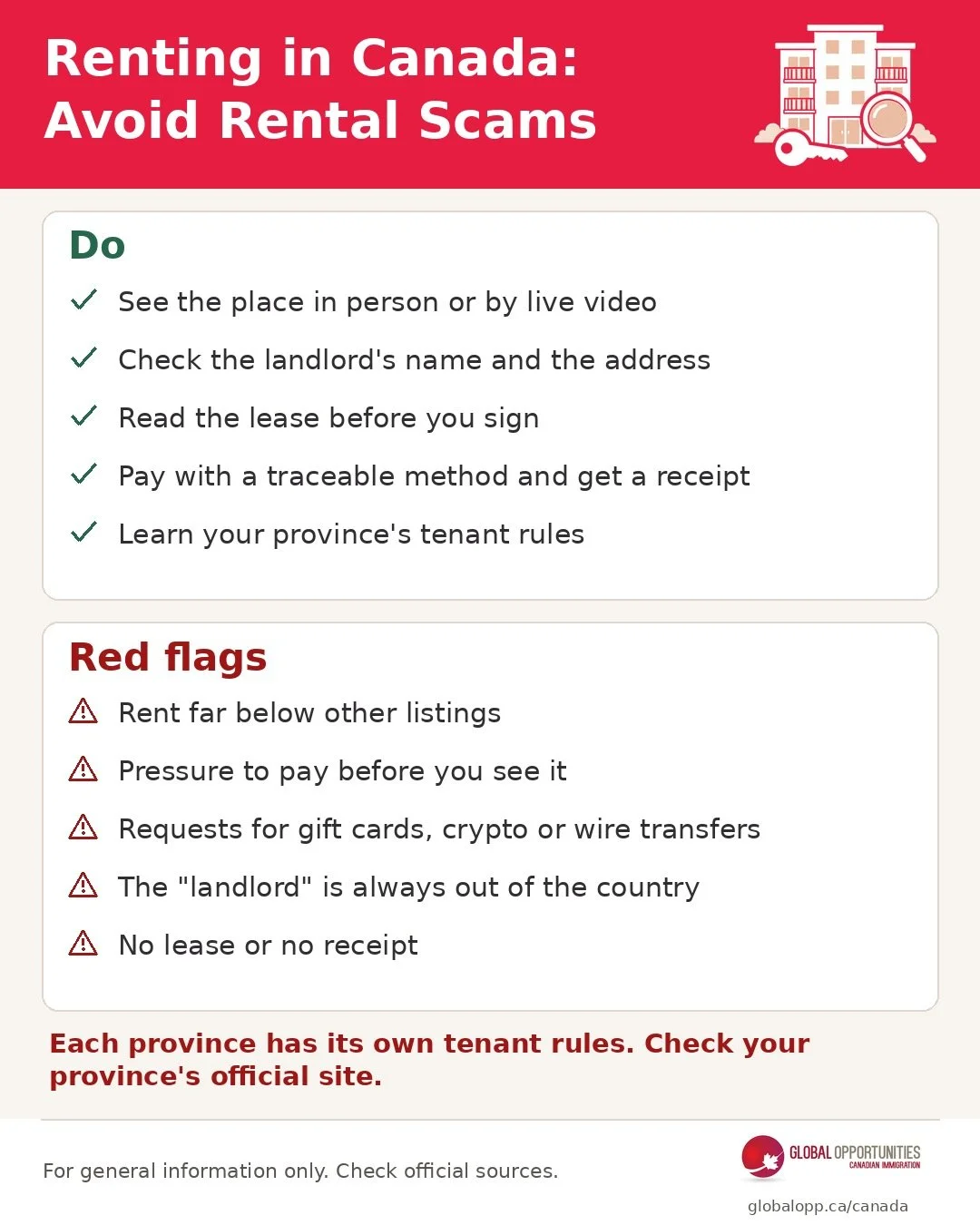
How to avoid rental scams
The Competition Bureau warns about rental scams in its article Rental scam: no room for error. In short, follow these steps:
Compare the price. Be suspicious if the rent is far below similar units, or if the listing pressures you to decide or pay quickly.
Do not pay strangers. Never wire money or send a deposit to someone you have not met, especially someone who says they are outside the country.
Visit in person. Make sure the person showing the unit can actually rent it. A reverse image search can reveal photos copied from other listings.
Get it in writing. Ask for a written lease (in most cases, the Ontario standard lease) and a receipt for every payment.
Pay only after you have seen the place and have a written lease.
Utilities: hydro, heat and internet
Ask what is included in the rent. In many apartment buildings, heat and water are included and you pay electricity ("hydro") separately; in houses and basement units, utilities may be shared or included. Internet and mobile phone service are usually separate, and you can compare providers. Many landlords ask for tenant insurance in the lease; it protects your belongings and liability, so read your lease to see whether it is required.
Rents as published by CMHC, and deposit, lease and rent increase rules as published by the Government of Ontario and the Landlord and Tenant Board, as of November 2026. The rent increase guideline does not apply to every unit (for example, most units first occupied after November 15, 2018), so check the linked pages for your own unit before you rely on them.
Electricity price plans in Ontario: Time-of-Use, Tiered and Ultra-Low Overnight
If you pay your own electricity ("hydro") bill and buy it from your local utility, the Ontario Energy Board (OEB) sets the regulated price. According to the OEB, you can choose between three price plans: Time-of-Use, Tiered and Ultra-Low Overnight (OEB, electricity rates).
As of November 2026, the OEB's page lists these prices, in effect from November 1, 2026 (the OEB sets them once a year, on November 1):
Time-of-Use: 9.1 cents per kWh off-peak (weekdays 7 p.m. to 7 a.m., and all day on weekends and holidays), 14.6 cents mid-peak and 18.9 cents on-peak. In winter (November 1 to April 30), on-peak is weekdays 7 to 11 a.m. and 5 to 7 p.m.; in summer, it is weekdays 11 a.m. to 5 p.m.
Ultra-Low Overnight: 3.7 cents per kWh every night from 11 p.m. to 7 a.m., 9.1 cents on weekend and holiday daytime, 14.6 cents mid-peak and 37.7 cents on-peak (weekdays 4 to 9 p.m.). It can suit households that use most of their power overnight, for example to charge an electric car.
Tiered: 11.2 cents per kWh up to a monthly threshold (1,000 kWh in winter and 600 kWh in summer for homes) and 13.2 cents above it, whatever the time of day.
The OEB says fewer than 1 in 10 customers buy electricity from a retailer; retail contract prices are not regulated by the OEB, so read any contract carefully before you sign. Your bill also includes delivery and other charges.
Prices as published by the Ontario Energy Board, as of November 2026. They change every November 1, and the best plan depends on how and when you use electricity: check the OEB page and your utility before you switch.
Driving in Ontario: licences, insurance, car rental and parking
According to the Government of Ontario, you can drive in Ontario with a valid licence from another province, state or country for 60 days after you move; after that you need an Ontario licence. New drivers go through graduated licensing (G1, G2 and G), and every vehicle must be insured. (Government of Ontario, exchange an out-of-province licence) Toronto and Ottawa can be managed without a car; in many other cities a car is close to essential.
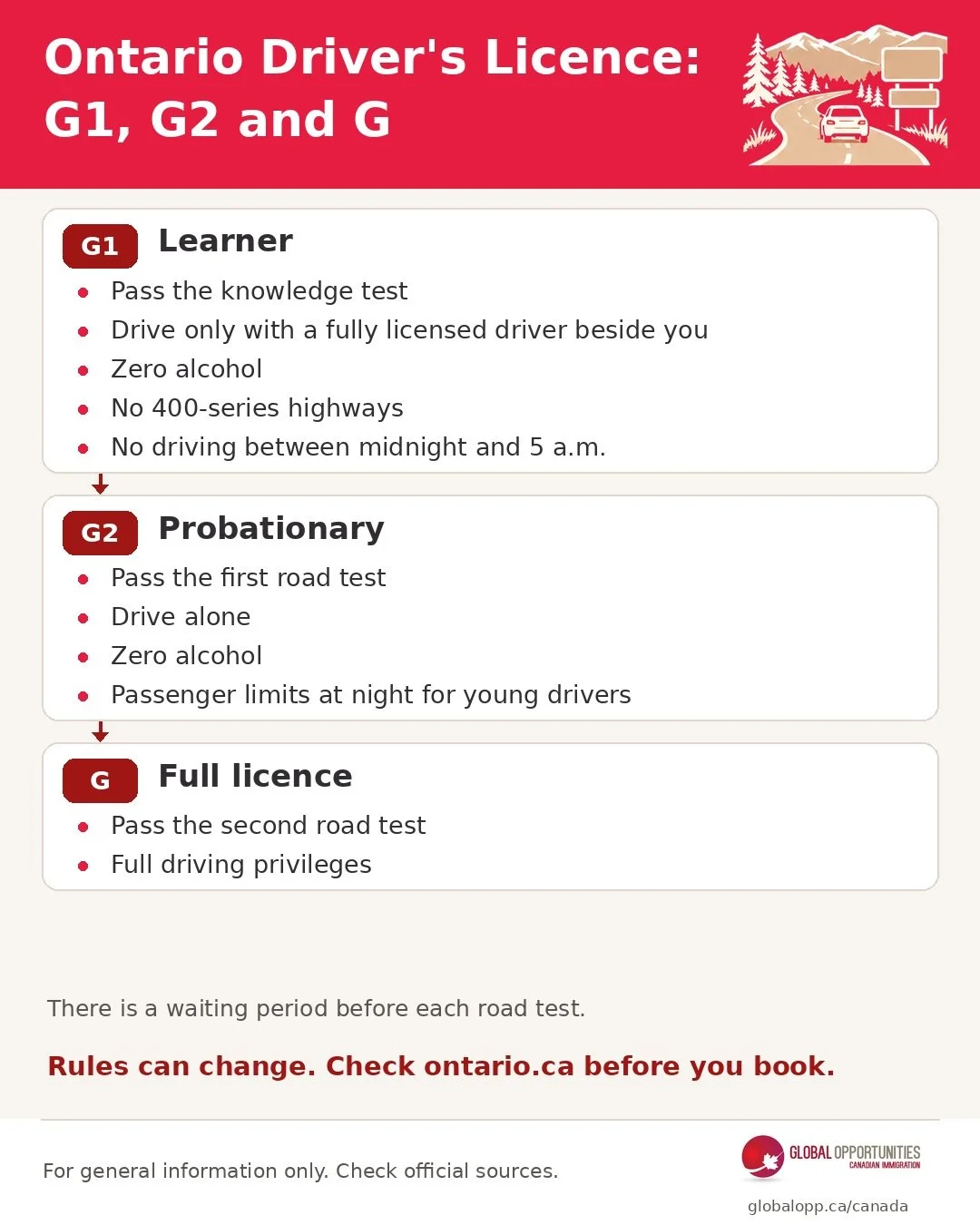
Ontario's graduated licensing: G1, G2 and G explained
According to the Government of Ontario's page Get a G driver's licence: new drivers, to apply you must be at least 16, be a resident of Ontario (not a visitor), and pass a vision test and a knowledge test on the rules of the road. The page notes that as of May 11, 2026, applicants must declare that Ontario is their primary place of residence and that their presence in Canada is legal. You apply at a DriveTest centre (no appointment needed for knowledge tests) or at ServiceOntario Bay and College in downtown Toronto (by appointment), with original ID. You have up to five years to complete the whole process.
G1 (beginner). According to the same page, by law, with a G1 you must:
keep a zero blood alcohol level;
make sure every passenger wears a working seatbelt;
not drive between midnight and 5 a.m.;
not drive on 400-series highways or high-speed expressways such as the 401, the QEW or the Gardiner Expressway (unless with a certified Ontario driving instructor);
drive with a fully licensed driver who has at least four years of experience and a blood alcohol level under .05 (zero if 21 or under), and who is the only other person in the front seat.
The same page says that in most cases you practise with a G1 for 12 months before taking the G2 road test. If you complete a government-approved driver education course, you can take it after eight months. The road test checks turns, stops, parallel parking, lane changes, three-point turns and intersections.
G2 (intermediate). After passing the G2 road test, you can drive without an experienced driver, on all Ontario roads, at any time of day in most cases. You must still keep a zero blood alcohol level and carry only as many passengers as there are working seatbelts. Drivers 19 and under have extra passenger limits between midnight and 5 a.m. The page says you practise for 12 months before the G road test (Get a G driver's licence).
G (full licence). The G road test covers more advanced skills, such as highway driving. Once you pass, you have a full G licence.
Driver's licence and road test fees
According to DriveTest's fees page, which says the fees are set by the Government of Ontario and include taxes (fees effective July 12, 2019, as shown in November 2026):
G1 licence package: $159.75, which includes a knowledge test, a G2 road test and a five-year licence, paid when you apply.
Extra knowledge test attempt: $16.00
G2 road test: $53.75
G road test: $91.25
Licence exchange (for drivers from jurisdictions with exchange agreements): $90.00, the cost of the five-year licence.
Official MTO Driver's Handbook at DriveTest: $18.00, cash only (the Government of Ontario also lists the handbook at $14.95 plus taxes from other sellers, and an online version).
The Government of Ontario's driver and vehicle fees page also lists $90 for an original driver's licence (G1, G2, G). Check the current price before you go.
Exchanging a foreign driver's licence
According to the Government of Ontario's page on how to exchange an out-of-province licence:
You can use a valid licence from another province, state or country for 60 days after moving to Ontario.
You can exchange your licence if you are relocating from any Canadian province or territory, the Canadian Armed Forces, U.S. states, or from Australia, Austria, Belgium, Croatia, France, Germany, Great Britain, Hungary, Denmark, the Isle of Man, Japan, South Korea, Kosovo, New Zealand, Northern Ireland, the Republic of Ireland, Switzerland, Taiwan or Ukraine (with some exceptions, such as learner's permits and some licence classes). This list can change; check the official page.
If your country has no exchange agreement, you must pass the vision test, the knowledge test and the G2 road test, and wait at least 12 months before the G road test. The page says that effective July 1, 2026, you can get credit for up to one year of driving experience by showing a valid original foreign licence and an official authentication letter from the issuing government, in English or French.
Licences not in English or French need a certified translation from an approved translator, dated within six months.
You apply in person at a DriveTest centre or ServiceOntario Bay and College, with original ID, your original licence and any proof of experience.
Car insurance in Ontario
Car insurance is mandatory in Ontario. The regulator is the Financial Services Regulatory Authority of Ontario (FSRA), which says its role is to ensure insurers' proposed rates are fair and not excessive, and that agents and businesses selling auto insurance are licensed (FSRA, auto insurance).
According to FSRA's page on what is in a standard auto insurance policy, coverages automatically included in a standard policy are liability coverage, statutory accident benefits and uninsured automobile coverage. Direct Compensation-Property Damage (DCPD) is also included, and since January 2024 you may elect not to claim it; FSRA says opting out may not be the best option and suggests speaking with your insurer, agent or broker first. Optional coverages, such as collision and comprehensive, cost extra.
Why is car insurance in Ontario expensive, especially for newcomers? FSRA explains that your rate depends on a combination of factors, including your personal profile, the type of vehicle, the coverage amount, the deductible and the insurance company, and that inflation, fraud and changes in driving behaviour can push rates up. Newcomers often have no Canadian driving record, which can raise the price.
How to lower the cost:
Get several quotes from licensed agents, brokers and insurers, and compare the same coverage.
Ask whether the insurer will consider your driving record from your home country, and bring a letter from your previous insurer.
Ask about a higher deductible and about discounts. FSRA says all insurance companies must offer a discount if you install winter tires; each insurer sets the amount (FSRA, how to save on auto insurance).
Choose your car carefully: some models cost much more to insure.
If you have an accident, FSRA says you must report it to your broker, agent or insurer within seven days (FSRA, auto insurance).
Brokers are regulated by the Registered Insurance Brokers of Ontario (RIBO). This list of regulators is for reference only and may not be complete; confirm details with each regulator.
Renting a car when you arrive
Each rental company sets its own rules for age, licences, payment and fees, so check with the company before you book. Two examples from the companies' own pages, as of November 2026:
Enterprise Canada says it needs a valid, unexpired photo licence; it requires an International Driving Permit (IDP) only for licences written in a non-Latin alphabet, recommends one for other licences not in English or French, and says drivers under 25 may pay a young driver fee (Enterprise, licence requirements, rental requirements).
Hertz Canada lists a minimum age of 20 (18 in Quebec), a licence held for more than one year and a valid credit card (Hertz Canada, renting to drivers under 25).
Toronto Pearson lists the rental companies with counters at Terminals 1 and 3 (Toronto Pearson, car rentals). CAA explains that it is the only organization authorized to issue IDPs in Canada (CAA, International Driving Permit); if you need one for a foreign licence, ask the authority that issued your licence before you travel. On Highway 407 ETR, the toll bill goes to the rental company as the vehicle owner, and the company decides how to bill you for tolls and administrative fees (407 ETR, FAQ). Remember the 60-day rule above, and check what insurance you already have (for example through a credit card) before you accept or refuse the rental company's coverage. We mention private companies for reference only and have no relationship with any of them.
Parking in Toronto: permits, Green P and winter rules
The three-hour rule. The City of Toronto explains that, unless a sign says otherwise, there is an unsigned maximum three-hour parking limit on public roads, and parking is prohibited within three metres of a fire hydrant (City of Toronto, parking regulations).
Residential on-street permit parking. In many older neighbourhoods where driveways and garages are uncommon, residents can buy a permit to park on their street during permit hours. According to the City's residential on-street parking page, permits are issued for six-month terms (December 1 to May 31 and June 1 to November 30), you must check with the Permit Parking office whether your street is eligible and has spaces, and some streets have wait lists. The 2026 fee listed for a resident's first vehicle with no access to on-site parking was $24.23 per month plus HST, with higher fees for additional vehicles. Check the current price.
Green P. The Toronto Parking Authority, a City agency, operates municipal on-street pay-and-display parking and off-street lots and garages (City of Toronto, Toronto Parking Authority) under the Green P brand, which has an app to pay. Check rates on the sign at each location.
Winter: snow routes. According to the City's major snow event page, when a "major snow storm condition" is declared, parking is prohibited on designated snow routes, which are mostly downtown and include all streetcar routes. They are clearly signed, and parking on one during a major snow event can bring a fine of up to $500. Where temporary orange "no parking" signs are posted, parking is prohibited until snow removal is complete. Vehicles that block snow clearing can be towed.
Condo and apartment parking. In condos and apartment buildings, a parking spot is often rented separately from the unit, or not available at all. Ask before you sign the lease, and check whether visitor parking is allowed overnight.
Other cities have their own rules, including overnight winter parking bans in many municipalities. Check your city's website as soon as you move.
Licence rules and fees as published by the Government of Ontario and DriveTest, insurance information from FSRA and parking rules from the City of Toronto, as of November 2026. Whether you can exchange your licence depends on where it was issued and its class, and the list of exchange countries can change: check the linked pages before you rely on them.
How do newcomers get health care in Ontario? OHIP, family doctors and Health811
Ontario's public health insurance plan is OHIP, the Ontario Health Insurance Plan. Through OHIP, the province pays for many of the health services you may need, and you show your Ontario health card every time you use them (Government of Ontario, apply for OHIP).
New to how public health care works? Read the health care system in Canada.
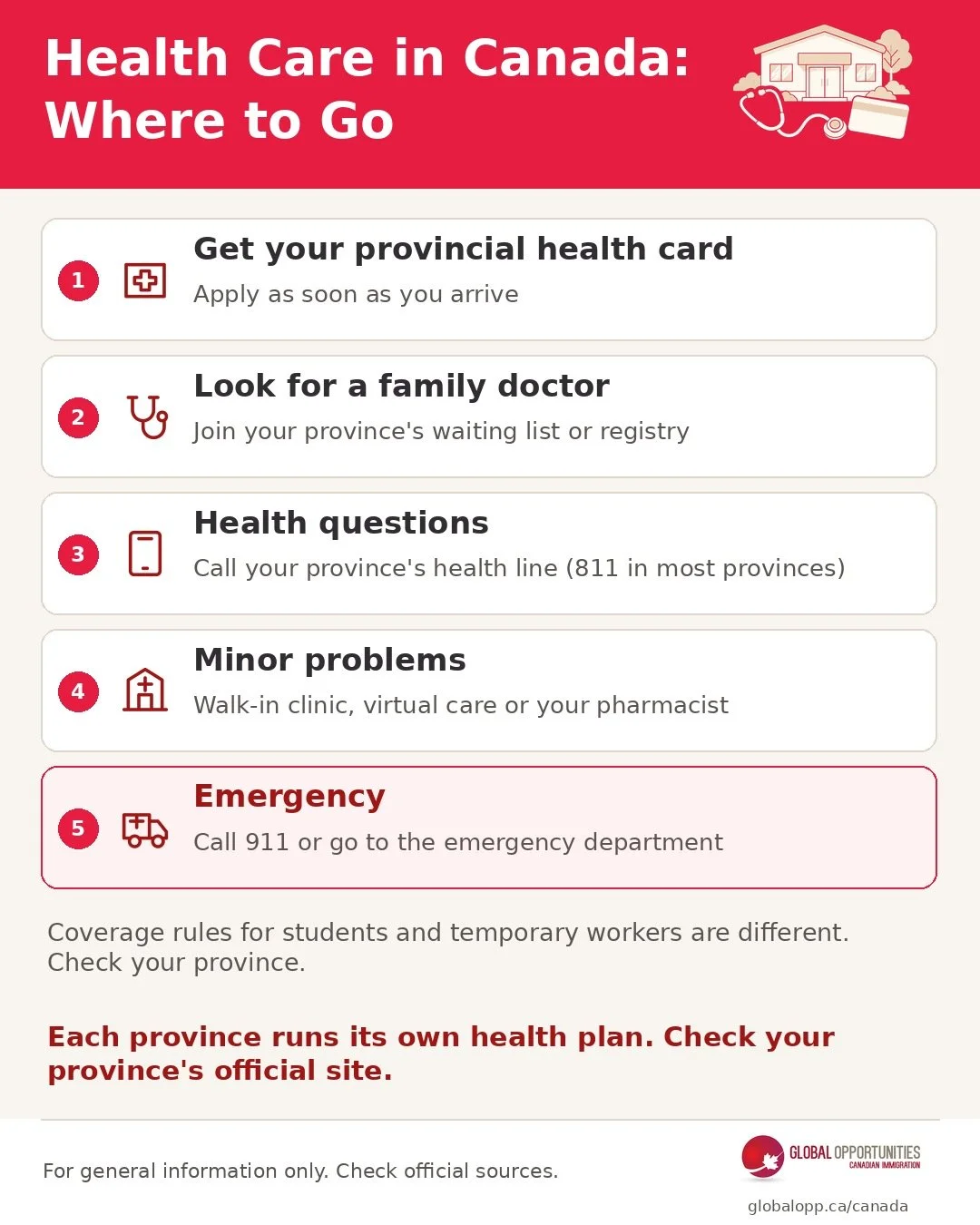
OHIP eligibility: what the official page says
The Government of Ontario's page Apply for OHIP and get a health card is the place to check whether you qualify. In November 2026 it states that there is no longer a waiting period for OHIP coverage: if you are eligible, your coverage starts right away.
In general terms, the page explains that eligibility depends on two things:
Your status. The page lists the eligible statuses. They include, among others, Canadian citizens, permanent residents, some people who have applied for permanent residence, and some work permit holders who work full-time for an Ontario employer. Each category has its own conditions.
Your presence in Ontario. The page sets out how many days you must be physically present in the province, both when you first arrive and in later years.
Read the official page for your exact situation.
How to apply for OHIP
According to the Government of Ontario's Apply for OHIP page, you must apply in person at a ServiceOntario centre, bringing three separate documents from the official list (photocopies are not accepted). Each eligible family member needs their own health card. Step by step:
Check the official document list on the Apply for OHIP page.
Gather three original documents: one that proves your citizenship or OHIP-eligible immigration status, one that proves your residency in Ontario, and one that proves your identity.
Go to a ServiceOntario centre in person (one visit for each family member who needs a card).
Keep private insurance until you know when your coverage starts.
If you are not yet covered, or your status does not qualify, buy private health insurance before you arrive. International students are usually covered by a health plan arranged through their college or university; ask your school what applies to you.
What OHIP covers
According to the Government of Ontario's page What OHIP covers, OHIP covers part or all of visits to doctors, hospital visits and stays, medically necessary lab tests, some dental surgery in hospital, eligible eye exams, part of podiatry visits and ambulance services, among others. Medically necessary visits to your doctor or to a walk-in clinic are fully covered, including virtual visits by video or telephone. Eye exams are covered once every 12 months for children and youth 19 and under, and for adults with certain medical conditions.
What OHIP does not cover
The same page explains that OHIP does not cover:
prescription drugs outside hospital (for example, antibiotics prescribed by your family doctor);
dental services in a dentist's office;
eyeglasses and contact lenses;
cosmetic surgery;
private or semi-private hospital rooms (you or your insurance pay some or all of the cost).
Many employers offer workplace health and dental insurance that covers some of these costs. According to the Government of Ontario, people 24 years of age or younger who are not covered by a private plan may qualify for drug coverage through OHIP+, and people automatically join the Ontario Drug Benefit program after they turn 65 (prescription drug coverage).
Finding a family doctor: Health Care Connect
Finding a family doctor can take time. The province runs Health Care Connect, where a "Care Connector" searches on your behalf for a family doctor, nurse practitioner or primary care team accepting new patients in your community. According to the official page, you can register yourself, someone else or your whole family, online in English or French, or by phone at 811 in English, French or another language, 24 hours a day. You need your health card to register. The Government of Ontario notes that joining does not guarantee a provider will be found immediately, and that people who need urgent care are matched first. Ask neighbours and settlement workers too: community health centres and clinics sometimes accept new patients directly.
Walk-in clinics, virtual care and pharmacies
Walk-in clinics see patients without an appointment or with same-day booking. Bring your health card. Many also offer virtual visits.
Pharmacists can do more than fill prescriptions. According to the Government of Ontario, pharmacists can assess and prescribe medication for common ailments like pink eye, seasonal allergies and skin rashes, and can extend certain prescriptions for chronic conditions until your next doctor's appointment (Your health). They can also give vaccines, including publicly funded vaccines (Government of Ontario, pharmacies).
Prescriptions are filled at any pharmacy. Without a drug plan, you pay the full price, so ask your pharmacist about generic options.
Health811 and emergencies
For a life-threatening emergency, call 911 or go to the nearest hospital emergency department.
For health questions that are not emergencies, call 811 (Health811, TTY 711) or use the online chat. According to the Government of Ontario, you can talk to a registered nurse day or night for free, secure and confidential health advice (Your health). The same page has a tool to find doctors, clinics, mental health services and pharmacies near you.
Emergency departments are for serious problems such as chest pain, difficulty breathing, severe injuries or signs of a stroke. For minor problems, a walk-in clinic, an urgent care centre, your pharmacist or 811 is usually faster.
OHIP rules as published by the Government of Ontario, as of November 2026. "No waiting period" applies only to people who meet the eligibility rules for their status and presence in Ontario, and ServiceOntario decides each application: check the linked pages before you rely on them.
Banking in Ontario for newcomers
Opening a bank account is one of your first tasks in Ontario: you need it to receive your salary, pay rent and build a credit history. The Financial Consumer Agency of Canada (FCAC) explains what identification banks require and what to do if a bank refuses to open an account (FCAC, opening a bank account).
Banks and credit unions in Ontario
The large national banks, RBC, TD, Scotiabank, BMO, CIBC and National Bank, each have a newcomer page describing packages for people new to Canada, such as a period without monthly fees (RBC, TD, Scotiabank, BMO, CIBC, National Bank). Ontario also has credit unions, which are member-owned; FSRA regulates them and insures eligible deposits (FSRA, credit unions and deposit insurance). There are also online banks. Compare monthly fees, transaction limits, international transfer costs and branch locations near your home or work. We mention financial institutions for reference only. Global Opportunities has no relationship with any of them and does not recommend any.
What you need to open an account
Generally, banks ask for identification such as a passport and your immigration document (for example, your Confirmation of Permanent Residence, work permit or study permit), and proof of address. FCAC's page lists the accepted documents and your rights. FCAC's page also explains when a bank can ask for your Social Insurance Number.
Building a credit history
In Canada, landlords, phone companies and lenders often check your credit report. FCAC explains how credit reports and scores work. To start building credit: get a credit card (a secured credit card, backed by a deposit, is an option if you are refused a regular card), use it for small purchases, pay the full balance on time every month, and keep your spending well below the limit.
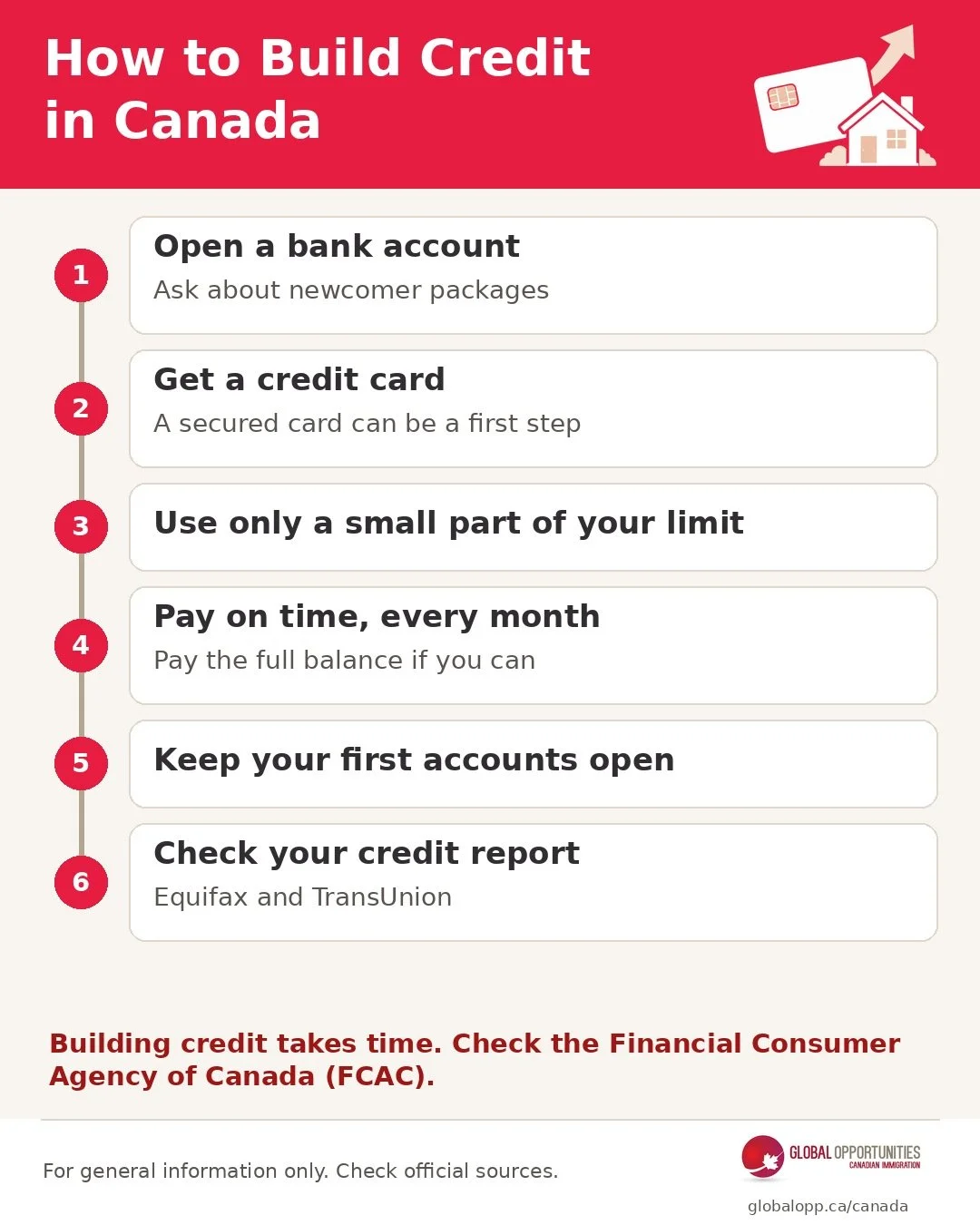
Groceries and shopping in Ontario
Ontario has supermarket chains at different price levels, plus international grocers. Prices vary a lot between chains, so many families shop at more than one.
Supermarkets and discount chains
Discount supermarkets: No Frills, FreshCo and Food Basics, which says it has served Ontarians since 1995. No Frills has a price match policy; ask at each store. Many people compare weekly flyers.
Large general store: Walmart Canada.
Warehouse club: Costco sells in bulk and requires a paid membership (Costco, membership).
Full-service supermarkets: Loblaws, Metro, Sobeys and Farm Boy, whose store list shows locations only in Ontario, including Ottawa and Toronto (Farm Boy, stores).
Asian supermarkets: T&T Supermarket and Galleria Supermarket, a Korean and Asian grocer with stores in Toronto, Thornhill and Oakville (Galleria), plus many independent stores.
International and Latin American products: Parks Canada describes Kensington Market's shops as selling food, spices and clothing from around the world (Parks Canada). Independent grocers across the GTA serve many communities, including Latin American ones; search by neighbourhood.
Dollar stores such as Dollarama for basic household items.
Farmers' markets operate in many cities in summer and fall; check your city's website.
We mention stores for reference only. Global Opportunities has no relationship with any of them.
Furnishing your home on a budget
IKEA, Walmart, Canadian Tire and Costco sell new furniture and household items. Facebook Marketplace and Kijiji have many second-hand items; meet in a public place and inspect before you pay. Value Village and other thrift stores sell used clothing and housewares.
How cold is Ontario, and how do you prepare for winter?
Ontario has four clearly different seasons. The Government of Ontario notes that summer temperatures can rise above 30°C, while winter temperatures can drop below -40°C in parts of the province (About Ontario). IRCC describes southern Ontario as having cold winters and warm, humid summers (Discover Canada).
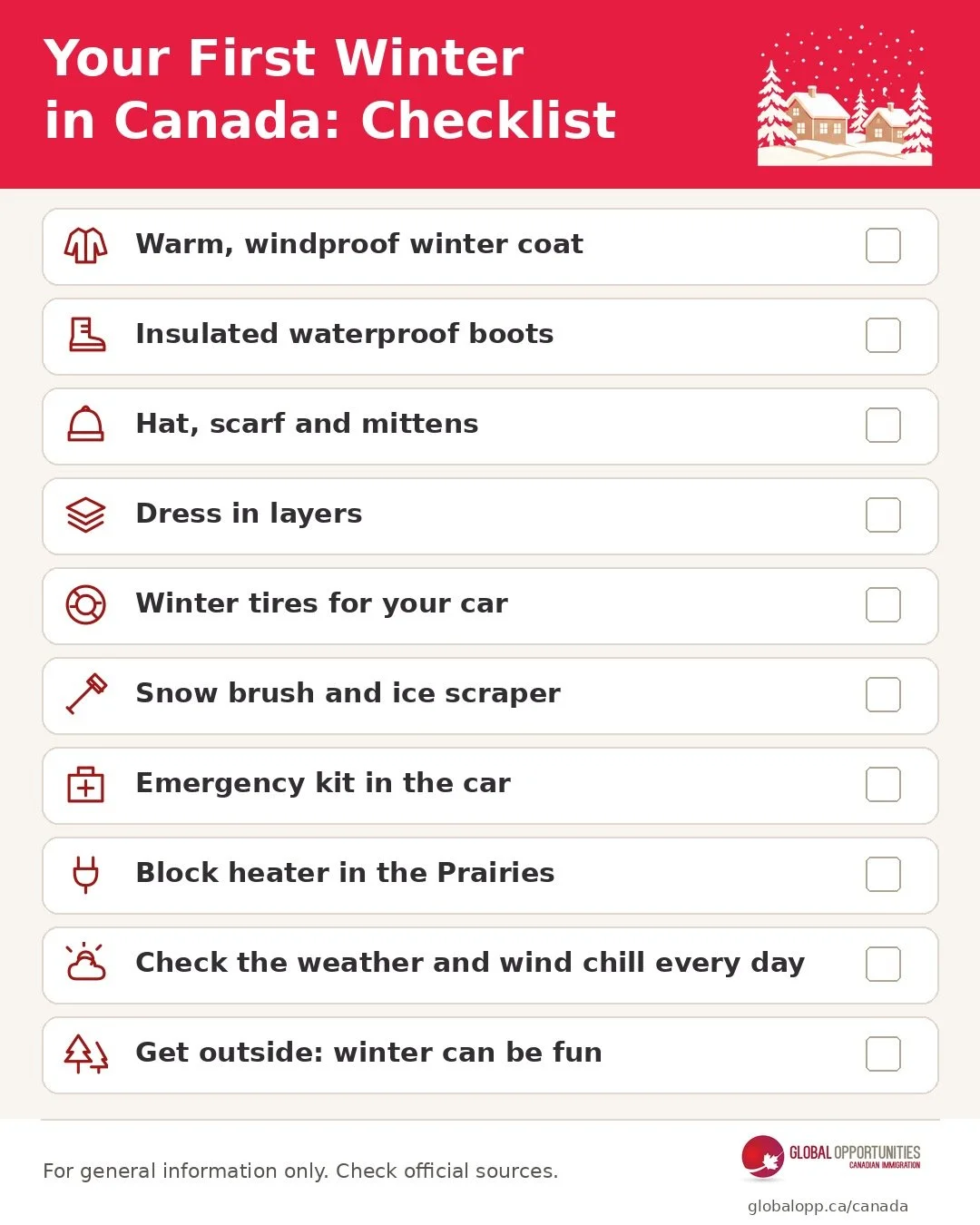
The seasons in Ontario
Winter (roughly December to February). Cold, with snow and icy days; generally milder near the Great Lakes, colder in Ottawa and longer and colder in the north. Days are short.
Spring (roughly March to May). Snow melts, rain increases and the days get longer. March can still feel like winter.
Summer (roughly June to August). Warm and often humid: the season of patios, festivals and beaches. Heat waves happen, so learn where your local cooling centres are.
Fall (roughly September to November). Pleasant early on, with bright autumn colours in October, and cooler weather by November.
Climate by region
Toronto, Hamilton, Niagara and the southwest: the mildest winters in Ontario, thanks to the Great Lakes, but humid summers and wet snow, slush and freezing rain in winter. Areas near the lakes can get "lake-effect" snow.
Ottawa and eastern Ontario: colder winters with more snow, and hot summers.
Barrie, cottage country and central Ontario: heavy snow in some areas, especially near Georgian Bay.
Northern Ontario (Sudbury, Thunder Bay, Timmins): long, very cold winters and short, warm summers.
To compare a specific city, look up its official climate normals on the Environment and Climate Change Canada climate normals site. In winter, pay attention to wind chill and cold warnings; the Government of Canada explains the risks of wind chill and cold weather, and Get Prepared explains how to prepare for severe weather.
What to buy for your first winter, and where
A warm winter coat that covers your hips, ideally windproof and waterproof, with a hood.
Insulated, waterproof boots with a good grip for ice and slush.
Layers: thermal underwear, sweaters and fleece you can add or remove.
Hat, scarf or neck warmer, and gloves or mittens.
Ice grips or crampons for your boots if you walk a lot, and a small shovel and ice salt if you rent a house.
For drivers: winter tires, an ice scraper and brush, winter windshield washer fluid and an emergency kit in the car.
Where people often buy these: Canadian Tire, Mark's, Walmart, Costco, Winners, Sport Chek and other sporting goods stores, plus second-hand options at Value Village and on Facebook Marketplace. Buy the basics when you arrive and add the rest after a few weeks, once you know how cold your commute is. We mention stores for reference only and have no relationship with them.
First-winter checklist
Buy boots and a coat before the first snow.
Find out who clears the snow at your home: in many rental houses, the lease says whether the tenant or the landlord is responsible.
Learn your city's winter parking rules (see the parking section).
If you drive, install winter tires and learn to drive on snow; leave more space and time.
Keep your phone charged and check the weather forecast every morning.
Get outside: skating, tobogganing and winter festivals help a lot with the long months.
Education in Ontario: schools, colleges and universities
Ontario has free publicly funded schools in English and French, 24 public colleges, more than 20 public universities, and free English classes for many newcomers. The numbers of colleges and universities come from the Government of Ontario's lists of colleges and universities.
Public schools for children
Publicly funded schools from kindergarten to Grade 12 are free for students who live in Ontario and are managed by district school boards. According to the Government of Ontario, Ontario has 72 district school boards, organized into four systems: English public, English Catholic, French public and French Catholic (Government of Ontario, education facts). French-language schools have their own admission rules. In Toronto, for example, the boards are the Toronto District School Board (English public), the Toronto Catholic District School Board, Conseil scolaire Viamonde (French public) and Conseil scolaire catholique MonAvenir (French Catholic, with its head office in Toronto).
How to register your child in school
Find your board and school with the official school board finder. Your address determines your local school.
Contact the board or school. Many boards have newcomer or welcome centres that assess English level and grade placement.
Bring documents. Boards usually ask for proof of your child's age (such as a passport or birth certificate), proof of your address (such as a lease or utility bill), immunization records and immigration documents. Each board sets its own list.
Ask about support. Ask what English-language support (ESL or ELD) and settlement programs the school offers.
Children can register during the school year, not only in September. CLEO's Steps to Justice explains the process and your rights in plain language (enrol your child in school). Children of international students and temporary workers should ask the board whether fees apply in their situation.
Ontario's public colleges
Ontario's public colleges offer applied and career-focused programs: certificates, diplomas, advanced diplomas, graduate certificates, some bachelor's degrees and apprenticeship training, and many programs include co-op or work placements. The Government of Ontario's official list of colleges names 24 public colleges. Here is each one, with its locations and program areas as each college describes them on its official website in November 2026. Program offerings and campuses change; check each college's website.
Toronto and the GTA
Centennial College (Toronto). Campuses across Toronto, including Progress, Morningside and Ashtonbee in Scarborough and the Downsview Campus for aerospace. Its faculties cover global business and creative industries; integrated health and community care; applied sciences, engineering technology, trades and transportation; and lifelong learning and industry training (Centennial, locations, faculties and schools).
George Brown Polytechnic (Toronto). Listed by the Government of Ontario as George Brown College. Three campuses in downtown Toronto: Casa Loma, St. James and Waterfront. Program areas include business; Chef School and hospitality; community services and early childhood; construction, engineering and computer technologies; design and fashion; health sciences; and media and performing arts (George Brown, campuses, programs).
Humber Polytechnic (Toronto). Listed by the Government of Ontario as Humber College. North Campus and Lakeshore Campus, plus a Downtown Campus. Its faculties are Applied Sciences and Technology; the Longo Faculty of Business; Health and Life Sciences; Liberal Arts and Sciences; Media, Creative Arts and Design; and Social and Community Services (Humber, campuses, faculties and schools).
Seneca Polytechnic (Toronto). Newnham Campus and Seneca@York in Toronto, King Campus in King City and a Peterborough Campus for aviation students. Areas of study include aviation; business; creative arts, animation and design; engineering; health and wellness; information technology; media and communications; and education, community and social services. Many programs include work-integrated learning, such as co-op (Seneca, campuses, co-op and work experience).
Sheridan College (Oakville). Trafalgar Campus in Oakville, Davis Campus in Brampton and Hazel McCallion Campus in Mississauga. Its faculties are Animation, Arts and Design; Applied Health and Community Studies; Applied Science and Technology; and the Pilon School of Business (Sheridan, campus locations, faculties).
Durham College (Oshawa). Campuses in Oshawa and Whitby. Its faculties include business and information technology; health sciences; hospitality and horticultural science; media, art and design; science and engineering technology; skilled trades and apprenticeship; social and community services; and liberal studies (Durham College, locations, academic faculties).
Central Ontario
Georgian College (Barrie). Main campus in Barrie, with campuses in Midland, Orangeville, Owen Sound and South Georgian Bay (Collingwood). Program areas include health and wellness; business and management; engineering; technology and IT; skilled trades; hospitality, tourism and culinary; agriculture and environmental sustainability; and marine. The college says most programs include a work-integrated opportunity, from paid co-op terms to internships and field placements (Georgian, campuses, co-op and career services).
Fleming College (Peterborough). Campuses in Peterborough (Sutherland), Lindsay (Frost), Haliburton and Cobourg. Its schools cover environmental and natural resource sciences; health and community services; trades and technology; business and information technology; general arts and sciences; and the Haliburton School of Art + Design (Fleming, programs, Cobourg campus).
Hamilton, Niagara and the southwest
Mohawk College (Hamilton). Fennell Campus in Hamilton, the Stoney Creek Campus for skilled trades and apprenticeship, the Institute for Applied Health Sciences at McMaster, and a Centre for Aviation Technology at Hamilton International Airport. Programs in business, community services, creative industries, health, technology and skilled trades (Mohawk, campuses, programs).
Niagara College (Welland). Welland Campus and the Daniel J. Patterson Campus in Niagara-on-the-Lake. More than 100 full-time programs in schools that include hospitality and tourism; culinary arts; wine, beer and spirits; environment and horticulture; health sciences and nursing; technology; trades; and business. The college describes itself as a leader in experiential learning (Niagara College, campuses, schools).
Conestoga College (Kitchener). Campuses and training centres in Kitchener (Doon), Waterloo, Cambridge, Guelph, Brantford, Milton, Stratford and Ingersoll. Its schools include business; engineering and technology; applied computer science and IT; health and life sciences; hospitality and culinary arts; trades and apprenticeship; community services; and creative industries (Conestoga, campuses and locations, academic schools).
Fanshawe College (London). A main campus and a downtown campus in London, plus regional campuses in St. Thomas, Simcoe and Woodstock. Its schools include nursing; health sciences and public safety; business; building technology and design; advanced manufacturing, science and transportation; aerospace, information and defence technologies; hospitality and creative industries; community studies; and arts and language. Fanshawe says it offers 70 co-op programs (Fanshawe, campuses, schools, Fanshawe).
Lambton College (Sarnia). Main campus in Sarnia, a Fire School in nearby Corunna and a Lambton in Ottawa location. Areas of study include business; community services; computer studies; emergency services; engineering and sciences; health care and safety; hospitality, tourism and culinary; and technology and trades (Lambton, about the college, programs).
St. Clair College (Windsor). Main campus in Windsor, a campus in Chatham and several downtown Windsor locations. Its schools cover business, information technology, community studies, engineering technologies, health sciences, nursing and skilled trades (St. Clair, schools).
Eastern Ontario
Algonquin College (Ottawa). Campuses in Ottawa and Pembroke, plus online programs. Areas of study include business; community and education studies; creative industries; culinary and baking; emerging technologies; environmental and applied sciences; health care and wellness; public safety; and skilled trades (Algonquin, programs).
La Cité (Ottawa). A French-language college with its main campus in Ottawa, the Alphonse-Desjardins campus in Orléans and a Toronto location. More than 140 programs taught in French, in fields such as administration, health sciences, engineering, computing, media, construction and mechanics, hospitality and tourism, and emergency services (La Cité, campus, programmes).
Loyalist College (Belleville). Main campus in Belleville, with locations in Bancroft, Port Hope and Tyendinaga. Areas of study include business; health sciences; biosciences; building sciences; community, justice and social services; computing and IT; creative industries; emergency services; and skilled trades (Loyalist, locations, programs).
St. Lawrence College (Kingston). Campuses in Kingston, Brockville and Cornwall. Diplomas, graduate certificates and four-year degrees in areas such as business, community and social services, health sciences, public safety, science and technology, skilled trades and veterinary (St. Lawrence College).
Northern Ontario
Cambrian College (Sudbury). According to the college, the largest college in northeastern Ontario. Main campus in Greater Sudbury, with sites in Espanola, Little Current and Val Caron. Its schools include health sciences and emergency services; engineering technology and environmental studies; skilled trades; business; information technology; and community services (Cambrian, about, skilled trades).
Collège Boréal (Sudbury). A French-language college that, according to the college, serves 26 Ontario communities through 31 campuses, including Sudbury, Ottawa, Timmins, Toronto and Windsor. Nearly 80 postsecondary programs taught in French (Collège Boréal, locations).
Canadore College (North Bay). Three campuses in North Bay: College Drive, Commerce Court and the Aviation Campus. Areas of study include aviation and aerospace technology; health sciences; trades and technology; media, design and dramatic arts; environmental studies; business; information technology; and community justice and police studies (Canadore, locations, program search).
Confederation College (Thunder Bay). Main campus in Thunder Bay, an Aviation Centre of Excellence at Thunder Bay International Airport, and regional campuses in Dryden, Sioux Lookout, Red Lake, Kenora, Fort Frances, Geraldton and Marathon. Areas of interest include aviation, business, community services, engineering technology, health, Indigenous studies, media arts, natural resources and skilled trades, and the college offers specialized services and programs for Indigenous students (Confederation, about, programs).
Northern College (Timmins). Campuses in Timmins, Haileybury, Kirkland Lake and Moosonee. Programs in business, administration and law; community services; emergency services; health sciences; engineering technology and trades; and veterinary sciences, plus the Haileybury School of Mines (Northern College).
Sault College (Sault Ste. Marie). Campus in Sault Ste. Marie. Program areas include natural environment, aviation, health, engineering technology, information technology, business, community services, culinary, media and design, policing and public safety, Indigenous studies, and skilled trades and transportation (Sault College).
This list is for reference only. Colleges change their programs, campuses and admission requirements; always confirm on the college's official website.
Ontario's universities
Ontario's public universities are found in almost every region, and each sets its own admission standards. According to the Government of Ontario's list of universities, they include:
Toronto: the University of Toronto, which describes itself as one university with three campuses: St. George (downtown), Mississauga and Scarborough (U of T, about); Toronto Metropolitan University; York University; OCAD University; and the Université de l'Ontario français, which teaches in French (UOF).
Ottawa: the University of Ottawa, which describes itself as the largest English-French bilingual university in the world (uOttawa, about), and Carleton University.
Hamilton: McMaster University.
Waterloo region: the University of Waterloo, which says it has North America's largest co-op program (University of Waterloo, co-operative education), and Wilfrid Laurier University.
London: Western University.
Kingston: Queen's University and the Royal Military College of Canada.
Guelph: the University of Guelph, whose founding colleges include the Ontario Veterinary College and the Ontario Agricultural College (University of Guelph, about).
Oshawa: Ontario Tech University.
Elsewhere: Brock (St. Catharines), Trent (Peterborough), University of Windsor, Laurentian (Sudbury), Lakehead (Thunder Bay), Nipissing (North Bay), Algoma (Sault Ste. Marie), NOSM University, and the Université de Hearst, a French-language university with campuses in Hearst, Timmins and Kapuskasing (Université de Hearst).
How to apply to colleges and universities in Ontario
Colleges: most applications go through ontariocolleges.ca, the central application service for Ontario's public colleges. International students sometimes apply directly to the college; check each college's instructions.
Universities: undergraduate applications usually go through the Ontario Universities' Application Centre (OUAC) at ouac.on.ca. Graduate programs are usually applied for directly with each university.
International students need a letter of acceptance from a designated learning institution (DLI); check the official DLI list. Most study permit applicants also need a provincial attestation letter (PAL); IRCC explains who needs one and how the school provides it (IRCC, provincial attestation letter). Study permit rules change often: check IRCC's study in Canada page.
Free English and French classes for newcomers
LINC classes (federal). According to IRCC, permanent residents and protected persons can take language classes at no cost through Language Instruction for Newcomers to Canada (IRCC, language classes).
Adult ESL (provincial). School boards across Ontario offer free beginner to advanced English classes for eligible residents, such as naturalized citizens and permanent residents, among others (Government of Ontario, adult English as a second language).
Adult French as a second language is also offered through school boards (Government of Ontario).
Information as published by the Government of Ontario, each institution and IRCC, as of November 2026; check the linked pages before you rely on it. A letter of acceptance or a provincial attestation letter does not mean a study permit will be approved: IRCC decides each case.
Jobs and main industries in Ontario
Ontario has the largest economy in Canada. According to the Government of Ontario, the province produced 38.4% of Canada's nominal GDP in 2025 (Ontario fact sheet, April 2026). Global Opportunities does not offer jobs, and no one can guarantee you a job in Canada.
Ontario's main industries
According to the Government of Ontario (About Ontario):
Services make up over 75% of Ontario's economy, including business and financial services, professional, scientific and technical services, and arts and culture.
Manufacturing remains important. Key industries include autos, information and communications technologies, biotechnology, pharmaceuticals and medical devices.
Mining is a significant economic driver, mainly in Northern Ontario.
Forestry supports many jobs in communities across the province.
Agriculture is strong in the south.
Key industries by region
Toronto and the GTA: finance and insurance, technology, professional services, health care, education, film and media, construction, logistics around Pearson Airport, and manufacturing in Peel, York and Durham.
Ottawa: federal government, technology, health care and education.
Waterloo region and Guelph: technology, engineering, insurance, advanced manufacturing and agri-food.
Hamilton and Niagara: steel and manufacturing, health care, education, logistics, tourism, wine and agriculture.
London, Windsor and the southwest: automotive and manufacturing, health care, agriculture, energy and petrochemicals around Sarnia.
Eastern Ontario: public services, health, education, military and manufacturing.
Northern Ontario: mining and mining services, forestry, health care, education and transportation.
To see which occupations have better prospects in your region, use the Job Bank outlooks below; regional conditions change.
The labour market in numbers
The same Government of Ontario fact sheet reports that in 2025 Ontario had 8,227,000 people employed and an unemployment rate of 7.7% (Ontario fact sheet, April 2026). These are province-wide averages; conditions vary by city, occupation and time.
Where to look for work
Job Bank: the Government of Canada's job board. You can filter by province, city and occupation.
Job Bank outlooks for Ontario: three-year employment outlooks by occupation, rated from very limited to very good. They are not job offers.
Job Bank wage search: low, median and high wages by occupation and region. A market reference, not what an employer will pay you.
Employment Ontario: free one-on-one help with resumes, interviews and job search. According to the Government of Ontario, it has over 700 locations.
Employers directly: hospitals, universities, colleges, school boards and municipalities post openings on their own careers pages.
Settlement agencies offer free employment workshops, mentoring and bridging programs for eligible newcomers.
Resume tips: use a concise Canadian-style resume (no photo, age or marital status), adapt it to each posting, build a network through volunteering, professional associations and settlement agencies, keep improving your English, and look beyond Toronto. Our newcomer guide to Canada has resume examples and more job search advice, so we do not repeat them here. Before you apply, read our guide to Canadian resumes, cover letters and job interviews.
Minimum wage in Ontario
According to the Government of Ontario, minimum wage rates increased on October 1, 2026, in line with the Ontario Consumer Price Index. As of November 2026, the official page lists these rates for October 1, 2026 to September 30, 2027 (Government of Ontario, minimum wage):
General minimum wage: $17.95 per hour. It applies to most employees.
Student minimum wage: $16.90 per hour, for students under 18 who work 28 hours a week or less when school is in session, or who work during a school break or summer holidays.
Homeworkers: $19.70 per hour.
Hunting, fishing and wilderness guides: paid by blocks of time, $89.75 for less than five consecutive hours in a day and $179.50 for five or more hours in a day.
According to the same page, the previous general rate, from October 1, 2025 to September 30, 2026, was $17.60. Minimum wage is the lowest pay allowed by law, not a typical wage for your occupation; use the Job Bank wage search above for market references. Your other rights, such as hours of work, overtime, public holidays and vacation, are explained in the Government of Ontario's guide to the Employment Standards Act. Rates change every year, so check the current rate on the official page.
Rates as published by the Government of Ontario, as of November 2026. They are reviewed every year and the rate that applies depends on your type of work: check the linked page before you rely on it.
Regulated professions and trades
According to the Government of Ontario, the province sets rules for over 100 professions and trades. If your occupation is regulated, you will likely need to apply to a regulatory body to work in it or use a protected title. Your foreign credentials alone do not give you a licence (Government of Ontario, work in your profession or trade).
The same page describes supports for internationally trained people:
The Ontario Bridge Training Program, which helps skilled newcomers find jobs that match their international qualifications.
The Trade Equivalency Assessment for trades with a certifying exam.
Global Experience Ontario, which provides information and referrals for non-health regulated professions and skilled trades.
Nurses trained abroad can read how to immigrate to Canada as a nurse, which lists the nursing regulator in each province.
Any mention of regulated occupations in this guide is for reference only. It may not be complete. Always confirm requirements directly with the regulator for your profession or trade.
How much tax do you pay in Ontario, and which benefits can you get?
In Ontario you pay federal and provincial income tax on what you earn, and the 13% HST on most purchases. Families and people with low or modest incomes can also receive tax-free federal and Ontario benefits, and almost all of them depend on one thing: filing a tax return every year, even if you had little or no income. The HST rate comes from the Government of Ontario's HST page.
The figures below come from the official pages as of November 2026. Tax rules and amounts change every year, so check the current rate before you budget. This section is general information, not tax advice. For your own situation, contact the Canada Revenue Agency (CRA) or a tax professional.
How much income tax do you pay in Ontario?
Canada's income tax is progressive. According to the CRA, provincial rates apply in addition to federal rates, each rate applies only to the portion of your taxable income that falls within its bracket, and your provincial rate depends on the province where you live on December 31 (CRA, tax rates and income brackets for the current year). For the 2026 tax year, the CRA lists:
Federal rates: 14% on the first $58,523 of taxable income; 20.5% on the portion from $58,523 to $117,045; 26% from $117,045 to $181,440; 29% from $181,440 to $258,482; and 33% above $258,482.
Ontario rates: 5.05% on the first $53,891; 9.15% from $53,891 to $107,785; 11.16% from $107,785 to $150,000; 12.16% from $150,000 to $220,000; and 13.16% above $220,000.
For example, using the CRA rates above, with a taxable income of $60,000, the federal 14% rate applies to the first $58,523 and the 20.5% rate only to the remaining $1,477. Deductions and tax credits then change the amount you actually owe, which is why two people with the same salary can pay different amounts.
The Ontario Health Premium. According to the Government of Ontario, Ontario residents also pay a health premium through the income tax system. It ranges from $0 if your taxable income is $20,000 or less to $900 if your taxable income is more than $200,600. In most cases it is deducted automatically from your pay as part of the income tax deduction on your pay stub. The premium is not linked to OHIP and does not affect your eligibility for health care (Government of Ontario, health premium).
Filing your return. According to the Government of Ontario, the last day to file your personal tax return is April 30 of each year (Government of Ontario, Ontario Trillium Benefit). If you have a modest income and a simple tax situation, the CRA's Community Volunteer Income Tax Program lists free tax clinics where volunteers complete returns (CRA, free tax clinics).
Sales tax in Ontario: the 13% HST
According to the Government of Ontario, the Harmonized Sales Tax (HST) is 13% in Ontario. It combines the 5% federal GST and an 8% provincial portion on most goods and services, and the CRA administers and collects it for the province (Government of Ontario, Harmonized Sales Tax).
Point-of-sale rebates. Ontario rebates the 8% provincial portion at the till on specific items, such as books, children's clothing and footwear, children's car seats and booster seats, diapers, print newspapers, and qualifying prepared food and beverages sold for a total of $4 or less (before HST) (Government of Ontario, HST point-of-sale rebates).
Zero-rated items. According to the CRA, basic groceries such as milk, bread and vegetables, and prescription drugs are zero-rated, which means no GST/HST is charged on them (CRA, type of supply).
Check the rate for any province with the CRA's GST/HST calculator.
The Canada Groceries and Essentials Benefit. According to the CRA, the federal GST/HST credit was renamed the Canada Groceries and Essentials Benefit (CGEB) as of July 2026, with the same eligibility, calculation and structure. It is a tax-free quarterly payment for individuals and families with low and modest incomes. You are considered automatically when you file your taxes, and the CRA page explains how to apply if you are a new resident of Canada (CRA, Canada Groceries and Essentials Benefit).
The Canada Child Benefit and the Ontario Child Benefit
The Canada Child Benefit (CCB) is a tax-free monthly payment for eligible families to help with the cost of raising children under 18 (CRA, Canada Child Benefit). According to the CRA's eligibility page, you must live with the child, be primarily responsible for the child's care and upbringing, and be a resident of Canada for tax purposes. You or your spouse or common-law partner must be a Canadian citizen, a permanent resident, a protected person, or a temporary resident who has lived in Canada for the previous 18 months and has a valid permit in the 19th month, among other cases listed on the page (CRA, who can apply). Newcomers apply with Form RC66 and Schedule RC66SCH, Status in Canada/Statement of Income (CRA, how to apply).
The Ontario Child Benefit (OCB) gives low- to moderate-income families up to $1,760 per child each year (as of November 2026), paid monthly. There is no separate application: when you apply for the CCB, you are automatically assessed for the OCB, and you must file your taxes every year to qualify, even if you have no income to declare (Government of Ontario, Ontario Child Benefit).
Affordable child care in Ontario: the CWELCC system
Ontario takes part in the Canada-wide Early Learning and Child Care (CWELCC) system, which lowers fees for children under 6 in participating licensed child care programs. According to the Government of Ontario, as of January 1, 2025 fees in CWELCC-enrolled programs are capped at $22 per day, bringing the provincial average to $19 per day, and 93% of licensed spaces for children aged 0 to 5 were in enrolled programs as of June 2026 (Government of Ontario, Canada-Ontario early learning and child care agreement).
You do not apply for the reduction. If your licensed provider is enrolled, the lower fee applies automatically. If it is not enrolled, your fees are not reduced, so ask each provider; the province says enrolment is shown in the parent handbook.
Licensed providers join CWELCC through their local service system manager. Check their website for participating programs in your area.
Ask about waiting lists early.
The Ontario Trillium Benefit
According to the Government of Ontario, the Ontario Trillium Benefit combines three credits to help pay for energy costs and sales and property taxes: the Northern Ontario Energy Credit, the Ontario Energy and Property Tax Credit and the Ontario Sales Tax Credit. To apply, you file your tax return each year and complete the ON-BEN Application Form included in the tax package; you must file even if you have no income to report, and the CRA decides whether you are eligible (Government of Ontario, Ontario Trillium Benefit).
Figures as published by the Canada Revenue Agency and the Government of Ontario, as of November 2026. Rates, brackets and benefit amounts change every year, and what you pay or receive depends on your own income, deductions and credits: check the linked pages before you rely on them.
Culture and things to do in Ontario
Ontario offers big-city culture, small towns, wilderness and lakes. The Government of Ontario highlights festivals such as Caribbean Carnival, Oktoberfest, Festival Franco-Ontarien, the Summer Solstice Indigenous Festival and the Indigenous Arts Festival, as well as Niagara Falls, one of the world's natural wonders (About Ontario).
In the cities
Toronto: museums, galleries, theatre and festivals, including the Toronto International Film Festival (TIFF). A Toronto Public Library card is free for Toronto residents and gives access to programs and workshops (Toronto Public Library, new to Canada).
Ottawa: Parliament Hill, national museums and, in winter, skating on the Rideau Canal.
Historic towns: Kingston and Niagara-on-the-Lake, which the Government of Ontario notes was Upper Canada's first capital (then called Newark) (About Ontario).
Nature and the outdoors
Provincial parks. Algonquin Provincial Park, established in 1893, has 7,635 square kilometres of forests, lakes and rivers, with camping, hiking and canoe routes (Ontario Parks, Algonquin).
The Great Lakes. Beaches, boating and lakeside trails in summer.
Niagara. The falls, plus wineries and orchards in the Niagara region.
Winter sports. Skating rinks (many free and outdoors in city parks), skiing, snowshoeing and tobogganing.
Community and the Latin American community
Ontario's cities have community centres, places of worship, sports leagues and cultural associations for many communities, including Latin American ones. Settlement agencies and public libraries can help you find them. Joining a community group, a sports team or volunteering is one of the best ways to make friends and build a professional network.
Settling in is also about people: read our article on building community in Canada.
How can you immigrate to Ontario?
There is no single "Ontario visa". People move to Ontario through federal immigration programs run by IRCC, through the Ontario Immigrant Nominee Program, or with a temporary permit to study or work. Programs, streams, requirements and fees change frequently, so always check the official pages linked below. Wanting to live in Ontario is one thing; the program that fits your profile may be a different one.
If you plan to visit first, use IRCC's official tool to check if you need a visa or an eTA.
Express Entry
According to IRCC, Express Entry is an online system used to manage immigration applications from skilled workers. It manages three programs: the Federal Skilled Worker Program, the Federal Skilled Trades Program and the Canadian Experience Class (IRCC, Express Entry). Draws, categories and requirements change over time; check the official page for current information. You can also read our page on the Federal Skilled Worker program.
The Ontario Immigrant Nominee Program (OINP)
According to the Government of Ontario, the OINP is the province's economic immigration program. It works with the Government of Canada through IRCC: the province nominates people for permanent residence, and the Government of Canada makes the final decision on permanent residence applications (Government of Ontario, OINP).
When we reviewed the official page in November 2026, it stated that the OINP is changing: a new Ontario Workforce Priority stream had launched, all other streams were closed, and more changes were coming. According to the Ontario Workforce Priority stream page, the stream is for eligible skilled foreign workers with a qualifying job offer, and also for eligible self-employed physicians. For candidates with a job offer, the employer starts the process through the OINP employer portal, and the candidate can then register an expression of interest.
What this means in practice: under the stream described on the official page, the process for most candidates starts with an Ontario employer, not with the candidate. A nomination is not permanent residence: after a nomination, you still apply to IRCC, which makes the final decision.
IRCC explains that each province sets its own requirements, and that provincial nominee applications go through either Express Entry or a non-Express Entry process (IRCC, provincial nominee program). OINP streams and requirements change often. What you read here may already be different when you read it. Always check the official OINP page, and be wary of anyone who promises a nomination, permanent residence or a job.
For a general overview of how these programs work across Canada, see our page on provincial nominee programs.
Studying in Ontario
Many people first come to Ontario as international students. According to IRCC, you need a letter of acceptance from a designated learning institution (DLI) to apply for a study permit, so check that your school is on the official DLI list, and most applicants also need a provincial attestation letter. Study and post-study work rules change often: check IRCC's study in Canada page.
If your permit ends within a year, watch Is your work permit or PGWP expiring in the next 12 months?
Work permits
IRCC describes two main types of work permits: employer-specific work permits and open work permits (IRCC, work in Canada). Some employer-specific permits require the employer to obtain a Labour Market Impact Assessment; see our page on the LMIA. If you are a young person from a participating country, read our page on International Experience Canada (Working Holiday) and confirm the current rules on the official IRCC website. Our newcomer guide explains work permits in more depth.
Irish citizens can read our working holiday guide for Irish citizens. Coming from abroad? See our guides for people moving from Europe, Asia, Africa and Australia.
Program information as published by IRCC and the Government of Ontario, as of November 2026; check the linked pages before you rely on it. Meeting a program's requirements does not mean an application will be approved (IRCC decides each case), and topics such as proof of funds, language scores and processing times depend on each case, so a consultation is the way to know what applies to you.
Already working in the province? Watch our live session Have you completed one year of work experience in Canada?, which explains why being eligible for permanent residence is not the same as being selected.
After permanent residence, many people apply for citizenship: see our guide to Canadian citizenship.
French in Ontario
Ontario is home to the largest francophone community in Canada outside Quebec. According to the Government of Ontario, 652,540 francophones live in the province (Government of Ontario, government services in French).
Francophone communities
Franco-Ontarians live across the province, with strong communities in eastern Ontario around Ottawa and in Northern Ontario, as well as in Toronto and other cities. IRCC notes that Ontario has the largest French-speaking population outside Quebec, with a proud history of preserving its language and culture (Discover Canada).
French-language services and education
Government services in French. Under the French Language Services Act, you can get provincial government services in French in or near designated areas. According to the Government of Ontario, roughly 80% of Ontario's francophone population lives in these designated areas (Government of Ontario).
French-language schools. Ontario has French public and French Catholic school boards (education facts).
Colleges and universities in French. Collège Boréal, La Cité and the Université de l'Ontario français teach in French, and the University of Ottawa and Université de Hearst offer programs in French. Other institutions also offer programs in French; check with each one.
Learning French. The Government of Ontario offers French as a second language for adults through school boards.
If French is one of your strengths, read our page on French language proficiency. Global Opportunities does not offer services for Quebec's immigration programs; this guide covers Ontario only.
First steps after arriving in Ontario
Your first weeks in Ontario involve a few key tasks. Doing them early makes everything else easier.
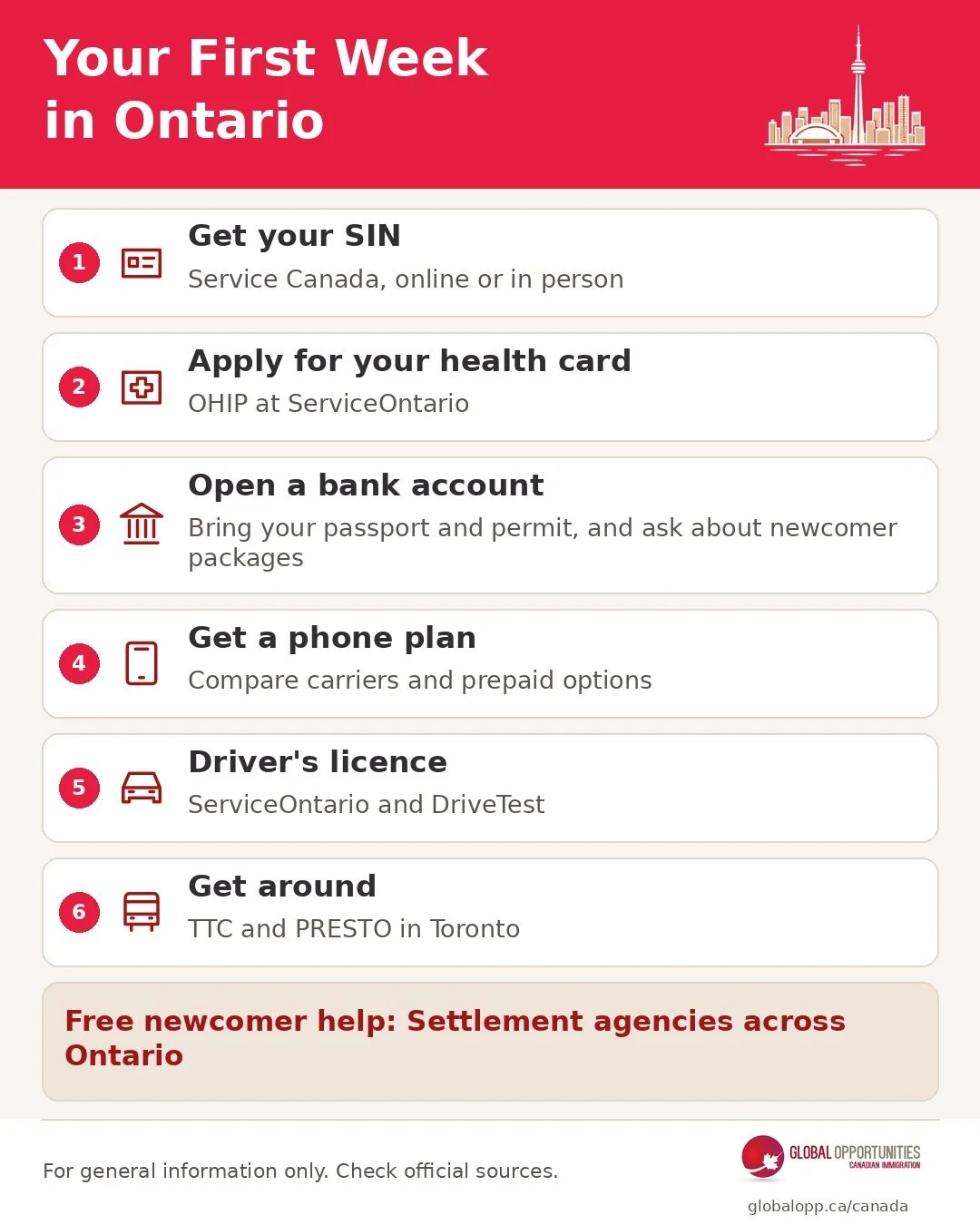
Your first-weeks checklist
Get your Social Insurance Number (SIN). According to the Government of Canada, you need this 9-digit number to work in Canada or to access government programs and benefits. Keep it private (Service Canada, SIN).
Apply for OHIP. If you are eligible, apply in person at ServiceOntario with your three documents (apply for OHIP).
Open a bank account and start building credit (FCAC, opening a bank account).
Get a phone plan and a Canadian phone number.
Get a transit card. In Toronto, add a free PRESTO card to your phone's wallet or buy a physical card, and set your discount fare type if you qualify.
Find newcomer services. Use IRCC's official newcomer services finder to find free, government-funded settlement services near you. IRCC notes that, starting April 1, 2026, economic class permanent residents can only access these services for a limited time, so it helps to start early. The Government of Ontario also has a page on getting settled in Ontario.
Register your children for school with your local school board.
Switch your driver's licence within 60 days, or start the G1 process (exchange an out-of-province licence).
Sign up for Health Care Connect once you have your health card, to look for a family doctor.
Prepare for winter if you arrive in the fall or winter.
Frequently asked questions
What language is spoken in Ontario?
English is Ontario's official language and the language of daily life and most work. Ontario also has the largest francophone community outside Quebec: according to the Government of Ontario's French-language services page, 652,540 francophones live in the province, and you can get provincial government services in French in or near designated areas. There are French public and Catholic school boards and French-language colleges and universities, such as La Cité, Collège Boréal and the Université de l'Ontario français. In cities like Toronto you will also hear hundreds of other languages, including Spanish and Portuguese. Good English opens most doors; French is a real advantage in Ottawa and some northern communities. See our French in Ontario section.
How much does the TTC cost in Toronto?
As of November 2026, the TTC's fares and passes page lists an adult fare of $3.30 with a PRESTO card or a contactless debit or credit card, and $3.35 in cash. Youth (13 to 19) pay $2.35 and seniors (65+) $2.25 with a PRESTO card set to the right fare type; children 12 and under ride free. Card payments include a two-hour transfer, and since August 31, 2026 the TTC uses monthly fare capping: after 47 eligible paid fares in a calendar month with the same card, the rest of that month's TTC trips are free. Cash does not count toward the cap. Fares change, so check the current price on ttc.ca. See our section on the TTC and PRESTO.
How do I get a PRESTO card in Toronto?
According to the TTC's fares and passes page, you can buy a physical PRESTO card for $4 at Fare Vending Machines in subway stations and Line 5 and Line 6 stations, at Shoppers Drug Mart or participating PRESTO Customer Service Outlets, or online at prestocard.ca. If you are 13 or older, you can add a digital PRESTO card to your phone's mobile wallet for free, and a limited number of free cards are available at select Toronto Public Library branches. Load money with the PRESTO app, online or at a machine. If you qualify for a youth, senior or child fare, set the fare type in person at Shoppers Drug Mart or a Customer Service Outlet with proof of age. Check current prices on ttc.ca.
Does the TTC have a transfer, and how does the two-hour transfer work?
Yes. The TTC's fares and passes page explains that when you pay with a PRESTO card, a PRESTO Ticket or a contactless debit or credit card, including in a mobile wallet, transfers made within two hours of your first tap are not charged another TTC fare. That means you can get off, do an errand and board again within the window, in any direction. Tap the same card or device every time you enter a station or board a vehicle. Cash payments do not include the two-hour transfer: you get a paper transfer valid only for a continuous, one-way trip on the day issued. With One Fare, a similar free transfer applies when connecting to GO, MiWay, Brampton Transit, YRT or DRT. See our transit section.
What is Ontario's One Fare Program?
According to the TTC's One Fare page, Ontario's One Fare Program lets you pay only once when connecting between the TTC and GO Transit, Brampton Transit, Durham Region Transit, MiWay and York Region Transit. It applies when you pay with a PRESTO card, PRESTO in a mobile wallet, or a debit or credit card, and not with cash or PRESTO Tickets. Always tap with the same payment method. When you move from the TTC to GO within two hours of your first TTC tap, the TTC part of your fare is reimbursed. Youth, seniors and students must use a PRESTO card with the right fare type set to get their discount. Fare caps for each agency are separate. See our One Fare section.
Can I use PRESTO in Ottawa?
Yes, OC Transpo accepts Presto cards, but with an important difference: OC Transpo says Presto on Apple Wallet or Google Wallet is not accepted on its buses, fare gates or Para Transpo, so in Ottawa you should use a physical Presto card or O-Payment (tapping a debit or credit card). As of November 2026, OC Transpo's fares page listed an adult Presto fare of $4.10, cash at $4.15, a DayPass at $12.25 and an adult monthly pass at $138.50, with daily and monthly fare capping. Discounted fares, such as the senior fare, require a Presto card. Check the current price on octranspo.com. See our Ottawa section for more.
How do I get from Pearson Airport to downtown Toronto?
The UP Express train connects Toronto Pearson with Union Station downtown in about 28 minutes, according to UP Express, with stops at Weston, Mount Dennis and Bloor. As of November 2026, its standard fares between Pearson and downtown are $12.35 one way and $24.70 return for adults (13 to 64), and $6.20 one way for seniors; paying with a PRESTO card, PRESTO in a mobile wallet or a contactless credit or debit card gets a lower PRESTO rate, and youth and post-secondary students save 40% with the right PRESTO fare type (UP Express, fares; PRESTO fares). A lower-cost option is a TTC bus, such as the 900 Airport Express; check the route and the current fare on the TTC website before you travel. See our transit section.
How much is rent in Toronto?
According to CMHC's Rental Market Survey data tables, the average rent for a two-bedroom apartment in purpose-built rental buildings in the Toronto CMA was $2,046 in October 2025, and $2,547 for units that changed tenants that year, which is closer to what a newcomer signing a new lease may see. Rented condo apartments averaged $2,891 for two bedrooms. The Toronto CMA includes Mississauga, Brampton and much of York and Durham regions. Rooms in shared houses usually cost less, and rents vary a lot by neighbourhood and building age. These are averages from the past; check current listings and the official CMHC tables before you budget. See our housing section.
What is the cheapest city to live in Ontario?
Based on CMHC's October 2025 Rental Market Survey data, the lowest average two-bedroom rents among Ontario's metropolitan areas were in Windsor ($1,454), Belleville-Quinte West ($1,484), Thunder Bay ($1,495), Peterborough ($1,518), St. Catharines-Niagara ($1,527) and Greater Sudbury ($1,558), compared with $2,046 in the Toronto CMA. But rent is only part of the picture. Smaller cities may have fewer jobs in your field, less frequent transit, and you may need a car, which adds insurance and fuel costs. Compare job postings on Job Bank, transit options and rents together before you decide, and compare with Alberta or Manitoba if you are open to other provinces. Data describes the past and changes every year. See the "Other cities in Ontario" section.
Should I live in Toronto, Mississauga or Brampton?
It depends on where you work or study, your budget and how you will get around. In CMHC's Rental Market Survey data, Mississauga and Brampton are part of the Toronto CMA, where the average two-bedroom rent in purpose-built buildings was $2,046 in October 2025, so compare current listings in each city rather than relying on one average. Transit also differs: as of November 2026, an adult PRESTO trip costs $3.30 on the TTC, $3.50 on MiWay and $3.55 on Brampton Transit, according to each operator's fares page, and Ontario's One Fare Program means you pay once when you connect between the TTC and MiWay or Brampton Transit with PRESTO or a debit or credit card. Commute time matters as much as rent, so test the trip at rush hour. Statistics Canada's Census Profile gives official data for each city. See the Mississauga and Brampton sections.
Is Toronto safe for newcomers?
Like any large city, Toronto has areas with different levels of reported crime, and conditions change over time and from street to street. Rather than relying on rankings or social media, look at official data. Statistics Canada publishes the Crime Severity Index, which takes into account both the volume and the seriousness of police-reported crime, for Canada, the provinces and census metropolitan areas such as Toronto (Statistics Canada, table 35-10-0026-01). The Toronto Police Service's Public Safety Data Portal lets you explore reported incidents by neighbourhood. Keep in mind that busy commercial areas often show more incidents simply because more people pass through them. Before you sign a lease, visit the area at different times of day, ask neighbours and check the route to transit. In an emergency, call 911.
How much can a landlord ask for as a deposit in Ontario?
According to the Landlord and Tenant Board's information for new tenants, a landlord can collect a rent deposit of no more than one month's rent (or one week's rent if you pay weekly). It must be used as the rent for the last month or week of your tenancy and cannot be used for damages, and the landlord must pay interest on it every year. The Government of Ontario's standard lease guide says the law also limits key deposits, and that a lease cannot require deposits that are not permitted, such as damage or pet deposits. That is why Ontario landlords usually ask for "first and last month's rent". If a landlord asks for more, contact the Landlord and Tenant Board. See our housing section.
How much can my rent go up in Ontario?
According to the Government of Ontario's residential rent increases page, for most tenants rent can only go up once every 12 months, with at least 90 days' written notice on the proper Landlord and Tenant Board form, and by no more than the province's rent increase guideline. As of November 2026, the same page states that the guideline for 2027 is 1.9%. The guideline does not apply to units first occupied for residential purposes after November 15, 2018 (including most new buildings and new basement apartments): rent there can still only go up once a year, but there is no limit on the amount. It also does not apply when a new tenancy starts. Ask your landlord which rules apply before signing. See the rent increase section.
Are basement apartments legal in Ontario?
Basement apartments are very common in Ontario, and many are legal second units. Whether a specific unit is legal depends on municipal zoning and on building and fire safety rules, so ask the landlord and check with your city if you have doubts. When you visit, look for windows large enough to exit in an emergency, working smoke and carbon monoxide alarms, a safe exit, enough ceiling height and no signs of humidity or mould. Most basement tenants are protected by the Residential Tenancies Act and the rent increase rules, but the Government of Ontario's rent increase guideline page says most new basement apartments first occupied after November 15, 2018 are exempt from the rent increase guideline. See our housing section.
Where can I find an apartment or a room in Ontario?
Most people search on listing sites such as Kijiji, Facebook Marketplace, Rentals.ca, PadMapper and Zumper, on the websites of property management companies, and through community groups, places of worship and settlement agencies. Students should contact their college or university housing office, which often has residences and off-campus listings. Set alerts, reply quickly and have your documents ready: ID, proof of income or a job letter, and references. Visit in person and never send money before seeing the unit and signing a written lease, usually the Ontario standard lease. We mention private websites for reference only and have no relationship with them. See our housing section.
How do I avoid rental scams in Ontario?
The Competition Bureau warns that if a rental listing looks too good to be true, it probably is. Red flags include rent far below similar units, pressure to pay a deposit quickly, a "landlord" who is abroad and cannot show the unit, and requests to wire money. Always visit in person, confirm that the person showing the unit has the right to rent it, do a reverse image search of the photos, and get a written lease and a receipt for every payment. Remember that, according to the Landlord and Tenant Board, in Ontario a landlord can only ask for a rent deposit of up to one month and a limited key deposit. If you are a victim, report it to the police and the Canadian Anti-Fraud Centre. See our scams section.
How do I get a driver's licence in Ontario as a newcomer?
According to the Government of Ontario's page on exchanging an out-of-province licence, you can drive with your valid foreign licence for 60 days after moving to Ontario. After that, you need an Ontario licence. If you come from a jurisdiction with an exchange agreement, such as any U.S. state, Australia, France, Germany, Japan, South Korea or Ukraine, among others, you can usually exchange your licence at a DriveTest centre. If not, you take the vision test, the knowledge test and the G2 road test, and wait at least 12 months before the G road test; since July 1, 2026, an official authentication letter can give you credit for up to one year of experience. Licences not in English or French need a certified translation. See our driving section.
What is the difference between G1, G2 and G in Ontario?
They are the three stages of Ontario's graduated licensing, as described on the Government of Ontario's new drivers page. With a G1 (beginner), you must drive with a fully licensed driver with at least four years of experience, keep a zero blood alcohol level, and you cannot drive between midnight and 5 a.m. or on 400-series highways and high-speed expressways. After 12 months (or eight with an approved course), you can take the G2 road test. With a G2, you can drive alone on all roads at any time, but must keep zero blood alcohol and passenger limits apply. After 12 more months, the G road test, which includes highway driving, gives you a full G licence. See our G1, G2 and G section.
How much does a driver's licence cost in Ontario?
According to DriveTest's fees page, as shown in November 2026, the G1 licence package costs $159.75 and includes a knowledge test, a G2 road test and a five-year licence. An extra knowledge test attempt costs $16.00, the G road test costs $91.25, and a licence exchange for drivers from jurisdictions with exchange agreements costs $90.00. DriveTest says the fees are set by the Government of Ontario and include taxes. A driver education course from an approved school, practice lessons and the handbook are extra. Prices change, so check the current price on drivetest.ca and ontario.ca before you go. See our driving section.
Why is car insurance so expensive in Ontario?
The regulator, FSRA, explains that your rate depends on a combination of factors, including your personal profile, the type of vehicle, the coverage amount, the deductible and the insurance company, and that inflation, fraud and changes in driving behaviour can push rates up. Newcomers often pay more because they have no Canadian driving record. To lower the cost, get several quotes from licensed agents, brokers or insurers, ask whether your foreign driving record and a letter from your previous insurer can be considered, ask about discounts and higher deductibles, and compare the insurance cost of different car models before you buy. See our car insurance section.
Can I park on the street overnight in Toronto?
It depends on the street. The City of Toronto's parking regulations page explains that, unless signs say otherwise, there is a three-hour maximum on public roads, so overnight street parking usually requires a residential on-street parking permit, available on designated streets where driveways and garages are uncommon. You must check with the City's Permit Parking office whether your street is eligible and has spaces. In winter, when a major snow storm condition is declared, parking is prohibited on designated snow routes, which include all streetcar routes, and, according to the City's major snow event page, fines can reach $500. In condos and apartments, parking spots are often rented separately. See our parking section.
Do I need an Ontario Photo Card if I don't drive?
It is not required, but it is useful. According to ServiceOntario, the Ontario Photo Card is government-issued photo ID for Ontario residents who do not have a driver's licence, for things such as opening a bank account, proving your identity and travelling within Canada; it cannot be used for international travel. You can apply in person at a ServiceOntario centre if you are an Ontario resident (not a visitor), 16 or older and do not have a driver's licence. As of November 2026 it costs $35, arrives by mail in 4 to 6 weeks and is valid for 5 years. Important: you cannot hold it together with a driver's licence or photo ID card from Ontario or elsewhere, and you must surrender your foreign driver's licence when you apply, so think about this if you plan to exchange your licence (Government of Ontario, Ontario Photo Card).
How do I get OHIP in Ontario?
First check whether you are eligible on the Government of Ontario's Apply for OHIP and get a health card page: eligibility depends on your status (for example, citizen, permanent resident or certain work permit holders) and on your physical presence in Ontario. Then apply in person at a ServiceOntario centre with three original documents from the official list: one proving your citizenship or eligible immigration status, one proving your Ontario residency and one proving your identity. Each family member needs a card. As of November 2026, the page states there is no longer a waiting period: if you are eligible, coverage starts right away. See our health care section.
How do I find a family doctor in Ontario?
Register with Health Care Connect, the Government of Ontario's service where a Care Connector searches for a family doctor, nurse practitioner or primary care team accepting new patients in your community. You can register online in English or French, or by phone at 811 in English, French or another language, 24 hours a day, and you can register your whole family. You need your health card. The province notes that joining does not guarantee a provider will be found immediately and that people who need urgent care are matched first. Meanwhile, use walk-in clinics, virtual care covered by OHIP, your pharmacist and Health811. See our section on family doctors.
What does OHIP not cover?
According to the Government of Ontario's What OHIP covers page, OHIP does not cover prescription drugs outside hospital, dental services in a dentist's office, eyeglasses and contact lenses, cosmetic surgery, or private and semi-private hospital rooms, among other things. Eye exams are covered only for certain groups, such as children and youth 19 and under and adults with some medical conditions. Many employers offer health and dental benefits that cover part of these costs, and people 24 and under without a private plan may qualify for drug coverage through OHIP+ (prescription drug coverage). If you are not eligible for OHIP yet, buy private health insurance. See our section on what OHIP covers.
What is Health811 in Ontario?
Health811 is Ontario's free health advice service. According to the Government of Ontario's Your health page, you can call 811 (TTY 711) or chat online to talk to a registered nurse day or night for free, secure and confidential health advice. It helps you decide whether you need a doctor, a walk-in clinic or an emergency department, and the website has a tool to find doctors, clinics, mental health services and pharmacies near you. You also use 811 to register for Health Care Connect by phone. Health811 is not for emergencies: for a life-threatening emergency, call 911 or go to the nearest hospital emergency department. See our Health811 section.
What are the public colleges in Ontario?
The Government of Ontario's list of colleges names 24 public colleges: Algonquin, Cambrian, Canadore, Centennial, Collège Boréal, Conestoga, Confederation, Durham, Fanshawe, Fleming, George Brown, Georgian, Humber, La Cité, Lambton, Loyalist, Mohawk, Niagara, Northern, St. Clair, St. Lawrence, Sault, Seneca and Sheridan. They are spread across the province, from Toronto and Ottawa to Sudbury, Timmins and Thunder Bay, and two of them, La Cité and Collège Boréal, teach in French. They offer certificates, diplomas, graduate certificates, some degrees and apprenticeship training, often with co-op. Most applications go through ontariocolleges.ca. Programs change, so check each college's website. See our colleges section.
How do I apply to college or university in Ontario?
For public colleges, most applications go through ontariocolleges.ca, although international students sometimes apply directly to the college. For undergraduate university programs, applications usually go through the Ontario Universities' Application Centre (OUAC), and graduate programs are usually applied for directly. International students need a letter of acceptance from a designated learning institution (DLI) and, in most cases, a provincial attestation letter (PAL), which IRCC explains on its official page. Check entrance requirements, English test requirements and deadlines on each school's website, and the current study permit rules on IRCC's website. See our education section.
How do I register my child in school in Ontario?
Use the Government of Ontario's school board finder to find the board and school for your address, then contact the board or school; many boards have welcome centres for newcomers. Boards usually ask for proof of your child's age, proof of address, immunization records and immigration documents, and each board sets its own list. Public schools are free for students who live in Ontario, and you can register during the school year, not only in September. Ask about English-language support and settlement programs. Ontario has English public, English Catholic, French public and French Catholic boards. Families with temporary status should ask the board about fees. See our schools section.
How do I get a free library card in Toronto?
According to Toronto Public Library, you qualify for a free card if you live, work, go to school or own property in the City of Toronto, or live on a First Nations reserve in Ontario (Toronto Public Library, your library card). Visit any branch with valid name and address identification: a driver's licence or an Ontario Photo Card is enough on its own; otherwise, bring one document from the library's name list and one from its address list (identification requirements). Cards expire once a year and can be renewed. With a card you can borrow books and digital material, reserve computers and get free museum passes through tpl:map. The library also lists settlement workers who give free help with jobs, English classes and newcomer programs (Toronto Public Library, new to Canada).
Where can I buy cheap groceries in Ontario?
Many families start with discount supermarkets such as No Frills, FreshCo and Food Basics, or with Walmart, and Costco sells in bulk with a paid membership. No Frills has an official price match policy. Full-service chains include Loblaws, Metro, Sobeys and Farm Boy. Many families compare weekly flyers and shop at more than one store. For international products, look at Asian supermarkets such as T&T and Galleria, Kensington Market (whose shops, according to Parks Canada, sell food and spices from around the world) and independent grocers that serve many communities, including Latin American ones. Farmers' markets operate in many cities in summer and fall. We mention stores for reference only and have no relationship with them. See our groceries section.
What do I need for my first winter in Ontario?
A warm winter coat that covers your hips, insulated waterproof boots with good grip, layers, a hat, scarf and gloves, and ice grips if you walk a lot. If you drive, install winter tires and keep a scraper, brush and emergency kit in the car. Many people buy winter clothing at stores like Canadian Tire, Mark's, Walmart, Costco, Winners and sporting goods stores, or second-hand at Value Village and on Facebook Marketplace. Winters are milder near the Great Lakes, colder in Ottawa and much longer in the north. Check wind chill warnings and learn your city's winter parking rules. See our winter section and first-winter checklist.
What is the HST in Ontario?
The HST, or Harmonized Sales Tax, is the sales tax you pay on most goods and services in Ontario. According to the Government of Ontario's HST page, it is 13%: the 5% federal GST plus an 8% provincial portion, collected by the Canada Revenue Agency. Its point-of-sale rebates page says Ontario rebates the 8% portion at the till on some items, such as books, children's clothing and footwear, children's car seats, diapers, print newspapers and qualifying prepared food and drinks sold for $4 or less in total. According to the CRA, basic groceries such as milk, bread and vegetables are zero-rated, so no HST is charged on them, while most other goods and services are taxed. People with low and modest incomes may receive the federal Canada Groceries and Essentials Benefit (formerly the GST/HST credit) after filing a tax return. Check the current rate with the CRA's GST/HST calculator. See our section on taxes and benefits.
What is the minimum wage in Ontario?
According to the Government of Ontario, the general minimum wage has been $17.95 per hour since October 1, 2026, and it applies until September 30, 2027. The student minimum wage, for students under 18 who work 28 hours a week or less while school is in session or during school breaks, is $16.90 per hour, and the homeworkers' rate is $19.70 per hour. Hunting, fishing and wilderness guides are paid by blocks of time. The rates rise each October in line with the Ontario Consumer Price Index. The general rate applies to most employees, and it is a legal floor, not a typical salary for your occupation. Check the current rate on the official minimum wage page and see our jobs section.
How much income tax do you pay in Ontario?
You pay federal and Ontario income tax, and each rate applies only to the part of your income inside its bracket. For 2026, the CRA lists federal rates from 14% (on the first $58,523 of taxable income) to 33% (above $258,482), and Ontario rates from 5.05% (on the first $53,891) to 13.16% (above $220,000). According to the Government of Ontario's health premium page, Ontario residents with taxable income above $20,000 also pay the Ontario Health Premium, from $0 up to $900 a year, usually deducted from each paycheque; it does not affect your OHIP eligibility. Deductions and credits change what you finally owe, and benefits such as the Ontario Trillium Benefit depend on filing your return by April 30, the deadline given on the Government of Ontario's Ontario Trillium Benefit page. Check the current rates on the CRA's tax rates page and read our taxes and benefits section.
What is $10-a-day child care in Ontario?
"$10-a-day child care" is the common name for the Canada-wide Early Learning and Child Care (CWELCC) system, which lowers fees for children under 6 in participating licensed programs. The Government of Canada says it is working toward bringing fees down to $10 a day on average (Government of Canada, Toward $10-a-day). In Ontario, according to the provincial government, fees in enrolled programs have been capped at $22 per day since January 1, 2025, bringing the provincial average to $19 per day. You do not apply for the reduction: if your licensed centre or home child care agency is enrolled, the lower fee applies automatically, and if it is not enrolled, your fees are not reduced. Ask each provider whether it takes part, join waiting lists early and check the official CWELCC page for updates. See our section on affordable child care.
What is the Ontario Trillium Benefit and the Ontario Child Benefit?
Both are Ontario benefits paid by the Canada Revenue Agency. The Ontario Trillium Benefit combines the Ontario Sales Tax Credit, the Ontario Energy and Property Tax Credit and the Northern Ontario Energy Credit, to help pay for energy costs and sales and property taxes. You apply each year by filing your tax return and completing the ON-BEN form, even if you had no income (Government of Ontario). The Ontario Child Benefit gives low- to moderate-income families up to $1,760 per child per year (as of November 2026), paid monthly. There is no separate application: you are assessed automatically when you apply for the Canada Child Benefit, as long as you file taxes every year (Government of Ontario). Amounts depend on your income, so check the official pages.
Is Ontario a good place to live?
It depends on what you need. On the plus side, the Government of Ontario describes a province with a highly diversified economy that generates 37% of Canada's GDP (About Ontario), and the 2021 Census shows communities from almost every part of the world, including about 249,000 people who identified as Latin American (Statistics Canada, table 98-10-0351-01). On the other side, CMHC's October 2025 rental market data shows an average two-bedroom rent of $2,046 in the Toronto area, well above cities such as Windsor ($1,454), winters are cold and, in the north, distances are long. Compare cities using the official data in this guide, and plan your budget before you move.
Are there direct flights to Toronto or Ottawa from Europe or Mexico?
Toronto Pearson is Ontario's main international airport and publishes its current airlines and non-stop destinations on torontopearson.com; we could not read that list for this update, so check it there. In Ottawa, the airport's airlines page listed nine airlines as of November 2026, including Air France and United Airlines, and its non-stop destinations page shows current routes. Routes and airlines change seasonally, so check the airport's page and the airlines before you book.
When should I call 911 in Ontario, and what if I call it by mistake?
Call 911 when someone's life, health, safety or property is in immediate danger and you need police, fire or an ambulance. If you dial 911 by accident, the City of Mississauga's When to call 911 page says: do not hang up; stay on the line and tell the dispatcher it was a mistake or a pocket dial, because if you hang up, 911 will call you back to confirm there is no emergency. The City of Toronto's Who to call in an emergency page says that 911 call takers in Toronto can access interpretation in up to 240 languages, and asks callers not to hang up until the call taker says so. For situations that are not emergencies, use your local police non-emergency number.
Is there a mental health crisis line in Ontario?
Yes. If you or someone you know is thinking about suicide, you can call or text 9-8-8, the Suicide Crisis Helpline, 24 hours a day, every day of the year (9-8-8). If someone's life is in immediate danger, call 911. For non-urgent health questions, Health811 can point you to local services (see the health section).
How do I check road conditions in Ontario before I drive?
Use Ontario 511, the province's traveller information site, to see road conditions, closures, construction and highway cameras by region before you leave. This matters most in winter and on long northern highways such as Highways 11 and 17. The Government of Ontario's winter storms page also advises avoiding unnecessary travel during storms.
What do I do if I get a flat tire or my car breaks down in Ontario?
If you are in danger or blocking traffic, call 911. For a flat tire, a dead battery or a tow, many drivers use roadside assistance. CAA offers roadside assistance to its members through regional clubs, and says that services may vary by club (CAA). Some car insurance policies, new-car warranties and credit cards also include roadside assistance: check your policy or card agreement before you need it, and keep the phone number in your car.
How does car insurance work in Ontario?
Car insurance is mandatory, and you buy it from private insurance companies, directly or through a broker. The provincial regulator, the Financial Services Regulatory Authority of Ontario (FSRA), explains what a standard policy includes and how rates are set (FSRA, auto insurance). Compare quotes from several insurers or brokers, and ask how they treat your driving history from abroad. See the driving section for details.
Can newcomers get the Canadian Dental Care Plan in Ontario?
Possibly, once you meet the conditions. According to the Government of Canada's CDCP eligibility page, you must meet all four requirements: no access to private dental insurance or coverage, a tax return filed in Canada (and your spouse's or partner's, if you have one), an adjusted family net income below $90,000, and being a Canadian resident for tax purposes. Filing your first Canadian tax return is therefore the first step. Conditions as published by the Government of Canada, as of November 2026; check the official page before you apply.
Can Global Opportunities get me a job in Ontario?
No. Global Opportunities does not offer jobs or job offers, and no one can guarantee you a job in Canada. To look for work, use the Government of Canada's Job Bank, employers' own careers pages, Employment Ontario (free help with resumes, interviews and job search at over 700 locations, according to the Government of Ontario's Employment Ontario page) and settlement agencies. Be very careful with anyone who asks you to pay for a job offer or promises a job or a nomination. If your occupation is regulated, contact the regulator first. Our newcomer guide to Canada has resume examples and job search tips. See our jobs section.
How do I immigrate to Ontario?
There is no single "Ontario visa". Common pathways include Express Entry (managed by IRCC), the Ontario Immigrant Nominee Program, and temporary study or work permits, which some people later use to qualify for permanent residence. In November 2026, the official OINP page stated that a new Ontario Workforce Priority stream had launched for eligible skilled workers with a qualifying job offer and eligible self-employed physicians, and that other streams were closed. Programs, requirements and fees change often, so always check the official IRCC and Government of Ontario pages. A provincial nomination is not permanent residence: IRCC makes the final decision. Which pathway may fit you depends on your own case; a consultation is the way to know. See our immigration section.
Related guides
How Global Opportunities can help
Choosing a province and a pathway depends on your education, work experience, languages and goals. We can help you understand your options.
Our regulated consultant: Lic. Mildrete Monserrath Gutierrez Martinez, Regulated Canadian Immigration Consultant (RCIC), CICC licence R514880. Verify her licence on the CICC Public Register: https://college-ic.ca/protecting-the-public/find-an-immigration-consultant. Global Opportunities does not offer services for Quebec's immigration programs. Global Opportunities is a private firm and is not part of the Government of Canada or any provincial government.
Recorded seminars and lives: watch our recorded seminars in English or the Spanish recordings, and visit our YouTube channel.
More articles in English: read our Moving to Canada articles on topics such as health care, cost of living, the ECA and professional licences, and building community in Canada.
Personalized consultation: for a review of your own case, contact us or write to info@globalopp.ca.
Prefer email? Tell us what you need help with (moving to Ontario) and we will reply: email info@globalopp.ca.
Contact Global Opportunities →
Sources
City of Toronto Archives, Resources on former municipalities
Destination Toronto, Financial District and PATH and City Centre
Destination Toronto, Yonge and Eglinton and Davisville Village
City of Toronto, Scarborough East rapid transit briefing note
Invest Mississauga, Industries · University of Toronto Mississauga
Waterloo EDC, Industries · Explore Waterloo Region, Centres of excellence
Tourism Barrie, Waterfront and GO Transit · Invest Barrie, Key sectors
City of Kingston, History and heritage · Invest Kingston, Defence and security and Life sciences
Tourism Thunder Bay, About us · Thunder Bay CEDC, Key sectors
Financial Consumer Agency of Canada, Renting an apartment or house
Government of Ontario, Get a G driver's licence: new drivers
Government of Ontario, Exchange an out-of-province driver's licence
Enterprise Canada, Driver's licence requirements and Car rental requirements
Financial Consumer Agency of Canada, Credit reports and scores
Bank newcomer pages: RBC, TD, Scotiabank, BMO, CIBC, National Bank
Store pages: No Frills store locator and price match, FreshCo, Food Basics, Walmart Canada, Costco membership, Loblaws, Metro, Sobeys, Farm Boy, T&T Supermarket, Galleria Supermarket, Dollarama, IKEA, Canadian Tire, Mark's, Winners, Sport Chek, Value Village
School boards: Toronto District School Board, Toronto Catholic District School Board, Conseil scolaire Viamonde, Conseil scolaire catholique MonAvenir
College websites: Centennial, George Brown, Humber, Seneca, Sheridan, Durham, Georgian, Fleming, Mohawk, Niagara, Conestoga, Fanshawe, Lambton, St. Clair, Algonquin, La Cité, Loyalist, St. Lawrence, Cambrian, Collège Boréal, Canadore, Confederation, Northern, Sault
University websites: University of Toronto, University of Ottawa, University of Waterloo, co-operative education, University of Guelph, Royal Military College of Canada, Université de Hearst, Université de l'Ontario français
Government of Ontario, Minimum wage · Your guide to the Employment Standards Act
Canada Revenue Agency, Tax rates and income brackets, current year
Government of Ontario, Harmonized Sales Tax · HST point-of-sale rebates
Canada Revenue Agency, GST/HST by type of supply · GST/HST calculator
Canada Revenue Agency, Canada Groceries and Essentials Benefit
Canada Revenue Agency, Canada Child Benefit · Who can apply · How to apply
Government of Ontario, Canada-Ontario early learning and child care agreement
Government of Canada, Toward $10-a-day: Early Learning and Child Care
Toronto Public Library, Your library card · Identification requirements
Statistics Canada, Crime severity index and weighted clearance rates (table 35-10-0026-01)
Global Opportunities, Provincial nominee programs · Building community in Canada · Cost of living in Canada · The health care system in Canada
Global Opportunities on YouTube, Is your work permit or PGWP expiring in the next 12 months?
Statistics Canada, Visible minority by gender and age (table 98-10-0351-01) · Ethnic or cultural origin by gender and age (table 98-10-0355-01)
Statistics Canada, Population and dwelling counts (table 98-10-0001-01) · by municipality (table 98-10-0002-01) · Population estimates, quarterly (table 17-10-0009-01)
Canada Border Services Agency, Border wait times · Travel information
Ottawa International Airport, Airlines · Non-stop destinations
Government of Ontario, Keeping Highways 11 and 17 safe in winter · Ontario 511
Canada Revenue Agency, First Home Savings Account · Opening your FHSAs · Home Buyers' Plan · Line 31270, home buyers' amount
Government of Ontario, Land transfer tax refunds for first-time homebuyers · City of Toronto, MLTT rebate opportunities
Government of Ontario, Emergency management in Ontario · Be prepared for an emergency · Forest fires · Winter storms
Alert Ready · Environment and Climate Change Canada, Air Quality Health Index
City of Mississauga, When to call 911 · City of Toronto, Who to call in an emergency
Government of Canada, Canadian Dental Care Plan: do you qualify
Global Opportunities on YouTube, Have you completed one year of work experience in Canada?
The information in this guide comes from the official sources linked in each section and listed above, as they read when we checked them in November 2026, and it may have changed since. It is general and for reference only. It is not immigration, legal, tax or professional advice. Global Opportunities is not responsible for how anyone interprets this content, for decisions made based on it, or for changes made to the sources after it was written: what you read depends on when you read it. Immigration programs, the Ontario Immigrant Nominee Program, provincial services, transit fares, licence fees, rents and rental rules change frequently, and statistics describe the past and do not predict any outcome. Always confirm requirements and current prices with official Government of Canada, Government of Ontario and municipal sources. Global Opportunities is a private firm, is not part of the Government of Canada or of any regulator, and does not offer jobs. For your own case, book a consultation.
Last reviewed: November 2026