
Living in Manitoba, Canada: A Complete Guide for Newcomers
Living in Manitoba, Canada means settling in the heart of the country: one large capital city, Winnipeg, smaller cities and towns across the south, and a northern region with centres such as Thompson. This guide explains what daily life in Manitoba looks like for newcomers: Winnipeg's neighbourhoods and the other cities, rents and tenant rights, buses and fares, driving with MPI, the health card and Family Doctor Finder, banks, groceries, winter, every public college and university, work, free newcomer services and the official ways people move here.
About our sources: This guide summarises what official sources (the Government of Canada, provincial and territorial governments and the other organisations we link to) said when we checked them in November 2026. We link every source so you can read it yourself. Rules, rates and requirements change, sometimes without notice, and the official page is the one that counts. This is general information, not legal, tax or immigration advice. Global Opportunities is not responsible for how this information is interpreted or for changes made after it was written.
According to Statistics Canada, Manitoba had 1,517,379 residents on July 1, 2026, about 3.6% of Canada's population (Statistics Canada, table 17-10-0009-01). Most of them live in and around Winnipeg, and the rest are spread across the southern prairies and a few northern centres.
We wrote this guide for someone who is about to arrive, or has just arrived, and knows nothing yet: workers, international students and families. Every section links to the official page where you can confirm the details. Where we give a price (a bus fare, a licence fee, an average rent), it comes from the official source, with the date we checked it. Prices change, so always check the current price on the source before you make a decision. For resume samples, work permits and your first weeks anywhere in Canada, read our companion newcomer guide to Canada.
Watch our recorded seminars and lives →
Prefer Spanish? Read our Spanish guide.
In this guide
Manitoba at a glance
Where is Manitoba? Map, location and key facts
How to get to Manitoba: by plane, car, train or bus
Buying your first home in Manitoba
Emergencies and natural hazards in Manitoba
Living in Winnipeg: neighbourhoods and city overview
Other cities in Manitoba: Brandon, Steinbach, Winkler, Portage la Prairie and Thompson
How much is rent in Manitoba, and where do you find a place?
Public transit in Manitoba: Winnipeg Transit, peggo and Brandon Transit fares
Driving in Manitoba: MPI licences, Autopac, car rental and winter driving
How do newcomers get health care in Manitoba? Health card, Family Doctor Finder and Health Links
Banking in Manitoba for newcomers
Groceries and shopping in Manitoba
How much tax do you pay in Manitoba, and which benefits can you get?
How cold is Manitoba, and how do you prepare for winter?
Education in Manitoba: schools, colleges and universities
Jobs and main industries in Manitoba
Free newcomer services in Manitoba: Manitoba Start and regional offices
How much does it cost to live in Manitoba?
Culture, community and things to do in Manitoba
How can you immigrate to Manitoba?
French in Manitoba
First steps after arriving in Manitoba
Frequently asked questions
Related guides
How Global Opportunities can help
Sources
Manitoba at a glance
Manitoba is the easternmost of Canada's three Prairie Provinces, between Saskatchewan to the west and Ontario to the east, with the United States to the south and Hudson Bay to the north. Its capital and largest city is Winnipeg. Manitoba joined Confederation on July 15, 1870 (Canadian Heritage, symbols of Manitoba).
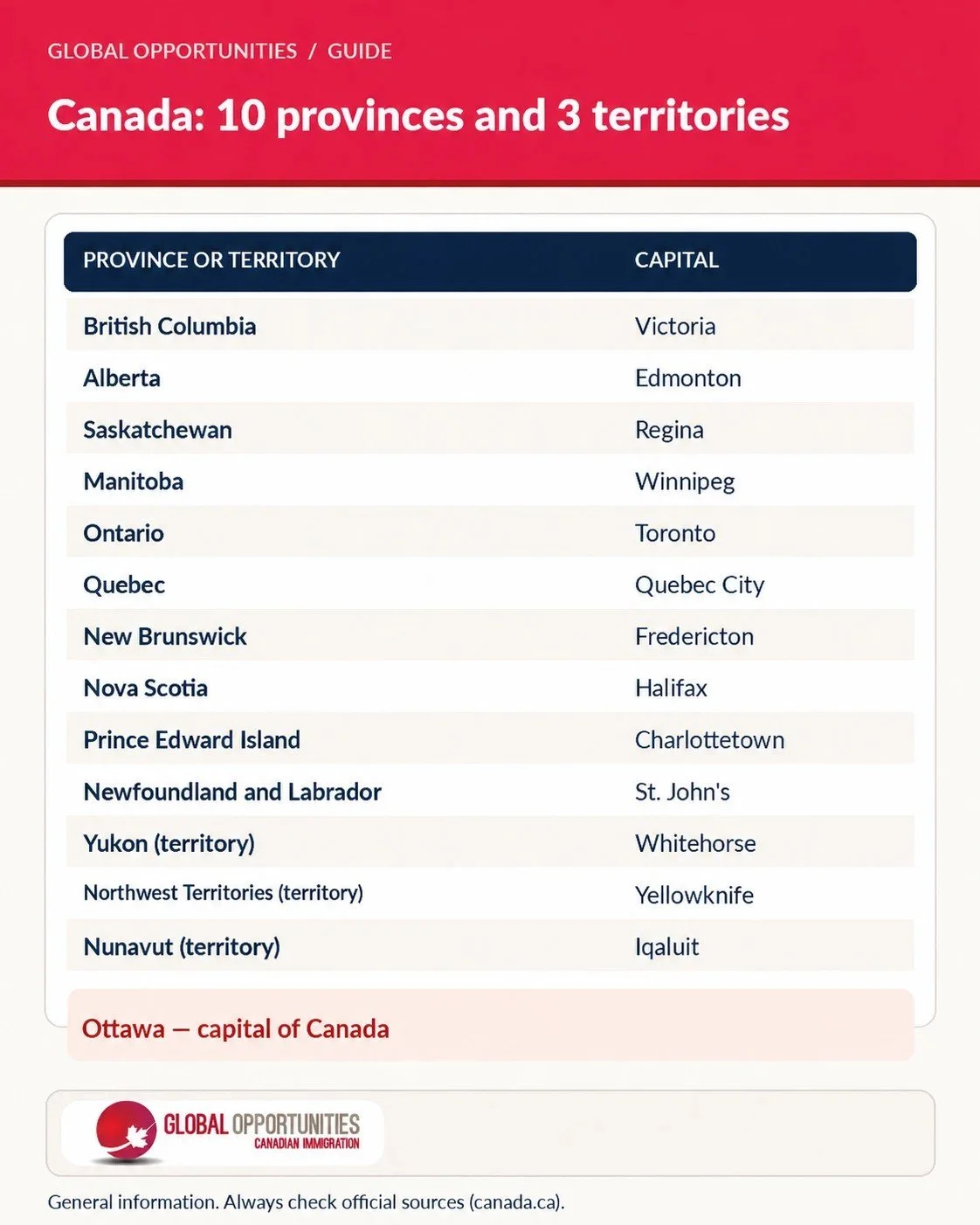
Key facts about Manitoba
Capital and largest city: Winnipeg.
Population: according to Statistics Canada, 1,517,379 on July 1, 2026 (Statistics Canada).
Joined Canada: according to Canadian Heritage, July 15, 1870, through the Manitoba Act, 1870 (symbols of Manitoba).
Motto: Gloriosus et liber ("Glorious and free").
Time zone: according to the Government of Manitoba, since November 1, 2026, Manitoba no longer changes its clocks. Its year-round official time is Manitoba Standard Time (MBT), five hours behind coordinated universal time (UTC-5), which is the same as the daylight saving time the province used to observe in summer (Government of Manitoba, time change).
The regions of Manitoba
Most Manitobans live in the south of the province, in and around Winnipeg and in cities such as Brandon, Steinbach, Winkler and Portage la Prairie (Statistics Canada, population estimates by census metropolitan area and census agglomeration). The north includes Thompson, The Pas, Flin Flon and Churchill.
History and the treaties
According to Canadian Heritage, the Assiniboine and the Cree lived in the region before European explorers arrived through Hudson Bay, and the fur trade shaped it for two centuries. In 1869, the Métis, led by Louis Riel, formed a provisional government in the Red River area, and the negotiations that followed led Parliament to pass the Manitoba Act, 1870. The name "Manitoba" likely comes from a Cree expression meaning "the narrows of the Great Spirit" (symbols of Manitoba). Most of the province is covered by numbered treaties between First Nations and the Crown, and you will often hear a land acknowledgement at the start of events and meetings.
Languages and people
According to the Government of Manitoba, most Manitobans use English in their daily lives, while English and French have official status in the province's legislative and judicial spheres, and many public services can be accessed in both languages. Manitoba is home to one of the most concentrated francophone communities outside Quebec. The province also recognizes seven Indigenous languages spoken and used in Manitoba: Cree, Dakota, Dene, Inuktitut, Michif, Ojibway and Oji-Cree (Immigrate Manitoba, official languages).
Where is Manitoba? Map, location and key facts
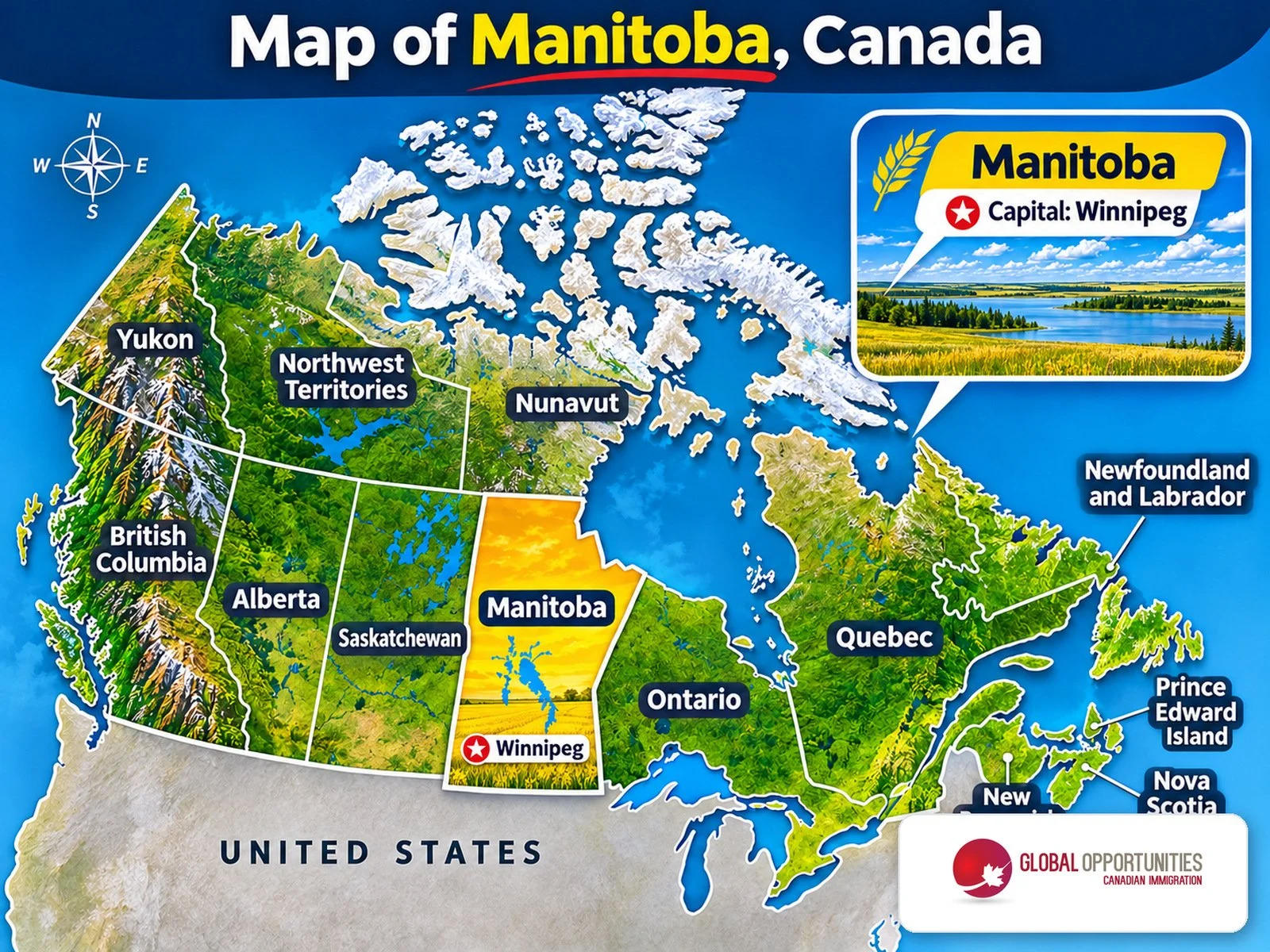
Manitoba is in the centre of Canada, the easternmost of the three Prairie Provinces. It borders Saskatchewan to the west, Ontario to the east, Nunavut and Hudson Bay to the north and the US states of North Dakota and Minnesota to the south. Its capital and largest city is Winnipeg, and it stays on Manitoba Standard Time (UTC-5) all year.
Borders and the US. According to the Government of Manitoba, Provincial Trunk Highway (PTH) 75 is the main connection to the United States, through the border crossing at Emerson (Government of Manitoba, transportation systems planning).
Time zone. According to the Government of Manitoba, since November 1, 2026, Manitoba no longer changes its clocks and stays on Manitoba Standard Time, UTC-5 (Government of Manitoba, time change).
Land area. According to Statistics Canada's 2021 Census, Manitoba covers 540,310 square kilometres of land (Statistics Canada, table 98-10-0001-01).
Population. The 2021 Census counted 1,342,153 people in Manitoba on Census Day, May 11, 2021 (Statistics Canada, table 98-10-0001-01). Statistics Canada's latest estimate is 1,517,379 residents on July 1, 2026 (Statistics Canada, table 17-10-0009-01).
Economy. According to IRCC, agriculture, mining and hydro-electric power generation are the bases of Manitoba's economy (Discover Canada, Canada's regions). See the jobs section below for Job Bank's outlooks by occupation.
Population by origin: what the census says
According to Statistics Canada's 2021 Census, about 290,735 people in Manitoba, out of 1,307,185 living in private households, identified as members of a visible minority group (Statistics Canada, table 98-10-0351-01). The largest groups were:
Filipino: 94,320
South Asian: 71,215
Black: 46,485
Chinese: 25,395
Latin American: 12,835
Southeast Asian: 11,375
Arab: 7,815
Korean: 4,320
West Asian: 3,445
Japanese: 1,860
The same census asked about ethnic or cultural origins, and people could give more than one. The most frequent answers in Manitoba were English (210,285), Scottish (189,645), German (177,360), Ukrainian (165,305) and Irish (144,420), followed by French (121,095), Filipino (90,950), Métis (88,305), Polish (78,860) and Mennonite (51,200). Among Latin American origins, about 7,425 people reported Mexican origins, 2,105 Brazilian, 1,580 Chilean and 1,380 Colombian (Statistics Canada, table 98-10-0355-01).
Census counts as published by Statistics Canada for the 2021 Census. They describe how people answered the census questions in May 2021, not today's population, and because people could report more than one origin, the origin counts add up to more than the population. They are context, not a ranking of places.
How to get to Manitoba: by plane, car, train or bus
Most people arrive in Manitoba by plane at Winnipeg's James Richardson International Airport. By road, the Trans-Canada Highway crosses southern Manitoba and PTH 75 is the main route from the United States, through Emerson. VIA Rail serves Winnipeg, with a northern line to The Pas and Churchill.
By plane: Winnipeg's airport
According to Travel Manitoba, Winnipeg's James Richardson International Airport welcomes travellers from around the world, and Churchill can be reached by Calm Air flights from Winnipeg (Travel Manitoba, travel information). The airports of Edmonton, Regina and Saskatoon all list direct flights to Winnipeg (YEG, non-stop destinations; YQR, where we fly; YXE, destinations).
Flying to Manitoba from abroad: airlines and common routes
The Winnipeg airport's own airline and destination lists could not be checked for this guide; look them up on the airport's website before you book. What official airline pages show, as of November 2026:
From Mexico, Central America and the Caribbean. According to WestJet, its winter schedule from Winnipeg includes Liberia (Costa Rica), Cancún, Puerto Vallarta and Los Cabos, plus new non-stop service to Punta Cana from November 28, 2026 and to Belize City from December 14, 2026 (WestJet, winter sun schedule; WestJet, new routes for winter 2026-2027). These are seasonal. From other Latin American cities, the trip usually involves a connection.
From Europe, Asia, Australia and New Zealand, the trip usually involves at least one connection in another Canadian or US airport. Calgary's airport, for example, lists year-round non-stop flights to Amsterdam, Frankfurt, London and Paris (YYC, airlines and destinations).
From the United States, check the airlines that fly to Winnipeg for current routes.
Routes as published by WestJet and by the Calgary, Edmonton, Regina and Saskatoon airports, as of November 2026. Routes and airlines change seasonally: check the airport's page and the airlines before you book. We do not recommend any airline or route.
By car: Manitoba's main highways
The Trans-Canada Highway (PTH 1) crosses southern Manitoba; Portage la Prairie's economic development office describes the city as one of the main urban hubs on its east-west corridor (Invest in Portage).
PTH 75 is, according to the Government of Manitoba, the main connection to the United States, through the border crossing at Emerson (transportation systems planning).
Before a highway trip, check road conditions, closures, construction and cameras on Manitoba 511, which also shows border crossings and can send alerts for your saved routes.
Driving from the United States
The Canada Border Services Agency (CBSA) lists Emerson (Emerson, Manitoba / Pembina, North Dakota) on its border wait times page. CBSA notes that wait times can vary with events, holidays and enforcement actions, and do not include delays on the roads leading to the border. Before you travel, check CBSA's pages on visiting Canada and the travel documents you need, and use IRCC's tool to check if you need a visa or an eTA.
By train: VIA Rail
According to Travel Manitoba, VIA Rail arrives in and departs from Winnipeg and serves many communities across the province. VIA's long-distance train connects Winnipeg with Saskatoon and western Canada, and a separate VIA train runs between Winnipeg, The Pas and Churchill on Hudson Bay (VIA Rail, Winnipeg station; VIA Rail, Winnipeg to Saskatoon; VIA Rail, Winnipeg to Churchill; VIA Rail, The Pas).
By intercity bus
According to Travel Manitoba, several bus lines and local companies serve Winnipeg and dozens of other destinations (Travel Manitoba, travel information). Check routes, schedules and fares with the operator before you travel.
Highways, crossings and services as described by the Government of Manitoba, Travel Manitoba, CBSA and VIA Rail, as of November 2026. Entry to Canada depends on your citizenship and documents, and the CBSA officer decides at the border: check the official pages before you travel.
Buying your first home in Manitoba
Most newcomers rent first, but many plan to buy. First-time buyers in Manitoba can use federal help (the First Home Savings Account, the Home Buyers' Plan and the home buyers' amount), and once they own their principal residence, Manitoba's Homeowners Affordability Tax Credit reduces school taxes on the property.
Saving for a first home: the FHSA and the Home Buyers' Plan
First Home Savings Account (FHSA). According to the Canada Revenue Agency (CRA), to open an FHSA you must be a resident of Canada, at least 18, 71 or younger at the end of the year you open it, and a first-time home buyer: you did not live in a home that you owned or jointly owned as your principal residence in the current year or the previous four calendar years (CRA, opening your FHSAs; CRA, FHSA overview).
Home Buyers' Plan (HBP). According to the CRA, the HBP lets you withdraw from your RRSPs to buy or build a qualifying home, up to $60,000, and pay it back over 15 years, with temporary relief that defers the start of repayment for first withdrawals made from 2026 to 2028 (CRA, what is the Home Buyers' Plan).
Home buyers' amount. According to the CRA, eligible first-time buyers can claim up to $10,000 for a qualifying home on line 31270 of their federal tax return, a non-refundable credit (CRA, line 31270).
Manitoba's Homeowners Affordability Tax Credit
According to the Government of Manitoba's Homeowners Affordability Tax Credit page, the HATC replaced the Education Property Tax Credit in 2025. It applies only to principal residences, not to rental properties, cottages or commercial properties, and renters are not eligible (renters have their own credit; see the taxes section). The page lists a maximum of $1,600 for the 2026 tax year. Eligible owners can receive it as an advance on their property tax statement if they have declared their principal residence with their municipality; otherwise, they can claim it on their income tax return.
The Canada Mortgage and Housing Corporation (CMHC) has a step-by-step home buying guide. Before you buy, consider testing the home for radon (see the emergencies section). Rules depend on each person's situation: check the CRA and Government of Manitoba pages, and talk to a lender or a tax professional before you decide.
Rules and amounts as published by the Canada Revenue Agency and the Government of Manitoba, as of November 2026. They may have changed by the time you read this, and meeting one program's conditions does not mean you qualify for the others: check the linked pages before you rely on them.
Emergencies and natural hazards in Manitoba
Manitoba's main natural hazards are spring flooding, especially along the Red and Assiniboine rivers, wildfires and smoke, summer storms and winter blizzards. Most newcomers never face a serious emergency, but it helps to install the province's MB Ready app and keep a simple plan and kit at home.
Why does Manitoba have a wildfire season?
Manitoba's Wildfires Act defines the wildfire season as the period from April 1 to November 15 each year, or another period the minister designates (The Wildfires and Consequential Amendments Act). During that season, burning restrictions and travel restrictions can apply. The Government of Canada explains that hotter temperatures and drier conditions are changing the frequency and intensity of wildfires (Get Prepared: wildfires). The Government of Manitoba's wildfire information page publishes the fire map, situation reports, burning and travel restrictions, and evacuation guidance, and is updated as information becomes available.
Evacuation alerts and orders: what to do
According to the Government of Manitoba's wildfire evacuation guidelines:
Report a fire right away to your local fire department, a Manitoba Conservation office or 911.
Evacuation alert: you have time to prepare. Plan to bring enough to keep your family comfortable for at least five days, including warm, waterproof clothing, food, medications, cash and cards, and pet food.
Evacuation order: you must leave your home. Use your pre-planned route and move away from the wildfire, never toward it.
Keep a battery-powered radio and listen to local radio for updates.
Spring flooding and the Red River
According to the Government of Manitoba's flood information page, floods in Manitoba's history have been especially severe along the Red River and Assiniboine River basins. The province's Hydrologic Forecast Centre publishes flood forecasts and reports (flood forecasts and reports), and the same page explains how to prepare your home and how to apply for Disaster Financial Assistance after a flood. If you rent or buy near a river, ask about the property's flood history and your insurance.
MB Ready, Alert Ready and air quality
MB Ready is the province's official emergency information tool, run by the Manitoba Emergency Management Organization. Its web portal maps active wildfires, flood alerts, evacuation orders, shelters, road closures and smoke and air quality information, and its free app sends alerts based on your location (Government of Manitoba, MB Ready).
Alert Ready is the national system that delivers critical alerts through television, radio and compatible wireless devices (Alert Ready).
Smoke. Check the Air Quality Health Index (AQHI), published by Environment and Climate Change Canada with health messages for the general public and for people at risk (Government of Canada, AQHI). When smoke is heavy, the Government of Canada suggests keeping windows and doors closed, using a certified portable air purifier and, if you must go outside, a well-fitting N95 or equivalent respirator (Get Prepared: wildfires).
Radon: test your home
Radon is a natural radioactive gas that can build up in homes, especially in basements. In Health Canada's cross-Canada survey of radon in homes, Manitoba, New Brunswick, Saskatchewan and Yukon had the highest percentages of tested homes above the radon guideline; in Manitoba, 23.7% of the homes tested were above it (Health Canada, cross-Canada survey). The only way to know your level is to test: Health Canada says to do a long-term test for a minimum of 3 months, with a kit or a certified professional (Health Canada, testing your home; Health Canada, radon). If you rent, you can ask your landlord whether the home has been tested.
Information as published by the Government of Manitoba, the Government of Canada, Health Canada and Alert Ready, as of November 2026. The radon percentages come from a national survey and do not tell you the level in any particular home. In an emergency, always follow the instructions of local authorities.
Living in Winnipeg: neighbourhoods and city overview
Winnipeg is the capital of Manitoba and, by far, its largest city. According to Statistics Canada, the Winnipeg census metropolitan area had 951,758 residents on July 1, 2025 (Statistics Canada, table 17-10-0148-01), which is well over half of the province's population.
What Winnipeg is like
Parks Canada describes The Forks as Winnipeg's "Meeting Place", with 6,000 years of history (Parks Canada, The Forks). Today The Forks Market is open seven days a week, and The Forks publishes a calendar of events and updates on its skating trail (The Forks). According to IRCC, Winnipeg's Exchange District includes the most famous street intersection in Canada, Portage and Main, and its French quarter, St. Boniface, has Western Canada's largest francophone community (Discover Canada).
Universities and colleges. The University of Manitoba, the University of Winnipeg, the Université de Saint-Boniface and RRC Polytech, all on the Government of Manitoba's list of public post-secondary institutions, are in Winnipeg (public post-secondary institutions).
Getting around. Winnipeg Transit runs the city's bus network (see the transit section).
Newcomer support. Manitoba Start, at 271 Portage Avenue, provides central registration for newcomers arriving in Winnipeg (see the newcomer services section).
City services: winnipeg.ca.
How Winnipeg is organized
CMHC divides the city into a core area (Fort Rouge, Centennial, Midland and Lord Selkirk zones) and suburban areas (St. James, West Kildonan, East Kildonan, Transcona, St. Boniface, St. Vital, Fort Garry and Assiniboine Park), which is useful when you compare rents. The average two-bedroom rents below come from CMHC's October 2025 survey (CMHC, rental market data tables, 2025).
Downtown and the Exchange District
Travel Manitoba describes downtown Winnipeg as a place for art, architecture, live entertainment and indoor attractions, and the Exchange District as a national historic site with about 150 heritage buildings, independent boutiques, galleries and locally owned restaurants (Travel Manitoba, five Winnipeg neighbourhoods). The Canadian Museum for Human Rights is just north of The Forks (Canadian Museum for Human Rights). Downtown is part of CMHC's Centennial zone, where, according to CMHC, the average two-bedroom rent was $1,646 in October 2025 (CMHC, Rental Market Survey data tables).
Osborne Village, Fort Rouge and Corydon
Travel Manitoba describes Osborne Village as a neighbourhood to explore on foot, with boutiques, vintage stores, record shops and coffee spots close together, and Corydon Avenue as an area associated with patios and dinner, with boutiques and independent stores (Travel Manitoba, Osborne Village). According to CMHC, its Fort Rouge zone had an average two-bedroom rent of $1,601 in October 2025 (CMHC, Rental Market Survey data tables).
Midland and Lord Selkirk zones
According to CMHC's October 2025 survey, in the core area the Midland zone averaged $1,258 and the Lord Selkirk zone $1,144 for a two-bedroom, the lowest averages among Winnipeg's zones (CMHC, Rental Market Survey data tables).
St. Boniface and St. Vital
St. Boniface is Winnipeg's French quarter (Discover Canada). Travel Manitoba invites visitors to experience its francophone heritage, historic landmarks, bakeries and winter celebrations (Travel Manitoba). According to CMHC, the average two-bedroom rent in October 2025 was $1,632 in St. Boniface and $1,620 in St. Vital (CMHC, Rental Market Survey data tables).
Fort Garry and the University of Manitoba
The University of Manitoba's Fort Garry campus is on a bend of the Red River, about 20 minutes from the city centre, according to the university (University of Manitoba, our campuses). According to CMHC, its Fort Garry zone had one of the city's highest averages in October 2025, at $1,731 for a two-bedroom (CMHC, Rental Market Survey data tables).
Assiniboine Park zone
According to CMHC, its Assiniboine Park zone had the highest average two-bedroom rent in the city in October 2025, at $1,809 (CMHC, Rental Market Survey data tables). Assiniboine Park itself is home to the Assiniboine Park Zoo and gardens such as the English Garden and the Leo Mol Sculpture Garden (Assiniboine Park).
St. James, the Kildonans and Transcona
According to CMHC's October 2025 survey (CMHC, Rental Market Survey data tables), average two-bedroom rents in these suburban zones were $1,442 in St. James, $1,549 in West Kildonan, $1,486 in East Kildonan and $1,450 in Transcona. Before you sign, check the bus routes to your work or school.
Commuter towns around Winnipeg
Some people live in smaller centres near Winnipeg. CMHC reported an average two-bedroom rent of $1,513 in Selkirk in October 2025 (CMHC, Rental Market Survey data tables).
Rents as published by CMHC in its October 2025 Rental Market Survey, as checked in November 2026. They are averages that include long-time tenants, not the price of a unit listed today: check the linked page and current listings before you rely on them.
Other cities in Manitoba: Brandon, Steinbach, Winkler, Portage la Prairie and Thompson
Outside Winnipeg, Manitoba's smaller cities have lower average rents and their own settlement offices. The Government of Manitoba notes that rural and small centres offer newcomer services such as language support, meet-and-greet events, youth programming and employment support (Immigrate Manitoba, settlement services). Rents below are CMHC averages for October 2025, according to CMHC's Rental Market Survey (CMHC, Rental Market Survey data tables); check current listings.
Brandon
After Winnipeg, Brandon is Manitoba's largest urban area. According to Statistics Canada, the Brandon census agglomeration had 62,723 residents on July 1, 2025 (Statistics Canada).
Size. The City of Brandon says it covers about 79 square kilometres and has an estimated trading population of 180,000 (City of Brandon, about Brandon).
Education. Brandon University and Assiniboine College (listed by the province as Assiniboine Community College) are public institutions with campuses in Brandon (Brandon University; Assiniboine College, campuses).
Transit. Brandon Transit runs the city's buses (see the transit section).
Average rent (according to CMHC, October 2025): one-bedroom $810; two-bedroom $1,086 (CMHC, Rental Market Survey data tables).
Newcomer support. Westman Immigrant Services, one of the rural settlement offices listed by the Government of Manitoba.
City services: brandon.ca.
Steinbach
According to Statistics Canada, the Steinbach census agglomeration had 20,081 residents on July 1, 2025 (Statistics Canada).
Education. RRC Polytech has a regional campus in Steinbach (RRC Polytech, campuses).
Average rent (according to CMHC, October 2025): one-bedroom $933; two-bedroom $1,004 (CMHC, Rental Market Survey data tables).
Newcomer support. Eastman Immigrant Services has its office in Steinbach (Eastman Immigrant Services).
City services: steinbach.ca.
Winkler and Morden
According to Statistics Canada, the Winkler census agglomeration, which includes surrounding areas, had 37,719 residents on July 1, 2025 (Statistics Canada).
Education. RRC Polytech has a regional campus in Winkler (RRC Polytech, campuses).
Average rent (according to CMHC, October 2025): one-bedroom $665; two-bedroom $1,046 (CMHC, Rental Market Survey data tables).
Newcomer support. Regional Connections Immigrant Services runs programs in Winkler and Morden, such as conversation circles and newcomer welcome evenings (Regional Connections).
City services: cityofwinkler.ca.
Portage la Prairie
Portage la Prairie's economic development office describes the city as one of the primary urban hubs along the east-west corridor of the Trans-Canada Highway in Manitoba (Invest in Portage).
Economy. Its target sectors include agriculture, agri-food and manufacturing and transportation (Invest in Portage).
Education. RRC Polytech has a regional campus in Portage la Prairie (RRC Polytech, campuses), and Assiniboine College's Portage Campus, in Southport, offers its Practical Nursing program (Assiniboine College, campuses).
Average rent (according to CMHC, October 2025): one-bedroom $829; two-bedroom $1,261 (CMHC, Rental Market Survey data tables).
Newcomer support. The Portage Learning and Literacy Centre, one of the settlement offices listed by the Government of Manitoba.
City services: city-plap.com.
Thompson and the north
According to Statistics Canada, the Thompson census agglomeration had 13,065 residents on July 1, 2025 (Statistics Canada).
Education. The University College of the North has campuses in Thompson and The Pas (University College of the North).
Average rent (according to CMHC, October 2025): one-bedroom $1,005; two-bedroom $1,133 (CMHC, Rental Market Survey data tables).
Newcomer support. North West Regional Immigrant Services has offices in Thompson, The Pas, Flin Flon and Swan River (NWRIS).
City services: thompson.ca.
Other towns
Morden, served by Regional Connections.
Neepawa, with Neepawa and Area Immigrant Settlement Services.
Dauphin, home to Assiniboine College's Parkland Campus (Assiniboine College, campuses).
The Pas, Flin Flon and Swan River, served by North West Regional Immigrant Services.
Churchill, where licensed tour operators lead visits to Wapusk National Park (Parks Canada).
In smaller towns, check how you will get to work before you choose where to live.
Population figures as published by Statistics Canada and rents as published by CMHC (October 2025), as checked in November 2026. Averages are not asking rents for units listed today: check the linked pages and current listings.
How much is rent in Manitoba, and where do you find a place?
Most newcomers rent when they first arrive in Manitoba. Residential renting in the province is governed by The Residential Tenancies Act, and the provincial Residential Tenancies Branch (RTB) helps tenants and landlords. This section explains rents, where to search, which deposits are legal, how rent increases work and how to avoid scams.
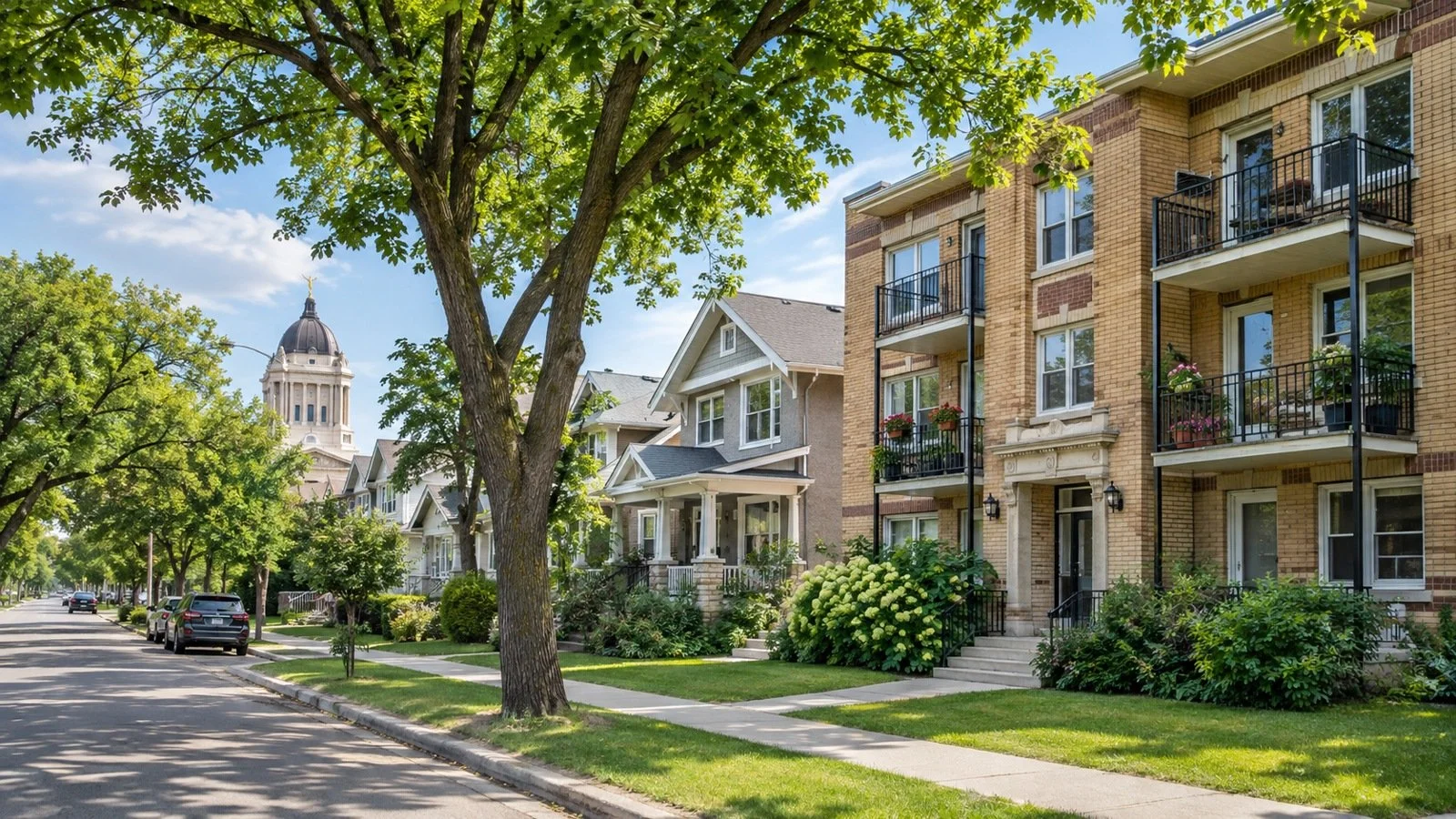
Average rents in Manitoba: CMHC figures
According to CMHC's Rental Market Survey, in October 2025, average rents for private apartments were (CMHC, Rental Market Survey data tables, Manitoba, 2025):
Winnipeg CMA: studio $915; one-bedroom $1,232; two-bedroom $1,571; three-bedroom or more $1,861; vacancy rate 2.8%.
Brandon: one-bedroom $810; two-bedroom $1,086; vacancy rate 1.9%.
Smaller cities: two-bedroom $1,261 in Portage la Prairie, $1,133 in Thompson, $1,046 in Winkler and $1,004 in Steinbach.
Manitoba, all centres of 10,000+: one-bedroom $1,207; two-bedroom $1,507.
According to the same CMHC data, inside Winnipeg the average two-bedroom ranged from $1,144 in the Lord Selkirk zone to $1,809 in the Assiniboine Park zone (see the neighbourhoods above). Averages include long-time tenants, and newly listed units often cost more. Rooms in shared houses usually cost less than a full apartment. Rents change, so check current listings.
Where to look for a rental in Manitoba
Online listing sites such as Kijiji, Facebook Marketplace, Rentals.ca, PadMapper and Zumper. Search by neighbourhood and set alerts.
Property management companies that own apartment buildings often list units on their own websites.
Community groups and places of worship sometimes share room listings.
University and college housing offices for students: the University of Manitoba, the University of Winnipeg, Brandon University and RRC Polytech have residence or housing information.
Settlement agencies such as Manitoba Start can refer you to housing help.
We mention private websites and companies for reference only. Global Opportunities has no relationship with them and does not recommend any of them.
Renting a room, a suite or an apartment
A room in a shared house is a common first step for students and single newcomers: cheaper, often furnished, with utilities usually included. Ask whether you will have a written agreement.
A basement or secondary suite in a house. Visit in person and check for proper windows, smoke and carbon monoxide alarms and a safe exit.
An apartment in a purpose-built rental building, often with heat included, or a condo rented by its owner.
What landlords usually ask for
Identification, proof of income or a job letter, references, and sometimes a credit check. Newcomers without Canadian credit history may be asked for more documents, such as bank statements or a letter from an employer or school. The Financial Consumer Agency of Canada has a guide on renting an apartment or house.
Deposits: what is legal in Manitoba
According to the Residential Tenancies Branch's deposits fact sheet:
A security deposit cannot be more than half of the first month's rent. The RTB's example: if the rent is $800, the security deposit is $400.
A pet damage deposit collected on or after August 1, 2014 can be up to one month's rent, and landlords can charge only one, no matter how many pets. Landlords cannot charge a pet damage deposit for a service animal.
Landlords must tell you about deposits before you sign and give you a receipt.
The landlord holds the deposit for the whole tenancy; you can only use it as your last month's rent if the landlord agrees in writing.
Landlords must pay interest on deposits, at a rate set by the government, and must return the deposit plus interest within 14 days of the end of the tenancy if there are no problems. If you disagree with a claim against your deposit, either side can ask the RTB to decide.
The tenancy agreement
The RTB explains that a tenancy agreement can be written, oral or implied. A written agreement must be signed by both, and the landlord must give the tenant a signed copy within 21 days of the tenant signing it. The RTB's forms include a Standard Residential Tenancy Agreement (Form 1) and a Rental Unit Condition Report (Form 5); doing a condition report at move-in protects your deposit (RTB, tenancy agreement fact sheet).
Rent increases and the rent increase guideline
According to the RTB's rent increases fact sheet:
In most cases, a landlord can increase the rent once every 12 months, with at least three months' written notice.
Each year, the government sets a rent increase guideline. As of November 2026, the RTB states that the 2027 rent increase guideline is 3 per cent, effective January 1, 2027 (RTB, current rent increase guideline).
Landlords who want to go above the guideline must apply to the RTB, and tenants can comment.
The guideline does not apply to some units, including newer buildings during an exemption period, units renting above an amount set each year, and government-managed units. Even then, three months' written notice is required. Ask about this before you sign.
The Residential Tenancies Branch
According to the Government of Manitoba, the Residential Tenancies Branch informs tenants and landlords about their rights and responsibilities, can help with rent, repairs and deposits, mediates disputes, investigates problems and holds hearings to make decisions and issue orders. It has offices in Winnipeg, Brandon and Thompson, and its first-time renter page links to fact sheets on deposits, repairs, giving notice and tenant insurance.
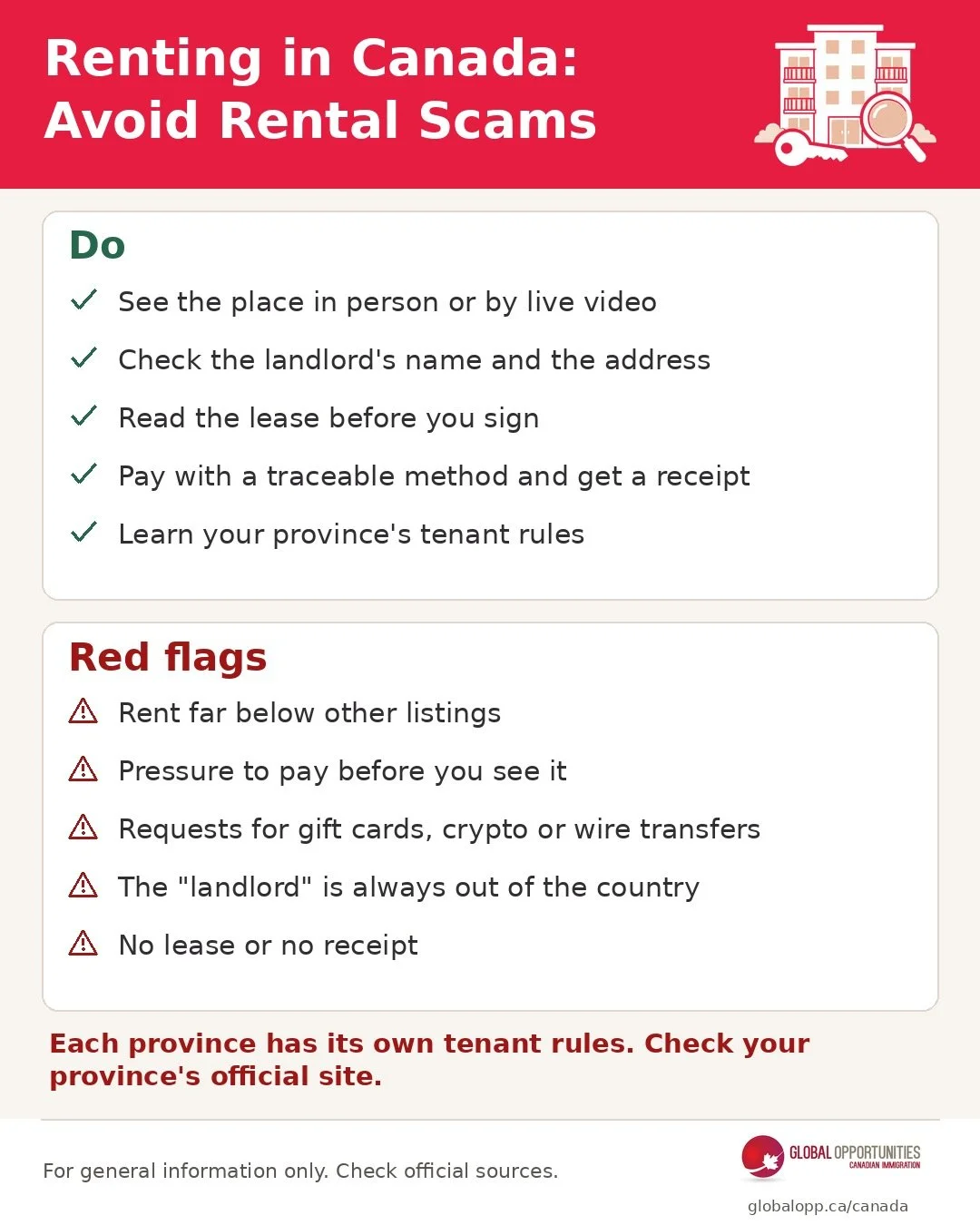
How to avoid rental scams
The Competition Bureau warns about rental scams in its article Rental scam: no room for error. Four steps protect you:
Be suspicious of rents far below similar units or pressure to pay quickly.
Never send a deposit to someone you have not met.
Visit the unit in person before you pay.
Get a written agreement and a receipt for every payment.
Remember that, according to the Residential Tenancies Branch's deposits fact sheet, a security deposit in Manitoba cannot be more than half a month's rent.
Utilities: hydro, heat and internet
Manitoba Hydro supplies electricity and natural gas in the province (hydro.mb.ca). In many apartment buildings, heat is included in the rent; in houses and suites, you may pay electricity and gas yourself. Internet and mobile phone service are separate, and you can compare providers. Ask exactly what is included, because winter heating matters. If you pay Manitoba Hydro yourself, its Equal Payment Plan lets you pay your electricity and/or natural gas bills in equal monthly payments over the year; according to Manitoba Hydro, the plan starts in September, balances out in August, and your monthly amount is estimated from past energy use (Manitoba Hydro, Equal Payment Plan). Tenant insurance is not required by law, but many landlords ask for it.
Rents as published by CMHC (October 2025) and deposit, notice and rent increase rules as published by Manitoba's Residential Tenancies Branch, as of November 2026. They may have changed by the time you read this: check the linked pages before you rely on them. The rent increase guideline does not apply to every unit, so ask the landlord or the RTB about yours.
Public transit in Manitoba: Winnipeg Transit, peggo and Brandon Transit fares
Winnipeg and Brandon have city bus systems. Outside them, most people drive. Fares change, so check the current price on the official page before you travel.
Winnipeg Transit fares
According to the City of Winnipeg's transit fares page, the 2026 fares, as of November 2026, are:
Cash: full fare $3.45; youth and senior $2.95.
e-cash on a peggo card (cheaper than cash): full fare $3.10; youth $2.30; senior $1.55.
Passes on peggo (full / youth / senior): 24-hour $11.45 / $8.50 / $5.75; 7-day $31.00 / $23.00 / $15.50; monthly $119.35 / $88.55 / $59.70.
Post-secondary: 7-day $24.80, monthly $95.50 and a semester pass of $324.65, on a post-secondary peggo card with student ID.
WINNpass for eligible low-income riders aged 64 and under: 50% off full fare, with a monthly pass of $59.70.
Children 11 and under ride free with a fare-paying customer.
peggo card: $5 one-time cost.
Who counts as what, according to the same City of Winnipeg fares page: full fare is ages 17 to 64; youth is 16 and under, or 17 to 21 with a GoCARD; seniors are 65+. When you pay with e-cash on peggo, a transfer is valid for 90 minutes; the City extended the transfer window from 75 to 90 minutes on October 6, 2025 (City of Winnipeg, October 2, 2025). Check the current price and routes before you travel.
How Winnipeg Transit works
The City of Winnipeg's transit page links to its Navigo tool to plan your trip and to Transit on the Go for live trip information while you travel. Use these official tools rather than old maps. In winter, dress warmly for waiting at the stop.
Brandon Transit fares
According to the City of Brandon's fares page, 2026 fares (effective January 1, 2026) are:
Cash: adult $2.10; youth (6 to 17) and seniors (60+) $1.60.
10-ride: adult $18.90; youth and senior $14.20.
30-day pass: adult $102.90; youth and senior $59.90; post-secondary student $65.10.
Children 5 and under ride free.
U-Pass for students, sold at Assiniboine College and Brandon University.
The City of Brandon's transit page also announces Ride Ready, a free youth transit program starting in September 2026 (Brandon Transit). Check the current price before you travel.
Do I need a car in Manitoba?
It depends on where you live and work. Winnipeg and Brandon have city buses; elsewhere, check how you will get to work. Check the bus routes and schedules for your trips before you decide, and remember that you can start with transit and decide about a car once you have a job and a Manitoba licence.
Fares as published by the City of Winnipeg and the City of Brandon, as of November 2026. They may have changed by the time you read this: check the linked pages before you rely on them. Age groups and discounts such as WINNpass and student passes have their own conditions, so confirm that you qualify before you buy.
Driving in Manitoba: MPI licences, Autopac, car rental and winter driving
In Manitoba, driver's licences, vehicle registration and basic auto insurance (Autopac) are all handled by Manitoba Public Insurance (MPI). You get them through MPI service centres and Autopac brokers.
Using your foreign licence and exchanging it
According to MPI's new to Manitoba page, as of November 2026:
Newcomers from another country can usually drive for up to three months on their current valid licence; after that, most must have a Manitoba licence.
If your country is on MPI's list, you can exchange your licence without tests. If not, you must pass a knowledge test, a vision test and a road test.
Bring your ID and your original valid licence (copies are not accepted), a translation if it is not in English or French, and any validity document or driving abstract required.
Fees: licence exchange $75; knowledge test $12; road test $35. Check the current price.
After you exchange or pass, you receive a temporary licence valid for up to 45 days. If you fail a road test, you wait 14 days to retake it.
Vehicles must also be registered and insured in Manitoba within three months.
When we checked in November 2026, MPI's list of countries eligible for licence exchange included reciprocal countries such as Australia, Austria, France, Germany, Ireland, Japan, South Korea, Switzerland, Taiwan, the United Kingdom and the United States, and simplified-exchange countries such as Belgium, Italy, the Netherlands, Norway, Poland, Portugal, Spain, Sweden and Ukraine, each with conditions. The list changes; check it before you go.
Graduated licensing in Manitoba, stage by stage
New drivers go through MPI's Graduated Driver Licensing (GDL) program. According to MPI's driver's handbook:
Learner stage (Class 5L), at least nine months. You must be 16, or 15 and a half and enrolled in high school driver education (parental consent under 18), and pass a knowledge test and vision and medical standards. No alcohol or drugs in your system. A qualified supervising driver sits in the front seat: someone who has held a full Class 5 licence for at least three years. No towing.
Intermediate stage (Class 5I), at least 15 months. You get here by passing a road test. No alcohol or drugs. From 5 a.m. to midnight, one front-seat passenger plus back-seat passengers up to the number of seatbelts; from midnight to 5 a.m., one passenger or a qualified supervising driver in the front.
Full stage (Class 5F). After at least 15 months in the intermediate stage. The no-alcohol, no-drugs rule continues for the first 36 months.
Read the full handbook before your knowledge test.
Car insurance in Manitoba: what Autopac is
Basic auto insurance in Manitoba is public. MPI's Autopac basic coverage has three parts, according to MPI (Autopac basic): the Personal Injury Protection Plan (PIPP), which covers injuries from an accident no matter who caused it (MPI, PIPP); All Perils coverage for damage to your vehicle; and third-party liability. You buy it through an Autopac broker when you register your vehicle, and you can add optional coverage, such as higher liability limits. Because basic insurance is public, people compare only the optional extras. MPI also uses a Driver Safety Rating scale that affects what you pay for your licence and insurance; safe driving moves you up the scale.
Renting a car when you arrive
Each rental company sets its own rules on minimum age, accepted licences, payment and fees, so read the requirements of the company and location you plan to use before you book. For example, when we checked in November 2026:
Enterprise stated that renters in Manitoba must be at least 21 (Enterprise, rental age by province), that renters under 25 pay a young renter fee that varies by location, and that you need a current licence with your photo plus a debit or credit card, with some locations requiring a credit card (Enterprise, renting under 25).
For visitors from other countries, Enterprise asks for a valid home-country licence with a photo; it recommends an International Driving Permit as a translation for non-English licences in Latin letters and requires one for licences in a non-Latin alphabet (Enterprise, driver's licence requirements).
National answers questions on age, licence policy and renting without a credit card in its car rental FAQs.
An International Driving Permit must be issued in the country of your licence: in Canada, CAA explains that only CAA is authorized to issue IDPs, for holders of a Canadian licence, and that an IDP is only valid together with a valid driver's licence (CAA, International Driving Permit). Remember MPI's three-month rule, and check what insurance you already have before accepting the rental company's coverage. We mention private companies for reference only. Global Opportunities has no relationship with any of them.
Winter driving: tires, block heaters and plug-ins
Winter tires. MPI runs a Winter Tire Program that lets eligible Manitobans finance winter tires; to qualify, the tires must display the Three Peak Mountain Snowflake symbol (MPI, Winter Tire Program).
Winter driving tips. MPI advises brushing off every window, mirror and headlight before you drive and doubling your normal following distance on winter roads (MPI, winter driving).
Plug-in parking. If you will park outside in winter, ask your landlord or employer whether your parking spot has an electrical outlet for a block heater.
Check road conditions before highway trips with the province's 511 Manitoba service.
Parking and snow clearing in Winnipeg
According to the City of Winnipeg, a major plowing operation is triggered when snow accumulates to 5 cm or more, its snow operations map shows whether a street is classified as a winter route, and the City announces winter parking bans, with notifications you can sign up for. Continue to obey street signs when you park (City of Winnipeg, winter maintenance).
Licence rules, fees and the list of exchange countries as published by Manitoba Public Insurance, as of November 2026. They may have changed by the time you read this: check the linked pages before you rely on them. Being from a country on MPI's list does not by itself mean your licence will be exchanged; MPI decides based on your documents and the conditions for your country.
How do newcomers get health care in Manitoba? Health card, Family Doctor Finder and Health Links
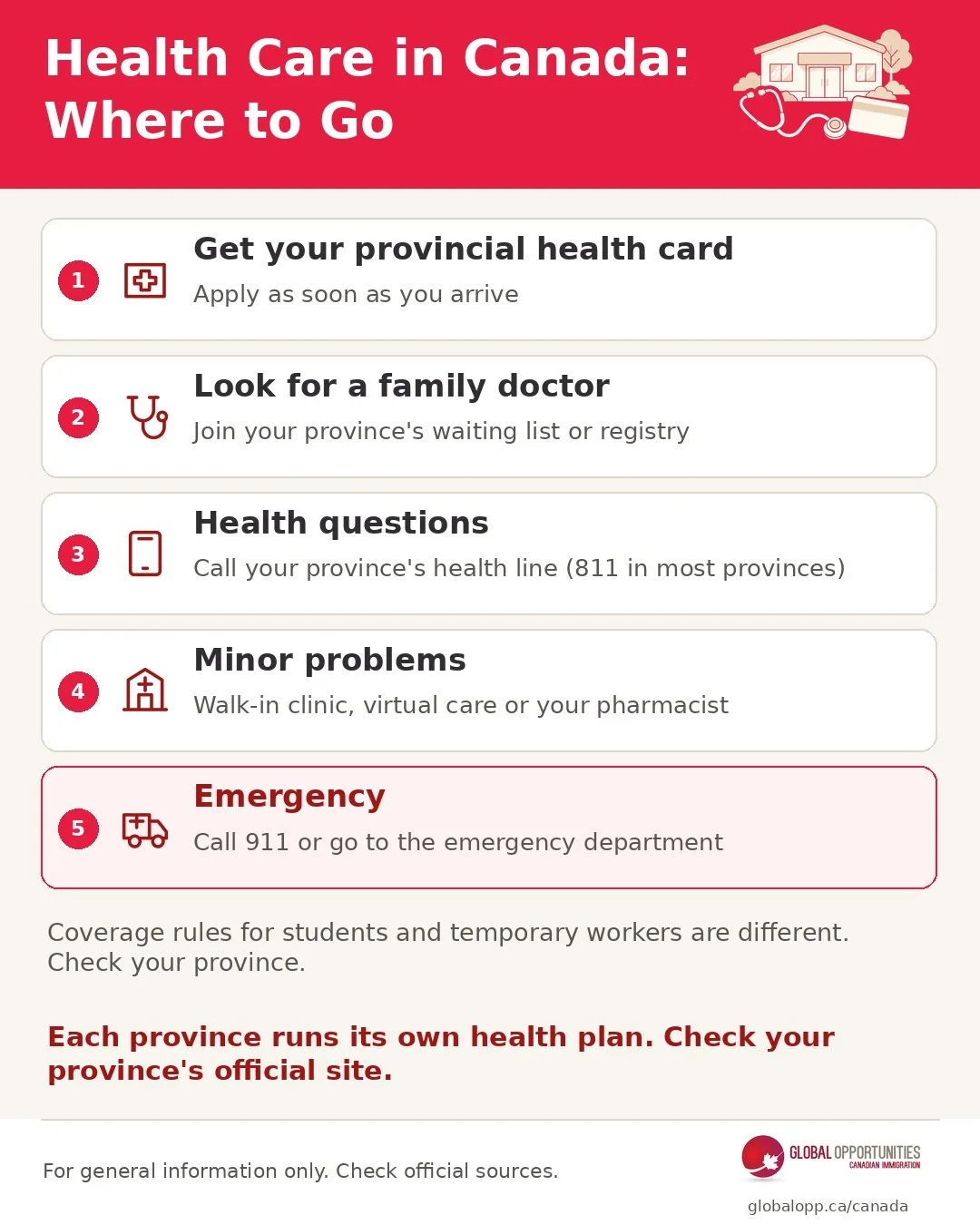
In Manitoba, as in the rest of Canada, medically necessary care is publicly funded for people who have provincial coverage. To use it, you register with Manitoba Health and show your Manitoba health card when you receive care.
New to how public health care works? Read the health care system in Canada.
Who is eligible for Manitoba Health coverage
According to the Government of Manitoba, you may be eligible if you make your home in Manitoba, are physically present in the province at least six months (183 days) in a calendar year, and are, among other categories (Manitoba Health, eligibility):
a Canadian citizen or a permanent resident;
in Manitoba with a valid work permit of 12 consecutive months or more (spouses and children under 18 may also qualify, subject to permit validity);
a convention refugee or protected person;
in Manitoba providing agricultural services under an issued work permit.
Tourists, transients and visitors are not eligible.
When coverage can start
The Government of Manitoba's page for people moving to Manitoba explains that:
permanent residents may apply for coverage from the date they arrive in Manitoba;
eligible work permit holders may apply from the date their work permit was issued;
the three-month waiting period described on the page applies to people moving from another Canadian province or territory;
people with a study permit are no longer eligible for Manitoba Health coverage, so international students need private or school health insurance.
How to register for a Manitoba health card
Registration is done online through the Government of Manitoba's registration page. The steps are:
Check that you are eligible (see the section above).
Gather copies of your required documents, such as proof of your immigration status and proof of Manitoba residence.
Register online and upload the documents, only through official Manitoba government websites.
No computer? The page lists public access computers, including the Bilingual Service Centre at 170 Goulet St. in Winnipeg.
Finding a family doctor: Family Doctor Finder
Family Doctor Finder is a Government of Manitoba program that helps you find a home clinic, a family practice with family doctors and/or nurse practitioners. According to the Government of Manitoba, you can register with the online form or get help by phone, Monday to Friday, 8:30 a.m. to 4:30 p.m., at 204-786-7111 in Winnipeg or 1-866-690-8260 toll-free. Finding a provider can take time, so sign up as soon as you have coverage.
Walk-in clinics, pharmacies and prescriptions
The Government of Manitoba's accessing care page lists walk-in clinics and QuickCare clinics among the options for mild problems, and names pharmacists, along with nurses and dietitians, among primary care providers. Bring a list of your medications, with generic names, from home.
Health Links – Info Santé and emergencies
For a life-threatening emergency, call 911 or go to the nearest emergency department.
For health questions that are not emergencies, call Health Links – Info Santé, a free telephone service staffed 24 hours a day, seven days a week by experienced nurses: 204-788-8200 in Winnipeg or 1-888-315-9257 (toll-free) elsewhere in Manitoba (Government of Manitoba, accessing care).
To find your closest point of care, the province points to Shared Health.
What is not covered
Public coverage does not include everything. Prescription drugs outside hospital, dental care and eyeglasses are often paid privately or through workplace insurance. According to the Government of Manitoba, its Pharmacare program helps eligible Manitobans whose income is seriously affected by high prescription drug costs, based on family income.
Eligibility rules, waiting periods and phone numbers as published by the Government of Manitoba, as of November 2026. They may have changed by the time you read this: check the linked pages before you rely on them. Meeting the general conditions does not mean you are covered; Manitoba Health decides each registration based on your status and documents.
Banking in Manitoba for newcomers
Opening a bank account is one of the first things to do. You need it to receive your pay, rent an apartment and build a credit history.
Banks and credit unions in Manitoba
National banks such as RBC (RBC branch locator, Winnipeg), BMO (BMO, Winnipeg branches) and National Bank (National Bank, Winnipeg branch) have branches in Winnipeg; use each bank's branch locator to find one near you. Manitoba also has member-owned credit unions, such as Assiniboine Credit Union (acu.ca), Access Credit Union (accesscu.ca) and Cambrian Credit Union, based in Winnipeg and Selkirk (cambrian.mb.ca). Compare fees, international transfer costs, newcomer offers and branch locations. We mention financial institutions for reference only. Global Opportunities has no relationship with any of them and does not recommend any.
What you need to open an account
The Financial Consumer Agency of Canada explains which identification banks accept and your right to open an account (FCAC, opening a bank account). Usually you bring your passport and immigration document. You do not need a job or a minimum deposit to open a basic account. The Government of Manitoba also has a financial literacy page for newcomers on banking, budgeting, credit and scams.
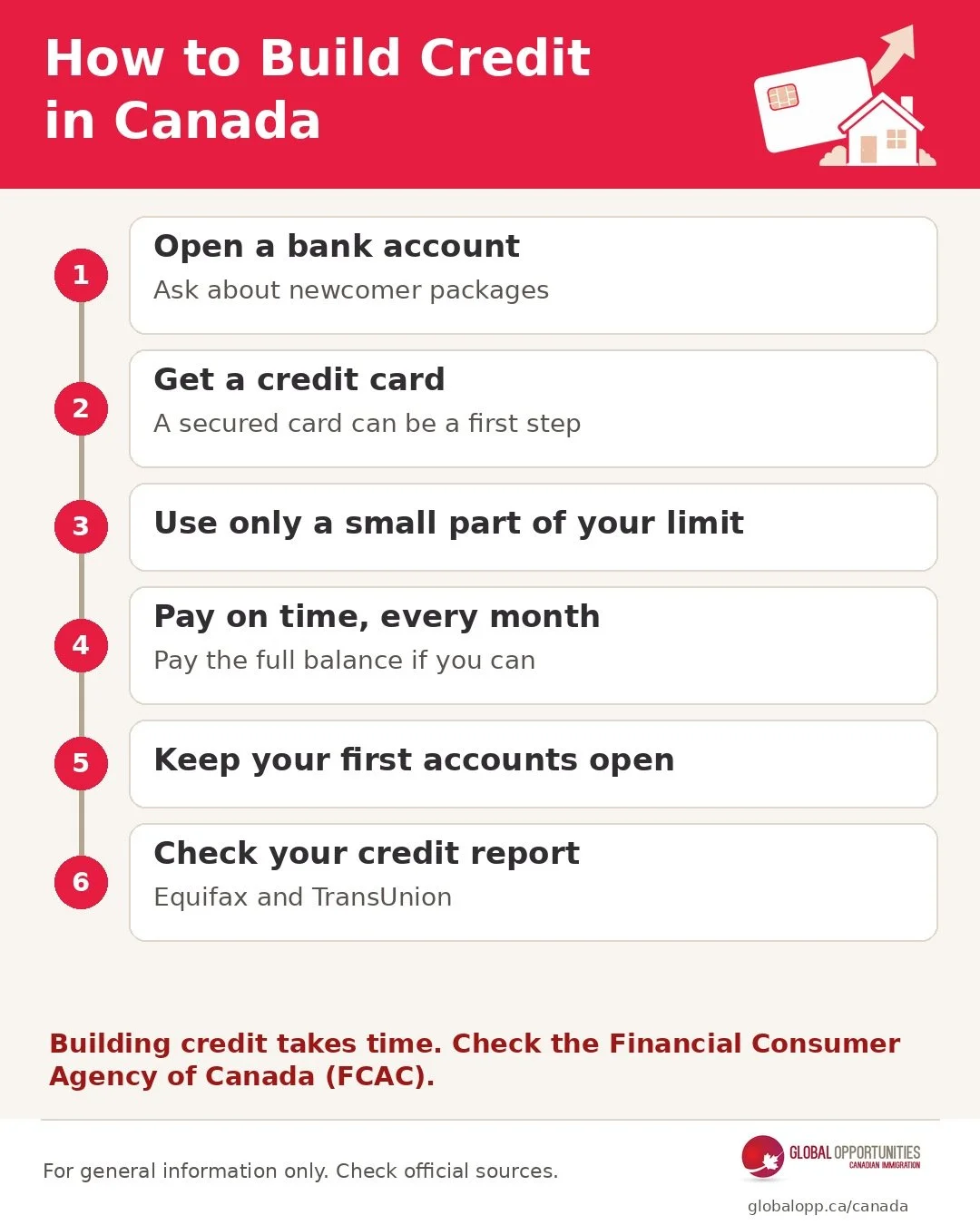
Building a credit history
Your credit history from home usually does not transfer to Canada. Many newcomers start with a credit card from their bank (sometimes a secured card, backed by a deposit), use it for small purchases and pay the full balance on time every month. The FCAC explains credit reports and scores.
Groceries and shopping in Manitoba
Winnipeg has supermarkets, discount stores and warehouse clubs from national chains. Comparing weekly flyers is a common way to save.
Supermarkets and discount chains
Some examples of chains with stores in Winnipeg, confirmed on their own websites in November 2026:
Real Canadian Superstore, a Loblaw banner, for example on Regent Avenue West (Loblaw, Real Canadian Superstore Winnipeg).
Walmart Supercentre, for groceries and household goods (Walmart, Winnipeg Central).
Costco, for bulk buying with a paid membership (Costco, South Winnipeg warehouse).
Use each chain's store locator to find the closest location, and ask your settlement agency or community groups where to find ingredients from home. We mention stores for reference only. Global Opportunities has no relationship with any of them.
How much tax do you pay in Manitoba, and which benefits can you get?
In Manitoba you pay federal and provincial income tax on what you earn, and GST plus retail sales tax on most purchases. Filing a tax return every year is also how you receive benefits such as the Canada child benefit and Manitoba's tax credits.
How income tax works in Manitoba
In Canada, personal income tax is administered by the Canada Revenue Agency (CRA). You pay federal tax and provincial tax, and both are calculated on the same yearly tax return. Canada uses brackets: each rate applies only to the portion of your taxable income that falls within that bracket, not to your whole income. According to the CRA, your provincial rate is determined by the province or territory where you lived on December 31 of the tax year (CRA, tax rates and income brackets for the current year).
According to the CRA, the rates for the 2026 tax year are, as of November 2026:
Federal: 14% on the first $58,523 of taxable income, rising in steps up to 33% on the portion over $258,482.
Manitoba: 10.8% on the first $47,564; 12.75% on the portion from $47,564.01 to $101,200; and 17.4% on the portion over $101,200.
Rates and brackets change every year, so check the current rate on the CRA page. If you are an employee, your employer deducts tax from each pay cheque; your return then settles the difference and claims your credits. You need a Social Insurance Number (SIN) to work and file. The CRA's page for newcomers to Canada explains residency for tax purposes, how to do your first return and how newcomers can apply for benefit payments even before they file for the first time.
Sales tax in Manitoba: RST and GST
Shelf prices usually do not include tax; it is added at the till. Manitoba's retail sales tax (RST, often called PST) has a general rate of 7%, according to the Government of Manitoba (Manitoba retail sales tax), and the federal GST of 5% applies across Canada (Canada Revenue Agency, GST/HST rates). Rates were current as of November 2026; check the official pages.
The Canada child benefit and other federal payments
According to the CRA, the Canada child benefit (CCB) is a tax-free monthly payment for eligible families to help with the cost of raising children under 18 (CRA, Canada child benefit). The CRA lists the conditions: you live with the child, you are primarily responsible for the child's care and upbringing, you are a resident of Canada for tax purposes, and you or your spouse or common-law partner is a Canadian citizen, a permanent resident, a protected person or a temporary resident who meets the CRA's conditions (CRA, before you apply for the CCB). Newcomers can apply through their CRA account or with Form RC66 (CRA, how to apply for the CCB). The amount depends on family income and on the number and ages of your children, and you and your spouse or partner must file a tax return every year to keep receiving it.
The CRA also pays the Canada Groceries and Essentials Benefit (CGEB), which replaced the GST/HST credit in July 2026. According to the CRA, it provides tax-free quarterly payments to individuals and families with low and modest incomes, and you are automatically considered for it when you file your taxes (CRA, Canada Groceries and Essentials Benefit).
$10-a-day child care in Manitoba
According to the Government of Manitoba, parents of children enrolled in infant, nursery and preschool programs pay $10 a day per child for regular hours of care (4 to 10 hours) at licensed child care facilities that receive operating grants, and school-age children who attend before school, at lunch and after school also pay $10 a day (Government of Manitoba, $10 a day child care), as of November 2026. Families do not need to apply for the reduced fee: it applies at funded facilities. The province explains that facilities without operating grant funding are not required to follow the regulated maximum fees for families without a subsidy. Lower-income families may also qualify for the Manitoba child care subsidy. To find licensed centres and homes, use Manitoba Child Care Search, and register early, because spaces are limited. Check the current fee on the official page.
Manitoba tax credits: the Renters Affordability Tax Credit and others
According to the Government of Manitoba, the Renters Affordability Tax Credit provides savings to Manitobans who rent their principal residence; for the 2026 tax year, it provides up to $625, claimed for each month you rented your home (Government of Manitoba, personal tax credits), as of November 2026. The same page lists other provincial measures, such as the Homeowners Affordability Tax Credit for people who own their home, and credits for specific situations. Amounts and conditions change from year to year, so check the current amount on the official page and claim what applies to you when you file your return.
Tax rates, credits, benefits and child care fees as published by the Canada Revenue Agency and the Government of Manitoba, as of November 2026. They may have changed by the time you read this: check the linked pages before you rely on them. Tax brackets apply only to the part of your income in each bracket, and whether you qualify for a benefit or credit depends on your own situation.
How cold is Manitoba, and how do you prepare for winter?
IRCC describes the Prairie Provinces as mostly dry, with cold winters and hot summers (Discover Canada). In Manitoba, winter is the season that surprises newcomers most.
The seasons in Manitoba
Temperatures, snowfall and the length of each season differ between the south and the north of the province. Rather than relying on general descriptions, look up the official averages for the city where you will live.
To compare cities, look up official climate normals on the Environment and Climate Change Canada climate normals site.
Wind chill and extreme cold
Environment and Climate Change Canada uses the wind chill to describe how cold it feels on exposed skin when the wind blows, issues extreme cold warnings when conditions become dangerous, and explains how frostbite can develop quickly on exposed skin (ECCC, wind chill and cold weather). Check the forecast every morning in winter, cover your face, ears and hands, and limit time outside on the coldest days.
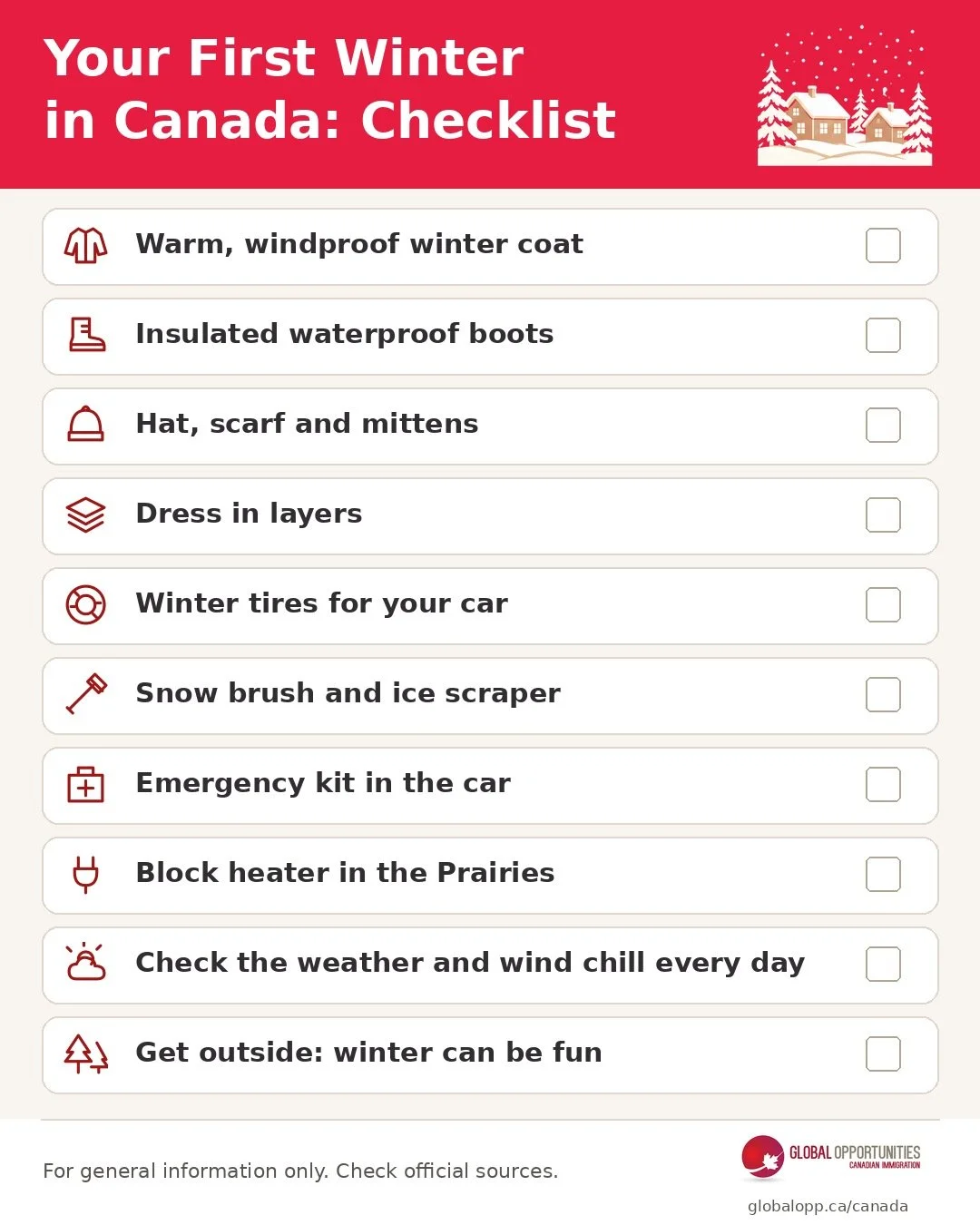
What to buy for your first winter, and where
A warm, windproof winter coat that covers your hips.
Insulated, waterproof winter boots with good grip.
A hat that covers your ears, a scarf or neck warmer, and insulated mittens or gloves.
Thermal layers for the coldest days.
For drivers: winter tires and a snow brush and scraper.
You can find winter clothing at general retailers, including the chains listed in the groceries section, and second-hand on online marketplaces. We mention stores for reference only and have no relationship with them.
First-winter checklist
Buy boots and a coat before the first big cold snap, ask your landlord how the heating works and whether you have a plug-in stall, sign up for the City of Winnipeg's parking ban notifications, and check the forecast every morning. For winter outings, The Forks publishes updates on its skating trail (The Forks).
Mosquitoes and summer
The City of Winnipeg runs a mosquito control program, with trap counts, a nuisance fogging schedule and larviciding, and residents can register to be notified of control activities (City of Winnipeg, insect control). Insect repellent, long sleeves and window screens help.
Education in Manitoba: schools, colleges and universities
Manitoba has public schools with English, French immersion and French-language programs, public universities and colleges, and free English classes for many newcomers.
Public schools for children
Kindergarten to Grade 12 schools are run by school divisions. The Government of Manitoba's schools directory lists every school, school division and district, with maps and contacts, and shows which programs each school offers, such as English, French, French immersion and Indigenous languages. According to the Government of Manitoba, Settlement Workers in Schools (SWIS) help newcomer families with the school system (Immigrate Manitoba, settlement services).
How to register your child in school
Find the school division for your address in the schools directory.
Contact the division or the nearest school and ask how it registers and places newcomer students.
Bring the child's passport or immigration document, proof of address, previous school records (translated if possible) and immunization records.
Ask about English as an additional language (EAL) support, school buses, French immersion and before- and after-school care.
Child care
According to the Government of Manitoba, licensed child care facilities that receive operating grants charge parents a reduced, regulated daily fee for regular hours of care for infants, nursery and preschool children. Fees can change, so check the current amount on the official page (Government of Manitoba, child care for families). Availability varies; start looking early. Our taxes and benefits section explains how $10-a-day child care works.
Manitoba's public universities and colleges
The Government of Manitoba keeps a list of public post-secondary institutions (public post-secondary institutions). Here are its universities and colleges, as each one describes itself on its official website in November 2026. Programs change every year; check each institution's website.
University of Manitoba (Winnipeg). The university says it offers more than 250 undergraduate and graduate programs and is the only Manitoba institution that educates lawyers, engineers, architects and actuaries. Its Fort Garry campus is on a bend of the Red River, and its downtown Bannatyne campus, next to the Health Sciences Centre, trains doctors, nurses and other health care professionals (University of Manitoba; our campuses).
University of Winnipeg (Winnipeg). A public university on the provincial list. See its programs and admission requirements on its website. uwinnipeg.ca
Brandon University (Brandon). Its faculties and schools include the Faculty of Arts, Faculty of Education, Faculty of Graduate Studies, Faculty of Science, Faculty of Health Studies and School of Music (brandonu.ca).
Université de Saint-Boniface (Winnipeg). A French-language institution that offers university, college and continuing education programs under one roof, in areas such as science, education, business, information technology and health (ustboniface.ca).
University College of the North (UCN). Campuses in Thompson and The Pas. It offers degrees, certificates and diplomas, on campus and online, through its Faculty of Arts, Business and Science; Faculty of Education and Early Childhood Education; Faculty of Health; and Faculty of Skilled Trades, Apprenticeship and Technology, including a Bachelor in Ininimowin, focused on the Cree language (ucn.ca).
RRC Polytech (Red River College Polytechnic). Its Winnipeg campuses are the Exchange District, Notre Dame, South Winnipeg and Stevenson (Airport) campuses, and its regional campuses are Interlake and Peguis-Fisher River, Portage la Prairie, Steinbach, Stevenson (Southport) and Winkler (RRC Polytech, campuses). Program areas include business and management, community services, creative arts, culinary, education, engineering and construction technology, health sciences, Indigenous education, information technology, skilled trades and transportation technology (RRC Polytech, programs).
Assiniboine College. Listed by the province as Assiniboine Community College. Its campuses are North Hill and Victoria Avenue East in Brandon, the Parkland Campus in Dauphin, the Portage Campus in Southport and a Winnipeg Campus, which offers Practical Nursing. The North Hill Campus is home to the Manitoba Institute of Culinary Arts and the Len Evans Centre for Trades and Technology (Assiniboine College, campuses). Its schools include the Peters School of Business, the Russ Edwards School of Agriculture and Environment and the Edna Edwards School of Nursing (assiniboine.net).
The province also keeps a separate list of private vocational and religious institutions; check it if a school you are considering is not on the public list.
This list is for reference only. Institutions change their programs, campuses and admission requirements; always confirm on the institution's official website.
How to apply to college or university in Manitoba
Manitoba has no central application service: you apply directly to each institution, on its website, following its deadlines and admission requirements. International students should check that the institution is on IRCC's list of designated learning institutions (DLIs). IRCC explains that a provincial attestation letter (PAL) is usually required to apply for a study permit, with exceptions listed on its page, and that you should contact your school to learn how to get one (IRCC, provincial attestation letter). Remember that study permit holders are not eligible for Manitoba Health coverage. Study rules change often; read IRCC's study in Canada page.
Free English classes for newcomers
LINC classes (federal). According to IRCC, permanent residents and protected persons can take free language classes through Language Instruction for Newcomers to Canada (IRCC, language classes).
Assessment in Winnipeg. The Winnipeg English Language Assessment and Referral Centre (WELARC) provides assessment and access to formal language classes.
Informal practice. The Manitoba Association of Newcomer Serving Organizations (MANSO) lists informal language options, most of which do not require an assessment.
Before you arrive. The Government of Manitoba suggests self-assessing your English with the online CLB-OSA tool and practising with English Online (Immigrate Manitoba).
Study permit, PAL and health coverage rules as published by IRCC and the Government of Manitoba, as of November 2026. They may have changed by the time you read this: check the linked pages before you rely on them. An acceptance letter or a PAL does not mean a study permit will be approved; IRCC decides each case.
Jobs and main industries in Manitoba
According to IRCC, Manitoba's economy is based on agriculture, mining and hydro-electric power generation (Discover Canada). Global Opportunities does not offer jobs, and no one can guarantee you a job in Canada.
Main industries in Manitoba
Agriculture, one of the bases of the economy named by IRCC.
Mining, another of those bases.
Hydro-electric power generation, the third, according to IRCC.
To see which occupations have good prospects in your region, use Job Bank's employment outlooks (below) rather than general lists.
Where to look for work
Job Bank: the Government of Canada's job board. The Government of Manitoba points people to the Manitoba section of Job Bank to find employment opportunities (Immigrate Manitoba, working in Manitoba).
Job Bank outlooks for Manitoba: three-year employment outlooks by occupation. They are not job offers.
Job Bank wage search: wages by occupation and region, as a market reference.
Government of Manitoba jobs: openings in the provincial public service.
Shared Health: Manitoba's provincial health organization, with health care job postings.
Manitoba Start: job postings, job fairs and job matching for newcomers.
Before you apply, read our guide to Canadian resumes, cover letters and job interviews.
Be realistic about timing. The Government of Manitoba is clear that permanent residence does not guarantee you a job: it may take months to find one, or longer if you need to upgrade your skills, education or language, or become licensed (Immigrate Manitoba).
Free employment services in Manitoba
Manitoba Start offers career services, job matching, job fairs, qualifications recognition sessions and webinars for newcomers in Winnipeg (Manitoba Start).
Manitoba Jobs and Skills Development Centres, run by the Government of Manitoba in Winnipeg and in regions across the province, offer employment needs assessments, career counselling and referrals to community agencies (Manitoba Jobs and Skills Development Centres).
Regional settlement offices outside Winnipeg offer employment support for newcomers.
For resume samples and tips on Canadian-style job applications, read our newcomer guide to Canada.
Your rights at work
Employment Standards sets the rules of the workplace in Manitoba, such as hours, vacations and termination (Manitoba Employment Standards).
Minimum wage. According to Manitoba Employment Standards, the minimum wage is $16.40 per hour, effective October 1, 2026 (Government of Manitoba, minimum wage). It changes over time, so check the current rate on the official page.
Recruitment. Under Manitoba's Worker Recruitment and Protection Act, employers must be registered before hiring temporary foreign workers, recruiters must have a licence, and a recruiter or employer cannot charge you money to get a job (Immigrate Manitoba).
Workplace injuries. You may be covered by the Workers Compensation Board of Manitoba.
Minimum wage and workplace rules as published by Manitoba Employment Standards, as of November 2026. They may have changed by the time you read this: check the linked page before you rely on it. The minimum wage is the lowest rate allowed, not what a given job will pay.
Regulated professions and trades
According to the Government of Manitoba, there are 31 regulated professions under the Fair Registration Practices in Regulated Professions Act. To practise a regulated occupation, you must apply for registration with the right regulatory body, which assesses your qualifications (Immigrate Manitoba, regulated occupations). The Fair Registration Practices Office oversees how those professions register applicants.
For more on licences, credential assessments and job searches by profession, see our guide on how to immigrate to Canada as a professional. Many regulators and employers ask for proof of English or French; our guide to English and French tests for Canada explains the main tests. Nurses trained abroad can read how to immigrate to Canada as a nurse, which lists the nursing regulator in each province.
Any mention of regulated occupations in this guide is for reference only. It may not be complete. Always confirm requirements directly with the regulator for your profession or trade.
Free newcomer services in Manitoba: Manitoba Start and regional offices
Settlement services in Manitoba are free for eligible newcomers, and Winnipeg has a central entry point.
Manitoba Start in Winnipeg
Manitoba Start describes itself as "the first step for all new immigrants and international students to the province". It provides central registration for newcomers arriving in Winnipeg and connects them to settlement, orientation, language and employment services. You gather your documents, register online and then receive free services. Its office is at 271 Portage Avenue, Winnipeg, with in-person and virtual services.
Regional settlement offices
Outside Winnipeg, the Government of Manitoba lists regional settlement offices (Immigrate Manitoba, settlement services). They include:
Westman Immigrant Services (Brandon and western Manitoba).
Eastman Immigrant Services (Steinbach and the southeast).
Regional Connections Immigrant Services (Winkler, Morden and south-central Manitoba).
Portage Learning and Literacy Centre (Portage la Prairie).
Neepawa and Area Immigrant Settlement Services (Neepawa).
North West Regional Immigrant Services (Thompson, The Pas and Flin Flon).
This list is for reference only and may change; confirm on the official page.
Other free help
IRCC's newcomer services finder lists free federally funded services near you.
MANSO connects newcomer-serving organizations and lists language options.
Manitoba 211 is a free directory of community and social services (mb.211.ca).
How much does it cost to live in Manitoba?
Housing is the biggest monthly cost for most newcomers, followed by food, transportation, utilities and phone. Our official reference points: according to CMHC's Rental Market Survey, the October 2025 average two-bedroom rent was $1,571 in Winnipeg, $1,086 in Brandon and $1,507 across centres of 10,000+; according to the City of Winnipeg's transit fares page and the City of Brandon's fares page, a 2026 full-fare monthly pass costs $119.35 in Winnipeg and an adult 30-day pass $102.90 in Brandon, as of November 2026; MPI's new to Manitoba page lists a $75 licence exchange fee; and, according to the Government of Manitoba and the CRA, retail sales tax is 7% plus GST of 5% on taxable purchases. All of them change, so check the current price on the sources linked in each section. To save, many newcomers share housing at first, compare grocery flyers, buy winter clothing second-hand, use WINNpass if eligible and apply for federal benefits they may qualify for (see the taxes and benefits section). For a national overview, see our article on the cost of living in Canada.
Figures as published by CMHC, the City of Winnipeg, the City of Brandon, Manitoba Public Insurance, the Government of Manitoba and the CRA, as of November 2026. They are reference points, not a budget for your household: check the linked pages before you rely on them.
Culture, community and things to do in Manitoba
Manitoba offers museums and festivals in Winnipeg, national parks and polar bear country near Churchill.
In Winnipeg
The Forks: Winnipeg's historic "Meeting Place" (Parks Canada), with The Forks Market, open seven days a week, a calendar of events and a winter skating trail (The Forks).
Canadian Museum for Human Rights, just north of The Forks (humanrights.ca).
The Exchange District, a national historic site with about 150 heritage buildings, according to Travel Manitoba, and home to Portage and Main, which IRCC calls the most famous street intersection in Canada (Travel Manitoba; Discover Canada).
St. Boniface, the French quarter, with its francophone heritage, historic landmarks and winter celebrations (Travel Manitoba).
Folklorama, held every August in Winnipeg, with performances, food and experiences from many of the province's ethno-cultural communities (folklorama.ca).
Nature and the outdoors
Riding Mountain National Park, which Parks Canada describes with grasslands, forests, lakes and wetlands (Parks Canada).
Wapusk National Park. According to Parks Canada, it protects one of the largest polar bear maternity denning areas in the world, and a licensed tour operator is required for all activities in the park; visits are mainly through operators in Churchill (Parks Canada).
Community and meeting people
Cultural associations, places of worship, sports leagues and events such as Folklorama are ways to meet people. Settlement agencies can point you to groups, and volunteering can help you meet people and gain Canadian experience. Settling in is also about people: read our article on building community in Canada.
For more ideas, see the official tourism site, Travel Manitoba.
How can you immigrate to Manitoba?
There is no single "Manitoba visa". People move to Manitoba through federal immigration programs run by IRCC, through the Manitoba Provincial Nominee Program (MPNP), or with a temporary permit to study or work. Programs, streams, requirements and fees change frequently, so always check the official pages linked below. Wanting to live in Manitoba is one thing; the program that fits your profile may be a different one.
If you plan to visit first, use IRCC's official tool to check if you need a visa or an eTA.
Express Entry
According to IRCC, Express Entry manages applications for three programs: the Federal Skilled Worker Program, the Federal Skilled Trades Program and the Canadian Experience Class (IRCC, Express Entry). Draws, categories and requirements change, and whether you are eligible and how your profile compares depends on each case; a consultation is the way to know. See also our page on the Federal Skilled Worker program.
The Manitoba Provincial Nominee Program (MPNP)
According to the Government of Manitoba, the MPNP is an economic immigration program designed to attract people with the skills, education and work experience needed to contribute to Manitoba's economy. Manitoba selects individuals from around the world and nominates them to become permanent residents of Canada (Immigrate Manitoba, MPNP). The final decision on permanent residence is made by the Government of Canada.
When we reviewed the official page in November 2026, it described three pathways: the Skilled Worker Stream, for skilled immigrants in and outside of Manitoba; the International Education Stream, for Manitoba graduates; and the Business Investor Stream, for investors and entrepreneurs. The MPNP uses Expression of Interest (EOI) profiles; the official site explains how they work. The Government of Manitoba reminds users that its only official MPNP websites are immigratemanitoba.com and its French version, and asks people to report sites that impersonate the program (Immigrate Manitoba, news).
IRCC explains that each province sets its own requirements, and that provincial nominee applications go through either Express Entry or a non-Express Entry process (IRCC, provincial nominee program). For an overview of how these programs work across Canada, see our page on provincial nominee programs. MPNP streams, pathways and requirements change often. What you read here may already be different when you read it. Always check the official MPNP page, and be wary of anyone who promises a nomination, permanent residence or a job.
Work permits
IRCC describes two main types of work permits: employer-specific work permits and open work permits (IRCC, work in Canada). According to the Government of Manitoba, before you can apply for a work permit for most temporary jobs, your employer must register with Manitoba Employment Standards and, in most cases, get prior approval from Employment and Social Development Canada (Immigrate Manitoba). See our page on the LMIA. If you are a young person from a participating country, read our page on International Experience Canada (Working Holiday) and confirm the current rules on the official IRCC website. If your permit ends within a year, watch Is your work permit or PGWP expiring in the next 12 months? Topics such as proof of funds, language results and processing times depend on each case, so we do not give figures here; book a consultation to review yours.
Already working in the province? Watch why being eligible for permanent residence is not the same as being selected.
After permanent residence, many people apply for citizenship: see our guide to Canadian citizenship.
Program and work permit rules as described by IRCC and the Government of Manitoba, as of November 2026. They may have changed by the time you read this: check the linked pages before you rely on them. Meeting a program's published requirements does not mean an application will be approved; Manitoba decides nominations and IRCC decides each permit and permanent residence application.
French in Manitoba
Manitoba has one of the most concentrated francophone communities outside Quebec, and English and French both have official status in the province's legislature and courts (Immigrate Manitoba, official languages).
St. Boniface. IRCC describes Winnipeg's French quarter as home to Western Canada's largest francophone community (Discover Canada).
Communities where French is common. The Government of Manitoba notes that in some communities French is frequently the language of choice, and that where you live and work will determine which language you use most.
Government services. Many public services can be accessed in both official languages. The province has a Francophone Affairs Secretariat and Bilingual Service Centres, such as the one at 170 Goulet St. in Winnipeg.
Schools. The Division scolaire franco-manitobaine runs French-language schools (DSFM), and the province's schools directory shows which schools offer French immersion.
Post-secondary. The Université de Saint-Boniface is a French-language institution with university, college and continuing education programs.
According to the Government of Manitoba, most Manitobans use English in their daily lives, so plan to work on your English too. If French is one of your strengths, read our page on French language proficiency. Global Opportunities does not offer services for Quebec's immigration programs; this guide covers Manitoba only.
First steps after arriving in Manitoba
Your first weeks in Manitoba involve a few key tasks. Doing them early makes everything else easier.
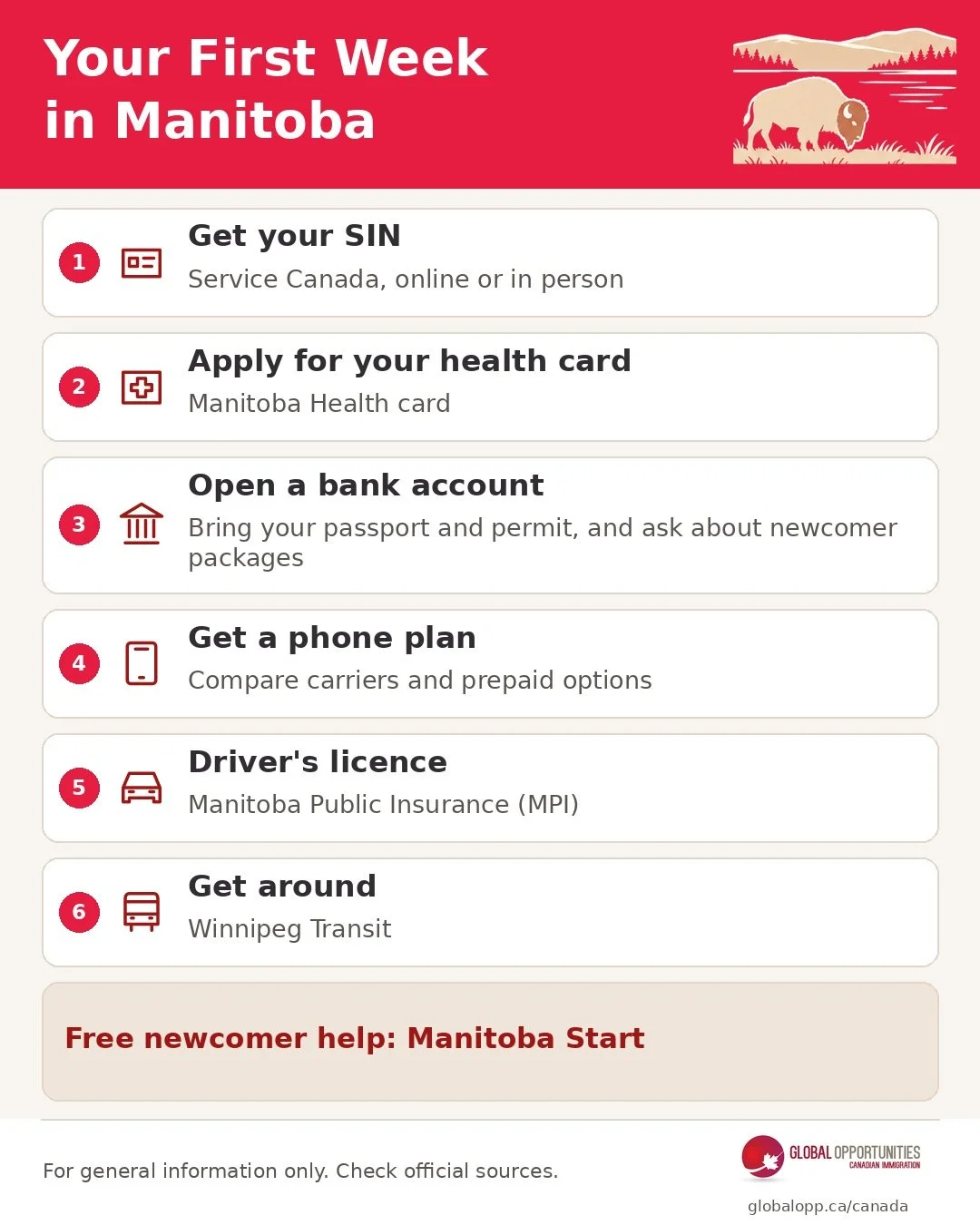
Your first-weeks checklist
Get your Social Insurance Number (SIN), the 9-digit number you need to work in Canada and access government benefits (Service Canada, SIN).
Register for Manitoba Health coverage online, if you are eligible (registration).
Register with Manitoba Start if you live in Winnipeg, or contact your regional settlement office.
Open a bank account and get a phone plan.
Find a place to live, do a condition report and set up utilities.
Sign up for Family Doctor Finder and save the Health Links number.
Register your children for school with your local school division.
Book an English assessment if you want free classes.
Switch your driver's licence with MPI within three months, the limit stated on MPI's new to Manitoba page.
Get a peggo card in Winnipeg.
Prepare for winter before the first cold snap.
Frequently asked questions
Is Winnipeg a good place to live for newcomers?
Whether Winnipeg suits you depends on your occupation, budget and family. On the official side, Winnipeg has central registration for newcomers through Manitoba Start, and, according to CMHC, the average two-bedroom rent in the Winnipeg area was $1,571 in October 2025 (CMHC, Rental Market Survey data tables). IRCC describes the Prairie Provinces as having cold winters and hot summers, so prepare for winter. Search Job Bank for jobs in your field, compare current rents and contact Manitoba Start before deciding. See our Winnipeg section.
How much is rent in Winnipeg?
According to CMHC's Rental Market Survey for October 2025, the average private apartment rent in the Winnipeg area was $915 for a studio, $1,232 for a one-bedroom and $1,571 for a two-bedroom, with a vacancy rate of 2.8% (CMHC, Rental Market Survey data tables). Rents vary a lot by area, according to the same survey: the average two-bedroom ranged from $1,144 in the Lord Selkirk zone to $1,809 in the Assiniboine Park zone. Newly listed units often cost more than the average, and rooms in shared houses cost less. Rents change, so check current listings. See our housing section.
What are the best neighbourhoods in Winnipeg for newcomers?
It depends on your budget and routine. CMHC's October 2025 averages show the range (CMHC, Rental Market Survey data tables): two-bedroom rents went from $1,144 in the Lord Selkirk zone and $1,258 in Midland to $1,731 in Fort Garry and $1,809 in the Assiniboine Park zone. Students may look near their campus, such as the University of Manitoba's Fort Garry campus. Travel Manitoba describes Osborne Village as a neighbourhood to explore on foot, and IRCC describes St. Boniface as Winnipeg's French quarter. Visit before you sign, and check the bus routes to your work or school. See our Winnipeg neighbourhoods section.
Winnipeg or Brandon: which is better for newcomers?
It depends on your occupation and plans. Winnipeg is much larger and has Manitoba Start, the central registration point for newcomers. Brandon, the province's second-largest urban area according to Statistics Canada, has lower average rents: in CMHC's October 2025 survey, the average two-bedroom was $1,086 in Brandon versus $1,571 in Winnipeg (CMHC, Rental Market Survey data tables). Brandon has Brandon University, Assiniboine College campuses, Brandon Transit and Westman Immigrant Services. Look at jobs in your occupation in each city first, then compare rent and transportation. See our Brandon section.
Winnipeg or Saskatoon: which is better for newcomers?
It depends on your occupation, budget and plans, so compare jobs in your field first. On housing, CMHC's October 2025 survey put the average two-bedroom apartment at $1,571 in the Winnipeg CMA and $1,548 in the Saskatoon CMA, so average rents were similar (CMHC, Rental Market Survey data tables). Winnipeg is the larger city and has Manitoba Start as a central registration point for newcomers; Saskatoon is home to the main campus of the University of Saskatchewan. For transit, a full-fare monthly pass cost $119.35 in Winnipeg (Winnipeg Transit fares) and an adult monthly pass $91.00 in Saskatoon (Saskatoon Transit fares), as of November 2026. Both cities have long, cold winters. Read our Saskatchewan guide and check the current prices on each official source.
Is Winnipeg safe?
Safety varies by neighbourhood and time of day, as in any large city, so it is best to look at official data and local advice rather than online rankings. Statistics Canada publishes the Crime Severity Index for provinces and census metropolitan areas, including Winnipeg, in table 35-10-0026-01, which lets you compare cities and see how the index changes from year to year. The Winnipeg Police Service publishes a crime and calls for service map and crime prevention advice. Before you sign a lease, visit the area at different times of day, ask your settlement agency and future neighbours, and check how you would get home by transit at night. In an emergency, call 911. See our Winnipeg section.
How much can a landlord ask for as a deposit in Manitoba?
According to the Residential Tenancies Branch's deposits fact sheet, a security deposit cannot be more than half of the first month's rent: if the rent is $800, the deposit is $400. If the landlord allows pets, a pet damage deposit collected since August 1, 2014 can be up to one month's rent, with only one per unit. Landlords must give you a receipt and pay interest on deposits, and must return the deposit plus interest within 14 days of the end of the tenancy if there are no problems. If you disagree with a claim, either side can ask the RTB to decide. See our housing section.
How much can my rent go up in Manitoba?
In most cases, a landlord can raise the rent once every 12 months, with at least three months' written notice, according to the Residential Tenancies Branch's rent increases fact sheet. Each year the government sets a rent increase guideline: as of November 2026, the RTB's current guideline page states that the 2027 guideline is 3 per cent, effective January 1, 2027. Landlords who want to go above it must apply to the RTB, and tenants can comment. The guideline does not apply to some units, including newer buildings during an exemption period, units renting above an amount set each year and government-managed units, although three months' notice is still required. Ask about this before you sign. See our housing section.
What are my rights as a tenant in Manitoba?
Residential renting in Manitoba is governed by The Residential Tenancies Act, and the provincial Residential Tenancies Branch (RTB) helps tenants and landlords. According to the Government of Manitoba, the RTB informs both sides about their rights and responsibilities, can help with rent, repairs and deposits, mediates disputes, investigates problems and holds hearings to make decisions and issue orders. It has offices in Winnipeg, Brandon and Thompson. The RTB's tenancy agreement fact sheet explains that a written tenancy agreement must be signed by both, and the landlord must give you a signed copy within 21 days. Its first-time renter page links to fact sheets on deposits, repairs, giving notice and tenant insurance. See our housing section.
Are utilities included in the rent in Manitoba?
Sometimes, so ask exactly what is included before you sign. In many apartment buildings, heat is included in the rent; in houses and suites, you may pay electricity and natural gas yourself. Manitoba Hydro supplies electricity and natural gas in the province. Internet and mobile phone service are separate, and you can compare providers. Rooms in shared houses often include utilities. Because winter heating matters in Manitoba, ask your landlord how the heating works. Tenant insurance is not required by law, but many landlords ask for it, and the Residential Tenancies Branch's first-time renter page has a fact sheet on it. See our housing section.
How much is Manitoba Hydro in winter?
There is no single figure, because your bill depends on whether heat is included in the rent, whether the home is heated with electricity or natural gas, its size and insulation, and how cold the winter is. Many apartment buildings include heat in the rent; in houses and suites, you may pay electricity and natural gas yourself. Before you sign, ask the landlord or the previous tenant for an idea of typical winter bills. To avoid big swings between summer and winter, Manitoba Hydro's Equal Payment Plan lets you pay electricity and/or natural gas in equal monthly payments over the year, estimated from past energy use; the plan starts in September and balances out in August. Your account must be up to date to join. See our utilities section.
How much does Winnipeg Transit cost?
According to the City of Winnipeg's transit fares page, the 2026 fares, as of November 2026, are $3.45 cash for full fare, or $3.10 with e-cash on a peggo card; youth pay $2.30 and seniors $1.55 with e-cash. A full-fare monthly pass costs $119.35, a 7-day pass $31.00 and a 24-hour pass $11.45, and post-secondary students can buy a semester pass for $324.65. Children 11 and under ride free with a fare-paying customer, and WINNpass offers 50% off for eligible low-income riders. Transfers are valid for 90 minutes with e-cash. Check the current price. See our transit section.
Do I need a car in Winnipeg?
It depends on where you live and work. Winnipeg Transit runs the city's buses, and the City's Navigo tool helps you plan your trip. Check the routes and schedules for your work or school before you decide. Outside Winnipeg, Brandon also has city buses; in other towns, check how you will get to work. If you buy a car, you will need Autopac basic insurance through MPI, and you must switch to a Manitoba licence within MPI's time limit. See our transit and driving sections.
Can I exchange my foreign driver's licence in Manitoba?
According to MPI's new to Manitoba page, newcomers can usually drive for up to three months on a valid licence from their country. If your country is on MPI's list, which in November 2026 included Australia, France, Germany, Ireland, Japan, South Korea, the United Kingdom, the United States and many European countries, you can exchange your licence without tests. If not, you pass a knowledge test, a vision test and a road test. As of November 2026, MPI listed fees of $75 for an exchange, $12 for a knowledge test and $35 for a road test. Bring your original licence and a translation if needed. See our driving section.
How does car insurance work in Manitoba?
Basic auto insurance in Manitoba is public and is provided by Manitoba Public Insurance as Autopac. According to MPI, basic coverage has three parts: the Personal Injury Protection Plan, which covers injuries from an accident no matter who caused it; All Perils coverage for damage to your vehicle; and third-party liability coverage. You buy it through an Autopac broker when you register your vehicle, and you can add optional coverage. MPI's Driver Safety Rating scale affects what you pay. Because basic coverage is public, people compare only the optional extras, through Autopac brokers. According to MPI, Basic rates are regulated and approved each year by the Public Utilities Board (MPI, statement on the 2026/27 PUB order). See our driving section.
Do I need winter tires and a block heater in Manitoba?
Manitoba helps drivers get winter tires, and a plug-in matters if you park outside. According to Manitoba Public Insurance, its Winter Tire Program lets eligible Manitobans finance winter tires, and the tires must display the Three Peak Mountain Snowflake symbol to qualify. MPI also advises brushing off every window, mirror and headlight before you drive and doubling your normal following distance on winter roads. If you will park outside in winter, ask your landlord or employer whether your parking spot has an electrical outlet for a block heater. Before highway trips, check road conditions with the province's 511 Manitoba service. See our driving section.
How do I get a Manitoba health card?
First check whether you are eligible on the Government of Manitoba's eligibility page: eligibility depends on your status, such as permanent resident or holder of a work permit of 12 consecutive months or more, and on making your home in Manitoba and being present at least six months (183 days) in a calendar year. Then register online through the official registration page, uploading proof of your immigration status and proof of Manitoba residence. If you need a computer, the page lists public access computers, including the Bilingual Service Centre at 170 Goulet St. See our health care section.
Is there a waiting period for Manitoba Health coverage?
It depends on where you are coming from. According to the Government of Manitoba's page for people moving to Manitoba, permanent residents may apply for coverage from the date they arrive in Manitoba, and eligible work permit holders may apply from the date their work permit was issued. The three-month waiting period described on that page applies to people moving from another Canadian province or territory. The page also explains that people with a study permit are no longer eligible for Manitoba Health coverage, so international students need private or school health insurance. Register online through official Manitoba government websites only. See our health care section.
How do I find a family doctor in Winnipeg?
Sign up with the province's free Family Doctor Finder as soon as your Manitoba Health coverage starts, online or by phone, and be patient: matching can take a while. Until then, walk-in clinics and Health Links – Info Santé can help with non-urgent problems, and 911 is for emergencies. The health care section has the phone numbers and hours.
What does Manitoba Health not cover?
Public coverage does not include everything. Prescription drugs outside hospital, dental care and eyeglasses are often paid privately or through workplace insurance. According to the Government of Manitoba, its Pharmacare program helps eligible Manitobans whose income is seriously affected by high prescription drug costs, based on family income. For health questions that are not emergencies, according to the Government of Manitoba's accessing care page, you can call Health Links – Info Santé, a free telephone line staffed 24 hours a day, seven days a week by experienced nurses, at 204-788-8200 in Winnipeg or 1-888-315-9257 toll-free elsewhere in Manitoba. For a life-threatening emergency, call 911. Bring a list of your medications, with generic names, from home. See our health care section.
Can international students get Manitoba Health coverage?
No. According to the Government of Manitoba's page for people moving to Manitoba, people with a study permit are no longer eligible for Manitoba Health coverage. International students therefore need health insurance through their school or a private plan. Before you arrive, ask your college or university's international office whether it has a student health plan, what it covers, when coverage starts and how you pay for it, and keep proof of insurance with you. Family members may have different rules depending on their own status and permits: for example, the province lists holders of a work permit of 12 consecutive months or more among those who may be eligible, so check the official eligibility page for each person. In an emergency, call 911. See our health care section.
How do I open a bank account in Manitoba as a newcomer?
Usually you bring your passport and your immigration document to a bank or credit union. The Financial Consumer Agency of Canada explains which identification banks accept and your right to open an account, and you do not need a job or a minimum deposit to open a basic account. In Winnipeg you will find national banks such as RBC, BMO and National Bank, and member-owned credit unions such as Assiniboine Credit Union, Access Credit Union and Cambrian Credit Union. Compare fees, international transfer costs and newcomer offers. Your credit history from home usually does not transfer, so many newcomers start with a bank credit card and pay the full balance every month. See our banking section.
How cold does it get in Winnipeg?
Winnipeg has a cold winter, and it is the season that surprises newcomers most. IRCC describes the Prairie Provinces as mostly dry, with cold winters and hot summers. Temperatures, snowfall and the length of each season differ between the south and the north of Manitoba, so look up the official averages for your city on Environment and Climate Change Canada's climate normals site. ECCC also uses the wind chill to describe how cold it feels on exposed skin, issues extreme cold warnings when conditions become dangerous and explains that frostbite can develop quickly. Check the forecast every morning in winter and cover your face, ears and hands. See our climate section.
What should I buy for my first winter in Manitoba?
Buy the basics before the first big cold snap. Our checklist includes a warm, windproof winter coat that covers your hips; insulated, waterproof boots with good grip; a hat that covers your ears, a scarf or neck warmer and insulated mittens or gloves; and thermal layers for the coldest days. Drivers also need winter tires and a snow brush and scraper. You can find winter clothing at general retailers and second-hand on online marketplaces. Environment and Climate Change Canada explains that frostbite can develop quickly on exposed skin, so limit time outside on the coldest days and ask your landlord how the heating works. See our climate section.
What universities and colleges are in Manitoba?
The Government of Manitoba keeps a list of public post-secondary institutions. Its universities and colleges include the University of Manitoba, the University of Winnipeg, Brandon University, the Université de Saint-Boniface (French-language), University College of the North, RRC Polytech and Assiniboine College. The province also keeps a separate list of private vocational and religious institutions. Check each institution's website for programs, campuses and admission. See our education section.
How do I register my child for school in Manitoba?
Start with the Government of Manitoba's schools directory, which lists every school, school division and district and shows which programs each school offers. Find the school division for your address, then contact the division or the nearest school and ask how it registers and places newcomer students. Bring your child's passport or immigration document, proof of address, previous school records (translated if possible) and immunization records. Ask about English as an additional language support, school buses, French immersion and before- and after-school care. According to the Government of Manitoba, Settlement Workers in Schools (SWIS) help newcomer families with the school system. See our education section.
How does $10-a-day child care work in Manitoba?
According to the Government of Manitoba, parents of children in infant, nursery and preschool programs pay $10 a day per child for regular hours of care (4 to 10 hours) at licensed centres and homes that receive provincial operating grants, and school-age children who attend before school, at lunch and after school also pay $10 a day (Government of Manitoba, $10 a day child care), as of November 2026. You do not apply for the reduced fee: it applies automatically at funded facilities. Facilities without operating grants are not required to follow the regulated maximum fees for families without a subsidy, so ask each provider. Lower-income families may also qualify for a child care subsidy. Search for spaces on Manitoba Child Care Search and put your name on waiting lists early. Check the current fee on the official page. See our taxes and benefits section.
Where can I take free English classes in Manitoba?
According to IRCC, permanent residents and protected persons can take free LINC classes. In Winnipeg, the first step is an assessment at WELARC, which refers you to a class at your level. If you only want conversation practice, many community programs listed by MANSO do not need an assessment. The education section has the links and the options for people still abroad.
What is Manitoba Start and do I need to register?
Manitoba Start is a Winnipeg organization at 271 Portage Avenue that describes itself as "the first step for all new immigrants and international students to the province". It provides central registration for newcomers arriving in Winnipeg and connects them to settlement, orientation, language and employment services, plus job matching, job fairs and qualifications recognition sessions. You gather your documents, register online and receive free services. If you live outside Winnipeg, contact your regional settlement office instead, such as Westman Immigrant Services in Brandon. See our section on free newcomer services.
Is French spoken in Manitoba?
Yes, in some communities, although most Manitobans use English in daily life. According to the Government of Manitoba, English and French both have official status in the province's legislature and courts, and Manitoba has one of the most concentrated francophone communities outside Quebec. IRCC describes St. Boniface, Winnipeg's French quarter, as home to Western Canada's largest francophone community. Many public services can be accessed in both official languages, including at the Bilingual Service Centre at 170 Goulet St. The Division scolaire franco-manitobaine runs French-language schools, and the Université de Saint-Boniface offers French-language programs. Global Opportunities does not offer services for Quebec's immigration programs. See our French in Manitoba section.
What jobs are in demand in Manitoba?
Rather than relying on general lists, check Job Bank's employment outlooks for Manitoba, which give three-year outlooks by occupation; they are not job offers. According to IRCC, Manitoba's economy is based on agriculture, mining and hydro-electric power generation. To search for work, the Government of Manitoba points people to the Manitoba section of Job Bank, and you can also check provincial public service openings, Shared Health postings and Manitoba Start's job matching. If your occupation is one of the 31 regulated professions listed by the Government of Manitoba (Immigrate Manitoba, regulated occupations), you must register with its regulatory body. The Government of Manitoba warns that finding a job may take months. See our jobs section.
What is the minimum wage in Manitoba?
According to Manitoba Employment Standards, the minimum wage in Manitoba is $16.40 per hour, effective October 1, 2026 (Government of Manitoba, minimum wage). The province notes that its fact sheet is a general overview and that the information is subject to change, so check the current rate on the official page before you accept a job offer. Employment Standards also sets the rules on hours of work, overtime, vacations and ending employment (Manitoba Employment Standards). Many jobs pay more than the minimum: Job Bank lets you look up the wages reported for your occupation in Manitoba (Job Bank, search wages). If you think you are being paid less than the law requires, contact Employment Standards. See our jobs section.
How much income tax do you pay in Manitoba?
It depends on your taxable income, because Canada taxes income in brackets: each rate applies only to the part of your income within that bracket. You pay federal and Manitoba tax on the same return. According to the Canada Revenue Agency, for the 2026 tax year Manitoba's rates are 10.8% on the first $47,564 of taxable income, 12.75% on the portion up to $101,200 and 17.4% above that, on top of a federal rate that starts at 14% (CRA, tax rates and income brackets), as of November 2026. Deductions and credits, such as Manitoba's Renters Affordability Tax Credit, reduce what you owe. Your employer deducts tax from each pay cheque, and your yearly return settles the difference. If your income is modest and your situation simple, the CRA lists free tax clinics. Check the current rates. See our taxes and benefits section.
Are there direct flights to Winnipeg from Europe or Mexico?
From Europe, we could not confirm any non-stop flights: the Winnipeg airport's own list could not be checked for this guide, so look it up on the airport's website before you book; many travellers connect through another Canadian or US airport. From Mexico, yes, in winter: according to WestJet, its winter schedule from Winnipeg includes Cancún, Puerto Vallarta and Los Cabos, plus Liberia (Costa Rica), Punta Cana and Belize City (WestJet, winter sun schedule). These are seasonal routes, so check the airline before you book.
When should I call 911 in Manitoba, and what if I call by mistake?
According to the Winnipeg Police Service, call 911 for in-progress or immediate threats to life or property, such as a medical emergency, a fire or a crime in progress (Winnipeg Police Service, reporting emergencies and non-emergencies). If you dial 911 by mistake, stay on the line and tell the operator you misdialed; if you hang up, the operator will call back to make sure you are safe, and police may be sent. The same page says 911 should never be used for a joke or prank call. For non-emergencies in Winnipeg, the police non-emergency line is 204-986-6222, city services are at 311 and community services at 211.
What is 9-8-8?
9-8-8 is the Suicide Crisis Helpline. According to 988.ca, you can call or text 9-8-8 any time, 24 hours a day, every day of the year, if you are thinking about suicide or are worried about someone else. If your safety is at risk right now, call 911.
Is there an 811 health line in Manitoba?
Manitoba's free health advice line is Health Links – Info Santé, staffed by nurses 24 hours a day. According to the Government of Manitoba, you call 204-788-8200 in Winnipeg or 1-888-315-9257 toll-free elsewhere in Manitoba (Government of Manitoba, accessing care). For a life-threatening emergency, call 911.
How do I check road conditions in Manitoba before driving?
Use Manitoba 511. Its map shows road conditions, winter roads, closures, incidents, construction, cameras and border crossings, and with an account you can get email or text alerts for your saved routes. Check it before every highway trip in winter.
What should I do if I get a flat tire or my car breaks down in Manitoba?
Move to a safe place if you can, turn on your hazard lights and call for help. Many drivers have roadside assistance through a CAA membership, offered in the province by CAA Manitoba (CAA), and some car insurance policies and credit cards include roadside assistance too: check your policy or card benefits before you need them. In winter, keep an emergency kit in your car. If anyone is hurt or the car is in a dangerous spot, call 911.
Should I test my home for radon in Manitoba?
Yes, it is worth it. In Health Canada's national survey, Manitoba had the highest share of tested homes above the radon guideline, and Health Canada recommends a long-term test of at least 3 months (Health Canada, testing your home). See the emergencies section.
Can newcomers get the Canadian Dental Care Plan?
Possibly, once they meet the conditions. According to the Government of Canada, you must not have access to private dental insurance, you (and your spouse or common-law partner, if you have one) must have filed tax returns in Canada for the previous year, your adjusted family net income must be under the federal limit, and you must be a Canadian resident for tax purposes (Canadian Dental Care Plan, who can qualify). Filing your first tax return is therefore the first step. Check the current conditions on the official page.
Can Global Opportunities get me a job in Manitoba?
No. Global Opportunities does not offer jobs or job offers, and no one can guarantee you a job in Canada. In Manitoba, the Government notes that a recruiter or employer cannot charge you money to get a job, so be careful with anyone who asks for payment. To look for work, use Job Bank and employer websites, and get free help from Manitoba Start or a Manitoba Jobs and Skills Development Centre. If you want to understand which immigration pathways may fit your profile, attend our free online seminars or ask for a personalized consultation. See our jobs section.
How do I immigrate to Manitoba?
There is no single "Manitoba visa". Common pathways include Express Entry, which manages the Federal Skilled Worker, Federal Skilled Trades and Canadian Experience Class programs; the Manitoba Provincial Nominee Program (MPNP), through which Manitoba nominates people for permanent residence; and temporary study or work permits. Each pathway has its own requirements, which change often, and the Government of Canada makes the final decision on permanent residence. Which pathway fits you depends on your own case; a consultation is the way to know. Use only official websites, such as immigratemanitoba.com and canada.ca, and be wary of anyone who promises a nomination or a job. See our immigration section.
Related guides
How Global Opportunities can help
Choosing a province and a pathway depends on your education, work experience, languages and goals. We can help you understand your options.
Our regulated consultant: Lic. Mildrete Monserrath Gutierrez Martinez, Regulated Canadian Immigration Consultant (RCIC), CICC licence R514880. Verify her licence on the CICC Public Register: https://college-ic.ca/protecting-the-public/find-an-immigration-consultant. Global Opportunities does not offer services for Quebec's immigration programs. Global Opportunities is a private firm and is not part of the Government of Canada or any provincial government.
Recorded seminars and lives: watch our recorded seminars in English or the Spanish recordings, and visit our YouTube channel.
More articles in English: read our Moving to Canada articles on topics such as health care, cost of living, the ECA and professional licences, and building community in Canada.
Personalized consultation: for a review of your own case, contact us or write to info@globalopp.ca.
Prefer email? Tell us what you need help with (moving to Manitoba) and we will reply: email info@globalopp.ca.
Contact Global Opportunities →
Sources
Statistics Canada, Population estimates, quarterly (table 17-10-0009-01)
CMHC, Rental Market Survey data tables, 2025 (Manitoba and Winnipeg)
Government of Manitoba, Manitoba Jobs and Skills Development Centres
Residential Tenancies Branch, Current rent increase guideline
Financial Consumer Agency of Canada, Renting an apartment or house
City of Winnipeg, Winnipeg Transit extends its transfer window (October 2, 2025)
Manitoba Public Insurance, Countries eligible for licence exchange
Manitoba Public Insurance, Driver's handbook: Graduated driver licensing
Government of Manitoba, Moving to Manitoba (health coverage)
Canada Revenue Agency, Tax rates and income brackets for the current year
Canada Revenue Agency, Before you apply for the Canada child benefit
Canada Revenue Agency, How to apply for the Canada child benefit
Canada Revenue Agency, Canada Groceries and Essentials Benefit
Statistics Canada, Crime severity index and weighted clearance rates (table 35-10-0026-01)
Environment and Climate Change Canada, Wind chill and cold weather
Travel Manitoba, Five Winnipeg neighbourhoods you want to explore
Travel Manitoba, Shopping, eating and drinking in Osborne Village
Financial Consumer Agency of Canada, Credit reports and scores
Winnipeg Police Service, reporting emergencies and non-emergencies
The information in this guide comes from the official sources linked in each section, as they read when we checked them in November 2026, and it may have changed since. It is general and for reference only. It is not immigration, legal, tax or professional advice, and it may change at any time. Global Opportunities is not responsible for how anyone interprets this content or for decisions made based on it: what you read depends on when you read it. Immigration programs, the Manitoba Provincial Nominee Program, provincial health coverage, transit fares, licence fees, rents, rental rules and driver licensing change frequently, and statistics describe the past and do not predict any outcome. Always confirm requirements and current prices with official Government of Canada, Government of Manitoba and municipal sources. Global Opportunities is not responsible for changes made to those sources after this guide was written. Global Opportunities is a private firm, is not part of the Government of Canada or of any regulator, and does not offer jobs. For your own case, book a consultation.
Last reviewed: November 2026