
Living in Saskatchewan, Canada: A Complete Guide for Newcomers
Living in Saskatchewan, Canada means wide prairie skies, two mid-sized cities, Saskatoon and Regina, and a long list of smaller cities and farm towns, with boreal forest and lakes in the north. This guide explains what daily life in Saskatchewan looks like for newcomers: the cities and their neighbourhoods, rents and tenant rights, buses and fares, driving with SGI, the health card, banks, groceries, winter, every public college and university, work and the official ways people move here.
About our sources: This guide summarises what official sources (the Government of Canada, provincial and territorial governments and the other organisations we link to) said when we checked them in November 2026. We link every source so you can read it yourself. Rules, rates and requirements change, sometimes without notice, and the official page is the one that counts. This is general information, not legal, tax or immigration advice. Global Opportunities is not responsible for how this information is interpreted or for changes made after it was written.
According to Statistics Canada, Saskatchewan had 1,278,402 residents on July 1, 2026, about 3.1% of Canada's population (Statistics Canada, table 17-10-0009-01). There is no big metropolis here: life runs at the scale of mid-sized cities and close-knit communities, and that shapes almost everything, from how people find housing to how they get to work.
We wrote this guide for someone who is about to arrive, or has just arrived, and knows nothing yet: workers, international students and families. Every section links to the official page where you can confirm the details. Where we give a price (a bus fare, an average rent), it comes from the official source, with the date we checked it. Prices change, so always check the current price on the source before you make a decision. For resume samples, work permits and your first weeks anywhere in Canada, read our companion newcomer guide to Canada.
Watch our recorded seminars and lives →
Prefer Spanish? Read our Spanish guide.
In this guide
Saskatchewan at a glance
Where is Saskatchewan? Map, location and key facts
How to get to Saskatchewan: by plane, car, train or bus
Buying your first home in Saskatchewan
Emergencies and natural hazards in Saskatchewan
Living in Saskatoon: neighbourhoods and city overview
Living in Regina: neighbourhoods and city overview
Other cities in Saskatchewan: Prince Albert, Moose Jaw, Swift Current, Yorkton, North Battleford and Lloydminster
Rural life in Saskatchewan
How much is rent in Saskatchewan, and where do you find a place?
Public transit in Saskatchewan: Saskatoon Transit and Regina Transit fares
Driving in Saskatchewan: SGI licences, insurance, car rental and winter driving
How do newcomers get health care in Saskatchewan? Health card, family doctors and 811
Banking in Saskatchewan for newcomers
Groceries and shopping in Saskatchewan
How much tax do you pay in Saskatchewan, and which benefits can you get?
How cold is Saskatchewan, and how do you prepare for winter?
Education in Saskatchewan: schools, colleges and universities
Jobs and main industries in Saskatchewan
Free newcomer services in Saskatchewan
How much does it cost to live in Saskatchewan?
Culture, community and things to do in Saskatchewan
How can you immigrate to Saskatchewan?
French in Saskatchewan
First steps after arriving in Saskatchewan
Frequently asked questions
Related guides
How Global Opportunities can help
Sources
Saskatchewan at a glance
Saskatchewan is one of Canada's three Prairie Provinces, between Alberta to the west and Manitoba to the east, with the United States to the south and the Northwest Territories to the north. Its capital is Regina and its largest city is Saskatoon. According to Canadian Heritage, it became a province on September 1, 1905 (Canadian Heritage, symbols of Saskatchewan).
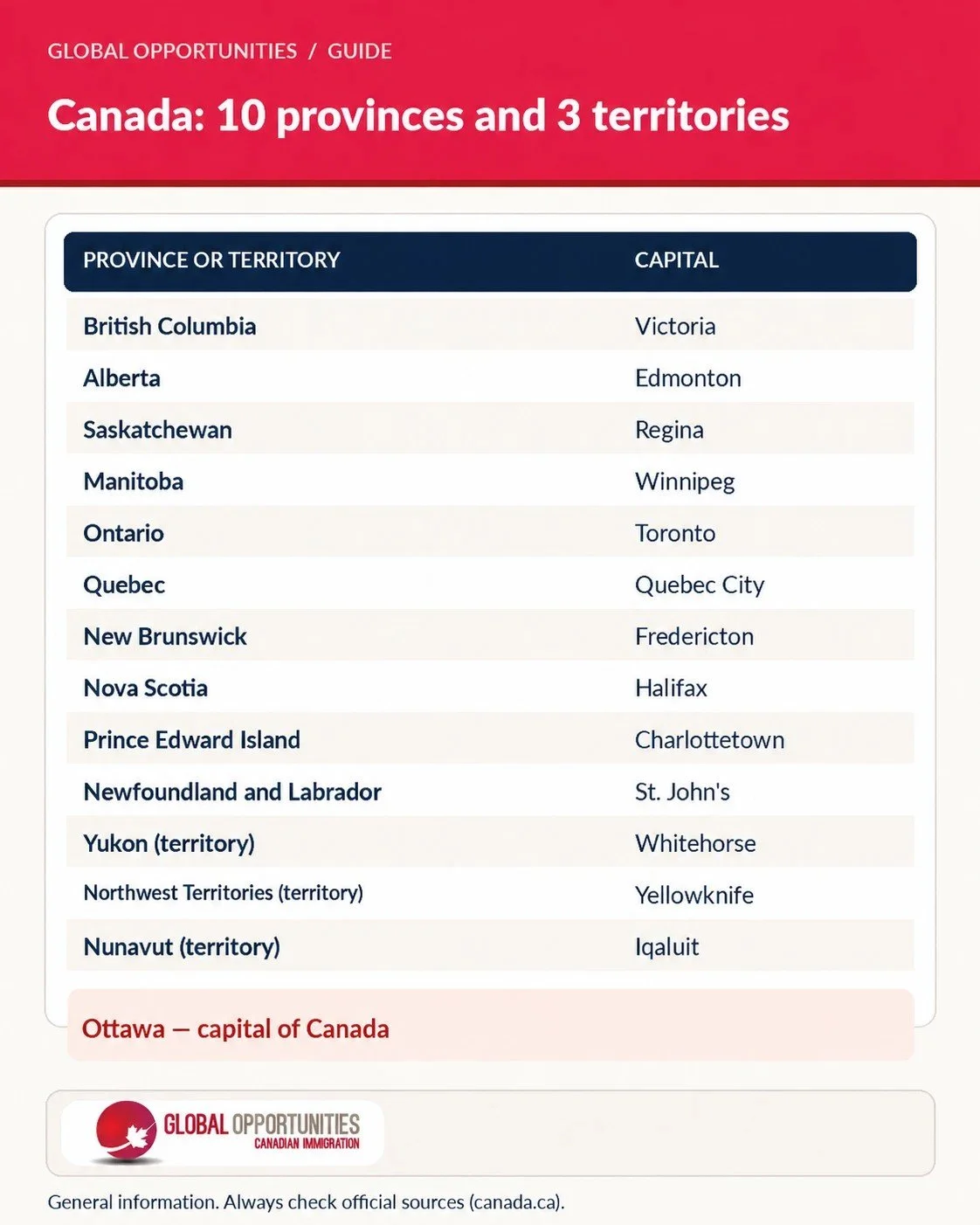
Key facts about Saskatchewan
Capital: Regina. Largest city: Saskatoon.
Population: 1,278,402 on July 1, 2026 (Statistics Canada).
Became a province: September 1, 1905, formed from parts of the districts of Saskatchewan, Athabaska and Assiniboia, according to Canadian Heritage.
No coastline: according to Canadian Heritage, Saskatchewan and Alberta are the only Canadian provinces not bordered by salt water.
Motto: Multis e gentibus vires ("From many peoples strength"), according to Canadian Heritage.
Time zone: Saskatchewan does not change its clocks. Under The Time Act, 2026, in force since October 30, 2026, the whole province, including the Lloydminster area, observes Central Standard Time all year (Government of Saskatchewan, October 30, 2026).
The regions of Saskatchewan
According to Canadian Heritage, prairie covers much of the province, while the north is wooded. Tourism Saskatchewan sums up the landscape as running "from vast prairies to boreal forests" (Tourism Saskatchewan).
People, history and the treaties
The same Canadian Heritage page explains that Saskatchewan was originally inhabited by peoples of the Athapaskan, Algonquian and Siouan language groups, the Cree belonging to the Algonquian group. Today Saskatchewan reflects many origins, including Indigenous, British, German, Ukrainian, Scandinavian and French peoples. Métis history is also central: according to Parks Canada, Batoche National Historic Site, about one hour north of Saskatoon, was the scene of Louis Riel and Gabriel Dumont's last stand during the Northwest Resistance of 1885 (Parks Canada, Batoche).
According to the Government of Saskatchewan, six numbered treaties cover all of Saskatchewan: Treaties 2, 4, 5, 6, 8 and 10, plus a significant adhesion, Treaty 6A (Government of Saskatchewan, May 24, 2024). Many organizations open their websites and events with a land acknowledgement naming the treaty territory; the University of Regina's, for example, notes that the university and its federated colleges are on Treaty 4 and Treaty 6 (University of Regina).
Language
English is the main language in Saskatchewan. The Government of Saskatchewan explains that you will use it to communicate with your employer, doctor and neighbours, and that the better you understand and speak English, the greater your chances of success living and working in the province (Government of Saskatchewan, language training). The province also has a francophone community, the Fransaskois, covered below.
Where is Saskatchewan? Map, location and key facts
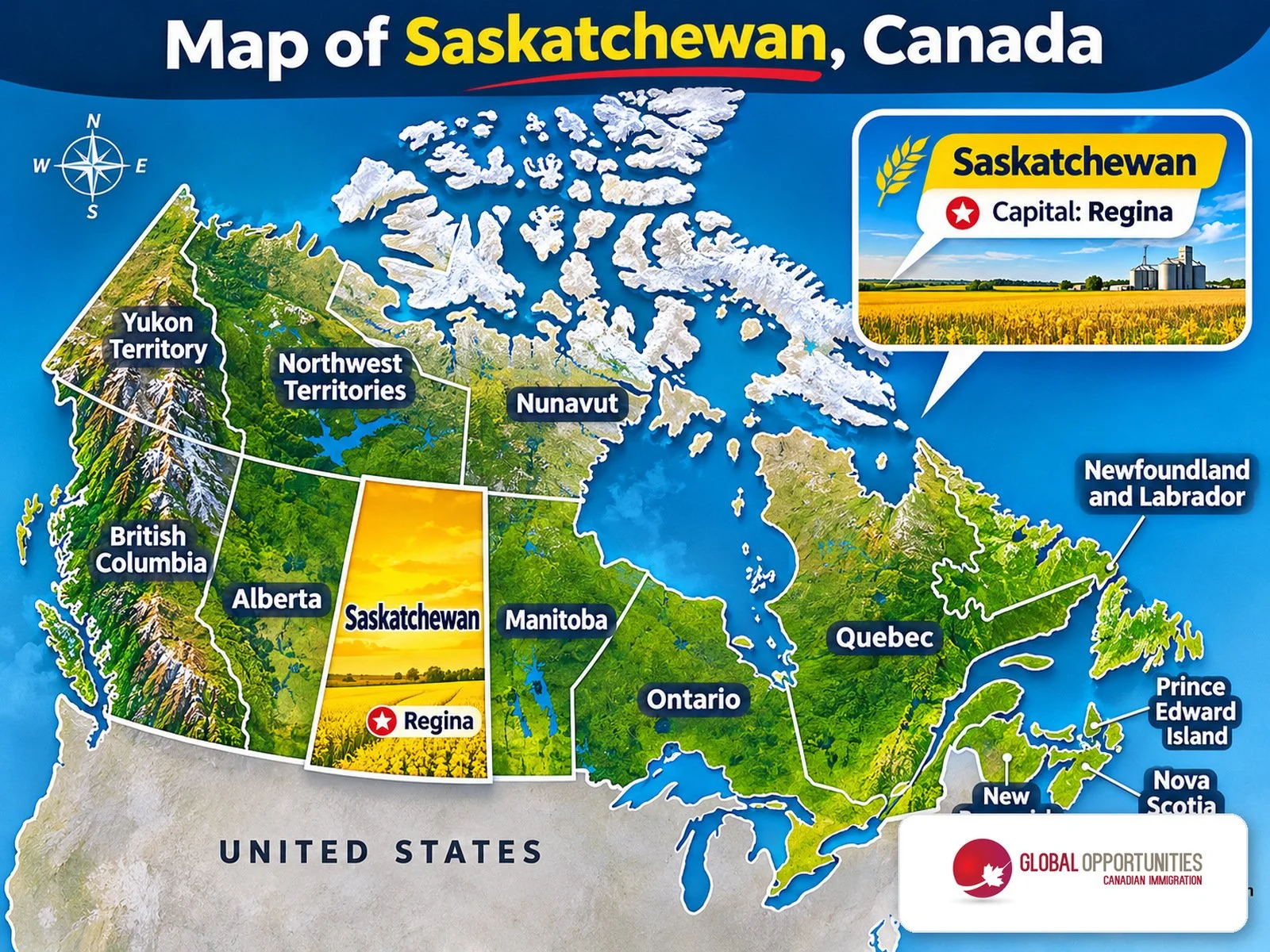
Saskatchewan is in the middle of the Canadian Prairies. It borders Alberta to the west, Manitoba to the east, the Northwest Territories to the north and the US states of Montana and North Dakota to the south. Its capital is Regina, its largest city is Saskatoon, and the whole province stays on Central Standard Time all year.
Borders and the US. Tourism Saskatchewan explains that the province has several land border crossings into Montana and North Dakota (Tourism Saskatchewan, getting here).
Time zone. According to the Government of Saskatchewan, under The Time Act, 2026, the whole province, including the Lloydminster area, observes Central Standard Time all year (see "Key facts" above).
Land area. According to Statistics Canada's 2021 Census, Saskatchewan covers 577,060 square kilometres of land (Statistics Canada, table 98-10-0001-01).
Population. The 2021 Census counted 1,132,505 people in Saskatchewan on Census Day, May 11, 2021 (Statistics Canada, table 98-10-0001-01). Statistics Canada's latest estimate is 1,278,402 residents on July 1, 2026 (Statistics Canada, table 17-10-0009-01).
Economy. According to the Government of Saskatchewan, potash, crude petroleum oil, wheat, canola seeds and natural uranium were among the province's top exports in 2025 (Government of Saskatchewan, June 18, 2026), and IRCC describes Saskatchewan as Canada's largest producer of grains and oilseeds (Discover Canada, Canada's regions). See the jobs section below.
Population by origin: what the census says
According to Statistics Canada's 2021 Census, about 159,360 people in Saskatchewan, out of 1,103,200 living in private households, identified as members of a visible minority group (Statistics Canada, table 98-10-0351-01). The largest groups were:
South Asian: 44,725
Filipino: 43,760
Black: 22,575
Chinese: 18,005
Southeast Asian: 8,540
Latin American: 5,685
Arab: 5,575
West Asian: 2,830
Korean: 1,845
Japanese: 830
The same census asked about ethnic or cultural origins, and people could give more than one. The most frequent answers in Saskatchewan were German (272,480), English (219,665), Scottish (175,590), Irish (145,415) and Ukrainian (138,705), followed by French (108,350), Norwegian (70,215), Métis (56,060), Polish (55,605) and First Nations (50,770). About 40,165 people reported Filipino origins and 19,965 Chinese. Among Latin American origins, about 2,620 people reported Mexican origins, 1,035 Chilean and 735 Colombian (Statistics Canada, table 98-10-0355-01).
Census counts as published by Statistics Canada for the 2021 Census. They describe how people answered the census questions in May 2021, not today's population, and because people could report more than one origin, the origin counts add up to more than the population. They are context, not a ranking of places.
How to get to Saskatchewan: by plane, car, train or bus
Most people arrive in Saskatchewan by plane, at Saskatoon or Regina, usually with a connection in another Canadian city. By road, Highway 1 (the Trans-Canada) crosses the south through Regina and Highway 16 (the Yellowhead) crosses the centre through Saskatoon. VIA Rail stops in Saskatoon, and Rider Express runs intercity buses.
By plane: Saskatoon and Regina airports
Tourism Saskatchewan explains that the province has two international airports, in Regina and Saskatoon, and that regional carriers serve smaller and northern communities (Tourism Saskatchewan, getting here).
Saskatoon (YXE), run by the Saskatoon Airport Authority (YXE).
Regina International Airport (YQR) (YQR).
Flying to Saskatchewan from abroad: airlines and common routes
According to the airports' own pages, as of November 2026:
Airlines at YXE: Air Canada, WestJet, Porter and RiseAir, with direct flights listed to Calgary, Edmonton, Vancouver, Toronto, Winnipeg and, seasonally, Montréal, Halifax and Kelowna (YXE, destinations).
Airlines at YQR: Air Canada, United Airlines and WestJet, with direct flights listed to Vancouver, Calgary, Edmonton, Winnipeg and Toronto all year and, seasonally, Kelowna, Montréal and Halifax (YQR, airlines; YQR, where we fly).
Common ways to get there, by region:
From Europe. Neither airport lists non-stop flights to Europe. Both list direct flights to Toronto, Vancouver and Calgary, and seasonally to Montréal, so travellers from Europe usually connect in one of those cities. Calgary's airport, for example, lists year-round non-stop flights to Amsterdam, Frankfurt, London and Paris (YYC, airlines and destinations).
From Mexico and Latin America. In winter, YXE lists WestJet flights to Puerto Vallarta, Cancún and Mazatlán, and YQR lists Cancún, Mazatlán and Puerto Vallarta. WestJet also announced new non-stop service between Regina and San José del Cabo from December 14, 2026 (WestJet, new routes for winter 2026-2027). Outside winter, and from other Latin American cities, the trip usually involves a connection in a Canadian or US city.
From the United States. YXE lists Minneapolis and, seasonally, Phoenix; YQR lists Minneapolis-Saint Paul and Denver all year, and Las Vegas and Phoenix in winter.
From Asia, Australia and New Zealand. Neither airport lists non-stop flights; travellers usually connect in Vancouver, Calgary or Toronto, which both airports list as direct destinations.
Airlines and routes as listed on the official pages of the Saskatoon and Regina airports, Calgary International Airport and WestJet, as of November 2026. Routes and airlines change seasonally: check the airport's page and the airlines before you book. We do not recommend any airline or route.
By car: Saskatchewan's main highways
Highway 1 (the Trans-Canada) crosses southern Saskatchewan; the Government of Saskatchewan's Regina Bypass updates describe the work on Highway 1 east of Regina and its link to Highway 11 (Government of Saskatchewan, bypass update).
Highway 16 (the Yellowhead) is, according to the Government of Saskatchewan, a major transportation corridor used to move people and goods across the province, running east of Saskatoon through the Yorkton area to the Manitoba border (Government of Saskatchewan, Highway 16 passing lanes).
Before any long drive, check road conditions with the Highway Hotline, the Government of Saskatchewan's map of road conditions, closures, cameras, ferry crossings and border crossings. Tourism Saskatchewan warns that digital maps sometimes send drivers onto unpaved roads that may be impassable, depending on the weather.
Driving from the United States
The Canada Border Services Agency (CBSA) lists North Portal (North Portal, Saskatchewan / Portal, North Dakota) on its border wait times page. According to Tourism Saskatchewan, Regway and North Portal offer 24-hour service, and other crossings, such as Coronach, Estevan Highway, Northgate and Carievale, have limited hours (Tourism Saskatchewan, getting here). CBSA notes that wait times can vary with events, holidays and enforcement actions. Before you travel, check CBSA's pages on visiting Canada and the travel documents you need, and use IRCC's tool to check if you need a visa or an eTA.
By train: VIA Rail
VIA Rail's long-distance train stops in Saskatoon, with connections west to Edmonton and east to Winnipeg (VIA Rail, Saskatoon station; VIA Rail, Edmonton to Saskatoon; VIA Rail, Winnipeg to Saskatoon). Tourism Saskatchewan lists other central Saskatchewan stations, such as Biggar, Melville and Watrous.
By intercity bus
According to Tourism Saskatchewan, Rider Express is an intercity bus service connecting Saskatchewan with Manitoba, Alberta and British Columbia, and several other companies offer charter service (Tourism Saskatchewan, getting here). Check routes, schedules and fares with the operator before you travel.
Highways, crossings and services as described by the Government of Saskatchewan, Tourism Saskatchewan, CBSA and VIA Rail, as of November 2026. Entry to Canada depends on your citizenship and documents, and the CBSA officer decides at the border: check the official pages before you travel.
Buying your first home in Saskatchewan
Most newcomers rent first, but many plan to buy. First-time buyers can combine federal help (the First Home Savings Account, the Home Buyers' Plan and the home buyers' amount) with Saskatchewan's First-Time Homebuyers' Tax Credit.
Saving for a first home: the FHSA and the Home Buyers' Plan
First Home Savings Account (FHSA). According to the Canada Revenue Agency (CRA), to open an FHSA you must be a resident of Canada, at least 18, 71 or younger at the end of the year you open it, and a first-time home buyer: you did not live in a home that you owned or jointly owned as your principal residence in the current year or the previous four calendar years (CRA, opening your FHSAs; CRA, FHSA overview).
Home Buyers' Plan (HBP). According to the CRA, the HBP lets you withdraw from your RRSPs to buy or build a qualifying home, up to $60,000, and pay it back over 15 years, with temporary relief that defers the start of repayment for first withdrawals made from 2026 to 2028 (CRA, what is the Home Buyers' Plan).
Home buyers' amount. According to the CRA, eligible first-time buyers can claim up to $10,000 for a qualifying home on line 31270 of their federal tax return, a non-refundable credit (CRA, line 31270).
The Saskatchewan First-Time Homebuyers' Tax Credit
According to the Government of Saskatchewan's First-Time Homebuyers' Tax Credit page, this is a non-refundable provincial income tax credit. For homes bought from January 1, 2025, it is calculated at 10.5% of the first $15,000, for a maximum of $1,575. In general, you must not have lived in a home you owned in the year of purchase or the four previous years, you (or your spouse or common-law partner) must live in the home within one year, and the home must qualify for the federal Home Buyers' Plan. You claim it on Form SK428 with your tax return for the year you bought the home, and you can only benefit if you owe Saskatchewan income tax. People who received a Graduate Retention Program First Home Plan loan cannot claim it.
The Canada Mortgage and Housing Corporation (CMHC) has a step-by-step home buying guide. Before you buy an older house, consider testing it for radon (see the emergencies section). Rules depend on each person's situation: check the CRA and Government of Saskatchewan pages, and talk to a lender or a tax professional before you decide.
Rules and amounts as published by the Canada Revenue Agency and the Government of Saskatchewan, as of November 2026. They may have changed by the time you read this, and meeting one program's conditions does not mean you qualify for the others: check the linked pages before you rely on them.
Emergencies and natural hazards in Saskatchewan
According to the Saskatchewan Public Safety Agency (SPSA), the main hazards in Saskatchewan are wildfires, spring flooding, severe summer storms, tornadoes and blizzards. Most newcomers never face a serious emergency, but it helps to sign up for SaskAlert and keep a simple plan and kit for at least 72 hours.
Why does Saskatchewan have a wildfire season?
According to the SPSA's emergency preparedness page, hot, dry and windy weather raises the risk of wildfire, so check fire bans before you burn anything. Fires can be started by lightning or by people: in its review of the 2026 season, the Government of Saskatchewan reported that fewer wildfires were human-caused than lightning-caused, and asked residents to stay alert and help prevent wildfires (Government of Saskatchewan, October 21, 2026). The SPSA publishes active incidents, fire bans and maps (active incidents).
What to do: plan, kit and evacuation
Make a household plan. According to the SPSA, plan how your family will stay in touch, including one or two out-of-town contacts, and pick meeting places near and away from home.
Build a kit for at least 72 hours, with about 2 litres of water per person per day, non-perishable food, a radio, a flashlight, a first aid kit, medications and cash, and keep a winter kit in your car (SPSA, emergency preparedness at home).
If you are told to evacuate, follow official routes and do not drive through a wildfire unless officials direct you to (Government of Canada, Get Prepared: wildfires).
Wildfire smoke and air quality warnings
Smoke can travel far. Check the Air Quality Health Index (AQHI), published by Environment and Climate Change Canada with health messages for the general public and for people at risk (Government of Canada, AQHI). When smoke is heavy, the Government of Canada suggests keeping windows and doors closed, using a certified portable air purifier and, if you must go outside, a well-fitting N95 or equivalent respirator (Get Prepared: wildfires).
SaskAlert and Alert Ready
SaskAlert is the Government of Saskatchewan's emergency public alerting program. You can get alerts through the SaskAlert app, text message, landline or email (SPSA, SaskAlert; sign up).
Alert Ready is the national system that delivers critical alerts through television, radio and compatible wireless devices (Alert Ready).
Radon: test your home
Radon is a natural radioactive gas that can build up in homes, especially in basements. In Health Canada's cross-Canada survey of radon in homes, Manitoba, New Brunswick, Saskatchewan and Yukon had the highest percentages of tested homes above the radon guideline; in Saskatchewan, 16.3% of the homes tested were above it (Health Canada, cross-Canada survey). The only way to know your level is to test: Health Canada says to do a long-term test for a minimum of 3 months, with a kit or a certified professional (Health Canada, testing your home; Health Canada, radon). If you rent, you can ask your landlord whether the home has been tested.
Information as published by the Saskatchewan Public Safety Agency, the Government of Saskatchewan, the Government of Canada, Health Canada and Alert Ready, as of November 2026. The radon percentages come from a national survey and do not tell you the level in any particular home. In an emergency, always follow the instructions of local authorities.
Living in Saskatoon: neighbourhoods and city overview
Saskatoon is Saskatchewan's largest city. According to Statistics Canada, the Saskatoon census metropolitan area had 378,475 residents on July 1, 2025 (Statistics Canada, table 17-10-0148-01).
What Saskatoon is like
According to IRCC, Saskatoon is the headquarters of the province's mining industry and an important educational, research and technology centre (Discover Canada, Canada's regions). Tourism Saskatoon describes the South Saskatchewan River, which runs through the middle of the city, as one of its defining features, and the Meewasin Valley along the river as one of Canada's largest urban parks (Tourism Saskatoon).
University city. The main campus of the University of Saskatchewan (USask) is here, and, according to the Government of Saskatchewan, Saskatchewan Polytechnic, the First Nations University of Canada and the University of Regina also have campuses in the city (post-secondary institutions).
Getting around. Saskatoon Transit runs the city's buses (see the transit section for fares).
Newcomer support. The Saskatoon Open Door Society offers settlement services (sods.sk.ca), and the provincial list of settlement services also names Global Gathering Place, International Women of Saskatoon, the Saskatchewan Intercultural Association and others (Government of Saskatchewan, settlement services).
Culture nearby. Wanuskewin Heritage Park, with a Saskatoon address, describes itself as a sacred site and gathering place for more than 6,400 years, working to advance understanding of the cultures of Northern Plains Indigenous peoples (Wanuskewin).
City services: saskatoon.ca.
How Saskatoon is organized
The City of Saskatoon publishes a Neighbourhood Profile for each of its neighbourhoods, with population, household and housing data, which is a good way to compare areas before you rent (City of Saskatoon, Neighbourhood Profiles, December 2025). CMHC's rental market data tables divide the city into seven survey zones, which helps when you compare rents.
Broadway and Riversdale
Tourism Saskatoon describes Broadway as "a walkable urban village with a small-town, main-street feel", with shopping, dining and entertainment along Broadway Avenue (Tourism Saskatoon, Broadway). According to Tourism Saskatoon, Riversdale was settled in the 1890s, became a village in 1905 and merged with Nutana and Saskatoon to form the City in 1906; 20th Street is its commercial thoroughfare (Tourism Saskatoon, Riversdale).
Other Saskatoon neighbourhoods
The City's profiles cover older neighbourhoods near downtown, such as City Park (profile), neighbourhoods next to the University of Saskatchewan, such as Varsity View (profile), and newer neighbourhoods such as Evergreen (profile). Check the profile and visit the area before you sign a lease.
Rents by area in Saskatoon
According to CMHC's Rental Market Survey, in October 2025 the Northeast zone had some of the city's highest average apartment rents and the Southwest zone the lowest (see the housing section).
Living in Regina: neighbourhoods and city overview
Regina is the capital of Saskatchewan. According to Statistics Canada, the Regina census metropolitan area had 291,187 residents on July 1, 2025 (Statistics Canada).
What Regina is like
Capital city. Regina is the capital of Saskatchewan (Canadian Heritage). According to IRCC, it is also home to the training academy of the Royal Canadian Mounted Police (Discover Canada).
Wascana Park. The main campus of the University of Regina is located in Wascana Park, which the Government of Saskatchewan describes as one of the largest urban parks in North America (post-secondary institutions).
Football. According to the City of Regina, Mosaic Stadium is the home of the CFL's Saskatchewan Roughriders (City of Regina, Mosaic Stadium).
Getting around. Regina Transit runs the city's buses (City of Regina, transit).
Newcomer support. The Regina Open Door Society offers settlement services (rods.sk.ca), and the provincial list also names the Regina Immigrant Women Centre and a Regina office of International Women of Saskatoon (settlement services).
City services: regina.ca.
Regina's neighbourhoods
The City of Regina publishes neighbourhood profiles with demographic, social and economic information that highlight the key features of each residential neighbourhood, updated in 2024 with 2021 Census data. They are grouped into zones and include, for example, Downtown, Cathedral, Heritage and North Central in the Central zone, Lakeview, Albert Park, Hillsdale and Harbour Landing in the north and south zones, and Whitmore Park in the East zone (City of Regina, neighbourhood profiles). Tourism Regina also publishes guides to areas such as the Warehouse District and Cathedral Village (Tourism Regina).
Rents by area in Regina
According to CMHC's Rental Market Survey, in October 2025 the East zone had some of Regina's highest average rents, while the West and Northeast zones had some of the lower average two-bedroom rents (see the housing section).
Saskatoon or Regina?
Both are mid-sized cities (see the Statistics Canada figures above). Look at jobs in your occupation first on Job Bank and SaskJobs. According to IRCC, Saskatoon is the headquarters of the province's mining industry and an educational, research and technology centre, and Regina is the capital. Then compare rents (see the housing section), think about where you have contacts, and, if you are a student, choose by program.
Other cities in Saskatchewan: Prince Albert, Moose Jaw, Swift Current, Yorkton, North Battleford and Lloydminster
Outside Saskatoon and Regina, Saskatchewan has a number of smaller cities, and CMHC's figures show lower average rents in most of them. Each one has its own settlement agency listed by the Government of Saskatchewan (settlement services). The rents below come from CMHC's October 2025 Rental Market Survey (CMHC, rental market data tables, 2025); check current listings.
Prince Albert
Prince Albert is a city in central Saskatchewan, north of Saskatoon. According to Statistics Canada, the Prince Albert census agglomeration had 48,655 residents on July 1, 2025 (Statistics Canada).
Education. Saskatchewan Polytechnic, the First Nations University of Canada, SIIT and the Gabriel Dumont Institute all have a presence in Prince Albert (post-secondary institutions).
Nature. Prince Albert National Park protects the transition between prairie grasslands and the lakes and wetlands of the boreal forest (Parks Canada).
Average rent (CMHC, October 2025): one-bedroom $1,093; two-bedroom $1,245.
Newcomer support: Prince Albert Multicultural Council and YWCA Prince Albert.
City services: citypa.ca, including the city's transit service.
Moose Jaw
Moose Jaw is a city in southern Saskatchewan, west of Regina. According to Statistics Canada, the Moose Jaw census agglomeration had 37,434 residents on July 1, 2025 (Statistics Canada).
Education. Moose Jaw is one of the four cities with a Saskatchewan Polytechnic campus, together with Saskatoon, Regina and Prince Albert (Saskatchewan Polytechnic).
Average rent (CMHC, October 2025): one-bedroom $998; two-bedroom $1,336.
Newcomer support: Moose Jaw Multicultural Council.
City services: moosejaw.ca, including the city's transit schedules.
Swift Current
Swift Current is in southwestern Saskatchewan. According to Statistics Canada, the Swift Current census agglomeration had 20,312 residents on July 1, 2025 (Statistics Canada).
Education. Great Plains College has a campus in Swift Current (Great Plains College).
Nearby. Parks Canada invites visitors to explore the prairie by day or night at Grasslands National Park, in southern Saskatchewan, with fossils and traces of those who lived there before (Parks Canada).
Average rent (CMHC, October 2025): one-bedroom $841; two-bedroom $1,011.
Newcomer support: Southwest Newcomer Welcome Centre.
Yorkton
Yorkton is a city in eastern Saskatchewan.
Education. Suncrest College has a campus in Yorkton, including a Trades and Technology Centre (Suncrest College).
Average rent (CMHC, October 2025): one-bedroom $1,091; two-bedroom $1,224.
Newcomer support: East Central Newcomer Welcome Centre.
City services: yorkton.ca.
North Battleford and the Battlefords
North Battleford is a city in west-central Saskatchewan; the City of North Battleford says approximately 15,000 people call it home (City of North Battleford).
Education. North West College has its Battlefords Campus in North Battleford (North West College).
Average rent (CMHC, October 2025): one-bedroom $930; two-bedroom $1,166.
Newcomer support: Battlefords Immigration Resource Center.
City services: cityofnb.ca.
Lloydminster: a city on the border
Lloydminster is a special case: the city lies on the Alberta–Saskatchewan border, and the Government of Saskatchewan refers to the Saskatchewan side of Lloydminster. Check which province your address is in before you sign a lease, because provincial services follow the province where you live. According to the Government of Saskatchewan, since October 30, 2026, The Time Act, 2026 means the Saskatchewan side, including the Lloydminster area, observes Central Standard Time all year (Government of Saskatchewan).
Education. Lakeland College has a Lloydminster Campus, with an Alberta address (Lakeland College).
Average rent, Saskatchewan part (CMHC, October 2025): one-bedroom $1,123; two-bedroom $1,353.
Newcomer support: Lloydminster Learning Council Association and Catholic Social Services.
City services: lloydminster.ca.
Estevan, Weyburn and other centres
In the southeast, Estevan and Weyburn both have Southeast College campuses (post-secondary institutions); according to CMHC, the average two-bedroom rent in October 2025 was $1,008 in Estevan and $914 in Weyburn. Humboldt, Melfort, Tisdale, Kindersley, Meadow Lake and La Ronge are other communities with regional college campuses, according to the same provincial page.
Rural life in Saskatchewan
Outside the cities, Saskatchewan has small towns, farms and First Nations and Métis communities.
According to IRCC, Saskatchewan has 40% of the arable land in Canada and is the country's largest producer of grains and oilseeds (Discover Canada). Regional colleges have campuses in many smaller communities (see the education section), and the provincial list of settlement services includes agencies in several smaller centres. Before moving to a small community, check jobs in your occupation, the nearest health services on the Saskatchewan Health Authority's facilities page, and how you will get around.
How much is rent in Saskatchewan, and where do you find a place?
According to the Government of Saskatchewan's renting and leasing page, residential renting in Saskatchewan follows The Residential Tenancies Act, 2006, and disputes are handled by the Office of Residential Tenancies (ORT). This section explains what rents look like, where to search, what deposits the law allows and what your rights are.

Average rents in Saskatchewan: CMHC figures
According to CMHC's Rental Market Survey, in October 2025, average rents for private apartments were (CMHC, Rental Market Survey data tables, Saskatchewan, 2025):
Saskatoon CMA: one-bedroom $1,259; two-bedroom $1,548; vacancy rate 3.3%.
Regina CMA: one-bedroom $1,238; two-bedroom $1,473; vacancy rate 2.7%.
Smaller cities: see each city in the previous section (for example, two-bedroom $1,245 in Prince Albert and $1,336 in Moose Jaw).
Saskatchewan, all centres of 10,000+: one-bedroom $1,199; two-bedroom $1,451.
Inside the big cities, rents vary by area. According to the same CMHC tables, in Saskatoon, the average two-bedroom ranged from $1,147 in CMHC's Southwest zone to $1,674 in the Northeast zone. In Regina, it ranged from $1,289 in the Northeast and West zones to $1,710 in the Northwest zone.
These are averages for private apartments; the rent for a specific unit can be higher or lower. Rents change, so check current listings.
Rents as published by CMHC in its October 2025 Rental Market Survey, as of November 2026. They are past averages, not the price of any specific unit, and may have changed by the time you read this: check the linked CMHC tables and current listings before you rely on them.
Where to look for a rental in Saskatchewan
Online listing sites such as Kijiji, Facebook Marketplace, Rentals.ca, PadMapper and Zumper. Search by neighbourhood and set alerts.
Property management companies that own apartment buildings may list units on their own websites.
Community groups and places of worship sometimes share room listings.
University and college housing offices for students: ask your institution about residence and off-campus housing.
Settlement agencies can help you understand the process; find one in the provincial list of settlement services.
We mention private websites and companies for reference only. Global Opportunities has no relationship with them and does not recommend any of them.
Renting a room, a basement suite or an apartment
A room in a shared house. Ask what is included (furniture, utilities), whether you share the kitchen and bathroom and whether you will have a written agreement.
A basement suite is a unit in the lower level of a house. Visit in person, check for proper windows, smoke and carbon monoxide alarms and a safe exit, and ask what utilities are included.
An apartment in a purpose-built rental building, run by a landlord or management company, or a condo rented by its owner.
What landlords usually ask for
Landlords may ask for identification, proof of income, references or a credit check. The Financial Consumer Agency of Canada has a useful guide on renting an apartment or house.
Security deposits: what is legal in Saskatchewan
According to the Government of Saskatchewan's security deposits page:
A landlord can ask for a security deposit worth no more than the equivalent of one calendar month's rent at the start of a tenancy.
At signing, the landlord can collect up to half of the total deposit; the rest is due within two months after the tenant moves in.
A landlord cannot write into the lease that they will automatically keep all or part of the deposit at the end of the tenancy.
At the end of the tenancy, a landlord who wants to keep part of the deposit must file a claim within seven business days, and the tenant can dispute it within 60 days of the end of the tenancy.
Tenancy agreements and the Standard Conditions
According to the Government of Saskatchewan, tenancy agreements can be periodic (for example, month to month) or fixed term, and verbal or written. The landlord must give every tenant the landlord's address for service and phone number, an emergency number, and a copy of the Standard Conditions (Schedule 1) within 20 days of the start of the tenancy. If there is a written agreement, tenants must receive a signed copy within the same period (tenancy agreements).
Rent increases in Saskatchewan
According to the Government of Saskatchewan's rent increases page:
Periodic tenancies (most landlords): the landlord uses a 12-month Notice of Rent Increase; the increase may not begin within the first 18 months of the tenancy, and rent can be increased only once every 12 months.
Landlords who are members in good standing of a prescribed landlord association use a six-month notice; the increase may not begin within the first 12 months of the tenancy, and rent can go up only once every six months.
Fixed-term tenancies: the increase must follow the written agreement or a two-month notice form served at least two months before the end date.
The page does not set a maximum percentage. Ask about this before you sign.
Rental rules as published by the Government of Saskatchewan on its security deposits, tenancy agreements and rent increases pages, as of November 2026. They are a summary, do not cover every type of tenancy and may have changed: check the linked pages, and remember that the Office of Residential Tenancies, not this guide, decides disputes.
The Office of Residential Tenancies
According to the Government of Saskatchewan, the Office of Residential Tenancies is an agency independent of government that provides information about the rights and responsibilities of landlords and tenants. When they cannot resolve a dispute on their own, both have the right to ask the ORT to make rulings and settle it, and the ORT decides impartially. It has jurisdiction over most residential tenancies in the province, with some exceptions listed on its page. The ORT also offers virtual information clinics and an online portal for notices and applications. The Government's renting and leasing page covers repairs, a landlord's right to enter, ending a tenancy and settling disputes.
How to avoid rental scams
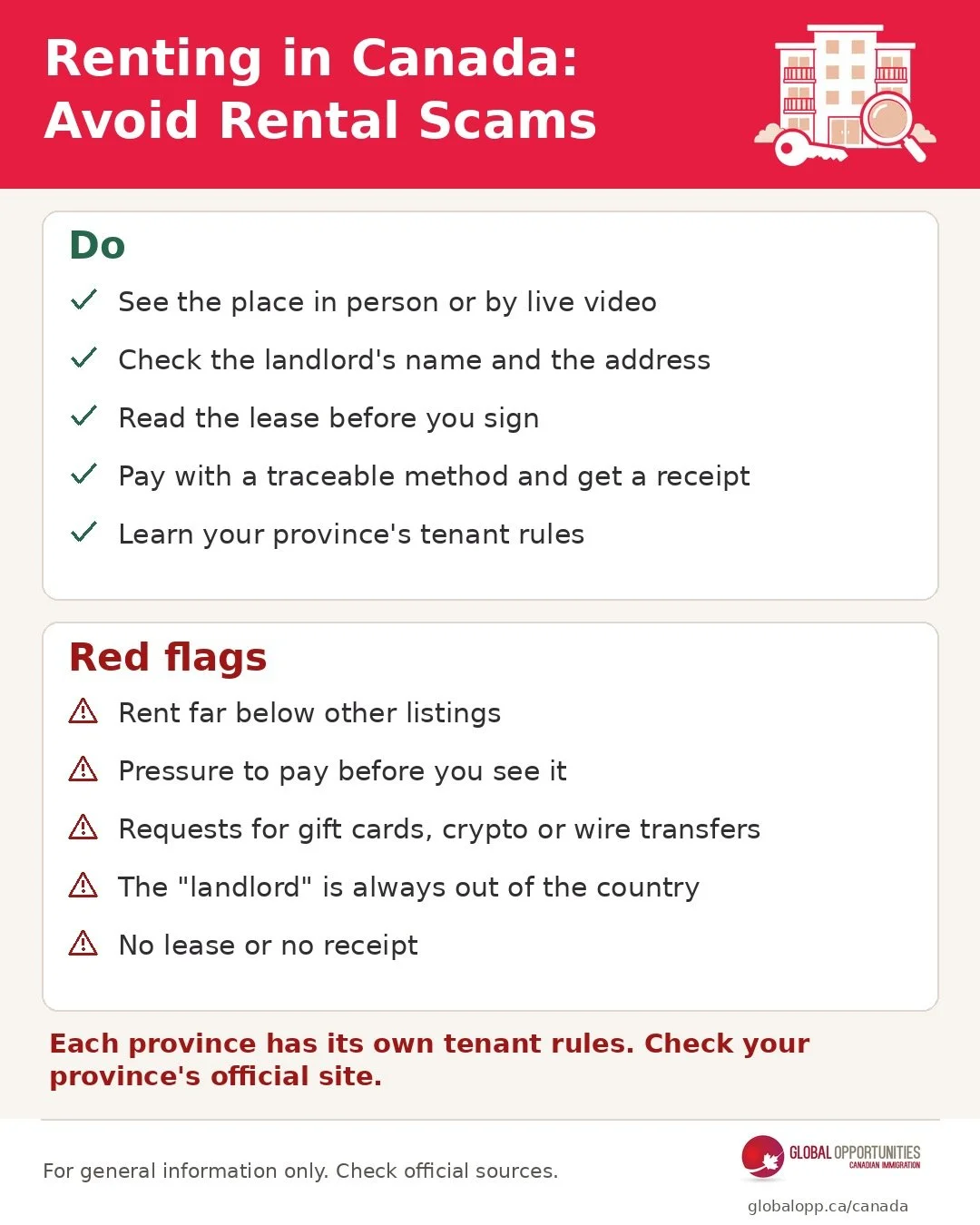
The Competition Bureau warns about rental scams in its article Rental scam: no room for error. Four steps protect you:
Be suspicious of rents far below similar units or pressure to pay quickly.
Never send a deposit to someone you have not met.
Visit the unit in person before you pay.
Get the agreement in writing, with a receipt for every payment.
Utilities: power, heat, water and internet
Saskatchewan's main utility providers include SaskPower for electricity (saskpower.com), SaskEnergy for natural gas (saskenergy.com) and SaskTel for phone, internet and TV (sasktel.com). Ask your landlord exactly which utilities are included in the rent and whether you need tenant insurance.
The Government of Saskatchewan's arrival checklist also mentions ExpressAddress, a service that lets you notify several provincial agencies of a new address at once (first things to do).
Public transit in Saskatchewan: Saskatoon Transit and Regina Transit fares
Saskatoon and Regina have city bus systems, and some smaller cities, such as Prince Albert and Moose Jaw, also run local transit. Fares change, so check the current price on the official page before you travel.
Saskatoon Transit fares
According to Saskatoon Transit's fares page, as of November 2026 (rate schedule effective July 1, 2026):
Single ride (cash or card): adult $3.25; high school students (Grades 9 to 12, with valid ID) $3.00; post-secondary and seniors $3.25.
Children (Grade 8 and under): ride free.
Day pass: $9.50, and a weekend/family pass at the same price.
Monthly passes: adult $91.00; high school $62.00; senior $30.00.
Post-secondary semester pass: $299.20.
Low-income passes (with active eligibility): adult $66.40; high school $47.20.
Ways to pay: exact cash (operators carry no change), a reloadable smart card with a $5.00 activation fee, or mobile tickets through the transit app.
Using the same card or mobile pass within 90 minutes counts as a transfer. The City of Saskatoon has announced a second fare adjustment for January 1, 2027 (City of Saskatoon, 2026 transit rates). Check the current price before you buy.
Regina Transit fares
According to the City of Regina's fares and passes page, as of November 2026:
Cash: $3.50 for all riders, exact coins only.
Stored value on an Umo card: $3.20 per ride, capped at $9.60 per day and $97 per month.
Monthly (31-day) passes: adult (19 to 64) $97; youth (14 to 18) $66; senior (65+) $33; post-secondary $86.
Children 13 and under: a child pass costs $0; children riding without a fare-paying adult need a valid child transit pass.
Affordable passes for lower-income residents: adult $78 and youth $53 (31-day).
U-Pass: University of Regina and SIIT students pay a semester fee for unlimited rides.
Ways to pay: the Umo card ($5 at transit agents), the Umo Mobility app, contactless bank cards (with automatic fare capping) or exact cash.
Transfers are valid for 90 minutes, but only when you pay with Umo, the app or open payment; cash riders pay again. Check the current price before you travel.
Fares as published by Saskatoon Transit and the City of Regina, as of November 2026. Fares, discounts and eligibility for low-income passes change: check the linked fares pages before you buy.
Transit in smaller cities and between cities
Prince Albert (City of Prince Albert, transit) and Moose Jaw (City of Moose Jaw, transit) publish their transit schedules on their city websites. For trips between cities, check the options available for your route before you travel.
Do I need a car in Saskatchewan?
It depends on where you live and work. Before you choose a home, check the bus routes and schedules between it and your work or school on your city's transit website. If you plan to drive, read the next section on SGI licences and insurance.
Driving in Saskatchewan: SGI licences, insurance, car rental and winter driving
In Saskatchewan, driver's licences, vehicle registration and basic auto insurance are all handled by SGI (Saskatchewan Government Insurance). You deal with SGI or one of its motor licence issuers for your licence, your plates and your basic insurance.
Using your foreign licence and exchanging it
According to SGI's driver's handbook (Saskatchewan's driver's licence program):
New residents may drive with their valid out-of-province driver's licence for 90 days after moving to Saskatchewan. Once a Saskatchewan licence is validated, your licence from home is no longer valid.
Licences from countries on SGI's honoured list may be exchanged for a Saskatchewan Class 5 licence. When we checked in November 2026, the list included Australia, Austria, Belgium, France, Germany, Ireland, Italy, Japan, the Netherlands, New Zealand, Poland, Portugal, South Korea, Spain, Switzerland, Taiwan, Ukraine, the United Kingdom and the United States, among others. You need your valid licence, a copy of your driving record and, if the licence is not in English or French, a translation acceptable to SGI, such as an International Driving Permit. SGI notes it may also accept licences from countries not on the list.
Licences from other countries require a driver's examination. The handbook says the nine-month learning period and the driver training requirement may be waived if you can prove past driving experience.
Identity and residency documents must be originals, not photocopies.
The list changes; confirm with SGI before your 90 days run out (SGI, moving to Saskatchewan; SGI, out-of-province licences).
Graduated licensing in Saskatchewan, stage by stage
New drivers go through SGI's Graduated Driver Licensing (GDL) program. According to SGI's handbook (GDL program):
Learner (Class 7), nine months. Minimum age 16 (15 in a high school program). You must pass the written knowledge test. An experienced, licensed supervising driver must sit in the front passenger seat at all times. No cellphone use, hand-held or hands-free. You must complete mandatory driver education: either high school training (30 hours in class and six in the car) or training with an SGI-certified instructor (six hours in class and six in the car). After nine months and the training, you take the road test.
Novice 1 (Class 5), six months. You can drive alone. Only one passenger who is not an immediate family member; between midnight and 5 a.m., passengers must be immediate family. No cellphones.
Novice 2 (Class 5), 12 months. Passengers are limited to the number of seatbelts. You must complete 12 months free of at-fault collisions, traffic convictions and suspensions; if something happens, the 12 months restart. Novice drivers cannot be supervising drivers and cannot get a commercial licence or school bus endorsement.
Experienced Class 5. After Novice 2, you graduate to an experienced licence.
The handbook also sets strict rules on impaired driving for all drivers. Read the full handbook before your test.
Licensing rules as published in SGI's driver's handbook and on SGI's moving to Saskatchewan page, as of November 2026. SGI decides whether a foreign licence can be exchanged and whether experience is credited, and its honoured list changes: check the linked SGI pages before your 90 days run out.
Car insurance in Saskatchewan: how SGI works
According to SGI's handbook (vehicle registration), basic insurance coverage is required by law and is bought at the same time you pay for your licence plates and vehicle registration; it is compulsory and provided by SGI through the Saskatchewan Auto Fund. All Saskatchewan residents are covered by No Fault injury coverage unless they choose Tort injury coverage and file a declaration; SGI explains that you can still be sued if you are at fault. Extra coverage, such as higher liability limits or a lower deductible, is sold as optional "package" policies by SGI and private insurers through insurance brokers.
Renting a car when you arrive
Each rental company sets its own rules on minimum age, accepted licences, young-driver fees and payment, and the rules can vary by location. For example, Enterprise says its minimum rental age is 21 throughout Canada, that renters under 25 generally pay a young renter fee, that you need a valid driver's licence with a photo, and that some locations may require a credit card (Enterprise, renting under 25). Check the requirements of the company and location you choose before you book, and ask whether they accept your foreign licence.
Regina International Airport lists National, Hertz, Avis, Budget and Enterprise on its rental cars page (YQR, rental cars).
Saskatoon John G. Diefenbaker International Airport lists Avis, Alamo, Budget, Enterprise, National and Hertz on airport property (YXE, ground transportation).
International Driving Permit: according to CAA, only CAA is authorized to issue IDPs in Canada, and only to holders of a valid Canadian provincial or territorial licence; an IDP is only valid together with a valid driver's licence (CAA, International Driving Permit). If a rental company asks you for an IDP, ask how you can obtain one in the country that issued your licence.
Remember SGI's 90-day rule, and check what insurance you already have before accepting the rental company's coverage. We mention private companies for reference only. Global Opportunities has no relationship with any of them.
Winter driving and road conditions
Check road conditions before long drives with the provincial Highway Hotline (Government of Saskatchewan, Highway Hotline).
Prepare your car for winter. Ask your mechanic or dealer about winter tires and a block heater, and ask your landlord or employer whether parking comes with an electrical plug-in.
Emergency kit: blanket, warm clothes, booster cables, a shovel, a flashlight, snacks and a charged phone, especially for highway trips.
Snow and parking in Saskatoon and Regina
Regina: according to the City of Regina, snow routes are called when there is 5 cm of snow in a single event, and a 24-hour parking ban then applies along those designated roads; residential streets are plowed only after a substantial snowfall of 15 cm from a single event (City of Regina, plowing, snow and ice control).
Saskatoon: the City's winter road maintenance page explains its snow grading priorities and that, on non-priority streets, graded snow is usually left in windrows or piles in the parking lane, median or boulevard (City of Saskatoon, winter road maintenance).
Follow your city's announcements and check parking signs.
How do newcomers get health care in Saskatchewan? Health card, family doctors and 811
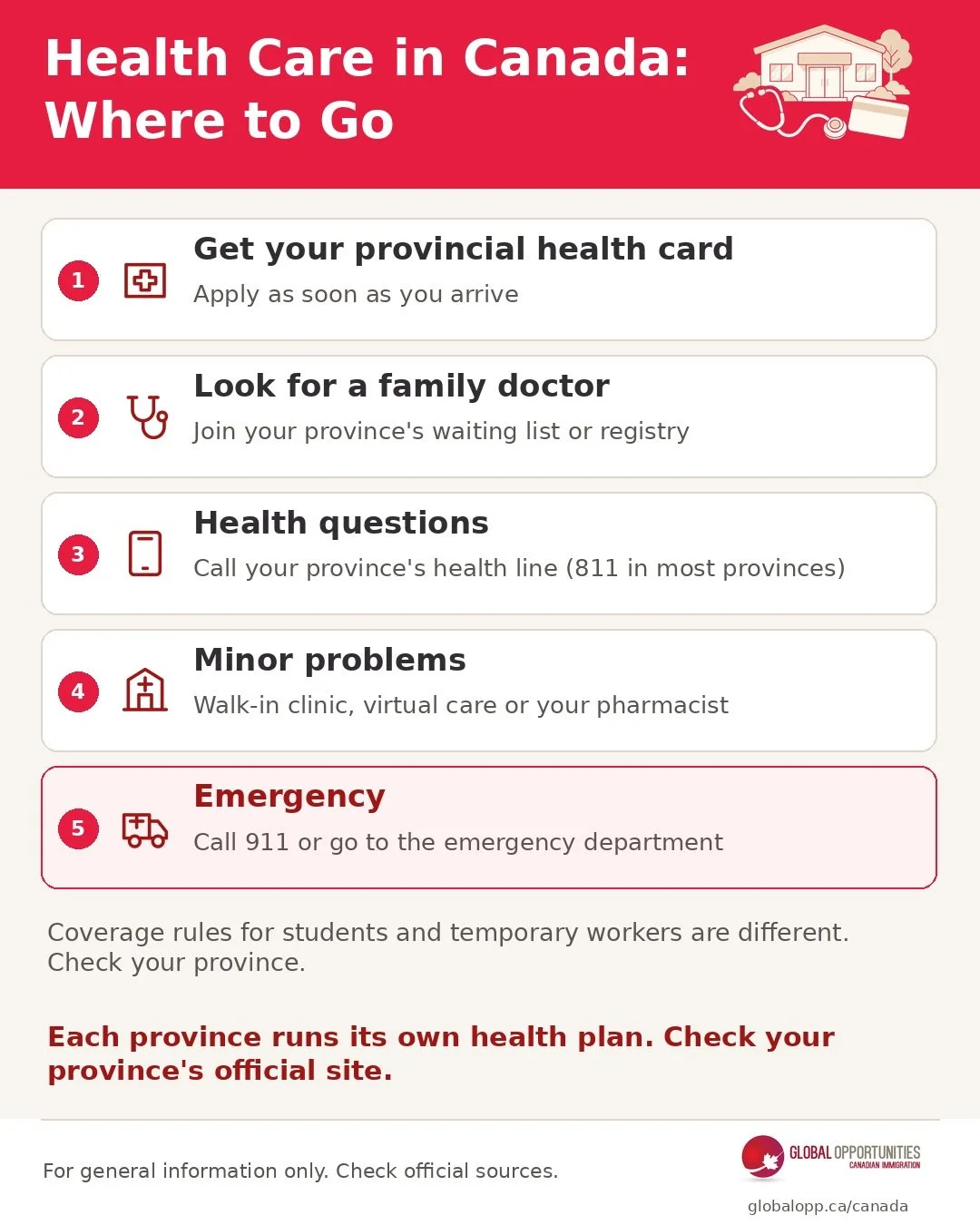
In Saskatchewan, medically necessary care is publicly funded for people with provincial coverage. Your Saskatchewan Health Services Card is issued by eHealth Saskatchewan, and you present it whenever you need health services.
New to how public health care works? Read the health care system in Canada.
Who is eligible for a Saskatchewan health card
According to eHealth Saskatchewan, you are generally eligible for coverage if you (eHealth Saskatchewan, apply for a health card):
live in Saskatchewan and plan to keep living here;
are physically present in the province for at least five months each year;
can provide the required documents, including proof that you can legally be in Canada and proof that you live in Saskatchewan.
If you move from outside Canada, eHealth Saskatchewan explains that you may qualify for coverage on or before the first day of the third month after you arrive in Canada. Consider private health insurance for your first weeks.
International students: the University of Regina explains that international students who hold a valid study permit are eligible for the Saskatchewan Health Card, and that the card is not a complete form of medical insurance, so additional insurance may be needed (University of Regina, health card). Ask your school's international office about its student health plan.
Temporary workers: eligibility depends on your permit and situation; confirm directly with eHealth Saskatchewan.
Eligibility rules as published by eHealth Saskatchewan and the University of Regina, as of November 2026. Meeting these general conditions does not mean you are covered: eHealth Saskatchewan decides each application, and coverage may not start on the day you arrive. Check the linked pages for your own situation.
How to apply for the health card
According to eHealth Saskatchewan, the steps are:
Check that you are eligible (see the section above).
Choose how to apply: online, through your Saskatchewan Account (select the Health Card service); by mail or courier, with the health card application form, to eHealth Saskatchewan, 101-1901 Scarth St., Regina; or in person at the eHealth front desk, 1901 Scarth St., Regina.
Include each family member who needs coverage.
Keep copies of your documents until your card arrives.
What the health card covers, and what it does not
Provincial coverage does not pay for everything, so ask your employer or school about extra health insurance. The Government of Saskatchewan explains its drug plans and extra coverage for eligible residents on its prescription drug plans and health coverage page.
Finding a family doctor and other care in Saskatchewan
To find care in Saskatchewan, newcomers can:
call HealthLine 811 for advice on whether to treat symptoms at home, go to a clinic, see a primary care provider or get emergency care (see below);
use the Saskatchewan Health Authority's facilities and locations search, which includes primary health care sites, community health centres and walk-in and urgent care locations;
contact clinics near their home and ask whether they accept new patients;
ask their settlement agency, school or employer for help.
Keep your records from home, including vaccinations and a list of your current medications with their generic names, translated if needed. Start looking right after you get your health card.
HealthLine 811 and emergencies
For a life-threatening emergency, call 911 or go to the nearest hospital emergency department.
For health questions that are not emergencies, call HealthLine 811. According to the Government of Saskatchewan, it is free, confidential and open 24/7, staffed by registered nurses, registered psychiatric nurses and registered social workers. Services are in English, with translation in over 100 languages. A nurse can help you decide whether to treat symptoms at home, go to a clinic, see your primary care provider or get emergency care (HealthLine 811).
Banking in Saskatchewan for newcomers
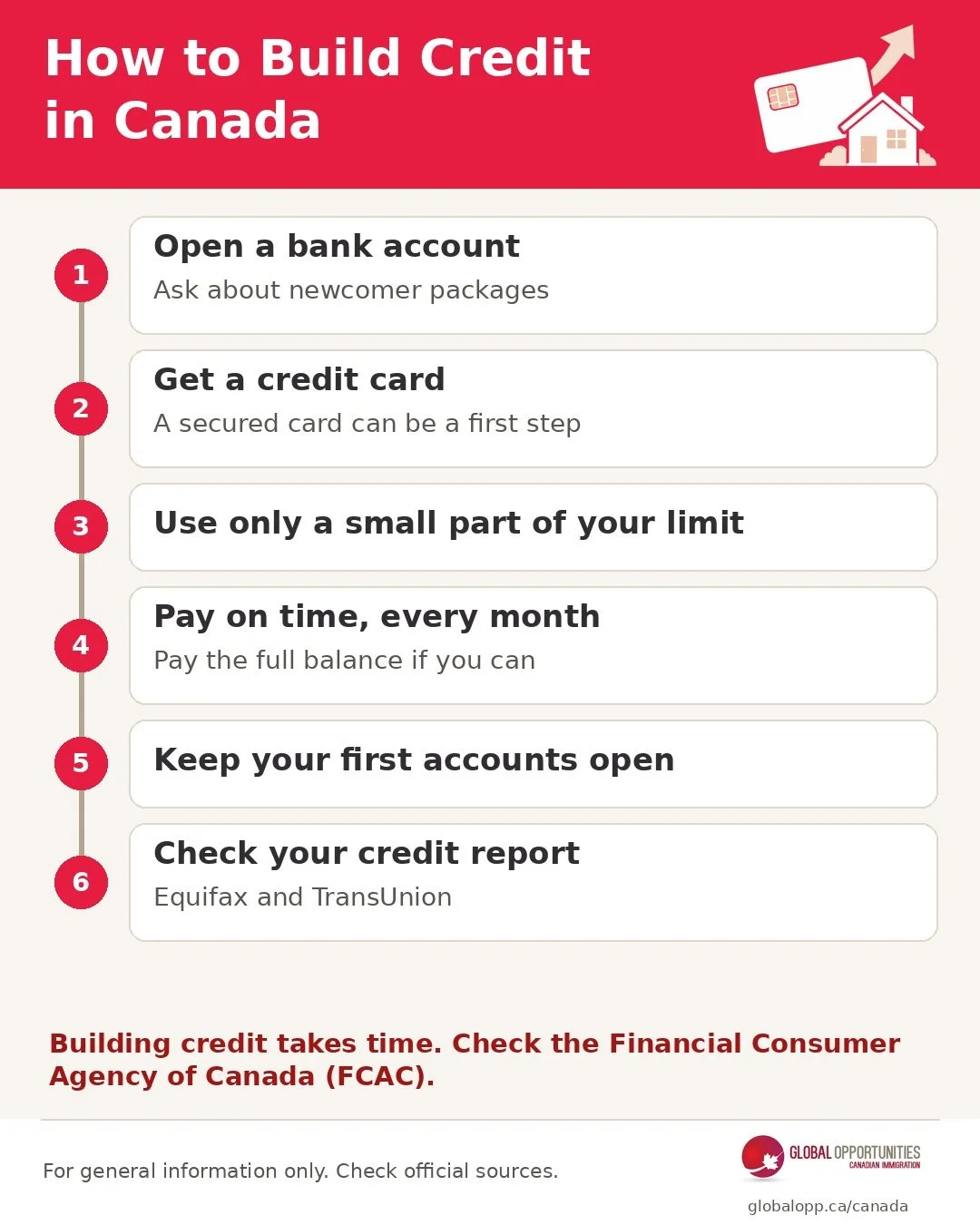
Opening a bank account is one of the first things to do. You need it to receive your pay, rent an apartment and build a credit history.
Banks and credit unions in Saskatchewan
Several national banks list branches in Saskatchewan's two largest cities on their official branch locators, for example RBC (Saskatoon main branch), TD Canada Trust (which lists a Regina address on its legal notices page), Scotiabank (Westgate Plaza, Saskatoon), BMO (Regina Main Office), CIBC (2nd Ave. and 21st, Saskatoon) and National Bank (Saskatoon locations).
Saskatchewan also has member-owned credit unions. For example, Conexus Credit Union says it has branches across Saskatchewan (conexus.ca), Affinity Credit Union says it has members and advice centres across Treaties 4 and 6 (affinitycu.ca), and Innovation Credit Union says it serves members in advice centre locations including Regina and Saskatoon (Innovation Credit Union, about us).
Compare monthly fees, transaction limits, international transfer costs and branch locations. We mention financial institutions for reference only. Global Opportunities has no relationship with any of them and does not recommend any.
What you need to open an account
The Financial Consumer Agency of Canada explains which identification banks accept and your right to open an account (FCAC, opening a bank account). The bank must confirm your identity with original documents, not copies; ask the bank which of your documents, such as your passport and immigration document, it accepts.
Building a credit history
If you are new to Canada, you may have no Canadian credit history yet. The FCAC explains credit reports and scores.
Groceries and shopping in Saskatchewan
Saskatchewan has local co-operatives and national supermarket chains. Check each store's website for locations near you.
Supermarkets in Saskatchewan
Co-op: for example, Saskatoon Co-op describes itself as a locally-owned co-operative serving Saskatoon, Martensville, Warman and other communities, with food, pharmacy, home centre, liquor and gas bar services (Saskatoon Co-op).
Real Canadian Superstore and No Frills list Saskatchewan among the provinces in their store locators (Real Canadian Superstore, store locator; No Frills, store locator).
Ask your settlement agency or community groups where to find ingredients from home. We mention stores for reference only. Global Opportunities has no relationship with any of them.
How much tax do you pay in Saskatchewan, and which benefits can you get?
In Saskatchewan you pay federal and provincial income tax on what you earn, and GST plus PST on most purchases. Filing a tax return every year is also how you receive benefits such as the Canada child benefit, the Saskatchewan low-income tax credit and, for eligible graduates, the Graduate Retention Program.
How much income tax do you pay in Saskatchewan?
In Canada, personal income tax is administered by the Canada Revenue Agency (CRA). You pay federal tax and provincial tax, and both are calculated on the same yearly tax return. Canada uses brackets: each rate applies only to the portion of your taxable income that falls within that bracket, not to your whole income. According to the CRA, your provincial rate is determined by the province or territory where you lived on December 31 of the tax year (CRA, tax rates and income brackets for the current year).
According to the CRA's tax rates page, the rates for the 2026 tax year are, as of November 2026:
Federal: 14% on the first $58,523 of taxable income, rising in steps up to 33% on the portion over $258,482.
Saskatchewan: 10.5% on the first $54,532; 12.5% on the portion from $54,532.01 to $155,805; and 14.5% on the portion over $155,805.
Rates and brackets change every year, so check the current rate on the CRA page. If you are an employee, your employer deducts tax from each pay cheque; your return then settles the difference and claims your credits. You need a Social Insurance Number (SIN) to work and file. The CRA's page for newcomers to Canada explains residency for tax purposes, how to do your first return and how newcomers can apply for benefit payments even before they file for the first time. If your income is modest and your situation simple, the CRA lists free tax clinics.
Sales tax in Saskatchewan: PST and GST
Saskatchewan charges a provincial sales tax (PST) of 6% on taxable goods and services (Government of Saskatchewan, provincial sales tax), and the federal GST of 5% applies across Canada (Canada Revenue Agency, GST/HST rates). Rates were current as of November 2026; check the official pages.
The Canada child benefit and other federal payments
According to the CRA, the Canada child benefit (CCB) is a tax-free monthly payment for eligible families to help with the cost of raising children under 18 (CRA, Canada child benefit). The CRA lists the conditions: you live with the child, you are primarily responsible for the child's care and upbringing, you are a resident of Canada for tax purposes, and you or your spouse or common-law partner is a Canadian citizen, a permanent resident, a protected person or a temporary resident who meets the CRA's conditions (CRA, before you apply for the CCB). Newcomers can apply through their CRA account or with Form RC66 (CRA, how to apply for the CCB). The amount depends on family income and on the number and ages of your children, and you and your spouse or partner must file a tax return every year to keep receiving it.
According to the CRA, it also pays the Canada Groceries and Essentials Benefit (CGEB), which replaced the GST/HST credit in July 2026, and it provides tax-free quarterly payments to individuals and families with low and modest incomes, and you are automatically considered for it when you file your taxes (CRA, Canada Groceries and Essentials Benefit).
The Saskatchewan low-income tax credit
The CRA administers the Saskatchewan low-income tax credit (SLITC) for the province. According to the CRA, it is a tax-free amount paid to help Saskatchewan residents with low and modest incomes, combined with the quarterly CGEB payments. For July 2026 to June 2027, it provides up to $460 for an individual, $460 for a spouse or common-law partner (or an eligible dependant) and $181 per child, up to two children, and it starts to be reduced when adjusted family net income is more than $39,345 (CRA, Province of Saskatchewan programs), as of November 2026. You do not apply separately: filing your tax return is what puts you in the system. Check the current amounts on the CRA page.
The Saskatchewan Graduate Retention Program (GRP)
According to the Government of Saskatchewan, the Graduate Retention Program (GRP) provides a tax rebate to eligible post-secondary graduates who live and file income tax in Saskatchewan (Government of Saskatchewan, Graduate Retention Program). When we checked the official page in November 2026, it listed these conditions, among others:
you graduated from an approved program at an eligible post-secondary institution, equivalent to at least six months of full-time study, that leads to a certificate, diploma, undergraduate degree or journeyperson certification (master's and PhD degrees are not eligible);
you live in or are moving to Saskatchewan and file Saskatchewan income tax;
you graduated within the last seven years.
The amount depends on your program and the tuition you paid; for programs completed on or after October 1, 2024, the official GRP page lists maximums from $3,600 for a one-year certificate up to $24,000 for a four-year undergraduate degree. The rebate is applied as a reduction to the income tax you owe and is paid out over seven years. Most Saskatchewan institutions apply on your behalf with your consent, and you receive a GRP certificate in your Advanced Education Student Portal account; you include it the first time you claim the credit on your return. If you studied outside Saskatchewan, including outside Canada, the page explains how to apply yourself. If you are an international student who plans to stay and work in Saskatchewan after graduating, check whether your situation meets the conditions on the official page, because they can change.
$10-a-day child care in Saskatchewan
According to the Government of Saskatchewan, parents of children under six enrolled in licensed child care pay $10 a day, and since April 1, 2026, children who turn six while in Kindergarten can continue with $10-a-day care until the end of the school year (Government of Saskatchewan, child care updates), as of November 2026. The province introduced it in April 2023 under the Canada-Saskatchewan Canada-Wide Early Learning and Child Care Agreement, and a five-year extension took effect on April 1, 2026. To find regulated child care near you, use the province's map of regulated child care facilities, and contact providers early, because spaces fill up. Check the current fee on the official page.
Tax rates, benefit amounts and program conditions as published by the Canada Revenue Agency and the Government of Saskatchewan, as of November 2026. Tax rates apply only to the part of your income in each bracket, and benefits depend on your eligibility, which the CRA or the province decides: check the linked pages before you rely on these figures.
How cold is Saskatchewan, and how do you prepare for winter?
IRCC describes the Prairie Provinces as mostly dry, with cold winters and hot summers (Discover Canada).
The seasons in Saskatchewan
Temperatures, snowfall and daylight vary a lot between the south and the north and from year to year. To compare cities, look up official climate normals on the Environment and Climate Change Canada climate normals site, and check the forecast before you travel.
Wind chill and extreme cold
Environment and Climate Change Canada uses the wind chill to describe how cold it feels on exposed skin when the wind blows. It issues extreme cold warnings when conditions become dangerous, and explains how frostbite can develop quickly on exposed skin in severe wind chill (ECCC, wind chill and cold weather). Check the forecast every morning in winter, cover your face, ears and hands, and limit time outside on the coldest days.
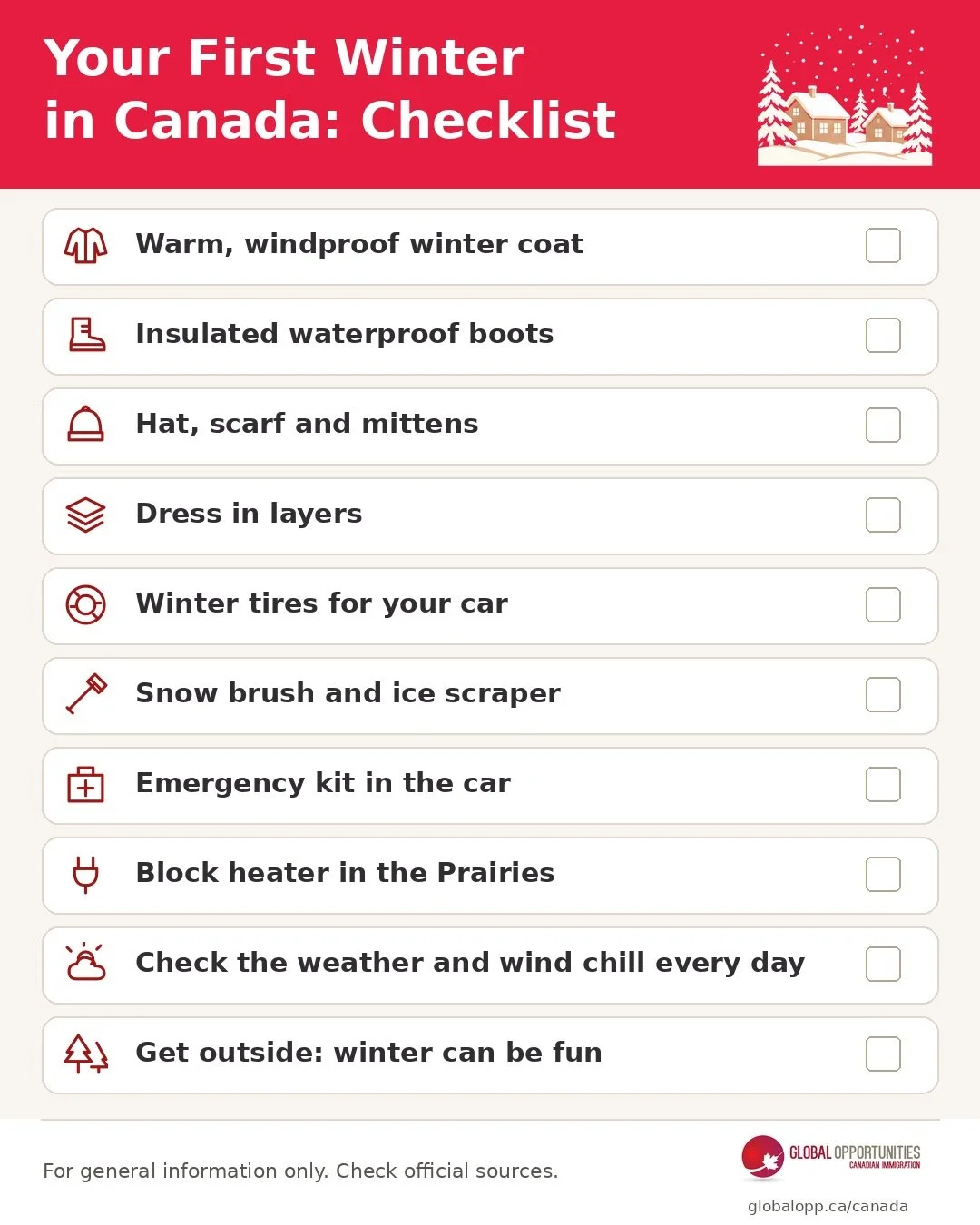
What to buy for your first winter, and where
A warm winter coat (insulated, windproof, long enough to cover your hips).
Insulated, waterproof winter boots with good grip.
A hat that covers your ears, a scarf or neck warmer, and insulated gloves or mittens.
Thermal layers for very cold days.
For drivers: winter tires, a long-handled snow brush and scraper, an emergency kit and a block heater cord.
You can buy them new in clothing and outdoor stores, or second-hand, for example at Value Village, which lists stores in Saskatoon and Regina (Value Village, Saskatchewan stores). We mention stores for reference only and have no relationship with them.
First-winter checklist
Buy boots and a coat before the first cold days, ask your landlord how the heating works and whether parking comes with a plug-in, save your city's snow and parking information, and keep an emergency kit at home and in the car.
Education in Saskatchewan: schools, colleges and universities
Saskatchewan has public, separate (faith-based) and francophone school divisions, two universities with federated and affiliated colleges, a polytechnic, regional colleges, Indigenous institutions, French-language options and free English classes for many newcomers.
Public schools for children
According to the Government of Saskatchewan, the province has 27 school divisions: 18 public, 8 separate (faith-based) and 1 francophone division for students whose first language is French. Students are usually placed in grades with peers close in age, and prekindergarten, a half-day option for children aged three and four, is offered at a limited number of schools (Government of Saskatchewan, PreK-12 education for newcomers). That page points to the guide Education in Saskatchewan: A Guide for Newcomers for registration details, and links to resources on English as an additional language (EAL) in Saskatchewan schools. You can also see the list of school divisions.
How to register your child in school
Find the school division that serves your address in the list of school divisions.
Read the province's guide for newcomers, then contact the division or the nearest school.
Ask which documents to bring; keep your child's previous school records and immunization records at hand, translated if possible.
Ask about English as an additional language (EAL) support, school buses, fees and before- and after-school care.
Child care
Saskatchewan's Early Learning and Child Care Program supports regulated child care under the Canada-Saskatchewan Canada-Wide Early Learning and Child Care Agreement. See the Government of Saskatchewan's child care page and ask providers about availability early, because spaces fill up. Our taxes and benefits section explains how $10-a-day child care works.
Saskatchewan's universities
All descriptions below come from the Government of Saskatchewan's post-secondary institutions page, which marks which institutions and campuses are designated to accept international students, and from each institution's own website. Programs change every year; check each institution.
University of Saskatchewan (USask), Saskatoon. The province and USask describe it as one of the top research-intensive, medical doctoral universities in Canada. USask says it offers undergraduate and graduate programs in over 200 fields of study, and its program lists include agriculture, engineering, law and veterinary medicine (usask.ca).
University of Regina (URegina), Regina, with a Saskatoon campus. According to the province, its main campus is in Wascana Park, one of the largest urban parks in North America. The University of Regina says it pioneered the first co-operative education program in Western Canada more than half a century ago and emphasizes experiential learning (uregina.ca).
Federated and affiliated colleges
According to the provincial page:
Campion College and Luther College are federated colleges at the University of Regina, in Regina. Luther College says it offers a liberal arts and sciences education (luthercollege.edu).
St. Thomas More College is a federated college at the University of Saskatchewan, in Saskatoon.
First Nations University of Canada is a federated college with campuses in Regina (at the University of Regina), Prince Albert and Saskatoon. It describes itself as specializing in Indigenous knowledge, serving Indigenous and non-Indigenous students (fnuniv.ca).
Affiliated colleges, most of them theological: St. Peter's College (Muenster), Briercrest College and Seminary (Caronport), and the College of Emmanuel and St. Chad, Horizon College and Seminary, Lutheran Theological Seminary and St. Andrew's College (all in Saskatoon).
Saskatchewan Polytechnic
Saskatchewan Polytechnic has campuses in Moose Jaw, Prince Albert, Regina and Saskatoon, plus distance education. The province describes it as the province's leading publicly funded post-secondary technical and skills training institute. Its schools include agriculture, natural resources and sustainability; business and entrepreneurship; computing and digital innovation; construction; health sciences; nursing; mining, manufacturing and engineering technologies; transportation; and education and community services, and it has a co-operative education program (saskpolytech.ca).
Saskatchewan's regional colleges
The province's post-secondary institutions page explains that regional colleges offer post-secondary programs in learning environments of 24 students or fewer, and marks which colleges and campuses are designated for international students; check the provincial page for the campus you are interested in.
Carlton Trail College: the province lists Humboldt, Punnichy, Wakaw, Watrous and Wynyard; the college says it serves the communities of east-central Saskatchewan (carltontrailcollege.com).
Great Plains College: Biggar, Kindersley, Maple Creek, Martensville, Swift Current and Warman (greatplainscollege.ca).
Lakeland College: a Lloydminster Campus with an Alberta address; not marked as designated for international students on the Saskatchewan list (lakelandcollege.ca).
Northlands College: campuses in La Ronge, Air Ronge, Buffalo Narrows and Creighton; it describes itself as Saskatchewan's northern college (northlandscollege.ca).
North West College: two primary campuses, in North Battleford (Battlefords Campus) and Meadow Lake, plus learning centres in the region (northwestcollege.ca).
Southeast College: the province lists Estevan, Indian Head, Weyburn and Whitewood, and the college says its main campus and administrative office are in Weyburn (southeastcollege.org).
Suncrest College: the province lists Canora, Kamsack, Esterhazy, Fort Qu'Appelle, Nipawin, Melfort, Melville, Tisdale and Yorkton (suncrestcollege.ca).
Indigenous institutions
Saskatchewan Indian Institute of Technologies (SIIT): the province describes it as a First Nations-governed educational institution for adult learners, with locations in Saskatoon, Regina, Prince Albert and other community sites. SIIT also runs JobConnections, an employment service with locations across Saskatchewan (siit.ca).
Gabriel Dumont Institute of Native Studies and Applied Research: locations in Saskatoon, Regina, Prince Albert, La Loche and other community sites, according to the province. It describes itself as an educational, employment and cultural institute serving Métis across the province, and its programs include SUNTEP, the Saskatchewan Urban Native Teacher Education Program (gdins.org).
Studying in French
La Cité universitaire francophone (University of Regina): offers degrees in French, from bachelor's to doctoral level, and certificates in French as a second language (La Cité).
Collège Mathieu (Gravelbourg, with Regina and Saskatoon also named): a French-language college offering technical and professional training in fields such as administration, education, trades, health and tourism (collegemathieu.sk.ca).
This list is for reference only. Institutions change their programs, campuses and admission requirements; always confirm on the institution's official website.
How to apply to college or university in Saskatchewan
Saskatchewan has no central application service: you apply directly to each institution, on its website, following its deadlines and admission requirements. International students should check that the institution and campus are on IRCC's list of designated learning institutions (DLIs). IRCC explains that a provincial attestation letter (PAL) is usually required to apply for a study permit, with exceptions listed on its page, and that you should contact your school to learn how to get one (IRCC, provincial attestation letter). Study and post-study work rules change often; read IRCC's study in Canada page.
Study permit rules as described by IRCC, as of November 2026. Being admitted to a school or holding a PAL does not mean a study permit will be approved; IRCC decides each case. What applies to you depends on your situation, so check the linked IRCC pages or book a consultation.
Free English classes for newcomers
According to the Government of Saskatchewan, many English classes for immigrants are free, provided by the Government of Canada and the Government of Saskatchewan, in a classroom or online. Before registering, you need a language assessment to find your Canadian Language Benchmark (CLB) level; the Regional Newcomer Gateway or your local regional college can help you book one (language training).
According to IRCC, permanent residents and protected persons can take free federal language classes (LINC) (IRCC, language classes).
Jobs and main industries in Saskatchewan
According to IRCC, Saskatchewan has 40% of the arable land in Canada, is the country's largest producer of grains and oilseeds, has the world's richest deposits of uranium and potash, and produces oil and natural gas (Discover Canada). Global Opportunities does not offer jobs, and no one can guarantee you a job in Canada.
Main industries in Saskatchewan
According to the Government of Saskatchewan, the province recorded over $43.7 billion in exports in 2025, reaching over 160 countries. Potash exports grew 13.5% from 2024, and other top export products included crude petroleum oil, wheat, canola seeds and natural uranium (Government of Saskatchewan, June 18, 2026).
Agriculture: according to IRCC, Saskatchewan is Canada's largest producer of grains and oilseeds, and wheat and canola seeds are among its top exports, according to the province.
Mining: potash and uranium, with Saskatoon as the mining industry's headquarters, according to IRCC.
Oil and natural gas, which IRCC lists among the province's products; crude petroleum oil is one of its top exports.
Other sectors: use Job Bank's outlooks (below) to see the prospects for your own occupation in Saskatchewan.
Where to look for work
Job Bank: the Government of Canada's job board, by province, city and occupation.
SaskJobs: Saskatchewan's job board, with openings across the province, job alerts and a resume builder.
Job Bank outlooks for Saskatchewan: three-year employment outlooks by occupation. They are not job offers.
Job Bank wage search: wages by occupation and region, as a market reference.
Saskatchewan Health Authority: the province's health authority.
Employer websites of Crown corporations, school divisions, universities, cities and large companies.
Before you apply, read our guide to Canadian resumes, cover letters and job interviews.
Free employment services in Saskatchewan
SaskJobs Career Services, run by the provincial ministry responsible for immigration and career training, offers job search, job matching, career planning and training services to Saskatchewan residents, including help with resumes, cover letters and interviews, with offices in Regina, Saskatoon, Prince Albert, Moose Jaw, Yorkton, North Battleford, Lloydminster, Estevan, Meadow Lake and La Ronge (SaskJobs Career Services).
Settlement agencies in the provincial list can tell you which employment supports they offer for eligible newcomers.
Regional Newcomer Gateways and regional colleges can connect you with English classes and employment supports.
For resume samples and tips on Canadian-style job applications, read our newcomer guide to Canada.
The Government of Saskatchewan suggests asking yourself practical questions before you look for work: how much money you and your family will need, whether you can work in your occupation of training, and whether you are willing to work in a related field if you cannot (regulated occupations and licensing).
Your rights at work
Saskatchewan's Employment Standards set out workplace rights and responsibilities for employers and employees, such as hours, overtime, vacations and termination (Government of Saskatchewan, employment standards). According to the Government of Saskatchewan, as of October 1, 2026, the minimum wage is $15.70 per hour (Government of Saskatchewan, minimum wage and reporting for duty pay). It changes over time, so check the current rate on the official page. If you are injured at work, you may be covered by the Saskatchewan Workers' Compensation Board.
Minimum wage as published by the Government of Saskatchewan, as of November 2026. It is the legal minimum, not a typical wage, and it may have changed by the time you read this: check the linked page before you rely on it.
Regulated occupations
According to the Government of Saskatchewan, most occupations in Saskatchewan are not regulated, and for those the employer sets the qualifications. If your occupation is regulated, you need a licence or certification from the right regulatory body. The province lists Saskatchewan regulatory bodies, and its Credential Recognition Services provide information and personalized support to help people trained elsewhere get their credentials recognized.
For more on licences, credential assessments and job searches by profession, see our guide on how to immigrate to Canada as a professional. Many regulators and employers ask for proof of English or French; our guide to English and French tests for Canada explains the main tests. Nurses trained abroad can read how to immigrate to Canada as a nurse, which lists the nursing regulator in each province.
Any mention of regulated occupations in this guide is for reference only. It may not be complete. Always confirm requirements directly with the regulator for your profession or trade.
Free newcomer services in Saskatchewan
Settlement services in Saskatchewan are free for eligible newcomers. According to the Government of Saskatchewan, settlement agencies offer information and referrals and one-on-one support from settlement advisors (settlement services).
Settlement agencies by city
When we checked in November 2026, the provincial list included:
Saskatoon: Saskatoon Open Door Society, Global Gathering Place, International Women of Saskatoon, Saskatchewan Intercultural Association and the Ukrainian Canadian Congress.
Regina: Regina Open Door Society, Regina Immigrant Women Centre and a Regina office of International Women of Saskatoon.
Across the province (in French): Assemblée communautaire fransaskoise.
Estevan: Southeast Advocates. Humboldt: Humboldt Regional Newcomer Centre. Lloydminster: Lloydminster Learning Council Association and Catholic Social Services. Moose Jaw: Moose Jaw Multicultural Council. North Battleford: Battlefords Immigration Resource Center. Prince Albert: Prince Albert Multicultural Council and YWCA Prince Albert. Swift Current: Southwest Newcomer Welcome Centre. Tisdale: Town of Tisdale. Yorkton: East Central Newcomer Welcome Centre.
This list is for reference only and may change; confirm on the official page.
Other free help
Regional Newcomer Gateways help with English assessments and connections to services; they also offer over-the-phone interpretation, according to the province.
211 Saskatchewan is a free, confidential directory of community, social and government services (sk.211.ca).
IRCC's newcomer services finder lists free federally funded services near you.
Find immigration services near you: the province's map of services.
How much does it cost to live in Saskatchewan?
Your main monthly costs will include housing, food, transportation, utilities and phone. Our official reference points: according to CMHC's October 2025 Rental Market Survey, the average two-bedroom rent was $1,548 in Saskatoon, $1,473 in Regina and $1,451 across centres of 10,000+; as of November 2026, adult monthly transit passes cost $91.00 according to Saskatoon Transit and $97 according to the City of Regina; and taxable purchases carry PST of 6%, according to the Government of Saskatchewan, plus GST of 5%, according to the Canada Revenue Agency. All of them change, so check the current price on the sources linked in each section. To save, consider shared housing at first, compare grocery prices, look at second-hand winter clothing and check whether you qualify for low-income transit passes and the benefits in our taxes and benefits section. For a national overview, see our article on the cost of living in Canada.
Figures as published by CMHC, Saskatoon Transit, the City of Regina, the Government of Saskatchewan and the Canada Revenue Agency, as of November 2026. They are reference points, not a budget for your household, and may have changed: check the linked pages before you rely on them.
Culture, community and things to do in Saskatchewan
Saskatchewan has Indigenous and Métis heritage sites, national and provincial parks, and sports and events in its cities.
Heritage
Wanuskewin Heritage Park, which describes itself as a sacred site and gathering place for more than 6,400 years, working to advance understanding of the cultures of Northern Plains Indigenous peoples (Wanuskewin).
Batoche National Historic Site, which, according to Parks Canada, is about one hour north of Saskatoon on the South Saskatchewan River, was the scene of the Northwest Resistance of 1885 and is a symbol of Métis resilience and cultural renewal (Parks Canada).
Regina, where Tourism Regina suggests a walk around Wascana Centre and Wascana Lake (Tourism Regina).
Nature and the outdoors
Grasslands National Park, in southern Saskatchewan, to explore the prairie by day or night, with fossils and traces of those who lived there before (Parks Canada).
Prince Albert National Park, where prairie meets boreal forest, lakes and wetlands (Parks Canada).
Provincial parks for camping, beaches and trails (Saskatchewan Parks).
Sports and community
The CFL's Saskatchewan Roughriders play at Mosaic Stadium in Regina, according to the City of Regina (City of Regina, Mosaic Stadium; team site riderville.com). In Saskatoon, Tourism Saskatoon describes Broadway as a district for shopping, dining and entertainment (Tourism Saskatoon). To meet people and find cultural and community groups, ask your settlement agency and check your city's recreation programs on saskatoon.ca or regina.ca. Settling in is also about people: read our article on building community in Canada.
For more ideas, see the official tourism site, Tourism Saskatchewan.
How can you immigrate to Saskatchewan?
There is no single "Saskatchewan visa". People move to Saskatchewan through federal immigration programs run by IRCC, through the Saskatchewan Immigrant Nominee Program (SINP), or with a temporary permit to study or work. Programs, categories, requirements and fees change frequently, so always check the official pages linked below. Wanting to live in Saskatchewan is one thing; the program that fits your profile may be a different one. Which pathway, if any, fits you depends on each case, and requirements such as language levels or settlement funds are best reviewed in a personalized consultation.
If you plan to visit first, use IRCC's official tool to check if you need a visa or an eTA.
Express Entry
According to IRCC, Express Entry manages applications for three programs: the Federal Skilled Worker Program, the Federal Skilled Trades Program and the Canadian Experience Class (IRCC, Express Entry). Draws, categories and requirements change; see also our page on the Federal Skilled Worker program.
The Saskatchewan Immigrant Nominee Program (SINP)
The SINP is Saskatchewan's provincial nominee program: the province can nominate people for permanent residence, and the Government of Canada makes the final decision (IRCC, provincial nominee program).
When we reviewed the official pages in November 2026, the Government of Saskatchewan grouped SINP programs into four categories (Government of Saskatchewan, browse SINP programs):
International Skilled Worker
Worker with Saskatchewan Work Experience
Entrepreneur
Farm Owner and Operator
Each category has sub-categories with their own requirements. The official SINP page explains how to assess your eligibility, how to apply and the language requirements, and its Immigration FAQs cover recent program changes. IRCC explains that provincial nominee applications go through either Express Entry or a non-Express Entry process. For an overview of how these programs work across Canada, see our page on provincial nominee programs.
SINP categories, sub-categories and requirements change often. What you read here may already be different when you read it. Always check the official SINP pages, and be wary of anyone who promises a nomination, permanent residence or a job. Meeting the requirements does not mean an application will be approved: the province decides nominations and IRCC decides permanent residence.
Studying and working in Saskatchewan
IRCC describes two main types of work permits: employer-specific work permits and open work permits (IRCC, work in Canada). Some employer-specific permits require a Labour Market Impact Assessment; see our page on the LMIA. If you are a young person from a participating country, read our page on International Experience Canada (Working Holiday) and confirm the current rules on the official IRCC website. If your permit ends within a year, watch Is your work permit or PGWP expiring in the next 12 months? If you graduate from a Saskatchewan post-secondary program, see also the Graduate Retention Program in our taxes and benefits section.
Already working in the province? Watch why being eligible for permanent residence is not the same as being selected.
After permanent residence, many people apply for citizenship: see our guide to Canadian citizenship.
Work permit types as described by IRCC, as of November 2026. Holding a job offer or meeting a program's published conditions does not mean a permit will be approved; IRCC decides each case. What applies to you depends on your situation: check the linked IRCC pages or book a consultation.
French in Saskatchewan
English is the main language in Saskatchewan, but the province has a francophone community, the Fransaskois, with its own school division, French-language post-secondary options and some government services in French.
Schools. One of Saskatchewan's 27 school divisions is a francophone division for students whose first language is French (PreK-12 education for newcomers).
Post-secondary. La Cité universitaire francophone of the University of Regina and Collège Mathieu offer studies in French (post-secondary institutions).
Government services. The Bonjour! citizen services centre gives general information in French on Government of Saskatchewan programs at 1-888-345-0850, and the government can provide services in French in some of its ministries, Crown corporations and agencies (Centre de services aux citoyens Bonjour!).
The Government of Saskatchewan notes that you will use English to communicate with your employer, doctor and neighbours. If French is one of your strengths, read our page on French language proficiency. Global Opportunities does not offer services for Quebec's immigration programs; this guide covers Saskatchewan only.
First steps after arriving in Saskatchewan
The Government of Saskatchewan publishes a first things to do checklist for newcomers. Here are the key tasks.
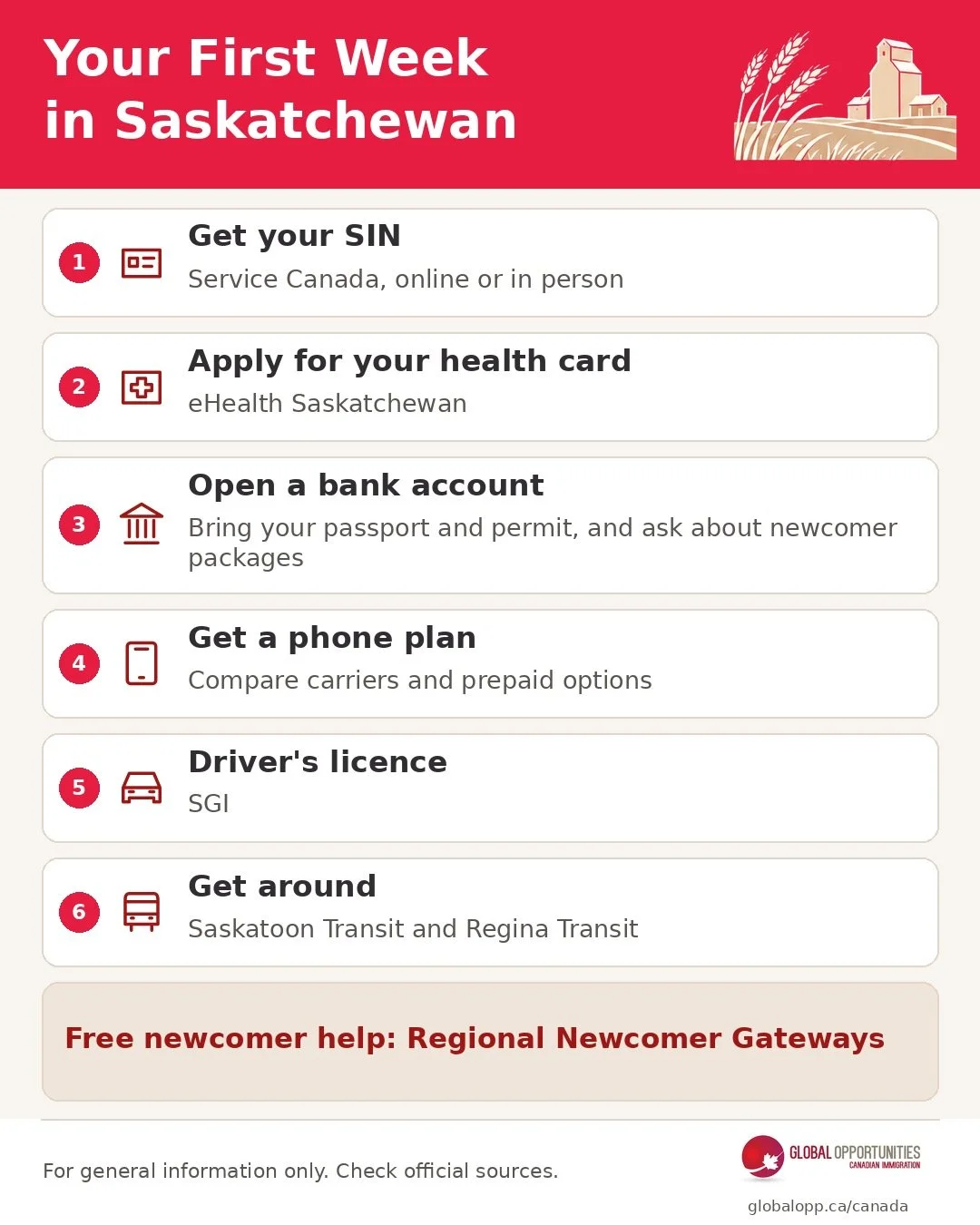
Your first-weeks checklist
Get your Social Insurance Number (SIN), which, according to Service Canada, is the 9-digit number you need to work in Canada and access government benefits (Service Canada, SIN).
Apply for your Saskatchewan Health Services Card with eHealth Saskatchewan (apply for a health card).
Open a bank account and get a phone plan.
Find a place to live and set up utilities; use ExpressAddress when you move.
Connect with settlement services through the provincial list or IRCC's newcomer services finder.
Book a language assessment if you want free English classes.
Register your children for school with your local school division.
Look for a family doctor and save HealthLine 811.
Switch your driver's licence with SGI within the 90 days that SGI's handbook allows.
Get a transit card (a Saskatoon smart card or a Regina Umo card).
Prepare for winter before the first cold days.
Frequently asked questions
Is Saskatchewan a good place to live?
It depends on your work, your budget and how you feel about winter. The province's economy rests on agriculture, mining and energy (see the jobs section), CMHC's average rents for Saskatoon and Regina are listed in the housing section so you can compare them with other cities, and the 2021 Census shows established Filipino, South Asian and other communities (see "Population by origin" above). On the other hand, winters are long and very cold, many smaller towns need a car, and job prospects vary by occupation. Compare CMHC rents and Job Bank outlooks for your occupation in Saskatoon, Regina and smaller cities before you decide, and remember that no one can promise that a move will work out.
Should I live in Saskatoon or Regina?
Work, study and contacts usually decide. According to IRCC's Discover Canada, Saskatoon is the headquarters of the province's mining industry and an educational, research and technology centre, and Regina is the provincial capital and home of the RCMP training academy. In CMHC's October 2025 survey, the average two-bedroom rent was $1,548 in Saskatoon and $1,473 in Regina. Search Job Bank and SaskJobs for jobs in your occupation in each city, and if you are a student, compare the programs offered by USask, the University of Regina and Saskatchewan Polytechnic. See our sections on Saskatoon and Regina.
Is Saskatoon or Regina safe?
Safety varies by neighbourhood and time of day in both cities, as in any city, so it is best to look at official data and local advice rather than online rankings. Statistics Canada publishes the Crime Severity Index for provinces and census metropolitan areas, including Saskatoon and Regina, in table 35-10-0026-01, which lets you compare cities and see how the index changes from year to year. Each police service also publishes local information: the Saskatoon Police Service has crime statistics reports on its website, and the Regina Police Service has a crime statistics page and a community crime map. Before you sign a lease, visit the area at different times of day, ask your settlement agency and future neighbours, and check how you would get home by bus at night. In an emergency, call 911. See our Saskatoon and Regina sections.
How much is rent in Saskatoon and Regina?
According to CMHC's Rental Market Survey for October 2025, the average private apartment rent in the Saskatoon area was $1,259 for a one-bedroom and $1,548 for a two-bedroom, with a vacancy rate of 3.3%. In the Regina area, it was $1,238 and $1,473, with a vacancy rate of 2.7%. Rents vary by area: in Saskatoon, the two-bedroom average ranged from $1,147 in CMHC's Southwest zone to $1,674 in the Northeast. These are averages, and a specific unit can cost more or less. Rents change, so check current listings. See our housing section.
How much can a landlord ask for as a deposit in Saskatchewan?
According to the Government of Saskatchewan's security deposits page, a security deposit can be worth no more than one calendar month's rent. At signing, the landlord can collect up to half of it, and the rest is due within two months after you move in. A lease cannot say the landlord will automatically keep the deposit. At the end of the tenancy, a landlord who wants to keep part of it must file a claim within seven business days, and you can dispute it within 60 days. Always get a receipt. See our housing section.
What are my rights as a tenant in Saskatchewan?
Your rights come from The Residential Tenancies Act, 2006, according to the Government of Saskatchewan (tenancy agreements). Tenancy agreements can be periodic or fixed term, verbal or written, and within 20 days of the start of the tenancy the landlord must give you an address for service, a phone number, an emergency number and a copy of the Standard Conditions, plus a signed copy of any written agreement. When landlords and tenants cannot resolve a dispute on their own, either can ask the Office of Residential Tenancies (ORT), an agency independent of government, to make a ruling. The ORT also offers virtual information clinics and an online portal for notices and applications (Office of Residential Tenancies). See our housing section.
How often can a landlord raise the rent in Saskatchewan?
In most periodic tenancies, once every 12 months. According to the Government of Saskatchewan's rent increases page, most landlords use a 12-month Notice of Rent Increase, and the increase cannot begin within the first 18 months of the tenancy. Landlords who are members in good standing of a prescribed landlord association use a six-month notice, cannot raise the rent within the first 12 months and can raise it only once every six months. In a fixed-term tenancy, the increase must follow the written agreement or a two-month notice served at least two months before the end date. The page does not set a maximum percentage, so ask about this before you sign. See our housing section.
Who provides electricity, heat and internet in Saskatchewan?
The main providers are SaskPower for electricity (saskpower.com), SaskEnergy for natural gas (saskenergy.com) and SaskTel for phone, internet and TV (sasktel.com). Before you sign a lease, ask your landlord exactly which utilities are included in the rent and whether you need tenant insurance. Setting up utilities is one of the first tasks after you find a place to live. When you move, the Government of Saskatchewan's arrival checklist mentions ExpressAddress, a service that lets you notify several provincial agencies of your new address at once. Utility services and their conditions can change, so check each provider's website. See our housing section.
How much does the bus cost in Saskatoon?
According to Saskatoon Transit, as of November 2026 (rates effective July 1, 2026), a single adult ride costs $3.25, high school students pay $3.00 and children in Grade 8 and under ride free. A day pass costs $9.50, an adult monthly pass $91.00 and a senior monthly pass $30.00; post-secondary students can buy a semester pass for $299.20. You can pay exact cash, use a smart card ($5.00 activation fee) or buy mobile tickets, and transfers are valid for 90 minutes. Another adjustment is scheduled for January 1, 2027, so check the current price. See our transit section.
How much does the bus cost in Regina?
According to the City of Regina, as of November 2026, cash fare is $3.50 (exact coins only). With an Umo card or the app, each ride costs $3.20, capped at $9.60 per day and $97 per month. Monthly passes cost $97 for adults, $66 for youth (14 to 18), $33 for seniors and $86 for post-secondary students, and children 13 and under can get a free child pass. Transfers last 90 minutes with Umo, the app or a contactless bank card, but not with cash. Check the current price. See our transit section.
Do I need a car in Saskatchewan?
It depends on where you live and work. Saskatoon and Regina have city bus systems, and Prince Albert and Moose Jaw publish their transit schedules on their city websites. Before you choose a home, check the bus routes and schedules between it and your work or school on your city's transit website. As of November 2026, an adult monthly pass cost $91.00 with Saskatoon Transit and $97 with Regina Transit, according to each fares page. If you plan to drive, remember that SGI handles licences, vehicle registration and basic insurance, and that, according to SGI's handbook, new residents may drive with a valid licence from elsewhere for 90 days. See our transit section.
Can I exchange my foreign driver's licence in Saskatchewan?
According to SGI's handbook, new residents may drive with a valid licence from elsewhere for 90 days. Licences from countries on SGI's honoured list, which in November 2026 included many European countries, the United Kingdom, the United States, Australia, New Zealand, Japan, South Korea, Taiwan and Ukraine, may be exchanged for a Class 5 licence with your driving record and an acceptable translation if needed. Otherwise you take a driver's examination, and the learning period and training may be waived if you prove past experience. Confirm with SGI. See our driving section.
How does car insurance work in Saskatchewan?
It is mostly public. Basic insurance is compulsory and comes from SGI's Saskatchewan Auto Fund, paid when you register your vehicle and buy your plates, so there is nothing to compare for the basic part (SGI handbook, vehicle registration). What you can compare is optional extra coverage, sold by SGI and private insurers through insurance brokers. Auto Fund rate changes are reviewed by the Saskatchewan Rate Review Panel before the government decides on them (Government of Saskatchewan, September 4, 2026). The driving section explains No Fault and Tort coverage.
Do I need winter tires or a block heater in Saskatchewan?
Plan for both before your first winter. Our first-winter shopping list for drivers includes winter tires, a long-handled snow brush and scraper, an emergency kit and a block heater cord. Ask your mechanic or dealer about winter tires and a block heater for your car, and ask your landlord or employer whether parking comes with an electrical plug-in. Before long drives, check road conditions on the Government of Saskatchewan's Highway Hotline, and keep a blanket, warm clothes, booster cables, a shovel, a flashlight, snacks and a charged phone in the car. In Regina and Saskatoon, follow the city's snow and parking announcements. See our driving section.
How cold does it get in Saskatchewan?
Winters are cold. IRCC describes the Prairie Provinces as mostly dry, with cold winters and hot summers. Temperatures, snowfall and daylight vary a lot between the south and the north and from year to year, so compare cities with the official climate normals published by Environment and Climate Change Canada. ECCC uses the wind chill to describe how cold it feels on exposed skin, issues extreme cold warnings when conditions become dangerous, and explains that frostbite can develop quickly in severe wind chill. Check the forecast every morning in winter, cover your face, ears and hands, and buy a warm coat and insulated boots before the first cold days. See our climate section.
How do I get a health card in Saskatchewan?
According to eHealth Saskatchewan, you can apply online through your Saskatchewan Account, by mail or courier, or in person at 1901 Scarth St. in Regina. You need proof that you can legally be in Canada and proof that you live in Saskatchewan, and you include each family member who needs coverage. eHealth explains that you are generally eligible if you live in Saskatchewan, plan to stay and are physically present at least five months each year. International students with a valid study permit are eligible, according to the University of Regina. See our health care section.
When does health coverage start for newcomers to Saskatchewan?
According to eHealth Saskatchewan, people who move from outside Canada may qualify for coverage on or before the first day of the third month after they arrive in Canada. Your first weeks may therefore not be covered, so consider private health insurance from the day you arrive and keep receipts if you need care. Apply for your health card as soon as you have your documents and a Saskatchewan address. Rules depend on your situation and can change, so check the official eHealth page. See our health care section.
Can international students get a Saskatchewan health card?
Generally, yes. The University of Regina explains that international students who hold a valid study permit are eligible for the Saskatchewan Health Card, and that the card is not a form of medical insurance, so additional insurance may be needed (University of Regina, health card). You apply to eHealth Saskatchewan online, by mail or in person, with proof that you can legally be in Canada and proof that you live in Saskatchewan (eHealth Saskatchewan, apply for a health card). Coverage may not start on the day you arrive, so ask your school's international office about its student health plan, what the plan covers that the health card does not, such as prescriptions or dental care, and what to do in your first weeks. Confirm your own situation directly with eHealth Saskatchewan. See our health care section.
How do I find a family doctor or health care in Saskatchewan?
Call HealthLine 811, Saskatchewan's free, confidential health line, open 24/7 and staffed by registered nurses, registered psychiatric nurses and registered social workers, according to the Government of Saskatchewan; it can help you decide whether to treat symptoms at home, go to a clinic, see your primary care provider or get emergency care. You can also search the Saskatchewan Health Authority's facilities and locations page for primary health care sites, community health centres and walk-in or urgent care, and contact clinics near your home to ask whether they accept new patients. In an emergency, call 911. See our health care section.
How do I open a bank account in Saskatchewan?
Visit a bank or credit union with your original identification. The Financial Consumer Agency of Canada explains which identification banks accept and your right to open an account; the bank must confirm your identity with original documents, not copies, so ask which of your documents, such as your passport and immigration document, it accepts. National banks such as RBC, TD Canada Trust, Scotiabank, BMO, CIBC and National Bank list branches in Saskatoon or Regina, and the province also has member-owned credit unions, such as Conexus, Affinity and Innovation. Compare monthly fees, transaction limits, international transfer costs and branch locations. We have no relationship with any of them. See our banking section.
Is it expensive to live in Saskatchewan?
It depends on your city, household and lifestyle. Your main monthly costs will include housing, food, transportation, utilities and phone. As official reference points, CMHC's October 2025 average two-bedroom rent was $1,548 in Saskatoon, $1,473 in Regina and $1,451 across centres of 10,000+; adult monthly transit passes cost $91.00 with Saskatoon Transit and $97 with the City of Regina as of November 2026; and taxable purchases carry the 6% provincial sales tax, according to the Government of Saskatchewan, plus the 5% GST, according to the Canada Revenue Agency. To save, consider shared housing at first, compare grocery prices, buy second-hand winter clothing and check whether you qualify for low-income transit passes. See our cost of living section.
What universities and colleges are in Saskatchewan?
According to the Government of Saskatchewan, the province has two universities, the University of Saskatchewan in Saskatoon and the University of Regina, with federated colleges such as Campion, Luther, St. Thomas More and the First Nations University of Canada, plus affiliated colleges, most of them theological. Saskatchewan Polytechnic has campuses in Saskatoon, Regina, Prince Albert and Moose Jaw. The provincial list of regional colleges includes Carlton Trail, Great Plains, Lakeland, Northlands, North West, Southeast and Suncrest. SIIT and the Gabriel Dumont Institute are Indigenous institutions, and La Cité universitaire francophone and Collège Mathieu offer studies in French. See our education section.
How do I register my child for school in Saskatchewan?
Contact the school division that serves your address. According to the Government of Saskatchewan, the province has 27 school divisions: 18 public, 8 separate (faith-based) and 1 francophone division for students whose first language is French. Find yours in the provincial list of school divisions, read the province's guide Education in Saskatchewan: A Guide for Newcomers, and ask the division or the nearest school which documents to bring. Keep your child's previous school records and immunization records at hand, translated if possible. Students are usually placed in grades with peers close in age; ask about English as an additional language (EAL) support, school buses, fees and before- and after-school care. See our education section.
How does $10-a-day child care work in Saskatchewan?
In short: if your child is under six and attends a licensed centre or home, you pay a flat daily fee instead of the full cost, as of November 2026 (Government of Saskatchewan, child care updates). The hard part is usually finding a space, so put your name on waiting lists as soon as you know where you will live, and confirm that the provider is licensed. The taxes and benefits section explains the program, the Kindergarten rule and the provincial map of regulated providers.
How can I take free English classes in Saskatchewan?
Book a language assessment first. According to the Government of Saskatchewan, many English classes for immigrants are free, provided by the Government of Canada and the Government of Saskatchewan, in a classroom or online. Before registering, you need an assessment to find your Canadian Language Benchmark (CLB) level, and the Regional Newcomer Gateway or your local regional college can help you book one. The Gateways also connect newcomers with services and offer over-the-phone interpretation, according to the province. According to IRCC, permanent residents and protected persons can take free federal language classes (LINC). The province notes that the better you understand and speak English, the greater your chances of success living and working in Saskatchewan. See our education section.
What jobs are in demand in Saskatchewan?
To see which occupations have good prospects, use Job Bank's three-year employment outlooks for Saskatchewan; they are not job offers. According to IRCC's Discover Canada, Saskatchewan is Canada's largest producer of grains and oilseeds, has the world's richest deposits of uranium and potash, and produces oil and natural gas, and the Government of Saskatchewan lists potash, crude petroleum oil, wheat, canola seeds and natural uranium among its top exports in 2025. Search openings on Job Bank and SaskJobs, and use SaskJobs Career Services or a settlement agency for help with resumes and interviews. Global Opportunities does not offer jobs, and no one can guarantee you a job. See our jobs section.
What is the minimum wage in Saskatchewan?
According to the Government of Saskatchewan, as of October 1, 2026, the minimum wage in Saskatchewan is $15.70 per hour (Government of Saskatchewan, minimum wage and reporting for duty pay). The same page explains the province's rules on minimum reporting for duty pay. Saskatchewan's Employment Standards also set the rules on hours, overtime, vacations and termination (Government of Saskatchewan, employment standards). Many jobs pay more than the minimum: Job Bank lets you look up the wages reported for your occupation in Saskatchewan (Job Bank, search wages). The rate changes over time, so check the current rate on the official page before you accept a job offer. See our jobs section.
What is the Saskatchewan Graduate Retention Program?
According to the Government of Saskatchewan, the Graduate Retention Program (GRP) provides a tax rebate to eligible post-secondary graduates who live and file income tax in Saskatchewan (Government of Saskatchewan, Graduate Retention Program). To qualify, you must have graduated within the last seven years from an approved program of at least six months of full-time study that leads to a certificate, diploma, undergraduate degree or journeyperson certification; master's and PhD degrees are not eligible. The amount depends on your program and the tuition you paid, up to $24,000 for a four-year degree completed on or after October 1, 2024, as of November 2026, and it is applied as a reduction to the income tax you owe over seven years. Most Saskatchewan institutions apply for you with your consent, and you attach your GRP certificate the first time you claim it. See our taxes and benefits section.
What free help is there for newcomers in Saskatchewan?
Settlement agencies offer free information, referrals and one-on-one support for eligible newcomers. In Saskatoon, these include the Saskatoon Open Door Society and Global Gathering Place; in Regina, the Regina Open Door Society and the Regina Immigrant Women Centre; smaller cities have their own, such as the Moose Jaw Multicultural Council or the East Central Newcomer Welcome Centre in Yorkton. Regional Newcomer Gateways help with language assessments, SaskJobs Career Services with job search, and 211 Saskatchewan lists community services. See our section on free newcomer services.
Are there direct flights to Saskatoon or Regina from Europe or Mexico?
From Europe, no: as of November 2026, neither airport listed non-stop flights to Europe, so travellers usually connect in Toronto, Vancouver, Calgary or, in summer, Montréal (YXE, destinations; YQR, where we fly). From Mexico, there are seasonal winter flights: YXE lists WestJet to Puerto Vallarta, Cancún and Mazatlán, YQR lists Cancún, Mazatlán and Puerto Vallarta, and WestJet announced Regina–San José del Cabo from December 14, 2026 (WestJet). Neither airport listed flights to Mexico City. Routes change by season, so check before you book.
When should I call 911 in Saskatchewan, and what if I call by mistake?
Call 911 in an emergency: according to the Saskatchewan Public Safety Agency, Sask911 connects you to help anywhere in Saskatchewan, and it asks callers to stay on the line and not hang up until the operator tells them to (SPSA, Sask911). For non-emergencies, call your local agency's administrative number. If you call 911 by accident, the Saskatoon Police Service asks you to stay on the line and tell the call-taker it was an accident; if you hang up, they do not know whether you are okay and will have to call back or send police to check on you (Saskatoon Police Service, FAQ).
What is 9-8-8?
9-8-8 is the Suicide Crisis Helpline. According to 988.ca, you can call or text 9-8-8 any time, 24 hours a day, every day of the year, if you are thinking about suicide or are worried about someone else. If your safety is at risk right now, call 911.
What is HealthLine 811 in Saskatchewan?
According to the Government of Saskatchewan, HealthLine 811 is a free, confidential, 24-hour health and mental health and addictions advice line. Registered nurses, registered psychiatric nurses and registered social workers answer, and they can help you decide where to get care, offer crisis support and connect you with local resources. For a life-threatening emergency, call 911.
How do I check road conditions in Saskatchewan before driving?
Use the Government of Saskatchewan's Highway Hotline. Its map shows road conditions, traffic events, cameras, ice roads, ferry crossings and border crossings, and you can click any road segment for details. Check it before every highway trip in winter.
What should I do if I get a flat tire or my car breaks down in Saskatchewan?
Move to a safe place if you can, turn on your hazard lights and call for help. Many drivers have roadside assistance through a CAA membership, offered in the province by CAA Saskatchewan (CAA), and some car insurance policies and credit cards include roadside assistance too: check your policy or card benefits before you need them. In winter, keep an emergency kit in your car. If anyone is hurt or the car is in a dangerous spot, call 911.
Should I test my home for radon in Saskatchewan?
It is a good idea. Health Canada's national survey found that Saskatchewan was among the provinces and territories with the highest share of tested homes above the radon guideline, and Health Canada recommends a long-term test of at least 3 months (Health Canada, testing your home). See the emergencies section.
Can newcomers get the Canadian Dental Care Plan?
Possibly, once they meet the conditions. According to the Government of Canada, you must not have access to private dental insurance, you (and your spouse or common-law partner, if you have one) must have filed tax returns in Canada for the previous year, your adjusted family net income must be under the federal limit, and you must be a Canadian resident for tax purposes (Canadian Dental Care Plan, who can qualify). Filing your first tax return is therefore the first step. Check the current conditions on the official page.
Can Global Opportunities get me a job in Saskatchewan?
No. Global Opportunities does not offer jobs or job offers, and no one can guarantee you a job in Canada. Be careful with anyone who asks for money in exchange for a job offer. To look for work, use Job Bank, SaskJobs and employer websites, and get free help with your resume and job search from SaskJobs Career Services and settlement agencies. If you want to understand which immigration pathways may fit your profile, you can attend our free online seminars or ask for a personalized consultation. See our jobs section and How Global Opportunities can help.
How do I immigrate to Saskatchewan?
There is no single "Saskatchewan visa". Common pathways include Express Entry, which manages the Federal Skilled Worker, Federal Skilled Trades and Canadian Experience Class programs; the Saskatchewan Immigrant Nominee Program (SINP), through which the province can nominate people for permanent residence; and temporary study or work permits. Each pathway has its own requirements, which change often, and the Government of Canada makes the final decision on permanent residence. Check the official IRCC and SINP pages, and be wary of anyone who promises a nomination or a job. See our immigration section.
What is the SINP?
The Saskatchewan Immigrant Nominee Program (SINP) is Saskatchewan's provincial nominee program. According to IRCC, the province can nominate people for permanent residence, and the Government of Canada makes the final decision; nominee applications go through either Express Entry or a non-Express Entry process. When we reviewed the official pages in November 2026, the Government of Saskatchewan grouped SINP programs into four categories: International Skilled Worker, Worker with Saskatchewan Work Experience, Entrepreneur, and Farm Owner and Operator, each with its own sub-categories and requirements. These change often, so check the official SINP page, and be wary of anyone who promises a nomination, permanent residence or a job. See our immigration section.
Does Saskatchewan change its clocks?
No. Saskatchewan observes Central Standard Time all year. Since The Time Act, 2026 came into force on October 30, 2026, this also applies to the Lloydminster area, where the Saskatchewan side previously used Mountain Standard Time in winter to match Alberta, according to the Government of Saskatchewan. The time difference with neighbouring provinces therefore changes during the year when they switch their clocks. Keep this in mind when you schedule calls with family abroad, job interviews with employers in other provinces, online classes or flights. See our Saskatchewan at a glance section.
What are the treaties in Saskatchewan?
According to the Government of Saskatchewan, six numbered treaties cover all of Saskatchewan: Treaties 2, 4, 5, 6, 8 and 10, plus a significant adhesion, Treaty 6A. You will often see them mentioned in land acknowledgements, with which many organizations open their websites and events by naming the treaty territory; the University of Regina's, for example, notes that the university and its federated colleges are on Treaty 4 and Treaty 6. To learn more about the province's Indigenous and Métis history, you can visit Wanuskewin Heritage Park, near Saskatoon, or Batoche National Historic Site, which Parks Canada describes as a symbol of Métis resilience and cultural renewal. See our Saskatchewan at a glance section.
Related guides
How Global Opportunities can help
Choosing a province and a pathway depends on your education, work experience, languages and goals. We can help you understand your options.
Our regulated consultant: Lic. Mildrete Monserrath Gutierrez Martinez, Regulated Canadian Immigration Consultant (RCIC), CICC licence R514880. Verify her licence on the CICC Public Register: https://college-ic.ca/protecting-the-public/find-an-immigration-consultant. Global Opportunities does not offer services for Quebec's immigration programs. Global Opportunities is a private firm and is not part of the Government of Canada or any provincial government.
Recorded seminars and lives: watch our recorded seminars in English or the Spanish recordings, and visit our YouTube channel.
More articles in English: read our Moving to Canada articles on topics such as health care, cost of living, the ECA and professional licences, and building community in Canada.
Personalized consultation: for a review of your own case, contact us or write to info@globalopp.ca.
Prefer email? Tell us what you need help with (moving to Saskatchewan) and we will reply: email info@globalopp.ca.
Contact Global Opportunities →
Sources
Statistics Canada, Population estimates, quarterly (table 17-10-0009-01)
CMHC, Rental Market Survey data tables, 2025 (Saskatchewan, Saskatoon and Regina)
Government of Saskatchewan, New Time Act in effect (October 30, 2026)
Government of Saskatchewan, In Saskatchewan we are all treaty people (May 24, 2024)
Government of Saskatchewan, Saskatchewan exports remain strong (June 18, 2026)
SGI, Driver's handbook: Saskatchewan's driver's licence program
Financial Consumer Agency of Canada, Renting an apartment or house
University of Regina, Saskatchewan health card for international students
Government of Saskatchewan, Prescription drug plans and health coverage
Canada Revenue Agency, Tax rates and income brackets for the current year
Canada Revenue Agency, Before you apply for the Canada child benefit
Canada Revenue Agency, How to apply for the Canada child benefit
Canada Revenue Agency, Canada Groceries and Essentials Benefit
Canada Revenue Agency, Province of Saskatchewan programs (Saskatchewan low-income tax credit)
Government of Saskatchewan, Regulated child care facilities in your community
Government of Saskatchewan, Minimum wage and reporting for duty pay
Statistics Canada, Crime severity index and weighted clearance rates (table 35-10-0026-01)
Environment and Climate Change Canada, Wind chill and cold weather
Government of Saskatchewan, Post-secondary education institutions
Government of Saskatchewan, First things to do in Saskatchewan
Government of Saskatchewan, Find immigration services near you
Government of Saskatchewan, Regulated occupations and licensing requirements
Government of Saskatchewan, Centre de services aux citoyens Bonjour!
Government of Saskatchewan, Saskatchewan Immigrant Nominee Program
Financial Consumer Agency of Canada, Credit reports and scores
Government of Saskatchewan, First-Time Homebuyers' Tax Credit
Saskatchewan Public Safety Agency, Emergency preparedness at home
The information in this guide is general and for reference only. It is not immigration, legal or professional advice, and it may change at any time. The information comes from the official sources linked in each section, as they read when we checked them in November 2026, and it may have changed since. Global Opportunities is not responsible for how anyone interprets this content, for decisions made based on it or for changes made after it was written: what you read depends on when you read it. Immigration programs, the Saskatchewan Immigrant Nominee Program, provincial health coverage, transit fares, rents, rental rules and driver licensing change frequently, and statistics describe the past and do not predict any outcome. Always confirm requirements and current prices with official Government of Canada, Government of Saskatchewan and municipal sources. For advice on your own case, book a personalized consultation. Global Opportunities is a private firm, is not part of the Government of Canada or of any regulator, and does not offer jobs.
Last reviewed: November 2026