
Living in New Brunswick, Canada: A Complete Guide for Newcomers
Living in New Brunswick, Canada means living in Canada's only officially bilingual province, where English and French have equal status. This guide explains what daily life in New Brunswick looks like for newcomers: Moncton, Dieppe and Riverview, Fredericton, Saint John and the north, how much French you need, buses, rents, tenant rights, driving, Medicare, banks, groceries, the HST, winter, every university and college, work, free newcomer services and the official ways people move here.
About our sources: This guide summarises what official sources (the Government of Canada, provincial and territorial governments and the other organisations we link to) said when we checked them in November 2026. We link every source so you can read it yourself. Rules, rates and requirements change, sometimes without notice, and the official page is the one that counts. This is general information, not legal, tax or immigration advice. Global Opportunities is not responsible for how this information is interpreted or for changes made after it was written.
We wrote this guide for someone who is about to arrive, or has just arrived, and knows nothing yet: workers, international students and families. Every section links to the official page where you can confirm the details. Where we give a price (a bus fare, an average rent, a tax rate), it comes from the official source, with the date we checked it. Prices change, so always check the current price on the source before you make a decision. For help with resumes, work permits and your first weeks in Canada, read our companion newcomer guide to Canada, which includes resume samples.
Watch our recorded seminars and lives →
Prefer Spanish? Read our Spanish guide.
In this guide
New Brunswick at a glance
Where is New Brunswick? Map, location and key facts
How to get to New Brunswick: by plane, car, train or bus
Buying your first home in New Brunswick
Emergencies and natural hazards in New Brunswick
English and French: bilingualism in New Brunswick
Living in Moncton, Dieppe and Riverview
Living in Fredericton
Living in Saint John
Northern New Brunswick: Bathurst, Edmundston, Miramichi and the Acadian Peninsula
Getting around New Brunswick: Codiac Transpo, Fredericton Transit and Saint John Transit
How much is rent in New Brunswick? Where to look, rents and tenant rights
Driving in New Brunswick: licences, insurance and winter
How do newcomers get health care in New Brunswick? Medicare, family doctors and 811
Banking in New Brunswick for newcomers
Groceries and shopping in New Brunswick
How much does it cost to live in New Brunswick?
How much tax do you pay in New Brunswick, and which benefits can you get?
How cold is New Brunswick, and how do you prepare for winter?
Education in New Brunswick: schools, universities and colleges
Jobs and main industries in New Brunswick
Free newcomer services in New Brunswick
Culture and the outdoors in New Brunswick
How can you immigrate to New Brunswick?
First steps after arriving in New Brunswick
Frequently asked questions
Related guides
How Global Opportunities can help
Sources
New Brunswick at a glance
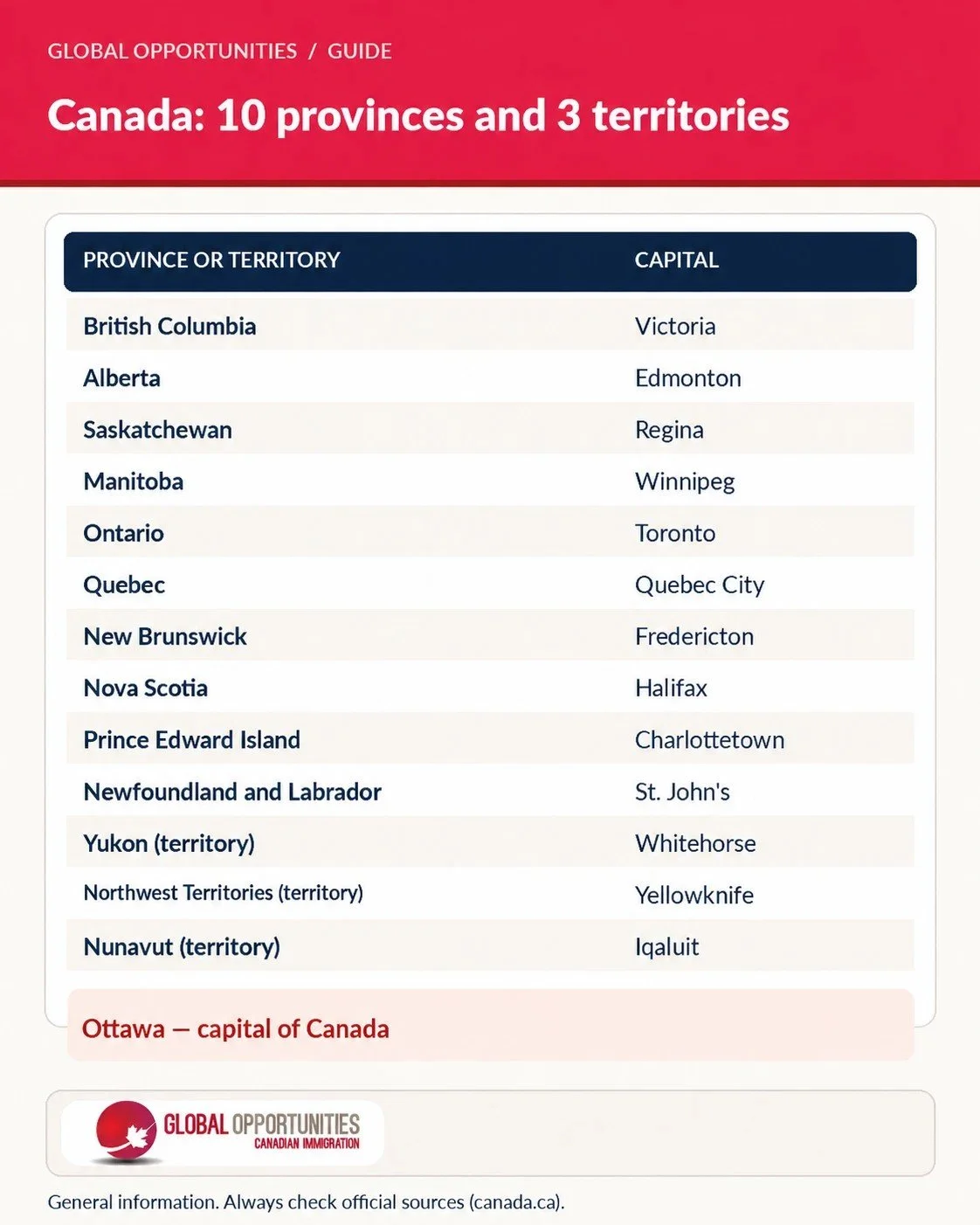
New Brunswick is one of Canada's Atlantic provinces. IRCC calls Fredericton its historic capital and Saint John its largest city, and the province's official languages are English and French (Discover Canada, Canada's regions).
Where the name comes from
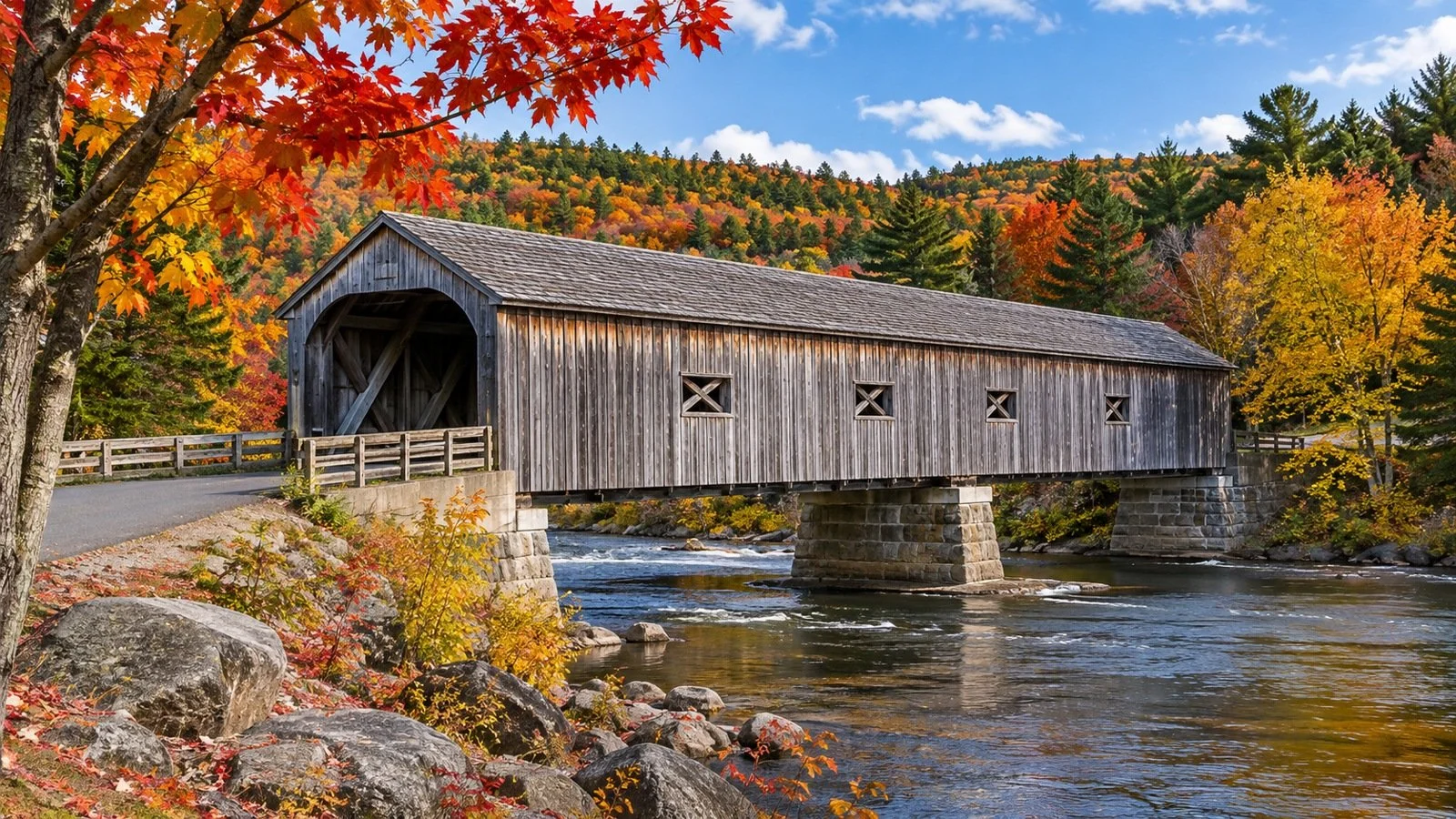
According to Canadian Heritage, New Brunswick was named in 1784 to honour King George III, who was also Duke of Brunswick. That year the British government created the colony in response to demands from Loyalists who had left the United States after the American Revolution. The provincial motto is Spem reduxit, "Hope restored" (Canadian Heritage, symbols of New Brunswick).
Land, rivers and coast
The Saint John River. According to Immigration, Refugees and Citizenship Canada (IRCC), New Brunswick has the second largest river system on North America's Atlantic coastline, the St. John River system (Discover Canada, Canada's regions).
The Bay of Fundy. Parks Canada invites visitors to "experience the world's highest tides along the Bay of Fundy" at Fundy National Park.
Forests and resources. According to IRCC, forestry, agriculture, fisheries, mining, food processing and tourism are the province's principal industries.
What a newcomer should know first
You can live in English or in French, but the balance changes by region: according to Statistics Canada, most workers in the north mainly used French at work, while most workers in the rest of the province, including Saint John and Fredericton, mainly used English (see the next section).
Buses connect the cities. The Government of New Brunswick's newcomers page lists city buses in Moncton, Saint John and Fredericton, and Maritime Bus as the main city-to-city bus line.
Your health card is called Medicare. According to the province's page on applying for a Medicare card, you can apply only once you have moved to the province.
Plan how you will get around. City buses run only in the three largest cities, so many newcomers in other places will need a car.
Sales tax is the HST, added at the till to most prices.
Where is New Brunswick? Map, location and key facts
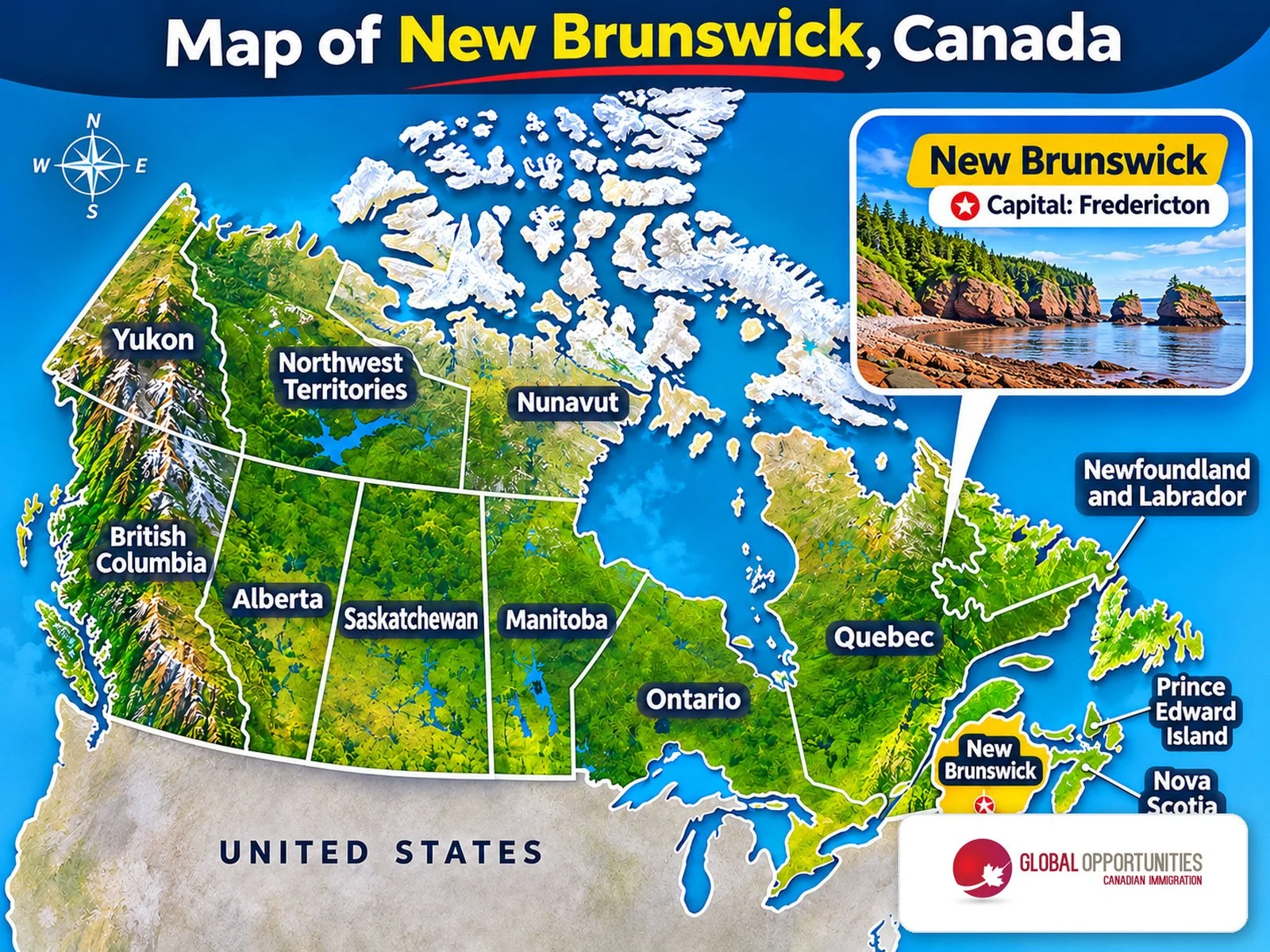
New Brunswick is the largest of Canada's three Maritime provinces. According to the Government of New Brunswick, it sits under Quebec's Gaspé Peninsula and beside the US state of Maine, and the Saint John River crosses it from north to south (Government of New Brunswick, about New Brunswick and geography).
Borders and neighbours
Quebec to the north and Maine (United States) to the west, according to the Government of New Brunswick's basic facts page.
Nova Scotia to the east: the province's newcomers page notes that Maritime Bus connects New Brunswick with Nova Scotia and Prince Edward Island.
Prince Edward Island, across the Northumberland Strait, linked to New Brunswick by the Confederation Bridge.
Capital, largest cities and time zone
Capital: Fredericton. Largest cities: according to Statistics Canada's 2021 Census, the City of Moncton had 79,470 residents, the City of Saint John 69,895 and the City of Fredericton 63,116 (Statistics Canada, table 98-10-0002-01). IRCC's Discover Canada still describes Saint John as the largest city; by population of the municipality itself, Moncton was larger in 2021.
Time zone: according to the Government of New Brunswick, the province, like Nova Scotia and Prince Edward Island, is on Atlantic Standard (Daylight) Time, so you set your watch ahead one hour when you enter from Maine or Quebec (basic facts).
Land area and population
Land area: 71,248.50 square kilometres, according to the 2021 Census (Statistics Canada, table 98-10-0001-01). The Government of New Brunswick gives a total area of 73,440 square kilometres (geography).
Population: Statistics Canada estimated New Brunswick's population at 883,522 on July 1, 2026 (Statistics Canada, table 17-10-0009-01).
Economy and main industries
According to the Government of New Brunswick's economy page:
Forestry contributes about $1.5 billion a year to the province's GDP, with about 9,700 direct jobs, and about 80% of New Brunswick forest products are exported to the United States.
Fishing: the province is one of the largest exporters of fish and seafood in Canada.
Mining: New Brunswick is the largest exporter of mineral products in the Maritimes.
Construction, manufacturing and food services are also important.
Emerging sectors include digital health, cybersecurity, advanced manufacturing, agritech, energy innovation and information and communications technology.
See our jobs section for where people work today.
Population by origin: what the census says
These figures come from the 2021 Census and describe the population living in private households (759,195 people in New Brunswick). They are context about who lives here, not a ranking of places (Statistics Canada, Census Profile, New Brunswick; detailed tables: visible minority, table 98-10-0351-01 and ethnic or cultural origin, table 98-10-0355-01).
Visible minority groups. According to the 2021 Census, 44,205 people in New Brunswick belonged to a visible minority group. The largest groups were Black (12,155), South Asian (8,630), Filipino (5,190), Arab (5,055) and Chinese (4,090), followed by Latin American (2,455), Southeast Asian (1,895) and Korean (1,650).
Ethnic or cultural origins. People can report more than one origin, so these numbers overlap. The most common origins reported were Canadian (174,905), Irish (155,920), English (137,145), Scottish (134,355), French (118,205) and Acadian (108,375), followed by German (33,205). Mi'kmaq origins were reported by 12,655 people.
Latin American origins. About 4,100 people reported a Latin, Central or South American origin, most often Mexican (990) and Brazilian (705).
Census counts as published by Statistics Canada for the 2021 Census, the most recent with these details when we checked in November 2026. They describe 2021, not today, and they are not immigration figures: check the linked tables for the full definitions.
How to get to New Brunswick: by plane, car, train or bus
According to the Government of New Brunswick, the province has three national airports with scheduled service, in Fredericton, Moncton and Saint John, plus scheduled flights in Bathurst, more than 18,000 kilometres of highways and secondary roads, VIA Rail's Ocean train, Maritime Bus and several ferries (Government of New Brunswick, transportation).
Main airports
Greater Moncton Roméo LeBlanc International Airport (YQM) (cyqm.ca).
Fredericton International Airport (YFC) (yfcfredericton.ca).
Saint John Airport (YSJ) (ysjsaintjohn.ca).
Flying to New Brunswick from abroad: airlines and common routes
As of November 2026, the airports' own pages list:
Moncton: year-round service by Air Canada, WestJet, Porter and PAL Airlines; winter seasonal service by Air Transat and Sunwing; and summer seasonal service by Flair Airlines (YQM, airlines). The airport's destination schedule shows the current routes.
Fredericton: Air Canada daily to Toronto Pearson, Montréal and Ottawa; Porter daily to Toronto (Billy Bishop) and Ottawa; WestJet to Calgary (May to October); and seasonal sun flights by Sunwing to Cancún and Punta Cana and by Air Transat to Cancún (YFC, airlines).
Saint John: the airport's flights page shows Air Canada flights to and from Toronto and Montréal and asks travellers to book with Air Canada or Flair.
Common ways to get there. None of these pages listed non-stop flights from Europe, Asia, Australia or New Zealand. From those regions, and from most of the United States and Latin America, travellers usually fly into a larger airport first and connect: the Fredericton and Saint John pages show direct flights to Toronto and Montréal, and Fredericton also to Ottawa. The only international non-stop flights we found were Fredericton's seasonal sun routes to Cancún and Punta Cana.
Airlines and routes as listed by the Moncton, Fredericton and Saint John airports, as of November 2026. Routes and airlines change seasonally: check the airport's page and the airlines before you book.
Highways and driving
The Government of New Brunswick explains that speed limits are posted in kilometres per hour, that most major highways have a limit of 100 km/h, with many four-lane sections at 110 km/h, and that hand-held phones are illegal while driving (transportation). Before a long drive, especially in winter, check road conditions and closures on New Brunswick 511 or dial 511 within the province (Government of New Brunswick, Storm Watch).
Train, bus and ferries
Train. According to the Government of New Brunswick, VIA Rail's Ocean provides round-trip passenger service through the province three days a week, with stops in Moncton, Miramichi, Bathurst, Campbellton and smaller centres (transportation). Check the current schedule on VIA Rail's Montréal–Halifax (Ocean) page.
Bus. The province names Maritime Bus as the largest intercity bus provider. Maritime Bus says it operates 364 days a year (Maritime Bus).
Ferries. Bay Ferries' MV Fundy Rose sails between Saint John and Digby, Nova Scotia (ferries.ca). According to the province, Coastal Transport serves Grand Manan year-round, and the Department of Transportation runs ferries between Deer Island and Letete and on the lower Saint John and Kennebecasis rivers.
Driving from the United States
The Canada Border Services Agency's border wait times page lists these New Brunswick crossings with Maine: St. Stephen (Ferry Point Bridge) and the St. Stephen 3rd Bridge (to Calais), Edmundston (to Madawaska) and Woodstock Road (Belleville, to Houlton). The same page shows current wait times. Before you travel, read the CBSA's travel information on what to declare and which documents you need, and check whether you need a visa or an eTA with IRCC's official tool. Entry rules depend on your citizenship and status.
Transportation information as published by the Government of New Brunswick, the CBSA, VIA Rail, Maritime Bus and Bay Ferries, as of November 2026. Some provincial descriptions may be older than the operators' pages, and services and schedules change: check the linked pages before you travel.
Buying your first home in New Brunswick
Most newcomers rent first. If you later want to buy, the Government of Canada offers a tax-free savings account for first homes, a way to use your RRSP savings and a tax credit. Every rule depends on your own situation, so read the official pages and talk to a lawyer, a mortgage professional or the Canada Revenue Agency (CRA) before you decide.
Saving for a first home: the FHSA and the Home Buyers' Plan
First Home Savings Account (FHSA). According to the CRA's opening your FHSAs page, to open an FHSA you must be a resident of Canada, at least 18 (19 where that is the age of majority) and no older than 71 at the end of the year, and a first-time home buyer: in general, you did not live in a home that you or your spouse or common-law partner owned in the current year or the previous four calendar years. Read the CRA's FHSA overview for the contribution limits.
Home Buyers' Plan (HBP). The CRA explains that the HBP lets you withdraw from your registered retirement savings plans (RRSPs) to buy or build a qualifying home. As of November 2026, its HBP page gives a withdrawal limit of $60,000, repaid over 15 years; for first withdrawals made from January 1, 2026, to December 31, 2028, the start of repayments is deferred.
Home buyers' amount. According to the CRA's line 31270 page, this non-refundable tax credit helps first-time home buyers; the page says you can claim up to $10,000 for a qualifying home acquired in 2025.
The Canada Mortgage and Housing Corporation (CMHC) has a step-by-step home buying guide, including information for newcomers.
Provincial rules
We did not find a provincial first-time home buyer program on the Government of New Brunswick pages we checked in November 2026. Property taxes and the costs of registering a purchase still apply, so ask your lawyer or the Government of New Brunswick which provincial and municipal costs and measures apply to your purchase.
Rules and amounts as published by the Canada Revenue Agency, as of November 2026. Eligibility depends on each person and the rules change: check the CRA and the provincial pages, or ask a professional, before you rely on them. Foreign buyers may face other federal rules.
Emergencies and natural hazards in New Brunswick
Emergencies are not part of everyday life in New Brunswick, but spring flooding, winter storms and summer wildfires do happen. The New Brunswick Emergency Measures Organization (NB EMO) publishes current incidents and preparedness information on the province's emergencies page. A little preparation goes a long way.
Spring flooding and River Watch
According to the Government of New Brunswick, the province has a long history of flooding, mainly caused by heavy rain combined with snowmelt, ice jams on rivers and storm surges along the coast (flood risk information). Each spring, River Watch publishes updates and flood forecasts for the Saint John River, which matters in Fredericton and the Saint John area. Before you rent or buy near a river or the coast, ask about past flooding and look at the province's flood hazard maps.
Wildfires and burn restrictions
The province's Fire Watch page shows wildfire activity and daily burn conditions, updated at 2 p.m. during the fire season. Campfires must follow those conditions, and some fires need a written permit. To report a wildfire, call 911 or the Department of Natural Resources (wildfires). If smoke reaches your area, check the Air Quality Health Index from Environment and Climate Change Canada.
Winter storms and power outages
During storms, the province's Storm Watch page lists road conditions, comfort centres and phone numbers. Check New Brunswick 511 before you travel, and call 911 if you or someone else is in immediate danger.
Emergency alerts
According to the Government of New Brunswick, the national Alert Ready system is one of the ways the province warns the public when there is a threat to life and immediate action is needed. Public alerts are issued through NB EMO; the RCMP can issue alerts for police events such as Amber Alerts, and Environment and Climate Change Canada for weather (public alerting). The Government of Canada's Get prepared page explains how to make an emergency plan and kit.
Radon in homes
Radon is a natural radioactive gas from the ground that is invisible, odourless and tasteless, and Health Canada calls it the number one cause of lung cancer in non-smokers (Health Canada, about radon). In Health Canada's cross-Canada survey, New Brunswick was one of the provinces and territories with the highest share of tested homes above the radon guideline (Health Canada, cross-Canada radon survey). Health Canada recommends a long-term test of at least 3 months, with a do-it-yourself kit or a certified professional (testing your home). If you rent, ask your landlord whether the home has been tested.
Information as published by the Government of New Brunswick, Health Canada, Environment and Climate Change Canada and the Government of Canada, as of November 2026. In an emergency, follow the instructions of local officials, and call 911 if lives or property are in danger.
English and French: bilingualism in New Brunswick
New Brunswick is Canada's only officially bilingual province. The Canadian Charter of Rights and Freedoms states that English and French are the official languages of New Brunswick and that its English and French linguistic communities have equal status, including the right to distinct educational and cultural institutions (Charter, sections 16 and 16.1).
According to the province's Commissioner of Official Languages, New Brunswick's first Official Languages Act, in 1969, made English and French its two official languages; a 1981 law recognized the equality of the two linguistic communities, some language rights were entrenched in the Charter in 1982, and a new Official Languages Act was passed in 2002 (Office of the Commissioner of Official Languages for New Brunswick, history).
What bilingualism means in daily life
Government services in both languages. Section 20(2) of the Charter gives members of the public in New Brunswick the right to communicate with, and receive available services from, any office of the provincial legislature or government in English or French. Tele-Care 811, for example, answers in English or French.
Two school systems. Public education has an Anglophone sector and a Francophone sector, each with its own districts and schools (see the education section).
Two health networks. Hospitals and community care are delivered by Horizon Health Network and Vitalité Health Network, which describes itself as a francophone leader serving its communities.
Post-secondary options in French, such as the Université de Moncton and CCNB (see the education section).
Settlement agencies in each region; the province's list notes which ones serve only in English or only in French.
How much French you will hear
According to Statistics Canada, using 2021 Census data, 75.9% of New Brunswick workers mainly used English at work, 20.1% mainly used French and 3.9% used both equally; 39% of workers were bilingual in English and French (Statistics Canada, languages of work in New Brunswick, March 2023). The picture changes by region:
North (Madawaska, Restigouche, Gloucester): 72% of workers mainly used French at work.
Southeast (Kent and Westmorland, including Moncton and Dieppe): 69% mainly used English and 24% mainly used French.
Rest of the province, including Saint John and Fredericton: 95% mainly used English at work.
Do you need French to live in New Brunswick?
Not necessarily. The Statistics Canada figures above show that most workers in Saint John, Fredericton and the southeast mainly used English at work, while most workers in the north mainly used French. Read each job posting carefully to see which languages it asks for. If you speak French, see the Government of Canada's page on francophone immigration outside Quebec and our page on French language proficiency. French speakers from Africa and Europe can read our country guides. Global Opportunities does not offer services for Quebec's immigration programs; this guide covers New Brunswick only.
Language figures as published by Statistics Canada (2021 Census data), checked in November 2026. They describe how workers used languages at work, not what any employer or program requires: check each job posting and the linked pages before you rely on them.
Living in Moncton, Dieppe and Riverview
Moncton is in southeastern New Brunswick, in the most bilingual part of the province. IRCC describes it as the principal francophone Acadian centre (Discover Canada). Together with neighbouring Dieppe and Riverview, it forms the Moncton CMA, the province's largest urban area.
How Greater Moncton is organized
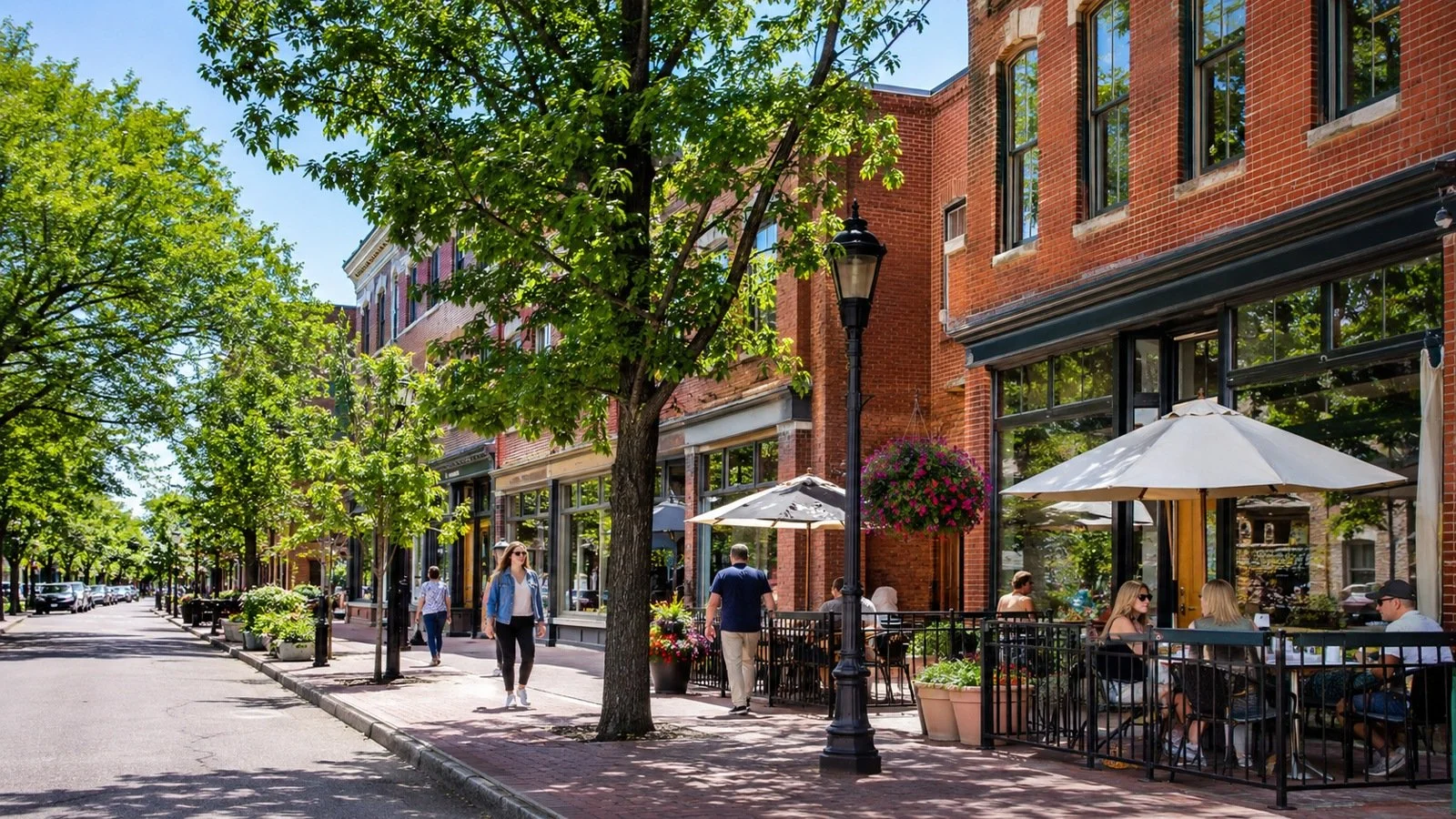
Greater Moncton includes the City of Moncton, the City of Dieppe and the Town of Riverview. Codiac Transpo's fares page offers its U12 pass to children from all three communities. The notes below are general orientation, not a ranking; visit, check bus routes and compare listings before you choose.
Downtown Moncton
Downtown Moncton is home to the Avenir Centre, which the City of Moncton describes as the city's largest multi-use facility, at 150 Canada Street (City of Moncton, Avenir Centre). The Moncton Market, at 120 Westmorland Street, opens on Saturday mornings with local food and artisan products (City of Moncton, Saturday mornings at the Market).
Studying in Moncton
The Université de Moncton has its Moncton campus in the city (Université de Moncton), and NBCC has a Moncton campus (NBCC). See the education section for details.
Dieppe
Dieppe is home to CCNB's Dieppe campus (CCNB), and the francophone settlement agency CAFi serves Dieppe, Shediac and Cap-Acadie (Government of New Brunswick, newcomers).
Riverview
The Town of Riverview describes itself as located between the Petitcodiac River and the Acadian Forest, a short drive from downtown Moncton (Town of Riverview).
Daily life in Greater Moncton
Jobs. According to Job Bank, the Moncton–Richibucto region added about 3,800 jobs in 2025, the second-largest gain in the province, and had the province's highest participation rate (Job Bank, New Brunswick economic scan, May 2026).
Health care. Horizon Health Network operates The Moncton Hospital, at 135 MacBeath Avenue.
Rent. According to CMHC, the average two-bedroom apartment in the Moncton CMA rented for $1,453 in October 2025, with a vacancy rate of 3.9% for all apartments (CMHC, Rental Market Survey data tables; see the housing section).
Newcomer support. MAGMA serves Greater Moncton, and CAFi serves francophone newcomers (Government of New Brunswick, newcomers).
Living in Fredericton
Fredericton is the capital of New Brunswick, on the Saint John River. IRCC calls it the historic capital (Discover Canada). The region's tourism organization calls the Wolastoq (Saint John River) "the heart of the region" (Fredericton Capital Region).
Fredericton's campuses and nearby communities
Universities and colleges. Fredericton has a campus of the University of New Brunswick (UNB), St. Thomas University (STU), NBCC's Fredericton campus (NBCC), the New Brunswick College of Craft and Design (NBCCD) and the Maritime College of Forest Technology (MCFT).
Oromocto. The 5th Canadian Division Support Base Gagetown is at 100 Broad Road in Oromocto (National Defence, August 2026).
Daily life in Fredericton
Jobs. According to Job Bank, the Fredericton–Oromocto region added about 1,300 jobs in 2025 (Job Bank, May 2026). Read each posting carefully to see which languages it asks for.
Language. According to Statistics Canada, 95% of workers outside the north and the southeast, a region that includes Fredericton, mainly used English at work in 2021 (Statistics Canada).
Rent. According to CMHC, the average two-bedroom rent in the Fredericton CMA was $1,413 in October 2025 (CMHC).
Outdoors and markets. Fredericton Capital Region lists biking, trails and paddling trails on the Wolastoq. The Fredericton Boyce Farmers Market, at 665 George Street, opens on Saturdays and says it has over 200 food and craft vendors (Fredericton Boyce Farmers Market).
Newcomer support. The Multicultural Association of Fredericton (MCAF) serves newcomers, and CAFi has a satellite office in the city (Government of New Brunswick).
Living in Saint John
Saint John is New Brunswick's port and industrial city, where the Saint John River meets the Bay of Fundy. IRCC describes it as a port and manufacturing centre (Discover Canada).
Saint John and its region
Uptown. The Saint John City Market, established in 1876, describes itself as Canada's oldest continuously operating farmers market, under one timber roof in Uptown Saint John (Saint John City Market).
The Bay of Fundy. Discover Saint John, the city's tourism organization, describes Saint John as a port city on the Bay of Fundy (Discover Saint John).
Nearby communities. Discover Saint John lists Quispamsis, Rothesay, Grand Bay-Westfield, Hampton and Fundy-St. Martins as part of the region.
Daily life in Saint John
Jobs. According to Job Bank, the Saint John–St. Stephen region lost about 4,400 jobs in 2025, the steepest decline in the province, so check current postings in your occupation (Job Bank, May 2026).
Language. According to Statistics Canada, 95% of workers in the part of the province that includes Saint John mainly used English at work in 2021 (Statistics Canada).
Education. UNB has a Saint John campus (UNB), and NBCC has a campus here (NBCC). Dalhousie University's Saint John campus is home to Dalhousie Medicine New Brunswick, hosted by UNB Saint John (Dalhousie University, Saint John campus).
Rent. According to CMHC, the average two-bedroom rent in the Saint John CMA was $1,290 in October 2025, the lowest of the three southern cities (CMHC).
Newcomer support. The Saint John Newcomers Centre, the YMCA of Southwestern New Brunswick and a CAFi office serve newcomers (Government of New Brunswick). The city also publishes a New Residents Guide (January 2024).
Northern New Brunswick: Bathurst, Edmundston, Miramichi and the Acadian Peninsula
Northern New Brunswick is the heart of francophone Acadia. According to Statistics Canada, in the northern counties of Madawaska, Restigouche and Gloucester, 72% of workers mainly used French at work in 2021 (Statistics Canada). According to CMHC's October 2025 survey, average two-bedroom rents in the northern centres listed below were lower than in the three southern cities.
Bathurst
Bathurst has CCNB's Bathurst campus, which is also the college's head office (CCNB), and a VIA Rail station with routes to Halifax and Montréal (VIA Rail, Bathurst station). According to CMHC, the average two-bedroom rent in the Bathurst area was $945 in October 2025. The Multicultural Association Chaleur Region (MACR) supports newcomers.
Edmundston
Edmundston, in the Madawaska region, has campuses of the Université de Moncton (Université de Moncton) and CCNB (CCNB). According to Job Bank, the Edmundston–Woodstock region had the lowest unemployment rate of the province's five regions in 2025, at 5.2% (Job Bank, May 2026). According to CMHC, the average two-bedroom rent in the Edmundston area was $1,004 in October 2025. CRNANO serves newcomers in Edmundston, Clair and Grand-Sault.
Miramichi
Miramichi has an NBCC campus (NBCC), and the Miramichi Regional Multicultural Association supports newcomers. According to Job Bank, the Campbellton–Miramichi region had the strongest employment growth in the province in 2025. According to CMHC, the average two-bedroom rent in the Miramichi area was $1,132 in October 2025.
The Acadian Peninsula and Campbellton
The Acadian Peninsula. The Université de Moncton has a campus in Shippagan, CCNB has its Acadian Peninsula campus there, and CAIENA-PA in Shippagan offers settlement services in French only (Government of New Brunswick, newcomers).
Campbellton has a CCNB campus and the Restigouche Multicultural Association. According to CMHC, the average two-bedroom rent in the Campbellton area was $922 in October 2025.
Smaller communities in the south and west
Sackville is home to Mount Allison University (Mount Allison), and NBCC has campuses in Woodstock and St. Andrews (NBCC). The province's newcomers page lists settlement agencies in Woodstock, Sussex, Saint George and St. Stephen, among other communities.
Getting around New Brunswick: Codiac Transpo, Fredericton Transit and Saint John Transit
City buses run in Moncton, Saint John and Fredericton, and Maritime Bus connects cities within New Brunswick and to Nova Scotia and Prince Edward Island (Government of New Brunswick, newcomers).
Codiac Transpo (Moncton, Dieppe and Riverview)
According to Codiac Transpo's fares page, as of November 2026:
Cash fare: $3 (exact fare required).
Individual day pass: $7.
10-trip pass: $29; 20-trip pass: $47.
Group day pass: $18.
30-day pass: $73 for adults; $58 for students, children 12 and over, and seniors 65 and over, with ID.
Children under 6 ride free, and children 6 to 11 who live in Moncton, Riverview or Dieppe ride free with the U12 pass.
The same page says the 30-day pass is valid for 30 consecutive days from the first time it is scanned. Codiac Transpo has launched the Codiac+ mobile app to buy and manage passes. Fares change, so check the current price on the official page.
Fredericton Transit
According to the City of Fredericton's transit fares page, as of November 2026:
Single fare: $3 by cash (exact fare), debit, credit card, phone or smartwatch (open payment).
Children under 6: free.
Adult monthly pass: $85; student monthly pass: $60 (proof of student status required).
Rider card (10 tickets): $27.50.
65 Plus Club Pass: $65 per year for seniors 65 and up.
U-Pass for students at St. Thomas University, UNB and the New Brunswick College of Craft and Design.
The city's fares page notes that on January 1, 2027, the adult monthly pass will rise to $90, the student monthly pass to $65 and the senior annual pass to $70. Transfers are free, one way, on request when you pay. Check the current price on the official page.
Saint John Transit
According to the City of Saint John's fares and passes page, with fares effective January 1, 2026:
Single ride cash fare: $3 (age 7 and over, exact change). Children 6 and under: the first three ride free, $2 each after.
Monthly passes: $83.50 adult (15 and over); $73.70 student; $61.85 senior (65 and over) or child (6 to 14).
10-ride Transcards: $27.30 adult; $24.25 student or senior.
The city has announced that multi-ride passes (monthly passes and 10-ride Transcards) will rise by an average of 1.5% on January 1, 2027, while single cash fares for in-city routes stay at $3 (City of Saint John, fare notice). Riders can also use the SJTRides mobile ticketing app. Check the current price before you travel.
Do you need a car in New Brunswick?
It depends on where you live and work. The province lists city buses only in Moncton, Saint John and Fredericton, so outside those cities you will likely need another way to get to work. Even in the cities, check the routes and schedules near your home and workplace before you decide.
Airports and intercity travel
Airports include the Greater Moncton Roméo LeBlanc International Airport (cyqm.ca), Fredericton International Airport and Saint John Airport. Maritime Bus is the main city-to-city bus line, and VIA Rail lists stations in Moncton and Bathurst, among others, with routes to Halifax and Montréal. Check schedules before you plan.
Fares as published by Codiac Transpo, the City of Fredericton and the City of Saint John, as of November 2026. Fares, eligibility for reduced passes and payment options may have changed by the time you read this: check the linked pages before you travel.
How much is rent in New Brunswick? Where to look, rents and tenant rights
Most newcomers rent when they first arrive in New Brunswick. According to the Government of New Brunswick's renting pages, renters' rights and responsibilities come from the Residential Tenancies Act, and the province's Tenant and Landlord Relations Office holds security deposits, helps resolve disputes and reviews rent increases.
Average rents in New Brunswick: CMHC figures
According to CMHC's Rental Market Survey, in October 2025, the average monthly rents in private apartment buildings were (CMHC, Rental Market Survey data tables, 2025):
Moncton CMA (including Dieppe and Riverview): one bedroom $1,164; two bedrooms $1,453; vacancy rate 3.9%. Two-bedroom units that changed tenants averaged $1,503.
Fredericton CMA: one bedroom $1,203; two bedrooms $1,413; vacancy rate 2.5%. Two-bedroom units that changed tenants averaged $1,564.
Saint John CMA: one bedroom $1,011; two bedrooms $1,290; vacancy rate 1.9%. Two-bedroom units that changed tenants averaged $1,428.
Smaller cities, two bedrooms: Miramichi area $1,132; Edmundston area $1,004; Bathurst area $945; Campbellton area $922.
New Brunswick (centres of 10,000+): two bedrooms $1,368; vacancy rate 2.9%.
These are averages for purpose-built rental apartments, not rooms or houses; long-time tenants often pay less than new ones, which is why units that changed tenants cost more. Rents change, so check current listings and CMHC's latest data.
Where to look for a rental in New Brunswick
Online listing sites such as Kijiji, Facebook Marketplace, Rentals.ca and PadMapper.
Property management companies that own apartment buildings in Moncton, Fredericton and Saint John.
University and college housing offices for students: UNB, the Université de Moncton, Mount Allison, St. Thomas, NBCC and CCNB have residences or off-campus information.
Community groups, places of worship and cultural associations, including Latin American groups.
Settlement agencies, which can explain the process and your rights.
We mention private websites and companies for reference only. Global Opportunities has no relationship with them and does not recommend any of them.
Renting a room or an apartment
A room in a shared house or apartment is a common first step for single newcomers and students: cheaper, often furnished, usually with utilities included. Get the agreement in writing. For an apartment, ask what is included (heat, hot water, electricity, parking, laundry) and how the home is heated. The province has a page of tips for first-time renters.
Security deposits: what is legal in New Brunswick
According to the province's security deposits page, checked in November 2026:
Your landlord may ask for the first month's rent and a security deposit, but cannot ask for the first month's rent and last month's rent.
The maximum deposit is one week's rent for a week-to-week lease and one month's rent for month-to-month, year-to-year and fixed-term leases.
A landlord who collects a deposit must submit it to the Tenant and Landlord Relations Office within 15 days. You can also pay it directly at a Service New Brunswick centre. Ask for a receipt.
The office sends a Certificate of Deposit to both landlord and tenant. If you do not receive it within four weeks, contact the office (1-888-762-8600).
When you move out, apply for the return of your deposit as soon as possible, online or at Service New Brunswick. Each tenant named on the certificate applies separately. If the landlord makes a claim, you can dispute it.
This system protects newcomers: your deposit is held by a government office, not by the landlord.
The lease
According to the Government of New Brunswick, the province has a Standard Form of Lease, available online or at any Service New Brunswick centre. A written lease is strongly recommended, but the Residential Tenancies Act and the standard lease still apply without one, and the landlord and tenant must each have a signed copy (lease information). Walk through and inspect the unit with your landlord before you move in, and take dated photos (inspections).
Rent increases and the rent cap
According to the province's rent increase page, checked in November 2026:
Landlords are not permitted to increase rent by more than 3% every 12 months.
Landlords must give six months' written notice before a rent increase.
Rent can only increase once every 12 months, and not within the first 12 months of the tenancy.
Above the 3% cap, up to 9%, a landlord must apply for permission for justified renovation costs, with evidence.
A tenant who receives a notice can accept it, end the tenancy with proper notice, or request a review from the Tenant and Landlord Relations Office within 60 days; there is no fee to apply.
Landlord entry and your rights
According to the province's landlord entry page, landlords must give notice before entering, except in an emergency: generally seven days' written notice for routine maintenance, and at least 24 hours' notice to show the unit or do an inspection. Entry for repairs and maintenance is allowed only between 8 a.m. and 8 p.m., excluding Sundays and holidays, unless it is an emergency or you request it. Entering without notice is an offence under the Act. Discrimination in renting is not allowed, and the province has pages on evictions and emergencies and repairs.
Solving problems: the Tenant and Landlord Relations Office
The Government of New Brunswick's solve a problem page explains the steps: talk it over, make a written complaint and, if the problem is not resolved, apply to the Tenant and Landlord Relations Office. The office first tries mediation; if that fails, a Residential Tenancies Officer makes a decision. You can contact the office by phone, by email, by mail or at any Service New Brunswick centre.
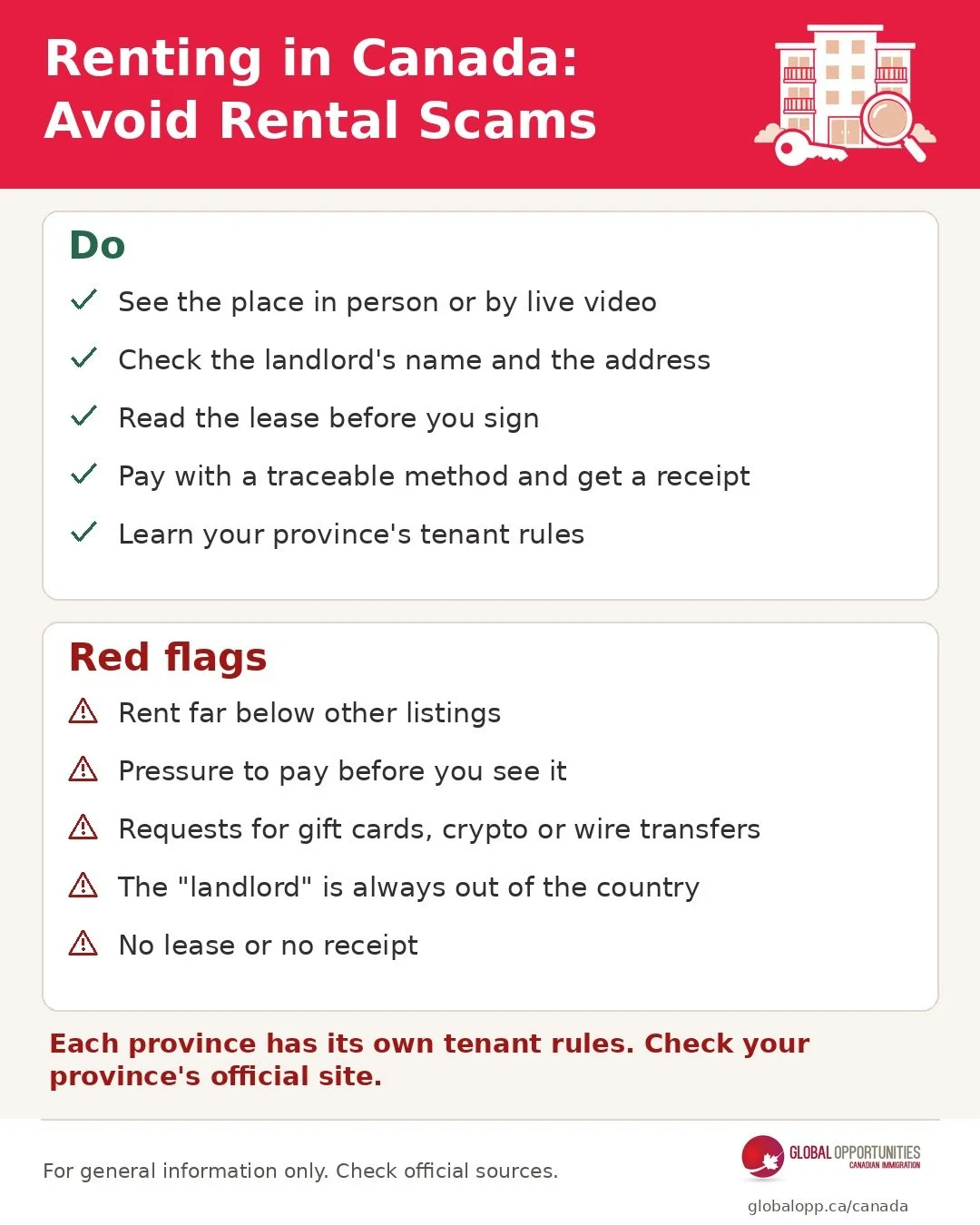
How to avoid rental scams
The Competition Bureau warns about rental scams in Rental scam: no room for error. Follow these steps:
Never send money for a place you have not seen.
Be suspicious of rents far below similar units or pressure to pay quickly.
Confirm that the person showing the unit can rent it.
Check the deposit. Under the province's security deposit rules, a landlord cannot ask for first and last month's rent or a deposit above the legal maximum, so either request is a warning sign.
Pay the deposit safely: you can pay it directly to Service New Brunswick.
Utilities: power, heat and internet
Ask what is included in the rent and how the unit is heated, because heating can be a large winter cost when it is not included. Ask the landlord, or the previous tenant, for an idea of typical monthly bills. Ask whether internet is included, and whether the landlord requires tenant insurance. According to NB Power, heating is the biggest driver of home energy use in New Brunswick, and in the coldest months heating alone can make up 70 to 80% of an electricity bill (NB Power, why energy bills rise in winter). If you pay NB Power yourself, its Equalized Payment Plan spreads your electricity costs over 12 equal monthly payments (NB Power, Equalized Payment Plan).
Rents as published by CMHC (October 2025 survey) and tenancy rules as published by the Government of New Brunswick, as of November 2026. CMHC figures are averages for purpose-built apartments, not the price of any specific listing, and the rules may have changed: check the linked pages before you sign a lease or pay a deposit.
Driving in New Brunswick: licences, insurance and winter
Outside the three cities with city buses, many newcomers need to drive. The Government of New Brunswick sets the rules for graduated licences and for exchanging a licence from elsewhere.
New Brunswick's graduated licensing: Class 7 Level 1 and Level 2
According to the Government of New Brunswick's graduated drivers' licences page, anyone applying for a driver's licence for the first time, regardless of age, receives a Class 7 Level 1 graduated licence and spends a minimum of 24 months in the program before getting a full licence. A graduated licence is marked with an "L".
Level 1 (what people used to call a "learner's permit"): you get it after passing a written test. A Level 1 driver cannot drive alone, and can carry no passengers other than a supervising driver with three years or more of experience; cannot drive between midnight and 5 a.m.; and has zero tolerance for drugs or alcohol. You must wait 12 months before the road test, reduced to 8 months if you pass a driver training course.
Level 2: after a successful road test. Level 2 drivers can drive alone with up to three passengers. Between midnight and 5 a.m., they can drive only with a supervising driver with three years' experience, to or from work or school, in an emergency, or with permission from the Registrar of Motor Vehicles. Zero tolerance for drugs or alcohol still applies.
Class 5: after completing 24 months at Levels 1 and 2 combined, you get a full Class 5 licence.
Exchanging a foreign driver's licence
According to the province's page on licences for new residents, checked in November 2026:
A person licensed elsewhere who takes up residence in New Brunswick must obtain a New Brunswick licence as soon as they take up residence.
Drivers from other Canadian provinces and the United States can exchange their licence class for class without tests, with some conditions.
Foreigners residing in New Brunswick must take a full driver licence examination (vision test, written exam and road test), unless their country has reciprocity.
Countries with reciprocity can exchange for a Class 5 without testing. The page lists Austria, Australia, Belgium, Denmark, England, France, Germany, the Isle of Man, Ireland, Italy, Japan, the Netherlands, New Zealand, Norway, Portugal, Scotland, the Republic of Korea, Spain, Sweden, Switzerland, Taiwan, Ukraine and Wales, with extra rules for some.
You need your original licence, an official translation if it is not in English or French (the page accepts a translation agency or an international driver's licence), proof of identity, two proofs of residency and proof of legal status in Canada.
Temporary residents with a work or study permit valid for more than six months can apply for a New Brunswick licence, or may choose to drive on their valid home-country licence for up to six months from the day they land in Canada.
Car insurance in New Brunswick
Car insurance is sold by automobile insurance companies doing business in the province, and the New Brunswick Insurance Board says its legislated role is to oversee the premiums they charge (New Brunswick Insurance Board). The Financial and Consumer Services Commission (FCNB) publishes consumer information on automobile insurance. Before you buy a car, bring proof of your driving and insurance history from home, ask each insurer how it treats foreign driving experience and compare several quotes.
Renting a car when you arrive
Each rental company sets its own rules, so check them before you book:
At the airports. The Greater Moncton Roméo LeBlanc International Airport lists Avis, Budget, Hertz, National, Enterprise and Alamo, with desks on the terminal's main level (YQM, transportation). Enterprise lists a Fredericton Airport location, and National lists a Saint John Airport location next to baggage claim.
Age. Enterprise says that to rent a car in New Brunswick you must be at least 21 (Enterprise, rental age by province). Other companies may set different rules.
Foreign licences. Enterprise asks international renters for a valid home-country licence with a photo; it requires an International Driver's Permit for licences in a non-Latin script, recommends one for other licences not in English or French, and does not rent on an International Driver's Permit alone (Enterprise, driver's licence requirements).
Getting an International Driving Permit. CAA, the only issuer of International Driving Permits in Canada, issues them only to holders of a full Canadian provincial or territorial licence, and a licence from another country cannot be used to get one (CAA, International Driving Permit). If you need a permit, get it in your home country before you travel.
Ask each company what insurance is included and what payment it accepts. We mention private services for reference only and have no relationship with any of them.
Winter driving and winter tires
Snow and ice are part of winter driving here. Ask your insurer or a tire shop whether winter tires make sense for your car, and keep a brush and scraper, winter washer fluid and an emergency kit in the car. Clear all snow and ice before driving and leave more space. Check road conditions on the province's 511 New Brunswick service before long trips.
Winter parking
Each city sets its own winter parking rules. In Moncton, according to the city's winter parking restrictions page, restrictions apply from December 1 to April 15: overnight parking is allowed on most streets except when snow clearing is expected or under way; when restrictions are in place, notice is issued by 4 p.m. and on-street parking is not allowed from midnight to 7 a.m., with three zones and alerts through Moncton Alerts. Dieppe, Riverview, Fredericton and Saint John have their own rules, so check your municipality's website.
Licensing rules as published by the Government of New Brunswick, and parking rules as published by the City of Moncton, as of November 2026. The reciprocity list and the conditions for each country may have changed, and each rental company sets its own rules: check the linked pages before you drive or exchange a licence.
How do newcomers get health care in New Brunswick? Medicare, family doctors and 811
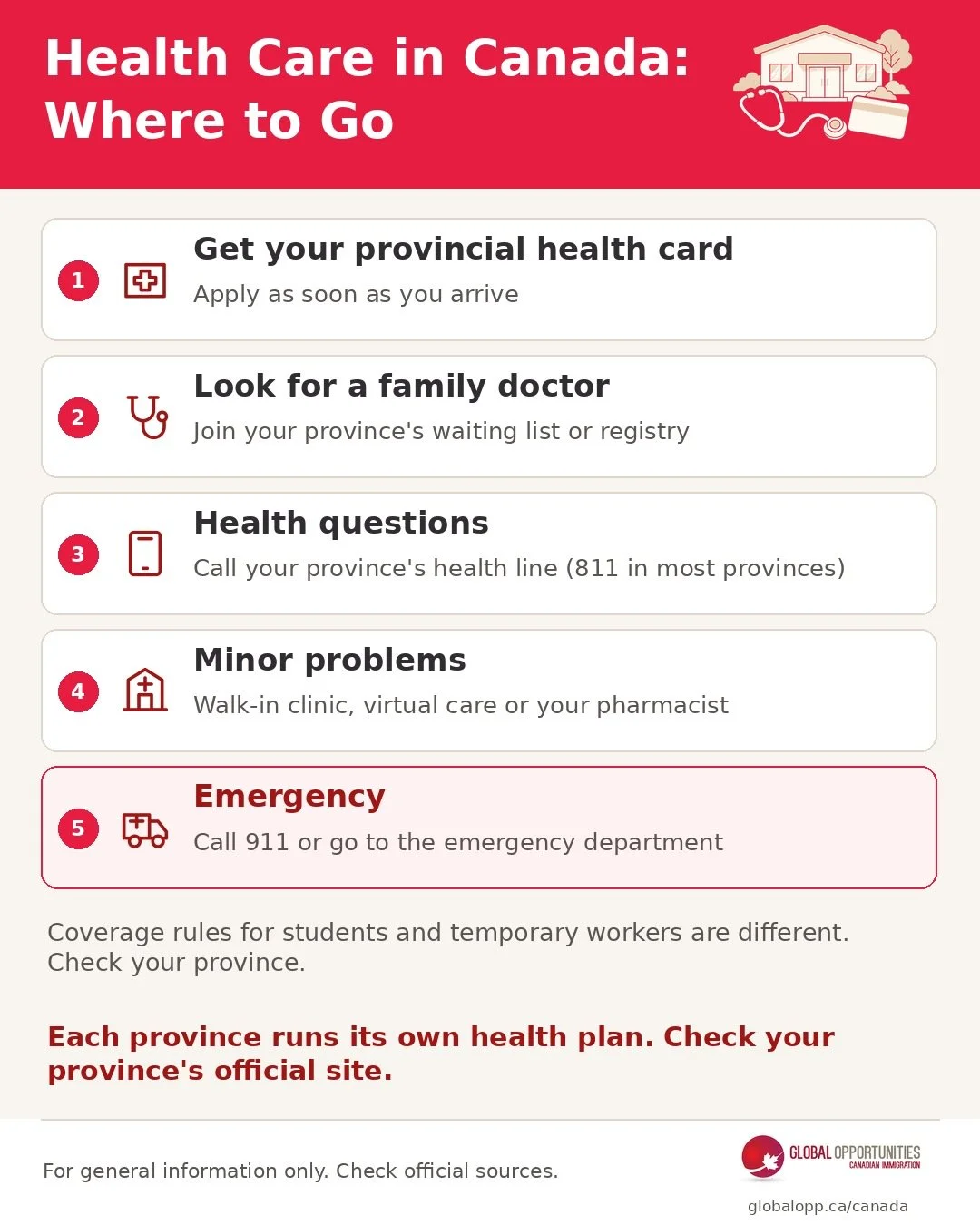
New Brunswick's public health insurance plan is New Brunswick Medicare. If you are eligible, you get a Medicare card and show it when you use health services. Hospital and community care is delivered by two regional health networks, Horizon and Vitalité.
New to how public health care works? Read the health care system in Canada.
Who is eligible for Medicare
According to the Government of New Brunswick, you must be a Canadian citizen or legally entitled to remain in Canada, make your permanent and principal home in New Brunswick, and be ordinarily present in the province. International students who meet the criteria can also qualify; tourists and visitors cannot (Medicare eligibility).
How to apply for a Medicare card
According to the province (applying for a Medicare card):
Move first. You can only apply once you have physically moved to New Brunswick.
Prepare your documents, including your immigration or citizenship documents, proof of identity and proof of New Brunswick residency. The official page lists all requirements, which depend on your situation.
Apply with the online Medicare application or the paper form.
Wait for your letter. Newcomers may be entitled to coverage from their first day in the province if they meet the requirements, but each application is assessed case by case. You receive a letter with your start date, then your card.
Until you are covered, buy private health insurance. The province's Medicare eligibility page notes that services such as prescription drugs, dental care and vision care are not included in Medicare and may be covered by private or workplace insurance.
Finding a family doctor: NB Health Link and Patient Connect NB
NB Health Link is the province's program for patients without a family doctor or nurse practitioner. According to its registration page:
You must be a New Brunswick resident with a valid Medicare card to register.
Registered patients can book appointments with the program's network of doctors and nurse practitioners while they wait to be matched with a permanent provider.
In several health zones, including Moncton, Saint John, Fredericton, the northwest, Bathurst and Miramichi, new registrants may be waitlisted until capacity increases; patients are taken off the waitlist by registration date.
The province's Patient Connect NB FAQ explains that NB Health Link is being phased in to replace Patient Connect NB, the older provincial registry, and that Patient Connect NB continues to refer patients in areas not yet served by NB Health Link. You can register through the websites or by calling Tele-Care 811. Answer calls or letters from the program.
Virtual Care NB, pharmacies and walk-in clinics
Virtual Care NB offers virtual consultations for common, non-urgent illnesses, injuries and infections. According to the province (virtual care), appointments are available 8 a.m. to 8 p.m., seven days a week, by video, phone or chat; you start with an online symptom checker or by calling 811, and no app is needed. Check the eligibility requirements on the page.
Pharmacists can answer questions about your medications.
Tele-Care 811 and emergencies
Life-threatening emergency: call 911 or go to the nearest emergency department.
Health questions that are not emergencies: call Tele-Care 811. A registered nurse answers 24 hours a day, in English or French. The service is free and confidential, and you do not need a Medicare card to call (Tele-Care 811).
Community services: call 211 to find local programs such as food banks and housing help.
Prescription drugs
The province has drug plans for certain groups, including the New Brunswick Drug Plan for residents without other drug coverage. If you get a job with benefits, read your group plan carefully.
Medicare rules as published by the Government of New Brunswick, as of November 2026. Meeting the eligibility criteria does not mean coverage starts on a given date: the province assesses each application case by case and confirms your start date by letter. Check the linked pages before you rely on them.
Banking in New Brunswick for newcomers
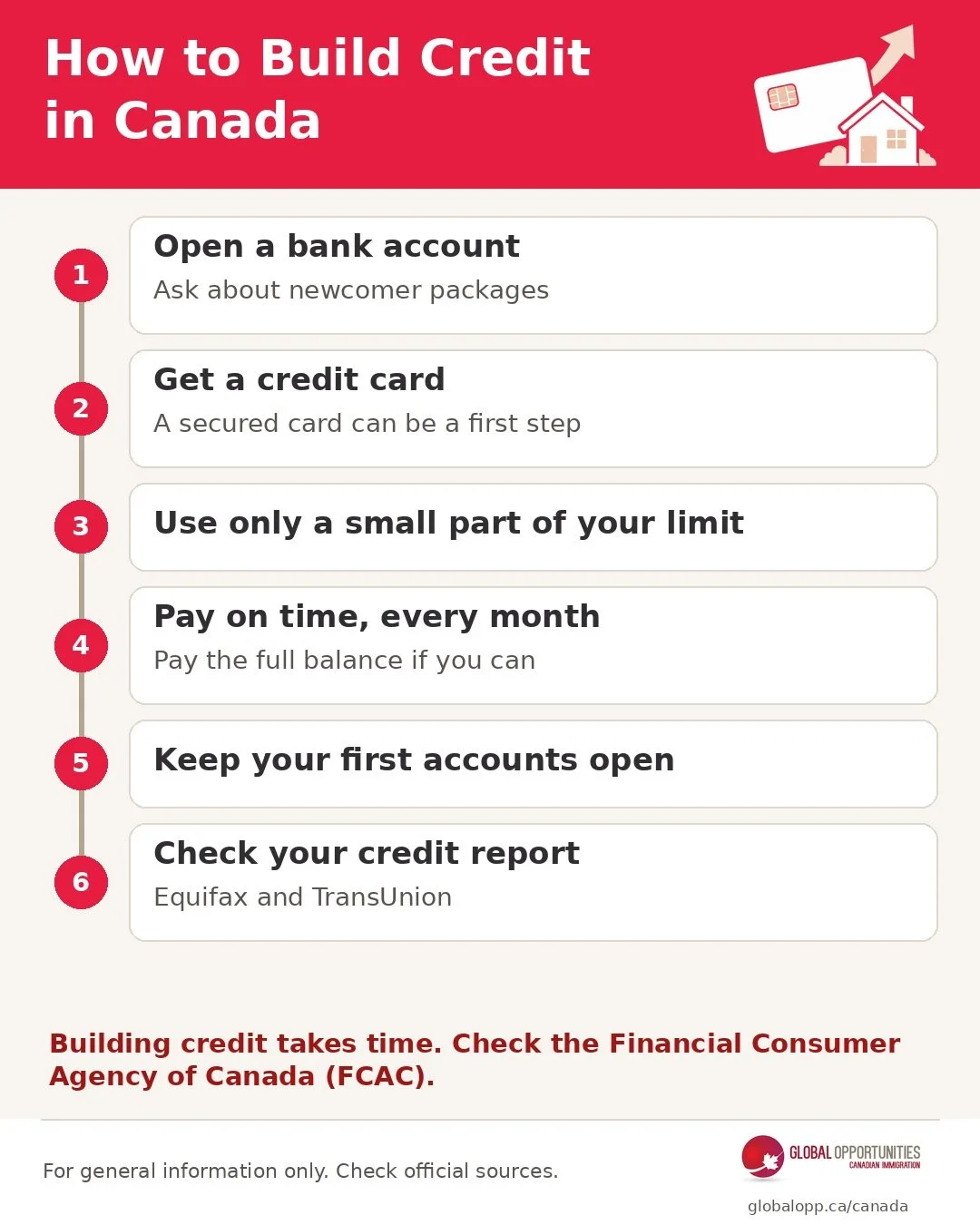
Opening a bank account is one of your first tasks: you need it to receive your salary, pay rent and start building a credit history. The Financial Consumer Agency of Canada (FCAC) explains what identification banks require and what to do if a bank refuses to open an account (FCAC, opening a bank account).
Banks, credit unions and caisses populaires
Large national banks have branches in New Brunswick; for example, BMO publishes a list of its branch locations in New Brunswick. Ask each bank whether it has a newcomer package and what it includes. You can also look at member-owned financial co-operatives such as UNI Financial Cooperation, which its website says is a trade name of Caisse populaire acadienne ltée, a CDIC member (UNI). Compare fees, transaction limits, international transfer costs and branch locations. We mention financial institutions for reference only. Global Opportunities has no relationship with any of them and does not recommend any.
What you need, and building credit
Banks generally ask for identification such as a passport and your immigration document, plus proof of address. In Canada, landlords, phone companies and lenders often check your credit report; FCAC explains how credit reports and scores work. To start building credit, get a credit card (a secured credit card is an option if you are refused a regular one), pay the full balance on time every month and keep spending well below the limit.
Groceries and shopping in New Brunswick
Compare supermarkets, discount stores and farmers' markets near your home, and check weekly flyers before you shop.
Farmers' markets: the Fredericton Boyce Farmers Market (665 George Street, Saturdays; official site), the Saint John City Market in Uptown Saint John (official site) and the Moncton Market (120 Westmorland Street, Saturday mornings; City of Moncton).
Dollar stores: Dollarama says it is present in all Canadian provinces (Dollarama, locations).
International products: ask settlement agencies and community groups where to find foods from your home country.
We mention stores for reference only. Global Opportunities has no relationship with any of them.
What to buy for your first winter
You will need a warm winter coat with a hood, insulated waterproof boots with good grip, layers, a hat, gloves and a scarf, and ice grips for your boots. Compare prices at local stores, and look for second-hand options on Facebook Marketplace and in community groups.
How much does it cost to live in New Brunswick?
Rent, transportation, winter heating and the HST are part of most newcomer budgets in New Brunswick. Use dated official figures, and check current prices before you decide.
Main monthly costs to plan for
Main costs to plan for include rent (according to CMHC, an average two-bedroom was $1,453 in the Moncton CMA and $1,290 in the Saint John CMA in October 2025), power and heat if they are not included, transportation (according to Codiac Transpo and the City of Fredericton, an adult 30-day pass is $73 in Moncton and an adult monthly pass $85 in Fredericton, as of November 2026, or the full costs of a car), groceries, phone and internet, winter clothing and child care. Prices change, so check the current price on each official source. The benefits in our taxes and benefits section can help. For a national overview, see our article on the cost of living in Canada.
Figures as published by CMHC, Codiac Transpo and the City of Fredericton, as of November 2026. They may have changed by the time you read this: check the linked pages before you rely on them.
How much tax do you pay in New Brunswick, and which benefits can you get?
In New Brunswick you pay federal and provincial income tax on what you earn, and the HST on most purchases. Filing a tax return every year is also how you receive benefits such as the Canada child benefit and the New Brunswick child tax benefit.
How income tax works in New Brunswick
In Canada, personal income tax is administered by the Canada Revenue Agency (CRA). You pay federal tax and provincial tax, and both are calculated on the same yearly tax return. Canada uses brackets: each rate applies only to the portion of your taxable income that falls within that bracket, not to your whole income. According to the CRA, your provincial rate is determined by the province or territory where you lived on December 31 of the tax year (CRA, tax rates and income brackets for the current year).
According to the CRA's tax rates page, the rates for the 2026 tax year are, as of November 2026:
Federal: 14% on the first $58,523 of taxable income, rising in steps up to 33% on the portion over $258,482.
New Brunswick: 9.4% on the first $52,333; 14% on the portion from $52,333.01 to $104,666; 16% on the portion from $104,666.01 to $193,861; and 19.5% on the portion over $193,861.
Rates and brackets change every year, so check the current rate on the CRA page. If you are an employee, your employer deducts tax from each pay cheque; your return then settles the difference and claims your credits. You need a Social Insurance Number (SIN) to work and file. Newcomers should file every year, even with low income: the CRA's page for newcomers to Canada explains residency for tax purposes, how to do your first return and how newcomers can apply for benefit payments even before they file for the first time. If your income is modest and your situation simple, the CRA lists free tax clinics.
The HST in New Brunswick
New Brunswick uses the Harmonized Sales Tax (HST), which combines the federal and provincial sales taxes. According to the Canada Revenue Agency, the HST rate in New Brunswick is 15% (CRA, GST/HST rates, checked in November 2026). Shelf prices usually do not include it; it is added at the till. Check the current rate on the CRA page.
The Canada child benefit and other federal payments
According to the CRA, the Canada child benefit (CCB) is a tax-free monthly payment for eligible families to help with the cost of raising children under 18 (CRA, Canada child benefit). The CRA lists the conditions: you live with the child, you are primarily responsible for the child's care and upbringing, you are a resident of Canada for tax purposes, and you or your spouse or common-law partner is a Canadian citizen, a permanent resident, a protected person or a temporary resident who meets the CRA's conditions (CRA, before you apply for the CCB). Newcomers can apply through their CRA account or with Form RC66 (CRA, how to apply for the CCB). The amount depends on family income and on the number and ages of your children, and you and your spouse or partner must file a tax return every year to keep receiving it.
The CRA also pays the Canada Groceries and Essentials Benefit (CGEB). According to the CRA, the CGEB replaced the GST/HST credit in July 2026 and provides tax-free quarterly payments to individuals and families with low and modest incomes, and you are automatically considered for it when you file your taxes (CRA, Canada Groceries and Essentials Benefit).
New Brunswick benefits and credits
The CRA administers these provincial programs for New Brunswick, and pays them together with the federal payments (CRA, Province of New Brunswick programs):
New Brunswick child tax benefit (NBCTB): a tax-free amount paid monthly to qualifying families with children under 18, combined with the CCB in a single payment. It can include the New Brunswick working income supplement for families with earned income and a yearly school supplement for low-income families.
New Brunswick harmonized sales tax credit (NBHSTC): a tax-free amount for households with low and modest incomes, to help offset the sales tax, combined with the quarterly CGEB payments.
Amounts and income limits are on the CRA page and change from year to year. Because these programs are paid with the CCB and the CGEB, applying for the CCB if you have children and filing your tax return every year is what puts you in the system. The province also has housing programs, such as the rent bank and rent supplements, listed on its renting page.
Affordable child care in New Brunswick
According to the Government of New Brunswick, licensed early learning and child care facilities can become designated facilities, and families with preschool-aged children (0 to 5 years, not yet attending school) enrolled in a designated facility pay the standard Parent Fee Grid rates, with no application or income test (Government of New Brunswick, information for families). Operators must not charge more than the grid. Under the grid effective May 1, 2026, the daily fees are $19 full day and $12 part day for infants (0 to 24 months) and $16 full day and $7 part day for preschoolers (2 to 5 years), the same across the province, as of November 2026. The same page explains Childcare Financial Assistance for low- and middle-income families who work, study or have a referral, and the Child Care Finder, which shows whether a facility is designated. Check the current fees on the official page.
Figures as published by the Canada Revenue Agency and the Government of New Brunswick, as of November 2026. Tax brackets, benefit amounts and child care fees change, and whether you qualify for a benefit depends on your own situation: check the linked pages before you rely on them.
How cold is New Brunswick, and how do you prepare for winter?
IRCC describes the Atlantic provinces as having cool winters and cool, humid summers (Discover Canada). Conditions vary from one part of the province to another, so compare the city where you will live.
Comparing climates in New Brunswick
Compare cities with official climate normals on the Environment and Climate Change Canada site, and check forecasts and warnings on weather.gc.ca.
Storms and power outages
Winter storms can cause power outages. Prepare for a few days without power: keep water, food that does not need cooking, flashlights, batteries, a radio, medications and phone power banks, as the Government of Canada explains on its emergency preparedness page. Never use a barbecue, camp stove or generator indoors, and follow official warnings on weather.gc.ca.
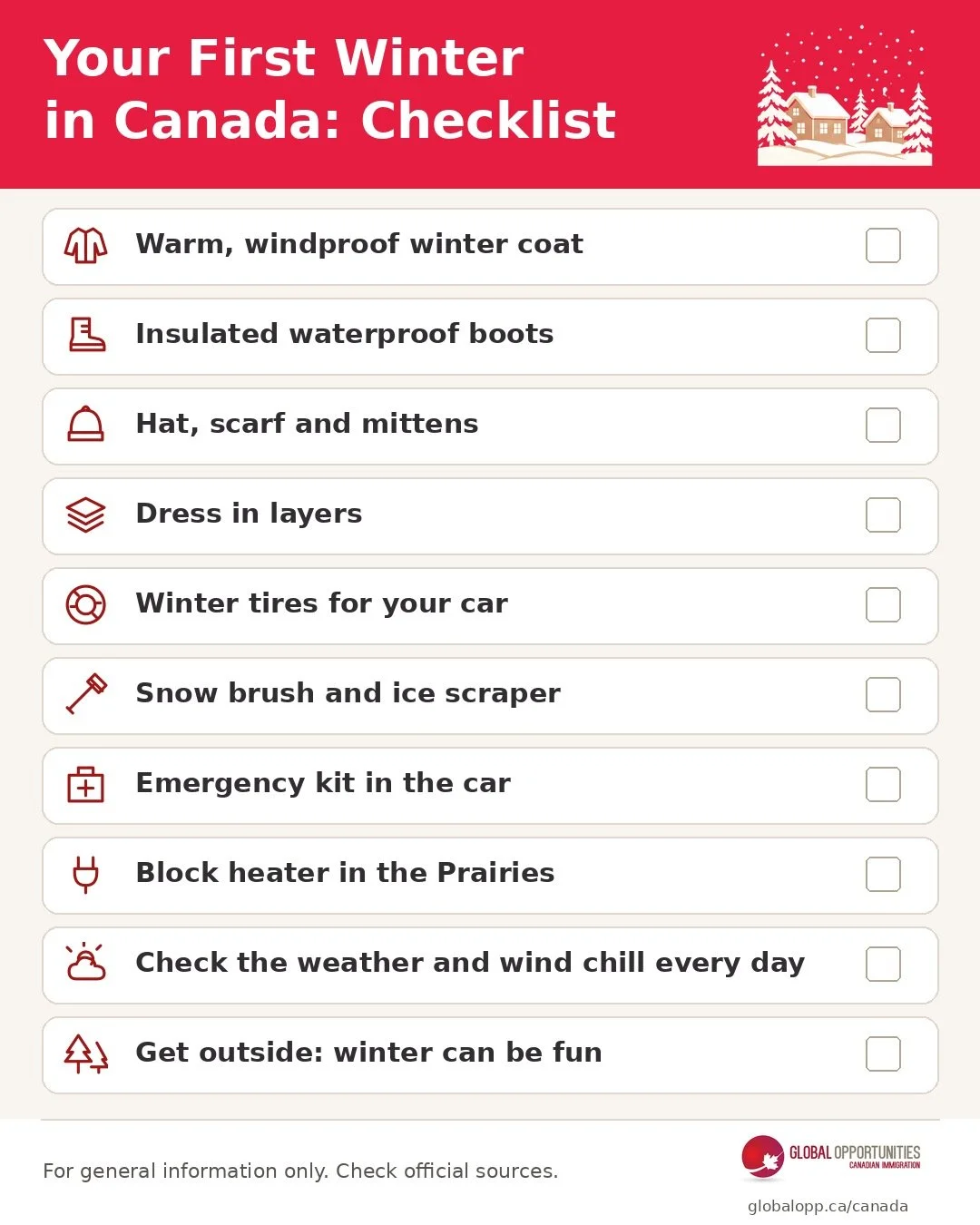
First-winter checklist
Buy boots and a coat before the first snow.
Check your lease to see who clears the snow at your home.
Learn your city's winter parking rules.
If you drive, ask about winter tires and check 511 before long trips.
Prepare an emergency kit for storms and power outages.
Look for winter activities in your city's recreation programs.
Education in New Brunswick: schools, universities and colleges
New Brunswick has two parallel public school systems, one in English and one in French, plus universities and colleges, including French-language options.
Public schools: Anglophone and Francophone sectors
According to the Government of New Brunswick, public education is organized into an Anglophone sector and a Francophone sector, and each school teaches and communicates in the language of its system (newcomers page). There are seven school districts (school districts):
Anglophone districts: Anglophone North (office in Miramichi), Anglophone East (Moncton), Anglophone South (Saint John) and Anglophone West (Fredericton).
Francophone districts: Francophone Nord-Ouest (Edmundston), Francophone Nord-Est (Tracadie) and Francophone Sud (Dieppe).
Choosing between the two systems is an important decision for families; the right to French-language education is protected by the Charter, and settlement agencies can explain the options.
French immersion in the Anglophone sector
Families in the English system can choose French immersion. According to the province (French education in the Anglophone sector), there are two entry points: Early French Immersion in Grade 1 and Late French Immersion in Grade 6, and in immersion "instruction is primarily provided in French".
How to register your child in school
Kindergarten: according to the province (kindergarten registration), the child must turn five by December 31 of the year they start. You pre-register through the Parent Portal or your district's website, usually from October of the year before. Documents include a birth certificate (with a certified translation if needed), proof of address, immunization records, Medicare or other health insurance and any education or medical reports.
Grades 1 to 12: contact your school district office, which will tell you which school serves your address. The province has a welcoming series for families new to the school system.
Child care: the province's newcomers page notes that the law requires children under 12 to always be supervised, and that there are many early learning and child care facilities across New Brunswick.
Universities in New Brunswick
International students should confirm each institution's status on IRCC's designated learning institutions list. Descriptions come from each institution's official website, checked in November 2026.
University of New Brunswick (UNB) has campuses in Fredericton and Saint John, and its homepage carries the line "Leading discovery and innovation since 1785." According to its faculties and departments page, Fredericton faculties include Arts, Management, Computer Science, Education, Engineering, Forestry and Environmental Management, Kinesiology, Law, Nursing and Health Sciences, and Science; Saint John faculties are Arts, Business, Nursing and Health Sciences, and Science, Applied Science and Engineering. Its homepage lists some programs with co-op and links to experiential education. Admissions.
Université de Moncton describes itself as one university with three campuses, in Edmundston, Moncton and Shippagan. Its website is in French, and its French immersion information page explains that admission depends on your level of French and that applicants who want to enter directly as regular students must take a French test. Its homepage links to co-op programs (Programmes COOP). Application.
Mount Allison University, in Sackville, describes itself as a residential campus with "experiential learning opportunities available in every degree." Its degrees and programs page lists bachelor's degrees in arts, fine arts, music, science and commerce, and an aviation program that pairs flight training with studies in arts, commerce or science. How to apply.
St. Thomas University (STU), in Fredericton, describes itself as a primarily undergraduate university dedicated to excellence in liberal arts education. Its academics page lists the Bachelor of Arts (including an aviation stream), the Bachelor of Applied Arts, a post-degree Bachelor of Education, Social Work and a Mi'kmaq Wolastoqey BSW. Apply.
Community colleges and specialized colleges
New Brunswick Community College (NBCC) has campuses in Fredericton, Miramichi, Moncton, Saint John, St. Andrews and Woodstock. Its website lists full-time, post-graduate and apprenticeship programs, part-time programs and courses, and microcredentials. See how to apply and the list of programs open to international applicants.
Collège communautaire du Nouveau-Brunswick (CCNB) is a francophone college, as the Government of Canada describes it (Canadian Heritage, May 2022), with campuses in Bathurst, Campbellton, Dieppe, Edmundston and the Acadian Peninsula (Shippagan) and its head office in Bathurst. Its five schools cover business, office and IT; preparatory studies and languages; trades and technologies; fisheries, natural resources and community services; and health sciences. Admission.
New Brunswick College of Craft and Design (NBCCD), in Fredericton, describes itself as dedicated to the study of fine craft and design, with programs such as foundation visual arts, 3D digital design, ceramics, fashion design, graphic design, jewellery and metal arts, photography and videography, textile design and Wabanaki visual arts. How to apply.
Maritime College of Forest Technology (MCFT), in Fredericton, describes itself as a leader in forestry education since 1946 and lists a two-year Forest Technology program and a Fish and Wildlife Technology program. Apply.
How to apply to college or university in New Brunswick
There is no central application service: you apply directly to each institution on its website. Requirements, deadlines and language requirements vary by institution and program. International students generally need a letter of acceptance from a designated learning institution, in most cases a provincial attestation letter (PAL), which IRCC says is "usually required to apply for a study permit" and is "provided by the designated learning institution (DLI) you plan to attend" (IRCC, provincial attestation letter), and a study permit. Rules change often; check IRCC's study in Canada page.
Free English and French classes
According to IRCC, permanent residents and protected persons can take free language classes in English (LINC) or French (CLIC) (IRCC, language classes). MAGMA offers English classes (MAGMA), and MCAF lists English or French classes among its settlement services (MCAF); ask your local agency what is available for your status.
School and admission rules as published by the Government of New Brunswick, IRCC and each institution, as of November 2026. Being admitted to a school does not mean a study permit will be approved; IRCC decides each case. Check the linked pages before you apply.
Jobs and main industries in New Brunswick
According to IRCC, forestry, agriculture, fisheries, mining, food processing and tourism are the principal industries in New Brunswick (Discover Canada). Global Opportunities does not offer jobs, and no one can guarantee you a job in Canada.
The labour market in numbers
According to Job Bank's economic scan for New Brunswick, updated in May 2026, employment rose by 1.3% in 2025 and the annual unemployment rate was 7.1%. Manufacturing (led by wood products and fabricated metal), health care and social assistance, public administration, education and trade added jobs, while transportation and warehousing, professional services and construction lost jobs (Job Bank, New Brunswick economic scan). Conditions vary by region and occupation.
Employment by region
According to the same Job Bank scan, in 2025:
Campbellton–Miramichi: the strongest employment growth in the province.
Moncton–Richibucto: about 3,800 more jobs, the second-largest gain.
Fredericton–Oromocto: about 1,300 more jobs.
Edmundston–Woodstock: about 700 fewer jobs, but the lowest unemployment rate of the five regions.
Saint John–St. Stephen: the steepest decline, about 4,400 fewer jobs.
Where to look for work
Job Bank and its outlooks for New Brunswick (outlooks are not job offers).
NBjobs.ca: a Government of New Brunswick job search site.
Health networks: Horizon careers and Vitalité careers.
WorkingNB: funded by the Government of Canada and the Province of New Brunswick. According to its newcomers page, its employment counsellors help newcomers with career planning and employment and can connect them with training and financial support. The province's employment counselling page adds resume and interview preparation. Ask about eligibility.
Employers directly and settlement agencies, which offer job search help for eligible newcomers.
Resume tips: use a concise Canadian-style resume (no photo, age or marital status), add a French version if you apply in French, and say clearly if you are bilingual. Our newcomer guide to Canada has resume samples. Before you apply, read our guide to Canadian resumes, cover letters and job interviews.
Minimum wage and employment standards
According to the Government of New Brunswick, as of April 1, 2026, the minimum wage is $15.90 per hour, and all employees paid by salary, commission or piece work must receive at least the minimum wage for every hour worked (Government of New Brunswick, minimum wage, overtime and minimum pay for reporting for work). The province explains that the minimum wage is updated on April 1 of every year based on the New Brunswick Consumer Price Index, and that the minimum overtime rate, one and a half times the minimum wage, applies to hours worked beyond 44 in a week (Government of New Brunswick, minimum wage engagement page). The rules come from New Brunswick's Employment Standards Act. The rate changes every year, so check the current rate on the official page.
Figures as published by the Government of New Brunswick, as of November 2026. The minimum wage changes every April 1, and some employees and situations have specific rules: check the linked pages before you rely on them.
Regulated professions and trades
Many occupations, such as engineers, nurses, doctors, teachers, accountants and electricians, are regulated in New Brunswick. You need a licence, registration or certificate from the provincial regulatory body, and foreign credentials alone do not give you a licence. Contact the regulator for your occupation to start. For more on licences, credential assessments and job searches by profession, see our guide on how to immigrate to Canada as a professional.
Nurses trained abroad can read how to immigrate to Canada as a nurse, which lists the nursing regulator in each province.
Any mention of regulated occupations in this guide is for reference only. It may not be complete. Always confirm requirements directly with the regulator for your profession or trade.
Free newcomer services in New Brunswick
IRCC offers free settlement services to eligible newcomers (IRCC, find free newcomer services), and the province's newcomers page lists settlement service providers by region:
Greater Moncton and southeast: MAGMA (which its website calls the Multicultural Agency of the Greater Moncton Area) and, for francophones in Dieppe, Shediac and Cap-Acadie, CAFi.
Fredericton and River Valley: the Multicultural Association of Fredericton (MCAF), a CAFi satellite office and the Multicultural Association of Carleton County.
Saint John and Fundy Shore: the Saint John Newcomers Centre, the YMCA of Southwestern New Brunswick, PRUDE Inc., a CAFi satellite office, the Charlotte County Multicultural Association and the Multicultural Association of Sussex.
Bathurst and Acadian Peninsula: the Multicultural Association Chaleur Region (MACR) and CAIENA-PA.
Madawaska and northwest: CRNANO (Edmundston, Clair and Grand-Sault), the Rural Settlement Network and AMINA.
Miramichi and Restigouche: the Miramichi Regional Multicultural Association, a CAFi satellite office in Miramichi and the Restigouche Multicultural Association.
This list is for reference only and may not be complete. Check eligibility with each organization. Immigration New Brunswick also offers an online orientation guide for newcomers, which requires creating an account. You can also use IRCC's newcomer services finder. IRCC's newcomer services page notes that, starting April 1, 2026, economic class permanent residents can only access federally funded settlement services for a limited time, so contact an agency early.
Eligibility rules as published by IRCC and the Government of New Brunswick, as of November 2026. Eligibility depends on your status and when you arrived: check the linked pages and confirm with each organization.
Culture and the outdoors in New Brunswick
According to IRCC, New Brunswick's Loyalist and French cultural heritage and history come alive in street festivals and traditional music (Discover Canada).
Acadian culture. According to Canadian Heritage, the Acadian flag, adopted in 1884, is based on the national flag of France, and its star represents Our Lady of the Assumption, patron saint of Acadians (Canadian Heritage, flags of the Francophonie). On August 15, National Acadian Day, celebrations include music, dance and tintamarres (Canadian Heritage, 2025 statement). The Festival acadien de Caraquet takes place in Caraquet in August, and the Village Historique Acadien is in Bertrand.
Community connections. Settlement agencies and university international offices can help you find cultural associations and community groups. Settling in is also about people: read our article on building community in Canada.
National parks. At Fundy National Park, Parks Canada says you can walk the ocean floor at low tide; check tide times before you go. Kouchibouguac National Park describes warm beaches, estuaries and a Dark Sky Preserve.
How can you immigrate to New Brunswick?
There is no single "New Brunswick visa". People move to New Brunswick through federal programs run by IRCC, the New Brunswick Provincial Nominee Program, the Atlantic Immigration Program, or a temporary permit to study or work. Programs, streams, requirements and fees change frequently, so always check the official pages. If you plan to visit first, use IRCC's tool to check if you need a visa or an eTA.
Express Entry. According to IRCC, it manages the Federal Skilled Worker Program, the Federal Skilled Trades Program and the Canadian Experience Class (IRCC, Express Entry). See our page on the Federal Skilled Worker program.
New Brunswick Provincial Nominee Program (NBPNP). According to the official NBPNP page, reviewed in November 2026, candidates choose a stream and submit an expression of interest, which is not a complete application and does not guarantee an invitation. Immigration New Brunswick invites selected people based on labour market needs, available allocation and other priorities, and IRCC makes the final decision on permanent residence. Priorities change; read the important notices. For an overview of how these programs work across Canada, see our page on provincial nominee programs.
Atlantic Immigration Program (AIP). According to IRCC, it is a pathway to permanent residence for skilled foreign workers and international graduates of Canadian institutions who want to work and live in Atlantic Canada (IRCC, Atlantic Immigration Program). In New Brunswick, employers must first be designated, and the job offer and candidate must be endorsed by the province (Government of New Brunswick, AIP). When we reviewed the province's important notices in November 2026, New Brunswick had paused new employer designation applications for the rest of 2026.
Study and work permits. See IRCC, work in Canada and our page on the LMIA. If your permit ends within a year, watch Is your work permit or PGWP expiring in the next 12 months?
The NBPNP and the AIP change often, sometimes from one month to the next. What you read here may already be different when you read it. Always check the official pages, and be wary of anyone who promises a nomination, permanent residence or a job. Meeting a program's requirements does not mean an application will be approved; the province and IRCC decide each case. Questions such as proof of funds, language points or processing times depend on each case: a consultation is the way to know how they apply to you.
Already working in the province? Watch our live session Have you completed one year of work experience in Canada?, which explains why being eligible for permanent residence is not the same as being selected.
After permanent residence, many people apply for citizenship: see our guide to Canadian citizenship.
First steps after arriving in New Brunswick
Your first weeks in New Brunswick involve a few key tasks. Doing them early makes everything else easier.
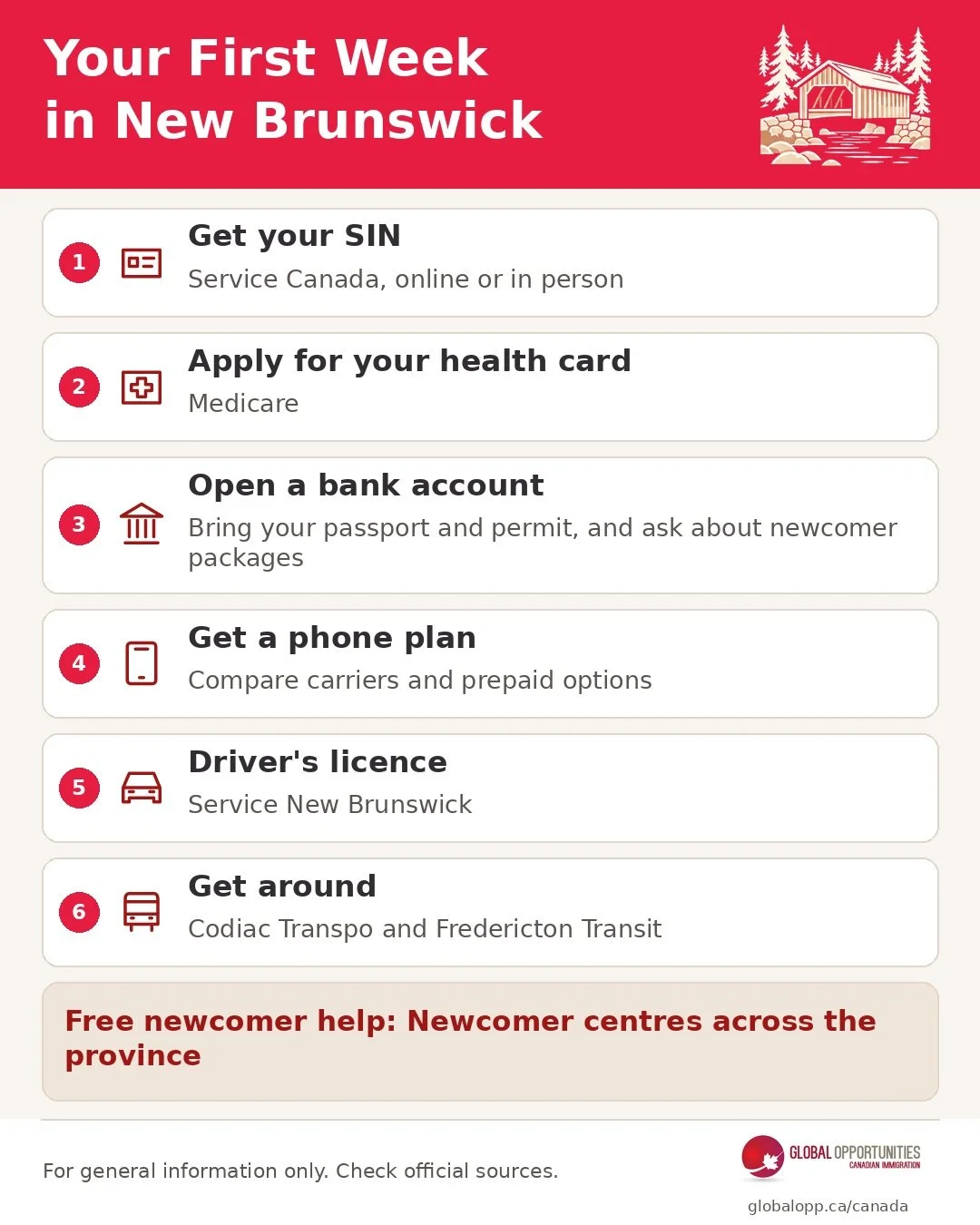
Get your Social Insurance Number (SIN) to work and access government programs (Service Canada, SIN).
Apply for Medicare once you have moved, and buy private insurance for any gap; when you have your card, register with NB Health Link or Patient Connect NB.
Open a bank account or a credit union or caisse populaire account.
Contact a settlement agency in your region, in English or French.
Find housing with a written lease; check that your deposit goes to the Tenant and Landlord Relations Office.
Get your New Brunswick driver's licence as the rules for new residents require.
Register your children in the Anglophone or Francophone school system.
Prepare for winter: coat, boots, emergency kit and, if you drive, winter tires.
Frequently asked questions
Is New Brunswick bilingual?
Yes. New Brunswick is Canada's only officially bilingual province. The Canadian Charter of Rights and Freedoms states that English and French are its official languages and that the English and French linguistic communities have equal status, including the right to their own educational and cultural institutions. The Charter also gives the public the right to receive available provincial government services in English or French, and public schools are organized into Anglophone and Francophone sectors. How much French you hear depends a lot on the region.
Do I need to speak French to live in New Brunswick?
Not necessarily. According to Statistics Canada's 2021 Census data, about three in four New Brunswick workers mainly used English at work, and in the rest of the province outside the north and the southeast, including Saint John and Fredericton, 95% did. In the northern counties, however, 72% of workers mainly used French, and in the southeast, which includes Moncton and Dieppe, 24% did. Read each job posting carefully to see which languages it asks for. If you speak French, see IRCC's page on francophone immigration outside Quebec.
Do I need French to get a job in New Brunswick?
Not for every job, but it depends on the region and the position. According to Statistics Canada, using 2021 Census data, 75.9% of New Brunswick workers mainly used English at work and 20.1% mainly used French, and 39% of workers were bilingual; in the north, most workers mainly used French, while in Saint John and Fredericton most mainly used English (Statistics Canada, languages of work in New Brunswick). Because the province offers government services in both languages, read each posting carefully to see which languages it asks for, and say clearly on your resume if you are bilingual. If you want to learn or improve your French, IRCC explains that permanent residents and protected persons can take free French classes (CLIC) (IRCC, language classes). WorkingNB can help newcomers with career planning. See our English and French section.
Moncton, Fredericton or Saint John: which is best for newcomers?
It depends on your job, languages and lifestyle; there is no single best city. IRCC describes Moncton as the principal francophone Acadian centre, Fredericton as the historic capital and Saint John as the largest city, port and manufacturing centre. In CMHC's October 2025 survey, Saint John had the lowest average two-bedroom rent of the three. According to Job Bank, the Moncton–Richibucto and Fredericton–Oromocto regions added jobs in 2025, while Saint John–St. Stephen lost jobs. All three have city buses and settlement agencies. Visit if you can, and compare job postings in your field.
Is Moncton a good and safe place to live?
Whether Moncton suits you depends on your work, budget and languages, but official data helps you decide. According to Job Bank, the Moncton–Richibucto region added about 3,800 jobs in 2025, and according to CMHC, the average two-bedroom apartment in the Moncton CMA rented for $1,453 in October 2025. On safety, look at official data and local advice rather than online rankings: Statistics Canada publishes the Crime Severity Index for provinces and census metropolitan areas, including Moncton, in table 35-10-0026-01, so you can compare cities and years. According to the City of Moncton, police services in Moncton, Dieppe and Riverview are provided by the Codiac Regional RCMP. Visit areas at different times of day before you sign a lease, and call 911 in an emergency. See our Moncton section.
Moncton or Halifax: which is better for newcomers?
It depends on your occupation, budget and languages, so compare jobs in your field first. Halifax is a larger city; Moncton is in the most bilingual part of New Brunswick, which can help if you speak French. On housing, CMHC's October 2025 survey put the average two-bedroom apartment at $1,453 in the Moncton CMA and $1,826 in the Halifax CMA (CMHC, Rental Market Survey data tables). For transit, according to Codiac Transpo and Halifax Transit, an adult 30-day pass in Moncton was $73 and an adult monthly pass in Halifax $90, as of November 2026. The HST is 15% in New Brunswick and 14% in Nova Scotia, according to the CRA. Read our Nova Scotia guide and check current prices on each official source.
Is it cheap to live in New Brunswick?
It depends on where you live and how you live. According to CMHC, in October 2025 the average two-bedroom apartment rented for $1,453 in the Moncton CMA, $1,413 in Fredericton and $1,290 in Saint John, and below $1,150 in the Miramichi, Edmundston, Bathurst and Campbellton areas. Other costs add up: according to the CRA, the HST in New Brunswick is 15% (checked in November 2026), and many households outside the three largest cities need a car. Build your budget with official figures and current listings, and check current prices before you decide.
How much is NB Power in winter?
There is no single figure, because your bill depends on whether heat is included in the rent, how the home is heated, its size and insulation, and how cold the winter is. According to NB Power, heating is the biggest driver of energy use and costs in New Brunswick homes, and in the coldest months heating alone can make up 70 to 80% of an electricity bill (NB Power, why energy bills rise in winter). Before you sign a lease, ask whether heat is included and ask the landlord or the previous tenant for an idea of typical winter bills. To avoid big swings, NB Power's Equalized Payment Plan spreads your electricity costs over 12 equal monthly payments. NB Power also lists payment assistance options for customers who have trouble paying. See our utilities section.
How much does the bus cost in Moncton?
According to Codiac Transpo's fares page, which covers Moncton, Dieppe and Riverview, as of November 2026 a cash fare costs $3 (exact fare), a day pass $7, a 10-trip pass $29 and a 20-trip pass $47. The adult 30-day pass costs $73, and $58 for students, children 12 and over, and seniors 65 and over with ID. Children under 6 ride free, and resident children 6 to 11 ride free with the U12 pass. You can buy passes in the Codiac+ app. Fares change, so check the current price on the official page.
Is there public transit in Fredericton and Saint John?
Yes. According to the City of Fredericton, Fredericton Transit charges $3 per ride, payable by cash, debit, credit card, phone or smartwatch; an adult monthly pass costs $85 and a student pass $60 as of November 2026, rising to $90 and $65 on January 1, 2027. According to the City of Saint John, Saint John Transit charges $3 for a single cash ride, and its adult monthly pass costs $83.50 (fares effective January 1, 2026), with multi-ride passes rising by an average of 1.5% on January 1, 2027. Check routes and schedules on each city's transit pages.
How much can a landlord ask for as a deposit in New Brunswick?
According to the Government of New Brunswick's security deposits page, the maximum security deposit is one week's rent for a week-to-week lease and one month's rent for month-to-month, year-to-year and fixed-term leases. A landlord can ask for the first month's rent plus the deposit, but cannot ask for the first and last month's rent. The landlord must submit the deposit to the Tenant and Landlord Relations Office within 15 days, and you can also pay it directly at Service New Brunswick. You will receive a Certificate of Deposit by mail.
How much can my rent go up in New Brunswick?
According to the province's rent increase page, landlords are not permitted to increase rent by more than 3% every 12 months. They must give six months' written notice, rent can only go up once every 12 months, and not within the first 12 months of a tenancy. A landlord who wants more than 3%, up to 9%, for justified renovation costs must apply for permission. If you receive a notice, you can accept it, end your tenancy with proper notice, or request a free review from the Tenant and Landlord Relations Office within 60 days.
How do I get a Medicare card in New Brunswick?
According to the province's page on applying for a Medicare card, you can apply only after you have physically moved to the province. Prepare your immigration or citizenship documents, proof of identity and proof of New Brunswick residency, then apply with the online Medicare application or the paper form. The province assesses each application case by case and sends you a letter with your coverage start date, then your card; newcomers may be entitled to coverage from their first day if they meet the requirements. Medicare does not cover prescription drugs, dental or vision care, so consider private or workplace insurance.
Can international students get Medicare in New Brunswick?
Yes, if they meet the criteria. According to the Government of New Brunswick, people eligible for Medicare include an international student who meets the eligibility criteria, while students from another province and tourists or visitors are not eligible (Government of New Brunswick, Medicare eligibility). The province's list of required documents asks international students for proof of enrolment for a full school or academic year, and notes that an acceptance letter is not accepted as proof of enrolment. You can only apply once you have moved to New Brunswick, and each application is assessed case by case, so buy private insurance or join your school's plan for any gap. Medicare does not include services such as prescription drugs, dental care and vision care. Ask your school's international office how its health plan works. See our health care section.
How do I find a family doctor in New Brunswick?
Once you have a valid Medicare card and live in the province, register with NB Health Link, the program for patients without a family doctor or nurse practitioner. Registered patients can book appointments with the program's network while they wait to be matched. In several health zones, new registrants may be waitlisted until capacity increases. NB Health Link is gradually replacing Patient Connect NB, which still refers patients in areas not yet covered. You can also call Tele-Care 811 for help, and use Virtual Care NB for common, non-urgent problems.
What is Tele-Care 811 in New Brunswick?
Tele-Care 811 is New Brunswick's free, confidential health line. A registered nurse answers 24 hours a day, in English or French, and can help you decide whether to see a doctor, go to an emergency department or treat a problem at home. You do not need a Medicare card to call, which is useful in your first weeks. Nurses can also connect you to services such as Virtual Care NB. For a life-threatening emergency, always call 911. For community services such as food banks or housing help, call 211.
Can I exchange my foreign driver's licence in New Brunswick?
It depends on your country. According to the province's page on licences for new residents, new residents must get a New Brunswick licence as soon as they take up residence. Nationals of countries with reciprocity, such as France, Germany, Ireland, Japan, the Republic of Korea, Spain, the United Kingdom and others on the official list, can exchange for a Class 5 without testing, with the required documents. Others must take the full exam: vision, written and road tests. Temporary residents with permits valid for more than six months may drive on their home licence for up to six months after landing.
What universities and colleges are in New Brunswick?
Universities include the University of New Brunswick (Fredericton and Saint John), the Université de Moncton (Edmundston, Moncton and Shippagan), Mount Allison University (Sackville) and St. Thomas University (Fredericton). Colleges include New Brunswick Community College, with six campuses, and the francophone Collège communautaire du Nouveau-Brunswick, with five. Fredericton also has the New Brunswick College of Craft and Design and the Maritime College of Forest Technology. Check each school's status on IRCC's designated learning institutions list.
Where can I get free help as a newcomer in New Brunswick?
IRCC offers free settlement services to eligible newcomers, and the Government of New Brunswick lists settlement service providers by region on its newcomers page. Examples include MAGMA in Greater Moncton, CAFi for francophones in the southeast, MCAF in Fredericton, the Saint John Newcomers Centre and YMCA in Saint John, MACR in Bathurst, CRNANO in Edmundston and the Miramichi Regional Multicultural Association. WorkingNB offers employment counselling. Eligibility depends on your status, so confirm with each organization, and contact them early, because some federal services are time-limited for certain permanent residents.
When should I call 911 in New Brunswick, and what if I call it by mistake?
Call 911 when there is an emergency, such as a person or property in immediate danger, an injury or illness that poses an immediate risk to life, a fire, a serious accident, a crime in progress or a poisoning, according to the Government of New Brunswick's 911 page. The same page asks you never to call 911 to test it, explains that if 911 is dialled by mistake from a pre-programmed number the operator will need to verify the call, and asks you to keep your phone on after you hang up in case the operator calls you back. Other Atlantic 911 services, such as Nova Scotia's, ask people who dial by accident not to hang up, but to stay on the line and tell the call taker it was a mistake.
Is there a mental health crisis line in New Brunswick?
Yes. If you or someone you know is thinking about suicide, you can call or text 9-8-8, the Suicide Crisis Helpline, 24 hours a day, every day of the year (9-8-8). If someone's life is in immediate danger, call 911. For non-urgent health questions, the provincial 811 line can point you to local services (see the health section).
How do I check road conditions in New Brunswick before I drive?
Use New Brunswick 511, or dial 511 within the province, to check road conditions, closures and highway cameras before you leave. The Government of New Brunswick's Storm Watch page asks motorists to plan ahead and keep checking 511 during storms.
What do I do if I get a flat tire or my car breaks down in New Brunswick?
If you are in danger or blocking traffic, call 911. For a flat tire, a dead battery or a tow, many drivers use roadside assistance. CAA offers roadside assistance to its members through regional clubs, and says that services may vary by club (CAA). Some car insurance policies, new-car warranties and credit cards also include roadside assistance: check your policy or card agreement before you need it, and keep the phone number in your car.
How does car insurance work in New Brunswick?
Car insurance is sold by private insurance companies doing business in the province. The New Brunswick Insurance Board says its legislated role is to oversee the premiums they charge (New Brunswick Insurance Board), and the Financial and Consumer Services Commission (FCNB) publishes consumer information on automobile insurance. Compare quotes from several insurers or brokers, and ask how they treat your driving history from abroad. See the driving section.
Can newcomers get the Canadian Dental Care Plan in New Brunswick?
Possibly, once you meet the conditions. According to the Government of Canada's CDCP eligibility page, you must meet all four requirements: no access to private dental insurance or coverage, a tax return filed in Canada (and your spouse's or partner's, if you have one), an adjusted family net income below $90,000, and being a Canadian resident for tax purposes. Filing your first Canadian tax return is therefore the first step. Conditions as published by the Government of Canada, as of November 2026; check the official page before you apply.
Should I test my home for radon in New Brunswick?
It is a good idea. Health Canada's cross-Canada survey found that New Brunswick was among the provinces and territories with the highest share of tested homes above the radon guideline (Health Canada). Radon is invisible and odourless, so the only way to know the level is to test. Health Canada recommends a long-term test of at least 3 months (testing your home). See our emergencies and natural hazards section.
Is New Brunswick a good place to live?
It depends on your work, languages and lifestyle. On the plus side, the province has English and French communities with equal status and growing sectors such as digital health and cybersecurity, according to the Government of New Brunswick's economy page. On the other side, city buses run only in the three largest cities, so many people need a car, winters are cold, and some jobs require French. Compare job postings and rents in the city you are considering using the official data in this guide before you decide.
Are there direct flights to Moncton or Fredericton from Europe or Mexico?
According to the airports' own pages as of November 2026, there were no non-stop flights from Europe. From Mexico, Fredericton's airlines page listed seasonal sun flights to Cancún by Sunwing (January to May) and Air Transat (December to May); Moncton listed Air Transat and Sunwing as winter seasonal airlines (YQM, airlines). A common way to get there from Europe and Latin America is to connect in Toronto or Montréal, which have direct flights to Fredericton and Saint John according to those airports' pages. Routes and airlines change seasonally, so check the airport's page and the airlines before you book.
Can Global Opportunities get me a job in New Brunswick?
No. Global Opportunities does not offer jobs or job offers, and no one can guarantee you a job in Canada. To look for work, use Job Bank, NBjobs.ca, the Horizon and Vitalité career sites, employers' websites, WorkingNB and settlement agencies. Be wary of anyone who sells "guaranteed jobs" or asks you to pay for a job offer. If you want to understand your immigration options, you can join our free online seminars or ask for a personalized consultation, as explained in the section on how Global Opportunities can help.
Do I need a car in New Brunswick?
It depends on where you live and work. According to the Government of New Brunswick's newcomers page, city buses run only in Moncton, Saint John and Fredericton, so outside those cities you will likely need a car or another way to get to work. Even in the three cities, check the routes and schedules near your home and workplace before you decide: Codiac Transpo serves Moncton, Dieppe and Riverview, and Fredericton and Saint John run their own transit systems. For longer trips, Maritime Bus is the main city-to-city bus line, and VIA Rail lists stations in Moncton and Bathurst, among others. See our getting around section.
How do I get a driver's licence in New Brunswick for the first time?
You start in the graduated licensing program. According to the Government of New Brunswick's graduated licences page, anyone applying for a driver's licence for the first time, regardless of age, receives a Class 7 Level 1 licence after passing a written test, and spends a minimum of 24 months in the program. Level 1 drivers cannot drive alone, cannot drive between midnight and 5 a.m. and have zero tolerance for drugs or alcohol. After 12 months, or 8 months with a driver training course, you can take the road test for Level 2, which allows driving alone with up to three passengers. After 24 months at Levels 1 and 2 combined, you get a full Class 5 licence. See our driving section.
Do I need winter tires in New Brunswick?
Snow and ice are part of winter driving in New Brunswick, so ask your insurer or a tire shop whether winter tires make sense for your car. Keep a brush and scraper, winter washer fluid and an emergency kit in the car, clear all snow and ice before driving and leave more space. Check road conditions on the province's 511 New Brunswick service before long trips. Winter parking rules also matter: according to the City of Moncton, restrictions apply from December 1 to April 15, and on-street parking is not allowed from midnight to 7 a.m. when restrictions are in place. Other municipalities have their own rules. See our driving section.
What is the weather like in New Brunswick?
IRCC describes the Atlantic provinces, including New Brunswick, as having cool winters and cool, humid summers, but conditions vary from one part of the province to another. Compare the city where you will live using the official climate normals on the Environment and Climate Change Canada site, and check forecasts and warnings on weather.gc.ca. Winter storms can cause power outages, so the Government of Canada recommends preparing for a few days without power with water, food that does not need cooking, flashlights, batteries, medications and phone power banks. Buy a warm coat with a hood and insulated waterproof boots before the first snow. See our climate section.
How do I rent an apartment in Moncton?
Start with online listing sites such as Kijiji, Facebook Marketplace, Rentals.ca and PadMapper, property management companies that own buildings in Moncton, and settlement agencies such as MAGMA, which can explain the process and your rights. Ask what is included in the rent (heat, hot water, electricity, parking, laundry) and how the unit is heated. According to the Government of New Brunswick's security deposits page, the maximum deposit for a month-to-month or fixed-term lease is one month's rent, and a landlord cannot ask for the first and last month's rent. The Competition Bureau warns never to send money for a place you have not seen. The same steps apply in Fredericton and Saint John. See our housing section.
What are my rights as a tenant in New Brunswick?
You have clear rules on entry, deposits, rent increases and disputes. According to the Government of New Brunswick's landlord entry page, landlords must generally give seven days' written notice before entering for routine maintenance, and at least 24 hours' notice to show the unit or do an inspection, except in an emergency. Entering without notice is an offence under the Act, and discrimination in renting is not allowed. Your deposit must go to the Tenant and Landlord Relations Office, and, according to the rent increase page, rent increases are capped at 3% every 12 months. If a problem is not resolved, apply to the Tenant and Landlord Relations Office, which first tries mediation; a Residential Tenancies Officer decides if that fails. See our housing section.
How do I open a bank account in New Brunswick?
Banks generally ask for identification such as a passport and your immigration document, plus proof of address. The Financial Consumer Agency of Canada explains what identification banks require and what to do if a bank refuses to open an account (FCAC, opening a bank account). Large national banks have branches in New Brunswick, and you can also look at member-owned co-operatives such as UNI Financial Cooperation, a caisse populaire. Ask each institution whether it has a newcomer package, and compare fees, transaction limits and international transfer costs. To start building credit, get a credit card, or a secured credit card if you are refused a regular one, and pay the full balance on time. See our banking section.
What jobs are there in New Brunswick?
According to IRCC, forestry, agriculture, fisheries, mining, food processing and tourism are New Brunswick's principal industries. Job Bank's economic scan for New Brunswick, updated in May 2026, reports that in 2025 manufacturing, health care and social assistance, public administration, education and trade added jobs, while transportation and warehousing, professional services and construction lost jobs. Conditions vary by region and occupation, so compare postings in your field on Job Bank and NBjobs.ca, the health networks' career sites and employers' websites. Many occupations, such as engineers, nurses and electricians, are regulated, so contact the regulator for your occupation. Global Opportunities does not offer jobs, and no one can guarantee you one. See our jobs section.
What is the minimum wage in New Brunswick?
According to the Government of New Brunswick, as of April 1, 2026, the minimum wage is $15.90 per hour, and employees paid by salary, commission or piece work must receive at least the minimum wage for every hour worked (Government of New Brunswick, minimum wage, overtime and minimum pay for reporting for work). The rate is updated every April 1. Employers must pay at least one and a half times the minimum wage for hours worked beyond 44 in a week, which the province puts at $23.85 per hour at the current rate (Government of New Brunswick, minimum wage engagement page). Many jobs pay more than the minimum: Job Bank lets you look up the wages reported for your occupation (Job Bank, search wages). Check the current rate before you accept a job offer. See our jobs section.
How do I register my child in school in New Brunswick?
First choose between the Anglophone and Francophone sectors; according to the Government of New Brunswick's school districts page, each school teaches and communicates in the language of its system, and there are seven school districts. For Grades 1 to 12, contact your school district office, which will tell you which school serves your address. For kindergarten, according to the province's kindergarten registration page, the child must turn five by December 31 of the year they start, and you pre-register through the Parent Portal or your district's website, usually from October of the year before. Documents include a birth certificate (with a certified translation if needed), proof of address, immunization records and Medicare or other health insurance. See our education section.
Can my children learn French in New Brunswick schools?
Yes, in two ways. Families can choose a school in the Francophone sector, where instruction is in French; the right to French-language education is protected by the Charter. Families in the English system can choose French immersion: according to the Government of New Brunswick, there are two entry points, Early French Immersion in Grade 1 and Late French Immersion in Grade 6, and in immersion instruction is primarily provided in French. Choosing between the two systems is an important decision for families, and settlement agencies can explain the options in your region. For the details, see the province's page on French education in the Anglophone sector. See our education section.
Are there free English or French classes in New Brunswick?
Yes, for eligible newcomers. According to IRCC, permanent residents and protected persons can take free language classes in English (LINC) or French (CLIC). In Greater Moncton, MAGMA offers English classes, and in Fredericton, MCAF lists English or French classes among its settlement services. Other settlement agencies across the province, listed by region on the Government of New Brunswick's newcomers page, may also offer classes or refer you to them. Ask your local agency what is available for your status, and contact it early, because IRCC notes that some federally funded settlement services are time-limited for economic class permanent residents. See our education section.
What is the New Brunswick Provincial Nominee Program (NBPNP)?
The NBPNP is New Brunswick's provincial nominee program, one of the ways people move to the province. According to the official NBPNP page of the Government of New Brunswick, candidates choose a stream and submit an expression of interest, which is not a complete application and does not guarantee an invitation. Immigration New Brunswick invites selected people based on labour market needs, available allocation and other priorities, and IRCC makes the final decision on permanent residence. Streams and priorities change often, sometimes from one month to the next, so read the official page and its important notices, and be wary of anyone who promises a nomination. See our how people immigrate section.
What is the Atlantic Immigration Program?
According to IRCC, the Atlantic Immigration Program (AIP) is a pathway to permanent residence for skilled foreign workers and international graduates of Canadian institutions who want to work and live in Atlantic Canada. According to the Government of New Brunswick, employers in the province must first be designated, and the job offer and candidate must be endorsed by the province. When we reviewed the province's important notices in November 2026, New Brunswick had paused new employer designation applications for the rest of 2026. The program changes often, so check IRCC's AIP page and the province's AIP page, and be wary of anyone who promises a job or permanent residence. See our how people immigrate section.
Related guides
How Global Opportunities can help
Choosing a province and a pathway depends on your education, work experience, languages and goals. We can help you understand your options.
Our regulated consultant: Lic. Mildrete Monserrath Gutierrez Martinez, Regulated Canadian Immigration Consultant (RCIC), CICC licence R514880. Verify her licence on the CICC Public Register: https://college-ic.ca/protecting-the-public/find-an-immigration-consultant. Global Opportunities does not offer services for Quebec's immigration programs. Global Opportunities is a private firm and is not part of the Government of Canada or any provincial government.
Recorded seminars and lives: watch our recorded seminars in English or the Spanish recordings, and visit our YouTube channel.
More articles in English: read our Moving to Canada articles on topics such as health care, cost of living, the ECA and professional licences, and building community in Canada.
Personalized consultation: for a review of your own case, contact us or write to info@globalopp.ca.
Prefer email? Tell us what you need help with (moving to New Brunswick) and we will reply: email info@globalopp.ca.
Contact Global Opportunities →
Sources
Justice Laws, Canadian Charter of Rights and Freedoms, sections 16 and 16.1
Office of the Commissioner of Official Languages for New Brunswick, History
Statistics Canada, Languages of work in New Brunswick (March 2023)
Canada Revenue Agency, Tax rates and income brackets for the current year
Canada Revenue Agency, Before you apply for the Canada child benefit
Canada Revenue Agency, How to apply for the Canada child benefit
Canada Revenue Agency, Canada Groceries and Essentials Benefit
Government of New Brunswick, Early learning and child care: information for families
Government of New Brunswick, Minimum wage, overtime and minimum pay for reporting for work
Government of New Brunswick, Required documentation for your Medicare
Statistics Canada, Crime severity index and weighted clearance rates (table 35-10-0026-01)
Government of New Brunswick, French education in the Anglophone sector
Parks Canada, Fundy National Park and Kouchibouguac National Park
Canadian Heritage, Statement on National Acadian Day (August 2025)
National Defence, 5th Canadian Division Support Base Gagetown (August 2026)
Greater Moncton Roméo LeBlanc International Airport, Transportation
Statistics Canada, Census Profile, 2021 Census: New Brunswick
Statistics Canada, Visible minority by gender and age (table 98-10-0351-01) · Ethnic or cultural origin by gender and age (table 98-10-0355-01)
Statistics Canada, Population and dwelling counts (table 98-10-0001-01) · by municipality (table 98-10-0002-01) · Population estimates, quarterly (table 17-10-0009-01)
Canada Revenue Agency, First Home Savings Account · Opening your FHSAs · Home Buyers' Plan · Line 31270, home buyers' amount
Government of Canada, Canadian Dental Care Plan: do you qualify
Global Opportunities on YouTube, Have you completed one year of work experience in Canada?
Government of New Brunswick, About New Brunswick · Basic facts · Geography · Economy · Transportation
Greater Moncton Roméo LeBlanc International Airport, Airlines · Destination schedule
Fredericton International Airport, Airlines · Saint John Airport, Flights
VIA Rail, Montréal–Halifax (Ocean) · Maritime Bus · Bay Ferries and Northumberland Ferries · Confederation Bridge
Canada Border Services Agency, Border wait times · Travel information
Government of New Brunswick, Emergencies · River Watch · Flood risk information · Fire Watch · Wildfires · Storm Watch · Public alerting · 911
Health Canada, Radon · About radon · Testing your home · Cross-Canada survey of radon concentrations in homes
Environment and Climate Change Canada, Air Quality Health Index
The information in this guide is general and for reference only. It comes from the official sources linked in each section, as they read when we checked them in November 2026, and it may have changed since then. It is not immigration, legal, tax or professional advice. Global Opportunities is not responsible for how anyone interprets this content, for decisions made based on it, or for changes made by the sources after it was written: what you read depends on when you read it. Immigration programs, the New Brunswick Provincial Nominee Program, the Atlantic Immigration Program, health coverage rules, rental rules, fares, rents and tax rates change frequently, and statistics describe the past and do not predict any outcome. Always confirm requirements and prices with official Government of Canada, Government of New Brunswick and municipal sources. Global Opportunities is a private firm, is not part of the Government of Canada or of any regulator, and does not offer jobs. For advice on your own case, book a consultation.
Last reviewed: November 2026