
Working in Canada: Canadian Resume, Cover Letter, Job Interview and Working Holiday Preparation
Whether you already live in Canada or you are getting ready for a Working Holiday, the same questions come up: how do I write a Canadian resume, what is the difference between a resume and a CV, should I add a photo, how do I get past applicant tracking systems, do I need a cover letter, how do Canadian job interviews work, what are employers not allowed to ask me, who helps newcomers with their job search for free, and how do I spot a job scam? This guide answers them in plain English, using official Government of Canada and provincial sources.
About our sources: This guide summarises what official sources (the Government of Canada, provincial and territorial governments and the other organisations we link to) said when we checked them in November 2026. We link every source so you can read it yourself. Rules, rates and requirements change, sometimes without notice, and the official page is the one that counts. This is general information, not legal, tax or immigration advice. Global Opportunities is not responsible for how this information is interpreted or for changes made after it was written.
This guide is written for two groups of readers:
People already in Canada: work permit holders, graduates on a post-graduation work permit, international students, International Experience Canada (IEC) participants and new permanent residents who want help with their resume and job search.
People still outside Canada who are preparing a Working Holiday under IEC and want to know what to do before activating their permit and travelling.
One thing first: Global Opportunities does not offer jobs, job placement or recruitment services, and we do not find job offers for anyone. Nobody can guarantee you a job in Canada; as IRCC's page on fraud targeting newcomers puts it, "No one can guarantee you a job or a visa to Canada or permanent residence." This is a free information guide. We are Global Opportunities, a private immigration firm based in Toronto. Hiring practices, programs and the eligibility of free services change, so we link the official page for each topic. Check the official page before you make any decision.

Watch our recorded seminars and lives →
In this guide
How do newcomers find a job in Canada?
Who helps you find a job in Canada for free
Working Holiday in Canada: which countries can participate
Benefits of an open work permit under the Working Holiday category
Before you activate your Working Holiday: what to prepare at home
Your first weeks in Canada: SIN, bank account and housing
Canadian resume vs CV: what is the difference?
Which resume format works best in Canada? Chronological, functional and combination
How to write a Canadian resume, section by section
What not to include in a Canadian resume, and why
Applicant tracking systems (ATS) and keywords
How to tailor your resume to each job
"Canadian experience": what it means and how to handle it
Canadian resume template and example
How to write a cover letter for a job in Canada
Your LinkedIn profile for the Canadian job market
Networking and informational interviews in Canada
Job interviews in Canada: what to expect
Common interview questions and how to answer them
Behavioural questions and the STAR method
Salary questions in a job interview
Questions you can ask the employer
Before you accept a job offer in Canada
What employers cannot ask you in a job interview in Canada
Do Canadian employers check references? References and background checks
Job scams in Canada: how to protect yourself
Regulated professions: ECA vs professional licence
Your basic rights as a worker in Canada
Frequently asked questions
Related guides
How Global Opportunities can help
Sources
How do newcomers find a job in Canada?
Most newcomers find work through a mix of tailored applications, free employment services and networking. CICIC says only about 20% of jobs are regulated, so in most cases your resume, cover letter, interview and references decide most hiring. Regulated professions and some trades also need a provincial licence, and your work permit sets what you can do.
Even people with strong experience need time to adapt their documents, learn how local employers recruit and build a network.
Most jobs are not regulated, but some are
The Canadian Information Centre for International Credentials (CICIC) explains on its page Identify the organization responsible for recognition that in regulated occupations, recognition "will be determined by the appropriate provincial or territorial regulatory authority", while in non-regulated occupations, recognition "is normally at the discretion of the employer." The same CICIC page says that "about 20% of jobs are regulated to protect the health and safety of Canadians", so most jobs are not regulated.
In a non-regulated job, your resume, cover letter, interview and references do most of the work. In a regulated profession or compulsory trade, you usually also need a provincial licence or certificate (see the section on regulated professions below).
Employers look for fit, results and communication
The Government of Canada's Job Bank says, on its page on how to write a good resume, that "An employer takes an average of 30 seconds to skim a resume." That is why Canadian resumes are short, focused on results and adapted to each job.
Your work permit conditions come first
Before you apply, read your permit. IRCC's page Find out if you need a work permit explains that there are two types: with an employer-specific work permit "You need a job offer", while with an open work permit "You can work for most compliant employers in Canada." The IEC Working Holiday category issues an open work permit, according to IRCC's page about IEC. An employer-specific permit only lets you work under the conditions written on it. Our newcomers in Canada guide explains how to read it.
Who helps you find a job in Canada for free
Canada has a large network of free, publicly funded employment services. Eligibility depends on the program, your immigration status and where you live, so always ask before you register. Many services ask for your Social Insurance Number (SIN) and proof that you can legally work in Canada.

Federally funded newcomer services (mainly for permanent residents)
Immigration, Refugees and Citizenship Canada (IRCC) funds free settlement services across the country. Its newcomer services finder lists organizations that help with jobs, language and settlement. Eligibility mainly covers permanent residents and people approved for permanent residence, plus some specific groups; most temporary workers, students and IEC participants are not eligible. If you are a new permanent resident, start here.
IRCC's free pre-arrival services help people abroad with job search, resumes and credential recognition (see Prepare to work in Canada), but the eligibility page requires approval for permanent residence and says: "Pre-arrival services aren't available if you're coming to Canada temporarily." Working Holiday participants are therefore not eligible.
Provincial employment services (often open to people legally entitled to work)
Provinces run their own free employment services, and many of them are open to temporary residents who are legally entitled to work. Some examples:
Ontario: Employment Ontario. Ontario says you can get free support to write your resume, prepare for interviews and find a job, with one-on-one help across the province. Eligibility depends on factors such as being legally entitled to work in Canada and living in Ontario; each provider confirms it.
British Columbia: WorkBC Centres. WorkBC says its centres "provide a wide range of free employment services", including help to create a resume and cover letter, interview coaching and practice, and free resume-writing workshops. You can check your eligibility online.
Alberta: Alberta Supports and alis. Alberta's employment services page describes workshops on resume writing, job interviews and job search at Alberta Supports centres, plus employability and career counselling. The province's career site, alis, has free articles on resumes, cover letters, references and interviews that are useful anywhere in Canada.
Other provinces have equivalent services. Our province guides (Ontario, British Columbia, Alberta, Manitoba, Saskatchewan, Nova Scotia, New Brunswick, Prince Edward Island and Newfoundland and Labrador) list the main ones.
Community agencies
Non-profit agencies run employment workshops, mentoring and bridging programs for internationally trained people. In Toronto, for example, the YMCA of Greater Toronto offers employment services, and ACCES Employment, COSTI and JVS Toronto run employment programs for newcomers. The City of Toronto has a page for newcomer job seekers. Some programs are only for permanent residents or specific groups.
Public libraries
Libraries are an underrated job-search tool. The Toronto Public Library, for example, gives residents a free card with access to computers, Wi-Fi, printing, workshops, language learning and job search tools, and some branches host settlement workers. Check your local library's website wherever you live.
College and university career centres
If you study at a Canadian college or university, your career centre is usually free for enrolled students and often for recent graduates. For example, Centennial College's Career Services and Co-operative Education offers job boards, resume reviews and career fairs. Ask your own institution what it offers to students and alumni.
Job Bank: the Government of Canada's job site
Job Bank is the federal government's free job site. Besides job postings, it has a Resume Builder (free account required), labour market information on job outlooks by region, and a wage search to "Compare how much you could make in different parts of the country or between occupations."
Organizations are listed for reference only. Global Opportunities has no relationship with them. Programs and eligibility change; many ask for a SIN and proof of status, and some are only for permanent residents. Ask before you register.
Working Holiday in Canada: which countries can participate
The "Working Holiday visa" is really the Working Holiday category of International Experience Canada (IEC), a Government of Canada program. Participants receive a work permit, not a visa as such.
You need citizenship of a country with a youth mobility agreement
IRCC's page on who can apply for IEC says that "your country or territory of citizenship must have a youth mobility agreement (YMA) with Canada." When we checked it in November 2026, the participating countries and territories were: Andorra, Australia, Austria, Belgium, Chile, Costa Rica, Croatia, Czech Republic, Denmark, Estonia, Finland, France, Germany, Greece, Hong Kong, Iceland, Ireland, Italy, Japan, Republic of Korea, Latvia, Lithuania, Luxembourg, Netherlands, New Zealand, Norway, Poland, Portugal, San Marino, Slovakia, Slovenia, Spain, Sweden, Switzerland, Taiwan and the United Kingdom.
Important details:
Not every country offers every category. For example, Switzerland takes part in IEC but does not offer the Working Holiday category. Check your country on IRCC's page IEC: eligibility by country and category, which also sets the age limit, the length of the permit, the funds required and any other conditions for each country.
Mexico is not on the list. Mexico does not appear on IRCC's list of countries and territories with a youth mobility agreement on its page Who can apply for IEC (checked in November 2026), so Mexican citizens cannot apply for the Working Holiday category with a Mexican passport. Check the official list for any change.
Refugee travel documents: IRCC says "You're not eligible to participate in IEC if you hold a refugee travel document from any country."
The list can change. Always confirm on the official page before you plan anything.
How IEC works, in one paragraph
IRCC's page about IEC explains that IEC runs by season: eligible candidates create a profile, enter a pool and may receive an invitation to apply. An invitation is not guaranteed. If invited, you apply for the work permit, and if approved you receive a port of entry letter of introduction. The actual work permit is issued by a border services officer when you arrive. Our Working Holiday page and our Working Holiday guide for Irish citizens explain each step in detail.
Country list and rules as published by IRCC on its IEC pages, as of November 2026. The list of countries, the categories each one offers, age limits, permit length and other conditions can change: check the linked IRCC pages before you plan anything. Being eligible to create a profile does not mean you will be invited or that a work permit will be issued; IRCC and the border services officer decide each case.
Benefits of an open work permit under the Working Holiday category
IRCC's about IEC page says: "The Working Holiday category lets you apply for an open work permit," and "This lets you work for most employers anywhere in Canada." It describes this category as a fit if you:
"don't have a job offer before you come to Canada";
"want to work for more than one employer in Canada";
"want to work in more than one location";
"want to earn some money so that you can travel."
In practice, this means you can start your job search once you land, change employers without a new permit, and work in different cities and provinces while your permit is valid.
Limits to keep in mind
Your permit conditions still apply. IRCC's page on preparing for arrival says to check your permit carefully at the border; for Working Holiday, it should show an open employer and an unknown location.
Some jobs require a medical exam. IRCC's IEC application page says you should get a medical exam before applying if you plan to work in health, education, child care or elderly care, or if you have recently lived or travelled in certain countries. Without it, your permit may carry restrictions.
An open permit is not a licence. It does not let you work in a regulated profession or compulsory trade without the provincial licence or certificate.
It is temporary. If you want to stay longer, IRCC's Canadian Experience Class page explains which kinds of work experience count for that program. Whether a longer stay or permanent residence is possible depends on each person's case; a consultation is the way to know what applies to you.
Work permit rules as published by IRCC, as of November 2026. An open work permit lets you work for most employers, but the conditions printed on your own permit are the ones that apply. Check the linked IRCC pages before you rely on them.
Before you activate your Working Holiday: what to prepare at home
Your time on a Working Holiday permit is limited, so every week you spend in Canada without a plan is a week less of work and travel. Much of the preparation can be done before you travel, and some of it has to be.
Prepare a Canadian-style resume (you need one for the application too)
IRCC's IEC application page says you must upload a copy of your CV or resume describing your education, qualifications and work experience, and that "It should also include your current job title and the city and country in which you currently live." That document is for IRCC. For Canadian employers, prepare a separate Canadian-style resume in English (or French where relevant), following the sections below. Ask a friend who works in English to proofread it.
Research the job market and your occupation
Use Job Bank's labour market information and wage search to see outlooks and typical pay for your occupation by region.
Check whether your occupation is regulated. The Government of Canada's Foreign Credential Recognition page says regulated professions are jobs that "must have a licence or certification to work or use a professional title, as required by law", and advises contacting the regulator, ideally before arriving, because the process "can vary by occupation and by province or territory."
Read job postings in the cities you are considering to learn the job titles, keywords and certifications employers use.
Work on your language skills
Canadian employers expect clear workplace communication in English, or French in some roles and regions. If you plan to stay longer, you may need an official language test later for some immigration programs; our English and French tests guide explains which tests IRCC accepts and how to prepare. Even if no test is required for your Working Holiday, practising interviews in English before you arrive makes a real difference.
Police certificates, as required by IRCC
IRCC's IEC application page explains that you need police certificates for countries where you have spent "6 or more months in a row" since age 18. For your current country, "the certificate cannot be older than 6 months from the day you apply", and for other countries, "the certificate must have been issued after you left." Some countries have their own IEC instructions. IRCC's general page on police certificates explains how to get them country by country. Start early, because some take time. Some Canadian employers may also ask for a Canadian police check later (see the background checks section).
Health insurance for your entire stay
This is one of the most important IEC rules. IRCC's prepare for arrival page says: "When you arrive at the port of entry, you must have health insurance valid for your entire stay in Canada." Your insurance must cover medical care, hospitalization and repatriation. IRCC adds that "Having a valid provincial health card is not enough," that "Repatriation isn't covered by provincial health insurance," and that "You may be refused entry if you don't have insurance." If your policy ends before your planned stay, your work permit may be issued to expire on the same date as your insurance, and IRCC explains that this cannot be fixed later. Read the IRCC page carefully before you buy. We do not recommend any insurer.
Proof of funds and your return ticket
IRCC sets the amount of money you must show, and it varies by country; we do not repeat it here. Check the current requirement on IRCC's eligibility by country page, and if you are unsure how it applies to you, a consultation is the way to know. The prepare for arrival page says the bank statement must be issued "no more than 1 week before" your departure, and that you need a ticket out of Canada or enough money to buy one.
Gather your work documents
Before you travel, collect what Canadian employers and regulators may ask for later:
Reference letters from former employers, with dates, job titles, main duties and an email contact.
Diplomas, transcripts and official translations if they are not in English or French.
Certificates, licences and, if your field uses them, work samples.
Requirements as published by IRCC on its IEC application and arrival pages, as of November 2026. Insurance, police certificate, medical exam and funds rules can change and some vary by country: check the linked IRCC pages before you apply, buy insurance or travel. Having these documents does not guarantee entry or a work permit; the border services officer makes the final decision.
Your first weeks in Canada: SIN, bank account and housing
Social Insurance Number (SIN)
You need a SIN to work and be paid in Canada. Service Canada's page on how to apply for a SIN says you can apply online, by mail or in person at a Service Canada Centre, and that "There is no fee to apply for a SIN." Temporary residents must provide a work permit issued by IRCC (or a study permit that authorizes work), so IEC participants apply after they receive their permit at the border. According to Service Canada's page on the SIN for temporary residents, SINs issued to temporary residents start with "9" and expire on the same date as your permit. Protect your SIN: give it to your employer and to organizations that legally need it, never to a landlord, and never put it on your resume.
Bank account
The Financial Consumer Agency of Canada explains your rights and the ID you can use on its page on opening a bank account. Many banks have newcomer pages on their own websites; check each bank's rules for temporary residents. We have no relationship with any bank.
Housing
IRCC's page on renting a home explains that landlords may ask for references, proof of income and a credit check. Many newcomers start with a short-term rental or a room and then look for something longer once they know the city and where they will work. Never send money for a place you have not seen; the Canadian Anti-Fraud Centre describes common rental scams. Tenant rules are provincial; our province guides explain them.
SIN and banking rules as published by Service Canada and the Financial Consumer Agency of Canada, as of November 2026. Check the linked pages before you apply, since documents and procedures can change.
Canadian resume vs CV: what is the difference?
In Canada, a resume is a short document, usually one or two pages, tailored to one job and focused on relevant achievements, without a photo or personal details. A CV (curriculum vitae) is longer and always chronological, and Alberta's alis says it is used mainly for academic, research, executive or professional applications, or when an employer asks for one.
In many countries, "CV" is the normal word for the document you send with a job application. In Canada, most employers expect a resume (also written résumé or resumé).
Alberta's alis explains on its page Which resume type fits you best? that a curriculum vitae (CV) is a longer document, up to 10 pages, that is always chronological. It is used for graduate or professional programs, academic or executive roles, professional memberships, or when an employer asks for one. For most job applications in Canada, alis says, "A resumé is usually the preferred document."
In short, a resume is shorter (Job Bank says: "Limit your resume to two pages"), focused on achievements relevant to one job, tailored for each application and free of photos and most personal data.
When a Canadian employer asks for a "CV", it often still means a resume, unless the job is academic, medical or research-focused. If you are unsure, read the posting carefully or ask.
Which resume format works best in Canada? Chronological, functional and combination
The same alis page describes three main resume types, and choosing the right one matters.
Chronological resume
It lists your work, education and training from most recent to oldest. alis says it suits people with a steady work history in the same field and people applying to traditional fields such as teaching or government work, and that "Employers know this type of resumé well."
Choose it if: you are applying for a job very similar to the one you have been doing, with no major gaps.
Functional (skills-based) resume
It organizes your abilities into skill groups instead of leading with your work history. alis says it suits first-time job seekers, career changers, people returning after time away and people whose skills come from volunteer or unpaid work, but warns that it is "Not liked by many Canadian employers."
Choose it with care: because many employers prefer to see where and when you worked, a purely functional resume can look like you are hiding something. Use it only if your history really does not support the other formats, and ask an employment counsellor to review it.
Combination (hybrid) resume
It puts skill groups first, then a brief work history. alis says it suits people whose experience is not closely tied to the job they want, and that it "works well for balancing attention between your relevant skills and your work history."
Choose it if: you are a newcomer with strong experience abroad who is applying for jobs with different titles in Canada, a career changer, or a Working Holiday participant applying for jobs outside your field while showing transferable skills.
How to write a Canadian resume, section by section
Job Bank's resume advice and the alis resume pages agree on the main principles: keep it short, tailor it, show achievements and keep it clear. Here is a section-by-section approach, in the usual order:
Contact information
Professional summary
Key skills
Work experience
Education
Certifications, training and licences
Languages
Volunteer experience
1. Contact information
Put your name, city and province, phone number, professional email and LinkedIn profile URL at the top. Job Bank says to place your contact details at the top of the first page and make sure they are accurate. A full street address is optional; alis's cover letter outline notes that if you are concerned about privacy, you can give only your city or town and province.
Tip for people still abroad: if you are applying before you arrive, write your target city and when you will be available, for example "Relocating to Calgary, AB, available from [month]."
2. Professional summary
Two to four lines at the top that say who you are professionally, your years of experience, your main strengths and what you are looking for. Use words from the job posting. Avoid generic phrases such as "hard-working team player" unless you prove them in your bullets.
3. Key skills
A short list of your most relevant technical skills (software, tools, methods, certifications) and a few soft skills that the posting mentions. This section also helps with applicant tracking systems.
4. Work experience
For each job: job title, employer, city and country, and dates (month and year). Under each job, write bullets that start with an action verb and show results. Job Bank recommends highlighting achievements rather than listing duties, quantifying results (for example, people supervised or percentage increases), using plain language and strong action verbs, limiting each section to "5-7 bullet points", and writing without "I" or "my". It also suggests focusing on recent experience and cutting or minimizing experience older than about 15 years.
Explain foreign employers in one line, for example "(national retail chain with 300 stores)".
Use job titles a Canadian employer would recognize for the same work.
5. Education
Degree or diploma, institution, country and year. If you have an Educational Credential Assessment (ECA), you can mention the Canadian equivalency it states. IRCC explains what an ECA is on its page on education assessed.
6. Certifications, training and licences
List certifications relevant to the job, including Canadian ones you have obtained or are working on (safety training, food handling, responsible beverage service, software certifications).
7. Languages
List your languages and level in plain words: native, fluent, professional, conversational.
8. Volunteer experience
Job Bank says you can include unpaid or volunteer work if it is relevant. Real volunteering in Canada can show local references and soft skills.
Formatting basics
One or two pages; Job Bank says no more than two.
A clean, simple layout with clear headings and bullets.
A standard font and consistent dates.
Save as PDF unless the posting asks for Word (some applicant tracking systems read Word files best; see the ATS section).
Name the file clearly, for example "FirstName-LastName-Resume.pdf".
Proofread several times, and ask someone else to read it, as Job Bank recommends.
What not to include in a Canadian resume, and why
This is where many newcomers lose interviews without knowing it. Some information that is normal on a CV in other countries is not expected in Canada, and some of it could expose an employer to a human rights complaint.
What Job Bank says to leave out
Job Bank's resume page says to exclude:
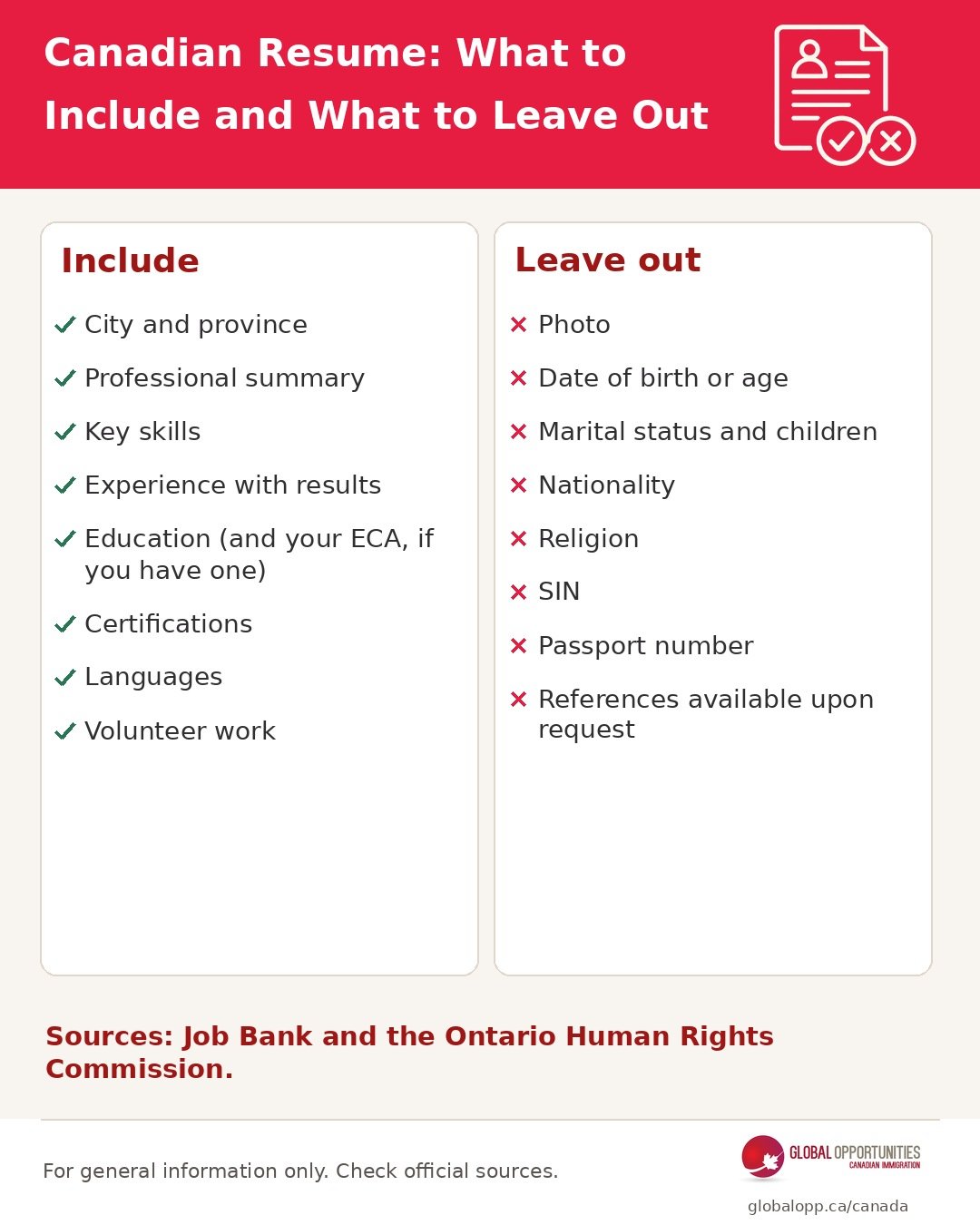
Personal details such as age, marital status, religion or political views.
A photo. Job Bank says it "is not the norm in Canada" and "can actually lower your chances of obtaining a position."
Your Social Insurance Number. Job Bank says: "never include your Social Insurance Number in your resume."
Reasons for leaving previous jobs.
Hobbies, unless they relate to the position.
It also recommends keeping references on a separate sheet and giving them only when asked.
Why: human rights rules in hiring
Human rights laws in Canada protect job applicants from discrimination based on specific grounds. The Ontario Human Rights Commission (OHRC), in its guide Human Rights at Work (third edition, dated 2008, which was still the guide the OHRC publishes on employment when we checked in November 2026) and specifically its section on designing application forms, explains that application forms should not ask about grounds of the Ontario Human Rights Code such as race, ancestry, citizenship, creed, sex, sexual orientation, record of offences, age, marital status, family status or disability. Some points from that guidance:
Photos: "employers should not request photos of potential employees", because they can reveal race, colour, sex or age.
Age: "No questions about age are permitted on an application form, other than whether an applicant is 18 years or over."
Citizenship: the one permitted question is "Are you legally entitled to work in Canada?" Questions about status, such as permanent residency, are not permitted at the application stage.
Because employers avoid collecting this information, it is safer to leave it out. Rules differ by province: in Alberta, for example, the Government of Alberta's career site alis explains on its page What can employers ask you? that "Any information that could be used to discriminate against you or restrict or deny you employment is off-limits", and refers employers to the Alberta Human Rights Commission's guide for pre-employment inquiries. Federally regulated employers follow the Canadian Human Rights Act. The interview section below lists the human rights law and commission or tribunal for every province and territory.
Should I mention my work permit?
You do not have to give details about your immigration status on your resume. Some candidates with an open work permit add a short line such as "Open work permit, eligible to work in Canada" near the contact details or in the cover letter, so the employer does not have to guess. That is your choice. Under the OHRC guidance above, the question an employer in Ontario may ask is "Are you legally entitled to work in Canada?"
Applicant tracking systems (ATS) and keywords
Many larger employers use software to manage applications. Alberta's alis explains on its page What employers are looking for in a job application that "Large companies often use applicant tracking software (ATS) to help them find the best applicants," and that the software "usually scans for certain keywords or phrases." alis adds that smaller companies may have a person sort applications by hand. We found no official figure for how many employers use ATS or how many resumes it filters out, so the safest approach is a resume that both software and people can read easily.
How to make your resume ATS-friendly
Use the posting's own words. If the posting says "accounts payable", do not write only "supplier payments".
Keep the format simple. alis warns that "Tables, fancy fonts, multiple columns, logos, and graphics can confuse software." Use simple headings, paragraphs and bullet lists.
Use standard headings: Summary, Skills, Work Experience, Education, Certifications.
Choose the file type carefully. alis notes that "Microsoft Word files are what most software is best at scanning." If the posting specifies a format, use it.
Spell out acronyms once, for example "Customer Relationship Management (CRM)".
Do not stuff keywords. alis warns that some people paste in lists of keywords, and that human reviewers notice these tricks. Every keyword should be backed by real experience in your bullets.
How to find the right keywords
Copy the job posting into a document.
Highlight the skills, tools, certifications and job titles it repeats.
Compare them with your resume and add the ones you genuinely have, in context.
Check two or three similar postings from other employers to see which terms are standard in your field.
How to tailor your resume to each job
Job Bank recommends tailoring each resume to the job by reviewing the job description or the employer's website. A practical method:
Keep a master resume with all your jobs, achievements and skills. It can be long; nobody sees it.
For each application, copy the master and delete what does not match the posting.
Rewrite the summary so it mirrors the job title and the two or three main requirements.
Reorder the skills so the most relevant ones come first.
Choose the bullets that prove the requirements in the posting.
Check the keywords (see the ATS section).
Write a short cover letter for that employer (see the cover letter section).
"Canadian experience": what it means and how to handle it
Many newcomers hear that they lack "Canadian experience". It is worth knowing what the rules say.
What the Ontario Human Rights Commission says
The OHRC's Policy on removing the "Canadian experience" barrier states that "a strict requirement for "Canadian experience" is prima facie discrimination", and recommends that employers "Consider all relevant work experience – regardless of where it was obtained." Its guidance on interviewing says employers should assess qualifications directly rather than asking about Canadian experience. The policy applies in Ontario; other provinces have their own human rights laws.
Ontario's rule on job postings
The Government of Ontario's Employment Standards Act guide on publicly advertised job postings says that, as of January 1, 2026, "Employers are prohibited from including in a publicly advertised job posting, or in any associated application form, any requirements related to Canadian experience." The same page says postings must include the expected compensation or a range (with exceptions for higher-paid roles), whether the employer uses artificial intelligence to screen, assess or select applicants, and whether the posting is for an existing vacancy, and that employers must tell interviewed applicants whether a hiring decision has been made, within the time the page sets. These requirements do not apply to an employer with fewer than 25 employees on the day the job is posted. Other provinces have different rules.
Rules as published by the Ontario Human Rights Commission and the Government of Ontario, as of November 2026. They apply in Ontario and have exceptions: check the linked pages before you rely on them.
What employers usually mean
In practice, when employers say "Canadian experience", they are often worried about things like communication in a Canadian workplace, knowledge of local regulations, software or standards, and whether they can check your references. You can address each of these concerns directly:
Communication: practise interviews in English and show local volunteering.
Local knowledge: take short Canadian courses or certifications in your field.
References: prepare references who answer email, and add a Canadian one as soon as you can.
Results: describe foreign achievements in terms any employer understands: team size, budget, clients, results.
Ways to build Canadian experience legally
Volunteering with a real non-profit (not unpaid work for a business; see the workers' rights section).
Co-op placements and internships that are part of an approved college or university program.
Contract work, bridging programs and mentoring programs in your field.
Find a mentor
IRCC's job search page for newcomers says that many Canadian professionals and business people give free advice and coaching to newcomers, and it lists organizations such as ISANS, CRIEC, TRIEC, ERIEC and OCISO that can connect you with a mentor. A mentor in your field can explain how hiring works in your occupation and introduce you to people, but does not find you a job.
Federal Internship for Newcomers Program
IRCC's Federal Internship for Newcomers (FIN) Program page describes temporary work experience for eligible newcomers with federal, provincial and municipal organizations, where each participant is matched with a public service mentor. Registration and eligibility are explained on that page. When we checked, it said its last process was closed, so check whether a new intake is open before you plan around it.
Mentoring and internship information as published by IRCC, as of November 2026. Programs and intakes change; eligibility is decided by each program.
Canadian resume template and example
Below is a template you can copy, followed by a short fictional example in the combination format. Adapt the structure, not the content.
Canadian resume template (skeleton)
FIRST NAME LAST NAME
City, Province · Phone · professional.email@example.com · linkedin.com/in/your-name
Optional line: Open work permit, eligible to work in Canada
PROFESSIONAL SUMMARY
[Job title you are targeting] with [number] years of experience in [field or industry]. Skilled in [two or three key skills from the posting]. Known for [one strength proven by a result]. [Languages, if relevant]. Looking to bring [what you offer] to [type of team or employer] in [city or region].
KEY SKILLS
[Technical skill from the posting]
[Technical skill or software]
[Certification or method]
[Industry knowledge]
[Soft skill the posting mentions, proven in your bullets]
[Languages]
WORK EXPERIENCE
[Job title] | [Employer] | [City, Province or Country] | [Month Year] to [Month Year or present]
[One-line description of the employer if it is not known in Canada]
[Action verb] + [what you did] + [result, with a number if possible].
[Action verb] + [what you did] + [result].
[Action verb] + [what you did] + [result].
[Previous job title] | [Employer] | [City, Country] | [Month Year] to [Month Year]
[Achievement]
[Achievement]
[Achievement]
EDUCATION
[Degree or diploma] | [Institution] | [Country] | [Year] ([ECA equivalency, if you have one])
CERTIFICATIONS AND TRAINING
[Certification] | [Issuing organization] | [Year or "in progress"]
LANGUAGES
[Language] (native) · [Language] (professional)
VOLUNTEER EXPERIENCE
[Role] | [Organization] | [City] | [Dates]: [one line on what you did]
Fictional example: combination resume for a Working Holiday participant
FICTIONAL EXAMPLE. This resume was invented for this guide to show the format. Valentina Rojas, Hotel Andes Centro, the school and every figure in it are made up; the person and companies do not exist. Do not copy the content: use the structure with your own real experience.
VALENTINA ROJAS
Vancouver, BC · (604) 000-0000 · valentina.rojas@email.com · linkedin.com/in/valentinarojas-example
Open work permit (International Experience Canada), eligible to work in Canada
PROFESSIONAL SUMMARY
Customer experience and events coordinator with five years of experience in hotels and corporate events in Chile. Skilled in guest service, event logistics, reservation systems and vendor coordination. Fluent in English and Spanish, with conversational Portuguese. Looking to bring a strong record of guest satisfaction and calm problem solving to a hotel or event team in Greater Vancouver.
KEY SKILLS
Guest service and front desk
Check-in and check-out, reservations, complaint resolution and upselling
Property management systems and online booking platforms
Events and coordination
Planning corporate events for up to 300 guests: venues, catering, audiovisual and schedules
Vendor coordination, budgets and post-event reports
Tools
Microsoft Excel, Google Workspace, Canva
WORK EXPERIENCE
Events Coordinator | Hotel Andes Centro (fictional; 180-room business hotel) | Santiago, Chile | March 2022 to August 2026
Coordinated more than 60 corporate events a year, from booking to final invoice, with no missed deadlines.
Raised the average guest satisfaction score for events by 12% in one year by introducing a pre-event checklist with clients.
Negotiated with five regular suppliers, lowering catering costs per event by 7%.
Front Desk Agent | Hotel Andes Centro (fictional) | Santiago, Chile | January 2020 to February 2022
Checked in up to 120 guests per shift, in English and Spanish, and trained four new agents.
EDUCATION
Professional degree in Tourism and Hospitality Management | Instituto Profesional (fictional) | Chile | 2019
CERTIFICATIONS AND TRAINING
Serving It Right (responsible beverage service, British Columbia) | in progress
Food safety training | Chile | 2023
LANGUAGES
Spanish (native) · English (fluent) · Portuguese (conversational)
VOLUNTEER EXPERIENCE
Volunteer, community festival information booth | Vancouver, BC | September 2026 to present: answer visitors' questions and help coordinate volunteers on weekends.
Why it works: the summary names the target job, skills are grouped by what the employer needs, each bullet shows a result, the foreign employer is explained in one line, the work permit line answers an employer's likely question, and there is no photo or personal data.
A note on that certification: British Columbia explains who needs a Serving It Right certificate for serving alcohol. Other provinces have their own programs, such as Smart Serve in Ontario, approved by the AGCO, and ProServe in Alberta.
How to write a cover letter for a job in Canada
Job Bank's page on how to apply for jobs says: "A cover letter is your introduction to a potential employer. It should be concise, well written and tailored to the company and job you are applying for." It adds: "You may need to prepare a different cover letter for each job."
When a cover letter is required
A cover letter is required when the posting or the application system asks for one. It is especially useful when someone referred you, when you contact an employer without a posting, or when you need to explain a career change, your move to Canada, your availability or your open work permit. If a posting says "no cover letters", respect it.
Cover letter structure
Alberta's alis cover letter outline says that "A good cover letter lets employers know who you are, what job you want, and why they should look at your resumé." It suggests this structure:
Header: your contact details, the date, and the recipient's name, title and company. alis notes that if you are concerned about privacy, you can give only your city or town and province.
Greeting: "Address a specific person, not Sir or Madam." If you have no name, use "Dear Hiring Manager" or "Dear [Company] Team."
First paragraph: why you are writing: the job title, where you saw it, and who referred you if someone did.
Middle paragraph or two: why you fit the job, with relevant work, training, volunteer or school experience that matches the posting.
Last paragraph: say that your resume is attached, request an interview and say you will follow up.
Closing: "Sincerely," and your name.
alis also advises: "Focus on highlights and leave the facts for your resumé," and "Keep your paragraph(s) short." In practice, one page is the norm.
Cover letter example (fictional)
Fictional example created for this guide. The people and companies do not exist.
Valentina Rojas · Vancouver, BC · (604) 000-0000 · valentina.rojas@email.com
November 20, 2026
Mr. Daniel Chen · Guest Services Manager · Harbourview Suites (fictional) · Vancouver, BC
Dear Mr. Chen,
I am applying for the Guest Services Agent position posted on your careers page. Harbourview Suites' focus on personalized service for business travellers caught my attention, because that is exactly the kind of guest I worked with for five years at a business hotel in Santiago, Chile.
As Events Coordinator at Hotel Andes Centro, I organized more than 60 corporate events a year and introduced a pre-event checklist that raised guest satisfaction for events by 12% in one year. Before that, as a front desk agent, I checked in up to 120 guests per shift in English and Spanish and learned to resolve complaints calmly at the desk.
Your posting mentions a property management system, flexible shifts and Spanish as an asset. I learn new systems quickly, I am available for mornings, evenings and weekends, and I hold an open work permit under International Experience Canada, so I am eligible to work in Canada.
I have attached my resume and would welcome the opportunity to discuss how I can support your team. I will follow up next week. Thank you for your time and consideration.
Sincerely,
Valentina Rojas
Your LinkedIn profile for the Canadian job market
LinkedIn is widely used by recruiters and professionals in Canada. It is a private platform, and we have no relationship with it, but a complete profile helps people find you and check you after reading your resume.
Profile checklist
Location: your Canadian city, or your target city if you are relocating.
Photo: a simple, professional photo (not expected on a resume, but normal on LinkedIn).
Headline: your target role and main skills, for example "Logistics Coordinator | Import Operations | SAP | English and Spanish".
About and experience: the same summary and achievements as your resume, in English (or French for French-language roles).
Skills and recommendations: the keywords from postings in your field, and short recommendations from former managers.
Messages: connect with people in your field with a short personal note, and never share your SIN, passport or banking details through messages (see the job scams section).
Networking and informational interviews in Canada
What networking looks like in Canada
Networking in Canada is usually low-key: conversations, coffee chats, events, volunteering and staying in touch. Alberta's alis describes networking as a way to get information about occupations and jobs from people you know, and to connect with potential employers. Good places to start are former colleagues and classmates already in Canada, professional associations, mentoring programs run by agencies and colleges, volunteering, hiring events and your university's alumni groups.
Informational interviews
An informational interview is a short conversation with someone who works in a job, company or industry that interests you. alis explains on its page Tips for a successful informational interview that it is a way to get "up-to-date, accurate facts about an industry, occupation, organization, or educational program", and that it is not a job interview.
alis's advice:
Ask politely by email or phone for 10 to 15 minutes, and keep to that time.
Prepare specific questions you could not answer online.
Do not ask for a job. alis warns that asking for employment "may reflect poorly on you and the person who referred you."
Follow up: send a thank-you "Within a day or 2", and alis suggests phoning about 2 or 3 weeks later to share your progress.
Job interviews in Canada: what to expect
Types of interviews
Screening call: a short phone or video call, often with a recruiter, about your interest, availability, work eligibility and salary range.
Video or in-person interview: with the hiring manager, sometimes a panel. For video, test your camera and connection first.
Skills tests or assignments: a case study, a short test or a practical task.
The OHRC's guidance on interviewing and making hiring decisions recommends that employers use the same questions for all candidates, based on essential job duties, and score answers against a set guide. That is why many Canadian interviews feel structured.
How to prepare
Job Bank's page on how to prepare for an interview advises you to "plan and rehearse answers to potential interview questions", to prepare questions that show you are informed about the company, and to bring copies of your resume, your reference list and any letters of recommendation.
A practical checklist:
Reread the posting and your resume, and research the employer.
Prepare five or six STAR stories (see below) and your answer to "Tell me about yourself."
Check typical wages on Job Bank's wage search.
Prepare three or four questions for the employer.
Arrive or log in a few minutes early.
After the interview
Job Bank advises writing to each interviewer to thank them, restate your interest and remind them of your qualifications, and says: "If possible, mail or e-mail the letter the same day as your interview." A short, polite email is enough. Job Bank also suggests that, if you have not heard back, you call after about two weeks to ask about the status.
Common interview questions and how to answer them
Alberta's alis explains how to approach the most common questions on its page How to answer common interview questions. Here are the questions newcomers ask about most, with practical advice.
"Tell me about yourself"
alis suggests using it to get the interviewer interested and to describe situations in which you used your skills, rather than listing traits, in about two to three minutes. A simple structure: present (your current or most recent role), past (one or two achievements that matter for this job), future (why this role is your next step). Keep personal and family details out unless they are relevant.
"What is your greatest strength?"
alis advises focusing on "a strength that qualifies you for the job" and backing it with a problem you solved or an improvement you made.
"What is your greatest weakness?"
alis suggests presenting a weakness you are actively improving, and warns: "do not choose a weakness that would prevent you from doing the job." Describe what you are doing about it.
"Why should we hire you?"
alis calls this "your chance to show that you stand out from the competition." Summarize two or three reasons that match the posting, with evidence.
"Why did you leave your last job?" or "Why did you move to Canada?"
Be brief, honest and positive. Focus on what you are moving toward: new experience, a career goal, the Working Holiday, your family's plans. Do not criticize former employers.
"Do you have Canadian experience?"
Answer calmly and redirect to what matters: what you have done, the results you achieved, and the steps you have taken to learn Canadian standards (courses, volunteering, certifications). See the section on Canadian experience above.
"Are you legally entitled to work in Canada?"
This is a permitted question. Answer clearly, for example: "Yes, I have an open work permit."
Behavioural questions and the STAR method
Canadian interviews often include behavioural questions: questions about how you handled real situations in the past. alis explains on its page Use the STARS method to shine in an interview that "Behavioural questions are ones that ask about how you handled a difficult situation at work in the past." They often start with "Tell me about a time when…", "Give me an example of…" or "Describe a situation in which…".
The STAR (or STARS) method
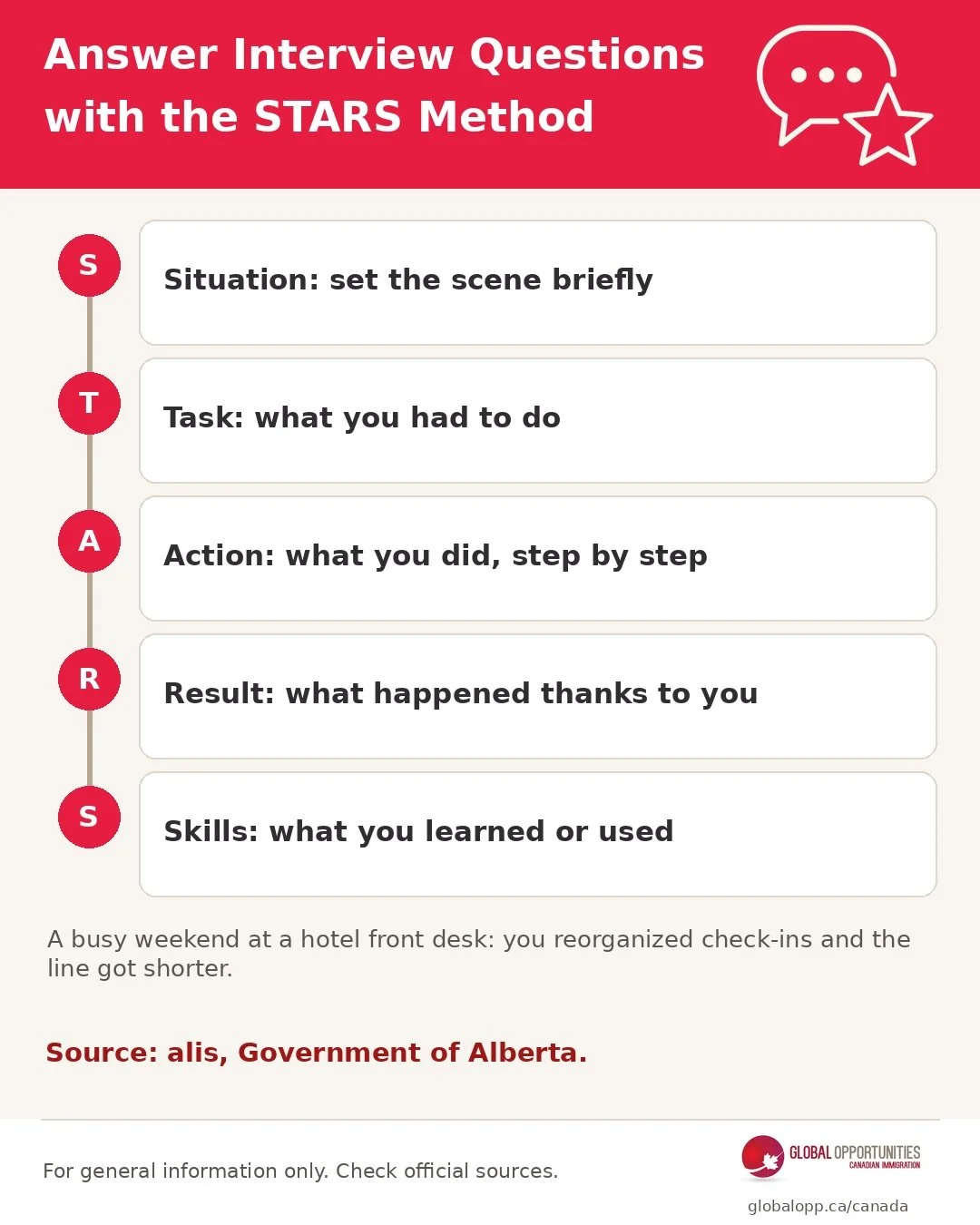
The STAR method is a structure for your answer. alis adds a final S for Skills:
S, Situation: set the scene and name the problem, in a few sentences.
T, Task: what you were responsible for and what the goal was.
A, Action: the specific steps you took.
R, Result: the positive outcome, with numbers where you can.
S, Skills: the skills you used, such as communication, analysis or teamwork.
alis advises keeping each step to "2 to 4 sentences at the most", choosing examples with positive outcomes and, if you talk about a mistake, finishing with what you learned. Practise your answers out loud.
Example answer (fictional)
Question: "Tell me about a time you dealt with an unhappy customer."
Answer: "At the hotel where I worked in Santiago, a corporate client arrived to find that the meeting room was set up for 40 people instead of 80 (situation). As the events coordinator, I was responsible for fixing it before the meeting started in 45 minutes (task). I apologized, moved the event to a larger room that was free, asked two colleagues to help reset it and arranged extra coffee service at no charge (action). The meeting started on time, the client booked three more events with us that year, and I added a confirmation call the day before every event to prevent the same problem (result). It showed my problem solving and my ability to stay calm under pressure (skills)."
Common behavioural questions to prepare
Tell me about a time you had a conflict with a co-worker.
Describe a time you had to meet a tight deadline.
Give an example of a mistake you made and what you learned.
Describe a situation in which you had to adapt to a big change.
Tell me about a time you went beyond what was expected for a customer.
Prepare one story for each, using real examples. alis notes that interviewers may ask follow-up questions, so the details must make sense.
Salary questions in a job interview
Salary questions make many newcomers nervous, especially when they do not yet know local pay levels.
Do your research first
Use Job Bank's wage search to see typical wages for your occupation in the city or region where the job is. Look at several similar postings, since some employers publish a range.
How to answer "What are your salary expectations?"
alis's advice on common interview questions is to "try not to talk about specific salary expectations until after someone has offered you a job." If you are pressed, alis suggests giving the typical range for the role and noting that the figure could depend on benefits, and warns: "If you state a figure that's too high, they may not consider you seriously for the position."
Practical phrases:
"I'd like to learn more about the responsibilities before discussing a figure. Could you share the range for this position?"
"Based on my research for similar roles in this city, I understand the typical range is [range from your research]. I'm flexible depending on the full package."
Think about the whole offer
Ask about benefits (health and dental plans), vacation, schedule, overtime, probation period and training. Read any written offer before you sign. Minimum wage and basic standards are set by law (see the workers' rights section); an employer cannot pay you less than the legal minimum, whatever your permit.
Questions you can ask the employer
At the end of most interviews you will hear: "Do you have any questions for us?" Saying "No" can look like a lack of interest. Job Bank recommends preparing "a couple of questions that shows that you are informed about the company."
Good questions:
What would success look like in this role after three or six months?
What are the main challenges the team is facing right now?
What training or onboarding do new employees receive?
What are the next steps in the hiring process, and when can I expect to hear back?
Leave vacation and salary questions for later, unless the interviewer raises them.
Before you accept a job offer in Canada
Before you say yes, compare the offer with your goals and get it in writing. Alberta's alis lists the factors to weigh on its page consider these factors before accepting a job offer:
Your current situation and goals, and whether the job solves the reasons you started looking.
The whole compensation package: pay, raises, benefits, bonuses and perks.
The role itself, including whether the offer is in writing and whether you have the skills for it.
Growth: training, promotion paths and how the job fits your career plan.
Culture and fit: the organization, the setting and the team.
Lifestyle and family: workload, remote or in-person work, commute and time for personal life.
alis says that if an employer refuses to give you an offer in writing, that is "a big red flag". Also check that the job matches the conditions of your work permit before you sign; IRCC's page Find out if you need a work permit explains the difference between open and employer-specific permits. Never pay an employer or a third party to get a job (see the job scams section).
Factors as published by Alberta's alis, and work permit rules as published by IRCC, as of November 2026. A job offer does not by itself give you the right to work in Canada; your permit conditions do.
What employers cannot ask you in a job interview in Canada
Human rights law in Canada limits what employers can ask job applicants. The rules depend on who regulates the employer: most employers follow the human rights law of their province or territory, while federally regulated employers follow the Canadian Human Rights Act.
Federal or provincial jurisdiction?
The Canadian Human Rights Commission explains on its page Find out if you are in the right place that it "only deals with discrimination complaints under federal jurisdiction." Federally regulated employers include, for example, federal government bodies, airlines and airports, banks, Canada Post, interprovincial or international railways, trucking and bus services, radio and television broadcasters and telecommunications companies. For a private business such as a retail store or a restaurant, the Commission says to contact your provincial or territorial human rights agency.
Grounds protected under federal law
Section 3 of the Canadian Human Rights Act lists the prohibited grounds of discrimination: "race, national or ethnic origin, colour, religion, age, sex, sexual orientation, gender identity or expression, marital status, family status, genetic characteristics, disability and conviction for an offence for which a pardon has been granted or in respect of which a record suspension has been ordered."
What the Ontario Human Rights Commission says about interviews
The OHRC's guidance on interviewing and making hiring decisions, part of its guide Human Rights at Work (third edition, 2008, still the edition on the OHRC website in November 2026), says interviews should gather only information about qualifications and job requirements, and that employers "could face a finding of discrimination even if there is no intention to discriminate." It gives examples of questions to avoid, including:
"Where are you from?" and "What nationality is your name?"
Questions about pregnancy or family plans, unless tied to a genuine job requirement.
Remarks or questions related to age.
Questions about disability that are not needed; disability and accommodation are generally discussed after a conditional offer, unless the applicant raises them.
Questions about place of birth.
Its guidance on application forms adds that in Ontario:
The permitted question about citizenship is "Are you legally entitled to work in Canada?"
The only age question allowed on a form is whether you are 18 or older; date of birth should wait until after a conditional offer.
On record of offences, the permitted question is "Have you ever been convicted of a criminal offence for which a pardon has not been granted?"
A copy of a driver's licence should only be requested after a conditional offer, and only if driving is an essential part of the job.
Human rights laws and guidance in each province and territory
Each province and territory has its own human rights law and its own commission or tribunal, and the Government of Canada keeps a list of provincial and territorial human rights agencies. For each jurisdiction below, we name the law and the body, and link its guidance on hiring, application forms or interview questions where we found one in November 2026. Where we did not find a specific hiring guide, we link the main page and say so.
Federally regulated employers (anywhere in Canada): Canadian Human Rights Act, Canadian Human Rights Commission. The Commission's page Find out if you are in the right place explains which employers fall under federal jurisdiction. We did not find a current guide on hiring or interview questions on the Commission's website when we checked.
Alberta: Alberta Human Rights Act, Alberta Human Rights Commission. Its information sheet A recommended guide for pre-employment inquiries sorts common questions into recommended and not recommended: for example, it recommends asking whether you are "Legally permitted to work in Canada?" and does not recommend asking about place of birth or citizenship. The Government of Alberta's alis explains the same rules for job seekers on its page What can employers ask you?
British Columbia: Human Rights Code. Complaints go to the BC Human Rights Tribunal, which describes itself as "responsible for accepting, screening, mediating, and adjudicating human rights complaints." BC's Office of the Human Rights Commissioner, in its infosheet Equitable hiring and promotion, recommends structured interviews and gives this example: "instead of asking about immigration status, ask if they are legally entitled to work in Canada." WorkBC, the Government of B.C.'s employment site, also has a page called Know Your Rights as a Job Applicant.
Manitoba: The Human Rights Code, Manitoba Human Rights Commission. Its guideline Human rights considerations in hiring says the application form or process "should not require an applicant to disclose their age, sex, ancestry, marital or family status, or other protected characteristic, unless that information is relevant to your assessment of them."
New Brunswick: Human Rights Act, New Brunswick Human Rights Commission. Its FAQs on employment say that "Typically, an employer is not permitted to ask questions either directly or indirectly about one of the protected grounds", unless the employer can show the information is needed because of the nature of the job. We did not find a separate guide on hiring.
Newfoundland and Labrador: Human Rights Act, 2010, Newfoundland and Labrador Human Rights Commission. Its Employers Guide to the Human Rights Act says discrimination is prohibited in every aspect of employment, including advertising, applications, interviews and hiring. We did not find a specific guide on interview questions.
Northwest Territories: Human Rights Act, Northwest Territories Human Rights Commission. Its guide Human Rights and Employment includes interview question guidelines and explains, for example, that "a candidate's marital status should not be asked before hiring but may be asked afterwards for taxation purposes or employee benefits." More resources are on the Commission's employment page.
Nova Scotia: Human Rights Act, Nova Scotia Human Rights Commission. The Commission's pamphlet For Employers: A guide for drafting job application forms and interview questions, posted on the Government of Nova Scotia's Workplace Initiatives site, says employers cannot ask about age or citizenship status before hiring, but can ask for documents that show a person is eligible to work in Canada. It is an older pamphlet (its contact details are out of date), so check the Commission's website for current information.
Nunavut: Human Rights Act, Nunavut Human Rights Tribunal (Nunavut has a tribunal rather than a commission). The Tribunal's website says it resolves claims under the Nunavut Human Rights Act and that "We do not adjudicate matters regarding federal businesses or organizations." We did not find a specific guide on hiring.
Ontario: Human Rights Code, Ontario Human Rights Commission. Its guidance on application forms and interviewing and making hiring decisions is summarised above.
Prince Edward Island: Human Rights Act, Prince Edward Island Human Rights Commission. Its page For Employers and Employees explains that employers must recruit and hire based on a person's qualifications. We did not find a separate guide on interview questions.
Quebec: Charter of human rights and freedoms, Commission des droits de la personne et des droits de la jeunesse (CDPDJ). Its page on employees' rights says employers are not allowed to ask about certain personal characteristics during an interview or on an application form, such as pregnancy or plans to have children, with limited exceptions, and that "You do not have to answer questions like these about your personal characteristics." (Global Opportunities does not offer services for Quebec's immigration programs.)
Saskatchewan: The Saskatchewan Human Rights Code, Saskatchewan Human Rights Commission. Its Guide to Application Forms & Interviews explains that the Code stops employers from asking certain questions on application forms or in interviews; on citizenship, it says an employer may ask whether the applicant is legally entitled to work in Canada.
Yukon: Human Rights Act, Yukon Human Rights Commission. We did not find a specific guide on hiring or interview questions on the Commission's website; its page What is discrimination? explains the basics.
Grounds that appear in every guide we checked
Section 3 of the Canadian Human Rights Act, the Saskatchewan Commission's guide and the Nova Scotia Commission's pamphlet all include, among others:
Race and colour
Religion
Age
Sex (the Saskatchewan and Nova Scotia guides say this includes pregnancy)
Sexual orientation
Marital status and family status
Disability
Each law adds other grounds (Saskatchewan's guide lists receipt of public assistance, and Nova Scotia's lists source of income and political belief, for example), so check the law where you work.
Protected grounds and rules vary by province and territory and by whether the employer is federally regulated. This list summarises what each commission's or tribunal's website said when we checked in November 2026. It is general information, not legal advice: for your own case, contact the human rights commission or tribunal that covers your employer.
Questions that are usually not allowed (examples based on the Ontario, Alberta, Saskatchewan and Nova Scotia guides above; rules vary by province)
How old are you? When were you born?
Are you married? Do you have children? Do you plan to have children?
Are you pregnant?
Where were you born? Where are your parents from?
What is your religion? Which holidays do you observe?
Do you have any disabilities or health conditions? (before a conditional offer, and not tied to the job)
What is your first language? (the OHRC says questions about language abilities may be asked when they relate to a genuine job requirement)
Questions that are usually allowed
Are you legally entitled to work in Canada? (the permitted question in the OHRC, Saskatchewan and BC Commissioner guidance)
Are you able to work the schedule required for this job? (alis gives night shifts and travel as examples of job demands an employer may ask about)
Can you speak, read and write [language] at the level the job requires? (when it is a genuine job requirement, according to the OHRC)
Can you perform the essential duties of this job? (the OHRC says ability to perform the essential duties with accommodation can be discussed when the applicant raises disability-related needs)
Questions about your skills, experience, education and references.
What to do if you are asked an inappropriate question
Stay calm and polite. You can redirect: "I can assure you that I am available for the schedule this role requires."
You can decline to answer a question that is not related to the job.
Write down what happened right after the interview: date, people present and the exact question.
Ask for advice from your provincial or territorial human rights agency (see the Government of Canada's list of agencies), or from the Canadian Human Rights Commission if the employer is federally regulated.
Based on what the Canadian Human Rights Act, the Canadian Human Rights Commission, the provincial and territorial human rights commissions and tribunals listed above and the Government of Alberta's alis say, as of November 2026. Human rights rules differ by province and territory and have exceptions (for example, for some special interest organizations or genuine job requirements). This is general information, not legal advice: for your own situation, contact the human rights agency where you work.
Do Canadian employers check references? References and background checks
References
Canadian employers often call or email references before making an offer. Job Bank advises keeping references on a separate sheet and providing them only when requested, and bringing your reference list to the interview. Alberta's alis, on its page How to choose the best job references, recommends having several references ready for each application and choosing people who can speak to your work, not family members.
For each reference, list their name, title, organization, how they know you, email and phone. Always ask them first and tell them about the job.
References from outside Canada
alis's page Unavailable or problem references: what you can do notes that employers rarely phone overseas references and suggests that you "offer an email contact or provide a good translation of a written reference." It also says that some employers may hire you without employment references if you do well in the hiring process, can explain your situation and can offer an option such as a character or volunteer reference. If a former employer cannot speak to a Canadian employer, ask for a letter instead; alis notes that "These letters can often be used for future interviews, so make sure to save copies."
Background checks
Depending on the job, an employer may ask for one or more checks, usually after a conditional offer and with your consent:
Criminal record checks. The RCMP explains on its page Why get a criminal record check that "Many organizations require people to get criminal record or vulnerable sector checks for different reasons", and that "You can go to your local police agency or to a company authorized to perform this service." Jobs with children or vulnerable people often require a vulnerable sector check through your local police service.
Education, licence and employment verification. Keep originals and translations ready, and make sure your resume matches your reference letters.
As explained in the interview section, Ontario's human rights guidance limits what can be asked about records of offences and when; rules vary by province. Never pay a "recruiter" or "employer" to run a background check for you as a condition of getting a job (see the next section).
Job scams in Canada: how to protect yourself
Job scams target people who are in a hurry to find work, including newcomers. IRCC's page on fraud targeting newcomers states: "No one can guarantee you a job or a visa to Canada or permanent residence."
Types of job scams described by the Canadian Anti-Fraud Centre
The Canadian Anti-Fraud Centre (CAFC) describes these schemes on its page on job scams:
Car wrapping: you are offered money to wrap your car with a company logo, then asked to send back part of a fake cheque.
Counterfeit cheques: scammers target people who post resumes online and ask them to cash a cheque and send part of the money back.
Crypto "online tasks" jobs: fake freelance work, sometimes using real company names, where your "earnings" appear in an account you cannot withdraw from.
Financial agent: you are asked to receive and transfer money; the CAFC warns that "The fraud has made you a money mule."
Mystery shopper: a fake selection letter with a cheque and instructions to transfer money.
Web surveys and "e-commerce" store jobs: you must make growing deposits to "unlock" your earnings.
Warning signs
The CAFC lists warning signs, including:
"A company uses a web-based email instead of an official business domain."
"You receive a job offer you did not apply for."
"The job requires upfront deposits" or fees.
"You see a balance on the website or app but cannot withdraw it."
"You are asked to recruit others."
"The offer promises high pay for minimal work."
How to protect yourself
The CAFC advises:
"Take time before responding to unknown job messages."
Check the company on its official website and call it using the official number.
"Never send deposits or pay fees for a job."
"Avoid downloading unknown software or apps."
"Do not share personal information or ID documents with unverified contacts."
"Be careful when sending cryptocurrency; in most cases, it cannot be reversed."
Never pay for a job offer. If someone offers you a job or immigration help in exchange for money, read IRCC's pages on protecting yourself from fraud and online and telephone scams. Paid immigration advice can only be given by authorized representatives; IRCC explains how to check if a representative is authorized.
If you were targeted
Stop contact, keep all messages, contact your bank right away if you sent money or shared banking details, and report it to the Canadian Anti-Fraud Centre and your local police. IRCC explains how to report fraud related to immigration.
Regulated professions: ECA vs professional licence
If you are a nurse, doctor, engineer, teacher, accountant, pharmacist, electrician or another regulated professional, your job search has an extra step.
What "regulated" means
The Government of Canada's Foreign Credential Recognition page explains that people trained abroad "must go through the foreign credential recognition process in the province or territory where you plan to work", a process that "checks whether your education, skills, and experience meet local standards." A regulatory authority is "An organization that oversees a regulated profession or trade and assesses education and credentials." The page links to a Foreign Credential Recognition Tool to check whether a job is regulated in a province and to find the right regulator. CICIC's page on recognition also explains who is responsible.
Regulation is provincial, so the same profession may have different requirements in Ontario, British Columbia or Alberta. Some occupations are regulated in one province and not in another.
An ECA is not a licence
An Educational Credential Assessment (ECA) compares your foreign degree with a Canadian one. IRCC explains it on its page on education assessed, mainly for immigration purposes. A professional licence is issued by a provincial regulator and lets you work in a regulated profession or use a protected title. Having an ECA does not give you the right to work in a regulated profession. We explain the difference in detail in our article ECA vs professional licence in Canada.
Trades
For trades, the Red Seal Program sets interprovincial standards for many trades, and each province's apprenticeship authority decides how experience from abroad is assessed. Some trades are compulsory in some provinces: you cannot work in them without a provincial certificate or registered apprenticeship.
Working while you get licensed
Many internationally trained professionals work in a related, non-regulated role while they go through licensing. Mention that you are "pursuing licensure with [regulator]" and avoid using a protected title you are not yet licensed to use. Our guide Immigrate to Canada as a professional has sections for nurses, engineers, teachers and other regulated professionals. Nurses can read our full guide on how to immigrate to Canada as a nurse.
Foreign Credential Recognition loans
Employment and Social Development Canada's Foreign Credential Recognition page describes loans that can help pay for licensing and qualifying exams, education and training programs and other costs of getting your credentials recognized, plus support services such as career counselling, mentorship, job readiness workshops and job search help. Its search tool shows the providers available by immigration status, language of service and province or territory. We do not list amounts here: check the page and the provider for your own case.
Any regulator or organization we mention is for reference only. The list is not complete, and requirements must always be confirmed directly with the regulator in the province or territory where you plan to work. Loan information as published by Employment and Social Development Canada, as of November 2026; each provider decides eligibility.
Your basic rights as a worker in Canada
Your rights at work do not depend on your passport. Employment standards (minimum wage, hours, overtime, vacation, public holidays, termination) are set mainly by each province or territory, while federally regulated industries follow the Canada Labour Code.
Federal or provincial rules?
The Government of Canada's list of federally regulated industries and workplaces explains which workplaces follow the Canada Labour Code, such as banks, air transportation and telecommunications, and tells everyone else to "consult the employment standards for your province or territory of work." The federal labour standards page says they "set out the employment conditions for hours of work, payment of wages, leaves, vacation, holidays, and more."
Provincial employment standards
Ontario: Your guide to the Employment Standards Act and employment rights of foreign nationals.
British Columbia: Employment standards.
Alberta: Employment standards.
Saskatchewan: Employment standards.
New Brunswick: Employment standards.
Prince Edward Island: Employment standards.
Other provinces and territories: see the links on the federal list of federally regulated industries page.
Rights IRCC highlights for temporary workers
IRCC's page on worker rights explains, among other things, that your employer must pay you for your work, must keep the workplace safe, "can't take your passport or work permit away from you," and that you do not need your employer's permission to contact labour offices, and "can't be punished or deported for contacting them." Employment and Social Development Canada has a similar page, your rights are protected.
Unpaid internships and "trial shifts"
Be careful with unpaid work for a business. Ontario's Employment Standards Act guide explains that a person doing work for a business is generally an employee entitled to minimum wage, unless specific conditions are met, and that placements that are part of an approved college or university program are treated differently. Rules vary by province; check yours before you agree to work without pay.
Rights and standards as published by IRCC, Employment and Social Development Canada and the provincial governments linked above, as of November 2026. Employment standards differ by province and territory and change over time: check the page for the province where you work.
Frequently asked questions
How do I write a Canadian resume?
Start with your contact details (name, city and province, phone, email, LinkedIn), then a short professional summary, a key skills section, your work experience in reverse order with achievement-focused bullets, education, certifications, languages and relevant volunteer work. Job Bank recommends keeping it to two pages, tailoring it to each job, quantifying results and leaving out personal details such as age and marital status, as well as photos and your SIN. Our section "How to write a Canadian resume, section by section" goes through each part, and the "Canadian resume template and example" section gives you a full skeleton you can copy.
What is the Canadian resume format?
There is no single official format, but most Canadian employers expect a short, clean resume of one or two pages, in reverse chronological order or in a combination format. Alberta's alis describes three types: chronological (most familiar to employers), functional (skills first, which many Canadian employers do not like) and combination (skills first, then a brief work history). For most newcomers, chronological works when you stay in your field and combination works when you change field or level. See "Which resume format works best in Canada?" and "Applicant tracking systems (ATS) and keywords" above.
Cover letter Canada example: what should it include?
A Canadian cover letter is a one-page letter tailored to one employer. Alberta's alis outline suggests: your contact details and the date; a greeting addressed to a specific person; a first paragraph naming the job and where you saw it; one or two middle paragraphs explaining why you fit, with examples that match the posting; and a last paragraph that mentions your attached resume, requests an interview and says you will follow up. Our section "How to write a cover letter for a job in Canada" includes a complete fictional example you can use as a model.
What can't employers ask in an interview in Canada?
It depends on the province and on whether the employer is federally regulated, but human rights law generally protects grounds such as race, place of origin, citizenship, religion, age, sex, sexual orientation, marital and family status and disability. The Ontario Human Rights Commission says employers should avoid questions like "Where are you from?" or "What nationality is your name?", questions about pregnancy or family plans, and unnecessary disability questions. The permitted citizenship question in Ontario is "Are you legally entitled to work in Canada?" Each province and territory has its own human rights commission or tribunal: see "What employers cannot ask you in a job interview in Canada" above for the full list with links.
How do I answer behavioural interview questions?
Use the STAR method: Situation, Task, Action, Result. Alberta's alis adds a final S for Skills, so you also name the skills you used. Keep each step short (alis suggests "2 to 4 sentences at the most"), say "I" when you describe your own actions, include numbers in the result where you can and choose examples with positive outcomes. If you talk about a mistake, finish with what you learned. Prepare six to eight real stories before the interview (conflict, deadline, mistake, change, leadership, customer) so you can adapt them to different questions. Our section "Behavioural questions and the STAR method" includes a full example answer.
How should I answer salary questions in a Canadian interview?
Research first: Job Bank's wage search shows typical wages for your occupation by region. Alberta's alis suggests trying not to discuss specific salary expectations until you have an offer; if you are pressed, give the typical range for the role and mention that it depends on the full package, including benefits. You can also ask the employer to share the range for the position. Whatever you agree, an employer must at least respect the minimum standards set by employment law in your province. See "Salary questions in a job interview" above.
How to get a job in Canada from abroad?
Start by checking whether you can legally work in Canada: you need a work permit or another status that allows work. Many people outside Canada cannot simply apply for jobs and move: IRCC's page Find out if you need a work permit explains that an employer-specific permit requires a job offer and that open work permits are only for certain situations. Which option fits you depends on your case; a consultation is the way to know. Global Opportunities does not offer jobs or find job offers. If your country takes part in International Experience Canada, the Working Holiday category may let you come with an open work permit and look for work after arriving. Never pay for a job offer. See "Working Holiday in Canada: which countries can participate" above.
Working Holiday Canada: what to do before arriving?
Prepare a Canadian-style resume in English, research the job market and wages on Job Bank, check whether your profession is regulated and contact the regulator early, and gather reference letters, diplomas and translations. Get the police certificates IRCC asks for, buy health insurance valid for your entire stay with medical care, hospitalization and repatriation (IRCC says you may be refused entry without it), and prepare your proof of funds and return ticket. After arrival, apply for your SIN, open a bank account and find housing. See "Before you activate your Working Holiday: what to prepare at home" above.
Which countries can do a Working Holiday in Canada? Can Mexicans apply?
Only citizens of countries and territories with a youth mobility agreement with Canada can take part in IEC. When we checked IRCC's list of participating countries in November 2026, it included countries such as Australia, Chile, Costa Rica, France, Germany, Ireland, Italy, Japan, the Republic of Korea, Spain, Taiwan and the United Kingdom, among others. Mexico is not on the list, so Mexican citizens cannot apply for the IEC Working Holiday with a Mexican passport. The list, age limits and permit length vary by country and can change, so always check IRCC's eligibility by country page.
Who helps newcomers find a job in Canada for free?
Several kinds of services: provincial employment services such as Employment Ontario, WorkBC Centres and Alberta Supports, which often serve people legally entitled to work; IRCC-funded settlement agencies, which mainly serve permanent residents; community agencies; public libraries; and college and university career centres for students and graduates. Job Bank, the Government of Canada's job site, has a free resume builder, job postings and wage data. Global Opportunities does not offer jobs. See "Who helps you find a job in Canada for free" above.
How do I spot a job scam in Canada?
The Canadian Anti-Fraud Centre lists warning signs: a company using a web-based email instead of an official domain, a job offer you did not apply for, requests for upfront deposits or fees, an online balance you cannot withdraw, being asked to recruit others and high pay for minimal work. Never pay for a job, never share your SIN, passport or banking details with unverified contacts and check the company through its official website and phone number. Report scams to the CAFC and your local police. See "Job scams in Canada: how to protect yourself" above.
Do I need my ECA or a licence to work in my profession in Canada?
It depends on whether your occupation is regulated. Most jobs are not regulated, and the employer decides whether your education fits. For regulated professions and compulsory trades, you usually need a licence or certificate from the provincial regulator. An Educational Credential Assessment compares your degree with a Canadian one, mainly for immigration purposes; it is not a licence and does not let you work in a regulated profession. Use the Government of Canada's Foreign Credential Recognition page to find your regulator, and contact it early. See "Regulated professions: ECA vs professional licence" above and our article on ECA vs professional licence.
How long should a Canadian resume be?
One or two pages. Job Bank's resume advice says to limit your resume to two pages, and it notes that employers skim a resume quickly, so put your most relevant achievements first. A longer CV is only for academic, research or similar roles, or when an employer asks for one. See "Formatting basics" above.
Should I put a photo on my resume in Canada?
No. Job Bank's resume page says a photo "is not the norm in Canada" and can lower your chances, and it also advises leaving out personal details such as age and marital status. A professional photo is normal on LinkedIn, not on the resume. See "What not to include in a Canadian resume, and why" above.
Do I need a cover letter for every job in Canada?
Send one when the posting or the application system asks for it, and whenever it helps explain your fit, a referral or your move to Canada. Job Bank's page on how to apply for jobs says a cover letter should be tailored to the company and job, and that you may need a different one for each job. If a posting says "no cover letters", respect it.
How do I get Canadian work experience?
Legally and step by step: volunteering with a real non-profit, co-op placements in an approved program, contract work, bridging programs and mentoring. IRCC's job search page lists organizations that connect newcomers with a mentor, and IRCC's FIN Program offers internships when an intake is open. Your work permit conditions always apply. See "Ways to build Canadian experience legally" above.
How do I follow up after a job interview in Canada?
Job Bank advises sending each interviewer a thank-you note, ideally the same day, that restates your interest and reminds them of your qualifications, and calling after about two weeks if you have not heard back. A short, polite email is usually enough. See "After the interview" above.
Is LinkedIn important to find a job in Canada?
It is not required, but it helps. LinkedIn is a private platform that many recruiters and professionals in Canada use to find and check candidates, so a complete profile that matches your resume makes you easier to find. Never share your SIN, passport or bank details through messages. See "Your LinkedIn profile for the Canadian job market" above.
Related guides
How Global Opportunities can help
Global Opportunities is a private immigration firm in Toronto. We do not offer jobs, job placement or recruitment, and we cannot guarantee a job, a permit or any result: hiring decisions are made by employers, and immigration decisions by IRCC or the province. What we can do is help you understand your immigration situation: your work permit, your Working Holiday options under IEC and the programs that may fit your profile.
Our regulated consultant: Lic. Mildrete Monserrath Gutierrez Martinez, Regulated Canadian Immigration Consultant (RCIC), CICC licence R514880. Verify her licence on the CICC Public Register: https://college-ic.ca/protecting-the-public/find-an-immigration-consultant. Global Opportunities does not offer services for Quebec's immigration programs. Global Opportunities is a private firm and is not part of the Government of Canada or any provincial government.
Recorded seminars and lives: watch our recorded seminars in English or the Spanish recordings, and find everything on our YouTube channel.
Working Holiday: read our Working Holiday page for an overview of IEC.
More articles in English: read our Moving to Canada articles on topics such as health care, cost of living, the ECA and professional licences.
Personalized consultation: to review your immigration situation, contact us through our contact page or write to info@globalopp.ca.
Prefer email? Tell us what you need help with (working in Canada and my Working Holiday) and we will reply: email info@globalopp.ca.
Contact Global Opportunities →
Sources
IRCC: Pre-arrival services, Prepare to work in Canada and Eligibility
IRCC: Protect yourself from fraud, Fraud targeting newcomers, Online and telephone scams and Report fraud
Service Canada: Apply for a SIN and SIN for temporary residents
alis (Government of Alberta): Consider these factors before accepting a job offer
Government of Canada: Federal labour standards and List of federally regulated industries and workplaces
Job Bank: Find a job, Write a good resume, Apply for jobs, Prepare for an interview, Resume Builder, Labour market information and Wage search
Canadian Human Rights Commission: Find out if you are in the right place
Government of Canada: Provincial and territorial human rights agencies
Provincial and territorial human rights bodies: Alberta Human Rights Commission: A recommended guide for pre-employment inquiries · BC Human Rights Tribunal · BC's Office of the Human Rights Commissioner: Equitable hiring and promotion · WorkBC: Know Your Rights as a Job Applicant · Manitoba Human Rights Commission: Human rights considerations in hiring · New Brunswick Human Rights Commission: FAQs on employment · Newfoundland and Labrador Human Rights Commission: Employers Guide to the Human Rights Act · Northwest Territories Human Rights Commission: Human Rights and Employment and Employment resources · Nova Scotia Human Rights Commission and its guide for drafting job application forms and interview questions · Nunavut Human Rights Tribunal · Prince Edward Island Human Rights Commission: For Employers and Employees · Commission des droits de la personne et des droits de la jeunesse (Quebec): Employees · Saskatchewan Human Rights Commission: A Guide to Application Forms & Interviews · Yukon Human Rights Commission and What is discrimination? · Canadian Human Rights Commission
Ontario Human Rights Commission: Human Rights at Work (third edition), Designing application forms, Interviewing and making hiring decisions and Policy on removing the "Canadian experience" barrier
CICIC: Identify the organization responsible for recognition
Government of Ontario: Employment Ontario, Your guide to the Employment Standards Act, Employee status, Publicly advertised job postings and Rights of foreign nationals
Government of B.C.: Employment standards and Serving It Right
Government of Alberta: Employment services and Employment standards · AGLC: ProServe
alis (Government of Alberta): Which resume type fits you best, What employers are looking for in a job application, Cover letter outline, How to answer common interview questions, Use the STARS method, Tips for a successful informational interview, How to choose the best job references and Unavailable or problem references and What can employers ask you?
Government of Saskatchewan: Employment standards · Government of New Brunswick: Employment standards · Government of PEI: Employment standards
City of Toronto: Newcomer employment seekers · Toronto Public Library: New to Canada
YMCA of Greater Toronto: Employment services · ACCES Employment · COSTI · JVS Toronto · Centennial College Career Services
The information in this guide comes from the official sources linked above (the Government of Canada, provincial and territorial governments, human rights commissions and the other organisations named), as they read when we checked them in November 2026. It may have changed since then, sometimes without notice, and the official page is the one that counts. This guide is general information for reference only. It is not immigration, legal, employment, human rights, tax or professional advice. Global Opportunities is not responsible for how anyone interprets this content, for decisions made based on it, or for changes made after it was written. International Experience Canada, its participating countries, categories and requirements, the eligibility of free employment and settlement services, human rights rules, employment standards and hiring practices change and vary by province, territory and employer. Resume, cover letter and interview advice describes common practice and does not guarantee an interview, a job offer or any result. The resume, cover letter and interview examples are fictional. Organizations, regulators, websites and companies mentioned are for reference only; we are not affiliated with them and do not recommend them. Professional licensing is decided by each provincial regulator. Global Opportunities is a private firm, is not part of the Government of Canada or of any regulator, and does not offer jobs, job placement or recruitment services. For advice on your own immigration situation, book a consultation.
Last reviewed: November 2026