
Living in Newfoundland and Labrador: A Complete Guide for Newcomers
Living in Newfoundland and Labrador means life at the eastern edge of North America: an island of rugged coasts and fishing communities, and a vast northern mainland, Labrador. This guide explains everything a newcomer needs to know: St. John's and the other main communities, where to find a rental and what it costs, tenant rules, Metrobus, driving and renting a car on arrival, MCP and finding a doctor, banks, groceries, the wind, fog and snow, Memorial University and College of the North Atlantic, work and free newcomer services.
About our sources: This guide summarises what official sources (the Government of Canada, provincial and territorial governments and the other organisations we link to) said when we checked them in November 2026. We link every source so you can read it yourself. Rules, rates and requirements change, sometimes without notice, and the official page is the one that counts. This is general information, not legal, tax or immigration advice. Global Opportunities is not responsible for how this information is interpreted or for changes made after it was written.
Newfoundland and Labrador is the most easterly province of Canada and the last one to join Confederation, in 1949 (Canadian Heritage, Provincial symbols: Newfoundland and Labrador). According to Job Bank, about 550,000 people lived in the province in 2025, 1.3% of Canada's population (Job Bank, Economic Scan: Newfoundland and Labrador, 2026).
We wrote this guide for someone who is about to arrive, or has just arrived, and knows nothing yet: workers, international students and families. Every section links to the official page where you can confirm the details. Where we give a price (a bus fare, a licence fee, an average rent), it comes from the official source, with the date we checked it. Prices change, so always check the current price on the source before you make a decision. For work permits and general first steps in Canada, read our companion newcomer guide to Canada.
Watch our recorded seminars and lives →
Prefer Spanish? Read our Spanish guide.
In this guide
Newfoundland and Labrador at a glance
Where is Newfoundland and Labrador? Map, location and key facts
How to get to Newfoundland and Labrador: by plane, car, train or bus
Buying your first home in Newfoundland and Labrador
Emergencies and natural hazards in Newfoundland and Labrador
Living in St. John's
Mount Pearl, Paradise and Conception Bay South
Corner Brook, Gander and Grand Falls-Windsor
Living in Labrador: Happy Valley-Goose Bay and Labrador City
How much is rent in Newfoundland and Labrador? Rents, where to look and tenant rules
Getting around: Metrobus, Corner Brook Transit, ferries and flights
Driving in Newfoundland and Labrador: licences, car rental and winter
How do newcomers get health care in Newfoundland and Labrador? MCP, family doctors and 811
Banking in Newfoundland and Labrador for newcomers
Groceries and shopping in Newfoundland and Labrador
How cold is Newfoundland and Labrador, and how do you prepare for winter?
Education in Newfoundland and Labrador: Memorial University and College of the North Atlantic
Schools for children in Newfoundland and Labrador
Jobs and main industries in Newfoundland and Labrador
Free newcomer services in Newfoundland and Labrador
How much does it cost to live in Newfoundland and Labrador?
How much tax do you pay in Newfoundland and Labrador, and which benefits can you get?
Culture, community and the outdoors in Newfoundland and Labrador
How can you immigrate to Newfoundland and Labrador?
French in Newfoundland and Labrador
First steps after arriving in Newfoundland and Labrador
Frequently asked questions
Related guides
How Global Opportunities can help
Sources
Newfoundland and Labrador at a glance
Newfoundland and Labrador is an Atlantic province made of two parts: the island of Newfoundland and Labrador on the mainland. Its capital is St. John's, and English is the language of daily life and work. Immigration, Refugees and Citizenship Canada (IRCC) describes it as the most easterly point in North America, with its own time zone, a heritage linked to the sea and a distinct culture (IRCC, Discover Canada: Canada's regions).
Key facts
According to Canadian Heritage (Provincial symbols: Newfoundland and Labrador):
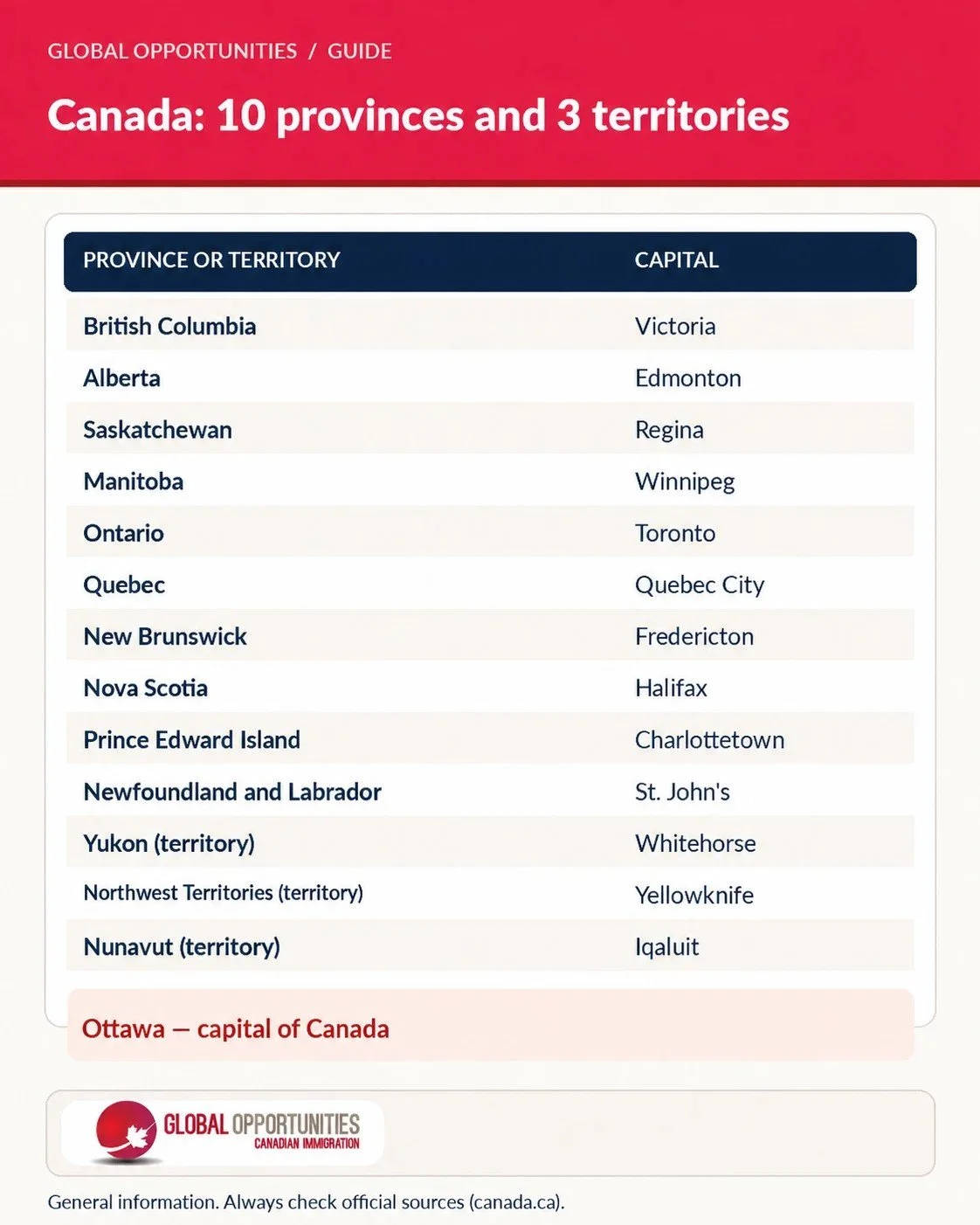
Capital: St. John's.
Total area: 405,720 square kilometres, including fresh water.
Joined Confederation: March 31, 1949, as the tenth province.
Name: the province officially became Newfoundland and Labrador in December 2001, through an amendment to the Constitution of Canada.
A short history
According to Canadian Heritage's provincial symbols page for Newfoundland and Labrador:
First peoples. The Beothuk inhabited Newfoundland long before European colonization; by the early 1800s they had disappeared. Inuit communities remain concentrated on the coast of northern Labrador, and other Indigenous peoples live across the province.
The Norse are thought to have arrived in the 10th century, and John Cabot landed in 1497. In 1610, a settlement at Cupids was the first recorded attempt at a formal English colony in present-day Canada.
Joining Canada. After the Commission of Government ruled from 1934 to 1949, two referenda in 1948 led to union with Canada, which won with 52% of the vote.
Language and population
According to Job Bank, based on the 2021 Census, 99.4% of residents identified English as their first official language and 0.5% French. Indigenous people made up 9.3% of the population. The province also has the highest median age in Canada, 48.0 years, and Job Bank notes that it relies on immigration to fill labour gaps, particularly in health care (Job Bank, Economic Scan 2026).
Newfoundland Time
Newfoundland has its own time zone. Under the province's Standard Time Act, Newfoundland Standard Time is three and a half hours behind Greenwich Mean Time, with daylight time from the second Sunday of March to the first Sunday of November (Standard Time Act). That is half an hour ahead of Atlantic Time. The National Research Council explains that most of Labrador uses Atlantic Time, while parts of southeastern Labrador use Newfoundland Time (NRC, time zones).
Sales tax
Prices in stores do not include tax. Newfoundland and Labrador uses the Harmonized Sales Tax (HST), which is 15% according to the Canada Revenue Agency (CRA, GST/HST rates). Basic groceries are generally not taxed, but most other purchases are.
Where is Newfoundland and Labrador? Map, location and key facts
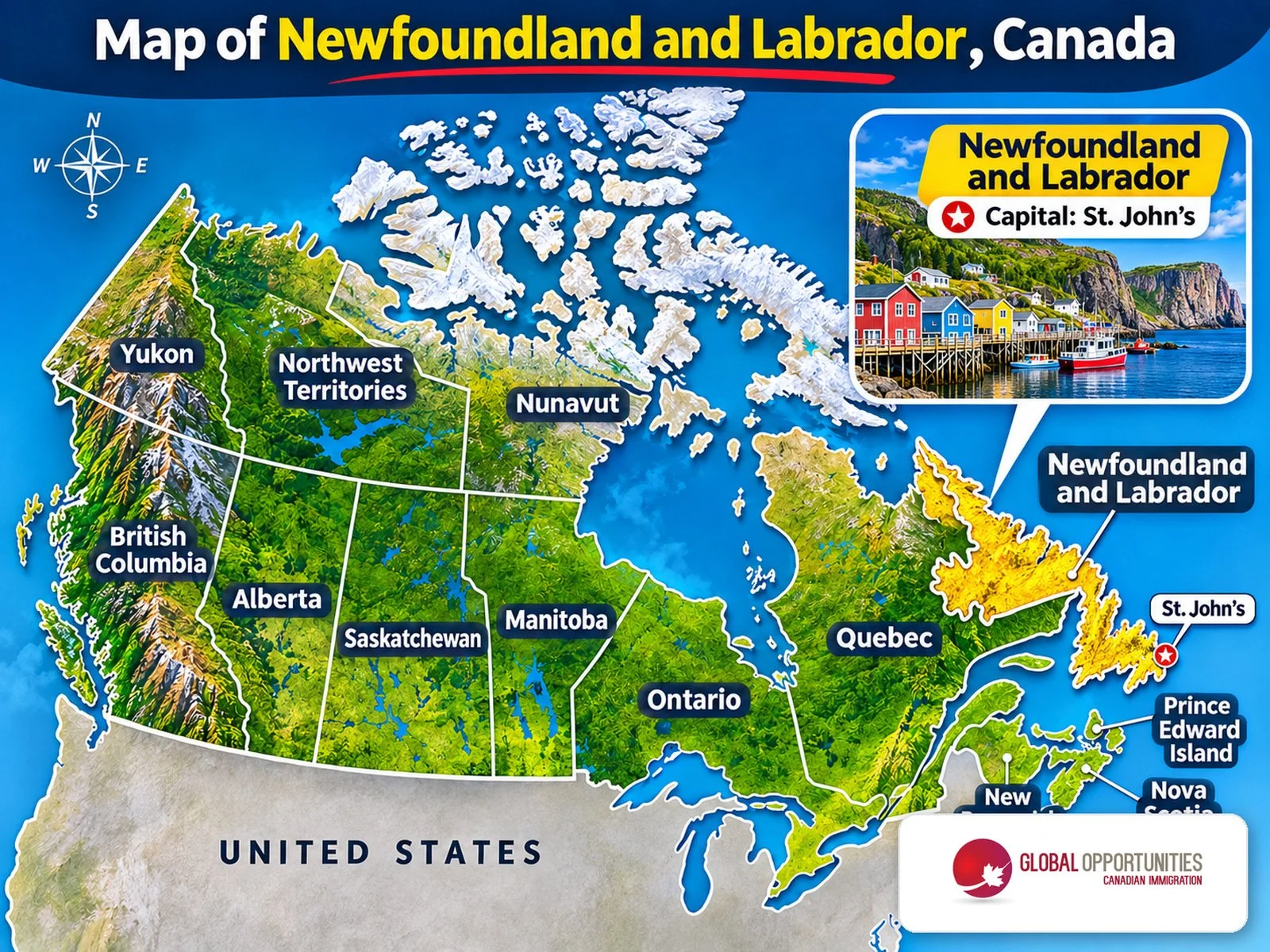
Newfoundland and Labrador is Canada's most easterly province, according to Canadian Heritage. It has two parts: the island of Newfoundland, in the Atlantic Ocean, and Labrador, on the mainland. Its capital, St. John's, is also its largest city, and most of the island runs on its own time zone, Newfoundland Time.
Borders and neighbours
As the political maps in Natural Resources Canada's Atlas of Canada reference maps show:
Labrador shares its land border with Quebec, to the west and south. To the east and north it faces the Labrador Sea.
The island of Newfoundland is surrounded by water: the Atlantic Ocean, the Gulf of St. Lawrence, the Strait of Belle Isle (between the island and Labrador) and the Cabot Strait (between the island and Nova Scotia).
The province has no land border with the United States. The French islands of Saint-Pierre and Miquelon lie off the island's south coast.
Capital and largest city
St. John's is the capital (Canadian Heritage) and the most populous municipality. According to Statistics Canada's 2021 Census, the City of St. John's had 110,525 residents (Statistics Canada, table 98-10-0002-01) and the St. John's census metropolitan area, which includes Mount Pearl, Paradise and Conception Bay South, had 212,579 (Statistics Canada, table 98-10-0005-01).
Time zones
As explained above under "Newfoundland Time", the island uses Newfoundland Time, three and a half hours behind Greenwich Mean Time under the province's Standard Time Act, and the National Research Council explains that most of Labrador uses Atlantic Time, while parts of southeastern Labrador use Newfoundland Time (NRC, time zones).
Area and population
Land area: 358,170 square kilometres, according to the 2021 Census (Statistics Canada, table 98-10-0001-01). Canadian Heritage gives a total area of 405,720 square kilometres, including fresh water.
Population: 510,550 people in the 2021 Census (table 98-10-0001-01). Statistics Canada's latest quarterly estimate puts the population at 552,462 on July 1, 2026 (Statistics Canada, table 17-10-0009-01).
Economy and main industries
According to Job Bank's 2026 Economic Scan, the province's economy relies on offshore oil and gas, mining (nickel, iron ore and gold), the fishery and seafood processing, public administration, health care and education, with tourism mainly in summer. See "Jobs and main industries in Newfoundland and Labrador" below for the details.
Population by origin: what the census says
Statistics Canada's 2021 Census asked people about their ethnic or cultural origins and whether they belong to a visible minority group. These figures come from the long-form census and cover people living in private households (502,100 people in Newfoundland and Labrador). You can explore them in the Census Profile for Newfoundland and Labrador and in Statistics Canada's tables on visible minority and ethnic or cultural origin.
Visible minorities. About 16,855 people identified as part of a visible minority group. The largest groups were South Asian (4,545), Black (3,590), Filipino (2,270), Chinese (2,005) and Arab (1,740). About 755 people identified as Latin American, 545 as West Asian, 505 as Southeast Asian, 220 as Korean and 80 as Japanese.
Ethnic or cultural origins (people could report more than one): the most common were English (175,045), Canadian (125,120), Irish (122,115), Newfoundlander (34,635) and Scottish (33,270), followed by French (22,925), Mi'kmaq (18,875) and German (7,335). About 1,260 people reported Latin, Central or South American origins, including Brazilian, Colombian and Mexican.
Indigenous identity. According to Statistics Canada's Indigenous identity table, about 46,545 people identified as Indigenous: 28,435 First Nations, 7,335 Métis and 7,330 Inuit.
These census counts describe the population in 2021. They are context for newcomers, not a ranking of communities, and the next census will update them.
Census figures as published by Statistics Canada (2021 Census and quarterly population estimates), as of November 2026. Census counts are rounded by Statistics Canada, and origin counts add up to more than the population because people could report several origins. Check the linked tables for the current figures.
How to get to Newfoundland and Labrador: by plane, car, train or bus
Most people reach Newfoundland and Labrador by plane, landing in St. John's, or by car and ferry from Nova Scotia. Labrador can also be reached by road through Quebec. There is no passenger train to the province, and an intercity bus runs across the island.
By plane: the main airports
According to the province's official tourism site, airlines fly into St. John's, Gander, Deer Lake, Happy Valley-Goose Bay and Wabush, and regional airlines serve smaller communities (Newfoundland and Labrador Tourism, getting here). The main gateway is St. John's International Airport; others include Gander International Airport, Deer Lake Regional Airport (the closest to Corner Brook and Gros Morne) and Goose Bay Airport in Labrador.
Flying to Newfoundland and Labrador from abroad: airlines and common routes
As of November 2026, St. John's International Airport's Routes and Airlines page lists these airlines: Air Canada, Air Saint-Pierre, PAL Airlines, Porter, Sunwing, WestJet and Flair. The airport's 2026 network map on the same page shows nonstop routes to:
Europe: Dublin, London Gatwick and Paris (Charles de Gaulle).
The United States: Orlando and Tampa. The airport also announced that United Airlines will fly daily between St. John's and Newark from June to September 2027 (St. John's International Airport, news release, October 16, 2026).
Mexico and the Caribbean: Cancún, Montego Bay and Punta Cana.
Canada: cities that include Toronto (Pearson and Billy Bishop), Montréal, Ottawa, Halifax, Hamilton, Winnipeg, Calgary and Edmonton, plus Saint-Pierre (France).
The map does not say which airline flies each route or which routes are seasonal. Common ways to get there by region of origin, based on that network:
From Europe: a nonstop flight from Dublin, London Gatwick or Paris when one is operating, or a connection in a Canadian city with nonstop flights to St. John's, such as Toronto, Montréal or Halifax.
From Latin America and Mexico: a nonstop flight from Cancún when one is operating, or a connection in Toronto, Montréal or Halifax.
From the United States: a nonstop flight from Orlando, Tampa or, from summer 2027, Newark, or a connection in a Canadian city.
From Asia: a connection in a Canadian city with nonstop flights to St. John's, such as Toronto, Montréal, Calgary or Edmonton.
Routes and airlines change seasonally; check the airport's page and the airlines before you book. Before you travel, use IRCC's tool to check if you need a visa or an eTA.
Airlines and routes as published by St. John's International Airport, as of November 2026. A route on the airport's map does not mean it operates all year or on the date you need: check with the airlines before you book.
By car and ferry
The island: most drivers arrive with Marine Atlantic from North Sydney, Nova Scotia, to Port aux Basques (year-round) or Argentia (summer); see "The ferry to Nova Scotia: Marine Atlantic" below. According to the province's tourism site, the Trans-Canada Highway (Route 1) crosses the island for 905 kilometres, from Port aux Basques to St. John's (Newfoundland and Labrador Tourism, car and ferry).
Labrador: the same tourism page explains that you can drive to Labrador through Quebec, on Quebec routes 138 and 389, and then follow Route 500 to Happy Valley-Goose Bay and Route 510 to Blanc-Sablon, Quebec. It describes a daily, year-round ferry of about 1.5 hours between Blanc-Sablon and St. Barbe, on the island.
Provincial ferries: the Department of Transportation and Infrastructure runs ferries to islands and coastal communities, including the St. Barbe–Blanc-Sablon crossing and coastal Labrador routes, and notes that schedules can change with the weather (Government of NL, ferry services).
Before you drive: check road conditions, closures, ferries and cameras on 511 Newfoundland and Labrador.
By train
VIA Rail's train to Atlantic Canada, the Ocean, runs between Montréal and Halifax (VIA Rail, Montréal to Halifax). VIA Rail does not run to Newfoundland and Labrador, so travellers who come by train continue by road and ferry or by plane.
By bus
According to its operator, DRL runs a daily motor coach service across the island between St. John's and Port aux Basques, with 25 stops (DRL). Check its site for the current schedule and fares.
Driving from the United States
Newfoundland and Labrador has no land border with the United States. Drivers from the U.S. enter Canada at a Canada Border Services Agency (CBSA) land crossing in another province, such as New Brunswick or Quebec, and continue by road and ferry. Check the CBSA's border wait times before you leave, and read its page on what to declare and bring when you enter Canada. Entry rules depend on your citizenship and status, so check IRCC's visa and eTA tool too.
Routes, ferries and services as published by Newfoundland and Labrador Tourism, the Government of Newfoundland and Labrador, VIA Rail, DRL and the CBSA, as of November 2026. Schedules change with the seasons and the weather: check the linked pages before you travel.
Buying your first home in Newfoundland and Labrador
Most newcomers rent first. When you are ready to buy, three federal measures can help first-time buyers: the First Home Savings Account, the Home Buyers' Plan and the home buyers' amount. Newfoundland and Labrador also has a provincial program for first-time buyers. Whether you qualify depends on your own situation.
Federal help for first-time buyers
First Home Savings Account (FHSA). According to the Canada Revenue Agency, to open one you must be a resident of Canada, at least 18 (or 19 where that is the age of majority), no older than 71 at the end of the year, and a first-time home buyer: you did not live, in the current year or the previous four, in a home that you or your spouse or partner owned (CRA, opening your FHSAs). Contribution limits are on the CRA's FHSA page.
Home Buyers' Plan (HBP). The CRA describes it as a program that lets you withdraw from your RRSPs to buy or build a qualifying home. As of November 2026, the CRA lists a withdrawal limit of $60,000 and a repayment period of 15 years (CRA, what is the Home Buyers' Plan).
Home buyers' amount (line 31270). A non-refundable federal tax credit for first-time home buyers. The CRA says you can claim up to $10,000 for a qualifying home acquired in 2025 (CRA, line 31270).
The Canada Mortgage and Housing Corporation has a step-by-step home buying guide.
The Newfoundland and Labrador First-time Homebuyers Program
According to the Newfoundland and Labrador Housing Corporation's First-time Homebuyers Program FAQ, eligible households may receive a grant of 50% of legal closing costs, up to $1,500, and a repayable loan of up to 5% of the purchase price. Applicants must be first-time homebuyers living in the province, have a total household income below $85,000 (up to $95,000 may qualify for reduced help) and have a mortgage pre-approval letter. When we checked, the page said there was no submission deadline "at this time".
Can newcomers buy a home?
A federal law temporarily prohibits most non-Canadians from buying residential property in Canada, with exceptions for some temporary residents. Our newcomer guide to Canada explains what the official pages say. Read the conditions before you make an offer, and speak with a real estate lawyer.
The rules depend on each person: your residency, your status, your income and whether you or your partner owned a home before. Check the CRA pages and the NLHC page before you rely on any of these measures.
Program rules and amounts as published by the Canada Revenue Agency and the Newfoundland and Labrador Housing Corporation, as of November 2026. Meeting one condition does not mean you qualify; the CRA and NLHC decide each case. This is not financial, tax or legal advice: check the linked pages and speak with a professional before you rely on them.
Emergencies and natural hazards in Newfoundland and Labrador
Newfoundland and Labrador's main natural hazards are winter storms, strong winds, power outages, flooding and, in summer, wildfires. The provincial government asks every household to be ready to look after itself for at least 72 hours, with an emergency kit and a plan.
Be prepared. The Government of Newfoundland and Labrador's Be Prepared page says you should always be prepared to be self-sufficient for at least 72 hours, and has emergency kit checklists, plans for pets and advice for power outages and floods. The federal Get Prepared site has more guides.
Winter storms and power outages. Follow Environment Canada's forecasts and warnings on weather.gc.ca or the WeatherCAN app, and keep a storm kit with water, food, a flashlight and a charged power bank.
Flooding. The province advises never crossing floodwaters on foot or in a vehicle, because the water may be deeper than it looks. Its alerts and monitoring page links to a daily flood report that runs during the peak hurricane months, from June to December.
Wildfires. According to the Be Prepared page, there are on average more than 160 wildfires in the province every year. The Department of Forestry, Agriculture and Lands' wildfire management page has the daily wildfire risk, a dashboard of active wildfires, fire bans and outdoor burning rules. To report a wildfire, call 1-866-709-FIRE (3473). If officials tell you to evacuate, leave.
Smoke and air quality. If there is wildfire smoke, check Environment and Climate Change Canada's Air Quality Health Index (AQHI); you can set AQHI notifications in the WeatherCAN app.
Emergency alerts. Alert Ready is Canada's emergency alerting system. Alerts reach people through television, radio and compatible wireless devices, with a distinctive tone. Check that your phone is compatible on the Alert Ready site.
In an emergency, call 911. A kit, a plan and a charged phone make storms and outages much easier to manage.
Preparedness advice as published by the Government of Newfoundland and Labrador, Environment and Climate Change Canada and Alert Ready, as of November 2026. Follow the instructions of local officials in any emergency, and check the linked pages for current alerts.
Living in St. John's
St. John's is the capital of Newfoundland and Labrador, on the Avalon Peninsula. The City describes it as known for its "colourful character, coastal beauty, and strong sense of community" (City of St. John's, New to St. John's). Job Bank's Economic Scan reports that in 2025 the Avalon Peninsula region had most of the province's growth in population, labour force and employment.
What life in St. John's is like
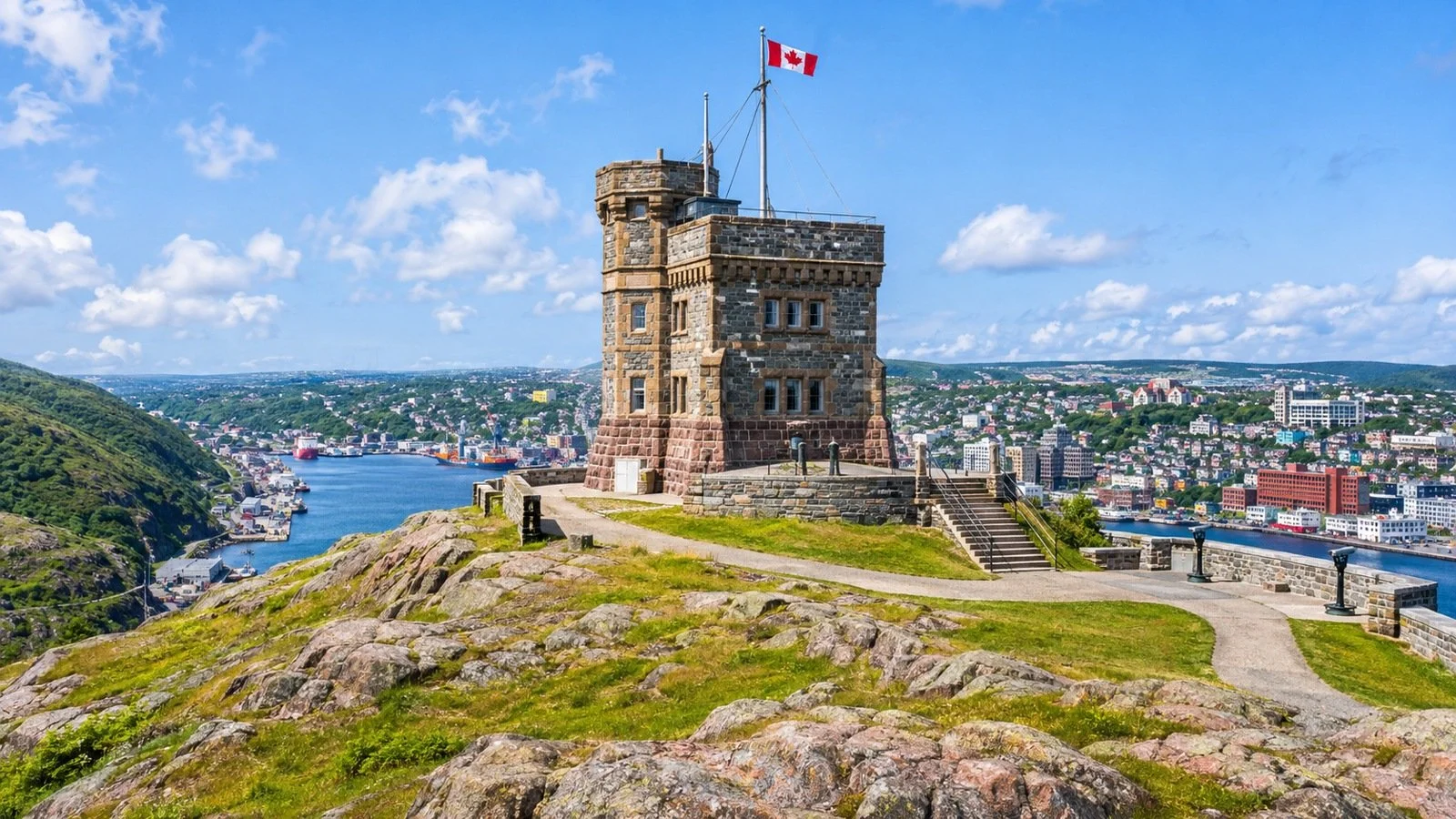
Landmarks. Parks Canada describes Signal Hill, with its hiking trails and Cabot Tower, as the city's most popular landmark; nearby, Cape Spear Lighthouse stands at North America's easternmost point (Parks Canada, Signal Hill).
Education. Memorial University's largest campus and its Fisheries and Marine Institute are in St. John's (Memorial University, campuses), and College of the North Atlantic lists Prince Philip Drive and Ridge Road campuses in St. John's and Seal Cove in Conception Bay South (CNA, campuses).
Health care. NL Health Services lists emergency departments at the Health Sciences Centre, St. Clare's Mercy Hospital and the Janeway Children's Health and Rehabilitation Centre in St. John's (NL Health Services, find an emergency department), and the city has an Urgent Care Centre (see the health section).
Transit. Metrobus runs the city bus network (see the transportation section).
City services. The City of St. John's website covers recreation, permits, waste collection, snow clearing and parking, and its New to St. John's page points newcomers to the Local Immigration Partnership, a students page and the Newcomer Navigator NL guide.
Areas of St. John's
According to the City, St. John's has several neighbourhoods, each with its own history and character, from downtown streets to quiet residential areas (City of St. John's, New to St. John's). If you will not have a car, look near a Metrobus route to your school or work. Whatever the area, check the bus route, the winter walk and winter parking.
Who St. John's suits
St. John's can suit students at Memorial and CNA, people who work in the capital, and anyone who wants city services and public transit: Metrobus is the main city bus network in the province.
Mount Pearl, Paradise and Conception Bay South
Mount Pearl, Paradise and Conception Bay South are part of the St. John's region on the Avalon Peninsula. Many people live in these communities and work in St. John's.
Mount Pearl. A city next to St. John's, with its own recreation programs, municipal services and a newcomer page (City of Mount Pearl). Metrobus lists Mount Pearl among its destinations (Metrobus, service at a glance).
Paradise. A town west of St. John's with its own municipal services (Town of Paradise). Metrobus also lists Paradise among its destinations.
Conception Bay South (CBS). A long town along the shore of Conception Bay. The town describes itself as the second-largest municipality in the province, with over 27,000 residents (Town of Conception Bay South). Many residents commute to St. John's.
In these communities a car is usually the most practical way to get around. Before you sign a lease, check the commute in winter, bus service for your hours and the distance to schools and groceries.
Corner Brook, Gander and Grand Falls-Windsor
Outside the St. John's region, the island's main service centres are Corner Brook on the west coast, and Gander and Grand Falls-Windsor in central Newfoundland. Beyond them are hundreds of smaller coastal communities, often called outports.
Corner Brook
The City of Corner Brook describes itself as a city in the Bay of Islands, in western Newfoundland. Memorial University's Grenfell Campus, with schools of Arts and Social Science, Fine Arts, and Science and the Environment, is here (Memorial, faculties and schools), along with a College of the North Atlantic campus. The city runs Corner Brook Transit, and Western Memorial Regional Hospital appears on NL Health Services' list of emergency departments. The city's snow clearing page notes that winter in Corner Brook "can bring heavy snowfall" (City of Corner Brook, snow clearing FAQ). Gros Morne National Park is also in western Newfoundland (Parks Canada, Gros Morne). According to CMHC's October 2025 survey (CMHC, Newfoundland and Labrador summary), the average rent for all units in Corner Brook was $899 (see the housing section).
Gander
The Town of Gander, in central Newfoundland, highlights opportunities in the aerospace, defence, retail and manufacturing sectors, and the town has an international airport (Gander International Airport). CNA has a campus here, and James Paton Memorial Regional Health Centre appears on NL Health Services' list of emergency departments. According to CMHC's October 2025 survey (CMHC, Newfoundland and Labrador summary), the average rent for all units was $983.
Grand Falls-Windsor
A town in central Newfoundland with a College of the North Atlantic campus and the Central Newfoundland Regional Health Centre, which appears on NL Health Services' list of emergency departments. The Town of Grand Falls-Windsor website covers municipal services and links to census data. According to CMHC's October 2025 survey (CMHC, Newfoundland and Labrador summary), the average rent for all units was $846.
Life in the outports
In small coastal communities, services are fewer and a car is usually needed. Job Bank's Economic Scan describes the fishery as one of the province's industries (see the jobs section). Before choosing a smaller community, check nearby jobs, schools, health services, internet and transportation, and how far the nearest hospital is.
Living in Labrador: Happy Valley-Goose Bay and Labrador City
Labrador is the mainland part of the province, a large northern region with few, widely spaced communities. IRCC notes that Labrador has immense hydro-electric resources (Discover Canada). Winters are longer and colder than on the island.
Happy Valley-Goose Bay
A town in central Labrador with the Labrador Health Centre, which appears on NL Health Services' list of emergency departments, and a College of the North Atlantic campus. According to Memorial University, its Labrador Campus in Happy Valley-Goose Bay is its newest location and provides "place-based, northern-focused, and Indigenous-led education and research opportunities" (Memorial University, campuses).
Labrador City and Wabush
Labrador City and Wabush are in western Labrador. According to the Government of Newfoundland and Labrador, the Iron Ore Company of Canada operates open-pit mines, a concentrator and a pellet plant in Labrador West (Government of NL, news release). College of the North Atlantic has a Labrador West campus, and the Labrador West Health Centre appears on NL Health Services' list of emergency departments.
Indigenous Labrador
Canadian Heritage notes that Inuit communities are concentrated on the coast of northern Labrador, and other Indigenous peoples also live in the region. Parks Canada describes the Torngat Mountains, in the far north, as an Inuit homeland (Parks Canada, Torngat Mountains). Many coastal communities can only be reached by air or by sea in summer.
Living in Labrador means planning ahead for travel, health care and supplies.
How much is rent in Newfoundland and Labrador? Rents, where to look and tenant rules
Most newcomers rent when they first arrive. Rental rules come from the Residential Tenancies Act, 2018, and the provincial government's Residential Tenancies office handles disputes between landlords and tenants. Rents in the province are lower than in Canada's largest cities, but vacancy is low, so start your search early.
Average rents in Newfoundland and Labrador: CMHC figures
The Canada Mortgage and Housing Corporation (CMHC) surveys rents every October. According to its Rental Market Survey of October 2025, average monthly rents for apartments and row houses in the St. John's metropolitan area were (CMHC Housing Market Information Portal, St. John's):
Studio (bachelor): $945
One bedroom: $1,064
Two bedrooms: $1,348
Three bedrooms or more: $1,327
All units: $1,215
Vacancy rate, all units: 2.1%
In other centres, the average for all units was $899 in Corner Brook, $983 in Gander and $846 in Grand Falls-Windsor, and $1,118 for the province as a whole, with a provincial vacancy rate of 2.1% (CMHC, Newfoundland and Labrador summary). CMHC does not publish these averages for every community, including some in Labrador.
These are averages for all existing rentals, including long-term tenants; units listed for new tenants are often above the average. CMHC publishes a new survey every December, so check the current figures in CMHC's rental market data tables.
Where to look for a rental
Listing sites and apps: Kijiji, Facebook Marketplace, Rentals.ca and PadMapper are widely used in St. John's.
Property management companies post their units on their own websites.
Local Facebook groups for St. John's, Mount Pearl, CBS, Corner Brook and other communities.
Students: contact Memorial University or CNA housing services for residences and off-campus listings.
Settlement agencies: the Association for New Canadians (ANC) can share housing information with its clients.
Word of mouth: coworkers, classmates and places of worship often know about units before they are posted.
We mention private websites and companies for reference only. Global Opportunities has no relationship with them and does not recommend any of them.
Renting a room, a basement apartment or an apartment
Many St. John's houses have a basement apartment, and shared houses are common near Memorial University. A room is usually the quickest and cheapest start. Ask whether heat and electricity are included and whether there is off-street parking for winter.
What landlords usually ask for
Identification, proof of income or a job letter, references and sometimes a credit check; newcomers may be asked for bank statements. Never give your Social Insurance Number just to view a unit.
Security deposits: what the law allows
According to the Residential Tenancies Act, 2018 (Residential Tenancies Act):
A security deposit can be no more than three-quarters of one month's rent (or two weeks' rent for a week-to-week tenancy).
The landlord must place it in an interest-bearing account in the province within two banking days, and it earns interest at the rate set by regulation. The province has a security deposit interest calculator.
It must be returned within 10 days after you leave, unless the landlord makes a claim against it.
Rent increases
Under the Residential Tenancies Act, 2018, rent cannot be increased in the first 12 months of a tenancy, and after that no more than once every 12 months, and not during a fixed-term agreement. The landlord must give written notice: six months for a month-to-month or fixed-term tenancy, and eight weeks for a week-to-week tenancy. The Act does not set a maximum percentage. Check the official guide for the current rules.
The rental agreement
The Residential Tenancies Act, 2018 says the landlord must give the tenant a copy of the Act and regulations when the agreement is made, and a copy of the signed agreement within 10 days (or a written notice with the key details if the agreement was oral). Ask for everything in writing and keep copies of receipts.
Residential Tenancies: where to get help
The Government of Newfoundland and Labrador's Residential Tenancies office mediates and adjudicates disputes between residential landlords and tenants and publishes a complete guide for landlords and tenants, forms and information on how to apply for dispute resolution (Government of NL, Landlord and tenant and Residential Tenancies guide). Read the guide before you sign a lease, and contact the office before you stop paying rent or leave early.
Job Bank notes that homelessness has risen and the social housing waitlist has grown, so plan carefully (Job Bank, Economic Scan 2026).
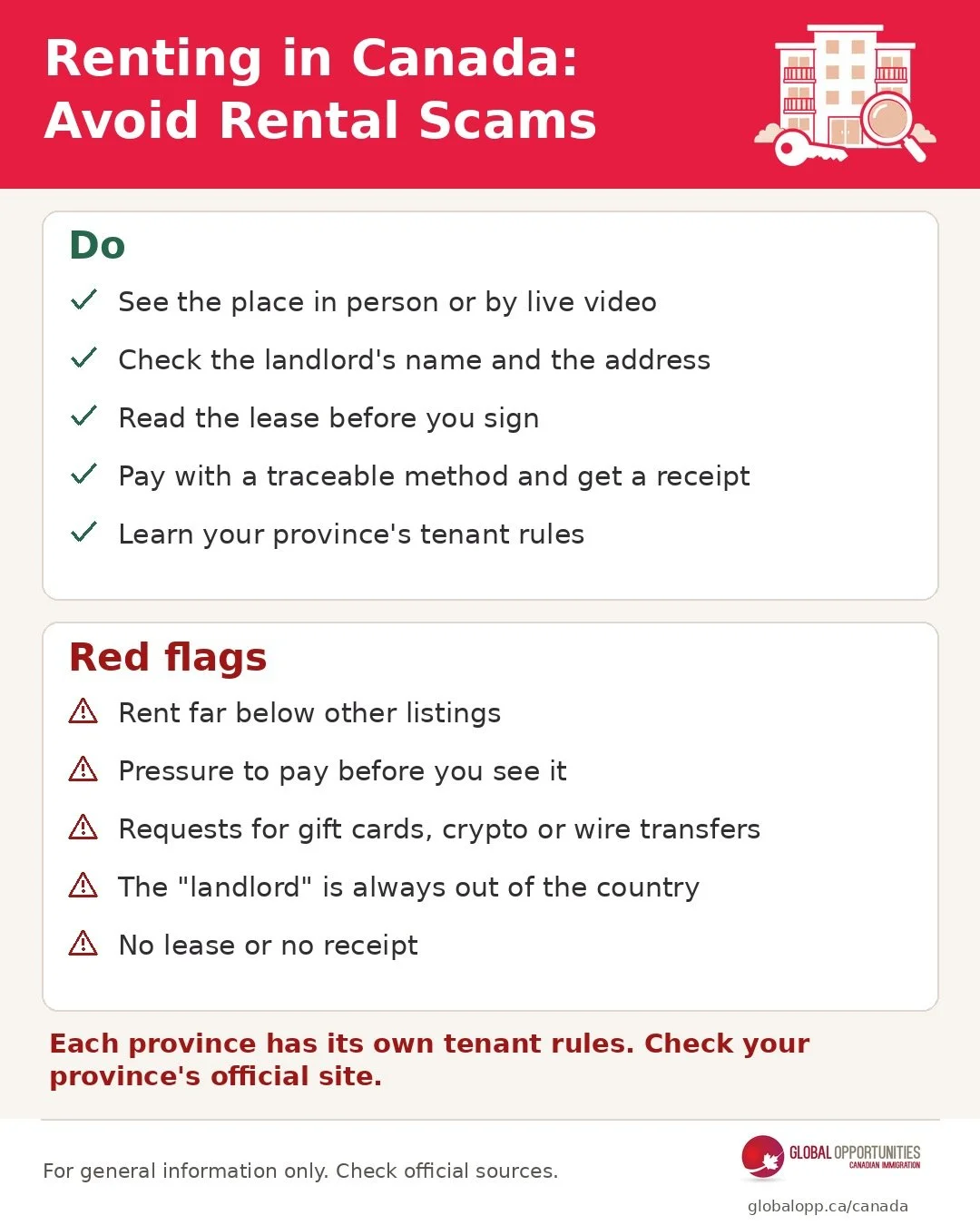
How to avoid rental scams
Never send money for a place you have not seen in person or on a live video call.
Be careful with very low rents, landlords who say they are away, or pressure to pay right away.
Confirm that the person owns or manages the unit.
Pay with traceable methods and get receipts.
Never pay more deposit than the law allows.
Utilities: electricity, heat and internet
Many homes heat with electricity, oil or heat pumps, so ask what is included and what January bills look like. Electricity rates are regulated by the Board of Commissioners of Public Utilities (PUB).
Rents as published by CMHC and tenancy rules as set out in the Residential Tenancies Act, 2018 and by the Government of Newfoundland and Labrador, as of November 2026. CMHC averages include long-term tenants, so an advertised unit may cost more; check the linked pages before you rely on them.
Getting around: Metrobus, Corner Brook Transit, ferries and flights
Public transit in Newfoundland and Labrador exists mainly in St. John's, with Metrobus, and in Corner Brook. Elsewhere, most people drive.
Metrobus in St. John's
Metrobus serves St. John's and nearby areas, with destinations that include Mount Pearl, Paradise, Goulds and Kilbride (Metrobus, service at a glance). Plan your trips with the route maps on the Metrobus site.
Fares. According to the Metrobus fares page, as of November 2026:
Adult cash fare: $2.50 (exact fare only).
Adult monthly or 30-day pass: $78.00.
mCard: a reloadable smart card that carries all fare types except cash; reload it online or at sales outlets.
Credit and debit cards are not accepted on board. Students should ask their institution about student passes. Check the current fares on the Metrobus site before you buy.
GoBus is Metrobus's accessible door-to-door service for people whose disability prevents them from using regular buses. It requires an application and an assessment, and uses the same fares (GoBus).
Corner Brook Transit
According to the City of Corner Brook, Corner Brook Transit runs fixed routes on weekdays during the day and an on-demand service in weekday evenings and on weekends, booked by app or phone. As of November 2026, the city listed an adult cash fare of $3.25, an adult monthly pass of $80 and a student semester pass of $220. Check the current fares on the city's site.
The ferry to Nova Scotia: Marine Atlantic
Marine Atlantic connects the island with North Sydney, Nova Scotia. According to its schedule page, the North Sydney–Port aux Basques crossing runs year-round and takes about seven hours, and the North Sydney–Argentia crossing runs in summer (about June to September) and takes about 16 hours. Book early in summer, check fares on Marine Atlantic's site, and remember that winter storms can delay sailings.
Flights
St. John's International Airport is the province's main airport, and Gander International Airport serves central Newfoundland; other communities also have airports. Routes change with the seasons, so check with the airlines.
Fares and schedules as published by Metrobus, the City of Corner Brook and Marine Atlantic, as of November 2026. They may have changed by the time you read this: check the linked pages before you rely on them.
Driving in Newfoundland and Labrador: licences, car rental and winter
Outside central St. John's, a car is close to essential in Newfoundland and Labrador. Licences are issued by the Motor Registration Division, new drivers go through graduated licensing, and every vehicle must be insured.
Do I need a car in Newfoundland and Labrador?
If you live and work or study in St. John's near a Metrobus route, you can manage without a car at first. In Mount Pearl, Paradise and CBS, a car makes life much simpler; in Corner Brook it helps outside transit hours; and in Gander, Grand Falls-Windsor, the outports and Labrador it is usually essential. Many newcomers rent a car for their first days and buy a used car later, after a mechanic's inspection.
Graduated licensing in Newfoundland and Labrador: Level I and Level II
According to the Motor Registration Division's Graduated Driver Licensing program page, every new driver, whatever their age, goes through graduated licensing. The minimum age is 16, and drivers under 19 need parental consent. You pass a written test and a vision test to start, and a road test to move up.
Class 5 Level I (learner), according to the same page:
The learner licence is valid for two years.
You hold it for at least 12 months before the road test, or 8 months if you complete an approved driver education course.
A driver with at least four years of Class 5 experience must sit in the front passenger seat, with a zero blood alcohol level.
You must also have zero blood alcohol.
No passengers other than the accompanying driver.
No driving between midnight and 5 a.m.
A "NOVICE DRIVER" sign is displayed on the rear of the vehicle.
You leave Level I by passing the road test.
Class 5 Level II (novice), according to the same page:
Covers the first 12 months after passing the road test.
Zero blood alcohol.
Between midnight and 5 a.m., you may drive only with a driver of four or more years' experience who has zero blood alcohol, with an exemption for driving to and from work.
Passengers are limited to the number of seatbelts.
Check the official page for how Level II ends and the full licence begins, and for the current rules. You can read the Driver's Handbook on the Motor Registration Division website.
Licence fees
According to the Motor Registration Division's fees policy (dated December 2023, checked November 2026), a two-year Class 5 Level I licence was $60, a five-year Class 5 licence was $125 ($115 if renewed online), a Class 5 or 6 road test was $78 and a photo ID card was $25. Fees change, so check the current price.
Exchanging a foreign driver's licence
According to the Government of Newfoundland and Labrador (licence application process for new residents):
New residents must exchange their licence within three months of becoming a resident, by appointment, and surrender the old licence.
Drivers from other Canadian provinces and the United States can exchange without tests if they meet the criteria.
The province has reciprocity agreements with certain countries, including Austria, Belgium, Denmark, France, Germany, Ireland, the Isle of Man, Japan, Northern Ireland, the Republic of Korea, Switzerland, Taiwan, Ukraine and the United Kingdom, for certain licence classes. Holders do not take the written, vision or road tests.
Drivers from all other countries take the written, vision and road tests and are placed in graduated licensing. A valid foreign licence may exempt you from the waiting period between Level I and Level II if you surrender it.
You need proof of legal presence in Canada and proof of address. Licences that are not in English or French need an English translation (translation of foreign licences).
The list of countries changes; confirm it on the official page before your appointment.
Renting a car when you arrive in St. John's
St. John's International Airport lists several on-site car rental companies, including Alamo, Avis, Budget, Enterprise, Hertz, National and Thrifty, and advises booking ahead, especially from May to September (St. John's International Airport, car rentals). The airport does not set licence or age rules; each company does. What to check before you book:
Your licence. Bring your valid, physical home-country licence with a photo; digital licences are usually not accepted. As an example, one major company's FAQ says an International Driving Permit (IDP) is recommended for licences in a Latin alphabet that are not in English or French, and required for licences in a non-Latin alphabet, and that the IDP is only accepted together with your home licence, never alone (Enterprise, licence requirements). An IDP is only valid with a valid licence and is issued in the country that issued your licence (in Canada, CAA issues IDPs to holders of Canadian licences: CAA, International Driving Permit), so get yours before you travel.
Your passport. Companies may ask for it with a foreign licence.
A credit card in the driver's name. Many companies require one for the security deposit and may not accept debit or prepaid cards. Ask before you book.
Age. The same company lists a minimum rental age of 21 in Newfoundland and Labrador (Enterprise, rental age by province); ask about any fees or vehicle limits for young drivers. Other companies have their own rules.
Insurance. Check what your credit card or travel insurance covers before accepting or refusing the rental company's coverage.
Winter. From November to April, ask whether the car has winter tires.
Remember the three-month rule for new residents: a rental is fine for your first weeks, but book your licence exchange appointment early. We mention private companies for reference only and have no relationship with any of them.
Car insurance in Newfoundland and Labrador
Car insurance is mandatory, and the province runs an Insurance Validation Program to check that vehicles are insured (Government of NL, news release). Insurance is sold by private insurers through brokers and agents. The Superintendent of Insurance licenses insurers, brokers and agents, and the Board of Commissioners of Public Utilities regulates auto insurance rates (PUB).
What affects the price: your driving history, the vehicle, where you live, how much you drive, coverage and deductible. Newcomers often have no Canadian record; ask your previous insurer for a letter in English with your years of insured driving and claims history, and compare quotes from several brokers before buying a car.
This mention of regulators is for reference only and may not be complete; confirm details with each regulator.
Winter driving, tires and moose
Winter tires. We found no general legal requirement to use winter tires, but they are strongly recommended for snow, ice and freezing rain.
Studded tires. According to the Government of NL, studded tires are allowed from November 1 to April 30, and the minister can extend the date in spring (Government of NL, studded tires).
Moose. The province warns that moose-vehicle collisions are a serious risk: more than 70% happen from May to October, most between dusk and dawn. It advises slowing down at night, scanning both shoulders, using high beams when safe and watching for warning signs (Government of NL, moose-vehicle awareness).
Emergency kit. Brush and scraper, shovel, blanket, booster cables, winter washer fluid, phone charger, snacks, and a half-full fuel tank. Check road conditions before long drives, especially on the Trans-Canada Highway in storms.
Parking and winter parking bans in St. John's
According to the City of St. John's winter parking page, an overnight parking ban usually runs from early January to April, with dates announced in late November. Outside downtown, overnight on-street parking is banned from 12:30 a.m. to 7:30 a.m.; downtown, the ban is from 4 a.m. to 6 a.m. on parts of Water Street and Duckworth Street. The ban applies whatever the street conditions, and the city can also declare weather-related bans during storms. Vehicles can be ticketed or towed; the city listed a $75 fine. Check the city's page for the current season's dates. If you rent without a driveway, ask the landlord where to park in winter.
Licensing rules and fees as published by the Government of Newfoundland and Labrador's Motor Registration Division, and parking rules by the City of St. John's, as of November 2026. Whether you can exchange a licence without tests depends on your country and licence class, and Motor Registration decides; check the linked pages before you rely on them.
How do newcomers get health care in Newfoundland and Labrador? MCP, family doctors and 811
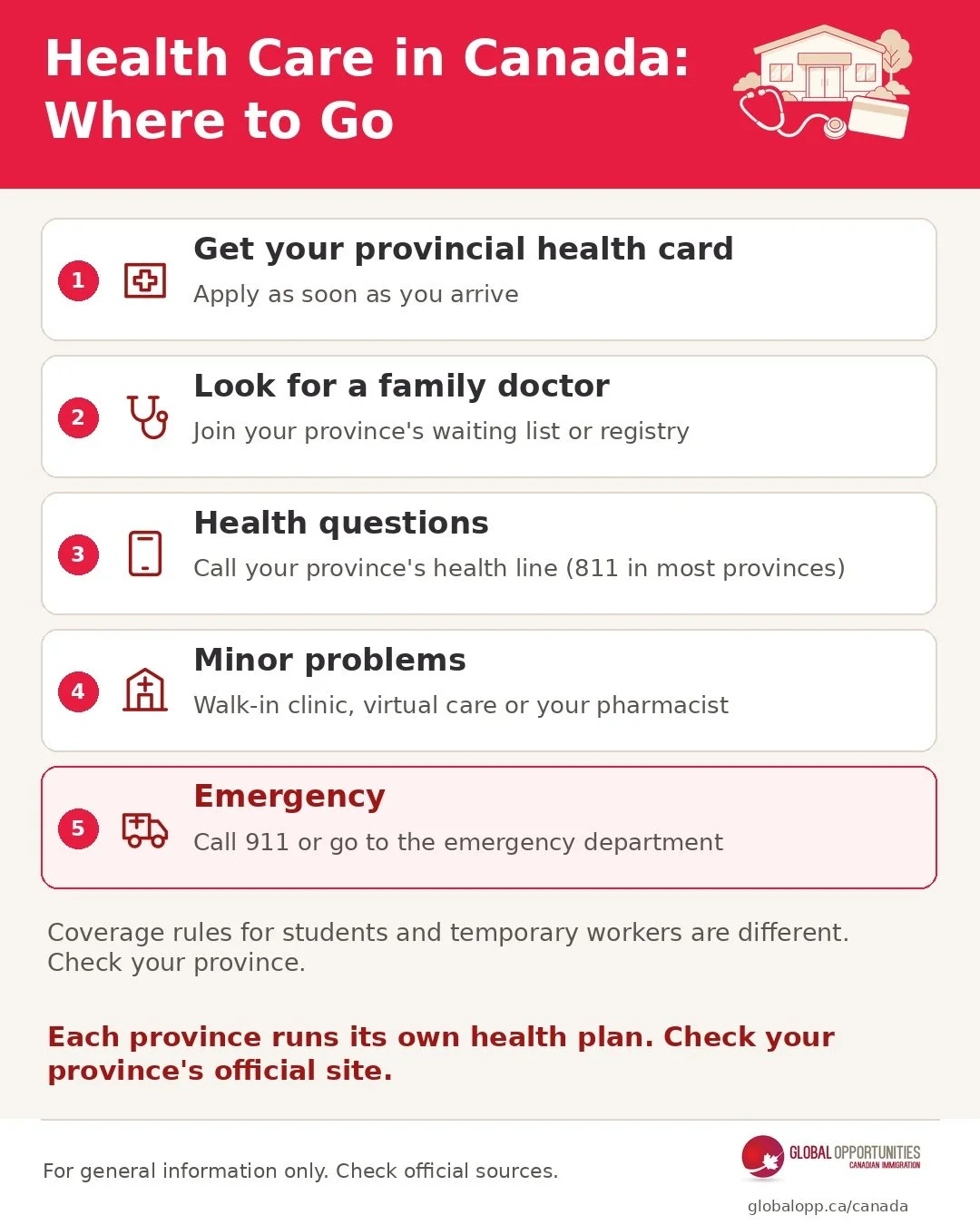
The Newfoundland and Labrador Medical Care Plan (MCP) is the province's public medical care insurance. According to the provincial government, MCP covers insured physician services for residents who meet the eligibility criteria, and beneficiaries are also covered for insured services in hospital (Government of NL, MCP).
New to how public health care works? Read the health care system in Canada.
MCP eligibility
According to the Government of NL's MCP page:
Every person living in the province must register to become and remain an MCP beneficiary, meet the eligibility criteria and reside in the province.
Applicants register under a group, such as Canadian citizens, permanent residents, international workers or international students, each with its own documents and coverage period.
International workers generally need a work permit valid for 12 months or more (with different rules for some provincial nominee and Atlantic Immigration Program workers), a signed recent letter from the employer confirming full-time work in the province, and a passport; coverage is granted for limited periods.
International students generally need a study permit valid for 12 months or more and a recent letter from the school confirming full-time study in a program of one year or more.
Read the official page for your group, because criteria change.
How to register for MCP
According to the Government of NL's MCP page, there is no online application for new registrations and there are no fees for registering. The steps:
Check your group (citizen, permanent resident, international worker or international student) and its documents on the MCP page.
Download the form "Application for Newfoundland and Labrador Health Care Coverage" from the province's health forms page.
Gather your documents, such as your permit, passport and an employer or school letter.
Submit everything by mail, fax, email or at an MCP office.
Show your MCP card whenever you receive care, or you may be billed.
Until you are covered, and for any gap, consider private health insurance; many international students are enrolled in a school health plan.
Finding a family doctor: Patient Connect NL
Patient Connect NL is the provincial list of people without a family doctor or nurse practitioner. The goal is to connect you with a Family Care Team or a primary care provider when one becomes available in your area. Register online or by phone at 1-833-913-4679 (Government of NL, Patient Connect NL). People on the list may be offered virtual primary care while they wait.
Virtual Care NL
Virtual Care NL, from NL Health Services, offers free virtual primary care for people without a family doctor or nurse practitioner, and supports some rural emergency departments where nurses work with a physician by video (Virtual Care NL).
The Urgent Care Centre in St. John's
According to NL Health Services, the Urgent Care Centre at 28 Stavanger Drive in St. John's is open from 8 a.m. to 8 p.m. daily, for walk-in visits or appointments, with no referral needed (NL Health Services, urgent care). It is for urgent problems that are not life-threatening.
Pharmacies and pharmacist care
Pharmacies are found in grocery stores, drugstore chains such as Shoppers Drug Mart and independent pharmacies. According to the Government of NL, pharmacists can assess you for free with an active MCP card for prescription extensions, contraception and nine minor ailments: urinary tract infections, conjunctivitis (pink eye), shingles, nail fungus, acid reflux (GERD), smoking cessation, cold sores, skin fungus and hemorrhoids; you pay for the medication (Government of NL, pharmacy services). The Newfoundland and Labrador Prescription Drug Program (NLPDP) helps eligible residents with prescription costs as a payor of last resort (NLPDP). Dental and eye care are often paid privately or through workplace benefits.
811 HealthLine and emergencies
For an emergency, call 911 or go to the nearest emergency department.
For health advice, call 811, the HealthLine: a free, confidential line where you can speak with a registered nurse 24 hours a day, seven days a week. From an out-of-province cell phone or internet phone, call 1-888-709-2929 (811 HealthLine).
Emergency departments: NL Health Services' list includes St. Clare's Mercy Hospital, the Health Sciences Centre and the Janeway Children's Health and Rehabilitation Centre in St. John's, Western Memorial Regional Hospital in Corner Brook, James Paton Memorial Regional Health Centre in Gander, Central Newfoundland Regional Health Centre in Grand Falls-Windsor, the Labrador Health Centre in Happy Valley-Goose Bay and the Labrador West Health Centre in Labrador City, among others (NL Health Services, find an emergency department). Hours at smaller sites can change, so check NL Health Services notices.
Mental health
In a crisis, call 911 or go to an emergency department. You can also call or text 988, the Suicide Crisis Helpline. The ANC offers support for newcomer youth and families.
MCP eligibility and coverage rules as published by the Government of Newfoundland and Labrador, and service hours as published by NL Health Services, as of November 2026. Meeting the criteria does not mean coverage starts automatically: you must register, and MCP decides each application; check the linked pages before you rely on them.
Banking in Newfoundland and Labrador for newcomers
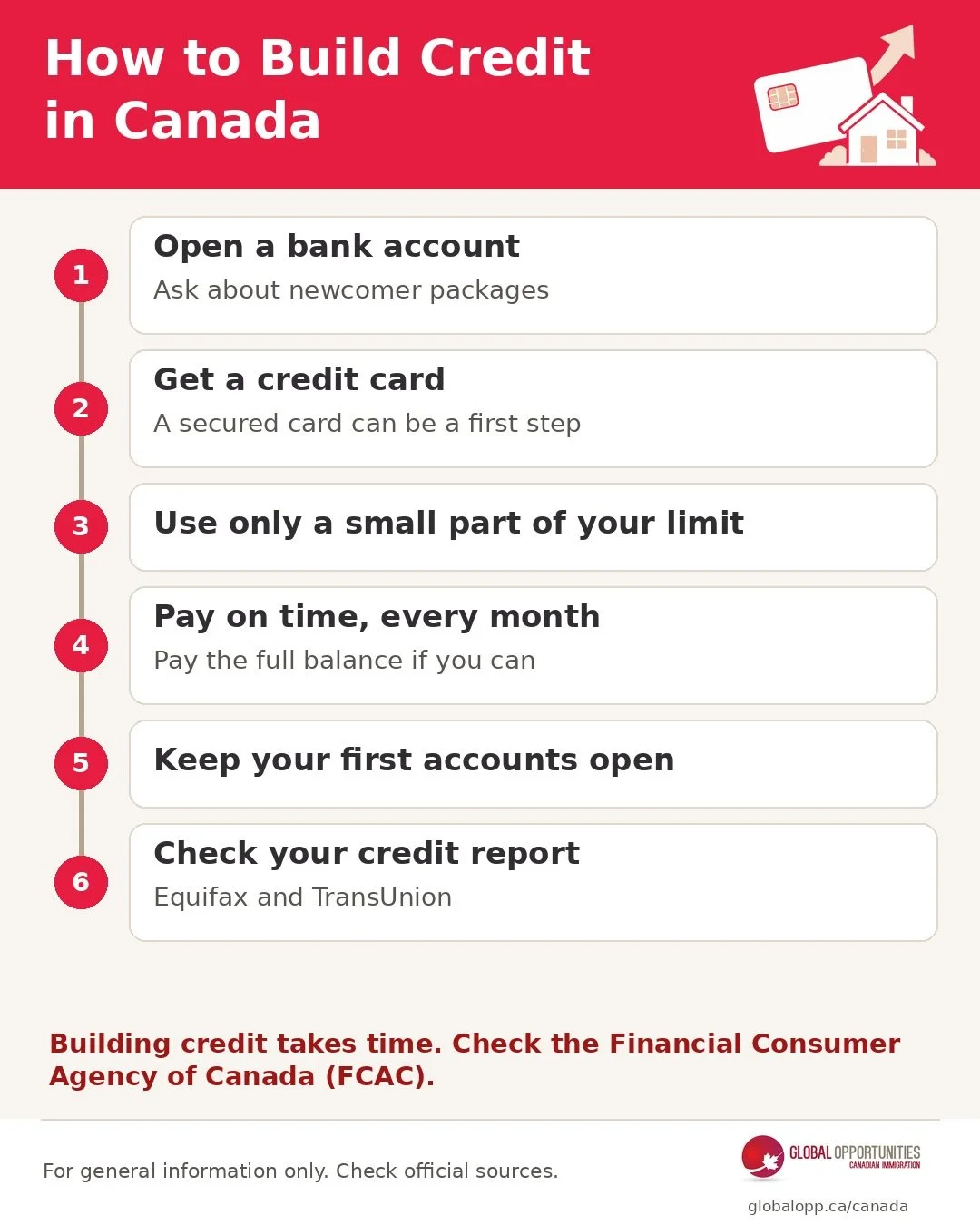
Opening a bank account is one of your first tasks: you need it to receive your salary, pay rent and build a credit history. The Financial Consumer Agency of Canada (FCAC) explains what identification banks require and what to do if a bank refuses to open an account (FCAC, opening a bank account).
Banks and credit unions
Large national banks such as RBC, TD, Scotiabank, BMO and CIBC operate across Canada; use each bank's online branch locator to see which have a branch near your home. Credit unions, which are member-owned, are another option. Banks often advertise newcomer offers; compare fees, international transfer costs and branch locations. We mention financial institutions for reference only. Global Opportunities has no relationship with any of them and does not recommend any.
What you need to open an account
The FCAC explains that banks usually ask for two pieces of identification, such as your passport and your permanent resident confirmation, work permit or study permit. A Social Insurance Number is not required to open an account, although the bank may ask for it for accounts that earn interest.
Building a credit history
Start with a credit card (a secured card if needed), use a small part of the limit and pay the full balance on time every month. The FCAC explains how credit reports and scores work (FCAC, credit reports and scores).
Groceries and shopping in Newfoundland and Labrador
Groceries in Newfoundland and Labrador are sold by a few large chains and many local stores. Because much food is shipped in, prices can be higher than in central Canada, so comparing flyers helps.
Supermarkets and discount stores
Supermarkets such as Dominion, Sobeys and Coleman's, a Newfoundland and Labrador grocer, plus local grocers in smaller communities.
General and discount stores such as Walmart and Dollarama, which says it is present in all Canadian provinces.
Costco: bulk shopping with a paid membership; check its warehouse locator for the nearest warehouse.
Pharmacies such as Shoppers Drug Mart, which also sell some groceries.
Northern stores operate in some communities of Newfoundland and Labrador (Northern, store locations).
Not every chain is in every town: use each company's official store locator to confirm the nearest location. We mention stores for reference only and have no relationship with them.
Latin American and international food
Large supermarkets usually have an international aisle, and St. John's has some independent international food stores. Ask the ANC or local newcomer groups where to find specific products; specialty items can also be ordered online.
Furnishing your home on a budget
Many newcomers furnish their first home second-hand through online marketplaces, thrift stores and community groups, and buy new basics at general and discount stores. Never pay for an item you have not seen.
How cold is Newfoundland and Labrador, and how do you prepare for winter?
Newfoundland's climate is shaped by the North Atlantic. IRCC explains that the Atlantic Ocean brings cool winters and cool, humid summers to the Atlantic provinces (Discover Canada). On the island, the weather changes quickly: strong winds, fog, rain, freezing rain and snowstorms are all part of the year. Labrador is colder, with longer, snowier winters.
The seasons
Winter (roughly December to March or April). Snowstorms and blizzards, freezing rain and strong winds. The wind can make the cold feel much harsher than the temperature, and storms can close roads, schools and offices for a day or more. The City of Corner Brook notes that winter can bring heavy snowfall there. In Labrador, winters are long and very cold.
Spring (roughly April to June). A slow, cool season, often foggy along the coast, with late snow possible. Icebergs can drift past the coast in late spring and early summer.
Summer (roughly July to August). Mild days, festivals, hiking and boat tours. Parks Canada describes drifting icebergs and whales off Cape Spear.
Fall (roughly September to November). Cooler days, autumn colours and occasional strong storms.
To compare St. John's, Corner Brook or a Labrador community with your home city, look up official climate normals on the Environment and Climate Change Canada climate normals site. For forecasts and warnings, use Environment Canada's weather site or its WeatherCAN app.
What to buy for your first winter
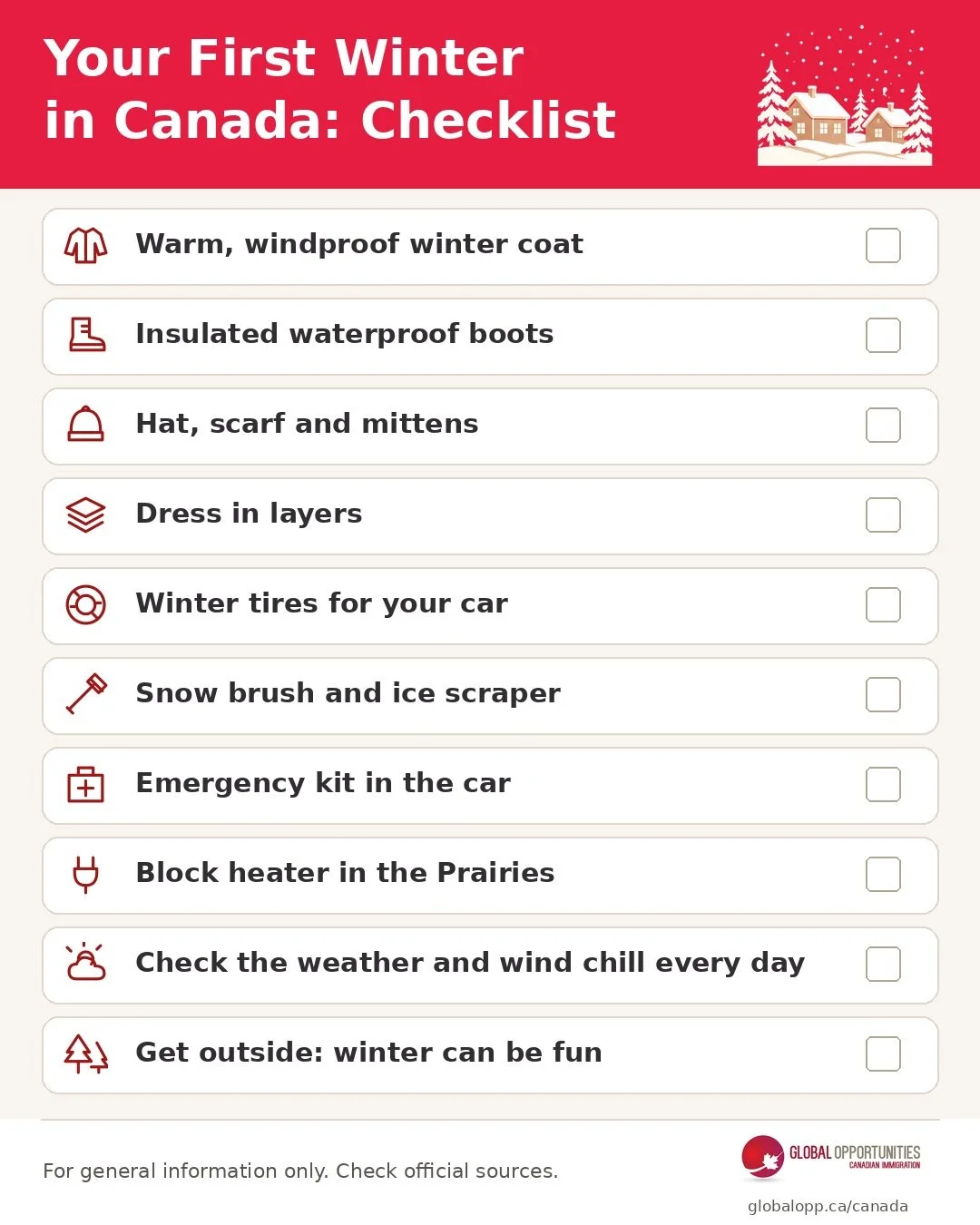
In Newfoundland, wind and wet snow matter as much as cold. Your basic kit:
A windproof and waterproof winter coat with a hood, long enough to cover your hips. On the island, a waterproof shell over warm layers works well in wet, windy weather.
Insulated, waterproof boots with strong grip for icy, steep streets.
Thermal base layers and wool or synthetic socks.
A toque, waterproof gloves or mittens, and a scarf or neck warmer to protect your face from the wind.
Ice cleats that slip over your boots. In St. John's, on hills and icy sidewalks, many residents consider them essential.
An umbrella is less useful than a good hood: wind turns umbrellas inside out.
For your home: a snow shovel, ice melt, a doormat and boot tray, and a storm kit with a flashlight, batteries, a charged power bank, water and food that does not need cooking, because storms can cause power outages.
For your car: winter tires, a brush and scraper, winter washer fluid, booster cables, a shovel and an emergency kit.
In Labrador, add warmer layers: heavier parkas, insulated pants and boots rated for very low temperatures.
Where to buy winter clothing and supplies
Winter boots, coats, shovels, ice melt and car kits are sold by national chains such as Canadian Tire, Mark's and Walmart, by sporting goods and outdoor stores, and second-hand at thrift stores and online marketplaces. Use each store's official locator to find the nearest branch. Buy the basics when you arrive and add the rest once you know your commute. We mention stores for reference only and have no relationship with them.
Education in Newfoundland and Labrador: Memorial University and College of the North Atlantic
Newfoundland and Labrador has one public university, Memorial University of Newfoundland, with several campuses, and one public college, College of the North Atlantic (CNA), with 17 campuses across the province, according to CNA's campuses page. If you need a study permit, confirm the institution on IRCC's list of designated learning institutions. This list is for reference only. Institutions change their programs, campuses and admission requirements; always confirm on the official website.
Memorial University: St. John's campus
Where: St. John's. What it is: the province's university and its largest campus and administrative hub (Memorial University, campuses).
According to Memorial's faculties and schools page, it has faculties of Business Administration, Education, Engineering and Applied Science, Humanities and Social Sciences, Medicine, Nursing and Science, and schools of Human Kinetics and Recreation, Music, Pharmacy, Social Work, Graduate Studies, and Arctic and Subarctic Studies.
Co-op: according to Memorial, co-op programs include archaeology, applied psychological science, biology, business, computer science, economics, engineering, human kinetics and recreation, physics, political science and psychology, plus some master's programs (Memorial co-op).
Memorial University: Grenfell Campus (Corner Brook)
Memorial describes Grenfell as "a liberal arts and science campus specializing in environmental and fine arts programs" (Memorial University, campuses). It has schools of Arts and Social Science, Fine Arts, and Science and the Environment (Memorial, faculties and schools).
Memorial University: Fisheries and Marine Institute (St. John's)
The Marine Institute has schools of Fisheries, Maritime Studies and Ocean Technology (Memorial, faculties and schools). Memorial describes it as "Canada's leading centre of fisheries and marine training" (Memorial University, campuses; Marine Institute).
Memorial University: Labrador Campus (Happy Valley-Goose Bay)
The newest campus is home to the School of Arctic and Subarctic Studies. According to the campus, its undergraduate programs are the Bachelor of Arctic and Subarctic Interdisciplinary Studies, a Diploma in Northern Peoples, Lands, and Resources, Nursing in Labrador (a BScN with the Faculty of Nursing) and Engineering One in Labrador, and it also lists graduate degrees in Arctic and Subarctic Futures (Labrador Campus programs).
How to apply to Memorial University
Apply online through Memorial's application system. The university explains the steps, the non-refundable application fee and the documents required on its how to apply page. International applicants should check English language requirements and deadlines for their program.
College of the North Atlantic (CNA)
What it is: the province's public college. CNA lists six schools: Academics, Applied Arts and Tourism; Business and Information Technology; Engineering Technology; Health Sciences; Natural Resources and Industrial Trades; and Sustainable Development. Some programs, for example in engineering technology, include co-op (CNA).
According to CNA's campuses page, its 17 campuses are:
Avalon: Carbonear, Placentia, Prince Philip Drive (St. John's), Ridge Road (St. John's) and Seal Cove (Conception Bay South).
Central: Baie Verte, Gander and Grand Falls-Windsor.
Eastern: Bonavista, Burin and Clarenville.
Labrador: Happy Valley-Goose Bay and Labrador West.
Western: Bay St. George (Stephenville), Corner Brook, Port aux Basques and St. Anthony.
Not every program is offered at every campus. How to apply: online through CNA's admissions page. Check program availability, entrance requirements and deadlines for each campus.
How to apply to study in Newfoundland and Labrador
Choose a program and read its admission and English requirements.
Apply directly to Memorial or CNA; there is no central application service.
Check DLI status on the IRCC list.
If you need a study permit, read IRCC's current rules. IRCC explains that most study permit applicants need a provincial or territorial attestation letter (PAL) from the province where they will study, which the school usually helps with (IRCC, provincial attestation letter). Rules, exemptions and caps change; check IRCC's study in Canada page and the work while studying page.
Register for MCP if you qualify, and plan housing early.
Free English classes for adults
According to IRCC, permanent residents and protected persons can take government-funded language classes at no cost (IRCC, language classes). The ANC offers language training and assessment. For tests, read our guide on English and French tests for Canada.
Study permit and attestation letter rules as published by IRCC, and programs and campuses as published by Memorial University and CNA, as of November 2026. An offer of admission or a provincial attestation letter does not mean a study permit will be approved; IRCC decides each case. Check the linked pages before you rely on them.
Schools for children in Newfoundland and Labrador
Public school is free for children who live in Newfoundland and Labrador, in English or French.
English-language schools: NLSchools
NLSchools runs the province's English-language public schools. You register at the school zoned for your address. Bring proof of your child's name and date of birth, their MCP number, proof of address (a utility bill is preferred) and, where they apply, citizenship or custody documents. The provincial Kindergarten to Grade 12 page explains the school system.
Support for newcomer students
The province offers English as an Additional Language (EAL) support, and the LEARN program for students whose schooling was interrupted by refugee or migration experiences. Ask the school about these supports when you register. The ANC's Settlement Workers in Schools program helps families and students settle into school life.
French-language schools: the CSFP
The Conseil scolaire francophone provincial (CSFP) runs six French first-language schools, in St. John's, Labrador City, Happy Valley-Goose Bay and the Port au Port Peninsula (La Grand'Terre and Cap Saint-Georges). Admission follows the CSFP's rules; ask whether your children are eligible.
Jobs and main industries in Newfoundland and Labrador
Newfoundland and Labrador's economy relies on offshore oil and gas, mining, the fishery and seafood, ocean technology, public services, health care, education and tourism. Global Opportunities does not offer jobs, and no one can guarantee you a job in Canada.
The labour market in numbers
According to Job Bank's 2026 Economic Scan (Job Bank):
The provincial unemployment rate was 10.1% in 2025, up slightly from 10.0%.
The rate for people 25 years and over fell to a new low of 9.2%, while youth unemployment rose.
Conditions vary by region, occupation and season.
Main industries
According to Job Bank's 2026 Economic Scan:
Oil and gas. Offshore oil production rose 14.5% in 2025, according to Job Bank, and IRCC notes that offshore oil and gas contributes a substantial part of the economy.
Mining. Nickel production grew strongly in 2025, and Job Bank mentions major projects such as the Voisey's Bay underground mine and the Valentine gold mine. Iron ore is mined in Labrador West.
The fishery and seafood. Its value grew in 2025, mainly because of higher snow crab prices. Fish processing is a major employer in coastal communities, often seasonally.
Ocean technology. St. John's has a cluster of ocean technology, marine and offshore engineering companies, linked to Memorial University and the Marine Institute.
Public administration, education and health care. Public administration employment reached a new high in 2025, and hospitals and ambulatory health care set new highs. Job Bank notes that the province relies on immigration to fill health care gaps.
Tourism. Icebergs, whales, national parks and music bring visitors, mainly in summer.
Where to look for work
Job Bank: the Government of Canada's job board.
Job Bank outlooks for Newfoundland and Labrador: three-year outlooks by occupation. They describe trends, not openings.
Job Bank wage search: wage ranges by occupation and region.
Government of NL, Labour Market Information: career profiles, job vacancy data and regional profiles.
Public employers: the Public Service Commission for the provincial public service, and NL Health Services for health careers.
Before you apply, read our guide to Canadian resumes, cover letters and job interviews.
Free employment services
Employment Centres. The Department of Immigration, Population Growth and Skills runs employment centres in communities across the province, with help on job searches, resumes, interviews and employment plans; call 1-800-563-6600 (Government of NL, career and employment FAQ).
The ANC. Its career and employment services include employment support, bridging programs, an Employment Readiness Centre and programs for newcomers in rural communities (ANC, career and employment services).
Students can use Memorial and CNA career and co-op offices. If you need a study permit, check any private career college on IRCC's DLI list before you pay.
Minimum wage
According to the Government of NL, the minimum wage became $16.35 per hour on April 1, 2026, and it is indexed to inflation (Government of NL, minimum wage). Check the current rate.
Minimum wage as published by the Government of Newfoundland and Labrador, as of November 2026. The rate is recalculated every April 1, so it may have changed by the time you read this: check the linked page before you rely on it.
Resume and job search tips
Use a concise Canadian-style resume (no photo, age or marital status), adapt it to each posting and volunteer to build local references. Our guide to Canadian resumes, cover letters and job interviews has a full sample resume and interview advice.
Regulated professions and trades
According to the Government of Newfoundland and Labrador, many jobs in the province are regulated, and you must meet the requirements of a regulatory body before you can work. The province recommends starting the credential recognition process before you arrive, and explains it on its internationally educated professionals page. Nurses trained abroad can read how to immigrate to Canada as a nurse, which lists the nursing regulator in each province.
Any mention of regulated occupations in this guide is for reference only. It may not be complete. Always confirm requirements directly with the regulator for your profession or trade.
Free newcomer services in Newfoundland and Labrador
The province's main settlement agency is the Association for New Canadians (ANC), based in St. John's with offices across the province. Its services are free for eligible clients.
The Association for New Canadians (ANC)
According to the ANC, its services include settlement and orientation, settlement in French, employment services, language training and assessment, Settlement Workers in Schools, the HIPPY home-learning program for families, youth mental health support, Community Connections, and support for temporary foreign workers, international students and work permit holders. Its main office is at 391 Empire Avenue in St. John's, and it has offices in Corner Brook, Grand Falls-Windsor, Gander, Clarenville, St. Anthony, Labrador City, Happy Valley-Goose Bay and Forteau (ANC, locations). The ANC also publishes a Guide for Newcomers to Newfoundland and Labrador.
The provincial government
The province's Office of Immigration and Multiculturalism lists settlement programs and resources on its settlement and other resources page.
Francophone services
The Fédération des francophones de Terre-Neuve et du Labrador runs Accueil francophone TNL, a francophone settlement service (FFTNL).
Federal services
Use IRCC's newcomer services finder. IRCC notes that, starting April 1, 2026, economic class permanent residents can only access these services for a limited time, so it helps to start early. 211 is a free directory of community and social services.
How much does it cost to live in Newfoundland and Labrador?
Living costs depend on where you live, whether you drive and how you heat your home. The official figures we cite in this guide:
Rent: average $1,215 per month for all units in the St. John's area, $899 in Corner Brook, $983 in Gander and $846 in Grand Falls-Windsor, according to CMHC's October 2025 survey (CMHC, Newfoundland and Labrador summary).
Transit: $2.50 cash fare and $78 adult monthly pass on Metrobus, according to the Metrobus fares page, as of November 2026.
Driver's licence: $125 for a five-year Class 5 licence and $78 for a road test, according to the Motor Registration Division's December 2023 fees policy.
Sales tax: 15% HST, according to the CRA's GST/HST rates page.
Minimum wage: $16.35 per hour as of April 2026, according to the Government of NL.
Check the current price on each source before you budget, and remember car, heating and winter clothing costs. Statistics Canada publishes the Consumer Price Index by province.
For a national overview, see our article on the cost of living in Canada.
Figures as published by CMHC, Metrobus, the Government of Newfoundland and Labrador and the Canada Revenue Agency, as of November 2026. They may have changed by the time you read this: check the linked pages before you rely on them.
How much tax do you pay in Newfoundland and Labrador, and which benefits can you get?
In Newfoundland and Labrador you pay federal and provincial income tax on what you earn, 15% HST on most purchases (according to the CRA), and you may receive tax-free benefits such as the Canada Child Benefit and the Newfoundland and Labrador child benefit. Most benefits depend on filing a tax return every year, even if you earned little.
Income tax in Newfoundland and Labrador: federal and provincial
Canada taxes income in brackets: each rate applies only to the part of your income that falls inside that bracket, not to all of it. You pay federal tax and, on top of it, provincial tax to the province where you live on December 31. Your employer deducts both from each pay cheque, and you settle the difference when you file your return with the Canada Revenue Agency (CRA). According to the CRA's tax rates page, for the 2026 tax year (as of November 2026):
Federal: 14% on the first $58,523 of taxable income, rising in steps to 20.5%, 26%, 29% and 33% on income over $258,482.
Newfoundland and Labrador: 8.7% on the first $44,678; 14.5% up to $89,354; 15.8% up to $159,528; 17.8% up to $223,340; 19.8% up to $285,319; 20.8% up to $570,638; 21.3% up to $1,141,275; and 21.8% above that.
Credits and deductions lower the tax you actually pay. Check the current rates on the CRA page before you plan your budget.
Sales tax: the 15% HST
Newfoundland and Labrador uses the Harmonized Sales Tax, which combines the federal and provincial sales taxes into one rate of 15%, according to the CRA's GST/HST rates page (as of November 2026). Shelf prices do not include it; it is added at the till. Check the current rate on the CRA page.
The Canada Child Benefit (CCB)
The Canada Child Benefit is a tax-free monthly payment from the CRA to eligible families to help with the cost of raising children under 18. You must be a resident of Canada for tax purposes, and you or your spouse or partner must be a citizen, permanent resident, protected person or a temporary resident who meets the CRA's conditions: according to the CRA's eligibility page, a temporary resident must have lived in Canada for the previous 18 months and hold a valid permit in the 19th month. You and your spouse or partner must file your tax returns every year to keep receiving it.
The Newfoundland and Labrador child benefit and other provincial benefits
According to the CRA's page on Newfoundland and Labrador programs, the CRA pays these provincial benefits on the province's behalf, so you do not apply to the province separately:
Newfoundland and Labrador child benefit: a tax-free monthly amount for low-income families with children under 18, combined with the CCB in a single payment.
Early childhood nutrition supplement: an extra amount for each child under five, paid with the child benefit and based on family income.
Newfoundland and Labrador income supplement: a tax-free payment for low-income individuals and families, and persons with disabilities, paid together with your quarterly federal benefit.
Newfoundland and Labrador seniors' benefit and disability benefit, for eligible low-income seniors and persons with disabilities.
Amounts depend on family income and are updated each July. Check the current amounts and conditions on the CRA page.
Affordable child care: $10 a day
According to the Government of Newfoundland and Labrador, since January 1, 2023 regulated child care centres and family homes that take part in the province's Operating Grant Program charge parents $10 a day for infant, toddler, preschool and full-day school-age care (as of November 2026). Spaces are limited, so ask centres about wait lists as soon as you know where you will live. Low-income families can also ask about the province's Child Care Subsidy Program. Check the current fees and conditions on the provincial pages.
Tax rates and benefits as published by the Canada Revenue Agency and the Government of Newfoundland and Labrador, as of November 2026. Tax rates apply only to the part of income inside each bracket, and eligibility for benefits depends on your residency, status and tax returns. They may have changed by the time you read this: check the linked pages before you rely on them. This is not tax advice; speak with a tax professional about your own case.
Culture, community and the outdoors in Newfoundland and Labrador
Newfoundland and Labrador has national parks, UNESCO World Heritage Sites and a long history, from the Norse site at L'Anse aux Meadows to Signal Hill.
National parks and historic sites
Gros Morne National Park. A UNESCO World Heritage Site with fjords, mountains and the Tablelands, a rare outcrop of the Earth's mantle (Parks Canada, Gros Morne).
L'Anse aux Meadows. At the tip of the Great Northern Peninsula, the first known evidence of European presence in the Americas: a Norse encampment over 1,000 years old, a UNESCO World Heritage Site since 1978 (Parks Canada, L'Anse aux Meadows).
Terra Nova National Park. Canada's most easterly national park, with boreal forest, coastline and camping (Parks Canada, Terra Nova).
Signal Hill and Cape Spear near St. John's, and Torngat Mountains National Park in northern Labrador.
Outdoor life
National parks such as Gros Morne and Terra Nova offer hiking and camping; check Parks Canada for seasons and conditions, and your municipality's recreation guide for winter programs.
Music, community and newcomers
Newfoundland has deep Irish roots; Irish readers can see our IEC guide for Irish citizens.
Volunteering is a good way to make friends. The ANC's Community Connections program links newcomers with local volunteers, and the City of St. John's promotes recreation, culture and events, including its My New St. John's Expo each October (City of St. John's, New to St. John's).
Settling in is also about people: read our article on building community in Canada.
How can you immigrate to Newfoundland and Labrador?
There is no single "Newfoundland visa". People move to Newfoundland and Labrador through federal programs run by IRCC, through the Newfoundland and Labrador Provincial Nominee Program (NLPNP), through the Atlantic Immigration Program, or with a temporary permit to study or work. Programs, categories, requirements and fees change frequently, so always check the official pages below.
If you plan to visit first, use IRCC's official tool to check if you need a visa or an eTA.
Express Entry
According to IRCC, Express Entry manages applications for three federal programs: the Canadian Experience Class, the Federal Skilled Worker Program and the Federal Skilled Trades Program (IRCC, Express Entry). Rules change; check the official page. See also our page on the Federal Skilled Worker program.
The Newfoundland and Labrador Provincial Nominee Program (NLPNP)
According to the province's Office of Immigration and Multiculturalism, the NLPNP helps employers with labour market challenges and skilled workers, international graduates and entrepreneurs who want to settle in Newfoundland and Labrador. Successful applicants may become permanent residents of Canada (Government of NL, NLPNP overview). For an overview of how nominee programs work across Canada, see our page on provincial nominee programs. When we reviewed the official page in November 2026, it listed these categories:
Express Entry Skilled Worker
Skilled Worker
International Graduate
International Entrepreneur
International Graduate Entrepreneur
The province uses an Expression of Interest (EOI) model: candidates submit a short form, and selected people receive an Invitation to Apply to the NLPNP or the Atlantic Immigration Program (Government of NL, EOI model). Not everyone who submits an EOI is invited.
IRCC explains that each province sets its own streams, and that provincial nominee applications go through Express Entry or a non-Express Entry process (IRCC, Provincial Nominee Program). NLPNP categories and selection rules change often.
The Atlantic Immigration Program (AIP)
According to IRCC, the Atlantic Immigration Program is a pathway to permanent residence for skilled foreign workers and international graduates from a Canadian institution who want to work and live in one of the four Atlantic provinces. You need a job offer from an employer designated by the province (IRCC, Atlantic Immigration Program). The Government of Newfoundland and Labrador explains that employers must be designated by the province to take part, and that they connect candidates with settlement resources (Government of NL, AIP overview).
Studying and working
Study rules are covered in the education section above. For work, IRCC describes employer-specific and open work permits (IRCC, work in Canada). Some employer-specific permits require a Labour Market Impact Assessment; see our page on the LMIA. Young people from participating countries can read our page on the Working Holiday.
If your permit ends within a year, watch Is your work permit or PGWP expiring in the next 12 months?
Already working in the province? Watch why being eligible for permanent residence is not the same as being selected.
Which pathway, if any, fits you depends on each case: your education, work experience, languages, job offer and other factors. A consultation is the way to know.
After permanent residence, many people apply for citizenship: see our guide to Canadian citizenship.
Program descriptions as published by IRCC and the Government of Newfoundland and Labrador's Office of Immigration and Multiculturalism, as of November 2026. Meeting the requirements, submitting an Expression of Interest or receiving an invitation does not mean an application will be approved; the province decides nominations and IRCC decides each permanent residence or permit application. Check the linked pages before you rely on them, and be wary of anyone who promises a nomination, permanent residence or a job.
French in Newfoundland and Labrador
English is the language of almost all work and daily life in Newfoundland and Labrador. According to Job Bank's Economic Scan, 0.5% of residents identified French as their first official language in 2021. Even so, there is an active francophone community, with historic roots on the Port au Port Peninsula and communities in St. John's and Labrador West.
French-language schools. The CSFP runs six French first-language schools.
Francophone settlement services. Accueil francophone TNL, run by the FFTNL, and the ANC, which offers settlement in French.
If French is one of your strengths, read our page on French language proficiency. Global Opportunities does not offer services for Quebec's immigration programs; this guide covers Newfoundland and Labrador only.
First steps after arriving in Newfoundland and Labrador
Your first weeks involve a few key tasks. Doing them early makes everything else easier.
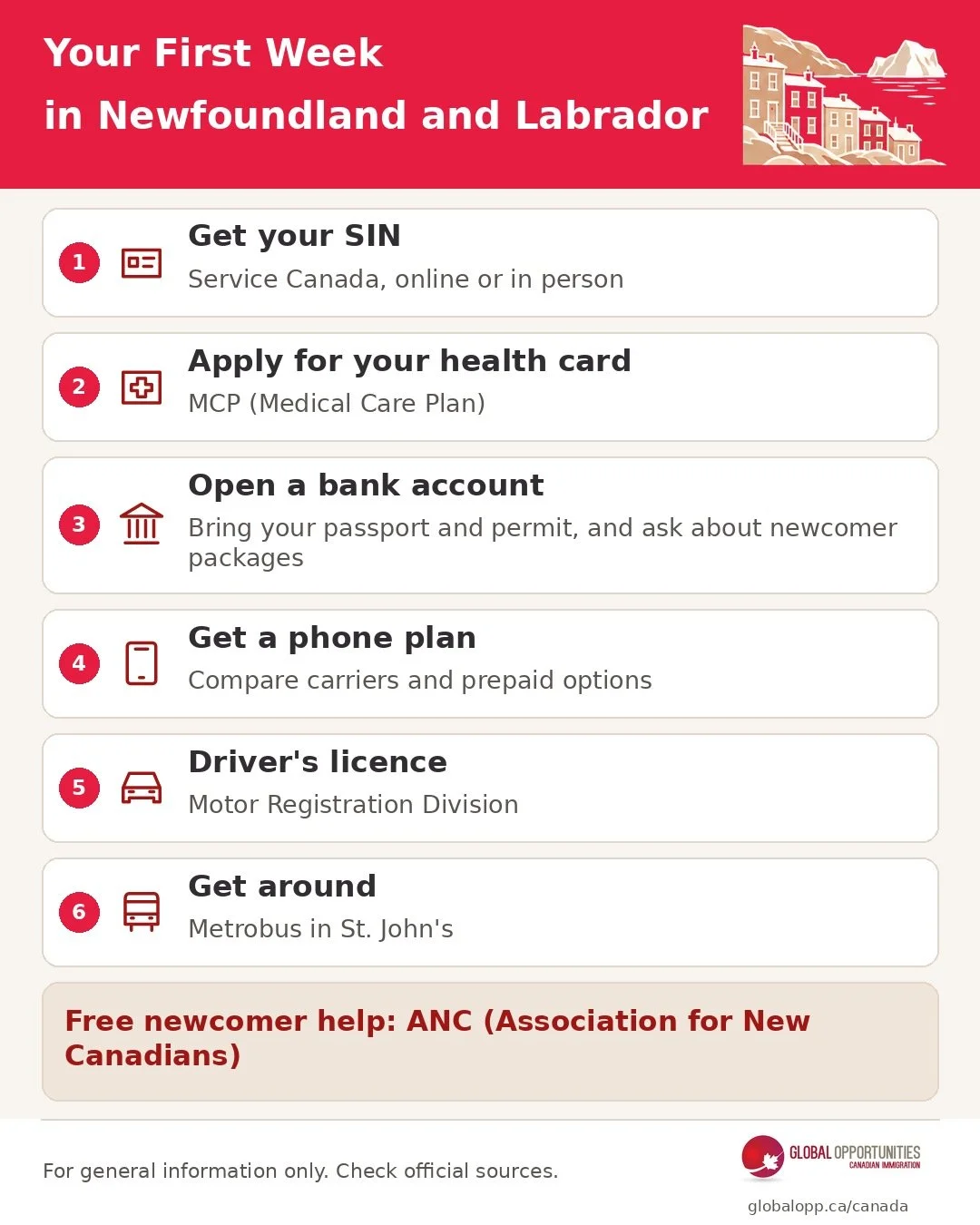
Your first-weeks checklist
Get your Social Insurance Number (SIN). You need it to work in Canada or to access government programs and benefits (Service Canada, SIN).
Register with MCP under the group that applies to you.
Register with Patient Connect NL to look for a family doctor or nurse practitioner.
Open a bank account and get a Canadian phone plan.
Contact the ANC for free settlement services.
Register your children for school with NLSchools or the CSFP.
Book your licence exchange with Motor Registration before the three-month limit.
Get an mCard or monthly pass if you will ride Metrobus, or arrange insurance if you buy a car.
Prepare for winter with windproof, waterproof clothing, ice cleats and, if you drive, winter tires.
Start your job search on Job Bank and contact an Employment Centre or the ANC's employment services.
Frequently asked questions
Is Newfoundland and Labrador a good place to live for immigrants?
Rents are lower than in Canada's largest cities (see the housing section), and the province has national parks and a long coastline. There are challenges too: Job Bank reported an unemployment rate of 10.1% in 2025, the weather is windy, foggy and snowy, many communities are remote, and outside St. John's you need a car. The province has the highest median age in Canada, and Job Bank notes it relies on immigration to fill gaps, especially in health care. Compare regions, read the housing and jobs sections, and visit if you can.
Is it cheap to live in St. John's?
Compared with Toronto or Vancouver, rents are lower: CMHC's October 2025 survey put the average rent for all units in the St. John's area at $1,215, with one-bedrooms at $1,064 and two-bedrooms at $1,348. But other costs can be higher: many goods are shipped in, heating in winter can be expensive, and outside the city you need a car, insurance and winter tires. Sales tax is 15% HST, according to the CRA. The Metrobus fares page listed a $78 adult monthly pass as of November 2026. Build a budget with official figures and check current prices on each source. See our cost of living section for the figures with dates.
What is the weather like in St. John's? Is it really that windy and foggy?
Yes, wind and fog are part of life in St. John's. The city sits on the Atlantic coast, and the weather can change several times a day: fog in spring and early summer, rain and drizzle, strong winds year-round, and winter snowstorms and freezing rain. Summers are mild rather than hot. Most residents dress in layers with a windproof, waterproof jacket and a good hood, because wind turns umbrellas inside out. For averages, check Environment and Climate Change Canada's climate normals for St. John's, and follow Environment Canada's forecasts and warnings. Many newcomers find the changing weather one of the biggest adjustments. See our climate section.
How cold does it get in Newfoundland?
On the island, winters are cold rather than extreme, but wind, wet snow and freezing rain make them feel harsh, and storms can close roads and schools. Winters usually run from December to March or April. Corner Brook and western Newfoundland get heavy snowfall. Labrador is much colder, with long winters that call for heavier parkas, insulated pants and boots rated for very low temperatures. To see averages for your community, use the official climate normals from Environment and Climate Change Canada. With a windproof coat, waterproof boots, layers, ice cleats and winter tires, most newcomers adapt. See our climate section.
How do I get an MCP card in Newfoundland?
Complete the "Application for Newfoundland and Labrador Health Care Coverage" from the provincial health forms page and submit it with your documents by mail, fax, email or at an MCP office; there is no online option for new registrations and no fee. You register under your group: citizens, permanent residents, international workers or international students. According to the Government of NL's MCP page, workers generally need a work permit valid for 12 months or more and a recent employer letter; students need a study permit valid for 12 months or more and a school letter, with some exceptions. Read the official MCP page for your group, and consider private insurance until you are covered. See our health section.
Can international students get MCP in Newfoundland?
Yes, if they meet the conditions on the Government of NL's MCP page. International students generally need a study permit valid for at least 12 months for full-time study in a degree program at Memorial University, a diploma program of at least 365 days at College of the North Atlantic, or a program of at least 365 days at a private training institution registered with the Department of Education. You also need a letter from your school, dated within 30 days of your application, confirming full-time enrolment in a program of at least one year, plus your unexpired passport. You must be physically present in the province during your terms. Coverage lasts no more than one year at a time, so you renew it each year. Until you are covered, use your school's health plan or private insurance. See our health section.
How do I find a family doctor in Newfoundland and Labrador?
According to the Government of NL, you register with Patient Connect NL, the provincial list of people without a family doctor or nurse practitioner, online or by phone at 1-833-913-4679. You will be connected with a Family Care Team or a provider when one becomes available in your area, and you may be offered virtual primary care while you wait through Virtual Care NL. Meanwhile, call 811 for nurse advice, visit a pharmacist for prescription extensions and certain minor ailments, and in St. John's use the Urgent Care Centre for urgent but non-life-threatening problems. For emergencies, call 911. See our health section.
What is 811 in Newfoundland and Labrador?
According to the 811 HealthLine, 811 is a free, confidential phone line where you can speak with a registered nurse 24 hours a day, seven days a week. The nurse can help you decide whether to treat a problem at home, see a pharmacist, use virtual care or go to an emergency department. Dietitian advice is also available. If you call from a cell phone registered outside the province or from an internet phone, use 1-888-709-2929. It is a useful first call for newcomers without a family doctor. For a medical emergency, such as chest pain or difficulty breathing, call 911 instead. See our health section.
Can I exchange my foreign driver's licence in Newfoundland?
It depends on the country. According to the Government of NL's licence application process for new residents, new residents must exchange within three months of becoming residents. Drivers from other provinces and the United States can exchange without tests if they meet the criteria, and the province has reciprocity agreements with countries such as Austria, Belgium, Denmark, France, Germany, Ireland, Japan, the Republic of Korea, Switzerland, Taiwan, Ukraine and the United Kingdom, for certain classes. Drivers from other countries take written, vision and road tests and enter graduated licensing, though a valid foreign licence may shorten the wait. Licences not in English or French need a translation. Confirm the current list with Motor Registration. See our driving section.
Can I rent a car in St. John's with a foreign licence?
Usually yes. St. John's International Airport lists several on-site rental companies, including Alamo, Avis, Budget, Enterprise, Hertz, National and Thrifty, and recommends booking ahead in summer. Each company sets its own rules: bring your valid, physical home licence with a photo and your passport; an International Driving Permit is often recommended or required if your licence is not in English or French, and it only works together with your licence. Most companies want a credit card in the driver's name; one major company lists a minimum rental age of 21 in the province (Enterprise), so ask about fees for young drivers. Ask about winter tires in winter. We have no relationship with these companies. See our driving section.
Do I need an International Driving Permit in Newfoundland?
The Government of NL's new-resident pages focus on exchanging your licence within three months and require an English translation for licences that are not in English or French. For renting a car, the rules come from each rental company: some, such as Enterprise, recommend an International Driving Permit for licences in a Latin alphabet that are not in English or French and require it for non-Latin alphabets. An IDP is a translation of your licence, not a licence on its own, and it must be issued in the country that issued your licence, so get it before you travel. Carry it with your original licence. See our driving section.
How does graduated licensing work in Newfoundland and Labrador?
According to the Motor Registration Division's Graduated Driver Licensing page, every new driver, of any age, starts with a Class 5 Level I learner licence after passing written and vision tests. For at least 12 months (8 with approved driver education), you drive only with an accompanying driver who has four or more years of experience and zero alcohol, carry no other passengers, avoid midnight to 5 a.m. and display a novice sign. After the road test, Level II lasts 12 months, with zero alcohol, passengers limited to seatbelts and night driving only with an experienced driver, except for work. The Motor Registration Division's page has the full rules. See our driving section.
Do I need winter tires in Newfoundland?
We found no general legal requirement for winter tires in Newfoundland and Labrador, but they are strongly recommended for snow, ice and freezing rain, especially on hills in St. John's and on highways. According to the Government of NL, studded tires are allowed from November 1 to April 30, and the province can extend the spring date. Book tire changes early in the fall, because shops fill up before the first snow. Ask your insurer whether winter tires affect your rate. Keep an emergency kit in the car, slow down, and watch for moose, especially at night. If you rent a car in winter, ask for winter tires. See our driving section.
Are there moose on the roads in Newfoundland?
Yes. The Government of Newfoundland and Labrador's moose-vehicle awareness page warns that moose-vehicle collisions are a serious risk. According to the province, more than 70% of collisions happen between May and October, with June to August the worst months, and most happen between dusk and dawn, often on clear nights and straight roads. The province advises slowing down at night, scanning both shoulders of the road, using high beams when safe, watching for warning signs and always wearing your seatbelt. Newcomers driving the Trans-Canada Highway at night should be especially careful. See our driving section.
Do I need a car in St. John's?
In central St. John's, near Metrobus routes, many students and workers manage without a car, especially at first. The Metrobus fares page listed a $2.50 cash fare and a $78 adult monthly pass as of November 2026. Check how often your route runs in the evenings and on weekends, because winter makes walking harder. In Mount Pearl, Paradise and Conception Bay South, a car makes daily life much simpler, and outside the St. John's region it is usually essential. Many newcomers rent a car for the first days and buy one later. See our transportation and driving sections.
How do I rent an apartment in St. John's?
Search on Kijiji, Facebook Marketplace, Rentals.ca, PadMapper and property management websites, and ask your school, employer, the ANC and community contacts. Have your ID, a job letter or proof of income and references ready, and reply quickly: the vacancy rate was 2.1% in CMHC's October 2025 survey. Visit in person, never send money for a unit you have not seen, and ask for a written agreement. Under the Residential Tenancies Act, 2018, the deposit can be at most three-quarters of one month's rent and must be returned within 10 days after you leave unless the landlord makes a claim. Ask about heat, parking and winter. See our housing section.
What are tenant rights in Newfoundland and Labrador?
Tenancies follow the Residential Tenancies Act, 2018. Key rules, according to the Act: the security deposit is limited to three-quarters of one month's rent, held in an interest-bearing account and returned with interest within 10 days unless the landlord makes a claim; rent cannot rise in the first 12 months, then only once every 12 months, with six months' written notice for monthly or fixed-term tenancies; and the landlord must give you a copy of the signed agreement within 10 days. The Residential Tenancies office mediates and decides disputes and publishes a full guide. Contact it before you stop paying rent or leave early. See our housing section.
How much is electricity and heating in Newfoundland?
It depends on the size of your home, how it is heated and how cold the winter is, so ask the landlord whether heat and electricity are included and what January bills look like. Depending on where you live, your electricity comes from Newfoundland Power or from Newfoundland and Labrador Hydro, whose customer groups include rural, isolated and Labrador systems. Rates are regulated by the Board of Commissioners of Public Utilities and can change during the year. Newfoundland Power posts its current residential rates on its site, including a standard rate that is the same all year and a seasonal option, and NL Hydro explains its own rates and recent changes. Many homes heat with electricity, oil or heat pumps, and oil is bought separately from a supplier. Check current rates with your utility before you sign a lease. See our utilities section.
What colleges are in Newfoundland and Labrador?
The province's public college is College of the North Atlantic (CNA). According to CNA's campuses page, it has 17 campuses: Carbonear, Placentia, Prince Philip Drive, Ridge Road and Seal Cove in the Avalon region; Baie Verte, Gander and Grand Falls-Windsor in Central; Bonavista, Burin and Clarenville in Eastern; Happy Valley-Goose Bay and Labrador West; and Bay St. George, Corner Brook, Port aux Basques and St. Anthony in the West. Its six schools are Academics, Applied Arts and Tourism; Business and Information Technology; Engineering Technology; Health Sciences; Natural Resources and Industrial Trades; and Sustainable Development, and some programs include co-op. If you need a study permit, check any other school's DLI status. See our education section.
Is Memorial University good?
Memorial University of Newfoundland is the province's public university, with faculties of business, education, engineering, humanities and social sciences, medicine, nursing and science, plus schools such as pharmacy, music and social work. Its teaching campuses are St. John's, Grenfell (Corner Brook), the Marine Institute (St. John's), which Memorial describes as Canada's leading centre of fisheries and marine training, and the Labrador Campus (Happy Valley-Goose Bay). Co-op is available in several programs, including engineering, business and computer science. Whether it suits you depends on your field, budget and goals: compare programs, co-op options and costs, and talk to current students. We do not rank universities. See our education section.
How do I apply to Memorial University or CNA?
Apply directly to each institution online. Memorial explains its steps, documents and non-refundable application fee on its how-to-apply page, and CNA has an online application on its admissions page; there is no central application service in the province. Check program requirements, English requirements and deadlines, and confirm which campus offers your program. International students should check DLI status and follow IRCC's study permit rules, which in most cases require a provincial attestation letter, usually arranged with the school's help. Plan housing early and register for MCP if you qualify. See our education section.
What do international students in Newfoundland ask most?
Common questions are about work, health coverage, housing and the weather. Off-campus work rules come from IRCC, so read its current work-while-studying page. According to the Government of NL's MCP page, students with a study permit valid for 12 months or more in a program of at least one year may qualify for MCP, and schools often have a health plan. Apply for residence or search for housing early, and budget for winter clothing. In St. John's, many students manage without a car using Metrobus. The ANC supports international students with settlement services. See our education, health and housing sections.
What jobs are in demand in Newfoundland and Labrador?
Job Bank's 2026 Economic Scan describes record public administration and health care employment, growth in offshore oil and mining, and a fishery whose value rose with snow crab prices. Health care is a clear need, as the province relies on immigration to fill gaps. Engineering, ocean technology, trades linked to resource projects and education are other important fields. Use Job Bank's three-year outlooks to see which occupations have good prospects in your region. Regulated occupations require a provincial licence first. Global Opportunities does not offer jobs, and no one can guarantee you one. See our jobs section.
Where can I get free help finding a job in Newfoundland and Labrador?
According to the Government of NL, the province runs Employment Centres in communities across the province, with free help on job searches, resumes, interviews and employment plans (1-800-563-6600). The Association for New Canadians offers employment support, bridging programs, an Employment Readiness Centre and programs for newcomers in rural areas. Memorial and CNA students can use their career and co-op offices. Our guide to Canadian resumes, cover letters and job interviews has a sample resume and interview tips. Be wary of anyone who charges for a job or promises one: legitimate employers do not sell jobs. See our jobs and newcomer services sections.
What is the minimum wage in Newfoundland and Labrador?
According to the Government of Newfoundland and Labrador, the minimum wage rose to $16.35 an hour on April 1, 2026, and the overtime minimum to $24.53 an hour. The province recalculates the rate every April 1 based on changes in the national Consumer Price Index, as its Labour Standards Regulations require, so the figure changes each spring. Your pay stub should show your hours, your rate and deductions such as income tax, CPP and EI. If you have questions about your pay, contact the province's Labour Standards office. Check the current rate on the provincial site before you accept an offer. See our jobs section.
Why does Newfoundland have its own time zone?
The island of Newfoundland uses Newfoundland Time, set by the province's Standard Time Act at three and a half hours behind Greenwich Mean Time, which is why it is half an hour ahead of Atlantic Time. It reflects the island's position far to the east. Daylight time runs from the second Sunday of March to the first Sunday of November. Most of Labrador uses Atlantic Time instead, while parts of southeastern Labrador follow Newfoundland Time, according to the National Research Council. For newcomers, the practical point is simple: check the time difference before calling family, government offices or employers elsewhere in Canada.
How do I get to Newfoundland?
By air or by sea. St. John's International Airport is the main airport, and Gander and other communities also have airports. According to its schedule page, Marine Atlantic runs ferries from North Sydney, Nova Scotia: to Port aux Basques year-round, a crossing of about seven hours, and to Argentia in summer, about 16 hours. Book summer sailings early and check Marine Atlantic for current fares and weather delays. See our transportation section.
How much is the ferry from Newfoundland to Nova Scotia?
Marine Atlantic runs the two ferry routes. According to its rate pages, as of November 2026, a one-way adult (13–64) fare between North Sydney and Port aux Basques is $21.92 and a car or pickup up to 21 feet is $57.12; on the summer route to Argentia, an adult is $60.40 and a car or pickup $121.81. These totals include a fuel surcharge and the adult security fee, HST does not apply to passenger and vehicle rates, and Marine Atlantic says the fares reflect the Government of Canada's rate reduction announced on August 1, 2025. Cabins and other extras cost more. Rates may change without notice, so check the current fares on Marine Atlantic's site before you book. See our transportation section.
Is Newfoundland safe?
Safety depends on the area and on your own situation. If you want data, Statistics Canada publishes the Crime Severity Index for Canada, each province and census metropolitan areas, and you can compare figures there; we do not rank places ourselves. As anywhere, take normal precautions: lock your home and car, and be careful with rental, job and immigration scams, especially online. For many newcomers, the bigger everyday risks are natural: winter storms, icy streets, wind on coastal trails and moose on the highway at night. Follow Environment Canada warnings, wear ice cleats and use winter tires. In an emergency, call 911. Policing is provided by the Royal Newfoundland Constabulary in the Northeast Avalon, the Corner Brook region, Labrador City and Churchill Falls, and by the RCMP elsewhere; for non-emergencies, contact your local detachment.
Is there an Irish community in Newfoundland?
Yes, Irish heritage is part of everyday culture here, especially on the Avalon Peninsula. The province's tourism site describes the Irish Loop, a coastal route south of St. John's, as an area shaped by its strong Irish heritage, with song and storytelling, and notes that Ferryland, where the Colony of Avalon was founded in the 1620s, is one of the oldest European settlements in North America. You will hear it in the music, place names and traditions. If you are an Irish citizen thinking of coming on a working holiday, read our IEC guide for Irish citizens, and check IRCC for the current rules. For meeting people once you arrive, the ANC's Community Connections program and local music and community events are good places to start. See our culture section.
What are the pros and cons of living in Newfoundland?
It depends on what you value, so here is an honest summary of what this guide covers. Pros: average rents in CMHC's survey that you can compare with the other cities in our guides, a strong sense of community, easy access to coast and national parks such as Gros Morne, free settlement help from the ANC, and two public post-secondary options, Memorial and CNA. Cons: long, windy and snowy winters, distance from the rest of Canada (you need a flight or a long ferry crossing), fewer jobs and services outside St. John's, the need for a car in most places, and a wait for a family doctor through Patient Connect NL. Heating and car costs can add up. Visit if you can, compare job listings and rents, and read our sections on housing, climate, health and jobs before you decide.
Should I live in St. John's or Corner Brook?
It depends on your work, studies and lifestyle. St. John's is the capital, with Memorial's largest campus and the Marine Institute, several emergency departments and Metrobus, with an average rent of $1,215 for all units in CMHC's October 2025 survey. Corner Brook is smaller, with Grenfell Campus, a CNA campus, Western Memorial Regional Hospital, Corner Brook Transit, winters that the city says can bring heavy snowfall, and an average rent of $899 in the same survey. Most people choose based on where they find a job or study. Visit both if you can, and compare commutes and listings. See our sections on both cities.
Are there direct flights to St. John's from Europe?
Yes, on some routes. As of November 2026, the 2026 network map on St. John's International Airport's Routes and Airlines page shows nonstop routes between St. John's and Dublin, London Gatwick and Paris (Charles de Gaulle). The map does not say which airline flies each route or in which months, so check with the airlines listed on the airport's page before you plan. When no nonstop flight fits your dates, a common way to get there is to connect in a Canadian city with nonstop flights to St. John's, such as Toronto, Montréal or Halifax. Routes and airlines change seasonally. Check whether you need a visa or an eTA with IRCC's tool. See "How to get to Newfoundland and Labrador".
When should I call 911 in Newfoundland and Labrador, and what if I call by mistake?
According to the province's 911 Division, 911 is for emergencies where there is an immediate threat to life, health, safety or property. If you call 911 by accident, the 911 Division's non-emergency calls page asks you to stay on the line and let the call taker know it was a mistake, because non-emergency calls take time away from real emergencies. Do not hang up: otherwise the call taker has to call you back or trace the call to make sure nobody needs help. For health advice that is not an emergency, call 811. For police matters that are not emergencies, contact your local police detachment.
What is 9-8-8, the Suicide Crisis Helpline?
9-8-8 is Canada's Suicide Crisis Helpline. You can call or text 9-8-8 at any time, 24 hours a day, every day of the year, if you are thinking about suicide or are worried about someone else. The service says that if someone's safety is at risk right now, you should call 911. In Newfoundland and Labrador you can also call 811 for health advice from a registered nurse, and the Association for New Canadians offers support for newcomer youth and families. See "Mental health" in the health section.
How do I check road conditions in Newfoundland and Labrador?
Use 511 Newfoundland and Labrador, the province's travel information site. It has an interactive map with road conditions, closures, incidents, construction, highway cameras and ferry information, and you can create an account to get notifications about events on your saved routes. Check it before long drives, especially on the Trans-Canada Highway in winter storms, and before you take a provincial ferry. For weather warnings, use Environment Canada's weather site or its WeatherCAN app. See "Winter driving, tires and moose".
What do I do if I get a flat tire or my car breaks down?
First get to a safe place, turn on your hazard lights and, if anyone is hurt or in danger, call 911. For roadside help, many drivers use a CAA membership: according to CAA Atlantic, which serves Newfoundland and Labrador, its plans with roadside service help with flat tires, towing, battery boosts and more, and the services included depend on your membership level. Some car insurance policies, car manufacturers and credit cards also include roadside assistance, so check your policy before you need it. Keep an emergency kit in the car. We mention CAA for reference only and have no relationship with it.
How does car insurance work in Newfoundland and Labrador?
Car insurance is mandatory, and the province checks that vehicles are insured through its Insurance Validation Program (Government of NL). Unlike some provinces, there is no public auto insurer: you buy a policy from a private insurer through a broker or an agent. The Government of Newfoundland and Labrador's insurance page says Government Services regulates insurance matters, including mediating disputes, and it explains the complaint process; the Board of Commissioners of Public Utilities regulates auto insurance rates. Compare quotes from several brokers, and bring a letter from your previous insurer about your driving history. See "Car insurance in Newfoundland and Labrador".
Can newcomers get the Canadian Dental Care Plan?
Possibly. According to the Government of Canada's Canadian Dental Care Plan page, you must meet four requirements: you have no access to private dental insurance, you (and your spouse or partner) have filed your tax returns in Canada, your adjusted family net income is below $90,000, and you are residents of Canada for tax purposes. So filing your first Canadian tax return is the first step. Many newcomers have dental coverage through work or a student plan instead. Check the current conditions on the official page.
Related guides
How Global Opportunities can help
Choosing a province and a pathway depends on your education, work experience, languages and goals. We can help you understand your options.
Our regulated consultant: Lic. Mildrete Monserrath Gutierrez Martinez, Regulated Canadian Immigration Consultant (RCIC), CICC licence R514880. Verify her licence on the CICC Public Register: https://college-ic.ca/protecting-the-public/find-an-immigration-consultant. Global Opportunities does not offer services for Quebec's immigration programs. Global Opportunities is a private firm and is not part of the Government of Canada or any provincial government.
Recorded seminars and lives: watch our recorded seminars in English or the Spanish recordings, and visit our YouTube channel.
More articles in English: read our Moving to Canada articles on topics such as health care, cost of living, the ECA and professional licences, and building community in Canada.
Personalized consultation: for a review of your own case, contact us or write to info@globalopp.ca.
Prefer email? Tell us what you need help with (moving to Newfoundland and Labrador) and we will reply: email info@globalopp.ca.
Contact Global Opportunities →
Sources
Canadian Heritage, Provincial symbols: Newfoundland and Labrador
National Research Council, Time zones and daylight saving time
CMHC, Housing Market Information Portal: St. John's average rents
Government of NL, Licence application process for new residents
Financial Consumer Agency of Canada, Credit reports and scores
Conseil scolaire francophone provincial de Terre-Neuve-et-Labrador
Association for New Canadians, Career and employment services
Canada Revenue Agency, Tax rates and income brackets for the current year
Canada Revenue Agency, Canada Child Benefit: before you apply
Statistics Canada, Crime severity index and weighted clearance rates (table 35-10-0026-01)
Statistics Canada, Census Profile 2021: Newfoundland and Labrador
Statistics Canada, Population and dwelling counts (table 98-10-0001-01)
Statistics Canada, Population and dwelling counts by municipality (table 98-10-0002-01)
Statistics Canada, Population and dwelling counts by metropolitan area (table 98-10-0005-01)
Statistics Canada, Population estimates, quarterly (table 17-10-0009-01)
Statistics Canada, Ethnic or cultural origin (table 98-10-0355-01)
Statistics Canada, Indigenous identity (table 98-10-0264-01)
St. John's International Airport, Newark service news release (October 16, 2026)
Newfoundland and Labrador Housing Corporation, First-time Homebuyers Program FAQ
Environment and Climate Change Canada, Air Quality Health Index
Government of Canada, Canadian Dental Care Plan: who can qualify
The information in this guide comes from the official sources linked in each section and in the Sources list, as published when we checked them in November 2026, and it may have changed since. It is general and for reference only. It is not immigration, legal or professional advice, and it may change at any time. Global Opportunities is not responsible for how anyone interprets this content, for decisions made based on it or for changes made after it was written: what you read depends on when you read it. For your own case, book a consultation. Immigration programs, the Newfoundland and Labrador Provincial Nominee Program, the Atlantic Immigration Program, provincial services, transit fares, licence fees and rules, rents and rental rules change frequently, and statistics describe the past and do not predict any outcome. Always confirm requirements and current prices with official Government of Canada, Government of Newfoundland and Labrador and municipal sources. Global Opportunities is a private firm, is not part of the Government of Canada or of any regulator, and does not offer jobs.
Last reviewed: November 2026