
How to Immigrate to Canada as a Nurse: Licence, NNAS, NCLEX and Pathways
Thinking about how to immigrate to Canada as a nurse? Moving to Canada as a nurse means running two separate processes side by side: an immigration process, decided by the Government of Canada or a province, and a licensing process, decided by the nursing regulator of the province where you will work. This guide explains both, step by step, with a link to every official source so you can check it yourself.
About our sources: This guide summarises what official sources (the Government of Canada, provincial and territorial governments and the other organisations we link to) said when we checked them in November 2026. We link every source so you can read it yourself. Rules, rates and requirements change, sometimes without notice, and the official page is the one that counts. This is general information, not legal, tax or immigration advice. Global Opportunities is not responsible for how this information is interpreted or for changes made after it was written.
The immigration process gives you the right to live and work in Canada. The licensing process gives you the right to call yourself a nurse and practise. One does not replace the other, and mixing them up is one of the most common, and most expensive, mistakes internationally educated nurses make. Below you will find the nursing roles and NOC codes Canada uses, how licensing works with NNAS and the provincial regulators, the NCLEX-RN and REx-PN exams, which English and French tests count for immigration and for your licence, what nurses earn in each province according to Job Bank, who hires nurses, and the immigration pathways that consider healthcare experience.
We wrote this guide for nurses who know nothing yet about the Canadian system: registered nurses, practical nurses, psychiatric nurses, nurse practitioners and nursing aides, wherever they trained. If you are a professional in another field, read our companion guide on how to immigrate to Canada as a professional.

Watch our recorded seminars and lives →
Prefer Spanish? Read our Spanish guide for nurses (in Spanish).
In this guide
Can you immigrate to Canada as a nurse?
How many nurses work in Canada? The official numbers
Nursing roles in Canada and their NOC codes
Nursing licence and immigration: two different processes
How to get a nursing licence in Canada as an internationally educated nurse
NNAS and credential assessment for nurses
Nursing regulators by province
NCLEX-RN, REx-PN and other nursing exams in Canada
English and French tests for nurses: immigration vs licence
Who employs nurses in Canada?
Nurse salaries in Canada by province
Nursing jobs in Canada for foreigners
Immigration pathways for nurses
Nurse aides and personal support workers
French-speaking nurses outside Quebec
Which is the best province for nurses in Canada?
Immigrating as a nurse from the Philippines, India, Nigeria and other countries
Documents nurses should prepare
Common mistakes and scams to avoid
Nursing associations and unions in Canada
Seminars and videos for nurses
Frequently asked questions
Related guides
How Global Opportunities can help
Sources
Can you immigrate to Canada as a nurse?
Yes. Nurses educated outside Canada can immigrate and, once they meet the requirements of the provincial regulator, become licensed to practise. There is no "nurse visa": you immigrate through an immigration program (Express Entry, a Provincial Nominee Program, a work permit or another pathway), and you apply for your nursing licence separately.
Your options depend on your whole profile: your nursing education, the type and length of your experience, your English or French, your family situation, the province you are interested in and the programs open at the time you apply. Two nurses with the same degree can end up on very different paths.
What is true for everyone:
"Nurse" is a protected title. According to the National Nursing Assessment Service (NNAS), the title "nurse" can only be used by professionals who are licensed or registered by the regulatory body in the province where they work.
Licensing is provincial. There is no national nursing licence. Each province and territory has its own regulator (see "Nursing regulators by province" below).
Permanent residence is not a licence. You can be a permanent resident and still not be allowed to practise as a nurse, and the other way round.
No one can guarantee the outcome. Licences are decided by regulators; visas and permanent residence by the Government of Canada and the provinces.
Global Opportunities is a private immigration firm in Toronto. It is not part of the Government of Canada or of any nursing regulator, it does not offer jobs and it is not a recruitment agency. Global Opportunities does not handle nursing licence applications: you submit those yourself, directly to the regulator.
Please note: Getting registered as a nurse and getting permission to immigrate are separate decisions, made by different bodies. Meeting a regulator's requirements does not mean an immigration application will be approved, and an immigration approval does not give you a licence.
How many nurses work in Canada? The official numbers
According to the Canadian Institute for Health Information (CIHI), there were 498,476 regulated nurses in the provinces and territories with available data in 2024, by far the largest group among the health professions in CIHI's data tables (CIHI, Health Workforce in Canada, 2020 to 2024: Overview, published 12 February 2026, data tables, Table 1).
CIHI's 2024 counts by nursing group:
Registered nurses (RNs): 338,871
Licensed practical nurses (LPNs; registered practical nurses in Ontario): 142,773
Nurse practitioners (NPs): 9,891
Registered psychiatric nurses (RPNs): 6,941
All regulated nurses: 498,476
CIHI's counts of regulated nurses by province in 2024 were: Ontario 178,592 · Quebec 113,294 · Alberta 63,172 · British Columbia 62,538 · Manitoba 19,057 · Saskatchewan 17,496 · Nova Scotia 16,621 · New Brunswick 12,125 · Newfoundland and Labrador 9,383 · Prince Edward Island 2,875 · Yukon 1,072. CIHI reports the Northwest Territories and Nunavut together and notes that it cannot report a regulated nurse total for them.
Is there a demand for nurses in Canada?
Statistics Canada published a summary of the health labour market with 2025 data on 19 October 2026 (Statistics Canada, The Daily, "Labour market characteristics of Canada's health workforce, 2025"). According to that release:
Just over 1.7 million people were employed in health occupations in Canada in 2025.
Employment in registered nursing occupations grew 6.5% (+25,300) from 2024.
There were 67,900 job vacancies in health occupations in 2025, down from a peak of 90,700 in 2023.
The job vacancy rate was 12.3% for licensed practical nurses, 5.0% for registered nurses and 4.7% for nurse aides, orderlies and patient service associates, compared with 2.7% across all occupations in Canada.
How to read these numbers. They describe the past, they vary by province and region, and they do not mean that a job is waiting for every nurse who arrives. To work as a nurse in Canada you generally need a licence from the regulator and an immigration status that allows you to work.
Figures as published by CIHI (2024 data) and Statistics Canada (2025 data), as of November 2026. Statistics describe the past and do not predict whether you will find a job or be invited to immigrate.
Nursing roles in Canada and their NOC codes
According to NNAS, Canada has three regulated nursing professions: registered nurse (RN), licensed practical nurse (LPN, called registered practical nurse or RPN in Ontario) and registered psychiatric nurse (RPN), which NNAS says is a regulated profession in British Columbia, Alberta, Saskatchewan and Manitoba. A nurse practitioner (NP) is an RN with advanced education. For immigration, each role has a National Occupational Classification (NOC 2021) code and a TEER category.
The codes, as listed in the official NOC 2021 tool of Employment and Social Development Canada (ESDC):
Registered nurses and registered psychiatric nurses: NOC 31301, TEER 1.
Nurse practitioners: NOC 31302, TEER 1.
Nursing coordinators and supervisors: NOC 31300, TEER 1.
Licensed practical nurses (registered practical nurses in Ontario): NOC 32101, TEER 2.
Nurse aides, orderlies and patient service associates (including personal support workers in nursing care): NOC 33102, TEER 3.
Home support workers and related occupations (including personal support workers in home support): NOC 44101, TEER 4.
What is TEER and why does it matter?
TEER stands for Training, Education, Experience and Responsibilities. For the Federal Skilled Worker Program, IRCC says your skilled work experience must be in TEER 0, 1, 2 or 3 (IRCC, Federal Skilled Workers). That is why experience as an RN, NP or LPN can count as skilled work, while home support work (TEER 4) does not count for that program. Your code is decided by the duties you actually performed, not by your job title. IRCC explains how to choose it on its find your NOC page.
Registered nurse (RN), NOC 31301
According to the NOC profile, RNs provide direct nursing care to patients, deliver health education programs and provide consultative services on nursing practice. The NOC says RNs need a university, college or other approved registered nursing program, and that registration with a regulatory body is required in all provinces and territories. According to NNAS, becoming an RN in Canada usually requires a four-year university program leading to a nursing degree. The NOC lists hospitals, nursing homes, extended care facilities, rehabilitation centres, doctors' offices, clinics, community agencies, companies and private homes as places where RNs work, and notes that some are self-employed. If you hold a Bachelor of Science in Nursing (BSN) or an equivalent degree, this is usually the category your education is compared with, but your regulator makes that decision.
Registered psychiatric nurse (RPN), also NOC 31301
Registered psychiatric nursing is a separate regulated profession in British Columbia, Alberta, Saskatchewan and Manitoba, according to NNAS, and the NOC profile also lists registration in Yukon. Watch the acronym: in the western provinces, RPN means registered psychiatric nurse; in Ontario, RPN means registered practical nurse.
Nurse practitioner (NP), NOC 31302
According to the NOC, nurse practitioners usually require a master's degree in nursing (or a nursing program with additional advanced primary health care education) and several years of practice as a registered nurse, and registration as an NP is required in all provinces and territories. If you were an advanced practice nurse in another country, ask your regulator which category you should apply for first.
Licensed practical nurse (LPN), NOC 32101
According to NNAS, becoming an LPN in Canada usually requires a two- to three-year college program leading to a nursing diploma. The NOC profile describes LPNs as providing nursing care, usually under the direction of medical practitioners, registered nurses or other health team members, and says registration with a regulatory body and a registration examination are required in all provinces and territories. In British Columbia, the BC College of Nurses and Midwives (BCCNM) says it assesses most internationally educated nurses for both LPN and RN licensure in the same application (BCCNM, internationally educated nurses).
Nurse aides and personal support workers, NOC 33102 and 44101
Nurse aides, health care aides and personal support workers in nursing care are classified in NOC 33102 (TEER 3); personal support workers in home support are in NOC 44101 (TEER 4). These roles are not regulated nursing professions, although some provinces keep their own registries or regulators. In Alberta, for example, the College of Licensed Practical Nurses and Health Care Aides of Alberta (CLHA) regulates health care aides as well as LPNs.
Choosing the right NOC code matters: the wrong code can affect your eligibility. Compare your real duties with the official profile and, if in doubt, get personalized advice before you submit a profile. Our live session on NOC codes and TEER categories, listed on our recorded seminars in English page, explains how to check whether your job matches a code.
Please note: NOC codes and TEER categories as published by ESDC, and the TEER rule as published by IRCC, as of November 2026. A NOC code is used for immigration and statistics only; it is not a licence and does not tell you whether a regulator will register you.
Nursing licence and immigration: two different processes
Your permanent residence or work permit is decided by Immigration, Refugees and Citizenship Canada (IRCC) or, for provincial nominee programs, by a province. Your nursing licence is decided by the nursing regulator of the province where you will work. They are separate applications, with their own requirements, fees and documents. The Government of Canada explains that the provinces and territories are responsible for delivering health care services (Government of Canada, Canada's health care system), and each province regulates its own health professions.
How the two processes compare:
Who decides. Immigration: IRCC, or the province for nominee programs. Licence: the provincial nursing regulator, for example the College of Nurses of Ontario (CNO) or BCCNM in British Columbia.
What you get. Immigration: permanent residence or a temporary permit. Licence: the right to use the title and practise as an RN, LPN, RPN or NP in that province.
Education check. Immigration: an Educational Credential Assessment (ECA) from an IRCC-designated organization. Licence: the assessment your regulator requires (NNAS or another provider it accepts).
Language. Immigration: a test IRCC accepts. Licence: the language evidence your regulator accepts.
Professional exam. Immigration: none. Licence: usually the NCLEX-RN for RNs and the REx-PN or another exam for practical nurses.
Which comes first? It depends on your profile. Many regulators let you start from abroad, and some immigration pathways favour candidates who have a job offer or who are progressing with licensure. BCCNM, for example, strongly recommends having the permits required to work legally in Canada before you apply to it, to avoid processing delays (BCCNM). Planning both processes together helps you avoid paying for steps in the wrong order. We explain the difference for all professions in our article on the ECA vs professional licence in Canada.
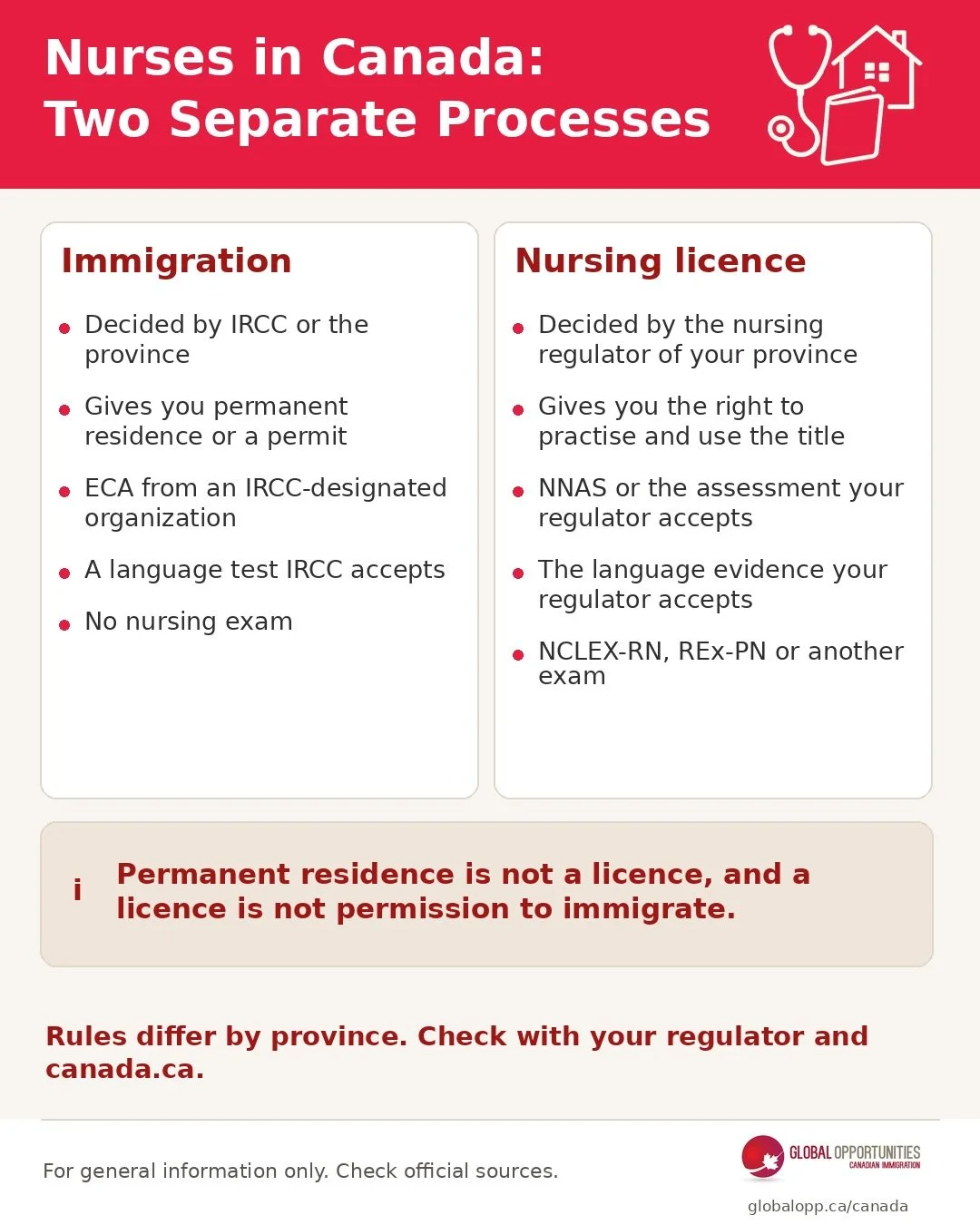
Please note: Getting registered as a nurse and getting permission to immigrate are separate decisions, made by different bodies. Neither one decides the other, and each body can change its requirements at any time.
How to get a nursing licence in Canada as an internationally educated nurse
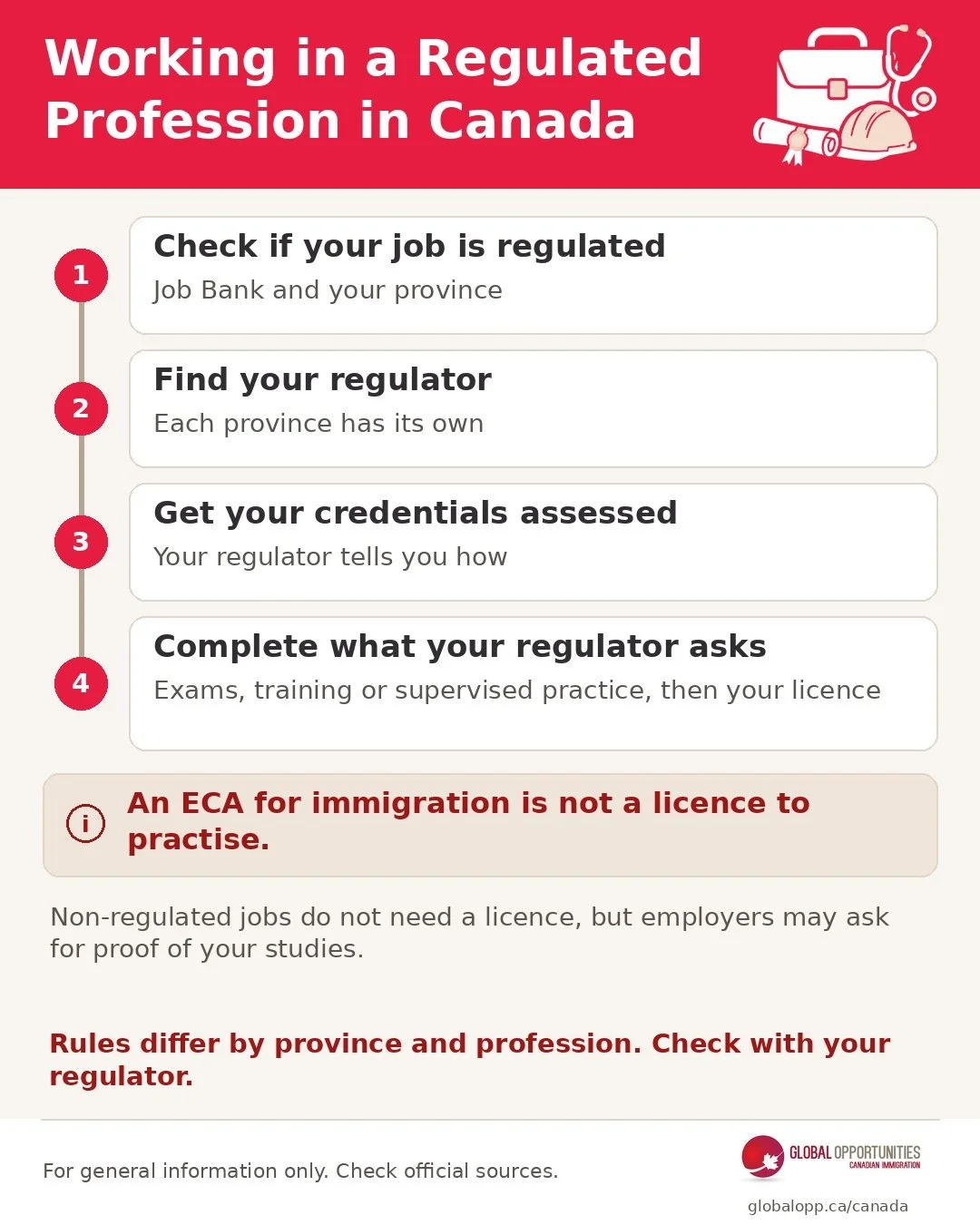
Every regulator sets and changes its own requirements, but the journey for an internationally educated nurse (IEN) usually includes the stages below. This is a general summary of what the regulators we link to describe; always confirm the order and details on your own regulator's website.
Choose your province and category: RN, LPN, RPN (psychiatric) or NP.
Have your credentials assessed through NNAS or another provider your regulator accepts.
Apply to the regulator yourself, usually through its online portal. CNO, BCCNM and the Nova Scotia regulator all say the applicant must complete the application personally.
Verification of registration and employment: your home regulator, school and employers usually send documents directly to the Canadian regulator or assessment service.
Competency assessment and transition education: if the regulator finds gaps compared with Canadian education, it may require courses, a bridging program or a competency assessment.
Language evidence in English or French, as accepted by the regulator.
Registration exam: usually the NCLEX-RN for RNs and the REx-PN or another exam for practical nurses, plus any jurisprudence requirement.
Registration and licence: with an active licence you can use the title and work as a nurse in that province.
Can I start my nursing licence from outside Canada?
In many cases, yes. NNAS and several regulators work online and accept applicants who live abroad, although some steps, such as certain transition courses or in-person assessments, may require you to be in Canada. The Nova Scotia Nursing and Midwifery Regulator (NSNMR), for example, says it processes first the applications of IENs with a confirmed job offer from a Nova Scotia employer or with a likely immigration pathway (such as US-based nurses), and then the rest in order of receipt, starting with applicants already living in Nova Scotia, then elsewhere in Canada, then abroad (NSNMR, international nurse applicants).
Will I have to study again? Bridging programs
Additional education is common. The Government of Saskatchewan says that most IENs who want to become RNs are currently required to take some degree of additional training before licensure, through the Registered Nursing Bridging Program for IENs delivered by Saskatchewan Polytechnic (Government of Saskatchewan, internationally educated health care professionals). BCCNM says required education can range from one course on the Canadian health system to a full re-entry or bridging program (BCCNM). In Ontario, CNO introduced a Transition to Practice requirement in April 2025 so that RN and RPN applicants are familiar with the context of practice in Canada; CNO says applicants who do not meet it through Canadian education or registration can take a CNO-approved course (CNO, new registration requirements).
Foreign Credential Recognition loans
Licensing can be expensive, and there is federal help to pay for it. Employment and Social Development Canada's Foreign Credential Recognition page describes loans that can help internationally trained professionals pay for licensing and qualifying exams, education and training programs and other costs of getting their credentials recognized, plus support services such as career counselling, mentorship and job search help. Its search tool shows the loan providers available by immigration status, language of service and province or territory. We do not list amounts or conditions here: check the page and the provider for your own situation.
What if I trained years ago or stopped practising?
Most regulators look at how recent your education and practice are. BCCNM, for example, says applicants are more likely to succeed if they completed their nursing education within the last 10 years or practised consistently as a nurse in the last 10 years, and that applicants with limited recent experience are more likely to need a full nursing or re-entry program (BCCNM). If you have been away from nursing for a while, ask the regulator before you pay for assessments.
Can a doctor work as a nurse in Canada?
Not on the basis of a medical degree. The College of Nurses of Ontario states that it "does not accept other medical qualifications as a basis for registration as a nurse", even if that training allowed you to carry out nursing duties in your home country (CNO, guide for nurses educated outside Canada). Doctors who want to practise medicine should read the physicians section of our professionals guide.
Please note: Licensing steps and rules as published by CNO, BCCNM, NSNMR and the Government of Saskatchewan, and loan information as published by Employment and Social Development Canada, as of November 2026. Eligibility for a loan is decided by the provider. Each regulator decides its own requirements and order of steps, and can change them; completing a step does not guarantee registration.
NNAS and credential assessment for nurses
The National Nursing Assessment Service (NNAS) describes itself as a non-profit organization that collects and verifies the documents of internationally educated nurses and prepares an Advisory Report for the regulators. According to NNAS, its members are 16 nursing regulatory bodies, its reports are accepted by all nursing regulators in Canada except those in Quebec and the territories, and it does not grant licences to practise; only the regulator decides (NNAS, our role).
Who can apply to NNAS?
According to NNAS eligibility, you can apply if you completed your post-secondary nursing education outside Canada and have never been licensed as a nurse in Canada in the profession you are applying for. For the Expedited Service, you must also have been licensed as a nurse outside Canada. NNAS says Canadian citizens and residents whose nursing education was completed outside Canada also apply through NNAS.
NNAS services
Expedited Service: according to NNAS, it lets you start the credentialing process for RN and LPN at the same time and send your Advisory Report to several participating regulators, and your nursing education is assessed at the country level, so you do not need to arrange for your curriculum to be sent. NNAS lists the participating regulators as the RN and LPN regulators of New Brunswick, British Columbia (RN and LPN only), Manitoba, Newfoundland and Labrador, Saskatchewan, Prince Edward Island, Nova Scotia, Alberta and Ontario. NNAS sets its own fees; check the current fee on its site.
RPN Service: NNAS runs a separate service with its own page (NNAS, RPN Service). Check that page and your regulator's instructions to see which service applies to you, especially if you are applying as a registered psychiatric nurse.
Recent changes in Ontario and British Columbia
Since 1 April 2025, CNO accepts credential verification from several approved providers: World Education Services (WES), the International Credential Assessment Service of Canada (ICAS) and BCIT's International Credential Evaluation Service (ICES). CNO says it continues to accept NNAS expedited reports, which are prepared by the Commission on Graduates of Foreign Nursing Schools, now known as TruMerit (CNO, approved credential assessment providers).
In British Columbia, BCCNM says Inspire Global Assessments confirms your identity and evaluates your English proficiency, your education credentials and your nursing knowledge and skills through a competency assessment, and then sends that information to BCCNM (BCCNM).
Practical takeaway: before paying for any assessment, check which provider your regulator accepts today. What was true a year ago may have changed.
Is the NNAS report an ECA for Express Entry?
No. For Express Entry, IRCC asks for an Educational Credential Assessment (ECA) from an IRCC-designated organization (IRCC, Educational Credential Assessment). Some organizations, such as WES or ICAS, are designated by IRCC and also appear on CNO's list, but the reports serve different purposes. Confirm with each organization which report you need for each process.
Please note: NNAS services and eligibility as published by NNAS, and Ontario and British Columbia processes as published by CNO and BCCNM, as of November 2026. An NNAS Advisory Report is not a licence and is not an ECA for immigration.
Nursing regulators by province
Your licence is issued by the regulator of the province or territory where you will work. Names and structures change, so always use the regulator's official link. Some of the main regulators:
Ontario: College of Nurses of Ontario (CNO) regulates RNs, registered practical nurses and NPs. Psychiatric nursing is not a separate profession.
British Columbia: BC College of Nurses and Midwives (BCCNM) regulates RNs, NPs, LPNs and registered psychiatric nurses.
Alberta: College of Registered Nurses of Alberta (CRNA) for RNs and NPs, College of Licensed Practical Nurses and Health Care Aides of Alberta (CLHA) for LPNs and health care aides, and the psychiatric nurses' regulator, CRPNA.
Saskatchewan: College of Registered Nurses of Saskatchewan (CRNS), College of Licensed Practical Nurses of Saskatchewan (CLPNS) and the psychiatric nurses' regulator, CRPNS.
Manitoba: College of Registered Nurses of Manitoba (CRNM), the practical nurses' regulator, CLPNM, and the psychiatric nurses' regulator, CRPNM.
Nova Scotia: Nova Scotia Nursing and Midwifery Regulator (NSNMR).
New Brunswick: College of Nursing of New Brunswick and the Association of New Brunswick Licensed Practical Nurses (ANBLPN).
Prince Edward Island: PEI College of Nursing and Midwifery (PEICNM) and the practical nurses' regulator, CLPNPEI.
Newfoundland and Labrador: Newfoundland and Labrador College of Nurses (NLCN), which says it regulates LPNs, RNs, RPNs and NPs.
Northwest Territories and Nunavut: the College of Nurses of the Northwest Territories and Nunavut (CNNN). NNAS reports are not used in the territories.
Yukon: confirm the current regulator for your category through the Canadian Council of Registered Nurse Regulators (CCRNR) or the Government of Yukon before applying.
Quebec: the Ordre des infirmières et infirmiers du Québec (OIIQ) regulates nurses and the OIIAQ nursing assistants. The process is in French, and Quebec runs its own immigration programs. We include Quebec for information only: Global Opportunities does not offer services for Quebec's immigration programs.
Ontario nursing licence for international nurses (CNO)
CNO regulates RNs, registered practical nurses and NPs in Ontario; it is not a school or an association. According to CNO, since April 2025 it accepts nursing education recognized or approved in any jurisdiction if it was designed to prepare you for the category you are applying for and meets the credential level (a baccalaureate for RNs, a diploma for registered practical nurses), it has a Transition to Practice requirement and it accepts more credential assessment providers (CNO, new registration requirements). CNO requires RN applicants to pass the NCLEX-RN and registered practical nurse applicants the REx-PN (CNO, registration examination). Its guide for nurses educated outside Canada also describes a separate online jurisprudence exam on Ontario's nursing laws and standards, and warns that you should never share your login details or let someone else, including immigration consultants or exam preparation services, submit or verify information for you (CNO guide).
British Columbia nursing licence for IENs (BCCNM and Inspire)
According to BCCNM, it assesses most IENs for both LPN and RN licensure in one application, so you can start working as an LPN while you complete RN requirements without reapplying. Applicants go through Inspire Global Assessments, and BCCNM says neither it nor Inspire endorses agencies that charge a fee to complete applications (BCCNM). BCCNM also has separate application processes for RNs from the United States and from Australia, New Zealand and the United Kingdom (see "Advice for nurses by country" below).
Alberta (CRNA, CLHA and CRPNA)
In Alberta, RNs and NPs register with CRNA, LPNs and health care aides with CLHA, and psychiatric nurses with CRPNA. According to NNAS, CRNA and CLHA take part in its Expedited Service.
Atlantic provinces
Nova Scotia (NSNMR), New Brunswick (College of Nursing of New Brunswick and ANBLPN), Prince Edward Island (PEICNM and CLPNPEI) and Newfoundland and Labrador (NLCN) each have their own regulators. NSNMR says the application must be filled out by the person seeking the licence and that forms completed by a third party or agency will be rejected (NSNMR).
This list of regulators is for reference only, may not be complete or up to date, and must be confirmed with the regulator. Listing a regulator does not mean it endorses Global Opportunities.
NCLEX-RN, REx-PN and other nursing exams in Canada
For licensure you generally need to pass a registration exam for your category: the NCLEX-RN for registered nurses and the REx-PN or another exam for practical nurses. Each regulator decides which exam it accepts, when you become eligible and how you register. Exam fees are set by the provider and change, so we do not publish them.
NCLEX-RN, for registered nurses. The NCLEX is a product of the US-based National Council of State Boards of Nursing (NCSBN). CNO requires it for RN applicants in Ontario (CNO), BCCNM requires it for IENs who have never held practising registration in Canada (BCCNM, NCLEX-RN), and NLCN lists it for RNs in Newfoundland and Labrador (NLCN).
REx-PN, for practical nurses. According to its official site, the REx-PN was developed for BCCNM and CNO, which partnered with NCSBN, and it is available in English and Canadian French.
Other practical nurse exams. NLCN lists a different exam, the CPRNE, for LPNs in Newfoundland and Labrador. Check what your province uses.
Nurse practitioner exams. The regulator names the approved exam for each NP specialty.
Jurisprudence. Some regulators test or teach the laws and standards that govern nursing in the province: CNO has a jurisprudence exam, and NLCN has a jurisprudence education requirement.
Do I need the NCLEX to work as a nurse in Canada?
If you want to be a registered nurse outside Quebec, in practice yes: the regulators we checked require the NCLEX-RN. But you do not simply book it on your own. In Ontario, CNO says you wait until it confirms you are eligible, then follow its instructions to book with the exam provider, pay the fees, write the exam and wait for your results (CNO, registration examination). Passing the NCLEX for a US state does not by itself give you a Canadian licence; BCCNM notes that US and Canadian jurisdictions both use the same regulatory exam for RNs, which is one reason it has a separate process for US-licensed RNs (BCCNM, applicants from the United States).
How many times can I take the exam?
It depends on the regulator and the exam. CNO says there is no maximum number of attempts for the RN and registered practical nurse exams until you pass, with mandatory waiting periods between attempts, and that the NP exam can be attempted three times (CNO, registration examination). Confirm the current rule in your province.
Please note: Exam rules as published by CNO, BCCNM, NLCN and the REx-PN site, as of November 2026. Passing an exam is one requirement among several; it does not by itself give you a licence, and regulators can change which exams they accept.
English and French tests for nurses: immigration vs licence
You will usually prove your language skills twice, under different rules: to IRCC for immigration and to the regulator for your licence. We do not publish minimum scores because they change and depend on the program and the regulator. Our full guide to English and French tests for Canada compares every test in detail.
Language tests accepted by IRCC for Express Entry
According to IRCC's language test page for Express Entry, the accepted tests are:
CELPIP-General (English).
IELTS General Training (English). IRCC says it does not accept the IELTS One Skill Retake for Express Entry.
PTE Core (English).
TEF Canada (French).
TCF Canada (French).
IELTS, CELBAN and other tests for your nursing licence
Each regulator sets its own accepted tests and scores, which are not the same as IRCC's. CNO, for example, accepts several types of evidence (nursing or health care education in English or French, practice in English or French, registration in a Canadian jurisdiction, or an approved test), and its list of tests includes CELBAN (the Canadian English Language Benchmark Assessment for Nurses), IELTS (General Training and Academic, and the One Skill Retake), OET, PTE Academic, TEF and TCF (CNO, proficiency in English or French). In British Columbia, BCCNM says Inspire evaluates English as part of its process.
Practical tip: if you plan to sit one test only, compare IRCC's list with your regulator's list first. IELTS General Training is on IRCC's list for Express Entry; for your licence, check whether your regulator accepts it or asks for another test. Note that CNO accepts the IELTS One Skill Retake while IRCC does not accept it for Express Entry: one result may not serve both purposes.
For the immigration side, watch our live session on how CELPIP results fit into an immigration application; nursing regulators set their own language rules.
Please note: Accepted tests as published by IRCC and CNO, as of November 2026. A test that a regulator accepts may not be accepted by IRCC, and the other way round; check both lists before you book.
Who employs nurses in Canada?
Health care in Canada is publicly funded: according to the Government of Canada, the system is funded through taxes, the provinces and territories are responsible for delivering health care services, and under national standards they must cover the full cost of medically necessary services (Government of Canada, Canada's health care system). That is why most nurses work for organizations funded by their province, even though their direct employer is not the government.
Who hires you: the organization where you work. According to the NOC profile for RNs, that can be a hospital, nursing home, extended care facility, rehabilitation centre, doctor's office, clinic, community agency, company or private home, and some nurses are self-employed.
Health authorities: in several provinces, hospitals and public services are run by regional or provincial health authorities. In British Columbia, for example, the Government of BC says the Ministry of Health works with a provincial health authority, five regional health authorities and a First Nations health authority (Government of BC, health authorities).
Unions: many nurses in the public sector are unionized, and their wages and conditions are set in collective agreements (see "Nursing associations and unions in Canada" below).
Examples of public health organizations that post nursing jobs, by province:
Ontario: public hospitals, long-term care homes and home care agencies; Ontario Health careers.
British Columbia: the health authorities, with recruitment support from Health Match BC.
Alberta: Alberta Health Services nursing careers.
Saskatchewan: the Saskatchewan Health Authority and Health Careers in Saskatchewan.
Manitoba: Shared Health and Health Careers Manitoba.
Nova Scotia: Nova Scotia Health jobs.
New Brunswick: Horizon Health Network, Vitalité Health Network and NB Health Jobs.
Prince Edward Island: Health PEI.
Newfoundland and Labrador: NL Health Services.
This list is for reference only and is not complete; several links come from the NNAS provincial resources page. Provincial health structures change, so confirm on each province's official site. We have no relationship with these organizations.
Nurse salaries in Canada by province
According to Job Bank, the Government of Canada's job site, the median hourly wage for a registered nurse (NOC 31301) in Canada is $45.00, with a low of $30.47 and a high of $56.00 (Job Bank, wages for registered nurses). Job Bank says these wages are for the 2024-2025 reference period and were updated on 18 November 2026. It also reports that 92.4% of workers in this occupation receive at least one type of non-wage benefit, such as a pension, insurance or paid leave.
Registered nurse (RN) salary by province
Job Bank hourly wages for registered nurses, low / median / high, reference period 2024-2025 (Job Bank, registered nurses):
Canada: $30.47 / $45.00 / $56.00
Ontario: $30.00 / $44.00 / $56.00
British Columbia: $40.00 / $51.00 / $60.00
Alberta: $30.00 / $50.00 / $58.18
Saskatchewan: $38.00 / $48.00 / $52.44
Manitoba: $36.00 / $45.00 / $54.25
Nova Scotia: $33.42 / $45.11 / $52.00
New Brunswick: $31.00 / $45.00 / $49.91
Newfoundland and Labrador: $34.50 / $48.10 / $55.00
Prince Edward Island: $31.59 / $44.00 / $51.00
Quebec: $28.00 / $41.00 / $52.60
Yukon: $53.45 / $63.76 / $71.96
Northwest Territories: $45.00 / $62.00 / $76.92
Nunavut: $45.00 / $60.00 / $75.55
Licensed practical nurse (LPN) salary by province
Job Bank hourly wages for licensed practical nurses (NOC 32101), low / median / high, reference period 2024-2025 (Job Bank, licensed practical nurses):
Canada: $25.19 / $32.00 / $38.60
Ontario: $26.50 / $33.00 / $38.25
British Columbia: $28.00 / $35.00 / $42.00
Alberta: $26.00 / $32.50 / $37.00
Saskatchewan: $34.00 / $38.68 / $42.00
Manitoba: $24.68 / $34.86 / $44.32
Nova Scotia: $28.00 / $32.00 / $35.50
New Brunswick: $27.00 / $32.14 / $38.00
Newfoundland and Labrador: $29.00 / $32.00 / $34.00
Prince Edward Island: $28.35 / $32.00 / $39.00
Quebec: $24.44 / $30.00 / $35.12
Yukon: $32.00 / $45.00 / $53.00
Northwest Territories: $37.25 / $45.04 / $52.82
Job Bank says it cannot publish LPN wages for Nunavut because of data limitations, and reports that 91.3% of LPNs receive at least one type of non-wage benefit.
Nurse practitioner and personal support worker salaries
Nurse practitioners (NOC 31302): according to Job Bank, the national median is $65.00 an hour (low $49.29, high $78.17). Provincial medians: Ontario $65.38 · Alberta $65.03 · New Brunswick $63.00 · Newfoundland and Labrador $62.40 · Manitoba $62.02 · Saskatchewan $62.00 · British Columbia $61.87 · Nova Scotia $57.94 · Quebec $57.69 · Prince Edward Island $50.16. Job Bank does not publish territorial figures for this occupation because of data limitations.
Personal support workers in nursing care (NOC 33102): according to Job Bank, the national median is $25.00 an hour (low $19.10, high $29.95), with medians of $28.84 in British Columbia, $25.00 in Ontario and $23.81 in Alberta.
Personal support workers in home support (NOC 44101): according to Job Bank, the national median is $21.00 an hour (low $17.00, high $27.92).
How much do nurses make in Ontario, BC and Alberta?
According to Job Bank, the median hourly wage for registered nurses is $44.00 in Ontario, $51.00 in British Columbia and $50.00 in Alberta (reference period 2024-2025, Job Bank). For registered practical nurses in Ontario, Job Bank reports a median of $33.00 (Job Bank, LPNs). The three territories show the highest RN medians in Job Bank's data, from $60.00 to $63.76; if you are looking at the North, read our guide to living in Yukon, the Northwest Territories and Nunavut.
How to read Job Bank wages
They are hourly wages for a past period, and Job Bank figures may not reflect premiums for nights, weekends or overtime.
Your real pay depends on the employer, the collective agreement, your experience, your category (RN, LPN, NP) and the region.
Your first Canadian salary may be different: while you complete licensing, you may work in a related occupation at a different wage.
Look up other occupations or cities in the Job Bank wage search.
Please note: Wages as published by Job Bank (Government of Canada) for the 2024-2025 reference period, updated 18 November 2026. They may have changed by the time you read this: check the current figure on Job Bank before you rely on it. A wage figure is not a job offer and does not mean you will be hired at that rate.
Nursing jobs in Canada for foreigners
Nursing jobs are posted mainly on health authority and hospital career sites, and on Job Bank, the Government of Canada's job board. Useful official resources:
Job Bank, including a section for newcomers. You can search by province, for example nursing jobs in Ontario.
Health authority career sites, such as Health Match BC, Nova Scotia Health or NB Health Jobs (see "Who employs nurses in Canada?" above).
Provincial services for internationally educated health professionals, for example Ontario Health's Access Centre, which Ontario Health describes as the centralized point of access for internationally educated health professionals in Ontario, or Nursing Jobs BC, run by Health Match BC, which describes itself as a free health professional recruitment service funded by the Government of BC.
Your regulator does not offer jobs, but it explains any provisional or transitional registration options that may let you work while you finish requirements.
If you are already in Canada, our newcomers in Canada guide covers resumes, job search and your first weeks.
Global Opportunities does not offer jobs, does not sell job offers and is not a recruitment agency. Never pay for a job offer. The Government of Canada says an employer cannot make you pay to get or keep your job, or make you reimburse recruitment fees they paid (Government of Canada, foreign workers' rights).
Can a Canadian employer hire me before I am licensed?
To work as a nurse (RN, LPN or RPN), you need the regulator's licence, so an employer can only hire you into that role once you have it or once the regulator grants some form of provisional or conditional registration. BCCNM, for example, describes provisional licences on its NCLEX-RN page. Some provinces and employers recruit internationally and support nurses through licensing; other nurses start in related roles, such as health care aide, while they complete requirements. Always confirm what each type of registration allows you to do.
Do Canadian hospitals sponsor nurses?
"Sponsorship" usually means an employer offering you a job that supports a work permit or a provincial nomination. Some pathways require that offer (for example, the BC PNP Health Authority stream or the Atlantic Immigration Program), while IRCC says a job offer is not a minimum requirement for the Federal Skilled Worker Program (IRCC, Federal Skilled Workers). A job offer never replaces your licence, and you should never pay for one.
Immigration pathways for nurses
There is no immigration program just for nurses, but several pathways take healthcare experience into account. Rules, categories and priorities change constantly, so what you read here depends on when you read it. For a full overview of every pathway, read our guides on how to immigrate to Canada and on how to immigrate to Canada as a professional.
Express Entry for nurses: Federal Skilled Worker and Canadian Experience Class
Express Entry is IRCC's online system for three federal permanent residence programs: the Federal Skilled Worker Program, the Canadian Experience Class and the Federal Skilled Trades Program. Nurses educated and working abroad usually look at the Federal Skilled Worker Program; nurses who have already worked in Canada in a skilled job may look at the Canadian Experience Class. You create a profile, IRCC ranks it with the Comprehensive Ranking System (CRS), which considers factors such as age, education, experience and language, and IRCC invites the highest-ranked candidates in each round. There is no fixed score that a nurse "needs": cut-offs change from round to round and your score depends on your whole profile. Whether Express Entry fits you depends on your case, and a consultation is the way to know.
Do you need a Canadian nursing licence to enter Express Entry? Generally not to create a profile: your experience is assessed through its NOC code and duties. But without a licence you will not be able to practise as a nurse when you arrive. More from Global: Express Entry.
The Express Entry healthcare category
Besides general rounds, IRCC can hold category-based rounds, and one of the current categories is healthcare and social services occupations. When we checked IRCC's category-based selection page in November 2026, the list included the nursing occupations 31300, 31301, 31302 and 32101, and nurse aides (33102).
IRCC identifies eligible candidates in the pool based on their profile, mainly their NOC code and experience.
A category does not guarantee an invitation. IRCC decides whether and when to hold a round, and it says it may not need a category-based round if there are enough top-ranking candidates eligible for a category.
Categories change. IRCC reviews them; always check the current list.
Please note: Category list as published by IRCC, as of November 2026. Being in an eligible occupation does not mean you will be invited or that an application will be approved; IRCC decides each case.
Provincial Nominee Programs with healthcare streams
Every province runs its own Provincial Nominee Program (PNP), and several have healthcare-focused pathways. Examples from official sites:
British Columbia: the BC PNP's Skills Immigration includes a Health Authority stream, which WelcomeBC says requires a full-time, indeterminate job offer from a B.C. health authority employer (WelcomeBC, Skills Immigration).
Alberta: the Government of Alberta says there are dedicated pathways operated in its Alberta Express Entry Stream for health care professionals, including the Dedicated Health Care Pathway (Alberta Advantage Immigration Program).
Saskatchewan: the Government of Saskatchewan says it has recruited hundreds of qualified health care workers from countries like the Philippines and is working with partners to shorten the training and licensing pathway for internationally educated nurses (Government of Saskatchewan).
Other provinces: Ontario, Manitoba, Nova Scotia, New Brunswick, Prince Edward Island and Newfoundland and Labrador run their own programs, with priorities that change during the year. Read our page on provincial nominee programs.
Requirements, priority occupations and draws change constantly, and many streams require a job offer from an employer in the province. Check each province's official site. To learn more, watch our video on Canada's Provincial Nominee Programs on YouTube (in Spanish).
Please note: Provincial streams as described by the Government of British Columbia, the Government of Alberta and the Government of Saskatchewan, as of November 2026. A nomination is not permanent residence: IRCC makes the final decision on each application.
Atlantic Immigration Program
According to IRCC, the Atlantic Immigration Program helps employers in Nova Scotia, New Brunswick, Prince Edward Island and Newfoundland and Labrador hire qualified candidates for jobs they have not been able to fill locally. It requires a job offer from a designated employer.
Work permits for nurses
To work temporarily, you generally need a job offer from a Canadian employer and the right work permit, which may or may not require a Labour Market Impact Assessment (LMIA). Some special cases:
US and Mexican citizens (CUSMA): according to IRCC's CUSMA professionals page, "Registered Nurse" is on the list of professionals, with a state or provincial licence or a Licenciatura degree as the credential. IRCC also says applicants need pre-arranged employment with a Canadian employer, and that to enter Canada as a registered nurse a licence issued by the province of destination is necessary. The list comes from CUSMA Chapter 16 (Global Affairs Canada).
French speakers: according to IRCC, the Francophone Mobility work permit lets Canadian employers hire eligible French speakers who will live and work outside Quebec without an LMIA.
Young people from partner countries: International Experience Canada (IEC) offers work permits to young citizens of countries and territories with an arrangement with Canada. When we checked IRCC's list, it included the United Kingdom, Ireland, Australia, New Zealand and France; Mexico is not on the list. A working holiday does not replace your nursing licence.
A temporary permit can give you Canadian experience that some programs value later, but it does not lead to permanent residence automatically.
Please note: Work permit rules as published by IRCC and Global Affairs Canada, as of November 2026. A work permit for a regulated occupation does not replace the provincial licence, and each permit is decided case by case.
Studying nursing in Canada
Some people choose to study in Canada: a nursing program, a bridging program for IENs or a related program. You need an acceptance letter from a designated learning institution and a study permit. Studying does not lead to permanent residence automatically, and post-graduation work rules change often, so check IRCC's current rules before you enrol.
What is the best way to immigrate to Canada as a nurse?
The one that fits your profile. For some nurses it is Express Entry from abroad; for others, a provincial stream with a job offer; for others, studying first or a work permit. What worked for a colleague may not work for you because of your language results, experience, family or the programs open at the time. That is why we recommend a personalized consultation before you invest in tests and assessments.
Nurse aides and personal support workers
NOC 33102 (TEER 3): nurse aides, health care aides and personal support workers in nursing care. As TEER 3, this experience can count as skilled work for the Federal Skilled Worker Program, and 33102 was on IRCC's healthcare category list when we checked it in November 2026.
NOC 44101 (TEER 4): home support workers. TEER 4 experience does not count as skilled work for the Federal Skilled Worker Program, according to IRCC.
Regulation: in Alberta, health care aides are regulated by CLHA. In most other provinces these roles are not regulated nursing professions; check your province.
If you trained as a nursing technician or diploma nurse, compare your education with the LPN category before assuming you can only work as an aide. The regulator decides which category your education fits.
French-speaking nurses outside Quebec
If you speak French, you may have extra options in Francophone communities outside Quebec. The Government of Canada promotes Francophone immigration outside Quebec.
Express Entry: IRCC lists French-language proficiency as one of the current Express Entry categories. How much French can help your profile depends on your case, and a consultation is the way to know.
Francophone Mobility: an LMIA-exempt work permit for eligible French speakers who will work outside Quebec (see "Work permits for nurses" above).
Health care in French: in New Brunswick, the Vitalité Health Network works in French. IRCC also describes Francophone communities outside Quebec in several provinces.
Licensing: some regulators accept French tests (CNO lists TEF and TCF), and the REx-PN is available in Canadian French.
Quebec runs its own immigration programs, for which Global Opportunities does not offer services.
Which is the best province for nurses in Canada?
There is no single best province: it depends on your language, your nursing category, the regulator, the cost of living, the climate, your family and the immigration pathways open at the time. A quick comparison, using the regulators listed above and Job Bank's median RN wages (2024-2025):
Ontario: CNO; RN median $44.00. According to CIHI, Ontario had the most regulated nurses in Canada in 2024 (178,592), and CNO changed its requirements for IENs in April 2025. Read our Ontario guide.
British Columbia: BCCNM for all categories; RN median $51.00. Inspire assessment and the BC PNP Health Authority stream. Read our British Columbia guide.
Alberta: CRNA, CLHA and CRPNA; RN median $50.00. The AAIP's Dedicated Health Care Pathway. Read our Alberta guide.
Saskatchewan: CRNS, CLPNS and CRPNS; RN median $48.00. RN bridging program at Saskatchewan Polytechnic and provincial international recruitment. Read our Saskatchewan guide.
Manitoba: CRNM, CLPNM and CRPNM; RN median $45.00. Read our Manitoba guide.
Nova Scotia: NSNMR; RN median $45.11. Processing priority for IENs with a provincial job offer or a likely immigration pathway. Read our Nova Scotia guide.
New Brunswick: College of Nursing of New Brunswick and ANBLPN; RN median $45.00. Health networks in English (Horizon) and French (Vitalité). Read our New Brunswick guide.
Prince Edward Island: PEICNM and CLPNPEI; RN median $44.00. Part of the Atlantic Immigration Program. Read our Prince Edward Island guide.
Newfoundland and Labrador: NLCN for LPNs, RNs, RPNs and NPs; RN median $48.10. Read our Newfoundland and Labrador guide.
The territories: RN medians from $60.00 to $63.76, the highest in Job Bank's data. Read our guide to Canada's North.
Please note: Wages as published by Job Bank (reference period 2024-2025, updated 18 November 2026) and nurse counts as published by CIHI (2024 data), as of November 2026. Check the current figures before you rely on them. This comparison is for reference only and is not a recommendation of any province.
Immigrating as a nurse from the Philippines, India, Nigeria and other countries
The licensing process and the immigration programs are the same for every nationality: we found no special rules for nurses from a given country in the official sources we checked. What changes is the paperwork you need from home, your travel requirements and, in a few cases, specific agreements or separate licensing processes for nurses already registered in certain countries.
How to immigrate to Canada as a nurse from the Philippines
Filipino nurses follow the same two processes: an immigration pathway and a provincial licence. If you have a BSN and a Philippine licence, your education is usually compared with the RN category, and NNAS's Expedited Service is designed for nurses who have been licensed outside Canada (NNAS). The Government of Saskatchewan has a page with training, licensing and career information for health care workers currently living in the Philippines (Government of Saskatchewan, international recruitment). Request your verification of registration and transcripts early, because regulators usually want them sent directly by the issuing body.
How to immigrate to Canada as a nurse from India
Indian nurses with a BSc Nursing are usually assessed against the RN category; diploma-trained nurses should check how their regulator classifies their education. Start with your language test, since both IRCC and your regulator require proof of English or French, and make sure you take the right test for each purpose (see "English and French tests for nurses" above). Arrange for your nursing council registration verification and transcripts to be sent directly, as regulators request.
How to immigrate to Canada as a nurse from Nigeria
Nigerian nurses and midwives follow the same path: credential assessment, a regulator application, the registration exam and an immigration program. Midwifery is a separate regulated profession in Canada, so if your training combines nursing and midwifery, ask your nursing regulator how it will assess it. As everywhere, never pay anyone for a job offer or for a "guaranteed" licence.
How to immigrate to Canada as a nurse from the UK
BCCNM says it offers an expedited application process for eligible RNs from Australia, New Zealand and the United Kingdom (RN–Adult and RN–Child), because evidence shows that nursing education and practice in these countries is "somewhat comparable to RN practice in Canada" (BCCNM, applicants from Australia, New Zealand and the UK). According to the same page, UK applicants with RN–Mental Health apply through BCCNM's pathway for internationally educated psychiatric and mental health nurses. Young UK citizens may also be eligible for International Experience Canada.
How to immigrate to Canada as a nurse from the United States
BCCNM runs a separate process for RNs who hold current licensure from a US licensing body and have recent RN practice in the United States, noting that US and Canadian jurisdictions both use the same regulatory exam for RNs (BCCNM, applicants from the United States). NSNMR says it prioritizes applicants with a likely immigration pathway, such as US-based nurses (NSNMR), and US citizens can look at the CUSMA professional work permit, which, according to IRCC, requires pre-arranged employment and the provincial licence.
Australia, New Zealand and Ireland
According to BCCNM, its expedited process also covers eligible RNs registered in Australia and New Zealand (BCCNM). Citizens of Australia, New Zealand and Ireland may be eligible for International Experience Canada, depending on the rules for their country.
Latin America and Spain
Spanish-speaking nurses can read our full guide for nurses (in Spanish), with sections by country. Mexican nurses can also look at CUSMA (see "Work permits for nurses" above).
Nurses living in a third country
You can apply from wherever you live. If you hold a nursing licence in that country (for example, in the United States, the United Kingdom or a Gulf country), it may affect which route the regulator offers you. For immigration, IRCC generally asks for police certificates from the countries where you have lived; check the instructions for your program on canada.ca.
Please note: Country-specific processes as published by BCCNM, NSNMR, NNAS, the Government of Saskatchewan and IRCC, as of November 2026. Eligibility for an expedited or separate process is decided by the regulator; it does not shorten or replace the immigration process.
Documents nurses should prepare
Many nursing documents take time because they must come directly from your school, your home regulator or your employers. A general checklist, based on what the regulators and IRCC pages we link to describe:
For your licence (regulator and assessment service):
Identity documents and passport.
Nursing diploma and transcripts, often sent directly by your school.
Course descriptions, if the assessment provider asks for them.
Verification of registration or licence, sent by your home regulator.
Employment verification sent by your employers.
Language evidence accepted by your regulator.
Certified translations into English or French, if requested.
For immigration (IRCC or a province):
A valid passport.
An ECA from an IRCC-designated organization, if your program requires it.
Results of a language test IRCC accepts.
Reference letters describing your duties, hours, dates and pay.
Police certificates and civil documents, as your program requires.
Proof of funds, if your program requires it. The amount depends on your program and family, so check the official page or ask in a consultation.
Certified translations, where IRCC requires them.
Tip: the reference letter for IRCC must describe duties that match your NOC code; the employment verification for the regulator is usually its own form. They are different documents about the same experience.
Common mistakes and scams to avoid
Confusing permanent residence with a licence. Arriving in Canada does not let you practise as a nurse without the regulator's licence.
Paying for assessments in the wrong order. Check which provider your regulator accepts today before paying.
Letting someone else complete your regulator application. CNO, BCCNM and NSNMR all say the applicant must complete and submit it, and CNO warns never to share your login details.
Picking a NOC code by job title. Your real duties are what count.
Taking the wrong language test. IRCC and the regulator may accept different tests.
Believing a category guarantees an invitation. No category or program guarantees permanent residence.
Paying for a job offer or a "guaranteed" licence. No one can sell you a legitimate job offer or a licence.

How to check an immigration consultant
According to IRCC, only authorized representatives can charge you for immigration advice: Regulated Canadian Immigration Consultants (RCICs) licensed by the College of Immigration and Citizenship Consultants (CICC), lawyers and notaries who are members of a Canadian provincial or territorial law society (or of the Chambre des notaires du Québec), and, in Ontario only, paralegals who are members of the Law Society of Ontario (IRCC, use an authorized representative). Search the CICC Public Register by name or licence number and check that the licence is active. You do not need an immigration consultant for your nursing licence: you submit that application yourself. See also IRCC's page on protecting yourself from fraud.
Nursing associations and unions in Canada
Associations and unions do not issue licences (regulators do), but they are good sources of information about the profession, working conditions and professional networks. Some of them:
Canadian Nurses Association (CNA): national nursing association.
Canadian Federation of Nurses Unions (CFNU): national federation of nurses' unions.
Canadian Association of Schools of Nursing (CASN): association of nursing schools.
Ontario Nurses' Association (ONA): union, Ontario.
Registered Nurses' Association of Ontario (RNAO): professional association, Ontario.
BC Nurses' Union (BCNU): union, British Columbia.
United Nurses of Alberta (UNA): union, Alberta.
Saskatchewan Union of Nurses (SUN): union, Saskatchewan.
Manitoba Nurses Union (MNU): union, Manitoba.
Nova Scotia Nurses' Union (NSNU): union, Nova Scotia.
New Brunswick Nurses Union (NBNU): union, New Brunswick.
PEI Nurses' Union: union, Prince Edward Island.
Registered Nurses' Union Newfoundland and Labrador (RNUNL): union, Newfoundland and Labrador.
This list is for reference only and may not be complete or up to date. Listing these organizations does not mean they endorse Global Opportunities, and we have no relationship with them.
Seminars and videos for nurses
Global Opportunities has given free information seminars on immigrating to Canada as a nurse or health professional with nursing colleges and universities in Latin America. The recordings are on our YouTube channel, in Spanish:
How can a nurse immigrate to Canada? Seminar with the Colegio de Enfermeras de Costa Rica (in Spanish).
Immigrating to Canada from El Salvador as a nurse, with Universidad Andrés Bello (in Spanish).
How to immigrate to Canada as a health professional, with UCIMED, Universidad de Ciencias Médicas (Costa Rica) (in Spanish).
Mentioning these institutions only means we shared an information seminar with them; it does not mean they endorse Global Opportunities or its services. If anything has changed since a recording, the official sources prevail. You can find more on our YouTube channel and on our recorded seminars and lives page. Our English recordings, including sessions on CELPIP and on NOC codes, are summarised on our recorded seminars in English page.
Frequently asked questions
How can I immigrate to Canada as a nurse?
Through two parallel processes. For immigration, nurses usually look at Express Entry (the Federal Skilled Worker Program from abroad or the Canadian Experience Class in Canada), IRCC's healthcare and social services category, provincial health streams, the Atlantic Immigration Program or a work permit. For the licence, you apply to the nursing regulator of the province where you want to work, which usually means a credential assessment (NNAS or the provider your regulator accepts), language evidence, a registration exam such as the NCLEX-RN or REx-PN and sometimes transition courses. The two processes are decided by different bodies, so plan them together. See "Nursing licence and immigration: two different processes" above.
What are the requirements to work as a nurse in Canada?
Two things: a licence or registration from the nursing regulator of the province where you will work, and an immigration status that allows you to work in Canada, such as permanent residence or a valid work permit. According to NNAS, only people licensed or registered by the regulator can use the title "nurse". Each regulator sets its own requirements, which usually include a credential assessment, language evidence, a registration exam and, often, transition education. Check your regulator's website for the current list before you pay for anything. See "How to get a nursing licence in Canada as an internationally educated nurse" above.
Does permanent residence give me a nursing licence in Canada?
No. IRCC, or a province for nominee programs, decides on your immigration, and the provincial nursing regulator decides on your licence. They are separate applications with their own requirements, documents and fees. You can be a permanent resident and still not be allowed to practise as a nurse until the regulator registers you. In the same way, a licence does not give you the right to live or work in Canada. Getting registered as a nurse and getting permission to immigrate are separate decisions, made by different bodies. See "Nursing licence and immigration: two different processes" above.
Can I apply for my nursing licence from outside Canada?
In many cases, yes. NNAS and several regulators work online and accept applicants who live abroad. Some steps, such as certain transition courses or in-person competency assessments, may require you to be in Canada. Some regulators also set processing priorities: NSNMR in Nova Scotia, for example, says it processes first the applications of IENs with a confirmed Nova Scotia job offer or a likely immigration pathway. BCCNM in British Columbia strongly recommends having the permits required to work in Canada before you apply. Check your regulator's current rules. See "How to get a nursing licence in Canada as an internationally educated nurse" above.
What is NNAS for internationally educated nurses?
The National Nursing Assessment Service collects and verifies the documents of internationally educated nurses and prepares an Advisory Report for the nursing regulators. According to NNAS, its reports are accepted by all nursing regulators in Canada except those in Quebec and the territories, and it does not grant licences. Ontario's CNO now also accepts other approved providers (WES, ICAS and BCIT's ICES), and BCCNM in British Columbia uses Inspire Global Assessments. The NNAS report is not an ECA for Express Entry, so most nurses who immigrate through Express Entry need both. See "NNAS and credential assessment for nurses" above.
Do I need to pass the NCLEX to work as a nurse in Canada?
To work as a registered nurse outside Quebec, the regulators we checked require the NCLEX-RN. In Ontario, CNO requires it for RN applicants and the REx-PN for registered practical nurse applicants, and you take the exam only once CNO confirms you are eligible. BCCNM requires the NCLEX-RN for internationally educated nurses who have never held practising registration in Canada. Without a licence you cannot use a protected title such as "registered nurse", although you may be able to work in related roles that do not need a nursing licence, such as some health care aide roles. See "NCLEX-RN, REx-PN and other nursing exams in Canada" above.
What is the REx-PN?
The REx-PN is the entry-to-practice exam for practical nurses developed for BCCNM in British Columbia and CNO in Ontario, which partnered with the US-based National Council of State Boards of Nursing (NCSBN) to create it, according to the official REx-PN site. It is available in English and Canadian French. In Ontario it is the exam for registered practical nurses, and in British Columbia for licensed practical nurses. Other provinces may use a different exam: Newfoundland and Labrador's regulator, NLCN, lists the CPRNE for LPNs. Check with your regulator which exam applies and when you become eligible. See "NCLEX-RN, REx-PN and other nursing exams in Canada" above.
Will I need a bridging program to become a nurse in Canada?
Often, yes. Many regulators require transition courses, a bridging program or a competency assessment when they find gaps compared with Canadian nursing education. The Government of Saskatchewan says most internationally educated nurses who want to become RNs currently need some additional training, through a bridging program at Saskatchewan Polytechnic. BCCNM says required education can range from one course to a full re-entry or bridging program, and Ontario has a Transition to Practice requirement that many IENs meet through a CNO-approved course. Your regulator tells you what you need after it reviews your file. See "How to get a nursing licence in Canada as an internationally educated nurse" above.
What is the NOC code for a registered nurse in Canada?
NOC 31301, "Registered nurses and registered psychiatric nurses", which is in TEER 1 according to the official NOC 2021 tool of Employment and Social Development Canada. Nurse practitioners are NOC 31302 and nursing coordinators and supervisors NOC 31300, both TEER 1. Licensed practical nurses (registered practical nurses in Ontario) are NOC 32101, TEER 2, and nurse aides and personal support workers in nursing care are NOC 33102, TEER 3. For immigration, the code depends on the duties you actually performed, not on your job title, so compare your duties with the official profile. See "Nursing roles in Canada and their NOC codes" above.
What is the difference between an RN and an LPN in Canada?
Education and scope of practice. According to NNAS, becoming a registered nurse usually requires a four-year university program leading to a nursing degree, while becoming a licensed practical nurse usually requires a two- to three-year college program leading to a diploma. RNs and LPNs are separate regulated categories with their own registration requirements and exams; in Ontario, LPNs are called registered practical nurses. Some regulators, such as BCCNM, assess internationally educated nurses for both categories in one application, so you may be able to work as an LPN while you complete RN requirements. See "Nursing roles in Canada and their NOC codes" above.
How much does a registered nurse earn in Canada?
According to Job Bank, the Government of Canada's job site, the national median wage for registered nurses (NOC 31301) is $45.00 an hour, with a low of $30.47 and a high of $56.00, for the 2024-2025 reference period, updated on 18 November 2026. Medians vary by province, from $41.00 in Quebec to $51.00 in British Columbia, and are higher in the territories. For licensed practical nurses, Job Bank reports a national median of $32.00 an hour. Your actual pay depends on your employer, your collective agreement, your experience and your region, so check the current figure on Job Bank. See "Nurse salaries in Canada by province" above.
Who hires nurses in Canada?
Mainly hospitals, health authorities, long-term care homes, home care agencies, clinics and community agencies funded by the provincial health systems. According to the Government of Canada, the provinces and territories are responsible for delivering health care services, so most nursing jobs are with organizations funded by the province, even though the government is not your direct employer. In several provinces, regional or provincial health authorities run hospitals and services and post their jobs on their own career sites, such as Alberta Health Services or Nova Scotia Health. Many public-sector nurses are unionized. See "Who employs nurses in Canada?" above.
Do Canadian hospitals sponsor foreign nurses?
Some employers make job offers that support a work permit or a provincial nomination, and some provinces and employers recruit internationally. Certain pathways require a job offer, such as the BC PNP Health Authority stream or the Atlantic Immigration Program, while IRCC says a job offer is not a minimum requirement for the Federal Skilled Worker Program. A job offer never replaces your nursing licence. The Government of Canada says an employer cannot make you pay to get or keep a job, so never pay anyone for a job offer. Global Opportunities does not offer jobs. See "Nursing jobs in Canada for foreigners" above.
Is there an Express Entry draw for nurses?
IRCC has a healthcare and social services category within Express Entry. When we checked IRCC's page in November 2026, it included the nursing occupations 31300, 31301, 31302 and 32101 and nurse aides (33102). IRCC identifies eligible candidates from their profiles, decides whether and when to hold category rounds, and says it may not need one if enough top-ranking candidates are already invited. Categories change and do not guarantee an invitation, and you still need to qualify for an Express Entry program. Whether this helps you depends on your whole profile; a consultation is the way to know. See "Immigration pathways for nurses" above.
How long does it take to immigrate to Canada as a nurse?
It depends on your profile, your regulator, your immigration program and current processing times, which change and which we do not publish. The licensing process has its own timeline, which depends on how quickly your documents arrive, whether you need transition education and when the regulator makes you eligible to write the exam. The two processes can run in parallel, but neither one controls the other. For current processing times, check IRCC's official page; to understand how long your own plan might take, we recommend a personalized consultation. See "Immigration pathways for nurses" above.
Which English test do nurses need for Canada?
Usually two answers. For Express Entry, IRCC accepts IELTS General Training, CELPIP-General and PTE Core in English, and TEF Canada and TCF Canada in French. For your licence, each regulator sets its own list: CNO in Ontario, for example, lists CELBAN, IELTS (General Training and Academic), OET, PTE Academic, TEF and TCF, and also accepts other evidence such as education or practice in English or French. A test that works for one purpose may not work for the other, so compare both lists before you book. See "English and French tests for nurses: immigration vs licence" above.
Can UK and US nurses work in Canada?
Yes, with a provincial licence and an immigration status that allows them to work. BCCNM says it offers an expedited application process for eligible RNs from the United Kingdom (RN–Adult and RN–Child), Australia and New Zealand, and a separate process for RNs currently licensed and practising in the United States, noting that US and Canadian jurisdictions use the same RN exam. NSNMR in Nova Scotia prioritizes applicants with a likely immigration pathway, such as US-based nurses. US citizens can also look at the CUSMA work permit, which requires a job offer and the provincial licence. See "Advice for nurses by country" above.
Which is the best province for nurses in Canada?
There is no single best province. It depends on your language, your nursing category, the regulator's process, wages, cost of living, climate, your family and the immigration pathways open at the time. According to Job Bank, median RN wages range from $41.00 an hour in Quebec to $51.00 in British Columbia, with higher medians in the territories, and according to CIHI, Ontario had the most regulated nurses in 2024. British Columbia and Alberta have healthcare-specific provincial streams, and the Atlantic provinces take part in the Atlantic Immigration Program. Read our province guides to compare daily life. See "Which is the best province for nurses in Canada?" above.
Does Global Opportunities find jobs for nurses or handle nursing licences?
No. Global Opportunities is a private immigration firm in Toronto. It does not offer jobs, does not sell job offers and is not a recruitment agency. It also does not handle nursing licence applications: you submit those yourself, directly to the regulator, and regulators such as CNO, BCCNM and NSNMR require the applicant to complete the application personally. Global Opportunities does not offer services for Quebec's immigration programs. What we do is help you understand which immigration pathways may fit your profile and plan them alongside your licensing steps. See "How Global Opportunities can help" below.
Can I apply to NNAS before I take an English test?
Yes, as far as NNAS is concerned. NNAS's FAQ says that since October 14, 2022 it no longer collects language test scores: applicants send proof of language proficiency directly to the nursing regulator as part of the regulator's review. Each regulator sets its own accepted tests and timing, so check your regulator before you book. See "English and French tests for nurses" above.
Can I work as a personal support worker while I wait for my nursing licence?
Possibly, but it is a different job, not nursing. Personal support worker and health care aide roles (NOC 33102 and 44101) are not regulated nursing professions in most provinces, although Alberta regulates health care aides through CLHA. Employers set their own requirements, and you need authorization to work in Canada: check IRCC's page on whether you need a work permit. See "Nurse aides and personal support workers" above.
Is there financial help to pay for my nursing licence?
There can be. Employment and Social Development Canada's Foreign Credential Recognition page describes loans for licensing exams, training and other recognition costs, with a search tool by status and province. See "Foreign Credential Recognition loans" above.
Related guides
How to immigrate to Canada as a nurse (in Spanish)
How Global Opportunities can help
Global Opportunities Canadian Immigration Services is a private immigration firm in Toronto. We help nurses understand which Canadian immigration pathways may fit their profile, plan the steps in a sensible order and prepare their immigration applications. For nurses, that means looking at your immigration options alongside your licensing plan, so you do not spend money on tests and assessments in the wrong order. Every profile is different, programs change constantly and no one can guarantee a result. Global Opportunities does not handle nursing licence applications: you submit those yourself, directly to the regulator.
Our regulated consultant: Lic. Mildrete Monserrath Gutierrez Martinez, Regulated Canadian Immigration Consultant (RCIC), CICC licence R514880. Verify her licence on the CICC Public Register: https://college-ic.ca/protecting-the-public/find-an-immigration-consultant. Global Opportunities does not offer services for Quebec's immigration programs. Global Opportunities is a private firm and is not part of the Government of Canada, any provincial government or any nursing regulator.
Recorded seminars and lives: watch our recorded seminars in English or the Spanish recordings (including our nursing seminars), and find everything on our YouTube channel.
More articles in English: read our Moving to Canada articles on topics such as health care, cost of living, the ECA and professional licences, and building community in Canada.
Personalized consultation: a review of your profile and options with our team. Contact us or write to info@globalopp.ca.
Prefer email? Tell us what you need help with (immigrating to Canada as a nurse) and we will reply: email info@globalopp.ca.
Contact Global Opportunities →
Sources
NNAS: our role, eligibility, Expedited Service, RPN Service, types of nursing roles and provincial resources, FAQ
Employment and Social Development Canada: Foreign Credential Recognition
CNO: new registration requirements (April 2025), guide for nurses educated outside Canada, approved credential assessment providers, registration examination and proficiency in English or French
BCCNM: internationally educated nurses, applicants from the United States, applicants from Australia, New Zealand and the UK and NCLEX-RN
Other regulators: CRNA, CLHA, CRPNA, CRNS, CLPNS, CRPNS, CRNM, CLPNM, CRPNM, College of Nursing of New Brunswick, ANBLPN, PEICNM, CLPNPEI, OIIQ, OIIAQ, CNNN and CCRNR
Government of Canada: Canada's health care system and foreign workers' rights
IRCC: category-based selection, Federal Skilled Workers, language tests, Educational Credential Assessment and find your NOC
IRCC: Atlantic Immigration Program, International Experience Canada, Francophone Mobility, Francophone immigration outside Quebec and Francophone communities outside Quebec
IRCC: CUSMA professionals and Global Affairs Canada: CUSMA Chapter 16
IRCC: use an authorized representative and protect yourself from fraud; CICC Public Register
CIHI: Health workforce in Canada, 2020 to 2024: overview (2024 data, published 12 February 2026)
Job Bank wages, reference period 2024-2025 (updated 18 November 2026): registered nurses, licensed practical nurses, nurse practitioners, personal support workers, nursing care, personal support workers, home support and wage search
WelcomeBC: BC PNP Skills Immigration, Government of BC: health authorities and Nursing Jobs BC (Health Match BC)
Government of Alberta: Alberta Advantage Immigration Program
Government of Saskatchewan: internationally educated health care professionals and international recruitment
Global Opportunities on YouTube: nurse seminar with the Colegio de Enfermeras de Costa Rica, Universidad Andrés Bello, UCIMED, Pontificia Universidad Católica de Chile and Provincial Nominee Programs (all in Spanish)
The information in this guide is general and for reference only. It comes from the official sources linked in each section, as we checked them in November 2026, and it may have changed since then. It is not immigration, legal or professional advice. Global Opportunities is not responsible for how anyone interprets this content, for decisions made based on it, or for changes made after it was written: what you read depends on when you read it. Immigration programs, Express Entry categories, provincial programs, nursing regulators' requirements, exams, assessment providers and Job Bank wages change frequently; the lists of regulators, employers, associations and unions are for reference only and may not be complete; and statistics describe the past and do not predict any outcome. Always confirm requirements with the nursing regulator of your province and with official Government of Canada sources. Global Opportunities is a private firm, is not part of the Government of Canada or of any regulator, does not offer jobs and does not handle nursing licence applications. For advice on your own case, book a consultation.
Last reviewed: November 2026