
How to Immigrate to Canada: A Plain-Language Guide
Wondering how to immigrate to Canada? There is no single "Canada visa": there are many immigration pathways, each with its own rules, and the right one depends on your profile. This guide explains every main pathway in plain language, from Express Entry and the provincial nominee programs to family sponsorship, study, work permits and the refugee system, and then shows you how to choose, what to prepare and how to avoid scams.
About our sources: This guide summarises what official sources (the Government of Canada, provincial and territorial governments and the other organisations we link to) said when we checked them in November 2026. We link every source so you can read it yourself. Rules, rates and requirements change, sometimes without notice, and the official page is the one that counts. This is general information, not legal, tax or immigration advice. Global Opportunities is not responsible for how this information is interpreted or for changes made after it was written.
Some people apply for permanent residence directly from abroad. Others come first as workers, students or young travellers and later look for a way to stay, and some are sponsored by a spouse or partner. Understanding the difference between these routes saves a lot of time and money.
We wrote this guide for people who are starting from zero. We explain how each pathway works in general terms, link the official Government of Canada or provincial page for every step, and leave out fees, points, cut-off scores, quotas and processing times on purpose: they change constantly, and an outdated number is worse than none. For a broader overview with official statistics, see our page Immigration to Canada.

Watch our recorded seminars and lives →
Prefer Spanish? Read our Spanish guide.
In this guide
How to immigrate to Canada: the big picture
Temporary residence vs permanent residence in Canada
What is Express Entry and how does it work?
Federal Skilled Worker Program (FSWP)
Canadian Experience Class (CEC)
Federal Skilled Trades Program (FSTP)
Express Entry category-based selection
What is a Provincial Nominee Program (PNP)?
Provincial Nominee Programs province by province
Quebec immigration: a separate system
Atlantic Immigration Program
Family sponsorship in Canada
Studying in Canada as a path to permanent residence
Work permits and the LMIA
Working Holiday in Canada (IEC)
Refugees and humanitarian protection: the basics
Permanent resident vs Canadian citizen
How to choose an immigration pathway to Canada
Step-by-step timeline to immigrate to Canada
Documents checklist to immigrate to Canada
How much does it cost to immigrate to Canada?
Admissibility: medical, criminal and misrepresentation
Your first weeks after you arrive in Canada
Immigration scams and authorized representatives
Frequently asked questions
Related guides
How Global Opportunities can help
Sources
How to immigrate to Canada: the big picture
Immigrating to Canada means getting an immigration status from the Government of Canada, either temporary (to visit, study or work for a limited time) or permanent (to live in Canada indefinitely). Immigration, Refugees and Citizenship Canada (IRCC) makes the final decision on visas, permits and permanent residence. Most provinces and territories can also nominate people, and Quebec selects its own skilled workers.
In practice, most people use one of these pathways:
Express Entry, the online system that manages three federal economic programs: the Federal Skilled Worker Program, the Canadian Experience Class and the Federal Skilled Trades Program.
Provincial Nominee Programs (PNPs), run by each province and territory except Quebec and Nunavut.
The Atlantic Immigration Program, a federal program for the four Atlantic provinces.
Family sponsorship, for spouses, partners, children and certain other relatives of Canadian citizens and permanent residents.
Temporary routes, such as work permits, study permits and International Experience Canada, which do not give permanent residence on their own.
Refugee protection, which follows its own rules (we explain the basics below).
Who makes the decisions
IRCC decides on visitor visas, electronic travel authorizations (eTAs), study and work permits, permanent residence and citizenship.
Provinces and territories decide on nominations and designate employers for some federal programs. A nomination is a recommendation: IRCC still decides on permanent residence.
Employment and Social Development Canada (ESDC) decides on Labour Market Impact Assessments (LMIAs), which employers request before hiring many foreign workers.
Regulators decide who can practise a regulated profession, in a separate process; see Immigrate to Canada as a professional.
A free tool to start
IRCC has a free questionnaire that lists programs you may want to read about: Explore immigration programs (IRCC), and a Come to Canada tool that checks whether you may be eligible for Express Entry. They give general orientation, not a decision.
Please note: These tools are run by IRCC. A result saying you may be eligible is not an assessment or a decision: IRCC decides each application, and the official program pages are the ones that count.
Watch our recorded live session for people planning to immigrate to Canada for a general overview of the first decisions.
Temporary residence vs permanent residence in Canada
Temporary residents are in Canada for a limited time and for a specific purpose, such as visiting, studying or working. Permanent residents can live, work and study anywhere in Canada indefinitely, as long as they keep their status.
What a temporary resident is
Visitors, international students and temporary foreign workers are temporary residents. IRCC is clear: you are not a permanent resident if you are only in Canada for a short time, for example as a student or foreign worker (understand PR status, canada.ca). A temporary resident can only do what their visa, eTA or permit allows, and must extend or change their status before it expires, or leave. Breaking the conditions of a temporary status can affect future applications.
What a permanent resident is
A permanent resident (PR) is someone who has been given permanent resident status by immigrating to Canada, but is not a Canadian citizen. According to IRCC, permanent residents (understand PR status, canada.ca):
get most social benefits that Canadian citizens receive, including health care coverage (managed by each province);
can live, work or study anywhere in Canada;
can apply for Canadian citizenship;
are protected under Canadian law and the Canadian Charter of Rights and Freedoms;
must pay taxes and respect all Canadian laws.
To keep their status, permanent residents must meet a residency obligation: according to IRCC's understand PR status page, they need to spend a minimum amount of time in Canada within a rolling period. According to IRCC, they also carry a permanent resident card, which they need to come back to Canada on a commercial flight, boat, train or bus.
Two-step immigration
Many permanent residents first lived in Canada as students or workers, and later qualified through programs that value Canadian experience, such as the Canadian Experience Class or some provincial streams. That route exists, but it is not automatic, and the rules that connect temporary status to permanent residence change often. Look at the whole route before you pay for anything. Watch why being in Canada is no longer enough to plan your next step early.
Can you apply for permanent residence from inside Canada?
According to IRCC's program pages, yes, for many programs, as long as you are in Canada legally: Express Entry, many provincial streams and spousal sponsorship can be processed while you live in Canada as a worker or student. Some people may be eligible for a bridging open work permit while IRCC finishes their application (open work permits, canada.ca). Having an application in process does not, by itself, extend your temporary status.
Please note: Based on IRCC's permanent residence and open work permit pages, as of November 2026. Eligibility for a bridging open work permit depends on the program and on your situation; check the linked pages, and remember that IRCC decides each case.
Read who is eligible for permanent residence, and who needs a different strategy.
What is Express Entry and how does it work?
Express Entry is the online system IRCC uses to manage immigration applications from skilled workers. It is not a program in itself: it manages three federal programs, and part of the Provincial Nominee Program also runs through it (Express Entry, canada.ca).
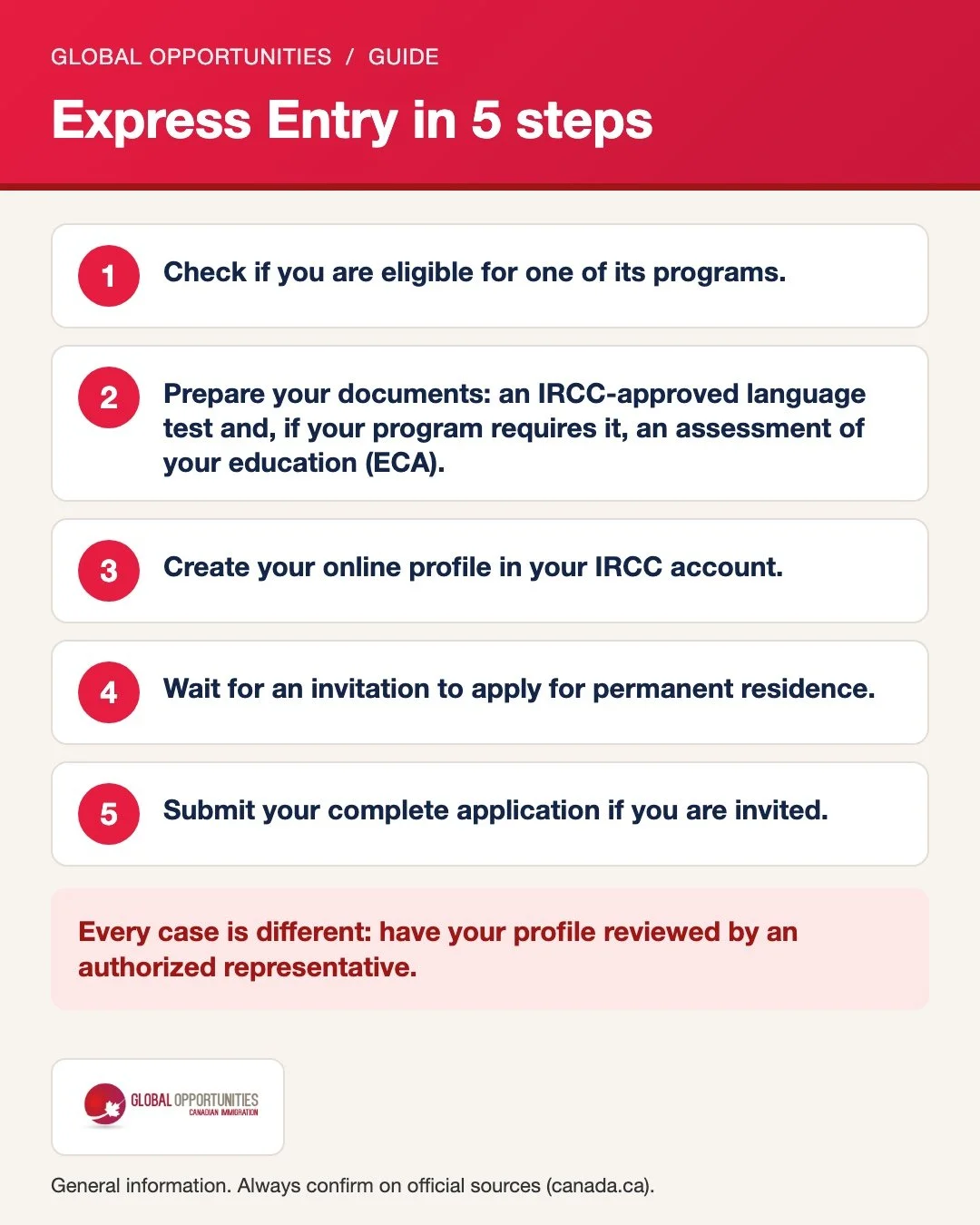
The three programs are the Federal Skilled Worker Program, the Canadian Experience Class and the Federal Skilled Trades Program, each explained below. IRCC compares their minimum requirements side by side on its who can apply page. You do not choose "one program" when you create a profile: the system checks which ones you are eligible for.
How the Express Entry process works
IRCC describes the process in four steps (Express Entry, canada.ca):
Create a profile and enter the pool. If you meet the minimum requirements of at least one of the three programs, IRCC places you in the pool.
IRCC invites candidates in rounds. Candidates in the pool are ranked with the Comprehensive Ranking System (CRS), a points-based score, and IRCC invites the highest-ranked candidates in rounds of invitations.
If you are invited, you apply. An invitation to apply (ITA) lets you submit a complete online application within a deadline IRCC sets.
IRCC reviews your application and makes a decision. It checks that you meet the program requirements, that your profile was accurate and that you are admissible to Canada.
What the Comprehensive Ranking System looks at
According to IRCC's CRS criteria page, the CRS looks at core human capital factors (such as age, education, official languages and Canadian work experience), factors for an accompanying spouse or partner, skill transferability and additional factors such as a provincial nomination or French ability. IRCC's official CRS tool lets you estimate your score.
Being in the pool does not mean you will be invited. Candidates are ranked against each other, and the scores invited change from round to round. IRCC can run general rounds, program-specific rounds and category-based rounds, and publishes every result on its rounds of invitations page. Your profile is a declaration: if you are invited, your documents must support everything you declared, so be accurate and keep it up to date.
Watch our recorded live session on the difference between applying and being selected for permanent residence.
Please note: Based on IRCC's Express Entry and CRS pages, as of November 2026. A CRS estimate from the official tool is not an invitation, and being in the pool does not mean IRCC will invite you or approve an application. We do not quote scores or cut-offs because they change with every round.
Federal Skilled Worker Program (FSWP)
The Federal Skilled Worker Program is the Express Entry program for skilled workers with foreign work experience who want to immigrate to Canada permanently. A job offer is not required (Federal Skilled Workers, canada.ca).
Minimum requirements of the Federal Skilled Worker Program
According to IRCC's Federal Skilled Workers page, in general terms you need:
Skilled work experience in an occupation in TEER category 0, 1, 2 or 3 of the National Occupational Classification, in your primary occupation. It must be recent, paid and continuous, full-time or an equal amount of part-time work, in Canada or abroad. Unpaid work and volunteering do not count.
Language ability: an approved English or French test with the minimum level in speaking, listening, reading and writing.
Education: a Canadian secondary or post-secondary credential, or a completed foreign credential with an Educational Credential Assessment (ECA).
Proof of funds, unless you can already legally work in Canada and have a valid job offer. The amount depends on your family size and is updated by IRCC, so it depends on each case; a consultation is the way to know what applies to you (proof of funds, canada.ca).
Admissibility, and a plan to live outside Quebec.
The selection factors
According to IRCC's six selection factors page, the FSWP also uses a selection factors grid with six factors: language skills, education, skilled work experience, age, arranged employment in Canada and adaptability. You must reach the minimum pass mark to be eligible. This grid is separate from the CRS: the grid decides whether you can enter the pool as a federal skilled worker, and the CRS decides your rank inside it.
Please note: Requirements as published by IRCC on its Federal Skilled Workers pages, as of November 2026. Meeting the minimum requirements lets you enter the pool; it does not mean IRCC will invite you or approve an application.
Who the FSWP usually suits
Professionals and skilled workers abroad without Canadian experience or a job offer, such as accountants, engineers, nurses, IT specialists, teachers or technicians with strong English or French. If your profession is regulated, the FSWP does not give you a licence; plan that in parallel. More from Global: Federal Skilled Worker.
NOC codes and TEER categories, in brief
Every job in Canada has a National Occupational Classification (NOC) code and a TEER category (Training, Education, Experience and Responsibilities), from 0 to 5. You choose your code on the official NOC website by matching the duties you actually performed, not your job title (find your NOC, canada.ca). Choosing a code your duties do not support can lead to a refusal or a finding of misrepresentation. We explain NOC codes profession by profession in Immigrate to Canada as a professional.
Canadian Experience Class (CEC)
The Canadian Experience Class is the Express Entry program for skilled workers who have Canadian work experience and want to become permanent residents (Canadian Experience Class, canada.ca).
Who the Canadian Experience Class is for
The CEC suits people who already work in Canada with a temporary permit, such as graduates with a post-graduation work permit, workers with employer-specific or open permits, or IEC participants in skilled jobs.
Canadian work experience requirements
According to IRCC's Canadian Experience Class page, your Canadian work experience must meet all of these conditions:
It is in one or more occupations in TEER 0, 1, 2 or 3 of the NOC. It can be in more than one job or NOC.
It was gained working in Canada while authorized to work under temporary resident status. If you worked remotely, you must have been physically in Canada and working for a Canadian employer.
It shows that you performed the actions in the lead statement of the NOC description and most of the main duties listed.
It was paid work, with wages or commission. Volunteer work and unpaid internships do not count.
It adds up to the minimum amount of skilled work experience within the recent period that IRCC sets. Full-time and part-time work can be combined in the ways IRCC explains on its page.
Work experience that does not count for the CEC
IRCC's Canadian Experience Class page lists situations in which you cannot count work experience:
if you were studying full-time while you worked (co-op work terms do not count either);
if you were self-employed (IRCC has a temporary exception for some physicians who provided publicly funded medical services);
if you were a volunteer or unpaid intern;
if you were not legally allowed to work in Canada.
Language and education for the CEC
Language: you must take an approved English or French test and meet the minimum score in all four abilities. The minimum level depends on the TEER category of your occupation; IRCC lists it on its who can apply page.
Education: according to IRCC, there is no education requirement for the Canadian Experience Class. However, education can improve your rank in the Express Entry pool: Canadian credentials count, and foreign credentials count if you have a completed credential and an ECA report.
Job offer: not required, according to IRCC.
More from Global: Canadian Experience Class. If you already have skilled work experience in Canada, watch our live session on why being eligible is not the same as being selected.
Please note: Requirements as published by IRCC on its Canadian Experience Class and who can apply pages, as of November 2026. Having Canadian work experience does not by itself make you eligible: every condition must be met, and IRCC decides each case.
Federal Skilled Trades Program (FSTP)
The Federal Skilled Trades Program is the Express Entry program for skilled workers who want to become permanent residents based on being qualified in a skilled trade (Federal Skilled Trades, canada.ca).
Which trades count for the FSTP
When we reviewed IRCC's Federal Skilled Trades page in November 2026, the eligible trades were grouped by NOC: Major Group 72 (excluding Sub-Major Group 726), Major Groups 73, 82, 83, 92 and 93 (for 92 and 93, excluding Sub-Major Group 932), Minor Group 6320 and Unit Group 62200. In plain words, this covers many industrial, electrical, construction, maintenance and equipment trades, general trades, supervisors in natural resources and agriculture, some processing and manufacturing supervisors, cooks, butchers and bakers, and chefs. Check your exact code on the NOC website and the current list on IRCC's page.
Minimum requirements of the FSTP
According to IRCC's Federal Skilled Trades page, in general terms you need:
Work experience in one skilled trade, all under the same NOC, showing that you performed the lead statement and most main duties, and that you met the job requirements of that NOC (except for needing a certificate of qualification). It must be paid work, gained in a place where you were qualified to practise the trade, within the recent period IRCC sets.
A valid job offer of full-time employment or a certificate of qualification in your trade issued by a Canadian provincial, territorial or federal authority.
Language results from an approved test, with the minimum level in all four abilities.
Proof of funds, unless you can already legally work in Canada and have a valid job offer.
No education requirement, although education can improve your rank in the pool.
Admissibility, and a plan to live outside Quebec.
What a certificate of qualification means
A certificate of qualification is issued by a provincial or territorial trade authority, usually after it assesses your experience and you pass a certification exam. We explain it trade by trade, including the Red Seal, in our professionals guide. More from Global: Federal Skilled Trades Program.
Please note: Eligible trade groups and requirements as published by IRCC, as of November 2026. A certificate of qualification lets you work in a trade in that province or territory; it is not an immigration approval, and IRCC decides each application.
Express Entry category-based selection
In category-based rounds, IRCC invites candidates who are eligible for a specific category established by the Minister to meet an economic goal, based on criteria such as official language ability, work experience in a specific occupation or education (category-based selection, canada.ca).
The current categories
When we reviewed IRCC's category-based selection page in November 2026, the categories were:
French-language proficiency;
healthcare and social services occupations;
science, technology, engineering and math (STEM) occupations;
trade occupations;
education occupations;
transport occupations;
physicians with Canadian work experience;
senior managers with Canadian work experience;
researchers with Canadian work experience;
skilled military recruits.
Each occupational category is defined by a list of NOC codes. For example, when we reviewed it, the transport category listed mechanics and technicians rather than truck drivers, and the STEM category included certain engineering occupations and cybersecurity specialists, but not software developers. We go occupation by occupation in our professionals guide.
Three rules to remember about categories
Categories change. According to IRCC, it monitors them regularly, and occupations are added and removed.
You do not apply to a category. IRCC identifies eligible candidates from the information in their Express Entry profile. You still need to qualify for one of the three programs.
A category is not a guarantee. IRCC says category-based rounds are meant to supplement other round types, and that it may not need a category-based round if enough eligible candidates are already invited through general or program-specific rounds.
That is why we do not recommend choosing a career, a study program or a life plan based only on a category. More from Global: Express Entry, Category-based selection and French-language proficiency. Nurses can read our nurse immigration guide.
A dedicated page for medical doctors
IRCC has a page called Live and work as a medical doctor in Canada that groups the options for doctors, separating those who have worked as a medical doctor in Canada from those who haven't. It lists Express Entry, including a category for medical doctors; regional, provincial and territorial programs; the Provincial Nominee Program; and a work permit for doctors nominated by a province or territory, so they can work while they wait for permanent residence. According to IRCC, doctors first need to have their foreign credentials assessed and to get licensed as a medical doctor through a provincial or territorial regulatory authority. Our professionals guide explains the licensing side. Hear from professionals who made the move, including a doctor, on our success stories page (in Spanish).
Please note: Categories as listed by IRCC in November 2026, and options for doctors as described on IRCC's medical doctors page in November 2026. Being eligible for a category does not mean IRCC will hold a round for it or invite you. How much French ability helps depends on each case; a consultation is the way to know.
What is a Provincial Nominee Program (PNP)?
Provincial Nominee Programs let provinces and territories nominate people who have the skills, education and work experience to help their economy, who want to live in that province or territory and who want to become permanent residents of Canada (Immigrate as a provincial nominee, canada.ca). Each province and territory has its own requirements and sets the number of people it can nominate.
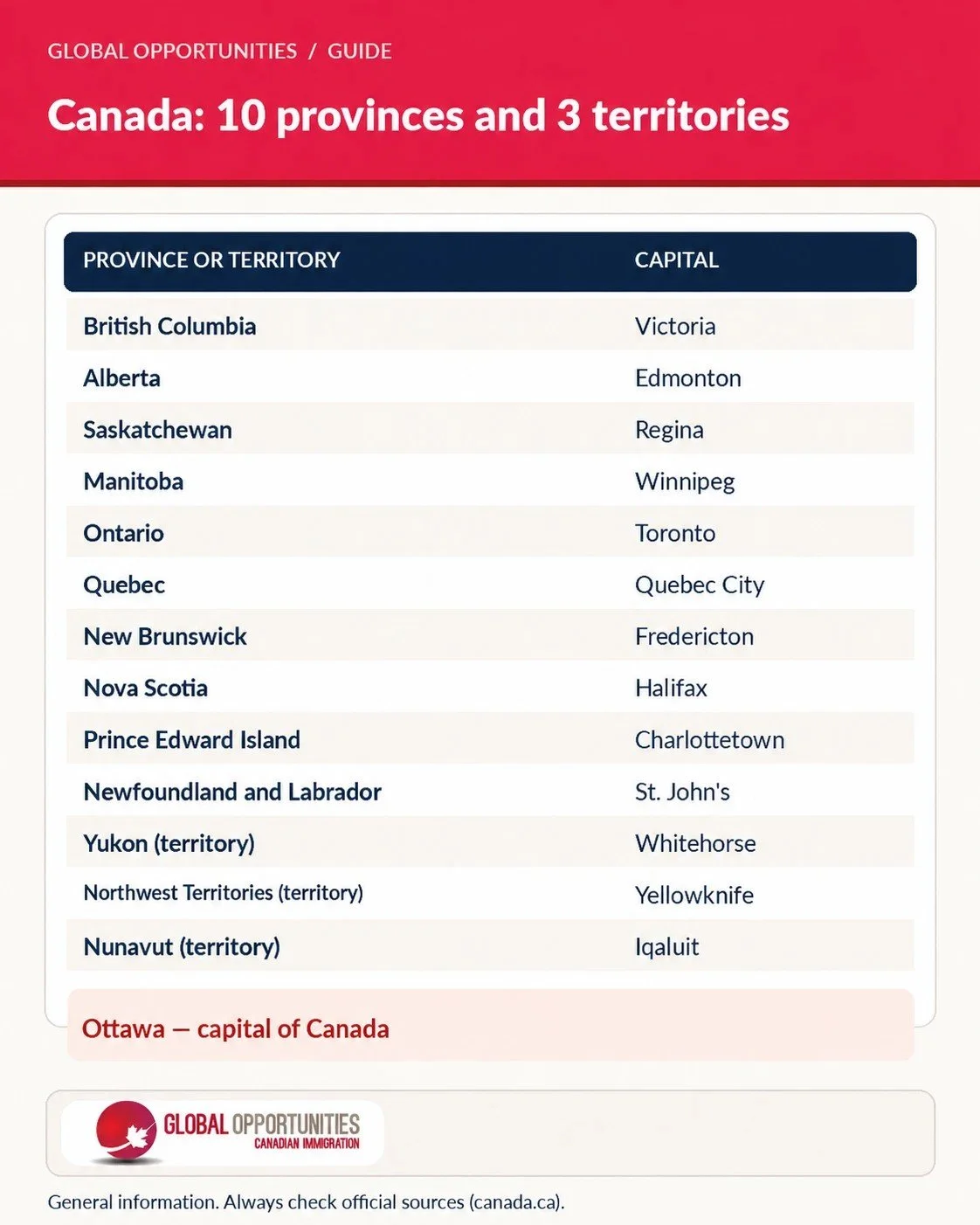
Provinces organize their programs in streams (some call them categories or pathways), which target groups such as students, business people, skilled workers, semi-skilled workers and specific occupations. Streams open, close and change often, sometimes from one month to the next. Quebec and Nunavut do not have Provincial Nominee Programs.
Base vs enhanced nomination: the two ways to apply
IRCC's provincial nominees page explains that there are two ways to apply for permanent residence through the PNP, and that the province or territory will tell you which one applies:
Enhanced nomination (through Express Entry): for people who qualify for a provincial stream and for one of the three Express Entry programs. You can apply to the province directly, or create an Express Entry profile and select the provinces that interest you; if a province sends a "notification of interest" to your account, you contact it and apply. If you are nominated, you show the nomination in your profile, receive additional CRS points that help you get invited, and apply online if IRCC invites you.
Base nomination (outside Express Entry): for people who qualify for a provincial stream but not for a federal Express Entry program. You apply to the province for a nomination and, if you are nominated, you apply to IRCC for permanent residence through the non-Express Entry process (non-Express Entry PNP, canada.ca).
In both cases, IRCC makes the final decision on permanent residence.
How provinces select candidates
According to the provincial program pages we link below, most provinces now use an expression of interest (EOI) model: you create a profile in the province's system, and the province invites selected candidates to apply, based on its labour market needs, priority sectors, available nominations and other criteria. An EOI is not an application, and being in a pool does not guarantee an invitation. Some streams are employer-driven: the process starts with a provincial employer, not with the candidate. Many streams require a job offer from an employer in the province; others do not, and which ones are open changes constantly. More from Global: Provincial Nominee Programs.
Provincial Nominee Programs province by province
Below is a short overview of each program as it appeared on its official website when we reviewed it in November 2026. Streams change often; always confirm on the official page. Each of our province guides explains the program in more detail, along with housing, health care, transit, jobs and daily life.
Ontario: Ontario Immigrant Nominee Program (OINP)
When we reviewed the official page, Ontario said the OINP is changing: the new Ontario Workforce Priority stream had launched for eligible skilled foreign workers with a qualifying job offer and eligible self-employed physicians, all other streams were closed, and more changes were coming. For candidates with a job offer, the employer starts the process through the employer portal (Ontario Workforce Priority stream). Official page: OINP. More from Global: Living in Ontario.
British Columbia: BC Provincial Nominee Program (BC PNP)
According to WelcomeBC, the BC PNP's worker streams generally require a full-time, indeterminate job offer from an eligible employer, and an Express Entry BC option links the nomination to a federal profile. The province's news page describes skills immigration priorities around Care, Build and Innovate. Check the current Skills Immigration guide. Official page: BC PNP. More from Global: Living in British Columbia.
Alberta: Alberta Advantage Immigration Program (AAIP)
When we reviewed it, the AAIP had worker streams, for people who live and work in Alberta or plan to, and entrepreneur streams, for people who plan to start or buy a business there. Changes are listed on the AAIP updates page. Official page: AAIP. More from Global: Living in Alberta.
Saskatchewan: Saskatchewan Immigrant Nominee Program (SINP)
The Government of Saskatchewan groups SINP programs into categories, each with sub-categories and its own requirements (browse SINP programs), and publishes FAQs about recent changes. Official page: SINP. More from Global: Living in Saskatchewan.
Manitoba: Manitoba Provincial Nominee Program (MPNP)
According to the Government of Manitoba's official MPNP site, the MPNP has three pathways: the Skilled Worker Stream, the International Education Stream (for Manitoba graduates) and the Business Investor Stream, and it uses expression of interest profiles. Manitoba reminds users that its only official MPNP websites are immigratemanitoba.com and its French version. Official page: MPNP. More from Global: Living in Manitoba.
Nova Scotia: Nova Scotia Nominee Program (NSNP)
According to the Government of Nova Scotia's NSNP page, you choose a stream and submit an expression of interest, and the province selects candidates based on labour market needs, sector priorities and program capacity. Being in the pool does not guarantee selection. Official page: NSNP. More from Global: Living in Nova Scotia.
New Brunswick: New Brunswick Provincial Nominee Program (NBPNP)
According to the Government of New Brunswick's NBPNP page, streams have included New Brunswick Skilled Worker, New Brunswick Express Entry and Business Immigration. You start with an expression of interest, which the province says is not a complete application and does not guarantee an invitation. Official page: NBPNP. More from Global: Living in New Brunswick.
Prince Edward Island: PEI Provincial Nominee Program
According to the Government of Prince Edward Island, PEI has streams for people working in the province, PEI graduates, a PEI Express Entry stream and streams employers can use to recruit from abroad. Official page: Immigrate to PEI as a worker. More from Global: Living in Prince Edward Island.
Newfoundland and Labrador: NLPNP
According to the Government of Newfoundland and Labrador, categories have included Express Entry Skilled Worker, Skilled Worker, International Graduate, International Entrepreneur and International Graduate Entrepreneur. An expression of interest model can lead to an invitation to the NLPNP or the Atlantic Immigration Program. Official page: NLPNP. More from Global: Living in Newfoundland and Labrador.
Yukon, Northwest Territories and Nunavut
Yukon has the Yukon Nominee Program for workers and the Yukon Business Nominee Program, closely tied to local employers (IRCC, provincial nominees).
Northwest Territories: you generally need a job offer from an NWT employer, or to open, buy or invest in a business there (Immigrate NWT).
Nunavut has no nominee program, as IRCC's provincial nominees page shows; people use federal programs such as Express Entry.
More from Global: Yukon, Northwest Territories and Nunavut.
Please note: Program descriptions as published by each provincial and territorial government and by IRCC, as of November 2026. Streams, priorities and selection rules change often. Being in an EOI pool or meeting a stream's criteria does not mean you will be invited or nominated, and a nomination does not mean IRCC will approve permanent residence. Be wary of anyone who promises a nomination, permanent residence or a job.
Quebec immigration: a separate system
Quebec has a special agreement on immigration with the Government of Canada, so it selects its own skilled workers. If you want to live in Quebec as a skilled worker, you apply to Quebec first and, if Quebec selects you, you then apply to IRCC for permanent residence (Quebec-selected skilled workers, canada.ca). The Government of Quebec manages its process through its own platform, which starts with an expression of interest (Immigration in Québec, quebec.ca). IRCC publishes the Canada–Quebec agreement among its federal-provincial agreements.
Global Opportunities does not offer services for Quebec's immigration programs. If Quebec is your goal, consult the Government of Quebec directly and an authorized representative who works with Quebec's programs.
French speakers who prefer to live outside Quebec can look at the French-language proficiency category of Express Entry, Francophone provincial streams and LMIA-exempt work permits for French-speaking workers outside Quebec. More from Global: French-language proficiency and our guide to English and French tests for Canada.
Atlantic Immigration Program
The Atlantic Immigration Program is a pathway to permanent residence for skilled foreign workers and international graduates from a Canadian institution who want to work and live in New Brunswick, Nova Scotia, Prince Edward Island or Newfoundland and Labrador (Atlantic Immigration Program, canada.ca). IRCC says it helps employers hire qualified candidates for jobs they have not been able to fill locally.
How the Atlantic Immigration Program works
According to IRCC's Atlantic Immigration Program page, in general terms:
An employer is designated. Employers must first be designated by the province where the candidate will work. Each province has its own process.
You receive a job offer from a designated employer that meets the program requirements.
You prepare a settlement plan with a settlement service provider, as the program requires.
The province endorses the job offer and issues a referral or endorsement letter.
You apply to IRCC for permanent residence.
You must be either a recent graduate of a recognized post-secondary institution in Atlantic Canada or a skilled worker who meets the program's requirements. You can be living abroad or in Canada as a temporary resident. With a qualifying job offer and a referral letter from the province, you may be able to apply for a work permit so you can start working while you wait, IRCC says.
Please note: Based on IRCC's Atlantic Immigration Program page, as of November 2026. A job offer from a designated employer and a provincial endorsement are steps in the process, not an approval: IRCC decides each application for permanent residence.
Family sponsorship in Canada
Canadian citizens and permanent residents may be able to sponsor certain family members to become permanent residents, so they can live, study and work in Canada (sponsor your family members, canada.ca). Being a sponsor comes with responsibilities: the sponsor signs an undertaking to support the person financially for a period IRCC sets, and must meet eligibility rules.
Sponsoring a spouse, common-law partner, conjugal partner or child
When we checked in November 2026, IRCC listed this program as open (sponsor your spouse, partner or child, canada.ca). It covers:
Spouses: people legally married to the sponsor.
Common-law partners: people who have lived with the sponsor in a conjugal relationship for the period IRCC defines.
Conjugal partners: a narrow category for partners who could not live together or marry because of significant legal or immigration barriers, as IRCC explains.
Dependent children, as IRCC defines them.
IRCC says sponsored family members can apply for an open work permit in some situations, which lets them work while the process continues. The relationship must be genuine: IRCC assesses it, and lying about a relationship is fraud with serious consequences. IRCC has a page on marriage fraud in its fraud and scams section. More from Global: spouse, common-law or conjugal partner sponsorship and sponsorship for dependent children.
Sponsoring parents and grandparents
When we checked in November 2026, IRCC showed the Parents and Grandparents Program as paused. Its page said it was not accepting new interest to sponsor forms or inviting potential sponsors to apply until further notice, and that it would keep processing existing applications (sponsor your parents and grandparents, canada.ca). Check the current status on that page; it can change.
Parents and grandparents may be eligible for a super visa, a visitor visa that lets them visit their children or grandchildren for long stays, with requirements that include private medical insurance and a minimum income for the host (super visa, canada.ca). A super visa is a visitor status: it does not give the right to work or permanent residence. More from Global: parents and grandparents sponsorship and the super visa for parents and grandparents.
Other relatives
IRCC also explains when you can sponsor an adopted child or certain other relatives, only in specific situations (other relatives, canada.ca). According to IRCC, brothers, sisters, cousins, aunts and uncles cannot generally be sponsored just because of the family relationship. More from Global: Family sponsorship.
Watch our recorded live session on family sponsorship in Canada for a general overview, and see our recorded family sponsorship seminar. Read more in our articles on family sponsorship in Canada and spousal sponsorship.
Please note: Program status and definitions as published by IRCC on its family sponsorship pages, as of November 2026. Programs can open, pause or change without notice. Meeting the definition of a spouse, partner or child does not mean IRCC will approve a sponsorship; IRCC assesses each relationship and each sponsor.
Studying in Canada as a path to permanent residence
Studying in Canada is a temporary route. It does not guarantee permanent residence, and the rules connecting study to permanent residence have changed several times. It makes sense when the education itself is right for you.

Study permits and designated learning institutions
According to IRCC, most foreign nationals need a study permit, and to apply you need a letter of acceptance from a designated learning institution (DLI), a school approved by a province or territory to host international students (designated learning institutions list, canada.ca). Many applicants also need a provincial or territorial attestation letter (PAL) (provincial attestation letter, canada.ca). IRCC's study permit page explains how to apply, the proof of financial support required and the conditions you must respect, including working while you study. Our province guides describe each province's colleges and universities and how to apply.
After you graduate: the post-graduation work permit
Graduates of certain DLIs and programs may be eligible for a post-graduation work permit (PGWP), an open work permit, and IRCC notes that experience gained after graduating may help you qualify for permanent residence (post-graduation work permit, canada.ca). Not every program leads to a PGWP, and IRCC has added conditions over time; check the PGWP eligibility page before you choose a program, not after.
Study, then work, then permanent residence
The typical path is study permit, graduation, PGWP, skilled Canadian work experience, then the Canadian Experience Class or a provincial stream. Every link has its own rules, and any of them can change while you study, so choose a program you would value even if they did.
Please note: Based on IRCC's study permit, DLI, PAL and PGWP pages, as of November 2026. Being accepted by a DLI does not mean IRCC will issue a study permit, and graduating does not mean you will get a PGWP or permanent residence. Check the linked pages for the rules that apply on the day you apply.
Work permits and the LMIA
Most people need a work permit to work in Canada. A work permit is temporary: it lets you work, but it does not make you a permanent resident. There are two types: employer-specific and open work permits (work in Canada, canada.ca).
Employer-specific and open work permits
An employer-specific work permit lets you work under the conditions written on it: the employer, the location and the occupation. You need a job offer from an employer who is not on the list of non-compliant employers (employer-specific work permits, canada.ca), and the employer usually needs a positive LMIA or an LMIA exemption. To change employers, you generally need a new permit.
An open work permit lets you work for almost any employer, without a job offer. But IRCC is clear that most people applying from outside Canada cannot get one: they exist only in specific situations, such as post-graduation work permits, the IEC Working Holiday category, certain family members of workers, students and permanent residence applicants, bridging permits and vulnerable workers (open work permits, canada.ca). IRCC has narrowed the rules for family members over time, so check them before you plan a family move.
What is an LMIA?
A Labour Market Impact Assessment (LMIA) is a document that determines whether hiring a temporary foreign worker will have a positive or negative effect on Canada's labour market. A positive LMIA confirms that no Canadians or permanent residents are available to do the job and that there is a need for a temporary foreign worker (find out if you need an LMIA, canada.ca).
The employer applies, not the worker. ESDC manages the Temporary Foreign Worker Program and issues the decision (Temporary Foreign Worker Program, canada.ca).
According to ESDC, most employers need an LMIA before hiring a temporary foreign worker, and usually must show they tried to hire Canadians first.
With a positive LMIA, the worker applies for a work permit. LMIA rules, especially for low-wage positions, change often.
More from Global: LMIA: Labour Market Impact Assessment.
LMIA-exempt work permits
Some work permits do not need an LMIA. They go through the International Mobility Program (International Mobility Program, canada.ca). IRCC's examples include French-speaking workers outside Quebec, some Global Skills Strategy applicants, the IEC Young Professionals and International Co-op categories, and workers under a free trade agreement (who you can hire, canada.ca). Each exemption has its own code and conditions. If you are a citizen of a country that has a free trade agreement with Canada, see our pages on work permits under CUSMA and on the agreements with Chile, Colombia, Peru and Panama. Our professionals guide explains how these agreements work for professionals.
Intra-company transferees
If you work for a multinational company and are coming to work at its parent company, subsidiary, branch or affiliate in Canada, you may be eligible as an intra-company transferee (company transfers, canada.ca). IRCC describes two types: transferees under a trade agreement, and transferees who bring significant economic benefit by sharing expertise. According to IRCC, in general, you must currently work for the company, transfer to a related company that does business in Canada and abroad, and move into an executive, senior managerial or specialized knowledge role. A mailing address or shared workspace in Canada does not qualify.
CUSMA professionals
Under the Canada–United States–Mexico Agreement (CUSMA), US and Mexican citizens can work temporarily at a professional level in listed occupations, such as engineer, accountant, registered nurse and computer systems analyst, with pre-arranged employment and the qualifications the list requires. For regulated professions, the person must have or be able to get the provincial licence, and self-employment is not allowed (CUSMA professionals, IRCC).
Your rights and fake job offers
No one can guarantee you a job or a visa to Canada, IRCC warns, and you should be careful if a salary seems too high to be real (online and telephone scams, canada.ca). Employers of temporary foreign workers cannot make you pay to get or keep your job, or make you reimburse recruitment fees; as a worker, you only pay for your work permit, medical exam and biometrics, if required (foreign workers' rights, canada.ca). Apply to extend your permit before it expires, and respect its conditions.
To look for work, use Job Bank and employers' own websites. Global Opportunities does not offer jobs, does not recruit workers and does not sell job offers.
Please note: Based on IRCC and ESDC work permit, LMIA and foreign workers' rights pages, as of November 2026. A job offer or a positive LMIA does not mean IRCC will issue a work permit, and a work permit does not lead to permanent residence on its own. IRCC and ESDC decide each case.
Working Holiday in Canada (IEC)
International Experience Canada (IEC) lets young people from countries or territories that have a youth mobility arrangement with Canada travel and work in Canada for a limited time (IEC eligibility, canada.ca).
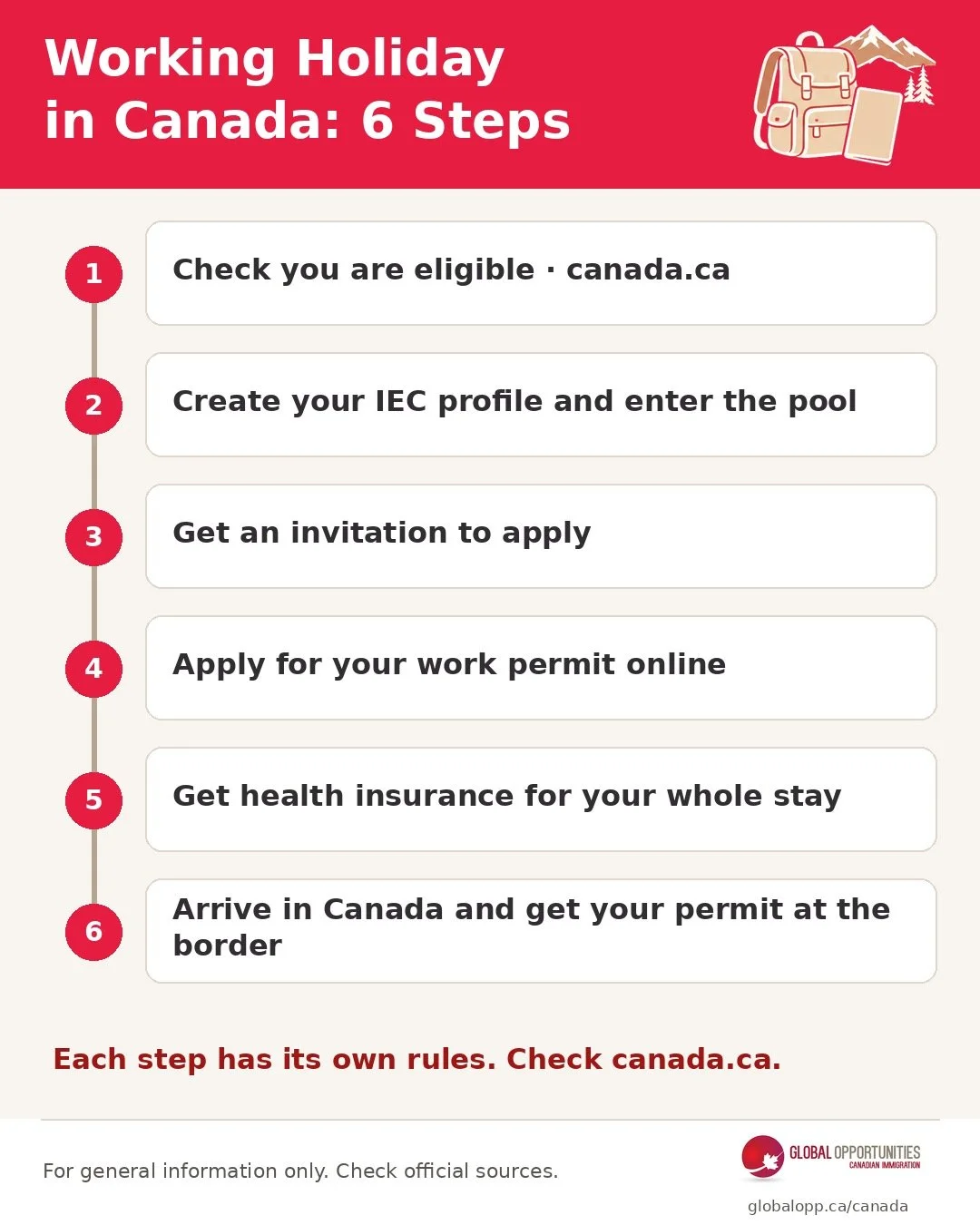
The three IEC categories
According to IRCC's IEC page:
Working Holiday: an open work permit, so you can work for almost any employer.
Young Professionals: an employer-specific permit for a job that counts toward your professional development (generally TEER 0 to 3).
International Co-op (Internship): for students who need a work placement to complete their studies.
Which categories you can use, the age range, how many times you can participate and the length of the permit all depend on your country of citizenship; the list is on IRCC's IEC page. IRCC also lists recognized organizations that can help some participants.
How IEC seasons and pools work
According to IRCC's IEC page, IEC works in seasons: you create a profile, enter a pool and may receive an invitation to apply. When we checked in November 2026, IRCC said the current season was closed, that people who had received an invitation could still submit their work permit application, and that others could create a new profile when pools reopen for the next season. Check the IEC page for the current season.
IEC and permanent residence
IEC is temporary and does not lead to permanent residence on its own. Some participants later qualify for other programs, for example if they gain skilled Canadian work experience that counts for the Canadian Experience Class. More from Global: Working Holiday in Canada and our country guides, including Working Holiday in Canada for Irish citizens, Moving to Canada from Australia and Moving to Canada from Europe.
Please note: IEC rules as published by IRCC, as of November 2026. Categories, age limits and the number of participations depend on your country of citizenship; being in a pool does not mean you will be invited, and an invitation does not mean IRCC will approve a work permit.
Refugees and humanitarian protection: the basics
Canada's refugee system protects people who cannot safely return to their home country. IRCC is clear that claiming asylum is not a shortcut to immigrate to Canada or to stay in the country (refugees and asylum, canada.ca).
In very general terms, according to IRCC's refugee pages:
Claiming asylum in Canada: people who are in Canada, or at a port of entry, and fear persecution or serious harm in their home country can make a claim. The Immigration and Refugee Board of Canada (IRB), an independent tribunal, decides most claims (claim protection inside Canada, canada.ca; IRB).
Resettlement from outside Canada: refugees abroad are referred to Canada and can be resettled as permanent residents through the Government-Assisted Refugees Program or private sponsorship by groups in Canada. You cannot apply directly for resettlement on your own (help outside Canada, canada.ca). When we checked, IRCC marked some private sponsorship options as paused.
Humanitarian and compassionate grounds: in exceptional cases, people in Canada may ask IRCC to consider their situation on humanitarian and compassionate grounds. This is not a program you can plan for; it is decided case by case.
These are legal matters with serious consequences: get advice from a lawyer or legal aid. Global Opportunities does not offer services for refugee or asylum claims.
Please note: A very general summary of IRCC and IRB pages, as of November 2026. It is not a description of who qualifies for protection: each claim is decided individually by the IRB or IRCC.
Permanent resident vs Canadian citizen
Permanent residence and citizenship are two different statuses. A permanent resident is not a Canadian citizen; citizenship is a separate application that you can make later, once you meet the requirements.
In general terms, according to IRCC's understand PR status page:
Living and working: both can live, work and study anywhere in Canada.
Keeping the status: permanent residents must meet a residency obligation and can lose their status in some situations; IRCC explains the rules on its PR status page. Citizens do not have a residency obligation.
Voting and some jobs: permanent residents cannot vote or run for political office, and cannot hold some jobs that need a high-level security clearance (understand PR status, canada.ca).
Travel document: permanent residents travel with their own country's passport and their PR card; citizens can apply for a Canadian passport.
How to become a Canadian citizen
According to IRCC's citizenship eligibility page, adults can apply once they are permanent residents and meet requirements that include enough physical presence in Canada, tax filing if they had to file, language proof and the citizenship test for some age groups, no prohibitions, and the oath. For every requirement, the test, children and the ceremony, read our guide to Canadian citizenship. More from Global: the Canadian passport.
Please note: Citizenship requirements as published by IRCC, as of November 2026. Days spent in Canada before becoming a permanent resident count only in the way IRCC's calculator explains, and meeting the physical presence rule does not mean IRCC will grant citizenship; IRCC decides each application.
How to choose an immigration pathway to Canada
There is no "best" program for everyone. The right pathway depends on your education, work experience, English or French, family situation, savings, occupation, age and where you want to live. These starting points only tell you which official pages to read first.
A simple order to follow:
Find your NOC code and TEER category for your main occupation.
Check whether your occupation is regulated in the province or territory you are considering.
Be realistic about your English and French, and whether you could improve them.
Check whether your education can be assessed with an Educational Credential Assessment (ECA).
Use IRCC's free Explore immigration programs tool to see which programs to read about.
Read the official page of each pathway on your shortlist, including the provincial streams for the places you are considering.
Get a personalized review before you spend money on tests, assessments or applications.
By your situation
Skilled professional abroad, no job offer: Express Entry (mainly the FSWP) and linked provincial streams; plan any licence in parallel (professionals guide).
Already working in Canada: the Canadian Experience Class and provincial streams for local workers.
International graduate in Canada: the post-graduation work permit, then the CEC or a provincial graduate stream.
Tradesperson: the Federal Skilled Trades Program, the trade category and provincial trade streams.
Job offer from a Canadian employer: an LMIA or LMIA-exempt route, and possibly a provincial stream or the AIP.
Employee of a multinational: the intra-company transferee rules.
US or Mexican professional: CUSMA work permits first, then a permanent program.
French speaker: the French-language proficiency category and Francophone options outside Quebec.
Young, from an IEC country: International Experience Canada, with a plan for what comes next.
Want to study first: choose the program for the education, then check its study permit and PGWP rules.
Spouse or partner of a citizen or permanent resident: family sponsorship.
By where you come from and where you want to live
Visa requirements, document rules and programs such as IEC depend partly on your citizenship. Our country guides explain what is different for each region, always from the Canadian side: Moving to Canada from Asia, from Africa, from Europe, from Australia and Working Holiday in Canada for Irish citizens. Each province also has its own labour market, nominee program, climate and cost of living: read its guide (linked in the province-by-province section above) before you choose it.
Questions to ask yourself before choosing
What is my occupation in the NOC, and what TEER category is it?
Is my occupation regulated in the province I am considering?
What are my realistic English and French levels, and could I improve them?
Is my education complete, and can it be assessed?
Can I document my skilled, paid experience with detailed letters?
Do I have, or could I get, a genuine job offer?
Who is coming with me, and what does each family member need?
Do I have the savings my program and my first months will require?
Do I have past refusals, overstays, criminal records or medical issues to declare?
How many points do you need? There is no fixed number, and many pathways do not use the same points at all. We recommend a personalized review of your case before you spend money on tests, assessments or applications.
Step-by-step timeline to immigrate to Canada
We do not give durations, because they depend on your program, your country and IRCC's workload; IRCC publishes current processing times. But most permanent residence plans follow a similar order.
In short:
Learn how the system works and check whether you need a visa or an eTA.
Identify your NOC and whether your occupation is regulated, then shortlist pathways.
Take an approved language test.
Get an ECA, if your program requires it or it helps your profile.
Gather documents, such as reference letters, police certificates and translations.
Submit your profile or application on the official IRCC or provincial portal.
Respond to requests for biometrics, the medical exam or more documents within the deadlines.
Receive your confirmation of permanent residence, arrive and settle in.
Each phase is explained below.
Phase 1: understand and plan
Learn how the system works with this guide, the official pages it links and our recorded seminars in English and in Spanish.
Check whether you need a visa or an eTA with IRCC's tool: find out if you need a visa (canada.ca).
Identify your NOC and whether your occupation is regulated in the province you are considering, then shortlist pathways.
Phase 2: build your profile
Take an approved language test after preparing properly.
Get an ECA, if your program requires it or it helps your profile.
Request reference letters and start long-lead documents, such as police certificates and translations.
If your profession is regulated, open your file with the regulator in parallel when it makes sense.
Phase 3: apply
Submit your profile or application on the official IRCC or provincial portal, yourself or through an authorized representative.
Respond to invitations and requests within the deadlines set, including biometrics, the medical exam and any request for more documents.
Phase 4: approval and arrival
Receive your confirmation of permanent residence and, if needed, a visa.
Arrive and complete landing, or confirm your permanent residence online if you are already in Canada, as IRCC instructs.
Settle in with the steps in our Newcomers in Canada guide.
Documents checklist to immigrate to Canada
The exact list depends on your program and your country: always follow the checklist IRCC or the province gives you (Express Entry documents, canada.ca).
Identity and civil documents
Valid passport for you and each family member, and birth certificates.
Marriage, divorce or common-law documents, and custody documents for children if a parent is not coming.
Certified translations of any document not in English or French.
Language tests
For Express Entry, IRCC only accepts approved tests. When we reviewed its page, they were CELPIP-General, IELTS General Training and PTE Core for English, and TEF Canada and TCF Canada for French (language tests, canada.ca). IELTS Academic is not the accepted IELTS option for Express Entry, and results must still be valid when you apply. More in English and French tests for Canada.
Please note: Approved tests as listed by IRCC in November 2026. The list and the rules on how long results stay valid can change, and the minimum level depends on your program; check IRCC's language test page before you book.
Educational Credential Assessment (ECA)
According to IRCC, an ECA shows what your foreign degree or diploma is equivalent to in Canada, for immigration purposes. It is required for the Federal Skilled Worker Program if you studied outside Canada, and it can help your score in other cases (ECA, canada.ca). It must come from an IRCC-designated organization (designated organizations, canada.ca). An ECA is not a licence to practise: see ECA vs professional licence.
Work experience documents
According to IRCC's Express Entry documents page, you will generally need reference letters on company letterhead, with your title, duties, dates, hours per week and salary, signed by a supervisor or human resources, plus contracts, pay slips or tax records that support them.
Police certificates, medical exam and biometrics
Police certificates from the countries IRCC requires; some take a long time, so start early (police certificates, canada.ca).
Immigration medical exam: your own doctor cannot do it; you must use an IRCC-approved panel physician (medical exams, canada.ca).
Biometrics (fingerprints and photo) when IRCC asks (biometrics, canada.ca). No one can buy you a faster appointment.
Other documents
Proof of funds if your program requires it, a provincial nomination certificate, job offer or employer documents if they apply, digital photos to IRCC's specifications and a use of representative form if someone represents you. More from Global: Permanent resident in Canada: requirements.
How much does it cost to immigrate to Canada?
There is no single cost: it depends on the program, the number of family members and your country. We do not publish fees because they change; IRCC lists all its current fees on its official fee list. Here are the categories of cost.
Government fees
IRCC processing fees for the principal applicant, spouse or partner and each dependent child.
The right of permanent residence fee, which applies to many adult applicants.
Biometrics fees, when biometrics are required.
Provincial fees, for nominee program applications in provinces that charge them.
Employer fees, such as LMIA or compliance fees, which, according to ESDC's foreign workers' rights page, the employer cannot pass on to you.
Third-party costs
Language tests (each attempt is paid).
Educational Credential Assessment and the cost of sending transcripts from your university.
Police certificates from each country that requires one.
Immigration medical exam with a panel physician.
Certified translations of documents not in English or French.
Courier, photos and document certification.
Professional assessments and licensing, if your profession or trade is regulated: assessment, exams, bridging courses and registration.
Proof of funds is not a fee
According to IRCC's proof of funds page, settlement funds are your own money, which you must show in some programs to prove you can support your family when you arrive. You keep it; it is not paid to anyone. Whether you need to show funds, how much and in what form depends on each case, so we do not give figures: a consultation is the way to know what applies to you.
Moving and first-months costs
Flights, temporary housing, a rental deposit as allowed by provincial law, winter clothing, transit, a phone plan and living expenses until your first salary. Our province guides and the Newcomers in Canada guide cover rents, transit fares and other living costs with official sources and dates.
Please note: Fees and required amounts are set by IRCC, the provinces and third parties, and change; IRCC's fee list and each provider's site are the ones that count. Costs differ for every family, so this list is not a budget.
Admissibility: medical, criminal and misrepresentation
Meeting a program's requirements is not enough: you and your family members must also be admissible to Canada (inadmissibility, canada.ca).
IRCC's inadmissibility page lists several reasons why a person may be inadmissible, including:
security reasons, human or international rights violations and organized crime;
criminality, including offences such as impaired driving in some cases;
medical reasons, such as a condition that could endanger public health or cause excessive demand on health or social services, under the rules and exceptions IRCC explains;
financial reasons, if you cannot support yourself and your family;
misrepresentation, which means lying or withholding important information, or submitting false documents;
non-compliance with immigration law, such as past overstays or unauthorized work;
having an inadmissible family member.
To understand how officers assess applications, read Canada visa refusals: how IRCC evaluates applications. If you have a criminal record, including impaired driving, see the FAQ on criminal records below.
Why misrepresentation matters so much
According to IRCC's inadmissibility page, if IRCC finds misrepresentation, the consequences can include a refusal and a ban from applying for a period IRCC sets. It applies even if a representative or someone else filled out the form for you. Declare past refusals from any country, previous names, all family members and any criminal history honestly. If you are unsure whether something must be declared, ask before you submit.
Please note: Based on IRCC's inadmissibility pages, as of November 2026. Having one of these factors does not automatically mean you are inadmissible, and not having them does not mean you are admissible: IRCC assesses each person and each case.
Your first weeks after you arrive in Canada
Getting permanent residence or a permit is the start, not the end. Our Newcomers in Canada guide covers each step in detail, and each province guide adds local details. In short:
Social Insurance Number (SIN), which you need to work and to access government programs (Social Insurance Number, canada.ca).
Provincial health card, applying as soon as you are eligible, with private insurance for any gap.
Bank account, and a plan to build credit history.
Phone plan and housing, knowing your rights as a tenant.
Free newcomer services funded by IRCC, for jobs, language classes and more: find free newcomer services. IRCC also funds free pre-arrival services; see prepare for life in Canada.
School registration for children, and a driver's licence under your province's rules.
Job search, with a Canadian-style resume: our guide to working in Canada: resume, cover letter and interview explains resumes, cover letters, interviews and how to avoid job scams.
Immigration scams and authorized representatives
Scammers often target people who want to move to Canada. The best protection is knowing what the official process looks like.
What IRCC says it will never do
According to IRCC, its employees will never ask you to deposit money into a personal bank account, ask you to transfer money through a private money transfer service, threaten you, offer special deals to people who want to immigrate, or use free email services such as Gmail or Yahoo Mail to contact you (online and telephone scams, canada.ca). IRCC also warns about AI-generated videos and fake websites that promote "fast" or "guaranteed" immigration.
You do not need a representative
IRCC is clear that you do not need to hire a representative. Using one does not draw special attention to your application or mean it will be approved, and all forms and instructions are free on canada.ca (learn about representatives, canada.ca).
If you choose professional help, make sure the person is authorized and get a written contract that lists the services and fees (choose a representative, canada.ca).
Who can charge you for immigration advice
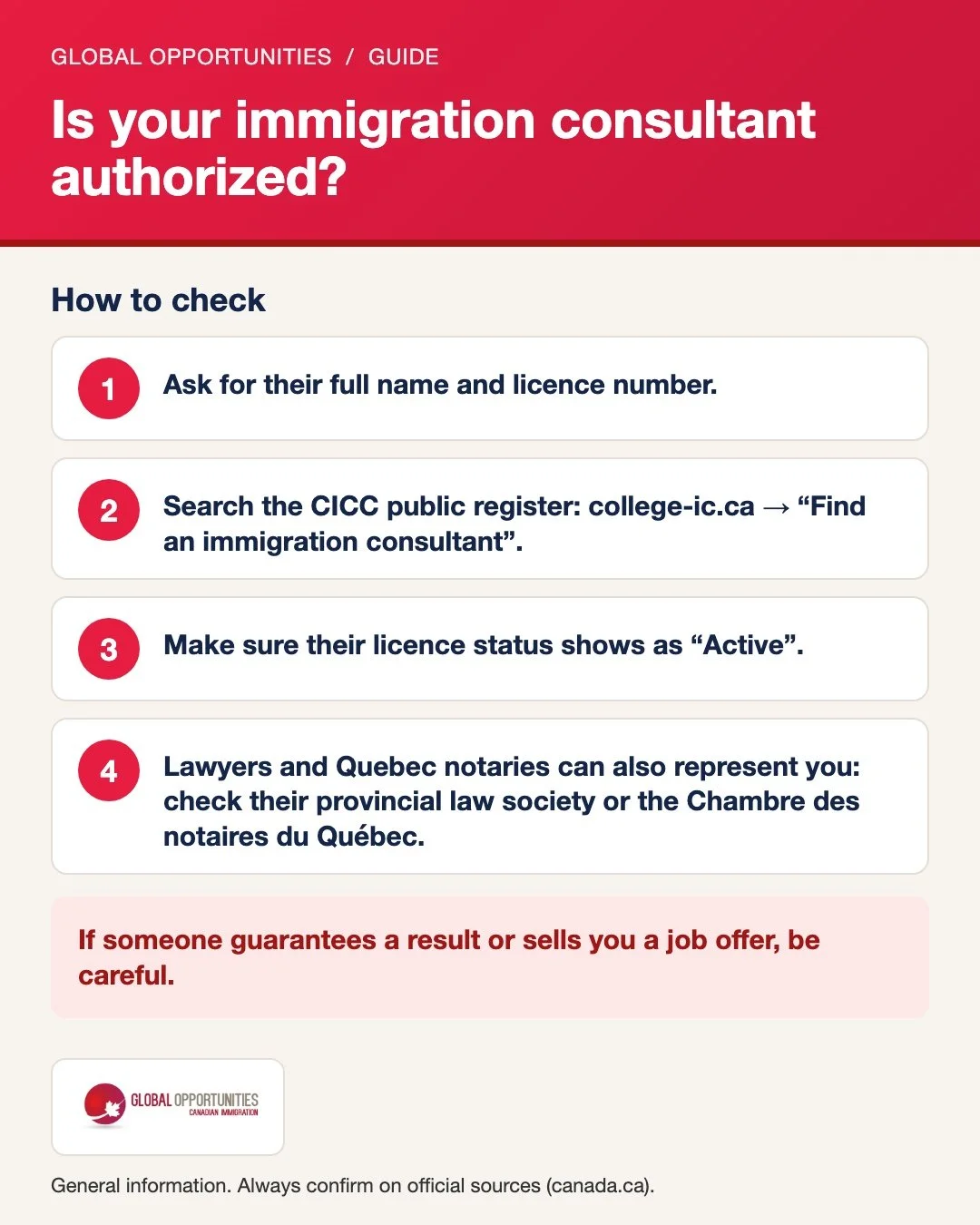
Only authorized representatives can charge a fee or receive any other payment for immigration or citizenship advice or representation. According to IRCC (check if your representative is authorized, canada.ca):
immigration and citizenship consultants must be members of the College of Immigration and Citizenship Consultants (CICC);
lawyers and notaries must be members of a Canadian provincial or territorial law society, or of the Chambre des notaires du Québec;
paralegals (Ontario only) must be members of the Law Society of Ontario.
If you use a paid representative who is not authorized, IRCC may return or refuse your application. You can check a consultant's licence on the CICC public register. More from Global: how to choose an immigration consultant.
Red flags
IRCC's choose a representative page tells applicants to beware of representatives who advertise their services as free and later ask for a fee, promise that your application will be approved, claim they can speed up your biometrics appointment for a fee, or advise you to lie on your application. Remember that you are responsible for all the information in your application, even if a representative completes it for you. More from IRCC: immigration fraud and scams.
Frequently asked questions
How do I immigrate to Canada?
You apply through a pathway that fits your profile. The main ones are Express Entry (Federal Skilled Worker Program, Canadian Experience Class and Federal Skilled Trades Program), Provincial Nominee Programs, the Atlantic Immigration Program, and family sponsorship. Many people also come first with a work or study permit and apply for permanent residence later. Your options depend on your occupation, experience, education, English or French, family and the programs open when you apply. Start by finding your NOC code, taking an approved language test and reading the official page of each pathway on your shortlist, as the section on choosing a pathway explains.
What is the easiest way to immigrate to Canada?
There is no simple or guaranteed way, and anyone who promises one should make you cautious. The realistic route depends on your skilled experience, language results, education, job offer, family ties and the programs open at the time. For one person it is the Canadian Experience Class after working in Canada; for another, a provincial stream with a job offer or a spousal sponsorship. Instead of looking for the "easiest" route, compare two or three that you actually qualify for, read their official pages and plan the order of your steps.
Is there an age limit to immigrate to Canada?
In general, Canada's economic programs for permanent residence do not set a maximum age to apply. Age does matter in some selection systems, though. In Express Entry, age is one of the core human capital factors of the Comprehensive Ranking System, so it affects your rank in the pool; IRCC publishes the details on its CRS criteria page. Provincial programs set their own selection factors, and temporary routes such as International Experience Canada have age ranges that depend on your country of citizenship. Family sponsorship and refugee protection follow their own rules. If you are older, strong language results, Canadian work experience, a genuine job offer or a provincial nomination can weigh more in your plan. Check each program's official page rather than relying on general rules, and be wary of anyone who says age does not matter at all.
Can I immigrate to Canada without a job offer?
Often, yes. The Federal Skilled Worker Program and the Canadian Experience Class do not require a job offer, and some provincial streams do not either. Other programs do: the Atlantic Immigration Program and many provincial streams start with an employer. Which streams are open without a job offer changes constantly, and some provinces have moved most of their selection toward job offers. Check each province's official stream list, and never pay for a job offer: employers cannot charge workers to get or keep a job.
Can I immigrate to Canada without IELTS?
Yes. IELTS General Training is only one of the approved tests. For Express Entry, IRCC accepts CELPIP-General, IELTS General Training and PTE Core in English, and TEF Canada and TCF Canada in French (language tests, canada.ca). Each test has its own format and scale, and IRCC converts the results to Canadian Language Benchmarks, so you can choose the one that suits you: CELPIP and PTE Core, for example, are taken on computer. What you cannot do is skip the test: economic programs ask for an approved result even if you are a native speaker. Watch our short video on how CELPIP fits into a permanent residence plan, and compare the five tests in our guide to English and French tests for Canada.
Can I immigrate to Canada without a degree?
Often, yes. IRCC lists no education requirement for the Canadian Experience Class or the Federal Skilled Trades Program, although education can improve your rank in the Express Entry pool. The Federal Skilled Worker Program is different: it requires a Canadian secondary or post-secondary credential, or a completed foreign credential with an ECA. Many provincial streams also include occupations that do not need a university degree, often with a job offer from an employer in the province. Without a degree, what usually weighs more is skilled work experience, a trade certificate, strong language results, Canadian experience or a genuine job offer. No pathway is guaranteed, so compare the programs you actually qualify for, and see our section on the Federal Skilled Trades Program above.
What is the difference between temporary and permanent residence in Canada?
Temporary residents, such as visitors, international students and temporary foreign workers, can stay for a limited time and only do what their visa, eTA or permit allows; they must extend their status or leave before it expires. Permanent residents can live, work and study anywhere in Canada indefinitely, get most social benefits including provincial health coverage, and can later apply for citizenship, as long as they meet the residency obligation. A temporary permit does not turn into permanent residence automatically, but Canadian experience gained with one can help you qualify for permanent programs.
What is Express Entry in Canada?
Express Entry is the online system IRCC uses to manage permanent residence applications from skilled workers. It manages the Federal Skilled Worker Program, the Canadian Experience Class and the Federal Skilled Trades Program, plus part of the provincial nominee programs. If you meet the minimum requirements of at least one program, you enter a pool, where candidates are ranked with the Comprehensive Ranking System. IRCC invites the highest-ranked candidates in rounds, and invited candidates submit a full application within a deadline. Being in the pool does not guarantee an invitation. See "What is Express Entry and how does it work?" above.
How many points do I need for Express Entry?
There is no fixed number. Express Entry ranks candidates against each other, and the scores invited change from round to round and between general, program-specific and category-based rounds. That is why we do not publish scores: any number would be out of date quickly. IRCC publishes every round's results on its rounds of invitations page and offers an official CRS tool to estimate your score. Remember that the Federal Skilled Worker Program also has a separate selection grid you must pass to enter the pool. Focus on what you can improve, such as language results, and on accurate documents.
What is the Federal Skilled Worker Program?
It is the Express Entry program for skilled workers with foreign experience who want to immigrate permanently. According to IRCC, you need skilled, paid experience in a TEER 0, 1, 2 or 3 occupation, an approved language test with the minimum level in all four abilities, a completed education credential (with an ECA if you studied abroad), proof of funds unless an exception applies, and a pass on a six-factor selection grid: language, education, experience, age, arranged employment and adaptability. A job offer is not required. You must also be admissible and plan to live outside Quebec.
What is the Canadian Experience Class?
It is an Express Entry program for skilled workers with paid, authorized Canadian work experience in TEER 0, 1, 2 or 3 occupations. Your experience must have been gained while authorized to work in Canada with temporary status, and must match the lead statement and most main duties of your NOC. Work done while studying full-time, most self-employment and unpaid work do not count. The CEC has no education requirement and does not require a job offer, but you need an approved language test. It is the usual route for graduates and workers already in Canada.
What is category-based selection in Express Entry?
It is a way for IRCC to invite Express Entry candidates with specific attributes, such as strong French or experience in certain occupations. When we reviewed IRCC's page in November 2026, categories covered French-language proficiency, healthcare and social services, STEM, trades, education and transport occupations, plus categories for physicians, senior managers and researchers with Canadian experience and skilled military recruits. You do not apply to a category: IRCC identifies eligible candidates from their profiles. Categories change, and IRCC says a category round may not be needed. Eligibility does not guarantee an invitation.
What is a Provincial Nominee Program?
It is a program that lets a province or territory nominate people it wants to welcome for permanent residence, because they have skills its economy needs and want to live there. Each province has its own streams, which open, close and change often. Some work through Express Entry (enhanced nomination) and others outside it (base nomination). Many use an expression of interest pool, and many require a job offer from a local employer. A nomination is not permanent residence: IRCC still decides. Quebec and Nunavut do not have nominee programs. Our province-by-province section links each official program.
Do I need to live in the province that nominates me?
Yes, that is the purpose of a nomination. IRCC's pages say provincial nominees must settle in the nominating province or territory. The province selects you because it needs your skills there, and your application rests on your intention to live there. Permanent residents have mobility rights in Canada, but moving right after landing can raise questions about whether your intention was genuine when you applied. If your circumstances truly change, keep records and get advice. The best approach is to choose a province where you actually want to build your life, after reading our guide to it.
What are the 10 provinces and 3 territories of Canada?
According to the Government of Canada's page on provinces and territories, Canada has 10 provinces (Ontario, Quebec, Nova Scotia, New Brunswick, Manitoba, British Columbia, Prince Edward Island, Saskatchewan, Alberta, and Newfoundland and Labrador) and 3 territories (Yukon, the Northwest Territories and Nunavut). Provinces and territories run their own health insurance plans, schools, driver licensing and, except Quebec, which has its own selection system, and Nunavut, their own nominee programs. Read our guides to Ontario, British Columbia, Alberta, Saskatchewan, Manitoba, Nova Scotia, New Brunswick, Prince Edward Island, Newfoundland and Labrador and Yukon, Northwest Territories and Nunavut, plus our Newcomers in Canada guide, which focuses on Toronto. Our page on Canada and its provinces has a quick overview.
Does Global Opportunities help with Quebec immigration?
No. Global Opportunities does not offer services for Quebec's immigration programs. Quebec has a special agreement with the Government of Canada and selects its own skilled workers through its own platform and rules. If you want to live in Quebec, consult the Government of Quebec's immigration website and, if you want professional help, an authorized representative who works with Quebec's programs. If you speak French but would prefer another province, this guide explains options outside Quebec, such as the French-language proficiency category and Francophone provincial streams.
What is the Atlantic Immigration Program?
It is a federal pathway to permanent residence for skilled workers and recent graduates of Atlantic institutions who want to live and work in New Brunswick, Nova Scotia, Prince Edward Island or Newfoundland and Labrador. You need a job offer from an employer designated by the province, and the province must endorse it before you apply to IRCC. You can be abroad or in Canada as a temporary resident, and with a qualifying offer and a provincial letter you may be able to work while you wait. You cannot apply without a designated employer.
Can I sponsor my spouse or partner to come to Canada?
If you are a Canadian citizen or permanent resident who meets IRCC's sponsor requirements, you may be able to sponsor your spouse, common-law partner, conjugal partner or dependent child. When we checked in November 2026, IRCC listed this program as open. The relationship must be genuine, and IRCC assesses it with evidence of a shared life. As a sponsor, you sign an undertaking to support the person financially for a period IRCC sets, and sponsored family members may be able to get an open work permit in some situations. Never misrepresent a relationship.
Can I sponsor my parents to immigrate to Canada?
When we checked in November 2026, IRCC showed the Parents and Grandparents Program as paused: it was not accepting new interest to sponsor forms or inviting potential sponsors until further notice, while it keeps processing existing applications. This can change, so check IRCC's page. Meanwhile, parents and grandparents may be eligible for a super visa, a visitor visa for long stays that requires private medical insurance and that the host meets income requirements. A super visa does not allow work or give permanent residence. Be wary of anyone who claims they can get you a sponsorship spot.
Can I bring my parents if the Parents and Grandparents Program is paused?
Not as permanent residents through that program while it is paused. When we checked in November 2026, IRCC said the Parents and Grandparents Program was not accepting new interest to sponsor forms or inviting potential sponsors until further notice (sponsor your parents and grandparents, canada.ca). The main alternative is the super visa, a multiple-entry visa that lets parents and grandparents of Canadian citizens, permanent residents and registered Indians visit for long stays. It requires private medical insurance and that the host meets income requirements, and it does not allow work or give permanent residence. Some parents may also qualify for permanent residence on their own, through an economic program, if they meet its requirements. Check the program's status again before you plan, and read our page on the super visa for parents and grandparents.
Does studying in Canada lead to permanent residence?
Not automatically. Some graduates later qualify by getting a post-graduation work permit, gaining skilled Canadian work experience and applying through the Canadian Experience Class or a provincial stream. But each step has its own rules: not every program or school leads to a PGWP, IRCC has added conditions over time, and many study permit applicants now need a provincial attestation letter. Rules can change while you study. Choose a program that makes sense for your career on its own, check PGWP eligibility before you enrol, and treat permanent residence as a possibility, not a promise.
What is an LMIA in Canada?
A Labour Market Impact Assessment is a document an employer gets from Employment and Social Development Canada showing that hiring a temporary foreign worker will not hurt the labour market, usually because no Canadian or permanent resident is available. The employer applies, not the worker, and generally must advertise the job and meet wage and working condition rules. With a positive LMIA, the worker applies to IRCC for an employer-specific work permit. Some permits are LMIA-exempt, such as intra-company transfers, trade agreement professionals and IEC categories. An LMIA is not permanent residence.
Can I buy an LMIA or a job offer to immigrate to Canada?
No. Employers of temporary foreign workers cannot make you pay to get or keep a job, or make you reimburse recruitment fees. As a worker, you only pay for your own work permit, medical exam and biometrics, if required. Offers to sell an LMIA, a "sure" job or a job offer are among the most common immigration scams, and IRCC warns that no one can guarantee you a job or a visa. Buying a fraudulent offer can also lead to a finding of misrepresentation. Look for work on Job Bank and employers' official sites, and report suspected fraud.
Is a Working Holiday in Canada a path to permanent residence?
Not on its own. International Experience Canada gives young people from partner countries a temporary work permit through seasons with pools and invitations; when we checked in November 2026, IRCC said the current season was closed and pools would reopen for the next one. Some participants later qualify for permanent residence through other programs, for example if they gain skilled Canadian experience in a TEER 0 to 3 job that counts for the Canadian Experience Class. Plan what you want to do during the permit, not just how to get it. Our country guides explain IEC by region.
Can I claim refugee status to immigrate to Canada?
Asylum is protection for people who cannot safely return to their home country because of persecution or serious harm, and IRCC says clearly that it is not a shortcut to immigrate to Canada or to stay in the country. Claims are decided case by case, mostly by the Immigration and Refugee Board, an independent tribunal, and a claim that is not genuine can lead to removal. If you are in danger, get advice from a lawyer or legal aid. If you want to move to Canada for work, study or family, use the economic, study, work or family pathways in this guide.
What is the difference between a permanent resident and a Canadian citizen?
Permanent residents can live, work and study anywhere in Canada and get most social benefits, but they cannot vote or run for office, cannot hold some jobs that need a high-level security clearance, travel with their own passport and a PR card, and must meet a residency obligation. Citizens can vote, can get a Canadian passport and have no residency obligation. To become a citizen, IRCC requires permanent residence, enough physical presence in Canada, tax filing if required, the language and test requirements if they apply to you, and the oath. For every requirement, the test, children and the ceremony, read our guide to Canadian citizenship.
How much money do I need to immigrate to Canada?
It depends on your program, your family size and your plans, and we do not publish figures because they change. Costs fall into categories: IRCC processing and right of permanent residence fees, biometrics, provincial fees where they apply, language tests, an ECA, police certificates, a medical exam, translations, and licensing costs if your profession is regulated. Some programs also require proof of settlement funds, which is your own money, not a fee. Budget too for flights, temporary housing and your first months. IRCC's fee list and proof of funds page give the official amounts.
How long does it take to immigrate to Canada?
It varies by program, country, how complete your application is and IRCC's workload, so we do not give durations. The total time includes your own preparation (language tests, ECA, police certificates, reference letters and licensing steps if your profession is regulated), time in a pool waiting for an invitation, any provincial nomination step and IRCC's processing. IRCC publishes current processing times by application type on its official tool. Preparing documents early, keeping your profile accurate and answering requests on time are the parts you control. Be wary of anyone who promises a specific timeline.
What happens after I get an invitation to apply (ITA)?
An invitation lets you submit a complete permanent residence application through your account, within the time IRCC sets. IRCC says to get your immigration medical exam from a panel physician, upload the documents from your profile and your personalized checklist, such as police certificates, and pay your fees before you submit (apply for permanent residence, canada.ca). After you submit, IRCC checks that the application is complete and confirms receipt, sends a letter if you need to give biometrics, and may ask for more documents or an interview. It then decides whether you meet the program's requirements and are admissible (after you apply, canada.ca). If you are approved, you pay any remaining fees and receive your Confirmation of Permanent Residence. The information in your application must match your profile and your documents.
What is a COPR and how do I land in Canada?
A Confirmation of Permanent Residence (COPR) is the document that, in IRCC's words, "proves that you have been approved for permanent residence" (COPR, canada.ca). It shows your personal details, your immigration category and a "valid to" date, and it cannot be extended, so you must complete the last step before it expires. If you are outside Canada, you show it to a border services officer when you arrive. If you are already in Canada, IRCC usually contacts you to confirm your permanent residence online through the PR Portal, and IRCC creates that account for you. Your first PR card is normally mailed to your Canadian address. Keep your COPR afterwards, as you may need it later. More from Global: what happens after you become a permanent resident.
How long do I have to live in Canada to keep my PR status?
IRCC's rule is that "you must have been in Canada for at least 730 days during the last five years", and those days do not need to be continuous (understand PR status, canada.ca). Some time spent outside Canada may count, in specific situations IRCC explains in its Help Centre. You do not lose your status automatically if you fall short, or when your PR card expires: IRCC says permanent resident status ends through an official decision, a voluntary renunciation, a removal order that comes into force, or becoming a Canadian citizen. Still, if you travel without a valid PR card, you may need a permanent resident travel document to come back, and an officer may review whether you met the obligation. Keep a record of your trips from the day you land.
How do I check my PR application status?
After you receive your acknowledgement of receipt, you can follow your application in your IRCC secure account. For Express Entry and for spouse, partner or dependent child sponsorship, among others, IRCC also offers the application status tracker, which needs a separate account and may show more detail than your main account. IRCC's page on checking your application status explains which tool covers which application. If you want to see the personal information IRCC holds about you, the Privacy Act lets you make a request, as IRCC explains on its access to information and privacy page. Before you contact IRCC, check the official processing times tool, and answer any request for documents by the date it gives you.
Can I immigrate to Canada with my family?
Yes. In most permanent residence programs, you can include your spouse or common-law partner and dependent children, and they become permanent residents with you. Each family member must be admissible, which usually means medical exams and, for adults, police certificates. You must declare all family members, even those not coming with you, because undeclared family members can later be difficult or impossible to sponsor. For temporary routes the rules differ: spouses of some workers and students may get open work permits, and children may be able to study, under conditions IRCC sets.
Can I immigrate to Canada with a criminal record or a DUI?
It may be possible, but a criminal record can make you inadmissible to Canada, whether the offence happened in Canada or abroad. IRCC treats impaired driving seriously: it says that if you were convicted of driving while impaired, "you may be inadmissible to Canada for serious criminality" (impaired driving, canada.ca). Depending on the offence and the time since your sentence ended, IRCC describes options such as deemed rehabilitation, applying for individual rehabilitation, a record suspension for convictions in Canada, or a temporary resident permit if you have a justified reason to be in Canada (overcome criminal convictions, canada.ca). None of these is automatic: an officer decides. Always declare your full criminal history, because hiding it can be treated as misrepresentation, which has its own consequences.
Do I need an immigration consultant to immigrate to Canada?
No. You can apply yourself with the free forms and instructions on canada.ca, and IRCC says using a representative does not get you special attention or approval. If you decide to pay someone for advice or representation, they must be authorized: a licensee of the College of Immigration and Citizenship Consultants (CICC), a lawyer or notary who is a member of a Canadian law society or the Chambre des notaires du Québec, or a paralegal licensed by the Law Society of Ontario. Check the CICC public register and ask for a written contract.
Related guides
Province guides: Ontario, British Columbia, Alberta, Saskatchewan, Manitoba, Nova Scotia, New Brunswick, Prince Edward Island, Newfoundland and Labrador and Yukon, Northwest Territories and Nunavut
Country guides: Moving to Canada from Asia, from Africa, from Europe, from Australia and Working Holiday in Canada for Irish citizens
Express Entry, Federal Skilled Worker and Canadian Experience Class
How Global Opportunities can help
Global Opportunities Canadian Immigration Services is a private immigration firm in Toronto. We help people understand which Canadian immigration pathways may fit their profile, plan the steps in a sensible order and prepare their immigration applications. Every profile is different, programs change constantly and no one can guarantee a result.
Our regulated consultant: Lic. Mildrete Monserrath Gutierrez Martinez, Regulated Canadian Immigration Consultant (RCIC), CICC licence R514880. Verify her licence on the CICC Public Register: https://college-ic.ca/protecting-the-public/find-an-immigration-consultant. Global Opportunities does not offer services for Quebec's immigration programs. Global Opportunities is a private firm and is not part of the Government of Canada or any provincial government.
Recorded seminars and lives: watch our recorded seminars in English or the Spanish recordings, and browse our YouTube channel. A good place to start: Why Being In Canada Is No Longer Enough.
More articles in English: read our Moving to Canada articles on topics such as health care, cost of living, the ECA and professional licences, and building community in Canada.
Personalized consultation: a review of your profile and options with our team. Contact us or write to info@globalopp.ca.
Prefer email? Tell us what you need help with (immigrating to Canada) and we will reply: email info@globalopp.ca.
Contact Global Opportunities →
Sources
IRCC: Express Entry, who can apply, rounds of invitations, CRS criteria, CRS tool and documents
IRCC: Federal Skilled Workers (modified 18 Nov 2026), Canadian Experience Class and Federal Skilled Trades (modified 18 Nov 2026)
IRCC: Category-based selection (modified 18 Nov 2026)
IRCC: Live and work as a medical doctor in Canada (page dated 19 October 2026)
IRCC: Language tests, Educational Credential Assessment, designated organizations and proof of funds
IRCC: Immigrate as a provincial nominee and non-Express Entry process
Provincial programs: Ontario OINP and Ontario Workforce Priority stream, BC PNP, BC PNP news and BC Skills Immigration, Alberta AAIP and AAIP updates, Saskatchewan SINP and browse SINP programs, Manitoba MPNP, Nova Scotia NSNP, New Brunswick NBPNP, PEI PNP, Newfoundland and Labrador NLPNP and EOI model, Immigrate NWT
IRCC: Quebec-selected skilled workers, Canada–Quebec agreement and Government of Quebec: Immigration
IRCC: Work in Canada, employer-specific work permits, open work permits, find out if you need an LMIA, International Mobility Program, IMP: who you can hire and company transfers
ESDC: Temporary Foreign Worker Program and foreign workers' rights
IRCC: Study permit, designated learning institutions, provincial attestation letter, post-graduation work permit and PGWP eligibility
IRCC: Family sponsorship, spouse, partner or child, parents and grandparents, other relatives and super visa
IRCC: Refugees and asylum, claim protection inside Canada, help outside Canada and Immigration and Refugee Board
IRCC: Find out if you need a visa, police certificates, medical exams, biometrics and inadmissibility
IRCC: Learn about representatives, choose a representative and check if a representative is authorized
IRCC: Overcome criminal convictions and convicted of driving while impaired
IRCC: Apply for permanent residence through Express Entry, after you apply, Confirmation of Permanent Residence and PR Portal
IRCC: Check your application status, application status tracker and access to information and privacy
Global Opportunities: Recorded seminars and lives in English · Success stories (in Spanish)
Global Opportunities videos: Planning to immigrate to Canada · Permanent residency: applying vs being selected · Have you completed one year of work experience in Canada? · Family Sponsorship in Canada
The information in this guide is general and for reference only. It comes from the official sources linked in each section and under "Sources", as they read when we checked them in November 2026, and it may have changed since. It is not immigration, legal or professional advice. Global Opportunities is not responsible for how anyone interprets this content, for decisions made based on it or for changes made after it was written: what you read depends on when you read it. For advice on your own case, book a consultation. Immigration programs, Express Entry rounds and categories, provincial streams, family sponsorship statuses, work permit and study rules, and official requirements change frequently, and no pathway guarantees an invitation, a permit or permanent residence. Always confirm requirements with official Government of Canada and provincial sources. Global Opportunities is a private firm, is not part of the Government of Canada or of any regulator, and does not offer jobs.
Last reviewed: November 2026