
Moving to Canada from Africa: A Guide by Country
Moving to Canada from Africa starts with the same questions in every country: do I need a visa, where do I give biometrics, which police certificate does IRCC want, which skilled pathway fits me, which English or French test should I take, and how do I avoid scams? This guide answers them in plain English, with a deeper section for each of the main African countries and links to official Government of Canada sources.
About our sources: This guide summarises what official sources (the Government of Canada, provincial and territorial governments and the other organisations we link to) said when we checked them in November 2026. We link every source so you can read it yourself. Rules, rates and requirements change, sometimes without notice, and the official page is the one that counts. This is general information, not legal, tax or immigration advice. Global Opportunities is not responsible for how this information is interpreted or for changes made after it was written.
Canada has two official languages, English and French, and both count in its economic immigration programs. Still, there is no special immigration program for any African country: Canada assesses each person against the requirements of the program they apply to. This guide covers only Canada's side: Canadian programs, Canadian requirements and Canadian daily life. We do not give advice on the laws, documents or procedures of any African country; confirm those with the authority that issues them.
We are Global Opportunities, a private immigration firm based in Toronto. Programs change often, so we link the official page for each one. Please check it before you make any decision. For life after you land, such as housing, banking, health cards and winter, we have a separate newcomers in Canada guide.
Watch our recorded seminars and lives →
In this guide
Moving to Canada from Africa: do you need a visa?
Biometrics, police certificates and medical exams for applicants in Africa
Moving to Canada from Africa as a skilled worker: Express Entry and provincial programs
Can studying in Canada be a pathway from Africa?
How do you get African qualifications recognized in Canada?
English and French tests for moving to Canada from Africa
French-speaking Africans and Francophone immigration outside Quebec
Moving to Canada from Nigeria
Moving to Canada from Ghana
Moving to Canada from Kenya
Moving to Canada from South Africa
Moving to Canada from Cameroon
Moving to Canada from Morocco
Moving to Canada from Algeria
Moving to Canada from Tunisia
Moving to Canada from Egypt
Moving to Canada from Senegal
Moving to Canada from Côte d'Ivoire
Moving to Canada from Ethiopia
Moving to Canada from Zimbabwe
Moving to Canada from Uganda
Moving to Canada from other African countries
Immigration fraud and fake job offers: how to protect yourself
Which province should you choose when moving to Canada from Africa?
Planning checklist for moving to Canada from Africa
Your first steps after moving to Canada from Africa
Frequently asked questions
Related guides
How Global Opportunities can help
Sources
Moving to Canada from Africa: do you need a visa?
In most cases, yes. IRCC's entry requirements page lists almost every African country as visa-required, so most Africans need a visitor visa to travel to Canada. Citizens of Morocco and Seychelles may be eligible for an eTA instead, but only when flying. Run IRCC's official tool with your own passport to get your answer.
Entry rules depend on your citizenship, your passport, how you travel and why you are coming. The official place to check is IRCC's tool Find out if you need a visa or eTA to travel to Canada. You answer a few questions and it tells you which document you may need. Run it with the passport you will actually travel on; if you hold more than one nationality, the answer can be different for each passport.
What the official list shows
At the time of writing, IRCC's page entry requirements by country or territory does not list any African country among the visa-exempt countries whose citizens only need an electronic travel authorization (eTA). Most African countries, including Nigeria, Ghana, Kenya, South Africa, Egypt, Algeria, Tunisia, Cameroon, Senegal, Côte d'Ivoire, Ethiopia, Zimbabwe and Uganda, are on the visa-required list.
The same page lists Morocco and Seychelles among the visa-required countries whose citizens may be eligible for an eTA instead of a visa, only when travelling by air and only if they meet certain requirements. If they arrive by car, bus, train or boat, including a cruise ship, IRCC states that they need a visitor visa.
These lists can change. Always run the official tool before every trip, even if you have travelled to Canada before. Still unsure which one you need? See eTA vs visitor visa for Canada.
What a visitor visa is, and what it is not
According to IRCC's visitor visa page, a visitor visa is an official document placed in your passport that shows you meet the requirements to travel to Canada. Keep in mind:
A visitor visa is not a work permit or a study permit. To work you generally need a work permit, unless an exemption applies; check whether you need a work permit. To study you generally need a study permit. If you are approved for a study or work permit, IRCC issues the visitor visa you need with it; IRCC's fraud page warns against anyone who charges you separately for that visa.
Only the Government of Canada decides. IRCC states that only immigration officers in Canada and at Canadian embassies, high commissions and consulates can decide to issue a visa, and that no one can guarantee you a job or a visa to Canada.
Fees are paid to the Government of Canada. IRCC states that government fees are payable to the Receiver General for Canada, unless a visa office website states otherwise. Fees change, so check the official application page.
How to apply for a visitor visa from Africa
Most applicants apply online through their IRCC account. IRCC's page Apply for a visitor visa lists the forms, the documents and the steps, including biometrics.
A question we hear often is whether you can visit Canada and then look for work or change status once you are there. Canada's law does allow what IRCC calls dual intent. According to IRCC's dual intent instructions, having an intention to apply for permanent residence later is legitimate, as long as the officer is satisfied that you will respect the conditions of temporary residence and leave at the end of your authorized stay. Whether you can apply for a work permit from inside Canada depends on your situation; IRCC's work permit eligibility pages explain who can apply from inside Canada and who must apply from outside.
Watch our live session on the difference between an eTA and a visitor visa (recorded in November 2025; IRCC's tool has the current rules).
Entry rules as published by IRCC on its visa, eTA and dual intent pages, as of November 2026. A visa lets you travel to Canada; it does not let you work or study, and having one does not mean you will be admitted: the border officer decides at entry.
Biometrics, police certificates and medical exams for applicants in Africa
Three steps come up in almost every application: biometrics, police certificates and, for many applicants, a medical exam. Each one has its own official page, and none of them should cost you anything extra for an "appointment fixer".
Biometrics and visa application centres in Africa
Many applications for a visitor visa, a study permit, a work permit or permanent residence require biometrics: your fingerprints and a photo. You give them after IRCC sends you a biometric instruction letter (BIL).
According to IRCC's page where to give your fingerprints and photo:
Outside Canada and the United States, you give biometrics at a visa application centre (VAC).
You need an appointment. IRCC states that booking is free, and: do not pay anyone for an appointment.
IRCC states that you have 30 days from the time you get your BIL to give your biometrics. If you cannot, the page explains how to ask for more time through IRCC's web form.
If there is no VAC in the country or territory you are applying from, you can go to any other VAC location.
At the time of writing, IRCC's page lists VACs in these African cities. Some are marked as offering limited services, and locations can change, so always check the official page before you travel:
Nigeria: Lagos and Abuja
Ghana: Accra
Kenya: Nairobi
South Africa: Cape Town and Pretoria
Cameroon: Yaoundé
Morocco: Rabat
Algeria: Algiers
Tunisia: Tunis
Egypt: Cairo
Senegal: Dakar
Côte d'Ivoire: Abidjan (listed as Ivory Coast)
Ethiopia: Addis Ababa
Zimbabwe: Harare
Uganda: Kampala (listed with limited services)
Mali: Bamako
Burkina Faso: Ouagadougou
Guinea: Conakry
Niger: Niamey
Rwanda: Kigali
Tanzania: Dar es Salaam
Democratic Republic of the Congo: Kinshasa (listed with limited services)
IRCC's page did not list a VAC in Benin or Togo when we checked. Use only the links on IRCC's page to reach your VAC, and read IRCC's page on how to give your biometrics.
Police certificates: what IRCC asks for
IRCC usually asks for police certificates when you apply for permanent residence, and it may ask for them in other applications too. The general rules are on IRCC's page Police certificates, and IRCC keeps a country-by-country page, How to get a police certificate, that names the document and the authority for each country.
According to IRCC's general instructions:
In most cases you contact the local police or government to ask for a certificate. You may need photos, fingerprints, and the addresses and dates where you lived, and you may have to pay a fee to that authority.
If the certificate is not in English or French, you send the original with a translation by a certified translator.
Fingerprints you give for a police certificate are not the same as the biometrics for your IRCC application.
If you cannot get a certificate, you must show proof that you asked the right authority and explain your efforts in a letter, and IRCC states that acceptance is not guaranteed.
If your country is not on the list, IRCC says to contact that country's national police agency, or its embassy or consulate in Canada.
We summarize what IRCC's page says for each country in the country sections below. Some of IRCC's country pages are old, so confirm the details with the issuing authority before you apply, and start early: police certificates often take longer than people expect.
Immigration medical exams
Many applicants need an immigration medical exam. According to IRCC's medical exams page, your own doctor cannot do it: only a panel physician approved by IRCC can. Use IRCC's official panel physician search, linked on that page, to find one in your country, and do not use a clinic that only "says" it is approved. Requirements differ for permanent and temporary residents, so read the page for your application.
Submitting your passport from Africa
When IRCC is ready to issue a visa or a permit, it asks for your passport. IRCC's where to submit your passport page gives the instructions for each country. When we checked, it said that applicants in Angola, Botswana, Eswatini, Lesotho, Malawi, Mauritius and Namibia can submit in person at the VAC nearest to them in Pretoria, Harare or Port Louis; applicants in Zambia at the VAC in Dar es Salaam; and applicants in Libya at the VAC in Tunis. Send your passport only after IRCC asks for it, and follow the letter IRCC sends you.
Biometrics, police certificate and medical exam rules as published by IRCC, as of November 2026. VAC locations and deadlines can change: check the linked IRCC pages before you book or travel.
Moving to Canada from Africa as a skilled worker: Express Entry and provincial programs
Most skilled workers from Africa look at two families of programs: Express Entry, the online system IRCC uses for three federal economic programs, and the Provincial Nominee Programs run by the provinces and territories. Neither one is specific to any African country; IRCC assesses each person against the program's own requirements.
If your goal is to live in Canada permanently, you will usually look at the economic immigration programs. The two main families are the programs managed through Express Entry and the Provincial Nominee Programs (PNPs). Quebec has its own immigration system and selects its own economic immigrants. Global Opportunities does not offer services for Quebec's immigration programs; if Quebec is your goal, start at Immigration in Québec.
What Express Entry is
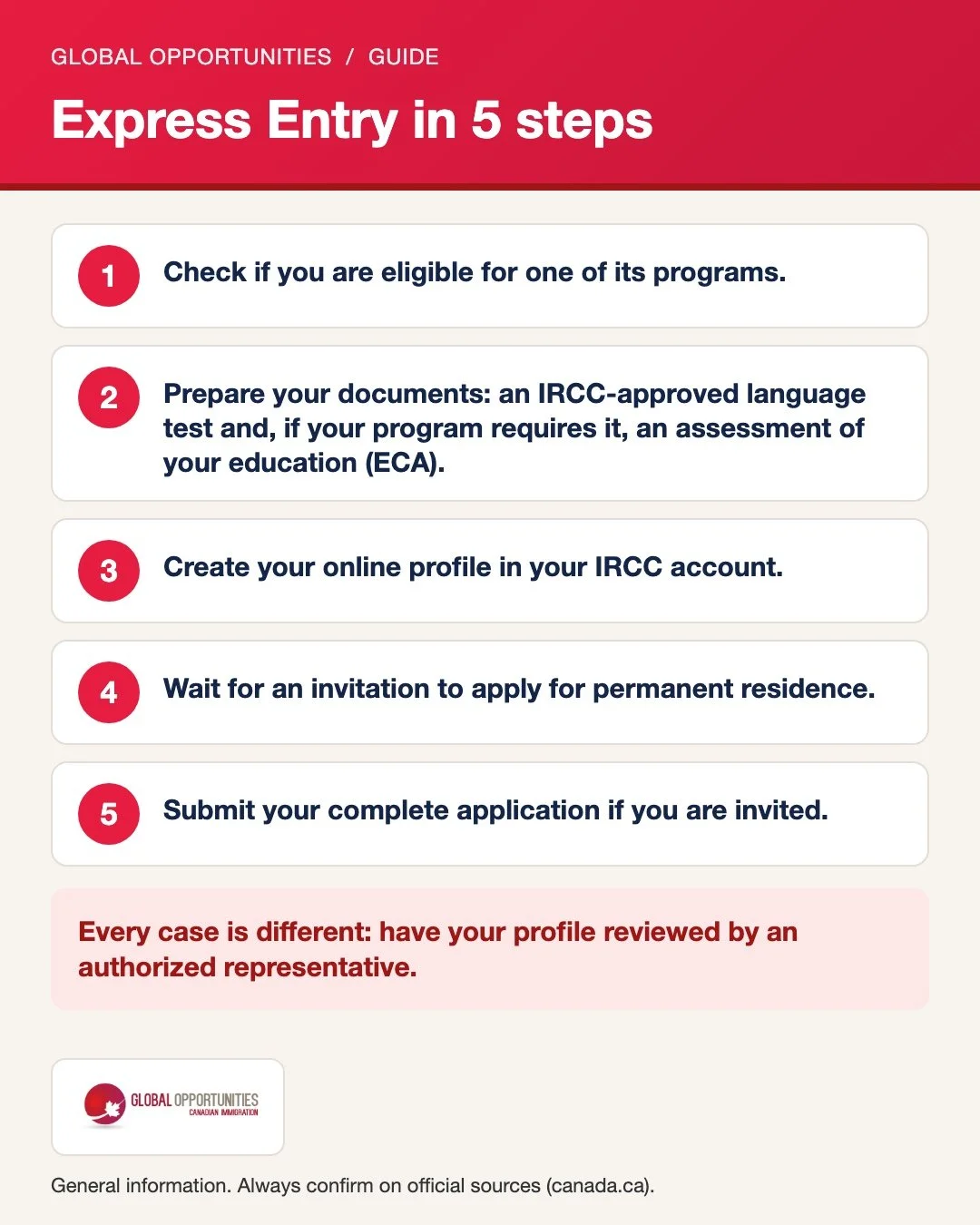
According to IRCC, Express Entry is the online system used to manage applications for three federal programs:
Federal Skilled Worker Program: for skilled workers with eligible foreign or Canadian work experience. Read more on our page about the Federal Skilled Worker program.
Canadian Experience Class: for skilled workers with eligible work experience gained in Canada.
Federal Skilled Trades Program: for skilled workers qualified in a skilled trade.
You can check the general requirements on IRCC's Express Entry eligibility page.
How Express Entry works, step by step
In general terms, according to IRCC:
You check whether you meet the minimum requirements of at least one of the three programs.
You gather the documents you need to create a profile, usually including approved language test results and, for foreign education, an Educational Credential Assessment.
You create an online profile. If you are eligible, you enter the pool of candidates.
Candidates are ranked with the Comprehensive Ranking System (CRS), which considers factors such as age, education, language ability and work experience.
IRCC holds rounds of invitations during the year. Rounds can be general, program-specific or category-based.
If you receive an invitation to apply, you submit a complete application for permanent residence, which IRCC then reviews.
Being in the pool does not guarantee an invitation. Round types, the number of invitations and the scores needed change from round to round. We do not publish scores or cut-offs because they describe the past and do not predict anything. IRCC's Help Centre notes that forms and guides are free on IRCC's website and that you do not need a paid representative to apply.
Proof of funds
Some Express Entry programs require you to show that you have enough money to settle in Canada, unless an exemption applies, for example in some cases where you are already authorized to work in Canada and have a valid job offer. IRCC publishes the rules on what counts as proof on its proof of funds page. Whether you need to show funds, and how much, depends on your program, your family size and your situation, so we do not give figures here: the way to know what applies to you is a consultation.
Category-based selection
IRCC can also invite candidates who fit a specific category. At the time of writing, the category-based selection page lists French-language proficiency; healthcare and social services occupations; STEM occupations; trade occupations; education occupations; transport occupations; physicians with Canadian work experience; senior managers with Canadian work experience; researchers with Canadian work experience; and skilled military recruits. Categories and the occupations in each one change, so always check the current page.
Provincial Nominee Programs
According to IRCC, provinces and territories can nominate people who can contribute to their economy and who want to live there. Each one sets its own criteria and streams, and these change often. IRCC's PNP page does not list Quebec or Nunavut among the participating provinces and territories. Some streams are linked to Express Entry; others are separate (base) streams.
Start with IRCC's Provincial Nominee Program page, then read the official site of the province that interests you. The Atlantic provinces also take part in the Atlantic Immigration Program, which works with designated employers. Our province guides explain daily life in each one: see the section on choosing a province below.
For a broader overview, see our guide How to immigrate to Canada, our page Immigration to Canada and our summary of permanent resident requirements. Watch our live session on why applying is not the same as being selected.
Program rules as published by IRCC on its Express Entry, category-based selection and PNP pages, as of November 2026. Meeting the minimum requirements of a program does not mean you will be invited or that an application will be approved; IRCC and the provinces decide each case.
Can studying in Canada be a pathway from Africa?
Many Africans first come to Canada as international students. Studying can be a valuable experience, but it is not an immigration shortcut, and it does not lead to permanent residence automatically. It is also an area where scams are common. For an overview of study permits and how to prepare, see our Study in Canada page.
What you need to know first
Study permit: according to IRCC, most foreign nationals need a study permit to study in Canada.
Designated learning institutions (DLIs): only DLIs can host international students with study permits, and not every Canadian school is one. Check the official list of DLIs before you apply or pay anything.
Letter of acceptance: IRCC's page on documents for a study permit explains that you need a letter of acceptance from a DLI, and that post-secondary schools must validate it with IRCC.
Provincial or territorial attestation letter (PAL/TAL): IRCC states that a PAL/TAL is usually required to apply for a study permit, and that in most cases you get it from your school after accepting your offer. Some groups are exempt; IRCC lists them on its PAL/TAL page. Studying in Quebec requires Quebec's own documents instead.
Proof of financial support: according to IRCC's documents for a study permit page, you must prove that you can support yourself and any family members who come with you. What you need to show depends on your case; a consultation is the way to know what applies to you.
Work after graduation: according to IRCC, the post-graduation work permit depends in part on graduating from an eligible DLI and program, and IRCC warns that not all DLIs and programs qualify. Eligibility rules change, so check them before you choose a program.
Study permit scams and how to avoid them
IRCC's page on international student fraud gives practical advice that every African student should read:
Have the DLI send the letter of acceptance directly to you, and be suspicious of anyone who promises one in exchange for payment. Real schools assess your academic record and identity before admitting you.
Always pay tuition directly to the school, not to an agent's personal account.
Be wary of anyone who charges you an application fee for a visitor visa or eTA when you apply for a study permit; IRCC states these are issued with your study permit.
Any representative, even an unpaid one, must be declared on your application. IRCC states that failing to declare information is considered lying and may lead to refusal.
Choosing a program for the right reasons
Choose a program for its own value, not only for what it might lead to. If you plan to study in French outside Quebec, read the section on Francophone immigration outside Quebec below. Our province guides describe colleges and universities in each province.
Study permit, PAL/TAL and PGWP rules as published by IRCC, as of November 2026. A letter of acceptance does not mean a study permit will be approved, and studying in Canada does not lead to permanent residence automatically.
How do you get African qualifications recognized in Canada?
Canada does not recognize foreign degrees or professional licences automatically. There are two different processes, and it helps to keep them apart: one for immigration and one for working in your profession. We explain the difference in detail in ECA vs professional licence in Canada.

Educational Credential Assessment (ECA) for Express Entry
According to IRCC, an Educational Credential Assessment checks that a foreign degree, diploma or certificate is valid and equal to a Canadian one. You need an ECA if you studied outside Canada and want to qualify for the Federal Skilled Worker Program as the principal applicant, or to get points for your foreign education in Express Entry.
IRCC designates the organizations that can issue ECAs for immigration. For most applicants they are (for reference only; check IRCC's current list):
Comparative Education Service, University of Toronto School of Continuing Studies
International Credential Assessment Service of Canada
World Education Services
International Qualifications Assessment Service (IQAS)
International Credential Evaluation Service, British Columbia Institute of Technology
Some occupations must use a designated professional body instead: the Medical Council of Canada for physicians, the Pharmacy Examining Board of Canada for pharmacists and the Canadian Architectural Certification Board for architects, in the cases IRCC describes.
Practical tips for ECAs from African institutions
In forums, the most common delays are about transcripts, not the assessment itself. A few points:
Each organization sets its own document rules. Many require transcripts to be sent directly by your university in a sealed envelope or through a verified electronic channel. Follow the organization's own instructions, not those of an intermediary or a forum post.
Degree certificate and transcript are different documents. Organizations often ask for both. Check the requirement for your country on the organization's site.
Translations: documents in a language other than English or French usually need a translation; the organization explains what kind.
An ECA is not a licence. IRCC states that an ECA may help when you are looking for a job, but it does not guarantee a job in your field or a licence to practise a regulated profession.
Regulated professions: licensing is provincial
In Canada, some occupations are regulated: you need a licence or certification from a regulatory body in the province or territory where you will work. Nurses, doctors, engineers, pharmacists, teachers and many health professions are common examples. According to the Government of Canada's Foreign Credential Recognition page, a regulatory body in the province or territory assesses your foreign credentials and issues licences, and it is a good idea to contact it, ideally before you arrive.
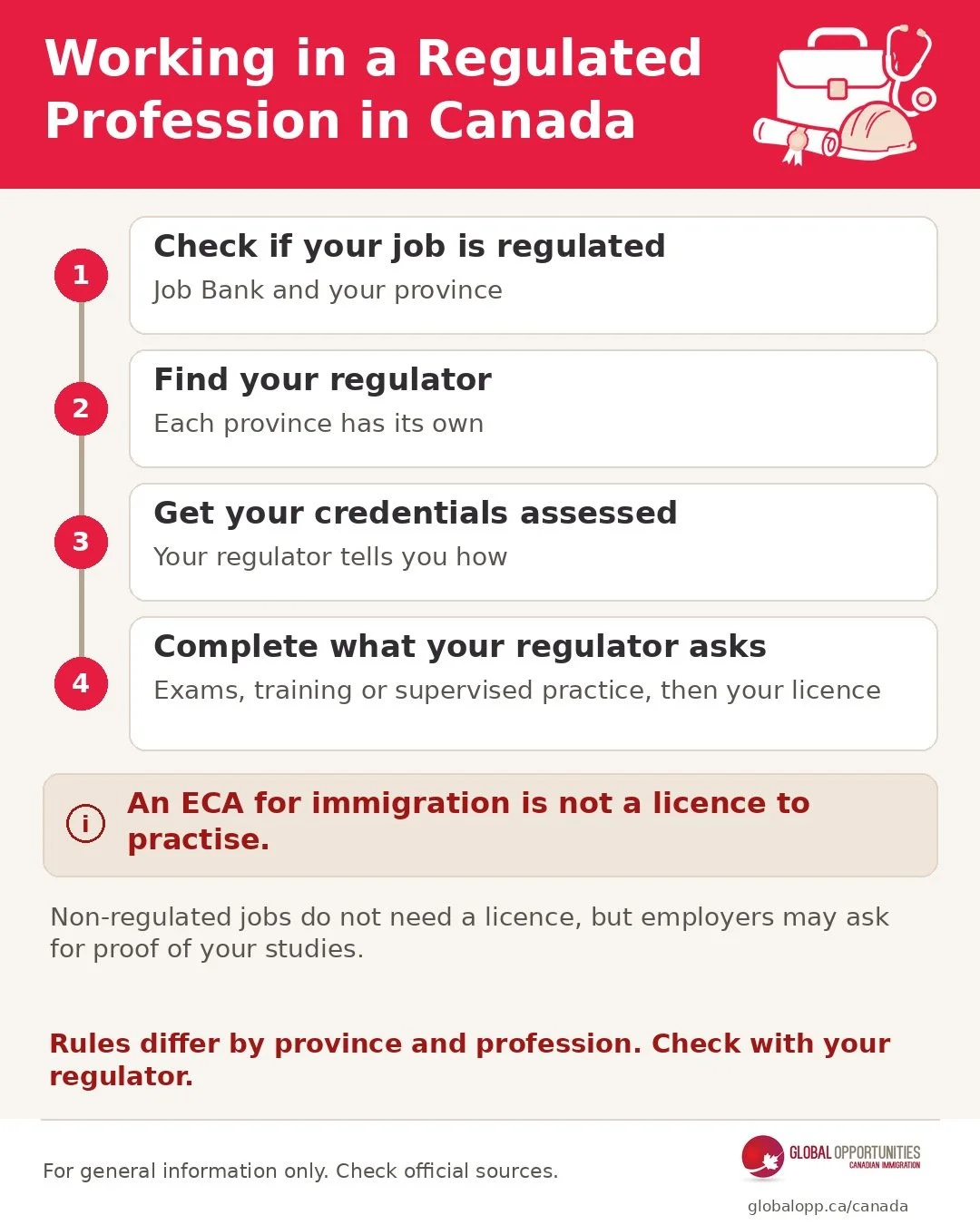
The Canadian Information Centre for International Credentials (CICIC) explains which occupations are regulated in each province and points you to the right regulator. IRCC also lists free pre-arrival services, including help to prepare for work in Canada and with credential recognition. Eligibility depends on your situation.
Any regulator or organization we mention is for reference only. The list may not be complete, and requirements must always be confirmed directly with the regulator in the province or territory where you plan to work.
Nurses from Africa
According to the National Nursing Assessment Service (NNAS), it handles applications for registered nurses (RN), licensed or registered practical nurses (LPN/RPN, depending on the province) and registered psychiatric nurses (RPN). NNAS describes itself as "the first step towards becoming a nurse in Canada" for internationally educated nurses: it verifies your documents and shares them with the regulators, but it is not a licence. The nursing regulator in your chosen province then decides whether you need more education, exams or a bridging program. Our guide for internationally educated nurses explains NNAS, the NCLEX-RN and each regulator.
Doctors from Africa
According to the Medical Council of Canada (MCC), physicians are licensed by the medical regulatory authority in each province and territory, and the MCC verifies medical credentials from around the world and runs national exams that regulators use in their licensing decisions. Each province's regulator sets its own routes for international medical graduates, so check with the regulator where you plan to work.
Engineers from Africa
According to Engineers Canada, "to practise engineering in Canada, you must hold and maintain a licence from one of Canada's engineering regulators." Requirements vary by regulator but generally cover academics, engineering work experience in the province or territory, a professional practice exam on law and ethics, good character and language ability. Many internationally educated engineers start as engineers-in-training.
Trades and the Red Seal Program
If you work in a trade, certification is provincial and territorial. According to the official Red Seal Program site, provincial and territorial apprenticeship authorities certify tradespeople and administer the Red Seal exams. Questions about experience gained outside Canada go to the authority in the province or territory where you plan to work; see Provincial and Territorial Apprenticeship and Certification Authorities. Some trades are compulsory in some provinces and territories, which means you cannot work in them without the certificate or an apprenticeship; the apprenticeship authority in each province lists which trades are compulsory there.
Licensing information as published by the Government of Canada, CICIC, NNAS, the MCC, Engineers Canada and the Red Seal Program, as of November 2026. An ECA is not a licence, and a licence is decided only by the regulator in the province or territory where you plan to work.
English and French tests for moving to Canada from Africa
Even if you studied in English or French, or English or French is an official language in your country, most Canadian economic immigration programs ask you to prove your language ability with an approved test. A degree taught in English or French, or a letter from your university, does not replace the test for Express Entry. For a full explanation of each test, read our guide English and French tests for Canada.
Which tests IRCC accepts for Express Entry
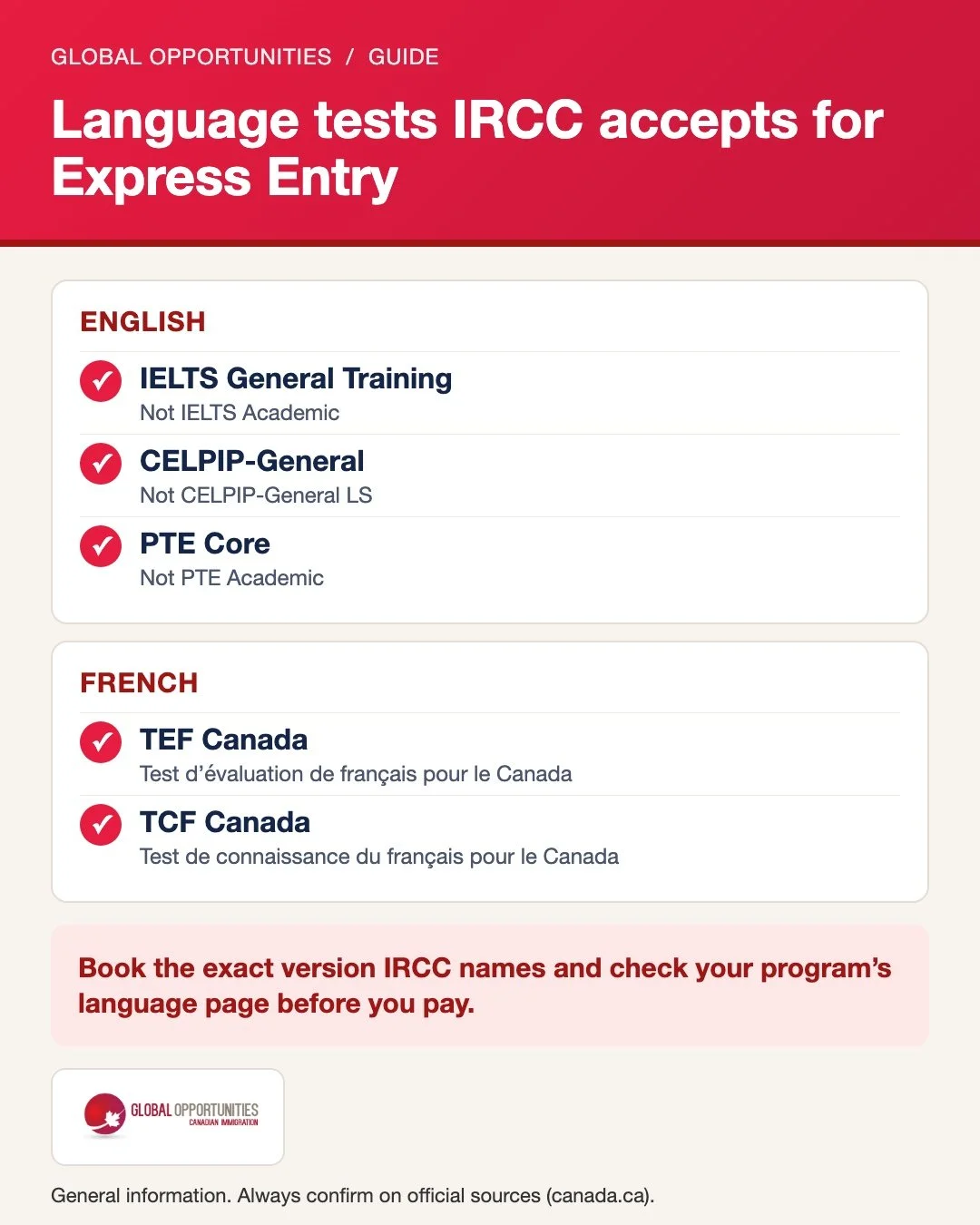
According to IRCC's Express Entry language test page, the accepted tests are:
English
CELPIP: it must be the CELPIP-General test.
IELTS: it must be the General Training option. IRCC states that the IELTS One Skill Retake is not accepted for Express Entry.
PTE Core: it must be the PTE Core option of the Pearson Test of English.
French
TEF Canada (Test d'évaluation de français).
TCF Canada (Test de connaissance du français).
Pay close attention to the exact name: IELTS Academic, PTE Academic, the DELF or DALF, and other French or English diplomas are not on IRCC's Express Entry list. IRCC converts results into Canadian Language Benchmark (CLB) levels for English or Niveaux de compétence linguistique canadiens (NCLC) for French, for each skill. IRCC states that results must be "less than 2 years old" when you create your profile and when you submit your application for permanent residence. Minimum levels are on the official page and differ by program.
Where to take the tests in Africa
Test centres and dates change, so use each provider's official finder and book directly with the provider or its authorized centre. These providers are private or independent organizations; the list is for reference only.
IELTS General Training: the official IELTS test centre finder lets you filter by country and test type. Make sure you book IELTS General Training, not Academic.
PTE Core: see Pearson's official PTE Core page. According to Pearson, PTE Core is taken at an authorized test centre, not at home, and it is a different test from PTE Academic.
CELPIP-General: check locations and dates on the official CELPIP website. Check whether there is a centre in or near your country.
TEF Canada: issued by Le français des affaires (CCI Paris Île-de-France). Use its official test centre finder and make sure you book TEF Canada, not another TEF version.
TCF Canada: issued by France Éducation international. Its official TCF Canada page explains the test and how to find an approved centre. Book the Canada version, as named on IRCC's list.
Test fees are set by each provider and vary by country and centre, so check the price on the provider's site when you book. Be wary of anyone who sells "guaranteed scores", leaked questions or test certificates. Results come only from the official test provider, and IRCC can verify them.
Should I take an English test, a French test or both?
According to IRCC's category-based selection page, French ability is the basis of the French-language proficiency category, and IRCC's system can also give weight to a second official language. How much French or a second language would help in your case depends on your whole profile, so we do not give points here; a consultation is the way to know. Read our page on French language proficiency. Watch our live session on how CELPIP results fit into an immigration application.
Accepted tests as listed on IRCC's Express Entry language test page, as of November 2026. Only the exact test versions named by IRCC count, and minimum levels differ by program: check IRCC's page and the test provider's site before you book.
French-speaking Africans and Francophone immigration outside Quebec
French is one of Canada's two official languages, and French-speaking Africans sometimes assume Quebec is their only option. It is not. IRCC's page Choose a Francophone community outside Quebec explains that many French-speaking Canadians live in other provinces and territories, where you can access French-language schools and some services in French. IRCC also notes that the working language in these communities is usually English, so English helps too.
These include Acadian communities in the Atlantic provinces, Franco-Ontarians, and communities in the western provinces and the territories. According to the Government of New Brunswick's basic facts page, New Brunswick is Canada's only officially bilingual province.
Federal options that value French
At the time of writing, IRCC programs that give weight to French outside Quebec include:
French-language proficiency in Express Entry: one of the category-based selection categories. IRCC states that eligibility depends on French test results that meet a minimum level in all four abilities. French ability is also considered in the ranking system.
Francophone Mobility (Mobilité Francophone): according to IRCC's eligibility page, this is a work permit that does not require an LMIA, for French-speaking workers with a job offer in a province or territory outside Quebec. IRCC states that you need intermediate French speaking and listening skills, at the level shown on the page, and that most occupations qualify, with exceptions it lists. The employer has steps to complete first in IRCC's Employer Portal and gives you an offer of employment number.
Destination Canada Mobility Forum
IRCC organizes an annual event, the Destination Canada Mobility Forum, for skilled French-speaking and bilingual candidates who want to learn about immigrating to communities outside Quebec. It includes information on programs and meetings with provinces, territories and Francophone organizations. Participation is free but by invitation; check the official page for the next edition.
Some provinces also have their own streams or initiatives for French speakers. Categories and streams can open, close or change, so check the official pages. Learn more on our page about French language proficiency.
What about Quebec?
Quebec has its own immigration system and runs its own selection, and its own documents apply to studying there. Global Opportunities does not offer services for Quebec's immigration programs. If you plan to settle in Quebec, start at Immigration in Québec.
Moving to Canada from Nigeria
Nigeria is one of the largest sources of applicants to Canada from Africa, and "japa" questions fill forums. Here are the Canada-side points that matter most for Nigerian citizens.
Visa: at the time of writing, Nigeria is on IRCC's visa-required list. Confirm with the official tool.
Biometrics: IRCC lists visa application centres in Lagos and Abuja on its biometrics page. Book only through the link on IRCC's page.
Police certificate: IRCC's Nigeria page names a Police Character Certificate from the Nigeria Police Force. It describes applying in person at the Central Criminal Registry in Lagos, or by mail with certified fingerprints if you are abroad. Confirm the current process with the issuing authority.
Language tests: even though English is Nigeria's official language, you need an approved test for Express Entry: CELPIP-General, IELTS General Training or PTE Core. Use the official finders for centres in Nigeria.
ECA: apply directly to a designated organization and follow its instructions on how your university must send transcripts. Start early.
Regulated professions: nurses start with NNAS and the provincial regulator; doctors with the MCC and the provincial college; pharmacists, engineers and others with their regulators.
Driving: at the time of writing, Nigeria is not on the licence exchange lists of the Government of Ontario or the Government of Alberta. Plan to go through the provincial licensing steps.
Scams: be especially careful with job offers, "LMIA sponsorship" and "agents". Read the fraud section of this guide.
Moving to Canada from Ghana
Visa: at the time of writing, Ghana is on IRCC's visa-required list. Confirm with the official tool.
Biometrics: IRCC lists a visa application centre in Accra.
Police certificate: IRCC's Ghana page names a Police Clearance Certificate from the Ghana Police CID Headquarters in Accra. It describes separate requirements for residents and for people who lived in Ghana but no longer live there, and says you can appoint someone to apply for you.
Language tests: even if you studied in English, you need an approved test for Express Entry: CELPIP-General, IELTS General Training or PTE Core.
Health professions: Ghanaian nurses and midwives should check CICIC for each occupation in their province, since nursing and midwifery may be regulated separately, by different bodies.
Driving: Ghana is not on the Ontario or Alberta licence exchange lists at the time of writing.
Moving to Canada from Kenya
Visa: at the time of writing, Kenya is on IRCC's visa-required list. Confirm with the official tool.
Biometrics: IRCC lists a visa application centre in Nairobi. If you live in a neighbouring country without a VAC, IRCC states you can go to any VAC.
Police certificate: IRCC's Kenya page names a Police Clearance Certificate from the Directorate of Criminal Investigations (DCI) in Nairobi, applied for in person with the DCI's form. IRCC's page is old, so confirm the current process, including options from abroad, with the DCI.
ECA and licensing: an ECA is for immigration; a licence for a regulated profession comes from the provincial regulator. Plan both early if you work in health care, engineering, accounting or teaching.
Driving: Kenya is not on the Ontario or Alberta licence exchange lists at the time of writing.
Moving to Canada from South Africa
Visa: at the time of writing, South Africa is on IRCC's visa-required list. Confirm with the official tool.
Biometrics: IRCC lists visa application centres in Cape Town and Pretoria.
Police certificate: South Africa does not have its own entry on IRCC's police certificate list when we checked. IRCC's general rule for unlisted countries is to contact the national police agency, or the country's embassy or consulate in Canada. Start early.
Language tests: even native English speakers need an approved test for Express Entry and most economic programs.
Trades: South African electricians, millwrights, welders, mechanics and other tradespeople should contact the apprenticeship authority in their province through the Red Seal contact list. Compulsory trades need provincial certification before you can work.
Regulated professions: licensing is provincial. Engineers, accountants, nurses, doctors and teachers should contact their regulator before they move.
Driving: South Africa is not on the Ontario or Alberta licence exchange lists at the time of writing.
Moving to Canada from Cameroon
Visa: at the time of writing, Cameroon is on IRCC's visa-required list. Confirm with the official tool.
Biometrics: IRCC lists a visa application centre in Yaoundé.
Police certificate: IRCC's Cameroon page names a Police Clearance Certificate from the Directorate of the Judicial Police in Yaoundé, and notes that you first need a Bulletin No. 3, which is a separate document. It explains that Cameroonians abroad can use a representative in Cameroon.
Languages: if you speak both French and English, IRCC accepts approved tests in both languages for Express Entry: TEF Canada or TCF Canada for French, and CELPIP-General, IELTS General Training or PTE Core for English.
French outside Quebec: read the section on Francophone immigration outside Quebec in this guide.
ECA: apply directly to a designated organization; anglophone and francophone systems issue different documents, so check what the organization asks for.
Moving to Canada from Morocco
Visa or eTA: at the time of writing, IRCC lists Morocco among the countries whose citizens need a visa but may be eligible for an eTA instead when flying, if they meet certain conditions. Travel by land or sea requires a visitor visa. Use the official tool and read the entry requirements page. Apply for an eTA only on the official eTA page.
Biometrics: IRCC lists a visa application centre in Rabat. Even if you travel on an eTA, a work permit, study permit or permanent residence application may still require biometrics.
Police certificate: IRCC's Morocco page names a fiche anthropométrique for Moroccan citizens and explains that citizens abroad can apply through a Moroccan embassy or consulate, or by proxy.
Languages: French and English tests are both accepted for Express Entry. French may be relevant for the French-language proficiency category, Francophone Mobility and Francophone communities outside Quebec.
Pensions: Morocco appears on the Government of Canada's list of countries with a social security agreement. Each agreement is different.
Moving to Canada from Algeria
Visa: at the time of writing, Algeria is on IRCC's visa-required list. Confirm with the official tool.
Biometrics: IRCC lists a visa application centre in Algiers.
Police certificate: IRCC's Algeria page names a Bulletin No. 3 from the Ministry of Justice's criminal records service, and mentions local police stations and an online option. Confirm options from abroad with the issuing authority.
Languages: many Algerian professionals take TEF Canada or TCF Canada, and an English test can add to a profile. Book the Canada versions only.
Outside Quebec: Algerian French speakers often only consider Quebec. Read the section on Francophone communities outside Quebec; Global Opportunities does not offer services for Quebec's programs.
Social security: Algeria does not appear on Canada's social security agreement list at the time of writing.
Moving to Canada from Tunisia
Visa: at the time of writing, Tunisia is on IRCC's visa-required list. Confirm with the official tool.
Biometrics: IRCC lists a visa application centre in Tunis.
Police certificate: IRCC's Tunisia page names a Bulletin No. 3 from the Ministry of the Interior, issued in French and Arabic. If yours is only in Arabic, you will need a certified translation into English or French.
Languages: TEF Canada and TCF Canada for French; CELPIP-General, IELTS General Training or PTE Core for English.
Francophone events: IRCC has held editions of the Destination Canada Mobility Forum in North Africa; check the official page for the next one.
Pensions: Tunisia appears on Canada's list of countries with a social security agreement.
Moving to Canada from Egypt
Visa: at the time of writing, Egypt is on IRCC's visa-required list. Confirm with the official tool.
Biometrics: IRCC lists a visa application centre in Cairo.
Police certificate: IRCC's Egypt page names a Criminal Record certificate from your local police station if you live in Egypt, or through the nearest Egyptian embassy or consulate if you live abroad. Arabic documents need a certified translation.
Language tests: use the official finders and book the exact Canadian version of each test. Some Egyptian French speakers can use TEF Canada or TCF Canada as well.
Engineering, medicine and pharmacy: these are regulated in Canada. Contact the provincial regulator early, ideally before you move.
Moving to Canada from Senegal
Visa: at the time of writing, Senegal is on IRCC's visa-required list. Confirm with the official tool.
Biometrics: IRCC lists a visa application centre in Dakar, which is also an option for applicants from neighbouring countries without a VAC.
Police certificate: IRCC's Senegal page names a Bulletin No. 3 issued by the tribunal for your region of residence, applied for in person. Ask the authority how to apply if you no longer live there.
French tests: TEF Canada or TCF Canada for Express Entry; use the official TEF Canada centre finder and France Éducation international's TCF page.
Francophone options: Francophone Mobility and the French-language proficiency category of Express Entry are worth reading about.
Moving to Canada from Côte d'Ivoire
Visa: at the time of writing, Côte d'Ivoire is on IRCC's visa-required list. Confirm with the official tool.
Biometrics: IRCC lists a visa application centre in Abidjan (under "Ivory Coast").
Police certificate: IRCC's Côte d'Ivoire page names an Extrait de casier judiciaire Bulletin No. 3. It says citizens can apply online through the public service portal, and that you can apply from abroad through the nearest Ivorian embassy or consulate.
French tests: TEF Canada or TCF Canada; book the Canada versions.
Credentials: an ECA for immigration is separate from licensing for regulated work. Ivorian accountants, nurses and engineers should contact the provincial regulator.
Quebec: Global Opportunities does not offer services for Quebec's immigration programs.
Moving to Canada from Ethiopia
Visa: at the time of writing, Ethiopia is on IRCC's visa-required list. Confirm with the official tool.
Biometrics: IRCC lists a visa application centre in Addis Ababa.
Police certificate: IRCC's Ethiopia page names a Certificate of Good Conduct from the Ethiopian Federal Police, and explains that people abroad can apply by mail with fingerprints taken by local police, or through a representative.
ECA: apply directly to a designated organization and follow its document instructions. Documents in Amharic or other languages need certified translations.
Moving to Canada from Zimbabwe
Visa: at the time of writing, Zimbabwe is on IRCC's visa-required list. Confirm with the official tool.
Biometrics: IRCC lists a visa application centre in Harare.
Police certificate: IRCC's Zimbabwe page names a police certificate from the Criminal Records Office at CID Headquarters in Harare, and says non-residents can apply at the nearest Zimbabwean embassy or consulate.
If you live in another country: many Zimbabweans apply from South Africa, the United Kingdom or elsewhere. You may need police certificates from each country where you lived for the periods IRCC specifies, and you can give biometrics at the VAC where you live.
Health and education professions: nurses start with NNAS; teachers contact the provincial certification body.
Moving to Canada from Uganda
Visa: at the time of writing, Uganda is on IRCC's visa-required list. Confirm with the official tool.
Biometrics: IRCC lists a VAC in Kampala with limited services. Check what it offers before booking; IRCC states that you can use any other VAC if needed, such as Nairobi.
Police certificate: IRCC's Uganda page names a Certificate of Good Conduct from the Directorate of Interpol and International Relations of the Uganda Police, and says you can apply from abroad through a Ugandan mission or a representative, with certified fingerprints.
Moving to Canada from other African countries
The same Canadian rules apply to every African country. Here are short notes for others we are often asked about, based on IRCC's pages at the time of writing:
Mali, Burkina Faso, Guinea and Niger: IRCC lists VACs in Bamako, Ouagadougou, Conakry and Niamey. French speakers should read the Francophone section of this guide.
Benin and Togo: IRCC's VAC list did not show a centre in either country when we checked. IRCC states you can go to any other VAC location.
Rwanda: IRCC lists a VAC in Kigali. Many Rwandans speak both English and French, and both tests are accepted.
Tanzania: IRCC lists a VAC in Dar es Salaam.
Democratic Republic of the Congo: IRCC lists a VAC in Kinshasa with limited services. French speakers can look at Francophone options outside Quebec.
Zambia, Malawi, Botswana, Namibia and other Southern African countries: run IRCC's visa tool, check the passport instructions in the biometrics section above, and use IRCC's police certificates page for your country.
Country notes based on IRCC's entry requirements, biometrics and police certificate pages and the Ontario and Alberta licence exchange pages, as of November 2026. Some IRCC country pages are old: confirm each document with the authority that issues it, and run IRCC's visa tool before you travel.
Immigration fraud and fake job offers: how to protect yourself
Immigration scams target people in every country, including through fake job offers, fake schools and fake "visa agents". Knowing the warning signs protects your money, your documents and your future applications.
What IRCC says
According to IRCC's page on online and telephone immigration scams:
No one can guarantee you a job or a visa to Canada.
Only immigration officers in Canada and at Canadian embassies, high commissions and consulates can decide to issue a visa.
IRCC will never send you an email asking for your private information, and it does not send visas by email.
Be careful with emails from free webmail addresses instead of a "gc.ca" or "Canada.ca" account.
IRCC will never ask for payment by telephone, ask you to deposit money into a personal bank account, or ask you to transfer money through a private money transfer service.
Be careful if the salary of a job seems too high to be real.
For scam websites, see IRCC's Help Centre answer How can I tell if an immigration website is a scam?.
Fake job offers and LMIAs
A Labour Market Impact Assessment (LMIA) is applied for by the employer, not by the worker. On its program requirements page for employers, the Government of Canada states that the LMIA processing fee cannot be paid by or recovered from temporary foreign workers, and that employers must make sure that neither they nor anyone recruiting for them charges or recovers recruitment fees from those workers. Warning signs:
Someone asks you to pay for a job offer, an LMIA, a "work visa" or a "guaranteed" placement.
The offer arrives without a real interview, or the job does not appear on the company's own website.
You are pressured to pay quickly or to keep the offer secret.
The "employer" or "agent" communicates only through social media or a free email account.
You can search real job postings on Job Bank, the Government of Canada's job site. For more on the LMIA, read our page on the Labour Market Impact Assessment. Global Opportunities does not offer jobs.
Fake agents and representatives
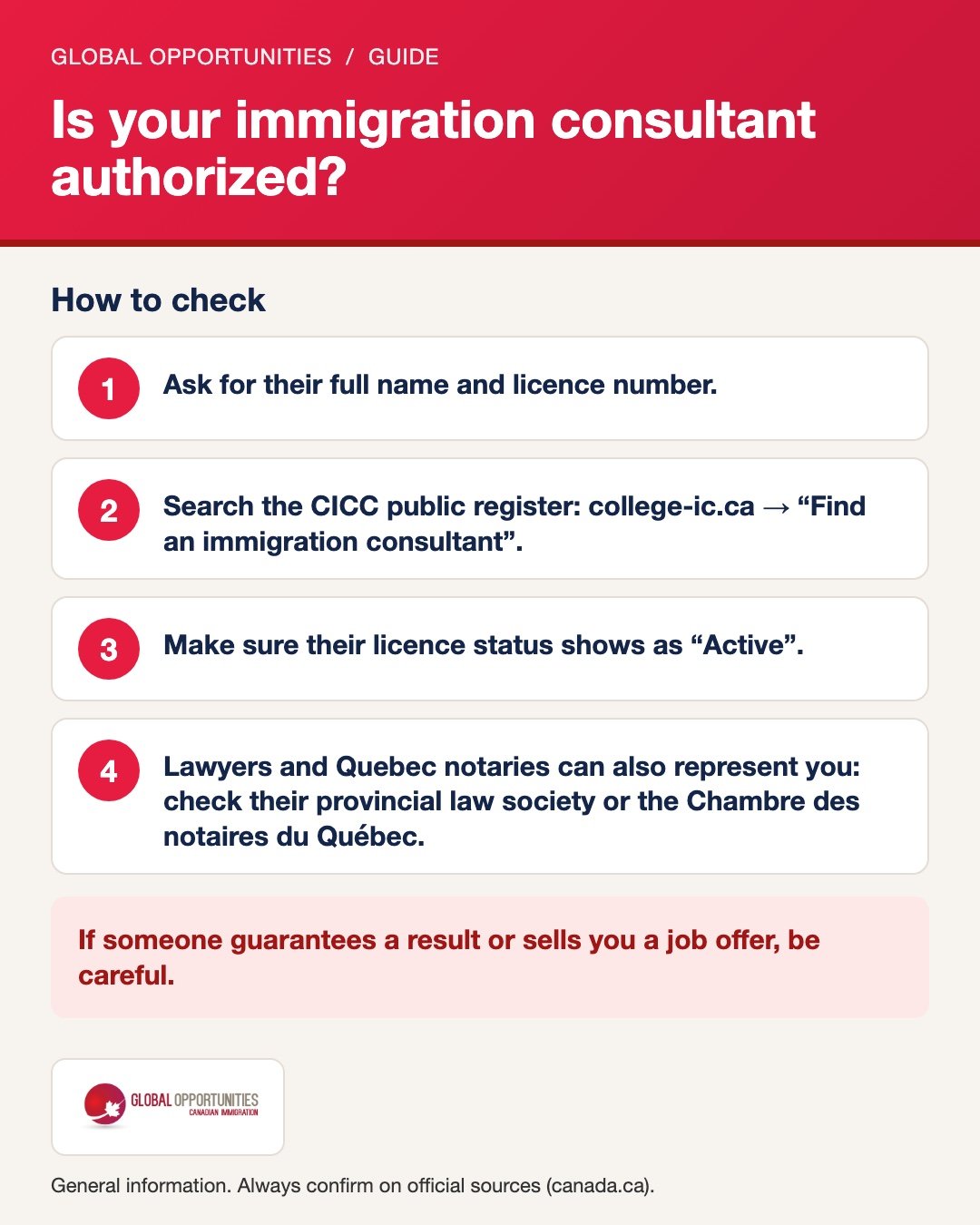
IRCC's page on international student fraud explains that paid representatives must be authorized, for example lawyers, paralegals, Quebec notaries and consultants registered with the College of Immigration and Citizenship Consultants. It warns that unauthorized "visa agents" or "visa fixers" have no special connections with officers and cannot speed up your application. To verify a consultant, use the CICC Public Register. For advice on choosing someone, see IRCC's page on choosing a representative.
The same IRCC page recommends getting a written contract, a fee breakdown and a signed receipt for every payment, never signing blank forms, and being present when your application is submitted.
Fake documents and "funds for hire"
Rented bank balances, purchased employment or reference letters, fake civil documents and "arranged" test results all put you at serious risk. IRCC's page on international student fraud warns that failing to declare information is considered lying and may lead to refusal; submitting false documents or information is misrepresentation under Canada's immigration law and can have serious consequences for future applications. If someone offers you a document you did not earn, walk away.
How to report fraud
IRCC's page How to report scams, fraud or abuse explains where to report, depending on the situation. Options include the Canadian Anti-Fraud Centre, your local police, and, for consultants, the College of Immigration and Citizenship Consultants.
Learn the Canadian resume format and how to spot job scams.
Fraud warnings and employer rules as published by IRCC and Employment and Social Development Canada, as of November 2026. A real job offer or LMIA does not mean a work permit will be approved; IRCC decides each application.
Which province should you choose when moving to Canada from Africa?
Where you live shapes your job search, your costs, the provincial programs you can look at and your community. Our province guides explain cities, housing, transit, health care, schools, work and winter in each one:
Quebec is not on this list because Global Opportunities does not offer services for Quebec's immigration programs.
Planning checklist for moving to Canada from Africa
Use this as a planning list, not as a legal checklist. Your program's official document list always comes first.
Six to twelve months before you apply or move
Check your passport's validity, and run IRCC's visa or eTA tool.
Decide which language test you need and book it with the official provider; consider both English and French if you speak both.
Request your transcripts and degree certificates and start your ECA if you need one.
If your occupation is regulated, contact the provincial regulator, or NNAS if you are a nurse, and read CICIC's page for your occupation.
Research provinces and cities with our province guides.
Three to six months before
Gather civil documents: birth certificate, marriage certificate, and children's documents, with certified translations into English or French if needed.
Request police certificates for each country IRCC asks about, following IRCC's country page.
Gather reference letters from employers describing your duties, as IRCC's pages explain.
If your program requires proof of funds, prepare the documents IRCC lists.
When you apply and before you travel
Book biometrics at a VAC through IRCC's links, within the time IRCC gives you.
Do your medical exam with an IRCC panel physician if asked.
Before travelling, plan your first weeks: temporary housing, money, winter clothing and health insurance for any waiting period, using our newcomers in Canada guide.
Read the Canada Border Services Agency's page on what you can bring into Canada, including food and money declarations.
Your first steps after moving to Canada from Africa
Most newcomers go through a similar checklist in their first weeks. Our newcomers in Canada guide explains each step in detail; here is the short version. Check each step with the official source for your status and province.
Keep your documents safe. Your passport, permit or confirmation of permanent residence, and any letters from IRCC are essential. Check the details on your permit as soon as it is issued.
Get your Social Insurance Number through Service Canada; Service Canada states there is no fee to apply.
Open a bank account. According to the Financial Consumer Agency of Canada, you can open one with proper identification even if you are not a Canadian citizen.
Sort out health coverage. Each province runs its own plan, and some have a waiting period. See IRCC's health care in Canada.
Check your driver's licence options. Licences are provincial, and at the time of writing no African country is on the Ontario or Alberta licence exchange lists. See the driving FAQ below.
Contact your regulator or apprenticeship authority if your occupation is regulated or you work in a trade.
Look for free newcomer services. IRCC's newcomer services finder lists settlement organizations outside Quebec. Eligibility depends on your status.
Learn about taxes. The Canada Revenue Agency has a page for newcomers to Canada explaining residency for tax purposes and benefits you may be eligible for.
Start your job search on Job Bank.
Planning for the long term? Our Canadian citizenship guide covers physical presence, the test and dual citizenship.
Settlement steps as described by Service Canada, the Financial Consumer Agency of Canada, IRCC, the Canada Revenue Agency and the provincial licensing pages, as of November 2026. Health coverage, waiting periods and licence rules differ by province and by status: check your province's official page.
Frequently asked questions
Do Africans need a visa when moving to Canada from Africa?
At the time of writing, no African country is on IRCC's visa-exempt list, so most African citizens need a visitor visa to travel to Canada. Citizens of Morocco and Seychelles may be eligible for an electronic travel authorization (eTA) instead, but only when flying and only if they meet IRCC's conditions; by land or sea they need a visa. Lists change, so always use IRCC's official tool with the passport you will travel on, before every trip. See the visa section of this guide for what a visitor visa does and does not allow.
Can Moroccans or Seychellois apply for an eTA instead of a visa?
Possibly, but only in some cases. At the time of writing, IRCC's entry requirements by country or territory page lists Morocco and Seychelles among the visa-required countries whose citizens may be eligible for an electronic travel authorization (eTA) instead of a visitor visa, only when travelling by air and only if they meet certain requirements. IRCC explains those requirements on its eTA eligibility page, and they can change, so read them on the day you apply. If you arrive by land or sea, including on a cruise ship, IRCC states that you need a visitor visa. An eTA is only a travel authorization: it does not let you work or study in Canada. Apply only on canada.ca, never on look-alike websites that charge extra. See the visa section of this guide.
Do I need a transit visa to fly through Canada?
If you are a citizen of a visa-required country, usually yes. According to IRCC's transit page, travellers from visa-required countries generally need a transit visa when their international flight stops at a Canadian airport, or when they connect between two international flights in Canada, if the transit lasts 48 hours or less. If it will last longer than 48 hours, IRCC says you need a visitor visa instead. Travellers from visa-exempt countries need an eTA to transit by air. IRCC also describes options to transit without a visa for some passport holders travelling to or from the United States, with conditions; when we checked, no African passport was on that list. Run IRCC's official tool before you book any connection through Canada, and see the visa section of this guide.
Does a visitor visa let me work after moving to Canada from Africa?
No. A visitor visa is a travel document that lets you come to Canada as a visitor. To work, you generally need a work permit, unless IRCC lists an exemption for your activity, and to study you generally need a study permit. IRCC's tool Find out if you need a work permit explains the exemptions. If you are approved for a study or work permit, IRCC issues any visitor visa you need with it, so be wary of anyone charging separately for that visa. The visa section of this guide explains dual intent and where to check whether you can apply from inside Canada.
Is there a Working Holiday for people moving to Canada from Africa?
At the time of writing, no African country appears on IRCC's list of countries with access to International Experience Canada (IEC), which includes the Working Holiday, Young Professionals and International Co-op categories. That means African citizens cannot use IEC through their African citizenship. If you also hold the citizenship of a participating country, the rules for that country apply. Check the official list, because Canada can sign new youth mobility agreements. In the meantime, the usual temporary routes are employer-supported work permits, Francophone Mobility for French speakers, and study permits.
Where do I give biometrics when moving to Canada from Africa?
At a visa application centre (VAC). IRCC's official page lists each VAC with its website link. You need an appointment, booking is free, and IRCC says not to pay anyone for one. IRCC also states that you have 30 days from your biometric instruction letter to give biometrics, and that if there is no VAC in your country you can use any other VAC. Book only through the VAC links on IRCC's page, and keep your appointment confirmation. See the biometrics section for details.
Which police certificate do I need when moving to Canada from Africa?
It depends on the country where you lived. IRCC's page How to get a police certificate has an entry for most countries, naming the document and the authority: for example, a Police Character Certificate for Nigeria, a Police Clearance Certificate for Ghana and Kenya, and a Bulletin No. 3 for several French-speaking countries. If your country is not listed, as with South Africa when we checked, IRCC says to contact the national police agency or the country's embassy or consulate in Canada. Certificates not in English or French need a certified translation. Start early, and read our country sections for what IRCC's page says.
How do I get a police certificate in Nigeria, Ghana or Kenya for Canada?
Follow IRCC's page for each country where you lived, because the document and the issuing authority are different. At the time of writing, IRCC's Nigeria page names a Police Character Certificate from the Nigeria Police Force, with an in-person option at the Central Criminal Registry in Lagos and a mail option with certified fingerprints for people abroad. The Ghana page names a Police Clearance Certificate from the Ghana Police CID Headquarters in Accra, with separate steps for residents and for people who no longer live in Ghana. The Kenya page names a Police Clearance Certificate from the Directorate of Criminal Investigations in Nairobi. Some of these pages are old, so confirm the current process with the issuing authority, and start early. See the Nigeria, Ghana and Kenya sections of this guide.
Do I need a medical exam when moving to Canada from Africa?
Many applicants do, especially for permanent residence and for some temporary applications, depending on the work you will do and where you lived. IRCC explains who needs one on its medical exams page. Your own doctor cannot do the exam: only a panel physician approved by IRCC can. Use IRCC's official panel physician search to find one in your country, and do not trust a clinic just because it claims to be approved. IRCC also explains follow-up steps for certain results, such as monitoring after arrival for inactive tuberculosis.
Can I apply for permanent residence when moving to Canada from Africa without a job offer?
Some programs do not always require a job offer. The Federal Skilled Worker Program through Express Entry is the best-known example: you can create a profile with your foreign experience, education and language results, if you meet the minimum requirements. Other programs, and many provincial streams, do require a job offer or a connection to the province. Where a job offer is not required, IRCC may still require proof of funds. Being eligible to enter the pool does not mean you will be invited; invitations depend on the rounds IRCC holds and on your ranking. Read the Express Entry section and IRCC's eligibility page.
How much money do I need for proof of funds when moving to Canada from Africa?
We do not publish the amounts because they change and only IRCC's version is reliable. IRCC's proof of funds page shows how much you need for your family size, which documents it accepts and when you are exempt, for example in some cases where you are already authorized to work in Canada and have a valid job offer. IRCC generally does not accept borrowed money, and the funds must be available to you. Be wary of offers to "rent" a bank balance for your application: that is misrepresentation. Whether you need to show funds, and what counts in your situation, depends on each case; a consultation is the way to know. Also budget for your real costs in Canada, which our newcomers guide helps you estimate.
Does studying help with moving to Canada from Africa permanently?
It may give you Canadian education and, in some cases, Canadian work experience after graduation, which some permanent residence programs value. But studying does not lead to permanent residence automatically. Not all schools and programs qualify for a post-graduation work permit, and IRCC changes the rules for study permits and work after graduation. Choose a program for its own value, check that the school is on IRCC's list of DLIs, and pay tuition only to the school. French speakers can also read the section on Francophone immigration outside Quebec.
How do I avoid study permit scams when moving to Canada from Africa?
Follow IRCC's advice on international student fraud. Check the school on IRCC's list of designated learning institutions. Ask the school to send the letter of acceptance directly to you, and be suspicious of anyone who promises admission for a fee without assessing your record. Pay tuition directly to the school. Do not pay anyone for a visitor visa that comes with your study permit. Make sure any representative is authorized and declared on your application, never sign blank forms, keep receipts, and be present when your application is submitted.
Which English tests are accepted when moving to Canada from Africa?
For Express Entry, IRCC accepts three English tests: CELPIP-General, IELTS General Training and PTE Core. The exact version matters. IELTS Academic, PTE Academic and the IELTS One Skill Retake are not on IRCC's Express Entry list, and a degree taught in English does not replace the test, even if English is your country's official language. IRCC states that results must be less than two years old when you create your profile and when you apply. Find centres through each provider's official finder; CELPIP has fewer centres outside Canada. Read our guide English and French tests for Canada.
Which French tests are accepted when moving to Canada from Africa?
For Express Entry, IRCC accepts TEF Canada and TCF Canada. TEF Canada is issued by Le français des affaires (CCI Paris Île-de-France) and TCF Canada by France Éducation international, each through approved centres, including in many African countries. Other French diplomas, such as the DELF or DALF, and other versions of the TEF or TCF, do not replace them for Express Entry. French results can make you eligible for the French-language proficiency category and are needed to prove your level for options such as Francophone Mobility.
Can French speakers live outside Quebec when moving to Canada from Africa?
Yes. There are Francophone communities in every province and territory, including Acadian communities in New Brunswick, Nova Scotia and Prince Edward Island, Franco-Ontarians, and communities in Manitoba, Saskatchewan, Alberta and British Columbia. IRCC's page Choose a Francophone community outside Quebec explains that you can access French-language schools and some services in French there. IRCC also notes that the working language is usually English, so English matters too. Federal options that value French outside Quebec include the French-language proficiency category of Express Entry and Francophone Mobility.
What is Francophone Mobility for people moving to Canada from Africa?
Francophone Mobility (Mobilité Francophone) is a work permit option that does not require a Labour Market Impact Assessment. According to IRCC's eligibility page, it is for French-speaking workers with a job offer in a province or territory outside Quebec. You must show intermediate French speaking and listening skills, at the level IRCC states, and most occupations qualify, with the exceptions IRCC lists. The employer submits the job offer through IRCC's Employer Portal first and gives you an offer of employment number. It is not a permanent residence program.
Do I need an ECA for my degree when moving to Canada from Africa?
For the Federal Skilled Worker Program, and to get points for foreign education in Express Entry, IRCC requires an Educational Credential Assessment from a designated organization. Physicians and pharmacists use the designated professional bodies IRCC names. An ECA confirms that your credential is valid and equivalent to a Canadian one for immigration; it is not a licence to work in a regulated profession. Follow the organization's own instructions, not an intermediary's. See the ECA section of this guide and IRCC's ECA page.
How do I send WES transcripts from my African university?
You ask your university to send them: you cannot send them yourself. In its FAQ, World Education Services (WES) states that it does not accept academic documents sent by third parties and that it cannot request documents on your behalf. Paper transcripts must arrive in a sealed envelope from the institution, with an official's seal, stamp or signature across the back flap, and your WES reference number should appear on every envelope. WES also accepts documents through official and secure electronic channels when your institution uses one, and it lists the required documents for each country. For Nigerian post-secondary credentials, the WES Canada Help Centre says secondary school results are no longer required. Other designated organizations set their own rules. See IRCC's ECA page and the ECA tips in this guide.
How can African nurses work in Canada after moving to Canada from Africa?
Nursing is regulated by each province and territory. For most internationally educated nurses, the process starts with the National Nursing Assessment Service (NNAS), which describes itself as the first step towards becoming a nurse in Canada. NNAS verifies your education, registration and experience and shares the results with regulators, but it does not give you a licence. The nursing regulator in your chosen province then decides whether you need exams, extra courses or a bridging program. NNAS handles applications for registered nurses, licensed or registered practical nurses and registered psychiatric nurses, so check which one matches your training. Our guide for internationally educated nurses explains NNAS, the NCLEX-RN and each regulator.
How can African doctors and engineers get licensed after moving to Canada from Africa?
According to the Medical Council of Canada, doctors are licensed by the medical regulatory authority of each province or territory, and the MCC verifies medical credentials and runs national exams that regulators use; each regulator sets its own routes for international medical graduates. Engineers are licensed by provincial and territorial engineering regulators; according to Engineers Canada, licensing generally looks at academics, work experience in the province, a professional practice exam, good character and language. Many start as engineers-in-training. In both cases, contact the regulator early, ideally before you move, and treat any promise of a quick licence as a red flag.
Is my driver's licence valid after moving to Canada from Africa?
For a limited time, and then you need a provincial licence. Licences are provincial. Ontario's licence exchange page states that new residents can use a valid foreign licence for 60 days, and at the time of writing it lists no African country among its exchange agreements. Drivers from other countries can get credit for previous experience with the documents Ontario describes, including an authentication letter from the issuing authority, but still take tests. Alberta's exchange page also lists no African country and explains its testing steps. Other provinces have their own rules.
Do my pension contributions count after moving to Canada from Africa?
Canada has social security agreements with some countries that coordinate pension programs. At the time of writing, the Government of Canada's list of agreements includes Morocco and Tunisia, but not most other African countries. According to the Government of Canada, these agreements can help people who have lived or worked in both countries qualify for benefits, but they do not increase payments. The Government of Canada's page explains how each agreement works and how to apply. Questions about your pension in your own country should go to the competent authority there.
What food can I bring to Canada from Nigeria or Ghana?
Whatever you bring, declare it. The Canadian Food Inspection Agency (CFIA) states on its page Bringing food into Canada for personal use that travellers must declare all food products they bring into Canada. For countries other than the United States, the CFIA says fresh, dried and cured meats are not permitted, and only some commercially prepared, shelf-stable and sealed meat products are allowed. For dairy, it lists ice cream, yogurt, kashk and pasteurized cheese as permitted from any country. For a specific product, such as dried fish, spices or palm oil, check the CFIA's Automated Import Reference System (AIRS), which shows the rules by product and country of origin. The Canada Border Services Agency explains what you must declare when you arrive. If you are not sure about an item, declare it and let the officer decide.
Do I need to translate my documents when moving to Canada from Africa?
Usually, if they are not in English or French. According to IRCC's police certificates page and its application guides, IRCC asks for certified translations of documents in other languages, and its application guides explain the exact rules for each application, including what to do if the translator is not certified. For police certificates, IRCC states that you send the original with a translation by a certified translator. This matters for documents in Arabic, Amharic, Portuguese and other languages, and for some North African certificates issued only in Arabic. Documents already in French do not need translation for IRCC, but some provinces or regulators may ask for English. ECA organizations and regulators set their own rules for transcripts. Plan the time and cost of translations, and keep the originals.
Should I pay for a job offer when moving to Canada from Africa?
No. The Government of Canada states that employers cannot recover the LMIA processing fee from temporary foreign workers, and that employers must make sure that neither they nor anyone recruiting for them charges or recovers recruitment fees from those workers. Treat any request to pay for a job offer, an LMIA, a "work visa" or a "guaranteed placement" as a serious red flag. Real Canadian employers interview candidates, and the job usually appears on the company's own website or on Job Bank. Global Opportunities does not offer jobs. Read the fraud section of this guide.
Can I apply for a Canadian visa without an agent?
Yes. IRCC's Help Centre answer Do I need a representative to help me apply? says you do not, and that the Government of Canada treats everyone equally, whether they use a representative or not. IRCC's forms and guides are free on canada.ca, and you can submit your own application by following the instructions for it. If you choose to pay someone for help, IRCC's page on choosing a representative explains that a paid representative must be authorized, which means licensed to practise. Be wary of "visa agents" who promise approval, ask you to sign blank forms, or keep the login to your IRCC account. Keep control of your own account and documents. See the fraud section of this guide and the next question, on how to check a consultant.
How do I check a consultant before moving to Canada from Africa?
Paid immigration consultants must be licensed by the College of Immigration and Citizenship Consultants (CICC). Search the CICC Public Register with the person's name and licence number, and check that the licence is active. IRCC states that you do not need a paid representative to apply, and that hiring one will not speed up your application or guarantee approval. Ask for a written contract and receipts, never sign blank forms, keep access to your own IRCC account, and be present when your application is submitted. According to IRCC's page on choosing a representative, only authorized representatives can charge for immigration advice.
Where do I report a scam when moving to Canada from Africa?
Follow IRCC's report fraud page, which explains where to report depending on the situation. Options include the Canadian Anti-Fraud Centre, your local police, and the College of Immigration and Citizenship Consultants if a consultant is involved. IRCC also accepts tips about immigration fraud. Keep evidence: emails, messages, receipts, websites and phone numbers. If you paid money, contact your bank or transfer service quickly, and never send more money to someone who promises to "recover" what you lost. Reporting helps protect other people from the same scheme.
Can I bring my family when moving to Canada from Africa?
In many programs, yes. When you apply for permanent residence through Express Entry or a provincial program, you include your spouse or common-law partner and dependent children in your application, and they may need medical exams, police certificates and biometrics. For temporary permits, family members apply for their own permits or visas, and IRCC explains which permits a spouse or children may be eligible for; these rules change, so check the current pages. If you are already a permanent resident or citizen, IRCC's family sponsorship page explains who you can sponsor. Read more in our articles on family sponsorship in Canada and spousal sponsorship.
Why are Canadian visas refused, and what can I do after a refusal?
An officer refuses a visitor visa when they are not satisfied that you meet the requirements. According to IRCC's visitor visa eligibility page, the officer checks that you have a valid passport, are in good health and have no criminal or immigration-related convictions. The officer must also be satisfied that your ties to your home country, such as a job, a home, financial assets or family, will take you back, that you will leave at the end of your visit, and that you have enough money for your stay. Your refusal letter names the general reason. You can usually apply again, but only real changes or better evidence address that reason; sending the same file again rarely does. The next question explains how to request the notes on your file.
What if my Canadian visa is refused when moving to Canada from Africa?
Read the refusal letter carefully: it gives the general reason. Many applicants also request the notes on their file. IRCC's page How to make a request under the Privacy Act explains how to ask for the personal information IRCC holds about you. In most cases you can apply again, but a new application should address the reasons for refusal with real changes or better documents, not the same file again. Never add false documents. Be wary of anyone who promises that a reapplication will be approved. To understand how officers assess applications, read Canada visa refusals: how IRCC evaluates applications.
How long does it take when moving to Canada from Africa?
We do not publish processing times because they change constantly and depend on each case: the application, the country and IRCC's workload. A consultation is the way to understand what to expect in your situation. IRCC publishes current estimates on its official check processing times tool. In practice, the time you need to prepare also matters: language tests, ECAs, transcripts, police certificates and translations can take weeks or months, depending on the authorities involved. Start the steps that depend on other institutions first. Be wary of anyone who offers to make your application faster for a fee: IRCC states that representatives cannot speed up processing.
Which province is best when moving to Canada from Africa?
There is no single best province: it depends on your occupation, your language, your budget, your family and whether you have a job offer or connections somewhere. Compare rents with the CMHC Rental Market Reports and job postings on Job Bank, and check each province's own streams. French speakers can use IRCC's page Choose a Francophone community outside Quebec. Read our province guides, linked in the section on choosing a province, and each province's official immigration page.
Can I get free help before moving to Canada from Africa?
Possibly. IRCC funds pre-arrival services for some people who have been approved to come to Canada, including help with job search and credential recognition. Eligibility depends on your status and stage, so check the page. After you arrive, IRCC's newcomer services finder lists free settlement organizations outside Quebec that help with resumes, language classes, housing and orientation. Official information from IRCC, the forms and the guides is also free, so be wary of anyone who sells information that IRCC gives away. Our newcomers in Canada guide explains your first weeks.
Related guides
How Global Opportunities can help
Global Opportunities is a private immigration firm in Toronto. If you are planning a move from Africa, we can help you understand which Canadian programs may fit your profile and what to prepare. We cannot guarantee an invitation, a visa, a permit or a result: every decision is made by IRCC or the province.
Our regulated consultant: Lic. Mildrete Monserrath Gutierrez Martinez, Regulated Canadian Immigration Consultant (RCIC), CICC licence R514880. Verify her licence on the CICC Public Register: https://college-ic.ca/protecting-the-public/find-an-immigration-consultant. Global Opportunities does not offer services for Quebec's immigration programs. Global Opportunities is a private firm and is not part of the Government of Canada or any provincial government.
Recorded seminars and lives: watch our recorded seminars in English or the Spanish recordings, and find everything on our YouTube channel.
More articles in English: read our Moving to Canada articles on topics such as health care, cost of living, the ECA and professional licences, and building community in Canada.
Personalized consultation: to review your situation, contact us through our contact page or write to info@globalopp.ca.
Prefer email? Tell us what you need help with (moving to Canada from Africa) and we will reply: email info@globalopp.ca.
Contact Global Opportunities →
Sources
IRCC Help Centre: How can I tell if an immigration website is a scam?
Government of Canada: Program requirements for high-wage positions (LMIA)
Government of Canada: Countries with social security agreements
CICIC: Canadian Information Centre for International Credentials
Red Seal: Provincial and Territorial Apprenticeship and Certification Authorities
Government of Ontario: Exchange an out-of-province driver's licence
Government of Alberta: Exchange a licence from outside Alberta
IRCC Help Centre: Do I need a representative to help me apply?
WES Canada Help Centre: I studied in Nigeria, do I need to send my secondary school results?
The information in this guide comes from the official sources linked above, as they read when we checked them in November 2026. It is general and for reference only, it may have changed since then, and it is not immigration, legal or professional advice. Global Opportunities is not responsible for how anyone interprets this content, for decisions made based on it or for changes made after it was written: what you read depends on when you read it. Visa requirements, VAC locations, police certificate procedures, Express Entry, provincial programs, study permit rules, Francophone programs, language test rules and official requirements change frequently, and nothing in this guide covers the laws, documents or procedures of any African country. Always confirm requirements with official Government of Canada and provincial sources, and for your own case, book a consultation. Global Opportunities is a private firm, is not part of the Government of Canada or of any regulator, and does not offer jobs.
Last reviewed: November 2026