
Already in Canada? The Newcomer's Guide to Work Permits, Life in Toronto and Your First Job
You made it to Canada. Now the real questions start: how do I check my work permit status, what happens if my permit is about to expire, where do I find an apartment or a room in Toronto, which bank should I open an account with, how do I build credit, how do I get OHIP and a family doctor, how does the G1 licence work, why is car insurance so expensive, and where can I get free help with my resume? This newcomer's guide answers them in plain English, using official Government of Canada, Ontario and City of Toronto sources.
About our sources: This guide summarises what official sources (the Government of Canada, provincial and territorial governments and the other organisations we link to) said when we checked them in November 2026. We link every source so you can read it yourself. Rules, rates and requirements change, sometimes without notice, and the official page is the one that counts. This is general information, not legal, tax or immigration advice. Global Opportunities is not responsible for how this information is interpreted or for changes made after it was written.
This guide is for people who are already in Canada on temporary status: work permit holders (including working holiday participants under International Experience Canada), international students at colleges and universities, graduates on a post-graduation work permit, and their families. Most examples are from Toronto and Ontario, where many newcomers start, but the immigration sections apply across Canada.
We are Global Opportunities, a private immigration firm based in Toronto. Immigration rules, provincial programs, prices and local services change often, so we link the official page for each topic. Where we mention a living cost (a transit fare, an average rent, a licence fee), we say when we checked it. Please check the official page before you make any decision.
Watch our recorded seminars and lives →
In this guide
Understand your status: what your work permit really says
How to check your work permit or application status
How to extend or change your work permit
Maintained status: can I keep working while my work permit extension is processed?
What to do if your work permit has expired
Changing jobs or employers on a work permit
Post-graduation work permits and permits for spouses
Who can help you with Canadian immigration, and why it matters
Your first weeks in Canada: a practical checklist
How do temporary residents get a Social Insurance Number (SIN)?
Banks in Canada for newcomers: opening an account and building credit
Housing in Toronto: where to find an apartment or a room
Renting in Ontario: deposits, the standard lease and your rights as a tenant
How to avoid rental scams in Toronto
Utilities, internet and phone plans in Canada
Health care in Ontario: OHIP, family doctors, walk-in clinics and Health811
Groceries and shopping in Toronto on a budget
Your first Canadian winter: what to buy and where
Free newcomer services in Toronto and Ontario
Getting around Toronto: TTC fares, PRESTO, GO Transit and UP Express
Ontario driver's licence: G1, G2, G and exchanging a foreign licence
Car insurance in Ontario for newcomers
Can I rent a car in Toronto with a foreign licence?
Parking in Toronto: street permits, Green P and winter rules
For college and university students: work, co-op and internships
Finding a job in Canada: free help from YMCA, community agencies and Employment Ontario
Your Canadian resume, cover letter and interviews: the short version
Your rights at work
Taxes in Canada for newcomers: filing, CRA My Account and benefits
Buying your first home in Ontario: FHSA, Home Buyers' Plan and land transfer tax refunds
Planning to stay: permanent residence from inside Canada
Living outside Toronto? Our province-by-province guides
Common mistakes newcomers make
Frequently asked questions
Related guides
How Global Opportunities can help
Sources
Understand your status: what your work permit really says
Your work permit is the most important document you have in Canada. You will also show it to get a SIN, a health card, a driver's licence and often an apartment. Read it carefully the day you receive it, and again every few months.
Open or employer-specific?
According to IRCC's page on whether you need a work permit, there are two main kinds:
Open work permit: lets you work for almost any employer in Canada, unless conditions printed on the permit say otherwise. Working holiday (IEC Working Holiday) permits, post-graduation work permits and some spousal permits are open permits.
Employer-specific work permit: lets you work only according to the conditions on the permit: the employer, the job and often the location named on it. Changing any of those usually needs a new permit.
What to check on your permit
Expiry date. Mark it in your calendar, with reminders several months before.
Conditions. Some permits restrict the type of work, the employer or the location. Some say you cannot work in child care, health care or primary or secondary schools without a medical exam.
Your personal details. Name, date of birth and passport number must be correct. Mistakes can cause problems later, so ask IRCC to correct them early.
Your passport. A permit generally cannot be valid for longer than your passport, so renew your passport early if it is close to expiring.
How to check your work permit or application status
If you have applied for a new permit, an extension or permanent residence, IRCC gives you several official tools. The steps:
Check your application status: sign in to your IRCC account or use the options on IRCC's page Check your application status.
Use the application status tracker if your application type is included: IRCC's application status tracker shows more detail.
Compare with the processing times: IRCC publishes estimated processing times. They are estimates based on past applications, not a promise.
Ask a question only if you need to: contact IRCC through its web form. IRCC notes that sending more than one form does not speed up your application.
Anyone who promises to make IRCC process your file faster in exchange for money is a red flag.
Please note: as described on IRCC's status and processing-time pages, November 2026. Processing times are estimates, not a promise: how long your own application takes depends on your case. To understand your situation, book a consultation.
How to extend or change your work permit
If you want to keep working in Canada after your permit expires, or you need to change its conditions, you usually apply from inside Canada. According to IRCC's page on extending or changing the conditions of your work permit, you should apply at least 30 days before your current permit expires.
The steps, in order:
Mark the date: at least 30 days before your permit expires, according to IRCC.
Confirm the basis for your new permit (see below).
Check your passport and provincial documents before you apply.
Apply online when you can, and keep proof of the date you submitted.
Keep working only under your current conditions while you wait (see "Maintained status" below).
Some things to know before you apply:
You need a basis for the new permit. An extension is not automatic. Depending on your situation, you may need a new job offer, a new Labour Market Impact Assessment from your employer, a different program or another category. Read our page on the LMIA.
Some permits cannot be extended. For example, International Experience Canada (working holiday) permits generally cannot be extended. See our guide Working Holiday in Canada for Irish citizens, which explains the IEC rules.
Apply online when you can, and keep proof of the date you submitted.
Plan your passport. An extension cannot go past your passport's expiry date.
Plan your provincial documents. Renew your health card and driver's licence while your permit is still valid if you can, because renewing them on maintained status is usually not possible (see the next section).
If your permit ends within a year, watch Is your work permit or PGWP expiring in the next 12 months?
Maintained status: can I keep working while my work permit extension is processed?
Usually yes, if you applied in time. According to IRCC, if you apply to extend your work permit before it expires, you can stay in Canada while IRCC processes your application and keep working under the same conditions, as long as you stay in Canada. Applying even one day late means you do not have it.
IRCC calls this maintained status (it used to be called "implied status"). According to IRCC's page on expiring or expired work permits, if you apply to extend your permit before it expires, you can legally stay in Canada while IRCC processes your application, and you keep your authorization to work as long as you stay in Canada.
What maintained status means in practice, according to IRCC:
You must apply before your permit expires. Applying even one day late means you do not have maintained status.
You keep the same conditions. If you have an employer-specific permit, you keep working for the same employer, in the same job and location, until IRCC decides. You cannot start with a new employer or in a new job until your application is approved, unless IRCC gives you a specific authorization to do so.
Proof for your employer. IRCC explains what proof you receive when you apply online or on paper, so your employer can see that you are allowed to keep working.
Your SIN. Service Canada explains that if your SIN expires but you applied to extend your permit, you can keep working with your expired SIN until IRCC decides.
Provincial documents. IRCC notes that you usually cannot renew your provincial driver's licence or health card while on maintained status. Ontario's OHIP page says people on maintained status may be eligible and should contact ServiceOntario.
Leaving Canada. Maintained status depends on staying in Canada. If you leave, IRCC warns that it can affect your ability to work when you return. Read IRCC's page and get advice before you travel.
Please note: based on IRCC's page on expiring or expired work permits and Service Canada's SIN page, as of November 2026. Maintained status applies only if you applied before your permit expired and you stay in Canada; it does not mean your extension will be approved. IRCC decides each case.
What to do if your work permit has expired
If your permit expired and you did not apply in time, you may have lost your status. IRCC's page on restoring your status explains that, in general, you must apply within 90 days of losing your status, and that you normally cannot work until your status is restored and you receive a new permit. Approval is not guaranteed.
If you are in this situation, act quickly and get advice from an authorized representative. Each case is different, and waiting usually reduces your options. Tell your employer the truth: continuing to work without authorization can create serious problems for you and for them.
Please note: the 90-day rule comes from IRCC's page on restoring your status, as of November 2026. Applying for restoration does not mean it will be granted, and each case is different.
Changing jobs or employers on a work permit
Open work permit: you can usually change employers freely, unless your permit has specific conditions.
Employer-specific work permit: you usually need a new work permit before you start working for a new employer. IRCC explains the process on its page about changing jobs or employers.
A promotion or a new role with the same employer can also count as a change if it changes the occupation on your permit. Check before you accept.
If your employer treats you unfairly, read the section on your rights at work below. Canada has protections for temporary foreign workers, including an open work permit for vulnerable workers in some situations.
Post-graduation work permits and permits for spouses
Post-graduation work permit (PGWP)
If you are studying at a college or university in Canada, the post-graduation work permit may let you work in Canada after you graduate. Not every school or program qualifies, and the eligibility rules have changed several times, including requirements related to your field of study and language skills. Check the rules before you choose a program, not after you graduate.
If your permit ends within a year, watch Is your work permit or PGWP expiring in the next 12 months? Watch our recorded session on expiring work permits and the PGWP, with our other recordings in English.
Open work permits for spouses
The rules for spouses and partners changed recently. IRCC's page on open work permits for spouses of workers explains that eligibility now depends on factors such as the principal worker's occupation and program, and some spouses and dependent children who qualified in the past no longer do. Spouses of students also face new limits. Check the current rules for your situation. For an overview, see our page on open work permits.
Please note: PGWP and spousal work permit rules as published by IRCC, November 2026. They have changed several times and may change again. Meeting the published criteria does not mean IRCC will approve an application; IRCC decides each case.
Who can help you with Canadian immigration, and why it matters
When your status, your job or your future in Canada depends on an application, good advice matters. Many people search for "immigration consultant near me" or "immigration consultant Toronto". Here is how to choose well.
Who is allowed to give paid immigration advice
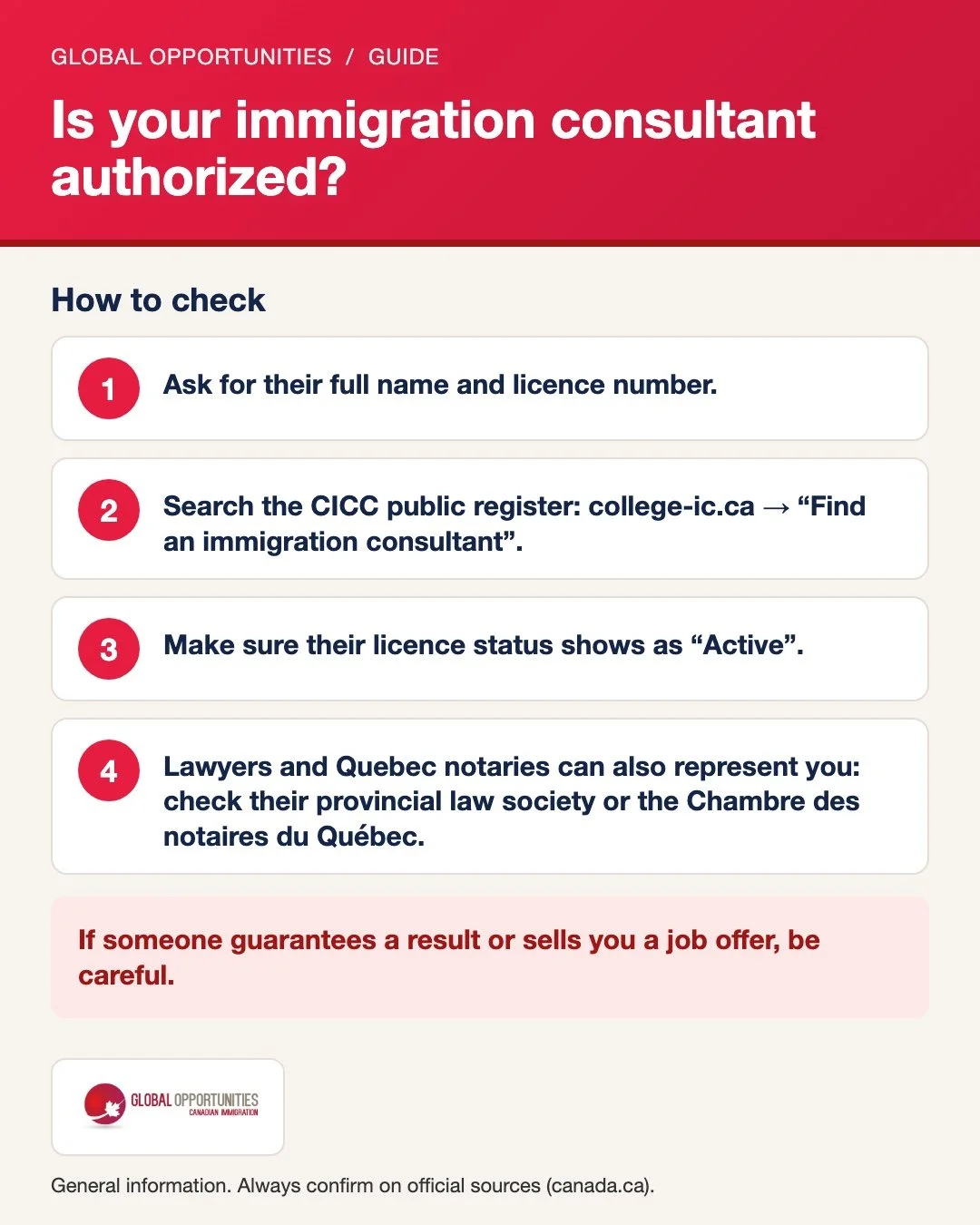
According to IRCC's page Check if your representative is authorized, only these people can charge you for immigration advice or representation:
Regulated Canadian Immigration Consultants (RCICs) who are licensees of the College of Immigration and Citizenship Consultants (CICC);
lawyers and paralegals who are members of a Canadian provincial or territorial law society (in Ontario, the Law Society of Ontario);
notaries who are members of the Chambre des notaires du Québec.
IRCC warns that if someone who is not authorized charges you for help, they are breaking the law, and IRCC may return or refuse your application.
How to verify an immigration consultant
Ask for the consultant's full name and licence number.
Search the CICC Public Register. Check that the licence is active and that the person is entitled to practise.
For lawyers and paralegals in Ontario, search the Law Society of Ontario directory.
Be careful with "ghost consultants": people who give advice for money but do not appear on your application, or who are not licensed. Any paid representative must be declared on your application.
When it is worth talking to an authorized representative
Your permit expires soon and you are not sure what comes next, or it has already expired.
You want to change employers, programs or status (for example from student to worker).
You received a refusal, a procedural fairness letter or a request you do not understand.
You want to plan permanent residence.
You do not have to pay anyone to apply: IRCC's forms are free. A good representative helps you understand your options, avoid mistakes and prepare a complete application. No one can guarantee a result, because every decision is made by IRCC or the province. If you have a problem with a representative, IRCC explains how to file a complaint.
Your first weeks in Canada: a practical checklist
A realistic order of steps, each explained further down:
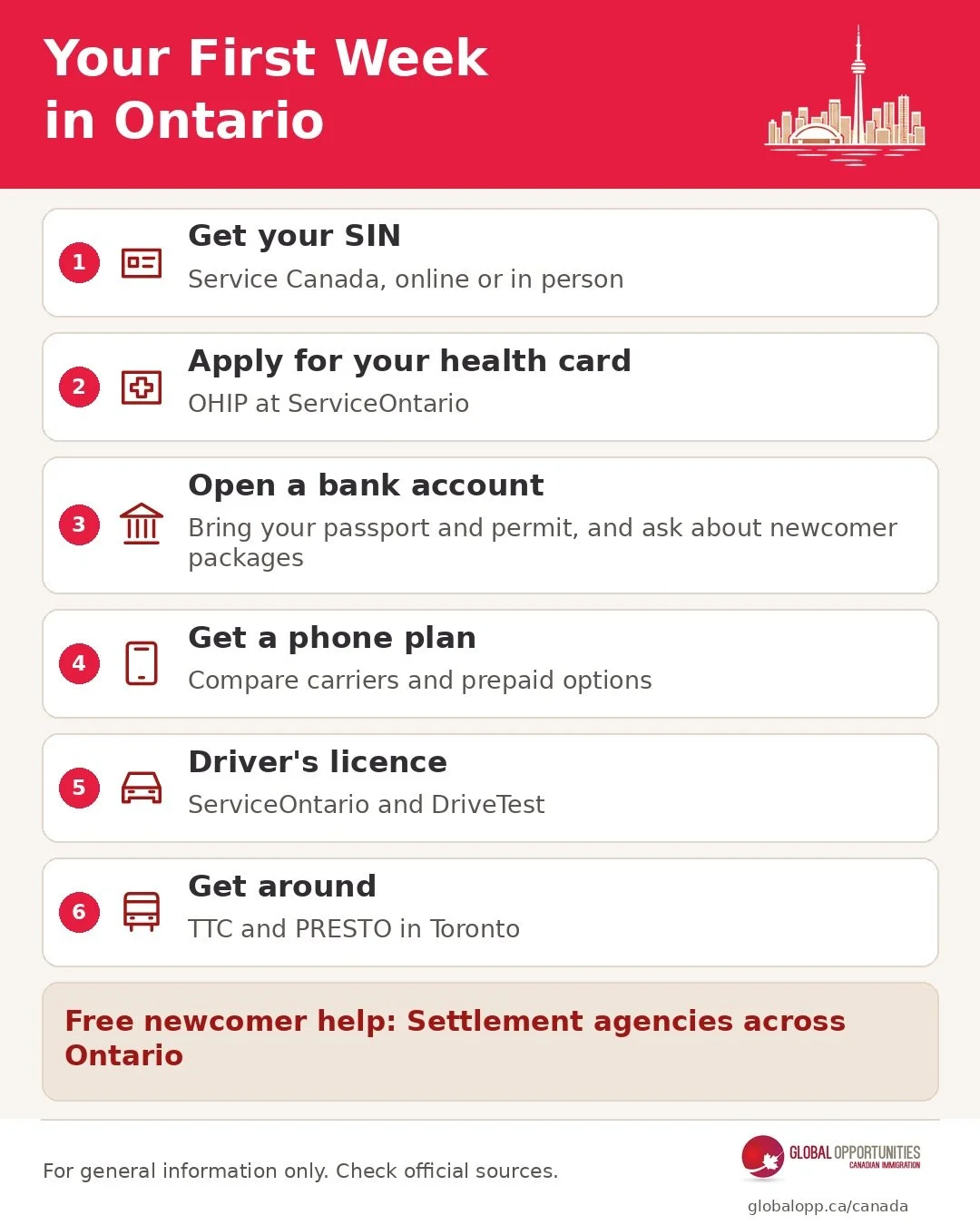
Check your permit for errors and conditions, and save copies of your documents.
Get a Canadian phone number for the bank, landlords and employers.
Apply for your SIN as soon as you are authorized to work.
Open a bank account and start building credit.
Find temporary housing first, then a longer-term place once you know the city.
Get a PRESTO card or set up PRESTO in your phone's wallet.
Apply for OHIP if you qualify, and buy private insurance for any gap.
Register with Health Care Connect to be matched with a family doctor.
Get a free Toronto Public Library card.
Book a free employment service to adapt your resume.
Start the Ontario licence process early if you plan to drive (according to Ontario's page on exchanging an out-of-province licence, new residents can use a foreign licence for 60 days).
Prepare for winter before November.
Mark your permit expiry date with reminders months in advance.
Coming from abroad? See our guides for people moving from Europe, Asia, Africa and Australia. Moving with a dog or cat? Read our guide to immigrating to Canada with your pet.
How do temporary residents get a Social Insurance Number (SIN)?
You need a SIN to work in Canada, get paid, file taxes and access government programs. According to Service Canada's page on the SIN for temporary residents:
SINs issued to temporary residents always start with "9" and expire on the same date as your permit. When you get a new permit, update your SIN record.
Apply online, by mail or in person with your valid permit (an IRCC email is not accepted) and an identity document such as your passport.
You can start working as soon as you apply; you do not need to wait for the number.
On maintained status, you can keep working with your expired SIN until IRCC decides.
Protect your SIN. Give it to your employer, to your financial institution when it is required, and to the Canada Revenue Agency. Do not give it to landlords or put it on your resume. Identity theft often starts with a stolen SIN.
Please note: SIN rules as published by Service Canada, November 2026. Check the linked page for the current rules before you apply.
Banks in Canada for newcomers: opening an account and building credit
The main banks and other options
Canada has a few large national banks: RBC Royal Bank, TD Canada Trust, Scotiabank, BMO Bank of Montreal and CIBC, plus National Bank, whose official branch locator lists branches in Toronto (National Bank, Toronto branches). There are also:
Credit unions: member-owned institutions. In Ontario, FSRA (the Financial Services Regulatory Authority of Ontario) regulates them and insures eligible deposits (FSRA, credit unions and deposit insurance).
Online banks and digital brands: some belong to larger banks. Tangerine says it is a wholly owned subsidiary of Scotiabank (Tangerine, about us), and Simplii Financial says it is a division of CIBC (Simplii, about us).
Newcomer packages: each large bank has a newcomer page describing its offers, such as a period without monthly fees (RBC, TD, Scotiabank, BMO, CIBC, National Bank). Terms change and vary by status; compare them.
We mention these institutions for reference only. Global Opportunities has no relationship with any bank or credit union and does not recommend any of them. Compare products yourself using the official tools below.
How to open a bank account in Canada
According to the Financial Consumer Agency of Canada (FCAC), you can open a bank account with proper identification even if you are not a Canadian citizen. The bank must confirm your identity with original documents: either two documents from reliable sources (one with your name and address, one with your name and date of birth; a foreign passport counts), or one document plus confirmation of your identity by a person in good standing, such as a customer of the bank.
In practice, newcomers bring their passport, work or study permit and proof of their Canadian address. Banks may also ask for your SIN for some accounts, and you may need to visit a branch. If a bank refuses, it must tell you in writing. Use FCAC's Account Comparison Tool to compare fees. Eligible deposits at member banks are protected by the Canada Deposit Insurance Corporation (CDIC) up to its limits; Ontario credit union deposits are insured by FSRA within its limits.
Building credit history in Canada
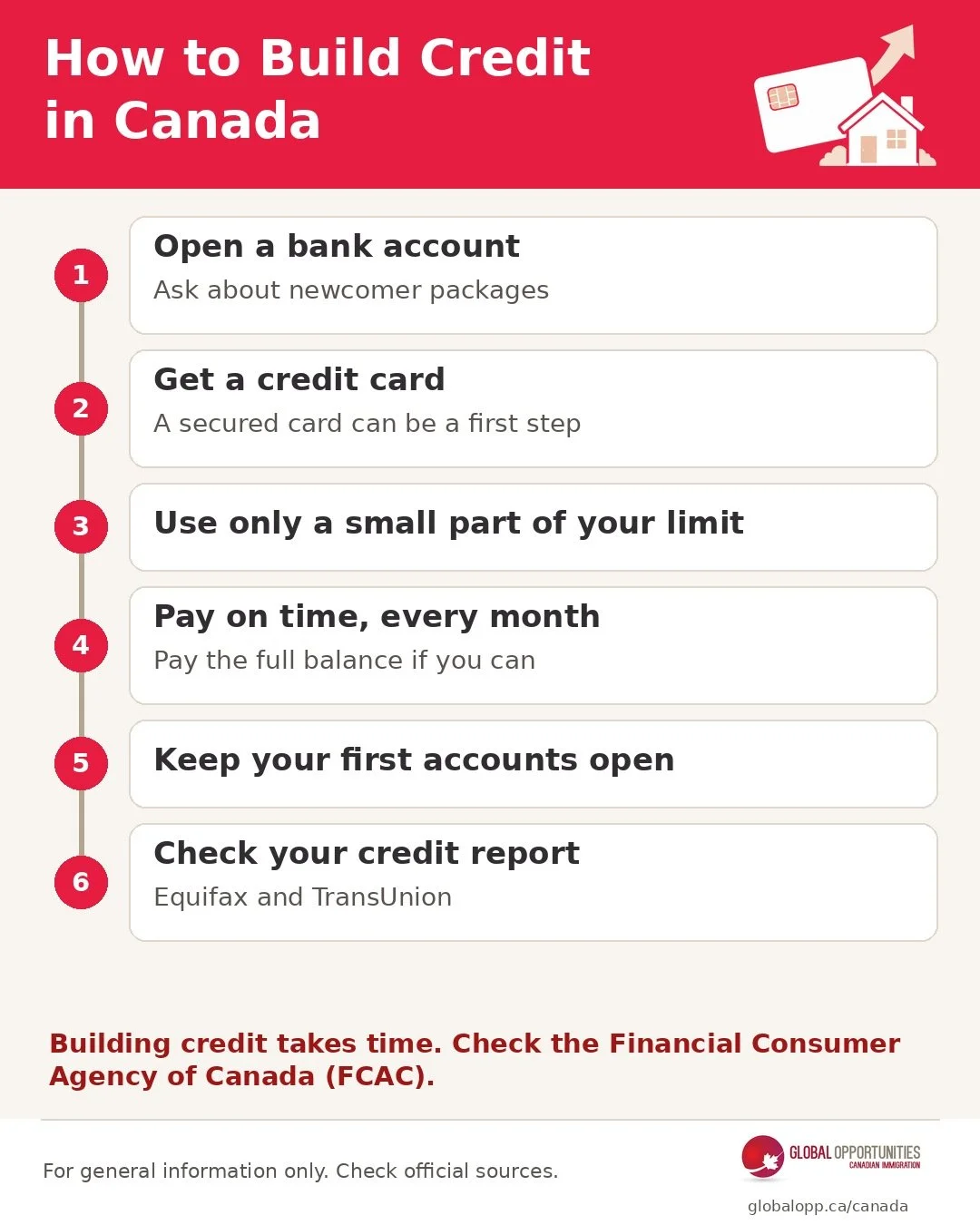
Your credit history from another country usually does not follow you to Canada. That matters, because landlords, phone companies, car dealers and insurers may check your Canadian credit. Here is how credit works, based on FCAC's guidance on improving your credit score:
Pay every bill on time. Payment history is the most important part of your credit score. Pay at least the minimum, and ideally the full balance.
Use only a small part of your limit. FCAC suggests trying to use less than 30% of your total credit limit, even if you pay in full every month.
Keep accounts open and active. A longer credit history helps. Closing your oldest card can hurt your score.
Apply for credit only when you need it. Many applications close together can lower your score.
Use different types of credit over time, carefully (for example a credit card and later a car loan).
Secured credit cards
If you cannot get a regular credit card, a secured credit card is a common way to start. According to FCAC's page on choosing a credit card, you give a security deposit to the financial institution that issues the card, and that deposit is usually your credit limit. You use it like any credit card, and if the issuer reports to the credit bureaus, your on-time payments build your history. Check that the issuer reports to the bureaus, check the fees, and be careful with companies that ask for money in advance to "repair" or "build" your credit.
Equifax and TransUnion: checking your credit report
Canada has two main credit bureaus, Equifax and TransUnion. According to FCAC's page on getting your credit report and credit score, you can get your credit report online for free from both, and checking your own report or score does not affect your credit rating. FCAC also notes that Equifax gives free credit scores in all provinces and TransUnion gives them free in Ontario and Quebec. Check your report once or twice a year for errors and fraud.
Please note: credit guidance as published by the Financial Consumer Agency of Canada, November 2026. Each bank and card issuer sets its own approval rules; FCAC's guidance does not mean a bank will approve you.
Housing in Toronto: where to find an apartment or a room
Renting a room vs an apartment
A room in a shared house or apartment is how many newcomers start: cheaper, often furnished with utilities included, and no long commitment. Ask whether you sign with the landlord or with a roommate who holds the lease.
A basement apartment is common in Toronto. Check windows, heating and a safe exit.
A purpose-built rental building is managed by a company and is often covered by rent increase rules.
A condo apartment is rented by its individual owner; often newer, with different rules.
Important: Ontario's tenant law has exceptions. Steps to Justice, a legal information website from Community Legal Education Ontario, explains on its page Find out if the Residential Tenancies Act applies that the law does not apply if you share a kitchen or bathroom with the owner or the owner's close family members. That means far fewer protections, including on evictions. Ask before you move in.
Where to look
Listing sites and apps: many newcomers search on Kijiji, Facebook Marketplace, Rentals.ca and PadMapper, among others. Verify every listing (see rental scams below).
Facebook and community groups: newcomer, neighbourhood and national community groups often post rooms, but nothing is verified.
"For Rent" signs on buildings and property management companies' own websites.
Your college or university housing office: off-campus listings, residences and advice on rights and scams.
Real estate agents: some help tenants, especially with condos. Ask who pays the agent.
Settlement agencies: some offer housing workshops.
Websites and apps are mentioned for reference only. Global Opportunities has no relationship with them.
How much is rent in Toronto?
The most reliable source for average rents is the Canada Mortgage and Housing Corporation (CMHC), which surveys purpose-built rental apartments every October. According to the CMHC Rental Market Report data tables for the Toronto area (survey of October 2025, published in the 2025 Rental Market Report, checked in November 2026), the average monthly rents for purpose-built apartments in the City of Toronto were:
Studio (bachelor): $1,499
One bedroom: $1,763
Two bedrooms: $2,055
All units: $1,912
These are averages of all tenants, including long-term tenants paying less, so asking rents for units listed today are usually higher, and CMHC reports higher averages for condo apartments rented by owners. Compare with real listings before you budget, and check the current price.
For a national overview, see our article on the cost of living in Canada.
What landlords usually ask for
According to IRCC's page on renting a home, landlords may ask for references (for example from a past landlord or employer), where you work, a credit check and proof of income. Newcomers without Canadian credit history can prepare a simple file: a copy of your permit, a job letter or pay stubs, bank statements, references from previous landlords (even from another country), and a short introduction.
The Ontario Human Rights Commission explains on its page Housing is a human right that landlords may request rental history, credit references or credit checks, but a lack of rental or credit history should not be viewed negatively. Landlords also cannot refuse you because of your place of origin, citizenship, family status or other protected grounds.
Some landlords ask for many months of rent in advance. Ontario law limits the deposit a landlord can require (see the next section); if you feel pressured, ask a legal clinic or settlement worker before you pay.
Please note: average rents as published by CMHC (October 2025 survey), checked in November 2026. They describe past rents, not what you will pay: check current listings and the linked pages before you rely on them.
Renting in Ontario: deposits, the standard lease and your rights as a tenant
Which deposits are allowed in Ontario
This is one of the most common questions from newcomers. According to the Landlord and Tenant Board's brochure Information for New Tenants:
Rent deposit (often called "last month's rent"): it cannot be more than one month's rent (or one week's rent if you pay weekly). It must be used as the rent for the last month or week of your tenancy, and it cannot be used for anything else, such as repairing damage.
Interest: the landlord must pay you interest on the rent deposit every year.
Post-dated cheques or automatic debit: a landlord can suggest them, but cannot refuse to rent to you or evict you for refusing.
According to Steps to Justice, on its page about deposits when you rent:
Key deposit: a landlord can ask for a key (or fob) deposit, but it cannot be more than the actual cost of replacing the keys, and the landlord must return it when you return the keys.
Not allowed: damage deposits and pet deposits.
So a typical lawful payment when you sign is the first month's rent plus a rent deposit for the last month, and possibly a refundable key deposit. Always get a receipt.
The standard lease
Most residential leases in Ontario must use the province's standard lease. Ontario's guide to the standard lease explains each section: the rent and what it includes (for example parking or air conditioning), who pays utilities, the rent deposit and key deposit, and rules for the building. The guide also lists terms that are void even if you sign them, such as banning guests or roommates, or requiring deposits the law does not allow.
If you are entitled to a standard lease and did not get one, Ontario's page Renting in Ontario: your rights explains that you can ask for it in writing and the landlord must give it to you within 21 calendar days.
Rent increases
According to Ontario's page on residential rent increases:
Rent can usually be increased only if at least 12 months have passed since the last increase or since the tenancy began.
The landlord must give you written notice at least 90 days before the increase, using the proper form.
For most tenants, the increase cannot be higher than the yearly rent increase guideline, which Ontario set at 1.9% for 2027 (checked in November 2026).
Important exception: new buildings, additions and most new basement apartments first occupied for residential purposes after November 15, 2018 are exempt from the guideline. Ask about this before you sign.
Evictions and the Landlord and Tenant Board
Ontario explains that a landlord can only evict you in specific situations, with written notice on the proper form from the Landlord and Tenant Board (LTB). Even if you receive a notice, you do not have to move out until the landlord applies to the LTB and gets an eviction order, and you have the right to a hearing. Harassing a tenant to make them leave is an offence. The LTB is the independent tribunal that resolves disputes between landlords and tenants in Ontario.
Where to get help as a tenant
Landlord and Tenant Board: information on your rights and the application forms.
Community legal clinics (through Legal Aid Ontario): free or low-cost legal information, advice and representation.
RentSafeTO: according to the City of Toronto, its program for apartment buildings with three or more storeys and ten or more units, where you can report problems such as no heat or pests.
Tenant insurance: not required by law, but many leases ask for it.
Please note: deposit, lease and rent increase rules as published by the Landlord and Tenant Board, the Government of Ontario and Steps to Justice, as of November 2026. The rent increase guideline changes every year and some units are exempt: check the linked pages, or a legal clinic, for your own tenancy.
How to avoid rental scams in Toronto
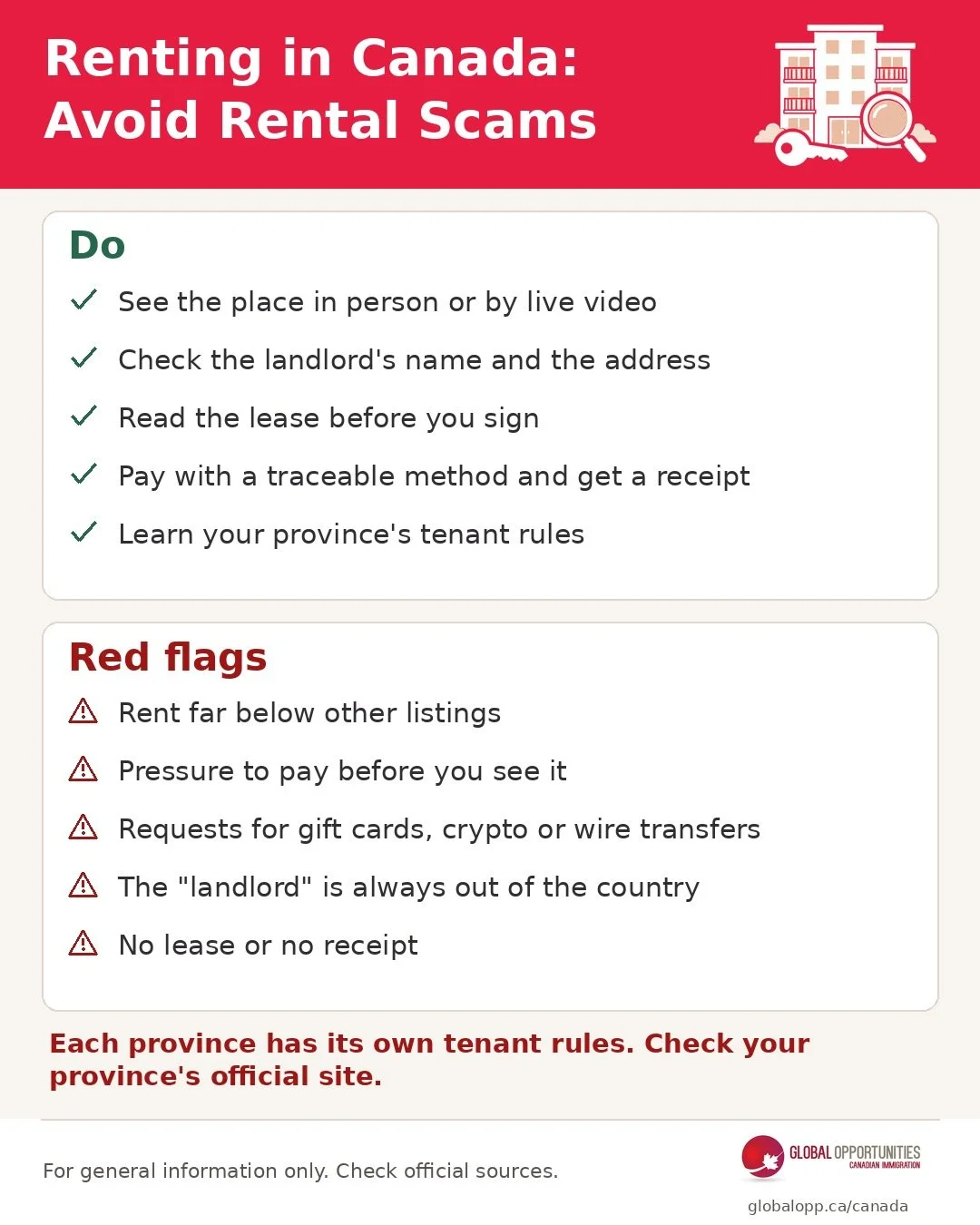
Scams target people in a hurry. The Competition Bureau's warning Rental scam: no room for error and the Canadian Anti-Fraud Centre describe common signs. Watch for:
A price far below similar listings in the same neighbourhood.
A "landlord" who is abroad and cannot show you the unit, but will "mail the keys" after you pay.
Pressure to pay a deposit immediately to "hold" the place, often by e-transfer, wire transfer, gift cards or cryptocurrency.
Photos copied from other listings. A reverse image search can reveal it.
No lease, or a lease that is not the Ontario standard lease.
Requests for your SIN, passport scan or banking passwords before you have even seen the place.
How to protect yourself: see the unit in person (or send someone you trust) before paying anything; confirm the person is the owner or authorized manager (for condos, ask the management office); pay only lawful amounts with a receipt; and read the standard lease first. If you were scammed, contact your bank right away and report it to the police and the Canadian Anti-Fraud Centre.
Utilities, internet and phone plans in Canada
Utilities in Toronto
Ask exactly what your rent includes. According to IRCC's renting a home page, if heat, water, electricity or internet are not included, you must arrange and pay for them yourself. In Toronto:
Electricity is called "hydro" in Ontario.
Heating (gas or electric) is often included in apartment rents but not in houses, where winter bills can be high.
Water is usually included in apartment rents.
Internet: you choose a provider; compare plans and contract length.
Electricity price plans in Ontario: Time-of-Use, Tiered or Ultra-Low Overnight?
If you pay for your own electricity in Ontario, you can usually choose between three price plans. According to the Ontario Energy Board (OEB), it sets regulated electricity prices once a year, on November 1, and residential customers can switch between Time-of-Use, Tiered and Ultra-Low Overnight pricing.
According to the OEB's electricity rates page, the prices from November 1, 2026 are:
Time-of-Use (TOU): the price depends on when you use electricity. Off-peak, 9.1¢/kWh, applies on weekdays from 7 p.m. to 7 a.m. and all day on weekends and holidays. In winter (November 1 to April 30), mid-peak, 14.6¢/kWh, runs on weekdays from 11 a.m. to 5 p.m., and on-peak, 18.9¢/kWh, from 7 to 11 a.m. and 5 to 7 p.m.; in summer the mid-peak and on-peak hours swap.
Ultra-Low Overnight (ULO): 3.7¢/kWh every night from 11 p.m. to 7 a.m., 9.1¢/kWh on weekend and holiday days, 14.6¢/kWh on weekdays from 7 a.m. to 4 p.m. and 9 to 11 p.m., and 37.7¢/kWh on weekdays from 4 to 9 p.m. It can suit people who use most of their electricity overnight, but the late-afternoon price is high.
Tiered: the price depends on how much you use each month: 11.2¢/kWh up to the monthly threshold (1,000 kWh in winter and 600 kWh in summer for homes) and 13.2¢/kWh above it.
These are prices for the electricity itself; the OEB also sets delivery rates, and your bill includes other charges. Many apartment rents include hydro, so check your lease first. To change your plan, contact your local electricity utility.
Electricity prices as published by the Ontario Energy Board, effective November 1, 2026. The OEB sets them once a year, so they may have changed by the time you read this: check the OEB page and your utility before you choose a plan.
Phone plans: big carriers and smaller brands
Canada's mobile market has a few large national carriers (Bell, Rogers and Telus) and several other brands, some of which belong to those carriers. For example, Rogers' history page describes acquiring the Fido brand and launching chatr (Rogers, our story), BCE lists Virgin Plus and Lucky Mobile among its brands (BCE, about us), and Freedom Mobile is operated by Vidéotron, part of Quebecor (Quebecor, our companies). Other brands, such as Koodo and Public Mobile, are also widely advertised. In general:
Prepaid plans usually need no credit check: a simple way to get a number on arrival.
Monthly plans may require a credit check or deposit without Canadian credit.
Phones on payment plans tie you to the carrier; read the cancellation terms. An unlocked phone with a local SIM or eSIM is simpler.
Complaints: if you cannot solve a problem with your provider, the Commission for Complaints for Telecom-television Services (CCTS) handles complaints about phone and internet services.
Carriers are mentioned for reference only. Global Opportunities has no relationship with any of them.
Health care in Ontario: OHIP, family doctors, walk-in clinics and Health811
New to how public health care works? Read the health care system in Canada.
OHIP for work permit holders
Ontario's public health plan is the Ontario Health Insurance Plan (OHIP). According to Ontario's page Apply for OHIP and get a health card, there is no waiting period for OHIP: you can apply as soon as you arrive if you qualify. To qualify, you must meet minimum conditions (including being physically in Ontario for 153 days in any 12-month period, being physically present for at least 153 of the first 183 days after you start living in Ontario, and making Ontario your primary residence), plus at least one additional requirement.
For temporary residents, the most common additional requirement is being in Ontario on a valid work permit and working full-time in Ontario, for an Ontario employer, for at least 6 months. If you meet it, your spouse and dependants may also qualify. Ontario also mentions specific rules for some other permit types and says people whose permit expired but who hold maintained status may be eligible and should contact ServiceOntario.
How to apply: in person at a ServiceOntario centre, with the registration form and three original documents (proof of eligible status, of Ontario residence and of identity).
What OHIP covers: according to What OHIP covers, medically necessary doctor visits (including walk-in clinics and virtual visits), hospital care, many lab tests and other services, but not most prescriptions outside hospital, routine dental care or, for most adults, eye exams. If you do not qualify yet, buy private health insurance for the gap.
International students: UHIP and college health plans
International students are generally not covered by OHIP. Ontario universities usually use the University Health Insurance Plan (UHIP), and colleges have their own plans. Ask your international office what is covered and whether family can be added; student unions often add health and dental plans.
How to find a family doctor in Ontario: Health Care Connect
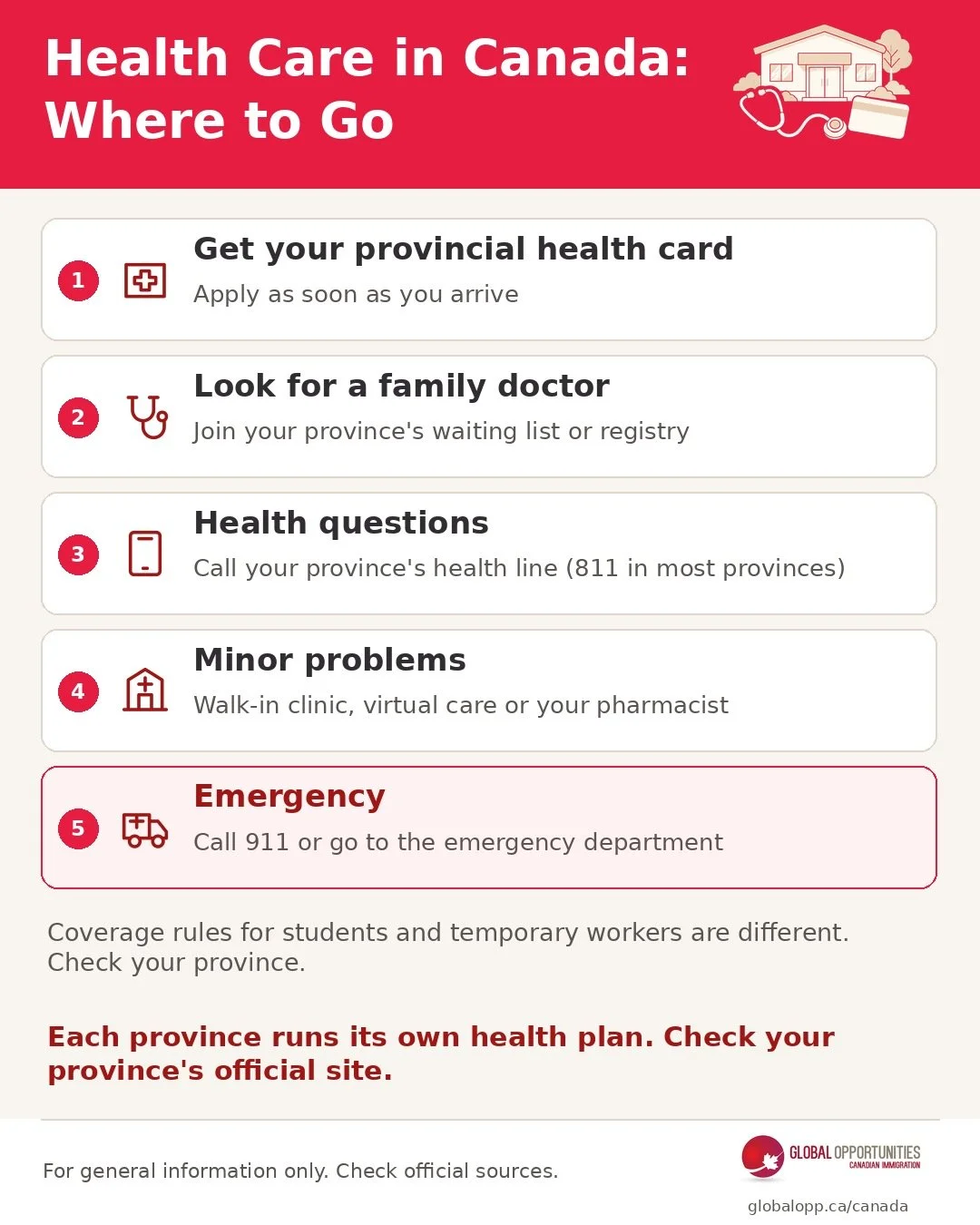
A family doctor or nurse practitioner gives you a regular place for checkups, prescriptions and referrals. Register with Health Care Connect: a Care Connector searches for a provider accepting new patients in your community. You need a valid Ontario health card number; you can register online or by phone at 811 (TTY 711), 24 hours a day. People with urgent needs are matched first, and registering does not guarantee an immediate match. Community health centres are another option.
Walk-in clinics and virtual care
Walk-in clinics see patients without an appointment or same day. With a health card, OHIP covers medically necessary visits; without OHIP, ask the price first. Many clinics offer virtual visits; some private apps charge fees, so read the terms.
Health811: free advice from a nurse, day or night
Health811 connects you with a registered nurse, day or night, for free, secure and confidential health advice. You can call 811 (TTY 711) or use the online chat. A nurse can help you decide whether you need to see a doctor, go to a clinic or go to emergency, and the service can help you find local health services. For emergencies, always call 911.
Emergency room vs urgent care
Call 911 or go to emergency for anything life-threatening: chest pain, trouble breathing, stroke signs, severe bleeding or injuries.
Urgent care centres (at some hospitals) treat same-day problems that are not life-threatening, such as sprains or cuts that need stitches.
Walk-in clinics, virtual care or Health811 for everything else. Emergency sees the most serious cases first, so minor problems wait long.
Pharmacies and prescriptions
You can fill prescriptions at any pharmacy. According to the Government of Ontario, pharmacists can prescribe treatment for some common ailments and give vaccines, including publicly funded vaccines (Government of Ontario, pharmacies). OHIP does not pay for most prescriptions outside hospital, but Ontario's page on prescription drug coverage explains that people 24 or younger without private insurance may qualify through OHIP+ (a health card number is required). Many employers offer extended health benefits for prescriptions, dental and vision; ask when you get a job offer.
Dental care is not covered by OHIP
OHIP covers some dental surgery in hospital, but not routine dental care such as cleanings and fillings. Options include an employer or student plan, paying directly, or lower-cost dental school and community clinics. The federal Canadian Dental Care Plan covers some people who have no access to private dental insurance, have filed a tax return in Canada, are Canadian residents for tax purposes and meet an income limit. Check the official page for the current conditions.
Other provinces have their own health plans and rules. See IRCC's page on health care in Canada.
Please note: OHIP, OHIP+ and dental coverage rules as published by the Government of Ontario and the Government of Canada, November 2026. Meeting one condition is not enough: you must meet all of Ontario's requirements, and ServiceOntario decides whether you qualify.
Groceries and shopping in Toronto on a budget
Supermarkets and discount chains
Discount supermarkets: No Frills, FreshCo and Food Basics.
Large general stores: Walmart Canada and Real Canadian Superstore.
Warehouse club: Costco sells in bulk and requires a paid membership (Costco, membership).
Full-service supermarkets: Loblaws, Metro, Sobeys, Longo's, which says it opened its first store on Yonge Street in Toronto (Longo's, our story), and Farm Boy, whose store list includes Toronto.
Asian supermarkets: T&T Supermarket, Galleria Supermarket (Korean and Asian groceries, with Toronto stores) and many independent stores.
Dollar stores: Dollarama and others, for kitchen and cleaning basics when setting up a home.
Latin American and international food in Toronto
Kensington Market, west of Spadina Avenue, is a national historic site. Parks Canada describes narrow streets of small shops selling food, spices and clothing from around the world, shaped by successive waves of immigrants (Parks Canada, Kensington Market National Historic Site), and Destination Toronto mentions its specialty grocers, bakeries and cafés (Destination Toronto, Kensington Market). Independent grocers across the GTA serve many communities, including Latin American ones; search by neighbourhood, and ask community groups and settlement workers where people shop.
Tips to save on groceries
Compare weekly flyers and join free loyalty programs.
Buy store brands and frozen produce in winter.
Ask about price matching where a store offers it (No Frills, for example, has a price match policy).
Food banks exist for people who need them; many colleges have their own.
Stores are mentioned for reference only. Global Opportunities has no relationship with any of them.
Your first Canadian winter: what to buy and where
Toronto winters are cold, windy and sometimes snowy, often below freezing, with wind chill making it feel colder. You need the right gear, not expensive gear. Check weather.gc.ca each morning for wind chill and warnings.
First winter checklist
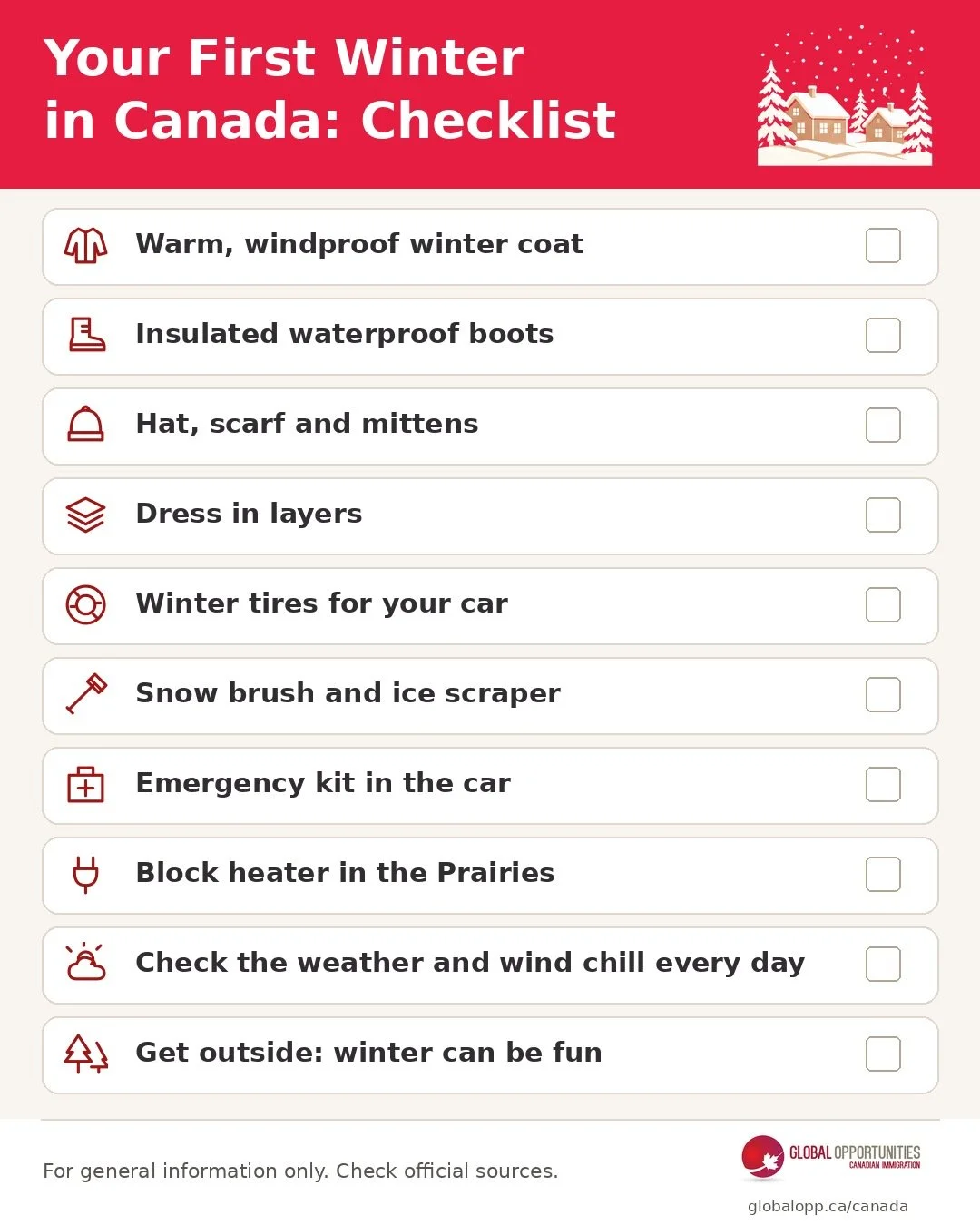
A warm, waterproof coat that covers your hips, with a hood.
Waterproof winter boots with good grip (salt and slush ruin regular shoes).
Layers: thermal base layers, fleece or sweaters and a windproof outer layer.
A toque that covers your ears, a scarf or neck warmer, insulated gloves or mittens and wool or synthetic socks.
Lip balm and moisturizer: indoor heating dries the air.
At home: check the heating and keep a small emergency kit for power outages.
If you drive: winter tires, an ice scraper, winter washer fluid and a car emergency kit.
Where to buy winter clothes in Toronto
Canadian Tire and Mark's for boots, winter accessories and car supplies.
Winners and other off-price stores.
Value Village and thrift stores for second-hand coats and sweaters.
Walmart, Uniqlo (for example at CF Toronto Eaton Centre), Sport Chek and other sporting goods stores for base layers and basics.
Community clothing banks: some organizations give free winter clothing to newcomers in need.
Stores are mentioned for reference only. Global Opportunities has no relationship with any of them.
Free newcomer services in Toronto and Ontario
Free help exists, but who can use it depends on your status. Understanding this saves you time.
IRCC-funded settlement services: IRCC's newcomer services finder lists free settlement organizations. IRCC's eligibility rules mainly cover permanent residents and some specific groups; most temporary workers and students are not eligible for these federally funded services. Check the finder for your case.
City of Toronto Newcomer Services Kiosks: the City of Toronto offers free, confidential help through its Newcomer Services Kiosks, and states that they are open to residents regardless of immigration status. Call or check online before you go.
Settlement.Org: settlement.org is a trusted source of newcomer information for Ontario.
211 Ontario: call 211 or visit 211ontario.ca to find community and social services near you, such as food banks, clothing banks and legal clinics.
Toronto Public Library: a library card is free for Toronto residents and gives access to computers, Wi-Fi, printing, workshops, language learning and job search tools. Some branches host settlement workers. See the library's New to Canada page.
Your college or university: international student offices, counselling, career centres and student unions offer many free services to enrolled students.
Organizations are listed for reference only and may change their eligibility rules. Confirm with each one directly.
Getting around Toronto: TTC fares, PRESTO, GO Transit and UP Express
Most newcomers live without a car, at least at first. The Toronto Transit Commission (TTC) runs the subway, streetcars and buses in the City of Toronto; Mississauga, Brampton, York Region, Durham and other areas have their own systems, most of which accept PRESTO.
How much is a TTC fare?
According to the TTC's fares and passes page (as of November 2026; check the current price):
Adult fare: $3.30 with a PRESTO card, Interac debit or credit card (including phones and watches), or $3.35 in cash.
Youth (13 to 19): $2.35 with PRESTO. Seniors (65+): $2.25 with PRESTO. Discounted fares are not available when you pay with a debit or credit card.
Two-hour transfer: when you pay with PRESTO or a contactless card, you can transfer within two hours of your first tap without paying another fare. This does not apply to cash.
Monthly fare capping: the TTC says that once you reach 47 eligible TTC fares in a calendar month, the rest of your TTC trips that month are free. It applies to PRESTO, debit and credit cards and mobile wallets, and resets on the first day of each month. The TTC also says most monthly passes were discontinued on August 31, 2026, when capping took effect.
Post-secondary students: the TTC lists a post-secondary student monthly pass; check eligibility and how to get the right PRESTO card type on the TTC page.
How to pay: PRESTO, credit card or phone
PRESTO card: the reusable fare card for Toronto and the region. The TTC's fares and passes page lists it at $4 (as of November 2026) at fare vending machines in subway stations, Shoppers Drug Mart and other outlets, or online. See New to PRESTO.
Digital PRESTO card: you can add a free digital PRESTO card to your phone's wallet (for people 13 and older), according to the TTC. See how to use PRESTO with Google Wallet and Apple Wallet.
Tap your credit or debit card, phone or watch: you can pay the adult fare by tapping. See contactless payment. Always tap the same card or device so transfers and capping work.
Youth, seniors and students need a PRESTO card set to the right fare type to get discounts.
GO Transit, UP Express and Bike Share
GO Transit: regional trains and buses connecting Toronto with the Greater Toronto and Hamilton Area. Fares depend on distance; see GO Transit fare information.
UP Express: the train between Union Station downtown and Toronto Pearson Airport, with stops at Bloor, Mount Dennis and Weston (UP Express). See UP Express fares. TTC buses also serve the airport, including the 900 Airport Express.
Bike Share Toronto: shared bikes across the city. See bikesharetoronto.com.
Tip: living near a subway line or frequent route can matter more than a slightly lower rent. Use a trip planner app for real-time arrivals and weekend closures.
Please note: fares as published by the TTC, PRESTO, GO Transit and UP Express, as of November 2026. Fares change, usually once a year: check the linked pages for the current price.
Ontario driver's licence: G1, G2, G and exchanging a foreign licence
How long can I drive in Ontario with my foreign licence?
According to Ontario's page Exchange an out-of-province driver's licence, when you move to Ontario you can use a valid licence from another province, state or country for 60 days. After 60 days, you need to switch to an Ontario driver's licence. Your foreign licence must be valid, show an expiry date and be in English or French; if not, you need a translation from an approved translator, dated within six months of your application.
Which countries can exchange their licence in Ontario?
As of November 2026, Ontario's page lists exchange agreements with all Canadian provinces and territories, U.S. states, and Australia, Austria, Belgium, Croatia, France, Germany, Great Britain, Hungary, Denmark, the Isle of Man, Japan, South Korea, Kosovo, New Zealand, Northern Ireland, the Republic of Ireland, Switzerland, Taiwan and Ukraine. Licences from these places may be exchanged for a full G without road tests, subject to conditions. The list can change.
If your country has no exchange agreement: credit for experience
Many newcomers (for example from Mexico and most of Latin America) come from places without an agreement. According to the same page:
You must pass the vision test, knowledge test and G2 road test, wait at least 12 months before trying the G road test, and then pass the G road test.
Effective July 1, 2026, you can get credit for up to one year of driving experience by showing a valid, original foreign licence and an authentication document: an official letter, in English or French, from the foreign government or agency that issued your licence, confirming that the licence is authentic.
Bring all original documents, your valid foreign licence and proof of your driving experience in English or French.
How graduated licensing works: G1, G2 and G
Without an exchange, you go through graduated licensing. According to Ontario's page Get a G driver's licence: new drivers, you must be at least 16, be an Ontario resident (not a visitor) and pass a vision and a knowledge test. Since May 11, 2026, applicants also declare that Ontario is their primary residence and that their presence in Canada is legal. You have up to five years to finish.
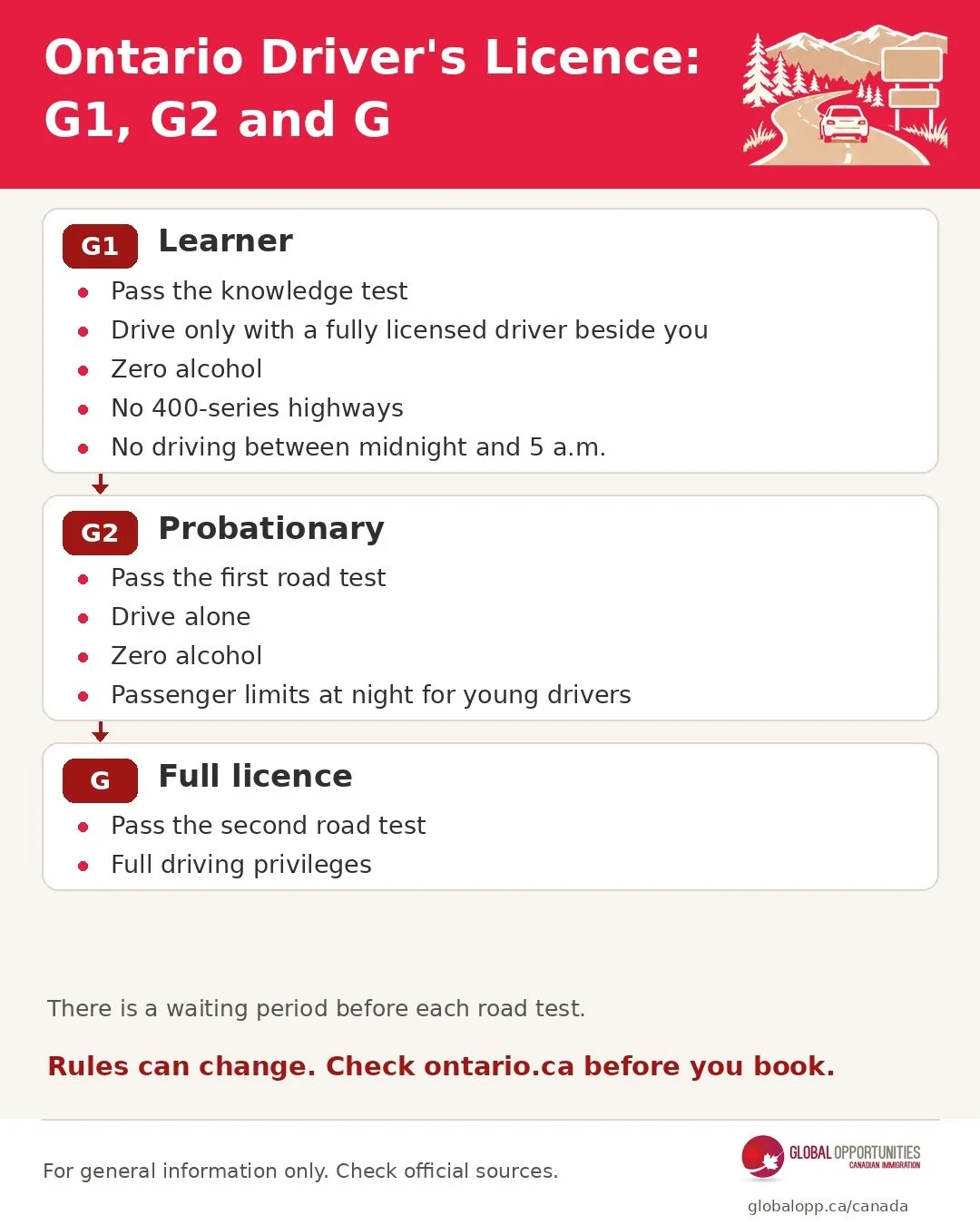
G1 (beginner): by law, with a G1 you must:
keep a zero blood alcohol level;
make sure every passenger wears a working seatbelt;
not drive between midnight and 5 a.m.;
not drive on 400-series highways or high-speed expressways (such as the 401, the QEW or the Gardiner Expressway), unless you are with an Ontario-certified driving instructor;
drive with a fully licensed driver with at least four years of experience and a blood alcohol level under .05 (zero if they are 21 or under), who must be the only other person in the front seat.
According to the same Ontario page, in most cases you practise with a G1 for 12 months before the G2 road test, or eight months if you complete a government-approved driver education course.
G2 (intermediate): after passing the G2 road test, you can drive without an experienced driver, on all Ontario roads, at any time, in most cases. You must still keep a zero blood alcohol level and carry only as many passengers as there are working seatbelts. Drivers 19 and under have extra passenger limits at night. Ontario's page says you practise with a G2 for 12 months before the G road test.
G (full licence): the G road test covers more advanced skills, including highway driving. Once you pass, you have a full licence.
Where to take the tests
Knowledge tests are at DriveTest centres (no appointment) or ServiceOntario Bay and College in Toronto (by appointment). According to Ontario's page Get a G driver's licence: new drivers, you book road tests online, by phone or at a centre, and must cancel at least 48 hours ahead to avoid losing the fee. Study with the free Official MTO Driver's Handbook.
How much does an Ontario driver's licence cost?
According to DriveTest's fees page (fees set by the Government of Ontario, in effect since July 12, 2019, including taxes; checked in November 2026; check the current price):
G1 licence package: $159.75 (includes a knowledge test, a G2 road test and a five-year licence).
Extra knowledge test attempt: $16.00.
G2 road test: $53.75.
G road test: $91.25.
Five-year licence: $90.00.
Licence exchange (for drivers from places with exchange agreements): $90.00.
Driving school courses are separate and set by each school.
Please note: licensing rules and fees as published by the Government of Ontario and DriveTest, as of November 2026. Check the linked pages for the current rules and fees before you book; exchange agreements and experience credit have conditions that ServiceOntario and DriveTest apply case by case.
Car insurance in Ontario for newcomers
Is car insurance mandatory in Ontario?
Yes. Ontario's licensing page says that to drive on Ontario roads you need a valid licence and valid insurance for the vehicle. According to the Financial Services Regulatory Authority of Ontario (FSRA), the provincial regulator, a standard auto policy automatically includes liability coverage, statutory accident benefits coverage and uninsured automobile coverage, and also includes direct compensation for property damage, which since January 2024 you may elect not to claim. See FSRA's page What is in a standard auto insurance policy?.
Important change in 2026: FSRA explains on its page about changes to accident benefits on July 1, 2026 that, as of July 2026, medical, rehabilitation and attendant care benefits remain mandatory, while all other accident benefits are optional. Ask your insurer or broker to explain what you are choosing before you decline any coverage.
What affects the price of car insurance
According to FSRA's page What determines your auto insurance rate, insurers build your profile using factors such as:
the type of vehicle you drive;
your driving record;
where you live;
your age, gender and marital status;
how much you drive;
how much coverage you buy and the deductible you choose;
the insurance company you choose.
Why newcomers often pay more
FSRA notes that prices depend on years licensed and years accident-free. Newcomers often have no driving history that Canadian insurers can see, many start on a G1 or G2, and Toronto is one of the more expensive areas, so first quotes can be high.
How to get quotes and lower the price
FSRA's tips on how to save on auto insurance include:
Shop around: companies do not charge the same price for the same coverage. Get quotes from several insurers, agents or brokers.
Know what coverage you need and consider a higher deductible.
Ask about discounts, such as driver training or winter tires. FSRA says all insurance companies must offer a discount if you install winter tires; each insurer sets the amount.
Bring proof of your driving history abroad, such as letters from previous insurers in English or French, and ask whether it counts.
Keep a clean record, pay on time and choose a car that is not costly to insure.
Report changes, such as a new address or upgrading to a G. Never misstate where the car is kept or who drives it: it can void your coverage.
Please note: based on FSRA's consumer pages, November 2026. Coverage rules changed in July 2026; each insurer sets its own prices and discounts, so ask yours what applies to you.
Can I rent a car in Toronto with a foreign licence?
Often, yes, but each rental company sets its own rules, so check with the company before you book. Two examples from the companies' own pages, as of November 2026:
Enterprise Canada says it needs a valid, unexpired photo licence (digital licences are not accepted). It requires an International Driving Permit (IDP) only for licences written in a non-Latin alphabet, recommends one for other licences not in English or French, says an IDP alone is not enough, and notes that drivers under 25 may pay a young driver fee (Enterprise, licence requirements, rental requirements).
Hertz Canada lists a minimum age of 20 (18 in Quebec), a licence held for more than one year and a valid credit card (Hertz Canada, renting to drivers under 25).
Other points to check:
At the airport: Toronto Pearson lists the rental companies with counters at Terminals 1 and 3 (Toronto Pearson, car rentals).
IDPs: CAA explains that it is the only organization authorized to issue IDPs in Canada (CAA, International Driving Permit). If you need one for a foreign licence, ask the authority that issued your licence before you travel.
Insurance: companies offer coverage at the counter; your credit card may include some rental coverage, so read its terms.
Highway 407 ETR: the toll bill goes to the rental company as the vehicle owner, and the company decides how to bill you for tolls and administrative fees (407 ETR, FAQ).
The 60-day rule: according to Ontario's licence exchange page, once you are a resident, your foreign licence is valid for 60 days in Ontario. Car-sharing services are another option; check their rules for foreign licences.
We mention private companies for reference only and have no relationship with any of them.
Parking in Toronto: street permits, Green P and winter rules
Read the signs on every street. Parking rules in Toronto are set street by street under the City's parking by-law (Toronto Municipal Code Chapter 950). Time limits, rush-hour bans and permit-only areas are posted on signs. See the City's parking regulations.
Residential on-street permits: in many older neighbourhoods where houses have no driveway, the City sells residential on-street parking permits that let you park on the street in a specific area during permit parking hours. Ask your landlord whether your address is eligible and whether a parking spot comes with your rental.
Temporary permits: the City also offers temporary on-street parking permits for permit areas, for example for visitors.
Municipal parking lots and garages: the Toronto Parking Authority, a City agency, operates municipal on-street pay-and-display parking and off-street lots and garages (City of Toronto, Toronto Parking Authority) under the Green P brand, which has an app to pay. See greenp.com.
Winter rules: during a declared major snow event, the City prohibits parking on designated snow routes, which are mostly downtown and include all streetcar routes. The City says parking on a snow route during a major snow event can lead to a fine. Watch for temporary orange "no parking" signs on streets being cleared. See major snow events.
For college and university students: work, co-op and internships
Working while you study
International students with a valid study permit may be able to work off campus, with a weekly limit during academic sessions and more flexibility during scheduled breaks. The rules are on IRCC's page Work off campus. Students enrolled only in English or French as a second language programs generally cannot work off campus. For an overview of study permits, see our Study in Canada page.
Co-op placements and internships
Many Ontario colleges include co-op terms or field placements in their programs. IRCC simplified the rules: eligible post-secondary students no longer need a separate co-op work permit for placements that are a required part of their program, if they meet IRCC's conditions. Read IRCC's notice on co-op work permits and the page on work placements for students before you accept a placement.
Where to find placements
Your college's career centre or co-op office (for example, Centennial College's Career Services and Co-operative Education): job boards, resume reviews and career fairs.
Job Bank and employer websites: search "co-op student", "intern" or "summer student".
Professional associations and real volunteering (not unpaid work for a business).
Are unpaid internships legal in Ontario?
In many cases, no. Ontario's Employment Standards Act guide explains that a person doing work for a business is generally an employee entitled to minimum wage, unless specific conditions are met. Placements that are part of a program approved by a college or university are treated differently. If in doubt, ask your school.
Please note: student work and co-op rules as published by IRCC, and internship rules as published by the Government of Ontario, November 2026. Off-campus work limits have changed several times: check IRCC's page before you accept hours, because working outside your permit's conditions can affect your status.
Finding a job in Canada: free help from YMCA, community agencies and Employment Ontario
Toronto and Ontario have many free, government-funded employment services.

Who can help you with your resume and job search
Employment Ontario: the province's network of free employment services. Ontario says you can get free support to write your resume, prepare for interviews and find a job, with one-on-one help across the province. Eligibility depends on factors such as being legally entitled to work in Canada and living in Ontario; each provider confirms it.
YMCA of Greater Toronto: employment services at no cost and immigrant services. Some programs are only for specific groups.
Community agencies: ACCES Employment, COSTI and JVS Toronto run employment programs, workshops and bridging programs for internationally trained professionals.
College and university career centres: usually free for enrolled students and often for recent graduates.
City of Toronto: resources for newcomer job seekers.
Toronto Public Library: free computers, printing, job search workshops and online courses with your library card.
Job Bank: the Government of Canada's job site, with postings and career tools.
Organizations are listed for reference only. Programs and eligibility change; many ask for a SIN and proof of status, and some are only for permanent residents. Ask before you register.
Why their help matters
Many qualified newcomers are filtered out because their documents follow another country's format. Counsellors review your resume line by line, help you describe foreign experience in Canadian terms, run mock interviews and sometimes connect you with employers.
Your Canadian resume, cover letter and interviews: the short version
For resume types, ATS keywords, LinkedIn and interview practice, see our full Canadian resume, cover letter and interview guide.
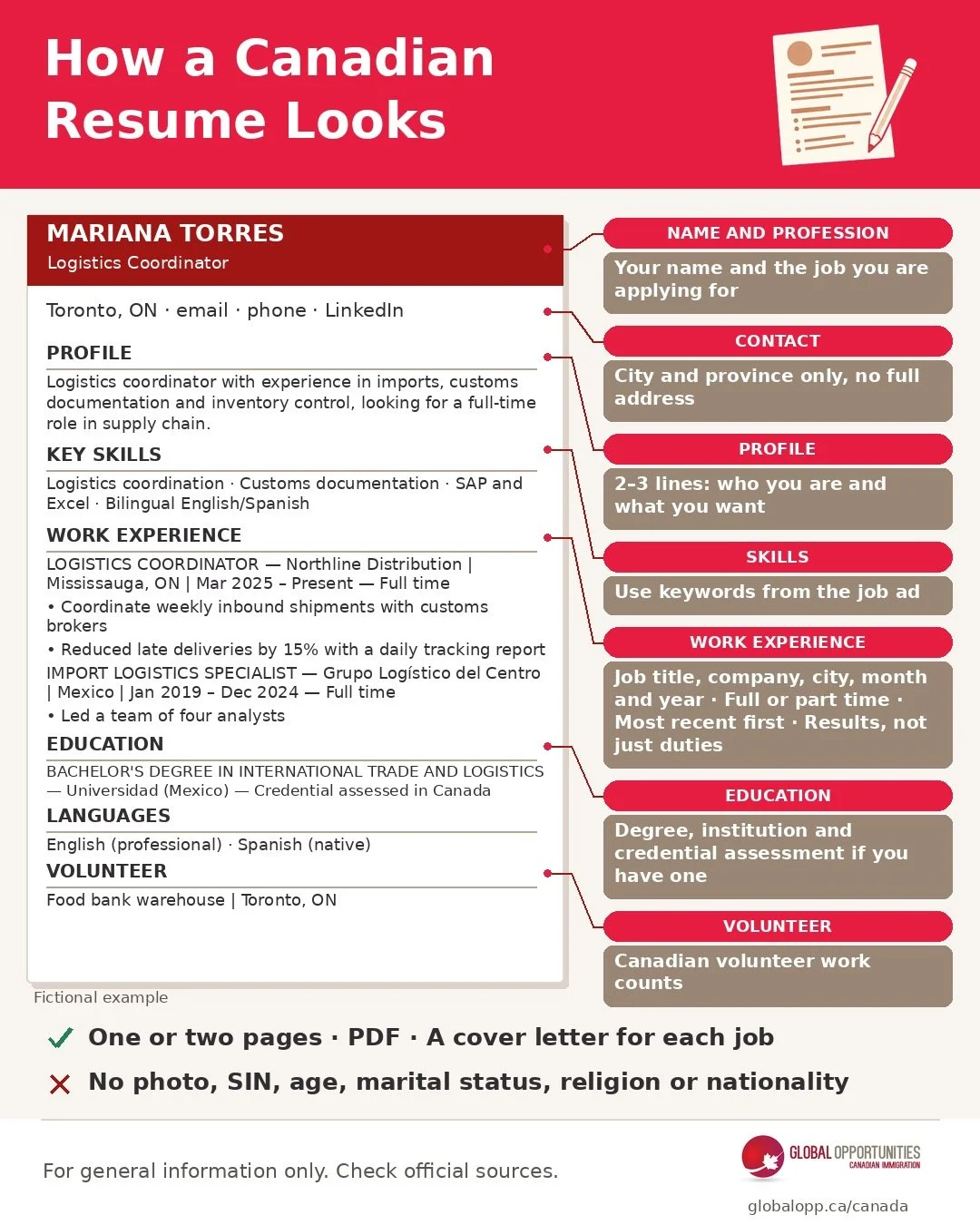
Resume. A Canadian resume is short, focused on results and adapted to each job. Job Bank recommends no more than two pages, and says a photo and your Social Insurance Number are not the norm in Canada (Job Bank, write a good resume). Use words from the job posting, show results with numbers and explain foreign employers in one line. Leave out your age, marital status and other personal details.
Cover letter. One page, written for that employer: why you want the job and two or three examples that match the posting. Job Bank explains how to apply for jobs.
LinkedIn and networking. Many jobs are filled through contacts. Complete your LinkedIn profile in English, ask for short informational interviews and volunteer for causes you care about; read our article on volunteering in Canada.
Interviews. Expect behavioural questions ("Tell me about a time when..."). Answer with the STAR method: Situation, Task, Action and Result. Job Bank has tips to prepare for an interview.
Our working in Canada guide has a full sample resume and cover letter, common interview questions and how to spot job scams.
Your rights at work
Employment standards: in Ontario, the Employment Standards Act sets rules on hours of work, overtime, public holidays, vacation, pay and termination. Ontario sets a general minimum wage and a student minimum wage, which usually change every October 1; see Ontario's minimum wage page for the current rates. Ontario also has a page on the employment rights of foreign nationals.
Your documents are yours: according to the Government of Canada's page Your rights are protected, an employer cannot take your passport or work permit.
Safety: you can refuse unsafe work, and workplace injuries are covered by the Workplace Safety and Insurance Board (WSIB) in Ontario.
If you are being abused: IRCC has information on worker rights, including an open work permit for vulnerable workers in some situations.
Never pay for a job: it is illegal for employers or recruiters to charge you for a job offer or an LMIA in many situations. Global Opportunities does not offer jobs.
Please note: as published by the Government of Ontario and the Government of Canada, November 2026. Minimum wage rates usually change every October 1: check Ontario's page for the current rate.
Taxes in Canada for newcomers: filing, CRA My Account and benefits
The Canada Revenue Agency (CRA) explains the basics on its page Newcomers to Canada and the CRA:
Residency for tax purposes is not the same as immigration status. You usually become a resident for tax purposes when you establish significant residential ties in Canada, such as a home here. For most newcomers, this starts the first day they live in Canada. International students have their own CRA guidance.
The tax year is the calendar year, and your return is usually due by April 30 of the following year.
Your employer deducts tax, CPP and EI from your pay, but you still file a return, which is often how you get refunds and benefits.
Your T4 slip: each employer gives you a T4 slip showing what they paid you and what they deducted during the calendar year. The CRA says employers must distribute the slips by the last day of February of the following year.
Benefits: as a resident for tax purposes, you can apply for benefit and credit payments even before your first tax return, including the Canada Groceries and Essentials Benefit (formerly the GST/HST credit). New residents without children apply with form RC151; families with children use the Canada child benefit application. The CRA explains that temporary residents can receive the Canada child benefit only from a certain point and with a valid permit; check the page for your case.
CRA My Account: register through CRA sign-in services to see your returns, benefits, tax slips and messages.
Free tax clinics: the Community Volunteer Income Tax Program helps people with a modest income and a simple tax situation file for free.
Please note: tax and benefit rules as published by the Canada Revenue Agency, November 2026. Tax residency is decided on your own facts and benefit amounts depend on income: check the CRA pages or a tax professional before you rely on them. This is not tax advice.
Buying your first home in Ontario: FHSA, Home Buyers' Plan and land transfer tax refunds
Most newcomers rent for years before they buy. When you are ready, federal measures can help first-time buyers save and pay less tax, and Ontario and the City of Toronto refund part of their land transfer taxes to some first-time buyers. Before any of that, check whether you are allowed to buy: a federal ban limits purchases by most non-Canadians.
Federal help for first-time buyers
First Home Savings Account (FHSA). According to the Canada Revenue Agency, to open one you must be a resident of Canada, at least 18 (or 19 where that is the age of majority), no older than 71 at the end of the year, and a first-time home buyer: you did not live, in the current year or the previous four, in a home that you or your spouse or partner owned (CRA, opening your FHSAs). Contribution limits are on the CRA's FHSA page.
Home Buyers' Plan (HBP). The CRA describes it as a program that lets you withdraw from your RRSPs to buy or build a qualifying home. As of November 2026, the CRA lists a withdrawal limit of $60,000 and a repayment period of 15 years (CRA, what is the Home Buyers' Plan). Newcomers usually have little RRSP room at first (see the FAQ on TFSAs and RRSPs).
Home buyers' amount (line 31270). A non-refundable federal tax credit for first-time home buyers. The CRA says you can claim up to $10,000 for a qualifying home acquired in 2025 (CRA, line 31270).
Ontario's land transfer tax refund for first-time homebuyers
When you buy a home in Ontario, you pay provincial land transfer tax. According to the Government of Ontario's page on land transfer tax refunds for first-time homebuyers:
The maximum refund is $4,000.
You must be at least 18, occupy the home as your principal residence within nine months, and never have owned a home or an interest in a home anywhere in the world; your spouse cannot have owned one while you were together.
Buyers who are not Canadian citizens or permanent residents when the purchase closes have 18 months after registration to become eligible and apply.
Toronto's municipal land transfer tax rebate
The City of Toronto charges its own Municipal Land Transfer Tax, on top of Ontario's. According to the City's page on MLTT rebate opportunities, first-time buyers may get a rebate of up to $4,475 if they are at least 18, are Canadian citizens or permanent residents (or become one within 18 months), have never owned a home anywhere in the world (nor has their spouse), and occupy the home as their principal residence within nine months.
Can I buy a home on a work permit?
Federal law prohibits most non-Canadians from buying residential property, with exceptions (Prohibition on the Purchase of Residential Property by Non-Canadians Act). Under the regulations, a work permit holder may be exempt if they have 183 days or more of validity left on their permit on the date of purchase and have not bought more than one residential property. The Department of Finance announced in 2024 that the ban would be extended to January 1, 2027. On November 16, 2026, it said the government would extend the ban on foreign purchases of existing residential properties for two years, to January 1, 2029, and would launch a regulatory process to exempt new residential properties. Those are legislative proposals, so check the current rules before you make an offer.
The rules depend on each person: your status, your residency for tax purposes, your income and whether you or your spouse owned a home before. Check the CRA, Ontario and City of Toronto pages, and speak with a real estate lawyer, before you rely on any of these measures.
Rules and amounts as published by the Canada Revenue Agency, the Government of Ontario, the City of Toronto, the Department of Finance and Justice Laws, as of November 2026. Meeting one condition does not mean you qualify; each government decides each case, and the foreign-buyer rules may change soon. This is not financial, tax or legal advice.
Planning to stay: permanent residence from inside Canada
Experience in Canada can open doors, but nothing is automatic.
Canadian Experience Class: for people with skilled, paid work experience in Canada. See IRCC's Canadian Experience Class page.
Provincial Nominee Programs: in Ontario, the Ontario Immigrant Nominee Program is changing: when we checked in November 2026, the official page said a new Ontario Workforce Priority stream had launched and the other streams were closed. Check the official page for the current streams. Other provinces have their own programs.
Language tests: most programs require an approved language test, even for native English speakers. See our guide to English and French tests for Canada, and watch our short video on how CELPIP fits into a permanent residence plan.
Credential assessment: if you studied outside Canada, you may need an Educational Credential Assessment.
Start early: many permits expire before people finish planning. Our guide How to immigrate to Canada explains the main programs.
Read who is eligible for permanent residence, and who needs a different strategy. Watch why being in Canada is no longer enough to plan your next step early.
Once you have a year of skilled Canadian work experience, watch why eligible is not the same as selected. Check whether your job counts by watching our live session on NOC codes and TEER categories.
Once you are a permanent resident, citizenship can be the next step: our Canadian citizenship guide explains how IRCC counts your days.
Please note: programs as described by IRCC and the Government of Ontario, November 2026. Meeting a program's requirements does not mean an invitation or approval; IRCC and the province decide each case, and requirements such as proof of funds depend on your situation. A consultation is the way to know what applies to you.
Living outside Toronto? Our province-by-province guides
Most examples in this guide come from Toronto and Ontario, but many newcomers live, study or work in other provinces, or move after their first job. Each province and territory runs its own health plan, driver's licensing, tenant rules and newcomer services, so the details change when you cross a provincial border. Moving to another province? Read our guides:
Living in Alberta: Calgary, Edmonton, Alberta Health Care and the Class 7 licence.
Living in British Columbia: Vancouver, Victoria, Kelowna, MSP and ICBC licences.
Living in Manitoba: Winnipeg, Manitoba Health and Winnipeg Transit.
Living in Saskatchewan: Saskatoon, Regina and the Saskatchewan health card.
Living in Ontario: Toronto, Ottawa, Hamilton and the rest of the province.
Living in New Brunswick: Moncton, Fredericton, Saint John and life in English and French.
Living in Nova Scotia: Halifax, MSI and Halifax Transit.
Living in Prince Edward Island: Charlottetown, Summerside and the PEI Health Card.
Living in Newfoundland and Labrador: St. John's, MCP and Memorial University.
Living in Yukon, the Northwest Territories and Nunavut: Whitehorse, Yellowknife, Iqaluit and life in the North.
Global Opportunities does not offer services for Quebec's immigration programs, so we do not have a Quebec guide.
Common mistakes newcomers make
Waiting until the last month to plan what happens after your permit expires.
Starting a new job before your new permit is approved on an employer-specific permit.
Leaving Canada while on maintained status without understanding the consequences.
Paying an unlicensed "agent" or someone who promises a job or a fast approval.
Letting your passport expire, which limits the length of any new permit.
Driving on a foreign licence after the 60 days Ontario's licence exchange page allows new residents.
Paying a deposit for an apartment you have not seen, or paying deposits the law does not allow.
Ignoring credit and going without health insurance while waiting for OHIP.
Sending a resume with a photo, date of birth and two pages of duties instead of results.
Frequently asked questions
How do I check my work permit status in Canada?
Sign in to the IRCC account you used to apply, or use the options on IRCC's Check your application status page. For some applications, the status tracker shows more detail. IRCC's published processing times are estimates, not a promise, and sending several web forms does not speed things up. If you have a question about your file, use IRCC's web form once and keep your application number handy. Never pay anyone who claims they can make IRCC process your file faster. See the section on checking your status above.
Can I work while my work permit extension is being processed?
Usually yes, if you applied before your permit expired and you stay in Canada. IRCC calls this maintained status. You keep working under the same conditions as your current permit: on an employer-specific permit, that means the same employer, job and location until IRCC decides. You cannot start with a new employer until the new permit is approved, unless IRCC authorizes it. Service Canada says you can keep working with an expired SIN while you wait, and IRCC explains what proof to show your employer. Read IRCC's page on expiring work permits and the maintained status section above.
When should I apply to extend my work permit in Canada?
IRCC says you should apply at least 30 days before your current permit expires, on its page about extending your work permit. In practice, start planning several months earlier, because you need a basis for the new permit (such as a new job offer, an LMIA or another program) and some permits, like most working holiday permits, cannot be extended. Check your passport too: a permit cannot be valid beyond it. Renew your health card and driver's licence while your permit is still valid if you can, because that is usually not possible on maintained status.
Can I travel outside Canada while on maintained status?
You can leave, but maintained status depends on staying in Canada, and IRCC warns that leaving can affect your ability to work when you return. You may need to wait for the new permit before working again, and you need valid travel documents (a visa or eTA, depending on your citizenship) to come back. Read IRCC's page on expiring work permits and its travel links before you book, and get advice if your job depends on returning to work right away.
What happens if my work permit expires in Canada?
If you did not apply for an extension before it expired, you may lose your status and must stop working. According to IRCC's page on restoring your status, you generally have 90 days from losing your status to apply for restoration, and you normally cannot work until your status is restored and you receive a new permit. Approval is not guaranteed. Do not keep working while you are out of status. Act quickly, gather your documents and speak with an authorized representative, such as a licensed consultant or lawyer, because options shrink as time passes.
Can I change employers on a work permit?
It depends on your permit. With an open work permit, you can usually change employers freely, unless your permit lists conditions. With an employer-specific permit, the employer, occupation and often the location are written on it, so you usually need a new permit before you start with a new employer. IRCC explains the process on its page about changing jobs or employers. A new role with the same employer can also require a change if the occupation changes. Do not resign from your current job until you understand the timing.
How do I know if an immigration consultant is legitimate?
Ask for the consultant's full name and licence number, then search the CICC Public Register to confirm that the licence is active. For lawyers and paralegals in Ontario, use the Law Society of Ontario directory. According to IRCC, only these authorized representatives (and Quebec notaries) can charge for immigration advice. Be wary of anyone who guarantees a result, promises a job, asks you to pay for a job offer, or asks to stay off your application. Paid representatives must be declared on your forms. See the section on who can help you above.
Why does my SIN start with 9?
According to Service Canada's page on the SIN for temporary residents, SINs issued to temporary residents always start with "9". Your SIN expires on the same date as your work permit, study permit or visitor record. When you receive a new permit, you must update your SIN record so it matches; you can do it online, by mail or in person. If you become a permanent resident, you get a new SIN that does not start with 9. Keep it confidential.
What documents do I need to open a bank account in Canada as a newcomer?
The Financial Consumer Agency of Canada explains that you can open an account even if you are not a citizen, using original documents. You can show two documents from reliable sources (one with your name and address, one with your name and date of birth), such as a foreign passport and a government-issued Canadian document or a recent utility bill, or one document plus confirmation of your identity by a person in good standing. Most newcomers bring their passport and work or study permit, and proof of address. See FCAC's page on opening a bank account.
How can a newcomer build credit history in Canada?
Start early. Get a credit card from your bank (many have newcomer offers) or a secured credit card, where your deposit becomes your limit. Use only a small part of the limit (FCAC suggests under 30%), pay the full balance on time every month, and keep your first card open. Avoid many credit applications close together, and never miss a payment on your phone or other accounts. Check your free credit reports from Equifax and TransUnion once or twice a year. See FCAC's page on improving your credit score.
How much is rent in Toronto?
According to CMHC's Rental Market Report (October 2025 survey, checked November 2026), average rents for purpose-built apartments in the City of Toronto were $1,499 for a studio, $1,763 for one bedroom and $2,055 for two bedrooms. These averages include long-term tenants, so rents for units listed today are usually higher, and condo rentals are often more expensive. A room in a shared house usually costs less. Compare real listings in the neighbourhoods you are considering, and check the current price before you budget. See the housing section above.
Can a landlord in Ontario ask for first and last month's rent?
Yes, within limits. A landlord can ask for the first month's rent and a rent deposit that cannot be more than one month's rent (or one week's rent if you pay weekly). According to the Landlord and Tenant Board's Information for New Tenants, that deposit must be used for the last month of your tenancy, not for damage, and the landlord must pay you interest on it every year. A refundable key deposit is allowed up to the cost of replacing the keys. Damage and pet deposits are not allowed. Always ask for a receipt.
Can a landlord refuse me because I have no Canadian credit history?
Landlords can ask for credit checks, references and income information, but the Ontario Human Rights Commission says on its page Housing is a human right that a lack of rental or credit history should not be viewed negatively, and landlords cannot discriminate based on grounds such as place of origin or citizenship. In practice, prepare a file with your permit, job letter or pay stubs, bank statements and references (including from your home country). If you believe you were refused for a discriminatory reason, ask a legal clinic for advice.
How do I avoid rental scams in Toronto?
Never pay for a place you have not seen in person or through someone you trust. Be suspicious of rents far below similar listings, landlords who are "abroad", pressure to pay immediately, payments by wire transfer, gift cards or cryptocurrency, and requests for your SIN or banking details. Confirm the person is the owner or authorized manager, use the Ontario standard lease, pay only lawful deposits and get receipts. If you were scammed, call your bank, report it to the police and to the Canadian Anti-Fraud Centre. See the section on rental scams above.
Do work permit holders qualify for OHIP?
Some do. According to Ontario's OHIP page, you may qualify if you are in Ontario on a valid work permit and working full-time in Ontario, for an Ontario employer, for at least 6 months, and you meet the residency and physical-presence rules. Your spouse and dependants may also qualify. There is no longer a waiting period, so you can apply in person at ServiceOntario as soon as you are eligible. Students and many working holiday participants do not meet the conditions; buy private insurance for any gap.
How do I find a family doctor in Ontario?
Register with Health Care Connect once you have a valid Ontario health card. A Care Connector searches for a family doctor, nurse practitioner or primary care team accepting new patients near you, and people with urgent needs are matched first. You can register online or by calling 811 (TTY 711), 24 hours a day. Registering does not guarantee an immediate match, so keep your contact details up to date. Meanwhile, use walk-in clinics, virtual visits and Health811. See Ontario's Health Care Connect page.
Is dental care free in Ontario?
No, for most adults. According to Ontario's What OHIP covers, OHIP covers some dental surgery when it must be done in hospital, but not routine care such as cleanings, fillings or check-ups. Most people use an employer or student dental plan or pay directly. The federal Canadian Dental Care Plan covers some residents who have no access to private dental insurance, have filed a Canadian tax return, are residents for tax purposes and meet an income limit. Dental schools and community health centres sometimes offer lower-cost care.
How much is a TTC fare in Toronto?
As of November 2026, the TTC's fares page lists the adult fare at $3.30 with PRESTO, debit or credit card, or $3.35 in cash. Youth and seniors pay less with a PRESTO card set to the right fare type. Transfers within two hours are free when you pay with PRESTO or a contactless card, and the TTC says that after 47 eligible fares in a calendar month, the rest of your trips that month are free. Most monthly passes ended in August 2026. Fares change, so check the current price on the TTC page.
How long can I drive in Ontario with a foreign licence?
According to Ontario's page on exchanging an out-of-province licence, new residents can drive with a valid licence from another province, state or country for 60 days. After that, you need an Ontario licence. Your licence must be valid, show an expiry date and be in English or French, or you need an approved translation. Visitors follow different rules from new residents. If you plan to drive, start the Ontario process early, because tests and waiting periods take time, and car insurance usually depends on having the right licence.
Can I exchange my driver's licence in Ontario?
Only if it comes from a place with an exchange agreement: as of November 2026, Canadian provinces and territories, U.S. states and a list of countries that includes Australia, France, Germany, Great Britain, Ireland, Japan, South Korea, New Zealand, Switzerland, Taiwan and Ukraine, among others. If your country is not on the list, you take the knowledge test and the G2 and G road tests, and since July 1, 2026 you can get up to one year of experience credit with an official authentication letter. Check the official page.
What can I do with a G1 licence in Ontario?
A G1 is a learner's licence. According to Ontario's page Get a G driver's licence, you must drive with a fully licensed driver who has at least four years of experience sitting next to you, keep a zero blood alcohol level, not drive between midnight and 5 a.m., and not drive on 400-series highways or high-speed expressways such as the 401, QEW or Gardiner (unless with a certified driving instructor). Everyone must wear a seatbelt. You usually wait 12 months, or eight with an approved driver education course, before taking the G2 road test.
Why is car insurance so expensive for newcomers in Ontario?
Insurers price your policy based on risk factors such as your driving record, years licensed, years without accidents, where you live, the car and how much you drive, according to FSRA's page on what determines your auto insurance rate. Newcomers often have no Canadian driving history and may hold a G1 or G2, and Toronto is one of the more expensive areas. To lower the price, get several quotes, ask whether your foreign driving history and a driver education course count, ask about winter tire and other discounts, consider a higher deductible and keep a clean record.
Can I rent a car in Toronto with a foreign licence?
Often yes, but each rental company sets its own rules. For example, Enterprise Canada requires an International Driving Permit only for licences in a non-Latin alphabet and recommends one for other licences not in English or French, and drivers under 25 may pay a young driver fee; Hertz Canada lists a minimum age of 20 outside Quebec, a licence held for more than a year and a valid credit card. An IDP never replaces your licence. New residents of Ontario can only use a foreign licence for 60 days. On Highway 407 ETR, tolls are billed to the rental company, which then bills you, usually with fees. Check the company's requirements before you book.
Where can I get free resume help in Toronto?
Employment Ontario service providers offer free help with resumes, cover letters, interviews and job search to eligible people who are legally entitled to work and live in Ontario; find them through Ontario's Employment Ontario page. Community agencies such as the YMCA of Greater Toronto, ACCES Employment, COSTI and JVS Toronto run workshops and programs for newcomers and internationally trained professionals. Students should start with their college or university career centre, and the Toronto Public Library offers free computers and workshops. Some programs are only for permanent residents, so ask about eligibility before you register.
Should I put a photo on my Canadian resume?
No. According to Job Bank's guide on writing a good resume, photos and your Social Insurance Number are not the norm on Canadian resumes. Most Canadian resumes also leave out age, date of birth, marital status, religion, nationality and immigration status, because employers must not base hiring decisions on many of these characteristics. Use the space for your summary, skills and results instead. If an employer needs to know whether you can work in Canada, they will ask, and you can answer honestly.
Do I have to file taxes in Canada on a work permit?
If you are a resident of Canada for tax purposes, generally yes, and filing is how you receive refunds and benefits. The CRA explains on its newcomers page that your residency for tax purposes depends on your ties to Canada, not on your immigration status, and that returns are usually due by April 30 of the following year. Newcomers can apply for some benefits, such as the Canada Groceries and Essentials Benefit, before their first return. Free tax clinics help people with a modest income and a simple tax situation.
Do international students need a co-op work permit?
Not always. IRCC simplified the rules so that eligible post-secondary students do not need a separate co-op work permit for placements that are a required part of their program, if they meet IRCC's conditions. Students in other situations, or in programs that do not meet those conditions, may still need one. Read IRCC's notice on co-op work permits and confirm with your school's international office before you start a placement, because working without the right authorization can affect your status and future applications.
Can my spouse get an open work permit?
It depends on your situation. IRCC's page on open work permits for spouses of workers explains that eligibility now depends on factors such as the principal worker's occupation, the type of work permit and the program, and that some spouses and dependent children who qualified in the past no longer do. Spouses and partners of international students have their own, narrower rules on IRCC's page about helping your spouse or partner work in Canada. Read the current conditions before you plan around a second income, and see our section on post-graduation work permits and permits for spouses above. If your case is not clear, ask an authorized representative.
Can I get the Canada Child Benefit on a work permit?
Possibly, if you meet the CRA's conditions. According to the CRA's page on who can apply for the Canada child benefit, you must live with a child under 18, be primarily responsible for the child's care and be a resident of Canada for tax purposes. A temporary resident (or their spouse or common-law partner) qualifies only if they "lived in Canada for the previous 18 months" and have a valid permit in the 19th month that does not say "does not confer status". Newcomers apply with Form RC66 and Schedule RC66SCH, as the CRA explains on its page on how to apply. Read our section on taxes in Canada for newcomers above, and check the CRA page for your case.
Can I get the GST/HST credit as a newcomer?
The GST/HST credit is now called the Canada Groceries and Essentials Benefit, and newcomers can apply before filing their first tax return. If you have no children, the CRA form is RC151, Canada Groceries and Essentials Benefit Application for Individuals Who Become Residents of Canada, which covers the year you became a resident. If you have children, you apply through the Canada child benefit application (Form RC66), as explained on the CRA's newcomers page. To keep receiving payments, file a tax return every year, even if you had little or no income. Payments depend on your family income, so check the CRA page for your situation.
Can I open a TFSA or RRSP on a work permit?
What matters to the CRA is your residency for tax purposes, not your immigration status. According to the CRA's page on opening a TFSA, you must be a resident of Canada for income tax purposes, be 18 or older (19 in some provinces and territories) and have a valid SIN. Your TFSA room starts building in the year you become a resident. A non-resident can hold a TFSA but cannot contribute to it tax-free. RRSP room is different: the CRA explains on its page on the RRSP deduction limit that it is based on your earned income from the previous year, so newcomers usually start with little or no room. This is general information, not investment advice; ask your bank or a tax professional.
Can I get Employment Insurance (EI) on a work permit?
Employment Insurance premiums are deducted from most paycheques, including those of many work permit holders, but receiving benefits depends on Service Canada's conditions. According to its page on EI regular benefits eligibility, you must have worked in insurable employment, lost your job through no fault of your own, worked the required number of insurable hours in the last 52 weeks (which depends on the unemployment rate where you live), and be "ready, willing and capable of working each day" while actively looking for work. For work permit holders, the conditions and expiry date of your permit can affect whether you are considered available for work. Apply as soon as you stop working, and ask Service Canada about your case.
Can I study part-time while on a work permit?
In some cases, yes. IRCC's page on studying without a study permit says that you may be able to study without a study permit while you work if you hold a valid work permit and your study program is 6 months or less. You can then study for up to 6 months or until your work permit expires, whichever comes first. Longer programs generally need a study permit, and studying in a program that is not allowed can affect your status and future applications. Before you enrol, read the IRCC page, check whether your program counts, and confirm with the school's international office. See our section for college and university students above for the rules that apply to study permit holders.
What is a T4 slip and when do I get it?
A T4 slip is the tax slip your employer gives you for each calendar year. According to the CRA's page on the T4 slip, it "identifies all of the remuneration paid by an employer to an employee during a calendar year", such as salary, wages, tips, bonuses and taxable benefits, and the deductions withheld, such as CPP, EI and income tax. The CRA says employers must distribute the slips by the last day of February of the following year. If you had several jobs, you get one T4 from each employer. You use your T4 slips to file your return, and you can also see them in CRA My Account. See our section on taxes in Canada for newcomers above.
Does volunteering help you find a job in Canada?
It can help, although it does not replace paid work experience or guarantee a job. Volunteering lets you practise English or French at work, meet people in your field, learn how Canadian workplaces operate and get references, which many employers ask for. Volunteer Canada has information on volunteering across the country, and many cities, libraries, settlement agencies and non-profits list opportunities. Choose roles linked to your skills when you can, and list them on your resume with results, as you would a job. Remember that real volunteering is for non-profits and community organizations: unpaid work for a business may not be legal (see our section on unpaid internships above). Read our article on volunteering in Canada.
What is the average salary in Canada?
According to Statistics Canada's payroll employment, earnings and hours release for August 2026 (published October 29, 2026, checked in November 2026), average weekly earnings in Canada, including overtime and seasonally adjusted, were $1,354.55, up 3.7% from a year earlier. This is an average for all employees and all industries, so it says little about what you will earn: pay varies widely by occupation, experience, province and city. For a specific job, check the wages by region on Job Bank and the Statistics Canada earnings table. Figures change every month, so check the current release. See our section on job interviews above before discussing pay.
Can I buy a house in Canada on a work permit?
There are restrictions. A federal law prohibits most non-Canadians from buying residential property, with exceptions. According to the Prohibition on the Purchase of Residential Property by Non-Canadians Regulations, a temporary resident with a work permit may be exempt if they have 183 days or more of validity remaining on their work permit or work authorization on the date of purchase and have not bought more than one residential property. International students have separate, stricter conditions. The Department of Finance announced in 2024 that the ban would be extended to January 1, 2027, and on November 16, 2026 it said the government would extend the ban on existing residential properties to January 1, 2029 and exempt new residential properties through legislation and regulations. Check the current rules on these official pages, and get advice from a real estate lawyer before you make an offer. See "Buying your first home in Ontario".
When should I call 911 in Toronto, and what if I call by mistake?
The City of Toronto's Make the Right Call page says to call 911 only in an emergency, meaning a situation that needs immediate help from a police officer, a firefighter or a paramedic, and warns that non-emergency calls could delay life-saving help for someone else. For non-emergency police matters it lists *TPS (*877) from a mobile phone or 416-808-2222, and 311 for City services. If you call 911 by mistake, the Canadian Radio-television and Telecommunications Commission's 9-1-1 page says to stay on the line and tell the operator that there is no emergency and that the call was unintentional, because these calls can delay help for others. For health advice, call Health811.
What is 9-8-8, the Suicide Crisis Helpline?
9-8-8 is Canada's Suicide Crisis Helpline. You can call or text 9-8-8 at any time, 24 hours a day, every day of the year, if you are thinking about suicide or are worried about someone else. The service says that if someone's safety is at risk right now, you should call 911. Moving to a new country is stressful, and many newcomers feel isolated in their first months. For non-urgent health advice, call Health811, and ask your settlement agency or your doctor about local mental health services.
What is Health811 in Ontario?
Health811 is Ontario's free, secure and confidential health advice service. You can call 811 (TTY 711) or use the online chat to reach a registered nurse, day or night. The nurse can help you decide whether you need to see a doctor, go to a clinic or go to emergency, and the service can help you find local health services. You can also register for Health Care Connect through 811 to look for a family doctor. For emergencies, always call 911. See "Health811: free advice from a nurse, day or night".
How do I check road conditions in Ontario?
Use Ontario 511, the province's traveller information service. It has an interactive map and a mobile app with collisions, road closures, construction, highway cameras and winter road conditions, including a tool to see where snowplows are. Check it before long drives, especially in winter, and follow Environment Canada's weather warnings. Inside Toronto, the City posts winter maintenance information and major snow events on its website. See "Parking in Toronto: street permits, Green P and winter rules".
What do I do if I get a flat tire or my car breaks down in Ontario?
First get to a safe place, turn on your hazard lights and, if anyone is hurt or in danger, call 911. For roadside help, many drivers use a CAA membership. According to CAA South Central Ontario's roadside services guide, members can get towing, battery service, flat tire help (installing your spare if it is inflated and serviceable), lockout help and fuel delivery, with limits that depend on the membership level, and you need a valid membership when you call. Some car insurance policies, car manufacturers and credit cards also include roadside assistance, so check your policy. We mention CAA for reference only and have no relationship with it.
How does car insurance work in Ontario?
Car insurance is mandatory in Ontario, and you buy it from a private insurance company, directly or through an agent or broker; there is no public auto insurer. The Financial Services Regulatory Authority of Ontario (FSRA) regulates insurers and explains what is in a standard auto insurance policy, including liability, statutory accident benefits and uninsured automobile coverage. FSRA also explains that some accident benefits became optional on July 1, 2026. Prices vary between companies, so FSRA recommends shopping around. See "Car insurance in Ontario for newcomers".
Can newcomers get the Canadian Dental Care Plan?
Possibly. According to the Government of Canada's Canadian Dental Care Plan page, you must meet four requirements: you have no access to private dental insurance, you (and your spouse or partner) have filed your tax returns in Canada, your adjusted family net income is below $90,000, and you are residents of Canada for tax purposes. So filing your first Canadian tax return is the first step. If you have dental coverage through work or school, you do not qualify. See "Dental care is not covered by OHIP".
Which electricity price plan should I choose in Ontario?
It depends on when you use electricity. According to the Ontario Energy Board, residential customers can choose Time-of-Use, Tiered or Ultra-Low Overnight pricing. From November 1, 2026, Time-of-Use costs 9.1¢/kWh off-peak and up to 18.9¢/kWh on-peak; Ultra-Low Overnight costs 3.7¢/kWh overnight but 37.7¢/kWh on weekdays from 4 to 9 p.m.; and Tiered costs 11.2¢/kWh up to a monthly threshold and 13.2¢/kWh above it. If hydro is included in your rent, you do not choose. Compare your own usage before you switch. See "Electricity price plans in Ontario".
How do I travel between provinces in Canada?
Canada is very large, so most people fly between distant cities, and there are also trains, intercity buses and highways. VIA Rail runs passenger trains on several routes; its busiest is the Québec City–Windsor corridor, which includes Toronto. If you drive, remember that each province has its own traffic rules, and if you move to another province, you will need to apply for its health card and exchange your driver's licence within its deadlines. Read our Explore Canada page for time zones, travel between provinces and what to pack, and our province-by-province guides in the section "Living outside Toronto?" above.
Related guides
How Global Opportunities can help
Global Opportunities is a private immigration firm in Toronto. If you are already in Canada and need to understand your work permit, your options before it expires or your path to permanent residence, we can review your situation and explain what to prepare. We cannot guarantee a permit or a result: every decision is made by IRCC or the province. We work in English and Spanish. Global Opportunities does not offer jobs or job placement.
Our regulated consultant: Lic. Mildrete Monserrath Gutierrez Martinez, Regulated Canadian Immigration Consultant (RCIC), CICC licence R514880. Verify her licence on the CICC Public Register: https://college-ic.ca/protecting-the-public/find-an-immigration-consultant. Global Opportunities does not offer services for Quebec's immigration programs. Global Opportunities is a private firm and is not part of the Government of Canada or any provincial government.
Recorded seminars and lives: watch our recorded seminars in English or the Spanish recordings, and visit our YouTube channel.
More articles in English: read our Moving to Canada articles on topics such as health care, cost of living, the ECA and professional licences, and building community in Canada.
Is your permit ending soon? Watch Is your work permit or PGWP expiring in the next 12 months? and why being in Canada is no longer enough.
Personalized consultation: to review your situation, contact us through our contact page or write to info@globalopp.ca.
Prefer email? Tell us what you need help with (my work or study permit and staying in Canada) and we will reply: email info@globalopp.ca.
Contact Global Opportunities →
Sources
IRCC: Check your application status and application status tracker
IRCC: Open work permits for spouses of workers and spouses of students
IRCC: Check if your representative is authorized and file a complaint
College of Immigration and Citizenship Consultants: Public Register · Law Society of Ontario: Directory
IRCC: Work off campus, co-op work permit notice and work placements for students
IRCC: Find free newcomer services · IRCC: Renting a home · IRCC: Health care in Canada
Service Canada: SIN for temporary residents · ESDC: Your rights are protected
FCAC: Opening a bank account, Improving your credit score, Choosing a credit card and Getting your credit report and score
Canada Deposit Insurance Corporation · FSRA: Credit unions and deposit insurance
Bank pages: RBC newcomers, TD New to Canada, Scotiabank StartRight, BMO newcomers, CIBC new to Canada, National Bank newcomers and Toronto branches, Tangerine, Simplii Financial
Carrier pages: Rogers, our story, BCE, about us, Quebecor, our companies
Store pages: No Frills and price match, FreshCo, Food Basics, Walmart Canada, Real Canadian Superstore, Costco membership, Loblaws, Metro, Sobeys, Longo's, Farm Boy, T&T Supermarket, Galleria Supermarket, Dollarama, Canadian Tire, Mark's, Winners, Value Village, Uniqlo, Sport Chek
Parks Canada: Kensington Market National Historic Site · Destination Toronto: Kensington Market
Car rental: Enterprise Canada, licence requirements and rental requirements, Hertz Canada, Toronto Pearson, car rentals, CAA, International Driving Permit, 407 ETR, FAQ
CRA: Newcomers to Canada and the CRA, CRA sign-in services and free tax clinics
Competition Bureau: Rental scam warning · Canadian Anti-Fraud Centre
CMHC: Rental Market Reports (2025 report, October 2025 survey, Toronto data tables)
Job Bank: Find a job, Write a good resume, Apply for jobs and Prepare for an interview
Government of Ontario: Apply for OHIP, What OHIP covers, Health Care Connect and Prescription drug coverage
Government of Ontario: Renting in Ontario, your rights, Guide to Ontario's standard lease and Residential rent increases
Steps to Justice: Deposits when you rent and Does the Residential Tenancies Act apply
Government of Ontario: Exchange an out-of-province driver's licence, Get a G driver's licence and Official MTO Driver's Handbook
FSRA: Standard auto insurance policy, What determines your rate, How to save and Accident benefits changes, July 1, 2026
Government of Ontario: Employment Ontario, Your guide to the Employment Standards Act, Employee status, Minimum wage and Rights of foreign nationals
City of Toronto: Newcomer Services Kiosks, Newcomer employment seekers and RentSafeTO
City of Toronto: Parking regulations, Residential on-street parking, Temporary on-street parking and Major snow events · City of Toronto: Toronto Parking Authority · Green P
TTC: Fares and passes · PRESTO · GO Transit fares · UP Express and fares · TTC: 900 Airport Express · Bike Share Toronto
Toronto Public Library: New to Canada · Settlement.Org · 211 Ontario
YMCA of Greater Toronto: Employment services and Immigrant services · ACCES Employment · COSTI · JVS Toronto · Centennial College Career Services
CRA: Canada child benefit, who can apply and how to apply · CRA: Form RC151
Statistics Canada: Payroll employment, earnings and hours, August 2026 and Table 14-10-0223-01
Justice Laws: Prohibition on the Purchase of Residential Property by Non-Canadians Regulations (SOR/2022-250) · Department of Finance Canada
CCTS: Commission for Complaints for Telecom-television Services · WSIB
Government of Ontario: Land transfer tax refunds for first-time homebuyers
City of Toronto: Municipal Land Transfer Tax rebate opportunities
Justice Laws: Prohibition on the Purchase of Residential Property by Non-Canadians Act
Department of Finance: Two-year extension to ban on foreign ownership of Canadian housing (2024)
Government of Canada: Canadian Dental Care Plan, who can qualify
The information in this guide comes from the official sources linked above, as they read when we checked them in November 2026, and it may have changed since. It is general and for reference only. It is not immigration, legal, financial, tax, insurance, employment or professional advice. Global Opportunities is not responsible for how anyone interprets this content, for decisions made based on it, or for changes made by any source after it was written: what you read depends on when you read it. For your own case, book a consultation. Work permit rules, maintained status, provincial health coverage, tenant rules, driver's licensing, insurance rules, transit fares, rents, student work rules and the eligibility of free services change frequently, and statistics such as average rents describe the past and do not predict any outcome. Prices are shown as of the date indicated; always check the current price on the official page. Banks, stores, websites, carriers and other organizations mentioned are for reference only; we are not affiliated with them, we do not recommend them, and you should confirm their services and eligibility directly. Always confirm requirements with official Government of Canada, provincial and municipal sources. Global Opportunities is a private firm, is not part of the Government of Canada or of any regulator, and does not offer jobs.
Last reviewed: November 2026