
Living in Prince Edward Island, Canada: A Complete Guide for Newcomers
Living in Prince Edward Island means life in Canada's smallest province: an island of red soil, beaches, farms and small communities, linked to the mainland by the Confederation Bridge. This guide explains everything a newcomer to Prince Edward Island (PEI) needs to know: Charlottetown, Summerside and rural life, where to find a rental and what it costs, tenant rules, T3 Transit, driving and licences, the PEI Health Card, banks, groceries, the first winter, UPEI, Holland College and Collège de l'Île, work and free newcomer services.
About our sources: This guide summarises what official sources (the Government of Canada, provincial and territorial governments and the other organisations we link to) said when we checked them in November 2026. We link every source so you can read it yourself. Rules, rates and requirements change, sometimes without notice, and the official page is the one that counts. This is general information, not legal, tax or immigration advice. Global Opportunities is not responsible for how this information is interpreted or for changes made after it was written.
PEI is small, but it has grown quickly. According to Job Bank, the Government of Canada's employment website, the population reached 182,657 as of July 1, 2025, up 1.6% in one year, second only to Alberta (Job Bank, Economic Scan: Prince Edward Island, 2026). That growth brings opportunities and real pressure on housing and health services, so preparation matters.
We wrote this guide for someone who is about to arrive, or has just arrived, and knows nothing yet: workers, international students and families. Every section links to the official page where you can confirm the details. Where we give a price (a transit fare, a bridge toll, an average rent), it comes from the official source, with the date we checked it. Prices change, so always check the current price on the source before you make a decision. For work permits, resume examples and general first steps in Canada, read our companion newcomer guide to Canada.

Watch our recorded seminars and lives →
Prefer Spanish? Read our Spanish guide.
In this guide
Prince Edward Island at a glance
Where is Prince Edward Island? Map, location and key facts
How to get to Prince Edward Island: by plane, car, train or bus
Buying your first home in Prince Edward Island
Emergencies and natural hazards in Prince Edward Island
Living in Charlottetown
Stratford and Cornwall: the Charlottetown area
Living in Summerside
Montague, Three Rivers and rural PEI
How much is rent in PEI? Where to look, rents and tenant rules
Getting around PEI: T3 Transit, the bridge and the ferry
Driving in PEI: licences, insurance, car rental and winter
How do newcomers get health care in PEI? The Health Card and finding a doctor
Banking in PEI for newcomers
Groceries and shopping in PEI
How cold is PEI, and how do you prepare for winter?
Education in PEI: UPEI, Holland College and Collège de l'Île
Schools for children in PEI
Jobs and main industries in Prince Edward Island
Free newcomer services in PEI
How much does it cost to live in Prince Edward Island?
How much tax do you pay in Prince Edward Island, and which benefits can you get?
Culture, community and things to do in PEI
How can you immigrate to Prince Edward Island?
French in Prince Edward Island
First steps after arriving in PEI
Frequently asked questions
Related guides
How Global Opportunities can help
Sources
Prince Edward Island at a glance
Prince Edward Island is one of Canada's four Atlantic provinces, in the Gulf of St. Lawrence. Its capital is Charlottetown, and English is the language of daily life and work. Immigration, Refugees and Citizenship Canada (IRCC) describes it as the smallest province, known for its beaches, red soil and agriculture, especially potatoes, and as the birthplace of Confederation (IRCC, Discover Canada: Canada's regions).
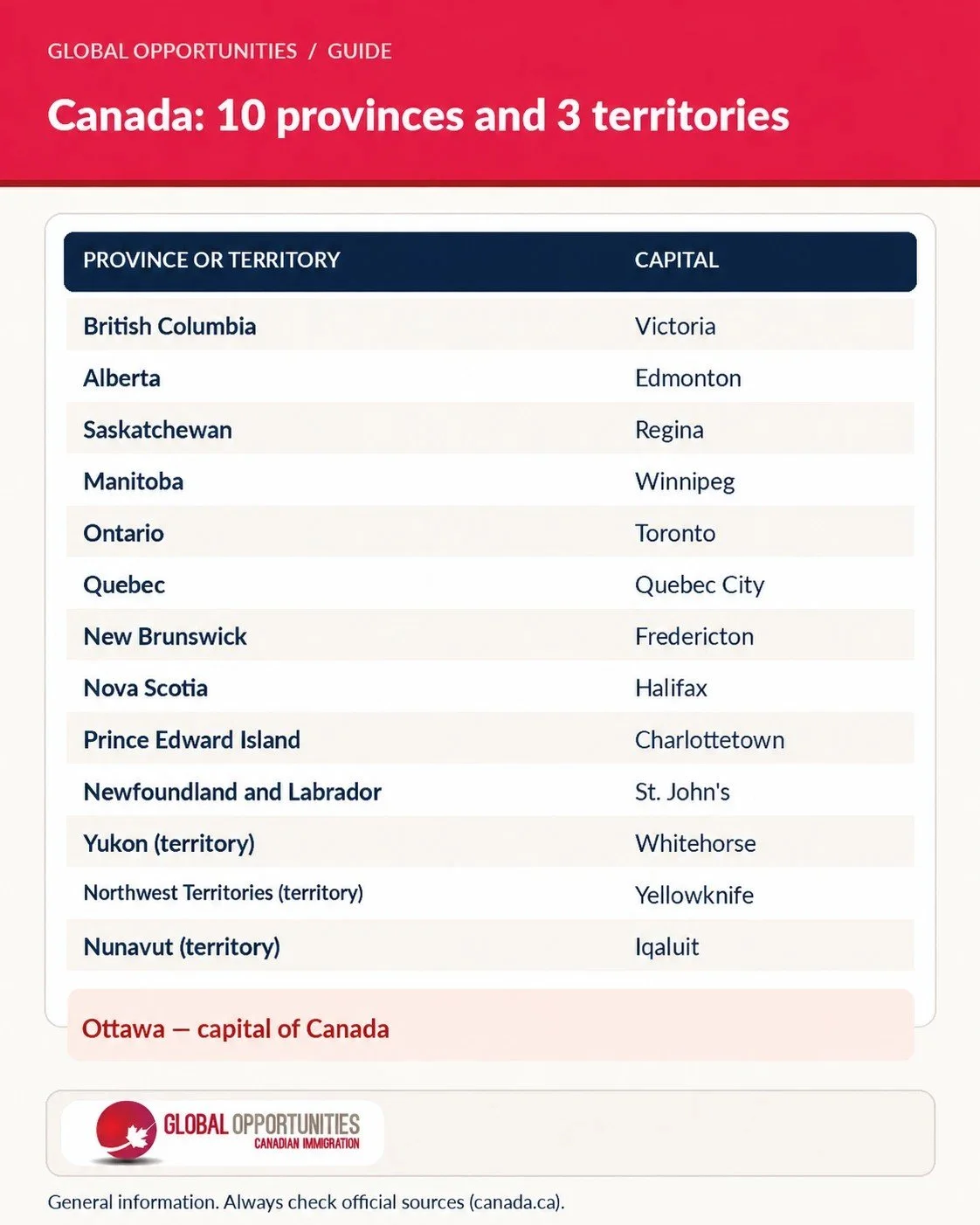
Key facts about PEI
According to Canadian Heritage (Provincial symbols: Prince Edward Island):
Capital: Charlottetown.
Land area: 5,660 square kilometres.
Joined Confederation: July 1, 1873.
Name: adopted in 1799 to honour Prince Edward, Duke of Kent. The Mi'kmaq name "Abegweit" is loosely translated as "cradled in the waves".
Why the soil is red: the island is formed from soft red sandstone with a high iron-oxide content.
Most people say "PEI" or "the Island", and residents are Islanders. Distances are short, but most of the province is rural.
A short history
The Mi'kmaq. According to Canadian Heritage, the Mi'kmaq have inhabited the island for at least 2,000 years. Today PEI has two Mi'kmaq First Nations: Lennox Island First Nation and Abegweit First Nation.
French and Acadian settlement. According to Canadian Heritage, the French established a permanent colony only in the early 1700s, and after the fall of Louisbourg in 1758 the British forced most Acadians to leave the island. Acadian communities remain part of PEI today.
Confederation. PEI hosted the first Confederation conference in Charlottetown in 1864 but stepped back from the union. Railway debt, pressure from Britain and promises from Canada, including year-round communication with the mainland, led it to join in 1873 (Canadian Heritage).
Language and population
According to Job Bank, based on the 2021 Census, about 96% of Islanders identified English as their first official language, and 3% spoke French most often at home. Indigenous people made up 2.2% of the population in 2021 (Job Bank, Economic Scan 2026).
The same Job Bank Economic Scan notes an older population: people aged 65 and over were 21% of Islanders in 2025, a share projected to reach 23% by 2035. That is one reason health care and social services need so many workers.
Time zone and sales tax
PEI is on Atlantic Time, one hour ahead of Eastern Time (Toronto). Prices in stores do not include tax: PEI uses the Harmonized Sales Tax (HST), which is 15% in the province according to the Canada Revenue Agency (CRA, GST/HST rates). Some basic groceries are not taxed, but most other purchases are, so add the tax when you budget.
Where is Prince Edward Island? Map, location and key facts
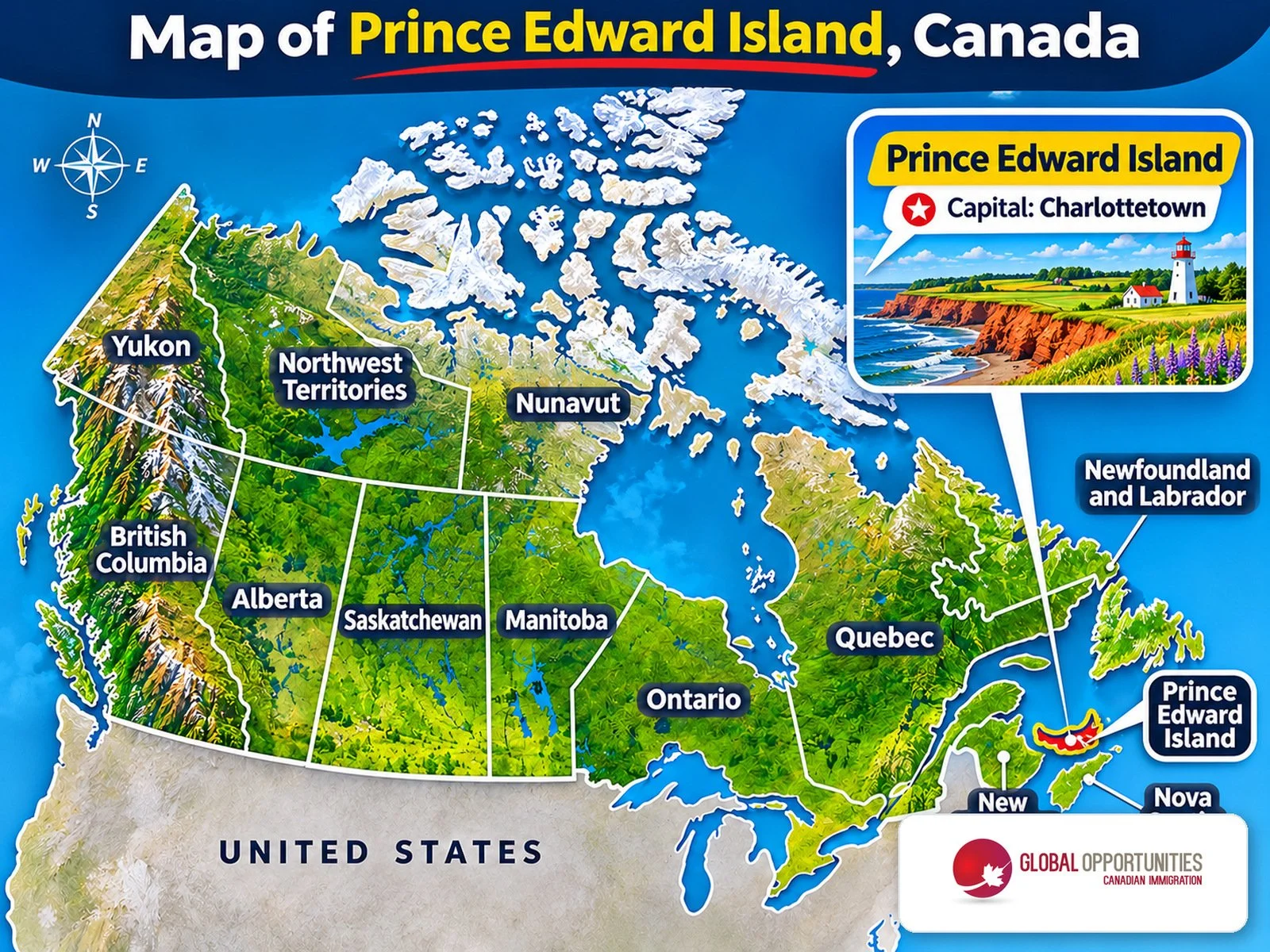
Prince Edward Island is an island province in the Gulf of St. Lawrence, on Canada's Atlantic side. It is linked to New Brunswick by the Confederation Bridge and to Nova Scotia by a seasonal ferry, and its capital and largest city is Charlottetown.
Neighbours and connections
New Brunswick, across the Northumberland Strait: according to the Government of Canada, the 12.9-kilometre Confederation Bridge links Borden-Carleton, PEI, with Cape Jourimain, New Brunswick (Intergovernmental Affairs, Confederation Bridge).
Nova Scotia, by Northumberland Ferries between Wood Islands and Caribou during the season (ferries.ca).
No land border with the United States: the closest US land crossings are in New Brunswick (see "Driving from the United States" below).
Capital, largest cities and time zone
Capital and largest city: Charlottetown. According to Statistics Canada's 2021 Census, the City of Charlottetown had 38,809 residents and the City of Summerside 16,001 (Statistics Canada, table 98-10-0002-01).
Time zone: Atlantic Time. The Government of New Brunswick notes that New Brunswick, Nova Scotia and Prince Edward Island are all on Atlantic Standard (Daylight) Time (Government of New Brunswick, basic facts), one hour ahead of Toronto.
Land area and population
Land area: 5,681.18 square kilometres, according to the 2021 Census (Statistics Canada, table 98-10-0001-01); Canadian Heritage gives 5,660 square kilometres. Either way, IRCC describes it as the smallest province.
Population: Statistics Canada estimated PEI's population at 182,989 on July 1, 2026 (Statistics Canada, table 17-10-0009-01).
Economy and main industries
According to Job Bank's 2026 Economic Scan for PEI, the Island's main industries include agriculture (especially potatoes) and food processing, health care and social assistance, manufacturing (with exports led by pharmaceutical and aerospace goods), construction, tourism, fishing and seafood, and bioscience and public services in Charlottetown. See our jobs section for details.
Population by origin: what the census says
These figures come from the 2021 Census and describe the population living in private households (150,480 people in PEI). They are context about who lives here, not a ranking of places (Statistics Canada, Census Profile, Prince Edward Island; detailed tables: visible minority, table 98-10-0351-01 and ethnic or cultural origin, table 98-10-0355-01).
Visible minority groups. According to the 2021 Census, 14,305 people in PEI belonged to a visible minority group. The largest groups were South Asian (3,740), Chinese (3,340), Black (1,815), Filipino (1,760), Arab (1,130) and Southeast Asian (1,040), followed by Latin American (590).
Ethnic or cultural origins. People can report more than one origin, so these numbers overlap. The most common origins reported were Scottish (51,235), Irish (41,845), English (36,050), Canadian (22,820) and French (21,355), followed by Acadian (8,265) and German (7,175). Chinese origins were reported by 3,050 people.
Latin American origins. About 950 people reported a Latin, Central or South American origin, most often Mexican (255) and Brazilian (165).
Census counts as published by Statistics Canada for the 2021 Census, the most recent with these details when we checked in November 2026. They describe 2021, not today, and they are not immigration figures: check the linked tables for the full definitions.
How to get to Prince Edward Island: by plane, car, train or bus
You can reach Prince Edward Island by plane at Charlottetown Airport, by car or bus over the Confederation Bridge from New Brunswick, or by ferry from Nova Scotia in season. Our section on getting around PEI explains the bridge toll and the ferry fares.
Main airport
Charlottetown Airport (YYG) (flyyyg.com) is the Island's airport.
Flying to Prince Edward Island from abroad: airlines and common routes
As of November 2026, the Charlottetown Airport destinations page listed:
Year-round non-stop flights to Montréal-Trudeau, Toronto Pearson and Ottawa.
Seasonal non-stop flights to Montréal Metropolitan Airport, Toronto Pearson, Calgary and Edmonton, and sun flights to Cancún, Mexico and Punta Cana, Dominican Republic.
Airlines shown on the same page: Air Canada, Porter, WestJet, Flair Airlines and Air Transat.
Common ways to get there. The airport's page listed no non-stop flights from Europe, the United States, Asia, Australia or New Zealand. From those regions, and from most of Latin America, travellers usually fly into a larger airport first and connect to Charlottetown through Toronto Pearson, Montréal-Trudeau or Ottawa, the three cities with year-round non-stop flights on the airport's page.
Airlines and routes as listed by Charlottetown Airport, as of November 2026. Routes and airlines change seasonally: check the airport's page and the airlines before you book.
By road, bus and ferry
Confederation Bridge from New Brunswick; the toll is paid when you leave the Island (Confederation Bridge).
Ferry from Caribou, Nova Scotia, to Wood Islands, in season (ferries.ca).
Bus. The Government of New Brunswick's newcomers page notes that Maritime Bus connects New Brunswick with Nova Scotia and Prince Edward Island; Maritime Bus says it operates 364 days a year (Maritime Bus).
Train. VIA Rail's Ocean does not stop on the Island; according to the Government of New Brunswick, its stops include Moncton (Government of New Brunswick, transportation).
Roads on the Island. Check road conditions, closures and highway cameras on PEI 511, a free service operated by the Government of Prince Edward Island; within PEI you can also dial 5-1-1 (PEI 511, FAQ).
Driving from the United States
PEI has no land border with the United States. The Canada Border Services Agency's border wait times page lists the nearest crossings from Maine into New Brunswick: St. Stephen (two bridges from Calais), Edmundston and Woodstock Road. From there you drive to the Confederation Bridge. Read the CBSA's travel information on what to declare and which documents you need, and check whether you need a visa or an eTA with IRCC's official tool. Entry rules depend on your citizenship and status.
Transportation information as published by Charlottetown Airport, the Confederation Bridge, Northumberland Ferries, Maritime Bus, the Government of New Brunswick, the Government of PEI and the CBSA, as of November 2026. Services and schedules change, and the ferry runs only part of the year: check the linked pages before you travel.
Buying your first home in Prince Edward Island
Most newcomers rent first. If you later want to buy, the Government of Canada offers a tax-free savings account for first homes, a way to use your RRSP savings and a tax credit. Every rule depends on your own situation, so read the official pages and talk to a lawyer, a mortgage professional or the Canada Revenue Agency (CRA) before you decide.
Saving for a first home: the FHSA and the Home Buyers' Plan
First Home Savings Account (FHSA). According to the CRA's opening your FHSAs page, to open an FHSA you must be a resident of Canada, at least 18 (19 where that is the age of majority) and no older than 71 at the end of the year, and a first-time home buyer: in general, you did not live in a home that you or your spouse or common-law partner owned in the current year or the previous four calendar years. Read the CRA's FHSA overview for the contribution limits.
Home Buyers' Plan (HBP). The CRA explains that the HBP lets you withdraw from your registered retirement savings plans (RRSPs) to buy or build a qualifying home. As of November 2026, its HBP page gives a withdrawal limit of $60,000, repaid over 15 years; for first withdrawals made from January 1, 2026, to December 31, 2028, the start of repayments is deferred.
Home buyers' amount. According to the CRA's line 31270 page, this non-refundable tax credit helps first-time home buyers; the page says you can claim up to $10,000 for a qualifying home acquired in 2025.
The Canada Mortgage and Housing Corporation (CMHC) has a step-by-step home buying guide, including information for newcomers.
Provincial rules
Provincial measures, such as the real property transfer tax and any exemptions for first-time buyers, are set by the Government of Prince Edward Island. We could not open the province's finance pages to confirm the current rules when we checked in November 2026, so ask your lawyer or the Government of PEI which provincial costs and exemptions apply to your purchase before you sign.
Rules and amounts as published by the Canada Revenue Agency, as of November 2026. Eligibility depends on each person and the rules change: check the CRA and the provincial pages, or ask a professional, before you rely on them. Foreign buyers may face other federal rules.
Emergencies and natural hazards in Prince Edward Island
Life on the Island is calm most of the year, but post-tropical storms, winter storms and power outages can happen. A Government of PEI news release from its Emergency Measures Organization asks Islanders to be ready to take care of their families for at least 72 hours, in three steps: know the risks, make a plan and create an emergency kit (Government of PEI, Get prepared to stay safe in an emergency, May 2015).
Hurricanes and storms
According to the Government of Canada, hurricane season usually lasts from June through November, and communities close to the Atlantic Ocean are most at risk (Get Prepared, hurricanes). Follow official warnings, keep your phone charged and have a kit with water, food, a flashlight and a battery or crank radio, as the Government of Canada's Get prepared page explains. In winter, check PEI 511 before you drive; PEI 511 reminds people to call 911, not 511, for emergencies.
Emergency alerts
Alert Ready is Canada's emergency alerting system. It sends critical alerts through television, radio and compatible wireless devices (Alert Ready). Make sure your phone is compatible and keep emergency alerts turned on.
Wildfire smoke and air quality
If smoke from wildfires reaches the Island, check the Air Quality Health Index from Environment and Climate Change Canada and follow local advice.
Information as published by the Government of PEI, the Government of Canada, Alert Ready and Environment and Climate Change Canada, as of November 2026. In an emergency, follow the instructions of local officials, and call 911 if lives or property are in danger.
Living in Charlottetown
Charlottetown is the capital of Prince Edward Island and hosted the first Confederation conference in 1864, according to Canadian Heritage. It is home to the provincial legislature, the Island's university, its referral hospital and the Confederation Centre of the Arts. It also has the largest number of T3 Transit city routes on the Island (T3 Transit).
What life in Charlottetown is like
Downtown. The Confederation Centre of the Arts, with its theatres, art gallery and the Charlottetown Festival, and Province House. Province House, home of PEI's Legislative Assembly, reopened for that role in fall 2026 after a conservation project, according to Parks Canada (Parks Canada, Province House).
Education. The University of Prince Edward Island (UPEI) and Holland College's largest campus, the Prince of Wales Campus, are in Charlottetown (Holland College, campuses).
Health care. The Queen Elizabeth Hospital, the provincial referral centre, is in Charlottetown (Health PEI, Queen Elizabeth Hospital).
Transit. T3 Transit runs city routes in Charlottetown and links it with Stratford and Cornwall (see the transportation section).
City services. The City of Charlottetown website covers recreation, permits, garbage collection and winter parking.
Who Charlottetown suits
Charlottetown can suit students, people who work in the capital and anyone without a car yet. In CMHC's October 2025 survey), its average rent was higher than Summerside's (see the housing section), so start your search early.
Stratford and Cornwall: the Charlottetown area
Stratford and Cornwall are towns next to Charlottetown. Many people live in them and work or study in the capital, and both are served by T3 Transit routes.
Stratford
The Town of Stratford is next to Charlottetown. Its website covers municipal services, recreation programs and a town profile. T3 City Transit serves Stratford as well as Charlottetown, Cornwall and Summerside (T3 Transit); check the schedule for your hours.
Cornwall
The Town of Cornwall is west of Charlottetown. The town runs recreation programs and a water and sewer utility, and T3 City Transit serves it (T3 Transit).
Before you sign a lease in either town, check the commute in winter, the bus schedule for your hours and the distance to schools and groceries.
Living in Summerside
Summerside is a city west of Charlottetown, with its own municipal services, police service and electric utility. In CMHC's October 2025 survey), its average rent was lower than Charlottetown's (see the housing section).
Services. The City of Summerside website covers recreation, permits and city services, including Summerside Police Services. The city runs its own electric service, Summerside Electric, for homes and businesses inside the city (Summerside Electric).
Health care. Health PEI describes Prince County Hospital in Summerside as the second largest acute care hospital in the province, with 24-hour emergency services (Health PEI, Prince County Hospital).
Education. Holland College's Summerside Waterfront Campus (industrial technology and trades) and its Marine Training Centre are here (Holland College, campuses), and the French first-language École-sur-Mer serves kindergarten to Grade 12 (Government of PEI, French education).
Transit. T3 City Transit serves Summerside, and weekday rural routes connect it with other communities (T3 Transit).
Summerside can suit people who want a smaller city with its own services and students in Holland College's trades and marine programs.
Montague, Three Rivers and rural PEI
Outside Charlottetown and Summerside, Prince Edward Island is mostly rural, with farms, beaches, harbours and small communities. In most rural areas you will need a car, because T3's rural routes run on weekdays only (T3 Transit).
Montague and Three Rivers
In eastern PEI, the Town of Three Rivers includes Montague and Georgetown; its website handles municipal services such as the Montague and Georgetown water and sewer utilities. Holland College's Georgetown Centre teaches plumbing/pipefitting and welding fabrication (Holland College, campuses), and T3's rural routes stop in Georgetown and Montague.
Western PEI and the Évangéline region
West of Summerside are communities such as O'Leary, Alberton and Tignish, which T3's weekday rural routes connect with Summerside and Charlottetown. Holland College's West Prince Campus in Alberton offers training in business, administrative assisting, resident care and welding (Holland College, campuses). In the Évangéline region, the French first-language École Évangéline in Abram-Village serves kindergarten to Grade 12 (Government of PEI, French education).
Fishing and farming villages
Job Bank notes that agriculture, fishing and tourism are important in PEI and that many of those jobs are seasonal (see the jobs section).
Is rural PEI right for you?
Rural PEI suits people who already have a job nearby, who drive, and who like small communities. Before choosing a rural address, check the drive to the nearest grocery store, school, pharmacy and hospital, internet options, and whether the weekday rural bus covers your trips.
How much is rent in PEI? Where to look, rents and tenant rules
Most newcomers rent when they first arrive in Prince Edward Island. Finding a place can take time: Job Bank reports that rental affordability remains strained, especially for lower-priced units, because new supply has not kept up with recent population growth (Job Bank, Economic Scan 2026). Rentals in PEI are governed by the Residential Tenancy Act and handled by the PEI Rental Office.
Average rents in PEI: CMHC figures
The Canada Mortgage and Housing Corporation (CMHC) surveys rents every October. According to its Rental Market Survey of October 2025 (published December 2025), average monthly rents for apartments and row houses were (CMHC Housing Market Information Portal, PEI)):
Charlottetown (census agglomeration):
Studio (bachelor): $984
One bedroom: $1,066
Two bedrooms: $1,354
Three bedrooms or more: $1,548
All units: $1,292
Vacancy rate, all units: 1.7%
Summerside:
One bedroom: $963
Two bedrooms: $1,241
Three bedrooms or more: $1,057
All units: $1,161
Vacancy rate, all units: 3.2%
Prince Edward Island as a whole: $1,261 for all units, with a vacancy rate of 2.0%.
These are averages for all existing rentals, including tenants who have lived in the same unit for years. Units that come on the market for new tenants are often listed above the average. CMHC publishes a new survey every December, so check the current figures in CMHC's rental market data tables. A low vacancy rate means few empty units, so expect competition.
Where to look for a rental in PEI
Listing sites and apps: Kijiji, Facebook Marketplace, Rentals.ca and PadMapper are common in PEI.
Property management companies in Charlottetown and Summerside post their units on their own websites.
Local Facebook groups for Charlottetown, Summerside and rural areas.
Students: contact the housing office of UPEI, Holland College or Collège de l'Île for residences and off-campus listings.
Settlement agencies: IRSA can share information on housing for newcomers (see the newcomer services section).
Word of mouth: in a small province, friends, coworkers and places of worship often know about units before they are posted.
We mention private websites and companies for reference only. Global Opportunities has no relationship with them and does not recommend any of them.
Renting a room, a shared house or an apartment
Many newcomers start with a room in a shared house, which costs less and is quicker to find, then move to their own apartment once they have a job and references. A furnished room for the first weeks gives you time to visit units in person. If you rent a room in a house where the owner lives, ask whether the Residential Tenancy Act applies to your situation, because some shared arrangements are treated differently; the Rental Office can explain.
What landlords usually ask for
Identification, proof of income or a job letter, references from previous landlords, and sometimes a credit check. Newcomers without a Canadian credit history may be asked for more documents, such as a bank statement or a letter from a school. Never hand over your Social Insurance Number just to view a unit.
Security deposits: what the rules say
According to the PEI Rental Office (Security deposits FAQ):
The deposit can be no more than one week's rent (if rent is paid weekly) or one month's rent (if rent is paid monthly).
A landlord can take only one deposit, and only when the agreement is made.
The landlord must give you a written receipt and place the money in an interest-bearing account in PEI within two banking days.
The deposit must be returned with interest. The Rental Office has an interest calculator.
Within 15 days after the tenancy ends, the landlord must return the deposit or file a claim (Form 2B) to keep part of it. If not, the landlord loses the right to claim it.
Rent increases in PEI
According to the Rental Office (2026 rent increase and rent increases), the maximum allowable rent increase is 2% for 2026 and has been set at 2.1% for 2027 (2027 maximum). Rent can be increased once every 12 months, with at least three months' written notice on the official form. A landlord who wants more than the allowable amount must apply to the Rental Office and receive an order first. The increase is tied to the unit, so rent cannot simply be raised between tenants. Check the Rental Office for the current year's rule.
The tenancy agreement
The Rental Office publishes a Standard Form of Tenancy Agreement (Form 1) in English and French, along with notices and application forms (PEI Rental Office forms). Ask for a written agreement, read it before you sign, and keep a copy, together with receipts for every payment.
The PEI Rental Office and IRAC
The Office of the Director of Residential Tenancy, known as the Rental Office, resolves disputes between tenants and landlords and gives information on rights and responsibilities (PEI Rental Office). If a landlord or tenant disagrees with a Rental Office order, it can be appealed to the Island Regulatory and Appeals Commission (IRAC) (IRAC). Call or visit the Rental Office before you stop paying rent, change locks or leave a unit early, so you understand the rules.
How to avoid rental scams
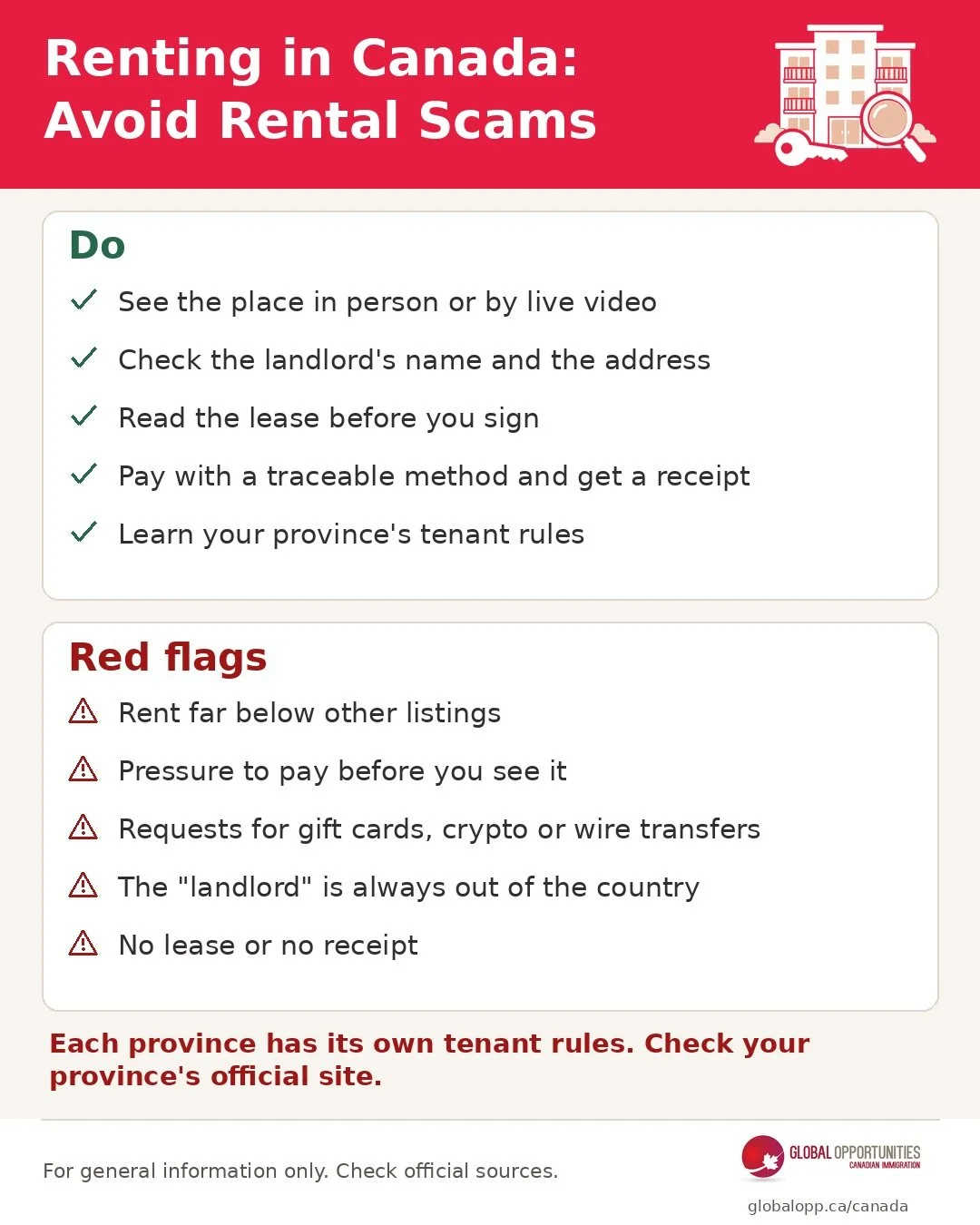
Never send money for a place you have not seen in person or by a live video call with the landlord.
Be careful with very low rents, landlords who say they are "out of the country", or pressure to pay right away.
Confirm that the person owns or manages the unit.
Pay by traceable methods and get a receipt.
Pay only the deposit allowed by law, and get every agreement in writing.
Utilities: electricity, heat and internet
Ask whether rent includes heat, electricity, hot water, parking and internet. Most of the Island gets electricity from Maritime Electric (Maritime Electric), and homes inside Summerside from Summerside Electric. IRAC regulates electricity rates. Many homes heat with oil, electricity or heat pumps; ask the landlord how the unit is heated and what winter bills usually look like. Internet and phone are sold by private providers; compare prices and check coverage in rural areas before you sign a lease.
Rents, deposit rules and rent-increase limits as published by CMHC and the PEI Rental Office, as of November 2026. CMHC figures are averages for existing rentals, not the price of a unit listed today, and the rules have exceptions: check the linked pages, or ask the Rental Office about your own tenancy, before you rely on them.
Getting around PEI: T3 Transit, the bridge and the ferry
Public transit in Prince Edward Island is run by T3 Transit, with city routes in Charlottetown, Stratford, Cornwall and Summerside, and weekday rural routes. Outside those areas, most people drive.
T3 Transit: where it goes
According to T3 Transit:
T3 City Transit serves Charlottetown, Stratford, Cornwall and Summerside.
T3/Transit PEI Rural runs on weekdays and connects communities such as Georgetown, Montague, Souris, St. Peter's, Rustico, Summerside, Borden, O'Leary, Alberton, Tignish and Charlottetown. Rural trips are booked online.
Transfers between the Charlottetown, Stratford and Cornwall routes are free with a transfer slip from the driver. Plan trips with the route maps on the T3 site; buses are less frequent in the evening and on weekends than in big Canadian cities.
T3 Transit fares
As listed on the T3 Transit fares page in November 2026:
Cash fare (exact change): $2.00 for adults, seniors and post-secondary students.
Monthly pass: $20 for adults; $10 for seniors (60+) and full-time post-secondary students.
Ticket booklets: $18 for 10 tickets (adults and students); $9 for 6 tickets (seniors).
Children and K-12 students ride free.
UPEI full-time students get a U-Pass included with tuition.
According to the same T3 fares page, Summerside and rural services use the same $2 cash fare and $20 / $10 monthly passes. Passes and booklets are sold through the T3 purchase page. Fares change, so check the current price on the T3 site.
Fares as published by T3 Transit, as of November 2026. Who qualifies for a reduced or free fare (seniors, students, children) is set by T3: check the linked fares page before you rely on these figures.

The Confederation Bridge
According to the Government of Canada, the Confederation Bridge is 12.9 kilometres long and crosses the Northumberland Strait. It was inaugurated in May 1997 and links Borden-Carleton, Prince Edward Island, to Cape Jourimain, New Brunswick (Intergovernmental Affairs, Confederation Bridge). IRCC's Discover Canada describes it as one of the longest continuous multispan bridges in the world.
The toll. According to the Confederation Bridge tolls page, as of November 2026, the toll for a two-axle passenger vehicle or a motorcycle is $20.00. It is paid only when you leave PEI, at Borden-Carleton, and covers the round trip. Cash, Interac and major credit cards are accepted. People on foot or bicycle cannot cross the bridge themselves; the bridge's shuttle service was listed at $4.75 for pedestrians and $9.50 for cyclists. Strong winds can lead to restrictions for some vehicles, so check the bridge's website before you travel in a storm. Check the current price before you go.
The ferry to Nova Scotia
Northumberland Ferries sails between Wood Islands, PEI, and Caribou, Nova Scotia, during the season. According to its 2026 fares page, a standard vehicle (up to 20 feet long and 7 feet high, passengers included) was $43, an adult walk-on passenger was $11.50, and a fuel surcharge of $2.50 applied to vehicles under 20 feet. The ferry does not run year-round; the schedule page showed a fall season ending December 20, 2026. Check the current schedule and fares before you plan a trip.
Tolls and fares as published by the Confederation Bridge and Northumberland Ferries, as of November 2026. Both change, and the ferry runs only part of the year: check the linked pages before you travel.
Driving in PEI: licences, insurance, car rental and winter
In most of Prince Edward Island a car is close to essential. Licences are issued by Access PEI under the province's Highway Safety rules, new drivers go through graduated licensing, and every vehicle must be insured.
Do I need a car in PEI?
If you live and work in Charlottetown or Summerside near a T3 route, you can manage without one at first, especially as a student. For rural jobs, shift work, evening activities, weekend trips and groceries in winter, most Islanders drive. Many newcomers buy a used car after a few months; have it inspected by a mechanic before you pay.
Graduated licensing in PEI: each stage explained
According to the Government of PEI's Graduated Driver Licensing information booklet, every new driver of any age starts in the Graduated Driver Licensing (GDL) program. It lasts at least three years, or a little less with a certified driver education course.
Stage 1: Instruction Permit ("L", Class 7).
Minimum age 16 (parental consent under 18). You pass a written road-sign and rules test and a vision test. The permit is valid for two years.
You must drive with an accompanying driver in the front seat who has held a full licence for at least four years and has a blood alcohol level under 0.05.
You must have zero alcohol and zero drugs in your system.
The only passengers allowed are the accompanying driver's immediate family.
Drivers under 21 cannot drive between 1 a.m. and 5 a.m.
No hand-held devices. A yellow "L" decal is displayed.
You wait 365 days before the road test (275 days with certified driver education), and you must complete the Novice Driver Course before the road test.
Stage 2: Class 5 with restrictions ("G").
You enter Stage 2 by passing the road test. It lasts 365 days.
Only one passenger who is not immediate family.
Zero alcohol and zero drugs. No hand-held devices.
No driving between 1 a.m. and 5 a.m. unless accompanied by a driver licensed for four years or more. This curfew does not apply to drivers 21 and over, and a work exemption form exists.
Stage 3: reduced restrictions ("G").
Lasts 365 days. Passengers are limited only by the number of seatbelts.
Zero alcohol and zero drugs. No hand-held devices. Keep the "G" decal.
At the end, you leave the GDL program automatically, without needing a new licence card.
The GDL booklet also explains that zero tolerance for alcohol and drugs applies to all drivers under 22.
Exchanging a foreign driver's licence in PEI
According to the Highway Safety Driver License Reciprocity sheet (dated October 2022):
New residents can drive on a valid licence from their home country for up to four months after becoming residents, and this can be extended if the exchange process has started.
Full-time students at UPEI or a college may drive on a valid home licence, with an International Driving Permit if one is required.
Reciprocal exchange (no written or road test) is available for licences from all Canadian provinces and territories and US states, and for certain classes from Austria, Australia, Germany, Japan, South Korea, Switzerland, Taiwan, the United Kingdom, France and Ukraine.
Unilateral exchange of a Class 5 licence, without written or road tests, was listed for Belgium, Denmark, Ireland, the Netherlands, New Zealand, Norway, Portugal, Spain and Sweden, with extra proof such as an International Driving Permit, a recent driver abstract or a letter from the licensing agency or embassy.
Drivers from all other countries take the written knowledge test, the Novice Driver Course for Newcomers and a road test, either through the GDL program or a certified driving school. Drivers who can prove two or more years of experience may receive credit through a certified driving school.
The list of countries changes. Check the current rules and the driver's licence fees with Access PEI before your appointment, and bring your foreign licence, passport, immigration documents and proof of address. If your licence is not in English or French, ask whether you need an official translation.
Licence rules as published by the Government of PEI in its Graduated Driver Licensing booklet and its Driver License Reciprocity sheet (dated October 2022), checked in November 2026. A country on the exchange list does not mean every licence class from it is exchanged automatically; Access PEI decides each case, so check the linked pages and confirm with Access PEI before you rely on them.
Car insurance in PEI
Car insurance is mandatory. Under the Highway Traffic Act, it is an offence to register or drive a vehicle that is not insured, and drivers must carry a liability insurance card (Highway Traffic Act). Insurance is sold by private insurers through brokers and agents. The Government of PEI's Superintendent of Insurance supervises the insurance business, and IRAC regulates auto insurance rates (Government of PEI, automobile insurance).
What affects the price: your driving history, the vehicle, where you live, how much you drive, the coverage and the deductible. Newcomers often have no Canadian driving record. Ask your previous insurer for a letter in English confirming your years of insured driving and claims history; some insurers consider it. Get quotes from several brokers before you buy a car, because insurance can change which car you can afford.
This mention of regulators is for reference only and may not be complete; confirm details with each regulator.
Renting a car when you arrive in PEI
According to Charlottetown Airport, Avis, Budget, Enterprise, Hertz, National and Thrifty have counters in the arrivals and baggage claim area, and you reserve directly with the company (Charlottetown Airport, car rentals). The airport does not set licence or age rules: each company sets its own, so check before you book:
Your licence. Bring your valid, physical home-country licence with a photo. As an example, one major company's FAQ says digital licences are not accepted, an International Driving Permit (IDP) is recommended for licences in a Latin alphabet that are not in English, and required for licences in a non-Latin alphabet, and that you cannot rent with the IDP alone (Enterprise, licence requirements). An IDP is only valid with a valid licence, and it is issued in the country that issued your licence (in Canada, CAA issues IDPs to holders of Canadian licences: CAA, International Driving Permit), so get yours before you leave home.
A credit card in the driver's name. Many companies ask for one for the security deposit; some do not accept debit cards or prepaid cards.
Age. The same company lists a minimum rental age of 21 in Prince Edward Island (Enterprise, rental age by province). Other companies have their own age rules and fees for young drivers.
Insurance. Check what your credit card or travel insurance covers before you accept or refuse the rental company's coverage.
Book ahead. Reserve directly with the company before you travel, especially in summer.
Remember the four-month rule for new residents above: a rental is fine for your first weeks, but start the licence exchange early. We mention private companies for reference only and have no relationship with any of them.
Winter driving and tires
Winter roads in PEI can be snowy, icy and windy, especially on open rural roads where snow blows across. Winter tires are strongly recommended for snow and ice, even though we found no general legal requirement to use them. Studded tires are allowed only during a set season under the province's Winter Tires Regulations. Keep an emergency kit in the car (brush and scraper, shovel, blanket, booster cables, windshield washer fluid rated for winter, a phone charger and snacks), keep the fuel tank at least half full, and slow down. Check road conditions before long drives and consider waiting out a storm.
Parking and winter parking bans
According to the City of Charlottetown winter operations page, on-street parking is not allowed from 11 p.m. to 6 a.m. between November 15 and April 15, enforced when plowing or de-icing is needed. It applies to residential permit holders too, and vehicles can be towed. The city lists overnight alternatives in some downtown lots. If you rent without a driveway spot, ask the landlord where to park in winter. In Summerside and other towns, check the municipality's website for winter rules.
How do newcomers get health care in PEI? The Health Card and finding a doctor
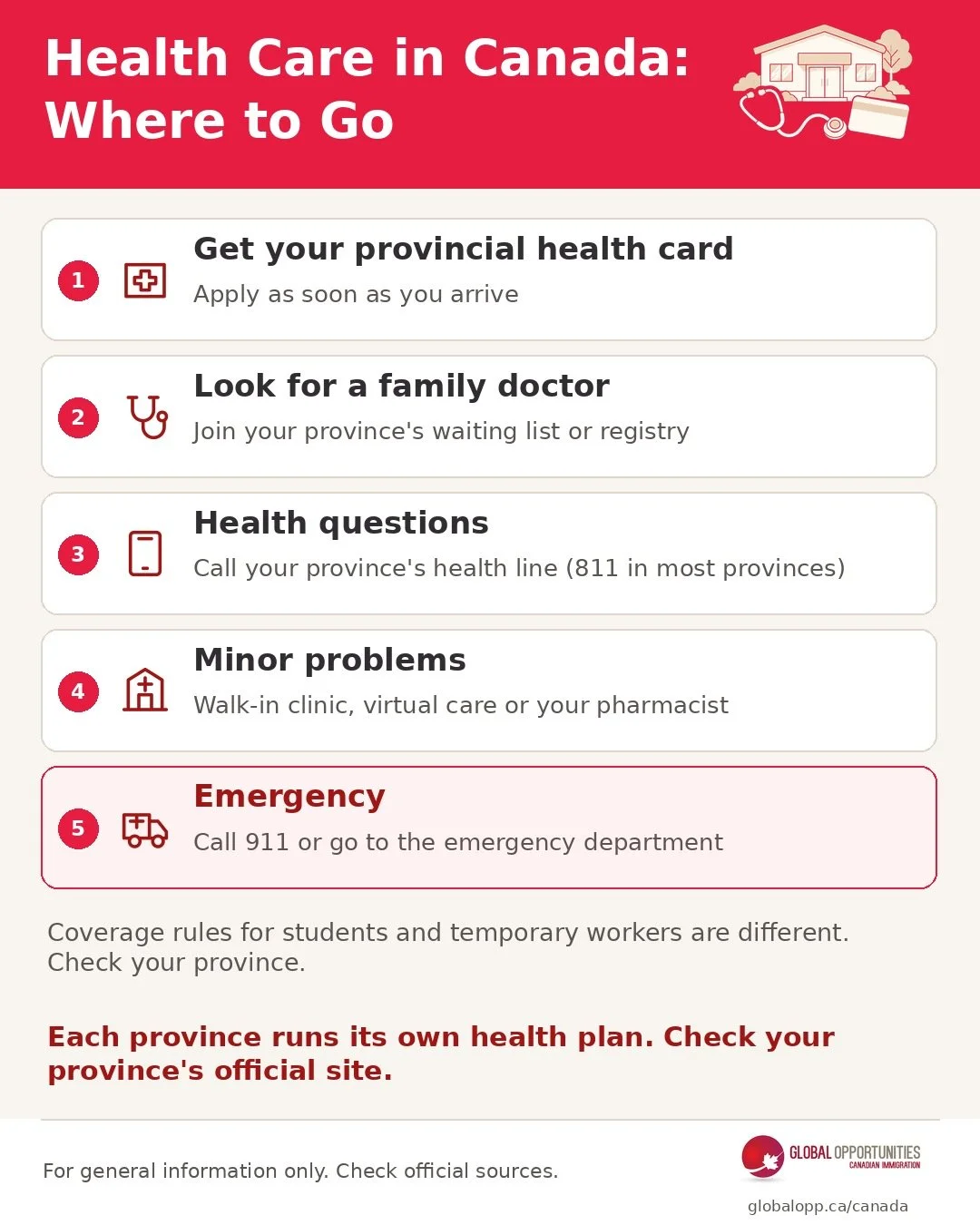
To use public health services in Prince Edward Island without being charged, you need a PEI Health Card. According to the Government of PEI, you show it at hospitals and other public health care facilities, and pharmacists use it to record your medications in the PEI Drug Information System (Government of PEI, PEI Health Card).
New to how public health care works? Read the health care system in Canada.
Who can get a PEI Health Card
The Government of PEI's PEI Health Card page describes two types of card:
A PEI Health Card for permanent residents, valid for five years from the date it is issued.
A Temporary PEI Health Card for international students and temporary workers, valid for the duration of the study or work permit.
According to the Government of PEI's Apply for a PEI Health Card page, you must be legally in Canada and make PEI your primary residence for at least six months plus a day each year, and you can apply once you are physically on the Island. Work permit holders need a permit that allows them to work in PEI for at least 183 days, and international students need a study permit and proof of enrolment at a designated learning institution, among other conditions. Eligibility rules change, so read the official page before you apply.
How to apply
New residents can apply through the province's online health card application. Step by step:
Arrive on the Island first: you can apply once you are physically in PEI.
Get your documents ready: your passport, immigration documents (permanent resident confirmation, work permit or study permit) and proof of PEI address.
Apply online in your first days on the Island. Until your card arrives, and for any period you are not covered, consider private health insurance; many international students are covered by a school plan, so ask your institution.
Finding a family doctor or nurse practitioner: the Provincial Patient Registry
The Government of PEI points out that having a health card does not put you on the list to get a family doctor or nurse practitioner: you must register separately with the PEI Provincial Patient Registry. You can register online, by phone at 1-855-563-2101, or at an Access PEI location, and patients are matched in order of registration within their region (Find a family doctor or nurse practitioner). Check the official page to confirm whether your type of health card is eligible. Register as soon as you have your card, because waiting times can be long.
Virtual care for people without a family doctor
Islanders on the Patient Registry can use free virtual visits through the province's virtual care program delivered with Maple; you receive an email invitation after you register, according to the Government of PEI (Virtual health care for Islanders without a family doctor). Check the official page for booking hours and who is eligible.
Pharmacies and Pharmacy Plus PEI
Pharmacies are found in grocery stores, drugstore chains such as Shoppers Drug Mart and independent pharmacies. Through Pharmacy Plus PEI, participating pharmacists can assess and prescribe for a list of common ailments and renew eligible prescriptions at no charge with a PEI Health Card (Pharmacy Plus PEI FAQ). You still pay for the medication unless you have a drug plan. Prescription drugs, dental care and eye care are often paid privately or through workplace insurance, so ask your employer about benefits.
811 and emergencies
For a medical emergency, call 911 or go to the nearest emergency department.
If you are unsure what to do about a health issue, call 811 to speak with a registered nurse, any time (PEI Health Card page).
Emergency departments: the Queen Elizabeth Hospital in Charlottetown has a 24-hour emergency department and is the provincial referral centre; Prince County Hospital in Summerside also offers 24-hour emergency services. The province publishes emergency department wait times.
For non-urgent problems, try 811, Pharmacy Plus or virtual care first, and keep the emergency department for serious or sudden problems.
Mental health
In a crisis, call 911 or go to an emergency department. You can also call or text 988, the Suicide Crisis Helpline. IRSA offers counselling for newcomers.
Eligibility rules as published by the Government of PEI on its PEI Health Card and Patient Registry pages, as of November 2026. Meeting these conditions does not mean coverage starts the day you arrive, and a health card does not register you for a family doctor; the Government of PEI decides each application, so check the linked pages before you rely on them.
Banking in PEI for newcomers
Opening a bank account is one of your first tasks in Prince Edward Island: you need it to receive your salary, pay rent and build a credit history. The Financial Consumer Agency of Canada (FCAC) explains what identification banks require and what to do if a bank refuses to open an account (FCAC, opening a bank account).
Banks and credit unions on the Island
Large national banks such as RBC, TD, Scotiabank, BMO and CIBC operate across Canada; use each bank's online branch locator to see which have a branch near your home. PEI also has local credit unions, such as Provincial Credit Union, whose deposits are protected by PEI's credit union deposit insurance corporation. Banks often advertise newcomer offers; compare fees, international transfer costs and branch locations. We mention financial institutions for reference only. Global Opportunities has no relationship with any of them and does not recommend any.
What you need to open an account
According to the FCAC, the bank must confirm your identity with original documents: either two documents from its approved list (one with your name and address, one with your name and date of birth), or one document plus confirmation from a bank customer in good standing or a respected community member. A foreign passport is on the list. Ask the bank what else it needs for your situation; some banks let you start the process before you arrive.
Building a credit history
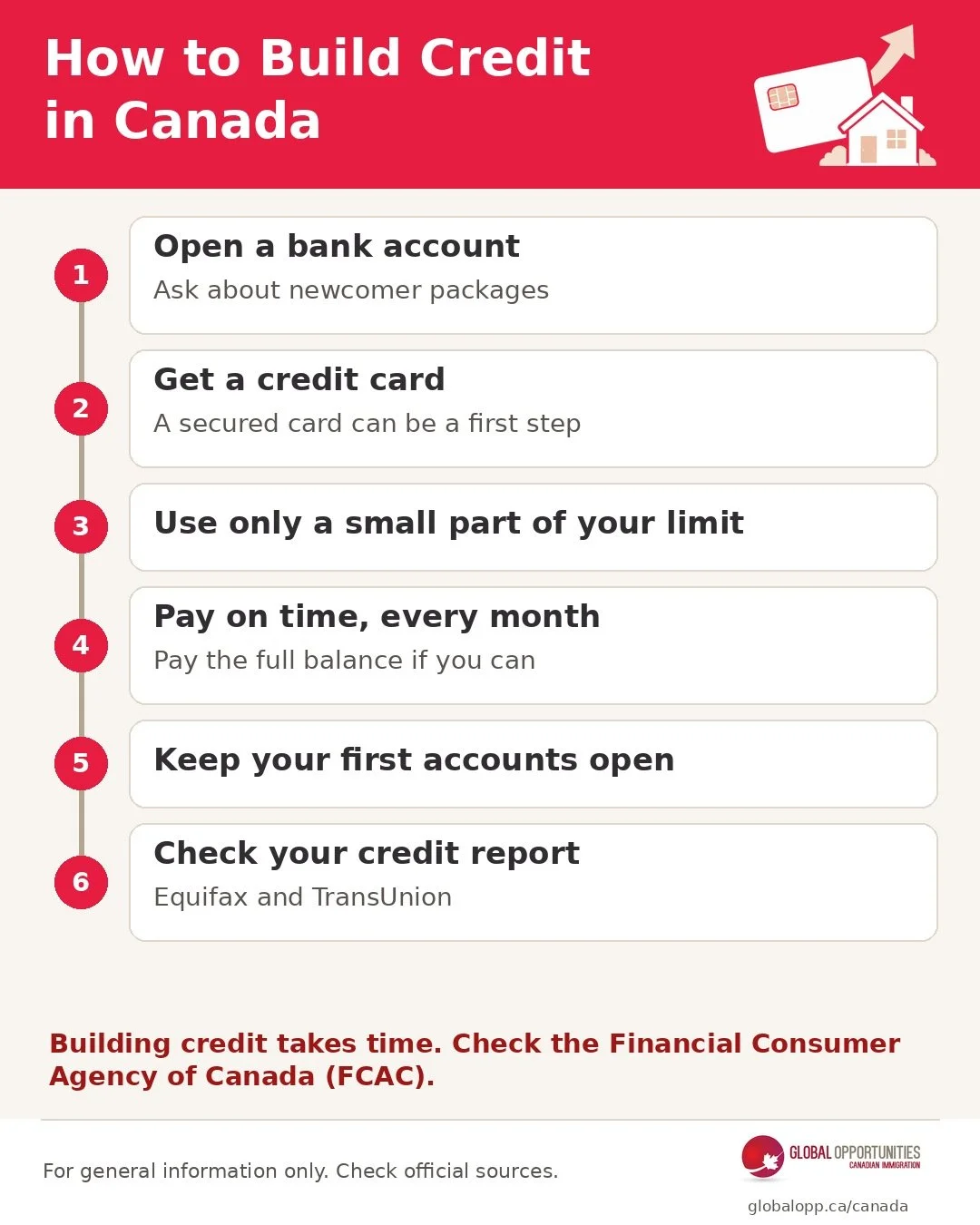
Your credit history affects renting, phone plans and car loans. Start with a credit card (a secured card if needed), use a small part of the limit, and pay the full balance on time every month. The FCAC explains how credit reports and scores work (FCAC, credit reports and scores).
Groceries and shopping in PEI
Groceries in Prince Edward Island are sold by supermarket chains, discount stores, independent grocers and, in season, farmers' markets. Prices vary between stores, so compare weekly flyers.
Supermarkets and discount stores
Supermarket chains such as Atlantic Superstore and Sobeys, plus independent grocers in smaller communities.
General and discount stores such as Walmart and Dollarama, which says it is present in all Canadian provinces.
Pharmacies such as Shoppers Drug Mart, which also sell some groceries.
Not every chain has a store in every town: use each company's official store locator to confirm the nearest location before you count on it. Costco does not currently list a warehouse in PEI; check its warehouse locator for the nearest one. We mention stores for reference only and have no relationship with them.
Local food and seafood
IRCC notes that PEI is known for agriculture, especially potatoes (Discover Canada). Farmers' markets and farm stands sell local produce in season.
Latin American and international food
Large supermarkets usually have an international aisle, and Charlottetown has some independent international food stores. Ask IRSA or local newcomer groups where to find specific products; specialty items can also be ordered online.
Furnishing your home on a budget
Many newcomers furnish their first home second-hand through online marketplaces, thrift stores and community groups, and buy new basics at general and discount stores. Never pay for an item you have not seen.
How cold is PEI, and how do you prepare for winter?
Prince Edward Island has four seasons shaped by the sea. IRCC explains that the Atlantic Ocean brings cool winters and cool, humid summers to the Atlantic provinces (Discover Canada). Winters are long, snowy and windy, with storms that can close roads and schools for a day or two.
The seasons in PEI
Winter (roughly December to March). Snow, freezing rain and strong winds are common. Storms from the Atlantic can bring heavy snow and drifting, and wind makes the cold feel much colder than the thermometer says. Roads, schools and the bridge can be affected by weather.
Spring (roughly April to May). A slow, often cool and wet transition, with sea ice lingering in some years.
Summer (roughly June to August). Warm, pleasant days, beaches, festivals, farmers' markets and many visitors.
Fall (roughly September to November). Harvest season, cooler days and autumn colours. Late-season storms are possible.
To compare Charlottetown with your home city, look up its official climate normals on the Environment and Climate Change Canada climate normals site. For daily forecasts and weather warnings, use Environment Canada's weather site or its WeatherCAN app.
What to buy for your first PEI winter
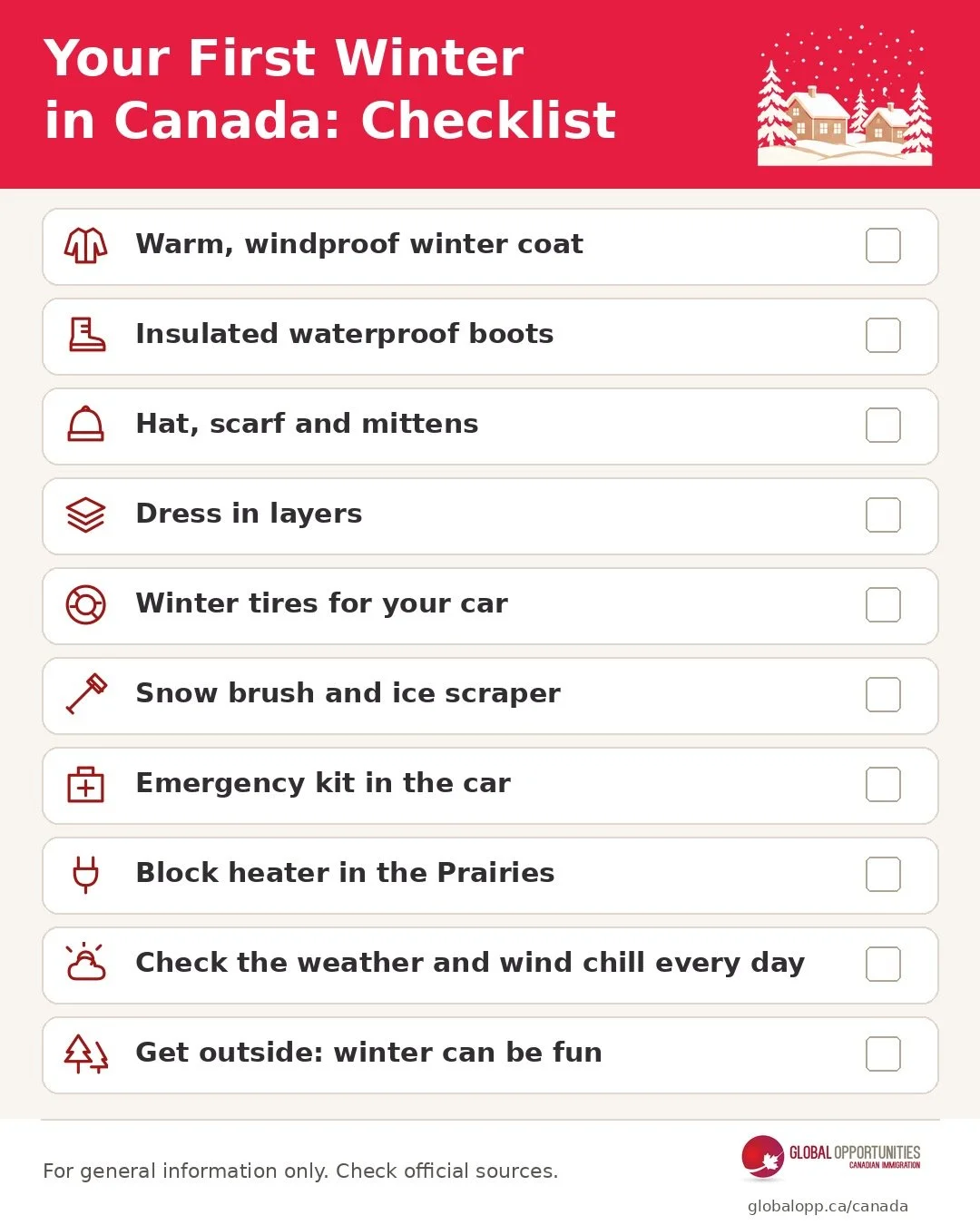
Dress in layers rather than one heavy item. Your basic kit:
A winter coat that is windproof and waterproof or water-resistant, long enough to cover your hips, with a hood.
Insulated, waterproof winter boots with good grip for ice. In PEI, wet snow and slush are common, so waterproofing matters as much as warmth.
Thermal base layers (long-sleeve top and leggings) and warm socks of wool or synthetic fabric. Avoid cotton next to the skin on very cold days.
A warm hat (toque), gloves or mittens, and a scarf or neck warmer to protect your face from the wind.
Ice cleats that slip over your boots for icy sidewalks.
For your home: a snow shovel if you have a driveway or steps, ice melt, a doormat and boot tray, and a flashlight and charged power bank in case of power outages during storms.
For your car: winter tires, a snow brush and scraper, winter windshield washer fluid, booster cables and an emergency kit.
Where to buy winter clothing and supplies in PEI
Winter boots, coats, shovels, ice melt and car kits are sold by national chains such as Canadian Tire, Mark's and Walmart, by sporting goods stores, and second-hand at thrift stores and online marketplaces. Use each store's official locator to find the nearest branch. Buy the basics when you arrive and add the rest after a few weeks, once you know how cold your commute is. We mention stores for reference only and have no relationship with them.
Storms and power outages
Before a storm, charge your phone, keep water, food that needs no cooking, a flashlight and batteries, and fill your car's tank. Never run a generator or fuel heater indoors.
Education in PEI: UPEI, Holland College and Collège de l'Île
Prince Edward Island has three public post-secondary institutions: the University of Prince Edward Island (UPEI), Holland College and the French-language Collège de l'Île. All three appear on IRCC's list of designated learning institutions (DLIs) (IRCC, DLI list). This list is for reference only. Institutions change their programs, campuses and admission requirements; always confirm on the official website.
University of Prince Edward Island (UPEI)
Where: Charlottetown. What it is: the Island's only university, with undergraduate, graduate and professional programs.
According to UPEI's faculties and schools page, UPEI has these faculties: Arts; the McDougall Faculty of Business; Education; Graduate Studies; Indigenous Knowledge, Education, Research, and Applied Studies; Medicine; Nursing; Science; Sustainable Design Engineering; and the Atlantic Veterinary College, which trains veterinarians for the region. It also has a School of Mathematical and Computational Sciences and a School of Climate Change and Adaptation.
Medicine. UPEI lists a Faculty of Medicine among its faculties; check its admission rules on the UPEI site.
Co-op. According to UPEI, the Faculties of Arts, Business and Science offer co-op programs, with work terms of 14 to 16 weeks; check the co-op page for application dates (UPEI co-op).
How to apply. Apply online through the UPEI application portal. International applicants should read the international admission requirements and English language requirements on the UPEI site.
Holland College
Where: campuses and centres across PEI. What it is: the Island's public college for applied, technical and trades education.
According to Holland College's campuses page:
Prince of Wales Campus & Adult Education Centre, Charlottetown: the largest campus, with a variety of programs and campus residences.
Tourism & Culinary Centre, Charlottetown: home of the Culinary Institute of Canada and the Business Analytics Centre.
Belmont Centre, Charlottetown: the central location for the Language Instruction for Newcomers to Canada (LINC) program.
Summerside Waterfront Campus & Adult Education Centre: the second-largest campus, with many industrial technology and trades programs.
Marine Training Centre, Summerside: Transport Canada approved training, with simulators and hands-on training.
Atlantic Police Academy, Slemon Park: law enforcement and public safety training.
Georgetown Centre & Adult Education Centre: plumbing/pipefitting and welding fabrication.
West Prince Campus & Adult Education Centre, Alberton: business, administrative assisting, resident care and welding.
Check each program page for work placements and admission requirements. How to apply: online through the Holland College application portal. Some programs fill early, so check deadlines and program availability on the college website.
Collège de l'Île
Where: administration in Wellington, with a campus at 295 Kent Street in Charlottetown. What it is: PEI's French-language college. Its website, in French, lists program areas in health, business, education, social services and continuing education (Collège de l'Île). Check the language of instruction and admission requirements for each program, and apply directly through the college.
Other schools
If you need a study permit, check any other school on IRCC's DLI list before you apply.
How to apply to study in PEI
Choose a program and read its admission and English requirements.
Apply directly to the institution; PEI has no central application service like Ontario's.
Check DLI status on the IRCC list.
If you need a study permit, read IRCC's current rules. IRCC explains that most study permit applicants need a provincial or territorial attestation letter (PAL) from the province where they will study, which the school usually helps with (IRCC, provincial attestation letter). Rules, exemptions and caps change; always check IRCC's study in Canada page.
Plan housing early, because student rentals are in high demand.
Free English classes for adults
According to IRCC, permanent residents and protected persons can take government-funded language classes at no cost (IRCC, language classes). In PEI, IRSA offers language assessment and support, and Holland College's Belmont Centre is the central location for its LINC program (Holland College, campuses). If you need an English test for immigration, read our guide on English and French tests for Canada.
Schools for children in PEI
Public school in Prince Edward Island is offered in English, through the Public Schools Branch, and in French, through the Commission scolaire de langue française. Ask the school board about registration and any costs for your child.
English-language schools: the Public Schools Branch
The Public Schools Branch (PSB) runs English-language schools across PEI and explains how to register your child for school. It offers French immersion programs. Your child's school depends on your address.
Newcomer students: the PEI Student Welcome Centre
According to the PSB, children born outside Canada, or who speak a language other than English, French or Mi'kmaq at home, register first with the EAL/FAL Reception Centre (PEI Student Welcome Centre) at 85 Fitzroy Street, Suite 203, in Charlottetown (PEI Student Welcome Centre). Bring immigration documents, a birth certificate, proof of address and school records, translated if needed. The centre assesses language needs, and the PSB offers EAL and FAL programs and services.
French-language schools: the CSLF
The Commission scolaire de langue française (CSLF) manages the province's French first-language schools, in Charlottetown, Summerside, Rustico, the Évangéline region, West Prince and Eastern Kings (CSLF). Admission follows the CSLF's policy; ask the CSLF whether your children are eligible.
Jobs and main industries in Prince Edward Island
Prince Edward Island's economy relies on agriculture, fishing and seafood, tourism, manufacturing, construction, health care and public services. Global Opportunities does not offer jobs, and no one can guarantee you a job in Canada.
The labour market in numbers
According to Job Bank's 2026 Economic Scan for PEI (Job Bank):
Total employment rose 1.1% in 2025 to reach 93,500, the highest annual level ever recorded in the province.
The provincial unemployment rate was 8.0% in 2025, unchanged from 2024 and higher than the Canadian average of 6.8%.
About two-thirds of working-age Islanders were active in the labour market in 2025. Conditions vary by community, occupation and season.
Main industries in PEI
Based on Job Bank's 2026 Economic Scan for PEI:
Agriculture, especially potatoes, and food processing.
Health care and social assistance, which added the most jobs in 2025. Job Bank reports persistently high vacancies in the health sector.
Manufacturing, with record shipments in 2025 and exports led by pharmaceutical and aerospace goods.
Construction, supported by record housing starts in 2025.
Tourism and hospitality, which had a record season in 2025, with more visitors outside the summer peak.
Fishing and seafood, including lobster, mussels and oysters, an important export sector.
Bioscience and public services, centred in Charlottetown.
Job Bank also notes that labour shortages remain widespread in PEI. These are descriptions of the market, not job offers. Many jobs in agriculture, fishing and tourism are seasonal.
Where to look for work in PEI
Job Bank: the Government of Canada's job board. Filter by province, city and occupation.
WorkPEI: the Province's job board, with labour market information and referrals to career development services. You must be eligible to work in Canada to apply.
Job Bank outlooks for PEI: three-year employment outlooks by occupation.
Job Bank wage search: wage ranges by occupation and region.
Health Jobs PEI: nursing and allied health careers.
Employers' websites and local networks; many Island jobs are filled through referrals.
Before you apply, read our guide to Canadian resumes, cover letters and job interviews.
Free employment services in PEI
SkillsPEI runs programs such as Work Experience PEI, Self Employ PEI, Training PEI and Career Connect, with offices in Charlottetown, Summerside, Montague and West Prince (SkillsPEI).
IRSA offers an Employment Assistance Service and workshops for newcomers who register with the association (IRSA employment programs).
Minimum wage
According to the Government of PEI, the minimum wage was $17.30 per hour as of October 1, 2026 (PEI minimum wage). It changes regularly, so check the current rate.
Rate as published by the Government of PEI, as of November 2026. Some jobs and situations have special rules, and the rate changes: check the linked page before you rely on it.
Resume and job search tips
Use a concise Canadian-style resume (no photo, age or marital status), adapt it to each posting and volunteer to build local references. Our newcomer guide to Canada has resume examples and more job search advice.
Regulated professions and trades
If your occupation is regulated (for example, many health professions, engineering, law, teaching and some trades), you will likely need a licence from the provincial regulator before you can work in it or use the protected title. Foreign credentials alone do not give you a licence, so contact the regulator early, ideally before you arrive.
Nurses trained abroad can read how to immigrate to Canada as a nurse, which lists the nursing regulator in each province.
Any mention of regulated occupations in this guide is for reference only. It may not be complete. Always confirm requirements directly with the regulator for your profession or trade.
Free newcomer services in PEI
Prince Edward Island's main settlement agency is the Immigrant & Refugee Services Association of PEI (IRSA), and the Government of PEI encourages newcomers to register with it. Its services are free for eligible clients.
IRSA
According to IRSA, it has offices at 49 Water Street in Charlottetown and in Summerside, and its services include:
Settlement: newcomer intake and orientation, francophone settlement, support for temporary foreign workers and international students, refugee resettlement, counselling, citizenship test preparation and pre-arrival services.
Employment: the Employment Assistance Service and workshops.
Youth and family: youth settlement services, family orientation, help with school enrollment and settlement workers in schools.
Language: Canadian Language Benchmarks placement tests, interpretation and translation, and volunteer English tutoring.
Community: programs that connect newcomers with Islanders and cultural events.
IRSA also publishes the Online Guide for Newcomers to Prince Edward Island, which covers documents, money, housing, food, transportation, health, parenting, employment and the law.
Federal services and pre-arrival support
Use IRCC's newcomer services finder to find free, government-funded services. IRCC notes that, starting April 1, 2026, economic class permanent residents can only access these services for a limited time, so it helps to start early. Pre-arrival services can help you prepare before you land.
211 PEI
211 PEI is a free directory of community, social and health services on the Island.
How much does it cost to live in Prince Edward Island?
Living costs in PEI depend on where you live, whether you drive and how you heat your home. Here are the official figures we cite in this guide, with the date of each:
Rent: average $1,292 per month for all units in Charlottetown and $1,161 in Summerside, according to CMHC's October 2025 survey) (see the housing section).
Transit: $2.00 cash fare and $20 adult monthly pass, as listed on the T3 Transit fares page in November 2026.
Bridge toll: $20.00 for a passenger vehicle, paid leaving PEI, according to the Confederation Bridge tolls page, as of November 2026.
Sales tax: 15% HST, according to the CRA.
Minimum wage: $17.30 per hour as of October 2026, according to the Government of PEI.
Check the current price on each source before you budget. Costs that newcomers often underestimate are a car and its insurance, winter heating, a first set of winter clothing and tires, furniture, and the first and deposit payments on a rental. For wider data, Statistics Canada publishes the Consumer Price Index by province.
For a national overview, see our article on the cost of living in Canada. Income tax, the HST and the benefits that families can receive are explained in the next section.
Figures as published by CMHC, T3 Transit, the Confederation Bridge, the CRA and the Government of PEI, as of November 2026. They may have changed by the time you read this: check the linked pages before you rely on them.
How much tax do you pay in Prince Edward Island, and which benefits can you get?
In Canada you pay income tax to two governments, federal and provincial, and the Canada Revenue Agency (CRA) collects both on one tax return. According to the CRA, PEI also applies the 15% HST to most purchases, and according to the Government of PEI, families can use $10-a-day child care in Early Years Centres, in addition to tax-free monthly benefits. This section explains how each one works. Tax rules and amounts change every year, so always check the official pages linked below.
How income tax works in PEI
Canada uses progressive tax brackets: each portion of your taxable income is taxed at the rate for that bracket, so a higher rate applies only to the part of your income above each threshold, not to all of it. If you live in PEI on December 31, you pay federal tax plus PEI tax for that year, and both are calculated on the same return (CRA, Canadian income tax rates for individuals).
If you work for an employer, tax is usually deducted from each paycheque, and in the spring you file a return for the previous year. The return works out whether you paid too much (you get a refund) or too little (you owe the difference). Filing also matters if your income is low or zero, because the CRA uses your return to calculate benefits and credits.
Federal and PEI income tax rates
According to the CRA's tax rates for the current year, as of November 2026 the rates for the 2026 tax year are:
Federal tax:
14% on the first $58,523 of taxable income
20.5% on the portion from $58,523 to $117,045
26% on the portion from $117,045 to $181,440
29% on the portion from $181,440 to $258,482
33% on the portion over $258,482
Prince Edward Island tax:
9.5% on the first $33,928 of taxable income
13.47% on the portion from $33,928 to $65,820
16.6% on the portion from $65,820 to $106,890
17.62% on the portion from $106,890 to $142,520
19% on the portion from $142,520 to $200,000
20% on the portion over $200,000
Your actual tax is lower than these rates suggest, because non-refundable credits, such as the basic personal amount and Canada Pension Plan and Employment Insurance contributions, reduce it. Brackets are adjusted every year: check the current rate on the CRA page before you budget.
Sales tax in PEI: the 15% HST
PEI uses the Harmonized Sales Tax (HST), which combines the federal GST and the provincial portion into one tax. According to the CRA, the HST rate in Prince Edward Island is 15%, and it has been since October 1, 2016 (CRA, GST/HST rates). Shelf prices usually do not include it, so a $10.00 item costs $11.50 at the till. Some items, such as basic groceries, are not taxed. Check the current rate on the CRA page.
The Canada Child Benefit and the PEI child benefit
The Canada Child Benefit (CCB) is, in the CRA's words, a tax-free monthly payment for eligible families to help with the cost of raising children under 18 (CRA, Canada child benefit). The amount depends on your adjusted family net income and on the number and ages of your children.
Temporary residents. The CRA says temporary residents can qualify if they have lived in Canada for the previous 18 months and have a valid permit in the 19th month, along with the other conditions, such as being a resident of Canada for tax purposes and being primarily responsible for the child (CRA, CCB: before you apply).
How to apply. Read the CRA's how to apply page. Both parents must file a tax return every year to keep receiving it.
The Prince Edward Island child benefit (PEICB). According to the CRA, the PEICB is a tax-free amount for low- to medium-income families, fully funded by the province and paid together with the CCB in one monthly payment. The CRA explains that it is reduced to zero when adjusted family net income is above $80,000 (CRA, Prince Edward Island programs). Check the current amounts on the CRA page.
Affordable child care: $10-a-day Early Years Centres
According to the Government of PEI's Early Years PEI parents page, Early Years Centres have regulated parent fees of $10 per day for children from birth to school entry age (as of November 2026). The federal government's Canada–PEI early learning and child care agreement supports this system.
How to find a space. Families must join the PEI Early Learning and Child Care Registry and choose the centres they want; each choice adds the child to that centre's waitlist. The province encourages parents to join the registry as early as possible, and you must log in at least once every 90 days to stay on the waitlists.
Pre-kindergarten. The same page explains that pre-kindergarten starts in September of the year before kindergarten, for children who are four on or before December 31 of that year.
Spaces are limited in many areas, so register before you arrive if you can, and check the current fees and rules on the official page.
PEI credits and benefits: the PEI essentials benefit
According to the CRA, the federal Canada Groceries and Essentials Benefit (CGEB) is the new name of the GST/HST credit, a tax-free payment for people and families with low or modest incomes (CRA, Canada Groceries and Essentials Benefit). The CRA explains that the Prince Edward Island essentials benefit (PEIEB) replaces the PEI sales tax credit starting November 2026. You do not need to apply: you must live in PEI on the first day of the payment quarter, be at least 19 and file a tax return every year, even with no income. Payments are normally made quarterly, together with the CGEB (CRA, Prince Edward Island programs). Check the current conditions on the CRA page.
Filing your first tax return in PEI
Get your SIN as soon as you can work; your employer needs it for payroll.
Keep your slips. Employers issue a T4 slip with your income and the tax deducted.
File every year, even with little or no income, so that the CRA can calculate your benefits and credits.
Use free help if you need it. The CRA's Community Volunteer Income Tax Program offers free tax clinics for people with modest incomes and simple returns (CRA, free tax clinics). Settlement agencies such as IRSA can also point you to local clinics.
Tax rates, benefit rules and child care fees as published by the Canada Revenue Agency and the Government of PEI, as of November 2026. They change every year: check the linked pages before you rely on them. Meeting a benefit's conditions does not mean you will receive a set amount; the CRA calculates each case from your return. This is general information, not tax advice; for your own situation, speak with a qualified tax professional.
Culture, community and things to do in PEI
Prince Edward Island is known for its beaches, its seafood, its Confederation history and Anne of Green Gables. Its culture brings together Mi'kmaq and Acadian heritage, the British settlement history and the newer communities that have arrived in recent years.
Anne of Green Gables
According to Parks Canada, Green Gables Heritage Place brings to life the home of Anne, the red-haired orphan from Lucy Maud Montgomery's 1908 novel, and the farmstead that inspired the author (Parks Canada, Green Gables).
Nature and the outdoors
Prince Edward Island National Park. Parks Canada describes sandy beaches, red cliffs, dunes, a seaside cycling path and woodland trails (Parks Canada, PEI National Park).
Beaches and lighthouses around the coast.
Winter activities: municipal recreation programs and outdoor rinks; Stratford's website, for example, lists outdoor rinks and trails. Check your municipality's recreation guide.
Arts, festivals and community
The Confederation Centre of the Arts presents theatre, concerts and exhibitions of Canadian art, and runs the Charlottetown Festival. Tourism PEI publishes a festivals and events listing for the whole Island. IRSA's community programs help newcomers meet Islanders, and volunteering is a good way to build friendships and local references.
Settling in is also about people: read our article on building community in Canada.
How can you immigrate to Prince Edward Island?
There is no single "PEI visa". People move to Prince Edward Island through federal programs run by IRCC, through the province's Provincial Nominee Program, through the Atlantic Immigration Program, or with a temporary permit to study or work. Programs, streams, requirements and fees change frequently, so always check the official pages linked below.
If you plan to visit first, use IRCC's official tool to check if you need a visa or an eTA.
Express Entry
According to IRCC, Express Entry manages applications for three federal programs: the Canadian Experience Class, the Federal Skilled Worker Program and the Federal Skilled Trades Program. Candidates create a profile and enter a pool, and IRCC invites candidates to apply in rounds (IRCC, Express Entry). Rules and selection criteria change; check the official page. You can also read our page on the Federal Skilled Worker program.
The PEI Provincial Nominee Program (PEI PNP)
Prince Edward Island has its own Provincial Nominee Program. IRCC explains that provincial nominee programs are for people who want to live in a specific province and become permanent residents, and that each province sets its own streams and requirements. Depending on the stream, applications go through Express Entry or through a non-Express Entry process (IRCC, Provincial Nominee Program).
For PEI's current streams and how to apply, IRCC links to the Government of PEI's official page, Immigrate to PEI as a worker. For an overview of how nominee programs work across Canada, see our page on provincial nominee programs. PEI PNP streams, intake and priorities change often. What you read here may already be different when you read it. Always check the official page, and be wary of anyone who promises a nomination, permanent residence or a job.
The Atlantic Immigration Program (AIP)
According to IRCC, the Atlantic Immigration Program is a pathway to permanent residence for skilled foreign workers and international graduates from a Canadian institution who want to work and live in one of the four Atlantic provinces, including Prince Edward Island. You must receive a job offer from an employer that has been designated by the province, and you can be living abroad or in Canada as a temporary resident (IRCC, Atlantic Immigration Program). Check the official page for the current requirements.
Studying and working in PEI
Study rules are covered in the education section above. For work, IRCC describes employer-specific and open work permits (IRCC, work in Canada). Some employer-specific permits require a Labour Market Impact Assessment; see our page on the LMIA. Young people from participating countries can read our page on the Working Holiday. Which permit or pathway fits you, and what you would need for it, depends on each case; a consultation is the way to know.
If your permit ends within a year, watch Is your work permit or PGWP expiring in the next 12 months?
Program and permit descriptions as published by IRCC and the Government of PEI, as of November 2026. Meeting a program's requirements does not mean an application will be approved; IRCC (and, for nominations, the province) decides each case. Check the linked pages before you rely on this information.
Already working in the province? Watch our live session Have you completed one year of work experience in Canada?, which explains why being eligible for permanent residence is not the same as being selected.
After permanent residence, many people apply for citizenship: see our guide to Canadian citizenship.
French in Prince Edward Island
English is the main language in Prince Edward Island, but the Island has a long-established Acadian and francophone community. According to Job Bank, about 3% of Islanders spoke French most often at home in 2021.
According to Canadian Heritage, the French established a permanent colony in the early 1700s, and Acadian communities remain part of the Island today, especially in the Évangéline region and around Rustico, Summerside and Charlottetown. Francophone families can choose a CSLF school, English-language schools offer French immersion, the Collège de l'Île teaches in French, and IRSA offers francophone settlement services.
French can be an advantage in some jobs and in community life, but English is needed for most work on the Island. If French is one of your strengths, read our page on French language proficiency. Global Opportunities does not offer services for Quebec's immigration programs; this guide covers Prince Edward Island only.
First steps after arriving in PEI
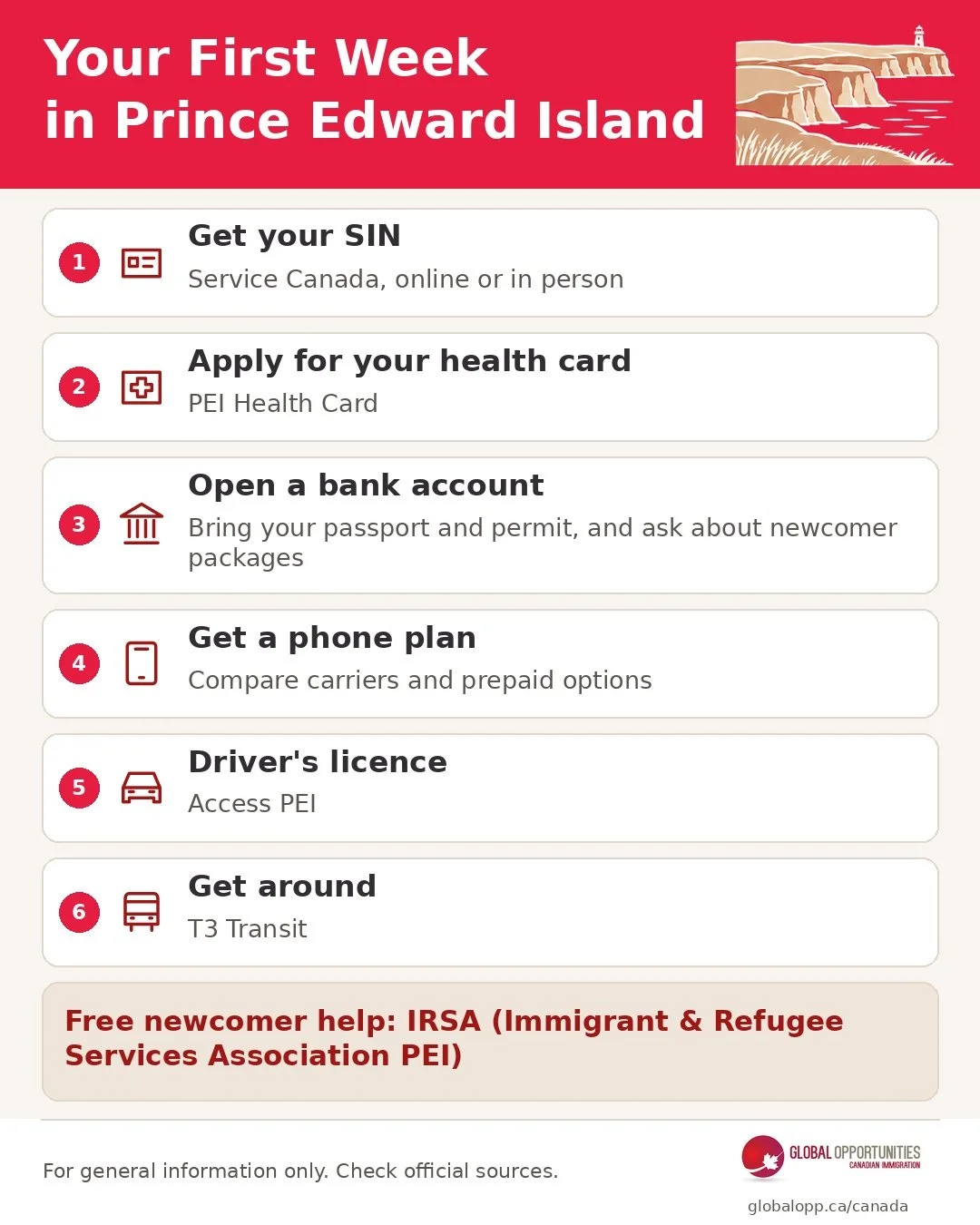
Your first weeks in Prince Edward Island involve a few key tasks. Doing them early makes everything else easier.
Your first-weeks checklist
Get your Social Insurance Number (SIN). You need it to work in Canada or to access government programs and benefits (Service Canada, SIN).
Apply for your PEI Health Card, if you are eligible.
Register with the Provincial Patient Registry to look for a family doctor or nurse practitioner.
Open a bank account and get a Canadian phone plan.
Register with IRSA for free settlement services.
Register your children for school, through the PEI Student Welcome Centre or the CSLF.
Sort out your driver's licence with Access PEI before the four-month limit for new residents.
Get a T3 pass if you will ride the bus, or arrange car insurance if you buy a car.
Prepare for winter with proper clothing and, if you drive, winter tires.
Start your job search on Job Bank and WorkPEI, and contact SkillsPEI or IRSA's employment service.
Frequently asked questions
Is Prince Edward Island a good place to live for immigrants?
Many newcomers value PEI's small communities, short distances, safety, beaches and friendly pace of life, and the Island has grown quickly through immigration. The challenges are real too: Job Bank reports that rental affordability remains strained and that health services are under pressure, and in most areas you need a car. Wages and job options can be narrower than in large cities, and many jobs are seasonal. PEI tends to suit people who like a quiet life, work in a sector the Island needs, such as health care, construction or food production, and are ready for long winters. Read the housing, health and jobs sections, compare with other Atlantic provinces, and visit if you can before you decide.
Is it expensive to live in PEI?
It depends on rent, transportation and heating. According to CMHC's October 2025 survey), the average rent for all units was $1,292 in Charlottetown and $1,161 in Summerside, lower than in Canada's largest cities but rising. Transit is inexpensive where it exists ($2.00 cash fare as listed on the T3 Transit fares page in November 2026), but most people outside the cities need a car, with insurance, fuel and winter tires. According to the CRA, sales tax is 15% HST. Winter heating and a first set of winter clothing are costs newcomers often forget. Check the current prices on the official sources and build a budget before you move; our cost of living section lists the figures with dates.
How do I get a PEI Health Card?
Apply through the Government of PEI once you are physically on the Island, using the online application for new residents. According to the Government of PEI's Apply for a PEI Health Card page, you must be legally in Canada and make PEI your primary residence for at least six months plus a day each year. Permanent residents receive a card valid for five years; international students and temporary workers who qualify receive a temporary card tied to their permit. Have your passport, immigration documents and proof of address ready. Consider private insurance until you are covered. Remember that the health card does not put you on the list for a family doctor: register separately with the Provincial Patient Registry. See our health section.
Can international students get a PEI Health Card?
Yes, in many cases. According to the Government of PEI's Apply for a PEI Health Card page, there is a Temporary PEI Health Card for international students and temporary workers, valid for the duration of the study or work permit. International students need a study permit and proof of enrolment at a designated learning institution, among other conditions, and you must be physically on the Island to apply. Coverage does not start the day you land, so keep private insurance or your school's health plan until your card is active, and ask your institution's international office what its plan covers. A health card does not put you on the list for a family doctor: you must register separately with the Provincial Patient Registry. Eligibility rules change, so read the official page before you apply. See our health care section.
How do I find a family doctor in PEI?
Register with the PEI Provincial Patient Registry, online, by phone at 1-855-563-2101 or at Access PEI. The Government of PEI explains that having a health card does not register you automatically, and patients are matched in order of registration within their region, so register as soon as you have your card. While you wait, you can use virtual care for Islanders on the registry, call 811 to speak with a registered nurse, and ask participating pharmacists through Pharmacy Plus PEI to assess common ailments and renew eligible prescriptions. For emergencies, call 911 or go to an emergency department. Check the official page to confirm whether your type of card is eligible. See our health section.
Is there public transit in PEI?
Yes. T3 Transit runs city routes in Charlottetown, Stratford, Cornwall and Summerside, and weekday rural routes that connect communities such as Montague, Souris, Borden, O'Leary, Alberton and Tignish with the cities; rural trips are booked online. As listed on the T3 fares page in November 2026, the cash fare is $2.00 and the adult monthly pass is $20, with $10 passes for seniors and full-time post-secondary students; children and K-12 students ride free, and UPEI full-time students get a U-Pass. Service is less frequent than in big cities, especially evenings and weekends. Check the current fares and schedules on the T3 site. See our transportation section.
Do I need a car in PEI?
In Charlottetown or Summerside, near a T3 route, you can manage without a car at first, especially as a student. For most of the Island, a car is close to essential: many jobs are in rural areas or on shifts, stores and services are spread out, and rural transit runs only on weekdays. Many newcomers rent a car for their first days and buy a used car once they have a job. Budget for insurance, which is mandatory and can be expensive without a Canadian driving record, plus fuel, winter tires and maintenance. Remember that new residents must exchange their foreign licence within the time allowed. See our driving section.
Can I exchange my foreign driver's licence in PEI?
It depends on the country. According to the Government of PEI's Driver License Reciprocity sheet, licences from Canadian provinces, US states and certain countries, such as Australia, Austria, France, Germany, Japan, South Korea, Switzerland, Taiwan, Ukraine and the United Kingdom, can be exchanged without tests for certain classes, and some European countries and New Zealand have a unilateral exchange with extra proof. Drivers from other countries take a knowledge test, the Novice Driver Course for Newcomers and a road test, and may receive credit for proven experience. New residents can drive on their home licence for up to four months. Lists change, so confirm with Access PEI. See our driving section.
How does graduated licensing work in PEI?
According to the Government of PEI's Graduated Driver Licensing booklet, new drivers of any age go through three stages. Stage 1 is the Instruction Permit: you drive only with an experienced accompanying driver, with zero alcohol and drugs, limited passengers and, if you are under 21, no driving between 1 a.m. and 5 a.m. After at least 365 days (or 275 with certified driver education) and the Novice Driver Course, you take the road test. Stage 2 lasts a year, with one non-family passenger and a night restriction for drivers under 21. Stage 3 lasts another year with fewer restrictions, after which you leave the program automatically. The official booklet has the details. See our driving section.
Can I rent a car in PEI with a foreign licence?
Usually yes, but each rental company sets its own rules. Bring your valid, physical home licence with a photo; if it is not in English or French, many companies require or recommend an International Driving Permit from your home country, used together with your licence. Most ask for a credit card in the driver's name for the deposit, and young drivers may pay extra or face other age rules set by each company. Several companies operate at Charlottetown Airport, and summer demand is high, so book ahead. Check what insurance your credit card covers. As a new resident, you can drive on your home licence only for the time PEI allows, so start the exchange early. See our driving section.
Do I need winter tires in PEI?
We found no general legal requirement to use winter tires in PEI, but they are strongly recommended. Winter roads on the Island can be snowy, icy and windy, and all-season tires lose grip in cold temperatures. Studded tires are allowed only during a set season under the province's Winter Tires Regulations, so check the dates before you install them. Insurers may consider winter tires when setting your rate, so ask your broker. Canadian Tire, tire shops and dealerships sell and install them; book early in the fall, before the first snow, when shops get busy. Keep an emergency kit in the car and slow down in storms.
How do I rent an apartment in Charlottetown?
Search on Kijiji, Facebook Marketplace, Rentals.ca, PadMapper and property management websites, and ask your school, employer, IRSA and community contacts. Have your ID, a job letter or proof of income, and references ready, and reply quickly, because the vacancy rate in Charlottetown was 1.7% in CMHC's October 2025 survey). Visit in person, never send money for a unit you have not seen, and ask for a written agreement such as the Rental Office's standard form. According to the PEI Rental Office, the landlord can ask for a deposit of up to one month's rent and must return it with interest. Many newcomers start in a shared room while they search. See our housing section.
What are tenant rights in PEI?
PEI tenancies follow the Residential Tenancy Act, and the PEI Rental Office explains rights and settles disputes. Key rules, according to the Rental Office's security deposits FAQ and rent increases page: the security deposit is limited to one month's rent (or one week's rent for weekly tenancies), held in an interest-bearing account and returned with interest; rent can rise only once every 12 months, with at least three months' written notice, and not above the yearly allowable increase (2% for 2026 and 2.1% set for 2027) without an order. Rental Office decisions can be appealed to IRAC. If you have a problem, contact the Rental Office before you stop paying rent or leave. See our housing section.
How cold does it get in PEI?
PEI winters are cold, snowy and windy, usually from December to March, and the wind off the sea can make it feel much colder than the temperature. Storms can bring heavy snow, freezing rain and drifting, closing roads and schools for a day or two. Summers are mild and pleasant thanks to the sea. To see averages for Charlottetown, look up the official climate normals from Environment and Climate Change Canada, and follow Environment Canada's forecasts and warnings. With a windproof coat, waterproof boots, layers, a hat and gloves, and winter tires if you drive, most newcomers adapt well. See our climate section.
What should I buy for my first winter in PEI?
A windproof, water-resistant coat with a hood; insulated, waterproof boots with good grip; thermal base layers and wool socks; a toque, gloves or mittens and a scarf or neck warmer; and ice cleats for sidewalks. At home, a shovel, ice melt and a storm kit with a flashlight, power bank, water and food. If you drive, winter tires, a brush and scraper, winter washer fluid and an emergency kit. National chains such as Canadian Tire, Mark's and Walmart, sporting goods stores and second-hand shops sell winter gear; check each store's locator. Buy the basics first and add more once you know your routine. See our climate section.
Where can I buy groceries cheaply in PEI?
Compare weekly flyers from supermarket chains such as Atlantic Superstore and Sobeys, general stores such as Walmart and independent grocers. Many families shop at more than one store and buy store brands. Costco does not currently list a warehouse in PEI. In season, farmers' markets sell local produce. Dollarama, which says it is present in all provinces, sells household basics. Remember that, according to the CRA, most non-food items carry 15% HST. Not every chain has a store in every town, so check store locators. We mention stores for reference only and have no relationship with them. See our groceries section.
What colleges and universities are in PEI?
PEI has three public post-secondary institutions. The University of Prince Edward Island (UPEI), in Charlottetown, has faculties of arts, business, education, medicine, nursing, science, sustainable design engineering and veterinary medicine (the Atlantic Veterinary College), with co-op in Arts, Business and Science. Holland College is the applied and trades college, with campuses in Charlottetown, Summerside and other communities and centres such as the Culinary Institute of Canada, the Marine Training Centre and the Atlantic Police Academy. Collège de l'Île is the French-language college, based in Wellington with a campus in Charlottetown. All three are on IRCC's list of designated learning institutions. See our education section.
Is UPEI a good university?
UPEI is PEI's university. According to its website, it has faculties of Arts, Business, Education, Graduate Studies, Indigenous Knowledge, Education, Research, and Applied Studies, Medicine, Nursing, Science, Sustainable Design Engineering and Veterinary Medicine (the Atlantic Veterinary College). Whether it is "good" for you depends on your field, budget and goals. Compare program content, co-op options and costs with other universities, read admission requirements on UPEI's website, and ask current students about their experience. We do not rank universities. See our education section.
How do I apply to Holland College?
Choose your program on the Holland College website, read its admission requirements, deadlines and English requirements, and apply online through the college's application portal. Some programs are popular and fill early, so apply as soon as applications open and check program availability. International students must confirm the college's designated learning institution status, then follow IRCC's study permit process, which in most cases requires a provincial attestation letter, usually arranged with the school's help. Check each program page for work placements. Contact Holland College's admissions office with questions about your previous education. See our education section.
Is PEI good for international students?
It can be, depending on your program and what you expect. PEI has three public post-secondary institutions on IRCC's designated learning institutions list: the University of Prince Edward Island in Charlottetown, Holland College, with campuses and centres across the Island, and the French-language Collège de l'Île. Class sizes and communities are small, and the IRSA settlement agency supports international students. The challenges are housing, because student rentals are in high demand, limited transit outside Charlottetown and Summerside, and a smaller job market for part-time work. Check study permit rules, the provincial attestation letter and work-while-studying conditions on IRCC's pages, and plan housing early. Global Opportunities cannot guarantee admission, a permit or a job. See our education section.
How do I register my child for school in PEI?
Public school in PEI is run by the Public Schools Branch (English) and the CSLF (French). If your child was born outside Canada or speaks a language other than English, French or Mi'kmaq at home, register first with the EAL/FAL Reception Centre, the PEI Student Welcome Centre, in Charlottetown, which assesses language needs. Bring immigration documents, a birth certificate, proof of address and school records, translated if needed. The Public Schools Branch runs English-language schools, with French immersion, and the Commission scolaire de langue française runs French first-language schools; ask the CSLF whether your children are eligible. IRSA's settlement workers can help with school enrollment. See our schools section.
What jobs are in demand in PEI?
Job Bank's 2026 Economic Scan describes widespread labour shortages in PEI, with persistently high vacancies in health care and growth in construction, manufacturing and tourism. Agriculture, food processing and the fishery are also major employers, though many of those jobs are seasonal. Use Job Bank's three-year outlooks by occupation to see which occupations are expected to have good prospects, and WorkPEI and Job Bank to find current postings. Regulated occupations, such as nursing and many trades, require a provincial licence first. Global Opportunities does not offer jobs, and no one can guarantee you a job in Canada. See our jobs section.
Is there work in PEI in winter?
Yes, but the job market changes with the seasons. Job Bank's Economic Scan for PEI notes that many jobs in agriculture, fishing and tourism are seasonal, while health care, public services, manufacturing, bioscience and construction employ people year-round. Many seasonal workers apply for Employment Insurance regular benefits, which Service Canada describes as support for people who lose their job through no fault of their own, including at the end of seasonal work, and who are available for and able to work (Service Canada, EI regular benefits). Check the qualifying rules on that page. If you are planning a move, look for year-round work, save for the quiet months, and use winter for training or English classes. See our jobs section.
Where can I get free help finding a job in PEI?
The Province's WorkPEI job board refers job seekers to career development services, and SkillsPEI runs programs such as Work Experience PEI, Training PEI, Self Employ PEI and Career Connect, with offices in Charlottetown, Summerside, Montague and West Prince. IRSA offers an Employment Assistance Service and workshops for newcomers who register with the association. Students can use their institution's career and co-op offices. For resume examples and general job search advice in Canada, read our newcomer guide to Canada. Be wary of anyone who charges you for a job or promises one: legitimate employers do not sell jobs. See our jobs and newcomer services sections.
What is the minimum wage in PEI?
According to the Government of PEI, the general minimum wage was $17.30 per hour as of October 1, 2026 (Government of PEI, minimum wage). The rate changes regularly, so check the current rate on the official page before you accept an offer or plan a budget. Your employer must also deduct income tax, Canada Pension Plan contributions and Employment Insurance premiums from your pay, so your take-home pay is lower than the hourly rate multiplied by your hours. If you have questions about your pay or hours, the Government of PEI's employment standards pages explain your rights. See our jobs section.
What is IRSA in PEI?
IRSA is the Immigrant & Refugee Services Association of PEI, the Island's main settlement agency, formerly the PEI Association for Newcomers to Canada. It offers free services to eligible newcomers: settlement and orientation, francophone settlement, support for temporary foreign workers and international students, employment assistance, youth and family services, help with school enrollment, language assessment, interpretation, counselling and community programs. It has offices in Charlottetown and Summerside, and it publishes an online newcomer guide to PEI. The Government of PEI encourages newcomers to register with IRSA. Contact IRSA soon after you arrive, because some federally funded services have time limits. See our newcomer services section.
How do I get to Prince Edward Island?
By road over the Confederation Bridge from New Brunswick, by ferry from Caribou, Nova Scotia, to Wood Islands during the season, or by air to Charlottetown Airport. As of November 2026, the bridge toll for a passenger vehicle was $20.00, paid only when leaving PEI, according to the Confederation Bridge website. Northumberland Ferries listed 2026 fares of $43 for a standard vehicle with passengers and $11.50 for an adult walk-on, and the ferry does not run year-round. Several car rental companies have counters at Charlottetown Airport. Check current tolls, fares and schedules before you travel. See our transportation section.
How much does it cost to cross the Confederation Bridge?
According to the Confederation Bridge tolls page, as of November 2026 the toll for a two-axle passenger vehicle or a motorcycle is $20.00. The bridge's website explains that tolls are collected when leaving Prince Edward Island, at the toll plaza in Borden-Carleton, so you pay nothing when you drive onto the Island and the one payment covers the round trip. Cash, Interac and major credit cards are accepted. Larger vehicles pay more. You cannot walk or cycle across the bridge yourself; the bridge runs a shuttle for pedestrians and cyclists. Strong winds can lead to travel restrictions for some vehicles, so check the bridge's website before you travel in a storm, and check the current price before you go. See our transportation section.
Is PEI safe?
Safety depends on the area and on your own situation, and we do not rank places. If you want official data, Statistics Canada publishes the Crime Severity Index by province and metropolitan area, which you can compare over time. As anywhere, take normal precautions: lock your home and car, keep valuables out of sight, and be careful with rental, job and immigration scams, especially online. Winter weather is a bigger everyday risk for many newcomers: icy sidewalks, storms and difficult roads. Follow Environment Canada warnings, wear ice cleats and drive with winter tires. In an emergency, call 911. For non-emergency matters, contact Charlottetown Police Services, your municipal police or the RCMP detachment for your area; the Government of PEI explains who polices each area.
How much income tax do you pay in PEI?
It depends on your taxable income, because Canada taxes each portion of your income at a different rate. For the 2026 tax year, the CRA lists federal rates from 14% to 33% and PEI rates from 9.5% on the first $33,928 of taxable income to 20% on the portion over $200,000, as of November 2026 (CRA, tax rates for the current year). Credits such as the basic personal amount reduce the tax you actually pay. Most employees have tax deducted from each paycheque and file a return in the spring, which also lets the CRA calculate benefits such as the Canada Child Benefit and the PEI essentials benefit. Brackets change every year, so check the current rate. See our taxes and benefits section.
Is there $10-a-day child care in PEI?
Yes, in Early Years Centres. According to the Government of PEI's Early Years PEI parents page, Early Years Centres have regulated parent fees of $10 per day for children from birth to school entry age, as of November 2026. To find a space, you join the PEI Early Learning and Child Care Registry and choose the centres you want, which adds your child to each centre's waitlist; the province encourages parents to join as early as possible, and you must log in at least once every 90 days to stay on the lists. Spaces are limited in many communities, so register early and check the current fees and rules on the official page. See our taxes and benefits section.
Charlottetown or Summerside: which is better for newcomers?
It depends on your work, studies and lifestyle. Charlottetown is the capital, with UPEI, Holland College's largest campus, the Queen Elizabeth Hospital and most T3 city routes, but higher rents: an average of $1,292 for all units in CMHC's October 2025 survey). Summerside is smaller, with Prince County Hospital, Holland College's trades campus and Marine Training Centre, city transit and an average rent of $1,161 in the same survey. Many people choose based on where they find a job. Visit both, check commute times and compare listings. See our sections on Charlottetown and Summerside.
What is there to do in PEI in winter?
Winter on the Island is quiet but not empty. Municipalities run recreation programs and outdoor rinks, the Confederation Centre of the Arts presents shows, and Tourism PEI lists winter festivals and events across the Island. IRSA's community programs also organize activities for newcomers. Many newcomers use winter to take English classes and volunteer. Check your municipality's recreation guide and local event listings for programs and schedules. See our culture section.
When should I call 911 in PEI, and what if I call it by mistake?
Call 911 for a medical emergency, a fire, a crime in progress or any situation where someone's life or safety is at risk. If you call 911 by mistake, do not hang up: in a news release, the Government of PEI said it is important to stay on the line and explain to the call-taker that emergency help is not needed, because staff spend a lot of time following up on calls where no one is on the line (Government of PEI, Stop pocket dialing 911). The same release suggests keeping 911 out of your speed dial and locking your phone before you put it in a pocket or bag.
Is there a mental health crisis line in PEI?
Yes. If you or someone you know is thinking about suicide, you can call or text 9-8-8, the Suicide Crisis Helpline, 24 hours a day, every day of the year (9-8-8). If someone's life is in immediate danger, call 911. For non-urgent health questions, the provincial 811 line can point you to local services (see the health section).
How do I check road conditions in PEI before I drive?
Use PEI 511, a free traveller information service operated by the Government of Prince Edward Island, to check road conditions, construction and closures. Within PEI you can also dial 5-1-1 toll-free (PEI 511, FAQ). Call 911, not 511, for emergencies.
What do I do if I get a flat tire or my car breaks down in PEI?
If you are in danger or blocking traffic, call 911. For a flat tire, a dead battery or a tow, many drivers use roadside assistance. CAA offers roadside assistance to its members through regional clubs, and says that services may vary by club (CAA). Some car insurance policies, new-car warranties and credit cards also include roadside assistance: check your policy or card agreement before you need it, and keep the phone number in your car.
How does car insurance work in PEI?
Car insurance is mandatory: under the Highway Traffic Act, it is an offence to register or drive a vehicle that is not insured (Highway Traffic Act). You buy it from private insurers through brokers and agents. According to the Government of PEI, its Superintendent of Insurance supervises the insurance business and IRAC regulates auto insurance rates (Government of PEI, automobile insurance). Compare quotes from several brokers, and ask how they treat your driving history from abroad. See the driving section.
Can newcomers get the Canadian Dental Care Plan in PEI?
Possibly, once you meet the conditions. According to the Government of Canada's CDCP eligibility page, you must meet all four requirements: no access to private dental insurance or coverage, a tax return filed in Canada (and your spouse's or partner's, if you have one), an adjusted family net income below $90,000, and being a Canadian resident for tax purposes. Filing your first Canadian tax return is therefore the first step. Conditions as published by the Government of Canada, as of November 2026; check the official page before you apply.
What is 811 in PEI?
811 is the number to call when you are unsure what to do about a health issue: according to the Government of PEI's Health Card page, you can speak to a registered nurse at any time. For emergencies, call 911. See our health section.
Are there direct flights to Charlottetown from Europe or Mexico?
There were no non-stop flights from Europe on Charlottetown Airport's destinations page as of November 2026. From Mexico, the page listed seasonal non-stop flights to and from Cancún. Year-round, Charlottetown had non-stop flights to Montréal-Trudeau, Toronto Pearson and Ottawa, which are common places to connect. Routes and airlines change seasonally, so check the airport's page and the airlines before you book.
Related guides
How Global Opportunities can help
Choosing a province and a pathway depends on your education, work experience, languages and goals. We can help you understand your options.
Our regulated consultant: Lic. Mildrete Monserrath Gutierrez Martinez, Regulated Canadian Immigration Consultant (RCIC), CICC licence R514880. Verify her licence on the CICC Public Register: https://college-ic.ca/protecting-the-public/find-an-immigration-consultant. Global Opportunities does not offer services for Quebec's immigration programs. Global Opportunities is a private firm and is not part of the Government of Canada or any provincial government.
Recorded seminars and lives: watch our recorded seminars in English or the Spanish recordings, and visit our YouTube channel.
More articles in English: read our Moving to Canada articles on topics such as health care, cost of living, the ECA and professional licences, and building community in Canada.
Personalized consultation: for a review of your own case, contact us or write to info@globalopp.ca.
Prefer email? Tell us what you need help with (moving to Prince Edward Island) and we will reply: email info@globalopp.ca.
Contact Global Opportunities →
Sources
CRA, Prince Edward Island programs (PEI child benefit and PEI essentials benefit)
Statistics Canada, Crime severity index and weighted clearance rates (table 35-10-0026-01)
CMHC, Housing Market Information Portal: Prince Edward Island average rents)
Government of PEI, Graduated Driver Licensing information booklet
Government of PEI, Health card application for new residents
Government of PEI, Find a family doctor or nurse practitioner
Government of PEI, Virtual health care for Islanders without a family doctor
Financial Consumer Agency of Canada, Credit reports and scores
Statistics Canada, Census Profile, 2021 Census: Prince Edward Island
Statistics Canada, Visible minority by gender and age (table 98-10-0351-01) · Ethnic or cultural origin by gender and age (table 98-10-0355-01)
Statistics Canada, Population and dwelling counts (table 98-10-0001-01) · by municipality (table 98-10-0002-01) · Population estimates, quarterly (table 17-10-0009-01)
Canada Revenue Agency, First Home Savings Account · Opening your FHSAs · Home Buyers' Plan · Line 31270, home buyers' amount
Government of Canada, Canadian Dental Care Plan: do you qualify
Global Opportunities on YouTube, Have you completed one year of work experience in Canada?
Government of New Brunswick, Basic facts (Atlantic Time) · Transportation · Newcomers
Confederation Bridge · Bay Ferries and Northumberland Ferries · Maritime Bus
Canada Border Services Agency, Border wait times · Travel information
Government of PEI, Get prepared to stay safe in an emergency (news release, May 2015) · Stop pocket dialing 911 (news release, November 2012)
Environment and Climate Change Canada, Air Quality Health Index
The information in this guide is general and for reference only. It is not immigration, legal or professional advice, and it may change at any time. Global Opportunities is not responsible for how anyone interprets this content or for decisions made based on it: what you read depends on when you read it. Immigration programs, the PEI Provincial Nominee Program, the Atlantic Immigration Program, provincial services, transit fares, tolls, licence rules, rents and rental rules change frequently, and statistics describe the past and do not predict any outcome. Always confirm requirements and current prices with official Government of Canada, Government of Prince Edward Island and municipal sources. The facts, figures and rules in this guide come from the official and other sources linked in each section, as they read when we checked them in November 2026; they may have changed since. Global Opportunities is not responsible for how this information is interpreted or for changes made after it was written. Global Opportunities is a private firm, is not part of the Government of Canada or of any regulator, and does not offer jobs. For advice on your own case, book a consultation.
Last reviewed: November 2026