
Living in Alberta, Canada: A Complete Guide for Newcomers
Living in Alberta, Canada means choosing between two large cities, Calgary and Edmonton, a string of mid-sized cities and mountain towns at the edge of the Rockies. This guide explains what daily life in Alberta looks like for newcomers: the main cities and their neighbourhoods, transit fares, rents, tenant rights, driving, health care, banks, groceries, schools, colleges and universities, work, the seasons and the official ways people move here.
About our sources: This guide summarises what official sources (the Government of Canada, provincial and territorial governments and the other organisations we link to) said when we checked them in November 2026. We link every source so you can read it yourself. Rules, rates and requirements change, sometimes without notice, and the official page is the one that counts. This is general information, not legal, tax or immigration advice. Global Opportunities is not responsible for how this information is interpreted or for changes made after it was written.
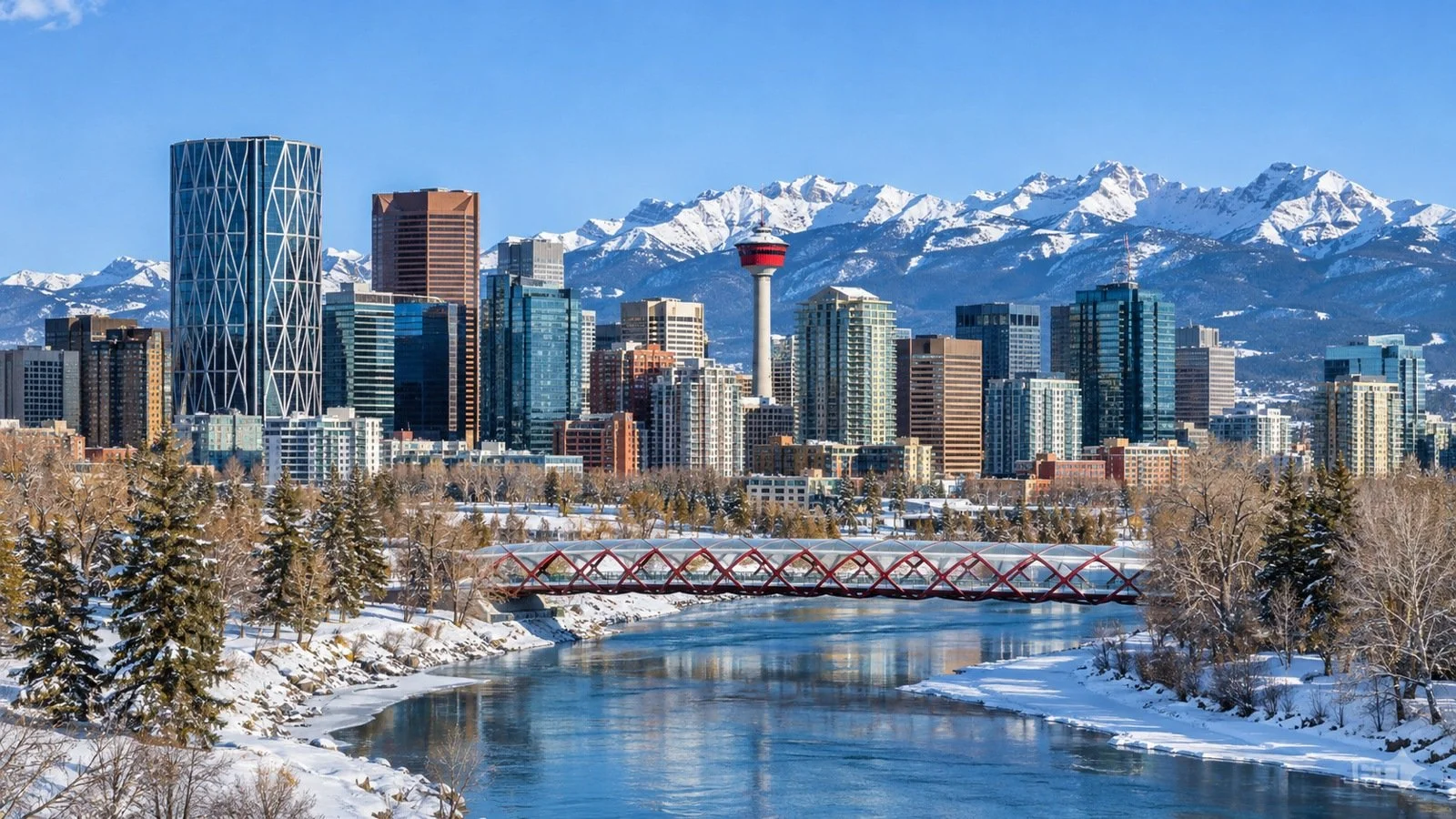
Alberta is a western province of energy, farmland, prairie and mountains, with no provincial sales tax and some of Canada's best-known national parks. It also has long, cold winters, an economy that moves with the price of oil and gas, and cities where many people rely on a car.
We wrote this guide for workers, international students and families who are about to arrive, or just arrived. Every section links to the official page where you can confirm the details, and every price comes from the official source with the date we checked it. Prices change, so always check the current price. If you want help with work permits, resumes and your first weeks in Canada, read our companion newcomer guide to Canada.
Watch our recorded seminars and lives →
Prefer Spanish? Read our Spanish guide.
In this guide
Alberta at a glance
Where is Alberta? Map, location and key facts
How to get to Alberta: by plane, car, train or bus
Buying your first home in Alberta
Emergencies and natural hazards in Alberta
Living in Calgary: neighbourhoods and city overview
Getting around Calgary: Calgary Transit, the CTrain and fares
Living in Edmonton: neighbourhoods and city overview
Getting around Edmonton: ETS, the Arc card and fares
Other cities in Alberta: transit, rents and what to expect
How much is rent in Alberta, and where do you find a place?
Driving in Alberta: licences, insurance, car rental and parking
How do newcomers get health care in Alberta? AHCIP, family doctors and 811
Banking in Alberta for newcomers
Groceries, shopping and taxes in Alberta
How cold is Alberta, and how do you prepare for winter?
Education in Alberta: schools, colleges and universities
Jobs and main industries in Alberta
Free newcomer services in Alberta
How much does it cost to live in Alberta?
How much tax do you pay in Alberta, and which benefits can you get?
Culture, community and the outdoors in Alberta
How can you immigrate to Alberta?
French in Alberta
First steps after arriving in Alberta
Frequently asked questions
Related guides
How Global Opportunities can help
Sources
Alberta at a glance
Alberta is a province in western Canada, between British Columbia and Saskatchewan. Its capital is Edmonton, its largest city is Calgary, and English is the language of daily life and work. According to Canadian Heritage, Alberta joined Confederation on September 1, 1905 (Canadian Heritage, symbols of Alberta).
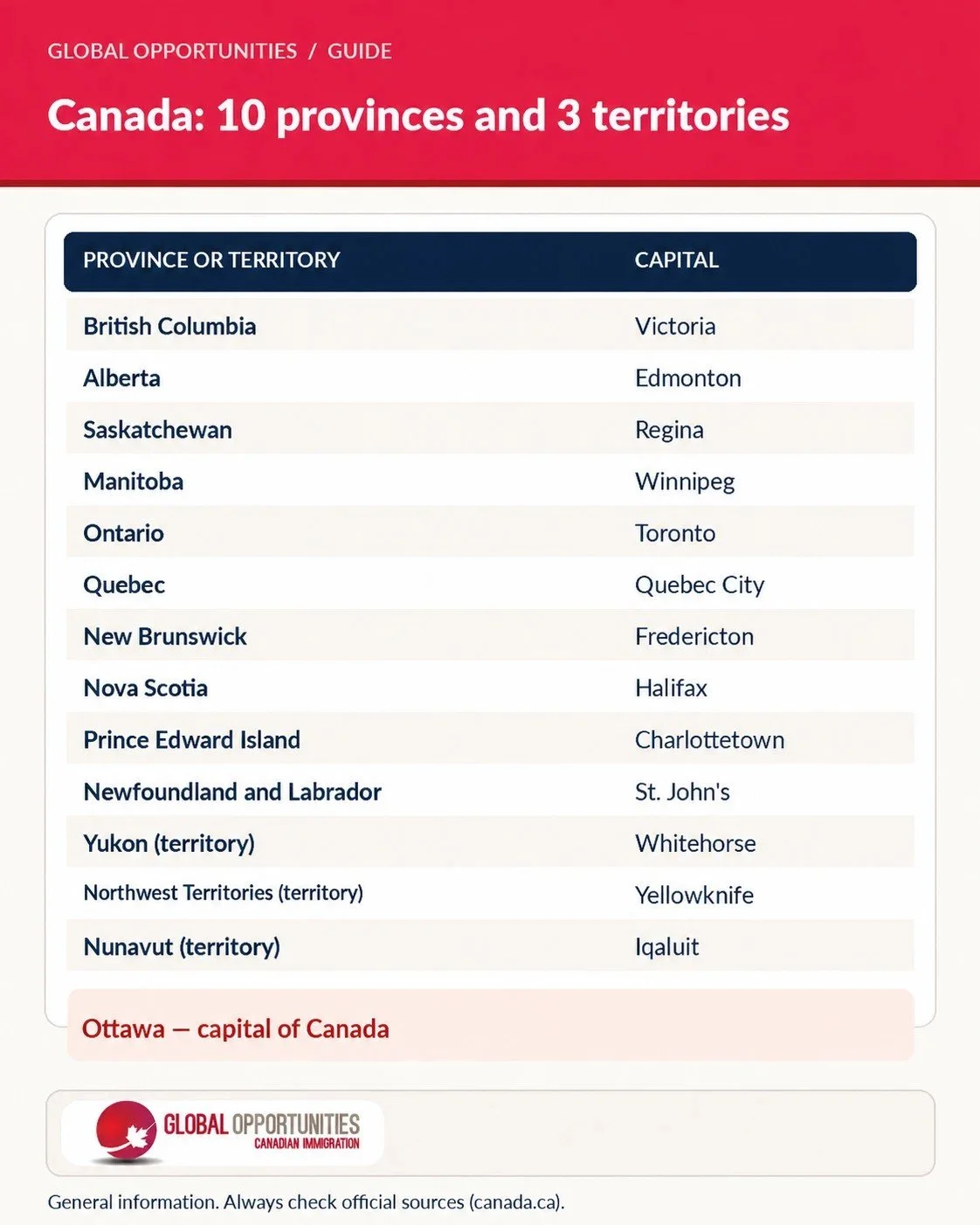
Alberta in a few facts
Population. According to Statistics Canada, Alberta had 5,101,050 residents on July 1, 2026, about 12.2% of Canada's population (Statistics Canada, table 17-10-0009-01).
Two large metropolitan areas. Statistics Canada estimated the Calgary metropolitan area at 1,836,012 people and the Edmonton metropolitan area at 1,692,385 people on July 1, 2025 (Statistics Canada, table 17-10-0148-01). Together, the two areas are home to most Albertans.
Energy. According to Immigration, Refugees and Citizenship Canada (IRCC), Alberta is the largest producer of oil and gas in Canada, and the oil sands in the north are being developed as a major energy source (Discover Canada, Canada's regions).
No provincial sales tax. According to the Canada Revenue Agency, purchases in Alberta carry the 5% federal GST and no provincial sales tax (CRA, GST/HST calculator and rates). Prices in stores are usually shown before tax.
Geography: prairie, parkland, forest and mountains
Alberta is a large province with very different landscapes. The south and east are prairie and farmland, with river valleys and badlands. Central Alberta, around Red Deer and Edmonton, is parkland that mixes farms, lakes and aspen forest. The north is mostly boreal forest, lakes and rivers, with the oil sands around Fort McMurray. Along the western edge rise the Rocky Mountains and their foothills, with Banff, Canmore, Jasper and Waterton. Distances are long, and the climate changes a lot from south to north.
Alberta Time: no more clock changes
According to the Government of Alberta, the province officially moved to Alberta Time on November 1, 2026. Alberta Time is equivalent to UTC-6, and Alberta no longer changes its clocks twice a year (Government of Alberta, Alberta Time). The time difference with places that still change their clocks shifts during the year.
The official newcomer guide
The Government of Alberta publishes the Opportunity Alberta Guide, an official guide for people who want to live, work or study in Alberta, available in several languages (Government of Alberta, Opportunity Alberta). The province also keeps a Moving to Alberta hub. This page follows the same topics, with more detail for each city.
Where is Alberta? Map, location and key facts
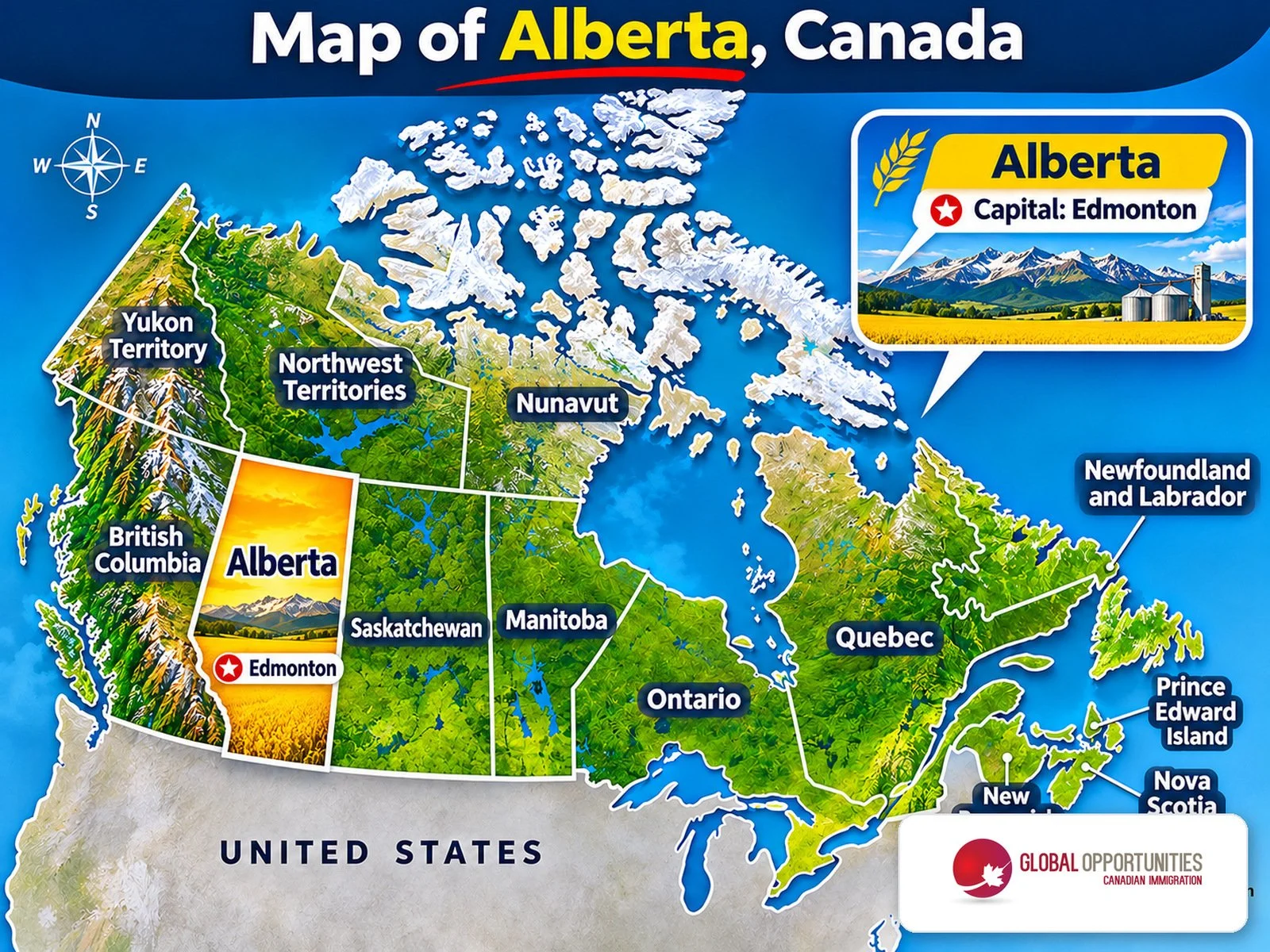
Alberta is in western Canada. It borders British Columbia to the west, Saskatchewan to the east, the Northwest Territories to the north and the US state of Montana to the south. Its capital is Edmonton, its largest city is Calgary, and the whole province uses Alberta Time (UTC-6) all year.
Borders and the US. According to the Government of Alberta, Highway 2 is the province's primary north-south corridor, linking Edmonton and Calgary and connecting to the United States at the Coutts-Sweetgrass border crossing (Government of Alberta, Highway 2 Airdrie bypass study).
Time zone. According to the Government of Alberta, Alberta Time is equivalent to UTC-6 and the province no longer changes its clocks (Government of Alberta, Alberta Time). See "Alberta Time" above.
Land area. According to Statistics Canada's 2021 Census, Alberta covers 634,658 square kilometres of land (Statistics Canada, table 98-10-0001-01).
Population. The 2021 Census counted 4,262,635 people in Alberta on Census Day, May 11, 2021 (Statistics Canada, table 98-10-0001-01). Statistics Canada's latest estimate is 5,101,050 residents on July 1, 2026 (Statistics Canada, table 17-10-0009-01).
Economy. According to IRCC, Alberta is the largest producer of oil and gas in Canada, and its cattle ranches help make Canada one of the world's major beef producers (Discover Canada, Canada's regions). The Government of Alberta publishes current indicators on the Alberta Economic Dashboard. Construction, health care, agriculture, technology, transportation and tourism are covered in the jobs section below.
Population by origin: what the census says
Alberta is a diverse province. According to Statistics Canada's 2021 Census, about 1,161,420 people in Alberta, out of 4,177,715 living in private households, identified as members of a visible minority group (Statistics Canada, table 98-10-0351-01). The largest groups were:
South Asian: 297,650
Filipino: 216,710
Black: 177,945
Chinese: 164,230
Arab: 69,510
Latin American: 66,515
Southeast Asian: 54,005
West Asian: 25,080
Korean: 24,370
Japanese: 13,555
The same census asked about ethnic or cultural origins, and people could give more than one. The most frequent answers in Alberta were English (766,070), German (641,025), Scottish (631,020), Irish (561,910), Ukrainian (343,640) and French (340,905), followed by Filipino (203,955), Chinese (177,990) and Indian (155,700). Among Latin American origins, about 25,450 people reported Mexican origins, 11,110 Colombian and 7,355 Chilean (Statistics Canada, table 98-10-0355-01).
Census counts as published by Statistics Canada for the 2021 Census. They describe how people answered the census questions in May 2021, not today's population, and because people could report more than one origin, the origin counts add up to more than the population. They are context, not a ranking of places.
How to get to Alberta: by plane, car, train or bus
Most people arrive in Alberta by plane, at Calgary International Airport (YYC) or Edmonton International Airport (YEG). By road, the Trans-Canada Highway (Highway 1) crosses southern Alberta, Highway 2 links Calgary and Edmonton, and the Yellowhead (Highway 16) crosses central Alberta. VIA Rail stops in Edmonton and Jasper, not in Calgary.
By plane: Calgary and Edmonton airports
Calgary International Airport (YYC). Its airlines and destinations page listed 16 airlines in November 2026. The airport explains how to get downtown by transit on its public transit page; see "Getting to and from Calgary" below.
Edmonton International Airport (YEG). Its airlines page listed 11 airlines in November 2026, and its non-stop destinations page shows every direct route. ETS Route 747 links the airport with Century Park; see "Getting to and from Edmonton" below.
Flying to Alberta from abroad: airlines and common routes
According to the airports' own pages, as of November 2026:
Airlines at YYC: Air Canada, Air North, Air Transat, Alaska Airlines, American Airlines, Central Mountain Air, Condor, Delta, Edelweiss, Eurowings Discover, Flair Airlines, KLM, Porter Airlines, Sunwing, United Airlines and WestJet (YYC, airlines and destinations).
Airlines at YEG: Air Canada, Air North, Air Tindi, Alaska Airlines, Canadian North, Central Mountain Air, Flair Airlines, KLM, Porter Airlines, United Airlines and WestJet (YEG, airlines).
Common ways to get there, by region:
From Europe. YYC lists non-stop flights to Amsterdam (KLM), Frankfurt (Eurowings Discover all year, Air Canada in summer), London (Air Canada and WestJet) and Paris (WestJet) all year, plus summer flights to Barcelona, Dublin, Edinburgh and Rome with WestJet. YEG lists Amsterdam (KLM) and a summer flight to Reykjavik (WestJet), and Discover Airlines service to Frankfurt starting June 1, 2027. From other European cities, travellers usually connect in one of these airports or in another Canadian hub.
From Mexico and Latin America. YYC lists year-round WestJet flights to Cancún and San José del Cabo and many winter flights to Mexico, Central America and the Caribbean. YEG lists Cancún, Los Cabos, Puerto Vallarta, Mazatlán and Huatulco, among others. WestJet announced new non-stop service between Calgary and Mérida from December 17, 2026, and between Calgary and São Paulo, Brazil, this winter (WestJet, new routes for winter 2026-2027; WestJet, winter sun schedule). From other Latin American cities, the trip usually involves a connection.
From Asia. YYC lists a summer WestJet flight to Tokyo (Narita). YEG lists no non-stop flights to Asia, and its page shows direct flights to Vancouver and Toronto, so travellers from Asia usually connect in another Canadian or US airport.
From the United States. Both airports list many US cities. YYC lists, among others, Chicago, Dallas-Fort Worth, Denver, Houston, Los Angeles, Minneapolis, Newark, New York (JFK), San Francisco and Seattle; YEG lists Denver, Houston, Las Vegas, Minneapolis, Phoenix and Seattle.
From Australia and New Zealand. Neither airport lists non-stop flights to Australia or New Zealand, so the trip involves at least one connection.
Airlines and routes as listed on the official pages of Calgary International Airport, Edmonton International Airport and WestJet, as of November 2026. Routes and airlines change seasonally: check the airport's page and the airlines before you book. We do not recommend any airline or route.
By car: Alberta's main highways
According to the Government of Alberta's economic corridors page:
Highway 1 (Trans-Canada) is an important corridor in southern Alberta, with access to Pacific ports to the west and markets to the east.
Highway 2 links Calgary and Edmonton and continues south to the US border at Coutts.
Highway 16 (Yellowhead) is an important corridor in central Alberta, linked to western ports and eastern markets.
Highway 63 is part of the Northeast Alberta Trade Corridor to Fort McMurray.
Before a long drive, check road conditions, closures and highway cameras on 511 Alberta, where you can also create an account for alerts on your routes. Winter conditions can change quickly; see the driving section.
Driving from the United States
The Canada Border Services Agency (CBSA) lists Coutts (Coutts, Alberta / Sweetgrass, Montana) as Alberta's crossing on its border wait times page, on Highway 2. CBSA notes that wait times can vary with events, holidays and enforcement actions, and do not include delays on the roads leading to the border. Before you travel, check CBSA's pages on visiting Canada and the travel documents you need, and use IRCC's tool to check if you need a visa or an eTA.
By train: VIA Rail
VIA Rail's list of Alberta stations does not include Calgary (VIA Rail, Alberta). VIA's long-distance train serves Edmonton and Jasper, with connections east to Saskatoon and west toward British Columbia (VIA Rail, Edmonton to Jasper; VIA Rail, Edmonton to Saskatoon).
By intercity bus
Red Arrow, a private intercity bus company, lists Calgary, Edmonton, Red Deer, Fort McMurray, Grande Prairie, Kelowna and Vancouver among its destinations (Red Arrow). 511 Alberta also lists bus information on its map. Check schedules and fares with the operator before you travel.
Highways, crossings and services as described by the Government of Alberta, CBSA, VIA Rail and Red Arrow, as of November 2026. Entry to Canada depends on your citizenship and documents, and the CBSA officer decides at the border: check the official pages before you travel.
Buying your first home in Alberta
Most newcomers rent first, but many plan to buy. The main help for first-time buyers in Alberta is federal: the First Home Savings Account (FHSA), the Home Buyers' Plan (HBP) and the home buyers' amount on your tax return. Each has its own conditions, so check whether you qualify before you count on it.
Saving for a first home: the FHSA and the Home Buyers' Plan
First Home Savings Account (FHSA). According to the Canada Revenue Agency (CRA), to open an FHSA you must be a resident of Canada, at least 18 (19 where that is the legal age), 71 or younger at the end of the year you open it, and a first-time home buyer: you did not live in a home that you owned or jointly owned as your principal residence in the current year or the previous four calendar years (CRA, opening your FHSAs; CRA, FHSA overview).
Home Buyers' Plan (HBP). According to the CRA, the HBP lets you withdraw from your registered retirement savings plans (RRSPs) to buy or build a qualifying home, up to $60,000, and pay it back over 15 years, with temporary relief that defers the start of repayment for first withdrawals made from 2026 to 2028 (CRA, what is the Home Buyers' Plan).
Home buyers' amount. According to the CRA, eligible first-time buyers can claim up to $10,000 for a qualifying home on line 31270 of their tax return. It is a non-refundable credit, so it only reduces tax you owe (CRA, line 31270).
The Canada Mortgage and Housing Corporation (CMHC) has a step-by-step home buying guide on budgets, mortgages and closing costs.
Property tax in Alberta's cities
Property tax is set and collected by your municipality. For example, the City of Calgary sends assessment notices to property owners in January and tax bills in May, due on the last business day of June, and you can pay monthly or all at once (City of Calgary, assessment and tax). Check your own municipality's page before you budget.
Rules depend on each person's situation: check the CRA pages and your municipality, and talk to a lender or a tax professional before you decide.
Rules and amounts as published by the Canada Revenue Agency and the City of Calgary, as of November 2026. They may have changed by the time you read this, and meeting one program's conditions does not mean you qualify for the others: check the linked pages before you rely on them.
Emergencies and natural hazards in Alberta
According to the Government of Alberta, the province's landscape and weather bring hazards such as extreme temperatures, tornadoes, wildfires, blizzards and flooding. Most newcomers never face a serious emergency, but it helps to know where official alerts come from and to keep a simple plan and kit at home.
Why does Alberta have a wildfire season?
According to the Government of Alberta's wildfire preparedness page, peak wildfire season in Alberta runs from March 1 to October 31, although wildfires may occur year-round, even in winter. The same page explains that human activity, such as backyard debris burning or campfires that are not fully put out, is a major cause, and lightning is another. During that period, a fire permit is required for most burning in the Forest Protection Area (Government of Alberta, get a fire permit).
Wildfire status. The Alberta Wildfire status page shows active wildfires, fire bans and advisories, and has the Alberta Wildfire Status app. To report a wildfire in a forested area, the page says to call 310-FIRE (3473).
Evacuation alerts and orders: what to do
According to the Government of Alberta's wildfire preparedness page:
Prepare in advance. Be ready to take care of yourself and your family for at least 72 hours, ideally a week or more, with an emergency kit and a household plan that includes pets.
Evacuation alert: get ready to leave on short notice, sometimes within 30 minutes to a few hours.
Evacuation order: issued when there is an immediate threat. If you are inside the boundaries, follow the direction to leave.
Follow official routes and do not drive through a wildfire unless officials direct you to (Government of Canada, Get Prepared: wildfires).
The Government of Alberta also explains how to gather supplies to shelter in place or to evacuate (prepare your emergency supplies).
Wildfire smoke and air quality warnings
Smoke can affect air quality even when fires are far away. The Government of Alberta suggests tracking the Air Quality Health Index (AQHI) for your community (wildfire preparedness). The AQHI is published by Environment and Climate Change Canada with health messages for the general public and for people at risk (Government of Canada, AQHI). When smoke is heavy, the Government of Canada suggests keeping windows and doors closed, using a certified portable air purifier and, if you must go outside, a well-fitting N95 or equivalent respirator (Get Prepared: wildfires).
Emergency alerts: Alberta Emergency Alert and Alert Ready
Alberta Emergency Alert. Alerts give critical information about potentially life-threatening situations: where the emergency is and what you need to do. They are sent on TV, radio, websites, social media, the Alberta Emergency Alert mobile app and compatible smartphones. Local authorities issue alerts for fires and floods, and Environment Canada for weather (Government of Alberta, emergency alerts; active alerts).
Alert Ready is the national system that delivers critical alerts through television, radio and compatible wireless devices (Alert Ready).
Other hazards. The Government of Alberta's know the risks page explains how to prepare for thunderstorms and hail, extreme heat, wildfires and power outages. Ask your insurer what your tenant or home policy covers for hail, smoke and evacuations.
Information as published by the Government of Alberta, the Government of Canada and Alert Ready, as of November 2026. In an emergency, always follow the instructions of local authorities, which take priority over anything in this guide.
Living in Calgary: neighbourhoods and city overview
Calgary is Alberta's largest city, in the south of the province where the Bow and Elbow rivers meet (City of Calgary, our city). Travel Alberta calls it the gateway to the Canadian Rockies, with Canmore about 104 km away (Travel Alberta, Calgary). According to Tourism Calgary, the city has the highest concentration of head offices per capita in Canada, and its key sectors include natural resources and clean technology, technology, transportation and logistics, agribusiness, aerospace and life sciences (Tourism Calgary, industry strengths).
How Calgary is organized
Calgary is divided into four quadrants: NW, NE, SW and SE, and the quadrant is part of every street address, so "10 Avenue SW" and "10 Avenue SE" are different places (City of Calgary, addressing). According to Tourism Calgary, numbered streets and avenues form a grid that starts downtown, and farther out the grid often gives way to self-contained neighbourhoods (Tourism Calgary, getting around). Downtown has the Plus 15 (+15) network: according to the City of Calgary, 86 bridges and more than 16 km of elevated, climate-controlled walkways (City of Calgary, Plus 15 network).
Downtown and the Beltline
Downtown is where most office towers are. According to Tourism Calgary, the CTrain is free downtown between City Hall Station and Downtown West/Kerby Station (Tourism Calgary, getting around). Just south of downtown, the Beltline has high-rise apartment buildings, restaurants, murals and parks, and 17th Avenue runs through it (Tourism Calgary, Beltline guide).
Inner-city neighbourhoods near the rivers
According to Tourism Calgary, Kensington, just north of downtown across the Bow River, has vintage shops and cafés; Bridgeland is an inner-city community with restaurants along 1 Avenue NE; Inglewood is Calgary's oldest neighbourhood, with live music, independent shops and breweries; and Mission began as a francophone village in the late 1800s (Tourism Calgary, best neighbourhoods). Marda Loop, in the southwest, is named after the old Marda movie theatre and a streetcar loop (Tourism Calgary, Marda Loop guide). The City of Calgary publishes community profiles with census data for each community.
Northwest Calgary
The CTrain Red Line serves the northwest, with stations such as Tuscany–Rocky Ridge, Crowfoot, Dalhousie, Brentwood, University, Banff Trail, Lions Park and SAIT/AUArts/Jubilee; the area also has bus terminals at the Foothills hospital and the University of Calgary (Calgary Transit, LRT and bus station maps). Communities such as Varsity, Royal Oak and Tuscany are in Ward 1, and Brentwood and Dalhousie in Ward 4.
Northeast Calgary
Ward 5, in the northeast, includes communities such as Saddle Ridge, Taradale, Martindale, Skyview Ranch, Cityscape and Redstone. The northeast branch of the CTrain Blue Line serves stations such as Saddletowne and Martindale (Calgary Transit, LRT and bus station maps).
Southeast and International Avenue
According to Tourism Calgary, International Avenue, on 17 Avenue SE just east of Deerfoot Trail, has shops and restaurants from many cultures (Tourism Calgary, International Avenue guide). Forest Lawn is in Ward 9. Farther south, McKenzie Towne, Auburn Bay, Mahogany, Cranston and Seton are in Ward 12, and Calgary Transit has a South Health Campus bus terminal.
Southwest Calgary
Southwest communities include Signal Hill, Aspen Woods and West Springs (Ward 6), Lakeview (Ward 11) and Woodbine (Ward 13).
Nearby communities: Airdrie, Cochrane, Okotoks and Chestermere
Many people who work in Calgary live in nearby communities such as Airdrie, Cochrane, Okotoks and Chestermere. According to the City of Airdrie, its Intercity Express (ICE) routes connect Airdrie and Calgary during weekday commuter periods (City of Airdrie, ICE). According to the City of Chestermere, Chestermere Lake began as a natural wetland and was developed as a balancing pool for irrigation (City of Chestermere, history). Check each community's transit before you choose where to live.
Daily life in Calgary
Studies: the University of Calgary, Mount Royal University, the Alberta University of the Arts, SAIT, Bow Valley College, Ambrose University and St. Mary's University (see the education section).
The Calgary Stampede. The city hosts the Calgary Stampede, a rodeo, fair and festival held every July. According to the Calgary Stampede's official website, the 2027 edition runs from July 9 to 18 (Calgary Stampede).
Mountains and chinooks. Banff National Park is within reach for weekend trips, and southern Alberta gets chinook winds that can raise winter temperatures quickly (see the climate section).
Rents in Calgary: according to CMHC, the average rent for a private apartment in the Calgary metropolitan area in October 2025 was $1,441 for a studio, $1,582 for a one-bedroom and $1,914 for a two-bedroom (CMHC, rental market report data tables; see the housing section for more cities).
Getting around Calgary: Calgary Transit, the CTrain and fares
Calgary Transit runs the CTrain light rail network (the Red Line and the Blue Line), the city's buses, MAX bus rapid transit routes, and on-demand service in some areas without regular bus service (Calgary Transit).
Calgary Transit fares
According to the Calgary Transit fares and passes page, which lists 2026 rates, as of November 2026:
Adult single fare (18 and over): $4.00. Cash fares are single-use and valid for 90 minutes.
Youth single fare (13 to 17): $2.65.
Children 12 and under: free.
Book of 10 tickets: $40.00 adult, $26.50 youth.
Day pass: $12.65 adult, $9.25 youth, valid until the end of service that day.
Monthly pass: $126.00 adult, $92.00 youth, valid for one calendar month.
Seniors (65 and over): a regular Seniors Annual Transit Pass costs $169.00 and a low-income seniors annual pass costs $34.00.
Fares change, so check the current price before you buy.
Fares as published by Calgary Transit, as of November 2026. They may have changed by the time you read this: check the linked pages before you rely on them.
How to pay in Calgary
According to Calgary Transit, you can buy tickets and passes on your phone with the My Fare app, through the Transit app, online, at customer service centres and at CTrain station machines (My Fare). Keep your proof of payment: inspectors check tickets on the CTrain.
The Low Income Monthly Pass
Calgary Transit offers a Low Income Monthly Pass priced on a sliding scale based on household income, for Calgary residents who qualify through the City's Fair Entry program (Calgary Transit, low income monthly pass).
Do you need a car in Calgary?
Living near a CTrain station or a frequent bus route, especially downtown, in the Beltline or near the university, makes life without a car realistic. Many suburbs and nearby towns are much easier with a vehicle.
Getting to and from Calgary
According to the Calgary International Airport (YYC), Calgary Transit provides dedicated bus service to the airport (YYC, public transit); Calgary Transit renamed Route 300 as Route 500 – Airport Express starting August 31, 2026 (Calgary Transit, fall service changes 2026). VIA Rail's list of Alberta stations does not include Calgary (VIA Rail, Alberta).
Living in Edmonton: neighbourhoods and city overview
Edmonton is the capital of Alberta. The North Saskatchewan River and its river valley parkland run across the city, which the City of Edmonton describes as the largest urban parkland in North America (City of Edmonton, about Edmonton). Explore Edmonton says the river valley has 160 km of trails (Explore Edmonton, river valley).
How Edmonton is organized
Most of Edmonton uses a numbered grid of streets and avenues. According to the City of Edmonton's archives, in 1913 the city adopted a system in which the centre is numbered 101 Avenue and 101 Street, with numbers expanding outward (City of Edmonton, street renumbering). Downtown has a pedway network; the City publishes building-by-building hours, and several pedway entrances connect to LRT stations such as Central and Churchill (City of Edmonton, downtown pedways).
Downtown and ICE District
According to Explore Edmonton, ICE District, downtown, is Edmonton's sports and entertainment neighbourhood and home to Rogers Place (Explore Edmonton, ICE District).
Old Strathcona and Whyte Avenue
According to Explore Edmonton, Old Strathcona, south of the river, centres on Whyte Avenue (82 Avenue), with historic buildings, an arts community, independent boutiques, galleries, restaurants and cafés, and it hosts the Fringe festival (Explore Edmonton, Old Strathcona and Whyte Avenue). The University of Alberta's North Campus is on the edge of the river valley (see the education section).
Getting around the city by LRT
Capital Line: runs from Clareview in the northeast to Century Park in the south (City of Edmonton, LRT station locations).
Valley Line Southeast: runs 13 km from downtown to Mill Woods (City of Edmonton, Valley Line Southeast).
Valley Line West: the second stage, from Mill Woods to Lewis Farms with a West Edmonton Mall station, is under construction and not open yet (City of Edmonton, Valley Line West).
Many suburban areas are far from the LRT, so test your commute before you sign a lease.
Nearby communities: St. Albert, Sherwood Park, Spruce Grove, Leduc and more
The Edmonton region includes St. Albert, Sherwood Park (in Strathcona County), Spruce Grove, Stony Plain, Leduc, Beaumont and Fort Saskatchewan. According to the City of Edmonton, the Arc fare system covers Edmonton, Leduc, St. Albert, Strathcona County, Beaumont, Fort Saskatchewan and Spruce Grove (City of Edmonton, Arc), and the City lists regional bus connections (City of Edmonton, regional service). Check your local transit agency for details.
Daily life in Edmonton
Government city: as the capital, Edmonton is home to the Government of Alberta.
Studies: the University of Alberta, MacEwan University, Concordia University of Edmonton, The King's University, NAIT and NorQuest College (see the education section).
Winters. According to Environment and Climate Change Canada's normals, Edmonton's average January temperature is colder than Calgary's (see the climate section).
Rents in Edmonton: according to CMHC, the average rent for a private apartment in the Edmonton metropolitan area in October 2025 was $1,108 for a studio, $1,301 for a one-bedroom and $1,603 for a two-bedroom (CMHC, rental market report data tables; see the housing section for more cities).
Getting around Edmonton: ETS, the Arc card and fares
Edmonton Transit Service (ETS) runs the city's buses, the LRT (light rail: the Capital, Metro and Valley lines) and On Demand Transit buses that serve select neighbourhoods. (Edmonton Transit Service).
What is the Arc card?
According to the City of Edmonton, Arc is the Edmonton region's electronic fare payment system. It includes the Arc card and Arc tickets, which riders tap when entering and exiting buses and the LRT. You can also tap your own credit or debit card, physical or digital, and get the same fare caps as an Arc card if you use the same card every time (ETS, transit fares). Arc cards are sold at locations listed on the ETS website.
ETS fares and fare caps
According to the ETS transit fares page, as of November 2026:
Adult (19 to 64), pay-as-you-go with Arc, credit or debit: $3 for 90 minutes of travel.
Adult daily fare cap: $10.50. After that, the day's ETS trips are free.
Adult monthly fare cap: $102. After that, the month's ETS trips are free.
Arc ticket: $3.75 for 90 minutes or $10.50 for 24 hours. Cash: $3.75.
Youth (18 and under): $3 pay-as-you-go, with a monthly fare cap of $66.
Seniors (65 and over): $3 pay-as-you-go, with a monthly fare cap of $36 and an annual cap of $396, after applying for the senior concession fare.
Children 12 and under: ride free when accompanied by a fare-paying rider.
Multi-day passes: $24 for 3 days and $30 for 5 days, valid only on ETS.
Airport (Route 747): $6 for a one-way trip.
These are ETS-only fares; regional trips to other municipalities can cost more. Check the current price on the ETS website before you travel.
Fares and fare caps as published by the City of Edmonton (ETS), as of November 2026. Caps apply only when you use the same card every time and only to ETS trips; check the linked pages before you rely on them.
Fare assistance in Edmonton
The City of Edmonton's Ride Transit Program offers subsidized transit for eligible low-income residents, and there are other programs for students, seniors and people with disabilities (ETS, Ride Transit Program). University and college students usually get a U-Pass through their school.
Getting to and from Edmonton
According to the City of Edmonton, ETS Route 747 runs daily between Century Park Transit Centre and the Edmonton International Airport (YEG) (City of Edmonton, Edmonton International Airport; Edmonton International Airport). Edmonton also has a VIA Rail station, and VIA's train The Canadian runs between Edmonton and Jasper (VIA Rail, Edmonton station; VIA Rail, Edmonton to Jasper).
Other cities in Alberta: transit, rents and what to expect
Outside Calgary and Edmonton, Alberta has several mid-sized cities. Commutes and rents are often different from the big cities, and you may need a car. CMHC rents for each city are listed in the housing section; fares below come from each city's transit page as of November 2026. Always check the current price.
Red Deer
According to Travel Alberta, Red Deer is halfway between Calgary and Edmonton (Travel Alberta, Red Deer).
Studies: Red Deer Polytechnic.
Transit. According to the City of Red Deer's fares and passes page, with prices effective September 1, 2026 to August 31, 2027: adult (18 to 64) cash fare $3, 12 rides $33, day pass $10 and monthly pass $75; youth, students and seniors pay $2.50 cash and $62 for a monthly pass; children 5 and under ride free. Fares are loaded on a MyRide card, which costs $5.
Lethbridge
According to Travel Alberta, Lethbridge is in southern Alberta, with trails along the Oldman River, and is home to the University of Lethbridge (Travel Alberta, Lethbridge).
Studies: the University of Lethbridge and Lethbridge Polytechnic.
Transit. According to Lethbridge Transit, as of November 2026: adult cash fare $3.00 (exact fare), 10 rides $22.50, day pass $7.50 and monthly pass $77.00; youth (6 to 17) monthly pass $62.00; senior (65 and over) monthly pass $28.00; post-secondary semester pass $289.00; children 5 and under ride free. A new LT fare card has a $5.00 activation fee.
Climate. According to Environment and Climate Change Canada's climate normals, Lethbridge had the mildest January average of the Alberta cities in our climate section.
Medicine Hat
According to Travel Alberta, Medicine Hat is in southeast Alberta, in the South Saskatchewan River valley (Travel Alberta, Medicine Hat). The City of Medicine Hat describes it as the sunniest city in Canada (City of Medicine Hat, the outdoor experience).
Studies: Medicine Hat College, which also has a campus in Brooks.
Transit. According to the City of Medicine Hat's transit page, as of November 2026: the cash fare is $3.25 per trip and a day pass is $6.50; monthly passes cost $70.50 for adults (18 to 64), $38.75 for youth (6 to 17), $43.75 for seniors (65 and over) and $61.00 for students.
Grande Prairie
According to Travel Alberta, Grande Prairie is a city in northwest Alberta's Peace Region (Travel Alberta, Grande Prairie).
Studies: Northwestern Polytechnic.
Transit. According to the City of Grande Prairie's fares page, with fares effective January 1, 2026: adult (18 to 59) cash fare $3.25, day pass $7.25 and monthly pass $74.25; youth (6 to 17) ride free with a valid SUPERPASS card; children 5 and under ride free.
Fort McMurray and Wood Buffalo
Fort McMurray is in northeastern Alberta, in the Regional Municipality of Wood Buffalo (Regional Municipality of Wood Buffalo). According to Travel Alberta, its attractions include the Oil Sands Discovery Centre, and Wood Buffalo National Park is in the region (Travel Alberta, Fort McMurray).
Studies: Keyano College.
Transit. According to the Regional Municipality of Wood Buffalo's fares page, as of November 2026: the cash fare is $2.25 per ride, an adult monthly pass is $76.00 and a student monthly pass (including Keyano College) is $57.75; seniors 65 and over and children under 5 ride free. Transfers are valid for 90 minutes.
Climate: much colder than the south (see the climate section).
Airdrie
Airdrie is a city next to Calgary. According to the City of Airdrie, its Intercity Express (ICE) routes connect Airdrie and Calgary during weekday commuter periods (City of Airdrie, ICE). In CMHC's rental market data, Airdrie is part of the Calgary metropolitan area figures.
St. Albert and Sherwood Park
St. Albert, northwest of Edmonton, runs St. Albert Transit. According to its fares page, as of November 2026: a local adult cash fare within St. Albert is $3.75, a commuter adult cash fare to or from Edmonton is $6.25, and a local adult monthly pass is $84.00; local youth (13 to 18) and children ride free within St. Albert. Sherwood Park and the rest of Strathcona County are served by Strathcona County Transit, which also uses Arc.
Banff, Canmore, Jasper and the Rockies
Alberta's Rocky Mountain towns sit inside or next to some of Canada's most visited national parks. According to Parks Canada, Banff National Park is Canada's first national park and part of the Canadian Rocky Mountain Parks UNESCO World Heritage Site (Parks Canada, Banff National Park).
Canmore. According to Tourism Canmore Kananaskis, Canmore is in the Bow Valley, just over an hour west of Calgary, and the organization has a page on living and working in Canmore and Kananaskis (Tourism Canmore Kananaskis, about Canmore).
Housing. According to CMHC's rental market data, the average was $1,858 for a one-bedroom and $2,442 for a two-bedroom apartment in the Canmore area in October 2025, higher than in Calgary.
Living in Banff. According to Parks Canada, only people who meet the eligible residency ("need to reside") requirements may live in Banff National Park communities such as Banff and Lake Louise, most commonly by working in the park (Parks Canada, eligible residency; Town of Banff, eligibility to reside). Ask your employer about staff housing before you move.
Studies: the Banff Centre for Arts and Creativity.
Many Working Holiday participants start here: see our IEC guide for Irish citizens.
Other communities worth researching
Camrose, Lloydminster (which, according to the City of Lloydminster, is a bi-provincial city straddling the Alberta–Saskatchewan border; City of Lloydminster, history and heritage), Cold Lake (home to 4 Wing Cold Lake, a Royal Canadian Air Force base, according to the City of Cold Lake), Brooks, Wetaskiwin, Strathmore, High River, Olds, Lacombe, Athabasca, Slave Lake, Peace River, Hinton and Whitecourt are other Alberta communities. Smaller places have fewer services in languages other than English; search Job Bank by city before you decide.
Fares as published by each city's transit service and rents as published by CMHC, as of November 2026. They may have changed by the time you read this: check the linked pages before you rely on them.
How much is rent in Alberta, and where do you find a place?
Most newcomers rent when they first arrive in Alberta. Rental rules come from the Residential Tenancies Act, and disputes can be handled by the Residential Tenancy Dispute Resolution Service (RTDRS).
Average rents in Alberta: CMHC figures
The most reliable source for rents is the Canada Mortgage and Housing Corporation (CMHC), which surveys purpose-built rental apartments every October. According to CMHC's Rental Market Survey for Alberta, the average rent for a private apartment in October 2025 was (CMHC, rental market report data tables):
Calgary (metropolitan area): studio $1,441; one-bedroom $1,582; two-bedroom $1,914; three-bedroom or more $2,171. Vacancy rate 5.0%.
Edmonton (metropolitan area): studio $1,108; one-bedroom $1,301; two-bedroom $1,603; three-bedroom or more $1,793. Vacancy rate 3.8%.
Lethbridge: one-bedroom $1,392; two-bedroom $1,706. Vacancy rate 4.5%.
Red Deer: one-bedroom $1,202; two-bedroom $1,414. Vacancy rate 3.5%.
Grande Prairie: one-bedroom $1,223; two-bedroom $1,419. Vacancy rate 2.0%.
Medicine Hat: one-bedroom $1,131; two-bedroom $1,258. Vacancy rate 3.4%.
Wood Buffalo (Fort McMurray): one-bedroom $1,199; two-bedroom $1,450. Vacancy rate 13.6%.
Canmore: one-bedroom $1,858; two-bedroom $2,442.
Alberta, all centres of 10,000 people or more: one-bedroom $1,402; two-bedroom $1,680.
These are averages for all tenants, including people who have lived in the same unit for years, so a unit advertised today often costs more. They cover purpose-built apartment buildings, not basement suites, rooms or condos rented by individual owners, and they describe October 2025. Check current listings and the latest CMHC data before you budget.
Where to look for a rental in Alberta
Rental websites: Rentals.ca, RentFaster, PadMapper, Zumper and Kijiji.
Facebook Marketplace and local groups, where many rooms and basement suites are rented. Be extra careful with scams here.
Property management companies, which list units in large buildings on their own websites.
University and college housing offices, for residences and off-campus listings.
Settlement agencies, which can help you understand a lease (see the newcomer services section).
We mention private websites and companies for reference only. Global Opportunities has no relationship with them and does not recommend any of them.
Renting a room, a basement suite or an apartment
A room in a shared house is usually the lowest-cost option and often includes utilities and internet. A basement suite is a self-contained unit on the lower floor of a house: ask whether it is a legal suite and how utilities are split with the upstairs household. Apartments and condos give more privacy, and townhouses and houses, mostly in the suburbs, suit families. Landlords usually ask for identification, proof of income or a job offer, and references; newcomers without Canadian credit history may be asked for a letter from an employer or proof of savings. You do not need to give your Social Insurance Number to rent a home.
Security deposits: what Alberta law says
According to the Government of Alberta's page on starting a tenancy:
Maximum: a security deposit cannot be more than one month's rent at the time the tenancy starts, and it cannot be increased during the tenancy.
Trust account: the landlord must put it in an interest-bearing trust account in Alberta within 2 banking days, and pay interest at the minimum rate set by regulation.
Your rights cannot be signed away. A tenancy agreement cannot take away any of the tenant's rights under the Residential Tenancies Act.
Put it in writing. The province recommends a written agreement with both parties' names and addresses, the rent, the deposit, repair responsibilities, insurance requirements and signatures.
Inspection reports and getting your deposit back
According to the Government of Alberta's page on ending a tenancy, move-in and move-out inspection reports are mandatory. If they were not done properly, the landlord cannot deduct damage or cleaning costs from the deposit. If there are no deductions, the landlord must return the full deposit plus interest within 10 days after you leave; if there are deductions, the landlord must send the balance with a statement or an estimate within 10 days, and a final statement within 30 days. To end a monthly periodic tenancy, a tenant must give one full tenancy month of written notice. Take dated photos when you move in.
Rent increases and your rights during the tenancy
According to the Government of Alberta's page on during a tenancy:
Rent cannot go up until at least 365 days have passed since the last increase or the start of the tenancy, and landlords cannot increase rent during a fixed term.
There is no limit on the amount of an increase. For a monthly periodic tenancy, the landlord must give 3 full tenancy months of written notice.
The landlord must keep the premises reasonably safe and in good repair, and must give written notice at least 24 hours before entering, except in an emergency or with your consent.
You cannot withhold rent because you believe the landlord is not meeting their obligations; you can apply to the RTDRS instead.
Because there is no cap on increases, ask how much the rent went up in past years before you sign.
Resolving disputes: the RTDRS
The Residential Tenancy Dispute Resolution Service (RTDRS) is a quasi-judicial tribunal that offers landlords and tenants a way to resolve disputes without going to court, for example over deposits, repairs or ending a tenancy. The Government of Alberta's residential tenancies page has handbooks and tip sheets for tenants, in English and French.
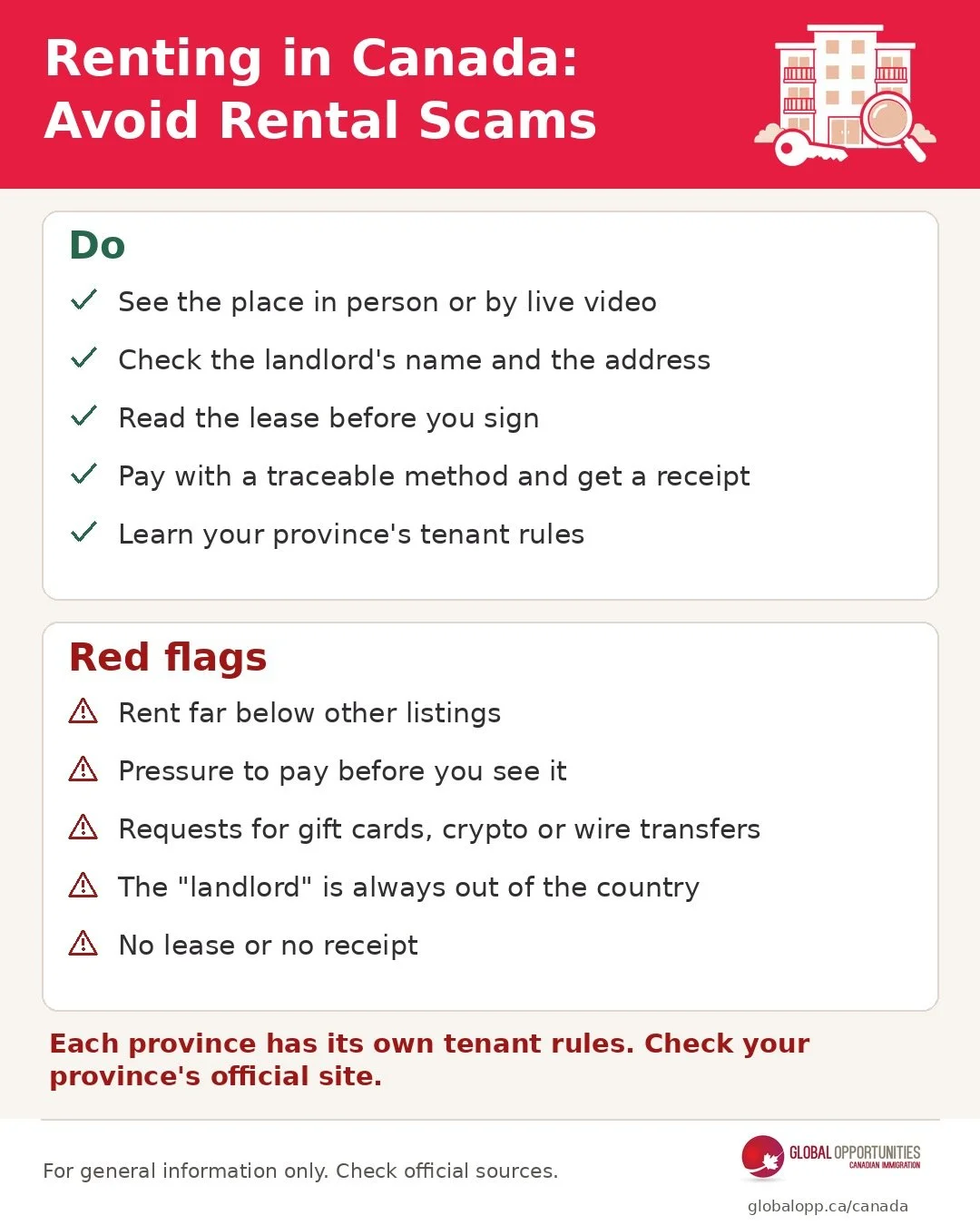
How to avoid rental scams
Rental scams usually ask for money before you have seen the place or met a real landlord. Five steps protect you:
See the place first, in person or by live video with someone you can verify, before you send any money.
Be suspicious of very low rents, landlords who say they are abroad and pressure to pay "today".
Search the photos online to see whether the listing was copied from another ad.
Ask for a written agreement and a receipt for every payment.
Never pay with gift cards or cryptocurrency.
Utilities: electricity, natural gas, water and internet
The Government of Alberta advises newcomers to check whether utilities are included before signing (Make Alberta your home). Alberta has a competitive electricity and natural gas market: according to the Government of Alberta's Utilities Consumer Advocate (UCA), customers without a contract are on the default electricity rate, the Rate of Last Resort, and can instead choose a fixed or floating plan from a retailer (UCA, Rate of Last Resort). The UCA explains how to compare retailers and helps with billing disputes. Heating bills rise in winter, so ask about typical costs. Water and garbage are usually billed by the city, and internet by several providers. Many leases also require tenant insurance.
Rents as published by CMHC (October 2025 survey) and tenancy rules as published by the Government of Alberta, as of November 2026. CMHC averages are not the rent you will be offered, and this summary does not replace the Residential Tenancies Act: check the linked pages before you rely on them.
Driving in Alberta: licences, insurance, car rental and parking
Many Albertans drive, especially outside downtown Calgary and Edmonton. Alberta uses graduated driver licensing (GDL), and licences, ID cards and vehicle registration are handled by private registry agents authorized by the province.
Registry agents: where you get a licence in Alberta
In Alberta you go to a registry agent, a private business authorized by the Government of Alberta, for driver's licences, ID cards, vehicle registration, knowledge tests and AHCIP registration. Find one with the official registry agent finder. Fees are charged per service, up to maximums set by the province; ask for the current price.
Alberta's graduated licensing: Class 7 and Class 5-GDL explained
According to the Government of Alberta's page Steps to getting a driver's licence, a new driver of a regular car goes through three stages, which take a minimum of 3 years.
Stage 1: Class 7 learner's licence. According to the Class 7 page:
Minimum age 14 (under 18 needs parental consent); you pass a knowledge test and a vision test at a registry agent, paying a fee each time.
You can drive a car only with a supervising driver over 18 with a full Class 5 licence, sitting in the front passenger seat.
No driving between midnight and 5:00 a.m., 0% blood alcohol, no more passengers than seat belts, and suspension at 8 demerit points.
You must hold the Class 7 for at least 12 months before the road test.
Stage 2: Class 5-GDL (probationary). You get it when you pass the road test, at a minimum age of 16. According to the Class 5 page, GDL drivers can drive alone, but must have zero alcohol and zero drugs, are suspended at 8 demerit points, cannot carry more passengers than seat belts, cannot be the accompanying driver for a learner and cannot upgrade to commercial classes.
Stage 3: full Class 5. According to the Government of Alberta's steps page and Class 5 page, you must be at least 18, complete 24 months of probationary driving (up to 6 months less with an approved driver training program) and have no suspensions and no demerits in the last 12 months. Since April 1, 2023, no advanced road test is required to exit GDL.
Exchanging a foreign driver's licence
According to the Government of Alberta's page on exchanging a licence from outside Alberta:
90 days. New residents must exchange their licence within 90 days of becoming residents, even if they travel during that period.
Exchange without tests. Valid licences from other provinces, the United States and a list of recognized countries can be exchanged without a knowledge or road test, usually for Class 5. When we checked in November 2026, the list included Australia, Japan, the Republic of Korea, Taiwan, New Zealand, Switzerland, Norway, Iceland, Ukraine, the United Kingdom, Ireland and most European Union countries, such as France, Germany, Italy, Spain and Portugal. Check the official list, because it changes.
Other countries, including most of Latin America: you pass a Class 7 knowledge test, then apply for a GDL Exemption so your driving history can be credited, and return after about 10 business days for the result. If approved, you take a road test; with 2 or more years of credited experience you get a full Class 5, otherwise a Class 5-GDL. Meanwhile, you drive under the Class 7 conditions.
Documents: your licences (they are surrendered), proof of Alberta residence and proof of legal status in Canada. Documents not in English need a translation from an Approved Document Translator.
Before you leave home, ask your licensing authority for an official driving record that shows how long you have been licensed.
Driving as a visitor, and the Alberta ID card
The same Government of Alberta page explains that visitors can drive in Alberta for up to one year on a valid licence from home, and that an International Driver's Permit is strongly recommended if your licence is not in English. Once you live in Alberta, the 90-day exchange rule applies instead. If you do not drive, get an Alberta photo ID card at a registry agent, available to residents aged 12 and over who are legally in Canada (Government of Alberta, ID card).
Car insurance in Alberta
According to the Government of Alberta's automobile insurance page, basic insurance (accident benefits and third-party liability) is required by law; collision and comprehensive are optional. Policies are sold by private insurers and brokers. The Automobile Insurance Rate Board (AIRB) regulates rates, and the province sets a maximum for basic coverage. Complaints go first to your insurer, then follow the province's insurance consumer complaints process.
According to the Government of Alberta, Care-First auto insurance takes effect on January 1, 2027. It stays privately delivered, so you still choose your insurer, and it offers medical, recovery and income replacement benefits to people injured in collisions regardless of fault (Care-First auto insurance).
Price depends on factors such as your driving experience and record, the vehicle and where you live. Newcomers often pay more at first, so bring a letter of experience in English from your previous insurer and compare several quotes.
Renting a car when you arrive
Each rental company sets its own rules on minimum age, accepted licences and payment. For example, Enterprise says its minimum rental age in Canada is 21, that renters aged 21 to 24 pay a young renter fee, and that you need a valid photo driver's licence and a valid debit or credit card (some locations require a credit card) (Enterprise Canada, renting under 25). Before you book with any company, check its own requirements page: ask whether it accepts your foreign licence, whether it also asks for an International Driver's Permit (which the Government of Alberta strongly recommends if your licence is not in English), what insurance is included and whether the car has winter tires. We mention private services for reference only and have no relationship with any of them.
Winter driving and winter tires
According to the Government of Alberta's winter driving page, winter tires grip better than all-season tires in cold, snow and ice. They are not required by law, but the province recommends four winter or all-weather tires for severe conditions (winter tires fact sheet). Carry an emergency kit (first aid kit, blanket, shovel, booster cables, sand, non-perishable food, flashlight, charged phone), stay back from snowplows, and check 511 Alberta before long trips.
Parking in Calgary and Edmonton
Calgary: Calgary Parking runs on-street parking, the MyParking app and residential permits. According to the City of Calgary, during a snow route parking ban you must move your car off snow routes, marked with blue signs with a white snowflake, for up to 72 hours (City of Calgary).
Edmonton: paid street parking is in EPark zones. The seasonal parking ban has Phase 1 for major roads and bus routes and Phase 2 for residential roads (City of Edmonton).
Cars left on the street during a ban can be ticketed and towed, so sign up for your city's alerts.
Licensing, exchange and insurance rules as published by the Government of Alberta, as of November 2026. Whether your foreign experience is credited is decided case by case under the GDL Exemption process; check the linked pages before you rely on them.
How do newcomers get health care in Alberta? AHCIP, family doctors and 811
Alberta's public health insurance plan is the Alberta Health Care Insurance Plan (AHCIP). It covers medically necessary services for eligible residents, and you show your Alberta health card when you use them. Apply as soon as you have an Alberta address.
New to how public health care works? Read the health care system in Canada.
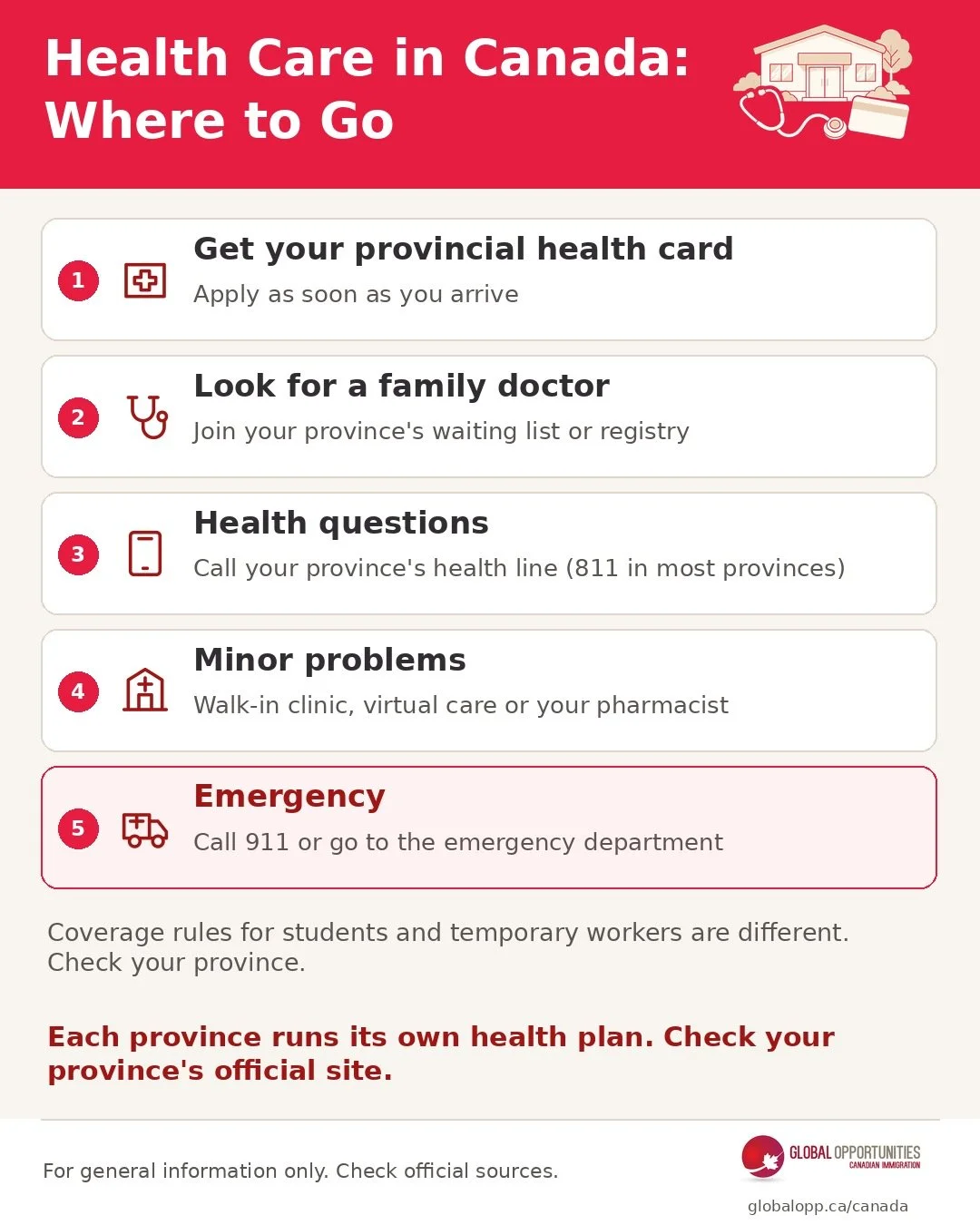
AHCIP eligibility: what the official page says
In general terms, the Government of Alberta's AHCIP eligibility page says you must be legally entitled to be in and remain in Canada and make your permanent home in Alberta, be committed to being physically present in Alberta for at least 183 days in any 12-month period, and not claim residency or benefits elsewhere. Tourists and visitors do not qualify.
AHCIP for temporary residents: workers and students
According to the Government of Alberta's page for temporary residents, some permit holders can register if they establish residency in Alberta and intend to live there for at least 12 consecutive months. Workers need a work permit for an Alberta employer with Alberta as the location, or an open work permit; students need a study permit for Alberta and a letter confirming full-time attendance at an Alberta institution. The page lists further conditions. Coverage ends on the expiry date of the document you submitted, so take any renewed permit to a registry agent. Many international students also have a school health plan.
When coverage starts
According to the Government of Alberta's page for people moving to Alberta:
If you arrive from outside Canada, you must apply within 3 months of establishing residency with all the required documents. If you do, you might be covered from the date you established residency; if you apply later, coverage starts when your application is processed.
If you move from another province or territory, coverage generally begins on the first day of the third month after you establish residency.
How to apply for AHCIP
According to the Government of Alberta (how to apply), the steps are:
Complete the AHCIP application form.
Gather original documents that show where you live in Alberta, who you are and your legal status in Canada (for example, a work or study permit or your permanent resident document).
Bring the form and documents to a registry agent. There is no charge.
Wait for your card, which is mailed to you.
If you are not yet covered, buy private health insurance before you arrive.
What AHCIP does not cover
According to the Government of Alberta, AHCIP does not cover, among other things, prescription drugs outside hospitals, routine dental care, routine eye exams for residents aged 19 to 64, and ambulance services except transfers between facilities (what AHCIP covers). Many people pay for these through workplace benefits. If you have none, the province's Non-Group Coverage, administered by Alberta Blue Cross for AHCIP-registered residents under 65 with a monthly premium, helps with prescription drugs, ambulance trips and some other services (Non-Group Coverage). Lower-income families can check the Alberta Child Health Benefit.
Finding a family doctor: Alberta Find a Provider
Alberta Find a Provider, from Primary Care Alberta with the Government of Alberta, shows clinics, family doctors and nurse practitioners who are taking patients near you. You can filter by the clinician's language (including Spanish and French) and gender, or share your information and ask for help. It also lists walk-in clinics and Primary Care Networks. Register with AHCIP first, call clinics near your home, and accept a nurse practitioner if one is available.
Walk-in clinics, pharmacies and emergencies
Walk-in clinics see patients without an appointment for problems that are not emergencies. Bring your health card.
Pharmacies are in supermarkets, drugstores and big-box stores. In Alberta, pharmacists can renew or adapt some prescriptions; ask what they can do for you (Alberta College of Pharmacy). Bring your medications and prescriptions from home, with their generic names.
Health Link 811: according to MyHealth.Alberta.ca, you can call 811 for health advice from registered nurses and other professionals, 24 hours a day (Health Link 811). Health information is also on MyHealth.Alberta.ca.
Emergencies: call 911 or go to the nearest emergency department. Remember that ambulance services are not fully covered by AHCIP.
Mental health: Health Link 811 can connect you with mental health and addiction services, and settlement agencies can help you find counselling in your language.
Eligibility, waiting periods and coverage as published by the Government of Alberta, as of November 2026. Holding a work or study permit does not by itself mean you qualify for AHCIP, and the province decides each registration; check the linked pages before you rely on them.
Banking in Alberta for newcomers
Opening a bank account is one of the first things to do in Alberta.
Banks and credit unions in Alberta
The national banks, such as RBC, TD, Scotiabank, BMO and CIBC, operate in Alberta; use each bank's branch locator to find branches near you and ask about newcomer packages.
ATB Financial: according to ATB, ATB Financial and its subsidiaries operate as Crown corporations of Alberta (ATB Financial, our business).
Credit unions: member-owned financial institutions. Servus Credit Union, headquartered in Edmonton, says it became Canada's largest credit union by total assets after its merger with connectFirst Credit Union on May 1, 2024, and that it has branches in communities throughout Alberta (Servus Credit Union). Other credit unions serve specific regions.
Online banks offer accounts without branches.
Compare monthly fees, transaction limits, the cost of international transfers and branch locations near your home or work. We mention financial institutions for reference only. Global Opportunities has no relationship with any of them and does not recommend any.
What you need to open an account
The Financial Consumer Agency of Canada explains what identification banks require and what to do if a bank refuses to open an account (FCAC, opening a bank account). Bring your passport and your immigration document; you do not need a job to open a basic account.
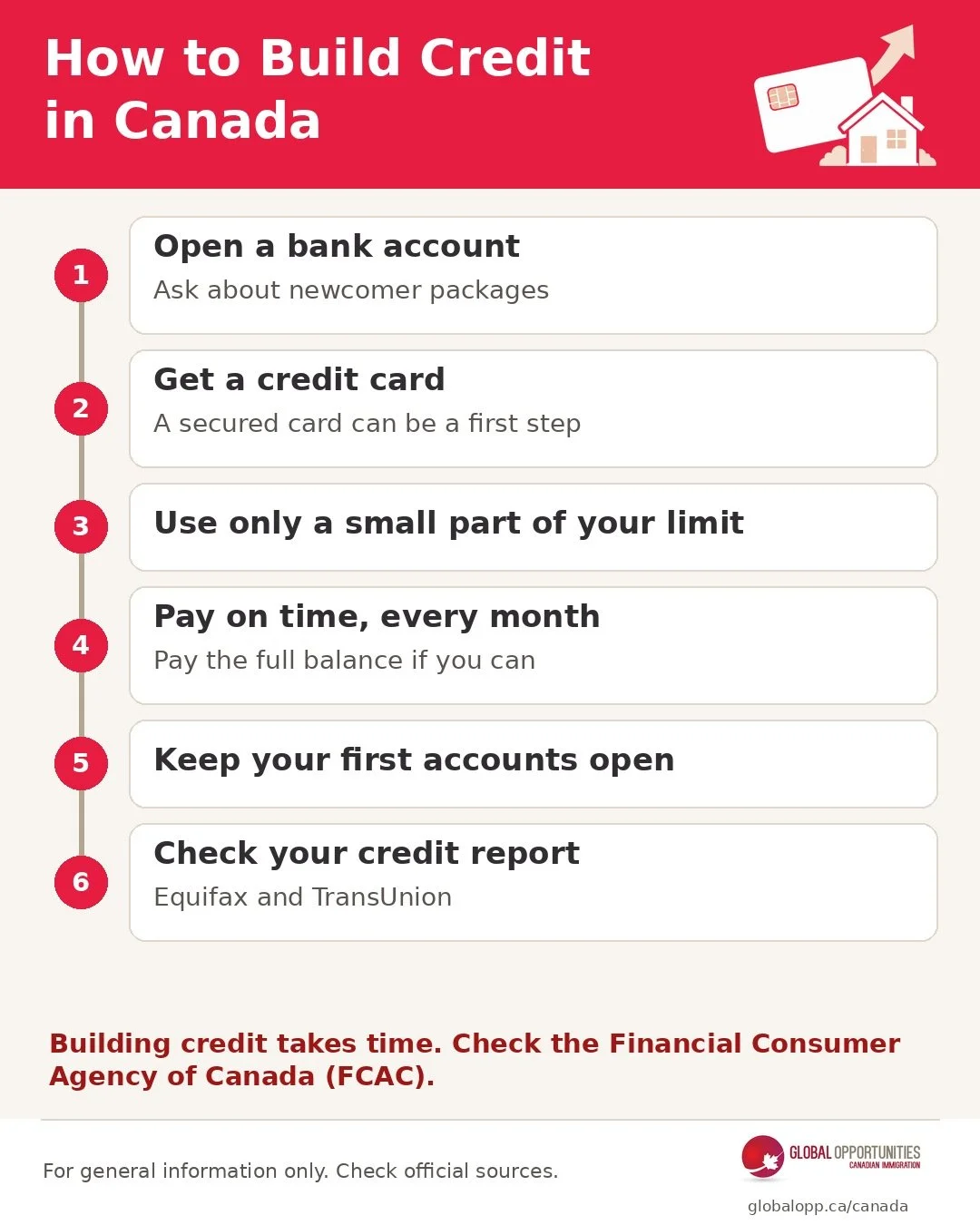
Building a credit history
Your credit history from abroad usually does not transfer to Canada. Many newcomers start with a credit card (sometimes a secured card backed by a deposit), use a small part of the limit and pay the full balance on time every month. Good credit helps when you rent, finance a car or apply for a mortgage.
Groceries, shopping and taxes in Alberta
Alberta has supermarkets for every budget, regional co-operatives and international grocery stores. And because Alberta has no provincial sales tax, the tax at the till is lower than in most provinces.
Sales tax: only the 5% GST
According to the Canada Revenue Agency, Alberta has the 5% federal GST and no provincial sales tax (CRA, GST/HST rates). Most basic groceries are zero-rated for GST, while prepared food, restaurant meals and most other goods are taxed. Shelf prices are shown before tax. Low- and modest-income residents may receive the federal Canada Groceries and Essentials Benefit, which the CRA says was the GST/HST credit until it was renamed in July 2026, after filing a Canadian tax return (CRA). See our section on taxes and benefits.
Supermarkets and other stores
Discount supermarkets and big-box stores are usually the lowest-cost option for groceries and household goods.
Warehouse clubs sell in bulk and require a paid membership.
Full-service supermarkets offer more variety, a pharmacy and prepared food.
Co-operatives: for example, Calgary Co-op describes itself as a member-owned retail co-operative with stores in Calgary, Airdrie, Cochrane, High River, Okotoks and Strathmore (Calgary Co-op, about us).
Asian, South Asian, Middle Eastern, African, Latin American and other international grocery stores sell products from home; many supermarkets also have an international aisle.
Dollar stores sell basic household items.
Chains change their locations, so use each store's own store locator to check what is near your home. We mention stores for reference only. Global Opportunities has no relationship with any of them.
Save money by comparing weekly flyers, buying store brands, asking about price matching and joining free loyalty programs. If money is tight, food banks in Calgary, Edmonton and other cities can help; 211 Alberta can refer you.
Furnishing your home on a budget
Most rentals are unfurnished, though many include a fridge and stove. Newcomers often furnish their first home with second-hand items from online marketplaces, thrift stores and community furniture banks, or new items from furniture and big-box stores. When you buy second-hand, meet in a public place and inspect the item before you pay.
Sales tax rules and benefits as published by the Canada Revenue Agency, as of November 2026. They may have changed by the time you read this: check the linked pages before you rely on them.
How cold is Alberta, and how do you prepare for winter?
Alberta has a dry continental climate, with long, cold winters, warm summers and many sunny days. Edmonton and the north are colder than Calgary and the south, and southern Alberta has chinooks that bring sudden warm spells in winter.
The seasons in Alberta
Winter (usually November to March): cold, dry and often sunny, with snow that can stay on the ground for weeks and cold snaps that last several days. Days are short in December and January.
Spring (April and May): short and changeable; a warm day can be followed by a snowstorm.
Summer (June to August): warm and sunny, with very long days. Thunderstorms and hail can be strong, and in some summers wildfire smoke affects air quality.
Fall (September and October): short, bright and cool, with the first snow sometimes in September or October.
Winter temperatures in Alberta's cities
According to Environment and Climate Change Canada's climate normals for 1981–2010, the average daily temperature in January was:
Lethbridge (airport): -6.0°C
Calgary (airport): -7.1°C
Edmonton (City Centre): -10.4°C
Fort McMurray (airport): -17.4°C
In July, the average daily temperature was 16.5°C at the Calgary airport and 17.7°C at Edmonton City Centre. Some winter days are much colder, and wind chill makes it feel colder still. Look up any city on the ECCC climate normals site, and check forecasts and alerts on weather.gc.ca. The dry air also means many people use moisturizer and a humidifier at home.
What is a chinook?
A chinook is a warm, dry wind that blows down the eastern slopes of the Rocky Mountains into southern Alberta. According to Parks Canada, chinooks can take winter temperatures from well below freezing to above 10°C within hours, with winds that can exceed 120 km/h, and they are often announced by a chinook arch, a long, curved band of cloud parallel to the mountains. (Parks Canada, Waterton Lakes climate). Calgary, Lethbridge and the foothills get chinooks most often; Edmonton and the north much less. When the cold returns, melted snow can turn into ice on roads and sidewalks.
What to buy for your first winter, and where
A warm winter coat with a hood, and insulated, waterproof boots with good grip.
Layers: thermal underwear, fleece or wool sweaters and wool socks.
A toque that covers your ears, a scarf or neck warmer, and insulated gloves or mittens.
For the car and home: winter tires, a snow brush, an ice scraper, an emergency kit, a snow shovel and ice melt.
You can find these at clothing, outdoor and big-box stores, or second-hand at thrift stores and online marketplaces. Buy the basics when you arrive and add the rest once you know how cold your commute is.
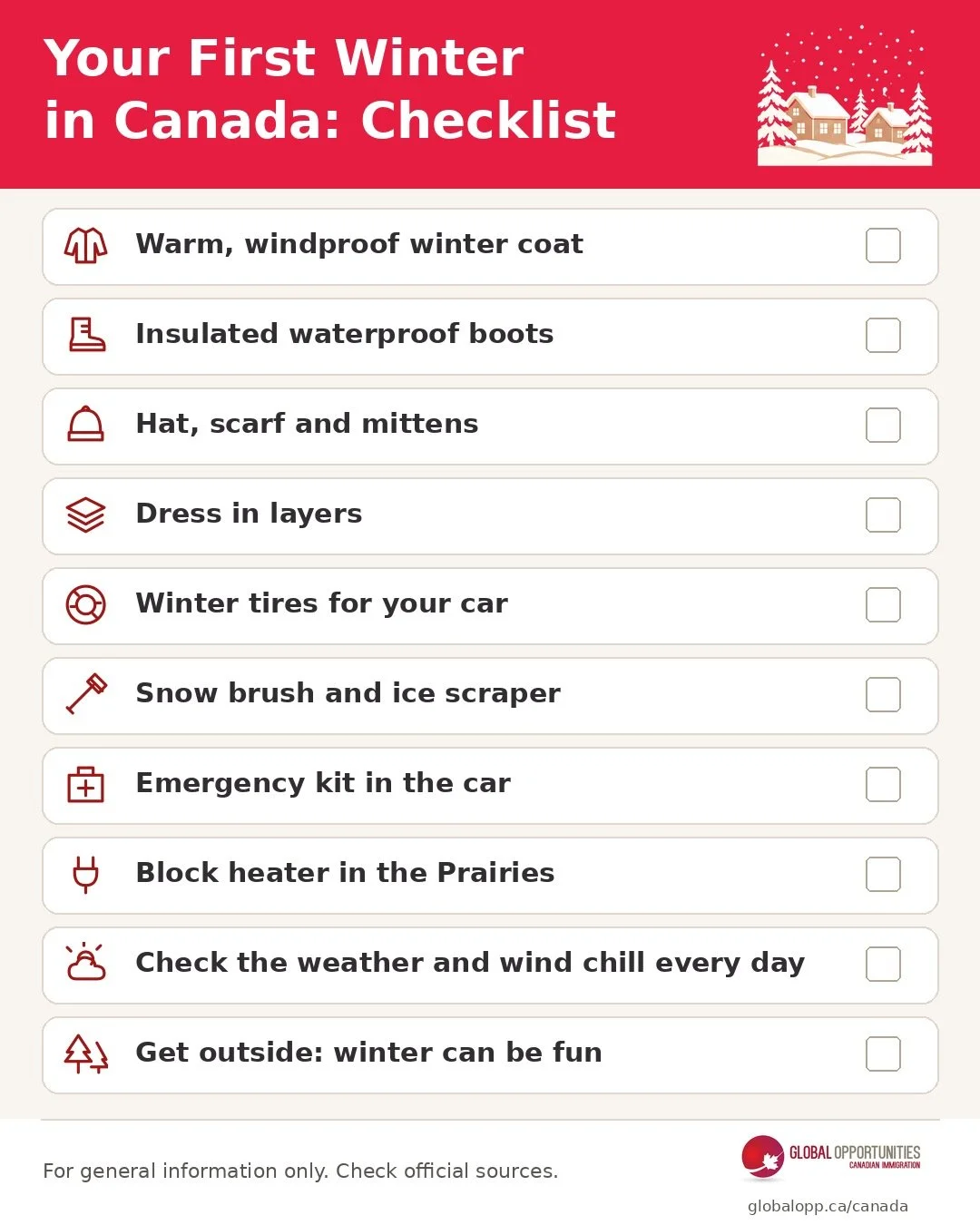
First-winter checklist
Buy your coat, boots and accessories before the first snow, and check the forecast every morning.
Ask your landlord who must clear the sidewalk after a snowfall.
If you drive, put on winter tires and keep an emergency kit in the car.
Plan for colder waits at bus stops and use trip planners with real-time arrivals.
Stay active: winter festivals, skating rinks, ski trails and recreation centres help with the short days.
Wildfire smoke, hail and Alberta Emergency Alert
Summer can bring thunderstorms, hail and wildfire smoke. Wildfire season, evacuation alerts, air quality and the Alberta Emergency Alert system are explained in the section "Emergencies and natural hazards in Alberta" near the top of this guide. Ask your insurer what your tenant or home policy covers for hail, smoke and evacuations.
Temperatures are long-term averages published by Environment and Climate Change Canada, not a forecast; any given winter can be colder or milder. Check weather.gc.ca and the linked Government of Alberta pages for current conditions and alerts.
Education in Alberta: schools, colleges and universities
Alberta has publicly funded schools in English and French, a network of public universities, polytechnics and colleges, and free English classes for many newcomers.
Public schools for children
According to the Government of Alberta, educational options include public and separate (Catholic) schools, francophone schools, charter schools, independent schools, home education and online learning (Alberta's K–12 education system). The Government of Alberta also states that publicly funded education for children aged 5 to 19 is free (Make Alberta your home).
In most cities you can choose a public or a Catholic (separate) board. In Calgary these are the Calgary Board of Education and the Calgary Catholic School District; in Edmonton, Edmonton Public Schools and Edmonton Catholic Schools. French immersion and francophone schools are other options (see the French section).
How to register your child in school
Find the school board and designated school for your address, then contact the school or the board's newcomer reception centre. Bring your child's passport and immigration document, proof of your Alberta address, previous school records (translated if possible) and immunization records, and ask about English language support, school buses and before- and after-school care. Families with temporary status should ask about the rules for their situation, because some may be asked to pay fees.
Child care
Child care includes licensed daycare centres, family day homes and out-of-school care; join waiting lists early. The Government of Alberta's Child Care Subsidy Program helps eligible families with the cost of out-of-school care for children in kindergarten to grade 6. Eligibility includes citizens, permanent residents, temporary residents with a valid work permit and refugee claimants, depending on income and other conditions (Government of Alberta, Child Care Subsidy Program).
Alberta's public post-secondary institutions
The Government of Alberta groups its publicly funded post-secondary institutions into categories (types of public post-secondary institutions). According to that page, research universities award undergraduate and graduate degrees, polytechnics focus on industry and career training including apprenticeship, and community colleges offer upgrading, certificates, diplomas, some degrees and English as an additional language. Here is each one, with its campuses and main program areas as described on its own website when we checked in November 2026.
Comprehensive academic and research universities
University of Alberta (Edmonton). Campuses in Edmonton, including North Campus, the francophone Campus Saint-Jean, South Campus and Enterprise Square downtown, plus Augustana Campus in Camrose. Faculties include engineering, medicine and dentistry, nursing, pharmacy, agricultural, life and environmental sciences, science, arts, business, education, law and Native studies, and graduate studies (University of Alberta, our campuses).
University of Calgary (Calgary). Main, Downtown, Foothills and Spy Hill campuses in Calgary. Faculties include engineering, medicine, business (Haskayne), law, nursing, veterinary medicine, arts, science, kinesiology, social work, education and graduate studies; co-op is offered in some faculties and internships in engineering (University of Calgary, about; University of Calgary, co-op and internships).
University of Lethbridge (Lethbridge). Campuses in Lethbridge and downtown Calgary. Faculties include arts and science, business, education, fine arts, health sciences, liberal education and graduate studies (University of Lethbridge, academics).
Athabasca University (Athabasca; online). An online university with faculties of business, health disciplines, humanities and social sciences, science and technology, and graduate studies (Athabasca University, faculties).
Undergraduate universities
MacEwan University (Edmonton). In central Edmonton, with faculties of arts and science, fine arts and communications, health and community studies (including social work) and nursing, plus a business school and continuing education (MacEwan University, faculties and schools; MacEwan University, about).
Mount Royal University (Calgary). In southwest Calgary, with arts, business, communication studies, health, community and education (including nursing and midwifery), science and technology, and a conservatory (Mount Royal University, faculties and schools).
Alberta University of the Arts (Calgary). An art and design university with fine arts, design and creative industries degrees (Alberta University of the Arts, undergraduate).
Polytechnic institutions
SAIT (Southern Alberta Institute of Technology, Calgary). Main campus in northwest Calgary, plus SAIT Downtown and other sites. Schools include advanced digital technology, business, construction, energy, health and public safety, hospitality and tourism, manufacturing and automation, and transportation, plus apprenticeship and trades (SAIT, programs and courses; SAIT, campus map).
NAIT (Northern Alberta Institute of Technology, Edmonton). Campuses in Edmonton and Spruce Grove. Schools include business (with culinary arts), construction and building sciences, energy and natural resources, health and life sciences, manufacturing and automation, media and information technology, and transportation, plus apprenticeship (NAIT, programs; NAIT, our campuses).
Red Deer Polytechnic (Red Deer). Schools of business, arts and education, health and wellness, and trades and technology (Red Deer Polytechnic, programs).
Lethbridge Polytechnic (Lethbridge). Programs in agriculture, environmental science, justice and human services, health and wellness, trades and apprenticeships, technology and engineering, business, culinary, and media and design (Lethbridge Polytechnic, programs).
Northwestern Polytechnic (Grande Prairie). Programs in skilled trades and apprenticeships, health, business, engineering, information technology, science, education, social work, degrees and university transfer (Northwestern Polytechnic, programs; Northwestern Polytechnic, our campuses).
Comprehensive community colleges
Bow Valley College (Calgary). Downtown Calgary campus. Programs in health and wellness, community studies (including early childhood education), business, technology, arts and sciences, English language learning and academic upgrading (Bow Valley College, program list).
NorQuest College (Edmonton). Campuses in Edmonton and Wetaskiwin; check its programs on its website (NorQuest College, campuses and maps).
Medicine Hat College (Medicine Hat). Campuses in Medicine Hat and Brooks. Programs in health and community services, business, technology and science, trades, university transfer and academic upgrading (Medicine Hat College, programs).
Keyano College (Fort McMurray). Main campus and an industrial campus in Fort McMurray. Programs in trades and heavy industrial, health and social services, business and computing, arts, sciences and environment, education and early learning, and academic upgrading (Keyano College).
Lakeland College (Vermilion and Lloydminster). Programs in agricultural sciences, environmental sciences, trades and technology, health and wellness, business, fire and emergency services, energy, human services and university transfer (Lakeland College, programs).
Olds College of Agriculture & Technology (Olds). Programs in agriculture, agriculture technology, horticulture, land and environment, animal health, business and trades (Olds College, programs).
Portage College (Lac La Biche and other campuses). Campuses in Lac La Biche, St. Paul, Cold Lake, Boyle and First Nations communities in northeast Alberta. Programs in health and wellness, trades and technology, business, culinary arts, arts, environmental studies and academic upgrading (Portage College, campus locations).
Northern Lakes College (Slave Lake, High Prairie and other communities). Campuses in many northern communities, with face-to-face, blended and distance learning. Programs in health careers, apprenticeship trades, business, human services, university studies and academic upgrading (Northern Lakes College).
Independent academic institutions and the Banff Centre
Ambrose University (Calgary). A faith-based university in southwest Calgary with arts and science, theology, business and education (Ambrose University).
St. Mary's University (Calgary). A Catholic university in southeast Calgary with arts, sciences and education (St. Mary's University).
Concordia University of Edmonton (Edmonton). Faculties of arts, science, management, education and graduate studies (Concordia University of Edmonton).
The King's University (Edmonton). Undergraduate programs in areas such as theology, music, commerce, computing science, education and kinesiology (The King's University, programs).
Burman University (Lacombe). A Seventh-day Adventist university with arts, science, nursing, business, education and music (Burman University, about).
MaKami College (Edmonton and Calgary). Listed by the Government of Alberta among its independent academic institutions, with certificate and diploma programs in areas such as health care aide, early childhood education, medical office assistant and business administration (MaKami College, campuses).
Banff Centre for Arts and Creativity (Banff). Residencies and programs in visual, literary, digital and Indigenous arts, music, dance, opera and theatre, and leadership (Banff Centre).
This list is for reference only. It follows the Government of Alberta's list when we checked it in November 2026. Institutions change their programs, campuses and admission requirements; always confirm on the institution's official website. Alberta also has private career colleges licensed by the province; check their status before you pay.
How to apply to colleges and universities in Alberta
ApplyAlberta. According to its website, ApplyAlberta is an online application and transcript transfer system, owned and operated by the not-for-profit Alberta Post-Secondary Application System (APAS), that you can use to apply to undergraduate programs at Alberta's publicly funded post-secondary institutions (ApplyAlberta).
Directly with the institution. Many programs, especially for international and graduate students, use the institution's own portal. Check each school's deadlines, fees and English requirements.
Credential assessment. The Government of Alberta's International Qualifications Assessment Service (IQAS) compares foreign credentials with Canadian standards (IQAS).
International students: DLI and PAL
According to IRCC, you need a letter of acceptance from a designated learning institution (DLI) to apply for a study permit, so check that your school is on the official DLI list. IRCC also explains that most study permit applicants need a provincial or territorial attestation letter (PAL/TAL), so ask your Alberta institution how to obtain it after you are accepted (IRCC, provincial attestation letter). Study and post-study work rules change often: check IRCC's study in Canada page before you apply.
Free English classes for newcomers
LINC classes (federal). According to IRCC, permanent residents and protected persons can take language classes at no cost through Language Instruction for Newcomers to Canada (IRCC, language classes).
Provincially funded settlement services. The Government of Alberta funds organizations that offer settlement services and language training. Settlement services are also free to temporary residents with a work permit and refugee claimants (Make Alberta your home).
Language assessment. For an official Canadian Language Benchmarks assessment, the Government of Alberta lists the Language Assessment, Referral and Counselling Centre (LARCC) in northern Alberta and Gateway in southern Alberta, and says these services are free to permanent residents and citizens of Canada (Make Alberta your home).
If you need an English or French test for immigration or studies, see our guide to English and French tests for Canada.
School, child care and study permit rules as published by the Government of Alberta, the institutions and IRCC, as of November 2026. An acceptance letter or a PAL does not mean a study permit will be approved; IRCC decides each case. Check the linked pages before you rely on them.
Jobs and main industries in Alberta
Alberta's economy is built around energy, but it also relies on agriculture, construction, health care, logistics, technology and tourism. According to the Government of Alberta, Alberta's GDP per capita in 2025 was the highest among Canada's provinces (Alberta Economic Dashboard, GDP). Global Opportunities does not offer jobs, and no one can promise you a job in Canada.
Alberta's main industries
Energy: according to IRCC, Alberta is the largest producer of oil and gas in Canada (see the at-a-glance section).
Agriculture and food: grain, canola, cattle and food processing, especially in the south and centre. IRCC notes that Alberta's vast cattle ranches help make Canada one of the world's major beef producers.
Construction and skilled trades, for industrial, housing and infrastructure projects.
Health care and social services, in every city.
Transportation and logistics, around the Calgary and Edmonton airports and the highway corridor between them.
Technology and professional services, mostly in Calgary and Edmonton.
Tourism and hospitality, in the Rockies, the national parks and the cities.
When energy prices are high, investment and hiring tend to grow; when they fall, projects can slow down. If your occupation is tied to energy, research the current market before you move. The Government of Alberta publishes current indicators, including unemployment, on the Alberta Economic Dashboard.
Where to look for work
Job Bank: the Government of Canada's job board, with employment outlooks for Alberta by occupation (rated from "very limited" to "very good"; they are not job offers) and a wage search by region.
alis: the Government of Alberta's career, learning and employment website, with occupation profiles, certification requirements, resume advice and a guide for newcomers on how to find work in Alberta.
Alberta Supports: a single point of contact for provincial employment, training, income and family support programs.
Employers directly: the Government of Alberta, the City of Calgary, the City of Edmonton, health care organizations, school authorities and post-secondary institutions post openings on their own sites.
Settlement agencies: many run free employment programs for newcomers, with resume help, mock interviews and mentoring.
Resume tips: use a concise Canadian-style resume (no photo, age or marital status), adapt it to each posting, network through volunteering and professional associations, and look beyond Calgary and Edmonton. Our newcomer guide to Canada has resume examples. Before you apply, read our guide to Canadian resumes, cover letters and job interviews.
Minimum wage and employment standards
According to the Government of Alberta's minimum wage page, as listed in November 2026, the general minimum wage is $15 per hour and applies to most employees. Students under 18 can be paid $13 per hour (the job creation student wage) for the first 28 hours worked in a week while school is in session; hours beyond 28 in that week must be paid at the general rate. Minimum wage is the lowest pay allowed by law, not a typical wage for your occupation. Check the current rate on the official page. Rights on hours, overtime, vacation, holidays and termination are on the employment standards page, and they apply to temporary foreign workers too. Be wary of anyone who asks you to pay for a job.
Minimum wage as published by the Government of Alberta, as of November 2026. It is the legal minimum, not the pay you should expect in your occupation, and it may have changed by the time you read this: check the linked page before you rely on it.
Regulated professions and trades
According to alis, regulated occupations "have legal requirements or restrictions with regard to licensing, certification or registration" (alis, certification FAQs). If your occupation is regulated, you will likely need to apply to the regulatory body before you can work in it or use a protected title.
Check your occupation in the alis certification requirements search.
Trades: apprenticeship and certification are managed by Apprenticeship and Industry Training on Tradesecrets. According to alis, a Red Seal lets qualified tradespersons work in any province or territory where the trade is regulated, without further exams.
Examples of regulators: the Government of Alberta's page on regulated health professions, APEGA for engineers and geoscientists, and the College of Registered Nurses of Alberta.
Education assessment: IQAS issues certificates that compare foreign credentials with Canadian standards (IQAS).
Fair registration: the Fairness for Newcomers Office works with regulatory bodies to streamline the assessment of qualifications; it does not handle individual applications.
Nurses trained abroad can read how to immigrate to Canada as a nurse, which lists the nursing regulator in each province.
Any mention of regulated occupations or regulators in this guide is for reference only. It may not be complete. Always confirm requirements directly with the regulator for your profession or trade.
Free newcomer services in Alberta
Settlement agencies funded by the Government of Canada and the Government of Alberta offer free orientation, English classes, employment programs and help with forms. Use them early.
How to find a settlement agency
IRCC's newcomer services finder: search by postal code for free services near you (IRCC, find free newcomer services).
AAISA: the Alberta Association of Immigrant Serving Agencies has a locator for settlement and language supports across Alberta.
211 Alberta: call 211, or search ab.211.ca, for community, social and government services, such as food banks, housing help and counselling.
Examples of settlement agencies
Calgary: Calgary Catholic Immigration Society (CCIS), Immigrant Services Calgary and the Centre for Newcomers.
Edmonton: the Edmonton Immigrant Services Association (EISA) and other agencies listed by AAISA.
Lethbridge: Lethbridge Family Services offers immigrant services among its programs.
Other cities: Red Deer, Medicine Hat, Brooks, Grande Prairie, Fort McMurray and other communities have their own agencies; use the IRCC finder or AAISA.
In French: FRAP in central and northern Alberta and CANAF in southern Alberta (see the French section).
This list is for reference only and is not complete. Global Opportunities has no relationship with these organizations. Services and eligibility vary; contact each organization to confirm.
Pre-arrival services
If you have been approved for permanent residence, IRCC funds free pre-arrival services to help you plan your job search and settlement before you land.
How much does it cost to live in Alberta?
Alberta is often described as more affordable than British Columbia or the Toronto area, mainly because of the absence of provincial sales tax and lower rents in many cities. Costs still vary a lot by city, and winter heating and car costs add up. Check the current price on each source.
Housing: according to CMHC, the average two-bedroom private apartment rent in October 2025 was $1,914 in the Calgary area, $1,603 in the Edmonton area, $1,414 in Red Deer, $1,258 in Medicine Hat and $2,442 in Canmore (CMHC). Add utilities and tenant insurance.
Transit: as of November 2026, an adult monthly pass costs $126.00 in Calgary (Calgary Transit), and the adult monthly fare cap is $102 in Edmonton (ETS).
A car: budget for the payment, insurance (often high for newcomers at first), fuel, winter tires, maintenance and parking.
Taxes: according to the Canada Revenue Agency, no provincial sales tax, only the 5% GST; you still pay federal and provincial income tax, and homeowners pay municipal property tax.
Your first winter: a one-time cost for a coat, boots and, if you drive, winter tires.
For a national overview, see our article on the cost of living in Canada.
Figures as published by CMHC, Calgary Transit, ETS and the Canada Revenue Agency, as of November 2026. They may have changed by the time you read this: check the linked pages before you rely on them.
How much tax do you pay in Alberta, and which benefits can you get?
Alberta has no provincial sales tax, but you still pay federal and Alberta income tax on what you earn. Families and people with low or modest incomes can also receive tax-free federal and Alberta benefits, and almost all of them depend on one thing: filing a tax return every year, even if you had little or no income.
The figures below come from the official pages as of November 2026. Tax rules and amounts change every year, so check the current rate before you budget. This section is general information, not tax advice. For your own situation, contact the Canada Revenue Agency (CRA) or a tax professional.
How much income tax do you pay in Alberta?
Canada's income tax is progressive. According to the CRA, provincial rates apply in addition to federal rates, each rate applies only to the portion of your taxable income that falls within its bracket, and your provincial rate depends on the province where you live on December 31 (CRA, tax rates and income brackets for the current year). For the 2026 tax year, the CRA lists:
Federal rates: 14% on the first $58,523 of taxable income; 20.5% on the portion from $58,523 to $117,045; 26% from $117,045 to $181,440; 29% from $181,440 to $258,482; and 33% above $258,482.
Alberta rates: 8% on the first $61,200; 10% from $61,200 to $154,259; 12% from $154,259 to $185,111; 13% from $185,111 to $246,813; 14% from $246,813 to $370,220; and 15% above $370,220.
According to the Government of Alberta, the 8% bracket was introduced on January 1, 2025, and Alberta has the highest basic personal and spousal amounts among the provinces, which means you can earn more before you start paying provincial income tax (Government of Alberta, personal income tax). For example, with a taxable income of $60,000, the federal 14% rate applies to the first $58,523 and the 20.5% rate only to the remaining $1,477, while the whole amount falls in Alberta's 8% bracket. Deductions and tax credits then change the amount you actually owe.
Filing your return. If you have a modest income and a simple tax situation, the CRA's Community Volunteer Income Tax Program lists free tax clinics where volunteers complete returns (CRA, free tax clinics), and the Government of Alberta also notes that free tax clinics are available for eligible lower-income Albertans.
Sales tax in Alberta: GST only
According to the CRA, purchases in Alberta carry the 5% federal GST and no provincial sales tax (CRA, GST/HST calculator and rates). The CRA lists basic groceries such as milk, bread and vegetables, and prescription drugs, as zero-rated, so no GST is charged on them (CRA, type of supply).
The Canada Groceries and Essentials Benefit. According to the CRA, the federal GST/HST credit was renamed the Canada Groceries and Essentials Benefit (CGEB) as of July 2026, with the same eligibility, calculation and structure. It is a tax-free quarterly payment for individuals and families with low and modest incomes. You are considered automatically when you file your taxes, and the CRA page explains how to apply if you are a new resident of Canada (CRA, Canada Groceries and Essentials Benefit).
The Canada Child Benefit and the Alberta Child and Family Benefit
The Canada Child Benefit (CCB) is a tax-free monthly payment for eligible families to help with the cost of raising children under 18 (CRA, Canada Child Benefit). According to the CRA's eligibility page, you must live with the child, be primarily responsible for the child's care and upbringing, and be a resident of Canada for tax purposes. You or your spouse or common-law partner must be a Canadian citizen, a permanent resident, a protected person, or a temporary resident who has lived in Canada for the previous 18 months and has a valid permit in the 19th month, among other cases listed on the page (CRA, who can apply). Newcomers apply with Form RC66 and Schedule RC66SCH, Status in Canada/Statement of Income (CRA, how to apply).
The Alberta Child and Family Benefit (ACFB) gives direct, non-taxable financial help to lower- and middle-income families with children under 18. According to the Government of Alberta, you must be a parent of one or more children under 18, be a resident of Alberta, file a tax return and meet the income criteria. You are considered automatically when you file your annual tax return and qualify for the Canada Child Benefit; no further action is needed. The CRA pays it in four instalments, in August, November, February and May, and it has a base component for lower-income families and a working component (Government of Alberta, Alberta Child and Family Benefit).
Affordable child care in Alberta: fees and subsidies
Alberta takes part in the Canada-wide Early Learning and Child Care system, through which funding goes directly to licensed child care providers to lower fees for children up to kindergarten age. According to the Government of Alberta, out-of-pocket parent fees for licensed spaces for these children went from an average of $44 per day in 2021 to a flat $15 per day as of April 1, 2025 (Government of Alberta, federal-provincial child care agreement).
School-age children. The Child Care Subsidy Program helps eligible families with children in full-time kindergarten to grade 6 who attend licensed programs outside regular school hours. Subsidy rates depend on family income, the type of program and the hours of care, and you apply or renew through Child Care Subsidy Online Services (Government of Alberta, Child Care Subsidy Program).
Spaces are limited. Alberta is still adding licensed spaces under the agreement, so contact programs near your home and join waiting lists early.
Figures as published by the Canada Revenue Agency and the Government of Alberta, as of November 2026. Tax rates, brackets and benefit rules change every year, and eligibility for a benefit depends on your own status and income: check the linked pages before you rely on them.
Culture, community and the outdoors in Alberta
Alberta mixes ranch and rodeo traditions, city festivals, Indigenous history, a growing mix of immigrant communities and some of Canada's most famous mountain scenery.
In the cities
Calgary: the Calgary Stampede every July (July 9 to 18 in 2027, according to its official website), and professional teams such as the Calgary Flames (NHL) and the Calgary Stampeders (CFL).
Edmonton: Explore Edmonton describes the Edmonton International Fringe Theatre Festival, held in Old Strathcona, and the Edmonton Folk Music Festival among the city's summer festivals (Explore Edmonton, festival city; Edmonton Fringe). Professional teams include the Edmonton Oilers (NHL), who play at Rogers Place, and the Edmonton Elks (CFL).
Recreation centres with pools, gyms and rinks are run by many municipalities; ask your city about low-income programs.
For more ideas, see the official tourism site Travel Alberta.
Parks and nature
The Canadian Rocky Mountain Parks. Banff and Jasper national parks are part of this UNESCO World Heritage Site (Parks Canada). Jasper is north of Banff.
Waterton Lakes and Elk Island. Waterton Lakes National Park is in the southwest corner of the province, and Elk Island National Park is a short drive east of Edmonton. National parks require a park pass; check Parks Canada for current fees.
Dinosaur Provincial Park. In the badlands of southeastern Alberta, it is a UNESCO World Heritage Site known for its fossils (Parks Canada, World Heritage sites).
Provincial parks. Find campgrounds, lakes and trails on the official Alberta Parks website.
Alberta has bears and sudden mountain weather: learn the wildlife rules and tell someone your plans before a hike.
Community
Calgary and Edmonton have communities from many countries. Settlement agencies, libraries, community associations and volunteering are good ways to meet people, including people from your own country. Learning about the First Nations and Métis communities and the treaties of the area where you live is also part of settling in.
Settling in is also about people: read our article on building community in Canada.
How can you immigrate to Alberta?
There is no single "Alberta visa". People move to Alberta through federal immigration programs run by IRCC, through the Alberta Advantage Immigration Program (AAIP), or with a temporary permit to study or work. Programs, streams, requirements and fees change frequently, so always check the official pages linked below. If you plan to visit first, use IRCC's official tool to check if you need a visa or an eTA.
Express Entry
According to IRCC, Express Entry is an online system used to manage immigration applications from skilled workers. It manages three programs: the Federal Skilled Worker Program, the Federal Skilled Trades Program and the Canadian Experience Class (IRCC, Express Entry). Draws and requirements change; check the official page. You can also read our page on the Federal Skilled Worker program.
The Alberta Advantage Immigration Program (AAIP)
According to the Government of Alberta, the AAIP is "an economic immigration program that nominates people for permanent residence in Alberta". The governments of Alberta and Canada run it together: the province nominates, and the Government of Canada, through IRCC, makes the final decision on permanent residence (Government of Alberta, AAIP).
When we reviewed the official page in November 2026, the AAIP had worker streams, for people who live and work in Alberta or plan to, and entrepreneur streams, for people who plan to start or buy a business in Alberta. Changes are listed on the AAIP updates page. See also IRCC's provincial nominee program page. AAIP streams and requirements change often. Always check the official AAIP pages, and be wary of anyone who promises a nomination, permanent residence or a job.
For a general overview of how these programs work across Canada, see our page on provincial nominee programs.
Studying and working in Alberta
For study permits, see the education section above. IRCC describes two main types of work permits: employer-specific work permits and open work permits (IRCC, work in Canada). Some employer-specific permits require the employer to obtain a Labour Market Impact Assessment; see our page on the LMIA. If you are a young person from a participating country, read our page on International Experience Canada (Working Holiday) and confirm the current rules on the official IRCC website.
If your permit ends within a year, watch Is your work permit or PGWP expiring in the next 12 months?
Already working in the province? Watch why being eligible for permanent residence is not the same as being selected.
After permanent residence, many people apply for citizenship: see our guide to Canadian citizenship.
Program descriptions as published by IRCC and the Government of Alberta, as of November 2026. Which pathway fits you, and what it requires, depends on each case; meeting a program's requirements does not mean an application will be approved, because the province decides on AAIP nominations and IRCC decides each application for permanent residence or a permit. For your own situation, book a consultation.
French in Alberta
English is the language of daily life and work in Alberta, but the province has a long-established francophone community. According to the Government of Alberta, French is the most widely spoken language in Alberta after English (Government of Alberta, Francophone Secretariat).
French-language services and community
Settlement services in French. According to the Government of Alberta, it funds organizations that serve francophone newcomers: FRAP in central and northern Alberta and CANAF in southern Alberta (Make Alberta your home).
Community. The Association canadienne-française de l'Alberta (ACFA) speaks for the province's francophone community.
French-language schools and French immersion
According to the Government of Alberta, francophone education is delivered by four francophone regional authorities: the Conseil scolaire du Nord-Ouest, Conseil scolaire Centre-Nord, Conseil scolaire Centre-Est and Conseil scolaire FrancoSud. Canadian citizens who qualify under section 23 of the Charter can enrol their children. French immersion, where French is taught as a second language, is a different program offered by many English-language school boards (Government of Alberta, francophone education). The University of Alberta's Campus Saint-Jean offers post-secondary programs in French.
If French is one of your strengths, read our page on French language proficiency. Global Opportunities does not offer services for Quebec's immigration programs; this guide covers Alberta only.
First steps after arriving in Alberta
Doing these tasks early makes everything else simpler.
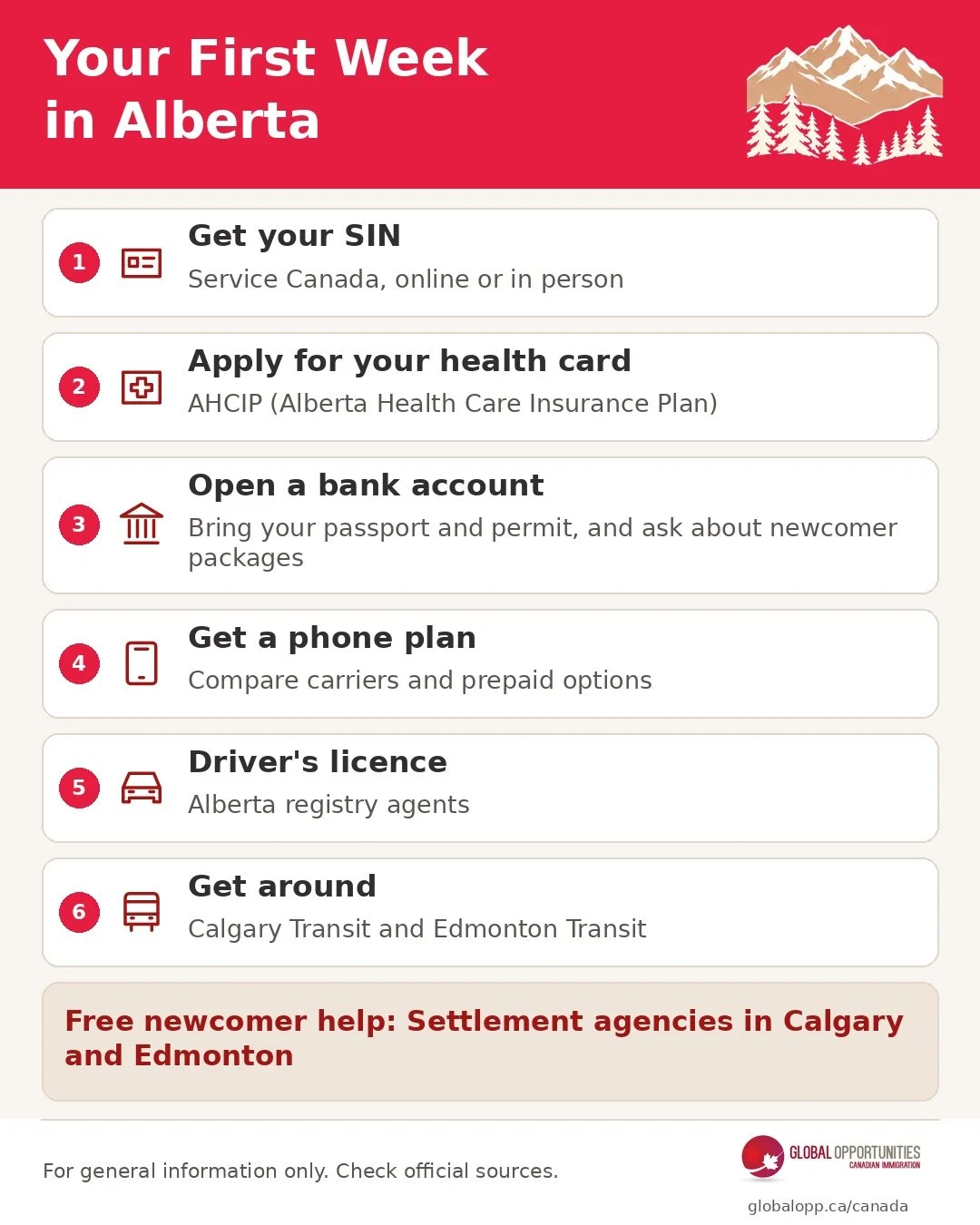
Your first-weeks checklist
Get your Social Insurance Number (SIN), which you need to work in Canada; keep it private (Service Canada, SIN).
Register for AHCIP. According to the Government of Alberta, people arriving from outside Canada should apply within 3 months of establishing residency (AHCIP, moving to Alberta). Bring your form and original documents to a registry agent (how to apply for AHCIP).
Open a bank account and start building credit (FCAC, opening a bank account).
Contact a settlement agency through IRCC's newcomer services finder or AAISA.
Register your children for school with your local school authority.
Get a transit card or app (My Fare in Calgary, Arc in Edmonton) if you will not drive.
Exchange your driver's licence, or get an Alberta ID card, at a registry agent: according to the Government of Alberta, new residents must exchange their licence within 90 days (exchange a non-Alberta licence).
Look for a family doctor with Alberta Find a Provider once you have your health card.
Prepare for winter: coat, boots and, if you drive, winter tires.
Frequently asked questions
Is Alberta a good place for newcomers to live?
Many newcomers choose Alberta for its jobs in energy, construction, health care and technology, the absence of provincial sales tax and access to the Rockies. Whether it suits you depends on your occupation, budget, family and how you feel about long, cold winters. Compare Job Bank postings for your occupation in Calgary, Edmonton and smaller cities, check CMHC rents for the city you are considering, and read the climate section. No one can promise that a move will work out, so research first and use free settlement agencies once you arrive.
Is it better to live in Calgary or Edmonton?
It depends on your occupation, budget and contacts. According to Tourism Calgary, Calgary has the highest concentration of head offices per capita in Canada, and it gets more chinooks and is closer to Banff; CMHC reported a higher average two-bedroom rent there in October 2025 ($1,914, compared with $1,603 in Edmonton). Edmonton is the capital, home to the provincial government, with colder winters. Both have light rail, universities, polytechnics and settlement agencies. Compare Job Bank postings for your field in each city and read the city sections above.
Does Alberta have a provincial sales tax?
No. According to the Canada Revenue Agency, purchases in Alberta carry only the 5% federal GST, the lowest sales tax of any province. Most basic groceries are zero-rated, while restaurant meals and most other goods are taxed, and shelf prices are shown before tax. You still pay federal and Alberta income tax on your earnings, and low- and modest-income residents may receive the federal Canada Groceries and Essentials Benefit (formerly the GST/HST credit) after filing a Canadian tax return. See the groceries and cost of living sections for official figures and links.
Is it cheaper to live in Alberta than in Ontario or British Columbia?
Often, yes, mainly because Alberta has no provincial sales tax and rents in many Alberta cities are lower than in Toronto or Vancouver. But costs vary by city: Canmore, for example, had higher average rents than Calgary in CMHC's October 2025 survey, and car insurance, heating and winter clothing add up. Compare CMHC rents for the specific cities you are considering, check current transit fares and build a monthly budget with your expected income. The cost of living section lists official figures with dates.
What are the best neighbourhoods in Calgary for families?
There is no official ranking, and the right community depends on your budget, your work, schools and how you will get around. The City of Calgary publishes community profiles with data from the 2021 Census about the people living in each community (City of Calgary, community profiles), and Statistics Canada's Census Profile gives official figures for the city. To compare areas, check the designated public and Catholic schools for each address with the Calgary Board of Education and the Calgary Catholic School District, the distance to a CTrain station or a frequent bus route, current rents, and the community association's programs. Visit at different times of day before you sign a lease. See the Calgary neighbourhood sections of this guide.
Is Calgary safe for newcomers?
Like any large city, Calgary and Edmonton have areas with different levels of reported crime, and conditions change over time. Rather than relying on rankings or social media, look at official data. Statistics Canada publishes the Crime Severity Index, which takes into account both the volume and the seriousness of police-reported crime, for Canada, the provinces and census metropolitan areas such as Calgary and Edmonton (Statistics Canada, table 35-10-0026-01). The Calgary Police Service publishes monthly community crime and disorder statistics (Calgary Police Service, crime statistics), and the Edmonton Police Service has a Community Safety Data Portal with a neighbourhood map. Busy commercial areas often show more incidents because more people pass through them. Visit an area at different times of day before you rent, and call 911 in an emergency.
How much is rent in Calgary and Edmonton?
According to CMHC's rental market data, in October 2025 the average private apartment rent was $1,582 for a one-bedroom and $1,914 for a two-bedroom in the Calgary area, and $1,301 and $1,603 in the Edmonton area. These averages include long-term tenants, so newly advertised units often cost more, and they leave out basement suites and rooms rented by individuals. Check current listings and the latest CMHC data before you budget. The housing section lists rents for Red Deer, Lethbridge, Medicine Hat, Grande Prairie and other Alberta cities.
How much can a landlord ask for as a security deposit in Alberta?
According to the Government of Alberta's starting a tenancy and ending a tenancy pages, a security deposit cannot be more than one month's rent at the start of the tenancy, and it cannot be increased later. The landlord must place it in an interest-bearing trust account in Alberta within 2 banking days and pay interest at the minimum rate set by regulation. Move-in and move-out inspection reports are mandatory, and if there are no deductions the deposit must be returned with interest within 10 days after you move out. See the housing section.
How much can my rent go up in Alberta?
According to the Government of Alberta's during a tenancy page, there is no limit on the amount of a rent increase. Rent can only go up once at least 365 days have passed since the last increase or the start of the tenancy, landlords cannot raise rent during a fixed term, and for a monthly periodic tenancy the landlord must give 3 full tenancy months of written notice. Because there is no cap, ask how much the rent has gone up in past years before you sign. See the housing section.
Do I need tenant insurance in Alberta?
Your lease may require it, so read it before you sign. The Government of Alberta recommends a written tenancy agreement that sets out, among other things, any insurance requirements (Government of Alberta, starting a tenancy). According to the Insurance Bureau of Canada, tenant's insurance covers your possessions in your apartment and while you are away, and personal liability insurance is typically a condition in a lease, because tenants may be liable for damage they cause to the building or for unintentional harm to others. Tenant policies also include additional living expense coverage, which pays, in certain circumstances and up to certain limits, for unexpected costs when you cannot live in your home because of a covered loss (IBC, types of home insurance coverage). Compare quotes and ask what the policy says about hail, water and wildfire evacuations.
What is the RTDRS in Alberta?
The Residential Tenancy Dispute Resolution Service (RTDRS) is a quasi-judicial tribunal of the Government of Alberta that helps landlords and tenants resolve disputes without going to court, for example over deposits, repairs, unpaid rent or ending a tenancy. It is usually faster and less formal than court. Before you apply, read the province's residential tenancies pages, which have handbooks for tenants in English and French, and keep copies of your lease, receipts, inspection reports and messages as evidence. See the housing section for links.
How much does Calgary Transit cost?
According to Calgary Transit's fares and passes page (2026 rates), as of November 2026 an adult single fare is $4.00, valid for 90 minutes; a youth fare is $2.65; children 12 and under ride free; an adult day pass is $12.65; and an adult monthly pass is $126.00. Low-income residents can apply for a Low Income Monthly Pass on a sliding scale, and seniors can buy an annual pass. You can buy fares in the My Fare app, online, at customer service centres and at CTrain station machines. Check the current price before you buy.
How does the Arc card work in Edmonton?
Arc is the Edmonton region's electronic fare system. You tap your Arc card, an Arc ticket or your own credit or debit card when you enter and exit ETS buses and the LRT. According to the ETS transit fares page, as of November 2026 an adult pays $3 per 90-minute trip, with caps of $10.50 a day and $102 a month, after which the rest of that day's or month's ETS trips are free. Use the same card every time to get the caps. Cash costs $3.75, and children 12 and under ride free with a fare-paying rider. Check the ETS website.
Do I need a car in Calgary or Edmonton?
Not always. If you live and work near the CTrain in Calgary or the LRT in Edmonton, or along frequent bus routes downtown and near the universities, you can manage without a car. Many suburbs, nearby towns and industrial workplaces are much easier to reach by car, and smaller Alberta cities have limited transit. Before you sign a lease, test your commute at the time you would travel, and if you will drive, budget for insurance, fuel, winter tires and parking.
Can I exchange my foreign driver's licence in Alberta?
According to the Government of Alberta's page on exchanging a licence, new residents must exchange their licence within 90 days. Licences from other provinces, the United States and a list of recognized countries, including Australia, Japan, the Republic of Korea, Taiwan, the United Kingdom and most of the European Union, can be exchanged without tests. If your country is not on the list, you take a Class 7 knowledge test, apply for a GDL Exemption to have your experience credited, and then take a road test. Translations must come from an Approved Document Translator. See the driving section.
What is the GDL program in Alberta?
GDL means graduated driver licensing. According to the Government of Alberta's Class 7 and Class 5 pages, new drivers start with a Class 7 learner's licence (minimum age 14), driving only with a supervising driver over 18 with a full licence, never between midnight and 5 a.m., and with zero alcohol. After at least 12 months, you can take the road test for a Class 5-GDL probationary licence, which lets you drive alone with zero alcohol and drugs and a lower demerit limit. After 24 months of probation (less with approved training) and a clean record, you move to a full Class 5.
Where do I get a driver's licence or health card in Alberta?
At a registry agent: a private business authorized by the Government of Alberta to issue driver's licences and ID cards, run knowledge tests, register vehicles and process AHCIP registrations, among other services. Find one near you with the official registry agent finder on alberta.ca. Bring original documents that prove your identity, your legal status in Canada and your Alberta address, such as a lease, a utility bill or a bank statement. Fees are charged per service, up to maximums set by the province, so ask for the current price.
Is car insurance mandatory and expensive in Alberta?
Yes, basic car insurance (accident benefits and third-party liability) is required by law. It is sold by private insurers, and the Automobile Insurance Rate Board regulates rates, with a maximum set for basic coverage. Newcomers often pay more at first because they have no Alberta driving history, so bring a letter of experience from your previous insurer and compare several quotes from insurers or an insurance broker. According to the Government of Alberta, a new Care-First system, still delivered by private insurers, takes effect on January 1, 2027. The province's automobile insurance page explains the rules, and complaints follow its insurance consumer complaints process. See the driving section.
Do I need winter tires in Alberta?
According to the Government of Alberta's winter driving page, winter tires are not required by law in Alberta, and the province recommends four winter or all-weather tires for severe winter conditions, because winter tires grip better than all-season tires in cold, snow and ice. Carry an emergency kit with a blanket, shovel, booster cables, food, a flashlight and a charged phone, and stay back from snowplows. If you drive to the B.C. side of the Rockies, B.C. has its own winter tire rules. Check 511 Alberta for road conditions before long trips.
How do I apply for Alberta Health Care (AHCIP)?
Complete the AHCIP application form and bring it to a registry agent with original documents that show where you live in Alberta, who you are and your legal status in Canada, such as your permanent resident document or your work or study permit. There is no charge, and the card is mailed to your home. Some work and study permit holders qualify, under conditions listed on the official temporary residents page. See the health section for the steps and links.
How long do I have to register for AHCIP after moving to Alberta?
According to the Government of Alberta's page for people moving to Alberta, people arriving from outside Canada must apply within 3 months of establishing residency, with all the required documents. If they do, they might be covered from the date they established residency; if they apply later, coverage starts when the application is processed. People moving from another province are generally covered from the first day of the third month after they establish residency. Buy private health insurance if you will have a gap in coverage. See the health section.
How do I find a family doctor in Alberta?
Use Alberta Find a Provider, from Primary Care Alberta with the Government of Alberta. It shows clinics, family doctors and nurse practitioners who are taking patients near you, and you can filter by the clinician's language, including Spanish and French, or share your information and ask for help. Register with AHCIP first, call clinics near your home and accept a nurse practitioner if one is available. Meanwhile, use walk-in clinics and call Health Link 811 for advice. See the health section for more.
What is Health Link 811?
According to MyHealth.Alberta.ca, Health Link is Alberta's free health advice line. When you call 811, registered nurses and other professionals help you decide whether you need a doctor, a walk-in clinic or an emergency department, and help you navigate the health system, 24 hours a day. For a life-threatening emergency, call 911 instead. Plain-language health information about symptoms, tests and services is also on MyHealth.Alberta.ca. Remember that AHCIP does not fully cover ambulance services, so check what your workplace benefits or Non-Group Coverage include.
Does AHCIP cover prescriptions, dental care and ambulances?
Not in general. According to the Government of Alberta's page on what AHCIP covers, AHCIP does not cover prescription drugs outside hospitals, routine dental care, routine eye exams for residents aged 19 to 64, or ambulance services except transfers between facilities. Many people get these through workplace benefits. If you do not have them, the province's Non-Group Coverage, administered by Alberta Blue Cross with a monthly premium, helps AHCIP-registered residents under 65 with prescription drugs, ambulance trips and some other services. See the health section.
What banks are there in Alberta?
Canada's national banks, such as RBC, TD, Scotiabank, BMO and CIBC, operate in Alberta, and many offer newcomer packages. Alberta also has ATB Financial, which operates as an Alberta Crown corporation, and member-owned credit unions such as Servus Credit Union. Online banks are another option. To open an account, bring your passport and immigration document; you do not need a job. We mention financial institutions for reference only and have no relationship with them.
How cold does it get in Calgary and Edmonton?
According to Environment and Climate Change Canada's 1981–2010 climate normals, the average daily temperature in January was -7.1°C at the Calgary airport and -10.4°C at Edmonton City Centre. These are averages: cold snaps bring much lower temperatures for days, and wind chill makes it feel colder. Calgary's winters are interrupted by chinooks, while Edmonton is colder and gets fewer of them. Summers are warm and sunny in both cities, with very long days. See the climate section for a first-winter checklist.
What is a chinook?
A chinook is a warm, dry wind that blows down the eastern slopes of the Rocky Mountains into southern Alberta. According to Parks Canada, chinooks can take winter temperatures from well below freezing to above 10°C within hours, with strong winds, and they are often announced by a chinook arch, a curved band of cloud parallel to the mountains. Calgary, Lethbridge and the foothills get them most often. They melt snow quickly, which can leave icy surfaces when the cold returns.
What universities and colleges are in Alberta?
According to the Government of Alberta's page on types of public post-secondary institutions, the province's publicly funded institutions include four comprehensive research universities (Alberta, Calgary, Lethbridge and Athabasca), three undergraduate universities (MacEwan, Mount Royal and the Alberta University of the Arts), five polytechnics (SAIT, NAIT, Red Deer, Lethbridge and Northwestern), eight comprehensive community colleges, independent academic institutions and the Banff Centre. Many undergraduate applications go through ApplyAlberta, and international students need a DLI and, in most cases, a PAL. See the education section for a description of each one.
How do I register my child for school in Alberta?
According to the Government of Alberta's Make Alberta your home page, publicly funded education is free for children aged 5 to 19. Find the school board and designated school for your address (in most cities you can choose a public or a Catholic board, and francophone or French immersion options may apply), then contact the school or the board's newcomer reception centre. Bring your child's passport and immigration document, proof of address, school records and immunization records, and ask about English language support. See the education section.
What jobs are in demand in Alberta?
Demand changes with the economy, especially with energy prices. Job Bank publishes employment outlooks for Alberta by occupation, rated from "very limited" to "very good", and wage ranges by region. Health care, skilled trades, construction and transportation are large employers in Alberta, but check your own occupation and city, because outlooks are updated over time. Many occupations are regulated, so check certification requirements on alis. Global Opportunities does not offer jobs. See the jobs section for job boards and free employment services.
Is French spoken in Alberta?
English is the language of daily life and work, but according to the Government of Alberta, French is the most widely spoken language in the province after English. According to the Government of Alberta's francophone education page, Alberta has four francophone regional school authorities, French immersion in many English-language boards, the University of Alberta's Campus Saint-Jean, and settlement services in French through FRAP in central and northern Alberta and CANAF in the south. You will need English in most workplaces. Global Opportunities does not offer services for Quebec's immigration programs.
Where can I get free help as a newcomer in Alberta?
Settlement agencies funded by the Government of Canada and the Government of Alberta offer free orientation, English classes, employment programs and help with forms. Find them through IRCC's newcomer services finder or the AAISA locator, and call 211 for community and social services such as food banks and housing help. Examples of agencies in Calgary, Edmonton and Lethbridge are listed in the newcomer services section. Lists are for reference only, so confirm services, eligibility and hours directly with each organization.
What is the minimum wage in Alberta?
According to the Government of Alberta's minimum wage page, as listed in November 2026, the general minimum wage is $15 per hour, and it applies to most employees. Students under 18 can be paid $13 per hour, the job creation student wage, for the first 28 hours they work in a week while school is in session; any hours beyond 28 in that week must be paid at the general rate. Minimum wage is the legal floor, not a typical wage for your occupation: use Job Bank's wage search to see market references for your field. Your rights on hours, overtime, vacation, holidays and termination are on the province's employment standards pages. Check the current rate on the official minimum wage page and see our jobs section.
What is the Canada Child Benefit and the Alberta Child and Family Benefit?
The Canada Child Benefit (CCB) is a tax-free monthly federal payment for eligible families with children under 18, paid by the Canada Revenue Agency. To qualify, you must live with the child, be mainly responsible for their care, be a resident of Canada for tax purposes and meet the status rules on the CRA's page, which include some temporary residents who have lived in Canada for 18 months. Newcomers apply with Form RC66 and Schedule RC66SCH (CRA). The Alberta Child and Family Benefit (ACFB) is a non-taxable provincial payment for lower- and middle-income families with children under 18. You do not apply separately: you are considered automatically when you file your tax return and qualify for the CCB, and the CRA pays it in August, November, February and May (Government of Alberta). Amounts depend on your family income.
Are there direct flights to Calgary or Edmonton from Europe or Mexico?
Yes, some. As of November 2026, Calgary International Airport's airlines and destinations page listed year-round non-stop flights to Amsterdam, Frankfurt, London and Paris, summer flights to Barcelona, Dublin, Edinburgh and Rome, and year-round flights to Cancún and San José del Cabo, with many more Mexican destinations in winter. Edmonton International Airport's non-stop page listed Amsterdam and several Mexican beach destinations. There were no non-stop flights to Mexico City listed at either airport. Routes change by season, so check the airport pages and the airlines before you book.
When should I call 911 in Alberta, and what if I call by mistake?
According to the Government of Alberta's when to call 911 page, call 911 for an immediate threat to life, health or safety, such as a medical emergency, a crime in progress or a fire; if you are unsure, call. If you call by mistake, stay on the line and tell the call-taker it was an accident; if you hang up, 911 will call you back, and police may be sent if there are safety concerns. The same page says that purposely misusing 911 may lead to fines under Alberta's Emergency 911 Act. For non-urgent matters, it lists other numbers, such as your local police non-emergency line, 311 for city services, 211 for community services and 811 for health advice.
What is 9-8-8?
9-8-8 is the Suicide Crisis Helpline. According to 988.ca, you can call or text 9-8-8 any time, 24 hours a day, every day of the year, if you are thinking about suicide or are worried about someone else. If your safety is at risk right now, call 911.
How do I check road conditions in Alberta before driving?
Use 511 Alberta, the province's road information site. It shows road conditions, closures, construction, highway cameras and weather alerts, and with an account you can get alerts for your saved routes. Check it before any highway trip, especially in winter, when conditions can change in a few hours.
What should I do if I get a flat tire or my car breaks down in Alberta?
Move to a safe place if you can, turn on your hazard lights and call for help. Many drivers have roadside assistance through a CAA membership (select your local club for services and prices), and some car insurance policies and credit cards include roadside assistance too: check your policy or card benefits before you need them. If anyone is hurt or the car is in a dangerous spot, call 911.
Can newcomers get the Canadian Dental Care Plan?
Possibly, once they meet the conditions. According to the Government of Canada, you must not have access to private dental insurance, you (and your spouse or common-law partner, if you have one) must have filed tax returns in Canada for the previous year, your adjusted family net income must be under the federal limit, and you must be a Canadian resident for tax purposes (Canadian Dental Care Plan, who can qualify). Filing your first tax return is therefore the first step. Check the current conditions on the official page.
Can Global Opportunities get me a job in Alberta?
No. Global Opportunities does not offer jobs or job offers, and no one can promise you a job in Canada. Use Job Bank, alis, Alberta Supports and employers' own careers pages, and take advantage of the free employment programs at settlement agencies. Be wary of anyone who asks you to pay for a job offer or promises a job together with immigration. To understand your immigration options, you can attend our free online seminars or contact us for a personalized consultation.
Related guides
How Global Opportunities can help
Choosing a province and a pathway depends on your education, work experience, languages and goals. We can help you understand your options.
Our regulated consultant: Lic. Mildrete Monserrath Gutierrez Martinez, Regulated Canadian Immigration Consultant (RCIC), CICC licence R514880. Verify her licence on the CICC Public Register: https://college-ic.ca/protecting-the-public/find-an-immigration-consultant. Global Opportunities does not offer services for Quebec's immigration programs. Global Opportunities is a private firm and is not part of the Government of Canada or any provincial government.
Recorded seminars and lives: watch our recorded seminars in English or the Spanish recordings, and visit our YouTube channel.
More articles in English: read our Moving to Canada articles on topics such as health care, cost of living, the ECA and professional licences, and building community in Canada.
Personalized consultation: for a review of your own case, contact us or write to info@globalopp.ca.
Prefer email? Tell us what you need help with (moving to Alberta) and we will reply: email info@globalopp.ca.
Contact Global Opportunities →
Sources
Statistics Canada, table 17-10-0009-01: population estimates, quarterly
Tourism Canmore Kananaskis, Living and working in Canmore and Kananaskis
Regional Municipality of Wood Buffalo, Transit fares and passes
Government of Alberta, Residential Tenancy Dispute Resolution Service
Environment and Climate Change Canada, Weather forecasts and alerts
Government of Alberta, Types of publicly funded post-secondary institutions
Government of Alberta, International Qualifications Assessment Service
Government of Alberta, Alberta Advantage Immigration Program
Canada Revenue Agency, Tax rates and income brackets, current year
Canada Revenue Agency, Canada Groceries and Essentials Benefit
Canada Revenue Agency, Canada Child Benefit · Who can apply · How to apply
Government of Alberta, Federal-provincial childcare agreement
Government of Alberta, Know the risks · Emergency alerts · Alberta Emergency Alert · Prepare your emergency supplies
Insurance Bureau of Canada, Types of home insurance coverage
Statistics Canada, Crime severity index and weighted clearance rates (table 35-10-0026-01)
Calgary Police Service, Crime statistics · Edmonton Police Service, Community Safety Data Portal
Global Opportunities, Provincial nominee programs · Building community in Canada · Cost of living in Canada · The health care system in Canada
Global Opportunities on YouTube, Is your work permit or PGWP expiring in the next 12 months?
The information in this guide is general and for reference only. It is not immigration, legal or professional advice, and it may change at any time. Global Opportunities is not responsible for how anyone interprets this content or for decisions made based on it: what you read depends on when you read it. Immigration programs, the Alberta Advantage Immigration Program, provincial services, transit fares, rents, licensing rules and tenancy rules change frequently, and statistics describe the past and do not predict any outcome. Always confirm requirements with official Government of Canada and Government of Alberta sources. We mention private companies and organizations for reference only and have no relationship with them. Global Opportunities is a private firm, is not part of the Government of Canada or of any regulator, and does not offer jobs. The information comes from the official sources linked in this guide, as they read when we checked them in November 2026; it may have changed since, and Global Opportunities is not responsible for changes made after it was written. For advice on your own case, book a consultation.
Last reviewed: November 2026