
Moving to Canada with Children: Schools, Health Cards, Child Care and the Canada Child Benefit
Moving to Canada with children means planning two things at once: how your children are included in your immigration application, and how they will settle once you arrive. This guide explains, with official sources, when a child needs a study permit, how to register your child in a public school in each of the main provinces, French immersion, health cards, the Canada Child Benefit and child care.
About our sources: This guide summarises what official sources (the Government of Canada, provincial and territorial governments, school authorities and the other organisations we link to) said when we checked them in November 2026. We link every source so you can read it yourself. Rules and requirements change, sometimes without notice, and the official page is the one that counts. This is general information, not legal, tax or immigration advice. Global Opportunities is not responsible for how this information is interpreted or for changes made after it was written.
Families are one of the profiles we see most often in our seminars, and their questions are always practical: "Will my kids go to school right away?", "Do they need a permit?", "What happens with their health insurance?". The good news is that Canada has free public schools and public health coverage, and many services for newcomer families. The part that takes planning is that each province runs its own schools, health card and child care system, so the details depend on where you settle.
This guide does not give benefit amounts, child care fees, processing times or program figures: they change often, and the official pages we link publish the current ones.
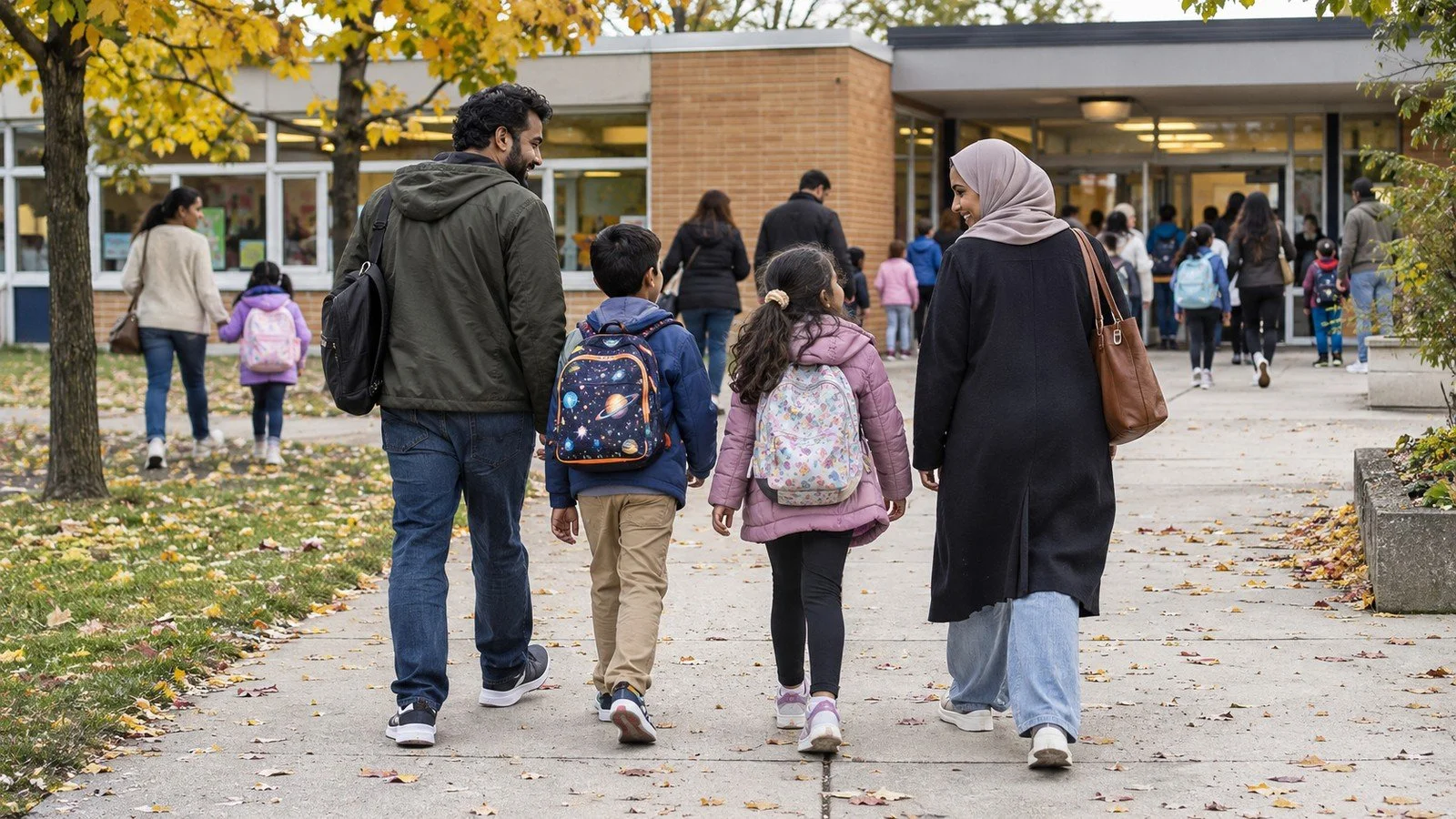
Watch our recorded seminars and lives →
Prefer Spanish? Read our Spanish guide to moving to Canada with children.
In this guide
How children are included in an immigration application
Does my child need a study permit to go to school in Canada?
How public schools work in Canada
How to enrol your child in school, province by province
English support for newcomer students
French immersion and French-language schools
Health cards for children
The Canada Child Benefit
Child care and daycare
Travelling with children
A checklist for families
Frequently asked questions
Related guides
How Global Opportunities can help
Sources
How children are included in an immigration application
In most immigration applications, you can include your dependent children. IRCC defines who counts as a dependent child, and checks the child's age on a fixed "lock-in" date so they do not lose eligibility while the application is processed.
IRCC's page Who you can include as a dependent child on an immigration application explains that if you apply to come to Canada as a permanent resident, or to work, study or visit, you may be able to include dependent children on your application. The same page sets the age limit and the conditions for a child to qualify, including the case of older children who depend on their parents because of a physical or mental condition.
Two ideas on that page are worth understanding early:
The age lock-in date. IRCC "freezes" the child's age on a date that depends on the program, so that a child does not become ineligible because processing takes time. For most programs it is the date IRCC receives your complete permanent residence application, but some programs lock it in earlier.
Family members count even if they do not move with you. According to IRCC's page on medical exams for permanent residence applicants, if you apply for permanent residence, your family members must also have a medical exam, even if they are not coming with you.
There are also family sponsorship programs. A Canadian citizen or permanent resident may be able to sponsor a dependent child, as IRCC explains on its page on sponsoring a spouse, partner or children. Our service pages explain how we help with sponsorship of dependent children.
Please note: Whether a child qualifies as a dependant depends on the program, the date and the child's situation. Custody, adoption and children who live with another parent can add steps and documents. We do not give age limits or program details here: read IRCC's page and, for your own case, book a consultation.
Does my child need a study permit to go to school in Canada?
It depends on the child's status and the parents' status. Children who are citizens or permanent residents do not need a study permit. Children of temporary residents may or may not need one, depending on whether they are coming to Canada or already here and on the parent's permit.
IRCC's page Studying in Canada as a minor has a table that schools also use. In summary, it says:
Canadian citizens and permanent residents do not need a study permit.
A child coming to Canada with a parent who will be a visitor (without a work or study permit) needs one.
A child coming to Canada with a parent who has a study or work permit needs one.
A child already in Canada with a parent who has a study or work permit does not need one, although IRCC recommends getting one.
The same page explains that each province and territory decides the age of majority, and that minor children under a certain age who come without a parent or legal guardian need a custodian in Canada.
School fees are a separate question. The IRCC table helps school authorities decide when fees apply, but each school board has its own policy for children of temporary residents. Ask the board before you arrive.
How public schools work in Canada
There is no national school system in Canada: each province and territory runs its own. Public schools are free for residents, children are required by law to go to school, and you can register your child during the school year, not only in September.
According to IRCC's Learn about education in Canada, it is the law in Canada that children get an education, and it is the parents' responsibility to enrol them and make sure they attend. IRCC adds that Canada does not have a federal department or national system of education.
IRCC's page on elementary and secondary school explains that:
depending on the province or territory, children can start primary school as young as 4 and finish secondary school at 18;
schools start with kindergarten and continue with grades 1 to 12, and the school year usually runs from the end of August to the end of June;
schools can be English- or French-language focused;
options may include free public schools, paid private schools and education at home;
if you arrive in the middle of a school year, you contact your local school board to find a place for your children.
School boards (also called school districts, divisions or district education councils) manage the schools in an area, and they are run by elected trustees, according to the same IRCC page. In practice, your home address decides your local school.
Our article The education system in Canada gives a wider overview, including colleges and universities.
How to enrol your child in school, province by province
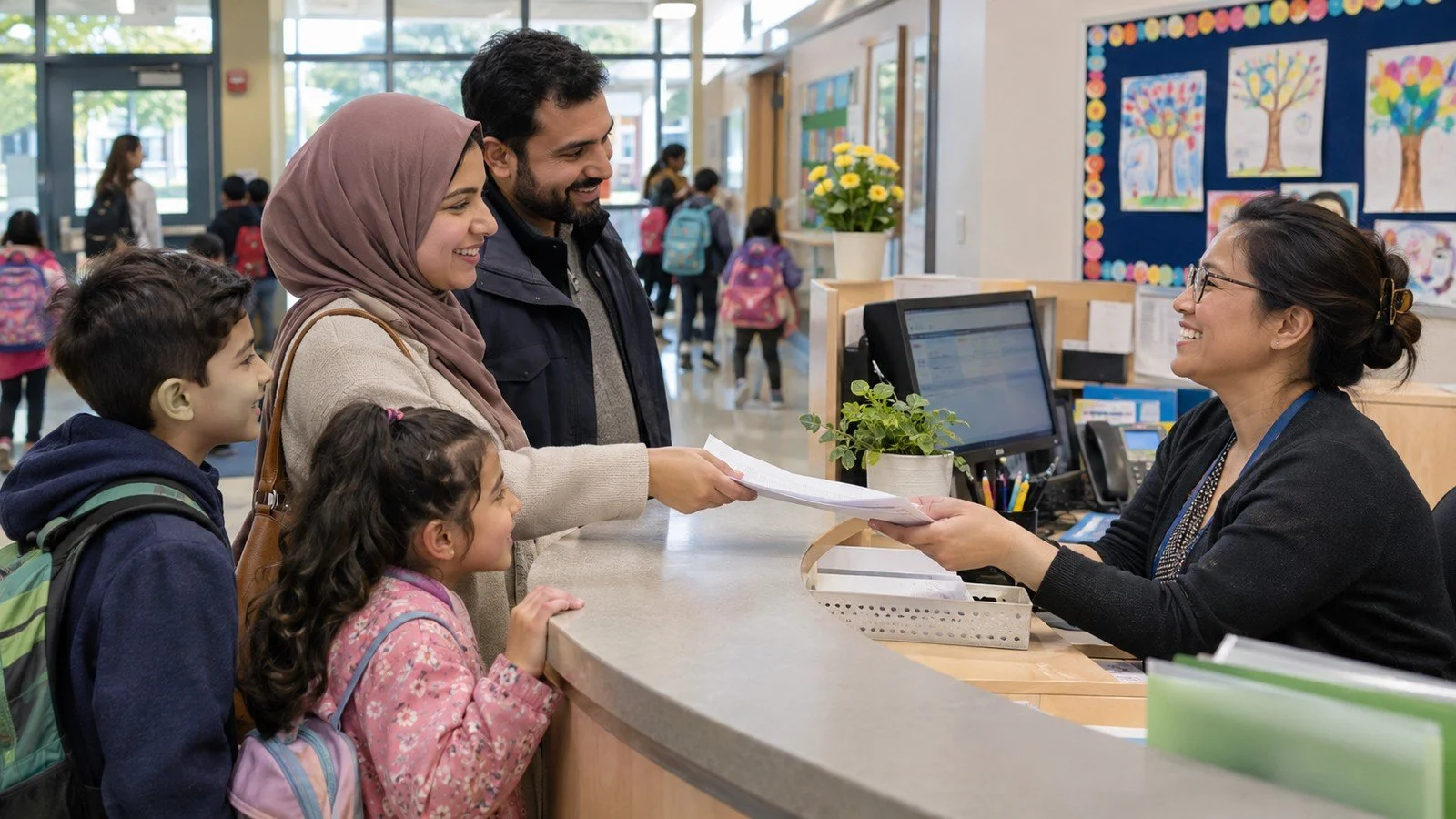
In every province, you register your child with the local school board or school, and you bring proof of age, proof of address, immunization records and immigration documents. The exact list and the starting ages are set by each province and board.
Ontario
According to the Government of Ontario's education facts, Ontario has district school boards organized in four systems: English public, English Catholic, French public and French Catholic. You find your board and school with the official school board finder. CLEO's Steps to Justice explains the registration process and your rights in plain language (enrol your child in school). More in our Ontario guide.
British Columbia
According to the Government of B.C., children can start kindergarten in September of the year they turn five, and parents must register their child for school or homeschooling by the calendar year the child turns six (Government of B.C., full-day kindergarten). You register with your local school district. More in our British Columbia guide.
Alberta
According to the Government of Alberta, educational options include public and separate (Catholic) schools, francophone schools, charter schools, independent schools, home education and online learning (Alberta's K–12 education system). The Government of Alberta also states that publicly funded education for children aged 5 to 19 is free (Make Alberta your home). More in our Alberta guide.
Saskatchewan
According to the Government of Saskatchewan's information on PreK-12 education for newcomers, students are usually placed in grades with peers close in age. The province has public, separate (faith-based) and francophone school divisions, and prekindergarten is available in a limited number of schools. More in our Saskatchewan guide.
Manitoba
The Government of Manitoba publishes a directory of schools in Manitoba, with contact information for schools, school divisions and districts, maps and school calendar dates. Contact the school division for your address to register. More in our Manitoba guide.
Nova Scotia
According to Nova Scotia's Going to School in Nova Scotia page, every person over 5 and under 21 has the right to attend a public school, and children enter school (Grade Primary) if they turn five on or before December 31 of that year. Nova Scotia also publishes an official newcomer guide to public schools and how to register, in Spanish. More in our Nova Scotia guide.
What to bring, in general: your child's passport or birth certificate, your immigration documents, proof of your address (such as a lease), and your child's immunization records and school reports, translated if possible. IRCC also reminds parents to check the school vaccination requirements of their local schools. Each board publishes its own list, so check it before your appointment.
Please note: Starting ages, documents and placement rules differ by province and board. The official provincial and school-board pages are the ones that count.
English support for newcomer students
Schools in Canada receive many newcomer students, and boards usually offer English-language support (called ESL, ELL or EAL depending on the province). Ask about it when you register.
When you register, ask the board:
whether it has a newcomer or welcome centre that assesses your child's English and previous schooling;
what English-language support your child will receive in class;
how grade placement works, especially for teenagers close to finishing secondary school.
Outside school, IRCC's tool to find free newcomer services near you lists settlement organizations that can help families with school registration, language classes and community programs.
French immersion and French-language schools
French immersion and French-language (francophone) schools are two different things. Immersion is for students who are learning French, and families usually do not need to speak French. Francophone schools are for children whose parents qualify under section 23 of the Canadian Charter of Rights and Freedoms.
The Government of B.C.'s page to compare French programs explains the difference clearly:
Core French: French classes a few times a week, for all students.
French immersion: taught mostly in French, open to all students; parents do not need to speak French. B.C. describes early immersion (starting in kindergarten or Grade 1) and late immersion (starting in Grade 6).
Francophone program: for students whose parents qualify under section 23 of the Charter.
The Government of Alberta makes the same distinction: francophone education is delivered by francophone regional authorities, and French immersion is a different program offered by many English-language school boards (Government of Alberta, francophone education).
Immersion programs are offered by school boards, and not every school offers them: B.C., for example, lists where each program is available. Canadian Parents for French has information for parents by province. Ask your board early if you are interested.
Health cards for children
Children who live in a province are covered by that province's public health plan if they are eligible, so apply for every family member. Some provinces have a waiting period before coverage starts, so many families buy private insurance for the first months.
IRCC's page on Canada's universal health care system says that in some provinces public coverage can take up to three months to start, and recommends private health insurance until then. Three examples:
Ontario (OHIP): the Government of Ontario says there is no longer a waiting period; if you are eligible, coverage starts right away, and you apply in person at ServiceOntario (Apply for OHIP and get a health card).
British Columbia (MSP): according to the Government of B.C., most new residents wait the rest of the month in which they establish residence plus two months (MSP eligibility).
Alberta (AHCIP): according to the Government of Alberta, if you arrive from outside Canada and apply within 3 months of establishing residency with all the documents, you might be covered from the date you established residency (AHCIP, moving to Alberta).
Eligibility depends on your immigration status, and the rules for children of temporary workers and students vary by province. Apply for every family member as soon as you arrive. Our guide Health care in Canada covers every province and territory, plus finding a family doctor or pediatric care and calling 811.
The Canada Child Benefit
The Canada Child Benefit (CCB) is a tax-free monthly payment from the Canada Revenue Agency (CRA) to eligible families to help with the cost of raising children under 18. Newcomers apply with a specific form, and you must file your taxes every year to keep receiving it.
According to the CRA's Canada Child Benefit overview, the CCB may include the child disability benefit and related provincial and territorial programs, and you must file your taxes to keep getting your payments. The CRA's page on who can apply says that, in general:
you must live with the child and be primarily responsible for the child's care and upbringing;
you must be a resident of Canada for tax purposes;
you or your spouse or common-law partner must be a Canadian citizen, a permanent resident, a protected person or a temporary resident who meets the conditions listed on the page.
Newcomers apply with Form RC66 and, if they are new to Canada, Schedule RC66SCH (Status in Canada and Statement of Income), as the CRA explains on how to apply. Several provinces also have their own child benefits, which the CRA administers together with the CCB in many cases; our province guides explain them, for example the Ontario guide and the British Columbia guide.
Please note: We do not publish CCB amounts because they change and depend on each family. The CRA's "How much you can get" section, linked from the overview page, explains how payments are calculated.
Child care and daycare
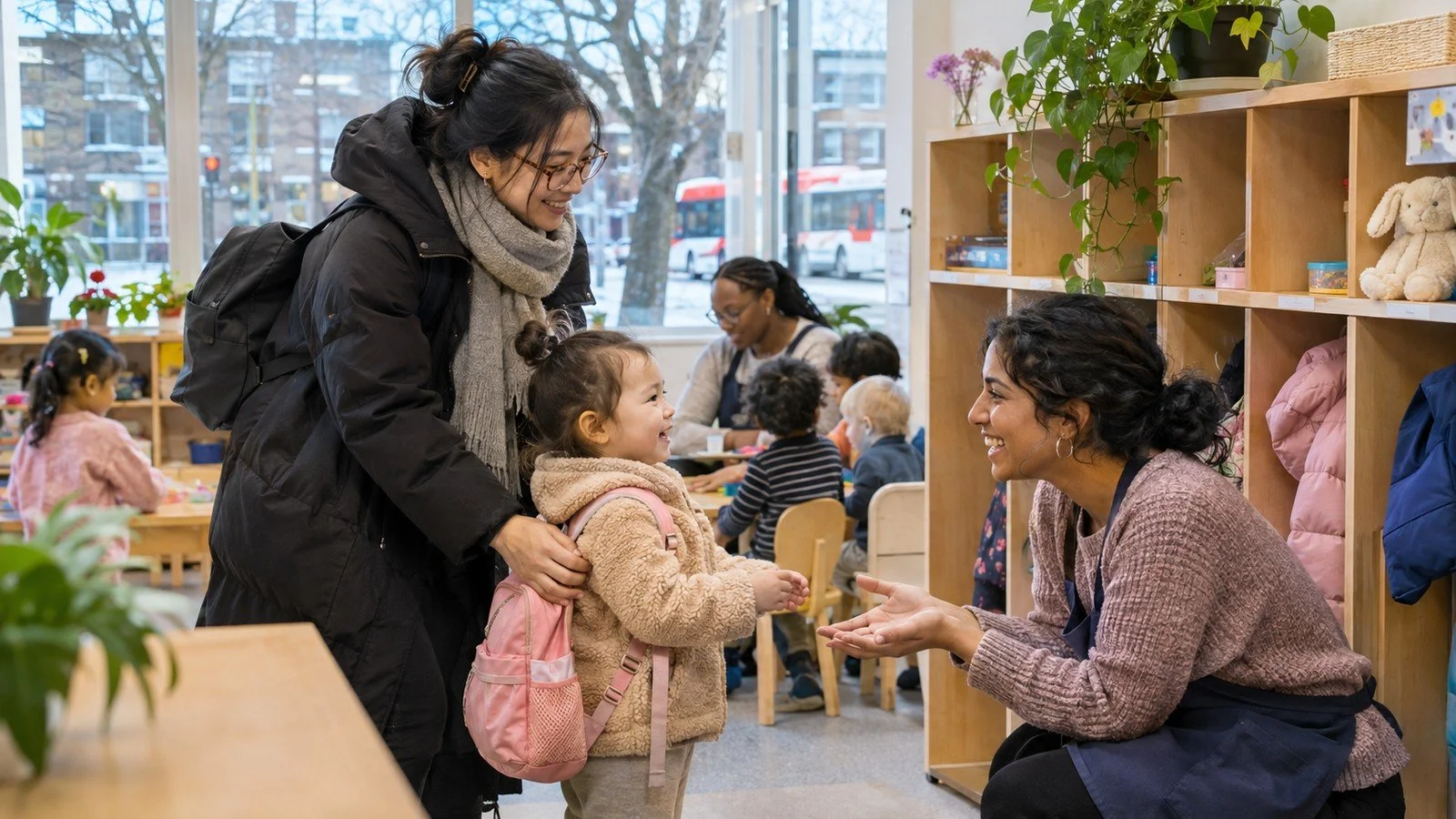
Child care in Canada is not free like school, but federal and provincial agreements have lowered fees in many licensed programs for young children. Spaces are limited in many cities, so join waiting lists as early as you can.
Each province runs its own child care system and its own help for families:
Ontario: the Government of Ontario's page Find and pay for child care explains care in centres and in homes, before- and after-school programs, how to search for licensed care and how to find out if you qualify for a child care subsidy.
British Columbia: the Government of B.C. describes its programs, including fee reductions and help with costs, on ChildCareBC programs.
Alberta: the Government of Alberta explains its federal-provincial agreement for licensed child care (federal-provincial child care agreement) and the Child Care Subsidy Program for eligible families.
Manitoba: the Government of Manitoba's early learning and child care pages explain how to find licensed care.
Nova Scotia: Child Care Nova Scotia has information for families.
Questions to ask any provider: whether it is licensed, whether it takes part in the province's fee-reduction program, what the waiting list looks like, and what is included in the fee.
Please note: Child care fees, subsidies and eligibility change often and depend on the province, the program and your income. We do not publish fees here; check the provincial page.
Travelling with children
If a child travels without one or both parents, the Government of Canada recommends carrying a signed consent letter. It is not legally required in Canada, but border officers or airlines may ask for it.
According to the Government of Canada's page on consent letters for children travelling abroad, a consent letter shows that the child has permission to travel from any parent or person with decision-making responsibility who is not travelling with them. It may be requested by immigration authorities, airline agents or Canadian officials when entering Canada, and not having one can cause delays. This matters for families who move in stages, for example when one parent goes first.
Bring originals (and translations) of your children's birth certificates, custody documents if they apply, vaccination records and school reports. You will need them for school, health cards and the CCB.
A checklist for families
Before you move:
Confirm with your immigration representative how each child is included in your application.
Gather birth certificates, custody or adoption documents, vaccination records and recent school reports, with translations.
Choose a city and look up the school board for the neighbourhoods you are considering.
Ask the board about registration, English support, fees (if you will be temporary residents) and French immersion.
Join child care waiting lists if you have young children.
Buy private health insurance for the family if your province has a waiting period.
In your first weeks:
Apply for every family member's provincial health card.
Register your children in school.
Apply for the Canada Child Benefit with Form RC66.
Contact a free settlement agency near you.
Our newcomer guide covers the other first steps, such as your SIN, a bank account and housing.
Frequently asked questions
Can I immigrate to Canada with my children?
In most programs you can include your dependent children in your application, and IRCC defines who qualifies on its dependent children page. The details depend on the program and the child's situation. See the section on how children are included in an immigration application, above.
Is school free in Canada for immigrant children?
Public schools are free for residents of the province. Children of permanent residents attend like any other resident. For children of temporary residents, each board has its own fee policy, so ask the board before you arrive.
How do I enrol my child in school in Canada?
Contact the school board for your address, then bring proof of age, proof of address, immunization records and immigration documents. You can register during the school year. See the province-by-province section above.
Do children of work permit holders need a study permit?
It depends on whether the child is coming to Canada or already here, as IRCC's Studying in Canada as a minor table shows. A child coming with a parent who has a work or study permit needs one; a child already in Canada with such a parent does not, though IRCC recommends it.
What is French immersion in Canada?
A public school program where students learn mostly in French, open to children whose parents do not speak French. It is different from francophone schools, which are for children whose parents qualify under section 23 of the Charter.
Can newcomers get the Canada Child Benefit?
Yes, if they meet the CRA's conditions on residence, status and care of the child. Newcomers apply with Form RC66 (CRA, how to apply).
Do children get free health care in Canada?
Eligible children are covered by their province's public plan once coverage starts. Some provinces have a waiting period, so many families buy private insurance for the first months.
Is daycare free in Canada?
No. Many provinces have lowered fees in licensed programs for young children through federal-provincial agreements, and there are subsidies for eligible families, but spaces are limited. Check your province's child care page.
What is the best city in Canada to raise children?
There is no single answer: it depends on your work, budget and community. Compare schools, rent and jobs in our province guides and our comparison of the best cities in Canada for newcomers.
Related guides
Newcomer guide: work permits, Toronto life and jobs in Canada
Living in Ontario · British Columbia · Alberta · Saskatchewan · Manitoba · Nova Scotia
How Global Opportunities can help
Moving as a family means making sure every child is correctly included in your application and that your plan fits your family's needs. We help families understand which immigration pathways may fit their profile and prepare their applications, including family sponsorship of dependent children. We cannot guarantee a permit, a nomination or any result: every decision is made by IRCC or the province.
Our regulated consultant: Lic. Mildrete Monserrath Gutierrez Martinez, Regulated Canadian Immigration Consultant (RCIC), CICC licence R514880. Verify her licence on the CICC Public Register: https://college-ic.ca/protecting-the-public/find-an-immigration-consultant. Global Opportunities does not offer services for Quebec's immigration programs. Global Opportunities is a private firm and is not part of the Government of Canada or any provincial government.
Recorded seminars and lives: watch our recorded seminars in English, our live session Family Sponsorship in Canada, or the Spanish recordings, including Emigrar a Canadá con niños (in Spanish). Join our free seminars in Spanish and visit our YouTube channel.
Family services: read about our help with family sponsorship and sponsorship of dependent children.
Personalized consultation: for a review of your family's case, contact us or write to info@globalopp.ca.
Prefer email? Tell us what you need help with (moving to Canada with my children) and we will reply: email info@globalopp.ca.
Contact Global Opportunities →
Sources
IRCC, Who you can include as a dependent child on an immigration application
Government of Ontario, Education facts · Find a school board · Apply for OHIP · Find and pay for child care
Government of B.C., Full-day kindergarten · Compare French programs · MSP eligibility · ChildCareBC programs
Government of Alberta, K–12 education system · Make Alberta your home · Francophone education · AHCIP, moving to Alberta · Child care agreement · Child Care Subsidy Program
Government of Manitoba, Schools in Manitoba · Early learning and child care
Nova Scotia Education and Early Childhood Development, Going to School in Nova Scotia · Newcomer guide to public schools (Spanish, PDF) · Child Care Nova Scotia
Canada Revenue Agency, Canada Child Benefit · Who can apply · How to apply
Government of Canada, Consent letter for children travelling outside Canada
Global Opportunities on YouTube, Family Sponsorship in Canada · Emigrar a Canadá con niños (Spanish live)
The information in this guide comes from the official sources linked in each section and listed above, as they read when we checked them in November 2026, and it may have changed since. It is general and for reference only. It is not immigration, legal, tax, financial or professional advice. Global Opportunities is not responsible for how anyone interprets this content, for decisions made based on it, or for changes made to the sources after it was written: what you read depends on when you read it. School rules, health coverage, benefits and child care programs change frequently and differ by province. Always confirm current requirements with official Government of Canada, provincial and school-board sources. Global Opportunities is a private firm, is not part of the Government of Canada or of any regulator, and does not offer jobs. For your own case, book a consultation.
Last reviewed: November 2026